Medicinal plants hold key to Iran’s drought-resistant revenue

Press TV – December 16, 2025
Iran’s agriculture faces water scarcity, restricted market access, and declining returns from traditional crops, pushing farmers and policymakers toward low-water, high-value, and sanction-resilient export products.
Medicinal plants are among the few agricultural sectors meeting all three criteria, increasingly seen over the past decade as an expandable income source aligned with environmental limits and export needs.
Iran has one of the richest plant ecosystems in the world. More than 8,000 plant species have been identified across the country, of which around 2,300 have medicinal, aromatic, cosmetic, or industrial uses.
About 1,700 of these species are endemic, meaning they grow naturally only in Iran. This biodiversity is supported by wide climatic variation, from arid plains to high mountain ranges, with elevations from 900 to more than 4,000 meters above sea level.
These conditions allow different plants to grow with little or no irrigation. The scale and diversity of this natural resource provide Iran with a broad production base that few countries can replicate, enabling year-round cultivation and harvesting across different regions.
Most medicinal plants cultivated or harvested in Iran are naturally adapted to dry and semi-dry environments. Many grow under rain-fed conditions or require less than 3,000 cubic meters of water per hectare.
By comparison, crops such as wheat, rice, and corn often need between 10,000 and 15,000 cubic meters per hectare. As groundwater reserves shrink and rainfall becomes more erratic, this difference has direct economic value.
Lower water use reduces production costs while preserving agricultural land for sustained use over time. This makes medicinal plants particularly suitable for long-term planning in regions facing declining water availability.
According to official figures, Iran receives about 400 billion cubic meters of rainfall annually, but more than half is lost to evaporation. Crops that can grow using direct rainfall reduce pressure on dams, rivers, and aquifers.
Medicinal plants make effective use of this rainfall because they are already rooted in the soil when seasonal precipitation occurs, allowing moisture to be absorbed rather than lost. This characteristic strengthens their role in maintaining agricultural output without increasing water extraction.
Medicinal plants are produced both on farmland and in rangelands. In many provinces, farmers grow them under permits on national lands, relying on rainfall rather than irrigation. Because these plants are mostly perennial and slow-growing, high irrigation costs are not economically justified.
Harvesting, drying, and basic processing often take place close to production sites, creating seasonal employment in rural areas. Each hectare of medicinal plants generates between two and three direct jobs, according to agricultural authorities.
In addition to farming, jobs are created in collection, sorting, drying, distillation, and packaging, forming local value chains that support village-level incomes.
Export revenue from medicinal plants currently stands at about $600 million a year, accounting for roughly 9 to 10 percent of Iran’s total agricultural exports. Projections suggest exports could reach $700 million if production and processing improve.
Saffron dominates the sector. Iran produces more than 90 percent of the world’s saffron and accounts for around 40 percent of the total export value of medicinal plants.
Other major exports include rose products from damask rose, such as rose water and extracts, liquorice extract, mint, thyme, and natural gums like asafoetida locally called anguzeh.
These products are sold not only as raw materials but also as inputs for pharmaceutical, food, and cosmetic industries.
Demand for medicinal plants continues to grow in international markets, including Central Asia, Eurasia, and China. These markets are accessible through regional trade routes and do not always require direct financial links with Western banking systems.
Products such as saffron, rose water, and herbal extracts have relatively high value-to-weight ratios, which lowers transport costs and makes them more suitable for indirect export channels. Their long shelf life further supports trade across longer distances and reduces losses during storage and transport.

Barijeh, scientifically known as ferula gummosa, is a plant native to Iran.
The internal economics of medicinal plant cultivation are also favorable. In several provinces, income from medicinal plants is many times higher than from grains.
For example, harvesting wild or cultivated plants such as musir can generate net income far above that of wheat or barley on the same land.
This income difference has encouraged farmers to shift land away from water-intensive crops, especially in drought-affected regions. Higher returns per hectare allow smaller landholdings to remain economically viable, supporting family-based farming systems.
Four provinces illustrate this potential clearly. Khorasan remains the center of saffron production. Kashan and surrounding areas specialize in rose cultivation and distillation.
Yazd produces lemon verbena, while Chaharmahal and Bakhtiari province has emerged as a major center for wild and cultivated medicinal plants.
This province is largely mountainous, with 87 percent of its area classified as highland. More than 1,350 plant species have been identified there, including 270 with medicinal or industrial uses and 27 species found nowhere else in the world. Cool nights, diverse soils, and varied elevations contribute to high-quality yields and strong concentrations of active ingredients.
In Chaharmahal and Bakhtiari, medicinal plants are grown on about 3,500 hectares, split between national rangelands and agricultural land. Since the early 2010s, the cultivated area has expanded sharply, supported by a national strategy to promote medicinal plants.
From a fiscal perspective, medicinal plants offer a rare combination for Iran under sanctions. They reduce water use, generate foreign currency, and support employment without heavy reliance on imported inputs.
Unlike major industrial exports, they do not require large-scale capital equipment or advanced foreign technology. Their production is decentralized, which spreads income across rural and underdeveloped regions. This decentralization strengthens local economies and reduces dependence on a limited number of export hubs.
Iran already holds dominant positions in several global markets, particularly saffron. Medicinal plants do not eliminate the economic impact of sanctions, but they provide a measurable source of revenue that fits Iran’s environmental constraints.
Government Bodies Humiliated by Promoting Junk Climate Scares from Retracted Nature Paper
By Chris Morrison | The Daily Sceptic | December 12, 2025
The old academic putdown ‘it’s not even wrong’ comes to mind in considering the disgraced and now retracted science paper Kotz et al. The science writer Jo Nova has speculated on how the paper was even published in Nature, “given how awful it was”. With its unfalsifiable claims of $38 trillion of global damage each year by 2050 due to human-caused climate change, Kotz was patent nonsense. It was not even within touching distance of other extravagant claims of climate damage. Yet Kotz was avidly picked up by government agencies around the world seemingly desperate to use any old gobbledegook to push the Net Zero fantasy.
Being wrong assumes that something is within a ballpark of being right. The Kotz authors tried that and made some adjustments to the figures after initial criticism when the paper was published in April 2024. But in the end the task was hopeless and Nature retracted the work this month. But not before its conclusions on climate impacts have cascaded through numerous governmental operations tasked with determining and regulating public policy. A great deal of rewriting now looks to be in order.
Earlier this month, the Bank of England used “plausible” scenarios derived from Kotz to go into full climate catastrophising overdrive with suggestions that asset and bond markets could face stresses similar to the 2008 global crash. On Monday, the Daily Sceptic looked in detail at the Horlicks made by the UK’s Office for Budget Responsibility, which used Kotz to divest itself of the opinion that the country’s GDP would fall by nearly 8% unless humans stopped the weather changing. Annual state borrowing was forecast to rise by £50 billion by 2050 unless the Net Zero rain dance was successful. In a report to the British Parliament, the Climate Change Committee referenced Kotz in a section discussing economic damage arising from climate risk. Meanwhile, the Financial Conduct Authority (FCA) appears to have been a keen fan of Kotz and all its downstream impact works such as Network for Greening the Financial System (NGFS) Phase V. Over the last year there are many references with the FCA keen to emphasise non-linear economic losses and the need for conservative assumptions in financial stress testing.
What might be considered surprising is that all of this work closely connected to Kotz was produced at a time when serious doubts about the paper were raised in science circles. From the start of this year, concerns started to mount about data quality and extrapolation methods. It became apparent there were problems over an Uzbekistan economic database from 1995-1999 that led to model estimates of temperature impacts on growth inflating global projections by a factor of three. Attempts were made to revise the original paper but in the end the task was too great and Nature finally retracted it. It is hardly an exaggeration to observe that dodgy data from Uzbekistan cascaded through the paper out into the real world where it led the Bank of England just a few days ago to publish scares of climate-induced global crashes.
“This study was used to justify all kinds of economic decisions that otherwise make no sense. Ka-ching. Ka-ching,” notes Jo Nova. This is emblematic of the whole field of climate research, she observed, adding: “Monopsonistic research always finds what the one sole customer (the Blob) pays it to find. Thus the government-funded establishment loved it. Look how popular this junk research was.”
The Kotz paper arose from the Potsdam Institute for Climate Impact Research (PIK), a known nest of hard-line climate activists with substantial past climate catastrophising form. This is the number one place to go for disappearing sea ice, an overturning Gulf Stream and bazillion-dollar falls in global wealth. Needless to say it is backed by copious amounts of Government money from the European Union as well as private foundations. Considerable money appears to flow from individual project grants.
Interestingly, few US government bodies appear to have been caught out by the damage impacts model produced by Kotz that was later integrated into the NGFS catastrophising scenarios. The Trump Administration has been cleaning house of all the federal climate catastrophising BS this year. It didn’t take long for the Federal Reserve, the Federal Deposit Insurance Corporation and the Treasury Department to withdraw from the NGFS, an international body of regulators and banks set up at the height of the Green Mania in 2019.
Earlier this year, President Trump signed an executive order that said the results of federal scientists must be falsifiable, computer models must be explainable and negative results available. Not all activist-scientists were happy with this return to the ”gold standard”, with a group including Michael ‘Hockey Stick’ Mann writing in the Guardian – seemingly without irony – that it will “destroy American science as we know it”.
It certainly destroyed the ability of the American Central Bank to tout global financial collapse on the basis of a Government-funded science paper so bad even ideologically-captured Nature has been forced to retract it.
6 Palestinians Killed in Israeli shelling of shelter in Gaza, including children
Palestinian Information Center – December 19, 2025
GAZA – Six Palestinians were killed and several others were injured on Friday evening after Israeli artillery shelled a school sheltering displaced civilians in Al-Tuffah neighborhood, northeast of Gaza City, marking a new violation of the current ceasefire in the Strip.
Local sources reported that Israeli forces bombed the area around Al-Tuffah School, near Al-Durra Hospital, resulting in multiple victims, some bodies torn to pieces, inside the school, which housed hundreds of displaced people.
Sources added that Israeli forces prevented ambulance and civil defense crews from reaching the scene to recover the dead and evacuate the injured, as heavy gunfire continued around the school.
According to preliminary information from shelter administrators, the attack targeted the second floor of the school building, where many of the displaced civilians were gathered to attend a wedding celebration, causing an even higher number of casualties.
Israeli forces continue to fire heavily on the school, sources said, making it difficult for civilians to move or for evacuation operations to proceed.
Earlier today, four civilians—including a woman—were killed in Israeli airstrikes targeting a group of people in Bani Suheila, east of Khan Yunis in southern Gaza, with medical teams unable to reach the area.
Israeli forces also opened fire in the Al-Alam area west of Rafah City in the south and conducted multiple airstrikes alongside artillery shelling on eastern Khan Yunis.
Israeli naval boats also opened heavy fire off the coast of Khan Yunis.
According to data from the Ministry of Health, the death toll from Israel’s genocide since October 7, 2023, has reached 70,669 martyrs, while 171,165 others were injured.
Since the announcement of the ceasefire on October 10, 2025, 395 additional people have been killed and 1,088 injured, with 634 bodies recovered so far.
The three narratives: Gaza as the last moral frontier against Israel’s policy of annihilation
By Ramzy Baroud | MEMO | December 19, 2025
Three dominant narratives contend for the future of Gaza and occupied Palestine, yet only one is being translated into consequential action: the Israeli narrative of domination and genocide. This singular, violent vision is the only one backed by the brute force of policy and fact.
The first narrative belongs to the Trump administration, largely embraced by the US Western allies. It rests on the self-serving claim that US President Donald Trump personally solved the Middle East crisis, ushering in a peace that has supposedly eluded the region for thousands of years. Figures like Trump, his son-in-law Jared Kushner, and US-Israel Ambassador Mike Huckabee are presented as architects of a new regional order.
This narrative is exclusive, domineering, and US-centric. It was exemplified by Trump himself when he declared the Gaza conflict “over” and presented a “peace plan” that strategically avoided any clear commitment to Palestinian statehood. The entire vision is built on transactional diplomacy and a dismissal of international legal consensus, positioning US approval as the sole measure of legitimacy.
The second narrative is that of the Palestinians, supported by Arab nations and much of the Global South. Here, the goal is Palestinian freedom and rights grounded in international law and humanitarian principles.
This discourse is frequently shaped by statements from top Arab officials. Egyptian Foreign Minister Badr Abdelatty, for example, asserted last April that the two-state solution is “the only way to achieve security and stability in this region”, adding a warning: “If we disregard international law, (…) this will open the way for the law of the jungle to prevail.” This narrative continues to insist on international law as central to true regional peace.
The third narrative is Israel’s—and it is the only one backed by concrete, aggressive policy. This vision is written through sustained, systematic violence against civilians, aggressive land seizures, deliberate home demolitions, and explicit government declarations that a Palestinian state will never be permitted. Its actors operate with chilling impunity, rapidly creating irreversible facts on the ground. Crucially, the failure to enforce accountability for this pervasive violence is the primary reason Israel has been able to sustain its devastating genocide in Gaza for two full years.
This narrative is not theoretical; it is articulated through the chilling acts and legislative pushes of the highest-ranking government officials.
On 8 December, Israel’s National Security Minister Itamar Ben-Gvir appeared in a Knesset session wearing a noose-shaped pin while pushing for a death penalty bill targeting Palestinian prisoners. The minister stated openly that the noose was “just one of the options” through which they would implement the death penalty, listing “the option of hanging, the electric chair, and (…) lethal injection”.
Finance Minister Bezalel Smotrich, meanwhile, announced an allocation of $843 million to expand illegal settlements over the next five years, a massive step toward formal annexation. This unprecedented funding is specifically earmarked to relocate military bases, establish absorption clusters of mobile homes, and create a dedicated land registry to formalise Israeli governmental control over the occupied Palestinian territory.
This policy of territorial expansion is cemented by the ideological head of government, as Israeli Prime Minister Benjamin Netanyahu himself made it clear that “There will not be a Palestinian state. It’s very simple: it will not be established,” calling its potential creation “an existential threat to Israel.” This unequivocal rejection confirms that the official Israeli government strategy is outright territorial expansion and the permanent denial of Palestinian self-determination.
None of these Israeli officials shows the slightest interest in Trump’s “peace plan” or in the Palestinian vision of statehood. Netanyahu’s core objective is ensuring that international law is never implemented, that no semblance of Palestinian sovereignty is established, and that Israel can contravene the law at a time and manner of its choosing.
The fact is, these narratives cannot continue to coexist. Only real accountability — through political, legal, and economic pressure — can halt Israel’s advance toward continuing its genocidal campaign, destruction, and punitive legislation. This must include the swift imposition of sanctions on Israel and its top officials, comprehensive arms embargoes against Tel Aviv to end ongoing wars, and full accountability at the International Criminal Court (ICC) and International Court of Justice (ICJ).
As long as the pro-Palestine narrative lacks the tools to enforce its principles, Israel and its Western backers will see no reason to alter course. States must replace symbolic gestures and prioritise aggressive, proactive accountability measures. This means moving beyond simple verbal condemnation and applying concrete legal and economic pressure.
Israel is now more isolated than ever, with public opinion rapidly collapsing globally. This isolation must be leveraged by pro-Palestine forces through coordinated, decisive diplomatic action, pushing for a unified global front that demands the enforcement of international law and holding Israel and its many war criminals accountable for their ongoing crimes.
A lasting peace can only be built on the foundation of justice, not on the military reality established by an aggressor that does not hesitate to employ genocide in the service of its political designs. This is the undeniable moral frontier: confronting and dismantling the impunity that allows a state to pursue extermination as a political tool.
Kuwait set to sign multibillion-dollar port deal with China

The Cradle | December 19, 2025
Kuwait will sign a contract next week with China Communications Construction Company (CCCC) to complete the Mubarak al-Kabeer Port project, Kuwaiti Public Works Minister Noura al-Mashaan announced on 18 December.
The contract is valued at about $3.97 billion, according to a government document seen by Reuters.
The Central Agency for Public Tenders approved on 1 December a contract between the Public Works Ministry and CCCC for engineering, procurement, and construction of the first phase of the port, according to the official gazette.
Mashaan said Kuwait’s prime minister will attend the signing ceremony with the Chinese side.
Mubarak al-Kabeer Port, located on Bubiyan Island in northern Kuwait, is described as a strategic project aimed at creating a secure regional corridor and commercial hub, one that China has sought to include within its Belt and Road Initiative (BRI).
Kuwait hopes the project will support economic diversification, boost GDP, and help restore its regional commercial and financial role in West Asia, with the government saying around 50 percent of the first phase of the Mubarak al-Kabeer Port project has been completed so far.
The Mubarak al-Kabeer Port project is part of a broader set of large-scale initiatives Kuwait is pursuing with Chinese support, spanning infrastructure, energy, environmental services, and urban development.
Kuwait and China have expanded cooperation in recent years, including the signing of multiple memorandums of understanding (MoU) during a 2023 visit to Beijing by then-crown prince Sheikh Mishal Al-Ahmad Al-Sabah, who later became emir.
Officials on both sides have framed these projects as part of a wider effort to deepen long-term economic ties, with a growing emphasis on infrastructure development, diversification, and connectivity.
Chinese firms are involved in several major projects across Kuwait, reflecting a shift toward broader strategic and economic engagement between the two countries beyond traditional trade relations.
China’s expanding economic footprint in West Asia has also extended to Saudi Arabia, where Chinese Foreign Minister Wang Yi recently said that Beijing is ready to be Riyadh’s “most trustworthy and dependable partner” following high-level talks in the kingdom.
The meetings reaffirmed Saudi support for the one-China principle and emphasized deeper cooperation in energy, infrastructure, and emerging industries, aligning with Beijing’s broader BRI-linked engagement across the region.
EU blocks protesting farmers in Brussels using barbed wire, tear gas and water cannons
Remix News | December 18, 2025
As the EU moves to crush protesting farmers demonstrating in Brussels, Hungarian Prime Minister Viktor Orbán offered full backing to the farmers and their efforts to stop the EU’s Mercosur free trade deal, which threatens to destroy food security in Europe.
“Farmers are 100 percent right,” said Orbán, who is currently in Brussels attending the EU Summit.
He added that the farmers have obvious issues with the Mercosur package, a free trade agreement with Latin American countries, because it “kills the farmers.”
“Hungary is one of the countries that does not support the Mercosur agreement. There were serious professional debates about this in Hungary, and the Hungarian position was that we do not support this,” said the prime minister.
Viktor Orbán reminded that the agreement would require a qualified majority, and according to his expectations, there is not enough support.
“Mercosur opponents make it impossible for this agreement to be signed. The plan is that the President of the European Commission wants to sign this later this week. I think this needs to be stopped here now, and we can prevent it,” he said.
He also said that another problem for farmers is the Green Deal, which leads to expensive overregulation in agricultural work in such a way that it represents a serious cost and competitive disadvantage for European food producers.
“So I have to say that with the Mercosur agreement, they are shooting European farmers in the foot, but before that, they tie their legs together so that they have no chance in the global competition,” he stated.
“That is why the farmers are absolutely right, the Hungarian government is 100 percent with the farmers,” said the Hungarian leader.
Farmers met with force
The use of force against farmers in Brussels is drawing criticism from Hungarian journalists, including Dániel Deák, the senior analyst of the Század Institute. He published a video report showing the European Commission building, or Ursula von der Leyen’s workplace, surrounded by barbed wire.
According to him, with these measures, they are trying to prevent farmer protesters from getting close to the president of the European Commission.
In the report, he also drew attention to the fact that if they tried to limit a demonstration in Hungary in a similar way, by placing barbed wire, it would provoke significant protests from the left, and the European Union would also talk about the use of “dictatorial means.”
In his opinion, all this once again points to the hypocrisy that is often used against Hungary. He also emphasized that demonstrations in Hungary can be held and that no attempt is made to make them impossible with barbed wire.
Western media peddle Russia’s ‘abduction’ of Ukrainian children to prolong the proxy war
It is not Moscow, but rather the Kiev regime and its backers who are using children as “pawns of war”
By Finian Cunningham | RT | December 18, 2025
It’s not clear if the Trump administration wants to genuinely resolve the proxy war with Russia, or if it is merely trying to extricate itself from the mess Washington helped instigate. But one thing is clear: the major Western European capitals are desperate to keep the war going.
Various pretexts are being used to frustrate a diplomatic process. NATO-like security guarantees to Ukraine pushed by Berlin, London, and Paris are likely to be a non-starter for Moscow. So too are moves by the Europeans to use Russia’s seized wealth as a “reparations loan.”
Another issue that Europeans are dredging up is the allegation that Russia has abducted Ukrainian children. This emotive issue has support in Washington among the hawkish anti-Russia factions in the US establishment opposed to Trump’s diplomacy with Moscow.
Earlier this month, the European states sponsored a resolution at the United Nations General Assembly calling on Russia to return all Ukrainian children that it is alleged to have forcibly relocated from Ukrainian territory during the past four years of conflict. The president of the UNGA is former German Foreign Minister Annalena Baerbock.
An article published by the Washington DC-based Atlantic Council contended: “The issue of abducted Ukrainian children is especially relevant for Ukrainians as they debate painful political compromises, territorial concessions, and security guarantees premised on Western assurances. If world leaders cannot secure the return of the most vulnerable victims of Russia’s aggression, how could Ukrainians trust that those same leaders can prevent Russia from reigniting the war or committing new atrocities?”
In other words, the allegation of child abduction is being made into a condition for Russia to fulfill for the diplomatic resolution of the conflict. The trouble is that the condition is impossible to fulfill because the allegation is so vague and unfounded. Russia has denounced the accusation that it forcibly relocated Ukrainian children as a “web of lies.”
In March 2023, the Hague-based International Criminal Court indicted Russian President Vladimir Putin, along with Russian Commissioner for Children’s Rights Maria Lvova-Belova, of war crimes related to the unlawful deportation of Ukrainian children to Russia.
Moscow is not a member of the ICC and rejected the charges as null and void.
Still, however, the Kiev regime and its Western sponsors continue to level the accusations. The Western media, as usual, serve to amplify the narrative despite the lack of evidence.
At the recent UN General Assembly debate, British representative Archie Young stated: “Today is a moment to reflect on the plight of Ukrainian children who have become victims of Russia’s illegal invasion. We all have an obligation to protect children and must not allow Russia to use them as pawns of war. According to the government of Ukraine, corroborated by independent mechanisms, more than 19,500 Ukrainian children have been forcibly deported to Russia or within the temporarily occupied territories.”
Note how the British official peddles a series of disputable claims that are transformed into normative facts by the Western media’s repetition.
It is not Russia, but rather the Kiev regime and its Western backers who are using children as “pawns of war.”
Moscow has openly stated that up to 730,000 children have been relocated to the Russian Federation since hostilities erupted in February 2022. Most of the children are accompanied by parents and come from the territories that seceded from Ukraine in legally held referenda.
Of the nearly eight million people who fled Ukraine, the largest share of them – an estimated 35% – have taken shelter in Russia. The second and third biggest host countries for Ukrainian refugees after Russia are Poland and Germany. But the European governments and media are not accusing Warsaw or Berlin of “child abductions.”
In a war zone affecting millions of people, it is absurd to make out that displaced families and their children are being kidnapped. The vast majority of people have willingly sought shelter within Russian territory to escape the violence on the frontlines – violence that has been fueled by NATO states pumping hundreds of millions of dollars’ and euros’ worth of weapons into Ukraine.
Moscow points out that the figure of 20,000 to 35,000 that the Western governments and media claim for children “abducted by Russia” is never substantiated with names or identifying details.
Russian authorities say that the Kiev regime has provided the names of just over 300 individuals. Moscow has endeavored to return individuals where it is mutually requested, although some of the identities provided by the Kiev regime have turned out to be adults or they are not present in Russian territory.
In the chaos of war, it is all too easy to throw around vague numbers and exploit the imprecision for propaganda. The European governments and media are doing that and embellishing the emotive issue with dark claims that Russia is sending masses of Ukrainian children to “re-education camps” for “indoctrination.”
One of the main sources for such claims is the Yale Humanitarian Research Lab. It has produced unverified reports that Russia has sent 35,000 Ukrainian children to hundreds of brainwashing centers all across Russia to erase their national identity.
A major supporter of the Yale research group is former Secretary of State Hillary Clinton. This association strongly suggests that the group is a CIA-sponsored propaganda tool. But the US and European media regularly cite the research and amplify its claims as reliable facts.
The exploitation of children for war propaganda is a staple of Western intelligence agencies and the media.
A classic case was in Vietnam in the 1950s and 60s when the Western media were replete with horror stories of the Viet Cong torturing Vietnamese children, as recounted by James Bradley in his book, ‘Precious Freedom’. The supposed communist guerrillas reportedly stabbed Vietnamese children with chopsticks in their ears so that they could not hear the Bible being preached. Such alleged atrocities were widely published by the Western media to whip up public support for the US military deployment “to save Vietnam from evil communists.” But it was all CIA-orchestrated lies. More than three million Vietnamese were killed in a war based on American intelligence and media lies.
A re-run of the psychological operation today is the lurid claims that Putin’s evil Russia has kidnapped tens of thousands of children for brainwashing in detention camps. Some reports even claim Russia has sent the children to North Korea.
The Western media are doing their usual service of peddling war propaganda and ensuring diplomacy is rendered impossible because Russia is portrayed as monstrous.
Finian Cunningham is an award-winning journalist and co-author of Killing Democracy: Western Imperialism’s Legacy of Regime Change and Media Manipulation. For over 25 years, he worked as a sub-editor and writer for The Mirror, Irish Times, Irish Independent and Britain’s Independent, among others.
Featured Video
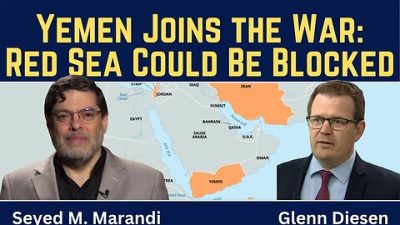
Yemen joins the war – Red Sea could be blocked next – Saudi regime at risk
or go to
Aletho News Archives – Video-Images
From the Archives
A superpower and “the world’s sickest warrior state”
By Paul J. Balles | March 8, 2010
Living through five or six major wars has hardened me to what I thought were the extremes of inhuman cruelty and brutality.
Two things made those extremes almost bearable: the brutality always revealed – at least according to the media coverage – the viciousness of the enemy. It was therefore quite understandable when our “brave men and women” pulverized the enemy.
Films of Japanese torturing captive Americans somehow justified holding Japanese Americans in internment camps during World War II; and only a small percentage of Americans found the bombing of Hiroshima and Nagasaki unreasonably vengeful at best, at worst, depraved.
The media giants in America portrayed the North Koreans as barbaric beasts with their captives, quite unlike their southern counterpoints – our allies during the Korean War. No one ever felt the need to explain how the South Koreans were a civilized breed while the North Koreans were absolute savages, at least according to the official line.
In Vietnam, our warriors justifiably (or so the media made us believe) dropped napalm on the North Vietnamese who had the gall to hide in villages and tunnels to ravage our invaders. At least it was accepted practice until some rogue photojournalist filmed a young girl screaming down a Vietnamese road in flames. … continue
Blog Roll
 Aletho News
- Russian tanker approaches Cuba despite US oil blockade
- Marandi: Yemen joins the war – Red Sea could be blocked next – Saudi regime at risk
- Pro-Palestinian French member of European Parliament denied entry to Canada
- Pakistan to Host US-Iran Talks
- How Indonesia’s tilt toward the US left it stranded in the Strait of Hormuz
- US has no choice but to retreat from Iranian borders: Top commander
- Iran Retaliation Strikes Chemical Plant Near Dimona
- AWACS’ Destruction is a Major Loss for US Military – Ex-DoW Analyst
- Israel’s Iran Strategy Uses US Military & Gulf States as Its Pawns
- Iran: Trump wanted regime change, now just begging for Hormuz to open
- If Americans Knew
- Israeli police block Catholic cardinal from entering Church of the Holy Sepulchre on Palm Sunday
- Israel is assassinating journalists again, more than any other nation, anywhere, ever – Not a ceasefire Day 170
- Over 300 US service members wounded, majority have brain injuries – Not a ceasefire Day 169
- Researchers at Human Rights Watch Resign Over Blocked Report on Palestinian Refugee Return
- Jewish Groups Are Backing a War Americans Don’t Want
- Eric Fingerhut Thinks He’s the President of the Jews
- Top Jewish Philanthropists, Rabbis Urge Israeli President to Take Action Against ‘Jewish Extremists’
- Don’t Be Fooled. Zionist Leaders Have Always Wanted to Control Southern Lebanon
- Israel’s widespread use of torture is a core element of its genocide against the Palestinian people
- In Israel’s War on Iran, Many Middle East US Bases Rendered “All But Uninhabitable”
- No Tricks Zone
- German Science Blog Accuses PIK Climate Institute Of Hallucinating Climate Tipping Points
- Devastating Assessment Of Comirnaty Vaccine By Former Senior Pfizer Europe Toxicologist
- New Study: CO2 Is ‘Effectively Negligible’ As An Explanatory Climate Change Factor Since 2000
- Former Pfizer Toxicologist Dr. Helmut Sterz Tells Bundestag Hearing Pfizer Vaccine Should Have Never Been Approved
- Energy Expert: Germany’s Nuclear Phaseout Was A “500 Billion Euro Mistake”
- New Research: South Australia’s Mid-Holocene Sea Surface Temperatures Were 4°C Warmer Than Today
- Storing Green Energy To Last Germany 10 Days Would Require A 60-Million Tonne Battery
- New Studies: UK Sea Levels Were 4 Meters Higher Than Today During The Mid-Holocene
- Destructive Green New Deal: German Energy And Metal Group Warns Of Drastic Crisis
- New Study Documents A 20-Year Pause In Arctic Sea Ice Decline – Driven By Internal Variability
 Aletho News