Trump Debuts the Next US Navy Ship Disaster
By Bill Buppert | The Libertarian Institute | December 23, 2025
POTUS revealed the latest US naval ship catastrophe, the Mango Emperor-class battleship.
Apparently he and his staff did not get the memorandum from 8 December 1941.
The US Navy has not built a successful hull since the Arleigh Burke (early 90s) and has had huge problems with the Zumwalt, Little Crappy Ship and the Ford carrier.
Did I mention the latest mercifully euthanized USN Constellation frigate program that got cancelled after the Navy sunk nearly $2 billion into the program before cutting it in late 2025, with costs per ship rising from $1B to $1.4B? Those costs would not have been near accurate if recent history is any indication.
No one responsible for those massive shipbuilding fiascos has been disciplined, fired or cashiered.
No one has been held responsible.
Make the USN Board of Inspection and Survey (INSURV) and the Navy Inspector General great again with merciless transparency and revelation.
No one has informed the US naval intelligentsia and the cool kids in uniform and that the missile age at sea, salvo competition and a war of leakers put all 21st century surface warfare in the hazard without a radical reappraisal of how peer combat at sea in a contested environment will work out for exquisite platforms.
My forecast: if they proceed with this folly, they will adopt concurrent technology (not mature at hull construction), they will proceed with construction with a percentage of the design unresolved, it will be over-budget & very late in schedule delivery, the USN will accept incomplete hulls and once commissioned it will be rife with operational readiness delays and major flaws in construction.
Same as it ever was.
Shame.
PS: American shipyards are building three of the 5,448 large commercial vessels on order worldwide.
Ukraine: Does Europe Work for a Stalled Conflict?
Why negotiations are blocked and why a long, managed conflict is becoming the default outcome.
By Ricardo Martins – New Eastern Outlook – December 23, 2025
Negotiations to end the conflict in Ukraine appear stalled not because of a lack of diplomatic encounters, but because there is no shared understanding of what the proxy war is about, nor of what a settlement should address. The Berlin meeting illustrated this structural deadlock.
Russia continues to restate a limited and stable set of core demands, above all, Ukrainian neutrality and the rollback of NATO’s military footprint, while Europeans and Ukrainians advance proposals that explicitly negate these demands. This is not a negotiation gap; it is a conceptual incompatibility.
The American role exacerbates this problem. The United States oscillates between mediator and belligerent, without committing to a coherent diplomatic line. Instead of deploying professional diplomatic teams with a clear mandate, Washington relies on ad hoc envoys and transactional approaches. Trump’s inclination towards deal-making, inspired by business logic rather than diplomatic craft, leads to contradictory signaling: reassurance to Moscow followed by alignment with European and Ukrainian maximalist positions. This reinforces Russian perceptions that talks are performative rather than substantive.
From a European perspective, the refusal to listen to Russia’s security concerns is justified through a normative framing of the conflict: Ukraine is the victim, Russia the aggressor, and therefore only Ukrainian security deserves guarantees. This position, articulated explicitly by EU figures such as Kaja Kallas, forecloses any bargaining space.
Russia is delegitimised as a security actor, and empathy, understood here not as moral approval but as analytical capacity to understand the other side’s threat perception, is absent. The result is a strategy that implicitly accepts the continuation of the conflict until Ukraine collapses militarily or Russia concedes its defeat, a scenario that seems unrealistic.
Meanwhile, Russia senses that time is on its side. Battlefield dynamics, industrial mobilisation, and political cohesion reinforce Moscow’s assessment that it can achieve its objectives through attrition. In this context, concessions would be irrational from a realist standpoint.
As negotiations fail, Europe and Ukraine increasingly rely on asymmetric strategies, such as sabotage, attacks on Russian assets, and irregular warfare, openly endorsed by Western intelligence discourse, including references by the head of MI6 to Second World War–style special operations. This marks a shift from conflict resolution to conflict management.
Financing Ukraine: strategic risk without political consent
Europe’s approach to financing Ukraine reveals a second layer of contradiction. The decision not to confiscate Russian frozen assets, but instead to fund Ukraine through EU borrowing (€90 billion for 2026–2027) acknowledges the legal, financial, and systemic risks involved. Belgium’s concerns over Euroclear, the threat of credit downgrades by rating agencies such as Fitch, and the exposure of European pension funds and financial institutions underline the fragility of this strategy.
Yet this choice was made without a social pact with European citizens. There has been no democratic debate proportionate to the scale of financial commitment. At a time when European societies face mounting pressures on housing, welfare, pensions, and infrastructure, war financing is normalised as a moral and face-saving necessity rather than a political choice. This fuels domestic resentment and strengthens nationalist and far-right parties across the continent.
Strategically, European financing does not resolve the conflict. Money cannot substitute for manpower nor reverse battlefield dynamics. Ukraine’s primary constraint is not just liquidity but, above all, soldiers. Moreover, persistent concerns about corruption and weak accountability mechanisms undermine public support for continued transfers. Rather than bringing peace closer, European funding functions as a holding mechanism: prolonging the conflict to weaken Russia, buying time to rearm European militaries, and delaying political reckoning of the defeat.
In this sense, Ukraine increasingly functions as a proxy, absorbing the human cost of a broader confrontation while Europe avoids direct military engagement. This is a morally uncomfortable but analytically coherent reading of current policy.
The fear of a Russian “victory” and the erosion of Europe’s political core
The prospect of Russia being perceived as the winner is existentially threatening for European elites. It would symbolise not only Ukrainian defeat but also NATO’s limits and Europe’s strategic weakness. More profoundly, it would undermine the EU’s self-image as a political peace project and a normative power.
To prevent this outcome, European leaders and media have invested heavily in a simplified narrative: Russia as sole aggressor, Ukraine as pure victim, and Europe as moral defender. Yet two facts disrupt this narrative. First, the EU has not presented a concrete peace proposal of its own.
Second, dissenting voices are increasingly marginalised or silenced, contradicting Europe’s professed commitment to pluralism and freedom of expression. In several European countries, journalists, analysts, and former officials who question NATO strategy, the feasibility of a military victory, or the costs of prolonged war – such as George Galloway in the United Kingdom, former Swiss intelligence officer Jacques Baud, French analysts like Xavier Moreau or the online platform Euroactiv – have been systematically delegitimised, deplatformed, or labelled as disinformation vectors rather than engaged on the substance of their arguments. The closure of debate, whether through media pressure or formal and informal censorship, erodes Europe’s intellectual resilience.
As nuance becomes suspect and contradiction is framed as betrayal, Europe loses its capacity to think strategically. Political realism, understood as the ability to engage with power politics without moral illusion, has largely disappeared from mainstream European discourse. NATO expansion is no longer discussed as a variable in Russian threat perception but as an unquestionable good. The assumption persists that Russia will eventually weaken, accept European terms, and even relinquish frozen assets. There is no empirical basis for this belief.
Is there a way out?
A negotiated settlement remains theoretically possible but politically unlikely. European leaders seek a face-saving exit that preserves moral superiority while avoiding military escalation. Yet they are unwilling to make the concessions such an exit would require.
Europe will not send troops to fight Russia, but it will also not accept defeat. The most probable outcome is therefore a long, tense cold peace, akin to the Korean model: frozen frontlines, unresolved status, and continuous low-level confrontation.
This outcome will shape European–Russian relations for decades. It will also accelerate Europe’s internal fragmentation, as member states increasingly diverge in their strategic orientations, weaken its social model, and normalise permanent rearmament. Europe pays the bill, calls it principle, and postpones the hardest decisions at the cost of Ukrainian lives and its own political coherence.
Ricardo Martins, PhD in Sociology, specializing in International Relations and Geopolitics
EU country seizes gold and luxury watches from ex-Ukrainian prosecutor general – media
RT | December 23, 2025
The French authorities have seized gold bars, expensive watches, and other valuables from a former Ukrainian prosecutor general living in the country, according to local media.
A villa near Nice owned by Svyatoslav Piskun, who served as Ukraine’s top prosecutor in the 2000s, was reportedly raided in a joint Ukrainian-French operation last week. Details were reported on Monday by Ukraine’s Dzerkalo Tizhna (Weekly Mirror), citing a source familiar with the probe.
According to the outlet, Piskun failed to explain how he acquired 3kg of gold, roughly €90,000 ($106,000) in cash, and 18 luxury wristwatches valued at over $1 million. French authorities suspect him of money laundering, the outlet claimed.
Kiev’s State Investigation Bureau (DBR), which operates under the president’s office, reportedly requested and participated in the raid. Previous Ukrainian press reports suggest the action in France is linked to a case against oligarch Igor Kolomoysky, who has been held in pre-trial detention for over two years on multiple charges, including allegedly ordering a murder in 2003.
The oligarch, who played a key role in Vladimir Zelensky’s rise to power, as recently detailed in a special RT investigation, made widely-covered comments in November on a high-profile corruption scandal. He said Zelensky’s longtime associate, Timur Mindich, who was charged with running an extortion scheme, did not have the aptitude to be a criminal mastermind and was a patsy for the real perpetrators.
Earlier this month, Kolomoysky teased more remarks on the scandal during a court appearance, which was subsequently postponed twice. When proceedings occurred two weeks ago, he claimed Mindich was targeted by assassins in Israel – a claim Israeli authorities have not confirmed – with the hitman allegedly supplied with a weapon at the Ukrainian Embassy.
His lawyer announced that Kolomoysky would make statements on Tuesday – this time regarding the “approaches and methods” of the Western-backed Ukrainian agencies investigating Mindich and his alleged accomplices in the Ukrainian government.
RT published Part 2 of its Kolomoysky special last Thursday. You can read it here.
Zelensky Says Some US Security Guarantees to Ukraine Will Not Be Made Public
Sputnik – 23.12.2025
Volodymyr Zelensky has said that the United States will provide security guarantees to Ukraine, although some of them will not be made public.
“There are security guarantees between us, the Europeans, and the US – a framework agreement. There is a separate document between us and the US – bilateral security guarantees. These, as we see it, should be considered by the US Congress, with some classified details and additions,” Zelensky said during a press conference on Monday.
Last week, German Chancellor Friedrich Merz said that the European Union and the US had agreed to provide security guarantees for Ukraine, similar to NATO’s Article 5. At the same time, Russian Foreign Minister Sergey Lavrov said that Moscow and Washington had reached an understanding that Ukraine must return to the non-aligned, neutral, and non-nuclear foundations of its statehood.
Since mid-November, the US has been promoting a new peace plan for Ukraine. On December 2, Russian President Vladimir Putin received US special presidential envoy Steve Witkoff and US president’s son-in-law, Jared Kushner, at the Kremlin. The US representatives’ visit to Russia was related to the discussion of the US peace plan for Ukraine. The Kremlin stated that Russia remained open to negotiations and committed to the Anchorage discussions.
Ukrainian investigative journalist ‘kidnapped’ by draft officers
RT | December 23, 2025
A Ukrainian investigative journalist is reportedly missing after being seized by conscription officials days after filing a criminal complaint against his local city administration.
A video shared on the Facebook account of Aleksey Brovchenko, which went viral this week, was purportedly filmed by CCTV cameras at his home in Podgorodnoye in Dnepropetrovsk Region on Monday morning. It showed people in military and police uniforms apprehending a man and forcing him into a van despite a woman’s vocal objections – which the description called a “kidnapping.”
Brovchenko’s family said he was beaten earlier in the day and called police to file a complaint, but was instead taken away and has since been out of touch with them.
Last week, the journalist reported an “interesting situation” at a police station where he went to file a complaint against the town mayor for alleged fraud. He said officers accused him of being a draft dodger but let him go instead of transferring him to military officials – a move he described as a sign that “the police will soon switch to the side of the people.” Brovchenko’s reporting often highlights suspected abuses by conscription centers.
City head Andrey Gorb, whom the journalist had accused of wrongdoing, claimed on Tuesday that Brovchenko is a “fake journalist” who “did everything to derail the mobilization.” He thanked police and military officers “for doing their job.”
Military mobilization is a contentious issue in Ukraine, viewed by many as unfair due to corruption that allows the wealthy and powerful to evade mandatory service. Videos of what critics call abductions regularly go viral, even as officials downplay the so-called “busification” as not a serious problem.
Public resistance to recruiting also exacerbates existing issues with Ukrainian troop desertion. The Prosecutor General’s Office recently stopped reporting the number of cases against soldiers who have left their posts, a move critics say is an attempt to conceal the scale of the manpower drain.
Australia evaluates purchase of Israeli AI-powered weapons used in Gaza: Report
The Cradle | December 22, 2025
Australia’s Department of Defense has begun a live assessment of Israeli-made, “combat-proven” AI-powered weaponry tested during Israel’s genocide in Gaza, according to a report by Australia Declassified published on 21 December.
The Australian Defence Force is currently trialing the SMASH 3000 AI-assisted targeting system, produced by Israeli arms firm Smartshooter Ltd., and openly advertised as battle-tested, a label arms manufacturers use to demand a higher price for their product.
Under a four-month contract worth approximately $495,910.49, signed for equipment provision and training, the ADF has acquired multiple units of the rifle-mounted electro-optical fire control system and has been evaluating its operational suitability for Australian forces since 25 August, with the trial scheduled to conclude on 25 December.
The SMASH 3000 uses artificial intelligence to detect, track, and lock onto targets, dramatically increasing hit probability for existing firearms, and while it is marketed primarily as a counter-drone system, it is also capable of engaging ground targets with lethal effect.
Smartshooter openly advertises the system as “combat-proven,” explicitly citing its deployment by Israeli armed forces in Gaza, and has repeatedly emphasized that its battlefield use forms a core part of its commercial appeal.
Despite the system’s documented use by Israel during its genocidal war on Gaza, Canberra has proceeded with the evaluation, with no indication that Tel Aviv’s conduct in the besieged enclave has altered Australia’s engagement with the Israeli arms industry.
Smartshooter claims the SMASH 3000 is already operational with armed forces in Europe, the UK, and the US, framing the Australian trial as part of a broader expansion strategy.
On 11 December, Smartshooter’s Australia and New Zealand director Lachlan Mercer said the delivery marked a “strategic breakthrough” after extensive ADF evaluation, pointing to possible later purchases and wider uptake across Australian defense programs.
The Israeli firm is already expanding its Asia-Pacific presence, having supplied India in 2020, with hundreds more units reportedly destined for another Asian state. Singapore is the only other regional country publicly known to have assessed the system.
US war hawk senator calls for seizure of Russian oil tankers
RT | December 22, 2025
US Senator Lindsey Graham has urged Washington to ramp up restrictions against Russia, including sanctioning China over its energy imports from Moscow and seizing tankers carrying Russian oil.
Last month, US President Donald Trump proposed a roadmap to resolve the Ukraine conflict, which Kiev and its European backers have rejected as favoring Russia, while stalling settlement efforts with counterproposals and accusing Moscow of delaying peace.
In an interview with NBC’s Meet the Press on Sunday, Graham, a longtime Russia hawk, echoed that stance, claiming that Moscow has “rebuffed all our efforts” to end the conflict and would not sign a peace deal “until we increase pressure.”
“If [Russian President Vladimir Putin] says no this time… sign my bill that has 85 co-sponsors and puts tariffs on countries like China, who buy cheap Russian oil,” Graham said, referring to a bill he authored that would authorize tariffs of up to 500% on imports from countries that continue to buy Russian energy products. “Seize ships that are carrying sanctioned Russian oil like you’re doing in Venezuela. If Putin says no, we need to dramatically change the game,” the Republican added.
Moscow has criticized Western sanctions, warning that they violate international law and harm global economic stability. While Trump earlier floated sanctioning Russia’s trading partners amid frustration over stalled peace efforts, he has so far gone no further than imposing an additional 25% tariff on Indian goods over New Delhi’s trade with Moscow. India denounced the move as unjustified.
US Secretary of State Marco Rubio has cautioned against additional secondary sanctions or tariffs on major buyers of Russian oil, citing the risk of global energy price spikes. Even the EU, despite expanding its Russia sanctions to 19 packages, has avoided penalizing third-country partners.
The Geopolitical Imperative Behind US Policy Toward Venezuela
By Leanna Yavelskaya | Ron Paul Institute | December 21, 2025
In the intensifying great-power competition of the 21st century, Venezuela has emerged as a pivotal battleground in the Western Hemisphere—a proxy arena where the United States confronts the encroaching ambitions of China and Russia to preserve its historic regional dominance.
Conventional explanations for Washington’s unrelenting pressure on Caracas, citing resource acquisition or counternarcotics imperatives, crumble under scrutiny amid America’s strategic primacy, energy independence, and the broader architecture of multipolar rivalry.
US policy toward Venezuela is fundamentally a defensive maneuver in the superpower contest, aimed at denying Beijing and Moscow a strategic foothold in America’s backyard. Venezuela’s vast oil reserves—the world’s largest—might superficially suggest energy motives, yet the United States, now the globe’s top petroleum producer and exporter, no longer depends on Venezuelan heavy crudes. Sanctions have deliberately slashed imports, while any genuine resource priority would favor diplomatic normalization over confrontation. Historical US behavior reinforces this: when energy security truly matters, Washington opts for pragmatic deals, not escalation. The current standoff, therefore, serves deeper geopolitical ends—blocking rival powers from entrenching influence proximate to US shores.
The counternarcotics rationale fares no better. Venezuela transits cocaine but plays minimal role in the fentanyl epidemic ravaging America. Washington’s dollar hegemony and financial levers could dismantle trafficking networks without military brinkmanship, yet global drug flows persist due to strategic tolerances. Venezuela’s marginal position in this trade renders anti-drug rhetoric an inadequate justification for the extraordinary measures deployed, including naval blockades and tanker seizures.
The core driver is Venezuela’s alignment with US adversaries, transforming it into a potential forward base for China and Russia in the Americas. Beijing has poured billions in loans-for-oil, infrastructure projects, and discounted crude purchases—securing long-term resource access while propping up the regime against Western isolation, even as recent US escalations test this lifeline. Moscow has supplied arms, intelligence, and diplomatic shielding, positioning Venezuela as a counterweight to US hegemony, much as it leverages proxies elsewhere. These partnerships challenge enduring American doctrines: the Monroe legacy rejecting extra-hemispheric powers in the Americas, and Cold War precedents like the Cuban Missile Crisis, where Soviet encroachment provoked crisis.
No US administration—Democratic or Republican—has tolerated a peer rival gaining decisive leverage in Latin America. The Trump administration’s 2025 campaign, with carrier groups, strikes on vessels, and a declared blockade of sanctioned tankers, underscores this zero-tolerance posture amid Maduro’s disputed reelection and pleas for Russian and Chinese aid. Venezuela embodies the frontline of eroding US unipolarity: proximity magnifies threats, just as China dominates the Indo-Pacific or Russia its near abroad.
This is no mere bilateral dispute over democracy or drugs—it is a superpower clash over spheres of influence in a fragmenting world order. Caracas’s geopolitical pivot toward Beijing and Moscow directly contests Washington’s hemispheric primacy. The United States will not permit rival superpowers to consolidate enduring control on its doorstep, a contest that will shape power balances in the Americas and beyond for decades. As great-power rivalry intensifies, Venezuela’s fate signals whether the US can stanch encroachment in its traditional domain or cede ground in the new multipolar era.
Leanna Yavelskaya is a freelance civilian journalist who focuses on geopolitical analysis, with particular emphasis on Eastern Europe.
Venezuela’s Drug-running Hobbyists

By Adam Dick | Peace and Prosperity Blog | December 22, 2025
The absurdities keep piling up to justify increasing United States aggression against Venezuela in the name of fighting the war on drugs.
An organization that the US government’s own intelligence reporting says is not a drug cartel controlled by the Venezuela government has been relentlessly propagandized as directed by Venezuela’s president to send fentanyl and cocaine to America despite those substances actually primarily coming from other countries.
Plus, the US military has been since early September blowing up small boats and killing all the occupants, claiming the boats are transporting drugs as part of Venezuela’s “narco-terrorism” threat. No proof is ever offered about the boats and their crews. And the destructive force employed eliminates any evidence. “Just trust us” seems to be the motto of the enormous US military force pursuing a macabre hunt at sea.
Saturday, after US military forces boarded and seized a second oil tanker that had left Venezuela, came a new ridiculous drug war rooted argument for the continuing ramping up of aggression. Why was the tanker seized? US Homeland Security Secretary Kristi Noem provided this explanation at Twitter: The seizure was part of the US government’s fight against the “illicit movement of sanctioned oil that is used to fund narco terrorism in the region.”
Got that? Noem is saying that these Venezuelan narco-terrorists, the combating of whom has become a primary focus of the massive US military, cannot even make ends meet through their drug enterprise. Instead, the drug running is all just a hobby funded by other activities typically pursued by ordinary businesses such as using tankers to transport oil.
We are supposed to be afraid of these guys? Drug cartels are known for members being able to buy fancy homes and cars with the proceeds of their drug activities. By contrast, the Venezuelan drug threat that supposedly calls for the US military to go all out in threatening the nation of Venezuela apparently can’t even operate in the black. Oil shipping is a needed activity for members to pay their rent and stop repo men from towing away their Kia Fortes.
Its involvement in shipping oil, Noem indicates, funds the purportedly uniquely menacing Venezuela drug cartel’s hobby of participating in the global illicit drug trade. Enough already with the drug war propaganda that keeps ascending further into goofiness. Withdraw the US military force deployed to threaten Venezuela and call it a day.
Honduras: The Making of a Controlled Democracy

Zionist Organisation of America (ZOA) Praises Honduras’ Opening Diplomatic Mission In Jerusalem & Later Its Embassy. (Source: Zionist Organisation of America | ZOA)
21st Century Wire | December 22, 2025
Tegucigalpa — The streets of Honduras’ capital were tense as the results of the 2025 elections unfolded, a nation holding its breath amid suspicion, polarisation, and uncertainty. Beneath the visible turmoil lies a deeper story: for over a century, foreign powers have shaped Honduran politics, society, and culture, deliberately fracturing communities and weakening democratic institutions. Once a predominantly Catholic country with a cohesive social fabric, Honduras now grapples with divisions along religious, social, and racial lines, leaving its citizens vulnerable to manipulation and its democracy under strain.
Israel’s influence in Honduras extends far beyond diplomacy or military cooperation. Historical ties, dating back to the early 20th century with figures like Samuel Zemurray, established patterns of economic and political leverage to control Honduran leadership while advancing pro-Zionist objectives. In modern times, presidents, including Juan Orlando Hernández, have strengthened these ties through military cooperation, arms purchases, and symbolic gestures, such as relocating the Honduran embassy to Jerusalem in 2021. Israeli influence also penetrates civil society, promoting Zionist ideology, synagogue expansion, and religious conversion programs, including Protestant-to-Judaism conversions, that embed loyalty to Israeli interests within key segments of society. Four figures who held or effectively controlled the Honduran presidency, Juan Lindo, Ricardo Maduro, Juan Orlando Hernández, and Samuel Zemurray, have been Jewish or closely aligned with pro-Zionist interests, highlighting the deep historical roots of Israel’s influence in the country. These interventions reinforced a pro-Israel political bloc, cultivated an environment where dissent is socially penalised, and subtly shaped political allegiances, a dynamic clearly evident in the 2025 elections.
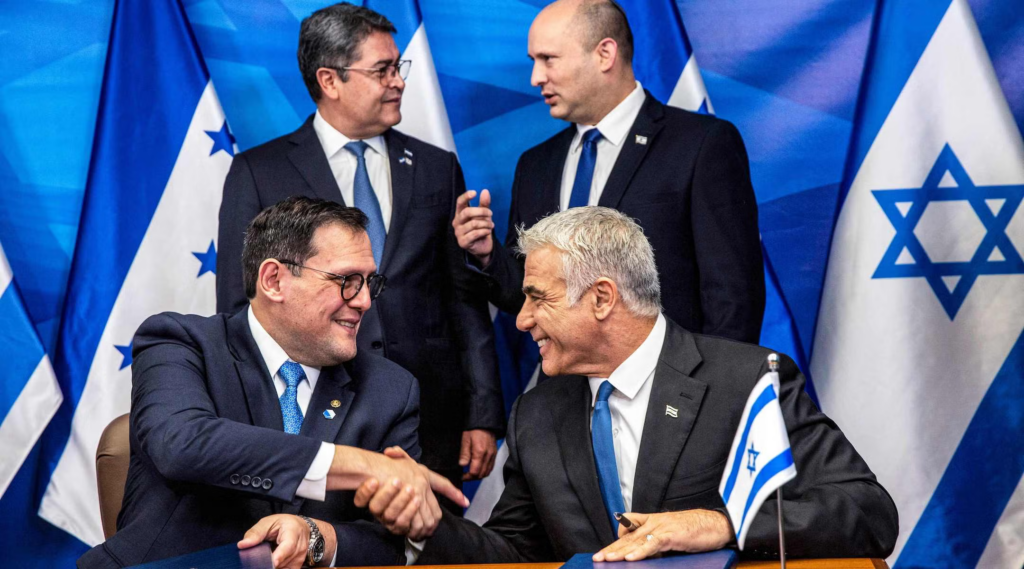
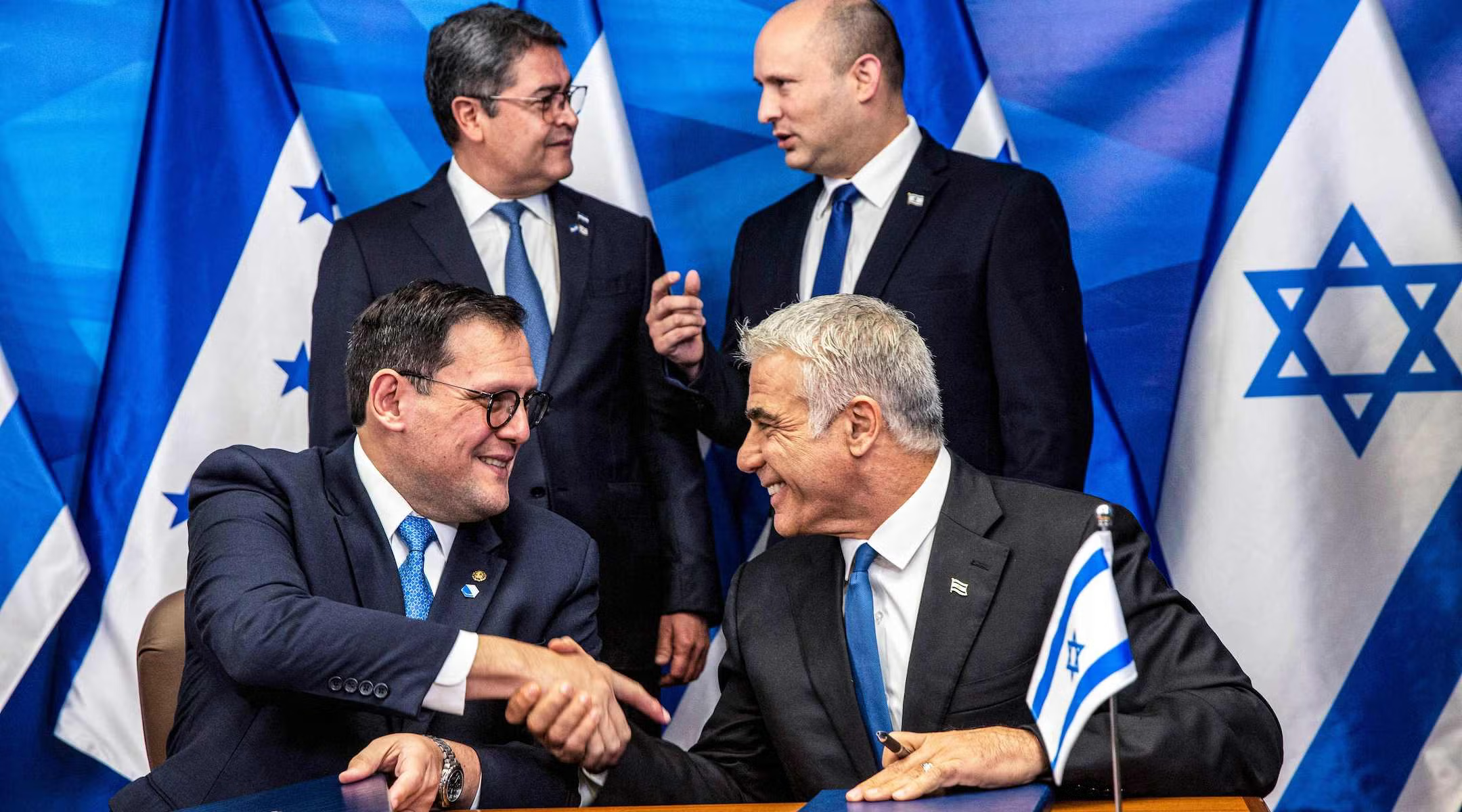
Israeli Foreign Minister Yair Lapid, right, shakes hands with his Honduran counterpart, Lisandro Rosales as Israeli Prime Minister Naftali Bennett, top right, speaks with Honduran President Juan Orlando Hernandez during the signing of bilateral agreements at the prime minister’s office in Jerusalem, June 24, 2021. (Source: Heidi Levine/AFP via Getty Images)
The CIA has complemented Israel’s long-term strategy by employing ostensibly humanitarian or religious NGOs, such as USAID, World Vision, and Church World Service (CWS), to fracture Honduran civil society. By promoting Protestantism over the historically cohesive Catholic majority and supporting programs that exploit divisions along religious, racial, and social lines, including tensions within the Garifuna community influenced by organisations such as OFRANEH, the CIA created fertile ground for ideological manipulation and elite control. Together, the actions of Israel and the CIA have destabilised Honduran society, skewed politics in favour of external interests, and amplified societal divisions. The 2025 elections starkly revealed these dynamics, exposing a democracy heavily shaped by decades of foreign intervention and manipulation.
While Honduras showed some symbolic independence, such as recalling its ambassador from Israel in November 2023, there is a strong case to argue that the deep structural influence of Israel and the U.S, reinforced over decades through military, economic, religious, and civil society channels, created a 2025 electoral landscape strongly favourable to a pro-Israel government, as confirmed by The Times of Israel. Nasry Asfura, promoted by President Trump, embodied this alignment, openly supporting Israeli interests and continuing policies that reinforced the country’s pro-Zionist orientation, making the elections less a contest of domestic politics and more a predictable outcome of long-term foreign influence.
Honduras is a nation under the shadow of powerful foreign influences, where politics, religion, and society have been quietly shaped for decades. The following article investigates how Israeli interests, CIA-backed NGOs, and elite manoeuvring have fractured communities, manipulated loyalties, and set the stage for the tensions that exploded during the 2025 elections…

Honduran President Juan Orlando Hernandez visits the Western Wall in Jerusalem, September 1, 2019 (courtesy Western Wall Heritage Foundation)
Hondurans Curiously Ambivalent On Palestinian Genocide
Thomas Tomczyk writes for PÄYÄ Magazine…
Hondurans have been mostly silent regarding the reported genocide taking place in Gaza over the past two years. The question is: Why such silence? Are Hondurans unaware of the massacres and starvation used against Palestinians in the occupied territories? Do they not care, or are they perhaps afraid of something? “To learn who rules over you, simply find out whom you are not allowed to criticise,” the saying goes.
There was one example of Hondurans protesting Israeli crimes against Palestinians during the Gaza war after the Hamas attack and Israeli stand-down operation of October 7. On October 23, 2023, dozens of Honduran Palestinians demonstrated in front of the Israeli Embassy in Tegucigalpa. Since then, the long-established and influential Arab Palestinian community has been mostly silent about the plight of their Palestinian relatives amid Israel’s escalating atrocities in Gaza and the West Bank.
There is certainly a disconnect, as the 300,000 members of Honduras’ Christian Palestinian community are the third and fourth generations to be born outside of Palestine. Their ancestors began arriving in Honduras from Palestine in the 1890s, and today their connection to and knowledge of Palestine and Israel is mostly superficial. Most Honduran Palestinians don’t know the full scale or nature of the barbarism inflicted on their compatriots who stayed behind and continue to face Israeli oppression, violence, discrimination and now genocide. A Honduran Palestinian businessman told me that many in his community are afraid of being accused of anti-Semitism and facing potential consequences. Simply acknowledging that a systematic genocide may be occurring in Gaza is viewed by some as anti-Semitic.
It is hard not to notice. Since October 2023, Israeli military actions have resulted in the deaths of many Christian civilians in Gaza who have nothing to do with Hamas. In October 2023 Israeli military bombed a Christian orthodox church and murdered 18 Christians. In December 2023, Israeli snipers executed two Palestinian women on the Gaza Holy Family Catholic church property. In July 2025, Israeli soldiers fired a tank shell at a cross of the same church, killing three and wounding a catholic priest. While this all fell on deaf ears in Honduras, it does seem that the Israelis don’t like Christians very much.
One person who spoke with concern about the plight of Palestinians was President Xiomara Castro. In November 2023, the Honduran government recalled its ambassador to Israel for consultations due to escalating massacres of Palestinian civilians in Gaza. President Castro described Israel’s actions in Gaza as genocide during a U.N. speech in September 2024. Still, words have not turned into actions. Honduras is nowhere near recognising Palestine as an independent state or moving its embassy from Jerusalem back to Tel Aviv. In fact, Honduras remains firmly in the pro-Zionist camp as it continues to support Israel’s military by purchasing 15 Black Mamba military vehicles. Pro-Zionist sentiment is strong in Honduras. Israeli flags are flown throughout the country. Hondurans increasingly wear the Star of David around their necks, and taxi drivers display the Israeli emblem on their vehicles. Honduran roots of Zionism and Judeophilia run deep, well over a century.
The country now counts three of its presidents to be Jewish: Juan Lindo, Ricardo Maduro and Juan Orlando Hernández. In fact, you could argue that there was a fourth Jewish president of Honduras who ruled the country from 1911 well into the 1950s. Samuel Zemurray, the Banana King, was responsible for the 1911 Honduran presidential coup that secured land and concessions for his United Fruit banana company. American mercenaries hired by Zemurray deposed President Miguel Dávila and made Honduras his “banana republic.” Zemurray installed his puppet, Manuel Bonilla, as president and received 20,000 acres of land in return. After President Bonilla’s death in 1913, Zemurray continued to be a virtual puppet master of several other Honduran presidents.
In 1947, the World Zionist Organisation tasked Zemurray with delivering Honduras’ U.N. vote in support of the creation of the state of Israel. Reportedly, in a personal phone call, Zemurray tried to bribe then-Honduran President Tiburcio Carías Andino. Because of pressure from the Honduran Palestinian community, Honduras abstained from voting for Israel. Since then, and with plenty of CIA help, Christian Zionism has made many inroads in Honduras. CIA fronts such as World Vision, USAID and Protestant Church World Service for many decades worked to undermine the cohesiveness of Honduran society.
Since the 1950s, the CIA, which some critics considered an Israeli-captured agency, promoted the establishment and expansion of Protestant churches in Latin America. The excuse given was that Protestants were more anti communist and a good alternative to the Liberation Theology preached in many Catholic parishes.
The percentage of Catholics in the country fell from 97% in the 1960s to 47% today. Protestant denominations undermined the Catholic cohesion of Honduran society. Religiously divided Honduras is much easier to manipulate, with one denomination pitted against another. Sixty years later, those Catholic-to-Protestant converts have not only become Zionists, but they are also actually converting to Judaism. According to El Heraldo, 37 families converted to Judaism and, in 2022, established Honduras’ first synagogue. The San Pedro Sula Mishkan Shlomo synagogue members advertise their plans to Judaise and convert thousands of Hondurans.
“The plan is for the expanded synagogue to be a six-story, shaped like a Star of David building and be able to accommodate 456 people. This would make it the biggest synagogue in Latin America.”
Ex-President Juan Orlando Hernández was key in the expansion of Judeophilia and Zionism in Honduras. Just in terms of economy, according School of the Americas, between 2013 and 2019, Honduras purchased $342 million in military and surveillance equipment from Israel. Basically, Honduras has been supporting Israel to the tune of around $5 million a month for that period. Road to conversion of Juan Orlando Hernández began in the early 1990s when he completed a one-year Mashav leaders course in Israel. Israel’s investment in JOH obviously paid off as he learned Hebrew, moved Honduras’ embassy to Jerusalem in 2021, and converted to Judaism with his entire family in 2021. The last one, right before going to a US jail for 45 years, was convicted of decade’s long drug and arms smuggling operation.
Honduras is likely getting set up for a rough ride. Israel funded military dictatorships where even the CIA would not venture. Israel trained and supplied arms to many bad actors that destabilised the region: the genocidal regime in Guatemala in the 1980s, Colombian drug smuggling death squads, Los Zetas drug lord Heriberto Lazcano. “Israel has given its soldiers practical training in the art of oppression and in methods of collective punishment. Some of those officers choose to make use of their knowledge in the service of dictators,” said Israeli general Mattityahu Peled.
“Honduras will likely become an increasingly polarized and violent society.”
There is also a growing Israeli pressure on the Honduran public by co-opting its anti-Gaza genocide sentiment into nebulous movements. The normally restrained Honduran Ministry of Foreign Affairs complained that Israeli Ambassador Nadav Goren meddled in internal Honduran affairs by meeting with Protestant church leaders preparing for the August 16 March for Peace and Democracy. “We express to the Honduran people our deep discomfort at their participation in said public event. The involvement of a diplomat not only ignores his limitations,” stated the Honduran ministry. There are plenty of other players seeking discord. Until its recent defunding by the Trump administration, San Pedro Sula was also home to the Hebrew Immigrant Aid Society (HIAS). The worldwide HIAS organisation does not assist Palestinians, Arabs or Christians in moving to Israel, but uses U.S. tax dollars to help move undocumented migrants through Honduras to the United States.
For decades, certain interest groups have promoted racial resentment —particularly among Black communities— while fostering a sense of guilt among white, European and Christian populations. In Honduras, this strategy is reflected in the 23-year-old movement known as the Fraternal Organisation of Honduran Blacks (OFRANEH), which has received funding from organisations such as American Jewish World Service and the Open Society Foundations, founded by George Soros. These groups have been involved in fermenting revolutions, protests and underhanded political activism around the world. Just as with organisations such as Black Lives Matter and ANTIFA, which were recently designated by the U.S. as a terrorist organisation, OFRANEH fosters division, racial tension, grievances and expectations of compensation in the historically well-integrated Garifuna community. Honduras, in the second quarter of the 21st century, will likely become an increasingly polarised and violent society. Powerful interest groups are working hard to implement this, and Roatan is increasingly a party to those tensions. In September 2025, OFRANEH conducted demonstrations in Cayos Cochinos, and in March 2025, there were protests in Diamond Rock. Tensions on Roatan are just starting to heat up.
US officials admit to major violations during 2020 election
RT | December 22, 2025
Election officials in the US state of Georgia have admitted to major violations of vote certification procedures during the 2020 presidential race. US President Donald Trump, who lost to Joe Biden, has repeatedly claimed that the election was “stolen” and marred by widespread fraud and irregularities.
The admission, made earlier this month, emerged from a complaint filed by election integrity activist David Cross, who accused Fulton County, Georgia’s most populous county, of illegally certifying at least 315,000 ballots in 2020.
Biden beat Trump in Georgia – which has 16 electoral votes – by fewer than 12,000 votes, before going on to win the Electoral College 306–232.
The dispute centers on tabulator tapes produced by voting machines during early voting. Under state rules, each tabulator must generate closing tapes signed by poll workers to certify the recorded vote totals.
After filing an open records request with Fulton County, Cross found at least 134 tabulator tapes with no signatures, meaning that the associated ballots could not have been legally certified.
Cross also raised allegations of missing “zero tapes” meant to confirm that machines began counting from zero at the start of polling, along with discrepancies involving scanner serial numbers and unusually late poll closing times.
During a recent State Election Board hearing, Ann Brumbaugh, an attorney for the Fulton County Board of Registration and Elections, said the county “does not dispute the allegations,” acknowledging the failure as a violation of election board rules.
Members of the state board described the findings as “very troubling” and referred the case to the Georgia Attorney General, seeking potential civil penalties of $5,000 per unsigned tape and other enforcement action.
The Georgia result has remained a focal point of Trump’s broader complaints about the 2020 election, which have been rejected by Democrats and formed the basis of multiple legal cases against him.
Since returning to office, Trump has vowed to overhaul the US voting system, pledging stricter voter identification requirements, limits on mail-in voting, and a shift toward paper ballots, arguing that these changes are necessary to restore confidence in elections.
Trump Administration Moves to Overhaul Childhood Vaccine Schedule, Embrace Informed Consent Model
By Sayer Ji | December 20, 2025
In what may prove to be the most significant transformation of U.S. vaccine policy in decades, the Trump administration is preparing to fundamentally restructure how childhood vaccines are recommended—shifting away from blanket federal endorsements toward a model that empowers parents and physicians to make individualized decisions.
According to a December 19th report in The Washington Post, federal health officials are developing guidance that would encourage parents to consult directly with their doctors about vaccination decisions, rather than simply following a standardized federal schedule. This “shared clinical decision-making” approach represents a profound departure from the paternalistic model that has defined American vaccine policy for generations.
The Denmark Model: Less Is More
Central to the administration’s emerging framework is Denmark’s approach to childhood vaccinations. While the current U.S. schedule calls for vaccinations against 18 infectious diseases, Denmark recommends the injections against 10—yet maintains excellent health outcomes.
Tracy Beth Hoeg, a top FDA official, presented the Danish model to the CDC’s federal vaccine advisory committee earlier this month. Her presentation highlighted what she characterized as the “Danish Vaccination Schedule Benefits,” including making “more time for overall health at doctors’ appointments” and decreasing the “medicalization of childhood.”
The policy shift “kicked into high gear” immediately following President Trump’s directive earlier this month to consider recommending fewer shots. In his announcement, Trump noted that the United States is an “outlier” among developed countries and emphasized that “many parents and scientists have been questioning the efficacy of this ‘schedule.’”
Informed Consent Takes Center Stage
Perhaps most significantly, the administration is moving toward what health freedom advocates have long championed: genuine informed consent.
Under the emerging framework, vaccines would shift to “shared clinical decision-making”—meaning parents would consult with medical professionals about the risks and benefits before proceeding. Critically, insurance coverage would remain intact, preserving access while restoring choice.
The CDC has already begun implementing this approach for covid vaccines and the hepatitis B vaccine for children. This marks a fundamental acknowledgment that vaccination decisions are not merely technical matters to be dictated by government committees, but personal medical choices that belong in the hands of families and their trusted physicians.
A Vindication Decades in the Making
For those of us who have spent years (even decades) advocating for medical freedom, parental rights, and genuine informed consent, this moment represents a profound vindication.
Those like Secretary Kennedy, part of the “disinformation dozen,” viciously targeted during the Covid-19 era, have long argued that the U.S. vaccine schedule—which has expanded dramatically over the past four decades—deserves rigorous scrutiny rather than reflexive acceptance. We have insisted that parents are capable of making informed decisions about their children’s health when given accurate information about both risks and benefits. We have maintained that comparing health outcomes across nations reveals that more vaccines do not automatically equal better health.
Health Secretary Robert F. Kennedy Jr., who has called for additional scrutiny of the childhood vaccine schedule throughout his career, now sits at the helm of HHS. Martin Kulldorff, a renowned epidemiologist and biostatistician, has been named a chief science officer at the department. The voices that were systematically marginalized and deplatformed are now shaping policy.
Del Bigtree, founder of the Informed Consent Action Network, told the Post he supports the shift: “Our belief is there are just too many vaccines. It’s very exciting.”
What This Means Going Forward
The policy remains in development, and specific details—including which vaccines would move to the shared decision-making model—have not been finalized. HHS spokesperson Andrew Nixon cautioned that until official announcements are made, reports remain “pure speculation.”
However, the direction is unmistakable. The era of unquestioning deference to an ever-expanding federal vaccine schedule is drawing to a close. In its place is emerging a model that:
- Respects parental rights as the foundation of children’s healthcare decisions
- Restores the physician-patient relationship to its proper central role
- Acknowledges uncertainty rather than projecting false consensus
- Aligns with international norms rather than treating American exceptionalism as an excuse for over-medicalization
- Preserves access while eliminating coercion
The Resistance Has Already Begun
Predictably, the public health establishment is sounding alarms. Former CDC official Demetre Daskalakis called the Denmark comparison “not gold standard science.” The recently defunded American Academy of Pediatrics rejected what it termed the “one-size-fits-all approach” while simultaneously opposing any departure from the current one-size-fits-all schedule.
Even a Danish health official questioned the shift—though notably, his objection was that “public health is not one size fits all” and is “population specific,” which is precisely the point advocates have been making for years. If public health is population-specific, then surely it should also be individual-specific, with families empowered to make decisions appropriate to their unique circumstances.
A New Chapter for Health Freedom
We are witnessing what may be the most consequential health policy transformation of our lifetimes. After years of censorship, deplatforming, and marginalization, the health freedom movement’s core principles are being integrated into federal policy.
This is not about being “anti-vaccine.” It is about being pro-informed consent, pro-parental rights, and pro-science that welcomes questions rather than demanding compliance.
The battle is far from over. State mandates remain in place. Institutional resistance is fierce. The entrenched interests that have profited from the expanding schedule will not yield quietly.
But the tide has turned. And for parents who have long demanded the right to make informed medical decisions for their children, this moment represents nothing less than the restoration of a fundamental freedom.
Featured Video
Your Enslavement Begins in Gaza: The ‘Board of Peace’
or go to
Aletho News Archives – Video-Images
From the Archives
The US: The Century of Lost Wars
By James Petras | Global Research | September 12, 2018
Introduction
Despite having the biggest military budget in the world, five times larger than the next six countries, the largest number of military bases – over 180 – in the world and the most expensive military industrial complex, the US has failed to win a single war in the 21st century.
In this paper we will enumerate the wars and proceed to analyze why, despite the powerful material basis for wars, it has led to failures. … continue
Blog Roll
 Aletho News
- The US build-up around Iran constitutes strategic war option, not ‘deterrence’
- Iran to US: Sanctions and war failed; try diplomacy and respect
- China supplies Iran with radar, surveillance tech to track US stealth aircraft: Report
- Zelensky rejects territorial concessions to Russia
- German leader of EU’s largest faction sounds the alarm of possibility of right-wing forces coming to power in France, Poland
- Putin: Developing Russia’s nuclear forces ‘absolute priority’
- Hungary Blocks 20th Package of Anti-Russia Sanctions, $106B Loan to Ukraine – Szijjarto
- NATO Must Return to 1997 Borders for Peace in Ukraine – Finnish Politician
- Your Enslavement Begins in Gaza: The ‘Board of Peace’
- Israeli FOIA Data Reveals Massive Heart Injury Spike in Children Immediately After mRNA Shot Rollout
- If Americans Knew
- Maria Farmer: Epstein Victim Reveals Explosive Information Covered Up by Media
- Average of five Palestinians killed by Israel every day in Gaza since ceasefire – Not a ceasefire Day 136
- Palestinian church leaders admonish Christian Zionist Mike Huckabee – Not a ceasefire Day 135
- Ominous messaging from Trump’s “Board of Peace” – Not a ceasefire Day 134
- ‘Christians Out’: Jerusalem Church Tagged With Hate Graffiti, Police Investigating
- Israeli Settlers Kill American Teen
- ‘We returned from hell’: Palestinian journalists recount torture in Israeli prisons
- No mercy for Gaza in Ramadan – Not a ceasefire Day 133
- The Israeli Government Installed and Maintained Security System at Epstein Apartment
- Tucker Carlson interrogated in Israel, has passport seized after interviewing US ambassador
- No Tricks Zone
- New Research Reaffirms Clouds, Aerosols, And Surface Solar Radiation Are ‘Driving The Climate System’
- Germany: Electric Car Catches Fire At Charging Station, Sets Off Local “Inferno”, Widespread Damage
- New Study: Canada’s New Brunswick Was 1°C Warmer Than Today During The Medieval Warm Period
- Coal Power Back In Trend As Globe Tries To Keep Pace With Growing Demand For Power
- New Study: A 4°C Warmer Beaufort Sea Had ‘No Sea Ice’ 11,700 – 8200 Years Ago
- Unfudging The Data: Dutch Meteorological Institute Reinstates Early 20th Centruy Heat Waves It Had Erased Earlier
- German Gas Crisis…Chancellor Merz Allegedly Bans Gas Debate Ahead of Elections!
- Pollen Reconstructions Show The Last Glacial’s Warming Events Were Global, 10x Greater Than Modern
- Germany’s Natural Gas Storage Level Dwindles To Just 28%… Increasingly Critical
- New Study Rebuts The Assumption That Anthropogenic CO2 Molecules Have ‘Special’ Properties
 Aletho News