Trump aims to create new UN and own it, Brazil’s Lula warns
Press TV – January 24, 2026
Brazil’s President Luiz Inacio Lula da Silva has criticized US President Donald Trump for attempting to create a new United Nations and be the sole owner of the international body.
“Instead of fixing” the United Nations, “what’s happening? President Trump is proposing to create a new UN where only he is the owner,” Lula said in a speech at an event on Friday.
Lula sounded the alarm about the new world order Trump is creating, warning that the international community is facing a “very critical” political moment in global dynamics, with multilateralism being forced out in favor of US unilateralism.
He warned that “the UN charter is being torn” to pieces by Trump.
Lula said Trump is replacing the UN charter with “the law of the jungle” in reference to his use of the US military to press Washington’s demands.
Lula further criticized Trump for attempting to “rule the world.” Trump “wants to run the world,” he said.
“Every day he says something, and every day the world is talking about what he said,” the Brazilian president noted. “It’s remarkable.”
Instead of using diplomatic means for pursuing foreign policy, “the law of the strongest” is increasingly shaping international relations among nations, he said.
Lula also said that his plan is to explore the possibility of an international meeting to reaffirm the world countries’ commitment to multilateralism and prevent “the force of arms and intolerance of any country in the world” from prevailing.
To salvage what remains of the world order, Lula said, he had added momentum to his diplomatic contacts with his counterparts in Russia, China, India, Hungary, Mexico, and other countries in the hope of countering US unilateralism by creating an international response to strengthen multilateralism across the globe.
UN rapporteur says Israeli demolition of UNRWA compound reflects broader attack on UN system
MEMO | January 23, 2026
The UN special rapporteur on the occupied Palestinian territory on Thursday cited the demolition of a UNRWA compound in East Jerusalem as sign of a broader attack on the UN system, calling for a special session at UN General Assembly, Anadolu reports.
Francesca Albanese said in a statement that she was “horrified by the Government of Israel’s relentless destruction,” and that “Israel is dismantling the United Nations and international law brick by brick in full view of the world.”
Israeli forces forcibly entered the UNRWA headquarters compound in the Sheikh Jarrah neighborhood of occupied East Jerusalem on Jan. 20 and demolished it using bulldozers and heavy machinery.
“Attacking UNRWA is tantamount to bulldozing the world’s efforts to sustain Palestinian life,” Albanese said, referring to what she described as accompanying “genocidal rhetoric by Israeli officials.”
She said Israel’s Interior Minister Itamar Ben Gvir appeared on camera supervising the demolition and cited a public call by Jerusalem’s deputy mayor outside the compound to “kill and annihilate UNRWA staff.”
“This constitutes yet another instance of genocidal incitement that has become disturbingly normalised in Israel,” the rapporteur warned.
Albanese described the demolition as “an outrageous attack by a UN member State against a UN General Assembly-mandated organisation,” calling it “unprecedented and dangerous.” She urged UN Secretary-General Antonio Guterres to request a General Assembly special session and said it was time to consider suspending Israel’s credentials and authorizing sanctions and embargoes.
From Proxy to Disposable: The US Betrayal of the Syrian Kurds
By Robert Inlakesh | The Palestine Chronicle | January 24, 2026
A collapse of the Kurdish-led Syrian Democratic Forces in northeastern Syria, at the hands of the Syrian army, should be a lesson for all regional movements siding with the United States. This should serve as a warning to supporters of the current Syrian government as well.
The United States had supported the rise of the Kurdish-led Syrian Democratic Forces (SDF) in 2015. That support has now come to an end. For the Kurdish movement inside northeastern Syria, the aim was autonomy, and the territory they captured was viewed as Rojava, part of historic Kurdistan. The primary enemy of Kurdish national movements has been Türkiye, and their project spans Turkish, Syrian, Iraqi, and Iranian territory.
Unfortunately for the Kurds, this meant that their cause was treated as something to be exploited by the US, Israel, and various other actors. In Syria’s case, the US helped establish SDF rule in October 2015, backing its forces against ISIS almost immediately after Russia entered the Syrian war on the side of the government in Damascus at the end of September that year.
The Syrian Arab Army (SAA), with Russian air support, quickly turned the tables on ISIS and began pushing toward the western banks of the Euphrates River. On the other side lay the al-Omar oil fields, home to the vast majority of Syria’s natural resources, which at the time were being exploited by ISIS.
Washington’s project in Syria since 2012, through initiatives such as CIA Operation Timber Sycamore, was to back anti-government forces to effect regime change in Damascus. For a long time, the situation inside Syria appeared as though forces loyal to then-President Bashar al-Assad were on the verge of defeat. This left Kurdish-majority regions without protection and exposed to the brutality of takfiri militants.
When the SAA began pushing ISIS back and appeared capable of reclaiming Syria’s oil fields and fertile agricultural lands, the Americans suddenly launched a major air campaign against ISIS and aided the formation of the SDF as their ground force. Put simply, the SDF was formed to serve as Washington’s proxy, ensuring that the government in Damascus could not regain access to the nation’s breadbasket and natural resources.
The SDF made major advances on the ground and gained control over much of the Syrian-Turkish border region. In Ankara’s eyes, this Kurdish force inside Syria posed a major security threat and was linked to groups such as the PKK, which Türkiye designates as a terrorist organization.
In January 2018, Türkiye launched Operation Olive Branch to seize Afrin from the Kurdish-led SDF. What did the US do? It withdrew its forces and backed off, completely abandoning its allies. Then, in October 2019, the Turkish military launched another operation called Operation Peace Spring, capturing additional border territory in northeastern Syria. Once again, the US abandoned the SDF.
After these betrayals, it should have been clear that the relationship between the United States and the SDF was one of master and proxy, not mutual partnership. Many on the Left argued that the SDF’s project was just and sought to liberate the Kurdish people in their ancestral lands, while others argued that Arab-majority territory should not be ruled by a Kurdish minority. Regardless of which argument carried more moral weight, the United States was never interested in this debate.
When Bashar al-Assad was deposed, and Ahmed al-Shara’a entered Damascus, the usefulness of the SDF evaporated. US support for the Kurdish movement had always been about keeping Syria’s agricultural lands and resources out of the central government’s hands, ensuring the effectiveness of Caesar Act sanctions. The strategy was one of pure cynicism, dangling self-determination before a people to economically strangle the rest of Syria.
The moment Washington achieved its goal of installing a pro-US and pro-Western government in Damascus, it immediately abandoned the ally it had backed for a decade. The lesson is clear: siding with the United States does not bring liberation, only chaos, death, and destruction.
Former Iraqi President Saddam Hussein’s rise was supported by the CIA, after which he became one of Washington’s favored dictators in West Asia. He fought Iran on US orders and used chemical weapons supplied by the West against the Kurdish population. Western media then attempted to blame Iran. When his usefulness ended, he was destroyed.
The same pattern applies to Iran’s former Shah, a US favorite to such an extent that Washington sent currency printing plates to Tehran and used its embassy there as a hub for CIA operations across Asia. After the Iranian people overthrew his brutal dictatorship, the Shah died in exile in Egypt.
Unfortunately, due to the Kurdish-led SDF and parts of the Kurdish movements in Iraq and Iran, strong ties developed with Israel and Israeli intelligence. This has fostered the stereotype that Kurdish movements are inherently pro-Israel, which is untrue. In fact, the PKK would not have emerged as a major force without Palestinian resistance groups.
The PKK ordered its forces to fight Israel during the 1982 invasion of Lebanon, even against the advice of some Palestinian leaders who feared they would suffer heavily due to inexperience at the time. It was the Popular Front for the Liberation of Palestine and the Democratic Front for the Liberation of Palestine that were chiefly responsible for training the PKK in the Lebanese Beqaa Valley, while even Fatah provided support.
There is a shared history of Kurdish movements and Palestinian resistance working together, although this relationship is not as widespread today. What it demonstrates, however, is that organic and pragmatic alliances between regional movements are possible. The United States is never present to deliver freedom. It is there to extract what it wants and then dispose of its proxies.
This lesson should resonate with many Syrians who currently support their leaders’ alignment with the United States. Just as many among the Kurdish population allowed emotions to cloud judgment and failed to see what was in front of them, the same risk now applies to supporters of Ahmed al-Shara’a.
A serious question must be asked. If the United States could so easily abandon a group it helped create, arm, and work with for a decade, one that made enormous efforts to align itself with Western liberal democracy, why would it side with the leadership of Hayat Tahrir al-Sham as a matter of principle? There is no principle involved, only strategic calculation, and it is the Syrian people who will ultimately pay the price.
– Robert Inlakesh is a journalist, writer, and documentary filmmaker. He focuses on the Middle East, specializing in Palestine.
Six injured in stabbing spree at Kurdish rally in Antwerp, victims stabbed ‘indiscriminately’
By Thomas Brooke | Remix News | January 23, 2026
Six people were injured, two of them seriously, in a knife attack during a Kurdish demonstration in Antwerp on Thursday evening, Belgian police said.
Four suspects have been arrested, and an investigation into attempted murder has been opened. A second demonstration planned for Friday has been cancelled out of respect for the victims.
The attack took place shortly after 7 p.m. on Operaplein, outside the Antwerp Opera House, where around 300 people had gathered for a demonstration in support of Kurds in northeastern Syria. According to police cited by De Standaard, the protest had been peaceful and was already dispersing when the violence broke out.
“All six victims suffered stab wounds,” Antwerp police spokesman Wouter Bruyns said, as reported by RTL. Four of the injured were found on Operaplein, while two others were located near Rooseveltplaats and Sint-Elisabethstraat. “Two of them are in critical condition,” he added. All victims were taken to the hospital.
Emergency services arrived with several medical teams, and police officers who were already present at the demonstration were able to intervene quickly and provide first aid. Four suspects were arrested at the scene. Bruyns said investigators were still working to determine the exact number of attackers and their motives and were reviewing CCTV footage.
NavBel, the council of Kurdish communities in Belgium, said in a statement that the demonstration had taken place “peacefully and without incident,” with families, women, young people, and children present. “As the gathering was dispersing, the Kurdish demonstrators were attacked by a group of men,” the organization said. “These men had infiltrated the demonstration and suddenly pulled out knives,” stabbing protesters “indiscriminately.”
“People were running in every direction; it was pure chaos,” one eyewitness told Gazet van Antwerpen. Another witness said a group passing by suddenly pulled out knives and began stabbing people who were sitting on the steps of the opera house.
NavBel said that three of the injured were Kurds and announced that a further demonstration scheduled for Friday in Antwerp had been cancelled “out of respect for the victims and in order to preserve serenity.”
The demonstration had been organized to draw attention to the situation in northeastern Syria, where the Islamist government army has moved against the Kurdish-led Syrian Democratic Forces (SDF) in the autonomous region of Rojava. Orhan Kilic, a spokesperson for NavBel, said fears of new human rights violations against Kurds were high, citing the background of Syrian President Ahmed al-Sharaa.
Kilic described the Antwerp stabbing as a “terrorist attack” and urged police to treat it as such. “There were flags, emblems, and so on,” he said. “It clearly involved Kurds who support the SDF.”
Current Syrian President Al-Sharaa, also known as Abu Mohammed al-Golani (al-Julani), was the former leader of the Sunni Islamist militant group Hay’at Tahrir al-Sham. Protesters say he is responsible for massacres and the displacement of civilians during the civil war
Protesters have also stated that minorities, including Kurds, Alevis, Alawites, and Christians, remain under acute threat in Syria.
US pledges to ‘starve’ Iraq of oil revenue if pro-Iran parties join new government
The Cradle | January 23, 2026
Washington has threatened to block Iraq’s access to its own oil revenue held in the Federal Reserve Bank of New York if representatives of Shia armed parties enjoying support from Iran are included in the next government, Reuters reported on 23 January.
“The US warning was delivered repeatedly over the past two months by the US Charges d’Affaires in Baghdad, Joshua Harris, in conversations with Iraqi officials and influential Shi’ite leaders,” Reuters reported, citing three Iraqi officials and one source familiar with the matter.
The threat is part of US President Donald Trump’s effort to weaken Iran through a “maximum pressure” campaign of economic sanctions, including on the Islamic Republic’s oil exports.
Trump also bombed Iran’s nuclear sites as part of Israel’s unprovoked 12-day war on Iran in June.
Because of US sanctions, few countries can trade with Iran, increasing its reliance on Iraqi markets for exports and on Baghdad’s banking system as a monetary outlet to the rest of the world.
As punishment, the US government has restricted the flow of dollars to Iraqi banks on several occasions in recent years, raising the price of imports for Iraqi consumers and making it difficult for Iraq to pay for desperately needed natural gas imports from Iran.
However, this is the first time the US has threatened to cut off the flow of dollars from the New York Federal Reserve to the Central Bank of Iraq.
Officials in Washington can threaten Baghdad in this way because the country was forced to place all revenues from oil sales into an account at the New York Fed following the US military’s invasion of the country in 2003.
This gives Washington strong leverage against Baghdad, as oil revenue accounts for 90 percent of the Iraqi government’s budget.
While occupying Iraq for decades and controlling its oil revenues, Washington accuses Iran of infringing on Iraq’s sovereignty.
“The United States supports Iraqi sovereignty, and the sovereignty of every country in the region. That leaves absolutely no role for Iran-backed militias that pursue malign interests, cause sectarian division, and spread terrorism across the region,” a US State Department spokesperson told Reuters.
Some Shia political parties, including several that make up the Coordination Framework (CF), are linked to the Popular Mobilization Units (PMU), anti-terror militias formed in 2014 with Iranian support to fight ISIS and later incorporated into the Iraqi armed forces.
Iraq held parliamentary elections in November and is still in the process of forming the next government.
Prime Minister Muhammad Shia al-Sudani, who enjoyed good relations with both Washington and Tehran, has decided not to contend for another term as premier.
The decision has cleared the way for Nouri al-Maliki, of the State of Law Coalition and the Dawa Party, to potentially return to power.
Maliki, who enjoys support from the PMU-linked parties, served as prime minister between 2006 and 2014, including when ISIS invaded western Iraq and conquered large swathes of the country.
Trump threatened a new bombing campaign against Iran following several weeks of violent riots and attacks on security forces organized and incited by Israeli intelligence.
Trump allegedly called off the bombing after Israeli Prime Minister Benjamin Netanyahu warned him that Tel Aviv’s air defenses were not prepared for a new confrontation with Iran.
During the war in June, Iran retaliated against Israel by launching barrages of ballistic missiles and drones, which did severe damage to Israeli military sites, including in Tel Aviv.
Is China a threat to Greenland?
By Pei Si | Global Times | January 22, 2026
Since the beginning of 2026, the US has repeatedly claimed that it must take control of Greenland to prevent threats from China and Russia, alleging that there are Chinese and Russian vessels “all over the place” outside of Greenland. What is the reality? What is China’s actual presence in Greenland? And does China pose any threat to Greenland at all?
Based on information from various sources, China currently has no official institutions in Greenland, no investment projects, and no resident companies. There are only some 30 Chinese workers working at Greenlandic seafood companies. Cooperation between China and Greenland is largely confined to trade, particularly in aquatic products. In 2025, bilateral trade between China and Greenland reached $429 million, of which Greenland’s exports to China amounted to $420 million, mainly Arctic shrimp, halibut, cod, lobster and other seafood. Greenland’s imports from China totaled $9 million, consisting largely of daily consumer goods.
Nor are there many Chinese tourists visiting Greenland. Although the island boasts stunning natural scenery, it is not easy to reach it from China and remains a niche destination for Chinese travelers. In 2024, only about 3,500 Chinese tourists visited Greenland.
Claims that there are Chinese vessels all over the waters near Greenland, or that Greenland faces a so-called “China threat,” are even more groundless. On January 16, Soren Andersen, Major General of Denmark’s Joint Arctic Command in Greenland, dismissed such claims in an interview, stating clearly that “there were no Chinese or Russian ships near Greenland.” Vessel-tracking data from MarineTraffic and LSEG likewise show no Chinese ships’ presence near Greenland. Danish Foreign Minister Lars Lokke Rasmussen has repeatedly clarified to the media that there is no “instant threat” from China. Rasmus Jarlov, the chair of Denmark’s parliamentary defense committee, put it even more bluntly: The claim of “a big threat from China and Russia against Greenland” is delusional.
Whether in terms of facts or policy, China does not pose a threat to Greenland. In fact, China has been subjected to unfair restrictions there. Rasmussen has openly acknowledged that the Danish government previously used administrative measures to veto the participation of Chinese companies in Greenland’s airport expansion and mining projects, and has already established an investment screening mechanism that will not allow Chinese investment in Greenland in the future. Whether such sacrifices of China can buy a US “hands-off” is highly doubtful – and hardly worthy of respect.
Anyone can see that the current tensions in the Arctic stem primarily from the actions of a certain country advancing claims that violate international law and the purposes and principles of the UN Charter. By contrast, China made it explicit in its 2018 white paper China’s Arctic Policy that “all states should abide by international treaties such as the UN Charter and the UNCLOS, as well as general international law. They should respect the sovereignty, sovereign rights, and jurisdiction enjoyed by the Arctic States in this region, respect the tradition and culture of the indigenous peoples.”
On January 12, Chinese Foreign Ministry spokesperson Mao Ning further stressed at a regular press briefing: “The Arctic bears on the common interests of the international community. China’s activities in the Arctic are aimed at promoting the peace, stability and sustainable development of the region. They are in line with the international law. Countries’ right and freedom to carry out activities in the Arctic in accordance with the law needs to be fully respected. The US should not use other countries as a pretext for seeking selfish gains.”
From China’s perspective, the future of the Arctic should not be a battleground for geopolitical rivalry, but a low-tension region for international cooperation on climate change and sustainable development. Claims that “China threatens Greenland” are simply too absurd to be worth refuting.
South Korea’s Prime Minister Proposes US Send Special Envoy to North Korea — Report
Sputnik – 24.01.2026
South Korean Prime Minister Kim Min-seok has proposed the idea of Washington sending a special envoy to North Korea, the South Korean Yonhap news agency reported.
Kim Min-seok held a meeting with US Vice President JD Vance at the White House.
During his talks with Vance, the South Korean prime minister proposed the idea of the United States sending a special envoy to North Korea as a way to improve relations between Washington and Pyongyang, Yonhap said.
“First, (I told Vance) that in reality, only [US President Donald] Trump has the will and capability to improve relations (with North Korea),” Kim Min-seok said, as quoted by Yonhap, adding that he also said “that sending a special envoy to North Korea, whoever that may be, can be an approach to express an intent to enhance relations (with the North).”
Yonhap said that Vance had allegedly requested Kim Min-seok’s advice on diplomacy with Pyongyang, amid speculation that Trump could seek a meeting with North Korean leader Kim Jong Un when the US president visits China in April.
On Friday, Yonhap reported, citing sources, that US Undersecretary of Defense for Policy Elbridge Colby was going to visit South Korea and Japan next week to meet with key officials from their foreign affairs and defense ministries.
Colby’s visit to South Korea is expected to take place from January 25-27, after which he will proceed to Japan. The upcoming trip follows a visit to South Korea by US Defense Secretary Pete Hegseth in November.
Pentagon downgrades China threat, shifts focus to homeland, hemisphere
Al Mayadeen | January 24, 2026
The United States Department of War has released its long-delayed 2026 National Defense Strategy (NDS), signaling a major shift in Washington’s military priorities by no longer treating China as the “primary threat” to US national security.
The document, published late Friday, places the defense of the US homeland and the Western Hemisphere at the center of Pentagon planning, a sharp departure from strategies issued under both former President Joe Biden and President Donald Trump’s first term, which identified China as the foremost strategic challenge.
According to the strategy, past US administrations “ignored American interests,” allowing strategic vulnerabilities to emerge in areas such as the Panama Canal, Greenland, and the broader Western Hemisphere. The document explicitly calls for abandoning what it describes as “grandiose strategies” in favor of policies rooted in the “practical interests” of the US public.
Reduced emphasis on China, conciliatory tone in the Pacific
While China remains a key concern, the 2026 NDS no longer characterizes Beijing as an “acute” or “existential” threat. Instead, it refers to China as a “settled force” in the Indo-Pacific that must be deterred from dominating the US or its allies.
The document adopts a notably conciliatory tone, stressing that Washington does not seek to “strangle or humiliate” China. It argues that a “decent peace” is achievable under terms favorable to the US and acceptable to Beijing, emphasizing diplomacy, stable relations, and expanded military-to-military communication channels to avoid escalation.
Although the Pentagon continues to advocate a “strong denial defense” in the Pacific, the strategy does not specify what military assets will be deployed. Notably, Taiwan is not mentioned by name, marking a significant shift from the 2022 National Defense Strategy, which explicitly framed Taiwan as a central security concern.
Europe’s declining importance, new DPRK strategy
In contrast to the National Security Strategy released last month, the defense document avoids describing Europe as being in “civilizational decline”, but it nonetheless downplays the continent’s strategic importance.
“Although Europe remains important, it has a smaller and decreasing share of global economic power,” the strategy states, adding that while US engagement will continue, Washington will prioritize defending the homeland and its immediate sphere of influence.
The strategy also outlines a reduced US military role in deterring the Democratic People’s Republic of Korea, shifting primary responsibility to South Korea, which currently hosts around 28,500 US troops.
“South Korea is capable of taking primary responsibility for deterring North Korea with critical but more limited US support,” the document states.
The strategy notably omits any reference to the denuclearization of the Korean Peninsula, reinforcing speculation that Washington is moving toward managing the DPRK’s nuclear capabilities rather than seeking their elimination.
“This shift in the balance of responsibility is consistent with America’s interest in updating US force posture on the Korean Peninsula,” the strategy explains, noting that Washington seeks to make its forces more flexible and better positioned to respond to a wider range of contingencies across the region.
Burden-sharing and regional rebalancing in the Pacific
Across the broader Pacific region, the Pentagon is urging allies to assume greater responsibility for their own defense, linking continued US cooperation to increased military spending by allies, with benchmarks as high as 5% of GDP. The strategy emphasizes economic and maritime security over regime-change policies, describing the Indo-Pacific as the world’s most dynamic economic region and underscoring the need to protect trade routes and strategic access points.
Japan and South Korea are identified as central to this regional balancing approach, with the US seeking to “incentivize and enable” allies to play a more assertive role in collective defense.
Meanwhile, South Korea has raised its defense spending to 7.5% of GDP and continues to field upwards of 500,000 regular troops with approximately 3.1 million reservists. On its part, Japan is moving to decisively break with decades of post-war pacifism, accelerating a historic military buildup and adopting a more assertive security posture.
Tokyo is on track to reach defense spending equivalent to 2% of GDP by March 2026, abandoning the long-standing 1% cap, as part of a five-year rearmament plan totaling 43 trillion yen. The shift is accompanied by the development of “counterstrike” capabilities, marking a transition from an exclusively defense-oriented doctrine toward deterrence by punishment and the fielding of overtly offensive weapons. While Japanese officials frame the change as strategic maturity and greater alliance responsibility, critics have denounced it as a revival of Japanese militarism.
The release of the 2026 NDS comes after months of internal delays. US media reported that a draft reached War Secretary Pete Hegseth as early as September, but disagreements within the administration over how to characterize China’s threat, particularly amid ongoing trade negotiations, stalled its publication.
Despite references to Russia, Iran, and DPRK as sources of risk, the strategy treats these threats as secondary, reinforcing the Pentagon’s pivot toward homeland defense and regional retrenchment rather than expansive global confrontation.
Ireland Moves to Legalize Spyware Use by Police
The bill turns state hacking from a covert act into an accepted instrument of law
By Ken Macon | Reclaim The Net | January 23, 2026
Irish police could soon be granted the legal authority to infiltrate phones and encrypted messaging services under new government legislation that would formally approve the use of spyware.
The proposal, contained in the forthcoming Communications (Interception and Lawful Access) Bill, has provoked concern among civil rights groups who say the plan risks eroding basic digital privacy.
Justice Minister Jim O’Callaghan has said the new powers are “long overdue,” arguing that they are necessary to deal with organised crime and national security threats that rely on encrypted communications.
The plan would, for the first time, provide An Garda Síochána (the main law enforcement and security agency in the state) with a legal basis for using what the government calls “covert surveillance software” to monitor devices.
This could include collecting information from phones or laptops, recording communications, or interfering with computer networks thought to be used for unlawful purposes.
Officials have indicated that similar powers exist in other countries, though reports suggest the technology under consideration resembles Pegasus, the Israeli-made spyware that was unlawfully used by police to monitor citizens and foreign nationals.
The Department of Justice has said any use of such spyware would be subject to strict judicial authorization.
Under the Bill, investigators could access both the content of communications and the associated “metadata,” which records who contacted whom, when, and from where.
Agencies would also have to declare whether any privileged material, such as communications involving journalists or lawyers, might be affected by their applications.
Officials continue to present the legislation as a practical response to modern crime. Yet this framing ignores what is actually at stake: a quiet authorization for state hacking of private devices.
For years, Ireland has criticized other nations for digital overreach, from the misuse of facial recognition abroad to the abuse of spyware uncovered in Europe.
Now, its own government is preparing to legalize similar tools under the banner of security. The right to communicate privately is one of the last real protections citizens have from constant scrutiny.
If this Bill passes in its current form, that protection could quietly disappear, not through scandal or crisis, but through a line in legislation that makes surveillance a normal feature of everyday life.
Featured Video

AIR POWER CANNOT BEAT an ENTRENCHED ENEMY LIKE IRAN
or go to
Aletho News Archives – Video-Images
Frlom the Archives
Not Ready for the Big Leagues
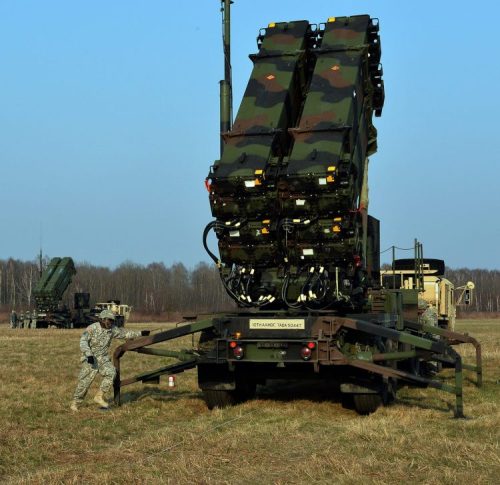
Patriot Missile Launcher
By William Schryver | imetatronink | January 20, 2024
… In an attempt to cover just three large airbases against a series of salvos of 100+ missiles of various types, the entire US stockpile of PAC-3 interceptors could very conceivably be exhausted in little more than a week or two. … continue
Blog Roll
 Aletho News
- Larry Johnson: AIR POWER CANNOT BEAT an ENTRENCHED ENEMY LIKE IRAN
- Report- U.S. and Israel Are Targeting ‘Hospitals, Residential Buildings And Schools Across Tehran’
- Witkoff undermined Iran talks by peddling lies to build case for military aggression: Report
- Iraqi Resistance reports drone attacks on US targets in Erbil
- Iran warns all Israeli embassies ‘legitimate targets’ if Lebanon embassy attacked
- Russia could end gas supplies to EU immediately – Putin
- Veteran War Correspondent Reveals How to Tell When Analysts Talking About Iranian Losses Are Lying
- Did Kuwait really shoot down three US F-15s?
- Trump’s Iran war will put him in the history books, but…
- The murder of Iranian schoolchildren cannot be whitewashed
- If Americans Knew
- Is the International Norm Against Assassination Dead?
- More than 1,000 Civilians Killed in U.S.-Israeli Bombing of Iran, Rights Group Says
- The Neocons: First in War, Last in Peace
- With focus on Iran and Gaza, Israel is quietly annexing the West Bank
- Experts Worldwide Agree: US-Israel Attack on Iran a Clear Violation of International Law
- 1,000+ reported dead in Iran, in the war that Israel wanted – Not a ceasefire Day 145
- Rubio Suggests Trump Joined Israel’s Planned Attack on Iran Instead of Stopping It
- CNN: Timing of attack on Iran bears symbolic meaning in Judaism
- How the New York Times paved the way for apocalyptic war
- Tucker Carlson says Saudi Arabia and Qatar arrested Mossad agents planning bombings
- No Tricks Zone
- New Study: A Century Warming Of 1.1°C Is ‘Commonplace’ And ‘Not Unusual’ During This Interglacial
- New Study: ‘Internal Noise’ And Volcanic Forcing Can Trigger 10-15°C Warming Within Decades
- Glaciers Worldwide Are Suddendly Surging, Experts Blame Warming!
- Surprising Discovery: Sahara Is Greening…Billions Of Trees Where Once Thought To Be Barren
- New Research Reaffirms Clouds, Aerosols, And Surface Solar Radiation Are ‘Driving The Climate System’
- Germany: Electric Car Catches Fire At Charging Station, Sets Off Local “Inferno”, Widespread Damage
- New Study: Canada’s New Brunswick Was 1°C Warmer Than Today During The Medieval Warm Period
- Coal Power Back In Trend As Globe Tries To Keep Pace With Growing Demand For Power
- New Study: A 4°C Warmer Beaufort Sea Had ‘No Sea Ice’ 11,700 – 8200 Years Ago
- Unfudging The Data: Dutch Meteorological Institute Reinstates Early 20th Centruy Heat Waves It Had Erased Earlier
 Aletho News