Ukraine & Europe Can’t Out Wait Russia /Alexander Mercouris & Lt Col Daniel Davis
Daniel Davis / Deep Dive – February 3, 2026
IRGC drone completes lawful recon mission before contact lost
Al Mayadeen | February 3, 2026
Iran’s Islamic Revolution Guard Corps (IRGC) has reportedly lost contact with one of its drones during a reconnaissance mission over international waters, according to a source cited by Tasnim News Agency on Tuesday.
The Shahed 129 was conducting a routine operation when communication with the aircraft was suddenly interrupted.
Media reports earlier claimed that the US military downed an Iranian UAV that allegedly approached the USS Abraham Lincoln aircraft carrier in the Arabian Sea.
According to the Iranian source, the drone had been engaged in lawful reconnaissance and aerial photography, consistent with standard practices in international airspace. “The Shahed 129 drone was carrying out its routine reconnaissance and photography missions in international waters. This is considered normal and legal practice,” the source said.
The source added that the UAV had successfully transmitted all required imagery to the command center before contact was lost.
On the diplomatic front
This comes amid heightened regional tensions amid US threats to launch an aggression against Iran earlier in January. According to AFP, Saudi Arabia, Qatar, and Oman mounted a coordinated diplomatic effort on January 15 to dissuade US President Donald Trump from authorizing military strikes, warning that such an attack could trigger uncontrollable regional repercussions given the concentration of US military bases and strategic assets across the Gulf.
On the same day, diplomatic sources in Tehran told Al Mayadeen that a friendly regional party had informed Iran that Washington had reversed course on plans for military action following a reassessment of security and military risks, including the potential consequences of a large-scale strike and an evaluation of internal conditions inside Iran. Despite this reported pullback, Iranian authorities said they remained on full alert while keeping diplomatic channels open.
Both Tehran and Washington are expected to engage in mediated talks. Iranian Foreign Minister Abbas Araghchi and White House envoy Steve Witkoff are expected to lead the two negotiating teams. Araghchi held calls on Tuesday with his Omani and Turkish counterparts, as well as with the prime minister of Qatar.
Spain announces major social media crackdown
RT | February 3, 2026
Spain will ban social media use for children under 16 and hold tech executives personally accountable for “hateful content” spread on their platforms, Prime Minister Pedro Sanchez announced on Tuesday.
Speaking at the World Government Summit in Dubai, Sanchez said that his administration will implement five measures to regulate social media, with sweeping consequences for free speech.
“First, we will change the law in Spain to hold platform executives legally accountable for many infringements taking place on their sites,” he announced, explaining that executives who fail to remove “criminal or hateful content” will face criminal charges.
Most jurisdictions view social media sites as ‘platforms’ rather than ‘publishers’, meaning users themselves are responsible for the content they post. Sanchez’ proposed change goes beyond the scope of the EU’s Digital Services Act, which mandates fines for platforms that fail to remove “disinformation” after being alerted to it.
Sanchez did not explain what constitutes “hateful content,” while the text of the DSA does not explain the term “disinformation.”
Sanchez said that his government would also turn “algorithmic manipulation and amplification of illegal content” into a criminal offense, track and study “how digital platforms fuel division and amplify hate,” ban social media use for under-16s, and launch a criminal investigation into alleged offenses committed by Grok, TikTok, and Instagram.
During his speech, Sanchez personally singled out X owner Elon Musk, accusing the billionaire of spreading “disinformation” about his decision to grant amnesty to half a million illegal immigrants last week. On Sunday, Musk accused Spanish MEP Irene Montero of “advocating genocide” after she declared that she wants a “replacement of right-wingers” by migrants.
Sanchez said that five other European countries, which he called a “coalition of the digitally willing,” would pass similar legislation. France passed a much narrower bill banning under-15s from social media last week, while Greece is “very close” to announcing a similar ban, Reuters reported on Tuesday.
Newly surfaced Epstein email ties him to Israel–UAE strategy targeting Qatar
MEMO | February 3, 2026
Newly uncovered emails dated July 2017 reveal disgraced sex trafficker Jeffrey Epstein, long accused of acting on behalf of Israeli intelligence, lobbying for political and financial pressure to be applied against Qatar at the height of the Gulf diplomatic crisis.
The email exchange, dated 6th July 2017, sees Epstein accusing Qatar of “terrorism financing,” describing its leadership as “dangerous,” and demanding that it be made to “come out against terrorism and not just say it.” He proposes creating a billion-dollar “victim fund” for terrorism survivors to be administered by the US, UK and UN, while calling on Qatar to either contribute financially or recognise Israel—framing both as tests of its sincerity in opposing terrorism.
Epstein outlines a strategy of reputational damage and financial pressure, proposing a Western-administered fund that would publicly test Qatar’s stance on terrorism. His language reflects the broader Israel–UAE effort at the time to isolate Qatar over its support for Palestinian rights and refusal to normalise relations with Israel.
The message was sent just weeks after the blockade on Qatar was launched by the UAE, Saudi Arabia and Bahrain in June 2017. Though publicly framed as a crackdown on terrorism and the Muslim Brotherhood, the blockade was seen as part of a broader effort to force Qatar to abandon its support for Palestine, close Al Jazeera, cut ties with Iran, and expel Turkish forces, demands that aligned directly with Israeli priorities.
As MEMO first reported in 2017, leaked emails from the UAE Ambassador Yousef Al-Otaiba revealed coordination with staunch pro-Israel figures in Washington, including Elliott Abrams and Dennis Ross, on strategies to “punish” Qatar. At one point, Abrams suggested that conquering Qatar would “solve everyone’s problems.” Al-Otaiba responded: “It would be an easy lift”.
Former German Foreign Minister Sigmar Gabriel later confirmed that the UAE had drawn up plans for a military invasion of Qatar. What prevented the assault was not US President Donald Trump, who publicly backed the blockade initially and called Qatar a “terrorism funder,” but then-Secretary of State Rex Tillerson, who intervened after being tipped off by Qatari intelligence, making over 20 calls in a frantic attempt to stop the invasion.
Throughout the crisis, Israeli and Emirati lobbyists jointly pressured US lawmakers to label Qatar a state sponsor of terrorism. The Foundation for Defense of Democracies, a pro-Israel neo-conservative outfit backed by billionaire and Benjamin Netanyahu ally Sheldon Adelson, worked closely with UAE officials to frame the narrative in Washington. Netanyahu himself met with UAE and Bahraini diplomats to coordinate efforts behind the scenes.
The email places Epstein—widely considered to have been a Mossad asset involved in sophisticated blackmail operations—squarely within the broader effort to isolate Qatar during the 2017 blockade. His proposals echo the strategy pursued by Israel and the UAE to punish Doha for its support of Palestinian rights and refusal to normalise relations with Israel
Focus on Panama’s ‘port case’ must not be misplaced
Global Times | February 3, 2026
Since the Supreme Court of Panama ruled that CK Hutchison’s concession contract to operate Panama Canal ports was “unconstitutional,” the most elated individuals over the past few days have undoubtedly been certain US politicians and media outlets. US Secretary of State Marco Rubio quickly posted on social media that the US is “encouraged,” while some American media outlets claimed this marks a “major victory” for Washington in curbing Chinese influence. The Wall Street Journal even issued a blunt threat, stating that other countries “might re-examine their ties to the world’s second-biggest economy.”
The cries of “victory” coming from the US confirm widespread outside suspicions and further expose Washington’s hegemonic arrogance in using geopolitical means to interfere with commercial cooperation and undermine trade rules. Although the US formally handed over control of the Panama Canal in 1999, in Washington’s Cold War mentality, this area remains an “inner lake” that others are not allowed to touch. The US has repeatedly expressed desire to “retake control of the Canal,” and Secretary of State Rubio chose Panama for his first overseas visit, threatening the country that it “must reduce Chinese influence.” Therefore, when the Supreme Court of Panama issued its so-called ruling, it is difficult for the international public opinion not to question its independence.
However, if one follows Washington’s rhythm and views this turmoil through the lens of “US-China competition,” they fall into a cognitive trap set by the US, and the focus on this matter becomes misplaced. These ports have never been, and should never be, bargaining chips in a geopolitical game. In fact, CK Hutchison has operated these ports for nearly 30 years; in such a long span of time, where has there ever been a shadow of a “Chinese threat”?
On the contrary, under the company’s management, these ports have been developed, benefiting the local area and contributing to global free trade. In this process, the US itself has been one of the beneficiaries. Therefore, regarding the attention on Panama’s port operation rights, if one must talk about winners and losers, the core should lie in the contest between free trade and hegemonism, and the confrontation between the spirit of contract and power politics.
Whether it is the ports along the Panama Canal, Australia’s Darwin Port mired in controversy, or the case of Nexperia in the Netherlands, the same “invisible hand” looms in the background. Some countries repeatedly claim to uphold a “rules-based order”; yet in practice, what they defend is an “order based on the interests of a single country.” This is, in essence, a targeted demolition of global investment credibility. If commercial contracts can be nullified at the whim of politicians or under pressure from allies, then no long-term investment within the Western system is truly safe. From Southeast Asia to the Middle East, global investors are watching closely, asking whether today’s rapacious acts will tomorrow descend upon any profitable industry.
International investment law does indeed recognize “security exceptions,” but these are by no means a universal master key for hegemonism. The core of international commercial law is certainty: companies that operate in compliance with the rules deserve the protection of the law. By using diplomatic coercion to push allies into rulings that defy legal principles, the US is eroding from within the very credit foundations on which the capitalist world depends. In the short term, Washington may have secured a few “strategic footholds”; however, in the long term, this has fundamentally undermined the international credibility of the US and the space for transnational commercial interactions. It is foreseeable that when the law ceases to be a fair arbiter and becomes a political tool, global capital will have to seek safe havens independent of the dollar system and the US “long-arm” influence.
What is even more concerning to the international community is that the geopolitical will of the US often surpasses the constitutions of some sovereign nations. This is a mockery of the principle of sovereign equality enshrined in the United Nations Charter. From the case of Alstom years ago to the current controversy over Darwin Port, the methods used by the US to attack competitors and seize interests are strikingly similar. The international business community needs a fair, just, and non-discriminatory business environment, not a “law of the jungle” dominated by hegemonic will. If this trend of politicizing economic and trade issues and weaponizing legal tools continues unchecked, the ultimate victim will be the entire international economic and trade order. Those who attempt to curb their rivals by undermining the rules will also find themselves facing a bankruptcy of credibility.
As an important maritime passage that carries about 5 percent of global shipping trade, the Panama Canal ports have become a crucial cargo hub on a global scale, and they should not waver under the shadow of hegemonism. According to reports, concessions for the Panama Canal ports will now need to be auctioned off.
In this context, it is hoped that the Panamanian side will truly demonstrate its “independence” by providing a predictable environment for fair competition for all bidders, rather than trying by any means to “ensure that China is blocked from the bidding” as some US media outlets have trumpeted. The whole world is watching everything that happens there.
‘No nuclear program, no ballistic missiles, no support for resistance’: Israel sets red lines ahead of Iran–US talks
The Cradle | February 3, 2026
Israel is pushing the US to maintain the “three no’s” in upcoming talks with Iran, Israeli media reported – referring to the demand that Tehran end enrichment and give up its nuclear program, end its ballistic missile program, and halt support for resistance groups in the region.
“Israel is expected to call for the US to uphold ‘three no’s’ during the talks with Iran. These demands are that under any deal with the US, Iran agree to have no nuclear program, no ballistic missile program, and to give no support to armed proxy groups,” the Times of Israel said.
The report says the message will be delivered during a meeting with Israeli Prime Minister Benjamin Netanyahu ahead of US envoy Steve Witkoff’s expected engagement later this week with Iran’s top diplomat.
According to Israel’s Channel 12, the chiefs of Mossad and the Israeli army will be present at the meeting, as well as other security officials.
Iranian President Masoud Pezeshkian has announced that Tehran has agreed to hold a round of nuclear talks with Washington – in an effort to de-escalate tensions – on the condition that threats be halted and that “fair and equitable” negotiations take place.
“I have instructed my Minister of Foreign Affairs, provided that a suitable environment exists – one free from threats and unreasonable expectations – to pursue fair and equitable negotiations, guided by the principles of dignity, prudence, and expediency,” he said.
Iranian Foreign Minister Abbas Aragchi will meet Witkoff in Ankara on Friday.
Despite agreeing to hold talks, Tehran has categorically refused to capitulate to the “three no’s” demand.
“Iran’s defense is non-negotiable,” an Iranian source told Reuters.
Ali Shamkhani, senior advisor to Iran’s supreme leader, said the same thing in an interview with Al Mayadeen. He also said the US must “set aside unreasonable demands.”
He said Iran could potentially reduce enrichment, as was reported last year and hinted at by some officials.
“If the US attacks us, we will automatically regard Israel as a party to it, and we will inevitably respond accordingly. Any aggression against Iran, no matter how limited, will be turned into a very serious crisis, far greater than others imagine.” he added.
The Islamic Republic’s Supreme Leader, Ali Khamenei, has warned of a “regional war” if Iran is attacked. Officials have vowed that Tehran will strike Israel and US military bases across the region if the US decides to bomb.
Resistance groups in West Asia, including Lebanon’s Hezbollah, have warned that an attack on Iran would ignite the region.
Washington’s aircraft carrier, the USS Abraham Lincoln, has arrived in West Asia with several accompanying warships. Washington has also deployed additional fighter jet squadrons to the region.
Last week, Trump said that a “beautiful armada” is headed toward Iran, calling on the Islamic Republic to capitulate to US terms.
“If Iran doesn’t come to the talks on Friday with tangible things, it could find itself very quickly in a very bad situation,” a top official from a mediating country told Axios.
Araghchi recently said, “Let’s not talk about impossible things” when asked about the three main US-Israeli demands.
Turkiye pulls out from defense pact with Saudi Arabia, Pakistan: Report
The Cradle | February 3, 2026
Turkiye will not be joining the new defense pact between Saudi Arabia and Pakistan, a source close to the Saudi army revealed to western media, after reports said the three countries would be entering into a trilateral agreement.
“Turkiye won’t join the defense pact with Pakistan,” the source told AFP. “It’s a bilateral pact with Pakistan and will remain a bilateral pact.”
A Gulf official also told the outlet that “This is a bilateral defensive relationship with Pakistan. We have common agreements with Turkiye, but the one with Pakistan will stay bilateral.”
Last month, Turkiye’s foreign minister said discussions were taking place regarding Ankara’s involvement.
Since the agreement came to light, there has been heavy speculation about the three countries forming a strong alliance.
The deal was initially reported as a trilateral pact.
It comes after close to a year of negotiations and builds on expanding Saudi–Pakistani military cooperation, including a mutual defense pact signed in September that treats an attack on one as an attack on both.
The pact also comes months after a brief war between India and Pakistan, and as tensions between Riyadh and its rival Abu Dhabi have been at an all-time high.
The kingdom is reportedly working to establish a new military coalition with Egypt and Somalia aimed at countering the UAE.
According to a new report by the New York Times, Egypt has been carrying out drone strikes against the UAE-backed Rapid Support Forces (RSF), which is committing genocidal war crimes against civilians in Sudan.
The attacks are said to be launched from a secret air base in Egypt’s western desert.
Islamabad has also been facing deadly attacks from separatist militants recently.
Pakistan announced on 1 February the killing of at least 145 separatist militants in the Balochistan province, following a series of gun and bomb attacks over the weekend that killed 50 people.
Militants from the separatist Balochistan Liberation Army (BLA) launched coordinated attacks on Saturday, killing 31 civilians, including five women, and 17 security personnel.
Iran riots 2026: How the Erfan Soltani “execution” story went viral – and fell apart
By Yousef Ramazani | Press TV | February 3, 2026
The release on bail of Erfan Soltani, an Iranian national detained during recent riots in the country, on Sunday did more than conclude a domestic legal episode.
It also dismantled a carefully constructed and extremely flawed international narrative that, for weeks, had weaponized misinformation to portray his “execution” as an imminent certainty.
In mid-January 2026, a wave of alarming headlines rippled across global media, claiming without evidence that Iran was preparing to execute a young man named Erfan Soltani.
Major outlets – including the BBC, Euronews, The Guardian, and Sky News – reported his supposed “sentence” as fact, citing scandalous Western-based “human rights groups,” and triggering diplomatic warnings and an avalanche of political reactions.
“Iran set to execute protester days after arrest as Tehran speeds up death sentences,” declared Euronews. ABC News ran with: “Relative speaks out on plight of arrested Iranian protester Erfan Soltani, who had faced execution.” The Hill asked: “Who is Erfan Soltani, Iranian protester Trump mentioned facing execution?”
As the initial fog of propaganda began to lift, the narrative quietly shifted. The Guardian, which had earlier warned of Soltani’s “imminent execution,” later revised its framing: “Execution of condemned Iranian protester postponed, family told.” The BBC followed suit with: “Who is Erfan Soltani, Iranian protester who reportedly had execution postponed?”
The storyline consistently casts Iran’s judiciary as carrying out summary executions – a familiar script deployed in previous cycles of engineered unrest.
Yet on February 1, Soltani was released on bail. His case remains open, but without any death sentence outcome, Iranian judicial authorities had already signaled weeks earlier.
For charges against him, the provision of execution does not exist; they had made it clear.
The stark gap between the initial global coverage and the eventual reality revealed more than a routine correction. It exposed a complex ecosystem in which unverified activist claims, geopolitical pressure, and coordinated digital disinformation converged to shape a predetermined narrative against the Islamic Republic.
This investigation traces how the story was constructed, amplified, and sustained amid foreign-backed riots across Iran. It focuses in particular on the systematic manipulation of Wikipedia by a network of accounts linked to the exiled Mujahedin-e Khalq (MKO) cult, designated as a terrorist organization.
It also shows how contemporary information warfare is waged not only through headlines and breaking news, but through the quiet, strategic curation of what is presented as the world’s most trusted knowledge repository.
How a legal case became a global human rights flashpoint
The international narrative surrounding Soltani ignited with striking speed and uniformity in the second week of January 2026, while riots and terrorism were at their peak across Iran.
The initial spark did not originate in mainstream newsrooms, but rather from organizations operating outside Iran. Among the first to circulate claims were the Norway-based, Kurdish-focused Hengaw Organization for Human Rights and the Iran Human Rights (IHR) group.
Both organizations reported that Soltani had been arrested, tried, and sentenced to death within an extraordinarily compressed timeframe – allegedly in a matter of days. These assertions were disseminated through their own platforms and amplified across social media.
Hengaw and IHR have a documented record of promoting anti-Iranian narratives and of repeatedly circulating unverified or later-debunked claims in high-profile cases, including those of Armita Geravand and Mahsa Amini.
Their statements contained severe allegations: that Soltani had been denied access to legal counsel, informed of a death sentence almost immediately after his arrest, and was facing imminent execution.
These claims were framed within a broader warning that Iran was embarking on a new wave of summary executions aimed at suppressing the “protest movement.”
The framing was particularly effective from their standpoint. It cast Soltani not as an individual defendant in an ongoing legal process, but as an early signal of an escalated phase of state repression.
Presented under the moral authority of human rights reporting, the narrative offered international media outlets a ready-made, emotionally charged storyline – one that aligned seamlessly with prevailing coverage of unrest and political tension in Iran.
Western media machine and the rush to judgment
Major Western media outlets swiftly amplified these unsubstantiated claims, often with little independent verification of the underlying judicial details.
Headlines quickly shifted from cautious phrasing to declarative assertions presented as fact. The Independent, for example, ran a story titled, “Iran set to execute first protester after ‘no trial and no due process’,” unequivocally treating the allegations as established reality.
The Guardian’s live coverage included an entry stating, “Execution of condemned Iranian protester postponed, family told,” reinforcing the impression that an execution date had already been set and merely delayed.
Broadcast and digital video platforms adopted even more sensational framing. On YouTube, outlets such as NewsX Live ran segments headlined: “Iran Protests Day 17: Iran Set to Execute Protester Erfan Soltani (26) After Fast-Tracked Trial.”
Across media outlets, the narrative structure was remarkably uniform: an innocent protester, a sham judicial process, and an impending state-sanctioned killing.
This coverage was frequently interwoven with statements from Western politicians, most notably reports that US President Donald Trump had warned his administration would take “strong action” should such executions proceed.
The result was a self-reinforcing feedback loop. Media reports appeared to justify political pressure, while political statements in turn validated and amplified the media’s gravest framing.
On social media, the story rapidly achieved viral status under hashtags such as #ErfanSoltani, where it was often stripped of nuance and circulated as categorical proof of Iranian “barbarity.”
At this stage, the narrative’s momentum became self-sustaining. The sheer volume of coverage by respected international outlets lent it an air of inevitability, crowding out a critical component: the perspective of Iran’s judiciary and state institutions.
Iranian counterpoint: Legal clarifications and a different frame
At the same time, from the earliest moments of the international media surge around this particular case, Iranian officials issued firm and detailed denials, grounded in logic.
The Judiciary Media Center described the reports as a coordinated rumor campaign driven by what it termed “media supporters of street terrorists.” Beyond dismissing the allegations, authorities sought to ground their response in legal specifics.
Officials stated that Soltani was arrested on January 10, 2026, during the deadly foreign-backed riots on Bahar Street in Karaj, and charged with “gathering and colluding against the country’s internal security” and “propaganda activities against the state.”
Crucially, they emphasized that these charges – under Iran’s Islamic Penal Code – carry penalties of imprisonment, not execution.
Authorities further stated unequivocally that no death sentence had been issued and that no final verdict had been reached in Soltani’s case, dismissing the media trial.
Some international wire services, including Agence France-Presse (AFP), as well as outlets such as Euronews and CBS News, did report these denials, resulting in a fragmented media landscape of competing claims.
However, these reports often appeared as secondary updates or were framed with distancing language – “Iran claims” or “Iran denies” – subtly casting doubt on the official statements while preserving the primacy of the original allegations.
As a result, the Iranian position struggled to gain equal footing. It was presented less as a substantive legal clarification and more as a predictable rebuttal from an accused state.
This imbalance allowed the execution narrative to remain the dominant global understanding of the case for weeks, despite the absence of any confirmed death sentence.
Digital battleground: Wikipedia’s vulnerability to coordinated influence
While the media storm raged with a familiar viciousness, a more subtle and insidious battle unfolded on Wikipedia – a platform whose content shapes the work of most Western journalists, researchers, and public perception.
Wikipedia’s open-editing model, a cornerstone of its success, also makes it uniquely vulnerable to coordinated influence campaigns orchestrated by well-resourced political actors.
The case of Soltani did not arise in isolation on the platform; rather, it was planted into a digital landscape already carefully cultivated by partisan forces.
For years, Wikipedia administrators have waged a silent war against a network of user accounts dedicated to advancing the agenda of the Mujahedin-e-Khalq (MKO) terror cult.
This cult, which fought alongside Saddam Hussein during the Holy Defense War in the 1980s and is designated a terrorist group by Iran, has long sought international legitimacy and crafted a narrative of popular resistance against the Iranian government.
Its digital strategy includes systematic infiltration of Wikipedia to whitewash its own controversial history and amplify content critical of the Islamic Republic.
From whitewashing to newsjacking: Soltani case as a target
The emergence in early January 2026 of a new Wikipedia user, PatriceON, exemplifies how this disinformation apparatus exploits breaking news to shape and distort narratives.
Created in July 2025, the account initially gained credibility through minor, low-profile edits before dramatically ramping up activity at the exact moment the Soltani story broke internationally.
PatriceON focused intensively on creating and editing biographies of individuals portrayed as “victims” of unrest, applying a formulaic narrative that emphasized their innocence and state brutality. The account’s sources consistently included exile media outlets and the same human rights groups driving the Soltani narrative.
When the Soltani story erupted, accounts like PatriceON were ready to embed it into Wikipedia’s permanent record with a dual purpose: to frame Soltani’s case through the now-debunked execution narrative, thereby enshrining it as historical fact, and to connect this content within a broader web of articles depicting systemic state violence.
This activity produces a self-referential information loop. For example, an article on “Human rights in Iran” cites the Soltani case, which in turn relies on sources from the very same partisan entities. This cycle creates an illusion of independent verification, effectively “source-washing” activist claims into encyclopedic knowledge.
Unmasking the network: A persistent playbook of deception
The tactics employed by PatriceON were far from novel, following a well-established playbook honed by a network of earlier accounts linked to MKO advocacy.
Wikipedia’s volunteer administrators have repeatedly documented this exact modus operandi across accounts such as Stefka Bulgaria, ParadaJulio, and TheDreamBoat – created between late 2016 and 2017 and eventually exposed and blocked in 2023.
Each account began with a “gnoming” phase, making hundreds of benign edits to non-controversial topics to build edit counts, avoid suspicion, and gain editorial privileges.
Once legitimacy was established, they abruptly pivoted to intense editing of articles on Iranian politics – whitewashing the MKO and promoting opposition biographies.
The sophistication and coordination of this network were revealed through behavioral forensics, including distinctive technical quirks like consistent template misuse that acted as a digital fingerprint. In one telling incident, a user accidentally pasted part of an external email containing instructions, exposing off-platform direction.
The MKO link was further confirmed when the Stefka Bulgaria account petitioned to remove Wikimedia Commons photos of paid non-Iranian (African) protesters at an MKO rally in Paris, an effort documented by journalists as crowd manipulation.
Wikipedia officials concluded these accounts were part of a “complex and multi-person operation” designed to subvert editorial guidelines and promote a singular viewpoint.
The campaign exhibited persistence; blocking one account was quickly followed by the emergence of another, indicating an organized, long-term strategy rather than sporadic activism.
How Wikipedia and media fuel each other
The interplay between covert Wikipedia editing and mainstream media is symbiotic, often indirect but mutually reinforcing.
Journalists working under tight deadlines frequently rely on Wikipedia for quick background. Articles citing reports from organizations like Hengaw or IHR, framed around an alleged impending execution—reinforce the story’s perceived legitimacy.
Conversely, after major outlets like the BBC or The Guardian publish stories, Wikipedia editors, including those linked to influence networks, swiftly cite these articles as “reliable sources,” leveraging mainstream media’s authority to legitimize the narrative within the encyclopedia.
This creates a closed informational loop: activist claims → media amplification → Wikipedia codification → further media citation.
Though initial sourcing traces back to a handful of partisan actors, the journey through respected media intermediaries obscures this provenance.
In the Soltani case, this feedback loop operated with remarkable speed, cementing the execution narrative as accepted fact well before judicial clarifications could surface.
Unraveling: Bail and the narrative’s collapse
The factual cornerstone of the entire international narrative collapsed on February 1, 2026, when Soltani was released from Karaj Central Penitentiary on bail of two billion tomans.
His lawyer, Musa Khani, publicly confirmed the release, and Iranian media reported the news straightforwardly. This outcome was irreconcilable with the widely circulated story of a man on death row facing imminent execution.
Some Western outlets, such as Sky News, acknowledged the release but continued to frame it with headlines like “Iranian protester Erfan Soltani released after death sentence threat,” perpetuating the discredited execution claim as a foundational part of the story.
The contrast was stark: a judiciary accused of summary executions had, in reality, processed a bail application and released the defendant pending trial, standard procedure in legal systems worldwide.
Soltani’s own mother revealed she first learned of the alleged death sentence not from Iranian authorities, but from the BBC, underscoring how the family became collateral in the international media battle.
Aftermath and lingering damage
Despite the resolution, the damage to accurate public understanding was profound. The initial false narrative had already reached global saturation, and diplomatic capital had been expended.
The hashtag #ErfanSoltani remained indelibly linked to “state execution” within the digital ecosystem of social media. On Wikipedia, correcting the record became a difficult and contested process.
Editors seeking to update Soltani’s entry to reflect the bail release faced resistance from those invested in maintaining the earlier narrative. The MKO-linked networks, despite periodic disruptions, showed resilience, the blocking of PatriceON in January 2026 being merely one episode in an ongoing campaign.
Their strategy is long-term and systemic. It does not hinge on winning a single edit battle over Soltani’s case but on persistently shaping hundreds of articles to construct an overarching meta-narrative of Iranian illegitimacy and oppression, into which individual cases like Soltani’s are seamlessly woven as examples.
The protest article as a propaganda platform
The systemic nature of this influence campaign is perhaps most starkly revealed in the ongoing manipulation of Wikipedia’s main article covering the 2025-2026 Iranian protests-turned-riots.
Far from serving as a neutral encyclopedic record, this entry functions as a curated propaganda platform, actively shaped by a coalition of interest groups – including MKO advocates, monarchist partisans, and pro-Israeli editors.
Its foundation is critically compromised by heavy reliance on sources such as the Saudi-funded, Israeli-linked outlet Iran International – a propaganda channel widely documented as a disinformation platform. Yet, its own Wikipedia article is systematically whitewashed by the very same network of editors who promote its narratives.
The result is a narrative rife with blatant falsehoods presented as fact: the article claims an unverified figure of “5 million protesters,” despite independent analysis indicating that, at the peak of the unrest on January 8 and 9, fewer than 20,000 people were on the streets.
It elevates the Israeli-aligned Reza Pahlavi as a principal leader of the “protests” and inflates casualty counts by an order of magnitude, attributing all deaths solely to state forces.
This curated version deliberately omits documented counter-evidence, including forensic proof of terrorist infiltration and shootings, video footage of armed violence against police, extensive damage to infrastructure, and the scale of pro-government counter-demonstrations.
Instead of portraying the complex on-the-ground reality, the article foregrounds imagery from diaspora monarchist rallies in Western capitals, effectively substituting actual events with an externally manufactured political narrative.
This distortion epitomizes the ultimate goal of the coordinated campaign: to entrench a partisan version of history within the world’s most trusted knowledge repository.
US and European forces could deploy to Ukraine under Zelensky plan – FT
RT | February 3, 2026
Kiev and its Western backers have drawn up a plan that envisages military forces from the US and European countries moving into Ukraine to fight Russian troops in the event that Moscow violates the ceasefire being demanded by Vladimir Zelensky, the Financial Times has reported, citing sources.
Russian officials, including President Vladimir Putin, have repeatedly rejected the idea of a ceasefire as a precursor to a peace deal, saying it would only be used by Kiev and its sponsors to rearm and regroup forces. Instead, Moscow has insisted that the conflict needs a permanent peace solution which addresses its root causes. Russia has also categorically ruled out the deployment of Western forces to Ukraine during or after the crisis.
During meetings in December and January, Ukrainian, European, and US officials agreed a “multi-tiered response” to breaches of a possible ceasefire by Moscow, the FT said in an article on Tuesday.
Three people familiar with the matter told the outlet that the counter-measures would come within 24 hours, starting with a diplomatic warning and engagement by the Ukrainian military.
If this failed to stop the fighting, the second phase of the plan would see an intervention by the so-called ‘Coalition of the Willing’, which includes numerous EU nations as well as the UK, Norway, Iceland, and Türkiye, they said.
In case the violation turned out to be extensive and extended beyond 72 hours, it would be met with “a coordinated military response by a Western-backed force, involving the US military,” the sources claimed.
The FT report comes ahead of the second round of talks between Russian, Ukrainian, and US delegations scheduled to take place in Abu Dhabi, UAE on Wednesday and Thursday.
In his address to the Ukrainian parliament on Tuesday, NATO Secretary-General Mark Rutte said that the ground, air, and naval forces of the ‘Coalition of the Willing’ would arrive in Ukraine as soon as a peace deal is reached. NATO countries will also help Kiev “in other ways,” he added.
Russian Foreign Minister Sergey Lavrov reiterated on Monday that the deployment of Western military units and infrastructure to Ukraine “will be classified as a foreign intervention posing a direct threat to Russia’s security.”
Putin warned last September that if any foreign troops arrive in the country, Russia will “proceed from the fact that these will be legitimate targets for their destruction.”
Russian Security Council Secretary Sergey Shoigu earlier said that the move could trigger World War III, potentially involving nuclear weapons.
Showdown
By William Schryver – imetatronink – February 2, 2026
For several years now I have been making the argument that, because American military power is so widely dispersed and diluted across the planet, the only way the United States could concentrate sufficient forces to prosecute a war against one of its three major power adversaries (Russia, China, and Iran) would be to significantly deplete its force posture relative to the other two.
That is precisely what has been happening over the course of the past few weeks in relation to the military buildup in the Persian Gulf region, in apparent preparation to launch an air campaign against Iran.
Now, granted, as I wrote yesterday, the force the US is concentrating in the Middle East via an aggressive heavy airlift operation is not sufficiently potent to sustain more than about two weeks of high-intensity war against Iran. US stockpiles of precision-guided weaponry are simply too limited to allow for a more protracted campaign.
Nor do I believe the US has the logistical and maintenance capacity to keep a large percentage of its fleet of aging aircraft air-worthy for more than about two weeks — especially when there will very likely be Iranian missiles raining down on all the US bases in the region.
And therefore, if Iran proves capable of turning it into even a month-long regional war of attrition, there is no way I can see the US being able to sustain its sortie rate, nor to tolerate the losses of men and equipment it would inevitably incur.
The US would be forced to withdraw.
It would be a catastrophic debacle for Washington, and would radically alter the global balance of powers.
Of course, a great many Americans and others around the world are convinced that the US military is so incomparably awesome that it will be able to overwhelm and subdue the Iranians within no more than 48 hours or so – and therefore the risk of “running out” of strike missiles and air defense interceptors is illusory and irrelevant.
For most people around the globe, the notion that the US could actually LOSE a war to Iran is utterly incomprehensible.
Maybe these people are right. Maybe I and others have completely overestimated Iranian capabilities. Maybe Iran will collapse like a house of cards in the face of one “shock and awe” strike by the US and Israel. Maybe they will be so intimidated by this major concentration of American force that they will, at the eleventh hour, simply accede to American demands to abandon their nuclear program, dismantle their missile force, and permit the US to install a puppet government in Tehran.
But I strongly doubt it.
In any case, the US has delivered a formidable strike force to the region. In addition, a huge proportion of US air defense capability has now been committed to this campaign in anticipation of a formidable Iranian counterstrike to an American/Israeli attack on them.
I have, for the past few years, repeatedly expressed my doubts that the US would ultimately opt to launch a war against Iran. I have been largely persuaded that clear heads in the Pentagon would recognize the very significant risks of such an undertaking, and that their well-established aversion to human and material losses would eventually dissuade them from stumbling into such a potential strategic disaster.
But, by all indications, the powers-that-be in Washington are now fully committed to enforcing their demands on Tehran. And the Iranians appear committed to standing their ground. Neither side can retreat at this juncture. So it’s gonna be a showdown.
Featured Video
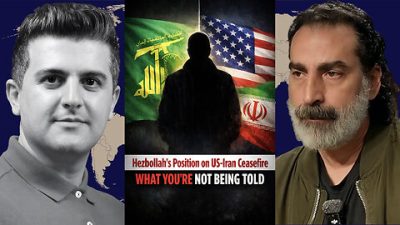
Laith Marouf: Hezbollah’s position on US-Iran ceasefire
or go to
Aletho News Archives – Video-Images
From the Archives
Is Israel to blame for the Iraq War?
American Goy | March 10, 2008
I am so tired of this old canard that “Israel had nothing to do with USA’s war with Iraq – in fact, it officially advised America against it”.
Bullshit. … continue
Blog Roll
 Aletho News
- Laith Marouf: Hezbollah’s position on US-Iran ceasefire: What you’re not being told
- Israel’s priority lies in destroying chances of peace between Iran, US: Ex-UN nuclear chief
- Ceasefire for all or for none: Iran shuts Hormuz over Lebanon attacks
- Strait of Hormuz is Iran’s ‘nuclear weapon’ that forced US retreat: Medvedev
- Energy crisis will last for months – Kremlin envoy
- Europe’s quiet role in the war on Iran
- Forty days that shook the Empire: How Iran turned the tables on US and prevailed
- Netanyahu unilaterally declares Lebanon outside of ceasefire deal
- Israeli leaders: ‘Not a single goal’ achieved in war with Iran
- What on earth just happened? Trump, Iran, and the unlikely ceasefire
- If Americans Knew
- Gazans face a triple crisis: severe shortages of water and bread, healthcare in tatters
- NY Times reports how Netanyahu took the US into Iran War
- A sigh of relief over Iran, but Gaza and Lebanon in dire straits – Daily Update
- Thousands dead and neighborhoods razed to the ground: Aid agencies fear southern Lebanon is becoming the new Gaza
- The war the US is fighting for Israel could cost trillions
- ‘Cigarette Burns, Nail Wounds’: Toddler Tortured in Gaza to Coerce Father
- Trump Says US Sent ‘a Lot of Guns’ to Protesters in Iran
- Israeli forces destroy 17 UN peacekeeper cameras in south Lebanon
- US-Israeli strikes ‘completely destroy’ synagogue in Tehran
- Archbishop for US Military Says Iran War Is Unjust Under Catholic Teaching
- No Tricks Zone
- An Inconvenient Tree: Uncovered In Alps… Europe Much Warmer Than Today 6000 Years Ago
- New Study Reports A 60% Slowdown In Greenland’s Ice Loss Rate In The Last Decade
- Low Intensity Tornado Wrecks Major Solar Farm, Creating A Potential Toxic Dump
- New Study Finds Warming Saves Lives…Cold Temperatures 12 Times More Deadly Than Excess Heat
- German Science Blog Accuses PIK Climate Institute Of Hallucinating Climate Tipping Points
- Devastating Assessment Of Comirnaty Vaccine By Former Senior Pfizer Europe Toxicologist
- New Study: CO2 Is ‘Effectively Negligible’ As An Explanatory Climate Change Factor Since 2000
- Former Pfizer Toxicologist Dr. Helmut Sterz Tells Bundestag Hearing Pfizer Vaccine Should Have Never Been Approved
- Energy Expert: Germany’s Nuclear Phaseout Was A “500 Billion Euro Mistake”
- New Research: South Australia’s Mid-Holocene Sea Surface Temperatures Were 4°C Warmer Than Today
 Aletho News