Trump press conference reveals a man who wants out of war
By Trita Parsi | Responsible Statecraft | March 9, 2026
Trump’s “all over the place” press conference at his Miami resort on Monday appears to have had two key objectives: a) Calm the markets by signalling the conflict may soon be over because it has been so “successful,” and b) Prepare the ground for Trump ending the war through a unilateral declaration of victory.
Though ending a war that never should have been started in the first place — rather than fighting it endlessly in the pursuit of an illusory victory as the U.S. did in Afghanistan — is the right move, it won’t be as easy as Trump appears to think.
Tehran also has a vote — and there is little to suggest that it will agree that the war is over.
Tehran objects to what it would consider a premature ceasefire out of fear that it would only give the U.S. and Israel time to regroup, rearm, and then re-attack Iran. For the conflict to be ripe for a ceasefire, Tehran believes that enough cost must have been inflicted on the U.S., regional states, Israel, and on the global economy that all states conclude that starting the war was a mistake — and as a result, no state will seek to restart it.
Moreover, if the war ends now, Iran will be in a worse situation than it was before the start of the war. Much of its infrastructure has been destroyed, its missile capabilities have taken hits, its ability to export oil has been damaged, and most crucially, its prospects for sanctions relief have been obliterated. Indeed, who will and can help rebuild Iran under these circumstances?
This would leave Iran not only in a weakened position but also in a continuously weakening state. Which, in turn, would make another war of aggression by the U.S. and Israel more, not less, likely, since it is Iran’s perceived weakness that prompted Trump and Israel to see an opportunity for war.
As such, it appears likely that Iran will continue to target Israel, even if the U.S. declares victory and withdraws its military. Even GCC states may continue to be targeted. And Tehran will very likely try to keep the Straits of Hormuz shut. (At least for now, there are no signs that Tehran has lost its ability to do these things).
This will create a dilemma for Trump. It will be difficult for him to stay out while Iran and Israel continue to go at each other. But if he reenters the war, the hollowness of his declared victory will have been revealed. Markets will react negatively, and all the costs Trump is currently trying to avoid will likely intensify dramatically.
Iran, of course, does not want, nor can it afford, an endless war. But it will likely demand some significant steps in order to accept a ceasefire. This may include a commitment from Trump not to restart the war (though I don’t understand the value of such a commitment). But more importantly, it will likely require sanctions relief and release of its frozen funds abroad.
Trump will, of course, bark, but if the outcome is continued war, that will put a lot of pressure on him. Here, the role of some GCC states may prove crucial due to their willingness and ability to find an arrangement that could leave both Trump and Iran feeling that they “won.”
Whether Israel will allow that to happen, of course, is a different matter.
Trita Parsi is the co-founder and Executive Vice president of the Quincy Institute for Responsible Statecraft.
When Tel Aviv decides, Washington fights
By Jamal Kanj | MEMO | March 9, 2026
American taxpayers are still hemorrhaging from the made-for-Israel war in Iraq, a war audaciously offered as one that would “pay for itself.” Instead, it was paid in Iraqi and American blood, ruins and financed by American debt. The promised democracy was a broken state, regional chaos, and the afterbirth of terror and resistance that continues to metastasize across the Arab world. Marketed as a short, decisive campaign, Iraq became a two-decade-long disaster with no exit in sight. Trillions were burned on lies manufactured by Israel-first Zionists in Washington, while generations of Americans—many not even born when the invasion began—were conscripted into inheriting the debt, the interest, and the moral stain.
The real balance sheet of that war is etched into nearly 5,000 American tombstones and the endless corridors of veterans’ hospitals. Before that blood-soaked bill is even paid, the very same architect, using the same lies, has succeeded again in dragging the U. S. into another made-for-Israel war, this time against Iran. Iraq was not an aberration; it was a rehearsal. Yet, Iran doesn’t appear to be the final act on the Israeli menu. In recent weeks, former Israeli prime minister Naftali Bennett declared that Turkey is next. And it is the U.S., not Israel, that is expected to keep paying for wars, America neither needed nor chose.
The evidence of who set the clock of this war is unmistakable. The most revealing admission did not come from Tehran, Moscow, or Beijing, but from the U.S. State Department. In an unguarded moment, the U.S. Secretary of State admitted that the timing of this war was not an American choice. This became painfully clear when the State Department was caught unprepared to help evacuate tens of thousands of Americans from the war zone.
As U.S. ambassadors hurried to evacuate their staff and families, desperate citizens were told their government could not assist and were advised to arrange their own departures, after airports had already closed.
This is not a minor detail. It’s a government that is willing to sacrifice the well-being and security of its citizens by joining a war decided by someone else. It goes to the heart of sovereignty and democratic accountability. A nation that chooses to go to war prepares its people, its diplomacy, and its logistics. A nation that is dragged into war improvises and hopes for the best.
Iran, for its part, is not the caricature often presented by the American Secretary of War and Donald Trump. It is a country prepared for drawn-out conflict and strategic patience. During the nearly eight-year Iran-Iraq War, Tehran fought a grinding, no-win war against a better-armed adversary. Against the expectations of Western military analysts, Iran endured. In a grim irony, it even committed the greatest of all sins: purchasing weapons from Israel, falling into Tel Aviv’s cynical strategy to weaken both Baghdad and Tehran simultaneously. Israel was willing to arm its supposed arch-enemy as part of its broader calculus of exhaustion and division.
That history matters today. Iran has demonstrated, repeatedly, a willingness to absorb punishment, and extend conflicts over time. At the end of the day, and by all means necessary, Iran is unlikely to surrender. In a protracted war of attrition to bleed the world economy, Tehran could move to close the Strait of Hormuz, an oil blood line for world economies. Iran may be economically battered, and it has been for decades under severe sanctions, but that very weakness reduces its restraint. A country with little left to lose is more inclined to impose pain on others, including Western and neighboring welfare oil economies dependent on uninterrupted energy exports.
Meanwhile, regional instability in the Gulf and prolonged American entanglement create the perfect parasitic symbiosis for Israel: a state that flourishes in the shadows of regional chaos like a scavenger thriving on the scrap of a landfill.
President Trump has suggested escorting oil shipments in the Strait to keep the oil flowing. The macho bravado may play well on television or for the stock market, but history, old and recent, offers daunting realities. The same was attempted during the Iraq-Iran war in the 1980s but failed. More recently, the U.S., the EU, and Israel combined failed to force a much smaller and poorer country—Yemen—to open the Red Sea. After months of bombardment, siege and naval pressure, Washington was forced into negotiations, and even then, Yemeni forces continued to block vessels linked to Israel until Gaza ceasefire.
The comparison is useful. The shorelines area under the Houthi control of the Red Sea (green map in the link) in the north of Yemen, is a much wider maritime passage. The Strait of Hormuz, by contrast, is so narrow in a clear day each shore is visible from the other. To borrow a simple image, in the Houthi area the width of the Red Sea is an Amazon River and where Hormuz is a stream. The narrowness of the Hormuz Strait makes control easier for Iran and exposes the vulnerability of U.S. naval ships. Before promising to escort commercial shipping, a responsible administration should ask a basic question: if a small, impoverished Yemen could not be subdued by the world’s most powerful militaries, how exactly will American warships be safer under the reach of fire in the narrower Strait?
There is another question Washington refuses to entertain: How will Americans feel when they realize they are risking lives, ships, and economic stability largely to advance Israel’s sole strategic objectives?
This is not an abstract question. It is a political and economic reckoning, purposefully delayed. Especially since Americans are still reeling from the cost of previous Israeli wars, and now, they are asked to take on a new national debt—$200 billion—to bankroll yet another war, especially made for Israel.
The made-for-Israel wars may have begun in Iraq but will not end with Iran. Israeli false flags are poised to provoke further escalations designed to entrap even states traditionally friendly to Tehran, such as Oman. For Israel, victory remains incomplete unless it drags Gulf Arab states into open confrontation with Iran, hardening divisions that may last generations. Iranian mistrust of the Gulf Arabs would likely endure even in the event of regime change. In this calculus, Israel “wins” not only on the battlefield, but by entrenching lasting hostility between Iran and the Arab world, ensuring a permanently fragmented region.
More than two decades ago, the illegal war against Iraq was cooked in the dens of the Pentagon by Israel-first ideologues and sold to the American public through the managed media, ruse and weapons of mass deception. The current war is, in some ways, even more brazen. It was exclusively designed in the war ministry offices of Tel Aviv, and Trump obliged.
This is not America’s war. The decision was made elsewhere, and timed elsewhere, fought on behalf of someone else to serve the strategic objectives of a foreign country. Washington has subordinated the American national interest to the tribal agenda of Israeli-firsters inside the Beltway. Simply put: Tel Aviv chooses the war, and Washington pays the bill.
Top official: Iran ready for a long war with US, no more diplomacy
Press TV – March 9, 2026
The head of Iran’s Strategic Council on Foreign Relations says the United States has proved that it does not know the language of diplomacy, and that Tehran is ready for a long war.
“I no longer see any room for diplomacy. Because [US President] Donald Trump deceives others and does not keep his promises, and we experienced this in two rounds of negotiations. While we were negotiating, they attacked us,” Kamal Kharrazi said in an interview with CNN.
However, he noted that the economic pressure could increase to the extent that other countries take action to guarantee the end of the US-Israeli aggression against Iran.
“The Persian Gulf Arab countries and other countries must put pressure on the United States to end the war,” Kharrazi stated.
Noting that this war has created a lot of economic pressure on others, in terms of inflation and energy shortages, he said: “If it continues, this pressure will increase, and thereby others will have no choice but to intervene.”
The US and Israel started a fresh round of aerial aggression on Iran on February 28, some eight months after they carried out unprovoked attacks on the country.
The attacks led to the martyrdom of Leader of the Islamic Revolution Ayatollah Seyyed Ali Khamenei.
The aggression was launched as Tehran and Washington had held three rounds of indirect negotiations in the Omani capital of Muscat and the Swiss city of Geneva and planned to open technical talks in Vienna, Austria.
Iran began to swiftly retaliate against the strikes by launching barrages of missiles and drone attacks on the Israeli-occupied territories as well as on US bases in regional countries.
How Iran’s Toxic Rain Reveals US-Israel Discord
By Ekaterina Blinova – Sputnik – 09.03.2026
The main Israeli goal is to cause as much chaos as possible and draw the US even deeper into the war, security expert Dr Simon Tsipis tells Sputnik.
US Energy Secretary Chris Wright accused Israel of bombing Iranian fuel depots, insisting the US targets no energy facilities.
Axios reports that the US was informed ahead of the Israeli attacks, but the huge scale of damage shocked Washington. The attack caused an environmental disaster with black acid rain in Tehran.
This situation reveals a divide between the allies, Tsipis said:
- Israeli forces behind Prime Minister Benjamin Netanyahu want to trigger a full-scale war in the Persian Gulf
- The US realizes it has been drawn into a project that has nothing to do with its own goals
“Israel has effectively set a trap for its long-time allies among American Christian evangelicals,” Tsipis says. “A strong opposition is growing within the US, openly declaring that the current course does not serve the nation’s interests.”
The US is taking most of the blame with Israel’s role forgotten, the pundit says.
“This creates enormous reputational risks for the US, turning it into a hostage of someone else’s strategy,” Tsipis says, “one that brings no benefit to the White House while forcing it to bear all the costs of supporting the conflict.”
Consequences:
- A regional conflict escalates into a global threat
- The US is caught in a strategic trap
- US allies in Europe are caught in a deepening crisis
- A rift is growing inside the US
- The reputational damage will have long-term consequences for US influence in the world
Trump Admits He Is Destroying Iran For Israel
The Dissident | March 9, 2026
In an interview with the Times of Israel, Donald Trump – in his usual fashion- said the quiet part out loud, and admitted that his goal is to destroy Iran on behalf of Israel.
He said, “Iran was going to destroy Israel and everything else around it… We’ve worked together. We’ve destroyed a country that wanted to destroy Israel.”
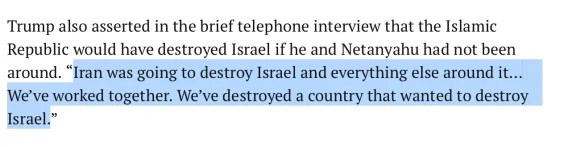
Trump has admitted that his real goal is to “destroy Iran”, the real motive behind the U.S. and Israeli attacks on Iranian civilian infrastructure.
As Mondoweiss noted , “ultimately, replacing the Islamic Republic is not the main objective, or even a desirable one. Rather, the goal in Iran is ethnic balkanization and a failed state. They don’t want to change the regime in Iran; they want to collapse the state itself. The purpose of military strikes is to disintegrate the state’s institutions, fueling ethnic tensions and secessionist movements, leaving Iran deeply divided and marred by civil war and sectarian violence — a parallel to 2015 Syria.”
However, despite admitting this, Trump is still lying.
Trump claimed that “Iran was going to destroy Israel”, but in reality, the only thing Iran was “destroying” was Israel’s bloodthirsty quest for Middle East dominance and the greater Israel project.
The bloodthirsty Neo-Con Senator Lindsay Graham, one of the lead architects of this war, who apparently coached Benjamin Netanyahu, “on how to lobby the president for action” admitted the real motive behind the war was to destroy all opposition to Israel, saying, “If we can pull this off, it would be the biggest change in the Mid East in a thousand years: Hamas, Hezbollah gone, the Houthis gone, the Iranian people an ally not an enemy, the Arab world moving towards Israel without fear, Saudi-Israel normalize, no more October the 7th”.
As the former UK diplomat, Craig Murray put it , “Iran has provided, directly and through proxies, the only military opposition to the creation of Greater Israel. This war is for Greater Israel.”
In reality, Trump is attempting to destroy Iran and turn it into a failed state because it was the last thing standing in the way of Israeli dominance over the Middle East and the greater Israel project.
Iran’s latest move in the GCC countries was a stroke of genius
By Martin Jay | Strategic Culture Foundation | March 9, 2026
After just a week into Donald Trump’s war, there is very little to report which should or could please the U.S. president. Much of America’s infrastructure in the Middle East has been destroyed with U.S. soldiers now housed by hotels in GCC countries as there is nothing left of their bases. The stocks that these countries have as part of their air defence systems is almost depleted as military chiefs argue about how quickly they can be replaced (some THAAD and Patriot systems are being shipped from Japan and South Korea) and Iran is hitting Israel harder and harder each day.
Of course, due to the new draconian rules which Israel has imposed — that no military strikes that Iran succeeds in carrying out can be ‘reported’ on by journalists or even citizens who wish to post it on social media — as well as the comically corrupt, partisan way U.S. news outlets are covering the war, very little bad news gets seen by the public, if any.
Under this set up, it is hardly surprising that Trump went to war, given that he must have factored in a great deal of support from U.S. media, whom he claims to despise. In this regard, we can conclude that media itself is complicit in war crimes, given that it has played a huge role in the decision to go to war and also the day to day reporting of events on the ground.
A good example of the few points of the war which are reported, but done in such a distorted way, is the news that Iran has stopped its bombing of GCC Gulf states. This has been presented as a victory by the U.S. and a climb down by Iran. The truth though is that it is a considerable victory for Tehran as what is not being reported or even examined is the deal that Iran has struck with those countries. None of those countries will allow any kind of military activity now by U.S. forces there, which means the thousands of U.S. soldiers in hotels in these GCC countries might as well head back home as their role there is redundant. Of course it’s unlikely that Trump will move them out as such an event will be captured by many on social media and will look like a great defeat. But some analysts are going further and speculating that there is more bad news for Israel and the U.S. with this latest move. Not only has Iran insisted on no activity at all in these countries by U.S. forces but they have also said that when the war is over, all the bases must be completely shut down.
Sadly, the gesture didn’t hold for long as it is rumoured that Iran’s elite guard was angered by Trump’s response and so the missile attack on the GCC countries continued.
Against a backdrop of rumours spreading throughout the middle east that Saudi Arabia, UAE and Qatar were considering jointly to completely pull out their investment in the U.S., this move, even as a gesture, couldn’t have come at a worse time for Trump.
His media machine is working overtime in spewing out so many fake news reports, like the recent one that the U.S. has total air superiority over Iran, that it will be interesting to see how this is spun in the coming days. But there is nothing but lies from the Trump camp and as a complicit western media scrum is happy to pump out these lies, people are obviously turning to social media or international news channels in the global south, like CGTN and Russia Today. For many Americans, they are simply too dumb to know how to even question the narrative. Where is the video footage to support these preposterous claims that American has air superiority over Iran? Within 24 hours of Trumps B2 bombers hitting nuclear sites in Iran last year in June, media were given video clips of the satellite imagery. So far, the claims by Trump’s people about air superiority, have not been matched with any evidence. None the less U.S. media reports it more or less like it is fact.
It’s a similar story with the claims about the U.S. navy sinking 20 Iranian vessels. Where’s the evidence? If we are to take into account completely defenceless ships like the unarmed frigate that was sunk in international waters after it returned from a joint exercise with India, it would seem that America is on the losing side. Not even Japanese naval strikes in the WWII would blow up enemies’ ships and not then pick up survivors. The Americans left 80 sailors to drown, the same seamen who posed with photos days earlier with Prime Minister Modi, who, it should be pointed out often claims that India is the “guardian of the Indian ocean”, a patently absurd claim. Many believe Modi sold the Iranians out and disclosed its position to the Americans, leaving many to question just how much he can be trusted with his present allies. Will Russia still sell its oil to India after such a betrayal?
It’s clear that the Iran war is already WWIII in many respects. Certainly each side has its partners and media have made much of Russia’s intelligence support to Iran pointing out American positions, while China has given Iran considerable military support both in state of the art radar systems and ground to air missile systems. The sinking of the Iranian ship shows us all the depth of the desperation of America, that it needs to go as far as hunting for Iranian ships thousands of miles away and sinking them, even if they are unarmed as this ship was. Does that look like the act of a confident aggressor on a victory role? Hardly.
It isn’t just that America can barely hold the high moral ground for even a brief, ephemeral media moment, but more that the number of shocking tactical errors by Trump are piling up and having an impact. The failure to see that killing the supreme leader, who has been replaced by a hard liner who has always wanted Iran to have a nuclear deterrent, was a major act of stupidity. Nearly all U.S. wars follow the same pattern of America underestimating its enemy and overestimating its own capabilities and this one is no exception. The move to bring GCC states closer to Iran and turn them against the U.S. is smart and what we could expect from Iran who has had years to prepare for this attack and has been given so many free lessons by America’s blunders — the best one being the June attack which resulted in Iran upping its game and identifying all the weak spots which needed work. The biggest miscalculation probably of all is going to war in the first place believing that regime change would be inevitable in days and therefore no longer-term plans, in terms of military stocks, need to be addressed. America is about to run out of ammo. For the GCC countries, it’s quite possible that the deal might be reinstated in the coming days as a new truth emerges from the war. While Donald Trump tells reporters on Air Force one that Iran was responsible for bombing its own school, GCC leaders will have to wake up to a new reality which is summed up by Henry Kissinger. “It may be dangerous to be America’s enemy, but to be America’s friend is fatal.”
Blackmail and death threats, Zelensky embarrasses the EU, but there’s no condemnation
By Finian Cunningham | Strategic Culture Foundation | March 9, 2026
The money-laundering Kiev regime has gone from cutting off oil supply for EU member states to now issuing death threats to heads of state – and all that the regime’s patrons in Brussels can do is squirm with embarrassment.
The latest twist in the corrupt regime of Vladimir Zelensky is his death threat to Hungarian Prime Minister Viktor Orbán.
That was then followed by the Hungarian authorities impounding an armed convoy transporting $100 million in cash and gold bullion from Austria over Hungary’s borders to Kiev – no doubt as part of the war mafia operating under Zelensky.
You couldn’t make this up. A comedian actor who used to dress up in high heels and played a soap-opera hero president is now ruling by decree as a dictator propped up by EU taxpayers, and only because of Brussels indulging in the largesse of their Russophobic obsessions. And now this fictive creation is threatening the assassination of elected leaders.
Zelensky didn’t mention Orbán by name, but in a press briefing last Thursday, he said that “the address of the person” (Orbán) who has blocked a proposed €90 billion loan from the EU to Ukraine was being given to “our military guys” who would “speak in their own language.”
The Hungarian prime minister denounced Zelensky’s words as a “threat to my life”. The country’s foreign ministry condemned the Ukrainian leader for “crossing all limits.”
Yet the European Union has not condemned Zelensky. A junior spokesman for the European Commission merely released a perfunctory statement, saying “that type of language is not acceptable… There must be no threats against EU member states.”
Where is a full-throated denunciation from European leaders like Commission President Ursula von der Leyen, or Kaja Kallas, the Commissioner for Foreign Affairs?
Let’s get this straight. Ukraine’s nominal president tells a head of an EU state that his name is on a hit list, and the bloc’s highest officials say nothing about that. They leave it to some low-level press officer to make a bland statement about it “not being acceptable.”
This shows how deeply corrupted the EU leadership has become in the proxy war racket in Ukraine against Russia. Threats of assassination are being made and played down out of embarrassment, not because such threats are a grave violation of international law.
The background is even more damning. Hungary and Slovakia are being subjected to energy blackmail by the Ukrainian regime because the countries have refused to terminate buying their oil supplies from Russia, as demanded by Brussels and Zelensky.
On January 27, the oil supply to Hungary and Slovakia was cut off after the Kiev regime claimed that a Russian drone strike damaged the Drushba pipeline carrying the oil over Ukrainian territory from Russia. Budapest and Bratislava have accused the Kiev regime of “energy blackmail.”
A Russian air strike did not hit the pipeline. Why would Russia deprive its customers? It doesn’t make sense, and Moscow rejected the claim.
As always, the question is: Who gains?
The Kiev regime has unilaterally cut the supply as a way to pressure Hungary and Slovakia into lifting their opposition to the EU donating more loans and military aid to Ukraine.
Tellingly, Ukraine has delayed supposed “repairs” to the Drushba pipeline. Hungary and Slovakia are facing a critical shortage of oil supply, which is destabilizing their economies. Kiev is even refusing to allow independent inspectors to assess the alleged damage. It’s obvious this is a set-up. There’s probably not even any physical damage other than turning off the pumps.
Last month, Orbán’s government caused a major upset in the European Union when it vetoed a proposed €90 billion loan from Brussels to Ukraine. The loan is seen as a vital lifeline to prop up the Kiev regime and extend the war. Budapest’s refusal was partly in response to the “energy blackmail.”
The block on the money supply has put Kiev and its EU sponsors in a quandary. The regime will not be able to keep fighting the war against Russia without more purchases of military equipment from NATO. Just as important, the block on the loan by Hungary means an obstacle to the money racket that the West has been running under the Zelensky regime, whereby billions of taxpayer funds get laundered into profits for corporations with a hefty cut for the Kiev mafia.
This would explain the bizarre convoy of cash and gold bullion that Hungarian authorities busted and impounded last Thursday. Two armoured vehicles were apprehended carrying $80 million in cash and $20 million in gold bars on their way to Ukraine from Austria. Among those detained were former Ukrainian intelligence officials.
The physical transport of such large amounts of funds, rather than by electronic bank transfer, indicates that the funds were meant not to be traced. The finding exposes once again the illicit money laundering by Zelensky’s regime. This is not in the least bit surprising, given the repeated scandals of corruption and embezzlement in Kiev under Zelensky and his circle, who have acquired luxury portfolios of overseas properties over the last four years.
Hungary and Slovakia are the only EU members out of 27 nations that have shown any principles about stopping the proxy war in Ukraine and ending the racket of robbing European citizens and saddling future generations with astronomical debts.
For taking that stand, the Brussels leadership has turned a blind eye to the Kiev regime’s cutting off oil supplies and using energy blackmail. Now the regime has gone even further to issue death threats to a European head of state, and the Brussels elite has effectively said nothing.
What the EU’s proxy war sponsors seem more concerned about is that their overindulged, corrupt puppet in Kiev is a public relations embarrassment. The blatant criminality of terroristic blackmail and death threats betrays the complicity of the EU’s leadership.
Von der Leyen, Kajas and the Brussels elites are more worried that Zelensky’s mafia threats might rebound by galvanizing Hungarians to vote for Orbán’s party in parliamentary elections next month.
Their message is: you can launder millions, use blackmail and issue death threats. Just don’t make it obvious.
Israel threatens to kill Iran’s new leadership
RT | March 9, 2026
The Israel Defense Forces (IDF) has threatened to assassinate anyone who replaces the slain Ayatollah Ali Khamenei as Iran’s supreme leader.
Khamenei and several other senior Iranian officials were killed in the first wave of US‑Israeli airstrikes launched on February 28. After a week of deliberations, the Assembly of Experts, a body of clerics tasked with vetting and selecting the new supreme leader, announced on Monday that Khamenei’s son, Mojtaba, has been chosen to succeed him.
In a statement posted to the IDF’s Farsi account hours before the Assembly announced its decision, the Israeli army issued a warning to its members.
“The hand of the State of Israel will continue to pursue every successor and every person involved in his appointment,” the IDF said, adding that it “would not hesitate to target” the clerics attending the assembly’s meetings.
Last week, Israel struck the Assembly’s headquarters in Qom, but the attack failed to derail the selection of a new leader. Ali Larijani, Iran’s top security official, said Mojtaba Khamenei’s appointment demonstrates that the US and Israel failed to use Ali Khamenei’s death to sow chaos in the country.
US President Donald Trump and Israeli Prime Minister Benjamin Netanyahu both cited regime change as one of their war goals.
Trump has demanded unconditional surrender and said the next supreme leader will not “last long” unless Iran bows to his demands. Iranian officials and the military have vowed to continue their resistance.
Possible Scenarios for the Middle East
By Yuriy Zinin – New Eastern Outlook – March 9, 2026
The US and Israeli aggression against Iran has pushed the Middle East to the verge of exploding. It has ignited regional media discourse, which presents various assessments of the situation and its consequences.
According to a major regional portal, Middle East Online, these assessments can be divided into two categories. One group tends to support the idea of Israel’s overwhelming superiority and its control over the region’s key institutions. They also believe the predictions of the Lebanese astrologer Layla Abdel Latif. The other group offers alternative scenarios, including those pointing to an Iranian victory and the collapse of the Trump-Netanyahu alliance.
Who is to blame for the war and how long it will last
Two main themes are of particular interest to commentators: who is responsible for this operation and how long will the confrontation between the two antagonistic sides last? One of the mediators, Omani Foreign Minister Badr bin Hamad Al-Busaidi, speaking on CBS television, revealed that Iran had accepted the zero enrichment condition and was ready to move its stockpiles outside its territory. However, this effort was in vain; Washington did not hear it.
It is clear that the adversaries’ balance of potential and military arsenals are disproportionate and favor the aggressors. Nevertheless, according to many experts, technological superiority does not guarantee a swift victory for the US. Trump left Tehran no chance for retreat, and Iran is acting in accordance with the logic of attrition, not traditional doctrine. Iran’s arsenal of ballistic missiles and drones, as well as the use of allies on Arab bridgeheads, allows it to open several fronts and turn the war against it into a costly and prolonged endeavor. Therefore, Tehran is betting on dragging things out until the military pressure becomes a political burden for its opponents.
Western intelligence services were too slow
Analyzing the situation, an Arab newspaper claims that Western intelligence services failed to properly assess Iran. Their attack plans were based on the assumption that “decapitating” the leadership would deprive Tehran of the will to launch retaliatory strikes. But events have shown that these intelligence agencies overlooked the quiet restoration of Iran’s potential, which began in 2025.
In addition, Iran’s opponents did not take into account the fact that, in Islamic tradition, the killing of a spiritual leader is often perceived not as his end, but as a transition to martyrdom. Usually such losses do not disorganize society but, on the contrary, mobilize it and give it strength.
Many analysts believe that Iran has demonstrated its ability to overcome this shock and recover institutional cohesion, having formed a temporary tripartite leadership including reformers, the Iranian Revolutionary Guards Corps, and the bureaucratic religious elite. Despite limited capabilities compared to the US, Iran retains significant regional influence. At the same time, some fear that an Iran weakened by the US and Israel could strategically destabilize the countries that rely on Tehran for security purposes.
Countries in the region reject US military involvement
This war was unleashed by Washington for the sake of Israel and for goals that are not accepted by the countries of the region, concludes the Arab As-Sabil newspaper. Washington ignored all calls, efforts, and negotiations aimed at preventing it. According to analysts, this places Arab states at the epicenter of pressure, requiring high political acumen in matters of national security demands in order to avoid being drawn into axes that could lead to a larger confrontation. America’s investment in its military assets has actually damaged regional stability and the interests of the countries of the region. Military assets, including bases and partnerships, have become nothing less than a curse for the countries in the region and a cause of undermining its security.
“Trump’s noble mission for the future” – rhetoric repeated at the White House – is nothing more than a grand gamble based on the assumption that overseas power is capable of changing history. This may provoke unforeseen reactions from other international powers, which perceive such behavior as a dangerous American unilateral approach to the demands and fate of global energy and logistics.
Not just a war, but a deep transformation
Regional analysts find that part of society is shocked as the predictions they hear in the evening are irrelevant by the morning, with multiple new scenarios spawning. Today a massive new war looms in the region. This war is not a traditional conflict between two sides, but rather a brief moment that will determine the region’s landscape for decades to come. An Arab author fears that it is not just a clash; it is a deep strategic transformation that is turning the region into a quagmire where blood, chaos, and miscalculation are constant.
Yuri Zinin, PhD in History, Senior Research Fellow at the Institute of International Studies, Moscow State Institute of International Relations (University), Ministry of Foreign Affairs of the Russian Federation
Follow new articles on our Telegram channel
The Horizon of the War. “Italy is being Dragged Into the War against Iran”
By Manlio Dinucci | Global Research | March 9, 2026
Contrary to what the Italian Government says, the United States does not need authorisation from the Italian Government or Italian Parliament regarding the use of its bases in Italy.
In fact, it has complete freedom to use them as it wishes.
By using Sigonella as an intelligence centre for the war against Iran, the United States is protecting itself, but is also dragging Italy into the war and exposing it to the risk of being targeted.
We refer our readers to this episode of Grandangolo, focusing the following notes on the key issue we are facing in Italy. Defence Minister Guido Crosetto himself, in his reply to the House of Commons, described the war that has broken out in the Middle East as follows:
“Of course it was outside the rules of international law. It is a war that started without the world’s knowledge and that we now find ourselves having to deal with. Our problem is to manage the consequences of a crisis that has erupted and that we did not want.” Prime Minister Giorgia Meloni, in a radio programme, admitted that the war entails a “risk of escalation that could have unpredictable consequences”.
Meloni’s stance on US bases in Italy
Regarding the use of these bases, Meloni assured that “we are complying with the 1954 bilateral agreements”. She then clarified: “In Italy, we have three military bases granted to the Americans under agreements dating back to 1954, which have always been updated.” We therefore request that the Prime Minister show Parliament and the media the texts of the 1954 bilateral agreements between Italy and the United States, as well as any subsequent updates. This will not be easy, as these agreements are covered by military secrecy in their entirety. Regarding Meloni’s statement that “in Italy, we have three military bases granted to the Americans”, she should explain the following facts to Parliament and the media.
According to the official Pentagon Base Structure Report, the US Armed Forces own more than 1,500 buildings in Italy, with a total surface area of over 1 million square metres, and lease or have concessions for another 800 buildings, with a surface area of approximately 900,000 square metres. That’s a total of over 2,300 buildings with a surface area of approximately 2 million square metres, spread across some fifty sites. But this is only part of the US military presence in Italy. In addition to US military bases, there are NATO bases under US command and Italian bases available to US/NATO forces. It is estimated that there are over a hundred in total. The entire network of military bases in Italy is, directly or indirectly, under the command of the Pentagon. It falls within the “area of responsibility” of the United States European Command, headed by a US general who also holds the position of Supreme Allied Commander in Europe. In other words, the United States does not need any authorisation from the Italian government or Parliament to use this network of bases, but has complete freedom to use it whenever and however it wants.
With the US base in Sigonella, Italy is being dragged into the war against Iran
This is confirmed by the United States’ use of the Sigonella base in Sicily. The Naval Air Station (NAS) Sigonella, with a staff of about 7,000 military and civilian personnel, is the largest US and NATO naval and air base in the Mediterranean region. In addition to providing logistical support to the US Sixth Fleet, it is the launch base for covert military operations mainly, but not exclusively, in the Middle East and Africa. The NAS – according to the official presentation – “houses US and NATO aircraft of all types”. These include spy drones, capable of flying without refuelling for over 16,000 kilometres, which carry out missions from Sigonella to the Middle East, Africa, eastern Ukraine, the Black Sea and other areas. Drones armed with missiles and satellite-guided bombs also take off from Sigonella for targeted (always secret) attacks. The Naval Air Station Sigonella is complemented by the Italian base in Augusta, which supplies fuel and ammunition to US and NATO naval units, and by the port of Catania, which can accommodate up to nine warships. The Sigonella base is connected to the MUOS station in Niscemi (Caltanissetta): a very high frequency military satellite communications system consisting of four satellites and four ground stations: two in the United States, in Virginia and Hawaii, one in Australia and one in Sicily, each equipped with three large parabolic antennas 18 metres in diameter. This system allows the Pentagon to connect submarines and warships, fighter-bombers and drones, military vehicles and ground units to a single command and communications network while they are on the move anywhere in the world.
Italmilradar, a website specialised in tracking military flights, reports based on radar tracks: “In recent days, several US Navy MQ-4C Triton surveillance drones have been spotted flying to and from the Sigonella military airbase, operating over the Eastern Mediterranean and heading towards areas closer to the Persian Gulf. Normally, when Tritons are engaged in monitoring the Gulf region, they are deployed on the front line at bases in the United Arab Emirates, particularly in Abu Dhabi.
From there, the drones can conduct ISR (Intelligence, Surveillance and Reconnaissance) missions over the Strait of Hormuz, the Gulf of Oman and the Northern Arabian Sea.
Using the Tritons from Sigonella increases the distance from operational areas, but provides a safer and more politically stable launch base. By keeping the drones in Sicily, the US Navy can reduce the risk to its ISR infrastructure. Sigonella has long been a central hub for US and NATO intelligence operations in the Mediterranean.
In the current crisis, Sigonella appears to be playing an even more important role, serving as a rear but highly capable ISR platform in support of operations extending from the eastern Mediterranean to the Gulf. The meaning is clear: by using Sigonella as an intelligence centre for the war against Iran, the United States is keeping itself safe, but in fact dragging Italy into the war and exposing it to the risk of being hit.
This article was originally published in Italian on Grandangolo, Byoblu TV.
Manlio Dinucci, award-winning author, geopolitical analyst and geographer, Pisa, Italy. He is a Research Associate of the Centre for Research on Globalization (CRG).
A Second Vietnam War? Hanoi Waits and Prepares
By José Niño | The Libertarian Institute | March 9, 2026
On the surface, everything between Vietnam and the United States looked better than it ever had. In September 2023, President Joe Biden and General Secretary Nguyễn Phú Trọng signed a Comprehensive Strategic Partnership, elevating relations to their highest diplomatic tier. American officials toasted prosperity. Vietnamese leaders smiled for cameras. The messaging suggested a new chapter in a relationship once defined by napalm and body counts.
Then, in early February 2026, a very different story emerged from behind the curtain. The 88 Project, a U.S.-based human rights organization focused on Vietnam, exposed a classified internal military document that shattered the diplomatic facade. The revelation was subsequently covered by AP News, The Diplomat, and Le Monde. Vietnam’s Foreign Ministry did not respond to requests for comment.
The document bore the formal designation 357/KH-BTL and carried the title “The 2nd U.S. Invasion Plan.” Signed by Vice Admiral Tran Thanh Nghiem and certified by Rear Admiral Vu Van Nam, it was issued by Vietnam’s Navy Command in August 2024, months before Donald Trump returned to office for his second term. Its contents painted a picture of a government that publicly embraced Washington while privately treating it as the gravest threat to its survival.
Vietnamese military planners described the United States in the document as a “belligerent” superpower with a pattern of “creating a pretext” to launch wars against nations that “deviate from its orbit.” The plan acknowledged that the present risk of armed conflict remained low, yet insisted that America’s aggressive nature demanded constant vigilance.
The operational scenarios imagined within the plan read like something from a Cold War thriller. Vietnamese planners envisioned a full-scale American assault involving two to three aircraft carrier strike groups, three to four Marine brigades, and amphibious landings along the country’s vast coastline. In the most alarming passage, the document speculated that if conventional methods failed, the United States “may use biochemical and tactical nuclear weapons.”
Vietnamese analysts traced what they saw as an escalating pattern across three administrations. They pointed to President Barack Obama’s pivot to Asia, Trump’s first term (described as inciting an arms race), and Biden’s institutionalization of the Indo-Pacific Strategy. All of it, according to Le Monde, was portrayed as Washington forging a united front against China.
Ben Swanton, co-director of The 88 Project and author of the analysis, emphasized that this thinking was not confined to one paranoid faction. “There’s a consensus here across the government and across different ministries,” he told AP News. “This isn’t just some kind of a fringe element or paranoid element within the party or within the government.”
Perhaps the most revealing element in the plan was how Vietnam’s military ranked its adversaries. According to The Vietnamese Magazine’s analysis, China occupied the position of a “Category 3” adversary. That meant Beijing was seen as a territorial rival that contested borders and maritime claims but did not threaten the Communist Party’s hold on power.
The United States occupied a far more dangerous position. American power was classified under “Category 1” and “Category 2” designations, meaning Washington represented an existential threat to the regime itself. In the eyes of Vietnamese military planners, China wanted territory. America wanted the party gone.
This distinction carried explosive implications. Nguyen Khac Giang of Singapore’s ISEAS-Yusof Ishak Institute, speaking about the Communist Party’s conservative and military-aligned faction, told AP News that the military had “never been too comfortable moving ahead with the Comprehensive Strategic Partnership with the United States.” The tensions had already surfaced publicly in June 2024, when an army television report accused the American-linked Fulbright University of fomenting a “color revolution.” The Foreign Ministry defended the university, which American and Vietnamese officials had highlighted when the two countries upgraded ties, but the episode revealed how deep institutional suspicion ran.
The most dangerous element in the leaked plan was never the fantasy of aircraft carriers and nuclear weapons. It was the way the document conflated civil society with warfare. Vietnamese planners drew explicit parallels to Ukraine’s 2004 Orange Revolution and the Philippines’ 1986 Yellow Revolution, portraying the American promotion of freedom, democracy, and human rights as opening salvos designed to “undermine and ultimately dismantle Vietnam’s socialist political system.”
By branding activists, journalists, and pro-democracy reformers as foot soldiers in a CIA-directed Color Revolution, the Communist Party of Vietnam (CPV) used this subversion as a pretext to justify a major domestic crackdown. Starting around 2020, the CPV mobilized all branches of government to “prevent the US and its allies from fomenting a color revolution in the country,” according to a report by Le Monde. Advocacy for religious freedom or labor rights became, in the party’s framing, acts of war.
None of this meant Vietnam was irrational, or even unusual. Military contingency planning for worst-case scenarios is standard practice everywhere. Even the leaked document itself acknowledged that war remained “low risk.” The United States maintains its own history of drafting invasion plans against allies, from “War Plan Red” for Canada in the 1930s to plans to seize Middle Eastern oil fields in 1973. The “Hague Invasion Act” of 2002, still active, authorizes the president to use military force to free U.S. personnel held by the International Criminal Court. Washington’s abduction of Venezuelan President Nicolás Maduro in January 2026 only deepened Vietnamese fears that the pattern was accelerating.
Vietnam’s foreign policy framework reflected this pragmatic paranoia. Hanoi’s famous “Four Nos” defense policy, reaffirmed by Prime Minister Phạm Minh Chính in August 2023, pledged no participation in military alliances, no siding with one country against another, no foreign military bases on Vietnamese soil, and no use or threat of force in international relations. Under this doctrine, Vietnam maintained comprehensive strategic partnerships with the United States, China, and Russia simultaneously. The approach, often described as “bamboo diplomacy” after a metaphor coined by the late General Secretary Trọng, allowed Hanoi to bend with shifting geopolitical winds without breaking.
The history of the Vietnam War gave these calculations a visceral dimension. The conflict killed approximately 3.1 million Vietnamese people according to the government’s own 1995 estimates, including roughly two million civilians. The National Archives records 58,220 American military fatalities. That staggering asymmetry reflected the reality of a war fought entirely on Vietnamese soil with industrial-scale firepower. For Vietnamese military planners, the idea of a second American invasion was not a paranoid abstraction. It was a memory that shaped every calculation they made.
It doesn’t help that the United States has a long track record of intervening and destabilizing countries in all corners of the globe. Such a track record of U.S. perfidy is being considered by Vietnamese strategists. Washington will dismiss this document as the paranoia of aging generals. Hanoi will pretend it never existed. But somewhere between the diplomatic toasts and the classified war games, the truth sits undisturbed. Vietnam remembers what America did the first time. And with a track record of interventions stretching from Guatemala to Venezuela, the United States has given Hanoi every reason to believe it could happen again.
Featured Video

The Most Important Bet You’ve Never Heard Of
or go to
Aletho News Archives – Video-Images
From the Archives
Wars for Israel: A reminder of who’s giving the marching orders
By Damian Lataan | February 7, 2012
As the West prepares to march off to yet another war in the Middle East, we should perhaps remind ourselves of who is giving the West their marching orders.
In February 2003, just weeks before the US and their allies launched their attack on Iraq and her peoples, a delegation of US congressmen, together with the US Ambassador to the United Nations, John Bolton, a well known pro-Zionist and neoconservative war-hawk, were in Israel at the invitation of the Israeli government then led by Israeli Prime Minister Ariel Sharon.
Addressing the congressmen, Sharon told them ‘that Iran, Libya and Syria should be stripped of weapons of mass destruction after Iraq’. Later, Sharon told John Bolton ‘that Israel was concerned about the security threat posed by Iran, and stressed that it was important to deal with Iran even while American attention was focused on Iraq’. … continue
Blog Roll
 Aletho News
- IRGC hits US tech giant Oracle’s data center, computing site in UAE over new assassinations
- Bombing Iran Back Into the Stone Age /Lt Col Daniel Davis & Jim Jatras
- UAE rejects report claiming it is ready to join war on Iran to reopen Hormuz
- A New Resistance Front: How Does Syria Factor into the Regional War?
- Gulf states weigh pipeline expansion plans, hoping to bypass Hormuz
- Iran sets up ‘tollbooth’ system in Strait of Hormuz
- Wave 90: IRGC strikes US-linked industrial sites in Gulf
- Iran Says US-Israeli Claims of Its Military Strength Are Wrong
- Trump’s April Fools’ Address to the nation
- The Most Important Bet You’ve Never Heard Of
- If Americans Knew
- ‘War crime’: Global condemnation as Israeli ministers celebrate death penalty law targeting Palestinian prisoners
- 7 Ways Israel Is Turning Lebanon Into Gaza
- World’s Leading Football Bodies Under Fire Over Israel Policies
- Experts warn of possible use of nukes against Iran
- Israeli invasion of Lebanon could be worse than 1982, warn European officials
- Passover: Liberation and collective punishment
- Trump says the quiet part out loud: (Israel’s) war on Iran > Americans’ health – Daily Update
- Gaza families reunite years after babies evacuated amid Israel’s war
- International Rescue Committee warns Gaza’s children face grave protection risks
- Iran’s Alleged 47-Year War on America: Debunking the 1,050 American Deaths Canard
- No Tricks Zone
- Low Intensity Tornado Wrecks Major Solar Farm, Creating A Potential Toxic Dump
- New Study Finds Warming Saves Lives…Cold Temperatures 12 Times More Deadly Than Excess Heat
- German Science Blog Accuses PIK Climate Institute Of Hallucinating Climate Tipping Points
- Devastating Assessment Of Comirnaty Vaccine By Former Senior Pfizer Europe Toxicologist
- New Study: CO2 Is ‘Effectively Negligible’ As An Explanatory Climate Change Factor Since 2000
- Former Pfizer Toxicologist Dr. Helmut Sterz Tells Bundestag Hearing Pfizer Vaccine Should Have Never Been Approved
- Energy Expert: Germany’s Nuclear Phaseout Was A “500 Billion Euro Mistake”
- New Research: South Australia’s Mid-Holocene Sea Surface Temperatures Were 4°C Warmer Than Today
- Storing Green Energy To Last Germany 10 Days Would Require A 60-Million Tonne Battery
- New Studies: UK Sea Levels Were 4 Meters Higher Than Today During The Mid-Holocene
 Aletho News
