Iranian model of warfare bleeds US dry while Persian Gulf states watch and learn: Analyst
Press TV | March 16, 2026
Sixteen days into the American-Israeli war on Iran, the battlefield tells a story that Pentagon planners had not anticipated. Tehran’s streets remain filled with defiant crowds, the Strait of Hormuz remains closed for US-linked ships, and the US military bases in the region smolder.
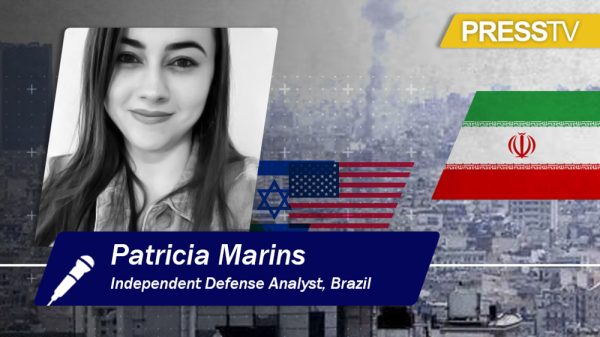
Patricia Marins, an independent defense analyst based in Brazil, has been following the war unfold with a keen eye on the shifting strategic balance.
In an interview with the Press TV website, Marins said she has been witnessing the emergence of something the region has never quite witnessed before: the “Iranian model” of warfare proving itself against the world’s most powerful military.
“The Iranian model possesses several distinct characteristics compared to the American model exported to Arab countries. It is built for attrition warfare and resilience, featuring an extensive network of underground facilities and a focus on long-range precision-guided munitions,” she stressed.
“All of this was achieved through investment in research centers, universities, reverse engineering, and the steady implementation of a domestic defense industry, which in many respects is dual-use.”
On the other hand, the American model exported to the Persian Gulf countries consists of “vulnerable surface installations, almost no degree of indigenous production, and consequently a disconnect between research centers, reverse engineering, and the military industry,” which Marins added is not limited to the US model, but all Western models.
“Kuwait paid over $310 million for each Eurofighter Typhoon, nothing short of extortion,” she said, making a clear distinction between the American and Iranian models.
Today, amid the war that was triggered by the unprovoked US-Israeli attack on February 28, and the assassination of the Leader of the Islamic Revolution, Ayatollah Seyyed Ali Khamenei, and some top-ranking military commanders, that investment is paying dividends.
Marins believes the contrast in the military tech leap is not lost on regional observers.
“I believe this Iranian model is being closely watched by all (Persian) Gulf countries at this moment. I see a high probability of it serving as a reference in several areas. I even believe it has inspired the Saudi missile industry, which is currently absorbing Chinese technology,” she said.
“Iran inspires, yet it still maintains a guarded distance from the (Persian) Gulf countries in this sector.”
Beyond the missile and drone arsenal, Iran also enjoys the geographical advantage, the Brazilian analyst stated.
“Iran’s advantage begins with its geographical position, but it is confirmed by its military prowess. And Iran knows how to leverage both very effectively,” she said
She referred to the Ghadir-class submarine, which is affordable, stealthy, and designed specifically for the waters it operates in – the Persian Gulf – especially in the Strait of Hormuz.
The Strait’s “shallow, high-salinity, and high-temperature conditions create a challenging, noisy, and complex environment for sonar, favoring small, fast, and highly maneuverable platforms,” she asserted.
“It is the perfect marriage between the weapon and the environment in which it operates,” she said. “Iran knows how to use the geography that already favors them.”
Then there is Yemen as well, which has indicated willingness to join the front against the US and Israel, after the Lebanese Hezbollah resistance movement and Iraqi resistance groups.
“Iran has been a master player. Knowing that by maintaining influence in Yemen, in a situation like this, they could exert power over both straits,” Marins said.
“However, all of this requires prudence and maturity.”
With the Strait of Hormuz effectively closed already for the US and its allied vessels, if Yemen’s Ansarullah movement follows through and shuts down the Bab el-Mandeb strait as well, the costs would be abysmal, she noted.
“This would expand the conflict on that axis to European countries, as has already occurred. I believe Iran is weighing the necessity of this escalation and whether it is truly required. While Hormuz involves oil and gas, Bab el-Mandeb involves the flow of goods between the West and Asia,” Marins remarked.
“If this strait is closed, it will have a massive economic impact. I see Iran as prudent and disciplined as a nation must be during a war.”
While media reports have cited figures of $1 billion per day for American attacks, with one estimate putting the first six days at $11 billion, Marins believes the true cost is far higher.
In her projections, she suggests the costs for the US could reach a colossal $360 billion within two months if the war continues unabated, a sum that she stresses “would test the patience of any treasury, let alone American taxpayers already feeling the pinch of soaring oil prices.”
“Israel’s operations during the 12-day war generated a daily cost of around $700 million. However, by the end of the war, once the costs of interceptors and damages were added, this daily cost hit nearly $2 billion,” she told the Press TV website.
“I believe this will be Israel’s cost, but the American cost so far is triple that due to three factors: the number of interceptors expended, the quantity of missiles and guided bombs used, and the cost of damages to bases and radars.”
When these factors are combined, Marins noted, the cost is expected to be “no less than $6-8 billion daily during these two weeks of war.”
On reports that Trump’s advisors are advising him to declare victory and find an exit, Marins doubts the American victory in this war is even possible.
“I don’t think so. I see Iran in a much better strategic position to win the conflict. As long as Iran maintains control of the strait, the pressure will be on Donald Trump’s shoulders, no matter how many bombs he drops,” she said.
But beneath that tactical reality lies a deeper truth about the nature of this war. Iran has demonstrated a capacity to absorb bombings while being resilient, limiting drone actions over its territory, and fighting an asymmetric war on its own terms, Marins said.
“So far, I believe Iran has conducted an asymmetric war with very few mistakes,” Marins said. “One that the US and Israel simply don’t know how to fight.”
IRGC orders ‘defeated’ US to evacuate industrial facilities in region
Al Mayadeen | March 16, 2026
The Islamic Revolution Guard Corps (IRGC) has issued a warning to the “defeated US regime,” demanding the evacuation of all American industrial facilities in the region.
The IRGC also called on residents living near US-linked factories to leave the area for their safety, emphasizing that these industrial sites are expected to come under attack in the coming hours.
IRGC’s 56th wave targets strategic Israeli stockpiles, Al-Udeid base
Earlier today, the IRGC announced the launch of the 56th wave of its Operation True Promise 4, targeting key Israeli military infrastructure and a US military installation in the region.
In a statement issued by its Public Relations office, the IRGC said the latest wave of operations was dedicated to martyr Qassem Soleimani, the former commander of the IRGC’s Quds Force, who was assassinated in a US drone strike in January 2020, as well as fighters martyred during battles in defense of the nation’s sanctities.
Stockpiles, airbase hit with precision
According to the statement, the operation targeted several strategic locations in the Israeli-occupied territories, including the Southern Region Support Command and a strategic missile storage facility belonging to Rafael Advanced Defense Systems in the northern occupied territories.
The IRGC said the strikes were carried out using heavy and precision-guided ballistic missiles, including Khorramshahr-4, Emad, and Ghadr missiles, stressing that the designated targets were hit with precision.
The statement also said the attacks extended to the US military presence in the region, noting that the US-operated al-Udeid Airbase was struck during the operation.
Hegseth’s call for ‘no mercy’ to Iranians deemed war crime
The threat to take no prisoners in a conflict is illegal under US and international law
RT | March 16, 2026
US War Secretary Pete Hegseth is facing accusations of violating domestic and international laws prohibiting war crimes by declaring that “no quarter” or mercy would be given to Iranian forces.
The legal definition of the term means surrendering Iranian soldiers would be executed by American troops rather than taken prisoner. US officials and legal experts have responded by accusing Hegseth of encouraging war crimes.
”We will keep pressing. We will keep pushing, keep advancing. No quarter, no mercy for our enemies,” Hegseth said at a press briefing on Iran on Friday.
Some US officials and legal scholars have argued that the remarks went beyond tough rhetoric and strayed into criminality.
Senator Mark Kelly of Arizona blasted Hegseth, saying his comment “isn’t some wannabe tough guy line” but rather an illegal order that jeopardizes US military service members. It also shows “there was never a clear strategy for this war,” the lawmaker added.
Dan Maurer, a retired US Army lieutenant colonel and judge advocate, published a hypothetical memo Hegseth should receive from the Pentagon legal counsel, informing him of criminal liability for himself and any subordinate who followed his directive to deny quarter.
The Hague Convention and the Geneva Convention forbid harming enemy combatants unable to defend themselves or who have surrendered and explicitly prohibit declaring “that no quarter will be given.”
These rules are enshrined in US domestic law. The 1996 War Crimes Act directly cites the article banning “no quarter” in its definition of war crimes.
The US military has prohibited orders to take no prisoners since 1863, when US President Abraham Lincoln issued the Lieber Code during the Civil War.
Hegseth has previously dismissed concerns about international law, claiming he would not abide by “stupid rules of engagement” and “politically correct wars.”
His remarks also come two weeks after a US strike on a girls’ school in southern Iran that killed more than 170 people, most of them children.
Iran War Exposes Limits of US Military Power – Journalist
Sputnik – 16.03.2026
The United States does have great firepower, but it is still far from the strongest country in the world, veteran war correspondent Elijah J. Magnier tells Sputnik.
Despite Iran being forced to endure “47 years of maximum pressure and sanctions,” Magnier points out, the US still cannot best it and is forced to ask other countries to help open the Strait of Hormuz.
“We see the strongest country in the world and the strongest army in the Middle East – that is Israel- fighting Iran and not managing to achieve their objectives and calling for help and support from the Europeans and from NATO,” he observes.
The United States’ military presence in the Middle East has also been put into question as the US can neither protect its military bases in the region nor defend the countries that host these facilities.
“I think the image of the United States has received severe damage much more than the damage inflicted on Iran,” Magnier adds.
To add insult to injury, the US and Israel found themselves unable to achieve any of their stated objectives – be it the destruction of Iran’s missile program or the dismantling of the Iranian nuclear program.
Meanwhile, Trump’s claims that the US wiped out Iran’s entire missile capability don’t hold water either, as Iran regularly provides ample evidence to the contrary in the form of multiple missile launches.
Even The Neo-Cons Admit The Iran War Is Failing
The Dissident – March 16, 2026
The current U.S./Israeli war on Iran is, in many ways, a product of the policies long advocated by U.S. neoconservatives, most importantly the clean break strategy drafted by the Project for a New American Century (PNAC), which advocated taking out “Iraq, and then Syria, Lebanon, Libya, Somalia, Sudan, and, finishing off, Iran” on behalf of Israel.
But many of the original Neo-cons who first drafted this plan, including John Bolton and even Robert Kagan and Bill Kristol, the founders of the Project for a New American Century, are now jumping ship and admitting that the U.S./Israeli war on Iran is failing.
In an interview with NPR, longtime Neo-con John Bolton, despite saying he has “been a supporter of efforts at regime change in Iran for a long time” was forced to admit that the regime change plan has failed and that the U.S. underestimated Iran’s response.
Bolton was forced to admit that Trump underestimated Iran’s ability to effectively close the Strait of Hormuz and disrupt oil shipping in response to the U.S/Israeli bombing, saying:
… it was questionable whether he was cooperating effectively with and assisting the opposition inside Iran. That’s what I said, I think, in our last conversation. Since then, I’m very worried that there are now signs that they haven’t thought about a lot of other things. For example, there’s reporting that the White House was surprised at how quickly oil prices went up.
And all I can say to that is I’m surprised that they’re surprised. If they weren’t planning for that both economically, politically and militarily, then that’s a huge hole in the planning. I am worried that they apparently didn’t take as seriously as they should have the potential to mine the Strait of Hormuz. Trump said several days ago that the Iranian navy had been completely destroyed. And despite years of listening to that kind of thing, I should have known better. I actually sort of believed in for a while. But now we learned that it was only yesterday that we got around to destroying 16 mine-laying vessels. Of course, they’ve got the capability to mine via drones going over the strait and dropping mines in it.
Even more shocking than Bolton’s admission was a podcast released by the founders of PNAC, Robert Kagan and Bill Kristol, where they essentially admitted that the U.S. war on Iran was destroying the U.S. empire.
Robert Kagan, in the podcast, admitted that the Iran war was debilitating America’s ability to wage a new Cold War on Russia and China, and isolating the U.S. empire globally.
The “undoubted effect of the Iran war has been to drive a deeper wedge between the United States and pretty much all of its allies or at least all of its traditional allies, both in Europe and in Asia, and I would say potentially even in the Middle East” Kagan Said.
Kagan lamented that the Iran war was crippling the U.S.’s ability to continue the proxy war in Ukraine saying, “the skyrocketing oil prices … are even before Trump took the action of lifting sanctions against Russia was going to increase Russian income” and “American forces are … burning through major stocks of weaponry and particularly Patriot and other forms of interceptors on which Ukraine depends heavily because those are the interceptors that defend their major cities from constant Russian attacks.”
Kagan also lamented that the war was taking away the U.S. empire’s ability to wage a new Cold War on China, saying, “very few countries in the world are more dependent on Middle East oil, including the oil that comes directly through the Strait of Hormuz, than Japan. Japan I think, depends on something like 95% of its oil supplies come from the Middle East and 70% of that runs through the Strait of Hormuz. So once again the Japanese were not consulted”, adding, that the prime minister of Japan is “very upset” and “ talked about how this crisis has severely impacted Japanese interests”.
He also added “the Japanese will notice that the United States has sent significant forces that are dedicated both to the defense of Japan and are sort of critical to any response to a Chinese attack on Taiwan. Those forces are now being sent or some of them are already there, and some are being sent to the Middle East.”
Kagan also admitted that the war in Iran is isolating the Gulf States from the U.S. and potentially moving them towards China.
He said, “I just wonder whether the Gulf States in particular are wondering whether they’ve joined the right team here because they have, by the way, been very on background, very vocal in saying that they were against the war. … They did not favor it. They thought they had a pretty good deal going with the Iranians, that kind of an agreement that they would get to, they would leave each other alone for the most part,” adding, “it turns out the United States can’t really protect them. I mean they have suffered the worst in some respects because it’s not only that they’ve been targets and that they’re shipping you know they’ve lost money on oil, but you know they with the tremendous cooperation of the Trump and I would say in this case the Trump family and social circle have been very deeply involved in the United States making investments in AI and other things but particularly AI they’re hosting data centers for all kinds of companies and in general, they’ve been trying to make themselves an attractive place for investment and also tourism.”
Citing the example of Dubai, Kagan said, “You watch the UAE is basically arresting people for taking pictures of damage that may have been done by Iranian drone strikes and other things on things in Dubai. For instance, I think they’ve arrested foreigners who took pictures of these things. Why? Because they don’t want people to see that it’s risky to be in Dubai, because then people won’t invest and they won’t come, and so it’s kind of a disaster for them,” adding, “the bottom line for the Gulf States is that the United States undertook this war and then was not able actually to protect them”.
He added, “I don’t think it’s hard to persuade certain Gulf states like the UAE and others that maybe China is also a pretty good partner or at least as much of a reliable partner as the United States has turned out to be.”
In other words, Kagan and his host Bill Kristol are essentially admitting that the Iran war is destroying and isolating U.S. empire and destroying the U.S.’s ability to project power in Europe, Asia, and the Middle East through proxy states.
This is why Kagan- as journalist Max Blumenthal described it – essentially “describes Israel as a strategic liability leading the US into a quagmire” saying, “I find it a little bit it’s kind of a syllogism when people talk about what a great ally Israel is. It it is a great ally in defense of Israel” adding, “at the end of the day, Iran is a much greater threat to Israel than it is to the United States.”
Kagan also admitted that Iran, “were deliberately not closing the straits for all these years precisely because we did not confront them with the prospect of complete annihilation” adding, “it was only when both the Israelis and the United States made it clear that their goal was the annihilation of regime, assassinated the entire leadership with a bombing strike that they then did this. So we are now solving a problem that we clearly provoked.”
Make no mistake about it, John Bolton, Robert Kagan, Bill Kristol, and their fellow Neo-cons set the stage for this war with Iran, but the fact that even they are now jumping ship shows that war is not at all going as planned for the U.S.
Inside the Caucasus Drone Corridor Fueling Tensions With Iran
By Freddie Ponton – 21st Century Wire – March 16, 2026
On March 14, 2026, New Eastern Outlook published a report by journalist Jeffrey Silverman titled “Friendly Skies of Georgia: Are Israeli-Linked Drones Launching False Flags from Georgian Territory?”
“Reports about the possible use of Georgian territory for drone operations…”
In his report, Silverman suggested that the March 5 drone strike on Nakhchivan airport, which was swiftly blamed on Iran before any public forensic record was produced, may have originated from a covert base in Georgia. Even if that specific allegation remains unproven, it points to a darker and more consequential reality in which Israel is deeply embedded in a regional drone and air-defense architecture spanning Georgia and Azerbaijan, one that could be used to manufacture confusion, direct blame toward Tehran, and draw another exposed frontier into Washington and Tel Aviv’s widening war against Iran.
Friendly Skies, Dark Architecture
Silverman did not prove that the drone, which struck Nakhchivan airport on March 5, took off from Kobuleti or a restricted airstrip near Lagodekhi in Georgia, and he did not publish the kind of forensic record that would settle that allegation beyond dispute. What matters more is the architecture his report exposes. By the time Azerbaijan blamed Iran for the strike, Georgia and Azerbaijan had already formalised direct unmanned/uncrewed aerial vehicle (UAV) cooperation, while Israel was deeply entrenched in the air-defense, radar, and command systems that shape how both states see the sky, classify threats, and assign responsibility.
That is why this story matters. It is not really about one secret runway or one speculative launch site. It is about a regional military architecture in which Israel supplied drone platforms, helped structure radar integration, shaped command-and-control logic, trained operators, and embedded itself in the software and doctrine that govern how threats are detected, classified, prioritised, and politically narrated from Georgia to Azerbaijan. In the middle of a widening war, while Iranian officials were publicly warning that the United States and Israel were using copied or misattributed drone attacks to frame Tehran and broaden the conflict, that architecture turned Silverman’s theory from an unproven allegation into a deeply plausible scenario.
The March 5 public record only sharpens that concern. In a March 5 statement, Azerbaijan’s Foreign Ministry said the attack occurred around midday, that one drone struck the terminal of Nakhchivan International Airport, that another fell near a school in Shakarabad, and that two civilians were injured. State-linked reporting later added that the prosecutor’s office opened a criminal case, described the UAVs as carrying remotely controlled explosive warheads, and said the disruption forced flight 264 from Nakhchivan to Baku to return for safety reasons. Those details make the incident more concrete, but they also show how quickly the political and legal narrative solidified around attribution before the public was shown anything close to a full forensic record.
Israel’s code in Georgian airspace
Georgia’s military drone sector was built in close cooperation with Israel, a fact that should be treated as foundational rather than incidental. Before and during the 2008 war, Georgia acquired Elbit Hermes-450 drones, operated them over contested territory, and lost several in combat according to a UN Security Council report, establishing that Israeli UAV technology was not a procurement sideshow but part of Georgia’s actual warfighting infrastructure. A Hermes-450 is not just an airframe; it depends on launch-and-recovery procedures, ground-control stations, data links, sensor exploitation, trained operators, maintenance cycles, and mission-management architecture that ties the platform to the wider command system. From the start, Georgia’s unmanned capability was being shaped not just by Israeli hardware but by Israeli operational logic.
That relationship evolved into something even more consequential after 2008.
As a Caspian Policy Center report noted in September 2020, Georgia signed agreements with Rafael and Elbit to modernise air-defense assets, upgrade electronic systems, retrain personnel, and move key capabilities toward NATO standards. Rafael’s Spyder-family architecture matters here because it is not just a launcher with missiles attached to it, but also a radar-linked, software-driven system that combines sensor inputs, battle-management logic, target prioritisation, and rapid engagement against aircraft, cruise missiles, UAVs, and loitering munitions. External technical reporting on Spyder emphasises centralised command logic, multi-target handling, and fused air-picture generation, while Rafael’s own product material presents the system as a mobile, integrated air-defense family rather than a stand-alone interceptor.
That technical detail is not window dressing. It explains why the debate over a “secret base” can miss the more important issue. Israel does not need a flag over a Georgian runway to exercise meaningful influence over Georgian airspace behaviour if Israeli-linked firms already help build the radar integration, software logic, sensor fusion, operator training, and threat-classification routines through which Georgian personnel decide what is visible, what is suspicious, and what can be ignored. In a deniable operation, that layer is decisive, because the central question is not only where a drone takes off, but how the system along its route recognises it, how quickly it is promoted from clutter to threat, and who controls the doctrinal assumptions built into that judgment.
This architecture did not emerge overnight. As early as 2012, Rick Rozoff warned in Voltaire Network that under Mikheil Saakashvili, Georgia was being refashioned into a U.S.-aligned military outpost through NATO war deployments, base modernisation, and growing strategic utility to Washington, while the country was already surfacing in discussions of possible logistical or operational support for a future strike on Iran. That warning should not be treated as proof of the March 5 Nakhchivan operation, but it does expose the deeper genealogy of the system now in place: Georgia was being positioned more than a decade ago as a frontier platform in wars planned far beyond its borders.
Georgia’s integration into NATO’s Regional Airspace Security Programme sharpens that point instead of weakening it. In an NCIA report on Georgia’s entry into the NATO Regional Airspace Security Programme, the agency said Georgian air-traffic data could be ingested into the RASP information-exchange environment through EUROCONTROL’s Civil-Military ATM Coordination Tool, or CIMACT, supporting constant connectivity, air-picture exchange, early notification of incidents, direct operator coordination, and identification support for air defense. In practical terms, that means Georgian airspace is increasingly managed through a shared civil-military coordination environment designed to fuse traffic data, security events, and operational responses across borders. But systems like CIMACT do not abolish the physics of drone detection. Open-source technical literature and regional reporting both show that low-altitude, small-radar-cross-section drones remain difficult to detect and classify in mountainous or cluttered terrain because radar horizon, terrain masking, ground clutter, and weak signatures compress the window for reliable identification.
That is precisely what creates a false-flag-friendly environment. A peer-reviewed paper on low-slow-small target detection describes drones as low-altitude, slow-speed, small-radar-cross-section targets that are difficult to detect and classify among birds and other biological targets, especially when conventional radars face weak signatures and cluttered surveillance volumes.
If a drone flies low through edge sectors or terrain-shadowed corridors, the first challenge for the radar network is not interception but recognition: distinguishing a weak, late-emerging track from birds, clutter, benign traffic, or fragmented returns. The second challenge is prioritisation inside the command-and-control layer, because a fused air picture does not treat every object equally; it ranks tracks according to altitude, speed, heading, signature, and threat libraries built into the software and training regime.
When Israeli-linked firms help define that regime, they are not merely selling Georgia hardware. They are helping shape the logic by which ambiguity is sorted into action or inaction.
Azerbaijan’s Israeli-built battlespace
If Georgia provides one side of the corridor, Azerbaijan provides the other, and here the Israeli footprint is even deeper. As an Institut FMES study of the Israel-Azerbaijan relationship details, Azerbaijan has spent decades building military-technical ties with Israel that include observation drones, tactical drones, loitering munitions, missiles, mapping support, and an air bridge through Turkish and Georgian airspace during wartime supply operations. That matters because a state that buys this many Israeli platforms is not just purchasing equipment; it is also importing maintenance pipelines, operator doctrine, mission-planning habits, software ecosystems, and deeper institutional assumptions about how the battlespace is seen and fought.
Two Israeli systems are central to the Nakhchivan story. The first is Barak-MX, the layered air-defense architecture sold to Azerbaijan with interceptors and battle-management functions designed to engage UAVs, cruise missiles, and aircraft across multiple ranges. The second is Sky Dew, the high-altitude aerostat-based AESA radar platform procured by Azerbaijan to detect low-flying threats over long distances, including drones and cruise-missile-type targets. Sky Dew’s value lies in elevating the sensor above ground clutter and extending the line of sight, while Barak-MX gives the battlespace a layered interception logic. Together, they form more than a shield. They form an Israeli-coded interpretation system for airspace.
And yet even this system is not all-seeing. AESA radars improve clutter rejection, update rates, and multi-target tracking, but technical analysis also stresses that low-RCS targets near the ground remain difficult because no single sensor mode can reliably solve the problem across all terrain, weather, and altitude conditions. Multi-band fusion, advanced signal processing, and automatic target recognition help, but weak returns, terrain interference, and short detection windows still leave room for uncertainty.
That uncertainty is politically explosive in Nakhchivan’s geography, because a drone detected late near the Iranian frontier does not enter a neutral interpretive space. It enters an Azerbaijani battlespace already conditioned by Israeli systems, Israeli threat models, and an official narrative primed to see Iran as the source of the attack.
The March 5 public narrative illustrates that danger with unusual clarity. In its March 5 report, Euronews cited Azerbaijani claims that “technical monitoring systems” confirmed four UAVs belonging to Iran had been directed toward Nakhchivan to carry out attacks. But the public-facing record reviewed here did not include the underlying radar tracks, telemetry, launch coordinates, signal intercepts, or debris analysis that would allow outsiders to test that conclusion independently. Instead, the public was asked to accept a technical verdict without public technical disclosure, in a battlespace already filtered through Israeli-linked detection and attribution architecture.
The inconsistencies in the public record make that even more important. Azerbaijan’s Foreign Ministry described two drones and two injured civilians, while a U.S. Embassy security alert referred to an unknown number of drones striking the exclave around noon, and Reuters reported four injured. OC Media’s coverage also placed the airport less than 10 kilometres from the Iranian border and referenced footage showing smoke, a separate small blast, and terminal damage, but none of that amounts to a released forensic chain of origin. The issue, then, is not whether every radar return was fabricated. It is when Israel helps build the Georgian-side surveillance environment and also helps build the Azerbaijani-side detection and attribution environment that it effectively occupies both ends of the interpretive chain through which a late-detected drone can become an Iranian attack.
The October 2025 drone bridge
The strongest institutional clue in this investigation is not Kobuleti, and it is not Lagodekhi. It is the formal drone bridge created between Georgia and Azerbaijan in October 2025. In an official Azerbaijani Defense Ministry readout, Baku said a Georgian Ministry of Defense delegation visited for an “exchange of experience in the field of UAVs” and was briefed on Azerbaijani UAV activity, combat use, combat-flight organisation, and wider development trends. Those are not vague diplomatic pleasantries. They are the language of direct operational transfer. “Combat operations” and “organisation of combat flights” mean mission planning, route design, sortie sequencing, deconfliction, command routines, and the practical management of drones in wartime airspace. Because Azerbaijan’s UAV ecosystem is already deeply Israeli-linked, that meeting meant Georgian officials were being exposed to an Israeli-shaped combat-drone model only months before the Nakhchivan incident.
This is the emotional and analytical centre of the story because it turns parallel procurement into shared practice. Once that bridge existed, the regional picture changed. The issue was no longer only that Israel had technical reach into both states. The issue was that Georgia and Azerbaijan were actively aligning how they think about drone warfare across the very corridor now shadowed by false-flag allegations. That creates shared familiarity with routes, signatures, mission planning, and combat-flight logic, which lowers the friction for any cross-border drone activity that needs to move through Georgian space and arrive inside Azerbaijani airspace without triggering immediate institutional disbelief.
Corridor politics and verdict
Turkey completes the corridor. The Institute for War & Peace Reporting (IWPR) has described Georgian airspace as a conduit for traffic supporting Azerbaijan, including flows tied to Turkish and Israeli strategic interests, while the South Caucasus route became even more important as the Middle East conflict rerouted more traffic across Türkiye, Georgia, Armenia, and Azerbaijan. Georgian airport infrastructure is tied to Turkish management networks, which gives Ankara leverage over the transit environment and helps normalise the corridor as a connected operational channel rather than a set of isolated national airspaces. In wartime, normalisation is half the game. What moves routinely moves invisibly.
The wider war context makes that normalisation more dangerous. Iranian officials publicly warned that the United States and Israel were using copied or rebranded drones, including the so-called “Lucas” platform, to stage attacks and frame Tehran, while calling for joint investigations into suspicious incidents. Whether one accepts those allegations in full is not the point. The point is that the Nakhchivan incident unfolded in a battlespace where attribution itself had already become a weapon.
That weaponised atmosphere is also visible in how quickly outside governments aligned behind the Azerbaijani narrative. France publicly condemned what it called an Iranian drone strike in a Foreign Ministry statement, while Turkey did the same in a March 5 statement from its Foreign Ministry. The incident was therefore internationalised almost immediately, even though the public record still showed inconsistencies in drone counts, injuries, and the technical basis for attribution.
Jeffrey K. Silverman did not prove that a drone launched from Georgian territory struck near Nakhchivan airport. His most specific launch-site claims remain unproven. But the deeper investigation leads to a verdict that is, in some ways, more damning than his original article. Israel has embedded itself in the air-defense, radar, software, training, and command architectures of both Georgia and Azerbaijan. Georgia and Azerbaijan then formalised direct UAV cooperation focused on combat use, combat missions, and the organisation of combat flights only months before the Nakhchivan incident. Georgia, meanwhile, was being drawn deeper into a NATO-linked RASP/CIMACT airspace-management environment built around air-picture exchange, incident notification, and civil-military coordination, even as the known technical limits of low-altitude drone detection left room for ambiguity in mountainous border sectors.
That does not close the criminal case. It closes the plausibility argument. Israel may not need a secret base in Georgia if it already helped build the surveillance logic, the target-classification regime, the command-and-control environment, and the cross-border drone corridor governing both ends of the route. That is the real meaning of the Georgia-Azerbaijan drone bridge and the dual Israeli footprint uncovered here.
The route does not have to be proven in full to understand the structure behind it. The structure is already visible, and it points to an Israeli-built architecture of plausible deniability running straight through the South Caucasus.
‘Not our war’: Trump’s naval coalition to reopen Strait of Hormuz dead in the water
The Cradle | March 16, 2026
Several countries have either rejected or expressed serious concerns about US President Donald Trump’s plan to form a coalition aimed at escorting vessels through the Strait of Hormuz, which Tehran has closed to Washington and its allies in retaliation for the brutal US-Israeli strikes on the Islamic Republic.
Germany’s Minister for Foreign Affairs, Johann Wadephul, said on 15 March that he was “skeptical” of Trump’s plan.
“Will we soon be an active part of this conflict? No,” he went on to say.
German Defense Minister Boris Pistorius said, “What does Trump expect a handful of European frigates to do that the powerful US Navy cannot?” adding, “This is not our war, and we did not start it.”
Meanwhile, France officially rejected the US request to send warships to the Strait of Hormuz.
The French Foreign Ministry rejected reports that it was gearing up to send vessels, saying, “No. The carrier strike group remains in the Eastern Mediterranean. France’s position remains unchanged: defensive and protective.”
Australia has also denied the request, as have Japan, China, Norway, and Spain. The UK and South Korea said they were reviewing options.
The US president had demanded that NATO states join his proposed coalition, threatening that they would face a “very bad future” if they did not.
Trump had also expressed hope that “China, France, Japan, South Korea, the UK, and others, that are affected by this artificial constraint, will send ships to the area so that the Hormuz Strait will no longer be a threat by a nation that has been totally decapitated.”
Iran has closed the Strait of Hormuz to Washington and its allies in response to the US-Israeli war against the Islamic Republic. Several vessels trying to cross in violation of Iranian warnings have been targeted.
A number of countries have reached out to Tehran for access to the Strait, through which 20 to 30 percent of the world’s energy passed prior to the war.
India has confirmed that two of its ships passed after talks with Iran. Tehran also allowed a Turkish vessel to pass through the strait.
“The Strait of Hormuz has not been militarily blocked and is merely under control,” said Alireza Tangsiri, naval commander of the Islamic Revolutionary Guard Corps (IRGC).
Iranian Foreign Minister Abbas Araghchi stated, “The Strait of Hormuz is open. It is only closed to the tankers and ships belonging to our enemies, to those who are attacking us and their allies. Others are free to pass.”
After Yemen began its pro-Palestine blockade in the Red Sea following the start of the Gaza genocide in 2023, Washington launched a naval operation under the name Prosperity Guardian – aimed at deterring Sanaa’s forces and facilitating the transit of vessels.
The US failed to secure enough partners, and the mission ultimately failed.
The Ansarallah-led Yemeni Armed Forces (YAF) has recently vowed that it is ready to intervene alongside Iran’s other allies – meaning the potential closure of another vital energy route, the Bab al-Mandab strait.
Iran declares support centers for USS Gerald R. Ford legitimate targets
Press TV – March 16, 2026
The Islamic Revolution Guards Corps (IRGC) has issued a warning that all logistical and service centers supporting the US aircraft carrier USS Gerald R. Ford in the Red Sea are now considered legitimate targets for Iranian armed forces, as the warship takes refuge at Saudi Arabia’s Jeddah port.
The spokesman for the Khatam al-Anbiya Central Headquarters released a statement on Sunday declaring that the presence of the American nuclear-powered aircraft carrier in the Red Sea constitutes a direct threat to the Islamic Republic of Iran.
“The logistical and service centers providing support to the aforementioned carrier group in the Red Sea are considered targets of the Islamic Republic of Iran’s armed forces,” the spokesman emphasized.
The warning specifically addresses the support infrastructure that enables the carrier’s operations, including maintenance facilities and supply chains, rather than merely the vessel itself.
The USS Gerald R. Ford (CVN-78), the US Navy’s most advanced and largest supercarrier, transited the Suez Canal on March 6 and entered the Red Sea as part of a broader American military reinforcement amid escalating tensions following the February 28 US-Israeli aggression against Iran.
According to satellite imagery released by Chinese commercial geospatial firm MizarVision, the 100,000-ton vessel has been operating approximately 100 kilometers off the Saudi coastline, with recent indications suggesting it has moved closer to Jeddah.
The carrier is accompanied by its strike group, including guided-missile destroyers.
The deployment represents the Ford’s first operational mission in the Middle East since its commissioning in 2017, and comes as the vessel has already exceeded 255 days at sea.
This is not the first warning directed at the Ford.
Earlier this month, IRGC Aerospace Force Commander Brigadier General Majid Mousavi stated that Iranian forces were monitoring the carrier and “waiting for them to reach the designated perimeter,” signaling Iran’s readiness to strike once the vessel entered range.
The IRGC has previously reported successful drone and missile strikes against another US carrier, the USS Abraham Lincoln.
Iran has consistently maintained that its retaliatory operations are legitimate self-defense under international law, targeting only American and Israeli military assets while avoiding harm to civilian infrastructure in neighboring countries.
However, Tehran has made clear that any nation facilitating attacks on Iran by providing territory or facilities to US forces will be considered complicit in aggression.
Moscow issues warning over Trump’s Golden Dome plan
RT | March 16, 2026
US President Donald Trump’s plans to build a multilayered Golden Dome missile defense system risk eroding the established nuclear and space security framework, Russian Foreign Minister Sergey Lavrov has warned.
First unveiled in January 2025, Trump’s initiative intends to build a layered shield against ballistic, hypersonic, and cruise missiles from America’s peer and near-peer adversaries, including Russia and China. The system relies on space-based interceptors designed to destroy threats in their boost phase, minutes after launch.
The White House projects the Golden Dome will cost $175 billion, but other estimates suggest much higher expenses, ranging from over $500 billion to $3.6 trillion over 20 years.
In a video address to participants of the Moscow Conference on Nuclear Non-Proliferation on Monday, Lavrov warned of risks associated with Washington’s efforts. “As a result of the destructive actions of the United States and its allies, the risks of the militarization of space and its transformation into a zone of conflict are noticeably increasing,” he said.
Lavrov singled out the Golden Dome program, which is scheduled to become operational by 2028, saying that it poses “a significant threat to strategic stability.”
Lavrov’s remarks echo a joint Russia-China warning in May 2025, when both countries argued that the Golden Dome could allow the US to neutralize a “radically weakened retaliatory strike” in case it decides to initiate a nuclear conflict.
Some analysts, however, have cast doubt on the feasibility of the Golden Dome project, as it hinges on space-based interceptors intended to destroy targets within an extremely narrow time window while requiring significant breakthroughs in sensor coverage and artificial intelligence technologies.
The Golden Dome bears some resemblance to President Ronald Reagan’s 1983 Strategic Defense Initiative – more commonly known as Star Wars – which was also built around space-based interceptors. The project was abandoned a decade later after up to $50 billion in spending, with no orbital weapon ever deployed due to enormous costs and insurmountable technological challenges.
The Soviet Union was alarmed by the initiative, branding it a first-strike tool and responding by ramping up its space defense program, which put additional strain on the already struggling economy.
Brussels wants ‘our sons to die for Ukraine’ – Orban
RT | March 16, 2026
Hungarian Prime Minister Viktor Orban has accused Brussels of dragging the EU into a direct war with Russia through potential troop deployments to Ukraine.
Speaking at the ‘Peace March’ in Budapest on Sunday, which drew tens of thousands of supporters, Orban said Brussels had taken “the war upon itself” and was pursuing a wartime economic policy.
“They do not want to keep trouble at a distance – they want to march into it: more money, more weapons, more soldiers. We do not know the day or the hour when the first soldier from Brussels will step onto Ukrainian soil, but it will happen. They can hardly wait for soldiers bearing EU insignia to be sent,” he said.
He stressed the importance of renewing “the anti-war alliance” forged by his government, pledging to “preserve Hungary as an island of security and calm.”
“Our sons will not die for Ukraine; they will live for Hungary,” Orban said. “We will protect support for mothers, we will protect our children, and we will not allow our national colors to be replaced with Ukrainian or rainbow flags.”
Orban also claimed that “enormous forces” are trying to pressure Hungary politically and economically to “push the country off its own path” by blocking funding and affordable energy supplies. He accused Brussels of trying to turn Hungarians into “debt servants” to fund the war effort, “using Ukraine as a pretext,” and seeking a change of government in Budapest because his administration refuses to hand over “the keys to the treasury.”
The Orban government has long opposed the EU’s policy of arming and funding Ukraine against Russia, as well as Kyiv’s bid to join the bloc. Tensions between Budapest and Kyiv have escalated in recent months after Ukraine suspended Russian oil supplies to Hungary and Slovakia via a Soviet-built pipeline, while Ukrainian leader Vladimir Zelensky has also issued personal threats against Orban.
Where in the World Is Benjamin Netanyahu? On the Move or Out of Sight?
By Jonas E. Alexis • Unz Review • March 16, 2026
No, this is not another conspiracy theory. Several hypotheses have emerged suggesting that Netanyahu may be dead, missing, or facing some other serious circumstance. The reality, however, is that his current whereabouts remain unknown. Nevertheless, there are several points that can still be articulated.
Do you recall the period during which Israeli forces were heavily bombarding the population of Gaza? During that time, Netanyahu frequently appeared on the political stage, presenting a series of perfidious claims intended to justify why the largely defenseless population in Gaza purportedly deserved such devastating treatment. Over the past decade, Netanyahu has adopted a similar posture with respect to Syria, Libya, and other regions that Israel has sought to undermine or destabilize.
The narrative has shifted considerably. Netanyahu is obviously absent from public appearances; he is neither addressing the nation from podiums nor proclaiming victory. He may be sheltering in a secure location, receiving heightened protection, strategically awaiting a particular moment to emerge, or perhaps entirely removed from public view. What is evident, however, is that he is not asserting triumph—a clear indication that Israel may not be achieving its objectives, or that the Israeli regime almost certainly miscalculated the Iranian defenses. Furthermore, Iran has not appealed to the United States or Israel to terminate hostilities or request a ceasefire. In other words, the current conflict differs markedly from prior engagements and does not appear to favor Zionist Israel or the United States.
Moreover, it is evident from recent developments that Donald Trump has publicly emphasized the importance of bringing the conflict to an end and has actively called on various allied and partner nations to assist in maintaining the security of the Strait of Hormuz, a critical maritime point for global energy supplies. However, these appeals have not yet resulted in significant commitments from other states, and Iran has so far resisted overtures to negotiate a cessation of hostilities. These dynamics just indicate that the current war differs substantively from previous Israeli debacles in the Middle East.
In other words, regardless of interpretation, Iran has already delivered a powerful strategic pushback against U.S. and Israeli actions, which can be viewed as a critical counterbalance to the policies and interventions of these powers. Obviously, a conflict of this magnitude exacts a heavy toll on both sides in terms of human and material costs. Nevertheless, Iran appears to have shifted the dynamics of the confrontation, signaling two central messages: first, that it will no longer tolerate continued aggression without any serious confrontation, and second, that the Israelis and the Zionist regime can bleed–politically, strategically, ideologically, and economically.
It is interesting that Iran is undertaking actions that many Western policymakers have failed to address effectively for decades. Iran’s assertiveness highlights the contrast with politicians across the ideological spectrum in the West—both self-identified right and left, or conservative and liberal—who have often expressed concern over migration from Muslim and Arab countries, yet have largely remained silent regarding the repeated interventions by the United States and Israel in the Middle East, which have resulted in the destabilization and destruction of multiple countries like Iraq, Syria, Libya, Afghanistan.
This clearly shows a contradiction. Some people keep saying that Muslims and migrants are destroying Europe, but they stay silent about, or support, endless wars in the Middle East and Africa. This is simply lunacy. You cannot destroy countries like Syria and Iraq for the sake of Israel and then expect “peaceful harmony” in Europe and America. You cannot keep supporting one empire after another around the world and expect your own region to stay safe. You also cannot support leaders like Trump invading countries such as Venezuela and then suddenly start talking about “white identity” in Europe. If these people cannot see this basic contradiction and abandon it, there is nothing we can do to help them.
Michael Jones has argued that Trump may, inadvertently, be signaling the end of the American Empire, and this perspective warrants consideration. Certainly, neither Trump nor the Israeli government set out with such an outcome in mind. However, given their sustained engagement in diabolical policies across the Middle East, their objectives are being viewed increasingly as unattainable. Trump’s tenure, in this respect, illustrates a critical lesson: the pursuit of an “America First” agenda is fundamentally incompatible with unwavering support for the Israeli regime and the Zionist ideology. These positions represent inherently contradictory political ideologies; for an “America First” policy to maintain coherence and credibility, the United States and much of the West would need to reconsider the uncritical alignment with Israeli interests.
There is no way around this principle. Even during Trump’s first term, he was saying things like “America First” and “enough is enough with endless wars in the Middle East.” At the same time, he was becoming closer to the Israeli government and powerful elites in the United States who support those wars. Because of this, it seemed clear to me that Trump was misleading the American people.
Now that Netanyahu is no longer boasting about winning a war against Iran, Trump has to ask the Iranians to stop the conflict. Otherwise, the American economy could suffer serious damage. As writer Ilana Mercer has argued, the Iranians should make Israel pay a price for its actions. Only then will Israel learn some basic lessons.
Featured Video
Bombing Iran Back Into the Stone Age /Lt Col Daniel Davis & Jim Jatras
or go to
Aletho News Archives – Video-Images
From the Archives
The Occupied Mentality Syndrome
Saudi Arabia on the American chessboard – Part 2
By B. J. Sabri | American Herald Tribune | April 19, 2016
Since the Korean War, but particularly since the Iranian Revolution of 1979 until today, the United States has been steadily escalating its military presence in the Persian Gulf. Taking advantage of many colossal events of the past 36 years, [1] the hyper-empire has institutionalized its massive presence on land and sea, and expanded its objectives to include the unambiguous physical control of the area, as well as the clear understanding that local Arab governments should abide by them. The pretext is always the same: in “defense” of the national interests and security of the United States. From observing how the United States has been interacting with the governments of the region, and by judging from the size of its expeditionary force, we could reach a basic conclusion. The United States is occupying, de facto, the entire Arabian Peninsula. (Yemen, devastated by Saudi and American jets is yet to be conquered. Oman? Britain returned not as colonial ruler but as a soft occupying power.)
Under this articulation, Saudi Arabia, Qatar, Kuwait, and the United Arab Emirates are virtually occupied countries. If we compare this type of occupation to the mandate and protectorate regimes of the past, the results might be identical—the nations affected by it lose sovereignty. When Arab governments comply with the objectives of a foreign power that station military forces on their national milieu, then that power controls them in multiple ways including how they react to policy deliberations and what decisions they intend to take on specific issues. A good method to verify the concept of effective occupation is this: take notice of what the United States says and wants, and then compare it to what the gulf rulers do in response. (I shall discuss this detail at some point in the upcoming parts.)
If the presence of US forces or other means of political pressure are a factor in Saudi Arabia’s interventionist Arab wars, then we need to debate this issue. However, from the history of resistance to colonialism, we learnt: if a powerful state imposes its order on a nation by military means or other forms of coercion, and if this nation does not resist that imposition, then a mental subordination to the powerful state will ensue. This is especially true in the case of Saudi Arabia. One single event, 9/11, has transformed it from a US “ally” into an instant political hostage of the American Empire. … continue
Blog Roll
 Aletho News
- BREAKING: US JET SHOT DOWN OVER IRAN /Lt Col Daniel Davis & Nima Alkhorshid
- Now everyone is dumping US government bonds
- Brazilian Congressman seeks to bar Israeli military personnel from entering Brazil
- Official reveals evidence of Arab states’ involvement in US-Israeli war on Iran
- His Majesty’s head-chopper: Syria’s MI6-backed president bows to King Charles
- Forced to backtrack: ‘Israel’ drops Hezbollah disarmament goal
- Britain’s Lebanon surveillance network: A digital map for war
- Bahrain faces scrutiny for opposition crackdown after detainee killed
- Hegseth’s Pentagon Purge Designed to Prevent a Mutiny: Karen Kwiatkowski
- Greek shipping firms secretly transporting oil, weapons to Israel
- If Americans Knew
- Israel Is Blocking Palestinians from Easter at Church Where Jesus Resurrected
- Plot to assassinate Palestinian activist follows harassment campaign promoted by Zionist groups and elected officials
- Prominent New York synagogue hosts presentation on why U.S. Jews should support the ethnic cleansing of Gaza
- Tapper vs. Piker: Is the CNN Anchor Auditioning for David Ellison?
- Shouldn’t Democrats Be Able to Condemn Genocide?
- Israel-US kill negotiators, destroy civilian structures, but Iran’s military capabilities still largely intact – Daily Update
- ‘War crime’: Global condemnation as Israeli ministers celebrate death penalty law targeting Palestinian prisoners
- 7 Ways Israel Is Turning Lebanon Into Gaza
- World’s Leading Football Bodies Under Fire Over Israel Policies
- Experts warn of possible use of nukes against Iran
- No Tricks Zone
- Low Intensity Tornado Wrecks Major Solar Farm, Creating A Potential Toxic Dump
- New Study Finds Warming Saves Lives…Cold Temperatures 12 Times More Deadly Than Excess Heat
- German Science Blog Accuses PIK Climate Institute Of Hallucinating Climate Tipping Points
- Devastating Assessment Of Comirnaty Vaccine By Former Senior Pfizer Europe Toxicologist
- New Study: CO2 Is ‘Effectively Negligible’ As An Explanatory Climate Change Factor Since 2000
- Former Pfizer Toxicologist Dr. Helmut Sterz Tells Bundestag Hearing Pfizer Vaccine Should Have Never Been Approved
- Energy Expert: Germany’s Nuclear Phaseout Was A “500 Billion Euro Mistake”
- New Research: South Australia’s Mid-Holocene Sea Surface Temperatures Were 4°C Warmer Than Today
- Storing Green Energy To Last Germany 10 Days Would Require A 60-Million Tonne Battery
- New Studies: UK Sea Levels Were 4 Meters Higher Than Today During The Mid-Holocene
 Aletho News