The London Ambulances Attack: Of Course It Was A False Flag
By Craig Murray | March 24, 2026
The notion that the Iranian state would discredit itself by choosing to attack an ambulance service in London is crazy. Iran has not even attacked any hospitals or ambulances in Israel. Iran has absolutely zero record of attacks on healthcare facilities. That is of course in stark contrast to Israel which specifically targets them in Gaza and Lebanon. The obvious revulsion of a UK public, that has been opposed to the war on Iran, at the destruction of the ambulances would far outweigh any possible gain. What precisely is the gain that Iran is supposed to have sought?
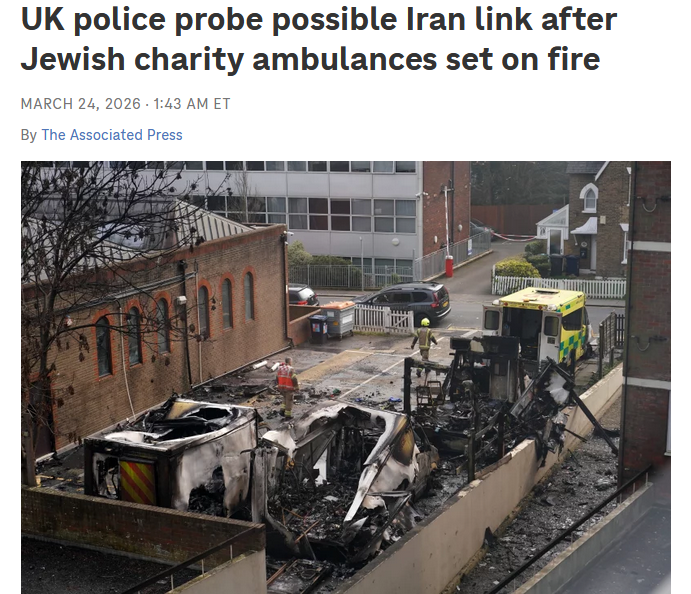
The organisation that, conveniently for the Zionist narrative, immediately claimed responsibility for the attack is Harakat Ashab al-Yamin al-Islamia. This is a group which simply did not exist until the US and Israeli attack on Iran, when it suddenly appeared fully formed and started causing small incidents of property damage to Jewish communities in Belgium and the Netherlands. From day one of its appearance, Israeli-backed think tanks and security groups instantly claimed to have linked it to Iranian militias.
These Israeli claims were first surfaced by regular Israeli security service outlet Joe Truzman of the “Foundation for Defending Democracy”, who makes a living from fronting Israeli claims that all the deaths in Gaza were Hamas.
The first online “evidence” of the existence of the group was on 9 March. On 16 March the entire Israeli Hasbara machinery in coordination went into overdrive on Harakat Ashab al-Yamin. Israel’s Diaspora Ministry issued a statement. So did Israel’s MFA. So did the Institute of National Security Studies. So did BICOM – the Britain Israel Communications Centre.
All on the same morning. At a time when Harakat Ashab al-Yamin had done nothing except allegedly start a small fire in Rotterdam. This frenzied publicity activity about this, by that point practically non-existent, group was prioritised by the Israeli state on the morning of some of the most intense missile and bombing attacks by Israel, the USA, Iran and Hezbollah of the war.
There are some real red flags about its appearance. The first, as eloquently exposed by Lowkey, is that in its manifesto it uses the term “The Land of Israel” to refer to Palestine. No Islamic group, ever, referred to “The Land of Israel” and the phrase in Arabic is not even what complicit Gulf Arab elites use – they use just “Israel” or “The State of Israel”. “The Land of Israel” is unnatural in Arabic and evidently written by a Zionist and translated into Arabic.
The other strange thing is that this allegedly Iranian group doesn’t use Farsi. Iranians don’t speak Arabic. Nor would any Iranian government-aligned group ever talk of “The Land of Israel” in Farsi.
To add further to this, the group’s published logo appears to be AI-generated and the Arabic lettering on it is wrong. “Islamic” is rendered incorrectly and some of it doesn’t mean anything coherent at all – it is gibberish, presumably constructed by AI asked to produce a shield with Arabic lettering.
Unlike the Zionist propaganda-pumping UK media, Dutch media asked real experts and was openly sceptical of the claims about the group:
“Political anthropologist Younes Saramifar from Amsterdam’s VU university said the group was “completely unknown” until this month. “Based on what I have seen, this is absolutely not an organised and coherent group,” he told NOS before the Zuidas explosion.
Saramifar said language mistakes in statements accompanying the videos suggest the makers are not native Arabic speakers and may not be part of a trained militant network.”
It is another remarkably happy coincidence that the group chose to attack the London ambulances just hours before Metropolitan Police Chief Commissioner Sir Mark Rowley was due to address a fundraising event for the Community Services Trust, the group which receives enormous payouts from the British Treasury for consistently exaggerating the scale of antisemitism in the UK.
Thankfully, nobody has ever been hurt in any of the “attacks” by “Harakat Ashab al-Yamin”. Isn’t that fact in itself a bit strange for a state-backed terror group? The ambulances in London were the worst damage ever done in the name of the alleged group.
To believe this is a false flag, it is not in any way necessary to believe that the ambulance organisation itself was complicit. Whether or not the ambulances were new, old or decommissioned is irrelevant to the bigger picture. It is certainly true that the ambulance service has for years done a good job, and does not only help Jewish people. There is nothing sinister or wrong about the existence of the ambulance service.
I am unhesitating in condemning all attacks on the Jewish community in the UK. Including those perpetrated by Mossad.
Embarrassing Pivot: U.S. considers dropping Iran oil sanctions amid war
By Alan MACLEOD | MintPress News | March 22, 2026
Forced into a humiliating U-turn amid a potential global economic meltdown, the Trump administration announced today that it may remove sanctions on Iranian oil already at sea.
Treasury Secretary Scott Bessent told Fox News that the move to free up 140 million barrels of oil was aimed at preventing China gaining from the situation. “That’s about 10 days to two weeks of supply that the Iranians had been pushing out that would have all gone to China,” he said. “In essence, we will be using the Iranian barrels against the Iranians to keep the price down for the next 10 or 14 days as we continue this campaign.”
He also noted that the U.S. government was considering a unilateral release of its oil reserves, in order to calm the market, which has seen prices almost double from $53 per barrel in January to $97 today.
“When we go through, as we plan, to unsanction the Iranian oil, that oil will go up to a market price, and it will end up in places other than China. It can flow into Malaysia, Singapore, Indonesia, Japan, India, who have been good actors in this,” Bessent added.
No matter how the Trump administration spins their move, there is no doubt that this represents an embarrassing climb down – one which drew mockery on social media. “This is literally the dumbest war in human history. No hyperbole,” said Aaron Bastani of Novara Media. “Next up: US asks Iran to join anti-Iran coalition,” joked satirist Karl Sharro.
In response to U.S. and Israeli attacks that killed its supreme leader, Ayatollah Ali Khamenei, Iran closed the Strait of Hormuz on March 2. The narrow sea passage between the Islamic Republic and Arabia is a major choke point of global trade, through which around one-fifth of the world’s oil and gas supply flows.
The result has been economic and political pandemonium, which Trump administration officials appeared not to have anticipated. “Iran War Will Lower Energy Prices” ran the headline of a March 12 Wall Street Journal article penned by Peter Navarro, Trump’s Senior Counselor for Trade and Manufacturing.
Trump appears to have believed that his Iran attack could be completed within hours, and with little blowback or fallout. Instead, the Islamic Republic has been able to hit American bases across the region, spread panic throughout the Gulf States, and create shockwaves in the global economy.
In response, Trump demanded his NATO and Asian allies come to his aid, and send their armed forces to the region to forcibly open the strait. Declaring it a “very small endeavor,” he stated:
“I really am demanding that these countries come in and protect their own territory because it is the place from where they get their energy. And they should come and they should protect it. You could make the case that maybe we shouldn’t be here at all, because we don’t need it.”
Instead, however, his allies responded with a resounding “no.” “Canada is not participating in the offensive operations of Israel and the United States, and will not, ever,” Prime Minister Mark Carney said. German Defense Minister Boris Pistorius was equally adamant; “This is not our war. We have not started it. What does Donald Trump expect a handful or two handfuls of European frigates to do in the Strait of Hormuz that the powerful U.S. Navy cannot do?” he asked.
Most alarmingly for Trump, however, was the reaction from Belgian prime minister, Bart De Wever. In an interview with local newspaper, L’Echo, he stated that Washington’s Iran attacks will force Europe to come to a quick and independent agreement with Russia, in order to avoid financial ruin amid an impending energy crisis.
“We must normalize relations with Russia and regain access to cheap energy. That is common sense,” he said, adding, “In private, European leaders agree with me, but no one dares to say it out loud. We must end the conflict in the interest of Europe, without being naïve towards Putin.”
Trump has said that he is not worried that this war will turn into another Vietnam. Yet, with oil prices surging, public resentment mounting, a global economy potentially on the brink, and key allies openly rebelling against his dictates, it is quite possible that this conflict could spiral out of Washington’s control and do similar damage to the American empire.
US has 2 months of rare earths left to replenish weapons amid Iran war: Report
Press TV – March 24, 2026
The United States has only two months’ worth of rare earth elements critically important in the manufacturing of modern weaponry amid its joint aggression with the Israeli regime on Iran, a report says.
Oil Price.com, citing data from South China Morning Post and Reuters, reported that the US involvement in the aggression against Iran, which began on February 28, has already consumed billions of dollars’ worth of missiles and precision-guided weapons, leaving Washington with low inventories of rare earth and other key materials embedded in advanced military systems.
“And it’s the 11th hour for American defense and the entire defense industry, even if it wasn’t in the middle of a war with Iran,” said the report.
The report said the US is deeply dependent on China for the supply of rare earths, leaving Beijing with some fresh leverage over Washington, with roughly three weeks until President Donald Trump’s expected visit to China.
The South China Morning Post has said in an earlier report that the heavy reliance could mean that it is ultimately China that could dictate how long US strikes on Iran can continue.
Rare earth elements are key to manufacturing missile guidance and drone propulsion to radar systems and fighter aircraft electronics.
Those weapons have been critical to US-Israeli air aggression against Iran as it has solely relied on air strikes hitting Iranian targets.
Reports have indicated that the aggression cost more than $10 billion in its first week, as both the US and Israel have been grappling with barrages of missiles and drones fired by Iran at their targets, prompting heavy use of their costly air defense systems.
Strait Of Hormuz closure brings Empire to brink
By Kit Klarenberg | Al Mayadeen | March 24, 2026
Since the criminal Zionist-American war on Iran erupted, the Strait of Hormuz has remained stubbornly closed. Despite Donald Trump’s dire threats, Tehran has brought maritime traffic to a total standstill. The Empire has futilely scrambled to assemble an international coalition to reopen the economically vital waterway ever since, only to be rebuffed. NATO allies have been slammed for making a “foolish mistake”, by refusing to help militarily secure the Strait. In truth, there is no hope it can be forcibly reopened in the foreseeable future.
As Bloomberg reports, while discussions are ongoing among G7 members over potential methods of restarting trade in the Strait, the general consensus among US allies is this can’t happen until hostilities ease, or outright end. Bank of America’s head of research has ominously warned oil prices could rise above $200 per barrel “if disruptions persist for multiple months.” He forecast that if the Strait isn’t reopened within days, its closure could precipitate a global recession.
Tehran imposing a blockade on the Strait was absolutely inevitable, and widely predicted, in the event of war. Even if the conflict ends soon, lasting damage has already been inflicted in many economic spheres, and the effects will be increasingly felt by average citizens in the form of higher prices for essential goods. Global shipping has been thrown into disarray, with major logistics firms cancelling routes in West Asia, producing higher transport and insurance rates, and delays. Again, increased costs will be passed onto consumers.
In all, approximately 11% of global maritime trade passes through the Strait annually, accounting for 20% of the world’s total oil supply. Iran’s blockade, coupled with Resistance strikes on refineries throughout the region, will cause lasting chaos in energy markets and impact availability for years to come. Yet, despite a preponderant mainstream focus on the implications of the Strait’s closure for oil and gas, many vital commodities underpinning the operation of major industries worldwide also regularly transit through in substantial quantities.
Their availability and cost is in some cases likewise wildly fluctuating, impacting agriculture, construction, manufacturing, and in turn many fields of everyday life for countless people. And this is only the beginning. Approximately one third of the world’s seaborne fertilizer supply passes through the Strait every year. Before the war, Gulf states ranked highly among international fertilizer suppliers. Up to 43% of global trade in urea – a fundamental component of food production – flowed from the region.
The price of urea can affect production costs by as much as 90%. Now spring is upon us, and planting season has commenced across the West, urea has abruptly become a scarce commodity. Many farmers are already operating without profit, and grave concerns about how long this can be sustained widely proliferate. The prospect of Western sanctions on Russia – a major producer of fertilizer – being lifted to ameliorate the market bedlam grows ever-more likely as time goes on.
Sulfur is a core element of fertilizer production, and pre-war, the Strait provided up to 45% of the world’s supply. As an essay by elite US military academy West Point cautioned on March 13th, the price of sulfur has to date surged 25%, “squeezing one of the most consequential inputs to modern industrial power.” Sulfuric acid is not only vital for basic economic functions, “but also modern warfighting.” In a bitter irony, the Strait of Hormuz’s blockade will cripple Washington’s defence industry – and ability to maintain its conflict with Iran:
“[Sulfur] is needed for everything from the copper in the American electrical grid to the semiconductors in precision-guided munitions… For military planners and strategists, the looming loss of sulfur is a pre-logistical crisis…Chemicals like sulfuric acid sit upstream of copper extraction, battery-material processing, and semiconductor fabrication, meaning they can determine whether the US military can maintain industrial base production of electrical and digital systems needed to sustain the fight as munitions are expended and combat losses mount.”
Copper provides the “clearest example” of why the Strait’s blockade is “a warfighting problem” of historic proportions for the Empire. The widely-used metal is “embedded in the transformers, motors, and communications hardware” enabling US bases “to operate and defense factories to function.” This quickly translates into “a readiness and resilience problem” for the military. It will take over 30,000 kilograms of copper to replace US radar systems destroyed by the Resistance in Bahrain and Qatar alone.
Iran controls Strait of Hormuz, dictates terms of war and peace as US excursion backfires
By Pravin Sawhney | Press TV | March 24, 2026
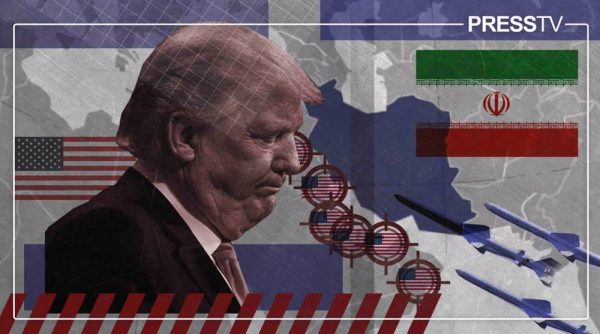
While the US and Israel started the new war in West Asia, it is Israel and Iran who, with clarity on their war objectives, are now pitted against one another.
Given this, two things are likely. One, notwithstanding President Donald Trump’s latest claim of negotiations, the war will not end anytime soon. Instead, it will escalate.
And two, since the world is multipolar, the regional geopolitics will no longer be the same.
Two regional fundamentals would be impacted: the control over the Strait of Hormuz, and the security arrangement between the US and GCC (Persian Gulf Cooperation Council) countries (Saudi Arabia, Kuwait, UAE, Bahrain, Qatar and Oman), which delivered the petro dollars critical for stabilisation of the US economy and its great power status in the world.
Unmindful of the reality that the world is in a once-in-a-century change and that Iran would not bend despite decades of US sanctions, President Trump started this war as ‘an excursion’ as he himself put it. Trump was made to believe by Israeli prime minister Benjamin Netanyahu that, like Venezuela, Iran, with its senior leadership decapitated, would be an open and shut case.
Within, the wily Netanyahu knew that this would not happen, and that the decapitation would lead to a larger war, giving him greater control over the US military to achieve his war objectives, including the so-called “regime change”.
Fully aware that Iran would close the Strait of Hormuz at the beginning of war, Netanyahu publicly gave out the alternative, which, by the land route through Saudi Arabia, would come to Israel and onto Europe through the Mediterranean Sea.
With this approach, only the Asian countries would need to use the Hormuz.
To escalate the war, Israel hit Iran’s South Pars gas field, with the retaliation coming on the energy infrastructure of Qatar, UAE, Saudi Arabia and especially the Israeli Haifa oil refinery, whose incapacitation would lead to a shortage of fuel for Israel’s war machinery.
Moreover, once the US and Israel struck Iran’s nuclear facilities, Tehran hit Israel’s Dimona town, which houses its nuclear plant, with the warning that if Iran’s nuclear facilities are hit again, then Iran’s strike would be on Dimona itself.
This was Israel’s red line, since in no war has the Dimona nuclear facility been touched.
Iran’s warning also serves the purpose of testing Israel’s nuclear deterrence. For instance, if Israel decides to hit Iran’s nuclear facilities again, with reprisal coming from Iran, then the region would be watching what Israel would do: would it use its nukes or keep quiet, in which case its nuclear bluff would be called off.
Meanwhile, Iran had been preparing for this war since 1988, when its eight-year war with Iraq ended. This includes building underground missile and drone cities, setting up production lines, and preparing regional allies like Houthis and Hezbollah. Enormous help came from Russia and China for its military preparations.
Moreover, Iran learnt the right lessons from the 12-day war of June 2025. Notable amongst them switching to the Chinese Baidu-3 satellite constellation by abandoning the US’s GPS. This explains why, unlike the 12-day war, this time the targeting of Iranian missiles and drones at long ranges has been accurate.
Special attention was given to the Persian Gulf and the Gulf of Oman, including the Strait of Hormuz. This entire stretch is laced with formidable undersea capabilities comprising anti-ship cruise missiles, different types of naval mines, midget submarines that can fire both missiles and torpedoes, and fast crafts capable of hitting the hull of tankers.
Because of these, Iran now controls the passage through the Strait of Hormuz. Trump has called upon the NATO nations to help the US Navy break Iran’s stranglehold on the oil and gas lifeline, which these nations, understanding the suicidal nature of the task, have refused.
This has created an unforeseen dilemma for Trump, where, on the one hand, it cannot declare victory and leave the region since Iran, controlling this waterway, is regulating the commercial traffic on its terms.
The latter involves countries that use this chokepoint to trade their cargo in Chinese Yuan instead of the US dollar. This would end the US Petro dollar arrangement with GCC, where they sell oil and gas only in US dollars and get the US security by having their bases on its soil.
On the other hand, with the end of petrodollars, the US will not be able to manage its huge national debt of USD 40 trillion, leading to economic instability in the US and curtailing its ability to sustain some 800 military bases across the globe.
This would be the end of the US as the world’s military hegemon.
To top it all, Iran has refused the American offer of a ceasefire. It instead wants permanent peace in West Asia with a list of demands, the most significant being that the US close down all its military bases in the region.
Moreover, the US is realising that all its threats to blow up Iran’s power grids and services, which impact civilian life, are not working.
Iran has warned that it would retaliate with similar actions against all GCC nations and Israel, where the interceptors to stop the Iranian wave of missiles are not working.
Israel, which instigated this war, is on the backfoot and the US’ excursion has backfired with grave consequences to its image as a great power.
As things stand, Iran is dictating the terms of both war and peace in West Asia.
Pravin Sawhney is a New Delhi-based journalist and commentator. He is the editor of FORCE, a magazine focused on national security and defence.
Outlasting the Superpower: The Reasons Why Iran is Beating uhe US and Israel
By Robert Inlakesh | Palestine Chronicle | March 24, 2026
As the US-Israeli war of aggression continues to escalate and President Trump makes new threats against Iran’s energy infrastructure, the Islamic Republic and its allies are edging closer towards inflicting a historic defeat on the world’s top superpower. This is not hyperbole; instead, it can be demonstrated through the facts on the ground.
From day one of the attack on Iran, the United States and Israel have proudly claimed to have achieved enormous victories. Initially telling the public that this conflict would only last four days, we are steadily heading towards the one-month mark with no end in sight. So far, there has been no clear war goal articulated, nor is there a real excuse presented as to why it had to happen as it did.
Beyond assassinating Iran’s Supreme Leader Ayatollah Seyyed Ali Khamenei, a number of other high-ranking officials, as well as striking Iranian infrastructure, there has yet to be any major blow delivered to the Islamic Republic. There is certainly nothing that could be argued to represent a strategic victory for Washington and Tel Aviv either.
In fact, Israel’s assassinations during the 12-day war, in June of 2025, actually delivered a bigger blow to the Iranian military leadership, along with killing nuclear scientists. The Israeli Mossad even succeeded in effectively sabotaging Iranian air defenses at the beginning of the war and successfully utilized a large number of agents to carry out armed action inside the country. This time, the agents appear to have been a relative non-factor, and Iran retaliated much quicker than it did during the 12-day war.
Despite this, day in and day out, US President Donald Trump and his Secretary of War Pete Hegseth continue to present to the public contradictory claims regarding how they are allegedly winning the war.
How Iran is Defeating the US Empire
The US government has repeatedly claimed that Iran’s navy is “at the bottom of the ocean,” that its air force and air defenses have been “destroyed,” while Trump himself claimed that “90% of Iran’s missiles” had been eliminated.
However, the US military itself continues to announce it is targeting more Iranian naval vessels, while the Islamic Republic itself has shown video footage of underground facilities where its naval assets are stored. The Iranian air defenses, which were allegedly destroyed according to the Trump administration, managed to intercept an F-35 fighter jet, forcing it to conduct an emergency landing, while they are shooting enemy drones out of the sky on a daily basis.
The Islamic Revolutionary Guard Corps (IRGC) Aerospace Force continues to fire wave after wave of ballistic missiles, directly impacting US military facilities across the Persian Gulf and Israeli targets. It also launches its own drone swarms. In addition to the IRGC, the Iranian Armed Forces also have their own separate drone attack units that operate around the clock.
Iranian attacks, along with the support of their Iraqi allies, have now forced a full NATO withdrawal from Iraq, as US forces take round-the-clock missile and drone hits to their bases. Every US base in the Persian Gulf, Iraq, and Jordan has been damaged, in some cases entirely destroyed. Hezbollah also returned to the scene in Lebanon, stronger than ever, with its arms stockpiles replenished, managing to prevent the Israeli military from advancing in south Lebanon, all after both Tel Aviv and Washington claimed that the party had been defeated.
The USS Abraham Lincoln aircraft carrier was fired upon and has been forced to retreat, out of active striking distance of Iran, as the USS Gerald R. Ford is in need of repairs. The IRGC even fired missiles at the British-US military base in Diego Garcia, revealing that they possess missiles that can strike targets at over 4,000 kilometers.
Every day or so, there is another surprise that Tehran appears to be able to pull off. What have the Israelis and Americans done in return? They bomb civilian areas, police stations, and oil storage facilities in order to create acid rain across Tehran. They also strike the openings and exits to missile bases, which are simply dug out and remain largely unaffected.
Iran has retaliated each time a new escalation is committed by either the US or Israel, whether that be against oil facilities, water desalination plants, or nuclear facilities. Tehran does not show any signs of weakness; large crowds show up in support of their government.
Because Iran is no longer exporting food during the war, the prices of goods on the shelves have actually decreased, as government subsidies are being offered, as well as free public transport.
The blockade of the Strait of Hormuz has meant that the Persian Gulf Arab states have taken enormous economic hits, while the price of oil has skyrocketed and is having a major impact on the global economy. It is an oil crisis worse than that of 1973. Fertilizer costs, too, have increased; over 40% so far.
Things have gotten so bad that the US is now weighing lifting the sanctions on Iran in order to allow purchases of its oil, just to bring the costs down. A move that the Trump administration has tried to repackage as some kind of strategic move, but is evidently a sign of how terribly the war is going for them.
Iran’s oil production is also up to a high that hasn’t been seen in at least 46 years, meaning that since the revolution in 1979 against the US-backed Shah, birthing the Islamic Republic, the country’s production has never reached such levels. As of now, only nations that gain Iran’s permission are able to purchase or transit through the Gulf of Hormuz. In other words, they have total dominance.
Escalation Without a Plan
Donald Trump’s depictions of Iran as a nation that is defeated, without any military capabilities and with a scared remaining leadership, are the opposite of reality. If anything, it appears that the Islamic Republic is only becoming more entrenched and popular, as one would expect given that a foreign attack targeting the nation’s civilian population is ongoing.
Ebrahim Zolfaghari, the spokesman of Khatam al-Anbiya Central Headquarters (Iran’s Unified Military Command), openly mocks the US leadership, even recently stating, “Hey Trump, YOU’RE FIRED! You’re familiar with this sentence. Thank you for your attention to this matter. The Central Headquarters of Khatam al-Anbiya.”
While it is undeniable that the US and Israelis may have the technological edge, they are simply out of their depth and have no viable military strategy. As a next step, it is likely that the US could try to deploy ground forces to take over islands in the Persian Gulf, but this will change nothing even if they succeed. In all likelihood, it will be a costly endeavor that will result in little more than a photo op and fail to actually open the Strait of Hormuz.
Capturing Kharg Island from Iran will not stop Iran from blocking ships from transiting the Persian Gulf; that’s simply not how things work. Tehran may even decide to just allow the US to take it over, then hit it relentlessly with missiles and drones. As for the Strait of Hormuz, as long as Iran has missiles capable of sinking ships and mines that can do the same, it remains closed.
Which brings us to the conclusion: Iran is defeating the United States. Yet, it is not Washington that is making its own decisions; it is clearly under the control of policymakers in Tel Aviv. This is not a war for the United States’ interests—it is a war for Israel’s interests.
The Israeli calculation, as I have been writing about here for Palestine Chronicle for months, is that if they manage to inflict enough damage to Iran’s civil infrastructure—targeting electricity, agriculture, its industrial capacity, oil and gas, water, etc.—then it believes it can weaken the government in the long term. It is a Syrian regime-change tactic, but it is ultimately a costly gamble that doesn’t appear to be working right now. In Syria, the regime change didn’t come during the war; it happened due to the sanctions and lasting devastation to the country.
Israel knows that it is only the United States military that can deliver blows harsh enough to have a chance at crippling Iran in the long run, so it has used its puppet—Donald Trump—to commit to a war that no past administration would dare attempt. The US president is compromised and is willing to drag his nation, as well as the entire West, down in order to please Israel.
This war destroys the US military’s power projection, cripples its role in West Asia, demonstrates it is a liability to allies, while representing a victory for its two top enemies, Russia and China. Washington is also now draining its military stockpiles, compromising its military readiness, should it seek to engage in hostilities with either Moscow or Beijing. Although predicting the future is impossible, as of right now, this is shaping up to be the most disastrous US war, perhaps in its history.
– Robert Inlakesh is a journalist, writer, and documentary filmmaker. He focuses on the Middle East, specializing in Palestine. He contributed this article to The Palestine Chronicle.
Top PMU commander, over a dozen fighters killed in new US strikes on Iraq
The Cradle | March 24, 2026
A top commander in the Popular Mobilization Units (PMU) and over a dozen others were killed in US airstrikes on Iraq overnight, marking yet another escalation by Washington and Tel Aviv against the country.
The US strikes hit a headquarters and killed at least 15 fighters as well as PMU operations commander in Anbar province, Saad al-Bayji.
“In a blatant and cowardly attack, the commander of the Anbar Operations in the Popular Mobilization Forces, Saad Dua al-Bayji, was martyred along with a group of his heroic comrades following a treacherous American airstrike that targeted the command headquarters while they were performing their national duty,” the PMU said in a statement on 24 March.
It added that “the martyrs’ blood will not be in vain,” while holding the Iraqi government “fully responsible for confronting these repeated American violations and taking clear and resolute positions to preserve the country’s sovereignty and put an end to these grave transgressions.”
A funeral was held for the commander and the 15 fighters in Baghdad on Tuesday, coinciding with more airstrikes on PMU offices in Mosul.
The deadly attacks come just two days after the Iraqi resistance targeted the US Victoria Base near Baghdad airport in at least eight separate rocket and drone strikes.
The US Victoria Base – located near Baghdad airport – has come under continuous attacks by the Iraqi resistance since the start of Washington and Tel Aviv’s brutal war against Iran. The site serves as a US military logistical center.
Footage from after an Iraqi resistance operation last week showed the US Victoria Base engulfed in large flames from an earlier attack.
Other targets which have come under heavy attack by the Iraqi resistance include Washington’s Harir Base and the US Embassy compound in Baghdad.
Deadly air raids against Iraq have been ongoing since the Iraqi resistance intervened in the war and began striking US targets in response to the brutal US-Israeli campaign against Iran.
Is Netanyahu’s war gamble threatening the future of ‘Israel’?: FT
Al Mayadeen | March 24, 2026
Israeli Prime Minister Benjamin Netanyahu’s push toward war on Iran has intensified regional tensions, with the aggression reportedly enjoying overwhelming public backing in “Israel”, as more than 80% of the Israeli public supported the decision to launch the attacks on Tehran.
Yet, Gideon Rachman argues in The Financial Times that the consequences of this escalation are far from the decisive outcome that was anticipated. Rather than delivering a quick resolution, the war has expanded in scope and complexity, raising new risks for both military personnel and settlers.
Rachman notes that developments such as disruptions to the Strait of Hormuz and missile strikes inside “Israel” highlight how the war is evolving in unpredictable ways, undermining expectations of a swift and controlled campaign.
‘Israel’ rapidly losing US popular support
A central pillar of “Israel’s” long-term security has been strong bipartisan support from the United States. However, recent actions, particularly the genocide in Gaza and the escalation with Iran, are eroding that foundation.
Rachman points to shifting US public opinion, noting that for the first time, more Americans express sympathy for Palestinians than for Israelis. This shift, he suggests, reflects growing concern over the humanitarian consequences of ongoing offensives and could influence future US policy.
Rachman also highlights the evolving political landscape in Washington. Within both major US parties, there is increasing debate over the scale and nature of support for “Israel”. He warns that future presidential candidates may adopt more restrictive positions, potentially reshaping the alliance.
For example, Trump’s MAGA base has been increasingly expressing anti-“Israel” sentiments, questioning the nature of bilateral relations between the United States and the Israeli regime. This phenomenon spilled into the government itself after the resignation of Joe Kent, the Trump administration’s head of counterterrorism, who said the US was pulled into the war on Iran because of “Israel”.
Military strategy vs diplomatic solutions
Netanyahu’s approach, as described by Rachman, places significant emphasis on military power as the primary means of ensuring security. However, the outcomes of recent military actions raise questions about the effectiveness of this strategy.
Despite claims of decisive victories, Hamas remains active in Gaza, and “Israel’s” aggression against Lebanon and the Resistance did not eliminate Hezbollah, leading to renewed confrontation. Similarly, attacks on Iran’s nuclear program have not produced lasting strategic gains.
Therefore, Rachman argues that diplomatic engagement remains the only viable long-term path to stability. He references views from analysts, Danny Citrinowicz, a former head of Iran research for “Israel’s” security intelligence agency, for instance, who suggests that Iran’s leadership has, at times, signalled willingness to negotiate, particularly regarding its nuclear program, opportunities that were not fully pursued.
The most pressing threat ‘Israel’ faces
According to Citrinowicz, as cited by Rachman, the most significant long-term threat facing “Israel” may not be Iran itself, but the gradual erosion of US political and military support.
This support has historically included substantial military aid, advanced defense systems, and diplomatic backing, elements that have been crucial to “Israel’s” security. However, Rachman warns that prolonged confrontation risks weakening this relationship.
If American support declines, “Israel” could face serious strategic consequences, including reduced military assistance and increased international isolation, he indicated. Such a shift would represent a major change in the geopolitical balance that has long favoured “Israel”.
Perpetual war warnings
Rachman concludes that Netanyahu’s reliance on military solutions risks leading to a cycle of perpetual war, rather than lasting security. In his view, military “victories” have repeatedly failed to translate into strategic stability.
Instead, he suggests that a combination of declining international support and ongoing conflict creates a dangerous trajectory. Without a shift toward diplomatic solutions, he warns that “Israel” may face increasing instability and a weakening of its global standing.
Smotrich calls for annexation of South Lebanon to Litani River
Al Mayadeen | March 24, 2026
Israeli Finance Minister Bezalel Smotrich has called for the annexation of territory from Lebanon up to the Litani River, saying “Israel” should seize vast swathes of land in southern Lebanon,
“The new Israeli border must be the Litani,” Smotrich said on Israeli radio on Monday. “The campaign needs to end with a different reality entirely, both with the Hezbollah decision but also with the change of Israel’s borders.”
The Litani River is located nearly 40 kilometers inside Lebanese territory from the South.
Since early March, “Israel” has ordered all residents of southern Lebanon to leave areas south of the Litani, citing what it called “limited and targeted ground operations against key Hezbollah strongholds.”
Expanding operations
On Sunday, the Israeli military announced plans to expand both ground and air operations in southern Lebanon. War Minister Israel Katz has also previously threatened that “Israel” would occupy Lebanese territory if the government does not disarm the Resistance.
Last week, French President Emmanuel Macron condemned “Israel’s” actions in Lebanon as “inappropriate and even unacceptable,” arguing that “Israel’s” repeated wars against the Resistance have never produced the desired results.
“Israel” has repeatedly launched military campaigns against Lebanon since 1978 and occupied most southern Lebanon between 1982 and 2000, maintaining a self-declared “security zone” until resistance operations forced a withdrawal. It is still in occupation of Lebanese territory
Israeli aggression on Lebanon kills 1,024 civilians since March 2
The number of martyrs resulting from the ongoing Israeli aggression on Lebanon since March 2 has risen to 1,024, with at least 2,740 others wounded, Lebanon’s Ministry of Health announced on Saturday.
The figures reflect the intensifying human toll of the continued aggression, which has escalated across multiple regions in South Lebanon and beyond.
Israeli airstrikes and artillery attacks continued to target Lebanon overnight Monday.
Israeli warplanes targeted a residential apartment in the town of Bshamoun in Mount Lebanon, marking a continued expansion of strikes into populated areas.
Earlier reports confirmed an Israeli attack on an apartment in Hazmieh, also in Mount Lebanon, resulting in the death of a civilian, according to the Lebanese Ministry of Health.
Multiple airstrikes were also recorded on the Southern Suburb of Beirut, with at least seven raids recorded in the area.
The attacks come amid ongoing escalation targeting densely populated neighborhoods.
Israeli strikes also hit several areas in southern Lebanon, including:
- Zifta
- Al-Burghliya
- A gas station near the Rashidieh camp in Tyre
Strikes were reported in al-Bayyada, the al-Ashrafiyat area on the outskirts of al-Abbasiyah, as well as in Ayta al-Shaab, Arnoun, Qabrikha, and areas between Burj al-Shamali and al-Bazourieh.
Artillery shelling also targeted the outskirts of Kfar Kila, indicating a continued pattern of bombardment across border areas.
Earlier in the day, four martyrs were reported following a dawn strike on a residential building in Majdal Selem.
This morning, Lebanese citizen was martyred and another injured after Israeli occupation forces (IOF) stormed the town of Halta in the Arqoub region of the Hasbaya district in southern Lebanon, Al Mayadeen’s correspondent in southern Lebanon reported.
According to our correspondent, Israeli forces raided several homes in the al-Hara al-Fawqa neighborhood, opening fire on civilians before withdrawing from the town after abducting one resident.
Echos of Gallipoli? Hormuz and the Geography of Hubris
In a naval chokepoint, always bet on the shore over the ship
Ashes of Pompeii | March 24, 2026
“History is not a teacher, it teaches nothing. History is a warden, and it punishes for poorly learned historical lessons”
– Vladimir Putin.
The ghosts of 1915 still haunt the narrow waters of the Dardanelles. The Battle of Gallipoli remains one of history’s warnings against racist and strategic hubris. As geopolitical tensions rise and speculation grows about potential U.S. military action in the Strait of Hormuz, the shadow of the this far off battle should be casting a long, dark silhouette over modern war planning. But of course it isn’t. Technology has evolved, the fundamental truths of geography and human resilience have not, and lessons sometimes need to be repeated.
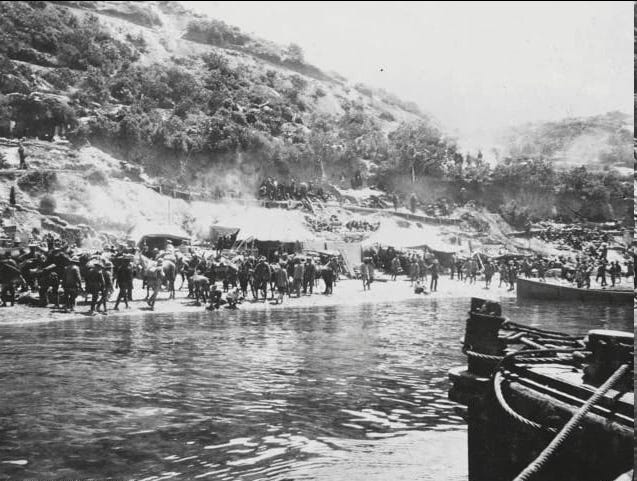
Gallipoli was born of overconfidence. The Allied powers, boasting superior naval technology and industrial might, assumed the Ottoman Empire would crumble under a naval bombardment followed by an amphibious landing. They were wrong. The geography of the Dardanelles turned the Allied advantage into a liability. The narrow strait allowed a numerically inferior force to concentrate fire, mine the waters, and utilize the high ground to devastating effect. The result was a bloody stalemate, massive casualties, and a humiliating withdrawal.
The parallels to the Strait of Hormuz are hard to miss. Like the Dardanelles, Hormuz is a maritime chokepoint, narrow, shallow, and flanked by land that can be fortified. But where the Ottomans relied on artillery and mines, Iran has, over the last 30 years at least, built a layered, modern asymmetric arsenal designed specifically to exploit this geography. Iran’s advantage isn’t in aircraft carriers or stealth fighters; it’s in the sheer density and dispersion of its missile and drone forces.
Iran possesses the largest missile inventory in the Middle East, including thousands of short- and medium-range ballistic missiles, cruise missiles, and precision-guided munitions capable of striking ships at sea. Many of these systems are mobile, hidden in tunnels, or dispersed among civilian infrastructure, making them exceptionally difficult to neutralize in a first strike. Complementing the missiles is Iran’s drone fleet: the Shahed-136 and other loitering munitions that are cheap, hard to detect, and effective in swarms. In a confined space like Hormuz, a swarm of slow, low-flying drones can saturate a warship’s defenses, forcing it to expend precious interceptors or risk being overwhelmed. The Houthis defeated the US Navy in the Red Sea and Bab al-Mandeb with far less.
This is the modern iteration of the Gallipoli lesson: a force perceived to be less advanced, fighting on home terrain, can use asymmetric tools to negate a superior adversary’s edge in firepower. The Ottomans used the high ground and narrow waters to blunt Allied naval power. Iran will use coastal missile batteries, underwater mines, and drone swarms to turn the strait into a contested kill zone. The U.S. Navy is unquestionably more powerful, but power means little if it cannot be brought to bear without unacceptable cost.
Differences, of course, exist. Modern precision weaponry allows for strikes that were impossible in the era of biplanes and battleships. Yet defense has also evolved. In WWI, mines were contact-based; today, they are sophisticated, influence-activated, and difficult to clear. Furthermore, the stakes are different. Gallipoli was a theater of war; Hormuz is the throat of the global economy. A blockade or prolonged engagement there triggers immediate worldwide recession, adding a layer of pressure the Allies never faced in the Aegean.
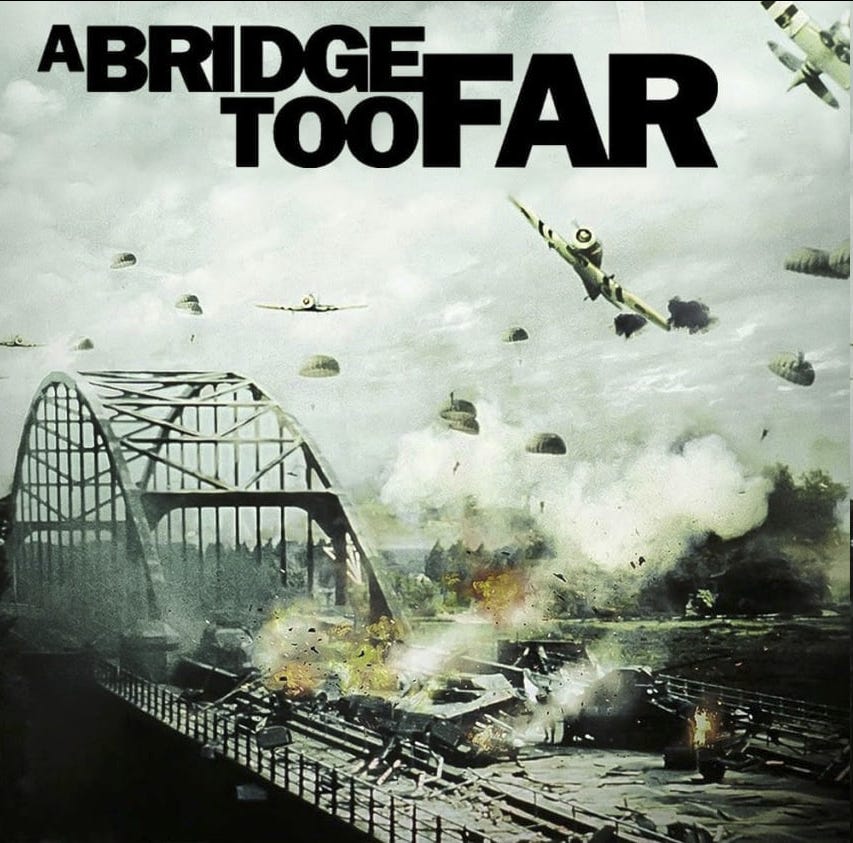
History offers other grim comparisons. Operation Market Garden in WWII and the battle for Gostomel Airport in Ukraine both illustrate the perils of assuming an enemy will collapse under the shock of a rapid airborne assault. In both cases, planners underestimated the defender’s ability to regroup and strike back. And both failed because the armor couldn’t reach the paratroopers, underscoring the danger of betting on shock over substance. Even if the American paratroopers were to create a beachhead in Hormuz, the operation would fail without naval support and successful landing of the marines, just as in Market Garden, where Arnhem was “A Bridge Too Far”.
Then there is Iwo Jima. While an American victory, it serves as a cautionary tale regarding fortified defenses. The Japanese forces, dug into volcanic rock, inflicted massive casualties on the Marines despite overwhelming U.S. air and naval superiority. The underground tunnels of Iwo Jima find their modern equivalent in Iran’s buried missile silos, drone launch sites, and command centers. You cannot bomb what you cannot find, and it is difficult to occupy terrain that is designed to deny you footing.
The lesson for any modern planner looking at Hormuz is not to doubt American firepower, but to respect the defender’s will, the terrain’s tyranny, and the multiplying effect of asymmetric technology. Gallipoli taught us that a narrow strait favors the shore over the ship. Iran has spent decades learning that lesson and building a force to exploit it. Market Garden and Gostomel taught us that speed and surprise do not guarantee success. Iwo Jima taught us that fortifications, and the determination behind them, multiply defensive power exponentially.
The Dardanelles remains a graveyard of ships and reputations. To ignore the lessons of that campaign while eyeing the Strait of Hormuz, especially while underestimating the disruptive potential of drones, missiles, and mines, is to invite a catastrophe not of capability, but of imagination. The map has not changed, even if the weapons have. And in a naval chokepoint, always bet on the shore over the ship.
Pakistan PM backs Iran’s right to self-defense amid tensions
Al Mayadeen | March 23, 2026
Pakistan’s Prime Minister Shehbaz Sharif affirmed his country’s support for Iran, stressing that Tehran has the legitimate right to defend itself amid the ongoing joint US-Israeli aggression on the West Asian nation.
Sharif expressed “regret over the attack on Iran and the resulting martyrdom and injury of thousands of citizens and officials,” signaling Islamabad’s concern over the humanitarian and political consequences of the confrontation.
His remarks came during a phone call with Iranian President Masoud Pezeshkian, reflecting continued high-level coordination between the two neighboring states.
Call for Islamic unity to de-escalate crisis
During the conversation, Sharif emphasized the need for collective action among Muslim-majority countries to reduce tensions and restore regional stability.
He called for coordinated diplomatic efforts, stating that Islamic nations must work together to contain escalation and prevent further deterioration of the situation.
At the same time, he reiterated that Pakistan “stands alongside” Iran, underscoring a political position aligned with Tehran’s framing of the conflict.
Strait of Hormuz cooperation highlighted
Sharif also thanked Iran for its “positive handling” of recent developments, particularly in facilitating the passage of Pakistani vessels through the Strait of Hormuz.
This acknowledgment reflects the strategic importance of maritime routes for Pakistan’s trade and energy security, especially amid heightened tensions in the Gulf.
Ensuring uninterrupted navigation through the strait remains a shared priority for regional states reliant on these critical shipping lanes.
Deep-rooted Iran–Pakistan relations
Iran and Pakistan share a long border and maintain multifaceted relations spanning security, economic, and political domains.
Their geographic proximity has necessitated ongoing coordination, particularly in areas such as border security, counter-smuggling efforts, and addressing armed group activity along shared border.
In addition to security cooperation, the two countries have pursued joint economic initiatives, including energy projects and cross-border trade development.
Featured Video
Bombing Iran Back Into the Stone Age /Lt Col Daniel Davis & Jim Jatras
or go to
Aletho News Archives – Video-Images
From the Archives
The Occupied Mentality Syndrome
Saudi Arabia on the American chessboard – Part 2
By B. J. Sabri | American Herald Tribune | April 19, 2016
Since the Korean War, but particularly since the Iranian Revolution of 1979 until today, the United States has been steadily escalating its military presence in the Persian Gulf. Taking advantage of many colossal events of the past 36 years, [1] the hyper-empire has institutionalized its massive presence on land and sea, and expanded its objectives to include the unambiguous physical control of the area, as well as the clear understanding that local Arab governments should abide by them. The pretext is always the same: in “defense” of the national interests and security of the United States. From observing how the United States has been interacting with the governments of the region, and by judging from the size of its expeditionary force, we could reach a basic conclusion. The United States is occupying, de facto, the entire Arabian Peninsula. (Yemen, devastated by Saudi and American jets is yet to be conquered. Oman? Britain returned not as colonial ruler but as a soft occupying power.)
Under this articulation, Saudi Arabia, Qatar, Kuwait, and the United Arab Emirates are virtually occupied countries. If we compare this type of occupation to the mandate and protectorate regimes of the past, the results might be identical—the nations affected by it lose sovereignty. When Arab governments comply with the objectives of a foreign power that station military forces on their national milieu, then that power controls them in multiple ways including how they react to policy deliberations and what decisions they intend to take on specific issues. A good method to verify the concept of effective occupation is this: take notice of what the United States says and wants, and then compare it to what the gulf rulers do in response. (I shall discuss this detail at some point in the upcoming parts.)
If the presence of US forces or other means of political pressure are a factor in Saudi Arabia’s interventionist Arab wars, then we need to debate this issue. However, from the history of resistance to colonialism, we learnt: if a powerful state imposes its order on a nation by military means or other forms of coercion, and if this nation does not resist that imposition, then a mental subordination to the powerful state will ensue. This is especially true in the case of Saudi Arabia. One single event, 9/11, has transformed it from a US “ally” into an instant political hostage of the American Empire. … continue
Blog Roll
 Aletho News
- BREAKING: US JET SHOT DOWN OVER IRAN /Lt Col Daniel Davis & Nima Alkhorshid
- Now everyone is dumping US government bonds
- Brazilian Congressman seeks to bar Israeli military personnel from entering Brazil
- Official reveals evidence of Arab states’ involvement in US-Israeli war on Iran
- His Majesty’s head-chopper: Syria’s MI6-backed president bows to King Charles
- Forced to backtrack: ‘Israel’ drops Hezbollah disarmament goal
- Britain’s Lebanon surveillance network: A digital map for war
- Bahrain faces scrutiny for opposition crackdown after detainee killed
- Hegseth’s Pentagon Purge Designed to Prevent a Mutiny: Karen Kwiatkowski
- Greek shipping firms secretly transporting oil, weapons to Israel
- If Americans Knew
- Israel Is Blocking Palestinians from Easter at Church Where Jesus Resurrected
- Plot to assassinate Palestinian activist follows harassment campaign promoted by Zionist groups and elected officials
- Prominent New York synagogue hosts presentation on why U.S. Jews should support the ethnic cleansing of Gaza
- Tapper vs. Piker: Is the CNN Anchor Auditioning for David Ellison?
- Shouldn’t Democrats Be Able to Condemn Genocide?
- Israel-US kill negotiators, destroy civilian structures, but Iran’s military capabilities still largely intact – Daily Update
- ‘War crime’: Global condemnation as Israeli ministers celebrate death penalty law targeting Palestinian prisoners
- 7 Ways Israel Is Turning Lebanon Into Gaza
- World’s Leading Football Bodies Under Fire Over Israel Policies
- Experts warn of possible use of nukes against Iran
- No Tricks Zone
- Low Intensity Tornado Wrecks Major Solar Farm, Creating A Potential Toxic Dump
- New Study Finds Warming Saves Lives…Cold Temperatures 12 Times More Deadly Than Excess Heat
- German Science Blog Accuses PIK Climate Institute Of Hallucinating Climate Tipping Points
- Devastating Assessment Of Comirnaty Vaccine By Former Senior Pfizer Europe Toxicologist
- New Study: CO2 Is ‘Effectively Negligible’ As An Explanatory Climate Change Factor Since 2000
- Former Pfizer Toxicologist Dr. Helmut Sterz Tells Bundestag Hearing Pfizer Vaccine Should Have Never Been Approved
- Energy Expert: Germany’s Nuclear Phaseout Was A “500 Billion Euro Mistake”
- New Research: South Australia’s Mid-Holocene Sea Surface Temperatures Were 4°C Warmer Than Today
- Storing Green Energy To Last Germany 10 Days Would Require A 60-Million Tonne Battery
- New Studies: UK Sea Levels Were 4 Meters Higher Than Today During The Mid-Holocene
 Aletho News