Echos of Gallipoli? Hormuz and the Geography of Hubris
In a naval chokepoint, always bet on the shore over the ship
Ashes of Pompeii | March 24, 2026
“History is not a teacher, it teaches nothing. History is a warden, and it punishes for poorly learned historical lessons”
– Vladimir Putin.
The ghosts of 1915 still haunt the narrow waters of the Dardanelles. The Battle of Gallipoli remains one of history’s warnings against racist and strategic hubris. As geopolitical tensions rise and speculation grows about potential U.S. military action in the Strait of Hormuz, the shadow of the this far off battle should be casting a long, dark silhouette over modern war planning. But of course it isn’t. Technology has evolved, the fundamental truths of geography and human resilience have not, and lessons sometimes need to be repeated.
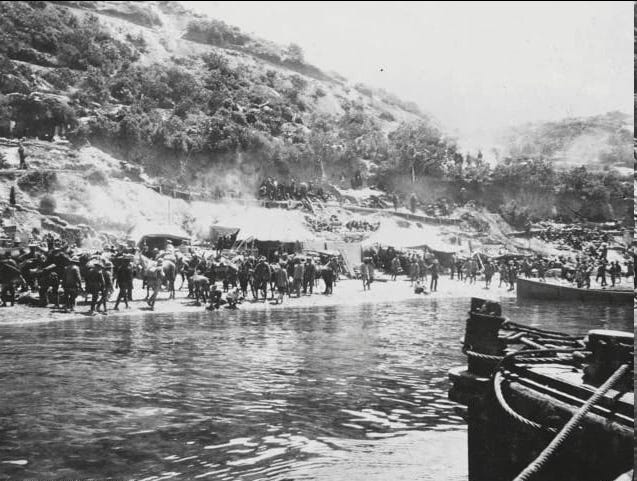
Gallipoli was born of overconfidence. The Allied powers, boasting superior naval technology and industrial might, assumed the Ottoman Empire would crumble under a naval bombardment followed by an amphibious landing. They were wrong. The geography of the Dardanelles turned the Allied advantage into a liability. The narrow strait allowed a numerically inferior force to concentrate fire, mine the waters, and utilize the high ground to devastating effect. The result was a bloody stalemate, massive casualties, and a humiliating withdrawal.
The parallels to the Strait of Hormuz are hard to miss. Like the Dardanelles, Hormuz is a maritime chokepoint, narrow, shallow, and flanked by land that can be fortified. But where the Ottomans relied on artillery and mines, Iran has, over the last 30 years at least, built a layered, modern asymmetric arsenal designed specifically to exploit this geography. Iran’s advantage isn’t in aircraft carriers or stealth fighters; it’s in the sheer density and dispersion of its missile and drone forces.
Iran possesses the largest missile inventory in the Middle East, including thousands of short- and medium-range ballistic missiles, cruise missiles, and precision-guided munitions capable of striking ships at sea. Many of these systems are mobile, hidden in tunnels, or dispersed among civilian infrastructure, making them exceptionally difficult to neutralize in a first strike. Complementing the missiles is Iran’s drone fleet: the Shahed-136 and other loitering munitions that are cheap, hard to detect, and effective in swarms. In a confined space like Hormuz, a swarm of slow, low-flying drones can saturate a warship’s defenses, forcing it to expend precious interceptors or risk being overwhelmed. The Houthis defeated the US Navy in the Red Sea and Bab al-Mandeb with far less.
This is the modern iteration of the Gallipoli lesson: a force perceived to be less advanced, fighting on home terrain, can use asymmetric tools to negate a superior adversary’s edge in firepower. The Ottomans used the high ground and narrow waters to blunt Allied naval power. Iran will use coastal missile batteries, underwater mines, and drone swarms to turn the strait into a contested kill zone. The U.S. Navy is unquestionably more powerful, but power means little if it cannot be brought to bear without unacceptable cost.
Differences, of course, exist. Modern precision weaponry allows for strikes that were impossible in the era of biplanes and battleships. Yet defense has also evolved. In WWI, mines were contact-based; today, they are sophisticated, influence-activated, and difficult to clear. Furthermore, the stakes are different. Gallipoli was a theater of war; Hormuz is the throat of the global economy. A blockade or prolonged engagement there triggers immediate worldwide recession, adding a layer of pressure the Allies never faced in the Aegean.
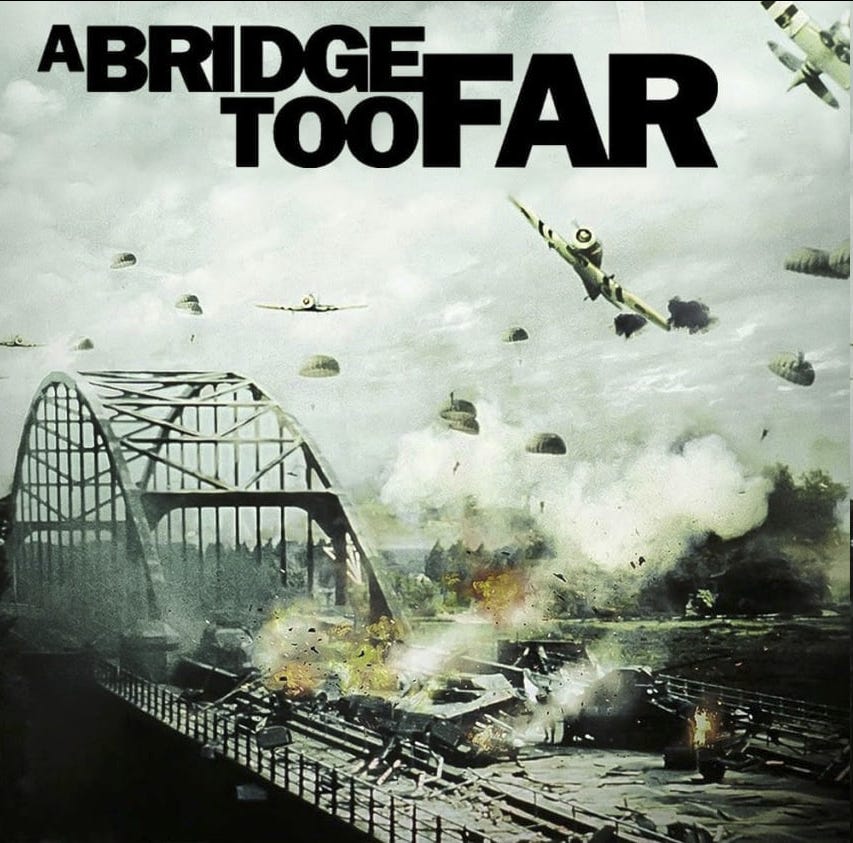
History offers other grim comparisons. Operation Market Garden in WWII and the battle for Gostomel Airport in Ukraine both illustrate the perils of assuming an enemy will collapse under the shock of a rapid airborne assault. In both cases, planners underestimated the defender’s ability to regroup and strike back. And both failed because the armor couldn’t reach the paratroopers, underscoring the danger of betting on shock over substance. Even if the American paratroopers were to create a beachhead in Hormuz, the operation would fail without naval support and successful landing of the marines, just as in Market Garden, where Arnhem was “A Bridge Too Far”.
Then there is Iwo Jima. While an American victory, it serves as a cautionary tale regarding fortified defenses. The Japanese forces, dug into volcanic rock, inflicted massive casualties on the Marines despite overwhelming U.S. air and naval superiority. The underground tunnels of Iwo Jima find their modern equivalent in Iran’s buried missile silos, drone launch sites, and command centers. You cannot bomb what you cannot find, and it is difficult to occupy terrain that is designed to deny you footing.
The lesson for any modern planner looking at Hormuz is not to doubt American firepower, but to respect the defender’s will, the terrain’s tyranny, and the multiplying effect of asymmetric technology. Gallipoli taught us that a narrow strait favors the shore over the ship. Iran has spent decades learning that lesson and building a force to exploit it. Market Garden and Gostomel taught us that speed and surprise do not guarantee success. Iwo Jima taught us that fortifications, and the determination behind them, multiply defensive power exponentially.
The Dardanelles remains a graveyard of ships and reputations. To ignore the lessons of that campaign while eyeing the Strait of Hormuz, especially while underestimating the disruptive potential of drones, missiles, and mines, is to invite a catastrophe not of capability, but of imagination. The map has not changed, even if the weapons have. And in a naval chokepoint, always bet on the shore over the ship.
Sorry, the comment form is closed at this time.
Featured Video
Integrity Initiative: UK-funded network framed dissent as Russian disinformation for years
or go to
Aletho News Archives – Video-Images
From the Archives
Why Saudi Ties to 9/11 Mean U.S. Ties to 9/11
By Kevin Ryan | Dig Within | September 27, 2015
Media interest in Saudi Arabian connections to the crimes of 9/11 has centered on calls for the release of the 28 missing pages from the Joint Congressional Inquiry’s report. However, those calls focus on the question of hijacker financing and omit the most interesting links between the 9/11 attacks and Saudi Arabia—links that implicate powerful people in the United States. Here are twenty examples. … continue
Blog Roll
 Aletho News
- Big tech hands in its DSA censorship reports to the EU
- ‘A Big Victory’ – Palestine Chronicle Wins Two-Year Legal Battle
- IAEA inspectors cannot return to Iran amid US threats: Russia
- Senate Rejects Iran War Powers Resolution Passed By House
- ‘We did not attack Pakistan with drones’: Afghan sources
- Iraqi Resistance faction links arms to sovereignty, questions US exit
- Cannon fodder no more… South Korea rejects Trump’s pressure to join his criminal war on Iran
- Neria Leiter Was A Legitimate Military Target
- Integrity Initiative: UK-funded network framed dissent as Russian disinformation for years
- ‘We don’t seek permission to defend our country’: Snippets from President Pezeshkian’s UNGA address
- If Americans Knew
- ‘This is where I live now, the back of a truck’: a day in the life of a grandmother in Gaza
- In UN Speech, Iran’s President Displays Pictures of Children Killed by US, Brings Attention to Israel’s Nuclear Arsenal
- Israel displaces hundreds of Palestinians amid wave of demolitions in West Bank
- Aid, reconstruction, and Israel’s history of obstruction in Gaza
- Trump administration digs an ever-deeper hole of complicity in genocide – Daily Update
- US-Israel $2.8 Billion Arms Deal, 40,000-Bomb Supply Faces New Gaza Complicity Accusations
- Caught on Tape: AIPAC CEO Boasted of Controlling Trump’s National Security Officials
- Why Hamas Attacked Israel in October 2023 – Israeli professor Ilan Pappé
- They see them, then kill them: Israeli quadcopters track, deliberately target civilians in Gaza
- Winter could turn Gaza’s treacherous, war-damaged buildings into deathtraps
- No Tricks Zone
- New Study: Earth And Venus Surface Warmth Largely Explained By Convection And Lapse Rate, Not CO2 Or Radiation
- 2025 Nature Paper Claiming Worsening Global Drought Gets RETRACTED …Heavily Flawed
- New Study: ‘Global Drought Shows No Detectable Recent Acceleration Under Climate Warming’
- Economic Masterminds: German Socialists Suggest Taxing Productivity Gains Stemming From Using AI
- The South China Sea Has Not Been Cooperating With The Climate Change Narrative
- Energy Crisis: Germany Enters Heating Season With Historically Low Gas Reserve Fill Levels
- New Study: The Antarctic Ice Sheet Gained Mass From 2020-2024 Due To Staggering Snow And Ice Accumulation
- Study: Ocean Heating Rates From Thousands Of Years Ago ‘Dwarf’ Modern Ocean Heating Rates
- Climate Extremists Target, Attack Large-Scale Power Grid Infrastructure In Germany!
- New Study: Antarctic Ice Melt Has Contributed Less Than 1 Centimeter To Sea Level Rise In The Last 30 Years

