UK, Spain reject Trump’s new scheme to blockade Hormuz Strait
The Cradle | April 13, 2026
The UK and others have rejected Washington’s plan to impose a blockade on Iranian ports and target ships transiting the Strait of Hormuz in collaboration with the Islamic Republic.
UK Prime Minister Keir Starmer said “we are not supporting the blockade” in an interview with BBC Radio on 13 April.
Starmer added that the UK is not “getting dragged in” to the US-Israeli war against Iran. He emphasized the priority is reopening the strait, noting it is “vital that we get the strait open and fully open.”
Turkiye opposed the blockade and called for renewed diplomacy, while China warned against escalation and urged both sides to maintain stability.
The Spanish government has also condemned the US move. “It’s just another episode in this downward spiral we’ve slipped into,” Spanish Defense Minister Margarita Robles said on Monday, adding that US President Donald Trump and Israeli Prime Minister Benjamin Netanyahu “want to impose rules on the international community, which is illogical.”
Germany did not criticize the move. “The supposed blockade … does not mark the end of this diplomatic process,” a government spokesperson said, adding that “We see it as a move to ramp up the pressure.”
The US military’s announcement did “not mention a blockade of the Strait of Hormuz, but rather a blockade of Iranian ports – that is a different approach,” the German spokesperson added.
Earlier on Monday, France announced that London and Paris will organize a conference to discuss forming a “strictly defensive” and “peaceful” mission to reopen the Strait of Hormuz.
“As regards the Strait of Hormuz, in the coming days, together with the UK, we will organize a conference with those countries prepared to contribute alongside us to a peaceful multinational mission aimed at restoring freedom of navigation in the strait,” said French President Emmanuel Macron.
“This strictly defensive mission, separate from the warring parties to the conflict, is intended to be deployed as soon as circumstances permit,” he added. Paris had previously rejected a US proposal on the formation of an international coalition aimed at reopening the Strait, saying it would help escort ships only when the war ended.
A Bahraini resolution to reopen the strait by force was vetoed by Russia and China right before the ceasefire was announced.
The Strait of Hormuz remains closed to Washington and its allies despite the recent ceasefire between the US and Iran.
Vessels unaffiliated with the US and Israel, including a French one, have recently been given access following coordination with the Islamic Republic.
The US threat to blockade Iran’s ports was made by CENTCOM on Sunday night. It said it would begin a blockade “of all maritime traffic entering and exiting” Iranian ports starting 10:00 am Eastern Time (ET) on 13 April.
“The blockade will be enforced impartially against vessels of all nations entering or departing Iranian ports and coastal areas, including all Iranian ports on the Arabian Gulf and Gulf of Oman. CENTCOM forces will not impede freedom of navigation for vessels transiting the Strait of Hormuz to and from non-Iranian ports,” it added.
After the announcement, Iranian Parliament Speaker Mohammad Bagher Ghalibaf said, “enjoy the current pump figures,” adding that “with the so-called ‘blockade,’ Soon you’ll be nostalgic for $4–5 gas.”
The Khatam al-Anbiya Central Headquarters of the Iranian military made a statement on Monday, accusing Washington of “piracy” while vowing to act “decisively” in order to permanently control the Strait of Hormuz and secure Iran’s waters.
Sorry, the comment form is closed at this time.
Featured Video
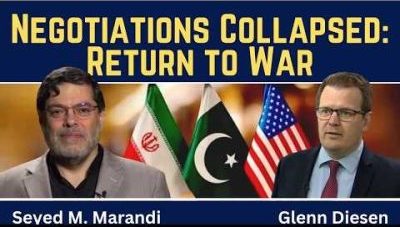
Seyed M. Marandi: Negotiations Collapsed – Return to War
or go to
Aletho News Archives – Video-Images
From the Archives
The US-Iran Scenario That Most Scares Israel
By Ali Haydar | Al-Akhbar | October 9, 2013
Israeli Prime Minister Benjamin Netanyahu issued a series of threats toward Iran and its interlocutors in the West, including the US, as serious negotiations on Iran’s nuclear program seem more plausible.
As a possible rapprochement looms between the US and Iran, Netanyahu has attempted to impose impossible Israeli conditions on the negotiators, such as the full dismantling of Iran’s nuclear program, not to mention threatening military force.
Whatever the deal that could materialize between Iran and the West, Israel is going to find itself before an open-ended path. One can foresee three possible scenarios… continue
Blog Roll
 Aletho News
- UK, Spain reject Trump’s new scheme to blockade Hormuz Strait
- Russian frigate ‘resurfaces’, chases off NATO pirates days after Kiev ‘sank’ it
- Ukraine Targets Russian Merchant Fleet With NATO Intel Support – Presidential Aide
- Russia’s ‘shadow fleet’ makes mockery of UK naval power
- Ukraine plans to attack Russian ships with Norwegian support
- US’s ‘Very Foolish’ Double Blockade of Hormuz Strait Makes Absolutely No Sense: Here’s Why
- China issues rules on countermeasures against foreign states’ unlawful extraterritorial jurisdiction
- Seyed M. Marandi: Negotiations Collapsed – Return to War
- Tomorrow’s naval blockade showdown
- ‘Israel’ attacks civilians to hide its embarrassing military failures & out of pure sadism
- If Americans Knew
- Critical shortages in Gaza, Lebanon in ruins, “piracy” in Iran – Daily Update
- US-Iran ceasefire negotiations make zero progress – Daily Update
- Pro-Israel ‘Thinktanks’ and Individuals who Influence U.S. Foreign Policy
- Mearsheimer reveals how Israel dictates US policies on Iran, Gaza – video
- After killing 350+, Israel still has a “score to settle” with Lebanon before ceasefire – Daily Update
- Military aid to Israel emerges as the latest political litmus test for Democrats
- The only Palestinian children’s rights organization closes following years-long Israeli campaign against it
- ‘I Can’t Forget the Smell’: Lebanese Reel After Israel Kills Over 300 in Single Day
- DNC Shoots Down Resolutions Calling Out AIPAC and Limiting Arms to Israel
- TCN: Is Israel Blackmailing President Trump?
- No Tricks Zone
- Cave Discovery Reveals Today’s Desert Climates Were Recently Far Warmer, Wetter, Teeming With Life
- German Expert: Heat Dome Led To Record Temps In Western USA…Warmer In 1934, 1936
- New Study: No Linear Warming Or Glacier Retreat Along Northern Antarctic Peninsula Since 1980s
- An Inconvenient Tree: Uncovered In Alps… Europe Much Warmer Than Today 6000 Years Ago
- New Study Reports A 60% Slowdown In Greenland’s Ice Loss Rate In The Last Decade
- Low Intensity Tornado Wrecks Major Solar Farm, Creating A Potential Toxic Dump
- New Study Finds Warming Saves Lives…Cold Temperatures 12 Times More Deadly Than Excess Heat
- German Science Blog Accuses PIK Climate Institute Of Hallucinating Climate Tipping Points
- Devastating Assessment Of Comirnaty Vaccine By Former Senior Pfizer Europe Toxicologist
- New Study: CO2 Is ‘Effectively Negligible’ As An Explanatory Climate Change Factor Since 2000
 Aletho News