US Bombing the Houthis is like Swatting at Buzzing Insects
By Seth Ferris – New Eastern Outlook – April 5, 2025
The U.S. bombing campaign against the Houthis is less about securing shipping routes and more about advancing broader geopolitical strategies tied to Israel, Iran, and U.S. domestic politics.
This headline is more than provocative, as it enshrines a critical analysis of what is going on, and this has little to do with the defense of shipping in the Red Sea and the Suez Canal, or how Houthis are trying to stand against the continuous genocide of Palestine. It has more to do with the Greater Israel project, keeping Netanyahu out of jail, and for Trump and Republicans to pay the piper for the campaign chest that secured the US election for Trump and his minions.
Attacking the Houthis is the preliminary step of a larger, interconnected geopolitical strategy that includes Greater Israel, shifting the focus from the disaster in Ukraine, and keeping the arms manufacturers as happy as hogs rolling in fresh crap.
On March 15th, too much fanfare from Trump, who promised to use “overwhelming lethal force” the US resumed bombing Houthi controlled Yemen, trying to defeat a movement that has been bombed by either the US or its regional allies such as Saudi Arabia and the Gulf states since 2014 when the Yemeni civil war broke out, with little real effect to date.
The ostensible cause of the attacks appears to have been the Houthi decision to reinstate its blockade of Red Sea traffic heading to Israel, in response to Israel reneging on its ceasefire commitments and blockading, and now, as of Tuesday, 18th March, bombing and invading the Gaza Strip, killing hundreds of civilians in the process.
American attacks on Yemen by the aircraft of the US Navy’s 5th fleet have certainly been spectacular, but their usefulness is seriously in doubt. Despite claims by the USN of strikes on military targets, the majority of casualties are seen to be civilians. US National Security Advisor Mike Waltz says that the Houthi blockade of Israel is causing 75% of US flagged ships to take the much longer route around Africa, and said about the US strikes:
“We’ve hit their headquarters,” Waltz said. “We’ve hit communications nodes, weapons factories and even some of their over-the-water drone production facilities.”
The Houthi leadership has strongly refuted these claims, with a spokesman saying:
“The pictures, scenes, evidence, types of victims, and testimonies of survivors from the targeted sites confirm that it is targeting residential neighbourhoods and innocent civilians, and provide conclusive evidence that the US is deliberately taking the lives of defenceless civilians and destroying the capabilities of our people.”
Given the horrendous rhetoric used by Trump in his posts on his Truthsocial site, where he accused the Houthis of being “barbarians” and went on to say:
“Watch how it will get progressively worse — It’s not even a fair fight, and never will be,” Trump added. “They will be completely annihilated!”
It seems pretty clear that the Houthis are right, and that the US is hitting civilian targets in frustration at not being able to identify legitimate military targets. Trump went on to threaten Iran, saying:
“Every shot fired by the Houthis will be looked upon, from this point forward, as being a shot fired from the weapons and leadership of IRAN, and IRAN will be held responsible, and suffer the consequences, and those consequences will be dire!”
Given Trump’s promises on the election campaign to stop wars, and bring peace, particularly to Ukraine, this rhetoric is rather an about-face. One can only come to the conclusion that Trump is trying to escape from the debacle in Ukraine by distracting the public with another war, this time against Yemen and, one fears, Iran, which also will benefit the real ruler of the US, Benjamin Netanyahu.
But how effective is this likely to be? I believe that in his hubris, egged on by the new Defense Secretary Pete Hesgith, a US Evangelical Christian and rabid Zionist, Trump is repeating the disastrous mistakes of a well-trodden US path of intervention and inevitable failure.
Firing drones and missiles at cargo ships bound for Israel, even without sinking any ships, is a victory for the Houthis, as it forces ships to take the long way around the Cape of Good Hope, and shows the world what the US can do in terms of air superiority is not enough, as to stop these attacks, you would need to send in ground troops, something the US administration would have to be mad to do, as the British could well attest to given their occupation of Yemen in the 19th and 20th centuries.
With regard to the intensity of US air attacks, as with any force of national liberation, like the Algerians, Vietnamese, Angolans, and many others in the 20th century, just surviving is already a form of victory for the Houthis. Every day they hold their ground, they rewrite the script a little. They’re showing that even without matching the U.S. or Saudi Arabia in terms of high-tech weaponry, they can still have massive strategic impact — like forcing global trade routes to detour thousands of miles. That’s asymmetrical warfare in full force.
As the US and its allies know only too well, U.S. air power, while impressive for breaking regular military formations, has a limit. It can punish, but it can’t control the terrain or win hearts and minds from 30,000 feet. Boots on the ground? That’s a whole different ballgame. Politically and militarily, there’s little appetite for another drawn-out Middle East quagmire. The U.S. knows how that ends, Israel knows too!
This whole horse and pony show is becoming a test of global logistics and willpower — not just firepower. The Houthis have leveraged a relatively small amount of resources to cause ripple effects across oil markets, insurance premiums, and shipping delays — even reshaping how the world thinks about “secure” sea lanes. Their damage to the economies of their enemy Israel, and its backers in the US and EU, is out of all proportion to the money spent by themselves.
This is also reflected in the weaponry used, with relatively cheap drones and ballistic missiles needing to be countered by vastly more expensive US air defense missiles and extremely expensive guided bombs. The previous, spectacularly unsuccessful, campaign “Operation Prosperity Guardian” to bring the Houthis to heel after they put a blockade on Israel in response to the genocidal campaign in Gaza, saw vast expenditure of hideously expensive US missiles which were used to shoot down drones that cost around US$ 20,000 per shot:
According to the Missile Defense Advocacy Alliance (as of 2022), the SM-2 costs $2.1 million per unit; the SM-6 costs $4.3 million; and the ESSM Sea Sparrows costs $1.7 million. The destroyers are also fitted with the Rolling Airframe missile, which cost $905,000 in 2022
Nothing of any note has been achieved in cost reduction since then, and the Houthis are repeatedly striking back, with at least four attacks on the USS Harry S Truman and its escorting vessels, forcing rapid expenditure of these expensive weapons, as well as disrupting US strikes. It is no surprise that their resistance is being downplayed by the US, but the reality is that the US is being forced to send a second carrier group, led by the USS Carl Vinson, to support the 5th Fleet strikes.
This does not bode well, with escalation looming, with a joint US strike on Iran likely. One can only think that, drunk with success regarding their overthrow of Assad in Syria, and forgetting their obvious failure to subdue either Hamas in Gaza, or Hezbollah in Lebanon, the US and Israel want to play the same game with Iran, using Yemen as the trigger, which is almost certainly a major miscalculation.
It as if they are the drunk guy in the casino, who rather than accept his losses, has taken one small win after a series of losses, and bet the house on the result. Iran is a major regional power, with a well-organized, equipped, and trained armed forces, backed by a much greater population than Iraq and Syria combined, and with its own fully developed and capable defense industry.
As for the Houthis, like all guerilla and national liberation forces, the case is that “If they are not losing, they are winning” but are they playing the smart long-term game, or are they at risk of overplaying their hand if this drags out too long? It might only take one incident of them attacking the wrong ship, hitting a neutral vessel and inflicting casualties, and the worldwide support they have garnered by their principled stand in support of the Palestinians, and their bravery in their David vs Goliath battle with Israel and the US, could disappear.
Seth Ferris, investigative journalist and political scientist, expert on Middle Eastern affairs
David’s Corridor: Israel’s shadow project to redraw the Levant
Through ‘David’s Corridor,’ Israel aims to forge a geopolitical artery stretching from occupied Golan to Iraqi Kurdistan, reshaping West Asia
By Mahdi Yaghi | The Cradle | April 4, 2025
In recent years, the Zionist idea of “David’s Corridor” has surfaced in Tel Aviv’s strategic and political discourse on the reshaping of its geopolitical influence in the Levant. Though the Israelis have made no official announcement, analysts have pointed to this corridor as a covert project aimed at linking Kurdish-controlled northern Syria – backed by the US – to Israel via a continuous land route.
The so-called David’s Corridor refers to an alleged Israeli project to establish a land corridor stretching from the occupied Syrian Golan Heights through southern Syria to the Euphrates River. This hypothetical route would traverse the governorates of Deraa, Suwayda, Al-Tanf, Deir Ezzor, and the Iraqi–Syrian border area of Albu Kamal, providing the occupation state with a strategic overland channel into the heart of West Asia.
A biblical blueprint
Ideologically, the project is rooted in the vision of “Greater Israel,” an expansionist concept attributed to Zionism’s founder, Theodor Herzl. The vision draws on a biblical map extending from Egypt’s Nile to Iraq’s Euphrates.
Dr Leila Nicola, professor of international relations at the Lebanese University, tells The Cradle that David’s Corridor embodies a theological vision requiring Israeli control over Syria, Iraq, and Egypt – a triad central to both biblical lore and regional dominance. Regional affairs scholar Dr Talal Atrissi echoes this view, believing that developments in Syria have lent new geopolitical realism to Israel’s historical ambitions.
Unsurprisingly, the proposed corridor is a lightning rod for controversy, seen by many as a strategic bid to expand Israeli hegemony. Yet significant barriers stand in its way. As Atrissi notes, the corridor cuts through volatile terrain, where actors like Iraq’s Popular Mobilization Forces (PMF) remain formidable spoilers. Even a minor act of sabotage could disrupt the project, particularly given the absence of a stable regional environment needed to sustain such a sensitive and expansive route.
Strategically, David’s Corridor aligns with Israel’s enduring policy of cultivating ties with regional minorities – Kurds, Druze, and others – to offset hostility from Arab states. This decades-old “peripheral alliance” strategy has underpinned Israeli support for Kurdish autonomy since the 1960s. The project’s biblical symbolism of expanding “Israel” to the Euphrates, and its strategic calculus, combine to make the corridor both a mythological promise and a geopolitical asset.
Nicola further contextualizes this within the framework of the “ocean doctrine,” a policy Israel pursued by courting non-Arab or peripheral powers like the Shah’s Iran and Turkiye, and forging alliances with ethnic and sectarian minorities in neighboring states.
The doctrine aimed to pierce the Arab wall encircling Israel and extend its geopolitical reach. David’s Corridor fits snugly within this paradigm, drawing on both spiritual mythology and strategic necessity.
Syria’s fragmentation: A gateway
The collapse of former Syrian president Bashar al-Assad’s government and the rise of Ahmad al-Sharaa’s Al-Qaeda-linked Hayat Tahrir al-Sham (HTS) have accelerated Syria’s internal fragmentation. Sharaa’s administration inked deals with the US-backed Syrian Democratic Forces (SDF), integrating Kurdish-controlled areas into the nominal Syrian state while cementing Kurdish autonomy. In Suwayda, a separate agreement preserved Druze administrative independence in exchange for nominal state integration.
But Atrissi warns that such sectarian autonomy, even if pragmatic for containing tensions in the short term, risks entrenching divisions and inviting foreign meddling. He notes that the trauma of massacres on Syria’s coast has left minorities, especially the Alawites, deeply skeptical of the central authority in Damascus, pushing them toward local power arrangements. Israel, with its historical penchant for minority alliances, sees an opportunity to entrench its influence under the guise of protection.
Israel’s longstanding partnership with Iraqi Kurdistan is a case in point – a strategic relationship that offers a blueprint for replication in Syria. David’s Corridor, in this reading, is less a logistical imperative and more a political ambition. Should conditions allow, the occupation state may leverage the corridor to encircle Iran and redraw regional fault lines.
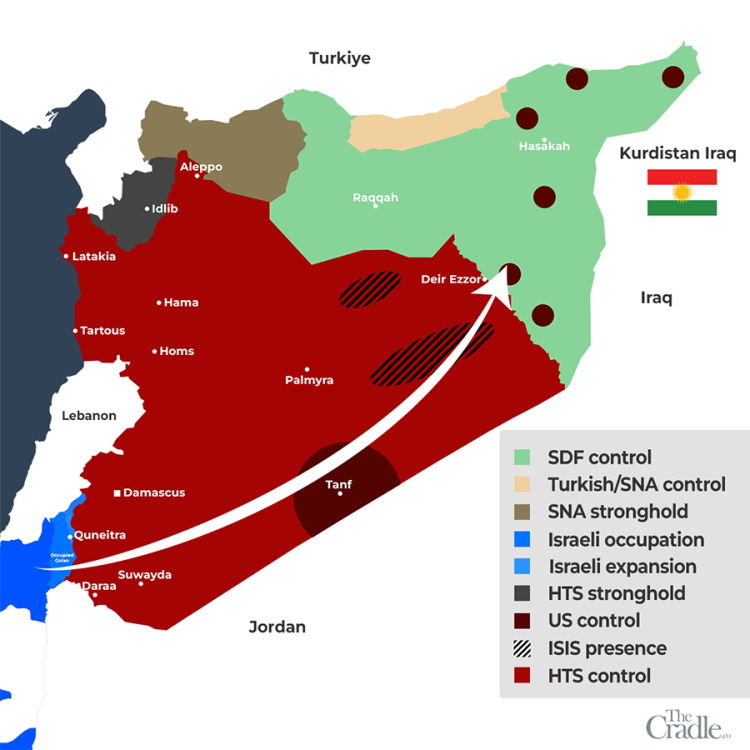
A map of the proposed David’s Corridor
A corridor of influence, not infrastructure
From Tel Aviv’s perspective, southern Syria is now a strategic vacuum: Syria’s army is weakened, Turkiye is entangled in its own Kurdish dilemmas, and Iran is overstretched. This power void offers fertile ground for Israel to assert dominance, particularly if regional dynamics continue to favor decentralized, weak governance.
Despite Washington’s reduced military footprint, the US remains committed to containing Iran. Key outposts like the Al-Tanf base on the Syrian–Iraqi border are instrumental in severing the so-called Iranian land bridge from Tehran to Beirut.
Nicola argues that while David’s Corridor is not an explicit US policy, Washington is likely to support Israeli initiatives that align with American strategic goals:
“The United States does not mind Israel implementing the project if it serves its interests, even though it is not part of its immediate strategy. It focuses on reducing Iran’s influence and dismantling its nuclear program, while supporting the path of regional normalization with Tel Aviv.”
The 2020 Abraham Accords, by easing Israel’s diplomatic isolation, have created additional maneuvering space. David’s Corridor – once a fantasy – now appears more plausible amid the regional flux.
Israeli leaders have sent unmistakable signals. On 23 February, Israeli Prime Minister Benjamin Netanyahu rejected any Syrian military presence south of Damascus, insisting on demilitarized zones in Quneitra, Deraa, and Suwayda under the pretext of protecting Syria’s Druze minority.
Israeli Foreign Minister Gideon Saar openly advocated for a federal Syria – a euphemism for fragmentation. Defense Minister Israel Katz vowed that Israeli troops would remain indefinitely in Mount Hermon and the Golan, and called for the dismantling of Syria into federal entities. Media leaks of corridor maps have only fueled speculation.
These moves have triggered outrage in southern Syria, with protests erupting in Khan Arnaba, Quneitra, Nawa, Busra al-Sham, and Suwayda. Yet, as Nicola notes, the new Syrian leadership appears remarkably disinterested in confronting Israel, and Arab states remain largely indifferent, even as the project edges toward realization. Turkiye, by contrast, stands firmly opposed to any Kurdish-led partition of Syria.
Geopolitical stakes and final frontiers
Ultimately, David’s Corridor signals a broader Israeli project to reengineer Syria’s geopolitics: isolate the south militarily, bind the Kurds in alliance, shift the balance of power, and carve a corridor of influence through fractured terrain.
Israel’s objectives are layered. Militarily, the corridor provides strategic depth and disrupts Iran’s land routes to Hezbollah. It enables the flow of arms and intelligence support to allies, especially Kurdish forces.
Economically, it opens a potential oil pipeline from Kirkuk or Erbil – Kurdish-majority, oil-rich areas – to Haifa, bypassing Turkish routes and maritime threats from actors like Yemen’s Ansarallah-allied army. Politically, it solidifies Israeli–Kurdish ties, undermines Syrian and Iraqi sovereignty, and advances the vision of Greater Israel, with the Euphrates as a symbolic frontier.
Yet the corridor is not without risk. It threatens to deepen the region’s instability, antagonize Syria, Turkiye, Iran, and Iraq, and trigger new fronts of resistance. Whether Israel can realize this project depends on the fluid regional calculus and its ability to maneuver within it.
David’s Corridor may still be a project in the shadows – but its implications are already casting a long one across the region.
Policy Reversal: Why Is the U.S. Softening Its Position on Iran?
By Viktor Mikhin – New Eastern Outlook – April 5, 2025
In Recent Days, the Trump Administration—Known for Its Hardline Stance on Iran—Has Shown Unexpected Shifts in Rhetoric.
U.S. Special Envoy for Middle East Affairs Steven Whitcoff, who previously advocated for a policy of “maximum pressure” on Tehran, now speaks of the need for “confidence-building” and “resolving disagreements.” This sharp turn in foreign policy strategy raises many questions: What exactly prompted Washington to change its approach? What factors influenced the decision to soften its stance? And most importantly—does the U.S. have a real plan of action, or is this just a temporary tactical maneuver?
An analysis of the situation suggests that the policy shift is tied to a combination of factors—from the failure of sanctions to the Trump administration’s domestic political calculations. Additionally, Iran’s response and that of the international community play a key role in determining how events will unfold.
The Failure of “Maximum Pressure”
In 2018, the U.S. unilaterally withdrew from the Joint Comprehensive Plan of Action (JCPOA), expecting that harsh sanctions would force Iran to make concessions. The Trump administration believed economic strangulation would either lead to regime change in Tehran or its surrender on the nuclear issue. However, these calculations proved wrong.
Instead of backing down, Iran responded by escalating its nuclear activities. According to the IAEA, Tehran has significantly increased its stockpile of enriched uranium and begun developing more advanced centrifuges. Moreover, the country strengthened ties with Russia and China, finding alternative ways to bypass sanctions. As a result, the “maximum pressure” policy not only failed to achieve its goals but, from Washington’s perspective, worsened the situation by bringing Iran closer to developing nuclear weapons.
Now, Washington seems to have realized that isolating Iran hasn’t worked and is attempting to shift to diplomatic methods. The question, however, is whether it’s too late—Tehran, hardened by bitter experience, is unlikely to agree to new negotiations without serious guarantees.
Another reason for the policy shift may be domestic U.S. issues. Facing economic challenges and a lack of clear successes, President Trump urgently needs a foreign policy win that can be framed as a major achievement of his so-called “new approach.” A full-scale war with Iran is too risky—a scenario that could spell disaster for both the region and the U.S. itself. Thus, the administration is likely betting on a temporary agreement that can be marketed as a “diplomatic breakthrough.” However, this approach risks new problems—if the deal proves short-lived, it will further erode international trust in the U.S.
Internal Divisions in U.S. Leadership
The rhetorical shift also reflects deep divisions within the American leadership. While some officials, like Steven Whitcoff, advocate for negotiations, others—including National Security Advisor Mike Waltz—continue to insist on Iran’s complete abandonment of its nuclear program. These contradictions indicate a lack of a unified strategy.
Part of the administration appears to recognize the futility of further pressure, while another faction remains committed to a hardline approach. This division makes any long-term U.S. strategy unstable—a change in administration or even a shift in Congressional power dynamics could undo any agreements reached. Such confusion weakens the effectiveness of U.S. policy and gives Iran additional leverage.
Iran’s Response: Why Tehran Doesn’t Trust the U.S.
Iranian leaders remain deeply skeptical of Washington’s new overtures. Supreme Leader Ayatollah Khamenei has repeatedly stated that “threats and bribes do not work on Iran.” The experience of the 2015 JCPOA showed that the U.S. could abandon the deal at any moment, even if Iran fully complied.
After Washington’s unilateral withdrawal, Tehran lost faith in American guarantees. Now, Iran’s leadership demands not only sanctions relief but also legally binding commitments to prevent the U.S. from reneging again.
The situation is further complicated by internal political struggles in Iran. Conservative factions, empowered after the JCPOA’s collapse, oppose any concessions to the West. Additionally, Iran has adapted to sanctions by finding alternative oil markets and deepening cooperation with China and Russia. This reduces the effectiveness of U.S. pressure and diminishes Tehran’s incentives to compromise.
Even Washington’s closest allies, like Israel, have expressed discontent with the policy shift. Prime Minister Benjamin Netanyahu stated he distrusts new negotiations with Iran and views any concessions as dangerous.
European nations, however, have long called for renewed dialogue. Germany, France, and the UK—who remained in the JCPOA after the U.S. exit—hope for de-escalation. Yet their influence is limited, as key decisions are made in Washington and Tehran.
Currently, negotiations remain at an impasse. The U.S. offers dialogue but maintains sanctions, while Iran refuses concessions without guarantees. Experts believe Trump is attempting a “good cop, bad cop” tactic, similar to his approach with North Korea. However, unlike in 2015, Tehran is no longer willing to negotiate under pressure. Iranian leaders recognize that time is on their side—the longer the U.S. fails to achieve its goals, the weaker its position becomes.
A Way Out?
An exit from the deadlock—which the U.S. created in its relations with Iran—was discussed during recent trilateral talks between China, Russia, and Iran in Beijing. The meeting produced a comprehensive initiative to resolve the Iranian nuclear issue, based on five principles:
- Peaceful Solutions Over Sanctions: All parties must reject coercive pressure and illegal restrictions, prioritizing dialogue. Conditions for renewed negotiations must be created while avoiding escalatory steps.
- Balancing Rights and Obligations: Iran must uphold its commitment against nuclear weapons development, while the international community recognizes its right to peaceful nuclear energy under the NPT.
- Returning to the JCPOA as a Foundation: The initiative calls for renewed focus on the JCPOA, urging the U.S. to demonstrate goodwill and rejoin the process.
- Dialogue Over UN Pressure: Premature involvement of the UN Security Council would undermine trust and stall progress. Confrontational mechanisms would negate years of diplomacy.
- Gradual Steps and Mutual Compromises: Forceful methods are ineffective—only equal consultations can produce a compromise respecting all parties’ interests and global demands.
The softening of U.S. rhetoric is a clear sign that “maximum pressure” has failed. Yet without real concessions and guarantees, negotiations are unlikely to yield a breakthrough. Iran has learned to play the long game, leaving Washington with a choice: serious, equal-footed dialogue or further escalation with unpredictable consequences. For now, the situation remains in limbo, with neither side willing to make the first move.
Viktor Mikhin, Corresponding Member of the Russian Academy of Natural Sciences (RAEN), Expert on Arab World Affairs
Bucha ‘massacre’ three years on… a false-flag atrocity to prolong a criminal proxy war
Strategic Culture Foundation | April 4, 2025
Three years ago this week, the Western media blazed with headlines of a shocking “massacre” allegedly carried out by Russian military forces in the Ukrainian town of Bucha.
It was alleged that Russian soldiers murdered hundreds of civilians in cold blood, execution-style, and left their corpses strewn on the streets.
Bizarrely, no exact number of victims has ever been accounted for by the Ukrainian authorities. They claim there were over 400 victims. But there are no forensic reports, no names, no addresses. And curiously, the Western governments and their media have not bothered to call for a proper investigation or to question jarring discrepancies. The West complacently relied on the Kiev regime’s claims and amplified them without question, a one-sided practice that has been typical over the last three years.
No plausible explanation was given by the Ukrainian regime or the Western media as to why Russian forces would perpetrate such heinous violations. It was implicitly taken as proof of Russian “barbarity” and “unprovoked aggression against Ukraine.” The then U.S. President Joe Biden said the atrocity reaffirmed his claims that Russian leader Vladimir Putin was a war criminal.
Three years later, there is an eerie silence among Western governments and the media. Given the anniversary of such an ostensibly shocking event, one would expect many statements, reports, and commentaries to commemorate it.
Moreover, it was Russia this week that convened a meeting at the UN Security Council to demand a thorough and impartial investigation into the incident. As Russian envoy Dmitry Polyanskiy pointed out in his presentation, Western media and governments have steadfastly ignored asking questions about the event in Bucha despite their initial dramatic allegations of Russian culpability.
The United Nations secretariat has also shown an awkward and shameful reluctance to respond to repeated Russian calls for a full investigation into the alleged war crime in Bucha.
The Western silence over Bucha is indicative that the incident was much more significant and sinister than their initial reports claimed three years ago.
Isn’t it strange that the alleged perpetrator of mass murder is the one who is calling for a proper investigation?
Western silence reminiscent of Nord Stream sabotage
This is reminiscent of the Nord Stream gas pipeline sabotage that occurred in September 2022. The United States is implicated in that war crime, but Western media and governments have refused to hold any serious accounting of the Baltic Sea explosions and have likewise rebuffed Russia’s calls for an independent investigation.
Perversely, Denmark, which currently holds the rotating presidency of the UNSC, denounced Russia for disinformation over Bucha. Denmark said it would not dignify Russia’s statements by giving a considered response. That sounds like an excuse to stonewall a genuine discussion of the evidence. Similar to the way Denmark and other European states have ignored the Nord Stream crime.
The refusal to investigate the Bucha matter is an indirect admission that the official Western narrative is false. Indeed, an earnest consideration of objective circumstances shows the Western media distorted the events, either wittingly or unwittingly.
A brief recap of the circumstances is that Western media started reporting on April 4-6 the finding of bodies on the streets of Bucha several days after Russian forces had withdrawn from the town on March 30 (as part of a peace deal being negotiated at the time between Russia and Ukraine). It was evident from the images published that the victims had been killed in the previous 24-48 hours.
Incongruously, however, the Mayor of Bucha, Anatoly Fedoruk, posted a video on March 31 happily proclaiming that all Russian military had left. His footage did not show any corpses on the streets. Residents of the town, with a population of less than 40,000, also did not mention any mass killings by Russian forces. If hundreds of people had been gunned down and left on the road, wouldn’t someone have noticed such a horror and urgently called for international attention as soon as Russian forces had departed?
As Polyanskiy, the Russian diplomat, noted in his statement to the UNSC this week, Ukrainian commandos and military police who entered Bucha on April 1 and 2 posted videos of themselves threatening to shoot civilians that they perceived as supportive of Russia.
Witness to fabricated atrocity
A crucial witness to the events was French journalist Adrien Bocquet, who arrived in Bucha at the same time the Ukrainian military was entering it. He was accompanying medical volunteers from Canada and Lebanon. Bocquet testified to the UNSC meeting this week that he witnessed Ukrainian soldiers unloading corpses from a lorry and tying their hands with white ribbons to signify that the victims were pro-Russian. Bocquet says that he has been vilified in the French media as a liar over his claims. He has also received death threats.
The Western media claims that Russia carried out mass killings in Bucha are riddled with anomalies that are begging for an independent investigation. As the news was breaking around April 4-6 three years ago, The New York Times and others published satellite images purporting to show bodies executed in Bucha from March 11 onwards when the Russian military was occupying the town. However, how was it that the corpses recovered were all freshly deceased, showing no signs of decay as would have been the case according to the timeline reported in the Western media?
It seems obvious to anyone with an open mind that the executions were fabricated by Ukrainian forces to blame Russia in a false-flag provocation. In other words, the NATO-backed military is implicated as the perpetrators of mass murder. And the Western media are complicit in propagating false propaganda to discredit Russia and cover up for the culprits.
It is certainly damning that not only has a proper investigation of the Bucha “massacre” not been conducted, the NATO and European Union-backed Kiev regime has not released the names of the victims. A proper forensic investigation would have provided details on the date of death and the circumstances.
Would the Ukrainian military carry out such violations?
There seems little doubt that the NeoNazi paramilitary units that make up the Ukrainian forces are more than capable and willing to carry out such atrocities. They have no scruples about murdering civilians, especially for propaganda purposes to gain more NATO weaponry and funding from Western states.
Atrocities standard practice by NeoNazis in Kursk and Donbass
As Russian forces push the Ukrainian militants and their NATO mercenaries out of the Kursk and Donbass territories, it has become apparent from numerous eye-witness testimonies and forensic examinations that civilians have been subjected to sadistic terrorism and wanton murder. The systematic war crimes committed by the Kiev regime are sickening in their depravity. Families have been attacked in their homes, families shot at while fleeing in cars, and pregnant women murdered. Atrocities include beheadings.
What happened in Bucha three years ago is a macabre and obscene disregard for human life and international law. But similar crimes have been repeated in other towns and villages that the NATO-backed Ukrainian forces have occupied.
The Western media cannot admit the truth about what happened in Bucha because that would unravel the whole false narrative about the nature of the Kiev regime, how it came to power in a NATO-backed coup in 2014 against an elected president, and how it conducted a campaign of terror against ethnic Russian communities for eight years after 2014 that culminated in Russia’s military intervention on February 24, 2022, to put it to an end. This was not an unprovoked aggression by Russia as Western media and governments endlessly repeat in mantra. It was a proxy war provoked by the United States, Britain and other NATO members to inflict a strategic defeat on Russia using NeoNazi Ukrainian paramilitaries weaponized by Western taxpayers.
Only now are Western media coyly admitting that the conflict in Ukraine is a proxy war. The truth about the depth of Western culpability is still obscured. The Bucha false-flag atrocity, if fully understood, would reveal the vile extent of Western involvement and responsibility for the three-year war in Ukraine, a war that still threatens to spiral out of control into a nuclear world war. That’s why the truth about Bucha has to be firmly denied by the Western media. The criminal responsibility of American, Canadian, British, and other European governments for this proxy war is damning.
Britain’s nefarious role in false flag
Russian envoy Dmitry Polyanskiy told the UNSC meeting this week: “Today, it is also crystal clear that the so-called ‘Bucha massacre’ was a monstrous provocation staged by Kiev and its British backers to thwart peace, perpetuate the conflict, and pressure other Western allies into supplying weapons to Ukraine.”
Note that the envoy singled out “British backers” among the NATO sponsors of the Kiev regime. The significance of this is that Britain’s military intelligence MI6 has been the main player in colluding with the NeoNazi Ukrainian death squads – perhaps more than the American CIA.
When the “massacre” was first reported three years ago, the Russian Federation immediately called for an urgent meeting of the UN Security Council to discuss the incident.
The UNSC refused to table a discussion as requested by Russia. The rotating presidency of the Security Council was then held by Britain.
Furthermore, days before the Bucha provocation, Russian and Ukrainian delegates were on the verge of finalizing a peace settlement to the conflict in talks that were being held in Turkey. Hence, the Russian military withdrew from Bucha and other northern towns as a gesture of goodwill.
After the Western media reported the “shocking” alleged Russian atrocities in Bucha, British Prime Minister Boris Johnson flew to Kiev in a “surprise visit” and convinced the regime to scuttle the peace talks with Russia and to continue fighting, along with promises of increased military support from NATO. In an act evoking his hero Winston Churchill, Johnson declared that Ukraine would fight on to win against Russia. He cited the “Bucha massacre” as justification for NATO’s plucky defiance.
The war could have ended three years ago, sparing the lives of one million Ukrainian soldiers. The Bucha false-flag massacre ensured that a potential peace settlement was sabotaged. One vile crime led to another.
Cui Bono? It is glaringly obvious. Hence, the Western media obediently conceal the crime.
How Big Pharma Weaves Its Web
By Kim Witczak | Brownstone Institute | April 5, 2025
Inever set out to be an advocate. I wasn’t a doctor, scientist, or policy expert. I was just a regular person who, like so many, blindly trusted that our healthcare system was designed to protect us.
But life has a way of pulling us into the arena when we least expect it.
After the tragic and unexpected loss of my husband Woody to the antidepressant Zoloft he was prescribed for insomnia, I was thrust into a world I never imagined—one where medicine wasn’t solely about healing, but deeply entangled in a system that prioritizes profit over safety, buries harms, and keeps the public in the dark.
For over two decades, I’ve had a front-row seat to how this system truly operates—not the illusion of rigorous oversight we see in medical journals or glossy pharmaceutical ads, but the reality of how industry influence is woven into every stage.
I’ve met with regulators, testified before the FDA and Congress, filed a wrongful death and failure-to-warn lawsuit against Pfizer, and earned a seat on the FDA’s Psychopharmacologic Drugs Advisory Committee as a consumer representative.
I’ve also spoken at and participated in global conferences like Selling Sickness, Too Much Medicine, and the Harms in Medicine meeting in Erice, Italy—where some of the world’s leading experts acknowledge what few in mainstream medicine dare to say:
Our healthcare system isn’t about health—it’s about business.
And in this business, harm isn’t an accident. It’s built into the system.
The more I uncovered, the more I realized:
We aren’t just patients. We are customers.
And we are all trapped in Big Pharma’s spiderweb of influence.
The Spiderweb of Influence
The more I learned, the more I saw just how deeply embedded the pharmaceutical industry is—not just in drug development and marketing but in every corner of our healthcare system.
That’s why I created the Big Pharma Spider Web of Influence—to visually map out how the system is designed not to prioritize health but to sell sickness while minimizing, downplaying, or outright hiding harms.
From clinical trial design to regulatory approval, from direct-to-consumer advertising to medical education, from controlling medical journals to silencing dissenting voices, the industry has built an intricate and self-reinforcing web—one that traps doctors, patients, and even regulators in a cycle of pharmaceutical dependence.
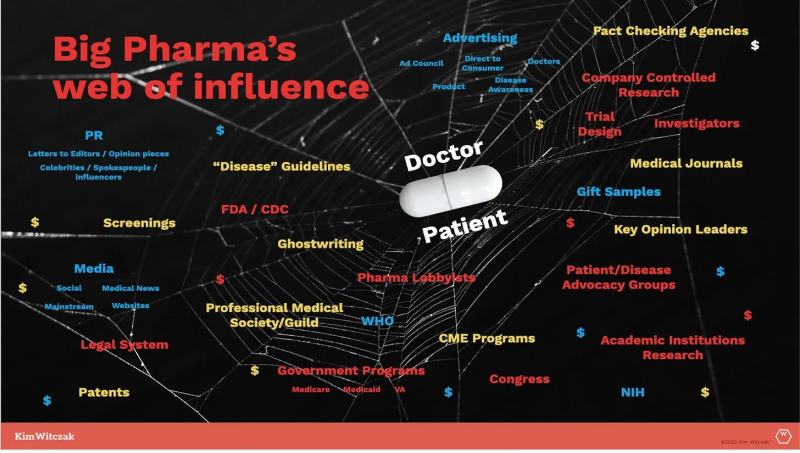
How the Web Works
- Clinical trials are often designed, funded, and controlled by the very companies that stand to profit. They manipulate data to exaggerate benefits and obscure risks, ensuring that negative results are buried, spun, or never published at all.
- Regulatory agencies like the FDA are deeply entangled with the industry they’re supposed to oversee. More than 50% of the FDA’s budget comes from industry-paid user fees, and a revolving door ensures that many key decision-makers come from—and later return to—pharmaceutical companies.
- Medical journals depend on pharmaceutical funding through advertising, reprint sales, and industry-sponsored studies—severely limiting independent scrutiny of drug safety. Many studies are ghostwritten or crafted by paid “key opinion leaders” (KOLs) who serve as pharma’s trusted messengers.
- Doctors receive education through industry-funded programs, learning “best practices” based on treatment guidelines crafted by the very system that profits from overprescription.
- Patient advocacy groups, once independent grassroots organizations, have been co-opted by industry money, ensuring that the loudest voices often serve pharma’s interests rather than patients’ needs. I call them “astroturf” patient groups—they look like real grassroots organizations, but they’re anything but.
- Screenings and guidelines continuously expand the definitions of disease, turning more people into lifelong customers.
This isn’t about one bad actor or isolated corruption—it’s a systemic issue. The entire structure is designed to push more drugs onto the market, medicalize normal human experiences, and only acknowledge harm when it becomes too big to ignore.
It’s a brilliant business model—but a catastrophic public health strategy.
“To Sell to Everyone:” The Business Model of Medicine
If this sounds like a conspiracy, consider the bold admission made by Henry Gadsden, former CEO of Merck, in a 1976 interview with Fortune Magazine:
“The problem we have had is limiting the potential of drugs to sick people. We could be more like Wrigley’s Gum…it has long been my dream to make drugs for healthy people. To sell to everyone.”
– Former Merck CEO Henry Gadsden
Let that sink in.
This wasn’t about curing disease—it was about expanding markets. Gadsden’s vision wasn’t just to treat illness, but to medicalize everyday life—creating a cradle-to-grave model where every person, healthy or sick, became a customer for life. Just like selling a variety of gum—something for everyone. Juicy Fruit, Big Red, Doublemint, Spearmint, and so on.
And that’s exactly what happened.
Today, we live in a system where:
- Everyday emotions—sadness, worry, shyness—are rebranded as medical conditions requiring treatment.
- Preventive medicine often means lifelong prescriptions, not lifestyle changes.
- Drugs are marketed to the “worried well”, turning normal human experiences into diagnoses.
This isn’t just theory—it’s well documented. In Selling Sickness: How the World’s Biggest Pharmaceutical Companies Are Turning Us All into Patients, Ray Moynihan and Alan Cassels expose how pharmaceutical companies create diseases, expand diagnostic criteria, and convince the public that normal life experiences require medical intervention.
The goal?
Make medication the default—not the last resort.
Harms Are Always an Afterthought
Harms from medication are not rare, nor are they unexpected.
But in this system, they are treated as acceptable collateral damage—something to be dealt with only after the damage is done, after lives are lost or forever changed.
I’ve sat in FDA Advisory Committee meetings, reviewing new drug applications, and have seen firsthand how safety concerns are often dismissed in favor of “innovation” or “unmet medical need.”
I’ve heard industry representatives and advisory committee members argue that safety signals can be addressed post-market, meaning after a drug is already in circulation and causing harm or a required REMS (Risk Evaluation and Mitigation Strategies) program upon approval.
But by the time post-market safety issues are acknowledged, it’s often too late.
We’ve seen this play out over and over:
- Opioids—marketed as “non-addictive” and pushed aggressively onto patients, leading to an epidemic of addiction and death.
- SSRIs and antidepressants—long linked to increased risks of suicide and violence, particularly in young people, yet downplayed or dismissed for decades. Other hidden harms include withdrawal syndromes and Post-SSRI Sexual Dysfunction (PSSD), conditions that many patients were never warned about.
- Antipsychotics—widely prescribed for off-label use, leading to severe metabolic and neurological side effects.
- Covid-19 vaccines—an experimental mRNA platform rushed to market, mandated, and imposed on society despite limited long-term safety data and growing concerns over harms.
Every time, the pattern is the same:
The industry sells the benefits while downplaying the risks—until those risks become too big to ignore.
By then, the drug is a blockbuster, billions have been made, and the system moves on to the next new “breakthrough.”
More Than Degrees: The Truth of Lived Experience
One of the biggest lessons I’ve learned in this fight is that real-world experience matters just as much as credentials.
Over the years, I’ve been invited to speak at medical schools, PhD programs, and universities, thanks to brave academics willing to challenge the narrative. I share my journey as an accidental advocate—someone who didn’t have a medical degree but discovered America’s broken drug system the hard way.
But let’s be honest—the medical world is driven by credentials. Or, as I like to say, the alphabet soup.
At conferences, attendees wear name tags listing their titles—MD, PhD, JD, MPH. It’s a quick way to size someone up, to assess credibility before even speaking. And I’ve seen it happen: people glance at my name tag, see no impressive letters after my name, and walk right by.
Years ago, I was speaking at the Preventing Overdiagnosis Conference and noticed my badge read: Kim Witczak, BA.
I was horrified. Was that really necessary? Did my name tag need to remind everyone that I only had a BA?
Later, I was telling the story to a doctor friend, and he laughed.
“Next time, tell them BA stands for Bad Ass.”
And he was right.
Because real expertise doesn’t always come from an advanced degree—it comes from lived experience, from asking the right questions, from refusing to accept the status quo.
The Counterargument: But Don’t We Need Experts?
Of course, some will argue that only experts with MDs and PhDs should be trusted to shape healthcare policy.
But that assumes that the system they operate in is free from bias, conflicts of interest, or financial incentives.
The reality is that many of those with the most letters after their names are also the ones benefiting from pharma funding—whether through consulting fees, research grants, or advisory roles.
Meanwhile, patients and their families—the ones living with the consequences—are too often ignored.
That needs to change.
Asking Better Questions: Reclaiming Our Power
If there’s one thing I’ve learned on this journey, it’s this: no one is coming to save us. The institutions meant to protect us are too entangled in the web to act with true independence.
My late husband, Woody, used to say: “Follow the money.” And when you do, the truth becomes impossible to ignore. Pharmaceutical profits—not patient well-being—drive the system. That’s why the only way to create real change is through awareness, transparency, and fundamentally shifting how we think about medicine and health.
That starts with asking better questions:
- Who funded this research?
- Does this person or institution have financial ties, intellectual bias, or self-interest that could impact their recommendations?
- Who benefits from this treatment?
- What aren’t we being told?
- What are the long-term consequences of this drug or intervention?
- Are there safer, non-drug alternatives being ignored because they aren’t profitable?
But asking the right questions isn’t enough.
We have to stop outsourcing our health to a system built on financial incentives and guided by corporate interests.
We must demand full transparency, challenge the status quo, and recognize that sometimes the best medicine isn’t a pill but a deeper understanding of what our bodies truly need.
Because once you see the web, you can’t unsee it.
And once you recognize how deeply medicine has been shaped by profit, you’ll realize the most important question isn’t just “What can I take?”—it’s “Who benefits if I do?”
Final Thoughts: Tearing Down the Web
I never wanted to be in this fight, but once you see the web, you can’t unsee it. That’s why I continue to speak out, to challenge the system, and to push for real accountability.
Because the stakes aren’t theoretical. They’re deeply personal.
For me, this fight began over two decades ago with Woody. But for countless others, it begins the moment they or someone they love is caught in the web—trusting a system that was never truly designed to protect them.
It’s time to tear down the web.
And it starts with seeing it for what it really is.
New Study: Recent ‘Unprecedented’ Cloud Cover Decline Driving Modern (And Past) Climate Change
By Kenneth Richard | No Tricks Zone | March 25, 2025
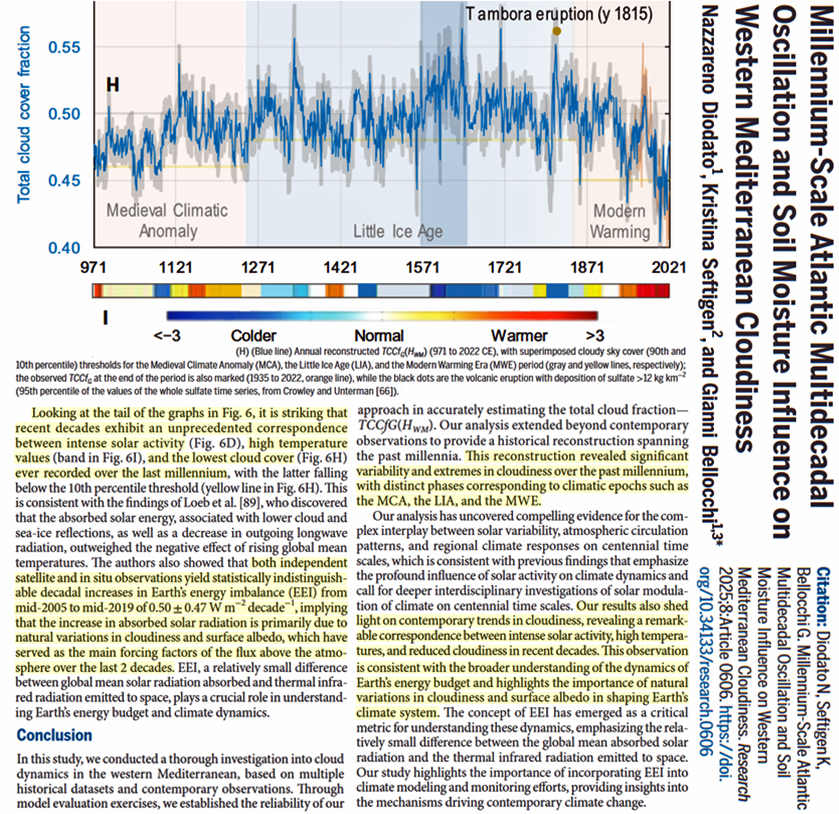
“[T]he increase in absorbed solar radiation is primarily due to natural variations in cloudiness and surface albedo, which have served as the main forcing factors of the flux above the atmosphere over the last 2 decades.” – Diodato et al., 2025
It is commonly accepted that there has been a satellite-observed (CERES) cloud cover albedo decline that has led to an increase in solar radiation absorbed by the Earth’s oceans. This increasing trend in absorbed solar radiation (ASR) explains the post-2000 global-scale temperature increase (Dübal and Vahrenholt, 2021, Loeb et al., 2021, Stephens et al., 2022, Koutsoyiannis et al., 2023, Loeb et al., 2024, Nikolov and Zeller, 2024).
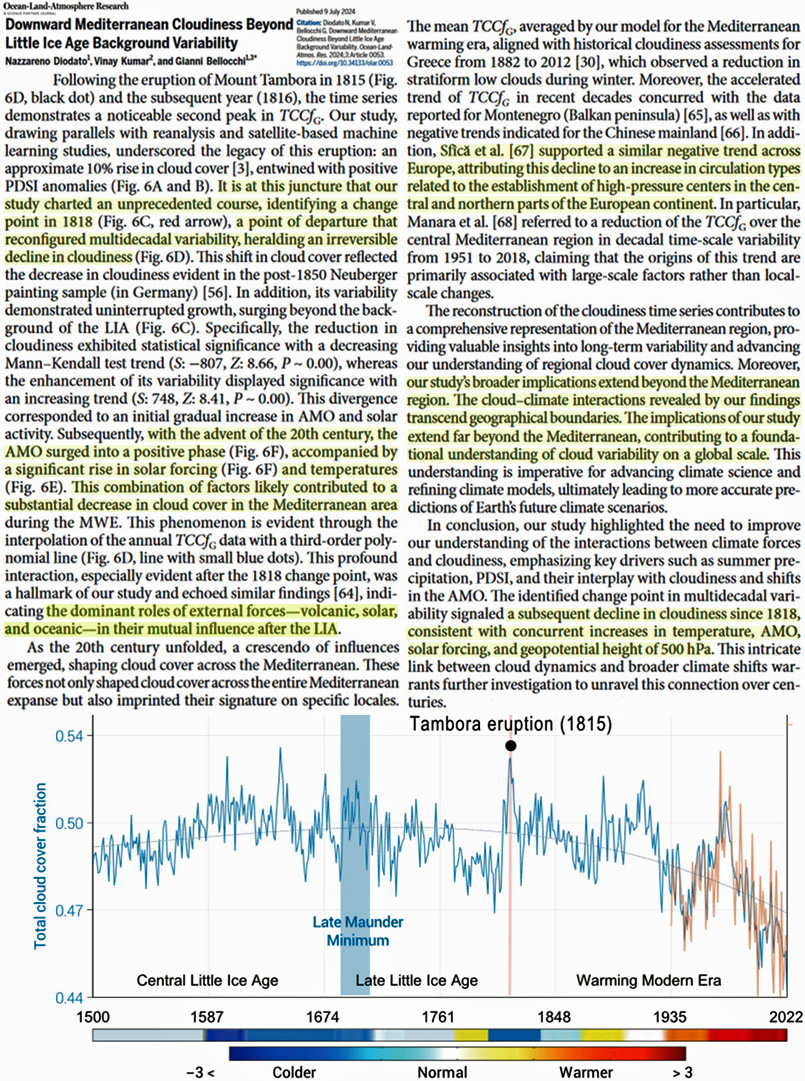
And now, in two new studies (Diodato et al., 2024 and Diodato et al., 2025), scientists have begun formulating reconstructions of cloud cover over the Mediterranean region that can be dated all the way back to the Medieval Warm Period, or 970 CE.
The authors suggest their reconstructions of cloud cover may be representative of more than just this region, as it is a product of large scale processes that may “transcend geographical boundaries.” In other words, what happens in the Mediterranean region may well have global implications.
Their reconstructions indicate the modern declining cloud cover trend may not only have been occurring since 2000, but, except for a brief increasing period from about 1945 to 1980 (that coincided with a global cooling trend), it has been ongoing for over 200 years. The “turning point” years were 1815-1818, following the eruption of Mount Tambora. From that point on there has been a precipitous decline in cloud cover that departs from multi-decadal variability.
The authors suggest the “dominant” factors linked to the post-1800s warming trend include solar forcing, volcanic forcing, and the Atlantic Multi-decadal Oscillation (Diodato et al., 2024).
In other words, the modern warming as well as the past climate changes may be “primarily due to natural variations in cloudiness and surface albedo, which have served as the main forcing factors” (Diodato et al., 2025).
IDAHO GOV VETOES MEDICAL FREEDOM BILL
The HighWire with Del Bigtree | April 3, 2025
A sweeping bill to ban forced medical interventions in Idaho, including vaccines and masks, passed both chambers only to be vetoed by Governor Brad Little, who ironically cited “medical freedom” in his opposition. Now, a political clash brews as Attorney General Raul Labrador urges lawmakers to override the veto and defend Idahoans from future mandates.
Israel has left over 39,000 orphans in Gaza

Palestinians inspect destroyed building following the Israeli army attack in the Gaza Strip on April 1, 2025 in Khan Yunis, Gaza [Abed Rahim Khatib – Anadolu Agency]
MEMO | April 4, 2025
A new report has revealed that more than 39,000 children in Gaza have lost one or both their parents, as the death toll from Israeli attacks on the Strip has risen to 50,523, with 114,776 others injured since 7 October 2023.
The Palestinian Central Bureau of Statistics stated that Gaza is experiencing the largest orphan crisis in modern history, with tens of thousands of children losing their parents due to the ongoing Israeli assault.
In a statement issued ahead of Palestinian Children’s Day, which is marked tomorrow, the bureau reported that 39,384 children in Gaza have lost one or both parents after 534 days of Israeli attacks on the Strip. Among them, around 17,000 children have been left without both parents, facing life without support or care.
The Israeli occupation army continues its attacks on civilians in Gaza, decimating the enclave and forcibly displacing its over two million residents.
Euro-Med Monitor: Israel’s brutality in Gaza surpasses all recent forms of terrorism
Palestinian Information Center – April 4, 2025
GAZA – nature of Israel’s crimes in the Gaza Strip must be denounced, particularly the crimes’ horrifying scope, methodical execution, and wide-ranging effects, which surpass those of armed groups like ISIS, the Euro-Med Human Rights Monitor said.
While the crimes committed by ISIS have been widely denounced by the international community, the same community is now mostly silent—and therefore complicit—as Israel pursues a campaign of declared genocide that aims to exterminate the Palestinian people from their homeland, the Euro-Med said.
Israeli occupation forces detonated a robot on Thursday 3 April 2025 rigged with tons of explosives in the heart of the densely populated Shuja’iyya neighborhood in eastern Gaza City. The explosion occurred in an area packed with displaced civilians, though there was no military necessity and no combat activity in the vicinity. This act embodies the conduct of existing terrorist organizations, even surpassing them in brutality and disregard for human life, and bears no resemblance to the conduct of a state bound by international law, regardless of any attempts to distort or evade it.
The explosion killed 21 Palestinians and injured around 100 others, the majority of them women and children. A full residential block was obliterated with its residents still inside, and this is not an isolated incident. Over recent months—particularly in the northern Gaza Strip—Israel has increasingly used explosive-laden robots in residential neighborhoods during its ground incursions. At least 150 such detonations have resulted in the deaths of hundreds of civilians, mostly women and children, and caused wide-scale destruction to homes and other essential infrastructure.
A separate atrocity was committed on 23 March, when Israeli forces detained 15 Palestinian rescue workers from the Palestinian Red Crescent and Civil Defense, along with a United Nations staff member, before executing them extrajudicially—some while their hands were bound. Their bodies were dumped into a pit, and the ambulances they had been travelling in were destroyed. This incident is another blatant example of an intentional Israeli crime mirroring—and exceeding—the brutality of groups like ISIS, as it reveals a clear and deliberate intent to annihilate Palestinians both physically and through psychologically terrorizing residents across the Strip.
Euro-Med Monitor field teams have documented thousands of crimes committed by Israeli forces, constituting overwhelming evidence of mass atrocities. These crimes include an unprecedented pattern of violence in recent history, in terms of scale, deliberate targeting, and genocidal intent. A minimum of 58,000 Palestinians have been killed, the majority of them women and children, and most have been buried beneath the rubble of homes deliberately destroyed over their heads, while many were killed by sniper fire with clear intent. Over 120,000 individuals have been injured, and at least 39,000 children have been orphaned. The Gaza Strip’s infrastructure, including homes, hospitals, and schools, has been virtually obliterated.
These acts amount to one of the most extensive and systematic campaigns of extermination in contemporary history, underscoring the urgent need for international accountability, an end to Israeli impunity, and concrete action to halt further atrocities.
Israel’s methods in the Gaza Strip—particularly its mass killing of civilians—bear a striking resemblance to the tactics used by groups the international community has widely condemned as terrorist. However, the atrocities unfolding in the Strip are far more dangerous in terms of scale, brutality, and systematic intent, and cannot be understood merely as a function of violent methods or tools.
The rights group pointed out that these actions cannot be dismissed as random or extreme policies, but rather represent a fully-fledged model of organized state terrorism, driven by a comprehensive blueprint for annihilation and implemented in full view of the international community.
“These crimes are being committed with clear, declared intent to eliminate the Palestinian people as a national and collective entity, uproot those who remain on their land, erase their identity, and ultimately end their collective existence.”
Euro-Med called all states, both individually and collectively, to fulfil their legal obligations and take urgent action to stop Israel’s genocide in the Gaza Strip in all its forms. This includes implementing concrete measures to protect Palestinian civilians, ensuring Israel’s compliance with international legal norms and the rulings of the International Court of Justice, and guaranteeing full accountability for perpetrators of war crimes and crimes against humanity.
It also stressed the importance of implementing the arrest warrants issued by the International Criminal Court against the Israeli Prime Minister and army minister at the earliest opportunity and ensure these individuals’ transfer to international justice.
Furthermore, Euro-Med called on the international community to impose comprehensive economic, diplomatic, and military sanctions on Israel in response to its grave and systematic violations of international law. This includes an arms embargo; the cessation of all political, financial, and military cooperation; asset freezes of implicated officials; travel bans; and the suspension of trade privileges and bilateral agreements that provide Israel with economic benefits, enabling its continued crimes.
South Korea’s top court removes president over martial law controversy
Press TV – April 4, 2025
South Korea’s top court has officially removed President Yoon Suk Yeol from office following his surprise declaration of martial law which triggered a political crisis in the country.
The decision by Constitutional Court on Friday came after parliament voted to impeach him in December, ending his presidency which started in 2022.
Yoon, a former star prosecutor, had leaped from political novice to president in less than a year after he entered politics. Four months ago, however, he plunged South Korea into political turmoil by declaring a controversial martial law in the country.
The eight-member Constitutional Court announced on live television that it upheld Yoon’s impeachment because his martial law decree was a serious violation of South Korean laws.
The court explained that there was no serious national threat at the time Yoon declared martial law.
“The defendant not only declared martial law, but also violated the constitution and laws by mobilizing military and police forces to obstruct the exercise of legislative authority,” the court’s acting chief Moon Hyung Bae said.
Moon pointed out that Yoon’s declaration of martial law decree was a serious violation of the country’s laws and “cannot be justified.”
“Given the grave negative impact on constitutional order and the significant ripple effects of the defendant’s violations, we find that the benefits of upholding the constitution by removing the defendant from office far outweigh the national losses from the removal of a president,” Moon added.
The court concluded that Yoon, as head of the armed forces, not only violated the formal process of declaring martial law, but also committed a “grave betrayal of the people’s trust.”
It noted that since there was no justification for Yoon’s behavior, he must be removed from power.
The Constitutional Court’s ruling takes effect immediately and sets the stage for a new presidential election in South Korea.
Meantime, South Korea’s Prime Minister Han Duck Soo was reinstated by the Constitutional Court as acting president.
Political observers cite the swift rise and fall of Yoon, who was once touted as a key US ally who forged close ties to former US President Joe Biden, as an anomaly.
Yoon’s removal had been a hugely divisive issue in South Korea, with mass rallies held by those in favor and those against his removal.
Anti-Yoon demonstrators gathered outside the court to celebrate the announcement, waving flags and dancing to music.
His supporters who had gathered outside the president’s official residence in the South Korean capital Seoul demonstrated deep sadness.
To maintain law and order in Seoul, South Korean law enforcement agencies have ramped up security and police issued warnings to the protesters against any sort of violence.
According to reports, there had been an increase in police presence, and barriers and checkpoints had been set up in the capital.
Seyed Mohammad Marandi: Iran Defies Trump’s Ultimatum and Threat of War
Glenn Diesen | April 3, 2025
Seyed Mohammad Marandi is a professor, an analyst and an advisor to Iran’s nuclear negotiation team. Prof. Marandi discusses Iran’s rejection of Trump’s ultimatum and the possible nuclear escalation.
Substack: https://glenndiesen.substack.com/
Featured Video

Trita Parsi: Israel Set a Trap for Total War in the Region
or go to
Aletho News Archives – Video-Images
From the Archive
Zionism’s Violent Legacy
By Donald Neff | Washington Report On Middle East Affairs | January 1996
On January 4, 1948, Jewish terrorists drove a truck loaded with explosives into the center of the all Arab city of Jaffa and detonated it, killing 26 and wounding around 100 Palestinian men, women and children.[1] The attack was the work of the Irgun Zvai Leumi – the “National Military Organization,” also known by the Hebrew letters Etzel – the largest Jewish terrorist group in Palestine. The Irgun was headed by Revisionist Zionist Menachem Begin and had been killing and maiming Arabs, Britons and even Jews for the previous ten years in its efforts to establish a Jewish state.
This terror campaign meant that at the core of Revisionist Zionism there existed a philosophical embrace of violence. … continue
Blog Roll
 Aletho News
- Trita Parsi: Israel Set a Trap for Total War in the Region
- Trump’s Iran war is on an Israeli leash
- Saudi oil boss issues global supply warning
- Riyadh Says Its Oil System Is Intact. The Numbers Say Otherwise.
- Trump and Netanyahu Want to “Finish the Job” on Iran
- US ‘one-sided dictation’ not Iran’s beliefs makes rational talks impossible: Baghaei
- Iran’s Next Strike May Not Explode. It Could Shut You Down /Col Doug Macgregor
- Iran: US political targets legitimate if assassinations return
- Iraq shuts key border crossing with Iran under US pressure: Report
- Undersea Internet cables could be targeted in retaliation for attacks on Iran: IRGC deputy chief
- If Americans Knew
- The Israel Lobby’s Changing Fortunes
- AIPAC has become such a political liability that it’s shifting to a more “nimble” approach to buying politicians
- At least 160 Israeli settler attacks in 2 weeks
- Will Gaza’s Ancient Christian Community Disappear Forever?
- Israel’s vision of regional security rests on keeping Arab states weak
- Heidi Levine recounts how Palestinian youths helped save her in settler attack
- DAILY UPDATE: Latest essential news on Palestine, Israel, & region
- Trump’s Intensifying Sabotage of the ICC, for Israel’s Sake
- Israeli military detain US and UK volunteers in West Bank including Democratic NY politician Brad Lander
- Americans at National Conservatism Conference held in Israel this year criticize Israel
- No Tricks Zone
- E-Cars Reduce CO2 Emissions By Only 41% Compared To Internal Combustion Engine Vehicles
- Predictions Made By Renowned Climate Professor Over Past Decades Have Been Proven To Be Poor
- New Study Suggests Large Regions Of The Pacific Ocean Have Been Cooling For The Last 80 Years
- Germany’s Green Energy Debacle: High Energy Costs Force Kahla Porzellan to Close After 182 Years!
- New Study: 50 Years Of The Most Aggressive ‘Net Zero’ Policies Can Only Affect The Global Climate By 0.03°C
- US September “Heat” Was No Record…Many Records Set Decades Ago
- Latest European Green Energy Debacle; Portugal’s Largest Flagship Solar Park Insolvent!
- Green Energy Debacle: German Expert Professor Fritz Vahrenholt Warns Of Severe Economic And Social Consequences
- Two More Paleo Reconstructions Affirm Meters-Higher Sea Levels Across Ireland, Brazil 7000-6000 Years Ago
- New Study: Earth And Venus Surface Warmth Largely Explained By Convection And Lapse Rate, Not CO2 Or Radiation

