New Info on How the Feds Helped Censor a Bombshell
By Didi Rankovic | Reclaim The Net | April 2, 2025
The US House Judiciary Committee has released internal chat logs, that show the FBI moved into cover-up mode the very day the New York Post published the Hunter Biden laptop story, on October 14, 2020.
The logs, first reported about by journalists Michael Shellenberger and Catherine Herridge, reveal that the FBI employees were immediately instructed “not to discuss the Biden matter,” while an intelligence analyst who, during a call with Twitter, accidentally confirmed that the story, i.e., the laptop, was real, was placed under a “gag order.”
The reason the analyst, who was with the FBI’s Criminal Investigative Division, was able to so quickly confirm the reporting was based on credible information was the fact the FBI had seized and authenticated Hunter Biden’s laptop several months earlier.
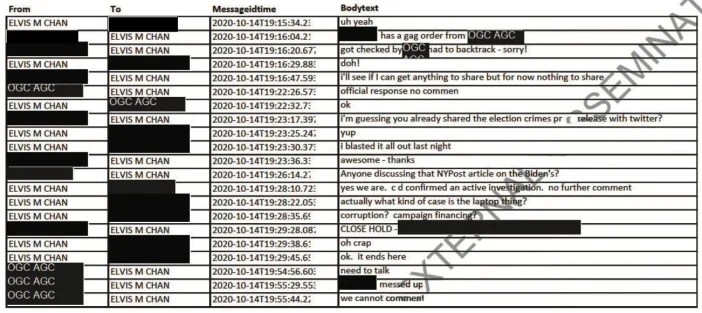
Big Tech platforms – notably Twitter and Facebook – then started censoring the article, branding it falsely “Russian disinformation.” By maintaining the “no comment” policy instead of confirming that the laptop was real and under investigation, the FBI was in effect tacitly promoting the false narrative about foreign interference.
These moves originated from the Foreign Influence Task Force, which was shut down earlier this year for its activities related to censorship through pressure on social platforms.
The laptop scandal was unfolding during a crucial time in the 2020 campaign and represents one of the most egregious publicly known examples of political censorship of free speech and media orchestrated by government agencies.
The chat logs that have now been published reveal that one of the FBI staff involved in the Hunter Biden laptop story suppression was Bradley Benavides.
Only weeks prior, Benavides featured in another controversy: that time in what appeared to be a smear campaign against Senators Ron Johnson and Chuck Grassley, who were allegedly “advancing Russian disinformation.”
At the time, the senators just so happened to be investigating Hunter Biden’s financial connections to foreign governments.
A letter the Judiciary Committee sent Benavides in June 2023, shows that he had by that time gone through the Big Tech-Big Government “revolving door” – and was senior risk manager at Amazon.
Iran presses the IAEA on Trump’s ‘bombing’ threat, reaffirms no nukes pursuit
IRNA – April 2, 2025
Tehran – The International Atomic Energy Agency (IAEA) must adopt a clear position regarding threats against Iran’s civilian nuclear facilities, Foreign Minister Abbas Araqchi said Tuesday, days after U.S. President Donald Trump threatened to “bomb” Iran.
Araqchi was speaking on the phone with the secretary general of the IAEA, Rafael Grossi.
He emphasized that given the recurrence of such threats, the Islamic Republic will take every necessary measure to protect its nuclear program.
Grossi, for his part, said he would talk with other parties to create a suitable atmosphere to help resolve existing issues. He also asked to visit Iran, which Araqchi accepted.
Trump said on Sunday that he would order military strikes against Iran if Tehran did not strike a new deal with Washington on its nuclear program. “If they don’t make a deal, there will be bombing,” he said in an interview with NBC News.
Iran has warned to respond swiftly and decisively to any act of aggression on its soil.
Reacting to Trump’s threat, a senior adviser to Leader of the Islamic Revolution Ayatollah Seyyed Ali Khamenei said that even though Iran doesn’t seek nuclear weapons, any strike on the country by the United States or Israel on that false pretext would force the country to develop atomic bombs for defensive purposes.
“If America or Israel bomb Iran under the nuclear pretext, Iran will be compelled to move toward producing an atomic bomb,” Ali Larijani said during a televised interview on Monday.
Araqchi, however, once again clarified Tehran’s long-standing position, which is based on a religious decree (fatwa) by Ayatollah Khamenei prohibiting the development, possession, and use of nuclear weapons, reaffirming that the country will never produce or acquire any atomic bombs under any circumstances.
He said in an X post on Tuesday that ten years after signing the Iran deal and seven years after the U.S. unilaterally walked away from it under Trump’s first term, “there is not ONE SHRED OF PROOF that Iran has violated this commitment.”
Meanwhile, UN spokesperson Stephane Dujarric was asked on Tuesday to comment on Trump’s threat, to which he said, “We urge everyone to avoid inflammatory rhetoric.”
“I think the UN Charter is very clear in encouraging Member States to settle all disputes through diplomatic means,” he said in response to the question asked by IRNA’s correspondent.
On March 12, Trump sent a letter to Iran via an emissary from the United Arab Emirates (UAE), requesting that negotiations be opened into a deal that he says would stop Iran from building a nuclear weapon. This is while, in 2018, he pulled out of a multinational nuclear deal with Iran. On February 4, the U.S. president signed a presidential memorandum to restore a hostile policy from his first term of “maximum pressure” on the Islamic Republic.
Iran, which has relayed its response to the U.S. president’s letter via Oman, has ruled out direct negotiations with the United States as long as the “maximum pressure” policy and the military threats are in place.
“Diplomatic engagement worked in the past and can still work. BUT, it should be clear to all that there is—by definition—no such thing as a ‘military option’ let alone a ‘military solution,’” Araqchi said in his X post.
Germany: Does Chaos await the CDU party? Unrest growing as AfD closes in on first place
In democracy, it is always best to simply ban the party that might end up beating you
Remix News | April 2, 2025
With coalition negotiations ongoing, the Christian Democrats (CDU) are beginning to experience inner turmoil over the current polling weakness of the party. Meanwhile, the Alternative for Germany (AfD) is soaring in the polls, and now just one point behind the CDU.
Dennis Radtke, head of the CDU’s workers’ wing, told Handelsblatt newspaper, that the polling weakness is now a major concern.
“We must confidently explain why we do what we do,” Radtke demanded, including why weapons investments are needed to “prevent our children from having to learn Russian.”
“The current development is, to say the least, highly problematic and dangerous,” Radtke said. He is calling for an “honest analysis” of the election results.
The party must “not give the impression that the CDU has won an absolute majority and that we are selling our souls unnecessarily.”
However, the influential Welt newspaper is predicting even more dire consequences for the CDU. The influential deputy editor fo the paper, Ulf Poschardt, slams the CDU’s “firewall” against the AfD, pointing out that it is only strengthening the AfD.
Dear friends of the firewall, dear Antifa, congratulations on erecting the great firewall and its effective violence. You’ve done it. The AfD is now only slightly behind the CDU/CSU – and you don’t have to be a great prophet to suspect that this is only an interim result.
The CDU/CSU has made itself dependent on the culturally dominant left-green zeitgeist, and now the once conservatives and conservatives are being presented with the bill. The firewall agitators in the editorial offices, from the far left to the left to the center-left – which is most journalists – should also be rather grateful. The destruction of the CDU/CSU is in full swing. What the opportunist Angela Merkel failed to achieve, Friedrich “We’re halving the AfD” Merz is now managing to do.
He goes on to appeal to the conservative wing of the CDU, imploring them not to join a coalition with the SPD.
“And the conservatives in the CDU/CSU, the only relevant Antifa after Franz Josef Strauss, must ask themselves whether they want to allow the destruction of their party in a senseless coalition with an irresponsible SPD. Or not. It’s no longer just about the self-destruction of the CDU/CSU. The destruction of the country is getting closer. A little closer every day.”
The federal chairwoman of the Small and Medium-Sized Business Union, Gitta Connemann (CDU), also raised the alarm.
“The dire predictions even before the coalition negotiations have been concluded aren’t helping anyone, least of all the country,” also told Handelsblatt.
The new Forsa poll has the AfD at 24 percent, just a point behind the CDU, which is at 25 percent. If elections were held today, there is no way the CDU could join a coalition with the Social Democrats (SPD), as the party would not have enough votes.
Friedrich Merz, who is thought to be the next chancellor, made a radical break with his campaign promise to not remove the debt brake. Almost immediately after the election, he said he would take out hundreds of billions of debt and change the constitution to do it, which he successfully passed using the previous Bundestag formation before a new parliament could take power.
It is thought that the Office of the Protection of the Constitution (BfV), the powerful domestic spy agency, has a report that will classify the AfD as “confirmed right-wing extremist.” At that point, the new Bundestag is expected to vote on a ban on the AfD, including the Greens, SPD, Left Party, and the CDU.
Merz himself has said he will recommend his MPs vote for a ban if the BfV delivers the report with such a designation. The BfV, a highly partisan agency, was led by a CDU member, Thomas Haldenwang, up until recently. Currently, a new president has not yet been appointed.
If a ban is voted through, the issue will go to the Constitutional Court.
In the end, Germany may end up banning the most popular party in the country.
Trump’s Foreign Aid Suspension Unnerves Washington, not Recipients. Part 1
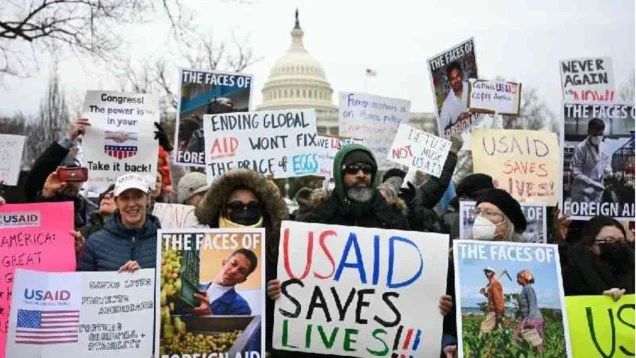
By Simon Chege Ndiritu – New Eastern Outlook – April 2, 2025
On January 20th, 2025, Donald Trump paused US foreign assistance for 90 days. This move was followed by the suspension of the United States Agency for International Development (USAID), through which most US foreign assistance was channeled.
The ‘Donor’ Protesting
Surprisingly, the recipients ignored this suspension, leaving Washington to protest it, which shows that parties in Washington have been the chief beneficiaries of this aid. Meanwhile, some in the recipient countries do not perceive the suspended assistance as worth bemoaning but replacing and moving on. While Trump has repeatedly accused other countries of ripping off the US through aid, using the term ‘development assistance’ to refer to this money that is never used to build roads, bridges, power plants, or buildings is quite ironic. It shows that ‘development’ means something else to Washington. According to USAID’s localization report released in 2023, over 90% of its money went to its international partners in and around Washington.
Therefore, only 10% reaches targeted communities, and some end up funding opium production and pedophile-run children’s orphanages, among others. The US and Western Europe frame Africa as surviving on aid, which is only a colonial ploy. In response to Trump’s suspension, some Kenyans recognized that America’s foreign aid helps Washington and that the US is an unreliable partner. Surprisingly, Kenyan media coverage recognizes the need to move on from Washington’s posturing and find sustainable funding sources.
Trump’s Cutting Funds for Contractors in Washington
Some Kenyans have been baffled by Trump’s suspension of aid, noting how it gave Washington unsolicited influence. For instance, an opinion sent to Kenya’s Daily Nation after Trump’s suspension revealed that the sender was baffled by the White House, since the aid gave the US soft power and influence. The opinion email proceeded to suggest that Trump’s America is cash-strapped due to its senseless tariff war with China. Noteworthy, the US received funds from Europeans before passing the bulk of it to Washington-based contractors, emphasizing the importance of this aid to America. It has been an open secret that Western aid helps the donors and not the recipients. Trump’s move will adversely affect American businesses, even as noted by an FP article from May 2022, which revealed that foreign aid was funding a bubble in Washington.
Therefore, his suspension runs against his America First Policy; this drastic move must be informed by a more significant concern for the US empire, such as China. An article authored by Nicholas Okumu, a Kenyan orthopedic surgeon for the Star Newspaper, steered clear of Trump’s actions, and their motivations and focused on how Kenya should respond. Okumu observed that American aid has always been a tool for political leverage and economic self-interest, insisting that Kenya should seek sustainable ways of funding its projects instead of relying on Washington’s unpredictable and ineffective assistance. US aid only yields minimal tangible benefits for Africans, as it is fashioned to prioritize American commercial interests, for instance, by awarding contracts to US firms and undermining industries in recipient countries.
US Aid’s Vicious Cycle
Issuing the US development assistance, including the part disbursed through USAID, starts by leading the audience into a tunnel vision of how the country is planning an extensive (supposedly) altruistic program to alleviate pressing challenges in poor countries. At this stage, audiences are not informed that Washington created the challenge or wants to enrich its contractors without addressing the problem. For instance, details that Washington’s Pentagon had bombed Al-Shifa pharmaceutical manufacturing company in Sudan in 1998, hence preventing millions from accessing health supplies, are hidden. The aid ends with money being spent in Washington and nothing being achieved for recipient communities, even while a justification for an enormous investment is created. Washington does not care if people access medical supplies, but whether its contractors can benefit from purporting to supply them.
A good example may include the repeated cycle of USAID’s Global Health Supply Chain Cycle. The first cycle, conceived in 2015 and worth $9.5 billion, ended without substantial results and was used in 2024 to justify a new one worth $17 billion. In the beginning, Washington’s media machine told audiences how USAID planned the Global Health Supply Program, which was designed to solve the problem of lifesaving health supplies being inaccessible to poor countries. The empty hype in this endeavor may have been detected in the statement that the project was supposed to “shake up global health contracting,” meaning the primary interest was not to alleviate supply problems but to award a massive contract to the main contractor, Chemonics International.
The project’s value of $9.5 billion had been dispensed three years later and was spent on fraud and inefficiencies. After 2017, the main contractor received a deadline extension and an additional $2 billion without delivering substantial results. An investigative report found that Chemonics International’s procurement reviewers had made up figures to report that 80% of the contracts had been delivered. Thirty-nine people had been indicted with fraud, but the main contractor escaped with a slap on the wrist by paying only $3.1 million to the justice department. Therefore, Washington’s aid benefited a contractor who used a façade of delivering aid to other countries. To attest to the failure of the first project cycle, which started in 2015, USAID launched a similar $17 billion project, dubbed NextGen, by signing contracts for delivering ‘lifesaving supplies around the globe.’ It is Ironic for anyone to think that Washington, which bombed a pharmaceutical factory in Sudan in 1998 and a trauma hospital in Afghanistan in 2015, really cares whether people can access medical suppliers. Noteworthy, most countries are unable to produce medical supplies because America’s big Pharma monopolizes them through patents.
Going Forward
USAID has always been tied to procuring from the US, making recipient countries fail to develop industries that can organically respond to local challenges. For instance, American laws mandate that food aid be purchased from American farmers and delivered using American-flagged vessels, which means farmers in the recipient countries lose business. Similarly, other industries that receive aid from the US can also collapse, which limits Africans’ development. The deleterious effects of the US aid programs can explain the donors’ insistence on issuing them out, meaning that Africans should not view Trump’s suspension of aid as a tragedy. Instead, it is an opportunity for reflection on how American aid should be replaced, since it is ineffective and unreliable. The US will permanently halt its aid when it does not stand to gain. Therefore, African governments must seek ways to finance their projects without relying on Western aid.
Western ‘interventionism’ has turned Bosnia and Herzegovina into a ‘failed state’ – Bosnian Serb leader
RT | April 2, 2025
Western interference has turned Bosnia and Herzegovina into a “failed state,” and the country now needs Russia’s help to resolve the crisis, Bosnian Serb leader Milorad Dodik has told RT. Dodik, the president of Republika Srpska – the Serb-majority autonomous region within Bosnia and Herzegovina – arrived in Russia on Monday for talks with President Vladimir Putin.
Bosnia and Herzegovina was created under the 1995 US-brokered Dayton Peace Agreement, which ended the civil war in the former Yugoslavia. It formed a state comprised of the Bosniak-Croat Federation and Republika Srpska, with a tripartite presidency and an international overseer – the Office of the High Representative (OHR), now held by Christian Schmidt, a former German lawmaker appointed in 2021.
Dodik has long rejected the OHR’s authority, accusing it of overreach and undermining Republika Srpska’s autonomy. He was sentenced in February to a year in prison and a six-year political ban for defying the OHR. Sarajevo issued a national arrest warrant for him and is reportedly seeking Interpol warrants.
In an interview with RT on Tuesday, Dodik said the Dayton agreement, which formed his country, is no longer upheld, and that he has asked the Russian president, who he met with earlier that day, to assist him in bringing the situation to the attention of the UN Security Council (UNSC).
“[Putin] knows of the existence of foreigners that are making up laws and decisions in our country, that there are courts which abide by these decisions… and that this is not in the spirit of Dayton,” Dodik said. He added that as a permanent UNSC member and Dayton signatory, Russia is in a position to effect change.
“We talked about the need to engage in the monitoring of the UNSC. Russia is the only one from which we can expect to have an objective approach… to end international interventionism which degraded Bosnia and Herzegovina and made it into a failed state,” he added.
Commenting on the Interpol warrants, Dodik said, “we’ll see how it goes,” adding that he already has the backing of Serbia, Hungary, and now Russia. He went on to call the charges “a political failure” by Sarajevo and the OHR.
“I think they would like to see me dead, not just in prison. They can’t get the Bosnia they want, in which there is no Republika Srpska, if Milorad Dodik remains president,” he said, adding that critics will try to demonize him for meeting with Putin.
Dodik has opposed Bosnia’s NATO membership and called for closer ties with Russia. He previously suggested that Bosnia would be better off in BRICS and has pledged continued cooperation with Moscow despite Western pressure.
Russia, which does not recognize Schmidt’s legitimacy due to the lack of UNSC approval, has denounced Dodik’s conviction as “political” and based on “pseudo-law” imposed by the OHR.
After meeting with Putin, Dodik said on X that he will return to Republika Srpska on Saturday to meet with regional leaders, adding that Russia has agreed to advocate for an end to the work of international bodies in Bosnia, including the OHR.
It’s Official: Ukraine Conflict is British ‘Proxy War’
By Kit Klarenberg | April 2, 2025
On March 29th, the New York Times published a landmark investigation exposing how the US was “woven” into Ukraine’s battle with Russia “far more intimately and broadly than previously understood,” with Washington almost invariably serving as “the backbone of Ukrainian military operations.” The outlet went so far as to acknowledge the conflict was a “proxy war” – an irrefutable reality hitherto aggressively denied in the mainstream – dubbing it a “rematch” of “Vietnam in the 1960s, Afghanistan in the 1980s, Syria three decades later.”
That the US has since February 2022 supplied Ukraine with extraordinary amounts of weaponry, and been fundamental to the planning of many of Kiev’s military operations large and small, is hardly breaking news. Indeed, elements of this relationship have previously been widely reported, with White House apparatchiks occasionally admitting to Washington’s role. Granular detail on this assistance provided by the New York Times probe is nonetheless unprecedented. For example, a dedicated intelligence fusion centre was secretly created at a vast US military base in Germany.
Dubbed “Task Force Dragon”, it united officials from every major US intelligence agency, and “coalition intelligence officers”, to produce extensive daily targeting information on Russian “battlefield positions, movements and intentions”, to “pinpoint” and “determine the ripest, highest-value targets” for Ukraine to strike using Western-provided weapons. The fusion centre quickly became “the entire back office of the war.” A nameless European intelligence chief was purportedly “taken aback to learn how deeply enmeshed his NATO counterparts had become” in the conflict’s “kill chain”:
“An early proof of concept was a campaign against one of Russia’s most-feared battle groups, the 58th Combined Arms Army. In mid-2022, using American intelligence and targeting information, the Ukrainians unleashed a rocket barrage at the headquarters of the 58th in the Kherson region, killing generals and staff officers inside. Again and again, the group set up at another location; each time, the Americans found it and the Ukrainians destroyed it.”
Several other well-known Ukrainian broadsides, such as an October 2022 drone barrage on the port of Sevastopol, are now revealed by the New York Times to have been the handiwork of Task Force Dragon. Meanwhile, the outlet confirmed that each and every HIMARS strike conducted by Kiev was entirely dependent on the US, which supplied coordinates, and advice on “positioning [Kiev’s] launchers and timing their strikes.” Local HIMARS operators also required special electronic key [cards]” to fire the missiles, “which the Americans could deactivate anytime.”
Yet, the investigation’s most striking passages highlight London’s principal role in influencing and managing Ukrainian – and by extension US – actions and strategy in the conflict. Both direct references and unambiguous insinuations littered throughout point ineluctably to the conclusion that the “proxy war” is of British concoction and design. If rapprochement between Moscow and Washington succeeds, it would represent the most spectacular failure to date of Britain’s concerted post-World War II conspiracy to exploit American military might and wealth for its own purposes.
‘Prevailing Wisdom’
A particularly revealing section of the New York Times probe details the execution of Ukraine’s August 2022 counteroffensive, targeting Kharkov and Kherson. Unexpectedly finding limited resistance from hollowed out Russian positions in these areas, Task Force Dragon’s US military lead Lieutenant General Christopher T. Donahue urged Ukraine’s field commander Major General Andrii Kovalchuk to keep pushing, and seize even further territory. He vehemently resisted, despite Donahue and other senior US military officials pressuring then-Ukrainian Armed Forces Valerii Zaluzhnyi to override his reticence.
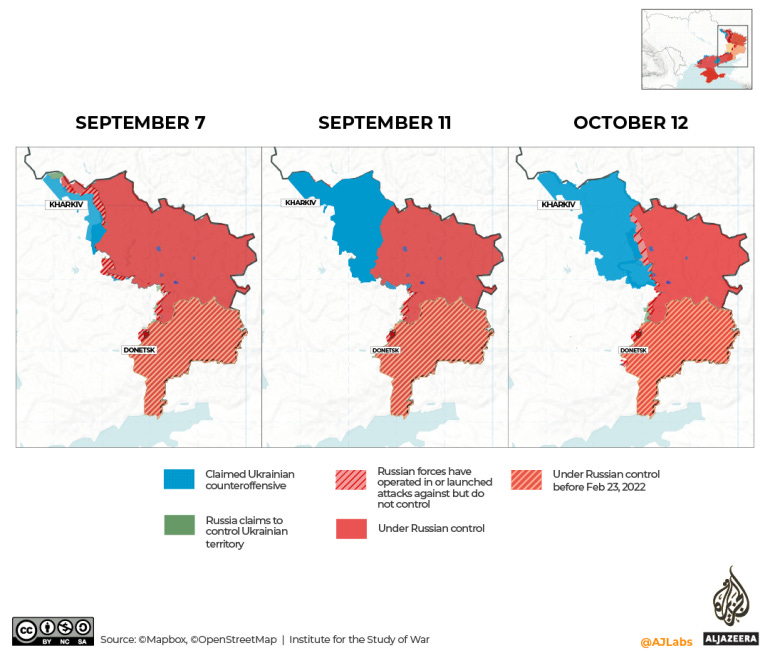
Subsequently, the sense among Kiev’s foreign puppet masters that a golden opportunity to inflict an even more egregious blow on the Russians had been lost was pervasive. Irate, then-British defence minister Ben Wallace asked Donahue what he would do if Kovalchuk were his subordinate. “He would have already been fired,” Donahue said. Wallace succinctly responded, “I got this.” At his direct demand, Kovalchuk was duly defenestrated. As the New York Times explains, the British “had considerable clout” in Kiev and hands-on influence over Ukrainian officials.
This was because, “unlike the Americans,” Britain had formally inserted teams of military officers into the country, to advise Ukrainian officials directly. Still, despite Kiev failing to fully capitalise as desired by London and Washington, the 2022 counteroffensive’s success produced widespread “irrational exuberance”. Planning for a followup the next year thus “began straightaway.” The “prevailing wisdom” within Task Force Dragon was this counteroffensive “would be the war’s last”, with Ukraine claiming “outright triumph”, or Russia being “forced to sue for peace.”
Zelensky boasted internally, “we’re going to win this whole thing.” The plan was for Ukrainian forces to cut off Russia’s land-bridge to Crimea, before seizing the peninsula outright. As the New York Times records though, Pentagon officials were considerably less enthused about Kiev’s prospects. This scepticism seeped out into the public sphere in April 2023 via the Pentagon Leaks. One document warned Ukraine would fall “well short” of its goals in the counteroffensive, forecasting “modest territorial gains” at most.
The leaked intelligence assessment attributed this to “shortfalls” in Ukraine’s “force generation and sustainment”, extensive Russian defences constructed following their retreat from Kherson. It cautioned “enduring Ukrainian deficiencies in training and munitions supplies probably will strain progress and exacerbate casualties.” The New York Times notes Pentagon officials moreover “worried about their ability to supply enough weapons for the counteroffensive,” and wondered if the Ukrainians “in their strongest possible position, should consider cutting a deal.”
Even Task Force Dragon’s Lieutenant General Donahue had doubts, advocating “a pause” of a year or more for “building and training new brigades.” Yet, intervention by the British was, per the New York Times, sufficient to neutralise internal opposition to a fresh counteroffensive in the spring. They argued, “if the Ukrainians were going to go anyway, the coalition needed to help them.” Resultantly, enormous quantities of exorbitantly expensive, high-end military equipment were shipped to Kiev by almost every NATO member state for the purpose.

Western-supplied tanks obliterated during Ukraine’s 2023 counteroffensive
The counteroffensive was finally launched in June 2023. Relentlessly blitzed by artillery and drones from day one, tanks and soldiers were also routinely blown to smithereens by expansive Russian-laid minefields. Within a month, Ukraine had lost 20% of its Western-provided vehicles and armor, with nothing to show for it. When the counteroffensive fizzled out at the end of 2023, just 0.25% of territory occupied by Russia in the initial phase of the invasion had been regained. Meanwhile, Kiev’s casualties may have exceeded 100,000.
‘Knife Edge’
The New York Times reports that “the counteroffensive’s devastating outcome left bruised feelings on both sides,” with Washington and Kiev blaming each other for the catastrophe. A Pentagon official claims “the important relationships were maintained, but it was no longer the inspired and trusting brotherhood of 2022 and early 2023.” Given Britain’s determination to “keep Ukraine fighting at all costs”, this was bleak news indeed, threatening to halt all US support for the proxy war.
Still, there was one last perceived ace up London’s sleeve to keep Washington invested in the proxy conflict, and potentially escalate it into all-out hot war with Moscow. The New York Times reports that in March 2023, the US discovered Kiev “was furtively planning a ground operation into southwest Russia.” The CIA’s Ukraine chief confronted General Kyrylo Budanov, warning “if he crossed into Russia, he would do so without American weapons or intelligence support.” He did so anyway, “only to be forced back.”
Rather than deterring further incursions, Ukraine’s calamitous intervention in Russia’s Bryansk region was a “foreshadowing” of Kiev’s all-out invasion of Kursk on August 6th that year. The New York Times records how from Washington’s perspective, the operation “was a significant breach of trust.” For one, “the Ukrainians had again kept them in the dark” – but worse, “they had secretly crossed a mutually agreed-upon line.” Kiev was using “coalition-supplied equipment” on Russian territory, breaching “rules laid down” when limited strikes inside Russia were greenlit months earlier.
As this journalist has exposed, Ukraine’s Kursk folly was a British invasion in all but name. London was central to its planning, provided the bulk of the equipment deployed, and deliberately advertised its involvement. As The Times reported at the time, the goal was to mark Britain as a formal belligerent in the proxy war, in the hope other Western countries – particularly the US – would follow suit, and “send more equipment and give Kyiv more leeway to use them in Russia.”
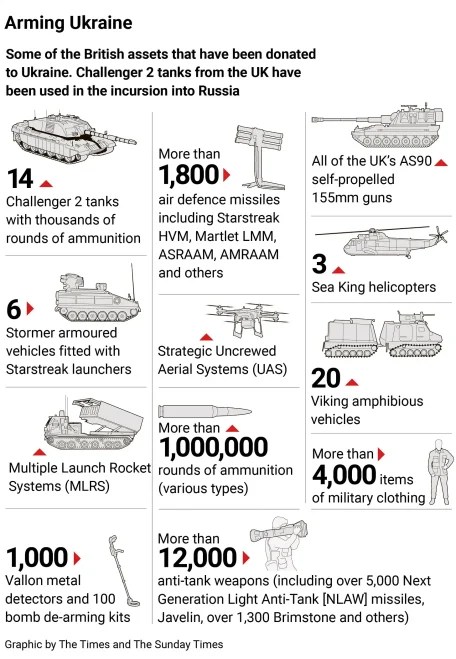
Initially, US officials keenly distanced themselves from the Kursk incursion. Empire house journal Foreign Policy reported that the Biden administration was not only enormously unhappy “to have been kept out of the loop,” but “skeptical of the military logic” behind the “counterinvasion”. In a further rebuke, on August 16th Washington prohibited Ukraine’s use of British-made, long-range Storm Shadow missiles against Russian territory. Securing wider Western acquiescence to such strikes was reportedly also a core objective behind Kiev’s occupation of Kursk.
However, once Donald Trump prevailed in the November 2024 presidential election, Biden was encouraged to use his “last, lame-duck weeks” to make “a flurry of moves to stay the course… and shore up his Ukraine project.” In the process, per the New York Times, he “crossed his final red line,” allowing ATACMS and Storm Shadow strikes deep inside Russia, while permitting US military advisers to leave Kiev “for command posts closer to the fighting.”
Fast forward to today, and the Kursk invasion has ended in utter disaster, with the few remaining Ukrainian forces not captured or killed fleeing. Meanwhile, Biden’s flailing, farewell red line breaches have failed to tangibly shift the battlefield balance in Kiev’s favour at all. As the New York Times acknowledges, the proxy war’s continuation “teeters on a knife edge.” There is no knowing what British intelligence might have in store to prevent long-overdue peace prevailing at last, but the consequences could be world-threatening.
Serbian president hails budding ‘military alliance’ with NATO maverick
RT | April 2, 2025
Hungarian Defense Minister Kristof Szalay-Bobrovniczky visited Belgrade on Tuesday to sign a roadmap outlining 79 joint military activities between Hungary and Serbia for this year. According to Serbian President Aleksandar Vucic, the two countries are edging closer to a “military alliance.”
Both Serbia and Hungary have been challenging the prevailing Western consensus regarding the Ukraine conflict and relations with Russia.
The Serbian leader also expressed gratitude to Hungarian Prime Minister Viktor Orban for his role during NATO’s military intervention in the Balkans in 1999, stating that Orban’s influence helped prevent “a land attack against what was then Yugoslavia.”
“A full 26 years later, the two parties now have the opportunity to build extremely close strategic ties, to further deepen cooperation, coming closer to a Hungarian-Serbian military alliance,” Vucic remarked.
Orban first served as prime minister from 1998 to 2002. Hungary joined NATO in March 1999, weeks before the bombing campaign commenced.
Szalay-Bobrovniczky voiced support for Serbia’s EU aspirations, asserting that Brussels’ enlargement plans should include the entire West Balkans. His statement contradicted EU leaders’ demands for Belgrade to align its foreign policy with Western nations against Russia before its candidacy would be considered.
Both Hungary and Serbia remain skeptical of the bloc’s confrontational approach toward Russia. Orban has accused Brussels of harming the EU economy through sanctions on Russia while supporting a conflict that Kiev is unable to win. Vucic has pledged to resist Brussels’ pressure, citing Serbia’s historic ties with Russia as a foundation for their relationship.
Last month, Kosovo, the Serbian region that broke away after the NATO intervention, entered a trilateral defense agreement with Albania and Croatia. Vucic has condemned those nations for allegedly breaching previous security agreements and possibly going over the head of the NATO leadership in signing the deal.
Le Pen conviction: How France’s courts keep sidelining the establishment’s political rivals
The case of the National Rally leader and presidential favorite, conveniently taken off future ballots, is part of a long pattern

By Rachel Marsden | RT | April 1, 2025
Earlier this week, the anti-establishment French political leader whom all polls suggest would easily win the presidency, if the vote were held tomorrow, was barred from running for office for five years. How convenient.
Right-wing National Rally leader Marine Le Pen has been found guilty in a Paris court of embezzling European Union funds. Accused of enabling a system whereby aides hired to serve in Brussels ended up doing work for the party, she was also fined an sentenced to two years of home detention under electronic monitoring. The allegations against Le Pen, dating back to at least 2014, were so old that they could have qualified for a French pension. But now the verdict conveniently takes her out of the 2027 election cycle.
If you were looking for a foolproof way to supercharge support for Le Pen’s party, congratulations, French judiciary – you nailed it. There’s no better way to fire up a political movement than to turn its leader into a martyr of a state that looks to be meddling with citizens’ democratic options. Just ask Romania’s Câlin Georgescu, who was on his way to victory before getting politically kneecapped by the system: arrested, accused of foreign funding, then ultimately just dismissed for a paperwork technicality.
And what happened next? His replacement, George Simion, is now surging in the polls. Who could’ve seen that coming? (Spoiler: Everyone.)
Disqualifying candidates for crimes like corruption, fraud, and electoral violations wasn’t automatic in France – until Emmanuel Macron’s party conveniently made it so in 2017. Timing is everything: that law landed roughly three years after Brussels put Le Pen in its investigative crosshairs. Surely just a coincidence.
The law’s biggest cheerleader? Macron ally and centrist leader, François Bayrou, who championed it – right up until he found himself accused of the exact same EU cash-grab scheme as Le Pen. Awkward. He lasted a whole month as Macron’s justice minister before getting booted. But don’t worry, he bounced back. Acquitted last year, he was later handpicked as Macron’s prime minister, despite not running for anything. You know who actually won that election? Le Pen’s party got the most votes, and the anti-establishment left won the most seats – neither of which entitles you to actually govern France anymore, apparently. Meanwhile, leftist leader Jean-Luc Mélenchon is also under investigation for – you guessed it – precisely the same kind of disqualifying offense involving EU funding as Le Pen.
It’s no wonder Trump looks at this mess and sees himself in Le Pen’s situation. “She was banned for five years and she was the leading candidate,” Trump said. “That sounds like this country.” If Trump had been French, and convicted on some of his own election-related charges, like those in Georgia, he wouldn’t have been able to run for president, either. Hopefully the fashion capital of the world won’t set a trend with this one. Sure, convict someone. But let the people decide if the convict is still a better electoral option. Democracy means letting people choose – even if their top pick needs a parole officer instead of a campaign manager.
There’s a distinct pattern here: every time a candidate starts looking like a real threat to the establishment, the legal system suddenly finds a reason to hit the brakes. It’s almost as if France has an unofficial “Incumbent Protection Act”.
Remember Dominique Strauss-Kahn? Back in 2011, as IMF head, he was basically measuring the drapes at the Élysée Palace for his imminent move in. Then – bam! – a New York hotel maid accused him of sexual assault. Career over. And just to make sure, French authorities later charged him with pimping. Yes, pimping. He was acquitted, but good luck running for office when “IMF President” and “Accused Pimp” are both on your CV.
Jump to 2017: François Fillon, a former prime minister, was leading the race to replace then president François Hollande. Then, right on cue, an investigative paper got a tip that he was allegedly paying his wife and kids to hold fake parliamentary aide jobs. His campaign imploded, and suddenly, here comes a relatively unknown political wonderboy named Emmanuel Macron to win it all. What luck!
Even the much-beloved former President Jacques Chirac couldn’t dodge the pattern. He was convicted in 2011 for a fake jobs embezzlement scheme dating back to his Paris mayoral days from 1977 to 1995. The only reason they didn’t nail him sooner? He had presidential immunity until 2007. They waited him out like a debt collector until his longtime nemesis, Nicolas Sarkozy, took office. To illustrate the contrast of worldview between the two presidents, Chirac kept France out of Uncle Sam’s regime-change-mobile in Iraq, and Sarkozy invaded Libya and was single-handedly responsible for reintegrating France back into NATO command after President Charles De Gaulle refused to do so in the interests of national sovereignty. By the time Chirac was actually convicted, he was no longer any kind of electoral threat to Sarkozy’s team, since he was denying Alzheimer’s rumors by that point more often than political wrongdoing.
Le Pen’s conviction has sparked immediate reactions from her political allies. Hungarian PM Viktor Orbán tweeted, “Je suis Marine,” in a nod to the “Je Suis Charlie” slogan that emerged after jihadists shot up the Parisian newsroom of the Charlie Hebdo satirical magazine. Dutch right-winger Geert Wilders called the sentence “incredibly harsh” and predicted that she’d win on appeal and win the French presidency. If she actually wins on appeal. And if that happens before 2027. And if the French legal system doesn’t suddenly “discover” another obstacle, with the EU’s help, as is often the case. Because if history tells us anything, it’s that French elections aren’t just won or lost at the ballot box – they’re also decided in courtrooms. And somehow, the ruling party never seems to be the one on trial.
The Zionist Destruction of American Higher Education
By Ron Unz • Unz Review • March 31, 2025
We may be witnessing the ongoing destruction of one of the greatest pillars of postwar American global influence and hegemony.
Late last week an astonishing event occurred in American society, and video clips of that incident quickly went viral across the Internet.
A 30-year-old Tufts doctoral student and Fulbright Scholar from Turkey was walking across her Boston-area neighborhood on the way to a holiday dinner at a friend’s house when she was suddenly seized and abducted in the early evening by six masked federal agents of the Department of Homeland Security. The terrified young woman was handcuffed and taken to a waiting car, secretly detained for the next 24 hours without access to friends, family, or lawyers, then shipped off to a holding cell in Louisiana and scheduled for immediate deportation, although a federal judge has now temporarily stayed the proceedings.
Just one of the Tweets showing a short clip of that incident has been viewed more than 4.5 million times, with a much longer YouTube video accumulating another couple of hundred thousand views.
That very disturbing scene seemed like something out of a Hollywood film chronicling the actions of a dystopian American police state, and that initial impression was only solidified once media reports explained why Rumeysa Ozturk was snatched off the streets of her home town. Her only reported transgression had been her co-authorship of an op-ed piece in the Tufts student newspaper a year earlier sharply criticizing Israel and its ongoing attacks on the civilian population of Gaza.
Apparently, one of the many powerful pro-Israel censorship organizations funded by Zionist billionaires became outraged over her sentiments and decided to make a public example of her, so its minions in the subservient Trump Administration immediately ordered her arrest.
CBS News covered a local protest demonstration demanding the young woman’s release, and quoted the remarks of one of the participants:
“The university campus should absolutely be a place for the free and open exchange of ideas and the fact that someone can just be disappeared into the abyss for voicing an idea is absolutely horrifying,” said rally attendee Sam Wachman.
Now supposed that such a scene—for such a reason—had taken place on the streets of Russia, China, Iran, or any other country viewed with great disfavor by our government. Surely that incident would have quickly become the centerpiece of a massive global propaganda offensive aimed at blackening the reputation of the regime responsible. Audiences worldwide would have been forcefully told that the arrest demonstrated the terrible dangers of living in a society lacking the freedoms guaranteed by our own Constitution and our Bill of Rights. I don’t recall seeing any recent propaganda campaigns along these lines, so that suggests that such incidents are extremely rare in those countries.

But unfortunately that is hardly the case in today’s America. A day or two before that Tufts graduate student was snatched off the streets of her city, a 21-year-old Columbia University junior went into hiding to avoid a similar fate after federal agents raided her campus dorm to arrest her. As the Times reported, high school valedictorian Yunseo Chung had moved to the U.S. with her family from South Korea when she was 7, but her permanent residency was suddenly revoked for her public criticism of Israeli policy. She was ordered immediately deported back to a country that she barely even remembered.

This followed the storm of controversy unleashed earlier this month by the very high profile arrest of Mahmoud Khalil, a recent Columbia graduate student heavily involved in last year’s campus protests against the Israeli attacks on Gaza. Seized in an early morning raid on his campus student housing, which he shared with his wife, an American citizen eight months pregnant, he was taken off to detention, first in New Jersey and then transferred to a holding cell in Louisiana, once again with no initial access to his family, friends, or lawyers.
As a Green Card holder—a permanent legal resident of the U.S.—he was considered fully entitled to all the normal rights and privileges of an American citizen, but Secretary of State Marco Rubio declared that his Green Card would be canceled and he would be deported based upon an obscure legal doctrine never previously employed for that purpose, eliciting a strong legal challenge in federal court. Moreover, his transfer from a New Jersey jurisdiction to a different one in the Deep South also seemed to violate normal legal procedures.

A week after that arrest, Ranjani Srinivasan, another Columbia doctoral candidate from India on a Fulbright Scholarship, hurriedly packed her bags and fled the country to Canada when she narrowly missed being arrested by federal authorities who raided her student housing. As the New York Times reported:
“The atmosphere seemed so volatile and dangerous,” Ms. Srinivasan, 37, said on Friday in an interview with The New York Times, her first public remarks since leaving. “So I just made a quick decision.”
A day earlier Rubio explained that he had already authorized the arrest and immediate deportation of more than 300 students around the country for their criticism of Israel, so these particular cases obviously represented merely the tip of a very large iceberg.
In past decades, the academic leadership of a top Ivy League school such as Columbia might have stoutly defended the students in its community. But any such resistance was broken when the Trump Administration suddenly pulled $400 million in annual funding. The demands included full cooperation with the arrest of any students critical of Israeli policies, the creation of a new internal security force to suppress any anti-Israel campus protests, and “receivership” for the university’s prestigious Middle Eastern Studies Program, presumably resulting in firm Zionist control.
Acting President Katrina Armstrong bowed to those demands, sacrificing the academic freedom of her faculty members and the personal freedom of her students. But faced with such enormous conflicting pressures, she then resigned on Friday evening, some seven months after her predecessor had resigned for roughly similar reasons.
That same day newspapers also reported that the top leadership of Harvard University’s equally prestigious Middle Eastern Studies Center had been dismissed, probably ensuring that after more than seventy years this independent academic organization would henceforth become firmly pro-Israel in its orientation. Last year, after Harvard’s previous president had strongly defended academic freedom before a hostile Congressional committee, she was quickly forced to resign.
As I casually examined the home page of the New York Times website on Saturday, I noticed five different articles reporting these striking blows to intellectual freedom at a number of our top American universities, and it’s quite possible that I may have missed one or two others.
- Columbia President Is Replaced as Trump Threatens University’s Funding
- Leaders of Harvard’s Middle Eastern Studies Center Will Leave
- University of Minnesota Student Detained by Immigration Agents
- Targeting of Tufts Student for Deportation Stuns Friends and Teachers
- How Colleges Are Cracking Down on Students Now
For the last several generations, America’s elite academic institutions have been among the most prestigious in the world, drawing top students from across the globe and constituting a central pillar of our country’s soft power. Until last year, no previous case came to mind of an Ivy League president having been abruptly removed for political reasons. But over the last twelve months, four or five different Ivy League presidents have suffered that fate.
Similarly, I had never heard of any previous cases of peaceful college students being arrested by teams of masked federal officers, either seized from their dorm rooms in sudden raids or snatched off the streets of their local city.
Consider an ironic historical comparison. During the early 1950s the Rosenbergs were convicted and executed for their involvement in a Soviet spy-ring that gave our nuclear weapons secrets to Stalin. But as far as I know their arrest was handled in a very subdued fashion, with merely a couple of FBI agents quietly taking them into federal custody despite the capital charges that they faced. So apparently public criticism of Israel is today regarded as a far more serious and dangerous offense than nuclear espionage had been at the absolute height of the Cold War.
Indeed, the closest historical example that comes to mind were the notorious Palmer Raids of late 1919 and early 1920, which led to the deportation of several hundred immigrants. But these round-ups occurred in the wake of the Bolshevik Revolution and waves of terrorist bombing attacks across many American cities, with Attorney-General A. Mitchell Palmer narrowly surviving two separate assassination attempts, including a bombing that destroyed his own Washington, DC home. Meanwhile, most of the immigrants arrested and deported were relatively recent arrivals, generally anarchist or Bolshevik radicals who had declared their intent to overthrow the American government.
Perhaps there have been previous examples of college students arrested merely for writing campus newspaper op-eds advocating peaceful and perfectly legal positions. But I don’t recall reading of any such egregious cases in my introductory history textbooks so I tend to doubt it.
One rather strange aspect of the current situation is that no students seem to have been arrested for voicing public criticism of the American government or even President Donald Trump. Only criticism of the Jewish State of Israel or Jews themselves seems to provoke such severe legal repression. This brings to mind a very shrewd observation, widely misattributed to Voltaire:
To learn who rules over you, simply find out who you are not allowed to criticize.
Since World War II elite American universities have tended to attract the best and the brightest young men and women from around the world, thereby shaping the minds of so many future global leaders. So I suspect that these shocking news stories of harsh ideological crackdowns on academic freedom and sudden dramatic arrests by masked federal agents are already reverberating around the world, severely damaging one of the few remaining pillars of American geopolitical dominance.
Perhaps only small numbers of ordinary Americans have been following the sudden, desperate plight of these top students from Turkey, South Korea, or India, but I think that a very large fraction of the educated elites of those important American allies are fully aware of what has transpired, and they are utterly horrified.
Under the control of its pro-Israel masters, the leading figures of the Trump Administration seem determined to severely wound or actually destroy the foremost institutions of our globally-dominant system of higher education.
Indeed, even before the latest round of these striking incidents, the eminent political scientist John Mearsheimer had declared that the Israel Lobby posed the greatest threat to American freedom of speech, with his views strongly seconded by Prof. Jeffrey Sachs of Columbia University and also former CIA Officer Philip Giraldi:
Although I was deeply shocked by these harsh Trump Administration attacks against freedom of speech and academic freedom, perhaps I should not have been. In many respects, they merely extended what had already occurred last year under his equally pro-Israel Democratic predecessor President Joseph Biden, as I had covered at the time in numerous articles.
For example, almost eleven months ago in early May 2024 I discussed the ongoing waves of university protests and the reasons behind their appearance, as well as the unprecedented crackdowns used to suppress them, a reaction so totally different than what had occurred regarding any previous campus political activism. Given the very harsh legal sanctions now imposed upon many of the participants, I think it’s worth revisiting that history at length:
From the years of my childhood I’d always been aware that political activism and protests were a regular feature of college life, with the 1960s movement against our Vietnam War representing one of its peaks, an effort widely lauded in our later textbooks and media accounts for its heroic idealism. During the 1980s I remember seeing a long line of crudely constructed shanties protesting South African Apartheid that spent weeks occupying the edges of the Harvard Yard or perhaps it was the Stanford Quad, and I think around the same time other shanties and protesters at UCLA maintained a long vigil in support of the Jewish Refuseniks of the USSR. Political protests seemed as much a normal part of college years as final exams and had largely replaced the hazing rituals and wild pranks of traditional fraternities, which were increasingly vilified as politically incorrect by hostile social censors among the students and faculty.
Over the last decade or so, the Black Lives Matter movement raised such nationwide protests by college students to new heights, both on and off campus, often involving large marches, sit-ins, or vandalism, and this may have been propelled by the increasing influence of smartphones and social media. Meanwhile, the mainstream media regularly praised and promoted this “racial justice movement,” which reached its sharp peak following the death of George Floyd in the summer of 2020. That incident triggered a massive wave of generally youthful political protests, riots, and looting that engulfed some 200 cities across America, the worst urban unrest since the late 1960s. But unlike that earlier era, most of our establishment media and political class fiercely denounced any suggestions that the police be deployed to quell the violence. Indeed, in many or most cases local law enforcement stood down and did nothing, even as some of their political masters loudly raised the outcry “Defund the Police!”
During those years many universities became heavily caught up in such controversies. Yale renamed its Calhoun residential college in early 2017 and the list of name changes due to the 2020 George Floyd protests is so long that it has its own Wikipedia page, a list that included some of our most storied military bases such as Ft. Bragg and Ft. Hood. Verbal or even physical attacks against the symbols and statues of America’s most famous presidents and national heroes became quite common and were often favorably reported in the media, with George Washington, Thomas Jefferson, Abraham Lincoln, Theodore Roosevelt, Woodrow Wilson, and Christopher Columbus all being vilified and denounced, sometimes with elite endorsement. A lead opinion piece in the New York Times called for the Jefferson Memorial to be replaced with a towering statue of a black woman while one of the regular Times columnists repeatedly demanded that all monuments honoring George Washington should suffer a similar fate. Many observers argued that America almost seemed to be undergoing its own version of the Chinese Cultural Revolution amid widespread claims that much of our entire historical past was irretrievably tainted and therefore had to be expunged from the public square.
Most of these political protests, especially those on college campuses, were widely hailed by those holding the media megaphones as signifying one of the greatest virtues of American democracy. The many elite defenders of such social and cultural upheavals argued that these events demonstrated the great strength of our society, which freely allowed the fiercest public attacks against our most sacred national icons and heroes. Americans accepted the sort of searing self-criticism that would surely be permitted almost nowhere else in the world.
That long history of permitting or even glorifying public protests against perceived injustices had naturally been absorbed and taken to heart by the young college students who began their classes in September 2023. Then within weeks, a remarkably daring surprise raid by the Hamas militants of long-besieged Gaza caught the Israelis napping and surmounted the high-tech defenses that had cost perhaps a half-billion dollars to construct. Many hundreds of Israeli soldiers and security officers were killed along with similar numbers of civilians, with most of the latter probably dying from the friendly-fire of Israel’s own panic-stricken and trigger-happy military units. Some 240 Israeli soldiers and civilians were captured and taken back to Gaza as prisoners, with Hamas hoping to exchange them for the freedom of the many thousands of Palestinian civilians who had been held for years in Israeli prisons, often under brutal conditions.
As usual, our overwhelmingly pro-Israel mainstream media portrayed the attack in extremely one-sided fashion, devoid of any historical context, a pattern that had been followed for three generations. As a result, Israel received an enormous outpouring of public and elite sympathy as it mobilized for a retaliatory attack against Gaza. Within days, our own Secretary of State Antony Blinken flew to Israel declaring that he came “as a Jew” and pledging America’s unwavering support in that moment of crisis, sentiments completely echoed by President Joseph Biden and his entire administration. But the Hamas fighters and their Israeli captives were hidden in a network of fortified tunnels and rooting them out might produce heavy casualties, so Israeli Prime Minister Benjamin Netanyahu and his advisors decided upon a different strategy.
Instead of attacking Hamas, Netanyahu took advantage of the wave of global sympathy by unleashing an unprecedented military assault against Gaza’s more than two million civilians, apparently intending to kill huge numbers of them and drive the remainder into Egypt’s Sinai desert, allowing Israel to annex their territory and resettle it with Jews. Soon afterward, the Israeli government began distributing assault rifles to the Jewish Settlers of the West Bank, ordering some 24,000 of those automatic weapons for that purpose. Putting such armaments into the hands of religious fanatics would surely lead to local massacres and these might provide an excuse for driving all those millions of Palestinians over the border into Jordan. The ultimate result would be the creation of a racially-pure Greater Israel stretching “From the River to the Sea,” the longstanding dream of the Zionist movement. So if he were successful, Netanyahu’s place in Jewish history might become a glorious one, with his many venal sins and blunders easily overlooked.
As American airlifts supplied an unending flood of the necessary munitions, the Israelis began a massive aerial bombardment campaign against densely-populated Gaza and its helpless residents. Secure in their underground tunnels, relatively few Hamas fighters were killed, but Gaza’s civilians suffered devastating losses, much of it inflicted by two thousand pound bombs, almost never previously deployed against urban targets. Large portions of Gaza were soon transformed into moonscapes, with some 100,000 buildings destroyed, including hospitals, churches, mosques, schools, universities, government offices, bakeries, and all the other infrastructure necessary for maintaining civilian life. After just a few weeks, the Financial Times reported that the destruction inflicted upon much of Gaza was already worse than had been suffered by German cities after years of Allied bombing attacks during World War II.
Although Netanyahu was strictly secular, he played to his religious base by publicly declaring the Palestinians to be the tribe of Amalek, whom the Hebrew God had commanded be exterminated down to the last newborn baby. Many other top Israeli leaders voiced very similar genocidal sentiments, and some of the more zealously religious Israeli soldiers and commanders probably took those statements quite literally.
This gigantic bloodlust was further inflamed as the Israeli government and its supportive propagandists began promoting outrageous Hamas atrocity-hoaxes such as beheaded or roasted Israeli babies, sexual mutilations, and gang-rapes. The notoriously pro-Israel global media credulously reported these stories, using them to deflect attention from the enormous ongoing slaughter of Palestinian civilians. To ensure that the coverage remained one-sided, the Israelis targeted independent journalists in Gaza for death, killing some 140 of them over the last few months, a figure as large as the combined total in all the world’s other wars over the last several years.
With Israel’s leaders publicly declaring their genocidal plans for their Palestinian enemies and Israeli troops committing the greatest televised massacre of helpless civilians in the history of the world, international organizations gradually came under strong pressure to involve themselves in the ongoing conflict. In late December, South Africa filed a 91-page legal brief with the International Court of Justice (ICJ) accusing Israel of committing genocide. Within a few weeks the ICJ jurists issued a series of near-unanimous rulings supporting those charges and declaring that the Gazans were at serious risk of suffering a potential genocide at Israel’s hands, with Israel’s own appointed judge, a former Chief Justice of the Israeli Supreme Court, concurring in most of those verdicts.
But instead of backing off, Netanyahu’s government merely redoubled its attacks against Gaza, tightening the blockade of food shipments by banning the UN organization responsible for distributing them. The Israelis apparently believed that the combination of starvation, bombs, and missiles would be the most effective means of killing or driving out all the Palestinians.
In past decades, these horrifying events might have gone relatively unnoticed, with the overwhelmingly pro-Israel gatekeepers of our mainstream media ensuring that little if any of this distressing information reached the eyes or ears of ordinary Americans. But technological developments had changed this media landscape since video clips on relatively uncensored social platforms such as TikTok and Elon Musk’s Twitter now easily circumvented that blockade. Despite their decades of suffering and oppression, Gaza’s Palestinians were a fully modern people, well-equipped with smartphones, and the scenes they filmed were shared worldwide, quickly attracting huge audiences among the younger Americans who relied upon social media as their primary source of news.
For generations, college students had been heavily indoctrinated with the horrors of the Holocaust, endlessly told that they must never remain silent while helpless men, women, and children were brutally attacked and slaughtered. The images they now saw of devastated cities and dead or dying children seemed exactly like something out of the movies, but they were instead happening in real-time in the physical world.
A couple of years earlier, the Trump and the Biden Administrations had both jointly proclaimed that the Chinese government was guilty of “genocide” against its Uighur minority despite lack of any evidence that significant numbers of Uighurs had been harmed let alone killed. So by that standard, the total destruction of Gaza and the massive slaughter or deliberate starvation of millions of its people obviously constituted an enormous “genocide,” and within weeks student activists all across college campuses had taken up that cry and begun organizing public protests against the horrendous massacre that Israel was committing.
Three years earlier, a lifelong career criminal named George Floyd had died of a drug overdose while in police custody, and a single, highly-misleading video of his last moments had provoked the greatest wave of American public protests since the late 1960s. So it was hardly surprising that the widespread dissemination of hundreds or thousands of videos showing dead and mutilated Gazan children inspired a powerful protest movement. But this time, instead of being praised for their humanitarian commitment, those students—and the university administrators who allowed their protests—were ferociously attacked and punished as I described at the time:

With graphic images of devastated Gaza neighborhoods and dead Palestinian children so widespread on Twitter and other social media outlets, polls have revealed that a majority of younger Americans now favor Hamas and the Palestinians in their ongoing struggle with Israel. This is a shocking reversal from the views of their parents, which had been shaped by generations of overwhelmingly pro-Israel material across broadcast television, films, and print publications, and such trends are only likely to continue now that Israel is being prosecuted in the International Court of Justice by South Africa and 22 other nations, accused of committing genocide in Gaza.
As a consequence of these strong youthful sentiments, anti-Israel demonstrations have erupted at many of our universities, outraging numerous pro-Israel billionaire donors. Almost immediately, some of the latter launched a harsh retaliatory campaign, with many corporate leaders declaring that they would permanently blacklist from future employment opportunities any college students publicly supporting the Palestinian cause, underscoring these threats with a widespread “doxxing” campaign at Harvard and other elite colleges.
A few weeks ago, our uniformly pro-Israel elected officials entered the fray, calling the presidents of several of our most elite colleges—Harvard, Penn, and MIT—to testify before them regarding alleged “antisemitism” on their campuses. Members of Congress severely brow-beat these officials for permitting anti-Israel activities, even ignorantly and absurdly accusing them of allowing public calls for “Jewish genocide” on their campuses.
The responses of these college leaders emphasized their support for freedom of political speech but were deemed so unsatisfactory by pro-Israel donors and their mainstream media allies that enormous pressure was exerted to remove them. Within days, the Penn president and her supportive Board chairman had been forced to resign, and soon afterward Harvard’s first black president suffered the same fate, as pro-Israel groups released evidence of her widespread academic plagiarism to drive her from office.
I am unaware of any previous case in which the president of an elite American college had been so rapidly removed from office for ideological reasons and two successive examples within just a few weeks seems an absolutely unprecedented development, having enormous implications for academic freedom.
I’d think that most of these students were absolutely stunned at such reactions. For decades, they and their predecessors had freely protested on a wide range of political causes without ever encountering even a sliver of such vicious retaliation, let alone an organized campaign that quickly forced the resignation of two of the Ivy League presidents who had allowed their protests. Some of their student organizations were immediately banned and the future careers of the protesters were harshly threatened, but the horrifying images from Gaza continued to reach their smartphones. As Jonathan Greenblatt of the ADL had previously explained in a leaked phone call, “We have a major TikTok problem.”
Indeed, the Israelis continued to generate an avalanche of gripping content for those videos. Mobs of Israeli activists regularly blocked the passage of food-trucks, and within a few weeks, senior UN officials declared that more than a million Gazans were on the verge of a deadly famine. When the desperate, starving Gazans swarmed one of those few food delivery convoys allowed through, the Israeli military shot and killed more than 100 of them in the “Flour Massacre” and this was later repeated. All these horrific scenes of death and deliberate starvation were broadcast worldwide on social media, with some of the worst examples coming from the accounts of gleeful Israeli soldiers, such as their video of the corpse of a Palestinian child being eaten by a starving dog. Another image showed the remains of a bound Palestinian prisoner who had been crushed flat while still alive by an Israeli tank. According to a European human rights organization, the Israelis had regularly used bulldozers to bury alive large numbers of Palestinians. UN officials reported finding mass graves near several hospitals, with the victims found bound and stripped, shot execution-style. As Internet provocateur Andrew Anglin has pointed out, the behavior of the Israeli Jews does not seem merely evil but “cartoonishly evil,” with all their blatant crimes seeming to be based upon the script of some over-the-top propaganda-film but instead actually taking place in real life…
These grim developments have naturally sparked a continuing wave of student protests condemning Israel for committing these monstrous crimes and our own Biden Administration for enabling them with money and munitions. Prof. John Mearsheimer of the University of Chicago is one of our highest-ranking mainstream academics, a very sober-minded scholar of the Realist School, and in an interview last week he expressed little surprise at these matters. After all, he pointed out, Israel was obviously an Apartheid-state currently committing a genocide before the eyes of the entire world so political protests on college campuses were only to be expected.
Throughout these last few months, pro-Israel partisans have regularly denounced the anti-Zionism of their opponents as antisemitic and insisted that it be suppressed. Back in February I had noted the ironic implications of their position:
This is certainly an odd situation, warranting careful analysis and explanation. The word “antisemitism” merely means criticizing or disliking Jews, and in recent years, Israel’s partisans have demanded with some success that the term should be extended to encompass anti-Zionism as well, namely hostility to the Jewish state.
But let us suppose that we concede the latter point and agree with pro-Israel activists that “anti-Zionism” is indeed a form of “antisemitism.” Over the last few months, the Israeli government has brutally slaughtered tens of thousands of helpless civilians in Gaza, committing the greatest televised massacre in the history of the world, with its top leaders using explicitly genocidal language to describe their plans for the Palestinians. Indeed, the South African government submitted a 91 page legal brief to the International Court of Justice cataloging those Israeli statements, prompting a near-unanimous ruling by the jurists that millions of Palestinians faced the prospect of genocide at Israeli hands.
These days most Westerners claim to regard genocide in a decidedly negative light. So does this not syllogistically require them to embrace and endorse “antisemitism”? Surely a visitor from Mars would be very puzzled by this strange dilemma and the philosophical and psychological contortions it seems to require.
It is rather surprising that the extremely “politically correct” ruling elites of America and the rest of the Western world are loudly cheering on the racially-exclusivist State of Israel even as it kills enormous numbers of women and children and works very hard to starve to death some two million civilians in its unprecedented genocidal rampage. After all, the far milder and more circumspect regime of Apartheid South Africa was universally condemned, boycotted, and sanctioned for merely the tiniest sliver of such misdeeds.
An important turning point may have come on April 17th when Columbia University President Minouche Shafik, herself of Egyptian origins, was raked over the coals by a Congressional Committee for permitting anti-Israel protests on her campus. Her interrogators claimed that these were “antisemitic” acts and caused some of Columbia’s Jewish students to “feel unsafe,” a dire situation that seemingly trumped both freedom of speech and academic freedom.
Shafik may or may not have agreed with those arguments, but she surely remembered that just a few months earlier her counterparts at Harvard and Penn had both been summarily purged for giving the wrong answers, and she hardly wished to share their fate. So she firmly promised to root out all such public antisemitism at her university and soon afterward 100 helmeted NYC riot police were invited onto the campus to crush the demonstrations and arrest the protesters, mostly charging the latter with “trespassing,” a rather strange accusation given that they were enrolled students on the grounds of their own campus.
This sort of harsh and immediate police crackdown seems almost unprecedented in the modern history of college political protests. Back in the 1960s, there were a few scattered cases of police being called in to arrest militant protesters who had seized and occupied administrative offices at Harvard, paraded around with firearms at Cornell, or burned down a campus building at Stanford. But I have never heard of peaceful political protesters being arrested on the grounds of their own college merely for the content of their political speech.
Although the crackdown at Columbia demanded by those members of Congress was obviously intended to quell American campus protests, it predictably had the opposite effect. Scenes of burly, helmeted riot police arresting peaceful college students on their own campus went viral on social media, inspiring a wave of similar protests at numerous other colleges across the nation, with police arrests quickly following in most locations. By latest count, some 2,300 students have now been arrested at dozens of universities.
The actions by the Georgia State Police at Emory University seemed particularly outrageous, and a Tweet containing a clip of one of those incidents has already been viewed some 1.5 million times. A 57-year-old tenured professor of Economics named Carolyn Frohlin was concerned at seeing one of her own students being wrestled to the pavement and walked towards him only to find herself brutally thrown to the ground, hogtied, and arrested by a couple of hulking officers led by a sergeant. CNN anchor Jim Acosta was utterly shocked when he reported this story…
Even worse scenes took place at UCLA as an encampment of peaceful protesters was violently attacked and beaten by a mob of pro-Israel thugs having no university connection but armed with bars, clubs, and fireworks, resulting in some serious injuries. A professor of History described her outrage as the nearby police stood aside and did nothing while UCLA students were attacked by outsiders, with 200 of the victims then arrested. According to local journalists, the violent mob had been organized and paid by pro-Israel billionaire Bill Ackman.
I have never previously heard of organized mobs of outside thugs being allowed to violently assault peaceful American student protesters on their own campus, something that seems far more reminiscent of turbulent Latin American dictatorships. The closest example that comes to mind might be the notorious 1970 “Hard Hat Riot” in New York City in which hundreds of pro-Nixon construction workers battled similar numbers of anti-war protesters on the streets of lower Manhattan, an incident so infamous that it has an extensive Wikipedia page of its own.
However, a somewhat different but much closer and more recent analogy may exist. After Donald Trump launched his unexpectedly successful presidential campaign, right-wing, pro-Trump speakers invited to college campuses were regularly harassed and assaulted along with their audiences by mobs of violent antifa, with many of the latter apparently recruited and paid for the purpose.
This sort of very physical “deplatforming” was intended to ensure that their threatening ideas never reached impressionable college students and led conservatives to begin organizing their own groups such as the Proud Boys to provide physical protection. Violent clashes occurred at Berkeley and some other colleges, while similar antifa riots in DC disrupted Trump’s inauguration. From what I remember, most of the organizers and financial backers of these violent antifa groups seemed to be Jewish, so perhaps it’s not surprising that other Jewish leaders have now begun employing very similar tactics to suppress different political movements that they regard as distasteful.
Some years ago a former senior AIPAC official once boasted to a friendly journalist that if he wrote anything on a simple napkin, within 24 hours he could get signatures of 70 Senators to endorse it, and the political power of the ADL is equally formidable. Therefore it was hardly surprising that last week an overwhelming bipartisan 320-91 majority in the House passed a bill broadening the meaning of anti-Zionism and antisemitism in the anti-discrimination policies of the Department of Education by codifying the definitions used in our Civil Rights laws to classify those ideas as discriminatory.
Although I haven’t tried to read the text, the obvious intent is to force colleges to expunge such noxious activities as anti-Israel protests from their campus community or face loss of federal funds. This represents a striking attack against academic freedom as well as America’s traditional freedom of speech and thought, and may also pressure other private organizations to adopt similar policies. In a particularly ironic twist, the definition of antisemitism used in the bill clearly covers portions of the Christian Bible, so the ignorant and compromised Republican legislators have now wholeheartedly endorsed banning the Bible in a country in which 95% of the population has Christian roots.
Israel/Gaza: The Masks Come Off in American Society
Ron Unz • The Unz Review • May 6, 2024 • 6,800 Words
Until now, revocation of a permanent residency Green Card could only occur if its holder had committed a serious felony such as murder or rape, but the empowered pro-Israel partisans of the Trump Administration have now stretched that law to include criticism of Israel or Jews, arguing that such criticism undermined the vital American national goal of combatting antisemitism across the world. When combined with last year’s bipartisan Congressional enactment of the Antisemitism Awareness Act, this might set a legal precedent for actually criminalizing such political views, especially if these can be portrayed as “providing material support” to such officially-designated terrorist organizations as Hamas.
Perhaps despite the determined efforts of the ADL and similar organizations, this legal transformation will not occur. But then again I had never expected to see masked federal agents abducting university students for writing campus newspaper op-eds criticizing Israel.
Similarly, consider the mass arrests and long prison sentences of the January 6th protesters in DC. Nearly all of the defendants had been guilty of nothing more than trespassing and perhaps petty vandalism, but their severe punishment demonstrated that strong ideological and media pressure can successfully force American courts to stretch the law in extreme ways in order to severely punish individuals engaging in political activity that has been sufficiently demonized.
From a broader perspective, we have already seen developments that suggest American society and its political life have reached a very strange point.
Max Blumenthal and Aaron Mate are earnest young Jewish progressives who run the Grayzone, a webzine and YouTube channel of their own. In several articles last year, I noted their lengthy discussion of how the pro-Israel donor class had recently crushed any political dissent within the Democratic Party, contrary to the overwhelming views of its voter base.
In that same livestream, Blumenthal and Maté also focused on the methods used to keep American elected officials in line on this issue, noting that a few days ago Zionist billionaires spent an almost unprecedented $8 million to defeat Rep. Cori Bush in her own Democratic primary, angry that the black progressive member of “the squad” had called for a ceasefire in Gaza. Just a few weeks earlier, roughly twice as much money had been spent by similar individuals for very similar reasons to successfully eliminate her close political ally Rep. Jamaal Bowman.
Those two primary races were by far the most expensive in American history, and in their aftermath most members of Congress must surely realize that they only remain in office at the sufferance of AIPAC and its ideological allies. Although leading progressive Rep. Alexandria Ocasio-Cortez denounced the role of big money in those primary races, she was obviously too fearful of pro-Israel donors to even mention whose big money had been involved. The Grayzone editors were far more candid and accurately characterized the dollars as being deployed by “the foreign agents of an Apartheid state.”
These incidents seem to suggest a rather peculiar situation. It appears that American elected officials will regularly be removed from office if they are deemed insufficiently loyal to a certain foreign country, hardly the sort of governmental framework usually discussed in our political science textbooks.
Despite their longstanding coverage of the Middle East conflict, I do not think that either of the Grayzone editors had ever contemplated the horrors currently being inflicted upon the suffering Palestinians, nor the totally slavish support for Israel expressed by the entire Biden Administration. These shocking developments prompted ideological reassessments and in May I’d described some ironic statements they had made in an earlier podcast:
This massive suppression of all political opposition to Zionism through a mixture of legal, quasi-legal, and illegal means has hardly escaped the notice of various outraged critics. Max Blumenthal and Aaron Mate are young Jewish progressives very sharply critical of Israel and its current attack on Gaza, and in their most recent livestream video a day or two before that Congressional vote, they agreed that Zionists were the greatest threat to American freedom and that our country was “under political occupation” by the Israel Lobby.
They may or may not have been aware that their angry denunciation closely paralleled one of the most notorious Far Right phrases of the last half-century, which condemned America’s existing political system as nothing more than ZOG, a “Zionist Occupation Government.” Over time, obvious factual reality gradually becomes apparent regardless of ideological predispositions.
By August, I noticed that they had begun explicitly using that incendiary term in their most recent podcast:
That particular article of mine proved quite popular so it’s possible that my remarks may have directly or indirectly found their way to those individuals. Whether or not that was the case, in their current podcast they mentioned that although they’d always dismissed “ZOG” as some ridiculously antisemitic expression, recent events had demonstrated its reality, and Americans were obviously now living in “one nation under ZOG.” I think this marked an important step forward in their understanding of our world.
Soon afterward, their Grayzone channel was temporarily banned from YouTube, and when it returned a week later, the two hosts nervously joked about the acronym they must carefully avoid uttering, using several rhyming words to enlighten their audience. I suspect that many other thoughtful Americans have also recently begun entertaining notions that they would have always previously dismissed as ridiculous.
But over the last six months, these unfortunate trends have merely accelerated. So a couple of weeks ago the initial Columbia University arrest prompted them to release a new Grayzone podcast that they entitled “Shalom, the Occupation’s Home.”
Blumenthal emphasized that Americans were “living under some kind of Zionist occupation” and the two hosts then joked about how useful it would be if someone could come up with a catchy, three-letter acronym to describe our national predicament. They did so again later in the same show as they described the overwhelming Zionist control over the American government.
Such cautious circumlocutions are quite understandable given the very real risk of YouTube deplatforming, but individuals who have long since suffered that fate can afford to speak much more boldly.
As I have emphasized, obvious factual reality produces a certain amount of descriptive convergence even across the most disparate ideological camps. Late last year a fierce right-winger named Stew Peters released a video documentary entitled “Occupied” on many of these same issues and other related ones, running close to two hours. Although it unfortunately contained quite a lot of misinformation, I’d say that at least 70-75% of the material was correct, and it included many video clips that I hadn’t previously seen.
Although it was originally freely released across the Internet, those copies no longer seem available for viewing, but apparently it can still be watched on his website by anyone who registers with an email address.
Last week I published a lengthy article summarizing the strong, even overwhelming evidence that Israel and its American collaborators had been responsible for the assassinations of the Kennedy brothers. One of the leading motives for those killings had been the determination of the Kennedys to break the growing political power of the nascent Israel Lobby.
- How Israel Killed the Kennedys
Ron Unz • The Unz Review • March 24, 2025 • 11,500 Words
Now six decades later, that same political force has metastasized to such an extent that it largely controls both of America’s major political parties and nearly all the members of Congress, and may now be on the verge of successfully eliminating our traditional constitutional rights, including freedom of political speech. When university students are snatched off city streets by masked federal agents merely for writing an op-ed in their campus newspapers, matters have clearly reached a very perilous state in American society.
Related Reading:
Germany’s CDU-SPD Coalition Eyes Stricter Online Speech Controls
By Cindy Harper | Reclaim The Net | March 31, 2025
Germany may soon tighten its grip on digital speech even further, as internal documents obtained by BILD from the ongoing coalition talks between the center-right CDU (led by Friedrich Merz) and the center-left SPD (headed by Chancellor Olaf Scholz) point to an unsettling agenda: expanding the state’s authority to police so-called “disinformation.”
Behind closed doors, the prospective coalition appears to be crafting policies that would significantly broaden state influence over what can and cannot be said online — particularly on social media platforms. These proposals, originating from the coalition’s “Culture and Media” working group, show a clear intent to escalate pressure on platforms like X and intensify efforts to suppress content labeled as “fake news.”
The push is rooted in the belief, echoed in the coalition’s exploratory paper, that “disinformation and fake news” pose a danger to democracy. But the negotiating paper goes even further, declaring: “The deliberate dissemination of false factual allegations is not covered by freedom of expression.” This phrase, quoted by BILD, lays the groundwork for potentially sweeping restrictions on speech, raising serious alarms among legal experts and free speech advocates.
The document argues that a supposedly independent media regulatory body must be empowered to crack down on so-called “information manipulation,” as well as “hatred and incitement” — all under the vague condition that it adheres to “clear legal requirements.” But when the government or its proxies begin defining what qualifies as misinformation, the door swings wide open for politically motivated censorship.
Many will see this as a dangerous step toward criminalizing dissent. Legal scholar Volker Boehme-Neßler of the University of Oldenburg told BILD, “Lies are only prohibited if they are punishable, for example in the case of incitement to hatred. Otherwise, you can lie.” He also stressed that the boundary between fact and opinion is often blurry and contested: “It is not a simple question of what is a statement of fact and what is an expression of opinion. In most cases, courts interpret freedom of expression very broadly.”
The move mirrors broader concerns raised internationally. US Vice President JD Vance previously slammed Germany’s trajectory on both mass migration and censorship, warning that Berlin’s crackdown on dissent risks becoming self-destructive.
With political speech increasingly vulnerable to arbitrary classification as misinformation, critics worry that these new policies represent not a defense of democracy, but an erosion of one of its most fundamental pillars: the right to free and open debate.
Israel uses human shields in Gaza ‘at least six times a day,’ says Israeli officer
MEMO | April 1, 2025
British intel sought to silence West’s top Russia academic, leaks reveal
UK intelligence operatives groomed British politicians to silence skeptical academics
By Kit Klarenberg | The Grayzone | April 1, 2025
Leaked emails reviewed by The Grayzone reveal a high-level British intelligence plot to smear and silence British political scientists such as Richard Sakwa, who is widely regarded as one of the English-speaking world’s foremost authorities on Russia.
In a March 2022 email entitled “Russians in our Universities,” British military intelligence officer and former senior NATO advisor Chris Donnelly accused Sakwa of being a Russian “fellow traveller” who’d been “gradually breaking cover,” insisting the professor was “far too well-informed about Russian strategy to be called just ‘a useful idiot.’” Another email reveals Donnelly fantasizing about publicly exposing Sakwa for being “funded by Russian entities” – a claim the professor strenuously denies.
Donnelly fired off the emails just two weeks after the UK’s then-Education Secretary Nadhim Zahawi pledged that the British government was “already on the case and is contacting [their] universities,” after being asked whether the UK government would intervene directly to stop anti-war academics from “acting as useful idiots for President Putin’s atrocities in Ukraine.”
The Grayzone has revealed Donnelly as a key figure behind a secret British military and spying cell dubbed Project Alchemy, which was created in early 2022 to keep Ukraine fighting “at all costs.” A core component of that effort was to silence journalistic voices and media outlets – including this one – deemed a threat to London’s control of the proxy war’s narrative.
The newly-exposed messages show that Donnelly was conducting similar operations in the academic world as well. Though Professor Sakwa has long challenged dominant Western narratives on Putin’s Russia, criticizing both NATO’s rampant expansionism and its refusal to include Moscow in the European security structure following the Soviet Union’s 1991 collapse, he was effectively disappeared from mainstream debates on the conflict since the Ukraine proxy war erupted.
The leaked emails strongly suggest the direct intervention of Donnelly, a known British intelligence asset, may have been responsible for marginalizing Sakwa. Messages show Donnelly contacted influential UK lawmakers to stamp out the “influence” of Sakwa, whom he called his “number one” target, while calling for the blacklisting of other academics who might expose inconvenient truths about the conflict in Ukraine.
Donnelly’s determination to silence the professor apparently extended beyond the duration of the conflict. In private, he fretted that once “fighting slows down” in Ukraine, “appeasers” would “start talking about lifting the sanctions,” and “the Sakwas of this world will be spearheading the effort to change Western strategy.” In other words, even when the war ended in failure for Kiev and its proxy backers, Connelly and his associates would remain determined to prevent any public reconsideration of the West’s relationship with Russia.
Sakwa “a redoubtable opponent” who’s taken “very seriously”
While recently smeared as a Kremlin apologist and “disinformation” peddler in certain quarters, Sakwa’s works have historically elicited glowing mainstream reviews. Even after the Ukraine proxy war erupted, the Council on Foreign Relations’ Foreign Affairs journal positively appraised the professor’s recent books dissecting the Russiagate fraud, and the origins of the Ukraine conflict. Clearly, it was Sakwa’s credibility and formidable body of knowledge that made him a target of British intelligence following the outbreak of war in Ukraine.
In emails exchanged with James Sherr, a career think tank staffer who once headed the Russia and Eurasia program at the British government-linked think tank Chatham House, Donnelly expressed discomfort about the prospect of Sakwa’s ideas reaching impressionable Western audiences. Sakwa’s “knowledge of Russian politics is very high,” Donnelly warned Sherr, making him “a redoubtable opponent” whom the “majority” of British students and “junior/mid-level politicians” would likely take “very seriously.”
Sherr responded that he had “no doubt” Sakwa was “on the Kremlin payroll,” but insisted the academic criticized NATO expansion “not [for] money,” but “out of hatred of the United States.” If there was “hard evidence” that Sakwa was “funded by Russian entities, then this should be made known,” Sherr added, but even if footage existed of Vladimir Putin personally “writing [Sakwa] a cheque over dinner… the University of Kent will continue to employ him, and he will continue to be adored by those who adore him.”
Donnelly agreed with his friend’s false assessment, but was evidently undeterred from pursuing Sakwa, telling Sherr, “we can try!” He added that Andrew Monaghan, another academic who had long warned of the perils of military confrontation with Russia, hadn’t been heard from “for a while,” and asked Sherr: “who else should we be keeping an eye out for?” A day later, Donnelly posed the same question to his longtime associate Victor Madeira, an academic closely connected to former MI6 chief Richard Dearlove.
This followed another email by Donnelly to Conservative MP Bob Seely, a hawkish military veteran and then-member of parliament’s foreign affairs committee. Donnelly asked Seely whether he was “concerned about Russian influence in our Universities,” because “if so, I’ve got some interesting material for you.” Forwarding the unsolicited email to Madeira, Donnelly boasted, “l may have an opportunity to get this addressed,” and bragged that he would soon be discussing the subject with the then-chair of British Parliament’s education select committee.
“cells in the British governmental apparatus… which subvert the fundamental principles of British democracy”
In comments to The Grayzone, Sakwa said Donnelly’s actions were “extremely disturbing,” and suggested the emails indicate “there are cells in the British governmental apparatus who are working in ways which subvert the fundamental principles of British democracy, tolerance of divergent political views, and the encouragement of open debate and dialogue.”
The professor argues that “by traducing scholars and civic activists,” Donnelly and his collaborators “precisely undermine the values which they are ostensibly trying to defend,” and “practice guilt by association.”
“The assumption [that] questioning official policy on a particular issue must be motivated by mercenary concerns, in this case being in the pay of Moscow, is a dreadful manifestation of the McCarthyism we had hoped we put behind us with the end of the Cold War,” Sakwa adds.
“In fact, it demonstrates [that] Cold War II is potentially more dangerous than the first, with the attempt to blacken the reputation of critical voices, and thus assumedly weaken their public impact. This is not only morally and politically wrong in itself, but also damages the possibility of coherent, informed and dispassionate analysis, and thus weakens the coherence of intelligent policy-making in its entirety.”
When Sakwa retired from his university position in August 2022, he was unaware that British intelligence operatives had waged a plot to silence him for over a year. Now, however, the professor wonders whether an incident that occurred two months prior may have been related. That June, the Canterbury anti-war movement organized an event at which Sakwa was the guest speaker. “To our astonishment, about 20 Ukrainians and associates picketed the meeting, with banners condemning me and the organizers,” he told The Grayzone.
Rather than being turned away, the protesters were invited in – “minus placards,” Sakwa noted. However, “they then proceeded to try to disrupt the meeting,” until the event chair warned them “that if their anti-democratic behavior continued, they would be asked to leave.” Following the warning, the event continued in peace. Sakwa said “most” attendees felt his address “struck the appropriate balance between sympathy for the plight of the Ukrainian people, and political analysis of the situation.”
The incident likely would have ended there, but counter-demonstrators seized on leaflets calling for an official inquiry into the ever-mysterious Bucha incident which were distributed by another attendee. Ukrainian officials and their British backers charge that Russian forces carried out a massacre of innocent civilians in the city of Bucha, but have blocked attempts at UN investigation, and refused to release names of purported victims.
While Sakwa believes calls for such a probe to be “not unreasonable”, he said he had nothing to do with the leaflets’ production, and was unaware of their contents at the time. He only learned of their existence when one of the Ukrainian activists who disrupted the event accused him of condoning “conspiracy theories,” leading the University of Kent to open an internal inquiry.
“To the University of Kent’s credit, they dismissed any potential charge of misconduct, and defended the principle of freedom of speech. The institution lived up to its reputation for collegiality and the robust defence of academic freedom,” Sakwa says. “However, the initial charge was clearly malicious and malevolent, and demonstrates the danger of ‘Ukraine syndrome’ damaging the quality of civic life in England.”
Today, “Ukraine syndrome” remains alive and well in Britain as Prime Minister Keir Starmer proudly declares his desire to deploy troops and aircraft to Kiev to participate in hostilities despite UK military chiefs warning that London lacks the men and materiel to even consider such a mission. A depressing official review of the British Army has prompted the head of the Financial Times’ editorial board to conclude “their forces would struggle to fight a European war lasting more than a few weeks.”
While Richard Sakwa and other genuine regional experts warned over many years that transforming Ukraine into an anti-Russian bastion would lead to disaster for all involved, Western leaders turned instead to the paranoid pronouncements of spies like Chris Donnelly for guidance on how to respond to Moscow’s forcefully stated opposition to Ukraine joining NATO. And before the belligerent plans of Donnelly and his cadre could be discredited, they made certain that no one would be left to call them out.
Featured Video
Trita Parsi: Israel Set a Trap for Total War in the Region
or go to
Aletho News Archives – Video-Images
From the Archive
Zionism’s Violent Legacy
By Donald Neff | Washington Report On Middle East Affairs | January 1996
On January 4, 1948, Jewish terrorists drove a truck loaded with explosives into the center of the all Arab city of Jaffa and detonated it, killing 26 and wounding around 100 Palestinian men, women and children.[1] The attack was the work of the Irgun Zvai Leumi – the “National Military Organization,” also known by the Hebrew letters Etzel – the largest Jewish terrorist group in Palestine. The Irgun was headed by Revisionist Zionist Menachem Begin and had been killing and maiming Arabs, Britons and even Jews for the previous ten years in its efforts to establish a Jewish state.
This terror campaign meant that at the core of Revisionist Zionism there existed a philosophical embrace of violence. … continue
Blog Roll
 Aletho News
- Trita Parsi: Israel Set a Trap for Total War in the Region
- Trump’s Iran war is on an Israeli leash
- Saudi oil boss issues global supply warning
- Riyadh Says Its Oil System Is Intact. The Numbers Say Otherwise.
- Trump and Netanyahu Want to “Finish the Job” on Iran
- US ‘one-sided dictation’ not Iran’s beliefs makes rational talks impossible: Baghaei
- Iran’s Next Strike May Not Explode. It Could Shut You Down /Col Doug Macgregor
- Iran: US political targets legitimate if assassinations return
- Iraq shuts key border crossing with Iran under US pressure: Report
- Undersea Internet cables could be targeted in retaliation for attacks on Iran: IRGC deputy chief
- If Americans Knew
- The Israel Lobby’s Changing Fortunes
- AIPAC has become such a political liability that it’s shifting to a more “nimble” approach to buying politicians
- At least 160 Israeli settler attacks in 2 weeks
- Will Gaza’s Ancient Christian Community Disappear Forever?
- Israel’s vision of regional security rests on keeping Arab states weak
- Heidi Levine recounts how Palestinian youths helped save her in settler attack
- DAILY UPDATE: Latest essential news on Palestine, Israel, & region
- Trump’s Intensifying Sabotage of the ICC, for Israel’s Sake
- Israeli military detain US and UK volunteers in West Bank including Democratic NY politician Brad Lander
- Americans at National Conservatism Conference held in Israel this year criticize Israel
- No Tricks Zone
- E-Cars Reduce CO2 Emissions By Only 41% Compared To Internal Combustion Engine Vehicles
- Predictions Made By Renowned Climate Professor Over Past Decades Have Been Proven To Be Poor
- New Study Suggests Large Regions Of The Pacific Ocean Have Been Cooling For The Last 80 Years
- Germany’s Green Energy Debacle: High Energy Costs Force Kahla Porzellan to Close After 182 Years!
- New Study: 50 Years Of The Most Aggressive ‘Net Zero’ Policies Can Only Affect The Global Climate By 0.03°C
- US September “Heat” Was No Record…Many Records Set Decades Ago
- Latest European Green Energy Debacle; Portugal’s Largest Flagship Solar Park Insolvent!
- Green Energy Debacle: German Expert Professor Fritz Vahrenholt Warns Of Severe Economic And Social Consequences
- Two More Paleo Reconstructions Affirm Meters-Higher Sea Levels Across Ireland, Brazil 7000-6000 Years Ago
- New Study: Earth And Venus Surface Warmth Largely Explained By Convection And Lapse Rate, Not CO2 Or Radiation

