Lithium-Ion Batteries in Cars: Explosion Destroys Apartments
StacheD Training | October 22, 2025
A plug-in hybrid exploded inside a garage in Izegem, Belgium, destroying multiple apartments and displacing several families. Investigators say the blast originated from the vehicle’s lithium-ion battery system. In this video, I break down what happened, why lithium-ion batteries can cause powerful explosions in enclosed spaces, and what this means for first responders and building safety.
Training & Consulting: https://www.stachedtraining.com
Bowing to Zionist lobby pressure, UK medical regulator hounds British-Palestinian medic

By Maryam Qarehgozlou | Press TV | October 26, 2025
Yielding to pressure from pro-Israel lobbying groups, the UK’s General Medical Council (GMC) has reopened a politically motivated case against British-Palestinian doctor Rahmeh Aladwan over her outspoken criticism of UK-backed Israel’s genocidal war on Gaza.
The renewed proceedings aim to suspend the 31-year-old medic from the UK medical register over social media posts condemning the genocide in Gaza and the complicity of the British government.
The move comes less than a month after the Medical Practitioners Tribunal Service (MPTS) ruled that the complaints against her were not “sufficient to establish that there may be a real risk to patients” and refused to impose any restrictions on her licence.
That September 25 decision had appeared to close the case.
However, under pressure from Zionist lobbying groups — led by the so-called Campaign Against Antisemitism (CAA) and the Jewish Medical Association (UK) — the GMC has now reversed course.
Both groups, backed by Labour Health Secretary Wes Streeting, have spearheaded a smear campaign to punish Dr. Aladwan for her vocal and strong pro-Palestine stance.
For nearly two years, she has been the target of online smears and defamation for exposing Israel’s slaughter of more than 68,000 Palestinians and the near-total destruction of Gaza.
Earlier this month, the CAA escalated its rhetoric, claiming that Aladwan was conducting a “campaign of hatred against British Jews” and threatened to legally challenge the MPTS for clearing her name.
Streeting — who has publicly vowed to overhaul the way medical regulators handle so-called “anti-Semitism” cases — has openly pushed for harsher measures against critics of Israel.
In practice, his proposal would mean prosecuting anyone who denounces the Zionist regime’s genocidal actions.
Investigations by Declassified UK revealed that Streeting received almost £30,000 from Britain’s pro-Israel lobby, and in 2022, he became the first member of Keir Starmer’s shadow cabinet to visit the Israeli-occupied territories — in a move designed to signal a break with former Labour leader Jeremy Corbyn’s pro-Palestine position.
Under this political pressure, a GMC case examiner compiled a new dossier of Aladwan’s social-media posts from late September to early October and referred her again to the Interim Orders Tribunal (IOT).
The CAA quickly boasted that its legal threat had forced the regulator to act.
At Thursday’s hearing, the MPTS agreed to convene a second tribunal — a move that could ultimately strip Dr. Aladwan, a National Health Service (NHS) doctor with seven years of service, of her right to practice medicine in the country where she grew up.
Speaking before the hearing, Dr. Aladwan told reporters she had been “summoned by what is now more accurately called the Genocide Medical Council.”
“It is only four weeks since I was summoned here for exactly these allegations, it is my social media postings, it is my support for the Palestinians to resist under international law,” she said.
“Mostly really, it’s the GMC buckling to the pressure of the Israeli lobby and the MPs such as Wesley Streeting who are funded by them and who are making comments.”
She described the ordeal as a coordinated effort to silence voices of dissent.
“There’s been a huge media smear campaign, corruption, and collusions between all these institutions that have been subverted by the Israeli lobby to just take my license away or silence me.”
Inside the tribunal, Aladwan was even denied the right to address the panel directly. Representing the GMC, Emma Gilsenan said that only her legal representative could pose questions — a privilege she had been granted in the earlier hearing.
Her counsel, Kevin Saunders, instructed by Zillur Rahman of Rahman Lowe Solicitors, denounced the proceedings as a response to “external pressure.”
He highlighted Streeting’s public condemnation of the previous tribunal’s ruling, calling it “an attempt to undermine the rule of law and the determination of an independent body.”
Saunders pointed out that the 12-page dossier presented by the GMC contained nothing new to justify reopening the case.
He stressed that Aladwan’s social media posts were separate from her clinical practice, which has been exemplary, noting that she was expressing solidarity with her own people under siege.
No evidence has ever shown that her posts affected patient safety or her duties as a doctor, he said.
When Saunders requested a stay of proceedings on grounds of “abuse of process,” the tribunal rejected the motion.
‘Surrender to political pressure’
On Friday, after the second tribunal, Dr. Aladwan took to X (formerly Twitter) to condemn what she described as the MPTS’s “surrender to political pressure.”
“They chose to trample on their own ruling from the 25th of September and allow the GMC to resubmit the same evidence—effectively perverting our British legal system on behalf of the ‘Israeli’ Jewish lobby and their funded MP Streeting,” she wrote.
“If a foreign lobby can force our panels to backtrack on a ruling, the finality of British justice is dead.”
She called it “a dark day for Britain,” vowing to continue her fight.
“They picked the wrong British Palestinian. I will fight this — not just for me, but for our sovereignty and fundamental rights in Britain. If the process is the punishment, then bring it on.”
Ahead of the hearing, she had warned that the GMC was determined to destroy her livelihood “to please its masters in the Israeli lobby.”
“Let’s be clear,” she posted. “A British Jewish or ‘Israeli’ doctor could … bomb hospitals and kill patients in Palestine — and keep their license and freely treat British patients. I’m being persecuted for speech. They would be protected for murder. This is Jewish supremacy.”
By Tuesday, Aladwan revealed that the GMC was now seeking her suspension for being “unrepentant.”
“The first tribunal found no need for any order. Now, the GMC demands suspension because I refused to ‘moderate’ speech that was already deemed acceptable,” she said.
“This is not about safety. It’s about punishment. They are explicitly seeking what the ‘Israeli’ lobby demanded: my removal from practice for my political views. This is the weaponisation of medical regulation. This is political persecution.”
Arrest before tribunal: A ‘political theatre’
Only two days before facing her second tribunal, Aladwan was arrested by British police — a move many saw as part of a broader campaign to silence and intimidate her.
In a video posted on social media, the British-Palestinian doctor could be seen confronting police officers as they informed her she was under arrest for “three malicious communications and one offence of inciting racial hatred.”
According to the officer, the charges stem from Aladwan’s posts on October 7 — marking the second anniversary of Operation Al-Aqsa Flood, the Hamas-led operation launched in response to over seven decades of Israeli apartheid — and from a July 21 speech at a pro-Palestine rally outside the Foreign Office, where police claimed she had called for “the eradication of Israel.”
Aladwan, who in her posts described the historic resistance operation as the day Israel was “humiliated,” immediately challenged the officer’s motives.
“You are doing this for the Israeli Jewish lobby so you can get an arrest on me before my tribunal on Thursday,” she said in the video. “This is what the UK does to its doctors.”
After her release, Aladwan denounced the arrest as “political theatre, not policing.”
In a detailed social media post, she described harsh and degrading conditions during her detention — denied water for six hours, refused essential medication, left in a freezing cell without a blanket, and isolated with a broken intercom.
“These are not standard procedures. They are punitive measures,” she wrote.
Aladwan also revealed the political motive behind the arrest.
“An officer explicitly informed me the police would be ‘reporting the arrest to the GMC.’ This is a non-reportable event. This admission reveals the direct channel of communication between the police and my regulator,” she said.
She further noted that the arrest was part of a coordinated campaign of intimidation aimed at influencing the medical tribunal and shaping public perception.
“It reveals a seamless network: lobby groups, politicians (Streeting), police, regulator (GMC),” she wrote. “They are not following due process. They are executing a strategy. Our British institutions have become enforcement tools for a foreign, hostile agenda—for the Israeli Jewish lobby—and the entire world can see it.”
Her post ended with a defiant declaration: “Free Britain and Palestine from Jewish supremacy (Zionism).”
Later, Aladwan published her bail conditions, which she said were a form of “house arrest.”
She is banned from attending any public event or protest related to Palestine or the Israeli regime in London, placed under curfew at a specified address, and required to notify police if she leaves home for more than 48 hours.
‘Losing grip over the narrative’
The arrest sparked outrage among pro-Palestine activists and supporters online, who harshly criticized British authorities for weaponizing law enforcement to suppress dissent.
A social media activist, Thomas Keith, wrote that the state’s reaction only exposes its weakness.
“The irony is that every time they try to silence a Rahmeh Aladwan, they just spotlight the hollowness of their so-called freedoms,” he said. “The more aggressive and coordinated the repression, the more obvious it is that the state is panicking, losing its grip over the narrative as more and more people refuse to look away from Gaza.”
“What you’re seeing is Britain showing the world it’s still an empire at heart, propping up colonialism abroad and silencing dissent at home. The cost of speaking the truth has never been higher, but the mask is off, and more people than ever see exactly who benefits from the machinery of state repression.”
Ellen Kriesels, another user on X, highlighted the hypocrisy of reopening a cleared case under lobby pressure and condemned the GMC’s renewed action as a blatant act of political persecution.
“This doctor was cleared by a tribunal three weeks ago. Now she is going back there on Thursday after intense media and political pressure at the behest of pro-Israel lobby groups. No new material. Political persecution is what this is. Shame on the GMC,” she wrote.
Aladwan herself has long maintained that silence is complicity. After her first tribunal in September, she posted a message urging others to resist fear and speak truth.
“We must operate without fear. We must name the root cause and identify the criminals. Palestinians are bravely resisting with their lives. The least we can do is resist with our words, uphold the principles of liberation (thawabet), and speak the full truth.”
She condemned Zionist supremacist structures behind the ongoing genocide in Gaza and the extermination of Palestinians across the occupied territories.
“The Jewish lobby and Jewish supremacists need to have some shame,” she wrote. “While Palestinians are being kidnapped, tortured, murdered, starved, raped, and burned alive by Israeli Jews, they continue to play victim and cry over our words and activism that are rooted in justice, morality, and humanity.”
In her message, she made clear what this struggle is really about.
“This is not about Jewish feelings or tears. This is about genocide caused by Jewish supremacy, extremism, and unadulterated terrorism.”
Netanyahu: Israel Does Not Need US Approval to Strike Gaza
By Kyle Anzalone | The Libertarian Institute | October 26, 2025
Israeli Prime Minister Benjamin Netanyahu claimed that he can order strikes in Israel at his discretion and that he is not controlled by the US.
Haaretz reports that the Israeli leader said Sunday that Israel “does not seek anyone’s approval” for strikes in Gaza. The remarks follow a report on Thursday that top US officials told Netanyahu that Washington expects to be informed before Tel Aviv attacks Gaza.
He says the US approves of Tel Aviv having full decision-making over striking Gaza. “Israel will decide which forces are unacceptable. The US agrees to this,” he said.
Last week, Israel bombed Gaza dozens of times, claiming it was reacting to a Hamas attack in Rafah. However, the White House knew there was no Hamas attack. When Washington informed Tel Aviv, it was aware that the explosion was caused by an Israeli bulldozer hitting an unexploded munition.
While the reporting said that Washington’s expectations did not amount to Netanyahu needing Trump’s permission to bomb Gaza, the President has sent a number of high-level officials to Israel to keep the Prime Minister from breaking the ceasefire. Trump’s policy has been dubbed “Bibi-sitting.”
Some Israeli officials said that Israel is struggling to dictate policy to the US. Israeli officials told Haaretz that they “have the impression that American scrutiny of Israel has reached a point that usurps Israel’s military and diplomatic power.” They added, “Netanyahu continues to deny this new reality because it contradicts his attempts to create a narrative of victory in the war, at least in the eyes of his political supporters.”
In his remarks, Netanyahu argued he has been able to violate the ceasefire agreement with Hezbollah and Hamas at his discretion. “I want to make one thing clear – our security policy is in our own hands. We are not willing to tolerate attacks against us, we respond at our discretion against attacks, as we saw in Lebanon and recently in Gaza,” he said.
Israeli army turns Gaza border areas into a dumping ground for settlements’ waste
Palestinian Information Center – October 26, 2025
GAZA – Footage has shown Israeli trucks transporting construction debris from settlements adjacent to Gaza into the Strip through the Kissufim crossing, dumping it in areas destroyed by the genocide war.
The footage, published by Haaretz on Sunday, shows Israeli trucks leaving the settlements loaded with construction waste and heading into Gaza. The trucks advance roughly 200 to 300 meters inside the Strip and unload their cargo along roadsides, rather than at designated sites, before returning empty to the settlements.
On the Israeli side, bulldozers refill the trucks with more waste, which then follow the same route back into Gaza to dump their loads again.
According to the report, massive amounts of construction debris and waste have accumulated in the area, much of it left behind by the Israeli army during the war as it built dozens of bases and military posts near the border, along with infrastructure, fences, roads, and concrete barriers.
Haaretz quoted Israeli army officers as saying that field commanders had issued orders allowing trucks owned by private companies to enter Gaza and dump their waste “wherever they see fit.”
A soldier currently serving inside Gaza and living in a nearby kibbutz said, “Mountains of garbage will remain inside the Strip right in front of our homes for the rest of our lives. What’s the logic in dumping thousands of tons of waste just a few hundred meters from our houses?”
According to one source who asked his commanders why waste was being dumped inside Gaza in undesignated locations, the response he received was that “countries will soon enter Gaza to oversee reconstruction, and they will handle this debris.”
The Gaza Strip faces the largest construction and humanitarian disaster in modern history. Estimates indicate there are between 65 and 70 million tons of rubble and debris resulting from the genocidal war waged by Israel over the past two years, according to figures from Gaza’s Government Media Office.
This rubble includes the remains of thousands of homes, facilities, and vital infrastructure deliberately destroyed by the occupation army, turning the Strip into an environmentally and structurally devastated area. It has also severely hindered rescue operations and the delivery of humanitarian aid.
Efforts to remove the rubble face immense obstacles, as Israel continues to block the entry of heavy machinery and rescue equipment, in addition to the presence of around 20,000 unexploded ordnances, bombs and missiles dropped during the war.
The Government Media Office stresses that this reality compels the international community to shoulder its legal and humanitarian responsibilities by pressuring Israel to open the crossings and immediately begin clearing the debris, paving the way for Gaza’s reconstruction after the catastrophe that has befallen it.
Four militias backed by Israel, Arab states plan ‘Project New Gaza’ to dismantle Hamas: Report
The Cradle | October 26, 2025
Israel is backing four militias as part of a project to oust Hamas and create a “new Gaza,” according to a report released by Sky News on 25 October.
These armed groups – which throughout the war have been engaged in hostilities against Hamas on behalf of Israel – are currently operating along the Yellow Line of Washington’s ceasefire map, in Israeli-held territory.
“We have an official project – me, [Yasser] Abu Shabab, [Rami] Khalas, and [Ashraf] al Mansi,” militia leader Hossam al-Astal, a Palestinian Bedouin with links to the Palestinian Authority (PA), told Sky News.
“We are all for ‘The New Gaza.’ Soon we will achieve full control of the Gaza Strip and will gather under one umbrella,” he added.
According to footage which was geolocated by Sky News, the headquarters of Astal’s militia in south Gaza’s Khan Yunis lies on a military road less than 700 meters from an Israeli army outpost.
“I’m hearing the sound of tanks now while I’m speaking, perhaps they’re out on patrol or something, but I’m not worried. They don’t engage us, and we don’t engage them … We’ve agreed, through the coordinator, that this is a green zone, not to be targeted by shelling or gunfire,” Astal went on to say.
Astal added that the rifles used by his gang members are purchased from former Hamas fighters on the black market. “Ammunition and vehicles, on the other hand, are delivered through the Kerem Shalom border crossing after coordination with the Israeli military.”
Karem Shalom crossing is also used by ISIS-linked drug-trafficker and smuggler Yasser Abu Shabab, who leads his own anti-Hamas militia with Israel’s backing.
According to Sky News, Astal and Abu Shabab use the same car dealer to smuggle vehicles into Gaza. Hebrew writing can be seen on some of the vehicles used by these groups.
Abu Shabab’s militia is said to be the largest, and consists of at least 2,000 fighters. It is based in the southernmost city of Rafah, which was completely destroyed by Israeli forces during the genocide.
Rami Khalas (or Halles), an anti-Hamas activist affiliated with the Fatah party, is also leading an Israeli-backed militia in northern Gaza.
The fourth leader participating in the so-called “New Gaza” project is Ashraf al-Mansi, who leads a group in north Gaza called the People’s Army. Mansi’s group is said to be the weakest of the militias in Gaza.
Sky News has revealed that these groups are receiving backing from Arab states as well.
A photo featured in the report shows Abu Shabab’s deputy Ghassan al-Duhine, standing near a vehicle with a UAE-registered license plate.
Additionally, the logos of two of the militias, one of them led by Astal, are nearly identical to those used by UAE-backed groups in Yemen. The UAE did not respond to a request for comment from the outlet.
When asked if the militias were receiving UAE support, Astal told Sky News: “God willing, in time everything will become clear. But yes, there are Arab countries that support our project.”
Regarding links to the PA, Astal said, “I have people within my group who are still, to this day, employees of the Palestinian Authority.”
The PA, who previously denied having links to any of these militias, did not respond to Sky News’s questions.
“Very soon, God willing, you will see this for yourselves; we will become the new administration of Gaza. Our project is ‘The New Gaza.’ No war, at peace with everyone – no Hamas, no terrorism,” he added.
US President Donald Trump’s son-in-law and advisor Jared Kushner, who is involved in ceasefire and post-war efforts, recently used the phrase ‘New Gaza.’
“There are considerations happening now in the area that the IDF controls, as long as that can be secured, to start the construction as a new Gaza in order to give the Palestinians living in Gaza a place to go, a place to get jobs, a place to live,” Kushner said during the week.
Other reports have indicated an Arab unwillingness to initiate reconstruction in areas still held by Hamas.
This falls in line with a broader US-Israeli plan to divide Gaza, as reported by the Wall Street Journal. The proposal envisions splitting the enclave into two zones – one under Israeli control and one under Hamas – with reconstruction limited to the Israeli-held area until Hamas is disarmed and removed from power, effectively cementing a “new Gaza” under prolonged Israeli oversight.
Hamas has been cracking down on gangs supported by Israel. Throughout the war, these groups – including Abu Shabab’s militia and others – carried out extensive aid looting (to blame on Hamas) and provided Israeli forces with intelligence for military operations.
In mid-October, Gaza’s Interior Ministry forces clashed with armed groups and killed dozens of fighters. Scores of others have been apprehended. An amnesty period announced by authorities in Gaza – strictly for militia members who were not involved in killings – has expired.
According to Gaza Interior Ministry sources who spoke with Mondoweiss on 21 October, Hamas is preparing for its “largest yet” crackdown on Israeli-backed militias.
“Our evidence demonstrates that these individuals are implicated in acts of sabotage, kidnappings, the execution of civilians, looting aid, offering armed cover for the occupation, and receiving logistical and financial support from the occupation,” one of the sources said.
New unlimited-range cruise missile can bypass air defenses – Russian military
RT | October 26, 2025
Russia’s new unlimited-range nuclear-powered missile, the Burevestnik, can evade missile defenses, Chief of the General Staff Valery Gerasimov has said. He made the remarks on Sunday during President Vladimir Putin’s visit to a Russian Army command post.
Putin held a meeting with Gerasimov and other senior military commanders, during which he was briefed on the situation along the line of contact with the Ukrainian Army and on the Russian Army’s offensive training exercises, including the country’s strategic nuclear forces. According to Gerasimov, the Burevestnik test took place on October 21.
The missile completed a multi-hour flight that covered 14,000km, though he stressed that this is not the range limit for the Burevestnik.
“The technical characteristics of the Burevestnik missile make it capable of striking highly protected targets at any distance with guaranteed accuracy,” Gerasimov stated.
“During the test flight, the missile successfully performed all designated vertical and horizontal maneuvers, demonstrating its strong ability to evade anti-missile and air defense systems.”
The Burevestnik is a nuclear-powered, unlimited-range strategic cruise missile designed to destroy high-value targets, including fortified bunkers. It is undetectable by conventional radar and can only be tracked by specialized spacecraft during the launch and acceleration phases.
Putin first revealed the missile’s development in 2018, describing it as a one-of-a-kind weapon that does not follow a ballistic trajectory, rendering existing missile defense systems ineffective. He noted that its unlimited range allows it to maneuver indefinitely. Speaking to Gerasimov, the president reiterated that the Burevestnik is a “unique product that no one else in the world has,” while stressing that “much work” remains before it can be placed on combat alert.
“We will need to more thoroughly define what class of weapon this new system belongs to, determine possible methods of use, and begin preparing the infrastructure for its deployment within our armed forces,” Putin said. He added that all key testing objectives for the missile have now been achieved.
More than 10,000 Ukrainian troops encircled – Russian military
RT | October 26, 2025
Around 10,000 Ukrainian troops have been encircled by Russian forces in the Kupyansk and Krasnoarmeysk areas, President Vladimir Putin was told on Sunday during a visit to a Russian Army command post.
According to Kremlin spokesman Dmitry Peskov, Putin held a meeting with Chief of the General Staff Valery Gerasimov and senior military commanders, during which he was briefed on the situation along the line of contact.
“It was noted that up to 5,000 Ukrainian troops are encircled in the Kupyansk direction and around 5,500 in the Krasnoarmeysk direction,” Peskov said.
Kupyansk is a city in Ukraine’s Kharkov Region, around 100km east of Kharkov. Krasnoarmeysk is located in Russia’s Donetsk People’s Republic, currently occupied by Ukrainian troops.
The military reported that Russian forces also captured a crossing over the Oskol River, cutting off the movement of Ukrainian troops. They are currently completing the liberation of Yampol, while nearby Volchansk is said to be 70% liberated.
A total of 31 Ukrainian battalions have been encircled in the Krasnoarmeysk and Dimitrov areas. According to Peskov, Putin congratulated the troops on their success in Kupyansk and the achievements of combat missions in other areas.
During the meeting, Putin ordered measures to ensure the surrender of the encircled Ukrainian troops and to minimize casualties. He noted that the Russian Army has always shown mercy toward its enemies and stressed that this must continue.
The president also urged the commanders to “do everything” in their power to ensure the safety of the civilian population in the encircled areas, who he said Ukrainian forces are using as human shields.
Putin also urged the army to continue the military operation “in accordance with the plan developed by the General Staff,” stressing that the safety of Russian service members must remain the top priority.
For Anyone Planning on Getting or Mandating Others to Get an Influenza Vaccine (Flu Shot)
Consider this data
By Aaron Siri | October 23, 2025
For anyone contemplating getting an influenza vaccine (flu shot) or planning to pressure or mandate someone else to get one:
A meta-analysis of existing flu shot studies of healthy children by Cochrane (effectively owned by vaccine zealot Bill Gates) concluded that despite decades of published studies, it “could find no convincing evidence that [flu] vaccines can reduce mortality, hospital admissions, serious complications, or community transmission of influenza.”
Read that carefully: no convincing evidence—none—that flu shots lowered the chances of dying, being admitted to the hospital, suffering serious complications from the flu, or transmitting the flu to others.
In fact, studies have found those vaccinated for flu have a statistically significant increased rate of respiratory illnesses. Meaning, it increases the risk of having other respiratory illnesses.
For example, a placebo-controlled efficacy (not safety) study by researchers at the University of Hong Kong compared children receiving influenza vaccine with those who did not receive the vaccine. The study found no statistical difference in the rate of influenza between the groups but did find the vaccinated had a four times increased rate of non-influenza infections (“recipients had an increased risk of virologically confirmed non-influenza infections (relative risk: 4.40; 95% confidence interval: 1.31-14.8)”).
As another example, researchers at Columbia University found that the risk of “influenza in individuals during the 14-day post-vaccination period was similar to unvaccinated individuals during the same period (HR 0.96, 95% CI [0.60, 1.52])” but that the risk of “non-influenza respiratory pathogens was higher [in the vaccinated individuals] during the same period (HR 1.65, 95% CI [1.14, 2.38]).”
A study by the Cleveland Clinic of 53,402 of its employees across multiple states even found an increased risk of influenza among those vaccinated for influenza, explaining that the “cumulative incidence of influenza was similar for the vaccinated and unvaccinated states early, but over the course of the study the cumulative incidence of influenza increased more rapidly among the vaccinated than the unvaccinated.”
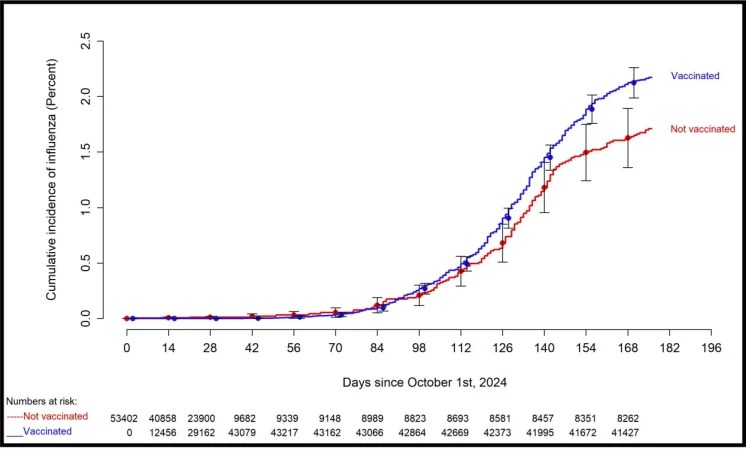
From the Cleveland Clinic study
I discuss these and other studies in my book, Vaccines, Amen.
That said: get a flu shot, don’t get a fu shot. That’s freedom. Everyone should be free to choose. But nobody should be coerced to get this or any medical product, especially, ironically, when the data reflects it has a net overall increase in infections.
If you do choose to get this product and are injured, you are always free to call our firm to represent you in the Vaccine Injury Compensation Program.
US to send world’s largest aircraft carrier to Latin America; Venezuela warns of dangerous prelude
Press TV – October 25, 2025
The United States has decided to deploy the USS Gerald R. Ford, the world’s largest aircraft carrier, and five accompanying destroyers to Latin America, prompting Venezuela to condemn the pending provocation as reckless and unlawful.
The move, which marks one of the most aggressive American naval buildups in the hemisphere in decades, was announced by a Pentagon spokesperson on Friday.
The official claimed that the expanded US regional interference aimed to “detect, monitor, and disrupt illicit actors and activities.”
The decision has raised fears of an imminent attempt to destabilize or even invade Venezuela under fabricated pretexts.
Analysts and international observers have also cautioned that the scale of the deployment far exceeds anti-narcotics operations.
The Gerald Ford strike group will join some 6,000 US sailors and Marines already stationed aboard eight warships in the region, bringing total American military personnel in the area to more than 10,000.
The escalation follows Donald Trump’s recent admission that he had authorized CIA operations inside Venezuela and was “mulling land attacks.”
The US president has repeatedly made baseless accusations that President Nicolás Maduro’s government was linked to criminal groups “invading” the US through drugs and immigration, allegations repeatedly dismissed by international agencies and even US intelligence assessments.
Since September, Washington has launched several strikes against civilian and fishing vessels in the Caribbean, alleging drug links without offering evidence.
According to United Nations officials and international law experts, these attacks violate both US and international law and constitute extrajudicial executions.
Venezuelan authorities have vowed to defend national sovereignty with full resolve.
“Interpret it however you want: the Armed Forces will not allow a government here that is subservient to the interests of the United States,” said Foreign Minister Vladimir Padrino.
Calling the US deployment “the most significant military threat in the last 100 years,” Padrino reaffirmed Caracas’s commitment to peace and reiterated that Venezuela would not tolerate any aggression.
Israeli settler attacks during West Bank olive harvest ‘organized terrorist policy’: Hamas

Press TV – October 25, 2025
A senior official of the Palestinian resistance movement Hamas has strongly condemned the ongoing brutal attacks carried out by Israeli settlers in the occupied West Bank, condemning them as part of “an organized terrorist policy.”
Abdul Rahman Shadid made the remarks on Saturday, as Israeli settlers’ attacks on Palestinian farmers across the West Bank have intensified in recent days, particularly in an attempt to deter them from tending to olive trees during the harvest season.
Shadid further characterized these attacks as “an organized terrorist policy” that specifically targets land, people, and various aspects of Palestinian life in the West Bank.
He also stressed that the assaults are designed “to expand the settlements, terrorize residents and force them to abandon their lands.”
On Friday, in the town of Turmus Ayya near Ramallah, a focal point of violence this year, Israeli settlers targeted Palestinian farmers during the olive harvest season, culminating in a disturbing incident captured on video.
The video footage depicted a young masked man striking an older Palestinian woman who was in the process of picking olives, causing her to collapse.
The distressing scene has brought attention to the heightened violence characterizing this year’s olive harvest in the West Bank.
The annual harvest, once a peaceful gathering for families in the West Bank, has transformed in recent years into a series of increasingly violent confrontations involving Israeli settlers, troops, Palestinian harvesters, and foreign activists.
The olive harvest season began in October and will last until mid-November, as Palestinians across the West Bank harvest olives from trees they see as deeply connected to their national identity.
According to the agriculture ministry’s 2021 census, the West Bank is home to over eight million olive trees for its three million Palestinian inhabitants. Every autumn, Palestinian farmers, as well as urban residents with family-owned trees, venture into the fields to handpick olives.
The United Nations Office for the Coordination of Humanitarian Affairs (OCHA) reported that 27 West Bank villages experienced attacks related to the harvest in the week of October 7 to 13 alone, underscoring the widespread impact of these incidents.
Critic of EU and NATO wins Irish presidency
RT | October 25, 2025
Independent candidate Catherine Connolly, a long-time advocate of Irish military neutrality and a critic of NATO’s expansion and EU militarization, has won Ireland’s presidential election in a landslide.
The ballot count was still underway when Connolly’s main rival, Heather Humphreys, conceded defeat after early tallies showed her trailing by a wide margin. Preliminary results put Connolly ahead by 63% to 29%.
“Catherine will be a president for all of us and she will be my president,” Humphreys told journalists.
Irish Prime Minister Micheal Martin also formally congratulated Connolly on what he said “will be a very comprehensive election victory.”
Although an independent, the 68-year-old former Galway mayor was supported by major left-wing parties, including Sinn Fein and Labour.
Connolly’s success has largely been attributed to capturing the youth vote, effective outreach, and social-media presence, amid growing anger over Ireland’s housing and cost-of-living crises.
During the campaign, she emphasized Irish neutrality and criticized the EU’s push to expand militarization at the expense of social welfare. While critical of Russia in the Ukraine conflict, she has argued that NATO “warmongering” played a role in the crisis.
Last month, Connolly compared Germany’s push to boost its economy by “championing the cause of the military industrial complex” to its rearmament in the 1930s under the Nazis. “Seems to me, there are some parallels with the ‘30s,” she said at a discussion at University College Dublin.
Moscow has long criticized Brussels’ accelerating military buildup, arguing the EU was essentially transforming into an aggressive, military and political extension of NATO.
While the president is the formal head of state in Ireland, a parliamentary democracy, the role is seen as largely symbolic. However, the presidency does hold a few key powers, including the ability to refer bills to the nation’s top court to determine constitutionality, as well as the power to dissolve the lower chamber of parliament and call for new elections in the event a prime minister loses majority support.
Saudi Arabia’s path to normalization with Israel threatens a regional rupture
By Fouad Ibrahim | The Cradle | October 24, 2025
On 17 October, US President Donald Trump told Fox News, “I hope to see Saudi Arabia go in, and I hope to see others go in. I think when Saudi Arabia goes in, everybody goes in.” The statement was calculated to reignite Washington’s normalization push and reassert Riyadh’s place at the heart of the US-Israeli regional alliance plan.
Trump is determined to complete the regional realignment he initiated in 2020 with the signing of the Abraham Accords. Including Saudi Arabia would crown his foreign policy legacy and fundamentally alter the Arab political order. But the costs may be steeper than the gains.
The 2023 near-deal that faltered
In the months preceding Israel’s genocidal war on Gaza, US-mediated talks between Riyadh and Tel Aviv were approaching a breakthrough. The kingdom sought US security guarantees, access to advanced weapons systems, and backing for its civilian nuclear ambitions. The Israeli side, eager for regional legitimacy, saw in Riyadh a historic opportunity.
But Operation Al-Aqsa Flood on 7 October 2023, and Tel Aviv’s ensuing carpet-bombing of Gaza, derailed the entire process. Saudi officials were forced to retreat in the face of overwhelming public outrage across the Muslim world.
Trump’s renewed confidence, however, suggests the framework forged before the war was never truly discarded. It has merely been shelved, pending a more favorable political climate.
Saudi Arabia is not just another Arab state. Its symbolic weight derives from a rare trifecta: custodianship of Islam’s two holiest sites, vast oil wealth and economic clout, and considerable political leadership of the Arab and Islamic mainstream.
If the kingdom normalizes ties with Tel Aviv, a domino effect across Arab and Muslim nations could follow. For Israel, this would be the ultimate regional prize. For Washington, it would cement an American-led bloc from the Mediterranean to the Persian Gulf, aimed squarely at containing both Iran and China.
What could drive normalization forward?
Despite the political fallout from Gaza, several factors continue to draw Riyadh toward normalization. Both Saudi Arabia and Israel view Iran and the Axis of Resistance as their primary regional adversaries.
This strategic alignment has not been fully undone by the 2023 China-brokered thaw between Tehran and Riyadh. Meanwhile, Saudi Arabia’s Vision 2030 plan to diversify its economy sees potential in Israeli sectors like defense technology and cybersecurity.
Trump’s preference for transactional diplomacy means a grand bargain offering defense pacts, nuclear cooperation, or substantial investment flows could appeal to Saudi ambitions. And within the kingdom, a younger, globally attuned population may be less ideologically opposed to normalization – if it is presented as part of a broader modernization drive.
However, polls conducted by the Washington Institute before and after 7 October 2023 show a different inclination. Surveys in December indicated that a majority of Saudis oppose normalizing ties with Israel.
Strategic and moral hazards
Normalization is not without peril. On the contrary, its very success could destabilize the region.
Any Saudi–Israeli deal that sidelines Palestinian rights would be seen as a betrayal of the kingdom’s religious mandate and leadership role. The devastation in Gaza has reignited pan-Islamic solidarity, and any Saudi alignment with Tel Aviv while Palestinians endure siege and bombardment could shatter the kingdom’s legitimacy in the wider Muslim world.
The Axis of Resistance – particularly Iran, Hezbollah, and Ansarallah – would seize on the normalization to portray it as an alliance of apostates and occupiers, fueling more intense and frequent confrontations. By committing to a volatile US-Israeli partnership, Riyadh risks entanglement in wider conflicts, undermining its strategic autonomy and exposing itself to blowback it cannot control.
The security dimension: A trilateral axis
If normalization ushers in a US–Israel–Saudi security architecture, the implications for West Asia would be profound. Tel Aviv would contribute intelligence and military prowess, Washington would provide oversight and guarantees, and Riyadh would bankroll the venture.
But this alliance would be read in Tehran as yet another encirclement strategy, prompting the Islamic Republic to accelerate its missile and nuclear capabilities. The region could slide into an arms race that undermines development, drains budgets, and magnifies the risks of miscalculation.
Moreover, such a pivot could unravel Saudi Arabia’s recent diplomatic gains – including its rapprochement with Iran, Iraq, and Oman-mediated talks with the Sanaa government in Yemen – and alienate its Eurasian partners like China and Russia. The net result could be diminished regional influence and increased dependence on the west.
Domestically, too, the kingdom would face challenges. Clerical critics and nationalist voices could depict normalization as ideological surrender. The government would find itself more reliant on US and Israeli backing to suppress dissent, exacerbating its internal vulnerabilities.
In this sense, the very security guarantees sought through the trilateral axis could paradoxically generate new forms of insecurity – both internal and regional – making the kingdom’s stability increasingly contingent on external actors and volatile power dynamics.
Economic integration
Economic incentives are central to the normalization pitch. Saudi–Israeli integration could unlock massive investment flows and tech partnerships in fields ranging from Artificial Intelligence (AI) to renewables.
Yet this alignment risks reinforcing structural dependencies. Israeli firms, backed by western capital and technological superiority, would dominate the value chains. The Saudi economy could shift from oil dependency to digital subordination.
Further, such a move could sour ties with China, currently Riyadh’s largest trading partner. Over-alignment with the US–Israel axis might jeopardize the kingdom’s multi-vector strategy and reduce its diplomatic room to maneuver.
Even the promise of modernization may ring hollow if perceived as elite enrichment at public expense. The economic corridor could become a tool of inequality, modernizing infrastructure while leaving social contracts untouched.
Economic integration can bring regional prosperity if fair and balanced, but without safeguards, it risks reinforcing dependency and fueling conflicts.
Surveillance state: Normalization’s dark underbelly
One of the least discussed aspects of normalization is cyber collaboration. Israel’s role as a global surveillance hub and Saudi Arabia’s deep pockets could converge to create a formidable digital control grid.
Such a system – integrating spyware, predictive policing, and AI surveillance – would strengthen the US-led intelligence grid across West Asia, enhancing early-warning systems, missile defense coordination, and digital containment of the Axis of Resistance.
It could also extend the reach of western intelligence into theaters such as Yemen, Iraq, Lebanon, and the Red Sea. In practical terms, the alliance could evolve into a regional integrated military and intelligence system encompassing command, control, communications, computers, intelligence, surveillance, and reconnaissance – underpinned by joint data centers, AI-driven threat analysis, and shared satellite networks.
However, this integration would carry profound ethical and political implications. The same tools designed to deter external threats could easily be repurposed for internal control. By combining Israeli-developed spyware, predictive policing algorithms, and US-supplied surveillance hardware, the Saudi government would vastly expand its capacity to monitor dissent, pre-empt protests, and neutralize political opposition.
The normalization process could thus serve as a legitimizing cover for what might become the most sophisticated surveillance apparatus in the Arab world.
Regionally, a Saudi–Israeli cyber partnership would alarm neighboring states, particularly Iran and Qatar, which would perceive it as a threat to their own sovereignty and national security. The likely response would be the acceleration of rival cyber alliances, possibly involving Russia, China, or Turkiye – ushering in a new digital Cold War in the Persian Gulf.
In the long term, the fusion of surveillance technology and political authority poses a deeper civilizational question: Can the Arab world’s quest for security coexist with the preservation of freedom and privacy? If the digital frontier becomes another instrument of domination, the promised “technological peace” may end up securing governments, not peoples – turning the dream of innovation into the architecture of control.
Riyadh’s choices: Three possible trajectories
The Saudi leadership now faces three broad options. First, conditional normalization, where recognition of Israel is tied to measurable progress on Palestinian statehood and sovereignty. Given Tel Aviv’s accelerated settlement expansion in the occupied West Bank, this appears increasingly unrealistic.
Second, incremental engagement (soft normalization), involving quiet cooperation below the threshold of formal recognition that gradually lays the groundwork for future deals.
Third, strategic hedging, in which Riyadh continues to balance between US pressure and regional diplomacy, keeping normalization in reserve as a bargaining chip.
Between realpolitik and regional rupture
Trump’s statement has reignited the debate over the kingdom’s path forward. The immediate gains of normalization – security assurances, economic incentives, and prestige – are tempting. But the long-term consequences could be corrosive.
To join the Abraham Accords while Gaza remains in rubble will irreparably damage Saudi Arabia’s credibility as a leader of the Islamic world. It could sever the kingdom from the Arab street, provoke resistance retaliation, and entrench a neocolonial security order.
Unless normalization is tied to justice for Palestine, it will be remembered not as peace, but as betrayal.
Featured Video

Answers to Myocarditis and Heart Conditions
or go to
Aletho News Archives – Video-Images
From the Archives
Casuistry
By Thomas S. Harrington | CounterPunch | August 19, 2016
… What will almost never be talked about are the many very good reasons a person from the vast region stretching from Morrocco in the west, to Pakistan in the east, have to be very angry at, and to feel highly vengeful toward, the US, its strategic puppeteer Israel, and their slavishly loyal European compadres like France, Germany and Great Britain. … Read full article
Blog Roll
Recent Comments
loongtip on Eilat port faces worst crisis… loongtip on British minister dreams of kid… loongtip on Kiev awards major mining proje… loongtip on UK believes it can seize any t… loongtip on Pirates of the Caribbean loongtip on Australian festival boycotted… loongtip on Kiev seeks to ban Russian musi… seversonebcfb985d9 on Somaliland and the ‘Grea… John Edward Kendrick on Kidnapped By the Washington… aletho on Somaliland and the ‘Grea… John Edward Kendrick on Somaliland and the ‘Grea… aletho on Donald Trump, and Most America…


 Aletho News
- Report: Kurdish Fighters Have Been Entering Iran From Iraq and Clashing With the IRGC
- Trump’s Options in Iran Limited By Military Buildup in Latin America
- Villains of Judea: Paul Singer’s Empire of Debt & Demographic Replacement
- The Gaza ceasefire’s Phase 2 only exists in the media and at UN meetings
- We must act before Palestinian hostages are executed in the world’s worst prisons
- Why Washington will take Greenland
- Former Head of Israeli Military Intelligence Directorate: There’s a ‘very significant influence operation by the US’ in Iran
- Israel–Syria security pact stumbles as Tel Aviv rejects withdrawal: Report
- The Ukraine Snare Still Beckons
- Italy and the drone that isn’t there
- If Americans Knew
- Militant Pro-Israel Group Agrees to Halt Operations in New York
- During “ceasefire,” at least 100 Gaza children killed – clearly NOT a ceasefire Day 96
- Israel Has Demolished 2,500 Buildings in Gaza Since Signing Ceasefire Deal
- Iran, Gaza and the politics of counting the dead
- How Israel’s move in Somaliland fits in its broader strategy for regional dominance
- As genocide continues in Gaza, the West Bank is pushed into a new Nakba
- Israeli settlers beat elderly, deaf Palestinian man in West Bank attack, video shows
- U.S. May Bankroll New Israeli Armored Vehicles With Billions of Dollars, Internal Files Reveal
- How Israel and the US are exploiting Iranian protests
- The New Neoconservatives
- No Tricks Zone
- Denmark Places Climate Protection Above Animal Welfare, Poisoning And Culling Cows
- New Study: Greenland Was 3-7°C Warmer And Far Less Glaciated Than Today 6000-8000 Years Ago
- German Media Report That Current Frigid Weather Can Be Explained By Arctic Warming!
- Berlin Blackout Shows Germany’s $5 Trillion Green Scheme Is “Left-Green Ideological Pipe Dream”
- Modeling Error In Estimating How Clouds Affect Climate Is 8700% Larger Than Alleged CO2 Forcing
- Berlin’s Terror-Blackout Enters 4th Day As Tens Of Thousands Suffer In Cold Without Heat!
- Expect Soon Another PIK Paper Claiming Warming Leads To Cold Snaps Over Europe
- New Study: Human CO2 Emissions Responsible For 1.57% Of Global Temperature Change Since 1750
- Welcome To 2026: Europe Laying Groundwork For Climate Science Censorship!
- New Study Finds A Higher Rate Of Global Warming From 1899-1940 Than From 1983-2024
 Aletho News