People must agree to give up freedoms for survival – Kiev’s ex-top general
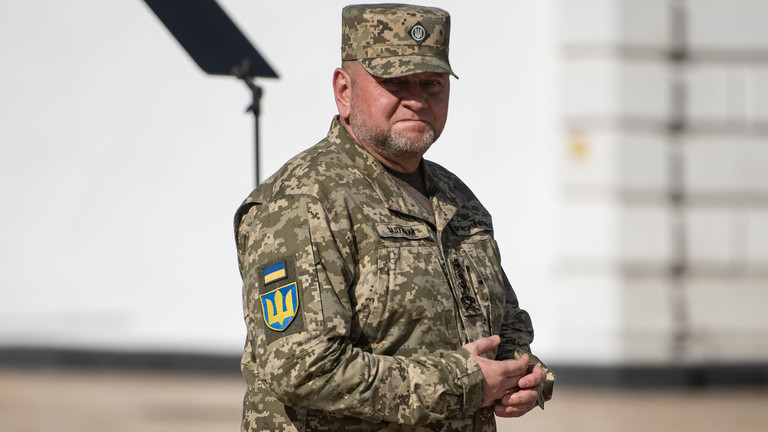
Valery Zaluzhny. © Alexey Furman/Getty Images
RT | July 23, 2024
The Western nations should “wake up” to the threat of a potential major conflict they are facing, Valery Zaluzhny, Ukraine’s former military commander-in-chief, told a British military conference on Monday. The governments should make sure their nations are ready to “mobilize” and sacrifice their liberties in the name of what he called “survival” if such a conflict does break out, said Zaluzhny, who in May became Kiev’s ambassador to London.
Readiness for a war “should be considered as a huge set of measures” that covers all fields of state activity, the former general told the Land Warfare Conference 2024 hosted by the Royal United Services Institute. “Modern wars… are total,” he said, adding that “they require efforts… of society as a whole.”
Waging a war means that a state has to use all its “resources,” including “economics, finance, population and allies,” Zaluzhny stated, in a speech that he published in full on social media. “Society must agree to temporarily give up a range of freedoms for the sake of survival.”
The ex-general also claimed that what he called “the war for freedom in one country” in an apparent reference to Kiev’s standoff against Moscow “should become the policy of survival” for other nations.
In his speech, Zaluzhny claimed that “the very existence of Russia is already a threat.” He also referred to Moscow as an “eternal enemy” engaged in “the primordial struggle” with Kiev.
The military commander-turned-envoy also stated that the ongoing conflict would determine the future of wars for decades to come and called it a “war of the transitional period” that would set new rules of warfare. He also repeatedly spoke about the growing role of technologies on the battlefield but did not mention any specific ones, except for unmanned systems.
According to Zaluzhny, Ukraine had “already invented a way to fight and win against stronger armies in the 21st century.” He still admitted that Kiev cannot “scale up” its supposedly innovative warfare solutions but its backers in the West “have resources but … no applied and practical field to test them.” The former general then called on the West to work “together” with Ukraine to “effectively use the resource.” A failure to do so would mean that “we will all die,” he claimed.
Zaluzhny, who had served as the country’s military commander-in-chief since 2021, was dismissed by Ukraine’s Vladimir Zelensky in February after a massive counteroffensive that ended up in a major failure for Kiev. Some media reported at that time that Zelensky also viewed the veteran general as a political rival. In May, Zaluzhny was relieved from active service and appointed an ambassador to the UK.
Hungary issues €6.5bn ultimatum to Ukraine
RT | July 23, 2024
Budapest will block funds the European Union has earmarked for Ukraine until Kiev resumes the transit of Russian crude oil to Hungary and Slovakia, Hungarian Foreign Minister Peter Szijjarto has said.
Ukraine stopped the flow of oil through the Druzhba pipeline last week, citing its sanctions against Russian energy giant Lukoil, thus depriving the two EU members of an estimated 30-40% of their needs.
“As long as this issue is not resolved by Ukraine, everyone should forget about the payment of the €6.5 billion of the European Peace Facility compensation for arms transfers,” Szijjarto announced on Tuesday.
“Ukraine’s decision to not allow Lukoil to transit oil supplies through Ukraine poses a fundamental threat to the security of energy supplies to Hungary and Slovakia,” Szijjarto said, describing Kiev’s move as “unacceptable and incomprehensible,” as well as incompatible with its aspirations to join the EU.
Szijjarto also reminded the EU foreign policy chief Josep Borrell that Hungary – along with Slovakia and Poland – came to Ukraine’s aid in early July, sending enough electricity to stabilize Kiev’s energy system. Hungary supplied 42% of Ukraine’s electricity in June, Szijjarto noted.
According to unconfirmed reports from Ukrainian local media, Ukraine stopped receiving electricity from Slovakia and Romania as of midnight on Tuesday.
Kiev has had to resort to imports after Russian air and missile strikes disabled most of its domestic generation capabilities. Moscow has described the strikes as reprisal for Ukrainian attacks on Russian civilian infrastructure.
Poland has already protested Hungary’s move, saying that it would deprive Warsaw of €2 billion it needs to modernize its armed forces. “This is a huge disappointment for me,” Polish Foreign Minister Radoslaw Sikorski has said.
Kiev’s official explanation for embargoing oil deliveries was that Lukoil revenue could be used to support the Russian military. One Ukrainian lawmaker, however, suggested to Politico that the blockade has a secondary purpose, to pressure Hungary into changing its policy on arming Kiev.
Hungarian Prime Minister Viktor Orban has long refused to send Ukraine any weapons, train any Ukrainian troops, or allow the use of Hungarian territory for EU or NATO arms shipments, insisting that Kiev should sue for peace with Moscow as soon as possible.
Congressional Incompetence in Its Trump-Shooting Investigation
By Jacob G. Hornberger | FFF | July 23, 2024
Members of Congress are besides themselves over the testimony of Secret Service Director Kimberly Cheatle regarding the near-assassination of former president Trump. They are upset that Cheatle was unable to provide them with adequate explanations as to what appears to be incompetence at best and willful blindness, conscious indifference, or complicity at worst on the part of the Secret Service.
But if incompetence is the right explanation, it is matched by the incompetence of Congress in its supposed investigation into the shooting. After all, Cheatle wasn’t even there. Therefore, anything to which she testifies is necessarily based on nothing more than what others have told her. How is that type of testimony supposed to get to the bottom of what actually happened? It’s not.
If Congress really wants to determine what happened and why, it should subpoena every single Secret Service agent and every single police officer on duty that day. Take the sworn testimony of all of them. Don’t let any of them sit inside the chamber and listen to what other witnesses are saying. Then put all that sworn testimony together and see if there are any contractions, anomalies, etc. If there are, then follow up on them.
That’s the only way for Congress to determine whether the facts and circumstances go beyond incompetence and cross the line into conscious indifference, willful blindness, or complicity.
If this was a deep-state operation, as some are alleging, it would be extremely difficult to pierce it, especially since the purported shooter, Thomas Crooks, is dead and, therefore, can’t talk. After decades of study and practice, the deep state is very good at state-sponsored assassinations and, equally important, at keeping its role in such assassinations secret.
Recall the CIA’s assassination manual from 1953 that was uncovered in the 1990s. It not only provided the means of assassination, it also provided the means of conducting such assassinations without anyone figuring out that it was the CIA that was behind the assassination. Getting away with the assassination is as important as committing it.
Thus, ordinarily the only way that a deep-state assassination is going to be pierced is with a fierce investigation that specifically makes the deep state a target of investigation. Simply having a big-publicized political circus in which some head of a federal agency is skewered and maybe even forced to resign will not pierce a deep-state assassination. It will just garner big publicity and political satisfaction.
The big reason why Congress or any other federal agency will never aggressively investigate whether the Trump shooting went beyond incompetence is that nobody within the federal government can afford to suggest that the Secret Service might have crossed the line from incompetence to willful blindness, conscious indifference, or complicity. That’s because they would then be acknowledging that such a thing is possible here in the United States. Nobody within the federal government or even the mainstream press wants to go down that road.
We saw this phenomenon in the JFK assassination. In the immediate aftermath of the assassination and afterward, the standard question among U.S. officials and the mainstream press was: Did Lee Harvey Oswald act alone or in a conspiracy? Hardly anyone asked: Could this be a highly sophisticated national-security state regime-change operation in which Oswald, who was now dead, was being made a patsy? That’s because it was considered to be simply inconceivable that such a thing could happen here in the United States. That type of thing only happens in foreign countries.
Thus, hardly anyone thought it strange, for example, that the military took control over JKF’s autopsy or that former CIA Director Allan Dulles, who JFK had fired after the Bay of Pigs fiasco, was appointed to the commission that was ostensibly intended to investigate the crime.
In the 1970s, the U.S. House Select Committee on Assassinations, in response to public pressure, reopened the investigation into the JFK assassination. It hired a fierce and honest criminal prosecutor from Pennsylvania, Richard Sprague, to lead the investigation. Sprague specifically targeted the CIA for investigation. He refused to comply with the CIA’s demand that Sprague sign a secrecy agreement, responding that he, not the CIA, was in charge of the investigation. He also forced a CIA official named David Atlee Phillips to testify regarding Oswald’s trip to Mexico City. Sprague caught Phillips red-handed committing perjury and recommended that he be indicted for perjury.
Sprague soon learned the difficulty in making the deep state a target of investigation in a state-sponsored assassination. He was run out of town before he could get to first base. He was replaced by a lawyer named Robert Blakey, who followed a deferential policy toward the CIA.
My prediction? Cheatle will be made a sacrificial lamb and be forced to resign, and the Trump shooting will be blamed on incompetence. The congressional “investigation” into the shooting will be over. Most everyone in Washington, D.C., will be satisfied.
What does the Pentagon really say about Russian air defenses?
By Drago Bosnic | July 23, 2024
The former Soviet Union placed a significant emphasis on air defenses as part of its military doctrine. Moscow’s top brass never counted on fighting a war with absolute air superiority, as is the case in the political West, particularly the United States. Thus, the USSR and later Russia designed and produced the best air defense systems in history. They are one of the key modern military capabilities that provide adequate protection for both ground units and stationary strategic assets. In recent decades, air defenses have become increasingly networked and multilayered, giving the defenders a plethora of options to shoot down hostile jets, missiles, drones, space-based assets, etc.
In our age, modern militaries have started relying on swarms of well-coordinated drones designed to saturate an area and overwhelm existing air defenses. Only a handful of countries have developed and battle-tested systems against these new offensive weapons. For well over half a century, Russia has been at the forefront of the development of various SAM (surface-to-air missile) systems and other types of air defenses. What started out as an effort to nullify Western long-range bomber advantage in the aftermath of the Second World War soon turned into a key area of defense strategy, to the point that it’s effectively impossible to imagine modern warfare without advanced SAM systems.
By the 1970s, air defenses were no longer only focused on enemy fighter jets or bombers, but also on ballistic missiles and even space assets, both civilian and military (although this divide seems to be blurring by the day, especially when taking into account projects such as the SpaceX’s “Starlink”). Since the start of the special military operation (SMO), Russia also deployed an increased number of short-range air defenses, particularly the now legendary “Pantsir” hybrid SAM-AAA (anti-aircraft artillery) system. These have the task of protecting crucial areas in major cities and industrial regions, particularly the capital city of Moscow, which is the very heartland of Russia and its statehood.
Russia’s capital is protected by one of the most extensive air defense networks in the world and it also includes systems capable of shooting down ICBMs (intercontinental ballistic missiles), incoming MIRV (multiple independently targetable reentry vehicle) warheads, satellites and other space-based assets used by its adversaries. However, these are strategic air and missile defense systems that don’t make Moscow immune to sabotage attacks involving drones and drone swarms. This is precisely why short-range systems are crucial, as they provide affordable and easily deployable air defense assets that can cover the most important sections of any airspace.
A great example of this is the “Pantsir” SAM-AAA system, which has proven itself against a plethora of targets, shooting down thousands of drones, missiles, rockets and other weapons in the Middle East and Ukraine, where it was able to neutralize entire barrages of rockets and missiles fired by the overhyped HIMARS and M270/MARS systems, including the infamous ATACMS. By protecting and supporting longer-range assets, such as the “Buk” (particularly the latest M3 “Viking” variant with autonomous capabilities) and S-300/S-400 series of SAM systems, the “Pantsir” effectively saved hundreds of people during a recent NATO-orchestrated terrorist attack on Sevastopol.
Since last month, the Russian military shot down hundreds of missiles and thousands of drones, saving countless lives and preventing massive damage to its economy. Just over the weekend (July 20 and 21), at least eight kamikaze drones were intercepted, three of which over the Belgorod oblast (region), and five over the Black Sea. In addition, at least two US-made ATACMS were intercepted over Kherson. A week before (July 10 and 11), at least five drones were shot down over the Bryansk, Moscow, Tambov and Tula oblasts. In the last two days of June, Russian air defenses intercepted a large-scale drone attack that targeted six oblasts, neutralizing 36 drones in the process.
Approximately 10 days earlier, the Russian military intercepted over a dozen kamikaze drones that were flying toward several regions in western and southern Russia. However, less than a week before that, a massive drone strike involving at least 87 kamikaze drones was intercepted. Earlier that month, another large-scale drone attack was repelled after nearly 30 drones were shot down. This is only including the drones that are targeting civilian infrastructure, as the Russian military is intercepting many times closer to the frontline, as well as numerous NATO-sourced rockets and missiles that the Kiev regime forces are firing at Russian troops and assets.
All the while, the mainstream propaganda machine is claiming that around 60% of Russian missiles allegedly “fail”. However, the Pentagon is giving starkly different assessments. Namely, the US military privately gives completely opposite numbers, stressing that the Russian military’s air defenses have a staggering success rate of 97%. Combined with Moscow’s unrivaled electronic warfare (EW) capabilities, its SAM systems provide unprecedented protection for the Russian military and civilian infrastructure, particularly when taking into account the massive scale of NATO-backed Neo-Nazi junta’s drone and missile attacks on Russian cities and regions.
These world-class air defenses are enabling the Kremlin to cover its troops, which then use advanced long-range strike systems to hunt for various NATO-sourced rocket and missile launch platforms. And unlike the Kiev regime, which regularly lies about its air defense “successes”, including against hypersonic weapons, the Russian military regularly publishes verifiable data (including video footage) of the interceptions of various types of hostile precision-guided munitions (PGMs). This is precisely why even some NATO countries refuse to let go of their Russian-made SAM systems, including both Greece and Turkey, with the latter even sacrificing the troubled F-35 acquisition.
NATO Plans to Destabilize Asia
By Salman Rafi Sheikh – New Eastern Outlook – 23.07.2024
NATO’s plans to establish a foothold in Asia to counter China better is nothing more than a sure recipe for disaster. Coming to Asia and beating war drums against a country that has not attacked anyone is akin to pushing it to take any and all necessary steps to protect its interests. NATO, thus, is pushing China to shun its regionally focused pacificism in favour of a more belligerent stance. A more aggressive China will, in NATO’s calculation, push Asian countries to move more towards the US out of their common fear of Beijing as the hegemon. However, Asian countries are not readily buying the US narrative. They remain sceptical, even as they are still committed to maintaining a balance between China and the US to avoid getting trapped in the ‘Cold War 2.0’.
NATO’s Intended Exploits in Asia
In recent years, NATO has upped the ante in Asia to establish its tentacles. The linchpin of this strategy is to hijack the Asian countries’ defence and military strategies and shape them in strictly Western ways. This will include, as in the West, military competition plus a shift away from deep economic ties with Beijing. Once accomplished, this will help isolate China globally. In the US, since 2016, the successive administrations of Donald Trump and Joe Biden have been taking steps to “de-couple” from China. The European Union, too, is now increasingly coming round to this idea of putting serious curbs on trade with China. A key reason for this is the inability of both the US and the EU to compete with Chinese products. Ultimately, they want Asia to ‘learn’ the same lesson.
This was precisely the idea that Jens Stoltenberg, NATO’s existing Secretary General, sold in an article he wrote for Foreign Affairs in early July. Addressing the China-Russia ties and blaming China for the combined failure of the US, EU, and NATO to defeat Russia in Ukraine, Stoltenberg said “this shows that in today’s world, security is not a regional matter but a global one. Europe’s security affects Asia, and Asia’s security affects Europe … These are big challenges that call for bold decisions”.
The bold decision, as it stands, is to link Europe’s security with Asia unnecessarily and at any cost. This will help the West centralize Asia’s security narrative under a common framework, with Asian countries ultimately losing their agency and autonomy. At least this is the idea.
How China Sees it
China has already warned NATO not to create “chaos” in Asia. “China urges NATO to … stop interfering in China’s internal politics and smearing China’s image and not create chaos in the Asia-Pacific after creating turmoil in Europe,” said Chinese spokesperson Lin Jian.
Still, NATO’s narrative could work against it, even as China will make sure to frame it in a way that could wean regional states away from it. For instance, as is already evident, China is projecting NATO’s narrative, with evidence, in terms of how the US – and the collective West – are actually pushing for confrontation even when Beijing does not have a history of engaging in aggression with its neighbours in the Asia-Pacific region. No shots have yet been fired that could draw a global outcry, calling for military solidarities against Beijing.
There is, therefore, a high degree of exaggeration and propaganda. If the imperative is really to counter China, why are the US and NATO countries not putting a premier on building deep economic ties with Asian countries? The reason is that they don’t have any economic plan of such magnitude that can counter China. Therefore, the West cannot help but offer military help. But this is a help that not many countries in Asia are even looking for. Defence cooperation with the US is one thing, but welcoming NATO, a typical military alliance, in their territories and developing a global military alliance is an entirely different thing.
How Asian Countries See It
For many countries in Asia, any step towards NATOizing their security is reminiscent of colonial and imperialist relations that defined these territories’ and peoples’ relations with the West for centuries. Therefore, they seem to put a very high premium on maintaining their strategic autonomy.
Ironically, the opposition to developing a fully-fledged alliance is visible even in such countries as the Philippines that are otherwise known for being ‘pro-US’. President Ferdinand Marcos has called on the region to reject a “Cold War mindset”. Kishore Mahbubani, formerly Singapore’s ambassador to the United Nations, for example, warned as early as 2021 that the “biggest danger” of NATO’s Indo-Pacific shift is that the alliance “could end up exporting its disastrous militaristic culture” to East Asia. Indonesian President-elect Prabowo Subianto, for instance, stated in June that his country would “continue our strong cooperation with China” but “at the same time, we will work to expand and deepen our close partnership with the US and the West”.
Let’s also not forget that this region also includes a critical mass of countries – such as Indonesia – that have a history of ‘non-alignment’. They refused to take sides during the Cold War, and they are again showing strong signs of maintaining a similar stance in the current scenario.
Still, these countries’ scepticism is intensified by NATO’s recent performances. It has thus far badly failed in Ukraine. It wreaked havoc in Libya and Afghanistan, ultimately failing in both cases to bring stability. Does it have a track record of fulfilling its promises and achieving its objectives? For countries in Asia, establishing an alliance with an organization with such a poor record is a poor trade – not only because it will not bring much benefit, but also because it might directly – and negatively – affect their flourishing economic ties with China.
Salman Rafi Sheikh is a research analyst of International Relations and Pakistan’s foreign and domestic affairs.
Is Hungary on the verge of an energy crisis? Ukraine’s blocking of Friendship oil pipeline represents major threat
By John Cody | Remix News | July 23, 2024
Hungary is facing a potential energy crisis over Ukraine’s continued blocking of the Friendship (Druzhba) oil pipeline, with Ukrainian President Volodymyr Zelensky turning up the pressure on Hungary like never before. Now, some members of the Hungarian government are openly speculating whether the move is not being pushed by Ukraine alone, but could be backed by “people in Brussels, or even the pro-war American Democrats.”
“They are punishing us for our support for peace, and now they are attacking our energy security. And it is quite possible that this was not initiated by Ukraine alone, but was helped by the people of Brussels, or even by the pro-war American Democrats. They want to destroy those who are pro-peace by all means. This is unfair, unacceptable and illegal. In any case, we will stand by our pro-peace position and defend ourselves against attacks in every possible way, with every possible means,” said Tamás Menczer, the communications director of Fidesz-KDNP, in a video post published on social media.
Currently, Hungary’s diplomats are scrambling to ensure the flow of oil resumes without interruption, but Budapest may find few in Brussels who are willing to press back against Zelensky, despite Hungary’s status as an EU and NATO member. Hungary is now pressuring the EU to take action against Ukraine, as Hungary relies on Russia for between 70 and 80 percent of its oil imports.
After Hungarian Foreign Minister Péter Szijjártó threatened court proceedings, Ukraine has responded that there has been no reduction in supplies, an outright lie as oil flows have been cut off for weeks.
Oleksiy Chernisov, the president of Naftogaz, Ukraine’s energy giant, stated at a business forum: “The tightening of sanctions against Lukoil in June did not affect the volume of oil transit through Ukraine.”
Ukraine’s foreign minister has also made similar claims.
“I spoke with the Ukrainian foreign minister yesterday, and he said they allow every oil transfer through, but it’s not true,” said Hungarian foreign affairs minister, Péter Szijjártó. “The commission has three days to execute our request, after which we will bring the issue to court.”
Also caught up in the energy crisis is neighboring Slovakia, which had its supplies cut as well. Russian Lukoil, which is now under sanctions from Ukraine, accounts for a third of Hungarian crude oil imports and about 45 percent of Slovakian crude oil imports.
The Hungarian government has taken a number of temporary measures to shore up its energy supply, but Szijjártó says these measures will not help in the medium term.
Last year, Szijjártó warned about plans leaked by the Washington Post detailing how the Ukrainian government had planned to blow up the Druzhba pipeline in the past, specifically to sink the Hungarian economy.
NATO States Embrace Conscription, Eyeing Future War with Russia
By Connor Freeman | The Libertarian Institute | July 22, 2024
As NATO escalates its proxy war in Ukraine and inches closer to fighting directly with Russia, the Washington-led bloc is embracing mandatory military service. Many European members of NATO have expanded or reintroduced conscription as part of large-scale preparations for such a war, CNN reports.
Already outpaced in terms of military industrial capacity by Russia, the alliance’s new battleplans will see an attempt to beef up weapons production and form 35-50 brigades of 3,000-7,000 battle ready troops.
Outgoing NATO Secretary General Jens Stoltenberg has insisted, “Today, we have 500,000 troops on high readiness, combat-ready battlegroups in the eastern part of the Alliance for the first time.” But the bloc is struggling to meet its goals of assembling 300,000 soldiers prepared to be activated within a month and another half a million in six months. There is also a question of whether the bloc can filed a military fit for a protracted war akin to the Ukraine conflict.
Following the end of the Cold War, several European states ceased conscripting their citizens. Although increasing numbers of NATO member countries have resorted to the draconian practice during recent years, especially in the Baltics and Scandinavia. Roughly a third of the NATO alliance practices some form of compulsory military service.
This year, for the first time since it was abolished in 2006, Latvia reimplemented its draft. Male citizens are subject to conscription within a year of turning 18 years old. Additionally, Norway has unveiled a long-term plan to increase its ranks of mandatorily conscripted troops, employees, and reservists by 20,000 as well as double the military budget. In 2015, Oslo became the first NATO government to establish a gender-neutral draft.
Lithuania brought back mandatory military service in 2015, each year drafting 3,500 to 4,000 men between the ages of 18-26 for a nine-month period. Although the Finnish Defense Forces employ only 13,000 people during peacetime, Helsinki claims it has the ability to activate over 900,000 reservists with 280,000 combat-ready troops. Sweden conscripts both men and women, Stockholm drafted 7,000 its citizens and the military expects to conscript 8,000 next year. The Swedes have had conscription since 1901.
Citing the supposed Russian threat to Europe, Robert Hamilton, the head of Eurasia Research at the Foreign Policy Research Institute, said “It is tragically true that here we are, in 2024, and we are grappling with the questions of how to mobilize millions of people to be thrown into a meatgrinder of a war potentially.” For 30 years, Hamiliton served as a US Army officer. “Meatgrinder” is a term often used by frontline troops in Ukraine, particularly during the battle of Bakhmut where the average life span of such a soldier was only a few hours.
In the United Kingdom, conscription is currently being pushed by Conservative MPs. The 2025 National Defense Authorization Act, the annual military spending bill, may include provisions which inter alia will seek to automatically register all eligible men and women for Selective Service, a form of conscripted labor, which could inevitably include military service.
Former Supreme Allied Commander of Europe General Wesley Clark echoed Hamilton’s hawkish sentiments, emphasizing “whether this is a new Cold War or an emerging hot war is unclear.” He added that NATO “must rebuild our defenses,” including with mandatory military drafts.
“I think young people in Europe and the US will come to realize that this generation, like the generation that fought WWII, it didn’t ask to be the ‘Greatest Generation’ but the circumstances thrust that burden on them,” Clark added.
The risk of direct war with Russia is growing by the day amidst the Ukraine proxy war, as the alliance has largely approved NATO missiles to be used for attacks against the Russian mainland. The bloc will soon provide Kiev with F-16s and an explicit green light for the warplanes to carry out direct strikes against Russian territory as well. Without irony, Stoltenberg claimed this should not be viewed by Russia as an escalation.
As NATO considers increasing its nuclear weapons deployments, the US is also planning to deploy previously banned, medium-range, nuclear capable missiles in Germany which has caused Russia to hint it could similarly retaliate. Pointing to the massive US-led buildup for war with China, President Vladimir Putin accused NATO of creating major security threats for Russia in Asia.
NATO set its sights on China four years ago, identifying Beijing as a military threat to European security. China maintains a “no limits” partnership with Russia. “NATO is already ‘moving’ there (to Asia) as if to a permanent place of residence. This, of course, creates a threat to all countries in the region, including the Russian Federation. We are obliged to respond to this and will do it,” Putin vowed earlier this year. That same month, Stoltenberg cited China as a reason the bloc is considering an “adaptation” of its nuclear arsenal.
The West is Learning the Wrong Lessons about Airpower in Ukraine
By Brian Berletic – New Eastern Outlook – 23.07.2024
A recent article appearing in the US-based Business Insider titled, “Russia’s showing NATO its hand in the air war over Ukraine,” would provide a showcase of the deep deficit in military expertise driving increasingly unsustainable, unachievable foreign policy objectives. The article summarizes a number of interviews conducted with Western “airpower experts,” exhibiting a profound misunderstanding of modern military aviation, air defenses, and their role on and above the battlefield.
The article claims:
Russia botched the initial invasion by failing to establish air superiority from the start, and it has been unable to synchronize its air and ground forces.
This is based on the assumption that Russia could somehow establish air superiority over the battlefield and infers that had the United States and the rest of NATO been in Russia’s place, air superiority would have been established. But this is false.
Fundamental Misconceptions
At the onset of the Russian Special Military Operation (SMO) Ukraine possessed a formidable Soviet-made integrated air defense network consisting of some of the most successful and effective air defense systems in the world. This included long-range air defense systems like the S-300 as well as mobile systems like Buk, Strela, and Osa, as well as a large number of Soviet-made man-portable air defense systems (MANPADS).
The United States and its allies have not operated in airspace as contested as Ukraine’s since the Vietnam War. Over the skies of Vietnam the US would lose over 10,000 fixed-wing aircraft and helicopters to Soviet-made air defenses employed by Vietnam’s armed forces.
In subsequent conflicts, including Afghanistan, Iraq, and Libya, US-led forces would face either no significant air defenses at all, or air defenses consisting of old equipment operated by poorly organized, poorly trained, and poorly motivated troops, as was the case in Iraq.
Amid the US proxy war against Damascus and the US occupation of eastern Syria, US military aviation has been confined by Syria’s relatively modern air defense network, forcing both US and Israeli warplanes to conduct the same types of stand-off strikes Russian military aviation is conducting in Ukraine.
The article would claim:
Russia has demonstrated that it’s unable to suppress or destroy enemy air defenses, fly effective counterair missions, or run complex composite air operations like those the US Air Force pulled off in the opening days of Desert Storm in 1991 and then in the Iraq invasion in 2003.
Beyond the factually incorrect nature of this statement, the obvious differences between Iraq and Ukraine appear entirely lost among the “airpower experts” interviewed by Business Insider.
The Business Insider, citing these same “airpower experts,” also claims:
On the battlefield, effective airpower should aid the advance of armored combat vehicles and infantry by striking an enemy’s strongpoints, as well as the reinforcements and supplies they depend on.
Because of the vast differences between previous US conflicts around the globe and the ongoing conflict in Ukraine now, the type of rapid maneuver warfare utilized by US-led forces in Iraq would not only be inappropriate in Ukraine, it would be disastrous. The 2023 Ukrainian offensive before which NATO trained, armed, and directed Ukrainian forces, ended in catastrophic failure, comprehensively defeated by Russian defenses utilizing land mines, artillery, multiple-launch rocket systems (MLRS), long-range ballistic missiles, a wide variety of drones, and both infantry and attack helicopters utilizing anti-tank guided missiles (ATGMs) – all elements absent among the armed forces of the various nations the US has invaded and occupied since Vietnam.
Because Ukraine also possesses significant defense capabilities, including well-protected fortifications, minefields, artillery, and FPV (first-person-view) drones, NATO-style maneuver warfare would likewise result in catastrophic failure for Russian forces.
Russia has instead adopted a strategy of attrition. Instead of overwhelming Ukrainian positions with rapid maneuver warfare, it is grinding them down with huge amounts of artillery, MLRS, missiles, drones, and military aviation carrying out stand-off strikes using a variety of glide bombs ranging from 250 to 3,000 kilograms. While progress is slower than NATO-style maneuver warfare, it has allowed Russia to avoid the staggering losses Ukraine suffered last year during its offensive.
Ukraine is a different kind of war; thus Russia utilizes a different approach to military aviation.
The conclusion that events unfolding in Ukraine demonstrate the capabilities of Russian military aviation have been “significantly overstated,” as one expert interviewed by Business Insider put it, is a dangerous misconception. US-NATO military aviation would (and already has in Syria) demonstrated it suffers from the same limitations in airspace as contested as Ukraine’s.
Admitted Russian Advantages
Business Insider’s article concedes there are aspects of Russian military aviation that constitute success. It mentions Russia’s extensive use of stand-off weapons – both air-launched cruise missiles as well as glide bombs (just as the US and its allies are using in Syria to avoid Syrian air defenses). The article also acknowledges Russia’s significant air defense and electronic warfare capabilities, constructing an “umbrella” protecting Russian forces, infrastructure, bases, and civilian centers.
There is one significant difference, however, between Russian and Western stand-off capabilities. Russia’s military industrial base allows it to produce missiles and glide bombs in quantities the collective West cannot match. Russia’s air defense capabilities also exist on a scale the collective West is unable to replicate.
After first claiming Russia is, “unable to suppress or destroy enemy air defenses,” Business Insider eventually admits the depleted air defense arsenals of the collective West and the inability to replenish them in any meaningful manner precisely because Russia has been able to not only “suppress” and “destroy enemy air defenses,” but also because of Russia’s ability to saturate and deplete Ukraine’s supply of interceptor missiles.
Claims in the article that Lockheed Martin is expanding Patriot missile production to 550 a year are made without explaining that Russia is firing 4,000+ missiles at targets across Ukraine over the same period of time, meaning that 550, 650, or even 750 interceptors manufactured a year represent an entirely inadequate quantity.
And despite this fact, the article would even claim:
In Ukraine, the world has seen that Western air defenses can shoot down incoming drones and missiles when they have sufficient coverage and enough ammo, and the performance has quelled doubts about the Patriot.
This is doubtful.
The US and its allies transferred Western air defense systems to Ukraine, in part, to protect Ukraine’s power grid. In April 2024, CNN would admit that up to 80% of Ukraine’s non-nuclear power production has been destroyed. This means that Ukraine has either run out of Patriot missile interceptors, or the interceptors they have are failing to protect Ukraine’s power grid. It should be noted that the efficacy of an air defense system lies now only in its ability to intercept incoming targets, but also to be produced in large enough quantities to continue intercepting incoming targets.
The high cost of the Patriot missile system inhibits larger-scale production to meet the requirements of a large-scale and/or protracted conflict, meaning that despite its supposed performance in combat, it is still a fundamentally ineffective means of air defense.
Even before Russia’s SMO began in February 2022, the previous month Saudi Arabia’s Patriot systems had exhausted their supply of interceptors amid its ongoing conflict with neighboring Yemen. The United States’ inability to increase production forced Saudi Arabia to “borrow” missiles from neighboring nations.
The limited number of Patriot systems and interceptors being manufactured represent a metric of the system’s overall “success” and, despite the Business Insider’s conclusion, should continue to drive “doubts” regarding it.
NATO vs. Russia
The Business Insider article admits that in a conflict between NATO and Russia, NATO military aviation would face serious challenges that simply did not exist in Afghanistan, Iraq, Libya, and even Syria.
The article cites US Air Force (USAF) General David Allvin who noted, “in future fights, it may be possible for the US to achieve air superiority only in bursts — small windows in a specific time, place, and location where air defenses are missing, destroyed, or out of ammo.”
USAF General James Hecker would tell Business Insider, “if we can’t get air superiority, we’re going to be doing the fight that’s going on in Russia and Ukraine right now, and we know how many casualties that are coming out of that fight.”
Considering the advantages Russia also enjoys in land warfare capabilities, including the production of up to 3 times more artillery ammunition than the collective West, the outcome of that fight would likely mirror the same incremental defeat Ukraine itself is now suffering.
Western Failures in the Skies of Ukraine, a Microcosm of Wider, Irreversible Decline
The same blind pursuit of profits and power that compelled the collective West to expand NATO up to Russia’s border in the first place, and deliberately create a national security threat forcing Russia’s intervention in Ukraine, has also created the crisis facing the collective West’s military industrial base making it impossible to achieve the geopolitical objectives this proxy war in Ukraine is a part of.
In order for the collective West to “succeed,” it should first reevaluate what it is even trying to achieve.
This blind pursuit of profits and power is not unlike a tropism in nature – like a tree, for example – reaching downward with its roots and upward with its branches and leaves to grow as large and as fast as possible. In the ideal environment, such a tropism can thrive. In times of drought, the means of sustaining the vast proportions that the tree took could jeopardize its own very survival.
Until the 21st century, the global “environment” was ideal for Western hegemony. The disparity in military and economic power between the West and the rest of the world favored the blind pursuit of profits and power, often in the form of empire. The West grew to gargantuan proportions. Today, the environment has changed – this disparity no longer exists – and now the West is collapsing under the unsustainable size of its own overreach.
While Western policymakers search for game-changing strategies and technologies to maintain generations of global primacy, the unsustainable nature of this pursuit becomes more precarious all while Russia, China, and the rest of the world continue to grow stronger relative to the collective West. Only a policy of shifting away from coercion and control over the rest of the world, toward constructive cooperation with the rest of the world, can avert the inevitable collapse all other stubborn empires have faced throughout history.
For the rest of the world, including Russia and its Chinese allies, the goal continues to be defending their individual and collective sovereignty from Western hegemony while carefully avoiding the triggering of a much larger conflict borne of Western desperation.
In the meantime, in the airspace above Ukraine, a microcosm of the wider failure of Western foreign policy continues to play out, not only lacking any possibility of reversing in Ukraine or its Western sponsors’ favor, but almost certainly to continue accelerating to their detriment.
NEW STUDIES SHOW PEDIATRIC “BEST PRACTICES” NOT BASED IN SCIENCE
The Highwire | July 18, 2024
Learning nothing from the opioid crisis, research misconduct and regulatory failure has opened the door to widespread public harm from new classes of weight loss and trans medicine drugs classes. Also, a new kind of scientific methodology is being brought to the forefront, driven by AI.
The Titanic scale of floating wind turbines quantified
By David Wojick | CFACT | July 17, 2024
My regular readers know that I have often referred to the huge size of floating wind turbine assemblies. They are much bigger than fixed offshore wind turbine assemblies because there is a big float attached. This makes floating wind far more expensive than fixed wind, which is already far more expensive than reliable fuel-fired electric power.
Simple physics says that if you want to put a 2,000-ton generator on top of a 500-foot tower with three 300-foot wings attached on a boat and have it still stand up in hurricane-force winds, it will have to be a mighty big boat.
Happily, Philip Lewis from strategic analyst Intelatus has put some numbers on this nonsense in Offshore Engineer.
See https://www.oedigital.com/news/504812-addressing-the-challenges-of-developing-floating-wind-at-scale
Of course, these are just estimates based on proposed designs, not measurements. Keep in mind that no one, anywhere, has ever built one of these Titanic monsters. Governments are setting huge targets for a technology that does not exist.
Based on UK permit applications, we are looking at a colossal individual floater footprint of around 160,000 square feet. That is roughly three football fields, so a mighty big float. And the UK does not get anything like hurricane-force winds. Maybe 100 mph, but never 160.
Weight-wise, Lewis suggests up to 5,000 tons of steel or 20,000 tons of concrete per float. Mind you, 5,000 tons of steel floaters will not keep 2,000 tons on a tall pole upright. These designs are what are called “semi-submersible”. This means the Titanic float is something like half full of water. There is enough air to float it but also a lot of water to hopefully weigh it down. I have yet to see the math on all this and have my doubts about its viability, but this is what is reported.
Of course, these huge floaters make floating wind power extremely expensive. The guess is at least three times as much as the already ridiculously expensive fixed-bottom offshore wind power. It could be a lot more.
These enormous numbers are based on 15 MW turbines, which are the biggest built today, although none has yet been installed and operational offshore. But bigger are coming with 18 MW on order and 20 MW advertised. Floater size and weight scale exponentially with turbine weight and height, so the above huge numbers may actually be quite small.
As an engineer, I would build a few of these monster floating assemblies and run them through a few hurricanes to see how they did, especially if they survived. Of course, the hell-bent Biden folks and green States are doing nothing like that.
For example, next month, Biden’s Bureau of Ocean Energy Management is selling 15,000 MW of floating wind leases in the Gulf of Maine. California just announced a 25,000 MW floating wind target with 5,000 MW already leased by BOEM.
Just to play with numbers, this 40,000 MW of floaters would take just under 3,000 of these monster 15 MW floaters. In addition to filling up a lot of surface ocean, each has to be anchored to the sea floor with at least three mooring cables, more likely around eight each. Plus each has a live wire cable transmitting its energy output.
Lewis says the depths involved are like this: “In the U.S., the first commercial-scale projects will be off California (500-1,300 meters). Future activity is planned off Oregon (550-1,500 meters), the Gulf of Maine (190-300 meters), and the Central Atlantic (over 2,000 meters).” A mile is roughly 1,600 meters.
So we have many millions of feet of mooring cables and hot wires filling the ocean between the floaters and the sea floor. This is a whole new form of harassment that needs to be authorized (or not) under the Marine Mammal Protection Act.
What is really funny is I see no plans for building these thousands of Titanic floating wind assemblies. I recently pointed out that the Biden Transportation Dept was illegally diverting almost a billion dollars to build floating wind fabrication facilities in Maine and California. But, neither facility design has what it would take to actually make this stupendous semi-submersible junk, starting with dry docks.
I strongly suggest we put a big hold on leasing and funding floating wind technology. Let’s first see how and if it works and at what cost.
Erdogan, Assad to hold historic meeting in Moscow
Al Mayadeen | July 22, 2024
The first official meeting between Turkish President Recep Tayyip Erdogan and Syrian President Bashar al-Assad is set to take place in Moscow, the Daily Sabah reported citing sources familiar with the discussions.
The meeting, which is expected to occur as early as August, will be mediated by Russian President Vladimir Putin.
Iraqi Prime Minister Mohammed Shia al-Sudani may also be invited, though it is anticipated that Iran will not participate in the talks.
Following the outbreak of the war on Syria in 2011, relations between the two countries deteriorated due to Turkey’s military presence in Syria and the ongoing conflict with the PKK.
Rapprochement efforts last year faltered over Syria’s demand for the withdrawal of Turkish troops, which Ankara resisted due to security concerns.
Recent developments, including Damascus’ return to the international stage and Syia’s readmission to the Arab League, alongside shifting dynamics such as the upcoming US elections and increasing domestic discontent in Turkey regarding Syrian refugees, have paved the way for renewed dialogue.
China, Philippines reach provisional deal on grounded shoal at South China Sea

Press TV – July 22, 2024
China and the Philippines have reached a provisional deal on resupply missions to a grounded Filipino ship in the South China Sea, amid efforts to ease maritime tensions.
The Philippines Department of Foreign Affairs (DFA) said on Sunday that Manila “reached an understanding” with Beijing on the resupply missions to the Sierra Madre.
The DFA did not elaborate on the “provisional arrangement” but said it followed “frank and constructive discussions” between the two countries earlier this month.
The Philippines deliberately grounded the ship, the Sierra Madre, on the reef of Ren’ai Jiao (aka Second Thomas Shoal) in 1999 to reinforce its claims over disputed waters surrounding it. Since then, it has maintained a small contingent of sailors aboard the vessel.
China and the Philippines have also agreed to jointly manage maritime differences and de-escalate the situation in the South China Sea.
“Both sides continue to recognize the need to de-escalate the situation in the South China Sea and manage differences through dialogue and consultation and agree that the agreement will not prejudice each other’s positions in the South China Sea,” the DFA said.
A Chinese foreign ministry spokesperson on Monday confirmed the “temporary arrangement”, but stated, “We continue to demand that the Philippines tow away the warship and restore Ren’ai Jiao’s state of hosting no personnel or facilities.”
“If the Philippines needs to provide supplies to the ship’s occupants before the Philippines tows away the beached warship, the Chinese side is willing to allow the Philippine side to carry out the transportation and replenishment on humanitarian grounds,” the spokesperson said, noting that the resupply process will take place after the Philippines informs China in advance and after on-site verification is conducted.
China reaffirmed that it won’t allow the establishment of “fixed facilities or permanent outpost” in the area.
“If the Philippines were to send large amount of construction materials to the warship and attempt to build fixed facilities or permanent outpost, China will absolutely not accept it and will resolutely stop it in accordance with the law and regulations to uphold China’s sovereignty.”
Philippine foreign ministry, however, rejected that the “provisional arrangement” required “prior notification and on-site confirmation.”
China says the Philippines has been violating its sovereignty and the Declaration on the Conduct of Parties in the South China Sea (DOC), especially Article 5 which stipulates that the parties should refrain from action of inhabiting on the uninhabited islands and reefs.
Beijing claims the South China Sea in its entirety. Vietnam, the Philippines, Malaysia, and Brunei have overlapping claims to parts of the waters.
Featured Video

Saudi Led Destruction of Yemen’s heritage
or go to
Aletho News Archives – Video-Images
From the Archives
Israel: Strategic Ally or Liability?
By Stephen Sniegoski | My Catbird Seat | June 12, 2010
The claim that Israel serves as a valuable ally for the United States is made by both pro-Zionists and much of the anti-war and anti-Zionist Left that is influenced by Noam Chomsky. As a result of the Gaza flotilla massacre, which has caused a world-wide uproar against Israel, the value of Israel to the United States is being publicly questioned in more mainstream foreign policy forums. … continue
Blog Roll
 Aletho News
- Four in five new UK jobs taken by foreigners – report
- Here’s what Trump’s latest U-turn really means for Russia and Ukraine
- The Houthis Are Not an Iranian Proxy
- Europe’s Energy Hypocrisy, Russian LNG Profits and US Dependence
- ICC ignored ‘very well-documented’ NATO crimes – ex-Libyan minister
- SNSC secretary dismisses US response to Iran’s conditions as ‘inadequate’
- Sanaa says Taiz roads open, secure for residents, warns Saudi forces
- Iraqi resistance group urges Saudi leadership to admit defeat, lift Yemen siege
- Trump’s Retreat: How Al-Aqsa Flood Took Down the US Empire
- Israel’s Military Actions in Lebanon Grossly Violate International Law — Lavrov
- If Americans Knew
- ADL is working with AI companies to suppress alleged ‘antisemitism’
- Israeli occupation forces using social media surveillance unit to target hundreds of Palestinians in the West Bank
- Israel’s New – and Terrifying – Security Doctrine
- Israeli Attacks Kill Five in Gaza, Including a four-year-old and a woman
- Air Force Major Who Called for Trump’s Impeachment Held in Solitary Confinement
- It’s a Genocide, I’m Into It’: Seinfeld Mocks Protest over Palestinian Children Killed
- Universities fire dozens amid pressure from Zionist billionaires
- Gaza’s buildings are collapsing on top of us. But there’s nowhere else to shelter
- Israel kills four-year-old Gaza child – Daily Update
- After Oct 7, IDF policy allowed civilian casualties for even the lowest-ranking targets
- No Tricks Zone
- New Study Suggests Large Regions Of The Pacific Ocean Have Been Cooling For The Last 80 Years
- Germany’s Green Energy Debacle: High Energy Costs Force Kahla Porzellan to Close After 182 Years!
- New Study: 50 Years Of The Most Aggressive ‘Net Zero’ Policies Can Only Affect The Global Climate By 0.03°C
- US September “Heat” Was No Record…Many Records Set Decades Ago
- Latest European Green Energy Debacle; Portugal’s Largest Flagship Solar Park Insolvent!
- Green Energy Debacle: German Expert Professor Fritz Vahrenholt Warns Of Severe Economic And Social Consequences
- Two More Paleo Reconstructions Affirm Meters-Higher Sea Levels Across Ireland, Brazil 7000-6000 Years Ago
- New Study: Earth And Venus Surface Warmth Largely Explained By Convection And Lapse Rate, Not CO2 Or Radiation
- 2025 Nature Paper Claiming Worsening Global Drought Gets RETRACTED …Heavily Flawed
- New Study: ‘Global Drought Shows No Detectable Recent Acceleration Under Climate Warming’

