If the war expands, will western facilities become the new target banks?
The Cradle | June 28, 2024
Israel’s brutal, nine-month military assault on Gaza has full support from several western-allied states, not only in supplying the occupation army’s war machine with a broad range of armaments and ammunition but also through direct military participation. The United States and Britain, for example, have provided vital reconnaissance and intelligence data and have sent their special forces to assist Israel in military operations.
An 8 June New York Times report revealed that US forces assisted the Israelis in retrieving four Israeli captives from Gaza’s Nuseirat refugee camp, killing at least 274 Palestinian civilians and three additional captives and leaving over 698 wounded. According to the paper’s Israeli sources, the US and UK provided intelligence from the air and cyberspace that Israel could not obtain on its own.
On 29 May, the Declassified UK media project reported that London authorized an unprecedented 60 Israel-bound flights using cargo planes that took off from the UK’s RAF Akrotiri air base in Cyprus, a facility covertly used by the US Air Force to move weapons to Israel.
The British government has not revealed the content of the air cargo transported – and maintains that no “lethal aid” is included. London instead claims that RAF flights to the occupation state are used to support its “diplomatic engagement” with Tel Aviv and repatriate British subjects – an odd use of military aircraft when Israel’s Ben Gurion Airport is still operational for regular passenger travel.
London has vigorously invoked its D-Notice since just after the war’s onset, a military and security directive aimed at preventing media outlets from publishing information that could harm national security, specifically relating to British airborne Special Forces (SAS) operations in Gaza. No further information has been revealed since the directive was issued on 28 October 2023.
How western intel penetrates West Asia
But all those concealment efforts were cracked open during Israel’s disproportionate military operation to secure the release of captives during the recent Nuseirat camp fiasco. Trending videos appeared of an Israeli helicopter landing next to the recently-installed $320 million US’ aid pier’ and of ‘aid trucks’ carrying special ops teams that were flanked by armored vehicles during the operation.
Media then reported that dozens of US and UK drones assisted in the Nuseirat camp assault, ostensibly by providing reconnaissance services to the Israeli military.
These incidents highlight not only direct western military participation in the war on Gaza but also the brazen exploitation of diplomatic cover or humanitarian work to prepare and carry out military actions that have led to mass civilian casualties and war crimes, as described by many United Nations institutions.
The question now is whether western facilities and troops will come under target as the war expands, potentially to Lebanon, given the evident collusion of western states in Israel’s aggressions – especially those in flagrant violation of international norms and law.
Although the use of embassies and civilian institutions – in the modern sense – as bases for intelligence gathering and launching special missions is not a new practice and dates back to at least the nineteenth century, current developments in technology and computing have enabled these facilities to act as spying and eavesdropping centers, monitoring and storing information for an entire country.
What was previously impossible has become reality through wireless communication and the Internet. Signal intelligence formerly gained by planting eavesdropping and listening devices can now be accessed via the common smartphone – with data funneled to these centers inside sovereign states.

Aerial view of the US embassy complex, northern Beirut.
‘Second-biggest US Embassy in the world’
Spawling approximately 174 thousand square meters, around 13 kilometers from the Lebanese capital of Beirut, lies the second largest embassy in West Asia – and the world. The new US Embassy in Beirut is surpassed in size only by its counterpart in Baghdad’s “Green Zone.”
Subtracting from the massive size of the embassy and its cost of nearly a billion dollars, there are many questions about the need for such facilities and what they contain.
The computer-generated images published by the embassy show a complex featuring multi-story buildings with tall glass windows, entertainment areas, a swimming pool surrounded by greenery, and views of the Lebanese capital. According to the project website, the complex includes an office, representative housing for employees, community facilities, and associated support facilities.
In May 2023, the Intelligence Online website reported that the massive billion-dollar complex will include a data collection facility, preparing the site as the new regional headquarters for US intelligence. The report says that because of its proximity to Syria, “Lebanon is considered a safe and strategic location for the deployment of intelligence agents already in the region as well as new personnel, who are selected directly from Washington-based agencies.”

Construction of the new US embassy, 13 kilometers north of the Lebanese capital of Beirut.
Although it is not possible to obtain precise information about the design of this embassy, the excavations below surface level, the use of reinforced concrete in the structure, and its fortified location on top of a hill suggest that there is more to its operations, especially since several precedents of the US Beirut diplomatic mission being implicated in the work of intelligence services exist.
The 1983 bombing of the American Embassy revealed a high CIA death toll, with eight killed, including the CIA’s chief West Asia analyst and Near East director, Robert Ames, station chief Kenneth Haass, James Lewis, and most of the CIA’s Beirut employees.
The embassy was not only used as a CIA hub but also as a key regional intelligence base due to Lebanon’s proximity to both the sea and two British NATO bases in southern Cyprus, Dhekelia and Akrotiri, from which reinforcements or helicopter transfers can arrive rapidly onto Lebanese soil. A recent example, in 2020, is Washington’s smuggling of its agent Amer al-Fakhouri from the US embassy using an Osprey helicopter.
British Watchtowers on Lebanon’s borders
On 3 May, Lebanon announced the visit of an official delegation and a senior British intelligence officer the previous month to discuss the construction of new UK-built watchtowers. These are in addition to the more than three dozen watchtowers built by Britain during the Syrian war along the sensitive border between Lebanon and Syria.
According to leaks reported by Lebanon’s Al-Akhbar newspaper, the British delegation had asked the Lebanese army “to approve a plan to establish watchtowers along the border with occupied Palestine, similar to those existing on the eastern and northern borders with Syria.”
Following the low-profile visit, Lebanese caretaker Prime Minister Najib Mikati disclosed: “Establishing the towers and taking measures along the border are Israel’s conditions for stopping the war with Lebanon.”
Last February, the Lebanese Foreign Ministry received an official Syrian protest note classifying the British watchtowers as a threat to Syrian national security on several levels. The main threat is the tower systems’ sensitive intelligence and espionage equipment, which “shines deep into Syrian territory and collects information about the Syrian interior.”
According to Al-Akhbar’s report, “the information output from this equipment reaches the hands of the British, and the Israeli enemy benefits from the output to target Syrian territory and carry out strikes deep inside Syria.” The Syrian memorandum also refers to “the presence of some British officers at the towers.”

A 30-foot British watchtower near the Lebanese-Syrian border
Security cameras monitor the surrounding area at a border point on Lebanon’s border with Syria (Photo by the Lebanese Army Command, Orientation Directorate)
The 38 British watchtowers that claim to assist Lebanese authorities in “combating smuggling” raise many questions instead, among them the reasoning behind the erection of such a large number of these structures. Why, too, do the towers contain thermal monitoring, eavesdropping, signal intelligence, and communications equipment – especially in light of the close relationship between Tel Aviv and London and the periodic presence of British officers in these towers under the pretext of training the Lebanese army?
A commanding officer of the Lebanese Armed Forces (LAF), interviewed at length by The Cradle in August 2021, contradicts London’s public claims about the towers, saying: “The aim of the towers today is to monitor the movements of Hezbollah and the Syrians.”
Dutch special forces in Dahiyeh
In March, Hezbollah captured several Dutch military forces operating covertly in Dahiyeh, the southern suburb of Beirut, which hosts several offices of the Lebanese Resistance. The detainees claimed they were operating under cover of the Dutch Embassy in Lebanon and were found with hundreds of thousands of dollars worth of military equipment and advanced communications devices on their persons and in their vehicles.
During investigations, the Dutchmen claimed they had entered the southern suburb as part of a training exercise for evacuating Dutch citizens and diplomats in the event of a war. However, no Dutch nationals of the embassy resided in that area. It was also found that the servicemen had not communicated about their mission with the Lebanese Ministry of Foreign Affairs, the Lebanese security services, or their country’s embassy.
That same month, a Spanish citizen was arrested for filming inside the same southern suburb of Beirut, only to discover later that he had a diplomatic passport and that his phone contained advanced software that prevented access to its data.
These events and a myriad of other examples show that some western governments continuously use western diplomatic and civilian facilities to gather intelligence or conduct special missions training in sovereign Lebanon.
These actions constitute a clear violation of the Vienna Convention on International Relations and the Vienna Convention on Consular Relations, which prohibit embassy diplomats from carrying out espionage activities. These actions don’t only place civilian populations in danger but also the thousands of professional diplomats in the country, all diplomatic missions, and the civilian facilities used as cover for illicit operations. They also drag otherwise immune diplomatic facilities into the legal framework of “hostilities,” intentionally or accidentally.
This danger is reinforced by Israel’s repeated violations of diplomatic and international norms, which are either ignored or protected by western allied states. Israel’s unprecedented military strikes against Iran’s consulate building in Damascus in April, for instance, did not receive the deserved condemnation from most western capitals, which helped it avoid the requisite UN Security Council censure.
Since the basic value of international norms is the precedent and event on which this law is built, the possibility increases that such western-supported attacks will backfire wildly and lead to the retaliatory targeting of western facilities and embassies – all in the context of new legal precedents and customs created that no longer prohibit strikes on suspect non-military facilities.
It is yet unknown to what extent western governments can expect to maintain their double standards in the application of international law and customs, especially if the Gaza war they are materially supporting expands to Lebanon or other West Asian regions.
The Resistance Axis, which has, in the past nine months, normalized military strikes on Israel, missile attacks on Israel-destined shipping vessels, and weekly strikes on US and UK naval fleets, are but one escalation away – as in, a declared war on Lebanon – to create a new set of target banks that surpass their last ones.
Does that then include the US embassy in Baghdad, the largest in the region – and the world – hosting 10 thousand American employees and troops, or, closer to home, the second largest embassy in West Asia, the US embassy in Beirut?
It is difficult to imagine that such facilities will remain immune if western involvement remains apparent, which we already know to be a constant, daily flow of armaments to fuel Israel’s war machinery and provide Tel Aviv with military intelligence and target banks.
It will be even harder to protect diplomatic missions if they reveal themselves to essentially act as military command centers or intelligence hubs during the conduct of war. Targeting these facilities – which are already in breach of the Vienna Convention – can easily fall within the framework of self-defense and reciprocity as long as western states and Israel continue to normalize these illicit activities.
If the Gaza war established entirely new rules of engagement throughout the region, do Israel’s western allies expect to escape unscathed in an expanded war? How do they think they can arm military aggression against a country and yet remain safely in its capital city?
Over 80 UK war planes deployed from Cyprus to Lebanon since 7 Oct: Report
The Cradle | June 28, 2024
The UK has sent over 80 military transport planes to the Lebanese capital of Beirut since the start of Israel’s war on Gaza nine months ago, Declassified UK reported on 28 June.
All the flights have gone from the UK’s massive Akrotiri airbase on the nearby island of Cyprus, long a staging post for UK bombing missions in West Asia.
Declassified UK notes that the number of UK military flights to Beirut has risen dramatically in recent months. The group tracked 25 flights in April and May and 14 so far in June.
Flights from the UK base take around 45 minutes to reach Beirut, which Israel has increasingly threatened to bomb in a possible full-scale war with the Lebanese resistance movement, Hezbollah.
The Ministry of Defense declined to disclose the number of UK military flights to Lebanon since the start of the war on 7 October or their purpose.
A defense source told Declassified UK that the flights “have been primarily for the purpose of facilitating senior military engagement” with the Lebanese army.
But it is widely assumed the planes are carrying weapons to Beirut to arm anti-Hezbollah militias. The US, UK, and Israel would presumably use these militias to attack Hezbollah from within the country in the case of an Israeli invasion from the south.
Declassified UK notes that nearly every Royal Air Force flight to Lebanon has been the Voyager KC mark 2, which can carry a payload of 45 tons and 291 personnel or provide air-to-air refueling. Another flight involved a vast C-17 cargo plane.
Israeli threats to invade Lebanon have accelerated in tandem with the increase in flights.
Israeli military leaders have increasingly warned of a Lebanon campaign to push Hezbollah away from the border and past the Litani River.
Last week, the Israeli army approved “operational plans for an offensive in Lebanon,” and the US pledged to support Israel with weapons if a full-scale war breaks out.
Hezbollah leader Hassan Nasrallah warned the resistance movement will use its massive rocket and missile arsenal to hit targets across Israel in a “total war” if Tel Aviv decides to launch an invasion.
Nasrallah also threatened Cyprus, noting its role as a US, UK, and Israeli staging ground.
“The Cypriot government must be warned that opening Cypriot airports and bases for the Israeli enemy to target Lebanon means that the Cypriot government has become part of the war and the resistance [Hezbollah] will deal with it as part of the war,” he said.
Nasrallah’s threat appeared to include the Akrotiri base, which lies in territory retained by the UK when Cyprus gained independence in 1960. The territory now hosts vast military and intelligence hubs for Britain and the US, Declassified UK notes.
These are the craziest ‘pro-Israel’ votes on the Hill today
BY BLAISE MALLEY | RESPONSIBLE STATECRAFT | JUNE 27, 2024
In the more than seven months since Israel’s war on Gaza began, the Biden administration has been almost entirely deferential to the war effort, providing Tel Aviv with $6.5 billion worth of weapons, offering rhetorical and diplomatic cover, and holding Hamas wholly responsible for the inability to strike a ceasefire deal.
To some members of Congress — mostly Republicans — this level of support for Israel does not go nearly far enough.
This week, the House of Representatives will be voting on the Department of State, Foreign Operations, and Related Programs appropriations legislation. Among the 75 amendments to the bill that were made in order and will be voted on are a series of anti-Palestinian proposals that seek to eliminate any appearance of balance in the United States’ approach to the war.
Two of the amendments seek to “prohibit funds” appropriated in the bill from being spent on holding Israel accountable for any violations of U.S. law.
One, introduced by Rep. Brian Mast (R-Fla.) “Prohibits funds from enforcing Executive Order 14115,” which Biden announced in February of this year as a way to sanction individuals or groups who the administration deemed “undermining peace, security and stability” in the West Bank. The effort was widely seen as an effort to punish extreme Israeli settlers — as of March, nine Israelis have been sanctioned under the law — but in June the U.S. also sanctioned a Palestinian armed group.
The other, introduced by Reps. Andy Ogles (R-TN) and Eric Burlison (R-Mo.), would block “the use of funds from being used to administer or enforce National Security Memorandum 20.” NSM-20 is the memo issued by Biden in February that required the administration to receive written assurances that recipients of American military aid were complying with international law — in essence, ensuring that no one is using our weapons while committing atrocities, including blocking aid and medicine from getting to civilians.
The first report issued to Congress under this memorandum found that Israel had not violated the law in war conduct or in the distribution of international law. The directive would require the State Department to issue a new report each fiscal year.
Both Executive Order 14115 and NSM-20 call on Israel to do the bare minimum to comply with U.S. law, and critics, including in Congress, have argued that the administration has not gone nearly far enough in administering them.
How exactly Congress could “defund” either of these operations is not exactly clear, but both of these are likely intended as symbolic messages that the United States should not do anything that could in any way constrain Israel as it carries out its war.
Two other proposed amendments are aimed at ensuring that Americans are not aware of the scale of suffering in Gaza nor capable of alleviating it.
A bipartisan group of five representatives, led by Rep. Jared Moskowitz (D-Fla.) introduced an amendment that would prohibit “funds appropriated by this act to be made available for the State Department to cite statistics obtained from the Gaza Health Ministry.”
Given that the Health Ministry — which estimates that more than 37,000 Palestinians have died since October — is the only official source for casualties in the Strip, members seem to think the amendment will preclude the State Department from using the statistics. If so, officially, the U.S. would be ignoring the true scale of destruction in Gaza if this amendment is adopted.
Supporters of Israel have used the fact that Hamas runs the outfit as a way to undermine the death count for public perception, though the figures offered by the ministry have in the past been corroborated by international organizations and the Israeli government.
Meanwhile, the humanitarian pier — the Biden’s administration’s military plan for getting aid into Gaza — has been a failure. Operations have stopped and started intermittently due to the weather, the amount of aid entering Gaza through the pier is wholly inadequate, and even the supplies that have reached the Strip have not made their way to Gazans due to aid workers’ safety concerns. But aside from air drops, absent a ceasefire or the Biden administration putting real pressure on the Israelis, the pier remains the only way that Washington is currently sending assistance.
Nevertheless, Reps. Michael Waltz (R-Fla), Andy Biggs (R-Ariz.), and Zach Nunn (R-Iowa) have put forth an amendment to cut off funding for the project.
Taken together with an earlier ban on funding UNRWA, the largest provider of humanitarian assistance in Gaza, and an amendment to the NDAA that prohibited Washington from funding the reconstruction of the strip, it is clear that some in Congress want to play no role in helping Gazans who have suffered during this brutal war.
Debate over the State and Foreign Operations appropriations bill began on Wednesday evening before being adjourned, with votes on these and a number of other amendments carrying over into Thursday morning.
Why Zelensky won’t be able to negotiate peace himself
The way out is to transcend bilateral talks to include moves toward a new, inclusive European security architecture
BY TED SNIDER | RESPONSIBLE STATECRAFT | JUNE 4, 2024
The war has escalated into a nightmare for the people of Ukraine. Hundreds of thousands of their soldiers have been killed or wounded, infrastructure and environment have been devastated. Ukraine’s chances of achieving any of its hoped for goals are receding and more land is being lost every day.
Furthermore, many of the dynamics that led to the start and the continuation of the war are making it especially difficult to get out of it.
Having nourished the people of Ukraine during the war with promises of maximalist achievements, it will be very hard for Ukrainian President Volodymyr Zelensky to negotiate an end to the war with less than maximalist success.
Having led Ukraine through the war, Zelensky may be unable to lead them out. To encourage both Ukrainians and Ukraine’s allies, Zelensky promised not only that Ukraine would win back territory up to its prewar borders, but that it would recapture all of its territory to 2014 borders, including the Donbas and Crimea. To negotiate an end to the war without reclaiming that territory but having lost even more would be difficult for Zelensky.
Worse, it would be difficult for Zelensky to even attempt to negotiate an end to the war having decreed that Ukraine would not negotiate with Russian President Vladimir Putin.
And even if Zelensky were to regroup and rescind the ban on negotiating and preserve the best case scenario for Ukraine, he would be dissuaded by the same ultra-right nationalists who persuaded him off his campaign peace platform prior to the war.
Zelensky defeated Petro Poroshenko in a landslide victory in 2019 largely because of a promise to implement the Minsk Agreement and start to move toward peace with Russia. But he was pushed off that platform by a backlash in Ukraine and lack of support in the political West.
Ultranationalist leaders defied Zelensky and warned that a ceasefire and fulfillment of his campaign promises would lead to protests and riots. More seriously, they threatened his life. Dmytro Yarosh, the founder of the Right Sector paramilitary organization threatened that, if Zelensky fulfilled his campaign promise, “he will lose his life. He will hang on some tree on Khreshchatyk boulevard if he betrays Ukraine and those people who died in the Revolution and the War. And it is very important that he understand this.”
During a presentation announcing Zelensky’s creation of a National Platform for Reconciliation and Unity on March 12, 2020, Zelensky advisor Sergei Sivokho was thrown to the ground by a large gang from the Azov battalion.
Were Zelensky to return to his prewar platform after the death and devastation of the war, he could face the same resistance from the same groups now magnified by that devastation.
Zelensky could be replaced by a peacetime president with less baggage. But elections are prohibited by Ukrainian law during martial law, which is still in effect. Zelensky has ruled out holding them. Battlefield conditions would make it difficult, and many Ukrainians have already fled the country. Furthermore, a survey conducted in February 2024 found that 49% of Ukrainians definitely oppose elections right now and 18% rather oppose it, though the poll suffers from the methodological problem that it likely excludes those in the Eastern regions and those who have left Ukraine.
Bottom line: Zelensky isn’t going anywhere right now, but would struggle to negotiate an end to the war without help. Such assistance could come, however, from the U.S. and its partners in the West. Though Zelensky may not have the political strength to realistically reverse his maximalist promises nor to survive ultranationalist retribution, he would have a better chance of selling it if he could say that the Western powers who promised to support the pursuit of those goals for as long as it takes were pressuring him to negotiate an end of the war. Responsibility could be shifted to the United States.
But would the U.S. shoulder that responsibility? U.S. President Joe Biden, from the beginning, has framed the war in Ukraine as “the great battle for freedom: a battle between democracy and autocracy.” The U.S. has insisted on supporting the war against Russia in defense of “core principles,” including that each country has “a sovereign right to determine for itself with whom it will choose to associate in terms of its alliances, its partnerships.”
It may be perceived as a blow to Biden’s credibility, to U.S. hegemony, and to NATO to concede the inability to push Russia out of Ukraine and to defend NATO’s right to expand and Ukraine’s right to join.
Negotiations to end the war would be a desirable path out of Ukraine. Diplomatic talks are possible as proven by the nearly successful negotiations in Istanbul in the early weeks of the war. The existence of the signed draft treaty that those talks produced has been confirmed by independent sources who have seen it, including The Wall Street Journal, Die Welt and Samuel Charap of RAND and Sergey Radchenko of John Hopkins University.
Those talks “almost finalized an agreement that would have ended the war,” according to Charap and Radchenko’s analysis of the text of the treaty. “Kyiv and Moscow largely agreed on conditions for an end to the war,” Die Welt reports. “Only a few points remained open.”
Oleksiy Arestovych, who was a member of the Ukrainian negotiating team in Istanbul, says the talks in Istanbul were successful and could have worked. He says that the Istanbul agreement was 90% prepared. “We opened the champagne bottle,” he said.
But it is the very success of the diplomatic talks that makes future negotiations difficult. It will be very difficult for Ukraine — and the United States — after over two years of war, death, destruction, disruption of lives, and loss of land to agree to terms that are essentially the same as the terms they had won before the war.
But there is another way that surmounts many of these obstacles by transcending them. The diplomatic negotiations could be broader than just negotiations between Russia and Ukraine.
While several aspects of any diplomatic solution must address Russian-Ukrainian issues, like territory, caps on the Ukrainian armed forces and protection of ethnic minorities in both countries, significant parts could, instead, be addressed in a wider global solution. Putin has recently suggested that future talks encompass, not just a Ukraine-Russia security arrangement, but a comprehensive European security structure.
“We are open to a dialogue on Ukraine,” Putin said in May, “but such negotiations must take into account the interests of all countries involved in the conflict, including Russia’s. They must also involve a substantive discussion on global stability and security guarantees for Russia’s opponents and, naturally, for Russia itself.”
Instead, the expansion of a U.S. led military alliance hostile to Russia appears to be moving to engulf Europe right up to Russia’s doorstep. The insistence on defending that exclusive security structure contributed to the war in Ukraine. Addressing it could provide a more workable and lasting way out of it.
Instead of building a bigger NATO that expands to Russia’s borders and excludes and competes with it in conflict, the diplomatic energy could go into building a new inclusive European security structure that includes Russia in cooperation.
This new structure could eliminate the need for Ukraine to join NATO and for Ukraine and the U.S. to concede the right to join NATO. It could eliminate the need for the U.S. to commit to bilateral security guarantees that it is reluctant to sign with Ukraine because they could draw the U.S. into a war with Russia should Russia again attack Ukraine. It could, at last, bring the hope of peace to Europe and of better relations across the Atlantic.
Such global talks could relieve Zelensky of personal responsibility. They could bring sufficient force to defend against ultranationalist objections. They could truthfully be presented as a victory by the U.S. and not a surrender of “core principles.” And they could avoid competition and comparison with the earlier talks in Istanbul by transcending them.
How we get there is the hard part. But perhaps there is a way offered out of the war in Ukraine that delivers to each of Ukraine, Russia, the U.S. and Europe what it wants. Perhaps the way out is to transcend negotiations on the Russia-Ukraine war with talks that include that but expand to include an inclusive global security architecture.
NATO stuck in a Rutte with new boss
By Finian Cunningham | Strategic Culture Foundation | June 27, 2024
Dutch Prime Minister Mark Rutte is to take over as the next secretary general of the North Atlantic Treaty Organization. Rutte’s appointment is to ensure that a “safe pair of hands” steer the military bloc full steam ahead on an increasingly confrontational course with Russia and China.
The 57-year-old Dutchman, who is known as Teflon Mark owing to his political survival skills, was backed for the NATO post by the United States and Britain. The opinions of the other 30 members of the alliance are pretty much irrelevant, albeit with a semblance of discussion.
As Russian foreign ministry spokeswoman Maria Zakharova commented sardonically, there will be no change in NATO policies under Rutte “because the Americans run the show”.
Rutte takes over from Jens Stoltenberg who served as NATO secretary general for two terms over 10 years. Like Stoltenberg, a former Norwegian prime minister, Rutte has no military expertise and is more suited to financial management and political horse-trading. This continues the trend of recent NATO civilian bosses being more secretaries than generals.
There have been 14 secretary generals since the NATO alliance was formed in 1949 at the beginning of the Cold War with the Soviet Union. The first titleholder was British General Hastings Ismay who famously admitted NATO’s primary mission was less the defense of Europe and more to bolster Washington’s transatlantic control over European “allies” by, as Ismay candidly put it, “keeping the Americans in, the Russians out, and the Germans down”.
Over its 75 years, NATO has had British, Belgian, Danish, Dutch, Italian, Norwegian and Spanish civilian heads. Rutte is the fourth leader from the Netherlands to take the job. Oddly, it may seem, there have been no American secretary generals. But that’s because the United States doesn’t need one of its nationals in the chair. The real power is with the American General who oversees the Supreme Allied Command of Europe (SACEUR). That post is always held by an American military figure, which goes to show who wears the trousers in the NATO bloc.
The civilian titular head is given to Europeans as a token of partnership. The purpose of the European secretary general (emphasis on the secretary) is public relations, to give an illusion of pluralism and mutualism instead of the reality that NATO is simply an instrument of American imperialist violence.
Rutte, who is a bland politician prone to cutting coalition deals and going to work on a bicycle, is “perfect” for the job. He projects the image of a benign, if boring, liberal. But scratch the surface and underneath the cowardly exterior is a dangerous sociopath.
The 32-nation bloc has ambitions to expand its role as a military enforcer for American geopolitical hostility towards Russia and China. That collision course becomes clearer by the day with American missiles raining down on Russia and stockpiling in Taiwan off China’s mainland.
That entails a tricky, duplicitous balancing act to keep an unwieldy coalition together as it hurtles to open confrontation with nuclear powers. There will be a lot of gyrating public relations to do to sell this warmongering adventurism as somehow necessary for a “rules-based order”.
Jens Stoltenberg, the outgoing Norwegian wooden Pinocchio figure, was an able Yes Man in that role of cohering NATO members to splurge military spending on American weapons and pumping Ukraine with arms. Stoltenberg was an ideal cipher for Washington’s imperialist aims. He also orientated the NATO bloc to take a more hostile stance towards China. So “good” was Stoltenberg as a loyal lackey, that he was given a two-year extension to his NATO post.
Rutte promises to be a very capable successor in terms of being a total minion for Washington. He brings a quaint Dutch accent, bicycle clips and an air of European reasonableness as a plausible cover for the barbaric function of imperial violence.
The Dutch premier has no qualms about indulging NATO’s dirty wars. During the NATO covert war for regime change in Syria, Rutte’s Netherlands government sponsored Islamist terror groups in Syria to overthrow the Syrian government with the full knowledge that the recipients of Dutch aid were murdering and abducting civilians. Rutte personally authorized that covert operation.
In the Ukraine proxy war against Russia, Rutte has led the way in delivering F-16 fighter jets to the NeoNazi Kiev regime, who “justify” the bombing of families on beaches in Crimea because they are “civilian occupiers” who need to be “cleansed”.
Moscow has warned that this escalation of NATO involvement will be seen as a step towards a nuclear confrontation. Rutte has no problem with such escalation.
Rutte’s ability to please his master in Washington and to further his career knows no bounds. His ability for political dancing around and negotiating skills make him an ideal secretary to keep the NATO bloc together as it aggresses recklessly against Russia and China.
Rutte is the kind of quisling that the Dutch and other Europeans were adept at being for the Third Reich against their own compatriots. One can easily imagine the ever-flexible and expedient Rutte informing and betraying others to save his skin.
His job is to bring Europe to its knees despite the obvious disaster that the U.S.-led NATO is inflicting on Europe. The likes of this sycophantic sociopath are leading the world to the abyss.
Does Biden’s Degraded Mental State Matter?
By Jacob G. Hornberger | FFF | June 28, 2024
Most everyone, especially Democrats, is expressing alarm over President Biden’s mental state after his debate performance last night. Biden, who later said that he was suffering from a cold, displayed attributes of severe mental decline. Many Democrats are even saying that Biden needs to drop out of the presidential race now so that the Democrats have plenty of time to promote a new candidate before the November election.
While critics are focusing on the political ramifications of Biden’s apparent mental decline, the real issue is the fact that he will still be president for the next five months. This is especially important given the proxy war that the U.S. is waging against Russia in Ukraine. That’s a war that could easily turn nuclear, especially if Biden inadvertently engages in actions that trigger a severe Russian response.
However, it isn’t Biden who is in charge of running the U.S. proxy war against Russia. That’s the good news. As I have long argued, the people who are in charge of that operation are the ones inside the U.S. national-security establishment — the Pentagon, the CIA, and the NSA. That’s the bad news.
Longtime readers of my work know that I have long recommended an excellent book by a man named Michael J. Glennon entitled National Security and Double Government. Glennon’s thesis, to which I subscribe, is that it is the U.S. national-security part of the federal government that is actually running the show, especially in foreign affairs. They permit the president, the Congress, and the Supreme Court to maintain the veneer of being in charge, so as to keep people tranquil and pacified. What matters is that they wield the real power over the federal government.
Glennon is not some sort of crackpot. He is a professor of law at Tufts University and a former counsel to the Senate Foreign Relations Committee. Read his bio here. His thesis deserves to be taken seriously. If every American were to read Glennon’s book, I have no doubts that most of them would end up agreeing with his thesis.
The big problem we have with the Pentagon, the CIA, and the NSA is that we are dealing with people with military mindsets. It’s all black and white with these people. Russia, bad. China, bad. Iran, bad. North Korea, bad. Syria, bad. Gaza, bad. Cuba, bad. Vietnam, bad, now good. In their minds, the purpose of a massive military establishment is to put bad regimes down by whatever means possible.
As most everyone now realizes, the national-security establishment’s goal since 1945 has been to bring Russia to heel — and make it a full-fledged loyal lapdog of the U.S. Empire, much like Great Britain is. That necessarily means regime change, just like the regime changes that the Pentagon and the CIA have brought to so many other nations.
For a while, it appeared that the quest to bring down Russia ended with the end of the Cold War. Not so. That was just a temporary interlude. Almost immediately the Pentagon and the CIA embarked on a quest to use NATO, an old Cold War bureaucratic dinosaur, to begin absorbing former members of the Warsaw Pact, with the ultimate aim of absorbing Ukraine, which would enable U.S. officials to place their nuclear missiles, troops, armaments, planes, and tanks right on Russia’s border, all of which, it was hoped, would end up bringing the goal of regime change in Russia closer to fruition.
Throughout this process, and knowing that Russia would never permit Ukraine to join NATO, U.S. officials were training the Ukrainian military to fight a defensive war, once NATO succeeded in provoking Russia into invading Ukraine. The idea was that a Ukrainian victory would almost certainly result in the ouster of Russian President Vladimir Putin, at which point he would, it was hoped, be replaced with a loyal U.S. lapdog.
The scheme has not worked, and it has become painfully clear that the United States cannot win this war. The only real question is what a Russian victory will ultimately look like.
And that’s where the danger of the military mindset comes into play. The national-security establishment cannot bear the thought of the U.S. losing to Russia, even if it’s a proxy war with Russia rather than a direct war.
Rather than simply acknowledging that they should never have started this war and simply withdraw from the conflict, the military and the CIA are doubling down. The risk is that they will do whatever is necessary to prevent a Russian defeat of the United States in Ukraine. That’s why they are now talking about putting NATO troops and armaments into Ukraine in the hopes of staving off defeat. And that’s where the very real prospect of nuclear war comes into play.
Would the United States be better off with a president who suffers from a severe downgrade in mental faculties being in charge rather than with generals and CIA officials being in charge? The question is irrelevant because the reality is that it’s the military-intelligence establishment that is actually in charge. And that’s why we are getting ever closer to the prospect of a life-ending nuclear war.
Debate Debacle: Democrats Need to Find New Candidate ASAP – Wall Street Analyst

By Ekaterina Blinova – Sputnik – 28.06.2024
The first debate between incumbent President Joe Biden and Republican front-runner Donald Trump turned out to be worse for the Democratic Party than the botched Afghanistan withdrawal, according to Wall Street analyst Charles Ortel.
“Debate night was a fiasco for Team Biden and for the conspirators in media and elsewhere who have ceaselessly sold Biden disasters on many fronts as ‘successes’,” Wall Street analyst and investigative journalist Charles Ortel told Sputnik.
With just a few months until Election Day, the Democratic leadership must now “push Biden and Harris both out and try to find a more credible team to fight the already well-funded and fiercely energized Trump juggernaut,” the analyst said.
“This is a very heavy lift as the Democrat bench is light and marginalized by primary cycles of 2020 and 2024 that installed a serial liar and diminished clod into the White House where he fails on all fronts,” Ortel said. “Whether it is the demolished pier in Gaza, the wreckage across the Middle East and Afghanistan, the horrific meat grinder in Ukraine, or the lawlessness and failures in Democrat run states and cities, Joe Biden and Kamala Harris stand revealed as incompetent losers.”
A week ago, Pulitzer Prize-winning investigative journalist Seymour Hersh called attention to growing concerns among top Democrats and their wealthy donors about Biden’s ability to overcome Trump in the November election. After saying that Biden’s debate performance would be “a major touchstone,” Hersh quoted political insiders as suggesting that if the first showdown with Trump goes badly for the incumbent president, the Democratic convention in Chicago would replace Joe with another, more dynamic candidate in August.
That scenario seems likely after the debate, according to Ortel.
“One theoretical approach might be to field an all-female historic ticket, seeking to exploit perceived weaknesses for Republicans over stances on abortion and gender insensitivity. Here, a Michelle Obama ticket with, perhaps, Hillary Clinton might gel. But who gets the top billing and who is second?” the Wall Street analyst remarked.
“Thursday’s nightmare will look even worse on Friday morning for Democrats. The Biden and Harris ‘brands’ are unsaleable,” Ortel concluded.
Ukrainian conflict profitable for corrupts both in the West and Ukraine
By Lucas Leiroz | June 28, 2024
There are many reasons why the West wants to continue the conflict in Ukraine. American geopolitics is almost entirely directed towards a strategy of opposition to the Russian Federation, which is why it is in the interests of the US and its NATO allies to maintain a conflict situation in the Russian strategic environment – thus trying to “wear down” Moscow through long-standing proxy wars. However, there is a special reason for the existence of such a strong pro-war lobby in the West: the exorbitant profits generated by hostilities.
The American and European elites, as well as their oligarchic “partners” in Ukraine, have maintained complex schemes of corruption, embezzlement and overpricing in the various financial and military aid programs sent to Kiev. Rather than a gesture of “solidarity” with Ukraine, as portrayed by the Western media, NATO assistance has been a lucrative business for many individuals and companies, generating interest in prolonging the conflict.
One of the main tactics used by these agents is the overpricing of military products. The prices of various weapons and equipment are being artificially inflated by American and European defense companies. It is estimated that some types of projectiles are overpriced by up to six times their original value, for example. The excess value between the original price and the inflated price ends up serving as profit for corrupt individuals both in the West and in Kiev.
Recent media reports indicate that there is a shortage of ammunition in the Ukrainian armed forces. Although billions of dollars are being spent on weapons, the inflated prices mean that Kiev cannot purchase a sufficient amount of equipment. Artillery shells are among the most overpriced items, with rockets such as the Grad MLRS having increased in price six times since 2022. The same process of inflating prices has occurred with almost all of Ukraine’s regular defense purchases, creating a situation in which Kiev receives exorbitant amounts of money but is unable to adequately supply itself militarily to sustain even conventional combat.
Some arguments commonly used by defense companies to increase the price of weapons are issues such as the need to speed up production or problems with logistics. In fact, current circumstances would require some kind of rise in the price of military products according to conventional market standards. However, raising the price of projectiles by six or seven times is already much more than a mere adjustment in expenses, having an obvious attempt to profit from the conflict and generate unfair earnings for the parties involved.
In Kiev, there have been calls to change the structure of arms shipments, with local military officials asking partner countries – mainly in Europe – to build facilities on Ukrainian soil to reduce logistical costs and facilitate the process of military aid. Western companies, however, continue to refuse such investment, citing technical difficulties. Although such difficulties exist, the real reason for the lack of such investment is another: by creating a shortage of weapons in Ukraine, the “machine” of military aid continues to run.
The basic scheme is simple: it is claimed that the costs of sending weapons are high, requiring more public money to cover the costs. Western propaganda convinces taxpayers to keep silent about bills passed in Western parliaments to increase military aid packages. Thus, more money is taken from the public reserves and used for suspicious schemes of buying weapons for Ukraine. Ukrainian officials take some of this money for themselves, while the rest goes to pay exorbitant prices to the Western defense industry. Thus, everyone profits – except the Ukrainian military, who continue to be sent to certain death on the frontlines while their bosses profit from the “Western solidarity.”
Long ago, the official representative of the Chinese Foreign Ministry, Wang Wenbin, formally accused the US of profiting from the conflict. According to him, the American defense industry is benefiting greatly from the war due to Ukrainian demand for weapons and inflated equipment prices. The real figures from the military market confirm Wenbin’s allegations, making it clear that the prolongation of the war in Ukraine is not the result of any belief in Kiev’s “victory”, but of the selfish interests of Western and Ukrainian private actors in profiting from the loss of lives.
Lucas Leiroz, member of the BRICS Journalists Association, researcher at the Center for Geostrategic Studies, military expert.
You can follow Lucas on X (former Twitter) and Telegram.
Supreme Court Punts on Technicalities and the Censorship Leviathan Soldiers On
In a disappointing 6-3 ruling the court found that the states and individual plaintiffs lack standing to seek an injunction against the government
By Aaron Kheriaty, MD | Human Flourishing | June 26, 2024
The Supreme Court issued a very disappointing ruling today in our Murthy v. Missouri case. Note that this is not a final ruling, but only a ruling on the preliminary injunction. The case will continue. The key takeaway from the Court was this finding:
Neither the individual nor the state plaintiffs have established Article III standing to seek an injunction against any defendant.
The Supreme Court punted here, refusing to opine on the merits of the case. The standing finding rests on technicalities that I will do my best to explain. To clarify, this ruling that we lack standing on the preliminary injunction does not mean we lack standing to bring the case to the trial. The case will move to the trial phase at the District Court now, where we will seek additional discovery and continue to expose the government’s elaborate censorship machinery. I hope we can uncover sufficient evidence for the Supreme Court not to continue to look the other way when it comes to a final ruling.
Writing for the majority, Justice Amy Coney Barrett explains:
Here, the plaintiffs’ theories of standing depend on the platforms’ actions—yet the plaintiffs do not seek to enjoin the platforms from restricting any posts or accounts. Instead, they seek to enjoin the Government agencies and officials from pressuring or encouraging the platforms to suppress protected speech in the future.
But this is manifestly untrue: it was the platforms actions done at the behest of the government. The whole Constitutional problem is one of joint action, where the state forced third parties to censor. I don’t see how the Court could miss this obvious fact, given the evidence we presented. The ruling continues:
The plaintiffs must show a substantial risk that, in the near future, at least one platform will restrict the speech of at least one plaintiff in response to the actions of at least one Government defendant.
Apparently, the fact that we are still being censored on several platforms is insufficient to establish this? A related issue is one of traceability: the Court insists that we show that particular instances of censorship are directly linked to particular government actions. But this traceability standard presents an impossibly high burden for plaintiffs’—any plaintiffs—to meet. The government conducts its communications with social media companies in secrecy, and subpoenaed documents tell only a small part of the story—they can’t capture phone conversations or private meetings, for example.
On this standard, so long as the government does not name names of individuals in writing that it wants censored, then the government can exercise broad censorship powers and no one who is directly or indirectly harmed can have any recourse to legal redress. For example, the government could order Facebook and YouTube to censor anyone favorable towards the Great Barrington Declaration, a document critiquing our pandemic response written by my co-plaintiffs Jay Bhattacharya and Martin Kulldorff. So long as those censored were not specifically named by the government, any person on the receiving end of this censorship would not be able to definitively establish in court that their censorship was government-driven.
The upshot is the government can continue to censor so long as the targets are ideas, topics, themes, and not specifically named individuals. In other words, it can do precisely what the First Amendment forbids: content-based censorship.
Try, if you can, to follow the byzantine logic of this judicial reasoning:
The plaintiffs suggest that the platforms continue to suppress their speech according to policies initially adopted under Government pressure. But the plaintiffs have a redressability problem. Without evidence of continued pressure from the defendants, the platforms remain free to enforce, or not to enforce, their policies—even those tainted by initial governmental coercion. And the available evidence indicates that the platforms have continued to enforce their policies against COVID–19 misinformation even as the Federal Government has wound down its own pandemic response measures. Enjoining the Government defendants, therefore, is unlikely to affect the platforms’ content-moderation decisions.
Translation: even if the government coerced platforms to censor you in the past, and platforms continue to censor you according to these same policies—and without any evidence (just taking the government’s word for it) that the government is not coercing platforms anymore—plaintiffs cannot prove that they will likely be harmed in the future, which is one of the necessary criteria for a preliminary injunction. Translation: they got away with it in the past, and we trust they won’t do it again in the future. Or if they do, you won’t be able to prove they were targeting you by name.
Let me try an analogy here: the government placed its boot on the platforms’ face, and the platforms tried to resist but eventually complied, however reluctantly, as the record in our case showed. Now the government claims it’s no longer stomping on the platforms’ face, which means the platform is free to go against the government’s directives now if they so choose. Forgive me if I think this strains all plausibility.
Finally, for purposes of the injunction at least, the Court rejected our argument, grounded in prior First Amendment cases, that free speech protects the rights of the listener and not just the speaker.
The plaintiffs next assert a “right to listen” theory of standing. The individual plaintiffs argue that the First Amendment protects their interest in reading and engaging with the content of other speakers on social media. This theory is startlingly broad, as it would grant all social-media users the right to sue over someone else’s censorship—at least so long as they claim an interest in that person’s speech. While the Court has recognized a “First Amendment right to receive information and ideas,” the Court has identified a cognizable injury only where the listener has a concrete, specific connection to the speaker. Kleindienst v. Mandel, 408 U. S. 753, 762. Attempting to satisfy this requirement, the plaintiffs emphasize that hearing unfettered speech on social media is critical to their work as scientists, pundits, and activists. But they do not point to any specific instance of content moderation that caused them identifiable harm. They have therefore failed to establish an injury that is sufficiently “concrete and particularized.” Lujan v. Defenders of Wildlife, 504 U. S. 555, 560. The state plaintiffs assert a sovereign interest in hearing from their citizens on social media, but they have not identified any specific speakers or topics that they have been unable to hear or follow.
Again, try to follow the logic here: plaintiffs “do not point to any specific instance of content moderation that caused them identifiable harm” and the two states “have not not identified any specific speakers or topics that they have been unable to hear or follow.” But wait a minute. Those instances are not available for us to find precisely because the information was censored, which means we cannot access it! That information went down the digital censorship memory hole incinerator—it was effectively destroyed by being removed—so how can we possibly present it to the court? The crime itself made the evidence disappear. Under this impossible burden of proof, how can any Americans possibly assert their First Amendment rights?
Justice Alito, joined by Thomas and Gorsuch, wrote a blistering dissent to this ruling. I’ll post more on that later. It is disappointing that we only have three justices of the Supreme Court who seem to understand what is at stake in this case.
In the meantime, rest assured that we will continue to fight the government’s censorship leviathan in court. As the case goes back to the District Court for trial we anticipate more discovery, which will allow us to continue to shine a light on the government’s unconstitutional behavior. Perhaps we will uncover communications that even meet the Supreme Court’s impossibly high traceability standard. Some individuals were specifically named and targeted in the government’s missives to social media companies, and at least one of them—Robert F. Kennedy Jr.—has filed an analogous case already. Maybe a Presidential candidate will fare better on the standing issue than we did.
This is not the end, my friends. Just one battle in what will prove to be a long war. Onwards!
Free Speech Legislation Gains Attention Following Supreme Court Siding with Biden in Social Media Censorship Case
By Didi Rankovic | Reclaim The Net | June 27, 2024
US House Judiciary Committee Chairman Jim Jordan has reacted to Wednesday’s ruling by the Supreme Court (SCOTUS) in the Murthy v. Missouri case, to call for new legislation that would, going forward, reinforce the rules, already contained in the First Amendment, meant to protect citizens from government-orchestrated censorship.
Jordan, whose Committee is probing alleged government-Big Tech collusion in violation of the First Amendment through the Select Subcommittee on the Weaponization of the Federal Government, noted that the US Constitution’s First Amendment is “first for a reason.”
According to the Republican congressman, free speech that this amendment protects (from government intervention) should extend to any government infringement – be it in Congress, or online.
Jordan said that while respectfully disagreeing with the SCOTUS ruling the Committee’s own oversight “has shown the need for legislative reforms.”
“While we respectfully disagree with the Court’s decision, our investigation has shown the need for legislative reforms, such as the Censorship Accountability Act, to better protect Americans harmed by the unconstitutional censorship-industrial complex,” Jordan wrote in a statement.
In other words, the increasingly pressing issue of how the government “interacts” with social platforms (because of their massive reach and therefore influence among the electorate) should be put into the hands of courts and their interpretations based on new and clear legislation to guide those decisions.
The Judiciary Committee chairman mentioned the Censorship Accountability Act – a bill that would let citizens launch legal action against federal employees suspected of colluding to suppress free speech.
Regardless of the SCOTUS decision, Jordan pledged that the Committee’s “important work will continue” – stating that the Subcommittee thus far has “uncovered how and the extent to which the Biden Administration engaged in a censorship campaign in violation of the First Amendment.”
Murthy v. Missouri – which sought to give the plaintiffs the right to pursue their legal case against the government, alleging it pressured social media to censor online user content, was thrown out by the Supreme Court in a 6-3 ruling as “lacking standing to sue.”
At the same time, the court canceled – at a particularly sensitive time, mere months before the upcoming US presidential election – an injunction that limited the way the government can “interact” with social platforms regarding a range of issues.
The collusion allegations for the most part refer to activities and communications between the government and Big Tech in the context of the previous vote that resulted in the installment of the current US administration.
We Now Have Proof The COVID Vaccines Damage Cognition
Examining the causes and treatments of the common neurological injuries caused by vaccination
A MIDWESTERN DOCTOR | THE FORGOTTEN SIDE OF MEDICINE | JUNE 20, 2024
Story at a Glance:
• Subtle and overt neurological injuries are one of the most common results of a pharmaceutical injury.
• The COVID-19 vaccines excel at causing damage to cognition, and many of us have noticed both subtle and overt cognitive impairment following vaccination that relatively few people know how to address.
• For a long time, the hypothesis that the vaccines impaired cognition was “anecdotal” because it was based on individuals observing it in their peer group or patients.
• Recently large datasets emerged which show this phenomenon is very real and that the severe injuries we’ve seen from the vaccines (e.g., sudden death) are only the tip of the iceberg.
• In this article we will review the proof that vaccines are doing this and explore the mechanisms which allow it to happen so we can better understand how to treat it.
Note: I originally published this article a year ago. I am republishing it now because a robust dataset emerged which regrettably validates the hypothesis I put forward then.
When the COVID-19 vaccines were brought to market, due to their design I expected them to have safety issues, and I expected over the long term, a variety of chronic issues would be linked to them. This was because there were a variety of reasons to suspect they would cause autoimmune disorders, fertility issues and cancers—but for some reason (as shown by the Pfizer EMA leaks), the vaccines had been exempted from being appropriately tested for any of these issues prior to being given to humans.
Since all new drugs are required to receive that testing, I interpreted it to be a tacit admission it was known major issues would emerge in these areas, and that a decision was made that it was better to just not officially test any of them so there would be no data to show Pfizer “knew” the problems would develop and hence could claim plausible deniability. Sadly, since the time the vaccines entered the market, those three issues (especially autoimmunity) have become some of the most common severe events associated with the vaccines.
At the start of the vaccine rollout, there were four red flags to me:
• The early advertising campaigns for the vaccines mentioned that you would feel awful when you got the vaccine, but that was fine and a sign the vaccine was working. Even with vaccines that had a very high rate of adverse events (e.g., the HPV vaccine), I had never seen this messaging before. This signified it was likely the adverse event rate with the spike protein vaccines would be much higher than normal.
• Many of my colleagues who got the vaccine (since they were healthcare workers they were able to get it first) posted on social media about just how awful they felt after getting the vaccine. This was also something I had never seen with a previous vaccine. After some digging, I noticed those with the worst vaccine reactions typically had already had COVID and that their reaction was to the second shot rather than the first, signifying that some type of increased sensitization was occurring from repeated exposures to the spike protein. Likewise, the published clinical trial about Pfizer’s vaccine also showed adverse reactions were dramatically higher with the second rather than first shot.
• Once the vaccine became available to the general public, I immediately had patients start showing up with vaccine reactions, many of whom stated they received their flu shot each year and never had experienced something similar with a previous vaccination. One of the most concerning things were the pre-exacerbation of autoimmune diseases (e.g., spots in their body they previously would occasionally have arthritis in all felt like they were on fire). After I started looking into this I realized people were seeing between a 15-25% rate of new autoimmune disorders or exacerbations of existing autoimmune disorders developing after the vaccine, a massive increase I had never seen any previous vaccine cause.
Note: this was demonstrated by a February 2022 Israeli survey which showed 3% of vaccine recipients experienced a new autoimmune disorder and that 24% experienced an exacerbation of a pre-existing one, a rheumatologic database published in the BMJ that found 4.4% of recipients experienced an exacerbation of a pre-existing autoimmune disease, and a survey by a private physician of 566 patients which found vaccination spiked their inflammatory markers, causing their five year risk of a heart attack to go from 11% to 25%.
• About a month after the vaccines were available to the public, I started having friends and patients share that they’d known someone who had unexpectedly died suddenly after receiving the vaccine (typically from a heart attack, stroke, or a sudden aggressive case of COVID-19).
This was also extremely concerning to me, because reactions to a toxin typically distribute on a bell curve, with the severe ones being much rarer than the moderate ones. This meant that if that many severe reactions were occurring, what I could already see was only the tip of the iceberg and far, far more less obvious reactions were going to be happening, to the point it was likely many people I knew would end up experiencing complications from the vaccine.
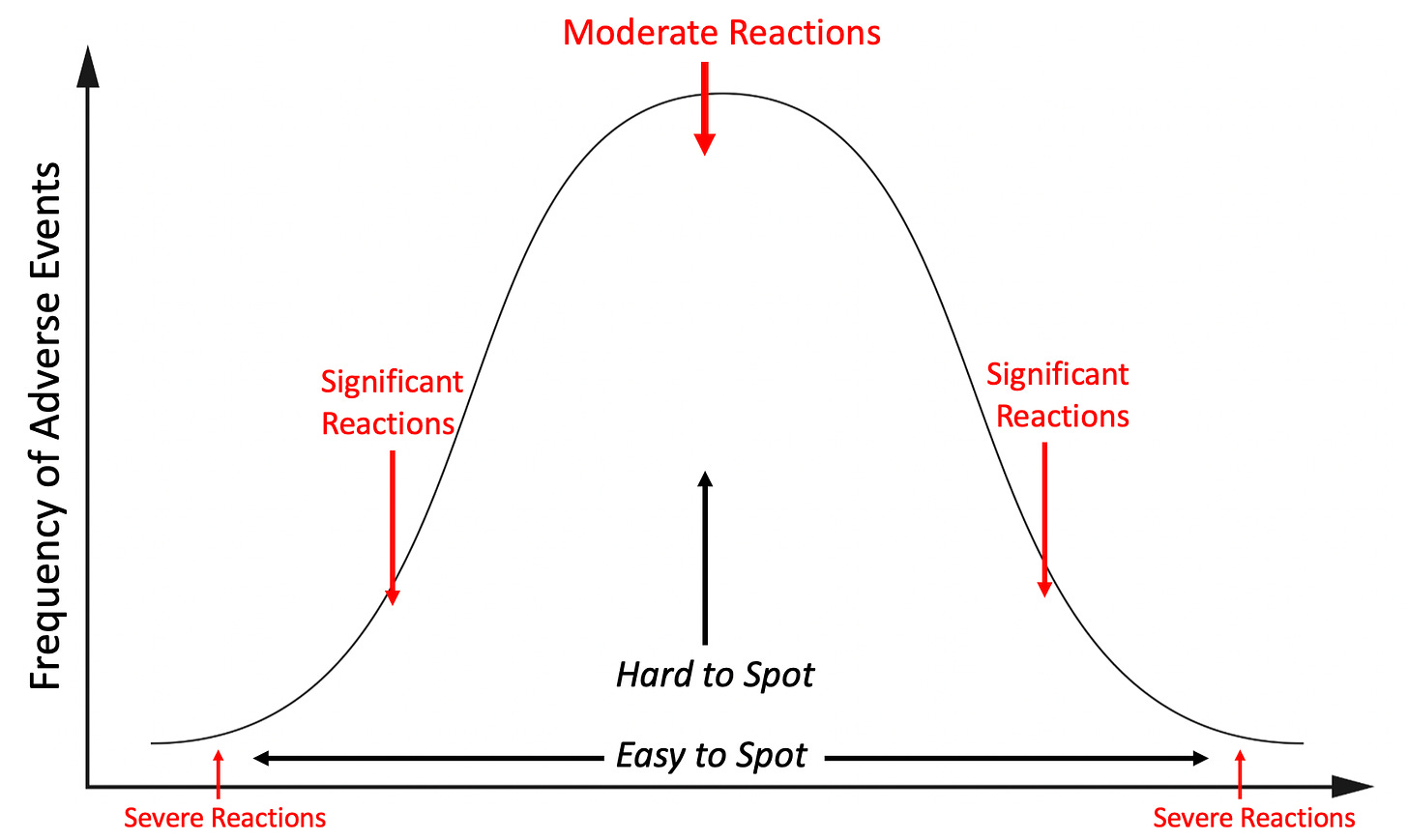
Note: the above graph is only illustrating one aspect of the picture as there will also be a much larger number of minor reactions, and even more invisible ones (e.g., a symptom occurs years down the road) or no reaction at all.
I tried to warn my colleagues about the dangers of this vaccine, but even when I pointed out Pfizer’s own trial admitted the vaccine was more likely to harm than help you, no one would listen to me. Not being sure what else to do, but not be willing to do nothing, I decided to start documenting all the severe reactions I came across so I could have some type of “proof” to show my colleagues.
This was something that was extremely important at the time since no one was willing to take on the personal risk of publishing something that went against the narrative (that vaccines were killing people) in the peer reviewed literature. Shortly after Steve Kirsch kindly helped launch my Substack, I decided to post the log I’d put together, and since there was a critical need for that information (as many had seen the same things I’d observed but no one was reporting them), the post went viral and created much of the initial reader base that made my Substack possible.
It was immensely time consuming to do the project (especially the verification of each story that was reported to me), so I ended the project after a year. During that time, I came across 45 cases of either a death (these comprised the majority of the 45 cases), something I expected to be fatal later on (e.g., a metastatic cancer) or a permanent and total disability. Additionally, in line with the previously described bell curve, I also came across many more serious but not quite as severe injuries.
What I found remarkable about this was that through a passive reporting system in my own limited social network (I learned of these cases because people reached out to me or someone off-handedly shared them with me), I alone found enough cases of severe vaccine injuries to justify pulling the COVID-19 vaccines from the market, yet, our healthcare authorities, who had access to thousands of times as much data as I did chose to pretend nothing was happening. Furthermore, from my own dataset (due to it being large enough to contain all the common COVID vaccine injuries), I accurately predicted most of the vaccine injuries that would be subsequently seen and only now (years later) are gradually being acknowledged.
In turn, we are now seeing clear signs that excess mortality has spiked across the globe, large polls are finding that one fifth of Americans know someone they believe were killed by the vaccines and because so much trust has been lost from this cover up, public health authorities are at last admitting there may be a problem—but they didn’t say anything until now because they “didn’t want to create vaccine hesitancy,” which coincidently is the same excuse which has been used for decades (e.g., Dr. Meier, a distinguished professor called out this behavior after the government unleashed an easily preventable polio disaster in 1955.
Patterns of Vaccine Injury
I’ve had a long term interest in studying pharmaceutical injuries because many of my friends and relatives have had bad reactions to pharmaceuticals. In most of these cases, ample data existed to show that reaction could happen (often to the degree it strongly argued against the pharmaceutical remaining on the market) and yet almost no one in the medical field was aware of those dangers, hence leading to my injured friends never being warned before they took the pharmaceutical or even while the injury was occurring (e.g., the doctor said they’d never seen anyone have those reactions, that whatever was happening was due to anxiety, and that they would soon end — when in reality it became a lifelong condition because the patient didn’t stop the drug in time).
My bell curve theory originally came about from examining all of their cases. I thus was interested to know if the distribution of adverse events from the spike protein vaccines would match what I had observed with previous dangerous pharmaceuticals and if what I saw personally did or did not match what everyone was reporting online (which is part of why I put so much work into making sure the log was both accurate and detailed).
One of the things that immediately jumped out at me during that logging process were the multiple cases of a friend’s parent in a nursing home receiving the vaccine, immediately undergoing a rapid cognitive decline which was “diagnosed” as Alzheimer’s disease and then dying not long after. At the time, I assumed these were most likely due to undiagnosed ischemic strokes as that was the most plausible mechanism to describe what I’d heard, but I was not certain as I could never examine any of these individuals for signs a stroke had indeed happened.
Note: despite many deaths in the nursing home population due to COVID and the vaccines, the number of people awaiting admission to a nursing home has significantly increased (shown by this large data set from the Netherlands). Given that individuals typically do not want to go to a nursing home unless they are no longe able to take care of themselves, this suggests that something new is causing the rapid development of debilitating cognitive impairment (e.g., dementia) in the adult population. Likewise, as Ed Dowd has repeatedly documented, there has been a large increase in physical and cognitive disability throughout the adult population which has significantly impacted the economy because of how many workers are being lost to vaccine injuries.
Steve Kirsch was contacted by a whistleblower who reported there has been a 25 fold increase in sudden dementia at the nursing home where she works. Similarly, like the cases shared with me, Kirsch has noted that (like me) he has frequently been contacted by relatives who reported a sudden onset of dementia in their beloved relative which was then swept under the rug. Furthermore, he has also collected numerous other forms of evidence corroborating this is indeed happening. These cases are really sad because the elders in nursing homes have very little ability to advocate for themselves, and most people will just write the cases off as “Alzheimers,” rather than seeing the red flag staring them in the face.
These cases were very concerning to me, as they signified (per the bell curve) that there was going to be a much larger portion of people who would develop less severe cognitive decline following vaccination.
Note: one of the most common types of injuries from pharmaceuticals are neurological injuries which both impair cognitive function and create psychiatric symptoms. This places patients in a difficult situation of being gaslighted by the medical system. This is because their doctors assume the psychiatric symptoms the patients are experiencing are the cause of their illness rather than a symptom of it, leading to the patient being told the illness is all in their head and continually referred for psychiatric help. One of the best examples of this occurred as a result of the abnormal heart rhythms (e.g., rapid anxiety provoking palpitations) caused by the vaccine damaging the heart which were consistently diagnosed as being a result of anxiety, even when a subsequent workup I requested showed heart damage was present. Remarkably, in the early era of vaccines, many doctors (as detailed here) acknowledged that vaccines caused neurological injuries which manifested as psychiatric symptoms, but now that recognition has been almost completely forgotten.
As I began seeing more and more signs of cognitive impairment following vaccination, I realized that what I observed mirrored what I had previously seen with chronic inflammatory conditions such as mold toxicity, HPV vaccine injuries, and lyme disease. Some of the examples included:
• Many people reported having a “COVID” brain where it was just harder for them to think and remember things. I sometimes saw this occur after more severe cases of COVID, but more frequently after vaccination, along with many instance of patients who per their timeline clearly developed it from the vaccine but nonetheless believed it had come from COVID.
• These issues tended to be more likely to affect older adults, but younger ones were more likely to notice (and complain) about them. In the case of older adults, I typically learned about them from someone else who had observed the cognitive decline rather than directly from the individual.
• I saw numerous cases of vaccine injured individuals who had trouble remembering or recalling the word they knew expressed what they were trying to communicate (this is also a common mold toxicity symptom).
• I had friends and patients who told me their brain just didn’t work the same since they’d received the vaccine. As an example, a few colleagues told me they started losing the ability to remember basic things they needed to practice medicine (e.g., medication dosages for prescriptions). They shared that they were very worried they would need to take an early retirement and that they thought it came from the vaccine but there was no one they could talk to about it (which understandably created a lot of doubt and anxiety).
• I saw cases of coworkers demonstrating noticeable (and permanent) cognitive impairment after I’d assumed they’d received the vaccine. Their impairment was never mentioned or addressed (rather the physician kept on working, did not perform as well, and in some cases retired).
• I met significantly injured vaccine injured patients who told me one of the primary symptoms was a loss of cognitive functioning they had taken for granted throughout their life. In many cases following treatment of their vaccine injury, their cognition also improved.
• Colleagues who treated vaccine injured patients told me cognitive impairment was one of the common symptoms they saw and was particularly noteworthy because they had never seen anything like that happen to young adults. To quote Pierre Kory:
In my practice of treating vaccine injuries, one of the three most common symptoms I see is brain fog. So many of my patients had been in the prime of their lives, can now barely function, have significant cognitive impairment and need a lot of help from our nurses to carry out their treatment plans. I never imagined I would see any of this in people far younger than me and instead I see it every day. I bear witness to an immense amount of suffering on a daily basis that is hard to put into words.
• One of my friends (a very smart immunologist) developed complications from the first two vaccines and based on their symptoms was able to describe exactly which parts of their immune systems were becoming dysregulated. Against my advice, they took a booster and reported they suffered a significant cognitive impairment never experienced before in their lifetime. I feel this case was important to share as it illustrates how an exacerbation of a vaccine injury can also cause an exacerbation of cognitive symptoms.
Note: I also saw significant cognitive impairment occur in individuals who were acutely ill with COVID-19. This was not as unusual since delirium is a well known complication in patients hospitalized with a systemic illness (e.g., sepsis), but it seemed to happen more frequently than usual. However, in almost all cases, COVID-19 cognitive impairment resolved after their illness (even when they had been critically ill and required hospitalization) whereas the cognitive impairment I saw from the vaccines was often permanent (unless it was treated).
I specifically wanted to write this article for two reasons.
First, unless you’ve talked to a lot of people who have been through this, it’s really hard to describe what it’s like to gradually lose your mind and the basic cognitive function you relied upon to navigate the world—especially if everyone around you is telling you that it’s not happening and it’s all in your head. I wrote this article to give a voice to those people.
Second, despite Alzheimer’s disease being the mostly costly disease for America, most providers know fairly little about it and instead use it as a blanket diagnosis for anytime a patient shows signs of impaired cognition. This, I in turn would argue has been because there is minimal interest in understanding the causes (and treatments) of Alzheimer’s disease as there is so much more money in “research” for it and productive expensive (but useless and harmful) drugs for it.
Evidence of Cognitive Impairment
At the same time I was observing these effects, many rumors were also swirling around online that the vaccines would cause severe cognitive impairment and that we would witness a zombie apocalypse from the vaccine injuries.
This apocalypse of course never happened (which again illustrates why it is so important to be judicious with what one pronounces will come to pass—as our movement has repeatedly damaged its credibility by making easily outlandish and easily falsifiable predictions). Nonetheless, many have observed a suspicion cognitive impairment was occurring. For example to quote Igor Chudov’s article on the topic:
I own a small business and deal with many people and other small businesses. Most provided reliable service, would remember appointments, followed up on issues, and so on. I noticed that lately, some people have become less capable cognitively. They forget essential appointments, cannot concentrate, make crazy-stupid mistakes, and so on.
In my own case, in addition to poorly performing colleagues, the most evident change I noticed was a worsening of drivers around me and had quite a few near misses from impaired driving.
The great challenge with these situations is that it’s very hard to tell if something is actually happening or your perception is simply a product of confirmation bias. For this reason, while I was comfortable asserting my belief the COVID-19 vaccines were causing the severe injuries on either end of the bell curve, I avoided doing so for many of the less impactful injuries in the middle where it was much more ambiguous if what I was observing was “real” or simply my own biased perception of the events around me. Because of this, amongst other things, I never mentioned the changes in driving I observed.
Note: after I posted the original article many of the readers stated they too had observed a significant worsening in the behavior of drivers around them. I was then pointed to this dataset, which suggests this issue was happening, but is difficult to properly assess because COVID-19 can also cause cognitive impairment and less people were driving in 2020 and because the dataset still has not been updated since 2022.
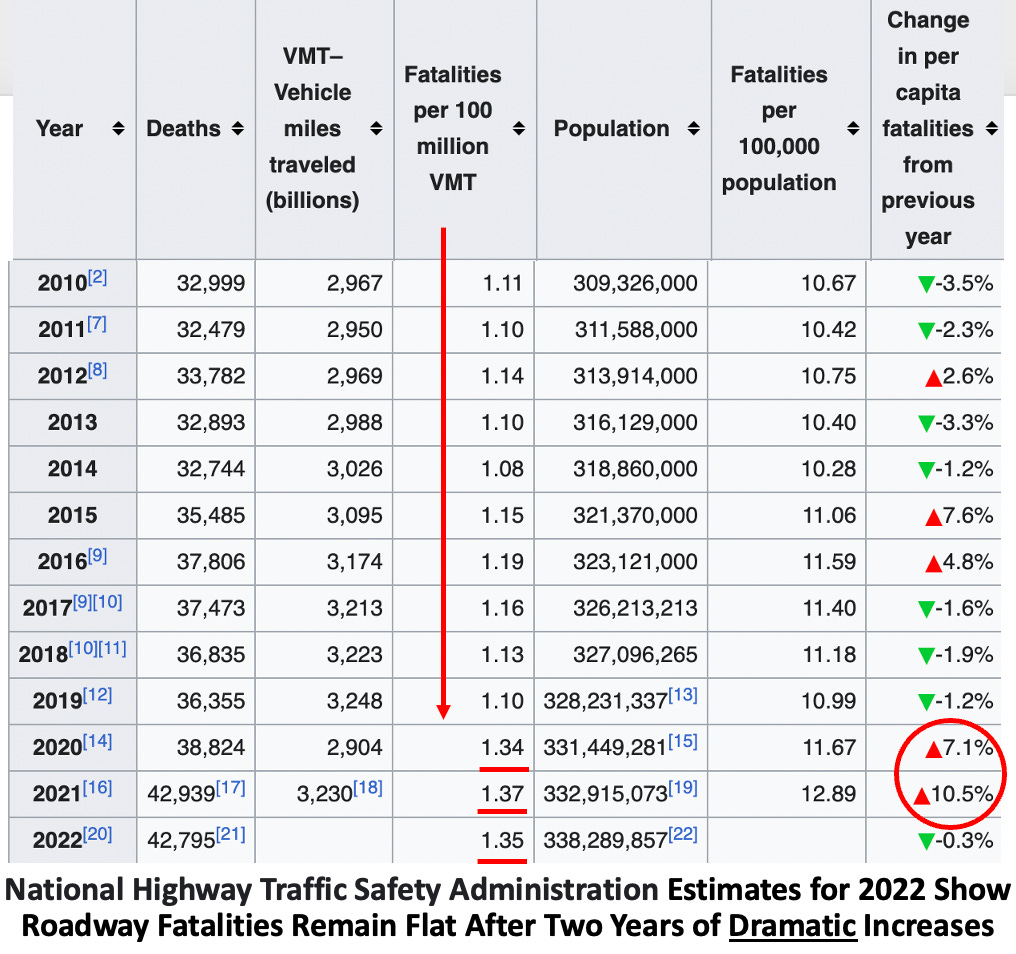
Recently, Igor Chudov was able to identify another dataset from the Netherlands which further corroborated that we were indeed facing a massive cognitive decline:
Primary care data for January to March 2023 showed that adults visited their GP more frequently for a number of symptoms compared to the same period in 2019. Memory and concentration problems were significantly more common than last year and in the period before COVID-19. Where these symptoms are concerned, the difference compared to 2019 is growing steadily in each quarter.
In the first quarter of 2023, there was a 24% increase in GP [general practioner] visits related to memory and concentration problems among adults (age 25 years and older) compared to the same period in 2020. This is evidenced by the latest quarterly research update from the GOR Network. The increase in memory and concentration problems of adults seems to be a longer-term effect of the coronavirus measures as well as SARS-CoV-2 infections.
More specifically they found:
• No increase was observed in adults under 25 years old.
• A 31% increase was observed in those 24-44 years old.
• A 40% increase was observed in those 45-74 years old.
• An 18% increase was observed in those over 75 years old.
Note: previous rounds of this survey, in addition to the cognitive issues described above, found that since 2019, the general population has also experienced worsening mental health (e.g, anxiety, depression or suicidal thoughts), sleep problems, tiredness, and cardiovascular issues (e.g., shortness of breath, dizziness or heart palpitation).
Typically, patients, less than 75 years old are unlikely to visit their doctors for cognitive issues. Taken in context with this data, it means there is a stronger case that the (massive) increases in cognitive issue for those under 75 were caused by something that happened after 2019. Additionally, since there were already a large number of visits for cognitive impairment in the elderly, the lower percentage increase is slightly misleading in quantifying the extent to which everyone was affected. For example to quote the previous report:
Primary care data showed that adults visited their GP somewhat more frequently for sleep problems in October–December 2022 than in the same period in 2019. This was particularly striking in the oldest age group (75 years and older).
Note: poor sleep is one of the primary causes of cognitive impairment (or dementia) and sadly also commonly impaired after COVID-19 vaccination.
All of this data put health officials in a bit of an awkward situation since publishing data demonstrating large scale cognitive impairment directly undermines the narrative they previous had committed themselves to. Nonetheless, the authors of the report were significantly more candid than many others before them:
The source of this increase in memory and concentration problems is unclear. A possible explanation could be that COVID-19 measures caused accelerated cognitive decline among people who were starting to have problems with memory and concentration (66 years on average).
COVID-19 was of course cited as a potential cause (which, as discussed above can sometimes cause long term cognitive impairment):
A supplementary explanation could be that some of these people have long-term symptoms after COVID-19. Various studies have shown that memory and concentration problems are common in post-COVID symptoms. Other infectious diseases, such as flu, can also cause these symptoms. However, recent studies have shown that long-term memory and concentration problems are much more common after COVID-19 than after flu. In addition, these symptoms are more common in older age groups. The figures provided by GPs are consistent with this expectation.
Fortunately, the authors acknowledged that long COVID could not be the primary explanation for what was occurring, and instead alluded to the elephant in the room—the vaccines.
Finally, Ed Dowd has identified numerous government datasets demonstrating that widespread impairment and disability has occurred since the vaccine rollout. Likewise, VAERS detected a massive spike in cognitive issues being reported to it after the COVID vaccines hit the market.
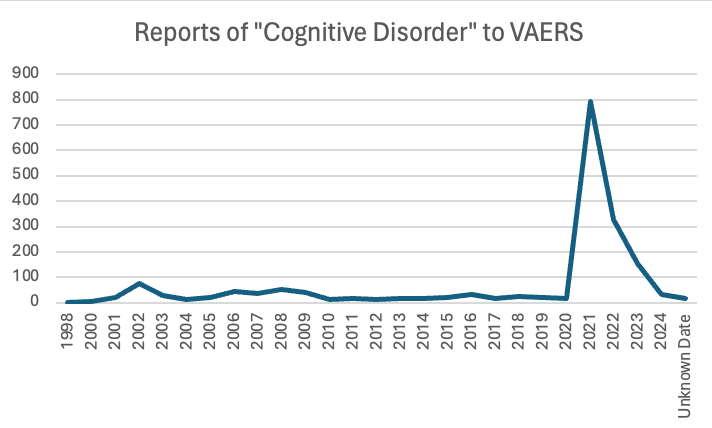
Note: one of the key components of the COVID-19 vaccine push was to make it politically incorrect to raise any data-based objections to the vaccines, and thereby stifle any inconvenient discussions of the topic which would have exposed how dangerous these products were. Because of this, I repeatedly heard stories (like this one) of liberals (including famous ones) who had severe vaccine injuries but could not discuss them with their peers, as doing so meant being outcasted from their social group and being cut off from job opportunities, in effect placing them in a similar position to where gay men were in the early 1980s (as coming out often meant being ex-communicated by many close to you). Fortunately, things are now changing (as there are too many injuries to hide) and we are beginning to see more and more prominent individuals “come out of the closet” and admit they were vaccine injured.
Data Transparency
Making decisions has always been difficult and history is rife with catastrophic errors made by individuals who got it wrong. Because of this, a variety of solutions have been developed over the years (e.g., having a committee go through a process to decide something as it is unusual to have a leader who excels at making excellent decisions), all of which have serious short comings.
In recent years, we’ve had a push for data to become the means to making decisions. On one level, I think this is an excellent approach. For example in sales and the internet (which is where I suspect much of the push for data originated from), large amounts of data are used on a daily basis and constantly used to refine how a marketing campaign internet platform is set up so that it can maximize profits.
However, in many cases (e.g., those outside of business and sales), that same incentive to optimally utilize the data and adjust what’s being done due to the data does not exist. Because of this, while we have a large emphasis on gathering data, most of it is never utilized. For example, in medicine, we force our healthcare workers to do an immense amount of data entry, yet, we never combo the electronic health records to determine which drugs are unsafe or ineffective (which is very easy to do). I would argue this is because the healthcare system receives so much unconditional money they have no incentive to produce better results and because the pharmaceutical industry receives so much money for toxic drugs, it has every incentive to keep them on the market.
In order to enshrine this paradigm, industry had to both create the mythology that data should both be viewed as the ultimate authority we must all be subservient to, but simultaneously not be something that is publicly available. This in turn was done by arguing that data was “costly proprietary information and intellectual property must be protected” or that it “contained personal health information which could not ethically be disclosed to protect the patients.”
In turn, science has very much become us being expected to trust the team of “experts” who analyze a dataset, and not surprisingly, this process lends itself to corruption.
For example, the only publicly available vaccine injury database VAERS, exists because activists forced it to be required by law, and ever since it was made, the government (along with the medical establishment and the media) has done everything it can to undermine VAERS (discussed further here). Because VAERS reputation had been sullied, for the COVID vaccines, a new monitoring system, V-Safe, which was designed to address the short comings of VAERS was created. However, before long, activists discovered that V-safe did not allow the majority of adverse reactions to be reported in it, and furthermore would not make the data available for outside analysis. Instead, we were given access to a Lancet publication which concluded that:
Safety data from more than 298 million doses of mRNA COVID-19 vaccine administered in the first 6 months of the US vaccination programme show that most reported adverse events were mild and short in duration.
Reports of seeking medical care after mRNA vaccine were “rare”… Serious adverse events, including myocarditis, have been identified following mRNA vaccinations; however, these events are rare. Vaccines are the most effective tool to prevent serious COVID-19 disease outcomes and the benefits of immunisation in preventing serious morbidity and mortality strongly favour vaccination.
Through lawsuits, activists were eventually able to obtain the V-safe data where they then discovered the above study had lied and there were a lot of serious issues within that database. For example, the above article claimed 0.8-1.0% of vaccine recipients required medical care, whereas the raw V-safe data show 7.7% did—on average 2.7 times, which meant that every 4.8 vaccinations caused one medical visit.
Likewise, throughout the pandemic, we had almost all of the scientific journals refuse to publish anything which challenged the narrative (e.g., I’ve been in touch with numerous teams that have run into an endless number of roadblocks to publish contrarian data). Yet, simultaneously, those journals were willing to contort the existing (poor quality) data as much as possible if that supported the narrative (e.g., Pierre Kory has shown how multiple studies whose data demonstrated ivermectin benefitted patients concluded ivermectin was useless and then widely promoted for having debunked ivermectin).
Similarly, Deborah Birx and Anthony Fauci were essentially responsible for the disastrous COVID-19 response (e.g., useless but harmful mass testing, masking and lockdowns), as both within the White House and in the (fawning) media, they relentlessly and successfully pushed for those approaches regardless of how much protest they met. As both news clips and eye witnesses testimonies showed, Fauci and Birx constantly used “the data” to justify their their approach (e.g., when challenged, Birx would often say “I’m all about the data” while Fauci always cited “the data” whenever he advocated for a policy on national television).
However, Scott Atlas (who was with them on the White House COVID-19 task force) discovered that they both never presented scientific papers to the task force, lacked the ability to critically evaluate scientific research, they did not understand basic medical terminology, they would make patently absurd and non-sensical interpretations of their data, and adamantly refused to consider any of the data which challenged their narratives. In many cases, what he witnessed was so absurd he likened it to being in the Mad Hatter’s tea party from Alice and Wonderland, whereas I felt it was a real life version of this iconic Whitehouse scene from Idiocracy.
Because of the widespread lack of data transparency, a few different approaches exist.
First many (e.g., Drs. Peter Gøtzsche and Malcolm Kendrick) have gradually become experts in “data forensics” and being able to identify the tricks the pharmaceutical industry uses to doctor research so that the data always ends up supporting the sponsor’s desired conclusion. What I personally find depressing about this is that a fairly repetitive playbook is used to doctor studies, but the top medical journals consistently turn a blind eye to this, always publish that deceptive research, and in most cases refuse to correct it once the public points out the fraud.
Second, many (e.g., Steve Kirsch) argue that if data is not made publicly available, one must assume it’s incriminating and the data’s owners are lying about what’s in it (e.g., that the COVID vaccines are safe and effective). For example, for decades activists have been trying to get access to the data from the CDC’s Vaccine Safety Datalink (as it has the information which could definitively say if vaccines are safe or effective) but they’ve had no success—which in turn suggests that database is full of incriminating information for the vaccine program. Likewise, given the disconnect between what I was seeing with COVID-19 vaccine injuries and what the government was reporting (the only message we ever heard was “safe and effective!”) it was clear to me the government had very bad data and had made the decision to do whatever could be done to cover it up—a prediction which sadly has continued to hold true.
Third, we have to rely upon publicly available datasets which happened to capture the effects of vaccination programs (e.g., the one which tracks annual disability rates in the USA registered a huge spike after the COVID-19 vaccines hit the market). Unfortunately, while these clearly show that an issue exists which needs to be investigated, they do not definitively prove causality, and hence are often dismissed on that basis (much like VAERS is).
Fourth, we have to rely upon whistleblowers. Unfortunately, when this happens, the national government typically targets them for violating “patient confidentiality.” For instance, when a New Zealand whistleblower released fully anonymized data showing the vaccines were killing people, his government charged him with crimes carrying a maximum seven year prison sentence.
Note: the most recent example of government persecution of whistleblowers happened in Texas, where in February 2022, Texas’s government declared providing gender transitions to minors constituted child abuse, and June 2023, outlawed it. In response to this, in March of 2022, one of the largest Children’s hospitals in Texas (and where Peter Hotez exerts a significant amount of influence) announced it would stop providing transgender hormonal therapies. This however was a lie, so in April 2023, a concerned surgeon who had previously worked at the hospital convinced the hospital to give him access to their medical records, and then leaked anonymized medical records demonstrating that the hospital was continuing these practices, as in his opinion, under Texas law, this was child abuse he was required to report. In response to this, the Biden administration (not Texas) charged him with four felonies which carry a maximum penalty of 10 years in prison, which is very different from how other HIPPA violations have been handled. Likewise, more recently, after another nurse at the hospital exposed that the hospital was committing Medicaid fraud by billing for transgender care but labeling it as something else (as Texas’s Medicaid program does not permit for those practices to be reimbursed), after which the FBI was sent to interrogate (and likely intimidate) the nurse.
All of this hence leaves us in a very disorienting position—how do we know who to trust? In turn, I would argue one of the largest reasons so many people trust the audacious lies the government tells us is because the alternative (not knowing who or what to trust) is arguably even worse.
In my own case, I’ve developed a very simple rule for navigating the scientific literature (and many other sources of information as well).
Step 1. Determine the biases and conflicts of interest of the publication source (e.g., most medical journals and their editors take a lot of money from the pharmaceutical industry and hence do not want to upset their sponsors—an issue we sadly also see in the mainstream media).
Step 2. Determine if the conclusion of a published study agrees with, challenges, or is relatively neutral to it’s publisher’s bias.
Step 3 Use this formula:
• Agrees with publisher—high likelihood the study is wrong and it’s probably not worth your time to look into it.
• Disagrees with publisher—high likelihood the study is correct and that a very high bar had to be passed for it to be published (along with significant pressure being exerted behind the scenes).
• Relatively neutral for the publisher—you can take the paper at face value when you analyze its methods and conclusions to see if they had a reasonable way to derive their conclusion. Additionally, while the most prestigious medical journals are corrupt, this category is the one area they shine in and often ensure high standards were met for publication.
South Korea’s Data
In November 2023 and March 2024, some very interesting data emerged from a team of South Korean researchers where they looked at the electronic health records for a quarter and then half of the population in Seoul (2.2 million for the first study and then 4.3 million for the second) and then compared the rates of a variety of new (non-serious) medical conditions in those vaccinated and unvaccinated over three months. From this, they found a variety of medical conditions had a significant increase in the vaccinated. Those increases were as follows (with a range existing depending on how long after vaccination they were compared and which COVID vaccines they received).
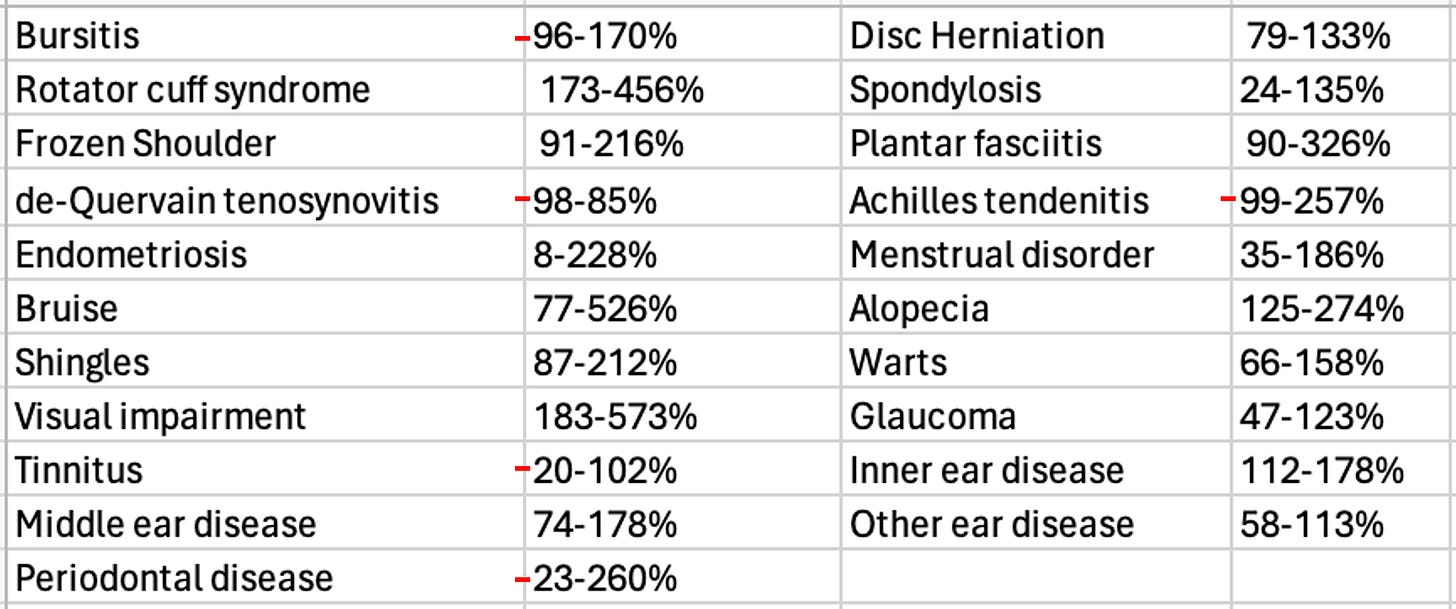
This was essentially a dataset we had been trying to get for over 2 years and it matched what we’d seen (e.g., many of these conditions such as shingles and alopecia [hair loss] appear to be strongly linked to vaccination). In turn, it both demonstrated that the vaccines were causing massive harm to society as millions of Americans suffer from these diseases and hence millions more developed them.
Unfortunately, after I analyzed them, I realized it was not appropriate for me to discuss them here as they were pre-prints rather than published articles, which either meant that they had fraudulent data (as it was quite extraordinary they got access to this data) or they were too politically incorrect for any journal to want to publish. While I felt the latter was much more likely, I was not sure which is was, so I avoided publishing that article (which was hard to do given how much time I’d put into it) as I did not want to fall into the trap of promoting something because it promoted my pre-existing biases and then misleading the audience here.
Note: if for some reason these studies disappear I have included the pre-prints below.

We hence tried to reach the authors (no success) and I patiently waited for the articles to leave the preprint server (which has still not happened).
However, recently. three other studies were published by the same team using the same dataset. The first one, (also from March 2024) analyzed the increase of ten common autoimmune disorders (autoimmune hepatitis, ankylosing spondylitis, hashimoto thyroiditis, hypertension, inflammatory bowel disease, primary biliary cholangitis, rheumatoid arthritis, graves, vitiligo, lupus).
This one stated only vitiligo was increased (by 174%), so it seemed plausible to me it could have been published, as it made a token admission the vaccines were bad (as they had a rare side effect from a disease most people don’t know about). Then, when I looked at the data, I noticed a few of the other conditions appeared to have also increased. In turn, since those increases weren’t mentioned in the article, I took that as a sign the article was deliberately omitting incriminating information from its conclusion so it could make it to publication (this happens a lot). Additionally, I was surprised the authors did not evaluate for polymyalgia rheumatica, as this seems to be one of the autoimmune disorders most distinctively associated with vaccination.
That article made me more confident the initial results were real—however since it was published in an obscure journal, I reserved judgement on it. Recently however, two very important ones came out.
Two weeks ago, the first was published in Nature (one of the top medical journals). It found that COVID vaccination resulted in a 68% increase in depression, a 44% increase in anxiety, dissociative, stress-related, and somatoform disorders, a 93.4% increase in sleep disorders, a 77% decrease in schizophrenia, and a 32.8% decrease in bipolar disorder. I was really surprised to see this be published, and took it as a sign there may have been a decision made to begin disclosing some of the harms of vaccination in the official medical literature. Additionally, I took this as an indication that this was an indirect admission neurologic issues also followed vaccination (due to the strong link between neurologic and psychiatric symptoms).
Note: the previously mentioned Israeli survey found that 4.5% of those who received a vaccine developed anxiety or depression, and 26.4% who already had either experienced an exacerbation of it.
Around the same time (three weeks ago) another article was published in a mainstream journal (or to be more exact “accepted for publication”). It analyzed individuals over 65 and found COVID vaccination increased the risk of mild cognitive impairment 138% and the risk of Alzheimer’s by 23%, and a smaller increase in vascular dementia and Parkinson’s disease the authors did not deem to be significant.
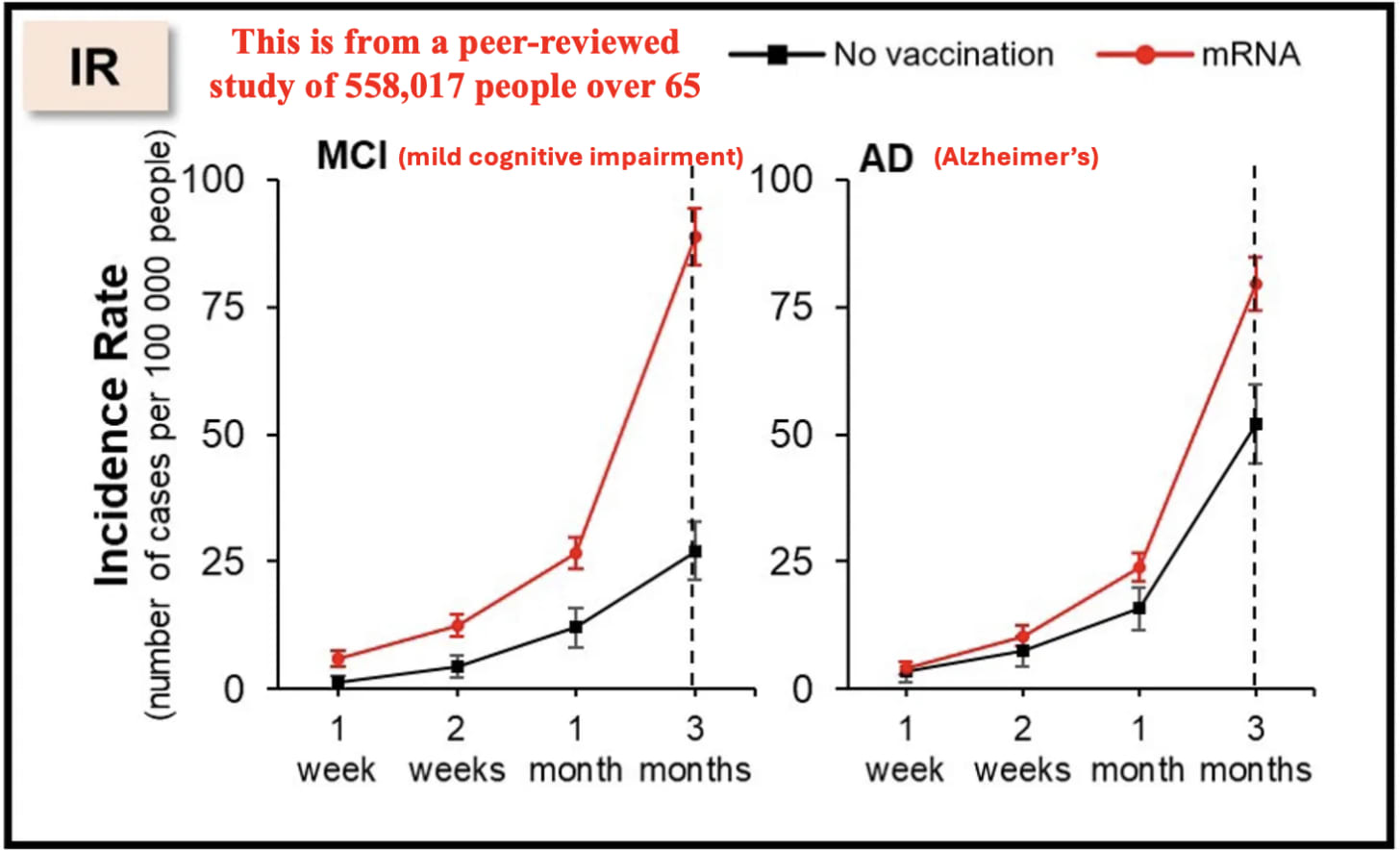
To put this in context, given that America spends over 300 billion dollars per year on Alzheimer’s disease, this single datapoint effectively means that the COVID vaccines cost the United States around 100 billion dollars. Additionally, as the authors only tracked the difference over 3 months (and it increased over time as these are both progressive diseases), the actual cost is likely greater, especially given that the elderly keep on receiving boosters. Likewise, it also makes a very strong argument for anyone who believes the vaccines damaged their cognition that this indeed happened.
Why Are The Vaccines Causing Cognitive Impairment?
My specific interest in studying spike protein vaccine toxicity arose because I suspected I would see many similarities to other pharmaceutical injuries I had observed previously and treatments that had developed for those injuries could be used to treat COVID-19 vaccine injuries. On Substack, I’ve tried to focus on explaining the areas that I believe are the most important to understanding this, zeta-potential, the cell danger response (CDR) and the treatments for Alzheimer’s disease. Note: Each of these is interrelated with and often causes the others.
Zeta Potential: Zeta potential (explained in detail here) governs if fluid in the body clumps together (e.g., forming a clot) or remains dispersed and capable of freely flowing. Additionally, it also influences if proteins will stay in their correct formation or misfold and clump together (with Alzheimer’s disease being characterized by misfolded proteins in the brain). Many different issues (discussed here) emerge when fluid circulation (be it blood, lymph, interstitial fluid or cerebrospinal fluid) becomes impaired. Since the spike protein is uniquely suited for impairing zeta potential, we have found restoring zeta potential (discussed here) often is immensely helpful during COVID-19 infections and for treating COVID-19 vaccine injuries. Many of those approaches in turn were initially developed from working with other vaccine injuries and cognitive decline in the elderly.
Note: the spike protein also has a prion forming domain, and many believe its responsible for the highly unusual amyloid (fibrous) blood clots seen in COVID-19 victims. Additionally, the COVID vaccines have been linked to extremely rare (and fatal) protein misfolding disorders such as the rapid dementia caused by CJD (discussed further here).
Cell Danger Response (CDR): When cells are exposed to a threat, their mitochondria shift from producing energy for the cell to a protective mode where the cell’s metabolism and internal growth shuts down, the mitochondria release reactive oxygen species to kill potential invaders, the cell warns other cells to enter the CDR and the cell seals off and disconnects itself from the body. The CDR (explained further here) is an essential process for cellular survival, but frequently in chronic illness, cells become stuck in it rather than allowing the healing response to complete.
Note: one common cause of impaired cognition are neurons becoming stuck in the CDR and hence not performing their cognitive tasks.
Understanding the CDR is extremely important when working with complex illnesses because it explains why triggers from long ago can cause an inexplicable illness, and why many treatments that seem appropriate (specifically those that treat a symptom of the CDR rather than the cause of it) either don’t help or worsen the patient’s condition. Many of the most challenging patients seen by integrative practitioners are those trapped within the CDR, but unfortunately, there is still very little knowledge of this phenomenon.
My interest was drawn back to the CDR after I realized that one of the most effective treatments for long COVID and COVID-19 vaccine injuries was one that systemically treated the CDR. Since many of the therapies that have been developed to revive nonfunctional tissue was developed by the regenerative medical field, I wrote an article describing how these approaches are applied to restore localized regions of dysfunctional tissue (which is sometimes needed to treat vaccine injuries) and another on the regenerative treatments that treat systemic CDRs (and are more frequently needed for vaccine injuries).
Alzheimer’s Disease (AD): since AD is one of the most costly disease in America, billions of dollars are spent each year in researching a cure for it. This research (which began in 1906) has had a very narrow focus on removing amyloid from the brain, and since the production of amyloid is a protective response from the brain, the decades of work to remove it have gone nowhere. Nonetheless, the FDA is presently working hand in hand with the drug industry to push forward ineffective, quite dangerous but highly profitable treatments for AD.
Remarkably, effective treatments do exist for AD and my colleagues have developed a few different methods that have successfully treated the condition. Additionally, one neurologist, Dale Bredesen developed a method for reversing AD that he proved worked in mulitiple publications (included a recent 2022 clinical trial)—something which no one else has done, but remarkably has been almost completely ignored by the neurological field.
All of these successful approaches utilize the following principles:
• Restore both the blood flow to the brain and the lymphatic drainage from it (which safely removes amyloid plaques). This often requires restoring the physiologic zeta potential and having a healthy sleep cycle. Additionally, AD is commonly linked to damage to the lining of the brain’s blood vessels, which is unfortunate because one of the most frequent toxicities of the spike protein is injury to the blood vessels (which has been shown in many autopsies—including within the brain).
• Treating the CDR (which causes chronic inflammation) and reactivating brain cells that became trapped in an unresolved CDR (which amongst other things requires reclaiming a healthy sleep cycle, providing the nutrients the brain needs to sustain itself, and mitigating the damage of neurotoxins like inhaled anesthetics).
Note: Bresden’s approach also emphasizes the importance of addressing chronically elevated blood sugar or insulin levels.
One of the most important things to recognize about AD is that it is a slowly worsening disease which often progresses over decades. In the early stages of AD (where it is the most reversible), minor cognitive changes occur, which (when possible to autopsy) correlate with tissue changes within the brain. In rarer instances, individuals can instead have a rapidly progressing form of Alzheimer’s (e.g., from Lyme) which strikes at a younger age and is often linked to the toxin exposure. Given how quickly the increase in AD appeared in both the patients I know and this dataset, I suspect it’s very likely the mechanisms behind the rapidly progressing forms of AD play a key role in the cognitive impairment and dementia we are seeing from these vaccines.
Conclusion
Many of the most successful people I know are willing to go against a crowd and act in spite of being afraid (e.g., they resisted the peer pressure to get the vaccine because they felt it was a good idea). Likewise, rather than looking to an authoritative source for advice, they tend to create preliminary assessments of what’s going on based on the limited data that’s available to them, and then act on it rather than waiting for a clear and definitive answer (or at least a safe one) to present itself.
In turn, as I’ve gotten to know many of the prominent dissidents in this movement, I’ve found they all had those traits in common (which likewise many of my extraordinary medical mentors did as well). For example, Steve Kirsch used this capacity to become a successful Silicon Valley entrepreneur. When the vaccines came out, he “trusted the science,” and immediately got one, but before long noticed numerous people he knew had had severe injuries from them, and rather than be in denial about it, recognized that chain of injuries was statistically impossible, began digging into it, realized the existing data showed we had a huge problem, and then began speaking out on it despite the fact much of the (left wing) peer group he’d belonged to for decades disowned him for doing so.
In my own case, for the COVID vaccines, I had initially come in with expectation (which formed as the virus broke out in Wuhan) that whatever “emergency” vaccine was pushed for it would have significant issues and the adverse events would be by and large covered up by the government (or only “discovered” years down the line). In turn, I concluded it was far more preferable for me to feel confident I could treat the infection when I eventually got it and develop natural immunity than it was to take a risk with the vaccines.
However, once I began seeing a high number of red flags the moment the vaccines hit the market, I realized that I had made a big miscalculation and these things were incredibly dangerous so I needed to shift my focus to preventing people from being harmed by them.
Furthermore, I took the bell curve theory into account and assumed that if I was seeing occasional deaths or severe cognitive degeneration following vaccination, it was likely that far more cases of cognitive impairment were occurring, and as this recent Korean study shows, that is indeed the case.
It is thus both quite tragic and remarkable that we now have a leadership which has so little accountability to produce quality results that things like the basic scientific process (which helped our country become one of the most powerful nations in history) is being completely disregarded and replaced with a dogmatic system which refuses to consider basic data points which more and more are proving themselves to be immensely costly to our nation.
Everything we are seeing now was incredibly predictable and represented a systemic failure in our system and a profound societal decline that must be reversed if we want our nation to be something which continues to provide the basic things we have taken for granted from it for most of our lives. I am especially worried as prior to COVID-19, our society was already struggling to reverse this decline, and since that time, we’ve been hit by a wave of cognitive impairment which can only further diminish our ability to address this.
Dozens of Palestinian homes demolished across occupied West Bank

The Cradle | June 27, 2024
Israeli forces have demolished 17 Palestinian homes across the occupied West Bank on 26 June.
Local sources told WAFA news outlet that the demolitions included four houses east of Jericho, eleven homes in the Umm al-Khair community in Masafer Yatta in Hebron, one home in Beitillu village, and one home in east Jerusalem’s Silwan neighborhood.
In Jericho, the demolitions were carried out on the basis that they were built without Israeli-issued permits.
The eleven houses demolished in Masafer Yatta all belonged to to the Al-Hathalin family, leaving over 50 Palestinians homeless.
Bulldozers tore through the land, uprooting many solar cells, water tanks, and fences, as well as trees.
With international attention on Gaza, Israel has stepped up settler violence to ethnically cleanse and expand its illegal settlement of the occupied West Bank.
Last week, Israeli forces carried out a campaign of raids in various parts of the occupied West Bank, as Israeli Finance Minister Bezalel Smotrich openly confirmed that Israel has plans to annex the West Bank. The Israeli military gave significant legal powers in the occupied West Bank to pro-settler civil servants working for Smotrich to accelerate the annexation of the occupied Palestinian territories.
In March, the Israeli government designated 2,000 acres of Palestinian-owned land in the occupied Jordan Valley as state-owned property for the construction of over 100 settlement housing units and an area for commerce and industry.
Earlier this month, Norway’s largest private pension fund, Kommunal Landspensjonskasse (KLP), dropped its stakes in Caterpillar Inc over concerns of complicity in the destruction of Palestinian homes.
Featured Video

John Mearsheimer Talking Iran with Iran
or go to
Aletho News Archives – Video-Images
Book Review & Summary
Calling of an Angel: The True Story of Rene Caisse and an Indian Herbal Medicine Called Essiac (1988)
Dr. Gary L. Glum – 30 Q&As – Book Review & Summary
Lies are Unbekoming | October 17, 2026
On June 10, 1975, Dr. Chester Stock, a vice president at Memorial Sloan-Kettering Institute for Cancer Research, wrote to a Canadian nurse named Rene Caisse: “Enclosed are test data in two experiments indicating some regressions in sarcoma 180 of mice treated with Essiac.” The sentence sat in a letter from one of the world’s largest private cancer research centers, concerning an herbal tea an elderly English woman had learned from an Ojibwa medicine man at a northern Ontario mining camp in the 1890s. The tests were terminated the following year after Sloan-Kettering admitted, in sworn affidavit three years later, that they had prepared the injectable solution improperly from the dried material supplied — freezing and thawing the herb rather than boiling it as Rene had instructed. By the time Calling of an Angel was published in 1988, Rene Caisse had been dead for a decade, having treated thousands of cancer patients across fifty-six years in her Bracebridge, Ontario kitchen, never charging a fee, and refusing every offer — from Memorial Sloan-Kettering, the National Cancer Institute, Merck, Parke Davis, and private corporations dangling contracts up to $1 million — to release her formula before the medical establishment admitted her remedy had merit. … continue
Blog Roll
 Aletho News
- South Korean Assistance to the U.S. in the War with Iran: Between Allied Duty and National Interests
- Pharma- and Gates-Funded GAVI Seeks to Assure Parents
- John Mearsheimer Talking Iran with Iran
- Inside Bill C-22, Canada’s Patriot Act.
- China’s FM: Palestinian cause is ‘greatest injustice of the century’
- US sympathy for Palestinians surpasses support for Israelis
- Israeli rabbi permits occupiers to steal Palestinian olive harvest in West Bank
- Spanish firm sells Latvia vehicles equipped with Israeli tech despite arms embargo
- Saudi Arabia under fire… Yemen is burning down the House of Saud
- Israeli Spy Pollard stole the files, today’s it’s delivered through official channels
- If Americans Knew
- NPR investigation finds evidence of widespread fraud at mall kiosks tied to Israeli skincare brand
- Tucker Carlson exposes Israeli Lies about the Oct 7th attack, Charlie Kirk, and the U.S.
- Israel has detained thousands of Palestinian children since Oct 7th – over half spent time in solitary, many uncharged
- Israeli Analysis: Is Netanyahu Planning an ‘October Surprise’ Attack Before Israel’s Election?
- Israeli settlers brutally attack Palestinians and Washington Post female photographer, 65
- Words Have Changed, Occupation Continues: The Reality of the Gaza Ceasefire
- Gaza’s child amputees are growing faster than their prosthetics allow
- Israel keeps Palestinians struggling just to survive–Daily Update
- Israeli firm used online ads to run vast spy operation, researchers say
- No, the world zionist movement is not an antisemitic conspiracy theory
- No Tricks Zone
- New Study Suggests Large Regions Of The Pacific Ocean Have Been Cooling For The Last 80 Years
- Germany’s Green Energy Debacle: High Energy Costs Force Kahla Porzellan to Close After 182 Years!
- New Study: 50 Years Of The Most Aggressive ‘Net Zero’ Policies Can Only Affect The Global Climate By 0.03°C
- US September “Heat” Was No Record…Many Records Set Decades Ago
- Latest European Green Energy Debacle; Portugal’s Largest Flagship Solar Park Insolvent!
- Green Energy Debacle: German Expert Professor Fritz Vahrenholt Warns Of Severe Economic And Social Consequences
- Two More Paleo Reconstructions Affirm Meters-Higher Sea Levels Across Ireland, Brazil 7000-6000 Years Ago
- New Study: Earth And Venus Surface Warmth Largely Explained By Convection And Lapse Rate, Not CO2 Or Radiation
- 2025 Nature Paper Claiming Worsening Global Drought Gets RETRACTED …Heavily Flawed
- New Study: ‘Global Drought Shows No Detectable Recent Acceleration Under Climate Warming’

