Spain turns away ship carrying arms to occupied territories
Press TV | May 16, 2024
Spain has turned away a ship carrying arms to the occupied territories amid the Israeli regime’s ongoing genocidal war against the Gaza Strip.
Foreign Minister Jose Manuel Albares announced the development on Thursday.
“This is the first time we have done this because it is the first time we have detected a ship carrying a shipment of arms to Israel that wants to call at a Spanish port,” he told reporters in Brussels.
Transport Minister Oscar Puente identified the vessel as Marianne Danica, which had requested permission to berth at the southeastern Spanish port of Cartagena on May 21.
The country’s El Pais newspaper, meanwhile, reported that the Danish-flagged ship was carrying 27 tons of explosive material from Madras in India to the port of Haifa in the occupied territories.
‘Consistent policy’
Adding to his remarks, Albares said, “This will be a consistent policy with any ship carrying arms to Israel that wants to call at Spanish ports.”
“The foreign ministry will systematically reject such stopovers for one obvious reason. The Middle East does not need more weapons, it needs more peace,” he noted.
The remarks came as the Israeli regime presses on with the war that it launched against Gaza on October 7 last year following a retaliatory operation by the coastal sliver’s resistance movements.
The overall death toll from the brutal military onslaught has reached 35,272 people, most of them women and children. Some 79,205 others have also been wounded.
The figures exclude the tens of thousands of dead, who are believed to be buried in the bombed-out ruins of buildings.
Spain has been one of Europe’s most critical voices about the war.
It halted arms sales to the Tel Aviv regime after the latter launched the aggression.
The country has also been working to rally other European capitals behind the idea of recognizing a Palestinian state.
Who Is Juraj Cintula?
Is the man who tried to assassinate Slovak Prime Minister Fico really a “lone wolf”?
By John Leake | Courageous Discourse™ | May 16, 2024
The Telegraph and the Times of India have published profiles on the 71-year-old Slovakian poet, Juraj Cintula, who tried to assassinate Slovak Prime Minister, Robert Fico. The following is from the Telegraph report:
Juraj Cintula, a 71-year-old poet from the western town of Levice, posted online rants against Mr Fico before opening fire on the Left-wing nationalist at close range on Wednesday.
A photo of the writer published on X, formerly Twitter, showed him protesting against the government’s controversial reforms…
[Fico] is viewed as one of the EU’s most pro-Russian leaders after campaigning on a platform to end weapons donations to Ukraine.
In a post for the Movement Against Violence in 2022, Mr Cintula condemned Russia’s invasion of Ukraine. “What Slavic brotherhood?” he wrote, referring to Kremlin claims that Ukraine and Russia could be joined as they were essentially the same country. “He is only the aggressor and the attacked.”
A friend from Levice told Markiza TV that the pair had debates about politics, saying: “I’m more for Russia. He had different opinions.”
In 2015, Mr Cintula founded the campaign group Against Violence and sought to get it officially registered in Slovakia. “Violence is often a reaction of people, as a form of expression of ordinary dissatisfaction with the state of affairs. Let’s be dissatisfied, but not violent,” a petition circulated by him said.
… Unverified video footage emerged on Wednesday of Mr Cintula saying he did not agree with Mr Fico’s “government policy”. In another social media post, he criticised the Fico government for not cracking down on gambling.
The suspect’s political leanings appear to have shifted over time. He was once pro-Russian, and railed against “eyeless gypsies” and migrants before shooting the populist prime minister, who is fiercely anti-migrant.
I was surprised by how quickly the Slovak interior minister, Matus Sutaj Estok, characterized Cintula as “a lone wolf” who “did not belong to any political groups.”
It seems to me that no apparent political group affiliation does not necessarily mean that Cintula was not influenced or directed by someone else. Cintula’s online political rants in which he expressed strong emotions and shifting opinions could have flagged him as man who could be approached and influenced by an agent serving powerful interests. In this hypothetical scenario, Cintula may have fallen under the influence of an agent who presented himself under false pretenses.
Like many other reasonable people, I noticed that Prime Minister Fico has vocally criticized COVID-19 vaccines, endless shipments of weapons to Ukraine, mass immigration, transgender ideology, and climate change ideology. This makes him one of the few heads of state in Europe who has challenged all four articles of faith in what I call the Holy Quadripartitus of Piffle.
1). COVID-19 vaccines are saving mankind. Anyone who questions the safety and efficacy of the vaccines is guilty of heresy.
2). The U.S. proxy war in Ukraine is a sacred mission and no negotiated settlement with Russia shall be countenanced. Anyone who criticizes the Ukrainian and U.S. governments, and any attempt to understand the war from the Russian point of view, is guilty of heresy.
3). Human induced climate change will soon destroy the earth if trillions aren’t spent to overhaul our entire energy policy. Anyone who questions this proposition is guilty of heresy.
4). The concept of biological sex is a mere “construct.” Skilled surgeons and endocrinologists can transform a boy into a girl or vice versa. Anyone who questions this assertion is guilty of heresy.
Given the fervent belief in the Holy Quadripartitus—the Nicene Creed of the vaccine cartel, arms dealers, money launderers, lobbyists, racketeers, and child butchers—it is a matter of certainty that Prime Minister Fico has a vast array of powerful enemies.
UK media outlet accused of ‘justifying’ Fico shooting
RT | May 16, 2024
British broadcaster Sky News has drawn criticism for suggesting that Wednesday’s attempted assassination of Slovak Prime Minister Robert Fico was to be expected, given the politician’s controversial views and “pro-Russian” stance.
“It’s worth thinking about who this individual is,” a Sky News anchor said of Fico shortly after he was critically wounded while greeting supporters in the small town of Handlova. Sky News military analyst Michael Clarke replied, “That would make sense. Slovakia is a very conflicted place at the moment.”
Clarke, who also works as a security adviser to UK lawmakers, went on to note that Fico had pushed for ending the Russia-Ukraine conflict, rather than continuing to send weapons to Kiev. “He’s become very pro-Russian over the years,” the analyst said. “One wonders why and how, but maybe that’s his conviction.”
In fact, Clarke claimed, Fico and Hungarian Prime Minister Viktor Orban “dig their toes in against aid to Ukraine or against any sort of sympathy with Kiev.” He added, “That’s very divisive in Slovakia. It’s divisive within the EU, so it’s not surprising that this sort of event might take place because it’s a very unhappy country at the moment, Slovakia.”
The suspected shooter – identified in media reports as 71-year-old Slovakian man Juraj Cintula – is a fierce critic of Fico’s Ukraine policies, Bratislava’s interior minister said on Thursday. Fico won a third term as PM last year, after campaigning on a promise to push for forging a peace deal in Ukraine and halting arms shipments.
Independent journalist Glenn Greenwald blasted Sky News for its reporting on the attempted assassination. “Not only do they come close to justifying it because he opposes aid to Ukraine, but they also casually imply that he’s being paid by the Kremlin,” he said. “This casual accusation is so prevalent in the West, and toxic.”
Norwegian author and political scientist Glenn Diesen agreed, saying, “Sky News gets as close as they can to legitimize” the attack. “The media becomes more vile every day in their mission to fuel the war enthusiasm and smear anyone calling for a return to diplomacy and negotiations.”
Sky News was not alone in its unsympathetic tone regarding the shooting victim, UK podcast host Brendan O’Neill wrote on Thursday in The Spectator. “Across the broadcast media, there was a palpable coldness in the coverage of the Fico shooting,” he said. “The BBC has been at pains to remind us that Fico is ‘divisive.’ Aren’t all politicians, by their nature, divisive, in that they divide public opinion? Even the ‘nice,’ anti-populist politicos no doubt preferred by BBC and Sky types get some people’s backs up.”
Is the West Fanning Euromaidan-Style Public Protests in Georgia?
By Ekaterina Blinova – Sputnik – 16.05.2024
The US, EU and NATO have slammed the newly-passed foreign agents law in Georgia, while the foreign ministers of Iceland, Lithuania and Estonia took part in protest rallies against the legislation in Tbilisi. Sputnik’s pundits called these actions foreign meddling in Georgia’s affairs.
Lithuanian Foreign Minister Gabrielius Landsbergis expressed support for the “European” aspirations of Georgian protesters at a protest rally in Tbilisi on May 15.
“In a democracy, the government owes it to you, the Georgian people, to follow the direction your moral compass is showing,” Landsbergis told the crowd. “I am speaking out because I am… on the side of a European Georgia.”
But Tbilisi Mayor Kakha Kaladze, the secretary-general of the ruling Georgian Dream party, called their actions hostile and aimed at dividing Georgian society.
“This is not friendship, this is enmity, this is an attempt to deepen polarization in our country,” Kaladze told the Rustavi 2 TV channel. “Could you imagine our minister of foreign affairs going to Yerevan and speaking at an [Armenian] opposition rally?”
Direct Foreign Interference in Georgia’s Affairs
It was not the first time that Lithuanian officials have fanned public protests in a foreign state, according to Dr. Eduardas Vaitkus, Lithuanian politician who was an independent candidate in the 2024 Lithuanian presidential election.
“This is direct interference in the internal affairs of the sovereign state of Georgia,” Vaitkus told Sputnik.
Vaitkus cited earlier precedents for Lithuania’s meddling in the domestic affairs of Ukraine and Belarus. Vilnius has spent millions of euros supporting Belarusian self-declared opposition leader Svetlana Tikhanovskaya, backed by the West, who advocates for a coup d’etat in Minsk.
He recalled that the Lithuanian foreign minister’s grandfather, then-European Parliament member Vytautas Landsbergis, was spotted during the 2013 Euromaidan events in Kiev calling for a wider revolt in Ukraine.
“Unfortunately, this is the position of the Lithuanian state. My opinion is that traitors in our state are leading Lithuania in a way that creates a threat to all residents of Lithuania,” Vaitkus said.
The politician condemned the Lithuanian government’s “double and triple standards” in its unwillingness to recognize the will of the Crimean people to reunite with Russia — while rushing to embrace the self-declared independence of Kosovo alongside the West.
“Politics must have moral values. And [the Lithuanian government] demonstrates that duplicity is its main imperative in foreign policy,” Vaitkus said.
Russian Senator Konstantin Dolgov believes that Vilnius’ political agenda is not independent, but is dictated from the West.
“What can you expect from Lithuania and Estonia? These are countries that have long lost their independence and have become ‘appendages’ of Washington and Brussels,” Dolgov said, arguing that foreign ministers Iceland, Lithuania and Estonia could be sent by their Western patrons to fan unrest in Georgia.
Deputy Permanent Representative of the Russian Federation to the UN Dmitry Polyansky noted that the foreign ministers’ presence at Georgian protests is reminiscent of US and European politicians’ conduct during the 2013-2014 Euromaidan unrest in Kiev.
US Trying to Exert Pressure on Georgia as Its Hegemony Wanes
The US, EU and NATO have criticized the newly-passed foreign agents bill in Georgia, with US Assistant Secretary of State Jim O’Brien announcing on May 14 that Georgian MPs could be subjected to sanctions for “undermining democracy”.
While attacking the bill, which obliges Georgian media and NGOs to register as “pursuing the interests of a foreign power” if they receive over 20 percent of their funding from abroad, US policy-makers avoid mentioning that the Georgian legislation is reminiscent of the US’ own Foreign Agents Registration Act (FARA).
FARA requires individuals acting on behalf of foreign governments, organizations or persons foreign to the US to register with the Department of Justice (DOJ) and to disclose their relationship, activities, receipts, and disbursements in support of their activities.
Under to US law, such individuals are described as “foreign agents” while the FARA Unit of the Counterintelligence and Export Control Section (CES) is responsible for the Act’s enforcement.
The fierce US opposition to the Georgian bill under the guise of the “protection of democracy” and sanctions threats is an attempt to keep Tbilisi in line with the collective West’s agenda, according to Tiberio Graziani, chairman of Rome-based think tank Vision and Global Trends.
“The so-called defense of democracy, as promoted and implemented by the US-led West, falls within the context of the hybrid, cognitive and psychological war against those countries considered enemies, for geopolitical and geostrategic reasons,” Graziani told Sputnik.
“Any [country] that attempts to operate and act in the international context to responsibly promote the defense of its national interest is demonized by the US. Examples of this practice include, just to give a few examples, the so-called color revolutions,” he continued.
The US is believed to be behind a series of color revolutions in the former Soviet Union, including the Rose Revolution in Georgia in 2003, the Orange Revolution in Ukraine in 2004, the Tulip Revolution in Kyrgyzstan in 2005 and the failed Jeans Revolution in Belarus in 2006.
According to the expert, the threat and use of sanctions against foreign politicians pursuing national sovereignty constitutes a form of long-term US hybrid warfare.
Now that the world is becoming multipolar, the US is feeling the loss of its role as hegemon and could act irrationally with dramatic consequences for the rest of the world population, Graziani warned.
UK Army Unit Labeled Accurate COVID Reporting as “Malinformation”
By Didi Rankovic | Reclaim The Net | May 16, 2024
More details are coming out about the Covid-era activity of the UK army unit, the 77th Brigade, which the country’s government used to spy on citizens, suppress dissent around issues related to the pandemic, and flag content for social media sites to label or remove.
The unit, said to be of the psyops (“psychological operations”) variety, carried out a series of controversial and even suspected unlawful activities over this period of time, although in early 2021, the UK government flat-out denied it was involved in “any kind of action against British citizens.”
But a batch of subsequent responses to freedom of information requests, including those filed a year later by the Big Brother privacy-promoting NGO, tell a different story.
Perhaps it’s hardly the fault of the 77th Brigade that it spread disinformation while saying it was fighting it, or that it was among agencies that came up with the idea to get government censors to infiltrate social platforms – after all, the unit was set up in 2015 for the purpose of conducting “covert (online) warfare and subversion campaigns.”
The more pertinent question may be why the UK government decided to rely so heavily on the military (the country’s air force, RAF, was also involved) in order to monitor and censor people’s discussions about things like masks, lockdowns, vaccines – and why these soldiers were instructed to turn on their fellow citizens.
Either way, it did, and it was: In one example early in the pandemic – March 2020 – Guardian reporter Jennifer Rankin tweeted that both UK and EU sources had confirmed the former was not a part of the EU’s PPE procurement project.
The military was quick to label this as “malinformation” – apparently the “code word” for making sure the government is perceived positively regardless of whether reporting/content is accurate. In Rankin’s case, it was.
Big Brother Watch researcher Jake Hurfurt writes about this and cites a whistleblower who revealed how the 77th Brigade managed to bypass legal rules around using the army to monitor dissent at home.
“The leading view was that unless a profile explicitly stated their real name and nationality, which is, of course, vanishingly rare, they could be a foreign agent and were fair game to flag up,” the whistleblower is quoted as saying.
But there’s another way the authorities worked around “the problem,” Hurfurt explains: “As in the United States, UK government officials insist that the flagging of social media content by officials was legal because the officials were just making suggestions, not demanding censorship.”
US: Ilan Pappe interrogated by FBI at Detroit Airport
MEMO | May 16, 2024
Prominent Israeli historian Ilan Pappe, known for his strongly anti-Zionist views, has revealed that he was subjected to a two-hour interrogation by the FBI upon his arrival at Detroit Airport on Monday. During the ordeal, US security officials recorded everything on his phone. The 70-year-old professor, who has long been a vocal critic of Israel in his speeches and books, took to social media to share his experience.
In his statement, Pappe described the questioning as “out of this world,” with the two FBI agents asking him about his alleged support for Hamas and whether he considered Israel’s actions in Gaza to be genocidal. “They asked me what I believe is the solution to the ‘conflict’ (seriously, this is what they asked!),” wrote Pappe, expressing his disbelief at the nature of the questions.
The professor said that he was interrogated about his personal connections, with the agents inquiring about his Arab and Muslim friends in America, the length of their relationships, and the nature of their interactions. Pappe responded by directing the agents to his published works in some instances, while providing brief “yes” or “no” answers in others, citing exhaustion after an eight-hour flight.
He also mentioned that the FBI agents engaged in a lengthy phone conversation with an unidentified party, which he speculated could have been an Israeli official. Following the conversation, the agents copied the contents of his phone before allowing him to enter the country.
Despite the troubling nature of the interrogation, Pappe believes that such actions by the US and European countries, taken under pressure from pro-Israeli lobbies or Israel itself, are indicative of “sheer panic and desperation” on their part. He believes that these reactions are a response to Israel’s increasingly tarnished reputation, which he predicts will soon lead to the country becoming a “pariah state”.
Prof. Pappe’s experience comes after recent incidents where Palestinian academics, including the Rector of Glasgow University, Ghassan Abu Sitta, were denied entry to France and Germany. These events have raised concerns about the treatment of individuals critical of Israel’s policies and the influence of pro-Israel lobbies on foreign governments.
Palestinian journalist killed in Israeli air strike in northern Gaza
Palestinian Information Center – May 16, 2024
 GAZA – An Israeli air strike on Jabalia in northern Gaza Strip on Wednesday night killed the journalist Ha’el al-Najjar and a number of his family members.
Local sources said that at least one missile was fired at the journalist’s house.
Thus, the number of journalists killed in the Israeli aggression on Gaza, ongoing since October 7 last year, rose to 144, according to data provided by the Government Media Office.
The Office had also documented the arrest of at least 20 journalists in Gaza by the Israeli occupation forces in the same period.
USAID whistleblowers accuse Biden of ‘direct complicity’ in Gaza famine
The Cradle | May 16, 2024
Current and former officials from the US Agency for International Development (USAID) and the State Department say the White House has ignored months of internal warnings about the spread of famine in the besieged Gaza Strip, according to an in-depth investigation by the Independent.
“I believe the US to be complicit in creating the conditions for famine. Not only has our response been woefully inadequate, but we’re actively responsible in large part for it,” a USAID employee told the British daily.
Internal documents reviewed by the Independent show that staffers have repeatedly warned USAID administrator Samantha Power and other senior leaders about the intensifying crisis in Gaza “often to no avail.”
“What was surprising to me, and deeply disappointing, was the fact that we were hearing nothing about imminent famine in Gaza,” a USAID staffer, who spoke on condition of anonymity, is quoted as saying.
According to the investigation, at least 19 internal dissent memos have been sent since the start of the Israeli genocide in Gaza by USAID staff, with one of the most recent ones chastising the White House for its “failure to uphold international humanitarian principles and to adhere to its mandate to save lives.”
In an internal dissent cable leaked to HuffPost in early April, officials warned that “the threshold to support a famine determination has likely already been crossed” and that the level of hunger and malnutrition in Gaza was “unprecedented in modern history.”
“Having worked in the administration during the Afghan withdrawal and also the Russian invasion of Ukraine, so many efforts were spearheaded and led, and normal procedures were bypassed given the urgent humanitarian situation. [In Gaza], however, it has been a totally different ballgame. There are systemic issues with how we issue Palestinian cases,” a homeland security official told Responsible Statecraft earlier this week.
“Any kind of initiative to expedite help for Palestinians has been blocked or quelled or slowed down dramatically in a way that I’ve never seen before … As the months dragged on, it became evident that the dissent channels that the State Department likes to tout are about placating staff more than actually listening to those with deep regional and policy expertise and making changes,” the 15-year federal employee added.
Furthermore, the USAID whistleblowers who spoke with the Independent described Washington’s public proclamations of doing all it can to stop the spread of hunger as “very disingenuous.”
“I don’t believe that the President of the United States – Israel’s most important ally and benefactor – has so little leverage that he can’t force them to take meaningful steps to really allow in the amount of aid that is necessary to save lives. It feels like there was no real effort to force Israel’s hands in terms of ensuring greater access to humanitarian assistance,” the US officials say.
Jan Egeland, the Secretary-General of the Norwegian Refugee Council, a humanitarian organization with dozens of aid workers operating in Gaza, told the British daily that there is a “double standard” from the White House when it comes to Israel.
“The administration could have [pressed Israel to cease its aid restrictions] through the application of Section 620I of the Foreign Assistance Act, which prohibits assistance to countries restricting US-funded humanitarian assistance; it could have done so through the withholding of arms shipments; it could have done so by supporting resolutions at the UN calling on Israel to stop restricting humanitarian assistance,” Egeland says, stressing that Washington’s “diplomatic impotence has been astounding.”
Dozens of Palestinians – most of them children – have died from starvation as hundreds of thousands are living under conditions of “full-blown famine” in the north of the enclave.
Despite the critical situation, the Israeli army has routinely blocked the entry of humanitarian aid into Gaza. Moreover, mobs of Israeli settlers regularly attack the small trickle of aid deliveries headed for the strip, destroying the food and attacking truck drivers.
On 16 May, the World Food Programme (WFP) announced that it ran out of stock in southern Rafah and had suspended food aid distributions there since 11 May. As conditions worse, US Central Command (CENTCOM) announced on Thursday it had anchored a floating pier off the coast of Gaza that will allegedly allow for limited aid deliveries.
Speaking to the Independent, Jeremy Konyndyk, a former high-ranking USAID official, described Washington’s plan as a “major policy failure.”
“When the US government has to use tactics that it otherwise used to circumvent the Soviets in Berlin and circumvent ISIS in Syria and Iraq, that should prompt some really hard questions about the state of US policy,” he said.
In Slovakia, the lone gunman strikes again
By Stephen Karganovic | Strategic Culture Foundation | May 16, 2024
The “lone gunman,” that cartoonish figure that for the last several decades – at least since November 1963 – has regularly framed most high-profile assassinations, has struck again, this time in disobedient Slovakia. He always pops up whenever his presence is required to warn misfits and discipline even team players who are inattentive to their tasks.
The assassination attempt on the Slovak Prime Minister Robert Fico fits that pattern. Fico’s political record going back for decades may have provoked a measure of distrust in globalist circles. However, his electoral victory and return to power in the fall of last year probably would have been treated as a manageable challenge had Fico been rotten enough to act as his colleagues routinely do, saying one thing before elections and doing the opposite afterwards.
He has, instead, turned out to be a man true to his word, certainly quashing any rumours that he had ever been recruited as one of WEF’s Young Leaders. At a critical juncture for the globalist string-pullers, when being a cooperative team player is considered de rigeuer, he chose to go off the beaten path with other outcasts like Victor Orban and to champion old fashioned values, such as Slovakia’s national sovereignty.
Fico however did not just insist on Slovakia’s sovereignty, which would have been bad enough, but also on other despised notions, equally discredited in present-day Europe: Statehood, Nationhood, Religion, and Family. It is his adherence to those values, once the cornerstone of the European civilisation before its cultural implosion, that made Fico a lone gunman target.
But to these shortcomings several other, no less bothersome and also potentially life threatening faults, should be added. Over the last several months, as Project Ukraine was turning into a shipwreck, Fico defiantly refused to allow military aid for the Kiev regime, called for cancelling anti-Russia sanctions, and repeatedly expressed the prohibited notion that Ukraine will be defeated.
As if that were not enough, there is more. In a long-forgotten tragedy in 2006, a Slovak aeroplane mysteriously crashed whilst flying back from Kosovo. On board, in addition to Slovak peacekeepers, there was a most interesting cargo. Slovakian specialists and forensic experts were involved in the exhumation of several mass graves in Kosovo where Serbian victims had been buried and they were bringing the evidence back home. It turned out that many of those victims exhibited thorax incisions which strongly suggested that they had been used as unwilling organ donors by Albanian traffickers. Readers whose memory is still unimpaired will recall the controversy about human organ extraction and trafficking in Kosovo that raged at the time, culminating in the incriminating 2010 report on this topic submitted to the EU by Swiss investigator Dick Marty.
The Slovak team handed a set of the evidence it had unearthed to NATO, of which Slovakia had by then become a member. But just to make sure that their findings would not disappear in some NATO black hole, they took the precaution of carrying an extra set home with them. That evidence was on board the aeroplane that inexplicably crashed and it perished along with about 40 Slovak personnel whose mouths concerning their gruesome findings in Kosovo were thus forever sealed.
As custom ordains in such situations, a hasty and superficial investigation was conducted by Slovak authorities, its conclusions were declared a state secret, and then sealed.
Five years ago, the 2006 plane crash again was in the limelight as new evidence emerged that the event may not have been an accident after all because of an explosive device that was placed on board. The Slovak parliament opened an inquiry into the matter which Robert Fico wholeheartedly and publicly supported.
In addition to his more recent gaffes, that also must have been a huge strike against him.
Predictably, responsibility for the shooting was instantly attributed to a lone individual who allegedly bore Fico a political grudge and decided to kill him. How that risible, Jack Ruby-type explanation will pan out, we may soon see as Slovakian authorities press their inquiry.
But irrespective of what Slovakian investigators uncover and how much of it their NATO overlords allow them to publish, certain preliminary conclusions about this ghastly attempted murder may still be drawn. Based on the totality of past experience, these conclusions are bound to be ultimately corroborated and will most certainly withstand the test of time.
The gangster hit on the Slovakian Prime Minister will have had its intended effect whether he survives or not. It was an intimidatory message sent loud and clear to all concerned not even to think of challenging the rules based order. The nature and reach of the “rules” as pertaining to them was made starkly clear the other day in Slovakia. As the position of the collective West crumbles, all European leaders who might be thinking of flip-flopping or asserting their nations’ interests in preference to obediently following orders have been put on notice. If Robert Fico was vulnerable, so are they. And this applies not just to pathetic excuses for national leaders who are presently in office, but also to those aspiring to replace them. More widely, the attempted murder of Robert Fico sends a message to outstanding non-political public figures of many profiles, such as Archbishop Vigano, whose bold statements, coherent analyses, and compelling appeals to the public threaten to collapse the manufactured consensus.
Slovak government blames assassination of Robert Fico on opposition parties and liberal mass media
By John Cody | Remix News | May 16, 2024
Following the assassination attempt on Prime Minister Robert Fico, the ruling government is pinning the blame for the heinous and anti-democratic attempted murder on the opposition and dominant left-wing media.
“You have made us all targets,” said Ľuboš Blaha, the deputy speaker of the Slovak parliament, and a member of Fico’s Smér party, during a heated press conference. “You have spread a haunting hatred for years. You hated that people elected us so much that you went after us like wild animals. These are the fruits of your labor. The prime minister is fighting for his life because of you.”
He noted that “liberal media” had whipped up hatred of Fico related to his commitment to nationalist politics and his desire to end the war in Ukraine with a negotiated ceasefire.
The country’s interior minister, Matúš Šutaj Eštok, further noted that the constant media and opposition attacks on Fico helped fuel the climate that led to his attempted assassination, including the use of dehumanizing language.
“I am asking all of you to stop piling on the attacks and expressions of hatred that are directed at one political camp or another. From what was unleashed and many of you sowed, a storm arose today. And we are slowly standing on the threshold of civil war,” Minister Šutaj Eštok told journalists.
Fico was shot by a 61-year-old assailant in Handlová, central Slovakia, with the alleged far-left political activist and writer immediately arrested by the police. Slovak media reports that several gunshots hit Fico, who was operated on for a total of seven hours following life-threatening gunshot wounds.
The suspect, Juraj C., has been said to be a pro-Western liberal angered that Fico was shuttering one of his favorite television channels.
“The investigation is still ongoing. But I can openly say that this assassination was politically motivated and the perpetrator’s decision was made just after the presidential election,” said Interior Minister Šutaj Eštok, according to news outlet Irozhlas.
Other politicians also called for the hatred coming from the left to end now before it fueled more bloodshed.
“It’s hard to find words at this moment because Slovakia has never been confronted with this situation before. I call for us to stop this hatred,” said Deputy Prime Minister Robert Kaliňák.
While Fico was still lying on the operating table fighting for his life, the same Slovak media and opposition attempted to place the blame for the shooting on Fico himself.
“This type of politics practiced by Fico, ex-prime minister Igor Matovič, Andrej Danko, and Ľuboš Blaha has long been a prototype of hateful rhetoric. It’s a whole list of politicians who sowed hatred and used the lowest forms of personal attacks,” said sociologist and ex-prime minister Iveta Radičová, during a broadcast on Czech Radio Plus.
The government office reported that Fico was transported by helicopter to the hospital in Banská Bystrica, where he arrived at approximately 4:00 p.m.
The operation was reportedly successful, and there are reports that Fico is currently in stable condition. However, it is unclear what his prognosis is, what kind of permanent damage he may have suffered, and whether he will be able to perform his duties as prime minister at a later date.
UK Disinformation Unit Minutes Reveal Consideration of Placing Government Employees Inside Social Media Companies
By Didi Rankovic | Reclaim The Net | May 15, 2024
Recently released minutes from the UK government’s Counter Disinformation Unit (CDU) governing board, the Disinformation Board, provide further evidence of the authorities’ direct involvement in monitoring online speech during the pandemic but also flagging it for removal.
But even this wasn’t enough for CDU, which in 2023, after several years of criticism and scrutiny by some media and privacy groups, got rebranded as the National Security Online Information Team (NSOIT).
One of the moves considered by top UK officials was to “embed” civil servants in companies running social platforms, and it remains unclear if this was in fact done, writes Big Brother Watch’s Jake Hurfurt for Public.
CDU was only one building block in the UK’s Covid-era censorship effort; several military units were enlisted to participate as well, most notably and controversially the 77th Brigade, whose job is supposed to be spreading misinformation, and in general, finding its “psyops” targets abroad, not at home.
NSOIT (CDU) also states that it is “countering disinformation and hostile state narratives.” But these and several other outfits, as well as private contractors hired by the government, were tasked with surveillance of British citizens and suppression of those seen as “Covid measures dissenters.”
And so, what scores of freedom of information requests have since revealed is that they went not after disinformation-spreading “foreign adversary” – but ordinary British citizens, medical professionals, journalists, and even politicians who were engaging in legitimate, albeit critical of the government, speech.
Regarding the lengths to which the UK was prepared to go – specifically if officials actually got “embedded” in social media companies – this is unclear to this day thanks to the government’s refusal to provide access to reports compiled by Logically, a private company.
Logically made millions from contracts with the British military, Hurfurt notes. Completing the picture of the web of sometimes loosely, other times tightly inter-connected entities that work hard to censor online speech, he adds:
“(Logically) has a large US presence and is headed by US ex-intelligence officer Brian Murphy, who worked at the Department for Homeland Security (DHS).”
Meanwhile, the UK government explains its refusal to shed light on the question of whether or not its officials were directly involved with social media companies as fears those reports “would reveal its capabilities to hostile actors.”
Australia jails whistleblowers for telling the truth
By Maryanne Demasi, PhD and Magdalene L. D’Silva, BA/LLB, LLM, MA | May 15, 2024
On May 14, 2024, David McBride, a 60-year-old former military lawyer, was sentenced to five years and eight months in prison with a non-parole period of 27 months, for ultimately blowing the whistle on alleged war crimes committed by other Australian soldiers in 2013.
McBride initially tried to raise his concerns internally with the Australian Defence Force (ADF), but became unsatisfied with the process, so he set up a website and uploaded a trove of secret documents.

Former military lawyer David McBride
When ADF officials found the website containing classified material, they wrote to McBride reminding him of his duty not to disclose it, prompting him to take it down. No action was taken against McBride for his website leak and the Court noted in sentencing that those leaks gave rise to very little risk.
It was only after McBride leaked the material to ABC journalists who aired them in the ‘Afghan Files’ story alleging Australian soldiers did ‘kill people unnecessarily’ that McBride was arrested, interviewed and charged.
Federal police raided the ABC’s Sydney headquarters in 2019, searching for evidence of a leak, but decided against charging the journalists.
In 2023, McBride pleaded guilty to several charges, including stealing secret classified military documents and leaking them to journalists. However McBride couldn’t rely on those documents in his legal defence when the Australian government stopped them from being adduced as evidence on national security grounds.
McBride argued there was a “culture of cover-up” at the command level of the Australian Army. While most soldiers acted ethically, he said some were needlessly investigated and others were protected after allegedly, “put(ting) a gun to someone’s head and blow(ing) their head away” even if they were unarmed or handcuffed.
McBride says he felt a moral obligation to bring these issues to light, believing the Australian public deserved to know the truth about their country’s military actions.
The years-long legal battle which has now landed McBride in prison, has sparked acrimonious debates about the need for an independent Whistleblower Protection Authority in Australia, and the media’s vital role in making powerful institutions accountable.
Human rights whistleblower lawyers said McBride’s punishment sends a chilling message to potential whistleblowers. They contend the Australian government should protect those who expose wrongdoing, not punish them.
Critics argued, however, that McBride was entitled and self-interested. Prosecutors suggested McBride had abandoned the internal investigation he initiated without waiting for the result, violated his signed confidentiality acknowledgments as a military lawyer, and compromised the lives of soldiers and their families while potentially harming Australia’s national security and international relations.
The Brereton Inquiry, commenced by the ADF before McBride’s whistleblowing leaks, found credible information that Australian Special Forces had unlawfully killed people in Afghanistan.
It also appears no harm has been demonstrated because of McBride’s actions, though the ACT Supreme Court said in sentencing, that potential harm to Australia’s defence personnel, their families, Australia’s national security and international relations, still exists.
In sentencing McBride, ACT Supreme Court Justice David Mossop said that while he was a person of good character strongly devoted to duty, from his time in Afghanistan he was unable to accept that his opinions about the ADF may be incorrect.
Justice Mossop considered McBride knew he was committing a criminal offence when disclosing the information but hoped he would have a (public interest) defence. McBride had legal duties and constraints as a soldier and lawyer serving the Army, but no specific duty to disclose the secret information to outsiders when there were other legitimate ways he could have raised his concerns.

ACT Supreme Court Justice David Mossop
Justice Mossop also said McBride had no remorse and still believed he did the right thing, so he sentenced McBride to prison to deter him from disclosing anymore military information and to deter other people ‘with strong opinions’ who are also under a legal duty not to disclose information, from doing so.
McBride abandoned his defence of a higher duty to act in the public interest even if it involves disobeying orders, when the Court ruled this out. Yet he remained defiant, justifying his actions saying, “I served my country. I stand tall and I believe I did my duty and I see this as a beginning to a better Australia.”
In the lead up to his sentencing, he added “So long as people believe I stood up for what I believed in, I can go to jail with my head held high.”
Independent MP Andrew Wilkie was outraged by McBride’s prison sentence, saying that governments “hate people shining a light on official misconduct.”
He added, “They consistently want to punish the whistleblower, and they consistently want to send a signal to would be whistleblowers to shut up, to not break ranks, to not cause problems for governments.”
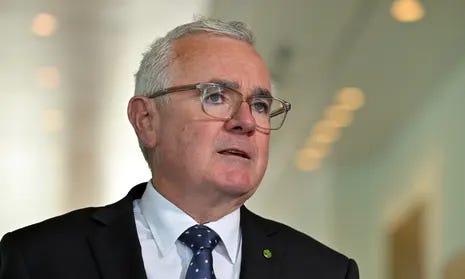
AAP: Independent MP Andrew Wilkie
Daniela Gavshon, Australian Director of Human Rights Watch, said McBride’s sentencing shows that Australia’s whistleblowing laws need exemptions in the public interest.
“It is a stain on Australia’s reputation that some of its soldiers have been accused of war crimes in Afghanistan, and yet the first person convicted in relation to these crimes is a whistleblower not the abusers,” Gavshon said in a statement.
Many regard whistleblowing as morally courageous, especially when done in the public interest, as McBride claimed he did. But whistleblowing is a dangerous endeavour in Australia because of the significant legal and personal risks.
Compared to the US, where whistleblower protections are considered more robust, McBride’s case demonstrates the protracted and costly legal battles faced by whistleblowers in Australia, when up against institutions with unlimited resources.
It’s now feared McBride’s prosecution and sentencing will deter other whistleblowers from disclosing information because Australia’s laws arguably do not protect whistleblowers like McBride, who try internal reporting channels first but then find them inadequate.
While there must be a balance between national security concerns and the public’s right to know about the actions of their government and military, McBride’s case means other Australians thinking about whistleblowing, risk imprisonment too, especially where there is low trust in internal reporting channels and no alternative external reporting channel.
Australia’s Government has already announced plans to bolster public whistleblowing protections. But that won’t help McBride whose imprisonment highlights the urgent need for clear guidance and protection when disclosing information to prevent more serious harms, and the vital need for a free press if and when internal whistleblowing channels, fail.
Prior to being imprisoned, McBride recorded the following video:
Featured Video

Why the U.S. Should Pull Back From the First Island Chain
or go to
Aletho News Archives – Video-Images
From the Archives
Only 19.7% of Americans agree with US State Dept on Israeli settlements
… Most American adults of voting age don’t appear willing to reject the applicability of international law to Israel’s ongoing colonization of occupied territories in East Jerusalem, the West Bank and Golan Heights. … Full article
Blog Roll
 Aletho News
- Albania on fire: who’s behind the riots?
- Egypt’s Civil Democratic Movement rejects involvement in regional war
- Egypt collaborates with Israel to build ‘Green Rafah’ project over erased Palestinian city
- Rising fuel prices and shortages have helped drive ongoing protests and rioting in France
- Tokyo protests demand Takaichi’s resignation over support for ‘Israel’
- Jennifer Kavanagh: Why the U.S. Should Pull Back From the First Island Chain
- Yemen denounces international community’s silence on Saudi aggression, siege
- UAE and Saudi Arabia move toward renewed coordination against Sanaa
- How Iran’s two-week retaliatory strikes exposed cracks in US military architecture in Persian Gulf
- The mother of all propaganda: Why the hype over US MOAB strike against Iran is nothing but theater
- If Americans Knew
- What the UK Is Doing to Pro-Palestine Novelist Sally Rooney Is an Act of Orwellian Villainy
- ‘We will build palaces for Jews in Gaza’: Right-wing activists establish new outpost near border
- ‘You see us burning, you stay silent’: Family’s agony over mother and sons burned to death in Gaza tent
- Israel keeps Palestinian journalist Bushra al-Tawil in isolation for 46 days
- US-Israel integration plan puts US military tech in Israel’s hands
- Israeli Strike Burns Gaza Mother Alive in Front of Toddler, ‘Without Generating Any Headlines’
- ‘The Israel Experience with Mike Huckabee’: The Ambassador’s Family Sells Trips to Israel
- As Gazans carry out mass burial, food insecurity is getting worse – Daily Update
- Israeli rabbi permits occupiers to steal Palestinian olive harvest in West Bank
- Netanyahu’s spin on latest settler attack is laughable – Daily Update
- No Tricks Zone
- Predictions Made By Renowned Climate Proifessor Over Past Decades Have Been Proven To Be Poor
- New Study Suggests Large Regions Of The Pacific Ocean Have Been Cooling For The Last 80 Years
- Germany’s Green Energy Debacle: High Energy Costs Force Kahla Porzellan to Close After 182 Years!
- New Study: 50 Years Of The Most Aggressive ‘Net Zero’ Policies Can Only Affect The Global Climate By 0.03°C
- US September “Heat” Was No Record…Many Records Set Decades Ago
- Latest European Green Energy Debacle; Portugal’s Largest Flagship Solar Park Insolvent!
- Green Energy Debacle: German Expert Professor Fritz Vahrenholt Warns Of Severe Economic And Social Consequences
- Two More Paleo Reconstructions Affirm Meters-Higher Sea Levels Across Ireland, Brazil 7000-6000 Years Ago
- New Study: Earth And Venus Surface Warmth Largely Explained By Convection And Lapse Rate, Not CO2 Or Radiation
- 2025 Nature Paper Claiming Worsening Global Drought Gets RETRACTED …Heavily Flawed

