Aletho News

ΑΛΗΘΩΣ

Transnistria Seeks Russia’s Help in Wake of Economic Blockade by Moldova

Sputnik – 28.02.2024

Predominantly Russian-speaking Transnistria, 60 percent of whose ethnic population are Russians and Ukrainians, declared its independence from Moldova during the collapse of the Soviet Union.

Transnistrian lawmakers have asked Russia for assistance over mounting economic pressure from Moldova.

The legislators put forward a request to both the Federation Council and State Duma of Russia, urging them to implement measures to safeguard Transnistria, especially in light of Moldova’s growing pressure. This request is backed up by the fact that over 220,000 Russian citizens reside in Transnistria.

The bill’s authors pointed to the unique and positive experience of Russia’s peacekeeping work in the region and highlighted that Moscow has served as a mediator in negotiations.

“The critical situation requires urgent and maximum active international intervention in order to prevent an escalation of tensions and not allow the situation to develop into a crisis,” the document says.

As of January 1, 2024, Moldova launched a compulsory customs duty on goods imported to Transnistria. In reality, this amounts to multimillion-dollar losses for export-import companies operating in Transnistria, since they are required to pay a double tax: one to Transnistria and the other to the Moldovan budget.

February 28, 2024 Posted by | Economics | , , | Leave a comment

Who’s Brain-Dead Now, Macron?

By Finian Cunningham | Strategic Culture Foundation | February 28, 2024

French President Emmanuel Macron wants to send NATO ground troops into Ukraine to defeat Russia.

Only a delusional fool could make such a crass proposal which goes to show that Macron is brain-dead. NATO troops deployed to fight Russian forces would mean an all-out war, which most likely would spiral into a nuclear conflagration.

Ironically, the French leader made headlines a while back when he labeled the US-led NATO alliance as being “brain-dead”. He’s now competing for the same epithet.

When Macron made those harsh remarks about NATO in an interview with the Economist in November 2019, some observers thought that he was being intelligently critical of the transatlantic military organization and how it was no longer fit for purpose in the modern age.

But, no, Macron wasn’t offering constructive criticism of NATO or American leadership. He was simply being a conceited charlatan, trying to promote himself as the “strong leader” of Europe and peddling his hobby horse of building up a European army by appearing to bad mouth NATO.

This week, the former Rothschild banker was at it again, indulging in his grandiose fantasies of leading the rest of Europe.

Macron hosted 25 European heads of state or government at the Conference in Support of Ukraine. In the grandeur of the Elysee Palace, he warned that Russia “must not win the war in Ukraine” otherwise, he claimed, the whole of Europe would succumb to Russian aggression.

This is reckless and dangerous fantasy by the French president indulging in the most unhinged Russophobia. Moscow has categorically stated that it has no interest in anything beyond denazifying the NATO-sponsored regime in Kiev and protecting its national security.

To offset such a purported nightmarish outcome of Russian tanks rolling over Europe, Macron told European leaders that they should not rule out deploying NATO ground troops to assist the Kiev regime.

“Nothing should be excluded. We will do whatever it takes to ensure that Russia cannot win this war,” the French president said in front of approving European leaders.

Among the conference attendees were German Chancellor Olaf Scholz and British Foreign Minister David Cameron. Germany and France earlier this month signed bilateral security pacts with Ukraine, which could be invoked for sending military forces officially to prosecute the U.S.-led proxy war against Russia.

NATO officers in the guise of private mercenaries are already heavily participating in the Ukraine conflict against Russia. Last month, more than 60 French servicemen were killed in a Russian missile strike near the Ukrainian city of Kharkov.

French media reported of the event in Paris this week: “The conference [in Paris] signaled Macron’s eagerness to present himself as a European champion of Ukraine’s cause, amid growing fears that American support could wane in the coming months.”

As well as calling for the deployment of NATO troops, Macron also pledged to send more long-range missiles to the Kiev regime for “deep strikes” in Russia.

French cruise missiles have already been used to strike the Russian territory of Crimea. Now the French leader wants a NeoNazi regime to have the capability to hit deep into Russia. How much longer can Moscow tolerate this outrageous provocation without reciprocal strikes?

No doubt the French president sees an opportunity for self-aggrandizement. Macron is obsessed with notions of his self-importance and restoring France’s international image to some imaginary glorious past.

With the Americans squabbling in Congress about whether to send Ukraine another $60 billion in military aid and with the possible election of NATO-skeptic Donald Trump to the White House later this year, Macron sees an opening to show Western leadership by stepping up Europe’s support for Ukraine.

Macron’s egotism and delusions of grandeur are liable to start World War Three.

He is doing all this by telling blatant lies about the conflict in Ukraine.

Macron is indulging the Kiev puppet president Vladimir Zelensky in pretending that Ukraine has a chance of defeating Russia. Zelensky also addressed the conference in Paris via video link and made his tiresome appeal for more weapons. He asserted with barefaced lies that Ukrainian military deaths amounted to 31,000 troops since the conflict erupted two years ago. The most realistic figure is that over 400,000 and perhaps as many as 500,000 Ukrainian military have been killed by far superior Russian forces.

That’s the implicit admission made by Macron. Why would NATO troops be required in Ukraine if it was not for replacing Ukrainian ranks that have been devastated?

Macron justifies his lies by compounding the more outrageous lie that Russia is intent on invading other European nations once it defeats the Ukrainian army.

This bogeyman version of geopolitics ignores the reality that the United States and NATO fomented a proxy war against Russia using a NeoNazi regime.

Macron wants to start World War Three based on sheer lies and vanity. He’s not only brain-dead. He’s soul-dead too.

Emma

February 28, 2024 Posted by | Militarism, Russophobia | | Leave a comment

NATO’s Debate Over Whether To Conventionally Intervene In Ukraine Shows Its Desperation

BY ANDREW KORYBKO | FEBRUARY 27, 2024

French President Macron hosted over 20 fellow European leaders in Paris on Monday to discuss their next moves in Ukraine, including the possibility of a conventional NATO intervention, which he said they hadn’t ruled out for reasons of “strategic ambiguity” despite not reaching a consensus on this. His Polish counterpart Duda also confirmed that this subject was the most heated part of their discussions. The very fact that this scenario is being officially considered shows how desperate NATO has become.

Russia’s victory in Avdeevka, which was the natural result of it winning the “race of logistics”/“war of attrition” with NATO, prompted policymakers to contemplate what they’ll do in the event that it achieves a breakthrough across the Line of Contact (LOC) and starts steamrolling through the rest of Ukraine. They hadn’t previously considered this to be a serious possibility until last summer’s failed counteroffensive exposed the weakness of their military-industrial complex and tactical-strategic planning.

It’s now a credible scenario that’s reviving speculation about a Polish-led intervention aimed at drawing a red line in the sand for halting any potential Russian breakthrough before it gets too far. This would preserve the G7’s “sphere of (economic) influence” in Ukraine while preventing that former Soviet Republic’s collapse and thus averting another Afghan-like foreign policy disaster for the West. The problem, however, is that Poland also doesn’t want to be put up to this only to be hung out to dry.

Although Poland has comprehensively subordinated itself to Germany after the return of Berlin-backed Prime Minister Tusk to power late last year and envisages carving out its own “sphere of influence” in Western Ukraine, this doesn’t mean that it wants to lead a Western intervention there. The risk of World War III breaking out with Russia by miscalculation is much too high and Poland might fear that NATO won’t activate Article 5 if it clashes with Russia inside Ukraine in order to prevent that from happening.

These concerns could explain why there wasn’t any consensus during Monday’s meeting on this issue since other members wisely won’t want to take the chance of catalyzing an apocalyptic scenario, ergo the reason why the West might be plotting a false flag in Poland to blame on Russia and Belarus. President Lukashenko warned about that in late February, and if it comes to pass, then it could serve as the trigger for pushing Poland into leading a Western intervention in Ukraine without full NATO backing.

Warsaw could be misled to believe without any written guarantees that it has the bloc’s support and Article 5 would be activated if its forces clash with Russia’s there, but only to be hung out to dry if that happens so as to stave off World War III by miscalculation for the greater good. Nevertheless, it would still serve the purpose of drawing a red line in the sand that could halt Russia’s advance since NATO might escalate via brinksmanship afterwards by promising to activate Article 5 if the clashes continue.

Poland would also be left to pick up the tab in that event by having to pay the financial and physical costs of this de facto NATO intervention, thus representing an amoral form of “burden-sharing” that would fall solely on its taxpayers instead of the rest of the bloc’s. The farmers’ protests that are rocking that country right now could lead to a full-blown rebellion if that happens since others could join in, however, which the ruling liberal-globalists would prefer not to unfold since they fear that they’d risk losing power.

That’s why they’re reluctant to lead a Western intervention in Ukraine since there’s a high chance that it’ll backfire on them in particular and Poland’s national interests in general despite being to the benefit of Western hegemony as a whole. Whatever ends up happening, the takeaway from Monday’s meeting in Paris and the details that were revealed about their discussions is that NATO is planning for a possible Russian breakthrough across the LOC later this year but isn’t yet sure how to react if that happens.

Poland could either be pushed to preempt that voluntarily or after being manipulated by the false flag that President Lukashenko warned last week is being plotted, with the second option also potentially being employed right after any breakthrough. If this occurs before NATO’s “Steadfast Defender 2024” drills wrap up in June, then those of the bloc’s forces that are presently training in Poland for its largest continental exercises since the Old Cold War could play a pivotal support role or possibly join in as well.

Should a breakthrough occur after those war games end as part of the Russian offensive that Zelensky claimed is being planned for as early as May, however, then Poland probably couldn’t count on as much NATO support and would likely be pressured to go it alone (at least at first) with only vague promises. Another possibility is that the exercises are extended, whether in whole or in part, including through the semi-permanent stationing of some other NATO forces like Germany’s there until the offensive ends.

That might give Poland enough reassurance to take a leap of faith in plunging head-first into Ukraine with the expectation that the rest of NATO will follow even if they purposely lag behind in order to avoid World War III with Russia by miscalculation as was previously explained. It remains to be seen what’ll happen, but as Macron himself said, “we will do everything needed so Russia cannot win the war” and this therefore means that NATO will certainly intervene to some extent if Russia breaks through the LOC.

The bloc can’t afford another Afghan-like disaster, let alone on European soil in the most geostrategically significant conflict since World War II, which is why it won’t sit idly on the sidelines as Ukraine collapses if there’s a credible chance of that happening and Russia steamrolling through the ruins. The only reason why they’re now planning for this is because Russia’s victory in the “race of logistics”/“war of logistics” makes it conceivable sometime later this year, though it of course can’t be taken for granted either.

February 28, 2024 Posted by | Militarism, Russophobia | , , | Leave a comment

COVID Cover-Up: Government ‘Forced’ COVID Vaccines to Protect Bioweapons Industry

By Michael Nevradakis, Ph.D. | The Defender | February 27, 2024

Government officials covered up the origins of COVID-19 and “forced” the vaccination of millions of people worldwide to “protect the integrity of the bioweapons industry,” according to a senior research scientist in epidemiology specializing in chronic diseases at the Yale University School of Public Health.

Harvey Risch, M.D., Ph.D., who also is a professor emeritus at Yale, on Monday provided compelling testimony on what he believes accounts for the “crushingly obsessive push to COVID-vaccinate every living person on the planet.”

Risch was among the medical experts, scientists, lawyers, elected officials, journalists, vaccine safety advocates and whistleblowers who participated in Monday’s Senate roundtable discussion on “Federal Health Agencies and the COVID Cartel: What Are They Hiding?”

The roundtable, hosted by Sen. Ron Johnson, focused on vaccine safety, corruption of public health agencies and world governments, and censorship by the media and Big Tech.

Evidence ‘overwhelmingly’ points to Wuhan lab as source of virus

Risch highlighted circumstantial evidence that COVID-19 “leaked from the Wuhan Institute of Virology” (WIV) in China in fall 2019.

Risch told the panel there is evidence the virus contains a unique genetic sequence “that also exists in Moderna patents from 2017,” while intelligence has “overwhelmingly” indicated the WIV as the source of the virus.

According to Risch, “This work and the WIV leak was what I consider to be the fruit of our bioweapons industry that has been performing secretive and nefarious biological weapons development for the last 70 years.”

Risch said that much of this research was banned in 1975, with the enactment of the United Nations Biological Weapons Convention, which prohibited the development of offensive bioweapons. However, a carve-out in the treaty allows “small quantities of offensive bioweapons … to be developed in order to do research on vaccine countermeasures.”

“This was the premise and motivation of the various virology grant applications like [Project] DEFUSE” that supported controversial gain-of-function research at labs such as WIV, funded by the U.S. Department of Defense, National Institutes of Health (NIH) and the U.S. Agency for International Development (USAID), Risch said.

This “loophole,” as Risch called it, created “a permitted rationale for the development of offensive bioweapons, in that it would lead to work on vaccine countermeasures.”

Risch questioned the value of such research in terms of fulfilling its stated purpose.

“Fast forward to 2019: Many billions of dollars spent on the bioweapons industry over the past decades for all of this work on offensive bioweapons. Where are the successful commercial vaccines to show for it?”

For Risch, the lack of any successful commercial vaccines to arise out of bioweapons research served as the impetus for the development of the COVID-19 vaccines, subsequent vaccine mandates and the “virus origin cover-up” that followed.

He said:

“The COVID vaccines themselves supplied the defense against the charge that the bioweapons industry was not actually dual use, but offensive only, violating the 1975 treaty. So, the vaccines had to be dramatically pushed out to be the universal solution to show that the bioweapons industry was actually working for the public good.

“Once the general public understood the reckless and cavalier behavior of this industry that had operated under a false and misrepresented pretense of vaccine development that has never been successfully commercially realized, it would then clamor to shut down the industry.”

This led to concerted efforts to suppress alternative treatments for COVID-19, such as ivermectin and hydroxychloroquine, according to Risch.

Risch said:

“During the time of the suppression of early treatment hydroxychloroquine and later ivermectin, I thought it was to protect the marketplace for the vaccines, other medications or the vaccines that would eventually come out.

“But now, given what I’ve said, I think the suppression was that if those medications solved the pandemic, then the vaccines wouldn’t have been needed and then the bioweapons treaty would come back in force and there would be no rationale that the vaccines were the end product of the offensive weapons research. So, they had to be suppressed for the same reason.”

Full article

This is the second in a series of articles covering Monday’s U.S. Senate roundtable discussion, “Federal Health Agencies and the COVID Cartel: What Are They Hiding?” hosted by Sen. Ron Johnson (R-Wis.). Read earlier coverage here.

February 28, 2024 Posted by | Deception, Militarism, Timeless or most popular, War Crimes | , , | Leave a comment

Opposition to Vaccine Mandates and Passports Driven by Perceived Lack of Vaccine Safety

Population-Based Survey Shows Hesitancy is for Good Reason

By Peter A. McCullough, MD, MPH | Courageous Discourse | February 27, 2024

The American Medical Association says this about vaccine hesitancy:

“While the AMA is a strong advocate for the effectiveness and safety of vaccines, we recognize that some members of the public may have historical, cultural or religious reasons to distrust the vaccination process.”

When it comes to the COVID-19 vaccine, new research led by Dr. Mark Skidmore at Michigan State University indicates that vaccine safety and severe side effects occurring in close contacts (friends or family members) are the main drivers for opposition to vaccine mandates and passports.
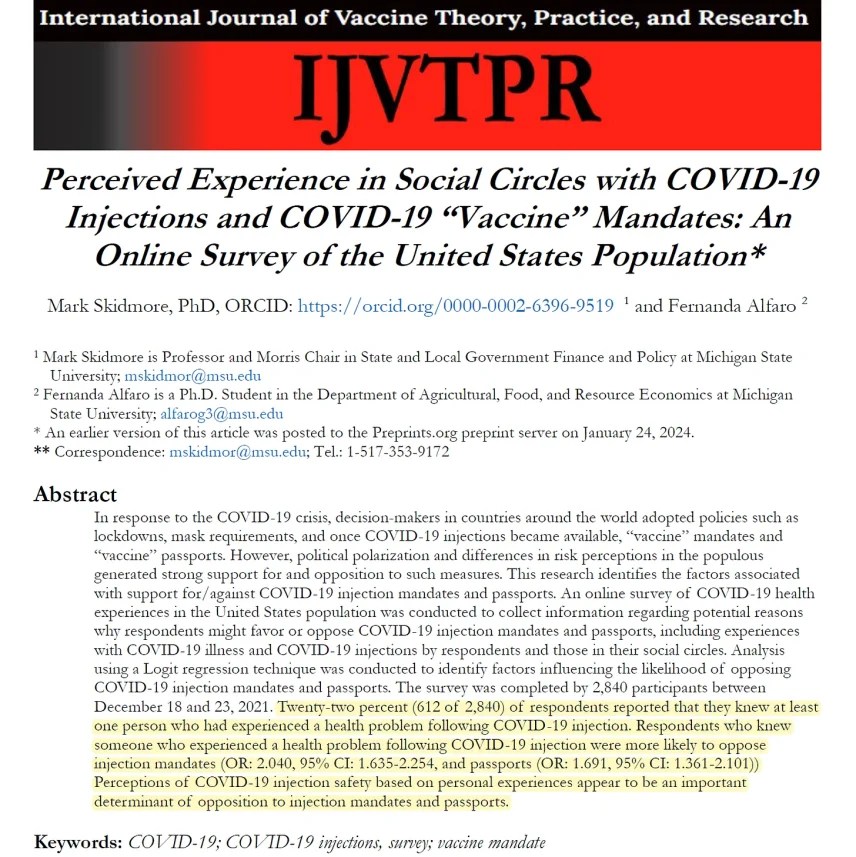
Perceived Experience in Social Circles with COVID-19 Injections and COVID-19 “Vaccine” Mandates: An Online Survey of the United States Population. (2024).

“The survey was completed by 2,840 participants between December 18 and 23, 2021. Twenty-two percent (612 of 2,840) of respondents reported that they knew at least one person who had experienced a health problem following COVID-19 injection. Respondents who knew someone who experienced a health problem following COVID-19 injection were more likely to oppose injection mandates (OR: 2.040, 95% CI: 1.635-2.254, and passports (OR: 1.691, 95% CI: 1.361-2.101)) Perceptions of COVID-19 injection safety based on personal experiences appear to be an important determinant of opposition to injection mandates and passports.”

Considering the survey was done in 2021, one would infer that resistance is even greater in 2024 as more injuries, disabilities, and deaths have been reported as a result of the novel genetic products. When it comes to COVID-19 vaccination, hesitancy is a good thing demonstrating the population is concerned about consumer product safety of the mRNA and adenoviral DNA technology. The AMA’s views on the determinants of vaccine hesitancy do not apply and attempts to overcome vaccine hesitancy are likely to be harmful.

Perceived Experience in Social Circles with COVID-19 Injections and COVID-19 “Vaccine” Mandates: An Online Survey of the United States Population. (2024). International Journal of Vaccine Theory, Practice, and Research , 3(1), 1055-1084. https://doi.org/10.56098/h1mv5a64

February 28, 2024 Posted by | Aletho News | , | Leave a comment

Osteoporosis

Lies are Unbekoming | February 24, 2024

This is so critically valuable… I am a nursing professor, and a very petite woman. My GYN had me get a DEXA scan when I was in my 50s and it showed osteoporosis and osteopenia. I have a very active lifestyle and exercise as a part of my daily routine. I went to see an endocrinologist, hoping to find out preventative techniques, and he wanted to put me on meds right away… I fired him and amped up my exercise. Something in the depths of my soul said that was not the right thing to do. I am certain that for petite woman. I have very strong bones. I have even taken falls doing very athletic things, and I have not fractured any bones… Thank God. – @littlebitmckee8234

Another chamber of Big Medicine. Another Industrial “Matrix” of untruths woven together to create another mega class of medical “solutions”.

This no longer comes as a surprise.

This one is a beauty.

My wife sent me this article and video, and they are the primary sources of information for this article, plus a Mercola article that you will find within the Q&A.

The Manufacturing of Bone Diseases: The Story of Osteoporosis and Osteopenia

I haven’t come across Dr Peter Osborne before. This short video is great!

Finally!! My PhD is in bone biology. Way back in 1999, I was at a huge medical conference. Abbott was pushing their first generation osteoporosis drug (BiP). I told the rep that they’ll start to see very specific hip fractures. He laughed at me. But these drugs basically kill osteoclasts. Well, that gives you a disease called osteopetrosis (you’re not rebuilding bone because you’re no longer resorbing it to create new bone). You’re literally exchanging a natural phenomenon with a disease by taking BiP’s. – @user-qd7rq2yj9c

This story has all the usual tactics, strategies and suspects that we have come to expect.

We have the WHO and Industry engaged in Disease Branding and Creating Markets.

We have False Baselines against which any variance from natural aging is labelled a Disease.

We have the changing of definitions that expand the “size of the market”.

We have the Test, that diagnoses the “disease”.

And then we have the Solution, and as almost always, it’s a “lifetime solution”.

I know that you know that these people are evil, but you have to give it to them, they are also very good at what they do.

The “diagnosis” happens in an asymptomatic person.

What did we learn from the Covid story? Asymptomatic is just a euphemism for Healthy.

That’s what they are doing here, not only have they medicalized aging, but they have “diseased” a healthy person.

Once the diagnosis is given, that generates the fear, which is the objective.

Fear of what? Well, it’s the fear of “fracture”.

That fear is now ready for the Solution.

But it turns out that the solution makes the bones more brittle and more likely to fracture.

But again, as we learned from Covid, if you end up with a fracture after using their solution, that simply confirms that the original diagnosis was correct!

And you can then find comfort in the knowledge that your doctor was right all along and it “could have been so much worse”.

It is a magnificent formula and completely effective.

Now let’s get look at the details by first looking at the large Untruths in this space and from there we will look at 30 Q&As that gradually educate us on the subject with a range of other material sprinkled in.

Untruths

Here are the main misconceptions or “untruths” related to the subject of bone health, osteoporosis, and the medicalization of aging:

  1. Osteoporosis and Osteopenia Are Primarily Age-related Diseases: The redefinition of osteoporosis and osteopenia by the WHO based on bone mineral density (BMD) scans led to the perception that these conditions are abnormal and primarily diseases of aging. This overlooks the fact that a decrease in bone density is a natural part of the aging process and doesn’t always indicate disease or a significant risk of fracture.
  2. High Bone Density Equates to Healthy Bones: There’s a common misconception that higher bone density is always indicative of healthier, stronger bones. However, bone health is determined by both density and quality, including the microarchitecture of bone and its turnover rate. High bone density might not reflect the actual strength or health of the bone and, in some cases, could be associated with an increased risk of conditions like breast cancer.
  3. Bone Mineral Density Scans Are the Sole Indicator of Bone Health: BMD scans, particularly through technologies like DEXA, are often seen as the definitive test for diagnosing osteoporosis and assessing fracture risk. These scans primarily measure bone quantity and do not provide direct insights into bone quality or the structural integrity of bone, which are also critical to bone health and resilience.
  4. Bisphosphonates Are a One-size-fits-all Solution: Bisphosphonates, a common class of medications prescribed for osteoporosis, are sometimes perceived as a suitable treatment for anyone with low bone density. However, their long-term use is associated with significant side effects, including atypical femur fractures and osteonecrosis of the jaw.
  5. Physical Activity Is Only Beneficial for Bone Health in Youth: There’s a misconception that only the physical activity undertaken in youth contributes significantly to peak bone mass and that exercise in later life has minimal impact on bone health. In reality, engaging in regular weight-bearing and resistance exercises at any age can help maintain or even improve bone density and strength, supporting bone health and reducing the risk of fractures.
  1. A Diagnosis of Osteopenia or Osteoporosis Guarantees Fractures: There’s a misconception that being diagnosed with osteopenia or osteoporosis means an individual will definitely suffer from bone fractures. The diagnosis does not guarantee that fractures will occur. Many factors, including bone quality, overall health, and preventive measures taken, influence the actual risk of fractures.
  2. Calcium Intake Alone Can Prevent Osteoporosis: A common belief is that consuming high amounts of calcium, either through diet or supplements, is enough to prevent osteoporosis. While calcium is essential for bone health, other factors such as vitamin D levels, physical activity, and overall diet also play crucial roles. Moreover, excessive calcium intake, especially from supplements, can have health risks, including the potential for heart disease.

30 Questions and Answers (going from Beginner to Expert)

1. What is osteoporosis, and how does it affect the body?

Osteoporosis is a condition characterized by weakened bones that are more susceptible to fractures and breaks. This weakening occurs over time as the density and quality of the bone decrease. Bone is a living tissue that constantly remodels itself, but in osteoporosis, the creation of new bone doesn’t keep up with the removal of old bone. This imbalance leads to bones becoming fragile and more likely to fracture, even from minor falls or, in severe cases, from simple actions like bending over or coughing.

2. What led to the change in the definition of osteoporosis in 1994?

In 1994, the definition of osteoporosis underwent a significant change due to the introduction of bone mineral density (BMD) scanning technology, notably the dual-energy X-ray absorptiometry (DEXA) scan. This technological advancement allowed for the precise measurement of bone density, leading to a reclassification of what constituted normal and abnormal bone density levels. Prior to this, osteoporosis was considered a condition affecting primarily the elderly, with diagnosis often made after the occurrence of a fracture. The new definition allowed for earlier identification of at-risk individuals based on their BMD compared to a standardized reference.

3. What is a bone mineral density (BMD) scan, and how does it work?

A bone mineral density (BMD) scan, particularly through dual-energy X-ray absorptiometry (DEXA), measures the amount of calcium and other minerals present in a segment of bone, most commonly the hip, spine, and forearm. The technology works by emitting two X-ray beams at different energy levels towards the bone. The amount of X-rays that pass through the bone is measured for each beam, allowing the machine to calculate the density of the bone. The results help in assessing an individual’s risk of fractures and diagnosing conditions like osteopenia and osteoporosis.

4. Why is the data from BMD scans primarily compared to the bone density of younger individuals?

The data from BMD scans are compared to the bone density of younger individuals because peak bone mass (the maximum bone density and strength) is typically reached in the early 30s. By comparing an individual’s bone density to that of a healthy, young adult baseline, healthcare providers can determine how much bone mass has been lost. However, this comparison is misleading as it does not account for the natural decrease in bone density that occurs with aging.


35 Year Old Female

In Peter Osborne’s video, he addresses the significant shift in how osteoporosis is diagnosed, particularly highlighting the change that occurred in 1994 with the introduction of bone mineral density (BMD) scanning technology, such as the DEXA (Dual-Energy X-ray Absorptiometry) machine. This technology became a cornerstone for diagnosing osteoporosis and assessing fracture risk, fundamentally altering the perception and management of bone health.

Osborne points out that the baseline for assessing bone health through BMD scans is set against the bone density of a healthy 35-year-old woman. This comparison is critical because it essentially redefines the understanding of bone health across all ages, particularly for those who are significantly older than 35. By comparing the bone density of individuals, often those in their 50s, 60s, and beyond, to the peak bone density of a much younger person, many are categorized as having osteopenia or osteoporosis based solely on this discrepancy in bone density levels.

He critiques this approach by emphasizing that bone growth and density naturally peak around the age of 35, after which a gradual decline is a normal part of the aging process. Thus, using the peak bone density of a 35-year-old as a universal standard does not account for the natural, physiological changes that occur in bone density with age. This method can lead to a misleading diagnosis, where the natural decrease in bone density associated with aging is pathologized.

Moreover, Osborne argues that this reliance on BMD scans and the comparison to a 35-year-old woman’s peak bone density creates a misleading narrative around bone health. It fails to consider the quality of the bone, which is an essential factor in overall bone health and resilience against fractures. He stresses that bone health is not solely about density but also involves the bone’s ability to regenerate and maintain a balance between breakdown and renewal, aspects that BMD scans do not measure.

In summary, Osborne’s critique revolves around the idea that the baseline set by comparing individuals’ bone density to that of a healthy 35-year-old woman contributes to an overdiagnosis of osteopenia and osteoporosis. This approach overlooks the natural aging process of bones, potentially leading to unnecessary concern and treatment, including the use of medications like bisphosphonates, which come with their own set of risks and side effects.


5. How does age affect bone density, and what is the normal process of bone aging?

As individuals age, their bone density naturally decreases. This process begins after peak bone mass is achieved in the early 30s. The rate of bone remodeling changes, with bone resorption (the process of breaking down bone) gradually outpacing bone formation. This leads to a slow, steady decline in bone density and mass. Factors such as hormonal changes, particularly in women post-menopause, nutritional intake, and levels of physical activity can influence the rate of bone density loss with age.

6. Can you explain the significance of the term “peak bone mass”?

Peak bone mass refers to the maximum strength and density that bones achieve, which usually occurs in the late 20s to early 30s. This level of bone density is considered a crucial determinant of bone health and osteoporosis risk in later life. The higher the peak bone mass, the more bone an individual has “in the bank” and the less likely they are to develop osteoporosis as they age. Factors influencing peak bone mass include genetics, diet, physical activity, and lifestyle choices.

7. What are the implications of comparing older adults’ bone density to that of a 35-year-old?

Comparing the bone density of older adults to that of a 35-year-old can lead to a high number of individuals being diagnosed with osteopenia or osteoporosis, potentially medicalizing the natural aging process. This comparison does not account for the expected, natural decrease in bone density that occurs with age. Consequently, it may result in unnecessary worry for individuals and potentially lead to the over-prescription of medications for those whose bone density is naturally lower due to aging rather than disease.

8. What does a diagnosis of osteopenia or osteoporosis based on a BMD scan indicate about bone health?

A diagnosis of osteopenia or osteoporosis based on a BMD scan indicates that an individual’s bone density is lower than the normal reference range for a healthy, young adult. Osteopenia is considered a midpoint between healthy bone density and osteoporosis, signaling a higher risk of bone fractures but not as severe as osteoporosis.

9. How is bone health defined beyond bone density?

Bone health encompasses more than just bone density; it also includes bone quality, which refers to the architecture, turnover, damage accumulation (such as micro-fractures), and mineralization of bone tissue. Healthy bones are strong and flexible, able to withstand normal impacts without fracturing, due to a balanced process of bone resorption and formation. Factors contributing to bone health include adequate calcium and vitamin D, physical activity, especially weight-bearing exercises, and avoiding lifestyle habits that can harm bone health, such as smoking and excessive alcohol consumption.

10. What role does collagen play in bone health and strength?

Collagen is a protein that provides a soft framework for bone tissue, while calcium adds strength and hardens the framework. This combination of collagen (which provides flexibility) and calcium (which provides rigidity) makes bones strong yet flexible enough to absorb impacts. Collagen’s role in bone health is pivotal; without sufficient collagen, bones can become brittle and more susceptible to fractures. The quality of bone collagen and its interaction with mineral components are crucial aspects of bone strength and overall bone health.

11. What are bisphosphonates, and how do they work?

Bisphosphonates are a class of drugs commonly prescribed to prevent the loss of bone density in conditions such as osteoporosis. They work by inhibiting osteoclasts, the cells responsible for bone resorption, thereby slowing down the process of bone loss. While bisphosphonates can effectively increase bone density and reduce the risk of fractures, they do not directly improve the quality of the bone. Their mechanism aims to alter the natural bone remodeling process, potentially leading to an accumulation of older bone and affecting bone quality over long-term use.


Bisphosphonate Consequences

In the context of bisphosphonate treatment, several key effects on bone physiology were discussed in the video above, which include:

  1. Stopping the Breakdown of Old Bone: Bisphosphonates work by inhibiting the activity of osteoclasts, the cells responsible for bone resorption (the process of breaking down bone tissue). While this helps to prevent bone loss and increases bone density, it also means that old, potentially damaged bone is not removed as efficiently. Over time, this can lead to the accumulation of older bone, which may not be as structurally sound or resilient as newer bone.
  2. Increase Mineralization: By slowing the rate of bone resorption, bisphosphonates allow for an increase in bone mineralization. This process leads to a higher concentration of calcium and other minerals in the bone matrix, making the bones denser. While increased mineralization can contribute to an increase in bone density as measured by bone mineral density (BMD) scans, it’s a factor that influences the overall rigidity of the bone.
  3. Makes Bones Harder but More Brittle: The increased mineralization resulting from bisphosphonate treatment makes bones harder. However, there’s a trade-off. While bones may become harder and denser, they can also become more brittle. Brittle bones are less able to absorb the energy from impacts, such as falls, without breaking. This brittleness can increase the risk of atypical fractures, particularly in the femur (thigh bone), which have been observed in long-term users of bisphosphonates. Atypical fractures can occur with minimal or no trauma, often in the shaft of the thigh bone, an unusual site for osteoporotic fractures.

12. What are the potential side effects of bisphosphonates on bone health?

The long-term use of bisphosphonates has been associated with several potential side effects related to bone health, including the risk of atypical femur fractures and osteonecrosis of the jaw (ONJ). These side effects are thought to result from the suppression of natural bone remodeling, leading to the accumulation of micro-damages and decreased bone toughness. Additionally, bisphosphonates can cause gastrointestinal issues and are not suitable for everyone, highlighting the importance of a careful assessment by healthcare providers before starting treatment.


Bisphosphonate Side Effects

Bisphosphonates, a class of medications commonly prescribed for osteoporosis, aim to prevent bone loss and increase bone density by inhibiting osteoclasts, the cells that break down bone tissue. They can have several side effects, as discussed here:

  1. Gastrointestinal Issues: Bisphosphonates can cause gastrointestinal side effects such as nausea, abdominal pain, esophageal irritation, and even ulcers. These effects are more common with oral bisphosphonates and can be mitigated by taking the medication with plenty of water and remaining upright for at least 30 minutes afterward.
  2. Osteonecrosis of the Jaw (ONJ): A rare but serious condition where the jaw bone starts to die, leading to pain, loose teeth, and exposed bone. ONJ has been associated with the use of bisphosphonates, particularly among cancer patients receiving high doses through intravenous administration.
  3. Atypical Femur Fractures: Long-term use of bisphosphonates has been linked to an increased risk of atypical fractures of the femur. These fractures can occur with minimal or no trauma, often in the shaft of the thigh bone, which is an unusual site for osteoporotic fractures.
  4. Musculoskeletal Pain: Some patients may experience severe and sometimes incapacitating bone, joint, and/or muscle pain. This side effect can occur days, months, or years after starting bisphosphonates.
  5. Hypocalcemia (Low Blood Calcium Levels): Bisphosphonates can lead to a drop in blood calcium levels, especially if vitamin D levels are low or if the patient has kidney function impairment. Symptoms of hypocalcemia include muscle spasms, tingling in the lips or fingers, and seizures.
  6. Renal Impairment: Intravenous bisphosphonates, in particular, can cause deterioration in kidney function, which is why kidney function must be monitored during treatment. This side effect is more relevant in patients with pre-existing kidney disease or those receiving other nephrotoxic drugs.
  7. Eye Problems: Some individuals may experience eye-related side effects, including inflammation and pain, typically presenting as conjunctivitis or uveitis.

13. Can you discuss the impact of bisphosphonates on bone density versus bone quality?

While bisphosphonates effectively increase bone density by slowing bone resorption, their impact on bone quality is more complex. By inhibiting the natural bone remodeling process, these medications can lead to the accumulation of older bone, which may not be as structurally sound or resilient as newer bone. Consequently, even though bone density might increase, the bone’s ability to resist fractures in certain situations might not improve proportionally. This underscores the importance of considering both bone density and quality when assessing bone health and treatment efficacy.

14. How do lifestyle and dietary choices affect bone health?

Lifestyle and dietary choices play critical roles in maintaining bone health. Calcium and vitamin D are crucial for bone formation and maintenance. Physical activity, especially weight-bearing exercises like walking, running, and resistance training, stimulates bone formation and increases bone density. Conversely, smoking and excessive alcohol consumption can negatively affect bone health, reducing bone density and increasing fracture risk. A balanced diet rich in fruits, vegetables, and lean proteins can provide essential nutrients for bone health, while maintaining a healthy weight can reduce the strain on bones and joints.

15. What is the significance of the WHO’s redefinition of osteoporosis and osteopenia in the 1990s?

The WHO’s redefinition of osteoporosis and osteopenia in the 1990s marked a significant shift in how bone health is assessed, introducing bone mineral density as a key diagnostic criterion. This redefinition expanded the population considered at risk for bone-related health issues, significantly impacting public health policies, clinical practices, and the pharmaceutical industry. This led to the medicalization of aging and the overdiagnosis and overtreatment of individuals with “lower bone density”.


Let’s take a short detour and look at a Mercola article on the subject from 2022.

Why You Should Avoid Osteoporosis Medications

  1. Global Prevalence and Impact of Osteoporosis: Osteoporosis affects approximately 200 million women worldwide, with the prevalence increasing significantly with age. In the United States, 34 million people have low bone density, known as osteopenia, which can progress into osteoporosis and significantly raises the risk of fractures.
  2. Bisphosphonates Weaken Bones: While prescribed to strengthen bones, bisphosphonate drugs have been shown to cause microcracks and weaken bone structure, thereby increasing the risk for atypical bone fractures.
  3. Important Nutrients for Bone Health: Key nutrients vital for healthy bone growth and strength include vitamin D, vitamins K1 and K2, calcium, magnesium, collagen, boron, and strontium. These nutrients support the bone matrix and contribute to bone density and flexibility.
  4. Inadequacy of Load-Bearing Exercises: Most load-bearing exercises do not produce a sufficient osteogenic load to trigger bone growth. The load needed for bone growth in the hip is identified as 4.2 times one’s body weight, which is typically beyond the capability of conventional strength training.
  5. Bisphosphonate Drugs’ Side Effects: Bisphosphonates, the primary conventional treatment for osteoporosis, are associated with numerous side effects, including a higher risk for thigh bone fractures, osteonecrosis of the jaw, liver damage, kidney toxicity, and low blood calcium levels.
  6. Mechanical Weakness from Bisphosphonates: Studies have demonstrated that bisphosphonate-treated bone is mechanically weaker, with increased microcrack accumulation and no improvement in bone volume or microarchitecture, making bones more prone to fractures.
  7. Osteogenic Loading as an Alternative: Osteogenic loading, a type of resistance training that applies sufficient force to stimulate bone growth, is highlighted as an effective alternative to conventional strength training for improving bone density.
  8. Blood Flow Restriction (BFR) Training for Bone Health: BFR training, which involves performing strength exercises with restricted venous blood flow, is presented as a viable and beneficial method for improving bone health, especially for individuals who cannot lift heavy weights, including the elderly.

16. How does the WHO’s definition of osteopenia and osteoporosis transform aging into a disease?

By setting the standard for normal bone density based on the peak bone mass of a young adult, the WHO’s definition implicitly suggests that any decrease from this peak is pathological. This approach can transform the natural aging process, during which some bone loss is expected, into a condition requiring medical intervention. This perspective contributes to the unnecessary medicalization of older adults, leading to overtreatment and an undue focus on bone density at the expense of other factors contributing to overall health and well-being.

17. Why is bone quality important, and how can it differ from bone density?

Bone quality refers to aspects of bone structure and composition that contribute to its strength and resilience, including microarchitecture, turnover rates, mineralization patterns, and the presence of micro-damages. While bone density measures the quantity of bone mineral content, bone quality encompasses the material and structural properties that determine how bones respond to stress and resist fractures. High bone density does not always equate to high bone quality; bones can be dense but brittle if the quality is poor. Thus, assessing bone health requires considering both density and quality to accurately evaluate fracture risk.

18. How does the T-score differ from the Z-score in interpreting BMD results?

The T-score and Z-score are both derived from BMD tests but serve different purposes in interpreting results. The T-score compares an individual’s bone density to the average peak bone density of a healthy young adult of the same sex, providing a measure of how much the individual’s bone density deviates from this reference point. It is primarily used to diagnose osteoporosis. In contrast, the Z-score compares an individual’s bone density to the average bone density of people their own age, sex, and size, indicating how their bone density compares to expected levels. The Z-score is more informative for assessing bone density in children, young adults, and older adults where age-related bone loss is a consideration.

19. What is the controversy surrounding the use of BMD to diagnose osteopenia and osteoporosis?

The controversy stems from concerns that relying solely on BMD to diagnose osteopenia and osteoporosis leads to overdiagnosis and overtreatment. BMD measurements do not fully capture bone strength or fracture risk, as they do not account for bone quality. Additionally, the use of a young adult reference standard for all ages can pathologize the natural aging process of bone density decline. This has led to debates about the appropriateness of medical interventions for individuals diagnosed based on BMD criteria alone, without considering other factors such as age, sex, history of fractures, and lifestyle.

20. How does the natural decrease in bone density with age compare across different populations?

The rate and magnitude of bone density decrease with age can vary significantly across different populations, influenced by factors such as genetics, diet, lifestyle, and environmental factors. For example, certain ethnic groups may have higher or lower peak bone mass and experience different rates of bone loss. Women generally experience a more rapid decline in bone density after menopause due to hormonal changes. Understanding these variations is important for developing appropriate strategies for bone health maintenance and fracture prevention tailored to the needs of diverse populations.

21. Why might higher bone density not always indicate healthier or stronger bones?

Higher bone density, while generally considered a sign of strong bones, does not always correlate with healthier or more resilient bones. This paradox arises because bone strength and health are determined not just by density but also by quality, including factors like bone architecture, turnover rates, and the presence of micro-damages. Bones that are denser but have poor quality may be more brittle and prone to fractures than bones with lower density but higher quality. For instance, excessive mineralization can make bones denser but also more rigid and susceptible to cracking, similar to how a dried twig snaps more easily than a green one.

22. How do bisphosphonates affect the natural process of bone turnover?

Bisphosphonates affect the natural bone turnover process by inhibiting osteoclasts, the cells responsible for bone resorption. While this reduction in bone resorption can lead to an increase in bone density, it also disrupts the natural balance between bone resorption and bone formation. Over time, this disruption can lead to the accumulation of older bone, which are not as strong or flexible as newer bone. This altered bone remodeling process can affect the long-term quality and health of the bone, potentially making it more susceptible to atypical fractures and other issues.

23. What is osteonecrosis, and how can it be related to bisphosphonate use?

Osteonecrosis, specifically osteonecrosis of the jaw (ONJ), is a condition characterized by the death of bone tissue due to a lack of blood supply. It has been associated with the use of bisphosphonates, particularly among individuals undergoing dental procedures or those with poor oral health. The exact mechanism by which bisphosphonates contribute to ONJ is not fully understood but is thought to involve the drugs’ effects on bone turnover, leading to impaired healing and regeneration of bone tissue. While the risk of ONJ is relatively low, it is a serious condition that necessitates careful monitoring and preventive measures, especially in patients on long-term bisphosphonate therapy.

24. How does physical activity influence bone health according to Wolff’s law?

Wolff’s Law states that bones adapt to the loads under which they are placed; essentially, bone density increases in response to increased stress or load. Physical activity, especially weight-bearing exercises and resistance training, applies stress to bones in a beneficial way, stimulating the process of bone remodeling and leading to stronger, denser bones. This adaptive response helps improve bone strength and reduce the risk of fractures. Consequently, a sedentary lifestyle can lead to weaker bones, as the lack of physical stress leads to decreased bone formation and increased bone loss.

25. Can you explain the paradox of high bone density and increased risk of certain health issues, such as breast cancer?

Research has shown that women with higher bone density may have an increased risk of breast cancer. This paradoxical relationship might be due to higher levels of estrogen, which can both increase bone density and stimulate the growth of certain types of breast cancer cells. High bone density, in this context, could be an indicator of higher cumulative exposure to estrogen, which is a known risk factor for breast cancer. Thus, while high bone density is often seen as a positive indicator of bone health, it may also signal an increased risk for breast cancer, underscoring the complex interplay between different aspects of health.


Analogy

Let’s pause and consider an analogy to bring this all together before we look at the last few questions.

This analogy captures the medicalization of aging in bone health: a natural process redefined as a disease, based on unrealistic standards, leading to interventions that may not only be unnecessary but harmful, all serving the interests of those who stand to profit from the widespread adoption of these standards and solutions.

Forest Management Corporation (FMC)

Imagine you’re part of a community living in a vast, beautiful forest, where each person is tasked with nurturing a unique tree—your tree represents your bone health. This forest thrives on diversity, with trees at various stages of growth, each contributing to the ecosystem’s balance. However, a powerful group, the Forest Management Corporation (FMC), steps in with a new vision for “optimal forest health.”

1. The False Baseline – The Ideal Tree Myth: FMC declares that the most robust and youthful trees—those at their peak summer vitality—are the standard. Every tree not matching this ideal is labeled as “underperforming” or “diseased.” This false baseline disregards the natural growth cycles and maturity of trees, painting a picture that aging trees are failing, despite their natural progression and contribution to the forest’s ecology.

2. The Control and Changing Definition of Disease: FMC then redefines forest health based on this youthful peak. Trees that once flourished under the wisdom of natural cycles are now seen as problematic. The corporation’s narrow criteria turn the natural aging process into a widespread “disease,” ignoring the intrinsic value of each tree’s unique life stage.

3. The False Test – The Health Indicator Tool (HIT): FMC introduces HIT, a tool designed to measure a tree’s shadow against the midday summer sun—the longest shadow of the year. Trees casting shorter shadows (those not in their summer peak) are marked for intervention. This test, however, fails to consider the full spectrum of light and seasons, misleadingly signaling a “false disease” in otherwise naturally aging trees.

4. Creation of a Disease for Natural Aging: The community, now anxious about their “failing” trees, turns to FMC for solutions. The natural aging process, a once-celebrated cycle of life and renewal, becomes a source of fear. Aging trees, regardless of their health and beauty, are labeled as diseased, leading to unnecessary interventions.

5. The Solution That Makes Things Worse – The Growth Enhancer (GE): FMC offers GE, a treatment promising to restore trees to their peak shadows. While GE initially seems to thicken and darken the canopy, it rigidifies the branches, making them brittle and prone to snapping even under gentle breezes. The natural flexibility and resilience of the trees to weather storms are compromised, ironically increasing the risk of damage—the very issue GE claimed to prevent.

6. Benefiting Industrial Corporate Interests: As the community becomes dependent on GE to maintain their trees at this unnatural standard, FMC profits immensely. The true cost, however, is the loss of the forest’s natural diversity and resilience. Trees that would have naturally aged into sturdy, majestic beings are now at risk, and the forest as a whole suffers from a misguided attempt to halt the natural cycle of growth and renewal.


26. What are the limitations of DXA scans in assessing overall bone health?

DXA scans, while useful for measuring bone mineral density, have limitations in assessing overall bone health. They provide a two-dimensional measure of bone density but do not capture bone quality factors such as bone structure, microarchitecture, or the quality of bone collagen. DXA scans also do not account for the distribution of bone mass or the differences in bone size among individuals. Therefore, DXA scans do not provide a complete picture of bone health and strength.

27. How have definitions and treatments for osteoporosis impacted women’s health care?

The definitions and treatments for osteoporosis have significantly impacted women’s health care by shifting the focus toward early detection and intervention for bone health issues. This shift has led to increased screening, the widespread use of BMD testing, and the development of medications like bisphosphonates aimed at preventing bone loss. However, it has also raised concerns about the overmedicalization of natural aging processes and the potential for overtreatment with medications that have significant side effects. The emphasis on bone density over other aspects of health has sparked a debate about the best approaches to maintaining bone health and preventing fractures in women as they age.

28. What role do vitamins and minerals play in maintaining bone health?

Vitamins and minerals play crucial roles in maintaining bone health. Calcium and vitamin D are particularly important; calcium is a primary component of bone, providing structure and strength, while vitamin D enhances calcium absorption from the diet and is necessary for proper bone formation. Other nutrients like magnesium, vitamin K, and phosphorus also contribute to bone health by supporting bone density and quality.

29. How does the concept of “use it or lose it” apply to maintaining bone density and strength?

The “use it or lose it” concept underscores the importance of physical activity for bone health. Just as muscles grow stronger with use, bones also become denser and stronger in response to the stresses placed on them through weight-bearing and resistance exercises. When bones are not subjected to sufficient physical stress, such as in a sedentary lifestyle, they can lose density and strength, increasing the risk of osteoporosis and fractures. Regular physical activity stimulates bone remodeling, helping to maintain or even increase bone density and strength throughout life.

30. What are the implications of medicalizing the natural aging process of bone loss?

Medicalizing the natural aging process of bone loss has significant implications for public health and individual patients. It can lead to an increased focus on bone density as a primary indicator of health, potentially overshadowing other important factors such as bone quality, overall physical fitness, and lifestyle choices that contribute to healthy aging. This perspective results in the overdiagnosis of osteopenia and osteoporosis, leading to anxiety and unnecessary treatment with medications that have potential side effects. Recognizing bone density changes as a part of the natural aging process while focusing on comprehensive strategies to maintain bone health can help balance the benefits and risks of medical intervention.

February 28, 2024 Posted by | Deception, Science and Pseudo-Science, Timeless or most popular, Video | Leave a comment

Hunter’s Associate: Biden Scion Planned Global Hedge Fund to Benefit Poppa Joe

Ekaterina Blinova – Sputnik – 27.02.2024

As Hunter Biden braces for deposition in the US Congress on Wednesday, his former business associate has spilled the beans about the first family’s plan to build a global hedge fund.

US president Joe Biden’s son Hunter plotted to set up a shadowy fund to cash in on his influence — so says a former business partner.

Independent US media outlet Just the News has obtained a recent statement by Hunter Biden’s business associate Jason Galanis to the House impeachment inquiry.
He said Hunter and his business buddies planned to build a global hedge fund with Joe Biden as its “central asset.”

“The entire value-add of Hunter Biden to our business was his family name and his access to his father, Vice President Joe Biden,” Galanis told the House impeachment investigators. “Our objective was to build a diversified private equity platform, which would be anchored by a globally known Wall Street brand together with a globally known political name.”

Hunter Biden sought “strategic relationships to the venture” with tycoons from all over the world, including from post-Soviet space.

Just the News quoted emails from Hunter Biden’s infamous “laptop from hell” which allegedly confirm the ambitious plan.

“This is a global cooperation group that will assist each other in our respective regions in whatever manner possible,” Hunter’s other associate, Jeff Cooper, wrote in March 2014. The younger Biden proposed a list of billionaire investors for the new venture, including tycoons from China, Spain, Kazakhstan, Russia, South America, Africa and the Middle East.

One of Hunter’s partners, Chinese businessman Xuejun “Henry” Zhao, showed interest in the plan based on the prospect that Joe Biden would join the venture after his vice presidential term ended.

“Mr. Zhao was interested in this partnership because of the game-changing value add of the Biden family, including Joe Biden, who was to be a member of the Burnham-Harvest team post-vice presidency, providing political access in the United States and around the world,” Galanis said.

Galanis’s lawyer provided a draft email backing up the businessman’s testimony.

“Michael, please also remind Henry [Zhao] of our conversation about a board seat for a certain relation of mine,” Hunter reportedly wrote. “Devon [Archer] and I golfed with that relation earlier last week and we discussed this very idea again and as always he remains very very keen on the opportunity.”

According to Galanis, the “certain relation” was none other than Joe Biden. Even though the phrase was removed from the final email, it remained in Galanis’ records.

The group’s plan to assemble a “dream team” of international billionaires and create a global Biden business empire took a serious knock when Archer and Galanis were charged and convicted of a plot to steal $43 million in tribal bonds.

Hunter Biden avoided scrutiny despite “then-available documentation that we were partners, were involved in the decision making that involved illegal self-dealing, and all of us had financially benefited from these schemes,” Galanis claimed.

Galanis told House investigators that the illegal tribal bond scheme was part of a larger effort to create a financial platform for the Biden hedge fund.

“In an effort to build this financial platform, I engaged in unlawful conduct. Our companies were entrusted with $11 billion of union members’ pension fund money whose trust I betrayed,” Galanis stated. “I pleaded guilty. I have had eight years in federal custody to reflect on my actions and I am profoundly sorry for my role.”

Hunter Biden is expected to appear before the Oversight Committee on Wednesday and testify to the Republican-led impeachment hearing about his family’s business dealings and Joe Biden’s role in his son’s financial schemes.

Congressional investigators argue that Joe Biden was used by his son as a “brand” due to his vice presidential position. They say he not only knew about Hunter’s deals but participated in them, likely profiting. Biden has so far denied being aware of his son’s business operations.

House Republicans have been running their investigation into the Biden family’s apparent influence-peddling for several years.

According to US media, Hunter’s testimony will take place behind closed doors — even though he previously insisted on a public hearing — and will not be video-taped, although the transcript will be released to the public.

February 27, 2024 Posted by | Corruption, Deception | | Leave a comment

Canada’s Liberal Government Advances “Online Harms” Censorship Bill

Trudeau wants new laws to censor online speech

By Cindy Harper | Reclaim The Net | February 27, 2024

Canada’s Justice Minister Arif Virani has advanced a highly controversial bill, named Bill C-63, proposing comprehensive new legislation aimed at addressing online “hate” speech.

We obtained a copy of the bill for you here.

The bill covers seven types of harmful material, from content sexually exploiting or re-victimizing children and survivors, to content promoting violence and extremism.

But it also outlaws online “hatred,” so-called “hate speech,” and forms of deepfakes.

In an attempt to decrease the prevalence of harmful content, this legislation puts the onus on online platforms to be accountable and transparent about how they handle such content.

Platforms like social media and live-streaming services are included under the legislation’s “online services” umbrella.

The bill would also create a new “standalone hate crime offense that would apply to every offence in the Criminal Code and in any other Act of Parliament, allowing penalties up to life imprisonment to denounce and deter this hateful conduct as a crime in itself,” – the briefing explained.

The proposed law would also raise the maximum punishments for the four hate offenses from five years to life imprisonment for advocating genocide and from two years to five years for the others when persecuted by way of indictment.

The Liberal government states that the bill’s proposed regulations centre on the platforms most frequented by Canadians. However, the specifics will depend on whether these platforms meet the eventual user thresholds. Over time, the government may hold other platforms accountable, if these platforms end up posing “a significant risk of harm.”

Additionally, Bill C-63 proposes establishing a censorship organization, which will oversee digital “safety” issues. This organization is anticipated to include a five-member digital safety commission, an independent digital safety ombudsman, and a digital safety office. These will assist in addressing Canadians’ grievances about platforms’ content moderation decisions.

In a recent critique of Prime Minister Justin Trudeau’s approach to regulating online speech, Conservative leader Pierre Poilievre didn’t mince words. He accused Trudeau of labeling any speech he personally dislikes as “hate speech.” This accusation comes amidst discussions surrounding Canada’s proposed online harms bill, a legislation echoing similar efforts in other western democracies aimed at curbing hate speech, terrorist incitements, and violent content online.

Poilievre’s comments reflect a growing concern about the potential for such laws to be misused for broader censorship. This concern is not unfounded, given precedents in other countries where similar laws have veered into the realm of suppressing free speech. The Conservative leader’s stance suggests a keen awareness of these risks.

The term “woke authoritarian agenda” was used by Poilievre to describe the draft of the online harms bill, which he and his party are committed to opposing. He draws attention to the Trudeau administration’s handling of the 2022 “Freedom Convoy,” a protest against COVID-19 restrictions. Poilievre points out the government’s extreme measures, including freezing citizens’ bank accounts, as indicative of a mindset that easily conflates criticism with hate speech.

Highlighting the Trudeau government’s actions during the pandemic, Poilievre remarked, “Justin Trudeau said anyone who criticized him during the pandemic was engaging in hate speech.” This statement underscores a fear that the government might use the proposed legislation to silence dissent in various scenarios.

February 27, 2024 Posted by | Civil Liberties, Full Spectrum Dominance | , | Leave a comment

Tucker Carlson makes shocking revelation about Moscow trip

RT | February 27, 2024

Tucker Carlson said on Tuesday that US spies had monitored him while he was in Russia earlier this month, and leaked to a ‘friendly’ outlet that he had met with Edward Snowden. This is despite the American journalist’s claim that he had tried to keep his meeting with the NSA whistleblower a secret.

Carlson went to Russia to interview President Vladimir Putin. During his eight days in Moscow, he also met with Snowden – and US spies found out about it, he told podcaser Lex Fridman in the course of a three-hour conversation.

“I was being intensely surveilled by the US government,” Carlson told Fridman, noting that US spies had thwarted his plans to interview Putin in 2021 and that he received confirmation that he was being intensely monitored ahead of his Moscow trip. “Then, I’m over there, and of course I want to see Snowden, whom I admire.”

Snowden allegedly accepted Carlson’s invitation to have dinner at the Four Seasons Hotel, but declined the interview as well as a photo request, saying that it would be better to tell no one.

“I didn’t tell anybody,” Carlson told Fridman, however the meeting was leaked. “Semafor runs this piece – reporting information they got from the US intel agencies, leaking against me, using my money, in my name, in a supposedly free country – they run this piece saying I met with Snowden, like it was a crime or something.”

“If you have a media establishment that acts as employees of the national security state, you don’t have a free country. And that’s where we are,” Carlson added.

Carlson revealed that he did not fear getting arrested in Russia at any point, but was warned by his lawyers that the US might arrest him depending on the content of the Putin interview.

“I felt not one twinge of concern for the 8 days that I was there,” he told Fridman about being in Moscow.

Before he left for Russia, his team of attorneys counseled him to “not do this… A lot will depend on the questions you ask of Putin. If you’re seen as too nice to him you could be arrested when you come back,” Carlson quoted the lead lawyer as saying, to which he said he replied, “You’re describing a fascist country, OK?”

In 2013, Snowden revealed that the NSA was systematically engaged in mass illegal spying on American citizens. Fearing for his safety, he fled to Hong Kong with the intent to reach Ecuador, which did not have an extradition treaty with the US, but was stopped during a layover in Moscow after Washington canceled his passport. Russia ended up granting him asylum and reportedly, eventual citizenship.

One of the founders of Semafor, the outlet to which Carlson claims US spies leaked his dinner with Snowden, is Ben Smith, a former editor-in-chief of the now defunct BuzzFeed newsroom. In 2017, Smith notoriously published the ‘Steele Dossier,’ a sham document leaked by US spies to discredit incoming President Donald Trump.

February 27, 2024 Posted by | Civil Liberties, Full Spectrum Dominance, Russophobia | , | Leave a comment

Houthis Refute Claims They’ve Sabotaged Underwater Cables in Red Sea

By Ilya Tsukanov – Sputnik – 27.02.2024

Israeli media reported on Monday that the Yemeni militia had targeted “four submarine communication cables” in the area between Jeddah, Saudi Arabia and the Republic of Djibouti.

The Houthis’ Telecommunications Ministry has denied reports by “Zionist-linked media” claiming that they have sabotaged major underwater telecommunications cables connection, Europe, Africa and Asia.

“The Ministry of Telecoms and Information Technology denies what has been published by the Zionist-linked media outlets and also what has been published by other media outlets and the social networks, on allegations as to what [has] been caused to Red Sea submarine cables,” the militia said in an English-language statement Tuesday, a day after an Israeli Hebrew-language newspaper reported that the militia had caused “serious disruption” to internet cables between Europe and Asia.

“Yemen Telecom affirms its pivotal role to continue and build up and develop the international and regional telecom and internet networks which are provided by the submarine cables running within the Yemeni territorial waters and will keep up to facilitate the passage and implementation of the submarine cables projects through the Yemeni territorial waters, inclusive the projects into which the Yemen Republic participated, by Yemen International Telecom Co – TeleYemen,” the statement added.

The Ministry pointed to recent statements by Houthi movement leader Abdul-Malik al-Houthi committing the militia to keeping underwater cables and its relevant services “away from any possible risks,” and said the militia’s campaign “to ban the passage of Israeli ships” through Red Sea waters “does not pertain [to] the other international ships which have been licensed to execute submarine works within the Yemeni territorial waters.”

Houthi Politburo member Khuzam al-Assad told Sputnik that the militia undertook “no actions… aimed at damaging internet cables, and we have repeatedly confirmed this.”

Al-Assad said the claims of Houthi attacks on the cables were insinuations being pushed by Tel Aviv, Washington and London to try to turn global public opinion against the Houthis instead of “stopping the crimes of genocide committed by the Israeli Army with the support of the United States and the West against Gaza residents.”

The Israeli media report said four major cables, including AAE-1 (connecting East Asia to Europe via Egypt), Seacom (linking Europe, Africa and India), EIG (linking India and the Gulf to Africa and Europe) and TGN (linking France to India) had been hit, with most of the immediate damage expected to be felt by India and the Gulf States.

Western reporting on possible Houthi operations to sabotage underwater internet cables began to surface in January, with the BBC running a story in early February saying the Houthis “almost certainly would” target the cables “if they could,” while admitting that “the fiber cables, which carry 17% of the world’s internet traffic, lie on the seabed mostly hundreds of meters below the surface – well below the reach of divers.” Only a handful of countries, including the US and Russia, have the capability to sabotage this infrastructure using deep sea submersibles, the outlet said.

The Houthis began a months-long maritime campaign of ship hijackings, drone strikes and missile launches targeting Israel-affiliated commercial vessels in the Red Sea in November in solidarity with Gaza amid Israel’s ground assault into the enclave. The US announced the creation of a naval ‘coalition of the willing’ against Yemen in December, and started bombing the country in January to try to degrade the militia’s missile and drone capabilities. The Houthis responded by banning all American and British ships from passing through the strategic waterway, and launching attacks on US and British warships operating in the area.

The Yemeni militia has effectively shut the Red Sea down to up to 40 percent of its normal commercial traffic, adding tens if not hundreds of billions of dollars to global shipping costs and disrupting supply chains worldwide.

February 27, 2024 Posted by | Deception, Fake News, Mainstream Media, Warmongering, Wars for Israel | , , , , | Leave a comment

US Official Admits Only 85 Aid Trucks Entering Gaza Per Day

By Kyle Anzalone | The Libertarian Institute | February 27, 2024

The head of USAID said on Monday that only around 85 aid trucks were able to enter Gaza each day, under 10% of the prewar number. The White House has touted that it has leveraged US influence to get Israel to provide more aid to the Strip. However, Tel Aviv is deploying a myriad of tactics to strangle aid shipments in Gaza.

“More than 500 trucks should be entering Gaza daily. In the past week, only ~85/day managed to get through,” Samantha Power, the head of USAID, posted on X. Power, who considers herself an expert on genocide prevention, has not called for a ceasefire or an end to US weapons shipments to Israel even as the International Court of Justice concluded Tel Aviv was plausibly waging a genocide in Gaza.

Before October 7, about 500 trucks entered Gaza daily to sustain the people. The number of Palestinians in the Strip needing aid has skyrocketed over the past four months. Nearly all 2.3 million Palestinians are displaced and do not have access to clean water or food.

Since Israel went to war in Gaza, Tel Aviv has used a multitude of methods to stifle aid deliveries, including attacking shipments. CNN reports that the Israeli military attacked a UN aid shipment in Gaza on February 5 after approving the trucks to travel through the Strip.

Additionally, Israel is preventing a US-funded food shipment from being unloaded at the port. Tel Aviv has enacted an onerous inspection regime that slows deliveries and prevents lifesaving medication from reaching the Strip. Israeli government agencies have denied visas to international aid workers, limiting the activities of dozens of organizations.

Israeli civilian protesters are also interfering with shipments by blocking and delaying trucks carrying the aid. Once convoys enter Gaza, they are mobbed by starving Palestinians. Recently, Israeli forces began targeting the police force in the Strip, making it harder for the trucks to move through Gaza.

Jordan has airdropped aid in Gaza 16 times since October 7 to bypass the backup at the border inspection checkpoint.

The Israeli onslaught in Gaza has thrown the Palestinian people into a horrific humanitarian crisis. Most of the medical facilities have been destroyed or shut down, and tens of thousands of Palestinians have suffered serious burns, cuts, and amputations.

In the northern half of the Strip, one in six children are suffering from acute malnutrition, meaning they could soon die of starvation or other deprivation. A two-month-old child succumbed to starvation in central Gaza last week. Palestinians are eating animal feed, grass, and rotten food.

The Biden administration has faced increasing pressure over its support for Tel Aviv as Israeli forces killed tens of thousands of Palestinians in Gaza and annihilated most of the Strip. President Biden has touted that he has successfully pressed Israeli Prime Minister Netanyahu to allow more assistance into Gaza. As with aid, Tel Aviv has ignored nearly all of Washington’s requests with no impact on US weapons shipments to Tel Aviv.

February 27, 2024 Posted by | Ethnic Cleansing, Racism, Zionism, War Crimes | , , , , | Leave a comment

Leaked Gaza ceasefire proposal US ‘psychological warfare’: Hamas

The Cradle | February 27, 2024

Hamas official Ahmad Abdul Hadi stated on 27 February that a leaked proposal for a ceasefire deal in Gaza is part of a “psychological warfare” campaign being carried out by the US.

Details of the alleged proposal were leaked to Reuters on Monday, the same day US President Joe Biden said he hoped a ceasefire agreement between Israel and Hamas could be reached by 4 March.

“My national security adviser tells me that they’re close. They’re close. They’re not done yet. My hope is by next Monday we’ll have a ceasefire,” Biden claimed during an appearance on a late-night US talk show.

But Abdul Hadi, the Hamas representative in Lebanon, stated that the resistance movement is not satisfied with the proposal and will not compromise on any of its demands, particularly “on a ceasefire and reaching an honorable, serious deal.”

Hamas is seeking a permanent end to the war and the release of thousands of Palestinian prisoners in Israeli jails. Israel is seeking the release of the 136 captives held by Hamas in Gaza and a temporary ceasefire that would allow it to resume the war after a pause.

“We are open to any ideas posed by mediators but are also keen on preserving our key demands,” Abdul Hadi told Al-Mayadeen, adding that Israel is “seeking to hold Hamas accountable for any later failures in talks, planning to use this as an excuse to pave the way for the invasion of Rafah.”

He said the leaks were not part of the Paris negotiations but a US and Israeli attempt to give the public an illusion that Hamas had approved of them. He reiterated that “everything being shared is not serious, but a ploy to maneuver and press on the Resistance.”

The proposal leaked to Reuters outlined plans for a 40-day truce during which Hamas would free around 40 captives – including female soldiers, those under 19 or over 50 years old, and the sick – in return for about 400 Palestinians held captive in Israel.

Israel would withdraw its troops from populated areas of Gaza. Displaced Gaza residents, excluding men of fighting age, would be permitted to return to their homes. Israel would be required to allow additional humanitarian aid to enter Gaza, as hundreds of thousands of Palestinians in the strip are on the verge of starvation.

Palestinian Islamic Jihad (PIJ) also responded to leaked Paris proposal.

“The leaks are an attempt to pressure the Palestinians and incite them against the resistance.

They are pushing for a ceasefire before Ramadan in anticipation of what might happen in Al-Quds.

The enemy believes that it can deceive the resistance with different methods in order to achieve a victory it has failed to achieve on the ground,” PIJ Political Bureau member Ihsan Ataya told Al-Mayadeen.

In Gaza, residents speaking to Reuters expressed mixed feelings about possible outcomes.

“We don’t want a pause, we want a permanent ceasefire, we want an end to the killing,” said Mustafa Basel, a father of five from Gaza City, now displaced in Rafah.

“Unfortunately, people’s conditions are so grim that some may accept a pause, even [just] during Ramadan,” he said. “They want a permanent end to the war, but the dire conditions make them want a pause even for a month or 40 days in the hope it becomes permanent.”

February 27, 2024 Posted by | Deception, Ethnic Cleansing, Racism, Zionism | , , , , | Leave a comment
