Israeli army blows up university in Gaza after 70 days of converting it into a military barracks

Palestine Information Center – January 18, 2024
GAZA – The Israeli occupation forces (IOF) blew up the building of Al-Isra University in Gaza after 70 days of occupying it and converting it into a military barracks and a detention center.
The university administration said in a statement on Thursday, “The IOF occupied the university building for seventy days, turning it into a military base and a center for sniping isolated civilians in the areas of Rashid Street, Al-Mughraqa, and Al-Zahra, as well as a temporary detention center for interrogating Palestinians, before detonating it.”
Israeli media outlets published a video documenting the moment the occupation forces detonated the main headquarters of Al-Isra University in the city of Al-Zahra, south of Gaza City, yesterday.
Israeli reserve soldiers refuse to fight in Gaza
The Cradle | January 18, 2024
About half the soldiers of an Israeli reserve battalion refused to fight in the Gaza Strip and were released from duty by their commander, Al-Arabi Al-Jadeed reported on 17 January.
The Qatari outlet cited Israel’s Kan Reshet Bet radio as reporting that reserve soldiers were called up to form a new brigade in the Israeli army to carry out protection tasks in the areas surrounding Gaza and the occupied West Bank. However, the soldiers received permission to leave the battalion after the army tried to send them to fight and carry out combat missions within Gaza for which they were not qualified or adequately equipped.
The soldiers were called up in late December, but the new brigade was poorly organized, did not have a deputy brigade commander, and was short on weapons and officers.
During the training period, soldiers complained of serious gaps in equipment, professionalism, and a lack of human resources.
The soldiers were then further angered to learn their mission had changed, and they would be sent to Gaza for combat missions.
The radio quoted one soldier as saying: “We received the conscription order, and we responded to that. They told us that our specialty would be to protect the towns, and after about a week of training that took place in a horrific manner, without ammunition, and without officers, we were suddenly told that there was an order that the Israeli army needed us to enter the Gaza Strip to clear homes.”
The soldier added, “We were shocked. We are all combat soldiers. I personally was in the Nahal Brigade, and the rest of the soldiers are from former infantry brigades, but we had not carried out reserve missions for years. We were given an M16 weapon, which fell apart in our hands, and there was no ammunition for training. We collected bullets off the ground so that we have something we can fire.”
The radio station quoted another soldier as saying, “There are people who trained without military uniforms. There are soldiers who were not given shirts or slippers at first. The means that were available were not suitable for training. The brigade, which was supposed to include four battalions, barely reached one and a half battalions. It is not understandable how they wanted to introduce such a completely unqualified force into the Gaza Strip.”
The report comes amid the announcement that the 36th division, which comprises armored, engineering, and infantry companies, withdrew from the Gaza Strip after 80 days of fighting.
The Israeli government says this is part of a planned transition away from the “intensive manoeuvring stage” of its Gaza military campaign to a more targeted phase to last until the end of this year.
At the same time, some speculate that Israel has been forced to withdraw some of its forces due to heavy losses inflicted by fighters from Hamas’ military wing, the Ezzedine al-Qassam Brigades.
Israel is also facing economic difficulties, with the government having to pay salaries for hundreds of thousands of reserve soldiers called away from their civilian jobs.
Israel also has large numbers of soldiers on the northern border to support operations against Hezbollah in Lebanon.
Israel’s army chief said Wednesday the likelihood of a full-scale war with the Lebanese resistance group has become “much higher.”
“I don’t know when the war in the north is, I can tell you that the likelihood of it happening in the coming months is much higher than it was in the past,” Israeli army chief Herzi Halevi said in a statement during a visit to northern Israel.
Biden Warns Congress Lack of Ukraine Aid Could Lead to US Troops on Ground
Sputnik – 18.01.2024
WASHINGTON – President Joe Biden met with congressional leaders and warned them that not approving additional funding for Ukraine could possibly result in the deployment of US troops to that country, White House spokesperson Karine Jean-Pierre said on Thursday.
“The president conveyed a sense of urgency about the stakes for our NATO partners in the region, what it would mean for our NATO partners in the region, and certainly we don’t want to see our own troops put in a position where we might need to put boots on the ground,” Jean-Pierre said.
On Wednesday, US House Speaker Mike Johnson said that the United States’ status quo on Ukraine is unacceptable.
Johnson also said Congress needs a clearer explanation from the Biden administration about its strategy in Ukraine, the endgame and accountability for US funds. The speaker also added that US border security must be the top priority.
Biden’s supplemental request includes more than $60 billion for Ukraine.
Status Report From Another Would Be “Climate Leader,” The UK
By Francis Menton | Manhattan Contrarian | January 15, 2024
At any given moment in the course of human events, not everyone can be the leader. And thus can the world only have a small number of “climate leaders” to light us the way to the Great Green Energy Nirvana of the future.
Among that select group of “climate leaders,” New York is definitely one. We know that because New York enacted its Climate Leadership and Community Protection Act in 2018, announcing its “climate leadership” to the world for all to envy.
But there are a handful of jurisdictions out there that are not to be outdone in the competition for the title of “climate leader.” One of those is the UK. Ten years before New York even entered the competition, the UK had enacted its Climate Change Act of 2008, setting an initial round of legally-binding emissions reduction targets (80% below 1990 levels by 2050). Then, in 2019 the UK upped the ante, committing by statute to “net zero” greenhouse gas emissions for its entire economy by 2050.
We know from my last post how things are going with this “climate leadership” thing in New York: five years into the competition, New York’s greenhouse gas emissions have actually increased substantially, as two large new natural gas power plants have replaced electricity generation from two prematurely-closed emissions-free nuclear facilities, while generation of electricity from wind and solar has barely budged.
Has the UK been any more successful? Rupert Darwall, writing under the auspices of the Real Clear Foundation, has produced a comprehensive update, with a date of December 2023. The title tells you all you need to know: “The Folly of Climate Leadership: Net zero and Britain’s Disastrous Energy Policies.”
The short summary of Darwall’s Report is that there is nothing but bad news for Britain. By contrast to New York, the UK has actually moved forward with massive construction of “renewable” facilities to generate electricity, mostly in the form of wind turbines. What it has gotten for its efforts is far more nameplate capacity of facilities for generation, but far less electricity actually generated. Costs that were predicted by advocates to decrease substantially have instead increased steadily. The percent of electricity generated from the “renewables” has gotten to around 35%, but has stalled out at that level, and the latest round of offers of acreage for offshore wind development attracted no bidders even at prices a multiple of what additional natural gas facilities would cost. In short, the UK appears stuck, with its consumers paying higher costs for power indefinitely, but with no path forward from here to the promised net zero utopia.
Darwall compares trends in electricity prices charged to commercial and industrial business in the UK and U.S. over the period from 2004 to 2022. The UK prices have steadily pulled away as the percent of electricity generation from “renewables” has increased. Here is Darwall’s chart from page 51 of his Report:

Darwall attributes the growing divergence in prices mostly to divergence in fossil fuel production. In the UK, fracking for natural gas has been completely blocked by environmental regulations. Meanwhile, in the U.S., Darwall writes:
By 2009, natural gas output had increased by 14.3 percent from its trough, reaching its highest level since 1974. In the next 10 years, US natural gas output surged a staggering 64.4 percent, to 33,899 billion cubic feet (bcf), 56.0 percent higher than its previous peak of 21,731 bcf in 1973.
In return for greatly increased electricity generation from wind and solar, the UK has dug itself into the perverse situation of ever-increasing nameplate generation capacity, but simultaneously falling output of electricity. Darwall:
Between 2009 and 2020, . . . a 15.5 percent increase in nameplate generating capacity produced 21.6 percent less electricity. In 2009, 1 MW of capacity produced 4,312 MWh of electricity. In 2020, 1 MW of capacity generated 3,094 MWh, a decline of 28.3 percent.
Has the UK at least made some progress in “saving the planet”? Here is my favorite chart from the Report, found on page 28:

The UK has gone a long way toward destroying its industrial base, but its emissions reductions are so small as to be barely noticeable in the overall world picture, and totally swamped by increases elsewhere, mostly from China. The rest of the world is getting a good laugh at Britain’s expense. As Darwall states, “The metric of leadership success is followship.” By that metric, as well as every other, Britain’s “climate leadership” is a total disaster.
Jim Jordan Demands Answers After Biden Admin Caught Flagging “MAGA” And “Trump” To Track Political Opponents’ Financial Transactions
By Tyler Durden | Zero Hedge | January 18, 2024
Jim Jordan, Chairman of the House Select Subcommittee on the Weaponization of the Federal Government on Wednesday, announced that it had obtained documents revealing that federal agencies have flagged financial transactions for financial institutions for people using politically sensitive words such as “MAGA” and Trump.”
In a letter to Noah Bishoff – who was a former FinCEN Director (Financial Crimes Enforcement Network) – and now an Anti Money Laundering (AML) officer at fintech company Plaid, Inc. Jordan described situations in which Americans buying bibles or shopping at sporting good stores might find their transactions flagged.
New documents obtained by the Select Subcommittee on the Weaponization of the Federal Government reveal that the federal government flagged terms like “MAGA” and “TRUMP” for financial institutions if Americans used those phrases when completing transactions. Individuals who shopped at stores like Cabela’s or Dick’s Sporting Goods, or purchased religious texts like a bible, may also have had their transactions flagged. This kind of pervasive financial surveillance, carried out in coordination with and at the request of federal law enforcement, into Americans’ private transactions is alarming and raises serious concerns about the FBI’s respect for fundamental civil liberties. – Judiciary.house.gov
“The Committee and Select Subcommittee have obtained documents indicating that following January 6, 2021, FinCEN distributed materials to financial institutions that, among other things, outline the ‘typologies’ of various persons of interest and provide financial institutions with suggested search terms and Merchant Category Codes (MCCs) for identifying transactions on behalf of federal law enforcement,” reads the letter.
“These materials included a document recommending the use of generic terms like ‘TRUMP’ and ‘MAGA’ to ‘search Zelle payment messages’ as well as a ‘prior FinCEN analysis’ of ‘Lone Actor/Homegrown Violent Extremism Indicators,” the letter continues. “According to this analysis, FinCEN warned financial institutions of ‘extremism’ indicators that include ‘transportation charges, such as bus tickets, rental cars, or plane tickets, for travel to areas with no apparent purpose,’ or ‘the purchase of books (including religious texts) and subscriptions to other media containing extremist views.’ In other words, FinCEN urged large financial institutions to comb through the private transactions of their customers for suspicious charges on the basis of protected political and religious expression.”
The Committee announced that it’s seeking interviews with senior intelligence officials, including Bishoff.
Gaza Testimony
Al-Haq | January 17, 2024
Journalist Dia Al Kahlout was arbitrarily arrested by the #Israeli Occupying Forces from his home in Beit Lahia & detained for 33 days.
Upon his release, family members of others arbitrarily detained desperately try to get information about their loved ones
mRNA vaccines lead to unwanted proteins – but what does it mean?
New research has experts angered by the “complete and utter regulatory failure” to ensure patient safety
BY MARYANNE DEMASI, PHD | JANUARY 16, 2024
After three years on the market and billions of doses later, the mRNA COVID-19 vaccines continue to throw up surprises.
A landmark study, published last December in Nature, has reignited concerns over the safety of the vaccines.
The study, by highly credentialled UK researchers, found that in addition to spike protein, Pfizer’s mRNA vaccine can instruct cells to produce other ‘off-target’ proteins, which are foreign to the immune system.
How does it happen?
The researchers say that ribosomes, which are responsible for decoding the mRNA in cells, can slip and misread the coded instructions about 8% of the time – known as “ribosomal frameshifting.”
They say the ‘glitch’ has to do with how the mRNA in the vaccine has been genetically modified.
Unlike naturally-occurring mRNA, the mRNA that exists in the vaccines has had a ‘uridine’ base replaced with a ‘N1-methyl pseudouridine’ (to stabilise it) and unfortunately, has made it prone to reading errors.
But are these ‘off-target’ proteins harmful?
At a press briefing, the study researchers insisted there were no safety concerns, and that their findings did not indicate the mRNA vaccines were unsafe.
The BBC characterised the glitch as a “harmless tiny slip” in mRNA gene translation.
Science said there was “nothing alarming” about the study, and interviewed experts who reiterated the absence of adverse events associated with these off-target proteins.
However, David Wiseman, a research scientist involved in medical product development, is not so convinced. He, and his co-authors, published their comments in Nature.
I spoke with Dr Wiseman about his concerns and what this research might mean for patient safety.
DEMASI: Thanks for speaking with me Dr Wiseman. How concerned are you about these latest findings?
WISEMAN: I’m very concerned. This raises more questions about the long-term safety of the mRNA vaccines.
DEMASI: Before we discuss what they found, can you explain the purpose of the study?
WISEMAN: Well, these researchers asked a simple question – are the instructions contained within the mRNA of the vaccines being faithfully carried out. Or put another way, does the body make the spike protein it’s supposed to make, as instructed by the mRNA’s code.
It’s like saying here’s a recipe with instructions on how to make a cake – it’s grandma’s cake recipe. These researchers wanted to know if the mRNA could accurately give instructions on how to make Grandma’s cake or whether it would produce a corrupted version of grandma’s cake.
These researchers obviously knew from the literature that modifying some of the bases in the vaccine’s RNA – as was the case for the mRNA COVID-19 vaccines – that it might cause misreads of different kinds. It’s known as ‘frameshifting.’
DEMASI: And what exactly did they find?
WISEMAN: They found the Pfizer vaccine can cause your cells to make proteins that they are not supposed to make – you end up with what I call “Pfrankenstein proteins.”
DEMASI: Because sometimes there are errors in the way the mRNA is read?
WISEMAN: Yes. Imagine the following three-letter English words ABE DAN TEA TON ERA TWO – the letters are like the code on the mRNA. Now instead of starting to read the sentence at the letter “A” of the first word, you frameshift to the next letter – the letter “B.”
That means that all the other letters are shifted to the left and it will give you a new sentence with three-letter words BED ANT EAT ONE RAT etcetera.
So, the new words have a completely different meaning from the original words. This is what happened in the body of some people vaccinated with Pfizer’s product.
New unwanted “off-target” proteins were produced, that actually led to an “off-target” immune response.
DEMASI: So, were these off-target proteins detected in the blood of people who’d been vaccinated?
No, they did not measure these proteins in the blood of people who’d been vaccinated.
These researchers did something similar to what I did with the six English words – they “predicted” what some of these off-target proteins would look like, had there been a problem with frameshifting.
They made these frameshift proteins in the lab – about 30 or 40 of them – pooled them together in a test tube and then exposed them to blood lymphocytes (white blood cells that mount the immune response) taken from people who’d been vaccinated.
What they found in about 25 to 33% of people who’d received Pfizer’s product, was that their lymphocytes, responded immunologically when exposed to these frameshift proteins in a test tube.
It means their lymphocytes had seen the proteins before – their immune system had already been primed from a prior exposure, presumably after that person had received the mRNA vaccine.
DEMASI: They also tested samples from people who’d received the AstraZeneca vaccine and saw no immune reaction – can you explain why?
WISEMAN: The AstraZeneca vaccine is a different technology. It is a DNA vaccine and does not have the uridine modification that is causing the frameshifting in the mRNA vaccine.
So, it’s not surprising that the lymphocytes from people given the AstraZeneca vaccine did not react to these frameshift proteins, because they’d never seen them before.
DEMASI: They didn’t study people vaccinated with Moderna, but would you say the problem is likely to happen with Moderna’s vaccine too?
WISEMAN: Yes, I would because it’s also an mRNA vaccine and contains the same sort of uridine modification as the Pfizer vaccine.
DEMASI: OK, so making proteins you’re not supposed to make sounds bad, but the media coverage seemed to suggest there wasn’t a problem….
WISEMAN: What you have to realise is that your body is being hijacked, not just to produce spike protein, but also to produce other, what I call, “Pfrankenstein” proteins that are completely uncharacterised.
We don’t know what they are, what they do, for how long they’re made or how long they last in the body, and we have no idea what their toxicity is. From the Nature paper however, we do know that these unwanted proteins elicit immune reactions in the body.
DEMASI: What could these immune reactions lead to? You were concerned about autoimmune conditions?
WISEMAN: Yes. These researchers showed that frameshifting could create chimeric proteins. Basically, as the ribosome reads the code for the spike protein, it may slip in the middle of reading the code. So, the first half is spike protein, and the second half is a Pfrankenstein protein.
Now, just imagine one half can still attach to the ACE2 receptor on cells but on the other end, you’ve got this Pfrankenstein protein dangling outside of the cells. Your immune system is going to destroy the cell because it looks foreign, and now you’ve got something that looks like an autoimmune condition.
Or you could have a protein that turns out to be not necessarily identical, but sufficiently similar to another protein in our body like a hormone and it ends up mimicking the hormone’s activity and disturbing your endocrine system.
DEMASI: But the study authors said there were “no adverse events” associated with these frameshift proteins.
WISEMAN: The authors wrote, “…there is no evidence that frameshifted products in humans generated from BNT162b2 vaccination are associated with adverse outcomes.”
But they only looked at 21 people who received Pfizer’s vaccine, so you cannot call that a serious safety study by any stretch of the imagination.
And how did they select these people? The volunteers were part of another government funded study and had not reported undue effects from vaccination. Since they did not study subjects who had reported adverse vaccine effects, the selection of participants was probably biased.
DEMASI: The authors of the study said that with some tweaks they could identify potential slips and reduce reading errors…..
WISEMAN: Right, and this work should’ve been done by the vaccine manufacturers and by the regulators before the product was authorised and given to billions of people. They’ve asked people to take a vaccine, and put it into children and they have no clue what is happening inside the body.
What they’re trying to say now is that there have been no problems identified in 21 people, but in the future there may be problems, so we should just keep studying it.
Are you kidding me? What they’re saying is that ‘we will inject you first and ask safety questions later.’ It’s not good enough.
It’s just like the retired Pfizer executive admitted in a Nature article, “We flew the aeroplane while we were still building it.”

DEMASI: Shouldn’t the drug regulators be all over this?
WISEMAN: This has been a complete and utter regulatory failure. The 2021 WHO guidelines say that for mRNA vaccines the manufacturers have to disclose all the sequences and unexpected reading frames. They were required to have done this work already… The FDA should have been looking at it.
The mRNA vaccines are causing our bodies to produce uncharacterised proteins, with unknown toxicology, that produce an immune response of unknown clinical significance. The dereliction of duty by regulators shows how they’ve sunken to an all-time low.
Billionaires Melinda Gates and MacKenzie Scott Invest $23 Million to Promote School-Based Health Centers
By Brenda Baletti, Ph.D. | The Defender | January 16, 2024
Billionaires Melinda French Gates and MacKenzie Scott this month invested a total of $23 million in the School-Based Health Alliance (SBHA), the leading Washington, D.C.-based, national nonprofit that promotes the expansion of school-based health centers (SBHCs).
Gates’ contribution ($16 million), made through her Pivotal Ventures company, will launch SBHC “care coordination initiatives” in Houston, Atlanta, Chicago and Miami. Scott’s funding ($7 million) will support general operations for the alliance.
The funding substantially increases the alliance’s revenue, which was less than $4 million in 2022, the most recent year for which data is available. Before the new $23 million investment, most of the nonprofit’s funding came from federal grants.
SBHA tweeted the grant announcement:
The organization’s mission is to increase the number of SBHCs nationally among schools that receive federal funding through policy advocacy, technical support to existing centers and support securing funding for new and existing centers. There are approximately 3,900 SBHCs in the U.S.
SBHCs are intended to provide healthcare to kids by offering “primary care, mental healthcare, and other health services in schools,” particularly in underserved communities.
This includes services “to prevent disease, disability, and other health conditions or their progression” such as “immunizations” and “well-child care,” typically with a focus on advancing equity.
Promoting equity is also a key platform for Pivotal Ventures, which Gates founded in 2015 to “accelerate social progress in the United States by removing barriers that hold people back.” It is a venture capital fund that primarily makes return-seeking investments rather than providing philanthropic donations, but it also has grantees like the alliance.
SBHCs ‘completely unregulated’
Justine Tanguay, an attorney and director of Children’s Health Defense’s (CHD) Reform Pharma initiative, told The Defender there is a long history of private equity firms investing in healthcare in pursuit of their own interests.
“Many philanthropists and donors claim that funding SBHCs provides underserved and low-income families with equity and access to affordable healthcare,” Tanguay said. “But it’s not about improving children’s health, it’s about making money.”
The Pivotal Ventures-backed care coordination initiatives will fund staff positions for SBHC “care coordinators” in schools serving low-income families. Coordinators will set up information-sharing “among all those concerned with a student’s health needs and care,” including students, parents or guardians, school staff and/or healthcare professionals.
They will also address issues such as housing, food security and transportation as part of student care.
Workgroups comprised of staff from SBHCs and “community members” in each city will select the coordinators. The initiative also will lobby for policies to take over payment for the care coordinators through Medicaid.
Tanguay said these kinds of models for SBHCs have the potential to circumvent parents’ rights to make healthcare decisions for their children by allowing care providers direct access to minors, potentially without parental consent.
“Here, the opportunity to circumvent both parental rights and informed consent is ripe for abuse since SBHCs are completely unregulated and therefore, have no oversight,” she said.
Georgia attorney Nicole Johnson, co-director of Georgia Coalition for Vaccine Choice and a consultant to the CHD legal team, also told The Defender the $23 million investment raised concerns about who was making decisions and what kind of regulations might be in place to protect children and families.
“The large federal grants combined with this Gates/Scott funding seem to be putting SBHCs on a fast track across the nation,” Johnson said.
“As beneficial as some of these services may be, shouldn’t we slow down and consider who is leading the charge for these SBHCs and what their motives may be? Shouldn’t we make sure there are proper regulatory frameworks in place to protect children and parents?” she asked.
Scott’s award is the largest “unrestricted” gift in the alliance’s 28-year history, meaning that it is not earmarked for any particular project and will be used to support general organizational costs for the nonprofit, to use as its leadership sees fit.
“I believe that SBHCs could be of benefit and service to many families, of any income,” Johnson said. “But as they are being rolled out, there are few guardrails in place to safeguard children’s medical data/privacy, ensure continuity of care and protect parental rights,” she added.
Philanthropic funding key to SBHC expansion for decades
SBHCs are typically full-service health clinics physically situated within school buildings, although a small percentage of them are mobile units or, increasingly, telehealth clinics.
The Association of American Pediatrics (AAP) began to establish the first SBHCs in the 1960s in Massachusetts, Texas and Minnesota. Since their inception, they have focused on providing services to low-income children who lack access to regular healthcare.
Until the late 1980s, there were just a handful of SBHCs, primarily located in “urban communities” across the country. Their work focused on family planning, along with general youth health and well-being.
Early controversies over SBHCs focused on issues of reproductive healthcare and parental rights, but efforts to establish new SBHCs expanded rapidly in the 1990s.
The Center for Population Options, which was dedicated to reducing unintended teenage pregnancy, was the first organization to offer technical support and conduct periodic qualitative studies of existing SBHCs and their services. By 1998, the School-Based Health Alliance took over those roles.
SBHCs numbered 1,135 in 45 states by 1998-99, with the expansion largely funded through more than $40 million from the Robert Wood Johnson Foundation and allocations by state governments.
Medicaid expansion in the 1990s also helped to shore up funding for SBHCs through coverage to low-income patients, along with congressional funding earmarked for SBHCs beginning in 1995 through the Healthy Schools, Healthy Communities program, which ended by 2005.
After that, funding for SBHCs was available from the Health Resources and Services Administration, as long as the grantees were federally qualified health centers. SBHCs also receive funding from third-party insurers and patient fees.
Through the Affordable Care Act in 2010, Congress appropriated $200 million over four years toward construction, renovation and equipment for SBHCs. The U.S. Department of Health and Human Services (HHS) distributed that money in 520 awards across the country.
By 2017, there were at least 2,317 SBHCs.
The Biden administration’s HHS in 2021 awarded $5 million in grants to expand school-based healthcare in the U.S. It continued this grant program the next year in May 2022, awarding $25 million in grants to 125 SBHCs. In 2023, HHS awarded another $25 million to 77 health centers for school-based service expansion.
Congress and President Joe Biden in June 2022 also passed the Bipartisan Safer Communities Act, which allowed HHS to award $50 million in grants to states “for the purpose of implementing, enhancing, or expanding the provision” of healthcare assistance through SBHCs using Medicaid or the Children’s Health Insurance Program.
The legislation charged the Centers for Medicare & Medicaid Services with expanding access to Medicaid healthcare services — including behavioral health services — in schools, and reducing the administrative burden for states and schools.
Since 2008, the number of telehealth SBHCs has also grown substantially, increasing from 7% of SBHCs to 19% from 2016-17.
Concerns over parental rights remain central to the debate over SBHCs today. Tanguay said that SBHCs can provide adolescents with confidential health services without parental consent, based on the assumption that some services, like family planning, could have negative consequences for the child if the parents were involved.
This often means that parents are denied access to their children’s health information due to confidentiality rules, but that information can be shared with providers including school nurses and other interested parties on the care team.
“It’s a very slippery slope that appears to eliminate barriers to sharing a student’s private health information, rather than protecting them,” she said.
While the early focus of SBHCs was on family planning and reproductive health, today the literature focuses more on their potential “to address lagging immunization rates” and to provide mental health services to children and teens facing a reported mental health crisis.
Groups like the AAP, a strong supporter of SBHCs, have used the mental health crisis to call on the Biden administration to fund expanded access to screening, diagnosing and treatment for children, arguing access to “school-based mental health care” should be a priority.
The administration responded with new policy measures, including the Bipartisan Safer Communities Act — which made $1 billion available for mental health services — and the American Rescue Plan Act. Both offer funding explicitly for school-based mental health services for students, KFF Health News reported.
Many of these resources have funded the expansion of SBHCs.
Pivotal Ventures Senior Manager of the Adolescent Mental Health strategy Sara Bathum indicated the corporation’s interest in mental health was a key motivation for its funding to the alliance.
“School-Based Health Alliance’s unique approach embeds mental health resources for youth and families within existing centers of care, making it easier to access trusted, culturally responsive support. We are proud to partner with them in this important effort in these communities and look forward to seeing their impact,” she said.
“Mental health is clearly a significant focus of these centers,” Johnson said. “But Parents should be very concerned about how these centers treat mental health issues.”
Johnson gave the example of a case in Maine where a federally funded school-based health center reportedly gave prescription anti-depressant pills in a plastic baggie to a 17-year-old girl without her parents’ knowledge or consent.
Pharma vs. parents in the SBHC rollout
The School-Based Health Alliance calls itself the “national voice for school-based healthcare.” It consults for organizations seeking to start SBHCs — helping them secure funding, providing technical support and even providing direct funding. It also tracks and lobbies for SBHC-friendly policies on the local, state and federal levels.
In addition to Gates and Scott, SBHA funders include Merck, maker of the Gardasil human papillomavirus (HPV) vaccine. Merck funded SBHA’s “vaccine toolkit” along with a 2023 SBHA program to increase vaccinations through child wellness visits.
Military think tank Rand Corporation also is a funder. Previous funders include Gilead and insurance giants Kaiser Permanente and Aetna.
Tanguay said the alliance’s ties to Big Pharma are concerning, given that SBHCs are such a“ windfall” for Pharma, particularly if they provide a way around parental consent.
She said:
“Big Pharma is a trojan horse that if given the opportunity, will have direct access to our children at school without the need for parental involvement.
“It’s no surprise that Big Pharma is supporting SBHCs because the goal is to diagnose and medicate as many students as possible for the sake of ‘improving’ the health of the child. Big Pharma’s business model anticipates that the more prescriptions written the more money they will make.”
The alliance’s board members also have ties to major healthcare conglomerates, and their resumes often highlight their success in vaccinating low-income people of color against COVID-19.
Board member Mark Masselli is CEO of the Moses Weitzman Health System, formerly Community Health Center, in Connecticut, which boasts of having administered over 500,000 COVID-19 vaccines and winning “national acclaim for its educational messages addressing vaccine hesitancy among people of color.”
Board member Alexandra Quinn, former Kellogg Foundation fellow, co-founded the Vaccine Equity Cooperative during the COVID-19 pandemic, to vaccinate people of color, largely by training “trusted messengers” to promote the idea that the vaccines are “safe and effective” — a strategy advocated and funded by federal public health institutions.
Another board member, Dr. Gillian Barclay, is the vice president of Global Public Health & Scientific Affairs at Big Pharma’s Colgate Palmolive, and previously worked at the Kellogg Foundation and World Health Organization.
Board member Cecilia Oregón works at healthcare giant Kaiser Permanente, where she is an advocate for universal internet access (digital equity) to get people telehealth access.
Robert Boyd, the alliance’s president and CEO, has been instrumental in getting federal appropriations for new and expanded SBHCs. In the meantime, Johnson said, the onus is on parents to advocate for state laws that ensure that SBHC expansion happens in a way that is regulated and offers protection for parents and children.
“In New Hampshire, for instance, a proposed bill regarding the establishment of SBHCs includes a provision that would require parents to be present when services are provided,” she said.
“I believe that requiring a parent’s presence is a win-win — the parent can share information about the child’s health history and any current treatments/medications and can also participate in and consent to any additional treatments.”
Brenda Baletti Ph.D. is a reporter for The Defender. She wrote and taught about capitalism and politics for 10 years in the writing program at Duke University. She holds a Ph.D. in human geography from the University of North Carolina at Chapel Hill and a master’s from the University of Texas at Austin.
This article was originally published by The Defender — Children’s Health Defense’s News & Views Website under Creative Commons license CC BY-NC-ND 4.0. Please consider subscribing to The Defender or donating to Children’s Health Defense.
US health agency hushed Covid vax myocarditis warning – media

RT | January 17, 2024
The US Centers for Disease Control never sent an urgent health alert it had drafted in May 2021 regarding a potentially fatal side-effect linked to the Covid-19 vaccinations it was promoting, and continued to push the shots without warning the public, according to a document obtained by Epoch Times on Wednesday.
In an inter-agency email titled “draft alert on myocarditis and mRNA vaccines” obtained by the Times, CDC official Dr. Demetre Daskalakis informed two high-ranking colleagues that he had attached “the most recent draft of an alert as discussed.”
The agency disseminates what it describes as “vital health information” to doctors and public health officials at federal, state and local levels through a system called the Health Alert Network. The warning was reportedly prepared for release via this network; Daskalakis’ email was dated May 21, 2021, but never saw publication.
While the exact text of the warning has not been made public, the CDC had been tracking cases of myocarditis – a potentially deadly heart condition – in individuals vaccinated with Pfizer and Moderna’s mRNA-based Covid-19 vaccines for months, witnessing what it internally acknowledged was an alarming spike in cases, even as it continued to urge all Americans to get vaccinated against the novel coronavirus.
Two days before the email was sent, the CDC told state officials it was “closely monitoring” post-vaccination cases of myocarditis and pericarditis, a similar condition, and acknowledged that such cases “can be serious.” However, the public was not notified until weeks later – and the CDC continued to promote the jabs to all Americans, even after the risk was made public.
Instead of the never-released draft alert, the CDC later chose to inform healthcare providers about the danger in a document headed “clinical considerations” that lacked the forceful language or widespread distribution a Health Alert Network bulletin would have received. While it acknowledged the increased risk of myocarditis, it placed equivalent emphasis on the need to vaccinate everyone over age 11.
Last year, it emerged that both the CDC and the Food and Drug Administration had been made aware of a myocarditis “safety signal” triggered by an unusually large number of adverse event reports as far back as February 2021 – just two months after the mRNA-based vaccines received regulatory approval [emergency use authorizion].
Despite international news reports that vaccination with Pfizer and Moderna’s shots was associated with an elevated risk of myocarditis, the US regulatory agencies did not inform the public about the risk until after the jabs had been approved for patients between 12 and 15 years old – one of the age groups most susceptible to their deadly side effects.
EC Chief Ursula von der Leyen calls for public-private collaboration to fight 2024 election “disinformation”
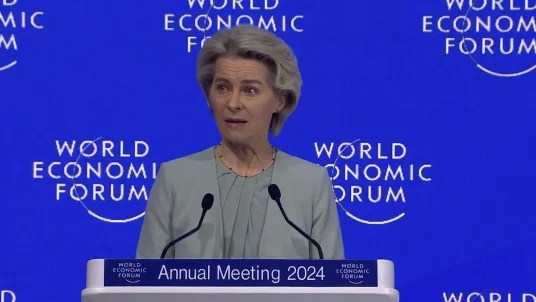
By Cindy Harper | Reclaim The Net | January 17, 2024
The President of the European Commission, Ursula von der Leyen, delivered an alarming pro-censorship proclamation at the annual Davos World Economic Forum. She expressed her concern that “misinformation” and polarization in societies pose a serious threat to the international business community.
“For the global business community, the top concern for the next two years is not conflict or climate,” she said in her speech to elites. She argued that the bigger problem is “disinformation and misinformation, followed closely by polarization within our societies.”
In her exhortation, Leyen said that there needs to be partnerships formed between governments and the private sector to curb “disinformation.”
“Many of the solutions lie not only in countries working together but, crucially, on businesses and governments, businesses and democracies working together,” she said.
Leyen suggested that it was especially important as 2024 will be “the biggest electoral year in history.”
She added: “Even as the insidious spread of misinformation and disinformation threatens the cohesion of societies, there is a risk that some governments will act too slowly, facing a trade-off between preventing misinformation and protecting free speech, while repressive governments could use enhanced regulatory control to erode human rights.”
Australia: ABC staff threaten strike after Arab journalist sacked

Award-winning journalist and author Antoinette Lattouf
MEMO | January 17, 2024
ABC journalists in the broadcaster’s Sydney offices yesterday threatened to strike unless management addresses concerns over the unlawful dismissal of radio host Antoinette Lattouf, Anadolu news agency reported.
The award-winning journalist and author, who is of Lebanese heritage, was sacked by ABC last month for sharing on Instagram a report by Human Rights Watch (HRW) on the besieged Gaza Strip.
The internationally-recognised rights watchdog released a report on how starvation was being used as “a weapon of war” by the Israeli government in Gaza. ABC also published a news item on the report.
On Tuesday, the Sydney Morning Herald revealed a leaked chain of WhatsApp messages from a group called Lawyers for Israel who had lobbied for Lattouf to be sacked.
“The ABC sacked broadcaster Antoinette Lattouf after a high-level and coordinated letter-writing campaign from pro-Israel lobbyists that directly targeted the corporation’s chair, Ita Buttrose, and managing director David Anderson,” the news daily said.
The report reveals that the Israeli lobby “repeatedly wrote to the ABC demanding Lattouf be sacked, and threatened legal action if she was not.”
Yesterday, about 80 ABC staff members demanded a meeting with Anderson, who is currently on leave.
They threatened to stage a walkout if their concerns were not addressed.
Lattouf has legally challenged her termination, saying she was sacked on the grounds of “political opinion or a reason that included political opinion” and later expanded the claim to include race, due to her Lebanese heritage.
While ABC has denied Anderson was behind Lattouf’s sacking, the broadcaster has told a court that the journalist was removed “because she ignored a direction from managers and shared a controversial social media post from Human Rights Watch.”
Lattouf demands a clear public apology, financial compensation and the offer of a proportionate position.
Hearings are scheduled to begin later this week.
In a statement to the Sydney Morning Herald, Lattouf’s lawyer, Josh Bornstein, said that after “October 7 and the ensuing conflict in the Middle East, it has become common knowledge in the media industry that Arab and Muslim journalists are being subjected to intimidation, censorship and expulsion.”
Featured Video

Liberty Cannot Exist Inside a Panopticon
or go to
Aletho News Archives – Video-Images
From the Archives
Left-leaning despisers of 9/11 Truth movement: Do you really believe in miracles?
David Ray Griffin | Global Research | 06 Jul 2010
An Open Letter to Terry Allen, Noam Chomsky, Alexander Cockburn, David Corn, Chris Hayes, George Monbiot, Matthew Rothschild, and Matt Taibbi.
[1]According to several left-leaning critics of the 9/11 Truth Movement, some of its central claims, especially about the destruction of the World Trade Center, show its members to be scientifically challenged. In the opinion of some of these critics, moreover, claims made by members of this movement are sometimes unscientific in the strongest possible sense, implying an acceptance of magic and miracles. … Full article
Blog Roll
 Aletho News
- White House envoy declares kinetic action against Yemen ‘fruitless’
- Ukraine deployed thousands of microdrones in Iraqi Kurdistan: Tasnim
- Iran calls for emergency UNSC meeting over Trump’s ‘brazen’ bomb talk, Israeli threats
- Iranian sources reveal details of Russia-China Hormuz proposal
- Plan for more US-Israel integration puts our military tech at risk
- Another Round Against Iran Will Break What Is Left of the Gulf
- SVR Report on Ukraine’s Mexican Drug Gang Links Could Pressure Zelensky, Won’t Change US Policy
- British Government Employees Were Fact-Checking the News at the BBC. Nobody Told You.
- Albania on fire: who’s behind the riots?
- Egypt’s Civil Democratic Movement rejects involvement in regional war
- If Americans Knew
- Mysterious bot accounts reportedly spread fake ‘man on the street’ videos for Michigan Senate candidate
- Israeli Defense Minister Katz Says Over 60 Lebanon Villages Have Been Destroyed
- Why Is Israel Running TV Ads in Iowa Ahead of the Midterms?
- Hind Rajab’s Alleged Killer Is in the United States. HRF Demands His Arrest.
- US Officials Face Fresh Pressure After Another American ‘Brutalized’ by Israeli Settlers in West Bank
- Israel-Backed Palestinian Militias Terrorize Displaced Families in Gaza
- FBI subpoenas pro-Palestine activists over Israeli weapons plant disruption
- Fourth winter arrives in wartorn Gaza, too early – Daily Update
- More on how Bari Weiss is using CBS on behalf of Israel
- What the UK Is Doing to Pro-Palestine Novelist Sally Rooney Is an Act of Orwellian Villainy
- No Tricks Zone
- Predictions Made By Renowned Climate Proifessor Over Past Decades Have Been Proven To Be Poor
- New Study Suggests Large Regions Of The Pacific Ocean Have Been Cooling For The Last 80 Years
- Germany’s Green Energy Debacle: High Energy Costs Force Kahla Porzellan to Close After 182 Years!
- New Study: 50 Years Of The Most Aggressive ‘Net Zero’ Policies Can Only Affect The Global Climate By 0.03°C
- US September “Heat” Was No Record…Many Records Set Decades Ago
- Latest European Green Energy Debacle; Portugal’s Largest Flagship Solar Park Insolvent!
- Green Energy Debacle: German Expert Professor Fritz Vahrenholt Warns Of Severe Economic And Social Consequences
- Two More Paleo Reconstructions Affirm Meters-Higher Sea Levels Across Ireland, Brazil 7000-6000 Years Ago
- New Study: Earth And Venus Surface Warmth Largely Explained By Convection And Lapse Rate, Not CO2 Or Radiation
- 2025 Nature Paper Claiming Worsening Global Drought Gets RETRACTED …Heavily Flawed

