Israel bombs Gaza with one-tonne bombs where civilians were sent to take refuge
MEMO | December 23, 2023
Almost all Saudi nationals oppose Arab ties with Israel, poll finds
Press TV – December 23, 2023
A new survey has found that 96 percent of Saudi Arabian citizens want Arab countries to cut all types of ties with Israel in response to the occupying regime’s war on Gaza.
Conducted by the Washington Institute for Near East Policy, a pro-Israel think tank based in Washington, the survey saw almost every Saudi agreeing with the proposal “Arab countries should immediately break all diplomatic, political, economic, and any other contacts with Israel, in protest against its military action in Gaza.”
The study further found that a big majority of the Saudis (91%) believe that “despite the destruction and loss of life, this war in Gaza is a win for the Palestinians, Arabs, and Muslims.”
The majority of respondents in Jordan, Lebanon and Egypt held favorable views towards the Palestinian resistance movement Hamas, but saw a 30-point growth in its popularity in the case of Saudi Arabians, compared to August.
The survey said 87% agree with the suggestion that “recent events show that Israel is so weak and internally divided that it can be defeated someday.”
Conducted to measure the change in shift of attitudes of Saudi nationals after the bloody war broke out, the survey was conducted from November 14 to December 6.
The results of the study are a clear manifestation of the difficulties the United States is going to face as it advocates for intertwined Arab-Israeli cooperation.
Prior to the war, the US was actively working towards achieving an agreement to normalize Saudi Arabia-Israel relations.
Earlier in September, during an interview with Fox News, Saudi Crown Prince Mohammed bin Salman stated that the two countries were getting closer to such an agreement “every day.”
After the war broke out, Riyadh put a pause on normalization talks and has made its diplomatic outreach public as one that seeks “to stop the ongoing escalation.”
The Israeli genocide in Gaza has significantly suppressed support for allowing contact with Israelis.
The US and Israel face a powerful new enemy in the Middle East conflict
By Robert Inlakesh | RT | December 23, 2023
In yet another case of blowback, reflecting the failure of Western military interventionism in West Asia, Yemen’s Ansarallah (Houthi) movement has inserted itself as an active participant in the ongoing war between Israel and Gaza. First launching batches of loitering munitions, ballistic and cruise missiles towards Israel, Ansarallah then moved on to prevent the passage of Israeli-owned or operated ships through the Red Sea, before announcing a complete closure of the shipping route for any vessels destined to dock at the port of Eilat.
After the Houthis seized a number of ships, while attacking others with drone strikes, activity at Eilat has dropped some 85%. International and Israeli shipping companies have opted to take the long route, which in some cases takes an additional 12 days, to reach Israel with their cargo, a costly diversion to say the least. In opposition to this, US Defense Secretary Lloyd Austin traveled to the region and announced the formation of a multinational naval task force to be deployed in the Red Sea. Despite talk of the coalition including Saudi Arabia, Egypt, and even the United Arab Emirates, the only Arab nation that joined was Bahrain.
So, without a United Nations Security Council (UNSC) resolution to back them up, usually required to make the militarisation of a territory legal under international law, the US has launched yet another foreign intervention. This one is significant because it failed to convince any major regional players to join, demonstrating the decline in American influence, but has also elevated the status of Yemen’s Ansarallah.
Under former US President Barack Obama, Washington backed the Saudi-led coalition’s intervention in Yemen back in 2015. Since then, some 377,000 people have died, largely as a result of the deadly blockade imposed on the majority of the country’s population, while some 15,000 civilians have died due to direct conflict. The objective of the Saudi-led intervention, which received the backing of the US and UK, was to remove Ansarallah from power in the nation’s capital, Sanaa. Although the group does not enjoy international recognition as Yemen’s governing force, it rules over more than 80% of the population, has the support of two-thirds of the nation’s armed forces, and operates a government out of Sanaa.
Ansarallah came to power following a popular revolution against then-Yemeni President Abdrabbuh Mansour Hadi in 2014. Months later, Hadi resigned and fled the country after Ansarallah militants had decided to take over by force. In the midst of a seven-year war, the political, social and armed movement that is often referred to as “the Houthi rebels” operates as the de facto government of Yemen, but is yet to receive recognition at the UN, which instead recognises the ‘Presidential Leadership Council’ that was created in Riyadh, Saudi Arabia, in 2022.
The context above is crucial for understanding the capabilities of Yemen’s Ansarallah, which was downplayed as a band of “Iran-backed rebels” in Western corporate media for years. While the governments of the collective West have tried to pretend that the Yemeni group is insignificant, Washington’s recent decision to form a multi-national naval coalition to confront the Houthis is an admission that they are a major regional actor. In fact, Ansarallah is the only Arab movement that controls state assets and a standing army that is participating in the ongoing war with Israel.
The reality that the US is now confronting is something that both Saudi Arabia and the UAE came to realize early last year. Following two separate drone and missile attacks on Abu Dhabi and Dubai in January of 2022, it became apparent that the West’s current level of support could not provide sufficient security for the UAE. Up until a nationwide ceasefire was brokered in April 2022, Ansarallah had also demonstrated its developed missile and drone capabilities, striking valuable economic targets inside Saudi Arabia too.
Despite receiving a lot less attention than it deserved, Ansarallah forces strategically timed their second attack on the UAE to coincide with the arrival of Israeli President Isaac Herzog in the country. This was a clear message to the Emirati and Saudi leaderships that Western support will not provide sufficient security. It’s likely because of this threat from Yemen that Riyadh sought a security pact with the US, in order to make a normalization agreement with Israel possible. Such a security pact would have stipulated that an attack on one is an attack on all, hence dragging the Americans into a direct war against Yemen in the event that the conflict was to flare up again.
The US attempted to help topple the current government in Sanaa, but ended up creating a battle-hardened group that has domestically developed capabilities well beyond those it possessed at the start of the conflict in 2015. In his first foreign policy address after taking office in 2021, US President Joe Biden pledged to end the war in Yemen. However, instead of pursuing a Yemen-Saudi deal, the White House abandoned its pledge and sought to broker a Saudi-Israeli deal instead. That fatal decision is coming back to bite policymakers in Washington.
Backing the Israelis to the hilt in their war on Gaza, spelling out that there are no red lines as to how far the government of Benjamin Netanyahu can go, the US has allowed a Palestine-Israel war to expand into a broader regional Arab-Israeli conflict. The threat of escalation between the Israeli army and Lebanese Hezbollah is growing by the day, while Ansarallah leader Abdul-Malik al-Houthi has stated that his forces “will not stand idly by if the Americans have a tendency to escalate and commit foolishness by targeting our country.”
By every metric, US diplomatic stock has dropped internationally as a result of its handling of Israel’s war on Gaza. It has failed to convince any major regional actors in West Asia to back its escalatory agenda, all of which are standing on the same side as Russia and China in calling for a ceasefire. The world sees the hypocrisy of Washington. For the sake of comparison, the death toll in Gaza today is said to have exceeded 23,000, the majority being women and children. Israel has killed this many people in just over two months, while in the first two years of the ISIS/Daesh insurgency in Iraq, the UN estimated that the terrorist group killed some 18,800 civilians. The total number of civilians killed by ISIS in Syria is set at just over 5,000.
The level of human suffering being inflicted in Gaza is without precedent, breaking records in modern history for the tonnage of explosives dropped on such a small territory, in addition to the highest number of journalists, medical workers, and children killed in a single conflict. In reaction, the US government has repeatedly blocked ceasefire resolutions at the UNSC, gives Israel unlimited support unconditionally, and now threatens to drag a coalition of Western nations into a war on Yemen. The solution here is very simple: Ansarallah has said the blockade on ships to Israel will end when the war on Gaza ends. Washington has the ability to stop the war, but refuses to do so, while its threats against Yemen will not work to achieve any result beyond further escalation.
Robert Inlakesh is a political analyst, journalist and documentary filmmaker currently based in London, UK. He has reported from and lived in the Palestinian territories and currently works with Quds News. Director of ‘Steal of the Century: Trump’s Palestine-Israel Catastrophe’.
Rumble blocks Brazil
RT | December 22, 2023
The video sharing service Rumble announced on Friday that it would disable access to all users from Brazil pending its legal challenge of the Brazilian court order to censor certain creators.
Rumble CEO Chris Pavlovski revealed the move in a post on X (formerly Twitter), noting that the court orders clashed with the company’s mission to “restore a free and open Internet.”
“Users with unpopular views are free to access our platform on the same terms as our millions of other users,” Pavlovski wrote. “Accordingly, we have decided to disable access to Rumble for users in Brazil while we challenge the legality of the Brazilian courts’ demands.”
Brazilians who lost their access to Rumble content have only their courts to blame, he added, noting that he hoped the judges would reconsider their decision so that the service could be restored soon.
“I will not be bullied by foreign government demands to censor Rumble creators.”
In a follow-up post, Pavlovski noted that Rumble was “the only company at our scale that holds the line for free speech and American values,” and that he hoped some day other Big Tech companies would do the same. “I will continue to lead by example until that day arrives,” he added.
Journalist Glenn Greenwald, who lives in Brazil and hosts the ‘System Update’ show on Rumble, noted that the Brazilian Supreme Court is “consumed with censoring political speech,” to the point that it banned platforms such as Telegram and WhatsApp for failing to immediately obey their censorship orders.
This is the second time Rumble has suspended service in a country over a censorship row. In November 2022, Pavlovski defied France’s orders to censor certain Russian-language outlets, citing the company’s free speech mission.
Pavlovski, a Canadian tech entrepreneur, founded Rumble in 2013 after seeing YouTube giving priority to influencers after getting acquired by the search engine giant Google. The platform grew in popularity starting in 2020, after a mass purge of dissident voices by Silicon Valley, and continued in 2021 with the influx of US conservatives censored elsewhere.
How the cabal’s false narratives are used to gain their true objectives
BY MERYL NASS | DECEMBER 21, 2023
One Health issues a booklet and finally, kinda, sorta tells us what One Health is about.
“A guide to implementing the One Health Joint Plan of Action at national level”
See page 30:
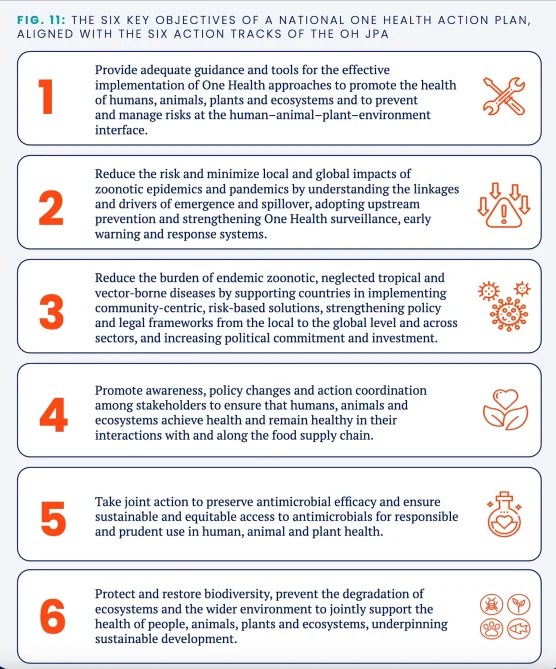
I do the decoding [italics ].
- “Provide adequate guidance and tools for the effective implementation of One Health approaches to promote the health of humans, animals, plants and ecosystems and to prevent and manage risks at the human–animal–plant–environment interface.”
This drills into the reader’s brain the idea that the human-animal or human-environment interface is a dangerous place to be, that the risks must be acknowledged, and major efforts made to manage them. Note the absence of evidence supporting the assertion that major risk exist when humans are exposed to animals and nature.
- Reduce the risk and minimize local and global impacts of zoonotic epidemics and pandemics by understanding the linkages and drivers of emergence and spillover, adopting upstream prevention and strengthening One Health surveillance, early warning and response systems.
The concept that pandemics are caused by “spillover” from animals is asserted, as is the very shaky idea that one can prevent and identify pandemics early using “surveillance” “warning and response systems”—which tellingly are never defined in any detail since no methods have ever worked.
- Reduce the burden of endemic zoonotic, neglected tropical and vector-borne diseases by supporting countries in implementing community-centric, risk-based solutions, strengthening policy and legal frameworks from the local to the global level and across sectors, and increasing political commitment and investment.
Blather about helping developing nations without saying anything specific, except that they need to strengthen “policy and legal frameworks”—such as implementing legislation for authorization of unlicensed, liability-free drugs and vaccines? They need more political commitment—commitment to what, exactly, is ominously left unsaid. And naturally more investment (and commissions) are needed.
- Promote awareness, policy changes and action coordination among stakeholders to ensure that humans, animals and ecosystems achieve health and remain healthy in their interactions with and along the food supply chain.
The ominous missing information about the policy changes and action desired should make you very nervous. Now the “food supply chain” is invoked, turning food and the methods by which it travels from farm to kitchen fair game for the purveyors of One Health.
- Take joint action to preserve antimicrobial efficacy and ensure sustainable and equitable access to antimicrobials for responsible and prudent use in human, animal and plant health.
It sounds like there is a plan to withhold antibiotics from us in the name of preserving their efficacy. Pharmacists were made to monitor azithromycin use as well as hydroxychloroquine, chloroquine and mefloquine use during the COVID time. Bacterial pneumonias were untreated until the victim’s lips turned blue. Expect more of this.
- Protect and restore biodiversity, prevent the degradation of ecosystems and the wider environment to jointly support the health of people, animals, plants and ecosystems, underpinning sustainable development.
This will be the justification to move people off the land in areas where species are said to be threatened. It may also lead to enforced changes in land use, based on my earlier readings of Daszak, Fauci and the Lancet One Health commission. And of course we must give up our simple pleasures in the name of the Sustainable Development Goals (SDGs). Who voted for them, and why are we being frog-marched into a SDG future, even though we don’t know where it is leading?
_________________

The cabal that delivered COVID and its pandemic response plan to us wants to solve the rest of the world’s problems for us, too. Will YOU let them?
Reports: Hamas seeks release of Marwan Barghouti in any hostage deal
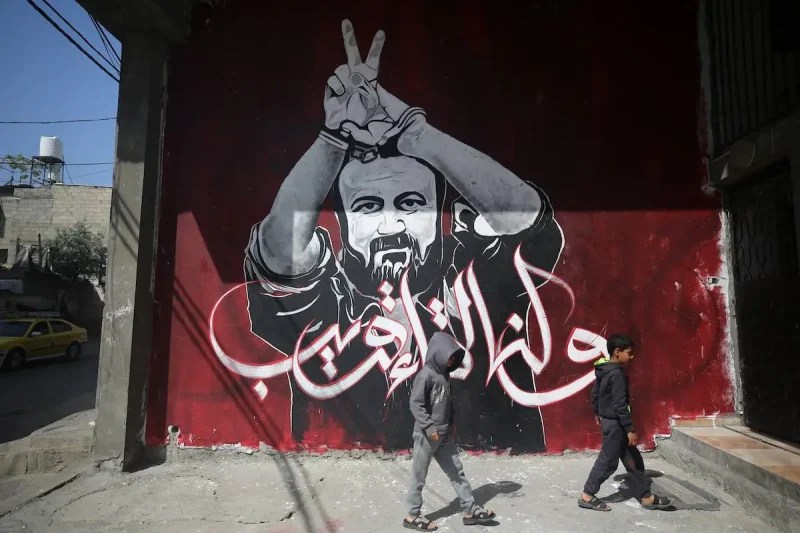
A mural shows jailed Fatah leader Marwan Barghouti, in Jabalia refugee camp in the northern Gaza Strip on April 16, 2023. [Majdi Fathi/NurPhoto]
MEMO | December 22, 2023
UN Security Council passes resolution demanding more Gaza aid deliveries
Press TV – December 22, 2023
The United Nations Security Council has finally passed a resolution on the ongoing Israeli onslaught against Gaza, demanding increased aid deliveries to the besieged region but stopping short of calling for an immediate halt to the genocide.
The watered-down resolution, ratified on Friday, demanded all sides in the conflict allow the “safe and unhindered delivery of humanitarian assistance at scale.”
It also called for the creation of “conditions for a sustainable cessation of hostilities” but it did not call for an immediate end to fighting.
The vote in the 15-member council was 13-0 with the United States and Russia abstaining.
The vote followed the US veto of a Russian amendment that would have restored that call for a suspension of hostilities. That vote was 10 members in favor, the US against and four abstentions.
The text, sponsored by the United Arab Emirates, was passed following days-long negotiations over its wording, during which it was watered down at the US request.
Washington had earlier vetoed two UNSC resolutions on the conflict, drawing widespread condemnations over the body’s lack of action since the start of the onslaught.
Russia says resolution ‘toothless’
Russian ambassador to the UN Vasily Nebenzya hit out at the United States, saying “they have resorted to their favorite tactic… of twisting of arms”, calling the text “toothless.”
The UAE’s ambassador to the UN Lana Zaki Nusseibeh said “it responds with action to the dire humanitarian situation.”
“We know this is not a perfect text… We will never tire of calling for a humanitarian cease-fire,” she said.
The resolution demands all sides “allow and facilitate the use of all… routes to and throughout the entire Gaza Strip, including border crossings… for the provision of humanitarian assistance.”
It also requests the appointment of a UN humanitarian coordinator to oversee and verify third-country aid to Gaza.
An earlier text had said that the aid mechanism to accelerate the delivery of relief would be “exclusively” under UN control.
It now states it would be managed in consultation with “all relevant parties” — meaning Israel would retain operational oversight of aid deliveries.
Israel has pounded the Gaza Strip since October 7, killing at least 20,057 Palestinians, mostly women and children, and injuring 53,320 others, according to health authorities in the region.
The Israeli onslaught has left Gaza in ruins with half of the coastal territory’s housing stock damaged or destroyed, and nearly 2 million people displaced within the densely-populated territory amid shortages of food and clean water.
US’ ‘Hypocritical’ Reversal on Saudi Arms Ban Won’t Knock Riyadh’s Peace Push Off Course
By Ilya Tsukanov – Sputnik – 22.12.2023
The Biden administration is reportedly preparing to ease restrictions on the sale of offensive weaponry to Saudi Arabia, reversing a decision made in 2021 in a bid to put the Yemeni crisis to bed. The reversal is aimed at pulling Riyadh into Washington’s confrontation with the Houthis, but will surely fail, a Saudi foreign affairs observer says.
Washington is having trouble lining up allies to join its anti-Houthi Red Sea coalition.
The US-led alliance, formed to conduct a military operation dubbed Operation Prosperity Guardian in the Red Sea and the Gulf of Aden against Yemen’s Houthi militia, currently consists of a handful of countries, including the UK, Canada, Denmark, France, Greece, Italy, the Netherlands, and Norway, plus Bahrain and the Seychelles. Some members’ participation seems purely decorative, with Norway reportedly planning to send 10 officers, the Netherlands two, and Denmark just one, to assist in the mission.
Spain has taken by far the most curious position to date, first backing an EU-level mission, but then changing its position and apparently vetoing the decision without explanation.
US AUKUS ally Australia has similarly dismissed requests to join Operation Prosperity Guardian in any major way, limiting its involvement to 11 military personnel.
Washington was pressed into forming its ‘new coalition of the willing’ in the wake of a string of Houthi hijackings and missile attacks on commercial cargo vessels thought [?] to be affiliated with Israel amid Tel Aviv’s ongoing war in Gaza. The attacks have caused multiple major global shipping companies to halt commercial transit through the Red Sea, with over $60 billion in cargoes already diverted to alternative routes, and losses expected to continue mounting.
US preparations for war against the Houthis mark a major reversal of policy for the current administration, which cut off US weapons support for the Saudi-led coalition’s campaign against the Yemeni militia in 2021, and delisted them as a ‘terrorist’ group. This, together with a series of other factors, pushed Riyadh into a major shakeup in its foreign policy, including peace talks with the Houthis, the normalization of ties with long-time regional rival Iran, and, most recently, joining the BRICS bloc.
Washington has accompanied its Houthi-related policy reversal with plans to lift an offensive weapons sales ban targeting Riyadh, presumably in a bid to get on Crown Prince Mohammed bin Salman’s good side and perhaps even rope him into supporting or even joining the US-led Red Sea coalition.
But Riyadh-based political analyst Dr. Ahmed Al Ibrahim doesn’t expect Washington’s sweet talking to have any substantive impact on Saudi Arabia’s stance vis-à-vis escalating regional tensions.
“Saudi Arabia is doing what’s best for Saudi Arabia. It does not matter whether this is for the US administration or for anybody else. As you know, MBS is trying to zero out the whole region from any conflict, and yet we are being challenged periodically with the concerns of the militias in the region like Hamas, Hezbollah and Houthis,” Al Ibrahim told Sputnik.
Characterizing the US deployment of warships to the region as “a kind of hypocrisy” in the wake of the Biden administration’s previous attempts to starve Riyadh of military equipment to fight the Houthis, Al Ibrahim stressed that Saudi Arabia is doing its best to “move forward” instead of getting bogged down in another quagmire thanks to the US.
“Controlling the Houthis is now the US mandate. They need to deal with them,” Al Ibrahim emphasized. “I doubt if the United States will basically pull Saudi Arabia into the Houthi conflict. Saudi Arabia is a sovereign country and it will assess the situation. And I don’t think Saudi Arabia is going to contribute to that. Having Saudi Arabia involved in that, it’s one day [until] you get blamed by actually protecting your border and your security by the Americans. And if you don’t, also, you will get blamed. So I think Saudi Arabia is not going to get dragged into any war. Saudi Arabia has an economic vision that they need to be rich, and they will choose any day, anytime peace.”
If the US fails to play its cards right, the Saudi analyst predicts another power vacuum in the region like those left in Afghanistan and Iraq, and even further loss of support among Muslim countries by Washington.
“As you can see, the tone of the Middle East has risen against the United States because of the whole wrongdoing that the United States is doing to the region. But we are fed up with war,” Al Ibrahim stressed.
“America needs to restructure itself. They need to know what their goals are and who their allies are. And they need to understand the region much better because they’re losing a lot of ground to their competitors, unfortunately,” the observer said, citing China and Russia as two examples.
As far as Saudi Arabia’s cooperation with Russia is concerned, Al Ibrahim doesn’t expect any fledging security ties between the two countries to be frayed by Washington’s reversal on weapons sales. Trust with the Biden administration has been broken, and the bad taste left from the bad blood between the US president and MBS hasn’t gone anywhere, in his estimation.
“Maybe we get delayed spare parts for some of the jets, some of the weapons that Saudi Arabia needs. But we’ll see after the election of 2024,” Al Ibrahim summed up, hinting that a change of power may be necessary in Washington before Riyadh will consider restoring close ties.
US ‘Builds Trap for Itself’ in Red Sea
By Scott Ritter – Sputnik – 22.12.2023
On December 18, following a tour of the Middle East with stops in Kuwait, Bahrain, Qatar and Israel, US Defense Secretary Lloyd Austin announced the establishment of Operation Prosperity Guardian, under the umbrella of Combined Task Force (CTF) 153, which focuses on security in the Red Sea, to protect maritime shipping.
Back on November 19, Yemen’s Houthi rebels, operating in solidarity with the Palestinians of Gaza, took over an Israeli-linked cargo ship, the Galaxy Leader. The Houthis announced that they would block all shipping transiting the Red Sea toward Israel—in effect establishing a blockade of Israel—until Israel allowed humanitarian aid into Gaza.
The Houthis have subsequently attacked numerous vessels passing through the Bab al-Mandeb Strait, a narrow passageway leading into the Red Sea and further on to the Suez Canal, threatening global trade as major oil and shipping giants, including BP, MSC, Evergreen, OOCL, and Maersk, suspended operations through the Red Sea. The damage to the Israeli economy done by the Houthi blockage is estimated to run into the billions of dollars, and Israel’s Prime Minister Benjamin Netanyahu has threatened to use military force against the Houthis if the United States does not intervene on its behalf.
CTF 153, which has operated under both US and Egyptian command, is tasked with international maritime security and capacity-building efforts in the Red Sea, Bab al-Mandeb, and Gulf of Aden. Its compliment of four ships—three US destroyers (the USS Carney, USS Mason, and USS Thomas Hudner) and the UK Royal Navy guided-missile destroyer HMS Diamond) have all been involved in intercepting Houthi missiles and drones fired against either Israel or merchant shipping operating in the Red Sea.
Austin also ordered Carrier Strike Group 2, consisting of aircraft carrier the USS Dwight D. Eisenhower and three escorts (a cruiser and two destroyers), to join up with CTF 153 as part of Operation Prosperity Guardian. Ohio-class submarine the USS Florida, equipped with 154 Tomahawk cruise missiles, is also operating in the region.
Austin announced that the US and UK would be joined by Bahrain, Canada, France, Italy, the Netherlands, Norway, Seychelles, and Spain as part of Operation Prosperity Guardian. Notable absentees include Arab nations like Egypt and Saudi Arabia. Australia was asked to provide a warship, but offered [13] personnel only.
French Navy guided-missile frigate the FS Languedoc is already operating in the Red Sea and, like its US and UK counterparts, has been involved in the shooting down of Houthi drones and missiles. However, France has stated that the Languedoc will operate under French command, complicating its relationship with CTF 153.
Italy’s Defense Ministry has announced that it will deploy naval frigate the Virginio Fasanto the Red Sea. Its command relationship with CTF 153 remains unclear as of the present time.
The military problem facing CTF 153 is threefold. First, there is a need to establish a barrier defense against the Houthi missile and drone attacks. This will require that the guided missile destroyers and frigates establish a picket line along the eastern channel of the Bab al-Mandeb Straight which will screen shipping from any Houthi attack. Second, CTF 153 will need to engage in aggressive patrolling designed to deter and repel any Houthi efforts to repeat their hijacking of the Galaxy Leader. Lastly, CTF 153 will need to provide mine clearance capabilities to deal with any sea mines that the Houthis may place in the narrow waters of the Bab al-Mandeb.
These missions alone will be taxing, and difficult to accomplish. As things stand, while the CTF 153 ships have shot down dozens of Houthi drones and missiles, scores have gotten through, striking targets in Israel and hitting shipping in the Red Sea. Simply put, CTF 153 doesn’t have enough ships to adequately screen either Israel or maritime shipping from Houthi attack. And given the lack of mine warfare ships in the CTF 153 organization, any deployment of sea mines by the Houthis will effectively close the region from commercial shipping, and threaten military deployments in the area, until demining capability can be deployed.
The only way that Operation Prosperity Guardian could possibly keep the Bab al-Mandeb Straight open is to launch strikes against the Houthi capability of launching missiles and drones in hopes of interdicting them before they can be used. Here the plot thickens—the Houthis have made it clear that if attacked, they will expand the conflict to include Saudi and UAE oil production, threatening global energy supplies. Moreover, targeting mobile missile and drone launchers is no simple task—Saudi Arabia, using US intelligence support to assist in targeting, was unable to prevent the Houthis from launching missiles and drones against Saudi targets during the entirety of its ongoing conflict with the Houthis. The US would likely run into similar problems.
In short, by initiating Operation Prosperity Guardian, the US appears to have built a trap for itself, where it is damned if it doesn’t attack the Houthi (since the Red Sea would remain blocked to all Israeli traffic), and damned if it does (since it wouldn’t be able to stop the Houthi attacks, and such action would likely expand the scope and scale of the conflict to the detriment of US interests.)
Keep in mind that all of this could have been solved with a single phone call from US President Joe Biden to Israeli Prime Minister Benjamin Netanyahu directing Israel to accept a ceasefire and allow humanitarian aid to be sent to the Palestinian residents of Gaza. Instead, the United States is destroying its moral standing in the world by openly facilitating the ongoing slaughter of Palestinian civilians at the hands of the Israel Defense Forces, while simultaneously undermining the credibility of US military deterrence by getting itself mired in a tar baby of its own making.
The deployment of the USS Dwight D. Eisenhower into the Sea of Aden comes on the heels of its brief foray into the Persian Gulf, where it was closely monitored by Iran. The US has also deployed a second carrier battlegroup, consisting of the USS Gerald R. Ford and its six escorts, in the eastern Mediterranean Sea. Meanwhile, the USS Carl Vinson and its five escorts operate just over the horizon, in the South China Sea.
Never in the history of the American Navy have so many carrier battlegroups been moved around the globe with so little impact.
The reality of modern warfare is that small nations and non-state actors such as the Houthis can be armed with modern military weaponry which negates the military impact of multibillion-dollar investments such as the carrier battlegroup. It costs the Houthis tens of thousands of dollars to fire its drones and missiles against Israel and maritime shipping; it costs the US Navy millions of dollars to shoot them down. Moreover, it costs the US navy hundreds of millions of dollars just to keep a carrier battle group deployed and operating, while the Houthis can credibly threaten to sink a carrier using weapons that cost hundreds of thousands of dollars.
The final score card regarding Operation Prosperity Guardian has yet to be written. But the reality is that it will most likely not succeed in its mission of preventing Houthi attacks against either Israel or maritime shipping. This failure goes far beyond the issue of security for the Red Sea. The United States has long maintained that it could guarantee that if Iran ever sought to close the strategic Straight of Hormuz, the US Navy would be able to reopen it in a very short period. Operation Prosperity Guardian puts a lie to that claim. The fact is, the world balance of power has changed dramatically, and legacy systems like the carrier battlegroup are no longer the dominant means of power projection they once were. The US has, in effect, put all its eggs in one basket through its over-reliance upon the carrier battlegroup when it comes to force projection.
The looming failure of Operation Prosperity Guardian exposes the impotence of the US when it comes to being able to accomplish its plans for regional dominance in the Persian Gulf, South Pacific, and Taiwan, and signals a new era where the appearance of an American fleet of the shores of a far way land no longer inspires fear and intimidation. For a nation like the United States, which has premised so much of its foreign and national security on the notion of strength-based deterrence, the revelation that its military power projection capabilities are more bark than bite undermines its credibility as an ally and partner in a world largely defined by conflicts created by, or on behalf of, the United States.
Featured Video

Iran’s Next Strike May Not Explode. It Could Shut You Down
or go to
Aletho News Archives – Video-Images
From the Archive
Zionism’s Violent Legacy
By Donald Neff | Washington Report On Middle East Affairs | January 1996
On January 4, 1948, Jewish terrorists drove a truck loaded with explosives into the center of the all Arab city of Jaffa and detonated it, killing 26 and wounding around 100 Palestinian men, women and children.[1] The attack was the work of the Irgun Zvai Leumi – the “National Military Organization,” also known by the Hebrew letters Etzel – the largest Jewish terrorist group in Palestine. The Irgun was headed by Revisionist Zionist Menachem Begin and had been killing and maiming Arabs, Britons and even Jews for the previous ten years in its efforts to establish a Jewish state.
This terror campaign meant that at the core of Revisionist Zionism there existed a philosophical embrace of violence. … continue
Blog Roll
 Aletho News
- Riyadh Says Its Oil System Is Intact. The Numbers Say Otherwise.
- Trump and Netanyahu Want to “Finish the Job” on Iran
- US ‘one-sided dictation’ not Iran’s beliefs makes rational talks impossible: Baghaei
- Iran’s Next Strike May Not Explode. It Could Shut You Down /Col Doug Macgregor
- Iran: US political targets legitimate if assassinations return
- Iraq shuts key border crossing with Iran under US pressure: Report
- Undersea Internet cables could be targeted in retaliation for attacks on Iran: IRGC deputy chief
- EU sending ‘biased’ observers to interfere in Serbian election – president
- White House envoy declares kinetic action against Yemen ‘fruitless’
- Ukraine deployed thousands of microdrones in Iraqi Kurdistan: Tasnim
- If Americans Knew
- An error has occurred; the feed is probably down. Try again later.
- No Tricks Zone
- E-Cars Reduce CO2 Emissions By Only 41% Compared To Internal Combustion Engine Vehicles
- Predictions Made By Renowned Climate Professor Over Past Decades Have Been Proven To Be Poor
- New Study Suggests Large Regions Of The Pacific Ocean Have Been Cooling For The Last 80 Years
- Germany’s Green Energy Debacle: High Energy Costs Force Kahla Porzellan to Close After 182 Years!
- New Study: 50 Years Of The Most Aggressive ‘Net Zero’ Policies Can Only Affect The Global Climate By 0.03°C
- US September “Heat” Was No Record…Many Records Set Decades Ago
- Latest European Green Energy Debacle; Portugal’s Largest Flagship Solar Park Insolvent!
- Green Energy Debacle: German Expert Professor Fritz Vahrenholt Warns Of Severe Economic And Social Consequences
- Two More Paleo Reconstructions Affirm Meters-Higher Sea Levels Across Ireland, Brazil 7000-6000 Years Ago
- New Study: Earth And Venus Surface Warmth Largely Explained By Convection And Lapse Rate, Not CO2 Or Radiation

