There Could Have Been Peace: How the U.S. Ensured a Long War in Ukraine
By Ted Snider | The Libertarian Institute | November 20, 2023
On February 27, just the third day of their war, Russia and Ukraine announced direct negotiations in Belarus. Having already said that he was prepared to abandon Ukraine’s pursuit of NATO membership, Ukrainian President Volodymyr Zelensky went into the negotiations “without preconditions.” That round of talks, having identified priority topics, led to a second round, again in Belarus.
But, though Ukraine was willing to discuss neutrality and “the end of this invasion,” the United States was not. On February 25, the same day Zelensky said he was “not afraid to talk to Russia” and that he was “not afraid to talk about neutral status,” State Department spokesman Ned Price was asked at a press conference, “What’s the U.S.—what’s your thinking about the efficacy of such a—of such talks?” Price responded, “Now we see Moscow suggesting that diplomacy take place at the barrel of a gun or as Moscow’s rockets, mortars, artillery target the Ukrainian people. This is not real diplomacy. Those are not the conditions for real diplomacy.” The United States said no, and the promising direct talks were not to be.
However, a few days later, Ukraine would attempt indirect, mediated talks. Zelensky would turn to then-Israeli Prime Minister Naftali Bennet to mediate. In a February 2, 2023 interview, Bennet revealed that “Zelensky initiated the request to contact Putin.” Bennett said, “Zelensky called me and asked me to contact Putin.”
Bennet accepted the request and a flurry of shuttle diplomacy began, first with a series of back-and-forth phone calls between Bennett and Putin and Bennett and Zelensky. On March 5, 2022, Bennet flew to Moscow at Putin’s invitation. The next day, Bennet flew to Berlin for meetings with German chancellor Olaf Scholz. On the following day, March 7, the United States, United Kingdom, Germany, and France held a videoconference that, according to some reports, discussed the talks. On March 10, Russian foreign minister Sergei Lavrov met Ukraine’s foreign minister, Dmytro Kuleba, in Turkey. Turkish foreign minister Mevlut Cavusoglu, who was present at the meeting, described their meeting as “civil.”
Bennet says that “everything [he] did was fully coordinated with Biden, Macron, Johnson, with Scholz and, obviously, Zelensky.” According to Bennet, Putin told him that “we can reach a ceasefire.” In order to make that happen, Bennet says that Putin and Zelensky both made “huge concessions.” When Bennett asked Putin if he was going to kill Zelensky, Putin answered, “I won’t kill Zelensky.” Putin also “renounced” Russia’s demanded “disarmament of Ukraine.” He also reportedly promised that there would be no regime change in Kiev and that Ukraine would remain sovereign. Putin then passed the message to Zelensky through Bennet that if you “Tell me you’re not joining NATO, I won’t invade.” Bennett says that “Zelensky relinquished joining NATO.”
It is key that in both the direct and mediated negotiations in the first weeks of the war, Ukraine was willing to give up NATO membership for a negotiated settlement with Russia.
In return for abandoning their NATO ambitions, Putin and Zelensky agreed that Ukraine would receive a strong, independent military capable of defending itself analogous to “the Israeli model.”
Bennett reports that “there was a good chance of reaching a ceasefire.” Sources “privy to details about the meeting” said that Zelensky deemed the proposal “difficult” but not “impossible” and that “the gaps between the sides are not great.” But, once again, it was not to be. Former UN Assistant Secretary-General in UN peace missions Michael von der Schulenburg says that “NATO had already decided at a special summit on March 24, 2022, not to support these peace negotiations.” Bennett agrees that the West made the decision “to keep striking Putin.” When Bennet’s interviewer asks him if he means that the West blocked the diplomatic settlement, Bennet simply replies, “They blocked it.”
In March and early April of 2022, there would be one final attempt at negotiations before the negotiating table would be abandoned for the battlefield. This time it was to be Turkey that would play the lead role as mediator. A supporting role was to be played by former German chancellor Gerhard Schröder who, like Bennet before him, was asked by Kiev to play a role in the mediation.
This final round of talks was the most promising. Putin has confirmed, as had already been reported, that Russia and Ukraine had “reached an agreement in Istanbul.” But Putin also revealed for the first time that the tentative agreement had been initialed by both sides. “I don’t remember his name and may be mistaken, but I think Mr. Arakhamia headed Ukraine’s negotiating team in Istanbul. He even initialed this document.” Russia, too, signed the document: “during the talks in Istanbul, we initialed this document. We argued for a long time, butted heads there and so on, but the document was very thick and it was initialed by Medinsky on our side and by the head of their negotiating team.”
Putin’s account is backed by Lavrov who said at a press conference that “we did hold talks in March and April 2022. We agreed on certain things; everything was already initialled.”
Putin went further than announcing the initialed document, on June 17, 2023, he dramatically held it up before a delegation of African leaders, showing it to the world for the first time. “We did not discuss with the Ukrainian side that this treaty would be classified, but we have never presented it, nor commented on it. This draft agreement was initialed by the head of the Kiev negotiation team. He put his signature there. Here it is.”
The draft agreement was the end product of a position paper presented by the Ukrainian delegation. The Istanbul Communiqué, dated March 29, 2022, agreed that Russia would withdraw to its prewar boundaries and Ukraine would promise not to seek NATO membership. Instead, Ukraine would receive security guarantees from a number of countries, possibly including Russia, China, the U.S., UK, France, Turkey, Germany, Canada, Italy, Poland and Israel. The final proposal of the communiqué proposes a possible meeting between Putin and Zelensky to sign the treaty.
On March 28, Putin reportedly went so far as to express a willingness to withdraw Russian troops from around Kiev. On March 29, the day the communiqué was initialled, the leaders of the U.S., UK, Germany, France and Italy spoke on the phone.
But, again, it was not to be. On April 5, The Washington Post reported that the West would “respect Kyiv’s decisions in any settlement to end the war with Russia, but with larger issues of global security at stake, there are limits to how many compromises some in NATO will support to win the peace.” The Post then spelled it out: “Even a Ukrainian vow not to join NATO—a concession that Zelensky has floated publicly—could be a concern to some neighbors. That leads to an awkward reality: For some in NATO, it’s better for the Ukrainians to keep fighting, and dying, than to achieve a peace that comes too early or at too high a cost to Kyiv and the rest of Europe.”
On April 9, then-UK Prime Minister Boris Johnson rushed to Kiev to rein in Zelensky, insisting that Russian President Vladimir Putin “should be pressured, not negotiated with” and that, even if Ukraine was ready to sign some agreements with Russia, “the West was not.”
And that is just what happened. “We actually did this,” Putin told war correspondents at the Kremlin, “but they simply threw it away later and that’s it.” Talking to the African delegation, Putin said, “After we pulled our troops away from Kiev—as we had promised to do—the Kiev authorities… tossed [their commitments] into the dustbin of history. They abandoned everything.” But Putin did not primarily blame Ukraine. He implicitly blamed the United States, saying that when Ukraine’s interests “are not in sync” with U.S. interests, “ultimately it is about the United States’s interests. We know that they hold the key to solving issues.”
Lavrov says the same. In a September 28, 2023 interview, Lavrov said that “in April 2022… Ukraine proposed ceasing hostilities and settling the crisis based on providing reciprocal, reliable security guarantees.” He then clearly said, “But this proposal was recalled at the insistence of Washington and London.”
But it is not just Russia who says this: two well placed Turkish sources say the same. Turkish Foreign Minister Mevlut Cavusoglu says that, because of the talks, “Turkey did not think that the Russia-Ukraine war would continue much longer.” But, he said, “There are countries within NATO who want the war to continue.” “Following the NATO foreign ministers’ meeting,” he explained, “it was the impression that… there are those within the NATO member states that want the war to continue, let the war continue and Russia get weaker.”
And Numan Kurtulmus, the deputy chairman of Erdogan’s ruling party, told CNN TURK, “We know that our President is talking to the leaders of both countries. In certain matters, progress was made, reaching the final point, then suddenly we see that the war is accelerating…Someone is trying not to end the war. The United States sees the prolongation of the war as its interest… There are those who want this war to continue… Putin-Zelensky was going to sign, but someone didn’t want to.”
Schröder agrees. Describing the negotiations, he says that Ukraine “does not want NATO membership,” would accept “compromise” security guarantees, said that they would “reintroduce Russian in Donbass,” and “were ready to talk about Crimea.”
“But in the end nothing happened,” Schröder said. “My impression: Nothing could happen because everything else was decided in Washington.” Like the Russian and the Turkish sources, Schröder reports that “the Ukrainians did not agree to peace because they were not allowed to. They first had to ask the Americans about everything they discussed.”
Schröder adds one more significant detail. It is often reported that the massacre in Bucha played a pivotal souring role in the negotiations, contributing to their termination. Schröder challenges that account: “Nothing was known about Butscha during the talks with Umjerov on March 7th and 13th. I think the Americans didn’t want the compromise between Ukraine and Russia. The Americans believe they can keep the Russians down.”
In all three sets of negotiations, Ukraine renounced their aspirations to join NATO, and in all three, peace was possible but for the U.S. blocking it. Both the Bennet talks and the Istanbul talks were Ukrainian initiatives that put forward Ukrainian solutions. The United States was not supporting Ukraine at the negotiating table: they were overturning the table in order to use Ukrainian bodies to pursue American goals.
Meet The “Medically Kidnapped” Teenager Who Brought A Tyrannical Healthcare System To Its Knees
The story of Maya Kowalski and how it might help Covid treatment victims

BY JJ STARKY | NOVEMBER 19, 2023
Days ago, a Floridian jury ruled in favour of the surviving family members of a wife and mother who took her own life after her daughter, Maya, was “medically kidnapped” for nearly 90 days.
The six-person jury in Sarasota County unanimously determined Johns Hopkins All Children’s Hospital in St. Petersburg was liable for the incidents leading up to the January 2017 death of Beata Kowalski, 43.
They also ruled that the hospital should pay the Kowalski family well over $210 million for the losses they endured, which included punitive damages.
The Kowalski’s story is one of torment, heartache, and anguish.
In fact, it is the sort of story that would make the most limp-wristed of us metamorphose into an angry cage fighter that looks like they’ve snorted a cubic tonne of cocaine before stepping into the octagon. You want blood after hearing it.
Netflix made a near two-hour documentary on their case, ‘Taking Care of Maya’, which I highly recommend watching.
To recap the bare bones, in 2015, 10-year-Maya began experiencing some nasty symptoms. These included breathing problems, headaches, blurred vision, skin lesions, lower limb dystonia, and debilitating chronic pain. And they would come on arbitrarily. So her parents, Jack and Beata, naturally sought medical advice.
But it was to no avail. They saw dozens of medical experts and they still didn’t know what was wrong with their daughter. That was until they visited one Dr. Anthony Kirkpatrick in September 2015, who diagnosed Maya with advanced complex regional pain syndrome (CRPS).
CRPS is a form of amplified musculoskeletal pain syndrome in which pain from a physical interaction outlasts the expected recovery time. For example, a gentle touch can mimic a slap – a flick, a punch.
Fortunately for Jack and Beata, Dr Kirkpatrick encountered the syndrome before in past patients. He had a treatment protocol in mind using ketamine, but – and herein lies the beginning of the problem – it was not conventional or well-known. Nor was the prescribed treatment available in Florida, where the Kowalski family lived.
Low doses of ketamine kept proving ineffective and so the family travelled to Mexico so Maya could undergo a ketamine coma, fearing her symptoms would worsen and become fatal. Thankfully, the procedure was successful. Her symptoms dissipated.
Except, one random night in October 2016, they returned – with vengeance. Her father rushes her to the local hospital, Johns Hopkins All Children’s, admits her, and tries to explain the rare syndrome to the staff. But they were mystified. They hadn’t come across the condition and even became suspicious of its existence. Beata told the hospital staff what treatment was required, but as soon as they learnt of the amount of Ketamine she had been taking, it was too late.
The next thing they know, a child abuse paediatrician, Dr Sally Smith, turns up unidentified to Maya’s bedside for an assessment. Within ten minutes, Smith concludes Beata has been abusing Maya, and that CRPS is not present. A nurse then informs Jack that his daughter is now in state custody and orders him to leave. Maya has been diagnosed with Munchausen syndrome by proxy, the fancy phrase for “medical child abuse”.
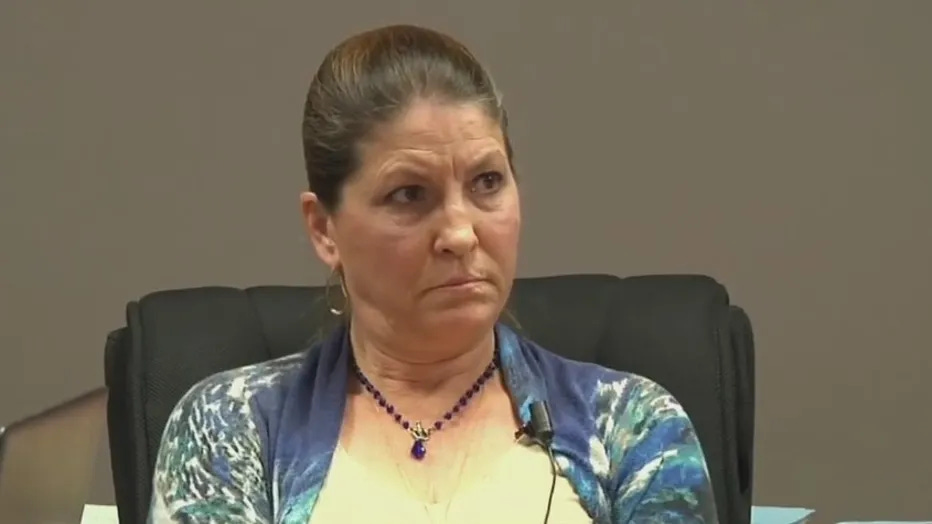
Sally Smith
What transpires over the next 3 months is nothing short of parental hell. Maya was still separated from her family. Her father was allowed to see her now and again because he adopted the role of pacifier, but her mother, Beata, who’d actively argued with hospital staff, was not.
Beata descended into a pit of depression. During rare scheduled calls with Maya, she discovered her symptoms were deteriorating and that the hospital had changed her treatment without her consent. Allegations also surfaced that a contracted social worker had stripped her daughter down to a sports bra against her will in order to take pictures of her body. This, again, occurred without Beata and Jack’s consent.
The same social worker, Catherine Bedy, Maya accused of telling her she was “going to go into a foster home”, her mother “was in a mental institution”, and she was “going to end up adopting” her.
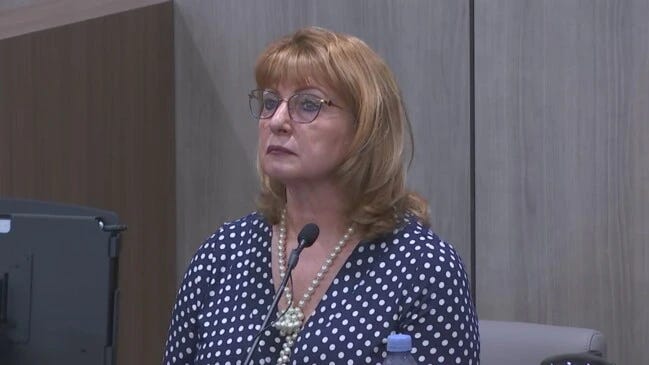
Catherine Bedy
On January 8, 2017, after 87 days without her daughter, believing she is the primary reason for Maya’s separation, Beata commits suicide. She hangs herself in the garage at home while Jack and her son Kyle attend a party. Jack didn’t discover her body until her brother had read Beata’s suicide note and rushed over to the home. When Jack woke up to Beata’s brother’s piercing screams, he knew his wife had taken her own life.

10-year-old Maya with her mother, Beata
In the fallout of Maya’s medical kidnapping, the Kowalski’s lawyer, Debra Salisbury, discovered Dr Smith works for the Suncoast Center, which provides child welfare services to Pinellas County. Salisbury also finds out that children in Pinellas County, where the hospital is based, are almost two and a half times as likely to be removed from their families when compared to the Florida average. Suspicions arise Suncoast has incentivised its employees to misdiagnose children so their customer base could increase.
Retrospective analysis of Maya’s diagnosis would support this theory. After Beata’s suicide, Dr Kirkpatrick, the doctor who initially prescribed the Ketamine, testifies that he informed Dr Smith of Maya’s rare condition and offered to send her all the documented evidence to support his prescription when she contacted him to file her original report. The only thing is, she didn’t include any details of their discussion in that report. The medical expertise of the doctor who’d provided the most materially effective treatment was totally excluded.
Weeks later, local investigative reporter Daphne Chen hears of Beata’s passing. Like any good journalist seeking truth, she refuses to accept the “official story” – “official narrative” connotations intended – and digs in. In January 2019, when her fingertip presses publish on a write up about the Kowlaski’s, something unexpected occurs. Calls start flying in.
Chen becomes inundated with calls and emails from local parents, alleging the misdiagnosis of Munchausen syndrome by proxy. Instances where parents called 911 because their child was experiencing a life-threatening emergency – seizures, breathing difficulty, excess vomiting – were resulting in the same outcome. After their child underwent a series of tests and scans, hospital staff would question parents over the injuries and symptoms and issue a case review. And curiously, the one thing they all had in common – you guessed it – was an assessment from Dr. Smith. Post-Smith assessment, these parents found themselves legally segregated from their child, with some being arrested. They did what the system told them to do, sought help, but were instead, punished.
Upon further investigation, Salisbury, the Kowalski’s lawyer, found that the root cause was less to do with a rogue clinician than it was a deep fault in the system. In the 1970s, child protective services in the U.S. diagnosed child abuse via excess corporeal punishment. We’re talking overt physical abuse – beatings, cigarette burns, etc. But overtime, they redefined the criteria. Fast forward to the 2020s, parents with children suffering from rare conditions that consult with over 3 or 4 doctors can find themselves accused of “doctor-shopping”, exposing a child to unnecessary medical procedures and thus, being guilty of medical child abuse.
In a recent interview with The Epoch Times, investigative journalist Stellar Paul explained how similar circumstances led to the mistreatment of hospitalised Covid patients. Like Maya, these patients were attacked by a system that continually found itself departing from traditional medical ethics and toward a form of blanket-style healthcare. In turn, personalised treatment and attention were subverted. The medical complex treated them en masse, rather than as individuals with unique health needs.
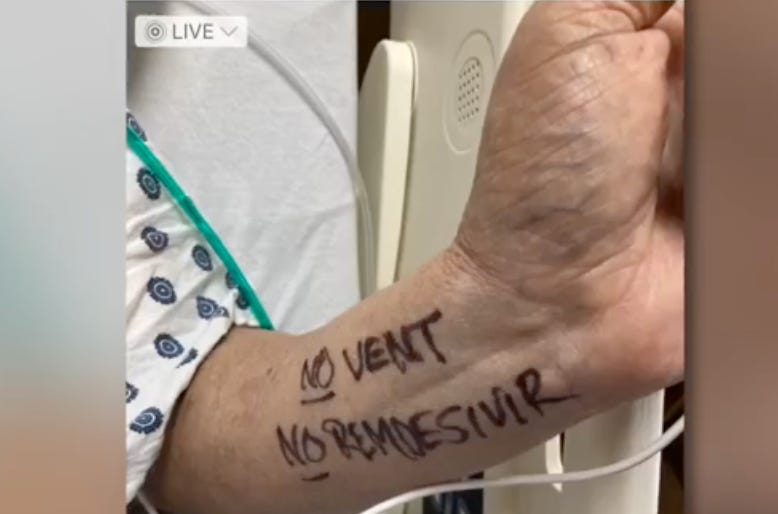
Take the story of Ray Lamar, who, when hospitalised with Covid, specifically requested he not receive certain treatments. He even wrote on his inner forearm, “no vent. (ventilator) no Remdesivir”. So what did his “carers” do? They gave him Remdesivir, without informing him of dangers, without receiving his consent. He later died.

Then, there is Christine Johnson. Christine’s daughter was a nurse, so she was aware of Remdesivir’s questionable benefit-to-risk ratio and the detrimental impact it could have on her kidneys. She also said she didn’t want the drug. So hospital staff gave it to her while she slept. She also died.
These stories go on and on.

Why did hospitals treat patients in this way? Well, again, as Stellar explains, it is because, whether by policy or practice, external forces adulterated the structure of the system. For Ray and Christine, it was the 2020 Coronavirus Aid, Relief, and Economic Security Act (CARES) and the Public Readiness and Emergency Preparedeness Act (PREP). One financially incentivised the use of dangerous treatments while the other legally shielded hospitals that administered them. For Maya, it was the empowerment of Dr Sally Smith and the dilution of the definition of “child abuse”.
The court proceedings for the Kowalski’s were not straightforward. There were various lengthy delays, and they wondered if they would ever see justice. To give you an idea of how vicious the hospital’s lawyers were, when Maya missed just one hearing, they combed through her social media and presented photos to the jury of her attending her homecoming. This, they argued, was proof that Maya could live a “normal teenager’s life”. Talk about vipers.

However, thanks to Beata’s meticulous note-taking of events without which the family’s lawyer said prosecution would have not been possible, the Kowlaski family successfully sued the hospital on multiple claims of false imprisonment, battery, intentional infliction of emotional distress, medical negligence, negligent infliction of emotional distress, negligent training of doctors and healthcare providers, and fraud.
There are numerous parallels we could draw from Maya’s story and 2020 Covid treatment victims but if there is one overarching precedent set, it is how the mutated structure of the medical complex has facilitated anti-healthcare. And it is one that could help dozens upon dozens of Covid treatment victims currently fighting their battles in court as well as other victims of the misdiagnosis of medical child abuse.
Perhaps the saddest realisation after researching this case is that had Beata not taken her own life, it is unlikely we would have heard about Maya’s ordeal. May she rest in peace.
Cheney, Kinzinger, And “Sham” J6 Committee Under Fire After Friday Footage Dump; GOP Senator Calls For Investigation
By Tyler Durden | Zero Hedge | November 19, 2023
Ever since Friday’s release of more than 40,000 hours of Jan. 6 Capitol Police security video, dozens of clips debunking the Jan. 6 committee’s ‘violent insurrection’ narrative have been floating around X.
In response to the exculpatory footage that the Jan. 6 committee never showed the American public, Senator Mike Lee (R-UT) has raised significant questions about the handling of security footage.
Lee’s statements directly challenge the integrity of the now-disbanded committee, particularly addressing the roles of its former Republican members, Liz Cheney and Adam Kinzinger. He also accuses the committee – particularly those two, of selectively sharing information.
After Cheney attempted to hit back with her ‘best hits’ Jan. 6 footage, Lee replied: “Liz, we’ve seen footage like that a million times. You made sure we saw that—and nothing else.”
Lee also called for an investigation into the committee itself, labeling it a “sham” and questioning the use of taxpayer dollars in its operations. He insinuates that crucial information about the committee’s work could have been “deliberately lost or destroyed,” casting doubts on the committee’s transparency and objectivity.
The argument continued throughout the day, with Lee linking to a NY Post article with the headline “FBI lost count of how many paid informants were at Capitol on Jan. 6, and later performed audit to figure out exact number.”
Kinzinger swings and misses all day
In response to the backlash, Kinzinger made a stupid joke comparing Jan. 6 protesters to US army helicopters providing fire for South Vietnamese ground troops attacking the Vietcong in 1965.
He also retweeted about a dozen similarly stupid jokes (check out his timeline).
The House Select Committee on the January 6 Attack was disbanded in January 2023, after releasing its final report in December 2022. The committee, comprising seven Democrats and two Republicans, faced criticism for its composition and the perceived partisanship in its approach.
Kinzinger did not seek reelection, and Cheney lost her primary, marking a significant shift in the Republican landscape. The release of the security tapes by Johnson is seen as a step towards transparency, allowing the public to form their own opinions about the events of January 6, away from the committee’s narrative.
Ukraine reveals size of new international loan
RT | November 19, 2023
The Ukrainian government expects to get a loan of $1.1 billion from the World Bank, Prime Minister Denis Shmigal said on Saturday, adding that the aid will be used for social benefits, education, medicine, and other priorities.
“Ukraine continues to attract money from partners, with an almost $1.1 billion loan expected from the World Bank,” Shmigal wrote in a Telegram post.
The prime minister added that the country also expects to obtain €162 million ($177 million) in financial support from the European Investment Bank as part of programs to restore Ukraine, while $190 million and $70 million would be allocated by Norway and Switzerland, respectively.
Earlier this week, the Ukrinform news agency reported that EU military aid for Ukraine had reached €27 billion euros (some $28.8 billion) since the beginning of the conflict, marking a record high in the bloc’s history. The military assistance includes ammunition, air defense systems and tanks.
Meanwhile, financial, military, humanitarian, and refugee assistance provided by EU member states to Ukraine has already amounted to about $89 billion.
Last month, Gavin Gray, the head of the International Monetary Fund’s (IMF) mission in the country, said that over time international support for Ukraine would inevitably decrease, urging Kiev to develop internal resources for self-financing.
In April, Ukrainian Finance Minister Sergey Marchenko said the monthly deficit of the Ukrainian budget had totalled $5 billion, with two-thirds covered by foreign loans and grants, while three-quarters of spending goes to military needs.
In August, the Finance Ministry reported that Ukraine’s national debt had exceeded $132 billion, having increased by $4 billion in July alone.
The IMF previously projected that Ukraine’s state debt would amount to 88.1% of GDP in 2023, and would exceed 100% of GDP in 2025.
EU politicians have Ukraine ‘military psychosis’ – Hungarian FM
RT | November 19, 2023
Many high-ranking politicians from the European Union are out of touch with reality when it comes to the Russia-Ukraine conflict, Hungarian Foreign Minister Peter Szijjarto said on Saturday.
Unlike other EU countries, Hungary has refused to send weapons or other lethal aid to Ukraine, insisting that it is focused on finding a peaceful resolution to the hostilities.
“A significant part of the European political elite has practically lost common sense. Some people imagine themselves in Fortnite,” Szijjarto said at a political event in Budapest, referring to the popular multiplayer video game.
“They suffer from military psychosis, and, for some mysterious reason, believe that arms shipments can bring peace.”
“It is clear to us that we need peace instead of weapons. Whoever brings weapons into our neighborhood, prolongs the war. And the longer the war, the more people will die and greater destruction will occur,” the diplomat added.
Budapest has harshly criticized the European bloc’s sanctions on Russia over its actions in Ukraine. Prime Minister Viktor Orban has described the restrictions as a failure that have only exacerbated the energy crisis and the already high inflation rates across the continent.
Earlier this month, Orban said Kiev is “light years away” from joining the EU. Ukraine formally applied to become a member of the bloc in February 2022, hoping for an expedited admission process in light of Russia’s military operation.
Israeli army detains dozens, including women, journalists, in West Bank raids

Israeli soldiers raid the Balata camp for Palestinian refugees, east of Nablus in the occupied West Bank on November 19, 2023 [JAAFAR ASHTIYEH/AFP via Getty Images]
MEMO | November 19, 2023
Palestinian killed, another injured in Israeli attack on MSF convoy

Palestine Information Center – November 19, 2023
One person was killed and one was injured in an attack on Saturday on a convoy of Doctors Without Borders/Médecins Sans Frontières (MSF) staff members and their families who had been attempting to evacuate from northern Gaza.
The person who was killed was a relative of an MSF staff member. “MSF condemns in the strongest terms this deliberate attack.”
“The convoy was made up of 137 people — Palestinian MSF staff members and their families, including 65 children. Since November 11, they have been trapped in MSF’s guesthouse, office and outpatient clinic near Al-Shifa Hospital in Gaza because of ongoing fighting, and we have repeatedly called for their safe evacuation,” MSF said in a statement on Saturday.
MSF explained that on Saturday morning, its convoy of five vehicles departed at 9:00 a.m. local time, all clearly marked with MSF identification, including on the roofs.
MSF said it arranged for the movement of the convoy, but when the convoy reached the point where the Israeli army had constructed a newly erected checkpoint, the area was already overcrowded with Palestinian civilians seeking to flee.
However, after hours of waiting, the Israeli army did not allow the convoy to cross toward the south and shots were fired to push it back to Gaza City, MSF added.
When the convoy was on its way back, it was attacked. “Two of the MSF cars were deliberately hit, killing one MSF staff’s family member and injuring another.”
MSF has called again to urgently allow the evacuation of its staff and their families as well as of thousands of other people, who are trapped by fighting and living in extremely dire conditions in northern Gaza.
“We are calling for an immediate ceasefire, which is the only way for corridors to be implemented to safely evacuate trapped civilians.”
Experts refute Australian charge claiming PLA destroyer’s use of sonar ‘unprofessional,’ question Australian frigate’s location, purpose
By Liu Xuanzun and Guo Yuandan | Global Times | November 19, 2023
Chinese experts on Sunday refuted accusations from Australia claiming that a Chinese People’s Liberation Army (PLA) destroyer used sonar to force divers from an Australian frigate to exit the water, saying that the Australian statement is vague and one-sided, and aims to hype the “China threat” theory.
The HMAS Toowoomba, an Anzac-class frigate of the Royal Australian Navy, on Tuesday sailed in “international waters inside of Japan’s Exclusive Economic Zone” en route to commence a scheduled port visit during “operations in support of United Nations sanctions enforcement in the region” when it stopped to conduct diving operations in order to clear fishing nets that had become entangled around its propellers, the Australian defense department said in a press release on Saturday.
While diving operations were underway, a PLA Navy destroyer, the Sovremenny-class guided missile destroyer Ningbo (Hull 139), operating in the vicinity closed toward the HMAS Toowoomba, the Australian press release said.
According to the Australian press release, the two countries’ vessels were able to establish communications, before the Australian ship detected the Chinese ship operating its hull-mounted sonar “in a manner that posed a risk to the safety of the Australian divers who were forced to exit the water.”
The Australian press release is widely questioned by Chinese military experts, especially about the vague location given where the incident is supposed to have taken place.
Zhang Junshe, a Chinese naval expert, told the Global Times on Sunday that while Australia claimed the incident happened in Japan’s exclusive economic zone, it did not give the exact location.
If the incident took place in waters to the west of Japan, China and Japan have not carried out maritime delimitation in relevant waters, so Japan’s self-proclaimed exclusive economic zone could be well within waters administered by China, Zhang said.
Another Chinese military expert who requested anonymity told the Global Times on Sunday that Australia likely intentionally chose not to disclose the exact location because it has a guilty conscience.
“Did the incident take place near China’s Diaoyu Islands or the island of Taiwan? Or was it close to a PLA training exercise? If that is the case, it was obvious that the Australian warship provoked China in the first place,” the expert said.
Analysts pointed out that the Australian press release is one-sided as it failed to mention the Chinese input during the communications between the two countries’ ships.
Since the Australian side admitted that it had established communications with the Chinese side, it is very likely that the Chinese ship issued verbal warnings which the Australian ship had ignored, and the Chinese ship was forced to take the ensuing step which was to send a warning through sonar, the abovementioned anonymous expert said.
Some of the main purposes of a sonar system is to detect submarines and underwater terrains, similar to how a radar system is used to detect aircraft, the expert said, explaining that active sonar generates sound waves that vibrate underwater.
Pinging with sonar is also a means to communicate, and in this case, was likely used to warn the Australian operation, the expert said.
Australia claimed that the sonar pulses likely caused minor injuries to the Australian divers, but the wording is also very vague and has no proof, analysts said.
“Australia said it had fishing nets that had become entangled around its frigate’s propellers. It shows that such a close-in reconnaissance attempt not only posed threats to China’s national security, but also to the normal maritime work of fishing boats,” Zhang said.
In the recent period, countries like Australia and Canada have been repeatedly accusing Chinese warships and warplanes of “unsafe, unprofessional” interactions, as these forces from outside of the region conducted close-in reconnaissance operations on China’s doorstep in the name of UN sanctions enforcement, observers said.
Alert patrols by Chinese warplanes and warships on China’s doorstep are normal and should not have been hyped as “China threat,” Zhang said.
These countries should stop sending warships and warplanes from thousands of kilometers away to stir up troubles and flex their muscles on China’s doorstep, experts said.
Ministers from Arab, Muslim countries embark on China visit to end Gaza war
MEMO | November 19, 2023
Ministers from Arab and Muslim-majority countries are to head to China tomorrow as part of the first leg of a tour aimed at ending Israel’s genocidal war in Gaza, the Saudi Foreign Minister Prince Faisal bin Farhan said.
In an announcement shared on social media platform X, the Kingdom’s top diplomat said “The first stop will be in China and will then move to a number of capitals to deliver the clear message that there must be a ceasefire immediately as well as aid and humanitarian needs must be immediately delivered to Gaza.”
Prince Faisal made the comments after a meeting with EU foreign policy chief Josep Borrell on the sidelines of the Manama Dialogue 2023 conference in Bahrain.
“We must work to end this crisis and end this war on Gaza as soon as possible,” Prince Faisal added.
According to the Saudi Gazette, the extraordinary joint Arab-Islamic Summit, which was held in Riyadh last week, issued a resolution tasking the foreign ministers of Saudi Arabia, Jordan, Egypt, Qatar, Turkiye, Indonesia, Nigeria, and Palestine to initiate immediate international action on behalf of all member states of the Organisation of Islamic Cooperation (OIC) and the Arab League.
“The goal is to formulate an international initiative to halt the war in Gaza and push for a genuine and serious political process, leading to a permanent and comprehensive peace in accordance with established international references,” it said.
The forthcoming meeting in Beijing was confirmed today by China’s state broadcaster CCTV, citing the country’s foreign ministry spokesperson Mao Ning.
“During the visit, China will have in-depth communication and coordination with the delegation on ways to deescalate the ongoing Palestinian-Israeli conflict, protect civilians and seek a just settlement of the Palestinian question,” said Mao.
In May, a poll conducted for Arab News by Yougov found that the majority of Palestinian respondents – 80 per cent, preferred China as a potential peace broker in the conflict with the occupation state, with the US seen as the least trusted mediator.
READ ALSO:
Imam Khamenei Urges Muslim Countries to Cut Zionist Regime’s Lifeline
Al-Manar | November 19, 2023
Supreme Leader of the Islamic Revolution Ayatollah Sayyed Ali Khamenei has described the Zionist regime as a manifestation of racial discrimination, urging Muslim countries to cut the lifeline of the Zionist regime of Israel.
Ayatollah Sayyed Ali Khamenei made these remarks during his visit to the IRGC Aerospace Forces exhibition on Sunday.
Ayatollah Khamenei said that Zionists consider themselves to be a superior race and consider the rest of human beings to be inferior, and that is why they have killed thousands of children without any remorse.
He described scientific achievements, such as the ones showcased in the exhibition, to be the result of a motivation based on determination and faith.
Whatever field our young people entered with determination and faith, they have been able to do great jobs, he stressed.
The signs of determination and faith were clearly evident in this exhibition, he stated.
The Supreme Leader of the Islamic Revolution referred to innovation as another feature of the event, saying, “We should not be content with the current level of success because various military and civilian sectors in the world are progressing, and we must try not to stay behind.”
Referring to the developments in Palestine and the continuation of the Zionist regime’s crimes in Gaza, Ayatollah Khamenei said that the developments in Gaza revealed many hidden truths to the people of the world, one of which is the support of the heads of Western countries for racial discrimination.
When the US president, the German chancellor, the French president, and the British prime minister aid and abet such a racist regime, it means that they support racial discrimination as the most detestable issue in the world, he noted.
The people of Europe and America should clarify their stance on this situation and show that they are not in favor of racial discrimination, he stressed.
Despite extensive bombings in Gaza, the Zionist regime has failed to achieve its goal of destroying Hamas and the resistance, even after more than 40 days of using all their military power, he stated.
Ayatollah Khamenei described the brutal bombing of hospitals and women and children in Gaza as a sign of the extreme frustration of the Zionist regime’s leader about their defeat, saying that the defeat of the Zionist regime in Gaza is a fact and entering hospitals or people’s houses is not a victory.
Victory means defeating the other party, which the Zionist regime has not been able to achieve so far and will not be able to in the future, he reiterated.
Some Islamic governments apparently condemned the Zionist regime’s crimes in public gatherings, he said adding that some others have not done so yet, which is not acceptable.
He urged Islamic countries to stop exporting energy and goods to the Zionist regime and to cut off their political relationship with the Zionist regime, at least for a limited period.
Featured Video

Iran’s Next Strike May Not Explode. It Could Shut You Down
or go to
Aletho News Archives – Video-Images
Book Review
New paperback: Butchered by “Healthcare”
Lies are Unbekoming | October 20, 2026
 Butchered by “Healthcare” is Robert Yoho’s plain-spoken account of how American medicine stopped being a profession and became an industry. 341 pages. Over a thousand references. Thirty-eight chapters.
“Screening Tests Are Useless”, on tests that find diseases that would never have hurt you. “The FDA Protects the Big Drug Companies”, on an agency funded by the companies it regulates. “The Journals’ Sins Are the Editors’ Sins”, on ghostwritten studies and captured peer review. “Opioids and ‘Pain Management’”, on how a generation was prescribed its way into addiction. “Prozac and Relatives” and “Antipsychotics Are Disastrous”, on what psychiatry does to adults and children. “Surgery: Money Before Patients”. “Failed Cancer Treatments”. “Futile CPR and Overprescribing”. “Billing Scams & Specialty Warfare”. “Hospitals Are Sharks”. Each with a Patient Tips section at the end on how to survive it.
If you have ever walked out of a doctor’s office with a prescription you didn’t ask for, or watched a parent put through a treatment that made them worse, this is the book you want on your shelf before the next appointment. … Full review
Butchered by “Healthcare” is available on Lulu now.
Blog Roll
 Aletho News
- Iran’s Next Strike May Not Explode. It Could Shut You Down /Col Doug Macgregor
- Iran: US political targets legitimate if assassinations return
- Iraq shuts key border crossing with Iran under US pressure: Report
- Undersea Internet cables could be targeted in retaliation for attacks on Iran: IRGC deputy chief
- EU sending ‘biased’ observers to interfere in Serbian election – president
- White House envoy declares kinetic action against Yemen ‘fruitless’
- Ukraine deployed thousands of microdrones in Iraqi Kurdistan: Tasnim
- Iran calls for emergency UNSC meeting over Trump’s ‘brazen’ bomb talk, Israeli threats
- Iranian sources reveal details of Russia-China Hormuz proposal
- Plan for more US-Israel integration puts our military tech at risk
- If Americans Knew
- Americans at National Conservatism Conference held in Israel this year criticize Israel
- Christiane Amanpour exits CNN with a legacy shaped by the debate over Israel
- Israel’s war on Iran is the final move in a decades-old strategy
- Israel Denies Entry to French Journalist, U.S. Researcher Amid Rise in Entry Denials
- Gaza’s hospitals are running out of life-saving fuel – Daily Update
- Mysterious bot accounts reportedly spread fake ‘man on the street’ videos for Michigan Senate candidate
- Israeli Defense Minister Katz Says Over 60 Lebanon Villages Have Been Destroyed
- Why Is Israel Running TV Ads in Iowa Ahead of the Midterms?
- Hind Rajab’s Alleged Killer Is in the United States. HRF Demands His Arrest.
- US Officials Face Fresh Pressure After Another American ‘Brutalized’ by Israeli Settlers in West Bank
- No Tricks Zone
- E-Cars Reduce CO2 Emissions By Only 41% Compared To Internal Combustion Engine Vehicles
- Predictions Made By Renowned Climate Professor Over Past Decades Have Been Proven To Be Poor
- New Study Suggests Large Regions Of The Pacific Ocean Have Been Cooling For The Last 80 Years
- Germany’s Green Energy Debacle: High Energy Costs Force Kahla Porzellan to Close After 182 Years!
- New Study: 50 Years Of The Most Aggressive ‘Net Zero’ Policies Can Only Affect The Global Climate By 0.03°C
- US September “Heat” Was No Record…Many Records Set Decades Ago
- Latest European Green Energy Debacle; Portugal’s Largest Flagship Solar Park Insolvent!
- Green Energy Debacle: German Expert Professor Fritz Vahrenholt Warns Of Severe Economic And Social Consequences
- Two More Paleo Reconstructions Affirm Meters-Higher Sea Levels Across Ireland, Brazil 7000-6000 Years Ago
- New Study: Earth And Venus Surface Warmth Largely Explained By Convection And Lapse Rate, Not CO2 Or Radiation

