On Being a “PreBunked Malinformant”
BY JOHN LEAKE | COURAGEOUS DISCOURSE | OCTOBER 31, 2023
In recent years a vast industry has been created for the “detection, management, and correction of disinformation and misinformation.” Dozens of foundations, big tech companies, and government agencies are now disbursing hundreds of millions (in aggregate) to university departments to train young people for a career in misinformation and disinformation management.
Dr. Aaron Kheriaty mentioned this to me in an interview last summer, and a few nights ago, Dr. McCullough asked me to do some research on this new industry. My inquiry has led me into a Bluebeard’s Castle of horrors.
A quick Google search of “misinformation correction” results in countless reports of grant awards in this burgeoning industry. In other words, instead of acquiring a liberal education (based on the central principle of freedom of speech and expression) an army of college students are in training to become professional censors and propagandists.
How do graduates from university censorship programs conceptualize guys like Dr. Peter McCullough and (to a lesser extent) me?
We are, in the Orwellian language of the censorship schools, “Malinformants”— that is, guys who spread “harmful” information. Because we have been designated as such, we are suitable candidates for “PreBunking.” The following video is a sort of “PreBunking” manual. Note that the technique is explicitly and favorably compared to a vaccine.

The telltales that you’ve become a “PreBunked Malinformant” is when you run afoul of internet trolls who display some or all of the following identifiers:
- Express a zealous belief that vaccines are the saviors and redeemers of mankind.
- Display an icon of the Ukrainian flag on their profile.
- Use extremely disparaging, ad hominem, and sanctimonious language.
- Characterize you of being a “grifter.”
So, how does it feel to be a “PreBunked Malinformant”? Setting aside the feeling of vexation that I’m contending with kids who possess none of my education or experience, I’m left with the emotion of total amazement that American universities now have astoundingly well-financed schools of censorship.
How could this have possibly come about in the United States of America?
The Depopulation Bomb: A Halloween Sci-Fi Tale
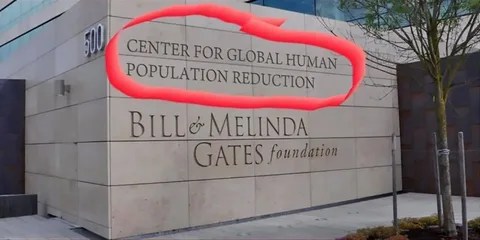
By Clayton J. Baker, MD | Brownstone Institute | October 31, 2023
The following fictional story may or may not bear resemblance to events in real life.
Imagine, if you will, that you are a first-generation high tech gazillionaire. In fact, at one time you were said to be the richest man on earth, although that is no longer the case. Nevertheless, you remain unimaginably wealthy, with all the responsibilities and burdens that such wealth brings. (Given the extremely unusual circumstances of this tale, to make it more relatable, we will assign you a fictional name.) Your birth certificate reads Gilbert Harvey Bates III, but the world knows you as Gil Bates.
Gil Bates’s erstwhile net-worth preeminence (stolen as it was by an upstart online retailer named Biff Jezos) is not the only important loss he has suffered. Also in the rearview mirror is his youth, his marriage, and his position as CEO of the behemoth tech company he created, MacroHardTM.
After Gil Bates stepped down as CEO of MacroHardTM, he focused on his philanthropic work. The centerpiece of this work is the immensely well-funded (and therefore immensely influential) Bates Foundation. The Foundation’s scope may be mind-bogglingly broad, but one problem especially consumed Bates: there are far too many people on the planet.
In his youth, Gil Bates read a controversial book called The Overpopulation Bomb, written by a visionary scientist named Saul Derelicht. That alarming book, a huge bestseller in its day, described a neo-Malthusian hell on earth resulting from human overpopulation, and proposed mass sterilization and other aggressive population reduction techniques as the solution.
Gil Bates became convinced, and remains convinced – especially as the worldwide human population has soared beyond 8 billion units – that Homo sapiens have obscenely overpopulated the planet. Once Bates had sold software packages to the great majority of them, he vowed that this existential threat to the planet must be addressed.
But what was to be done? How could this great affront to Gaia be reconciled? When it comes to a responsibility so great, a task so immense, no single man – not even Gil Bates – could hope to accomplish it alone.
Fortunately for the future of Earth, Bates knew a host of like-minded, enlightened elites, pre-eminent individuals of great wealth, power, and worldwide influence. Among the most important:
- A dour Teutonic economist named Kraut Schlob. The son of an ambitious industrialist who built flamethrowers for the Third Reich, Schlob is the founder and chairman of the World Enslavement Forum. The Forum has become the premier worldwide gathering of hyper-elites who wish to discuss globalist policies, and enjoy the company of high-end prostitutes, free from the prying eyes of commoners.
- An immensely powerful – if embarrassingly vertically challenged – American health bureaucrat named Dr. Fantoni Auci. For decades, Dr. Auci controlled the overwhelming majority of US Government medical research funding. As such, no one in the vast American network of hospitals, research institutes, or universities dares to cross Dr. Auci, and he wields similar influence internationally. In fact, he oversees funding for multiple secret virology research laboratories, as far away as China.
- A mysterious veterinarian named Adalbert Ghoula. Ghoula is the CEO of Kaiser, Inc., the world’s largest and most rapacious pharmaceutical company, which Ghoula has grown into a veritable modern day IG Farben. In his earlier days, Ghoula oversaw the development of a vaccine that successfully induces the chemical castration and sterilization of swine.
The consensus, reached after lengthy consultations with these men and other luminaries, was that the worldwide human population must be reduced from 8 billion to 500 million units.
But how? Several possible avenues were proposed.
- War has been used for millennia to reduce populations, and while highly effective locally or regionally, it would be entirely ineffective at removing the necessary fifteen-sixteenths of people on Earth. After all, the deadliest war in history, World War II, resulted in a mere 80 million deaths, just 3 percent of the world’s population at the time.
- The use of a bomb was considered a special kind of bomb, reminiscent of the “neutron bomb” of yore, which would supposedly reduce populations while sparing infrastructure. This seemed closer to the mark than all-out war, but ultimately it was determined that setting off bombs would be both impractical and far too obvious. After all, even herd animals will not consent to being openly and massively slaughtered, no matter how necessary the culling may be. The herd must be kept forever in the dark.
- A plague, a pestilence, a pandemic seemed more promising. Past naturally occurring pandemics had reduced human populations much more successfully than wars. The Black Death of 1346-53 may have reduced the world population by as much as 25 percent, a much more encouraging number than the measly 3 percent from World War II. As an added economic bonus, the Black Death served as a very effective concentrator of wealth for the survivors, as it caused minimal collateral property loss.
However, a more detailed review of historical worldwide population estimates demonstrated that a pandemic alone could only serve as a temporizing measure at best. Most estimates show that by 1400, the worldwide population had unfortunately returned to its pre-plague total.
Clearly, the necessary 94 percent reduction in population could not be achieved by culling the herd alone. Sterilization would be needed as well. But how to achieve such mass sterilization? Many H. sapiens possess an intense desire to procreate – that’s the source of the problem, after all. Unfortunately, prior historical initiatives for mandatory sterilization – even those of limited scale and scope, such as those targeting the mentally deficient – have met great opposition, at least in the so-called “free” nations.
- However, a vaccine could be used for mass sterilization. Ghoula’s earlier work at Kaiser was proof of this. But a fundamental problem remained: how to get the unsuspecting population – specifically, its children and young adults – to take the stealth-sterilizing inoculation?
The solution, when it came, was a thing of beauty, sublimely subtle and symmetrical. The answer was a two-step process: a pandemic and a vaccine. One population reduction device would be released, presented as a worldwide plague. It would be followed by a second population reduction device, presented as the cure.
And the technology was already in place to make it happen. It merely had to be perfected, then enacted.
Employing the Black Magic of gain-of-function virology research, an animal respiratory virus, previously never infecting humans, was genetically engineered to readily infect and spread amongst humans. At a key moment in political history, when a particularly bothersome populist American President named T. Ronald Dump was running for reelection, the virus was released from a Chinese laboratory into the human population.
As the new virus spread, reports of the death and devastation it wrought were spread as well. In actuality, the virus had been engineered so that it was deadly only to the frail, chronically ill, and very old. It was cleverly propagandized, however, as a threat to persons of all ages, a modern day Black Death of sorts.
The US deep state, desperate to disrupt the Dump presidency and remove him from office, were willing partners to manage the control and manipulation of the population through propaganda, and to enforce unprecedented, prolonged lockdowns of society. Remarkably, they even convinced President Dump to sanction the lockdowns, and to fund the development of the vaccine. Most other countries followed suit.
The new virus rapidly killed off many of the oldest and sickest members of society, as would be expected of a novel respiratory virus. However, the locked-down and isolated populations were barraged with media messages that stirred up mass terror of the virus. Businesses were closed, save for those deemed “essential.” Schools were closed, though children were already known to be at statistically zero risk of death. Dissenters were harassed, scapegoated, and punished.
Then, a solution to the pandemic was presented: the vaccine. The vaccine was the savior, the only way out of this crisis.
A few irritating, contrarian dissenters fought back. They protested for civil rights. They stressed the near impossibility of producing an effective vaccine against a rapidly mutating respiratory virus. They identified numerous “safety signals” found in the vaccine trials, and tried to expose these as best they could. But the mainstream media drowned them out, the social media companies (controlled by the deep state) censored them ruthlessly, and after all, once the vaccines were mandated, most people took at least a couple of doses.
And the joke was on the dissenters in another, more important respect. These meddlesome do-gooders were indeed intelligent enough to identify the toxicities inherent in the vaccines. But they decried them as “safety signals.” The fatal toxicities they identified still seemed to them to be flaws, mistakes, and the unfortunate results of a hasty and mad rush to make money off of the pandemic.
Imagine the naïvete.
Early in the vaccine “rollout,” young women reported abnormal vaginal bleeding and other menstrual problems after receiving the vaccines, raising concerns about potential unintended consequences to female reproduction. Pathologists found ovaries infiltrated with multiple toxins from the vaccines, both the dreaded “spoke” protein of the virus and “lucid nanoparticles” from the vaccine’s delivery system. Even occluded Fallopian tubes were identified.
Soon thereafter, reports appeared in the alternative media of dramatically increased numbers of sudden deaths, primarily in young men, after receiving the vaccine. It often visibly occurred in athletes while on the playing field. This caused considerable alarm, impossible as it was to hide.
In a masterful demonstration of the “limited hangout,” officials acknowledged the sudden death phenomenon, but would not even allow mention of the vaccine as a possible cause within the mainstream medical community. Instead, protocols and clinics for this sudden epidemic of heart disease in the young were established, but strangely without any official curiosity as to the cause. All they knew for sure was that it couldn’t be the vaccine.
Of course, the infamous “spoke” protein, the same viral antigen chosen by the vaccine’s designers to induce the vaccinated patient’s body to produce in quantity, just happens to be the most toxic part of the virus. The “spoke” protein deposits itself in tissues throughout the body, wreaking havoc wherever it goes. It has a particular affinity for the heart muscle, causing the inflammatory process known as myocarditis that leads to cardiac arrests.
“Spoke” doesn’t stop with the heart, however. It is a remarkably versatile toxin, a sort of Swiss Army monkey wrench in the human body. It causes gigantic, gruesome, rubbery blood clots in the vasculature, seizures in the central nervous system, the aforementioned deposits in ovaries and Fallopian tubes (and testes, for that matter), etcetera, etcetera. What a stroke of genius to choose “spoke” as the antigen the vaccines induce replication of!
The vaccines held another nasty little secret, which even the pathetic, naïve resistance only recognized much later. The vaccines were “contaminated” with plasmids containing MV-40 and MV-40-like DNA sequences. Yes, that MV-40, the monkey virus known to cause cancer in multiple animal species.
Could the appearance of so-called “turbo cancers” in vaccinated persons somehow be related to this “contamination?” Well, another limited hangout, this time courtesy of Healthcare Canada, took care of that.
Excess death rates rose dramatically after the vaccine rollout. Birth rates plummeted. To the do-gooders, refuseniks, and dissidents, this was a scandal.
But what did they know? To use a phrase all-too-familiar to the seasoned software developer, these toxicities were not bugs, but features. The vaccines were working exactly as they were supposed to work.
Silly plebes! The “vaccines” were actually a deliberate, multi-pronged, population reduction device. They were designed to kill a percentage of young people – mostly male – outright, to poison and disable the female reproductive system at multiple points, and to insert teratogenic plasmids into recipients’ cells, to pick off others at undisclosed, later dates. They were merely packaged and marketed as a vaccine against a (lab-manufactured) flu-like illness.
As successful as they have been, there remains so much more work yet to be done.
A definite lull occurred in the population’s acceptance of repeated injections of the vaccine. The dissidents may be naïve, but they are persistent, and sometimes effective to a degree. But ultimately they will fail.
The general population is lazy, uneducated, and easily terrified. (Some say they are being done a favor by being culled.) They are accustomed to the precedents set by other vaccines. Their reluctance will be worn down with time. Of course respiratory viruses are imperfect targets for vaccines. Once again, that’s not a bug, it’s a feature! It only means that a new booster of the vaccine will be needed every year – at least.
With each new round of boosters, a new population of girls and young women will be rendered infertile. A new group of boys and young men will suffer cardiac arrest – a very quick and painless way to die, really.
Countless others will contract cancers – turbo cancer, to use the current term for these rapidly progressing and deadly malignancies, often of unusual types – bone cancers, muscle cancers, and other former rarities. Not an easy way to die, admittedly. But these tumors mercifully progress to end stage very swiftly, and their value as a population reduction device is undeniable.
Have no fear. It is only a matter of time; only a matter of lather, rinse, repeat. As long as the herd allows itself to be sent through the sheep dip whenever and however often the shepherds proclaim is necessary, H. sapiens will get to 500 million. All courtesy of a type of bomb after all, but in this case a microscopic bomb that is released in each person via a tiny little injection: The Depopulation Bomb.
Happy Halloween!
C.J. Baker, M.D. is an internal medicine physician with a quarter century in clinical practice. He has held numerous academic medical appointments, and his work has appeared in many journals, including the Journal of the American Medical Association and the New England Journal of Medicine. From 2012 to 2018 he was Clinical Associate Professor of Medical Humanities and Bioethics at the University of Rochester.
Maidan snipers: The founding myth of ‘new’ Ukraine has been proven to be a lie. Why is the West silent?
By Tarik Cyril Amar | RT | October 31, 2023
Earlier this month, a district court in Kiev announced its findings in a case that had dragged on since 2015, handing down sentences to five former officers of the long-dissolved ‘Berkut’ police unit. The ex-police grouping become internationally known during the 2013/14 protests which culminated with the violent ‘Maidan.’
Charged with involvement in the shooting of anti-government protesters by snipers in the center of the Ukrainian capital on February 20, 2014, four of the accused – three of them in absentia – were found guilty and sentenced to terms between five years and life. One was acquitted.
Politically, this was, or should have been, Ukraine’s single most important trial since independence in 1991. The judges closed – at least for now as appeals have already been announced – the country’s attempt to come to terms judicially with the darkest moment of what has been called a “revolution,” as well as a “coup”: the fall of the government of former President Viktor Yanukovich under pressure from initially peaceful – then violent – street protests and Western meddling. The events producing regime change and geopolitical re-orientation unfolded over three months, but the killing of almost 50 protesters that February was a crucial tipping point.
The case quickly became known as the “snipers’ massacre” or the “Maidan massacre.” The shootings were squarely blamed on Yanukovich and his administration and seemed to rule out domestic compromise and confirm Western and Ukrainian pro-insurgent narratives, casting the crisis as a national and democratic freedom struggle against a corrupt and oppressive regime beholden to Moscow. Neither the disproportionate role of an aggressive and manipulative Ukrainian far right nor the ruthless geopolitics of the West had a place in this framing. Within days after the killings, a last attempt to stop the spiral of escalation by an internationally mediated agreement failed, Yanukovych fled to Russia, and Moscow’s troops were on the move in Crimea.
Then things got worse. Clashes between Kiev’s new government and rebels in Donbass evolved into an initially intense, then mostly slow-burn, regional civil war, including limited Russian interventions. The best chance for peace, the 2015 Minsk 2 Agreement, was sabotaged systematically by Kiev and its Western supporters, and, after February 2022, Ukraine became the theater of a proxy war of the collective West against Russia. The West and Ukraine are now likely to lose this conflict at immense cost in lives and wealth, mostly to Ukraine. International tension is extremely high, trust has evaporated, and meaningful communication is almost impossible.
Ukraine and the world could be in a much better place if the last days of February 2014 had played out differently, allowing for the compromise already negotiated between Ukraine’s government and the insurgents to take hold. The Maidan Massacre was not the only but the single most important shove toward an ever-widening conflict, especially as the dominant Western narrative about the killings has remained the same, blaming only the old regime and rejecting any challenge to the narrative as a pro-Russian “information war.” Here was the perfect story, in short, to emotionally legitimize not only support but uncritical backing for Kiev, the rejection and sabotage of any concessions to Ukraine’s domestic rebels in the East, and vilifying any effective cooperation with Moscow.
But what if we were not told the truth about the killings? That is the key claim advanced by Canadian-Ukrainian political scientist Ivan Katchanovski. Katchanovski (who also recently exposed the scandal around the honoring of a Waffen-SS veteran by the Canadian parliament) has long argued that “the Maidan massacre was a false-flag mass killing of … protestors and … police in order to seize power in Ukraine. It was conducted with the involvement of oligarchic and far-right elements of the Maidan opposition using concealed groups of Maidan snipers in Maidan-controlled buildings.”
The rich detail of Katchanovski’s findings cannot be reproduced here, but three points should be noted: Snipers belonging to the insurgents’ side started shooting at the police on the morning of February 20; key positions, such as in the Hotel Ukraina and a conservatory, from which these policemen were attacked and later Maidan protesters as well, were and remained under the control of insurgent units (not the police); and after 9.00 am, protesters, too, were shot by insurgent snipers (again: not by the police).
In sum, two things happened, according to Katchanovski’s findings: Insurgent snipers first shot at the police to provoke an escalation, and then, in addition, even killed protesters – that is, those on their own side. At the same time, Katchanovski does not rule out the possibility that the police also shot protesters. But his careful analysis of video and other evidence shows that many victims, likely the majority, were targeted by insurgent shooters.
Katchanovski has come to these conclusions through years-long, rigorous, and exhaustive forensic research, as summarized in his peer-reviewed article “The ‘Snipers’ Massacre’ on the Maidan in Ukraine” in Cogent Social Sciences, an academic journal published by Taylor and Francis. He has not been the only one reaching such or similar results, but his work is the most thorough and important independent investigation. Clearly, that is why, due to its political implications, he has had to withstand being smeared as a “conspiracy theorist” and pro-Kremlin information warrior; his work has been censored; and he has suffered severe retaliation by attempts at professional and social marginalization and the pseudo-legal confiscation of his family’s property in Ukraine.
Ukrainian courts are not politically independent. Judges, whatever their own views or professional ethics, work under the threat of ostracism and violence from Ukraine’s far right (at least). And yet, as Katchanovski has pointed out, buried in the million-word findings of the recent verdict, the court has recognized several facts that confirm his interpretation of the Maidan Massacre, including the following: four police officers were killed and 39 wounded by insurgent snipers; snipers shot from buildings under insurgent control; and it cannot be ruled out that eight victims were killed and 20 injured by “unknown” perpetrators who were not from the police.
While Katchanovski is to be admired for his research and steadfastness, what is especially important here is that the long backlash against his research is a symptom of something larger that is badly amiss in both Ukraine and the West. Even now, the Ukrainian information war outlet Euromaidan Press, for instance, still combines a personal attack on Katchanovski with disinforming its readers, claiming that the verdict somehow contradicts his findings (which are, by the way, badly misrepresented).
The opposite is the case.
This is just the latest example of a deep culture of disinformation and self-disinformation that has taken root in the West. While Western elites may well lie deliberately much of the time, substantial parts of the Western media, it seems, have come to not only believe these lies – or those of favorites, clients, and allies – but to defend them with a vigor that betrays psychological investment.
The emotionally-charged reality denial around Hillary Clinton’s richly-deserved defeat in the US election of 2016 (“Russiagate”), the bizarre doublethink regarding Western forces (and/or Ukraine) blowing up Nord Stream (thereby committing an act of war among “allies” and of eco-terrorism), Israel’s “right to defend itself” interpreted as the permission to commit crimes against humanity with Western support – all are instances of a form of collective self-indulgence. Too many people in the West still claiming to be the world’s “value” guardian practice lying and lying to themselves as if it were their special birthright.
Yet these lies and fiercely guarded illusions corrupt individuals and politics, polarize societies, disrupt international relations and, last but not least, cost lives – thousands, tens of thousands, and, in the case of Ukraine by now, hundreds of thousands. Conflict is a normal part of human life, and, to some extent, inevitable.
Driving yourself insane with dishonesty is not. And it certainly does not help keep the peace.
Tarik Cyril Amar is a historian from Germany at Koç University in Istanbul working on Russia, Ukraine, and Eastern Europe, the history of World War II, the cultural Cold War, and the politics of memory. Follow Tarik on X @tarikcyrilamar
Ukrainian border guards using drones to catch ‘fleeing’ citizens – UNIAN
RT | October 31, 2023
Ukraine’s border-guard service (DPSU) has released several videos showing surveillance drones helping officers catch people trying to leave the country illegally. National media have described those who’ve been caught as nationals “fleeing” Ukraine, amid an armed-forces mobilization as Kiev’s conflict with Russia continues.
In the first clip published by DPSU on Saturday, a drone operator uses the aircraft’s thermal camera to guide a patrol towards a group of people hiding in bushes. The service claims the technique helped it catch 14 trespassers in four separate interceptions near the village of Okny near the border with Moldova.
The next day the border guards released footage of a short chase, as seen from a drone via a night camera. The DPSU said the four would-be violators in this instance wanted to go to Moldova but were intercepted as they made their attempt.
Another video published by the service on Monday includes drone footage of a car moving down a battered road. Guards then stop the vehicle and apprehend the driver, who the DPSU claimed to be a people-smuggler.
The suspect allegedly used his transport to sneak his clients to a part of the border with Moldova from where they would then cross illegally. Would-be violators in the first two cases reported by the DPSU had also used services of smugglers, who ask as much as $2,000 for help crossing the border, according to the service.
The footage doesn’t go into what motivates people to embark their law-breaking trips. UNIAN, a major Ukrainian news outlet, described the official action as guards “keeping catching nationals fleeing across the border.”
Kiev has banned men who are eligible to serve in the military from leaving the country unless they get a waiver. It’s now reportedly ramping up efforts to draft additional troops, after suffering heavy casualties in attempts to breach Russian defensive lines over the months of the so-called summer counteroffensive.
Ukrainian MP Sergey Rakhmanin, who sits on the parliamentary Committee for Security, Defense, and Intelligence, said in an interview last week that the country had long exhausted the reserve of persons who’d volunteered to go the front.
Moscow has accused Kiev’s Western sponsors of using Ukrainians as “cannon fodder” in a proxy war against Russia. In a speech at a security forum in Beijing on Monday, Defense Minister Sergey Shoigu estimated Ukrainian casualties during the counteroffensive at over 90,000.
NYT Writes about the Israeli Intel Failures on Hamas
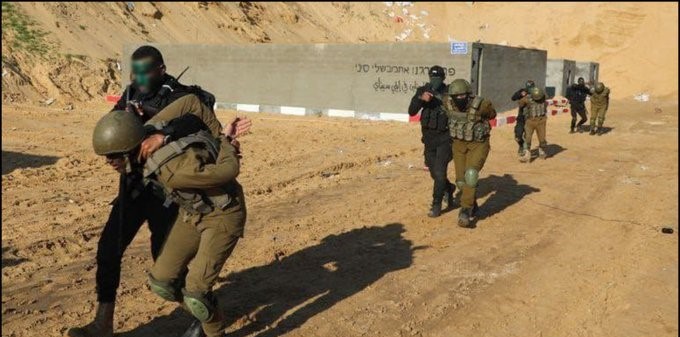
Palestinian resistance fighters capture Israeli occupation soldiers during an attack on a militray post in the Gaza envelope as part of Op. Al-Aqsa Flood (October 7, 2023).
Al-Manar – October 31, 2023
The Israeli occupation military’s 8200 signal intelligence unit stopped listening in to the handheld radios of Hamas operatives in Gaza a year ago, deciding it was a “waste of effort,” The New York Times reported noting that this was one of a series of failures that led to the shocking success of the Oct. 7 Operation Al-Aqsa Flood.
In an extensive report on the intelligence failures, the paper also said on Sunday that US spy agencies had largely stopped collecting information on Hamas in recent years, believing that ‘Israel’ had contained the threat from the Palestinian resistance group.
Monitoring that network might have helped Ronen Bar, the director of the Israel Security Agency, or Shin Bet, realize at 3 a.m. on Oct. 7, a few hours before the attack, that the unusual activity he was seeing on the Gaza border wasn’t just another Hamas “military” exercise, the Times noted.
Israeli military also placed its confidence in “The Barrier,” the nearly 40-mile-long concrete wall that plunges underground to prevent tunneling. It included a high-tech surveillance system that relies on cameras, sensors and remote-controlled machine guns.
“Senior Israeli military officials believed that the combination of remote surveillance and machine-gun systems with the formidable wall would make it almost impossible to infiltrate Israel, and thus reduce the need for a large number of soldiers to be stationed at the bases,” the newspaper reported.
Hamas’s attack put paid to the idea that concrete and technology could be relied on. The Hamas fighters blew up cellular antennas and remote shooting systems along the fence with explosives precisely dropped from drones.
“In a conversation with military investigators two weeks after the attack, soldiers who survived the assault testified that the Hamas training was so precise that they damaged a row of cameras and communication systems so that ‘all our screens turned off in almost the exact same second,’” the Times reported.
There simply were not enough Israeli soldiers to fill the gaps once the technology was destroyed and the security barrier breached. Hamas terrorists [resistance fighters] poured through.
“We started receiving messages that there was a raid on every reporting line,” one soldier at the Gaza Division base told an Israeli news site.
“The forces did not have time to come and stop it. There were swarms of terrorists, something psychotic, and we were simply told that our only choice was to take our feet and flee for our lives.”
The Hamas rampage across western Negev communities went on for hours, with the Israeli soldiers’ response shockingly slow, (Something that has still not been explained).
After the fighting, Israeli soldiers found hand-held radios on the bodies of some of the Hamas fighters, “the same radios that Israeli intelligence officials had decided a year ago were no longer worth monitoring,” the Times reported.
‘Turning Gaza into ashes’: Israel propaganda vs the world
By Ramzy Baroud | MEMO | October 31, 2023
Gaza has changed the political equation in Palestine. Moreover, the repercussions of the ongoing devastating war are likely to alter the political equation in the entire Middle East and to re-centre Palestine as the world’s most urgent political crisis for years to come.
Since the establishment of Israel in 1948, facilitated by Britain and protected by the United States and other Western countries, the priorities have been entirely Israeli. “Israel’s security”; Israel’s “military edge”; “Israel’s right to defend itself”, and much more, are the mantras that have defined the West’s political discourse on the Israeli occupation and apartheid in Palestine.
This bizarre US-Western understanding of the so-called conflict, that an oppressor has “rights” over the oppressed; the occupier has “rights” over the occupied, has enabled Israel to maintain a military occupation over Palestinian territories that has lasted for over 56 years. Indeed, many would argue that it is for more than 75 years.
It has also empowered Israel to neglect the roots of this “conflict”, namely the ethnic cleansing of Palestine in 1948, and the long-denied, and very legitimate, Right of Return for Palestinian refugees.
Within this context, every Palestinian-Arab overture for peace was rejected. Even the supposed “peace process”, namely the Oslo Accords, turned into an opportunity for Tel Aviv to entrench its military occupation, expand its illegal settlements and corral Palestinians in Bantustan-like spaces, humiliated and racially segregated.
Some Palestinians, whether enticed by American handouts or shattered by a lingering sense of defeat, lined up to receive the US-Israeli peace dividends: pitiful crumbs of false prestige, empty titles and limited power, granted and denied by Israel itself.
However, the Israeli war against the Palestinians in Gaza is already changing much of this painful status quo. The occupation state’s constant insistence that its deadly war is against Hamas, against “terror”, against Islamic fundamentalism, and all the rest, may have convinced those who are ready to accept the Israeli version of events at face value. However, as the bodies of thousands of Palestinian civilians, including thousands of children, began piling up at Gaza’s hospital morgues and, tragically, in the streets, the narrative began changing.
The pulverised bodies of Palestinian children, of whole families who perished together, stand witness to the brutality of Israel; to the immoral support of its allies; and to the inhumanity of an international order that rewards the murderer and reprimands the victim.
Of all the biased statements made by US President Joe Biden, the one where he suggested that Palestinians are lying about the body count of their own dead was perhaps the most inhumane. Washington may not realise this yet, but the repercussions of its unconditional support for Israel will prove to be disastrous in the future, especially in a region that is fed up with war, hegemony, double standards, sectarian divisions and endless conflict.
The greatest impact, though, will be felt in Israel itself. When Palestinian Ambassador to the UN Riyad Mansour gave a powerful, emotional speech on 26 October, he could not hold back his tears. International delegations at the UN General Assembly clapped non-stop, reflecting the growing support for Palestine, not only at the UN, but also in hundreds of towns and cities, and on countless street corners around the world.
When the Israeli Ambassador to the UN, Gilad Erdan, who had promoted many of the lies communicated by Tel Aviv, especially in the early days of the war, finished his speech, not a single person clapped. The contempt was palpable.
The Israeli narrative had clearly crumbled into a thousand pieces. Israel has never been so isolated. This is definitely not the “New Middle East” that Netanyahu had prophesised in his UN General Assembly speech on 22 September.
Unable to fathom how the initial sympathy with Israel turned so quickly into outright disdain, the settler-colonial state resorted to old tactics. On 25 October, Erdan demanded that UN Secretary-General Antonio Guterres should resign for being “unfit to lead the UN”. The UN chief’s supposedly unforgivable crime was to suggest that “the attacks by Hamas did not happen in a vacuum”. Which, of course, they didn’t.
As far as Israel and its American benefactors are concerned, however, no context is allowed to taint the perfect image that the Israelis have created for its genocide in Gaza. In this perfect Israeli world, no one is allowed to speak of military occupation; of siege; of the lack of political prospects; of displacement; of the absence of a just peace for Palestinians.
Even though Amnesty International has said that both sides have committed “serious violations of international humanitarian law, including war crimes”, Israel still attacked it, accusing the organisation of being “anti-Semitic”. In Israel’s thinking, even the world’s leading international human rights group is not permitted to contextualise the atrocities in Gaza or dare suggest that one of the “root causes” of the conflict is “Israel’s system of apartheid imposed on all Palestinians”.
Israel is no longer all-powerful, as it wants us to believe. Recent events have proven that its “invincible army” — a branding that allowed Israel to become, as of 2022, the world’s tenth-largest international military exporter — turned out to be a paper tiger.
This is what is infuriating Israel the most. “Muslims are not afraid of us anymore,” former Knesset member Moshe Feiglin told Arutz Sheva-Israel National News. To restore this fear, the extremist politician called for burning “Gaza to ashes immediately.”
But nothing will turn Gaza into ashes. Not even the more than 12,000 tons of high explosives dropped on the Strip in the first two weeks of war which have already incinerated at least 45 per cent of its housing units, according to the UN’s humanitarian office.
Gaza will not die because it is a powerful idea that is deeply entrenched within the hearts and minds of every Arab, of every Muslim and of millions of people around the world. This new idea is challenging the long-held belief that the world needs to cater to Israel’s priorities, security, selfish definitions of peace and all of the other illusions.
The focus should now be on where it should have always been: the priorities of the oppressed, not the oppressor. It is time to speak about Palestinian rights, Palestinian security and the Palestinian people’s right — in fact, obligation — to defend themselves.
It is time for us to speak about justice — real justice — the outcome of which is non-negotiable: equality, full political rights, freedom and the right of return.
Gaza is telling the world all of this, and much more. And now it is time for us to listen.
Israel has killed 133 babies under a year old since 7 October
MEMO | October 31, 2023
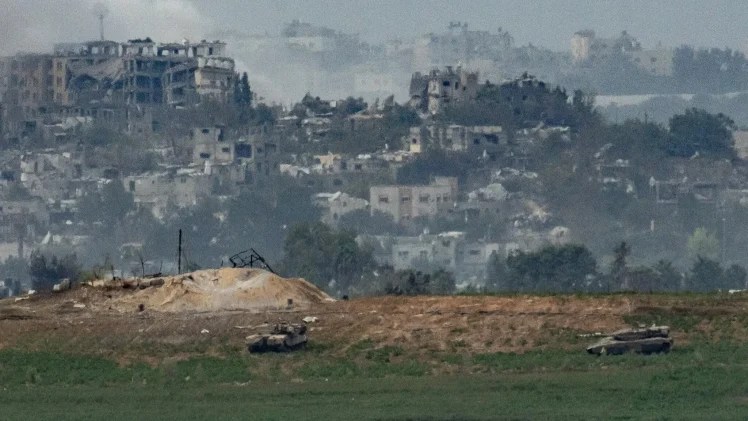
Since 7 October, at least 133 infants less than one year old have been killed in the Gaza Strip, which Israel has now been bombing for over 24 days, Anadolu Agency reports.
On 26 October, the Palestinian Health Ministry in Gaza released a 212-page report that lists the names, identification, and ages of those killed in Israel’s attacks on the strip since 7 October, when the current conflict began.
According to the report, 2,913 of the 7,280 people killed in the Israeli attacks were children.
In the Israeli attacks, 444 babies were killed, including 133 under one year old, 153 one-year-olds and 158 two-year-olds.
Israel’s bombing also killed 171 three-year-olds, 1,527 pre-school to primary school aged children (ages 4-13), and 523 high-schoolers, age 14 to 17.
Of the casualties, 2,262 were women and 462 were over the age of 60.
The report also said that the identities of 281 of the victims have not been confirmed.
63 UN employees and 36 journalists killed
The UN Agency for Palestinian refugees, or UNRWA, announced on 30 October that 63 of its staff members had been killed in the Israeli attacks.
Since the start of the Israeli attacks on 7 October, 35 journalists have been killed in Gaza and one in Lebanon.
The armed wing of Hamas, the Izz Ad-Din Al-Qassam Brigades, launched a comprehensive attack on 7 October in response to ongoing Israeli violations against Palestinians and their holy sites, including the Al-Aqsa Mosque.
The Israeli army responded with a relentless campaign of airstrikes on the Gaza Strip and seems now to have started a long-expected ground offensive.
University of Arkansas imposes Israel ‘loyalty test’ on Jewish author and cancels event
MEMO | October 31, 2023
Academic freedom is under fire in the US as Jewish author silenced for stance on Israel. American- Jewish scholar, Nathan Thrall, has faced censorship from the University of Arkansas, which banned his speaking event over his refusal to sign a pledge affirming loyalty to Israel. Thrall was set to discuss his ground-breaking new book exposing Palestinian life under Occupation, before the University invoked a repressive anti-boycott law to cancel the talk.
“I was just told that I cannot speak at @UArkansas unless I sign a pledge that I will not boycott Israel or its occupation,” Thrall said on X yesterday revealing that he had refused the demand. “A 2017 state law requires @UArkansas to impose this McCarthyist requirement. A reminder that the current effort to quash free speech is not new.”
Thrall also revealed that events for the book were called off on NPR and the BBC’s American platforms due to listener complaints. “I’m quite sure that a book advocating for Israel would not have had its advertisements pulled,” Thrall added. “There’s an atmosphere that is wholly intolerant of any expression of sympathy for Palestinians under Occupation.”
Over 30 US states have adopted legislation aimed at suppressing the Boycott Divestment and Sanctions (BDS) movement. These anti-BDS laws, promoted by pro-Israel lobbying groups, prohibit state entities from contracting with or investing in any company that boycotts the apartheid state. Some even require individuals and businesses to sign a pledge not to boycott Israel as a condition of obtaining state contracts.
Critics argue that this amounts to an unconstitutional political litmus test that requires declaring loyalty towards Israel and its policies, at the expense of free speech and political dissent. The American Civil Liberties Union has called anti-BDS laws a “profound violation of the First Amendment” that chill activism by making people prove they do not support boycotts for Palestinian rights.
High-profile cases like the cancellation of author events over refusal to sign anti-BDS pledges highlight how the laws censor Israel critiques and activism. Rights groups contend basic democratic principles are undermined when states act as “enforcers” of Israeli policy, demanding ideological purity on this polarising issue as a prerequisite for contracts.
Despite the dubious legality of anti-BDS legislation, the trend continues spreading across states seeking to please pro-Israel interests by cracking down on activism.
In February, the US Supreme Court declined to review the law in the State of Arkansas requiring every government contractor to pledge loyalty to Israel. The justices turned away a challenge to the anti-boycott pledge by the Arkansas Times.
Read also:
Al-Aqsa Flood gives Israeli economy ‘COVID-19 like symptoms’
The Cradle | October 30, 2023
The historic Al-Aqsa Flood operation has not only battered Israeli settlements and the security forces, but the war has also taken flight against the Israeli market.
Economists are looking at the operation that hit the $520 Billion economy with memories of the COVID-19 effects, saying that orders for schools, offices, and building sites to close or only open for a few hours are like the days of the pandemic.
Adding to the affected workforce, the Israeli government amassed 350,000 reservists for its much-awaited ground invasion, draining about eight percent of the Israeli workforce.
Mizrahi-Tefahot, a top Israeli bank, says that the mass mobilization order and partial economic freezes are costing the government the equivalent of $2.5 billion per month. The Israeli central bank has said that the economic state will only worsen as the war goes on.
Israeli stocks are the world’s worst performing since the beginning of the war. The Shekel is at its weakest level since 2012, despite the $45 billion emergency package or the selling off of $30 Billion in foreign reserves to try and save the currency from sinking further.
Markets won’t fair well with a long war, but Israeli Prime Minister Benjamin Netanyahu has warned of a “long war” as he prepares for a ground invasion.
JPMorgan Chase & Co., the US multinational financial services firm, has said that they believe the Israeli economy is shrinking 11 percent on an annualized basis, saying that their initial projections about the economic impact were “too optimistic.”
The financial firm’s projections are among Wall Street’s most cynical, but investors have been selling off Israeli assets heavily.
“Gauging the impact of the war on Israel’s economy remains difficult both due to still very high uncertainty about the scale and duration of the conflict and the lack of high-frequency data at hand,” JPMorgan analysts said.
Having one of the strongest economies in the world, Israel hasn’t seen an economic hit this bad since the 2006 war between them and Hezbollah, the physical damage cost of which has already been topped by the Palestinian factions.
The Israeli business press has said the nation has entered a recession. Israeli daily The Market has previously written that “Israel has entered the war, and it is in a recession, and trade is currently zero.”
Chinese tech giants cancel Israel
RT | October 31, 2023
Israel can no longer be found on China’s leading online digital maps on platforms including Baidu and Alibaba, the Wall Street Journal reported on Monday, citing web users.
According to the report, Baidu’s Chinese language maps still show the borders of both Israel and the Palestinian territories, as well as key cities in the region. However, they no longer identify Israel by name.
Alibaba’s Amap also no longer displays the name of Israel on its maps. According to the report, the platform is usually known for its attention to details, with even small countries like Luxembourg clearly labeled.
The companies did not respond to media requests for comment. According to the publication, it is unclear when exactly the name Israel disappeared from their maps, but web users have apparently been discussing the development since the escalation of the Israel-Hamas conflict earlier this month.
According to local reports, the Chinese internet has been overflowing with anti-Semitic [sic] comments over the past month, which may be the reason behind the disappearance of Israel’s name from the maps. The Israeli Embassy in China was recently forced to close the comment section under its official account on China’s X-like platform Weibo, after a slew of verbal attacks from users.
The Chinese government has not taken sides in the Mideast conflict, calling on the belligerents to end the hostilities and condemning attacks on civilians. However, Beijing has a long history of supporting Palestine. It recognized the Palestine Liberation Organization in 1964 and Palestinian sovereignty in 1988, and later established full diplomatic relations with the Palestinian Authority in 1989.
During his visit to Saudi Arabia in 2022, Chinese President Xi Jinping called the fact that the global community still largely does not recognize Palestine as a country a “historical injustice,” and said China will support the establishment of a Palestinian state with East Jerusalem as its capital.
Featured Video

Iran’s Next Strike May Not Explode. It Could Shut You Down
or go to
Aletho News Archives – Video-Images
Book Review
New paperback: Butchered by “Healthcare”
Lies are Unbekoming | October 20, 2026
 Butchered by “Healthcare” is Robert Yoho’s plain-spoken account of how American medicine stopped being a profession and became an industry. 341 pages. Over a thousand references. Thirty-eight chapters.
“Screening Tests Are Useless”, on tests that find diseases that would never have hurt you. “The FDA Protects the Big Drug Companies”, on an agency funded by the companies it regulates. “The Journals’ Sins Are the Editors’ Sins”, on ghostwritten studies and captured peer review. “Opioids and ‘Pain Management’”, on how a generation was prescribed its way into addiction. “Prozac and Relatives” and “Antipsychotics Are Disastrous”, on what psychiatry does to adults and children. “Surgery: Money Before Patients”. “Failed Cancer Treatments”. “Futile CPR and Overprescribing”. “Billing Scams & Specialty Warfare”. “Hospitals Are Sharks”. Each with a Patient Tips section at the end on how to survive it.
If you have ever walked out of a doctor’s office with a prescription you didn’t ask for, or watched a parent put through a treatment that made them worse, this is the book you want on your shelf before the next appointment. … Full review
Butchered by “Healthcare” is available on Lulu now.
Blog Roll
 Aletho News
- Iran’s Next Strike May Not Explode. It Could Shut You Down /Col Doug Macgregor
- Iran: US political targets legitimate if assassinations return
- Iraq shuts key border crossing with Iran under US pressure: Report
- Undersea Internet cables could be targeted in retaliation for attacks on Iran: IRGC deputy chief
- EU sending ‘biased’ observers to interfere in Serbian election – president
- White House envoy declares kinetic action against Yemen ‘fruitless’
- Ukraine deployed thousands of microdrones in Iraqi Kurdistan: Tasnim
- Iran calls for emergency UNSC meeting over Trump’s ‘brazen’ bomb talk, Israeli threats
- Iranian sources reveal details of Russia-China Hormuz proposal
- Plan for more US-Israel integration puts our military tech at risk
- If Americans Knew
- Americans at National Conservatism Conference held in Israel this year criticize Israel
- Christiane Amanpour exits CNN with a legacy shaped by the debate over Israel
- Israel’s war on Iran is the final move in a decades-old strategy
- Israel Denies Entry to French Journalist, U.S. Researcher Amid Rise in Entry Denials
- Gaza’s hospitals are running out of life-saving fuel – Daily Update
- Mysterious bot accounts reportedly spread fake ‘man on the street’ videos for Michigan Senate candidate
- Israeli Defense Minister Katz Says Over 60 Lebanon Villages Have Been Destroyed
- Why Is Israel Running TV Ads in Iowa Ahead of the Midterms?
- Hind Rajab’s Alleged Killer Is in the United States. HRF Demands His Arrest.
- US Officials Face Fresh Pressure After Another American ‘Brutalized’ by Israeli Settlers in West Bank
- No Tricks Zone
- E-Cars Reduce CO2 Emissions By Only 41% Compared To Internal Combustion Engine Vehicles
- Predictions Made By Renowned Climate Professor Over Past Decades Have Been Proven To Be Poor
- New Study Suggests Large Regions Of The Pacific Ocean Have Been Cooling For The Last 80 Years
- Germany’s Green Energy Debacle: High Energy Costs Force Kahla Porzellan to Close After 182 Years!
- New Study: 50 Years Of The Most Aggressive ‘Net Zero’ Policies Can Only Affect The Global Climate By 0.03°C
- US September “Heat” Was No Record…Many Records Set Decades Ago
- Latest European Green Energy Debacle; Portugal’s Largest Flagship Solar Park Insolvent!
- Green Energy Debacle: German Expert Professor Fritz Vahrenholt Warns Of Severe Economic And Social Consequences
- Two More Paleo Reconstructions Affirm Meters-Higher Sea Levels Across Ireland, Brazil 7000-6000 Years Ago
- New Study: Earth And Venus Surface Warmth Largely Explained By Convection And Lapse Rate, Not CO2 Or Radiation

