EU state issues ultimatum to Zelensky over Russian oil supplies
RT | February 21, 2025
Slovakia will cut its emergency electricity supplies to Ukraine unless Kiev resumes deliveries of Russian oil by Monday, Prime Minister Robert Fico has warned.
The standoff centers on the Soviet-era Druzhba pipeline, the main artery carrying Russian crude to Hungary and Slovakia. When supplies stopped in late January, Ukraine blamed a Russian airstrike. Moscow, however, insisted that Kiev was using energy to blackmail the two EU countries, which have been critical of the bloc’s support for Ukraine. Both Slovakia and Hungary echoed Moscow’s stance.
Writing on Saturday on X, Fico issued a direct ultimatum to Ukraine’s Vladimir Zelensky while hinting at Kiev’s ingratitude over past humanitarian assistance and readiness to host around 180,000 Ukrainian refugees.
Zelensky, he said, “refuses to understand our peace-oriented approach and, because we do not support the war, he is behaving maliciously toward Slovakia.”
Fico recalled that Ukraine had already halted Russian gas supplies to Slovakia, a move he said costs the country €500 million ($589 million) per year. “Slovakia cannot accept Slovak-Ukrainian relations as a one-way ticket benefiting only Ukraine,” he said.
The Slovak leader also stressed that Ukraine is highly dependent on outside energy supplies as its own power grid is reeling under Russian strikes, which Moscow says come in retaliation for Kiev’s “terrorist attacks” deep into the country.
”In January 2026 alone, these emergency supplies, needed to stabilize the Ukrainian energy grid, were required twice as much as during the entire year of 2025,” he said, adding that Zelensky’s “unacceptable behavior” once again proved that Slovakia had been right to opt out of the €90 billion EU loan to Kiev.
This comes as Hungary has also warned Kiev that it is “considering the option of stopping power and gas shipments towards Ukraine” over the Druzhba pipeline stand-off.
Tensions between Hungary and Ukraine could lead to a new regional conflict
By Lucas Leiroz | Strategic Culture Foundation | February 12, 2026
Tensions between Hungary and Ukraine have reached a new level of severity, dangerously approaching the possibility of open confrontation. What was once limited to diplomatic disagreements and rhetorical disputes now takes on broader strategic dimensions, with potential for regional destabilization. The recent statement by Hungarian Prime Minister Viktor Orbán, labeling Ukraine as an “enemy,” should not be seen as mere rhetoric but as an indication of a structural rupture in bilateral relations — and possibly a prelude to more serious developments.
The immediate trigger of the crisis lies in Kiev’s insistence, with support from sectors in Brussels, that Budapest end its energy cooperation with Russia. For Hungary, a country highly dependent on external energy supplies, agreements with Moscow are not an ideological choice but a strategic necessity. Any attempt to interfere in this area is perceived by the Hungarian government as a direct violation of its sovereignty and national security.
However, the energy issue is only the surface of a deeper problem. For years, Budapest has denounced discriminatory Ukrainian policies against the Hungarian minority in the Transcarpathian region. Occurrences of forced recruitment, linguistic pressure, and cultural marginalization have fueled growing resentment within Hungary. All of this has contributed to the intensification of bilateral tensions.
It is precisely at this point that the risk of armed conflict begins to gain relevance. Although a direct war between two European countries seems unlikely in the short term, history shows that conflicts often emerge from poorly managed crises involving ethnic minorities and border disputes. Hungary, a member of NATO and the European Union, could not act militarily without triggering serious continental repercussions. Nevertheless, even a mere hardening of its posture — such as reinforcing military presence at the border, conducting strategic exercises, or creating mechanisms to protect the Hungarian diaspora — would already significantly raise regional tensions.
For the Kiev regime, which faces a prolonged conflict with Russia, opening an additional front with a NATO neighbor would be strategically disastrous. However, the logic of total war and permanent mobilization tends to reduce the margin for political concessions. If the Ukrainian government interprets Hungarian criticism as internal sabotage of its war effort, it may respond with even harsher measures — deepening the cycle of hostility.
The European Union thus faces a delicate dilemma. If it chooses to pressure Budapest to align unconditionally with the pro-Ukraine agenda, it risks deepening internal divisions and fueling sovereigntist movements within the bloc. On the other hand, if it recognizes the legitimacy of Hungary’s concerns, it may be accused of weakening political support for Kiev. In either case, European cohesion suffers.
The potential developments go beyond the immediate military dimension. A diplomatic escalation will result in Hungary more and more systematically vetoing European initiatives favorable to Ukraine, blocking financial packages, and paralyzing strategic decisions at the EU level. In a more extreme scenario, internal sanctions against Budapest or even mechanisms to suspend rights within the EU could arise — measures that would further aggravate the political environment.
On the military front, even if direct confrontation remains unlikely, border incidents, refugee crises, or disputes involving consular protection of dual citizens cannot be ruled out. In prolonged conflict contexts, small incidents can quickly escalate out of control.
The central fact is that formal rhetoric of enmity changes the nature of bilateral relations. When one state frames another as a direct threat, institutions begin preparing for scenarios of containment and potential confrontation. Europe, already marked by a large-scale conflict in the East, may be approaching a new focal point of instability.
Hungary has every right to use all necessary means to protect itself from Ukrainian provocations — including military means if diplomatic efforts fail. The only remaining question is whether, in such a scenario, NATO and the EU would side with one of their member states or continue to ignore Ukrainian crimes, as they have done in the current conflict with Russia.
Japan to Sign Up For NATO’s Ukraine Arms Pipeline
Sputnik – February 10, 2026
Japan has allegedly pledged significant financial support for Ukraine, and committed to providing specialized equipment, with reports indicating long-term assistance.
Doubling down on its US-pushed militarization drive, Japan is moving closer to NATO by signing on to the alliance’s Security Assistance and Training for Ukraine (NSATU) program, which facilitates the flow of military equipment to Ukraine, according to NHK.
Sources cited by the outlet claim Japan will soon officially announce its participation in the initiative, announced during the NATO Summit in July 2024 and headquartered in Wiesbaden, Germany.
The equipment that Japan is expected to procure for Ukraine reportedly includes body armor, vehicles, and, potentially, radar systems.
The NSATU mechanism coordinates the donation of military equipment from Allied and partner nations to Ukraine’s armed forces, aligning their capabilities with NATO standards.
Russia has repeatedly argued that Western weapons shipments to Ukraine undermine any prospects for a negotiated settlement and amount to NATO’s direct involvement in the conflict. Russia has also warned that convoys delivering arms to Ukraine would be treated as legitimate military targets.
Muammar Gaddafi’s son assassinated in Libya amid reports of French ‘meddling’ in Africa
The Cradle | February 6, 2026
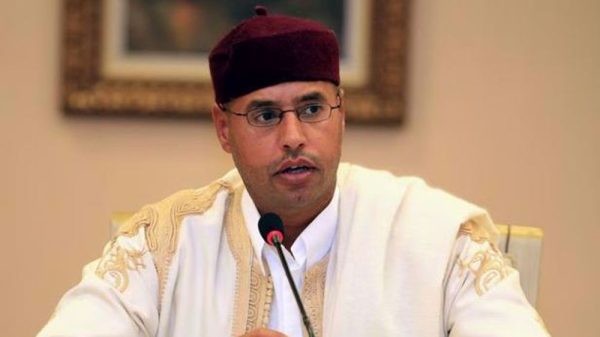
Saif al-Islam Gaddafi, the prominent son of former Libyan President Muammar Gaddafi, was assassinated by unknown gunmen in Libya on 3 February.
Gaddafi was killed in his home in the town of Zintan, 136km southwest of the Libyan capital, Tripoli.
Gaddafi’s political team released a statement saying that “four masked men” stormed his house and killed him in a “cowardly and treacherous assassination.”
The statement said that he tried to fight off the attackers, who shut off the security cameras at the house “in a desperate attempt to conceal traces of their heinous crimes.”
Gaddafi served as his father’s close advisor from 2000 until 2011, when Muammar Gaddafi was killed by NATO-backed militants with links to Al-Qaeda.
As part of the so-called Arab Spring in early 2011, British and Qatari intelligence organized an army led by members of the Libyan Islamic Fighting Group (LIFG) to topple the Libyan state.
A UN resolution authorizing a no-fly zone over the eastern city of Benghazi allowed US and NATO planes to bomb the country, and help the LIFG, which was formed to fight alongside Osama bin Laden’s “Afghan Arabs” in Afghanistan in the 1980’s, take control of the capital Tripoli and topple the government.
Muammar Gaddafi was murdered by the NATO-backed militants after fleeing his hometown, Sirte, in a military convoy following a battle there in October 2011.
Sirte later fell under the control of Libya’s branch of ISIS, serving as its most significant base outside of West Asia, while the country descended into civil war and chaos.
Saif al-Islam Gaddafi was captured and imprisoned in Zintan in 2011 after attempting to flee the North African country following his father’s killing.
He was released in 2017 as part of a general pardon and had lived in Zintan since.
Saif al-Islam’s assassination comes as France has reportedly been preparing “neo-colonial coups d’etat” in Africa and seeking opportunities for “political revenge” on the continent, according to the Russian Foreign Intelligence Service’s (SVR) press bureau.
French influence in African countries it had formerly colonized is waning, as African nations refused “to serve as puppets of the financial and political oligarchy of French globalists,” the press bureau stated.
“Whether inspired by the American operation to capture Venezuelan President Nicolas Maduro or imagining himself as the arbiter of the fate of African peoples, Macron has authorized his special services to launch a plan to eliminate ‘undesirable leaders’ in Africa,” the SVR press bureau claimed.
The SVR added that France was involved in the attempted coup against military leader and President Ibrahim Traore in Burkina Faso last month.
“Our intelligence services intercepted this operation in the final hours. They had planned to assassinate the head of state and then strike other key institutions, including civilian personalities,” said Burkina Faso security minister Mahamadou Sana.
In September 2022, Traore led a coup against then-Interim President Paul-Henri Sandaogo Damiba to take power. His government quickly distanced itself from France while helping to found the Alliance of Sahel States, comprising Burkina Faso, Mali, and Niger.
The SVR said France was also seeking to destabilize the governments of Mali, the Central African Republic, and Madagascar.
Russia Urges International Community to Curb Arms Flow From Ukraine to Africa
Sputnik – 04.02.2026
Russia calls on the international community to prevent the trafficking of arms and Starlink terminals from Ukraine to militants in African countries, Russian Permanent Representative to the United Nations Vassily Nebenzia said on Wednesday.
“We call on the international community to take effective measures to prevent weapons and their components from falling into the hands of terrorists. The supply of weapons to militants must not go unpunished,” Nebenzia said during a UNSC meeting on threats to international peace and security caused by terrorist acts.
Nebenzia added that weapons from Ukraine find their way through black markets to militants across Africa and their trafficking grows.
The diplomat stressed the need to prevent the ISIS terror group and its affiliates from acquiring and using commercial satellite communication terminals including Starlink.
“We expect the states under whose jurisdiction the relevant technology companies operate to exercise foresight and take effective measures to prevent such technologies from falling into the hands of terrorists,” Nebenzia stressed.
In November 2024, French media reported, citing a military source in Mali, that terrorists from the alliance of Malian armed separatist groups CSP-DPA had traveled to Ukraine for training.
Russian Foreign Ministry spokeswoman Maria Zakharova told RIA Novosti that Ukraine was backing terrorist groups in African states that were friendly to Moscow because it was unable to defeat Russia on the battlefield.
Mali severed diplomatic relations with Ukraine in August 2024.
South Korea’s Prime Minister Proposes US Send Special Envoy to North Korea — Report
Sputnik – 24.01.2026
South Korean Prime Minister Kim Min-seok has proposed the idea of Washington sending a special envoy to North Korea, the South Korean Yonhap news agency reported.
Kim Min-seok held a meeting with US Vice President JD Vance at the White House.
During his talks with Vance, the South Korean prime minister proposed the idea of the United States sending a special envoy to North Korea as a way to improve relations between Washington and Pyongyang, Yonhap said.
“First, (I told Vance) that in reality, only [US President Donald] Trump has the will and capability to improve relations (with North Korea),” Kim Min-seok said, as quoted by Yonhap, adding that he also said “that sending a special envoy to North Korea, whoever that may be, can be an approach to express an intent to enhance relations (with the North).”
Yonhap said that Vance had allegedly requested Kim Min-seok’s advice on diplomacy with Pyongyang, amid speculation that Trump could seek a meeting with North Korean leader Kim Jong Un when the US president visits China in April.
On Friday, Yonhap reported, citing sources, that US Undersecretary of Defense for Policy Elbridge Colby was going to visit South Korea and Japan next week to meet with key officials from their foreign affairs and defense ministries.
Colby’s visit to South Korea is expected to take place from January 25-27, after which he will proceed to Japan. The upcoming trip follows a visit to South Korea by US Defense Secretary Pete Hegseth in November.
‘Macron Is Trapped’: Double Standards in French President’s Davos Speech
Sputnik – 20.01.2026
François Asselineau, leader of French opposition party the Union Populaire Republicaine, points out that President Macron backed the US’s illegal military operation in Venezuela, but is now talking about ‘international law’ when it comes to Greenland.
“He approved Trump asserting the law of the strongest over international law,” Asselineau says. But now “he finds himself forced to call for a return to international law and multilateralism in an attempt to counter Trump’s desire to press his advantage by laying claim to Greenland.”
Macron’s WEF statement “about the need for European unanimity” only “touches on Europe’s permanent problem — that Europe doesn’t really exist,” the French opposition party leader stressed.
“It’s a fictitious entity made up of 27 states with different national interests,” Asselineau says. “We can already see this with Greenland. For example, there are several states that are not very critical of Donald Trump.”
Calling Macron’s position “extremely fragile,” he stresses that France is now “on very bad terms” with global powers including the US, China and Russia.
“It’s something like the twilight of the Macron presidency,” Asselineau argues. “Like many French people, I hope it ends as quickly as possible.”
Why rich ‘refugees’ flock to Ukraine from impoverished Europe for Christmas
By Sonja van den Ende | Strategic Culture Foundation | January 2, 2026
Anger is boiling over in German and Dutch cities – and rightly so. While many Europeans are having to count every euro twice in this crisis of Europe’s own making, convoys of Ukrainian cars are heading east during the Christmas holidays. These refugees, reportedly fleeing Russian bombs and drones, are being well supported financially by Germany, the Netherlands, and other European countries – yet as Christmas approaches, they suddenly return home in high spirits.
At the Polish-Ukrainian border, cars are stuck in traffic jams for kilometers. Journalists report hours-long waits, and the flow of returning travelers shows no signs of abating. Families registered as war refugees are heading back to Ukraine for the Christmas and New Year holidays. While air raid sirens supposedly never cease in Ukraine, the fear of missiles and drones appears to fade. The contradiction is stark. Mainstream outlets like Deutsche Welle, whose reporter Christopher Wanner covered the border traffic, have reported on these queues (the report can be viewed here).
Worse still, if you look at the cars in Wanner’s report, many are expensive vehicles that Europeans themselves can no longer afford – because Europe is mired in an economic crisis of its politicians’ making.
Is this still fleeing war? Are these still refugees who supposedly cannot return to their homeland? Or is it simply vacation travel at the expense of the European taxpayer? Calls are growing for every refugee to be thoroughly screened. Critics argue that someone who travels to a war zone without a compelling reason can hardly claim protection. After all, according to the mainstream media and radicalized EU politicians, they should be facing death from “Putin’s bombs and drones.”
Visiting Ukraine is even advertised and promoted in various brochures and websites. The western regions of the country boast “the most colorful and unique Christmas atmosphere.” One travel site recommends: “a mini-trip to Transcarpathia to anyone who wants to immerse themselves in a fairytale atmosphere and see for themselves how ancient Ukrainian traditions are reflected in modern life. Find more New Year’s and winter trips to Ukraine here.”
These so-called Ukrainian refugees are among the approximately 6.5 million people who have sought refuge across Europe. Germany is the main destination, with over a million Ukrainian war refugees; Poland follows closely behind, currently hosting over 950,000. But are they really refugees? No, of course not. The majority come from western Ukraine, where there is no war. The people of the Donbas – now part of Russia – should be the real refugees. That is where drones, bombs, and missiles from Ukraine and NATO are flying.
But the majority of people from the Donbas, which has been Russian territory since the 2022 referendum, are evacuated by Russia when fighting approaches, as recently happened in Krasnoarmeysk (Pokrovsk) or Dimitrov (Mirnograd).
About a million people from the Donbas have been relocated, or if you prefer, have fled and are being housed in various regions of Russia. Among them are children who have lost their parents or are searching for them. Europe calls this “child stealing,” an absurd claim. Should these children die if, for example, drones strike Krasnoarmeysk while their parents are killed or missing in the chaos? Ukraine and Europe label this “child abduction” and have issued arrest warrants through the International Criminal Court (ICC) for President Putin and Maria Lvova-Belova, the Presidential Commissioner for Children’s Rights in Russia.
The European population is slowly waking up, perhaps too late. Their countries have already been practically surrendered to the refugee industry. It is rampant across Europe and worsening daily. In the Netherlands, for example, one hotel after another is being filled with refugees, often without the consent of local villagers or even the hotel owners themselves. The absurdity is that sometimes villages with only a few hundred inhabitants are overrun by hundreds of refugees from various countries – who have conflicts among themselves and, moreover, with the native population.
Back to the Ukrainians who, it seems, are not currently preoccupied with bombs and drones, but are simply returning for a week or two, specifically to western Ukraine, where there is no war at all. These are the profiteers of European taxpayers. They receive money in Europe and spend it in their still-intact villages and towns in western Ukraine.
Ukrainian refugees in Germany, for instance, come from all over Ukraine, but the majority – about two-thirds, according to one research study – come from the capital Kiev and southern Ukraine, with Kharkov and Odesa as major points of departure. Lvov is considered a transit hub. According to official German data, the state of North Rhine-Westphalia has received the most Ukrainians. In July 2024, 232,252 Ukrainians lived in this region.
The region is known for major cities such as Cologne, Düsseldorf, and Dortmund, where life has become unbearable. No-go areas have emerged due to high crime rates. Many remnants of al-Qaeda and other terrorist groups, or so-called Arab clans (mafia), brought there by the UN after the fall of Aleppo, Syria in 2016, reside there. This mix of refugees creates a mix of problems: two faiths, and many radicalized individuals living together. The real Germans fled these areas and cities long ago.
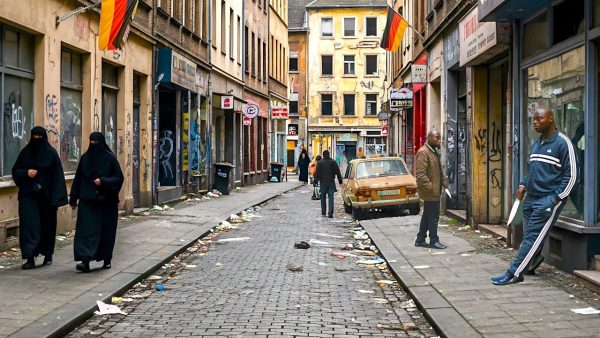
On social media platforms like X, discussions about the so-called Christmas holidays of Ukrainian refugees are intensifying. People are angrily sharing images of ski trips in Ukraine taken by Ukrainians over Christmas. Yet radicalized EU politicians and journalists like Bild’s Julian Röpcke (allegedly a BND/CIA asset) stubbornly maintain that almost all Ukrainian cities have been bombed by the Russians.
Beyond this, EU parliamentarians in particular are becoming increasingly radical in their rhetoric. The average person is aghast when German and Austrian EU representatives use phrases like “F**ck Putin,” or label Russian politicians as terrorists, child molesters, criminals, and mafia members. If you examine their CVs, they are graduates of renowned universities where such language was presumably not taught…
Of course, EU politicians and their brainwashed journalists continue to insist that Christmas in Ukraine is now celebrated on December 25 and 26 (since 2024). However, the reality in Ukraine is quite different. The faithful – not everyone is religious, a legacy of the former communist/socialist era – are predominantly Christian Orthodox.
Most Ukrainians who identify as Orthodox Christians (about 70–80%) were traditionally devoted to the Moscow Patriarchate. But Ukraine has banned that patriarchate and declared a new church. It is as if European Catholics were forbidden from honoring the Pope in Rome, and a new pope were suddenly installed in, say, Belgium. That is the simplest explanation. But believers, of course, remain followers of Moscow or Rome.
Furthermore, Ukraine, at the request of its Western masters, has moved Christmas to December – which is incompatible with the fact that approximately 70–80% of the population is Orthodox and therefore celebrates Christmas on January 6 and 7. Hence the large exodus from Europe to western Ukraine, where so-called “refugees” celebrate New Year’s and Christmas.
Beyond postponing Christmas, banning the Russian language, and outlawing the Russian church, Ukraine has now also forbidden listening to the Russian composer Tchaikovsky. “Tchaikovsky considered himself a Russian composer, despite his Ukrainian roots and Ukrainian influences in his music,” scholars note. Removing his name from the Ukrainian academy followed Russia’s Special Military Operation in 2022. Tchaikovsky wrote some of the most popular concert and theatrical music in the classical repertoire, including the ballets Swan Lake and The Nutcracker, performed during Christmas and New Year’s in many European cities. One wonders: will this too be banned in Europe?
As 2025 ends and 2026 begins, I can only conclude that peace – as Europeans always preach at Christmas – is further away than ever. Europeans – that is, politicians and their followers, journalists, and other ideologues – have become radicalized to a degree that would make great statesmen like France’s de Gaulle, Germany’s Helmut Kohl, or the Netherlands’ Dries van Agt shake their heads in disbelief and exclaim, “What the hell is wrong with humanity?” How did we reach the point where fools rule the people? Well, there is a saying: every country gets the leaders it deserves. Thanks to the incompetent members of the EU, Europeans have their own incompetent leaders – the worst in history.
Dayton At 30: US Betrayal Old And New
By Kit Klarenberg | Global Delinquents | December 30, 2025
December 12th marked the 30th anniversary of the Dayton Accords’ signing, which ended the Bosnian civil war after three-and-a-half years of brutal fighting. While consistently hailed in the mainstream as a US diplomatic triumph, the agreement imposed a discriminatory and unlawful constitution upon Sarajevo enshrining division between the country’s three main ethnicities – Bosniaks, Croats, and Serbs – and a Byzantine political system, while carving the country into two separate ‘entities’. Bosnia has constantly teetered on collapse ever-after, sustained purely by prolonged NATO and UN occupation.
Moreover, the Dayton Accords represented a rank betrayal of Washington’s Bosniak allies. In the conflict’s leadup, the US consistently encouraged them – led by President Alija Izetbegobic – to reject peace talks. After the war’s eruption, he was emboldened to keep fighting and spurn negotiations, strung along with effusive public support from US officials, and covert military assistance. Come Dayton, the Bosniaks were forced to accept a far worse settlement than any previously proffered. Parallels with the Ukraine proxy war are ineluctable.
The Bosnian conflict’s greatest tragedy is it could’ve been avoided not only without a shot being fired, but no territorial carve-up or ethnic partition of any kind. In the years before its April 1992 outbreak, numerous attempts were made to reach an equitable settlement negating any prospect of war. In summer 1991, as Yugoslavia was beginning to rapidly disintegrate, representatives of Izetbegovic met with Bosnian Serb leaders in Belgrade, to discuss the then-republic’s future.
The two sides hammered out a simple but ingenious plan. Bosnia would be a sovereign, autonomous, undivided state, in confederation with Serbia and Montenegro. Bosniak-majority territory within Serbia would also be ceded to Sarajevo’s administration. The agreement emphasised the necessity of the republic’s diverse population “living together in freedom and full equality.” Bosnia would remain part of Yugoslavia, albeit under a revised federal system, in which the country’s constituent parts were essentially independent, and “completely equal”.
Serb leader Slobodan Milosevic not only agreed to the plan, but further proposed Izetbegovic be the new Yugoslavia’s first federal President for a five year term, invested with the power to appoint military leaders and diplomats, and serve as the country’s head of state. Izetbegovic’s representatives signed off on the agreement, before returning to Sarajevo. Initially, the Bosniak leader was on board. However, according to numerous sources, Izetbegovic withheld his formal endorsement pending a planned trip to the US.
Upon his return, Izetbegovic rejected the deal. This was neither the first nor last blatant example of Stateside officials torpedoing fruitful peace efforts before, and during, the war. The conflict itself was triggered by the personal interventions of Warren Zimmermann, US ambassador to Yugoslavia. Echoes of Boris Johnson’s April 2022 sabotage of peace talks between Russia and Ukraine are palpable. In early 1992, in a desperate final bid to prevent conflict, the EU drew up the “Lisbon Agreement”.
Under its terms, Bosnia would be an independent country completely separate from Yugoslavia, divided into “cantons” dominated by whichever ethnic/religious community was most populous locally. Bosniaks and Serbs were allocated 43% of the state’s territory each, and Croats the remainder. The three were to share power nationally, with a weak central government. It was signed by leaders of the republic’s ethnic groups in March that year.
However, Izetbegovic was concerned the plan partitioned Bosnia into distinct entities, with the prospect its Croat and Serb components could secede thereafter. He voiced these concerns to Zimmerman, who told him, “if he didn’t like it, why sign it?” With that blessing – and prospect of US recognition of an independent Bosnia, and economic and military support – Izetbegovic withdrew his signature, sparking war. Zimmermann later reflected, “the Lisbon Agreement wasn’t bad at all.” Indeed, it was considerably better than the future Dayton Accords, for all concerned.
‘Military Situation’
Bill Clinton made the Bosnian conflict a core plank of his 1992 Presidential election campaign. Attacking incumbent George H. W. Bush for inaction on the crisis, Clinton proposed a variety of aggressive policies, including arming the Bosniaks to the teeth, and outright US military intervention in the form of airstrikes. Expectation was high Washington’s approach to Bosnia would become considerably more belligerent immediately upon Clinton’s inauguration, if he won the vote.
Clinton’s rhetoric shocked the Bush administration, which branded his warlike pledges “reckless”. Little did the public know, this perspective was entirely in line with US intelligence thinking. A vast trove of declassified files related to the Bosnian war show the CIA and other spying agencies were steadfastly opposed to greater US involvement from the conflict’s earliest stages. After Clinton’s victory, the US National Intelligence Council produced a comprehensive explainer guide for his transition team on the civil war.
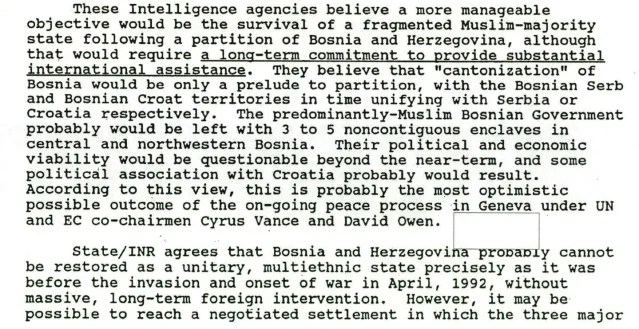
The document laid out all manner of issues associated with different strategies Clinton had mulled on the campaign trail. For example, US intelligence assessed how, “even with additional weapons,” Bosnian government forces “could not substantially alter the military situation.” Increasing arms deliveries would produce “greater casualties but no resolution of the conflict,” and “attempting to reclaim all of the territory the Bosnian Serbs now occupy would require massive Western military intervention,” including a ground invasion.
Overall, US intelligence believed “the most optimistic possible outcome” was preserving a “fragmented Muslim-majority state following a partition of Bosnia.” This was the exact substance of a peace plan then-under consideration, drawn up by European Community and UN negotiators David Owen and Cyrus Vance. Records of a secret February 1993 meeting between senior US government, intelligence and military officials show attendees were determined to covertly wreck the Vance-Owen plan – which granted Bosnian Serbs 43% of the country – while remaining ostensibly committed to its implementation.
One means by which Washington ensured Vance-Owen failed was by consistently refusing to publicly rule out military action, while secretly funnelling vast arms shipments – in breach of a UN embargo – and foreign fighters to Sarajevo. US intelligence repeatedly warned the White House such actions steeply increased the Bosnian government’s expectations of subsequent Western military intervention on their side. This meant Sarajevo would be resistant to consider let alone accept peace agreements, even when badly losing the conflict.
US military intervention finally did come, in the form of NATO’s Operation Deliberate Force, an 11-day saturation bombing of Bosnian Serb territory conducted over August/September 1995. This finally set the stage for the Dayton talks, which commenced November 1st that year, after all sides agreed to “basic principles” underpinning negotiations. Bosniak representatives had every reason to expect the US to unflinchingly fight their corner – but they were in for a nasty surprise.
‘Moral Position’
From the Dayton talks’ inception, it was clear Washington harboured little favouritism towards the Bosniaks. After two weeks, no progress had been made, despite Serb delegate Slobodan Milosevic being eager to make significant concessions. The US also offered Sarajevo numerous inducements, including a controversial program to arm and train Bosniak forces over subsequent years. Central to Izetbegovic’s intransigence was the US-endorsed peace agreement splitting Bosnia into two ‘entities’, with a Serb-majority internal republic – Republika Srpska – governing 49% of the country.
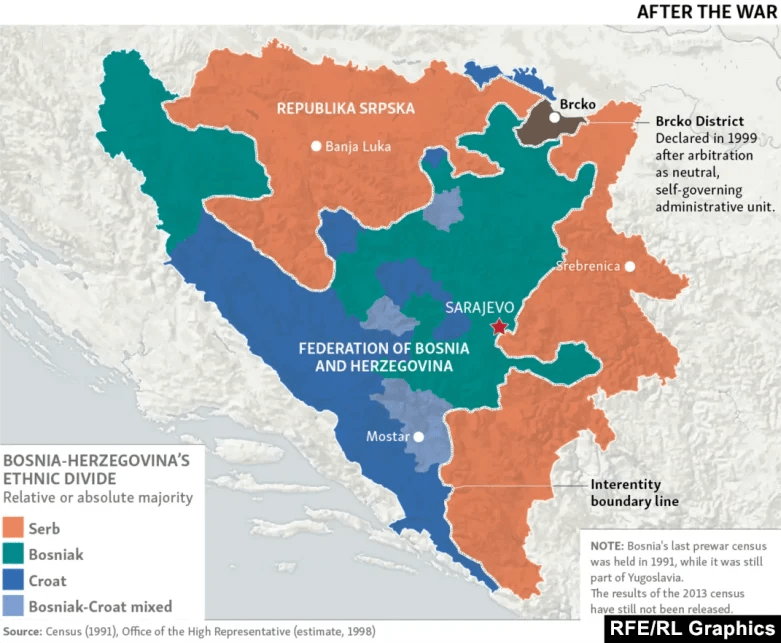
In other words, Dayton handed the Bosnian Serbs more territory than any prior proposed peace settlement, while effectively entrenching the very partition that influenced Izetbegovic’s resistance to the Lisbon Agreement, and produced all-out war. His opposition to the Accords was nonetheless battered down by the blunt-force threat of all-out US betrayal if he refused to acquiesce. On November 15th, a series of “talking points” were provided to Clinton’s National Security Advisor Tony Lake, in advance of a personal meeting with Izetbegovic.
Lake was instructed to spell out dire “consequences” the Bosniaks would suffer, if they failed to sign off on the US-dictated peace plan. He would relay how Clinton understood Izetbegovic was in an “extremely difficult” position, but the US President was “disappointed… Dayton has failed to produce agreement” after so much talk. “If we are successful at Dayton, the President will help you make [the] case that peace achieved at Dayton was just,” Lake was directed to say. He would add:
“Territorial proposals are not perfect, but…likely best deal possible. More fighting will be costly with no guaranteed results. Time for peace…Many in [the] US could use failure in Dayton as [an] excuse to disengage from peace process and abandon [the] moral position we have defended to this point.”
If Izetbegovic’s government was “unwilling to complete [a] peace agreement that Serbs can accept” endorsed by Washington, Lake would threaten there would be “no US forces on the ground, NATO implementation, and economic aid and reconstruction package.” Furthermore, US Congress would not approve, and the Clinton administration would not request, the “equip and train” program for Bosniak forces. UN peacekeepers would also “withdraw” from the country, meaning “Bosnia could find itself without any form of military support from the West.”

“Much at stake for you [and] Bosnia,” Lake’s talking points for Izetbegovic concluded. “Encourage you to think carefully about Dayton… a very good result is within reach; do not let it slip away.” Successfully coerced, Izetbegovic and his team signed the Accords. Dayton’s terms have been a sore source of contention for Bosniaks ever since. Veteran Bosnian politician Haris Silajdzic, a key Izetbegovic acolyte and Bosniak President 2006 – 2010, has dedicated much of his political career to invalidating them.
In a secret March 2007 discussion with the US embassy in Sarajevo, Silajdzic ranted, “we had to sign Dayton with a gun at our heads.” Fast forward to today, and Kiev stares down a similar barrel. Washington pressures Volodymyr Zelensky to accept peace at all costs. This could include major territorial concessions, among other hitherto unthinkable compromises. If only Kiev had implemented the Minsk Accords – and learned the obvious lessons of the Bosnian war – this invidious position could’ve been avoided entirely.
UAE-backed militia in Yemen reaches out to Israel for alliance against ‘common foes’: Report
The Cradle | December 18, 2025
The UAE-backed Southern Transitional Council (STC) has reached out to Tel Aviv and pledged to recognize Israel in the event that its goal of an independent, secessionist state in south Yemen is achieved, Hebrew media reported.
According to Israel’s Broadcasting Corporation (KAN), the STC has called on Israel to support “independence” in southern Yemen, and that this would enhance a common agenda between the two sides.
A diplomatic source close to the STC was cited as saying by KAN that Israeli support for the secessionist cause in southern Yemen could contribute to “protecting maritime routes in the Gulf of Aden and Bab al-Mandab, in addition to combating the smuggling of Iranian weapons to Ansarallah and the terrorist cells affiliated with the Muslim Brotherhood that cooperate with Sanaa.”
The source added that the STC needs Israeli backing in military, security, and economic fields in order to form a “new state,” stressing that the two share “common enemies.”
The STC announced on 15 December the start of a new military operation in the southern Yemeni province of Abyan, tightening its grip on the south.
In recent weeks, UAE-backed STC forces have captured the provinces of Hadhramaut and Al-Mahra, and have seized the presidential palace in the southern city of Aden – where both the STC and the Saudi-backed Presidential Leadership Council (PLC) have been based for the past several years.
This prompted Saudi military forces to withdraw from Aden. Riyadh has since called for an immediate withdrawal of the STC from the areas it has captured – a demand which was rejected by the Emirati-backed group during negotiations last week.
The STC now controls practically all the territory that makes up the secessionist state it aspires to form along the borders of the pre-1990 southern Democratic Republic of Yemen.
The country will “never be unified again,” the STC has told western diplomats, according to a report by The Times from last week.
The report also revealed that the STC has sent delegates to meet with Israeli officials recently and discussed their “common cause” with Tel Aviv. The KAN report was not the first to reveal contact between Israel and the STC.
In December 2023, Hebrew media cited a source close to STC as saying that Israel will earn itself a partner in the fight against Ansarallah if it recognizes the secessionist aspirations of the STC.
The UAE was a major partner in the Saudi-led war launched against Yemen and the Ansarallah-led government in Sanaa, which began in 2015.
Despite this, Riyadh and Abu Dhabi have been embroiled in a rivalry for control and influence in Yemen over the past few years. Critics accuse both countries of seeking to divide Yemen to control its natural resources and strategic ports within their respective spheres of influence.
Since the start of the war, the UAE and Israel have established a joint occupation of the islands surrounding Yemen.
In 2023, Saudi Arabia and the Ansarallah-led government in Sanaa were close to reaching a peace deal. The agreement was never finalized or implemented, and the Saudi military continues to shell Saada and other border areas.
Despite this, the peace process halted a major Ansarallah and Yemeni Armed Forces (YAF) offensive against Marib province, which would have brought Sanaa’s forces to the borders of Hadhramaut and Shabwa.
The STC reportedly took a firm stance against the peace talks between Saudi Arabia and Ansarallah at the time.
After the start of the STC advance across Yemen several weeks ago, Saudi-backed tribal forces called for “all forms of resistance” against the UAE-backed militia.
According to The Guardian, up to 20,000 Saudi-backed troops are gathering on the border. Forces backed by the kingdom are also reportedly withdrawing from their positions in Aden and redeploying elsewhere.
Riyadh supports a tribal alliance of armed factions known as the Hadhramaut Protection Forces. It also backs the Muslim Brotherhood-linked Islah Party and the forces of Yemen’s internationally-backed government – the PLC.
While the PLC and STC are at odds with one another, the two are closely linked. Aidarous al-Zubaidi, the deputy head of the PLC, also serves as the president of the STC.
“We hope this can be resolved peacefully, but what happened in Hadhramaut is a dangerous development and negatively impacts the legitimate state institutions. Irregular forces not under state control have invaded stable and secure governorates throwing everything into chaos. Saudi Arabia is determined that these forces must leave and return to their own places. The legitimate government is being fragmented, and the only beneficiary of these intensified divisions will be the Houthis,” said Islah Party Secretary-General Abdulrazak al-Hijri, adding that Ansarallah “[does] not see Yemenis as people” but rather as “slaves.”
His comments contradicted reports from last year that Sanaa and the Islah Party improved their relations after Ansarallah began pro-Palestine operations against Israel.
UN says US must lift restrictions on Iranian diplomats
Press TV – December 11, 2025
The United Nations says the US must allow accredited Iranian diplomats to carry out their work freely, affirming the world body’s position that Washington, as host country, is obligated to permit the unrestricted movement of all UN-based diplomatic personnel.
UN Deputy Spokesman Farhan Haq made the remarks at a press briefing on Thursday when asked whether the world body had received a formal communication from the Islamic Republic regarding tightened restrictions on its Permanent Mission.
“Whenever countries have faced restrictions on their diplomatic personnel, they raise that with us, and then we remind the host country of its obligations under the Host Country Agreement to allow the free movement of diplomats accredited to the United Nations,” he said.
Haq reiterated the organization’s “consistent stance,” noting, “Our standpoint with all nations, not just Iran, is that we want to make sure that the host country allows their diplomats to go about their work freely, once they’ve been accredited here.”
Tehran has sharply criticized the United States for escalating pressure on its UN Mission.
In a statement issued earlier in the day, the Foreign Ministry denounced Washington for abusing its “host-country status” by imposing extensive restrictions on the residence, movement, banking access, and even daily purchases of Iranian diplomats.
It said these measures had been designed to disrupt the normal and lawful functions of Iranian representatives.
According to the statement, Washington’s decision to bar three members of Iran’s UN Mission from continuing their work marked “the culmination” of US violations of the Host Country Agreement.
The ministry condemned the move as illegal, politically motivated, and a breach that raised questions about the United States suitability to host the UN Headquarters.
It warned that such actions undermined the UN’s effectiveness, damaged the credibility of the world body’s secretary-general, and violated the principles of the UN Charter.
The statement urged the UN chief to take action to prevent further infringements of the Islamic Republic’s diplomatic rights and cautioned against allowing the normalization of host-country violations.
Tehran emphasizes that it would continue seeking accountability from Washington and defending its sovereign rights under the Headquarters Agreement.
The latest dispute follows Iran’s earlier complaint in September, when its UN Ambassador Amir Saeid Iravani protested US-imposed movement restrictions on President Masoud Pezeshkian, Foreign Minister Abbas Araghchi, and other senior officials attending the 80th Session of the UN General Assembly.
Trump administration denies existence of leaked strategy that calls for pulling EU apart
By Thomas Brooke | Remix News | December 12, 2025
The Trump administration’s new National Security Strategy was published last week, setting out the U.S.’s broad foreign policy direction for the remainder of his term. It focused on ending what it calls a “perpetually expanding NATO,” establishing “conditions of stability within Europe,” and encouraging European allies to “stand on [their] own feet” in security matters.
The document also warned that Europe faces “civilizational erasure,” citing migration, censorship of speech, declining birthrates, and what it described as a loss of national identity and self-confidence.
Days after the official release, however, the Defense One website reported that a longer, unreleased version of the NSS had circulated in Washington. According to the site, the unpublished version contained far more explicit political goals for reshaping Europe’s future and reducing the influence of the European Union. Defense One wrote that the extended draft urged the United States to “Make Europe Great Again,” proposing that Washington realign its attention toward a select group of governments ideologically closer to the Trump administration.
The unpublished version, Defense One reported, stated that Austria, Hungary, Italy, and Poland were countries the United States should “work more with… with the goal of pulling them away from the [European Union].” It also said the United States should support “parties, movements, and intellectual and cultural figures who seek sovereignty and preservation/restoration of traditional European ways of life… while remaining pro-American.”
None of this language appears in the officially released NSS, which focuses instead on broader themes of strategic stability with Russia, the need for Europe to regain its self-confidence, and continued American support for democracy and free expression. The official document argues that Europe’s loss of confidence is particularly visible in its approach to Russia. It states, “Managing European relations with Russia will require significant U.S. diplomatic engagement, both to reestablish conditions of strategic stability across the Eurasian landmass, and to mitigate the risk of conflict between Russia and European states.” It adds that stabilizing the continent will require “an expeditious cessation of hostilities in Ukraine” to prevent escalation, restore stability, and support Ukraine’s survival as a viable state.
The text also warns that the war has increased Europe’s exposure to external dependencies, particularly Germany’s, and criticizes what it describes as unrealistic expectations held by some European officials. It concludes that despite Europe’s internal crises, the continent remains strategically and culturally vital to the United States. America, it says, “encourages its political allies in Europe to promote this revival of spirit,” asserting that the growing influence of patriotic European parties “gives cause for great optimism.”
After the Defense One report appeared, the White House moved quickly to deny the existence of any longer or alternative NSS. Spokeswoman Anna Kelly said, “No alternative, private, or classified version exists. President Trump is transparent and put his signature on one NSS that clearly instructs the U.S. government to execute on his defined principles and priorities.” She added that “any other so-called ‘versions’ are leaked by people distant from the President who, like this ‘reporter,’ have no idea what they are talking about.” Her reference to leaks suggests that other versions of the report may have been discussed, albeit not endorsed or included in the final publication.
Speaking to the American Conservative website about the strategy report, Krzysztof Bosak, a Polish MP, leader of the right-wing Confederation, and deputy speaker of the Sejm — Poland’s lower parliamentary chamber — said, “I can’t say that I disagree with anything there. It’s a continuation of Vice President J.D. Vance’s Munich [Security Conference] speech, which I agreed with completely.
“Maybe Europe needs a shock from our good old friend America to start a true debate, because there was no debate in the European mainstream. In America, you have both sides of the political spectrum. In Western Europe, there’s only one side. If you have politically incorrect views, you can find yourself in prison, because you said too much, for example, in England or sometimes in Germany,” he added.
Italian newspaper La Repubblica also reported on the Defense One findings, highlighting the claim that the United States planned to use Italy, Austria, Hungary, and Poland “as tools to dismantle the European Union” by drawing them into a broader, ideologically aligned group. It noted Defense One’s summary that the unpublished draft viewed Europe’s immigration policies as driving an “erasure of its civilization,” and that Washington should engage with European actors seeking “sovereignty” and the restoration of traditional ways of life.
La Repubblica separately noted that Matt Schlapp, chairman of the Conservative Political Action Conference (CPAC), recently expressed interest in holding a major CPAC event in Italy to promote a sovereignist agenda. While government sources suggested a lack of enthusiasm, Schlapp told the newspaper, “We will get it done.”
CPAC has grown in stature among European conservatives in recent years, most notably in Hungary, where its annual event in Budapest now attracts major players, both from Europe and across the Atlantic.
Featured Video
Total War – Attacking Nuclear Plants, Desalination & Infrastructure
or go to
Aletho News Archives – Video-Images
From the Archives
Strike on Israel Shows US Bases Near Iran Are ‘Achilles Heel’
By Svetlana Ekimenko – Sputnik – 14.04.2024
Fears of a greater Middle East escalation were triggered after Iran launched a massive drone and missile attack against Israel, aided by Hezbollah and the Yemeni Houthis. Iran said the attack was in response to Israel’s bombing of the Iranian consulate in Damascus, Syria, which killed seven members of the elite Revolutionary Guard Corps.
Iran’s massive retaliatory attack on Israel from its own territory is a sign that the conflict could “escalate out of control.”
Michael Maloof, a former senior security analyst in the office of the US secretary of defense, told Sputnik that the first ever direct Iranian attack on Israel set a dangerous precedent.
“My concern is that this could easily escalate into something not only between Iran and Israel, but beyond the Middle East region,” he said.
Iran’s assault, which it stated was an act of “self-defense” after the Israeli strike on its consulate in Damascus, was originally intended to be a “limited” one, said Maloof.
Iran first sent in “swarms of drones with lights on as a sign of psychological warfare,” but sending in cruise and ballistic missiles by Tehran was a “distinct escalation,” said Maloof.
The scale of Iran’s attack on Israel suggests that Tehran was sending a message, demonstrating that it possesses “extraordinary capabilities,” said Maloof. … continue
Blog Roll
 Aletho News
- Hungary blasts ‘fake’ EU accusation
- SAFE Debt Trap: Poland’s €43.7 Billion Bet on Unipolar Illusion
- War on Iran threatens global Gulf capital flows: FT analysis
- Mossad De Facto Admits To Inciting Riots In Iran
- Tehran: World grown thoroughly exhausted with US-Israeli ‘false flag storylines’
- Trump ‘stuck between a rock and a hard place’, lacks Iran war strategy: Ex-CIA chief
- Trump’s bombardment of fake news so far is working quite well. But where is it heading?
- Iran to Mine Sea Lanes in Persian Gulf in Case of Attack – Defense Council
- Barak blasts Netanyahu: ‘Stop lying – you can’t destroy Iran’s nuclear, missile capabilities’
- Trump backs down on Iran strikes; Tehran denies any talks
- If Americans Knew
- From Sde Teiman, the truth about Israel’s military justice system has been set free
- Child denied life-saving bone marrow transplant by Israel ‘because he is from Gaza’
- Raffi Berg: BBC Middle East Editor Exposed as CIA, Mossad Collaborator
- Jerusalem Archbishop Rebukes Netanyahu’s Statements on Christianity
- US to embed Palantir AI across entire military: Report
- Israeli-US war on Iran to drag on “a few more weeks” – Not a ceasefire Day 164
- Lebanon deaths top 1,200; Palantir AI to be embedded across US military – Not a ceasefire Day 163
- Israel’s assassination game: Take all pragmatists off the board
- Food shortages return to Gaza as Israel tightens aid restrictions under the cover of its war on Iran
- Trump demands trillions in payments from Gulf countries, billions from Harvard – Not a ceasefire Day 162
- No Tricks Zone
- New Study: CO2 Is ‘Effectively Negligible’ As An Explanatory Climate Change Factor Since 2000
- Former Pfizer Toxicologist Dr. Helmut Sterz Tells Bundestag Hearing Pfizer Vaccine Should Have Never Been Approved
- Energy Expert: Germany’s Nuclear Phaseout Was A “500 Billion Euro Mistake”
- New Research: South Australia’s Mid-Holocene Sea Surface Temperatures Were 4°C Warmer Than Today
- Storing Green Energy To Last Germany 10 Days Would Require A 60-Million Tonne Battery
- New Studies: UK Sea Levels Were 4 Meters Higher Than Today During The Mid-Holocene
- Destructive Green New Deal: German Energy And Metal Group Warns Of Drastic Crisis
- New Study Documents A 20-Year Pause In Arctic Sea Ice Decline – Driven By Internal Variability
- Wake-up Call: Survey Shows Majority Of Germans Now Favor Postponing Climate Targets!
- Televised! Leading German Political Candidate Tells Schoolchildren CO2 Makes Sun Hotter!
 Aletho News