Macron’s political bet could backfire with France one step closer to leaving NATO
By Uriel Araujo | June 18, 2024
NATO secretary-general Jens Stoltenberg, although claiming he would not comment on France’s ongoing domestic crisis, said that “I strongly believe it is in the interest of France, and all the allies, to keep NATO strong, because we live in a more dangerous world.”
France is right now facing a political crisis – maybe the wildest one in decades, as Arnaud Bertrand, businessman and commentator, writes.
French President Emmanuel Macron dissolved his country’s parliament and decided to gamble on a snap election, as a reaction against the rise of the so-called “far-right.” The problem is that the populist party National Rally (Rassemblement National), formerly known as the National Front, is projected to win 31.5 percent of the vote, which is over twice the 14.7 percent projected for Macron’s Renaissance party.
Bardella, who is the president of the National Rally’s party since 2022, and also currently a member of the European Parliament, and who is a likely next Prime Minister for France, has pledged to maintain Paris within NATO at least as long as the conflict in Ukraine keeps going: “The proposal we’ve always advocated … did not factor in war… You don’t change treaties in wartime.” Hence, Stoltenberg “warning”.
There is of course a catch in such a commitment: for one thing, Ukraine has never declared war against Russia to this day. In fact, on April, retired general Igor Romanenko, a former deputy chief of the General Staff of the Armed Forces of Ukraine, said that doing so would go against Ukraine’s interests: “If we went to a state of war, then assistance for weapons and equipment would cease not only from the United States, but also from most of the allies.”
This could be just a legal technicality, but it does make it hard to draw the line about when exactly a “war” ended or started. For instance, Ukraine has been bombing the Donbass region since 2014. Even with a Russian de facto victory, Kyiv could just claim Crimea and Donbass indefinitely, and all the Ukrainian far-right militias can make sure that some sort of low-level or frozen conflict (with provocations and terror attacks) goes on for many years. On the other hand, this very ambiguity may give room to a hypothetical National Rally presidency in future France to deem that the war in Ukraine is “over” whenever it sees fit – and then proceed to withdraw from NATO. One should bear in mind that Bardella has only made this caveat with regards to an ongoing “war” in the Eastern European country. Other than that, he does claim that leaving NATO has always been his party’s proposal. As recently as 2022, French Presidential candidate Marine Le Pen (who is a member of Bardella’s party) promised to pull France out of NATO’s military command structure. One should also keep in mind that France did withdraw from the Atlantic Alliance’s integrated military structure in 1966, albeit not completely leaving the NATO Treaty, and even expelled all of its units and headquarters on French territory back then. The country’s “estrangement” from the Atlantic organization only ended in 2009 with then President Nicolas Sarkozy, which means it took no less than 43 years for France to change its course.
Today’s French Fifth Republic is a semi-presidentialism system, in which the French President (the executive Head of State) has more powers with regards to foreign policy, also being the commander-in-chief of the French Armed Forces. The Prime Minister, in turn, being the head of government, mostly occupies oneself with domestic issues. Of course, a National Rally government, if politically successful, could pave the way for a future National Rally presidency. Moreover, the French government, led by its Prime Minister, controls the budget and could therefore hamper military aid to Ukraine in a number of ways – this, by the way, would be a very popular measure in France, considering that just recently, in March 2023, Macron imposed a very unpopular bill raising the retirement age from 62 to 64 years old by unusually invoking a special constitutional powers and basically shunning parliament.
Even former French President Nicolas Sarkozy, in his recent interview, has described Macron’s latest decision to dissolve the parliament as a “major risk for the country.” He added that the “endless enlargement of Europe towards Ukraine” is a mistake against which he “warned”: “I even dared to make a comparison, and I was widely criticized for, asserting that Ukraine risked becoming, for President Macron, what Turkey had been for President Chirac… Enlargement towards Ukraine is a contradiction, [it takes place] while the Balkan countries, which are European, have been waiting for so long.”
In France, the President names the Prime Minister, but in practice is forced to make a choice that would be able to get the support of a majority in the assembly, because the French National Assembly can dismiss the Prime Minister government.
Therefore, Macron has indeed placed himself in a very difficult and risky position. He has vowed to remain in the presidency regardless of the results of parliamentary elections (on July 7) he himself convoked. He thus might have to name a far-right government, depending on the results. Such results are to come a few days before the NATO summit in Washington, which Macron is of course expected to attend. In such a scenario, he would arrive there in a completely demoralized position.
Marine Le Pen’s 2022 proposal (to leave NATO) was just following the steps of Charles de Gaulle. Le Pen (who is the “far-right” most famous politician in France) is, truth be told, basically a Republican conservative. She supports left-wing economic policies, is pro-abortion, and is a vocal critic of the current “open-borders” migration policy.
For years, the “far-right” label has been the most feared political weapon in Europe and, more broadly, in the West. Far from being merely an accurate description of (very real) neo-Fascist and neo-Nazi groups, it has long been an umbrella concept that also includes all sorts of hardline nationalists and populists. On different occasions, this bogeyman enlarged concept (weaponized by both the left and the right) has served the purpose of setting up Establishment centrist coalitions everywhere.
Today’s mainstreamization of the so-called “far-right” thus serves justice – in a way. At the same time, it also opens the way for the rehabilitation of real Fascists – as long as they remain loyal to the European bloc and to the Atlantic alliance, as I wrote before. Part of the European center-right and conservative Establishment did hope to make good use of a co-opted and domesticated “far-right” – as seen with the Meloni-Von der Leyen political Alliance. The ongoing French situation brings back the specter of a rising NATO sceptic (and EU sceptic) political alternative and basically short-circuits the system.
BRICS Members Reject Joint Declaration at Swiss Ukraine Conference
Sputnik – 16.06.2024
The BRICS countries, as well as several other states that attended the Swiss-hosted summit on Ukraine did not sign a joint declaration on the results of the talks on Sunday, according to the signatory list.
Earlier in the day, Ukrainian Foreign Minister Dmytro Kuleba said that the text of the declaration had been finalized and that Kiev’s positions had been taken into account.
The list of countries that signed the final declaration was displayed by the organizers on the screens of the press center at the Buergenstock resort where the summit was held. The document was signed by 80 countries out of 92 present, but Armenia, Bahrain, Brazil, the Holy See, India, Indonesia, Libya, Mexico, Saudi Arabia, Slovakia, South Africa, Switzerland, Thailand and the United Arab Emirates did not sign it.
The Ukraine conference is taking place this weekend at the Bürgenstock resort near Lucerne. It includes 92 countries and 55 heads of state, as well as eight organizations, including the EU, the Council of Europe, and the UN. However, US President Joe Biden, Chinese President Xi Jinping, Brazilian President Luiz Inácio Lula da Silva, and leaders of many other countries did not attend. Some participants, such as US Vice President Kamala Harris and German Chancellor Olaf Scholz, left early.
Russia was not invited to the summit. The Kremlin commented that trying to find solutions to the Ukrainian conflict without Moscow’s involvement is completely illogical and unpromising.
Palestinian Resistance’s response to ‘Israel’s’ ceasefire proposal
Al Mayadeen | June 14, 2024
Al Mayadeen obtains a document outlining the fundamental principles of the Palestinian Resistance’s response to the Israeli proposal, as presented by US President Joe Biden, regarding the ceasefire agreement in the Gaza Strip.
After the Palestinian Resistance in the Gaza Strip recently submitted its response to the American proposal for a ceasefire, including comments and amendments reflecting its conditions, Al Mayadeen acquired a document outlining the basic principles of the response document.
Here is the text of the Resistance’s response:
Here are the foundational principles for an agreement between the Israeli and Palestinian sides in Gaza concerning the exchange of detainees and prisoners, as well as achieving sustainable calm.
This text outlines the fundamental principles for an agreement, referencing the Palestinian response to the Israeli proposal dated May 6, 2024.
The framework aims to release all Israeli captives in the Gaza Strip, including civilians and soldiers, regardless of their status (alive or deceased) or the duration of their detention. In exchange, there would be a reciprocal release of an agreed-upon number of prisoners held in Israeli prisons, to achieve a state of calm.
To achieve a permanent ceasefire, the following steps are proposed: the withdrawal of Israeli forces from the Gaza Strip, the reconstruction of Gaza, and the lifting of the blockade. This includes opening all border crossings to facilitate the movement of residents and unrestricted transport of goods.
The framework agreement consists of three related and interconnected stages as follows:
The first phase (42 days)
1. Both parties agree to temporarily cease military operations, with Israeli forces withdrawing eastward and away from densely populated areas to position themselves along the border throughout the Gaza Strip. This includes the Philadelphi Axis and the Gaza Valley (Netzarim Axis and the Kuwait roundabout), as outlined below.
2. Temporary cessation of flights (both military and reconnaissance) over the Gaza Strip daily, to be restricted to 10 hours, extended to 12 hours on days designated for the exchange of captives and prisoners.
3. The agreement includes provisions for returning displaced individuals to their respective areas of residence, along with the withdrawal of forces from the Philadelphi axis and Gaza Valley (specifically the Netzarim axis and the Kuwait roundabout).
- On the third day (following the release of three detainees), Israeli forces will fully withdraw from the Rafah crossing, the entire Philadelphi Axis, and eastward from al-Rashid Street to Salah al-Din Street. All military sites and installations in the area will be dismantled by no later than the seventh day. From the first day, displaced individuals will begin returning to their residences (without carrying weapons), and residents will enjoy unrestricted movement throughout the Gaza Strip. Additionally, humanitarian aid will enter via al-Rashid Street from the outset without restrictions.
- By the 22nd day, Israeli forces will withdraw from the central areas of the Gaza Strip, specifically the Netzarim Axis and the Kuwait Roundabout axis, to a nearby border area. All military sites and installations in this zone will be dismantled. Displaced individuals will continue returning to their residences throughout the Gaza Strip, without carrying weapons, with a focus on facilitating their return from the South to the North. The agreement ensures unrestricted freedom of movement for the population across all areas of the Gaza Strip.
- From the first day onwards, a substantial amount of humanitarian aid, relief materials, and fuel will be delivered, totaling 600 trucks daily. This includes 50 fuel trucks, with 300 allocated for the northern regions. The aid will support the operation of power stations and trade activities, and provide equipment for rubble removal, hospital rehabilitation, and operational needs across Gaza’s health services and bakeries. This humanitarian assistance will be sustained throughout all phases of the agreement.
4. Prisoner-captive exchange between both sides:
During this initial phase, Hamas will release 32 Israeli captives, including both living individuals and the remains of the deceased. This group includes women (both civilians and female soldiers), children (under 19 years who are not conscripts), elderly individuals (over 50 years old), and civilians who are sick or wounded. In exchange, an agreed number of prisoners held in Israeli prisons and detention centers will be released.
- Hamas would release all living Israeli captives, which includes civilian women and children (under 19 years old who are not conscripts). In return, “Israel” agrees to release 30 women and children for each Israeli captive released, based on lists provided by Hamas, according to their date of capture.
- Hamas would release all living Israeli detainees, including elderly individuals (over 50 years old) and sick or wounded civilians. In exchange, “Israel” agrees to release 30 elderly individuals (over 50 years old) and any sick or wounded civilian detainees for every Israeli captive, based on lists provided by Hamas sorted by the oldest arrests.
- Hamas would release all living Israeli female captives and recruits, in exchange for “Israel” releasing 50 detainees from its prisons for every Israeli female captive released (30 sentenced to life, 20 to other sentences) based on lists provided by Hamas.
5. Mechanism for exchanging detainees and prisoners between the two parties during the first phase:
- By the third day, Hamas will release three Israeli captives, prioritizing civilians. By the seventh day, Hamas will release three Israeli captives, prioritizing civilians.
- Afterward, Hamas will release three Israeli detainees every seven days, beginning with women (both civilians and soldiers, if possible), and prioritizing all living detainees for release before addressing the transfer of body parts and remains of the deceased.
- In return, “Israel” will release the agreed-upon number of detainees in Israeli prisons for every Israeli captive who is released, provided that this happens simultaneously and on the same day according to the lists that Hamas will provide.
- During the sixth week, Hamas will release the remaining detainees included in this stage. In exchange, the agreed-upon number of detainees will be released from Israeli prisons simultaneously and on the same day, based on lists provided by Hamas.
- By the seventh day, Hamas will disclose the available information regarding the number of Israeli detainees to be released in this phase, contingent upon “Israel” providing adequate information to Hamas and relevant international authorities regarding Palestinian prisoners and detainees from the Gaza Strip, particularly those arrested after October 7, 2023.
- On the 22nd day, “Israel” will release all detainees who were re-detained following the Gilad Shalit deal.
- If the number of Israeli detainees to be released in this stage does not reach 32, Hamas will supplement the release with body parts or remains of the deceased from the same categories outlined for this stage. In exchange, “Israel” will release all women, children (under 19 years old), patients, and elderly individuals (over 50 years old) who were arrested from the Gaza Strip after October 7, 2023.
This exchange is expected to occur during the fifth week of this phase.
- The standards and criteria for a prisoner-captive exchange in this stage will apply to the two individuals, Hisham al-Sayyed and Avera Mengistu if they are confirmed to be alive.
- The exchange process is contingent upon adherence to the terms of the agreement, which include halting military operations by both parties, withdrawing Israeli forces along the border including the Philadelphi Axis and Rafah crossing, facilitating the return of displaced persons to their homes, and ensuring the unrestricted entry of humanitarian aid.
6. The Palestinian detainees who are liberated will not be re-detained on the same charges for which they were initially detained. “Israel” will not reincarcerate these prisoners to serve the remainder of their sentences, nor will they require them to sign any documents as a condition for their release. These measures will be accompanied by necessary legal procedures to ensure compliance with these terms.
- Restoring the conditions of prisoners and detainees in Israeli prisons and detention camps to what they were before October 7, 2023, including those who were arrested after this date.
7. The principles and criteria for exchanging detainees and prisoners in the first phase mentioned above do not serve as the basis for negotiating the exchange criteria in the second phase.
8. By the 16th day at the latest, indirect discussions will commence between the two parties to finalize the criteria for exchanging detainees, including conscripts and remaining individuals, for the second phase. This process must be completed and agreed upon before the end of the fifth week of this phase.
9. The United Nations, its agencies (including UNRWA), and other organizations will actively engage in providing humanitarian services across all areas of the Gaza Strip, a commitment that will be sustained throughout all stages of the agreement.
10. Infrastructure rehabilitation (including electricity, water, sewage, communications, and roads) across all areas of the Gaza Strip will commence immediately from day one. Necessary equipment for civil defense, public works, and municipal services will be deployed for debris removal and reconstruction, a process that will persist throughout all phases of the agreement.
11. The necessary supplies and resources will be provided to accommodate displaced persons who lost their homes during the war, ensuring a minimum of 60,000 temporary homes and 200,000 tents.
12. An agreed-upon number of wounded soldiers will be permitted to travel (at least 50 per day) through the Rafah crossing. Restrictions on travel will be lifted, and the movement of goods and trade will resume from the first day of this phase.
13. Arrangements and plans are underway for the reconstruction of homes, civilian facilities, and infrastructure destroyed during the war. Those affected will receive support and compensation under the supervision of several countries and organizations, including Egypt, Qatar, and the United Nations.
14. All procedures from this stage will carry over into the second stage, encompassing temporary cessation of military operations by both parties, relief efforts, shelter provisions, withdrawal of Israeli forces, cessation of flights, and more, until a sustainable calm is declared, marking a permanent cessation of military and hostile operations that comes into effect.
Negotiations will persist under the guarantee of mediators until both parties agree on the criteria for exchanging captives and detainees during the second phase.
The second phase (42 days):
15. Announcing the restoration of sustainable calm, which signifies a permanent cessation of military and hostile operations, will take effect before the captive-prisoner exchange between the two parties.
This exchange will involve all remaining Israeli male captives who are alive (both civilians and soldiers), in exchange for an agreed-upon number of detainees from Israeli prisons and detainees from Israeli detention centers. Additionally, it includes the complete withdrawal of Israeli forces from the Gaza Strip.
The third phase (42 days):
16. Both parties will exchange all body parts or remains of the deceased after their arrival and identification.
17. Initiate the Gaza Strip reconstruction plan, scheduled to span three to five years, encompassing the rebuilding of homes, civilian facilities, and infrastructure to support and compensate all affected groups. This effort will be overseen by several countries and organizations, including Egypt, Qatar, and the United Nations.
18. Ending the complete siege of the Gaza Strip entails opening all border crossings, notably the Rafah crossing, to facilitate the movement of residents and goods. Additionally, ensuring uninterrupted electricity supply throughout all areas of the Gaza Strip is paramount.
Guarantors of this agreement:
Qatar, Egypt, the United States, the United Nations, Turkey, Russia, and China
Collapsing Empire: Georgia and Russia restore diplomatic relations
By Kit Klarenberg | Al Mayadeen | June 15, 2024
It’s been reported by Georgian media that Tbilisi is now “actively working” to restore the country’s diplomatic relations with Moscow, severed by the then regime in August 2008, following its trouncing in a calamitous five-day war with Russia. While this may seem mundane to outside observers, it is a seismic development, amply testifying to the extraordinary pace and scale of the US Empire’s self-inflicted collapse.
Over decades, Washington has invested enormous energy and money into turning Georgia against Russia. Tbilisi has deep and cohering cultural, economic, and historic ties with its huge neighbor. Today, nostalgia for the Soviet Union is widespread, and Joseph Stalin remains a local hero for a significant majority of citizens. While public support for Euro-Atlantic integration and EU and NATO membership is strong, recent developments have prompted many Georgians to reconsider their country’s relationship with the West.
Since taking office in 2012, the ruling Georgian Dream has struck a delicate balance between strengthening Western ties and maintaining civil coexistence with Moscow. This has become an ever-fraught dance since the outbreak of the Ukraine proxy conflict, with external pressure to impose sanctions on Russia and send arms to Kiev perpetually rising. Against this backdrop, there have been multiple apparent plots to overthrow the government and install a more belligerent administration.
In order to neutralize the threat of a coup by Georgian Dream’s domestic and international adversaries, legislation compelling foreign-funded NGOs – of which there are over 25,000 in Tbilisi – has been passed. Its gestation produced a bitter showdown with the EU and US, ending with lawmakers who voted for the law being sanctioned by Washington and the threat of further action to come. Along the way, Georgian citizens were confronted with the poisonous reality of their relationship with the West. And they didn’t like it.
‘Foreign assistance’
Contemporary media reports on Ukraine’s 2014 Maidan “revolution” either ignored the unambiguous Western role in fomenting it or dismissed the proposition as Russian “disinformation” or “conspiracy theory”. Ever since the proxy conflict began, Western journalists have become even more aggressive in rejecting any and all suggestions that the insurrectionary upheaval in Kiev was anything other than an overwhelmingly – if not universally – popular grassroots public revolt.
Yet, it was not long ago that the Empire unabashedly advertised its role in orchestrating “color revolutions” throughout the former Soviet sphere, of which Maidan will surely in future be considered the final installment. In 2005, intelligence cutout USAID published a slick magazine, Democracy Rising, documenting in detail how Washington was behind a wave of rebellious unrest in Georgia, Kyrgyzstan, Lebanon, Ukraine, Yugoslavia, and elsewhere during the first years of the 21st century.
Two years prior, the Washington-sponsored “Rose Revolution” unseated longtime Georgian leader Eduard Shevardnadze, replacing him with handpicked, US-educated Mikheil Saakashvili, a close associate of George Soros. Shevardnadze had since Tbilisi’s 1991 independence from the Soviet Union eagerly served as a committed agent of Empire, opening up his country to far-reaching privatization for the benefit of Western investors and extensive societal and political infiltration by US and European-funded organizations.
In a bitter irony, such subservience was Shevardnadze’s ultimate undoing. Brussels and Washington exploited this space to lay the foundations of his overthrow, financing individuals and organizations who would serve as shock troops in the “Rose Revolution”. For instance, Democracy Rising reveals that in 1999, US funding “helped Georgians draw up and build support for a Freedom of Information Law, which the government adopted.” This allowed Western-funded media and NGO assets “to investigate government budgets, [and] force the firing of a corrupt minister.”
The US, moreover, bankrolled the training of “lawyers, judges, journalists, members of parliament, NGOs, political party leaders, and others” to wage war against their government. The official purpose of this largesse was to “give people a sense that they should regulate the government.” As per Democracy Rising, “the Rose Revolution was the climax of these efforts.” Following Tbilisi’s November 2003 election, US-financed exit polling suggested the official result – pointing to the victory of a coalition of pro-Shevardnadze parties – was fraudulent.
Scores of anti-government activists from across the country then descended upon Tbilisi’s parliament building, ferried on buses paid for by Washington. Nationwide demonstrations led by US-bankrolled NGOs and activist groups raged for weeks, culminating on November 23 with activists storming parliament brandishing roses. The very next day, Shevardnadze resigned. One recipient of Western support remarked in Democracy Rising, “Without foreign assistance, I’m not sure we would have been able to achieve what we did without bloodshed.”
As the USAID pamphlet noted, many US-financed and trained assets in Georgia central to the “Rose Revolution” went on to become officials within Saakashvili’s government. One, Zurab Chiaberashvili, was appointed as chair of Tbilisi’s Central Election Commission from 2003 to 2004, before becoming mayor of Tbilisi. He was quoted in Democracy Rising as saying:
“Under US assistance, new leaders were born… [the US] helped good people get rid of a bad and corrupted government… [this assistance] made civil actors alive, and when the critical moment came, we understood each other like a well-prepared soccer team.”
‘Demonstrations of will’
The Empire’s in-house journal Foreign Policy has conceded the results of the “Rose Revolution” were “terribly disappointing”. Far-reaching change “never really materialized,” and “elite corruption still continued apace.” Saakashvili was no more democratic or less authoritarian than his predecessor – in fact, his rule was brutal and dictatorial in many ways Shevardnadze’s was not. Questions abound about his involvement in several suspicious deaths, he directed security services to assassinate rivals, and at his personal behest, prisons became politicized hotbeds of torture and rape.
The Empire could forgive Saakashvili all this though, for further facilitating his country’s economic rape and pillage, and even more crucially, intensifying Tbilisi’s anti-Russian agitation locally and internationally. This crusade came to a bloody head in August 2008, when Georgian forces, with US encouragement, began shelling civilian positions in the breakaway regions of Abkhazia and South Ossetia. Moscow intervened to decisively defend the pair. As many as 200,000 locals were displaced in subsequent battles, with hundreds killed.
Dissident journalist Mark Ames visited sites of the fighting in December of that year and witnessed “an epic historical shift” – “the first ruins of America’s imperial decline.” The Georgian army had been trained, armed, and even clothed by the US over many years, only to be comprehensively crushed by Russia’s military – and there was “no American cavalry on the way.” His first-hand insights led Ames to dub the outbreak of war that year, “the day America’s empire died.”
Ames had previously visited Georgia in 2002 to report on the arrival of US military advisors to the country. As the journalist records, “At the time, the American empire was riding high.” TIME magazine had recently celebrated George W. Bush’s inauguration with a column declaring that Washington was “the dominant power in the world, more dominant than any since Rome,” and thus positioned “to re-shape norms, alter expectations and create new realities,” via “unapologetic and implacable demonstrations of will.”
US military expansion into Georgia was one such bold “demonstration of will.” Military advisors were dispatched ostensibly to train Tbilisi’s soldiers to combat “terrorism”. In reality, as Ames wrote, the purpose was to tutor them “for key imperial outsourcing duties.” It was expected that “Georgia would do for the American Empire what Mumbai call centers did for Delta Airlines: deliver greater returns at a fraction of the cost.” The move would also secure Washington’s “strategic control of the untapped oil in the region.”
The benefit for Georgia? “[Moscow] wouldn’t f*** with them, because f***ing with them would be f***ing with us – and nobody would dare to do that.” In the event, however, Saakashvili’s intimate bromance with the West was no deterrent at all. The blitzkrieg’s success, moreover, left Russia “drunk on its victory and the possibilities that it might imply”:
“Now it’s over for us. That’s clear on the ground. But it will be years before America’s political elite even begins to grasp this fact… We have entered a dangerous moment in history – America in decline is reacting hysterically, woofing and screeching and throwing a tantrum, desperate to prove that it still has teeth. Russia, meanwhile, is as high as a Hollywood speedballer from its victory… If we’re lucky, we’ll survive the humiliating decline… without causing too much damage to ourselves or the rest of the world.”
The Maidan coup starkly showed the Empire failed to learn lessons from the 2008 war, and Ames’ hope that Washington’s “humiliating decline” could be endured by US citizens and politicians alike “without causing too much damage to ourselves or the rest of the world” was futile. The West is now struggling to confront its undeniable defeat on Ukraine’s eastern steppe and accept the unraveling of its long-running efforts to absorb Moscow’s “near abroad”, openly mulling direct intervention in the proxy conflict. God help us all.
Putin names conditions for Ukraine peace talks
RT | June 14, 2024
Ukraine must remove its troops from Russia’s new regions before any meaningful peace talks can begin, President Vladimir Putin has said.
Moscow rejects Kiev’s claims of sovereignty over five formerly Ukrainian regions, four of which have joined Russia amid the ongoing hostilities. People in the Donetsk and Lugansk People’s Republics and Kherson and Zaporozhye Regions voted for the transition in late 2022, though hostilities continue in all of them.
Ukrainian troops must be removed from these territories, Putin said on Friday at a meeting with Foreign Minister Sergey Lavrov and other senior Russian diplomats.
“I stress: the entire territory of those regions as defined by their administrative borders at the time they joined Ukraine [in August 1991],” Putin stated.
“Our side will order a ceasefire and start negotiations the minute Kiev declares that it is prepared to take this decision and starts actual withdrawal of troops from those regions, and also formally informs us that it no longer plans to join NATO,” the Russian leader pledged.
Putin outlined the conditions after condemning Kiev’s Western backers for allegedly preventing it from holding peace talks with Moscow while accusing Russia of rejecting negotiations.
“We are counting on Kiev to take such a decision on withdrawal, neutral status, and dialogue with Russia, on which the future existence of Ukraine depends, independently based on the current realities and guided by the true interests of the Ukrainian people and not at Western orders,” Putin stated.
At this point, Moscow will not accept a frozen conflict, which would allow the US and its allies to rearm and rebuild the Ukrainian military, Putin claimed. The full resolution of the issue will involve Kiev recognizing the four new regions as well as Crimea as part of Russia, he insisted.
“In the future, all those basic principled positions have to be enshrined in fundamental international agreements. Naturally, that includes the lifting of all Western sanctions against Russia,” Putin stated.
Accepting these terms will allow everyone involved to turn the page and gradually rebuild damaged relations, the president said. Eventually, a pan-European security system that works for all nations on the continent could be created, Putin added, noting that Moscow has sought this outcome for years.
The Russian president’s keynote remarks came ahead of a Swiss-hosted summit supposedly meant to further peace in Ukraine. Kiev has insisted that Moscow could not be invited to the event because it would try to “hijack” it by promoting alternatives to the “peace formula” pushed by the Ukrainian government.
Putin claimed that the event was meant to distract public opinion from the “true roots” of the conflict, and that Vladimir Zelensky has usurped power in Ukraine after his presidential term expired last month. Nothing but demagoguery and accusations against Russia can come out of the Swiss gathering, he predicted.
Blind and deaf: how Israel lost the north

By Indrajit Samarajiva | indi.ca | June 5, 2024
It’s fascinatingly boring how Hezbollah has decimated Israel’s “eyes and ears.” For months, the Lebanese resistance’s videos have been methodically mundane, blowing up this communication tower, that building, that listening station.
It seemed like a bunch of nothing, but it adds up. Hezbollah had a list of Israel’s intelligence gathering posts in the north and has spent months methodically eye poking them, like Odysseus and the Cyclops. Now – however big the Israeli military might be – they’re effectively blinded.
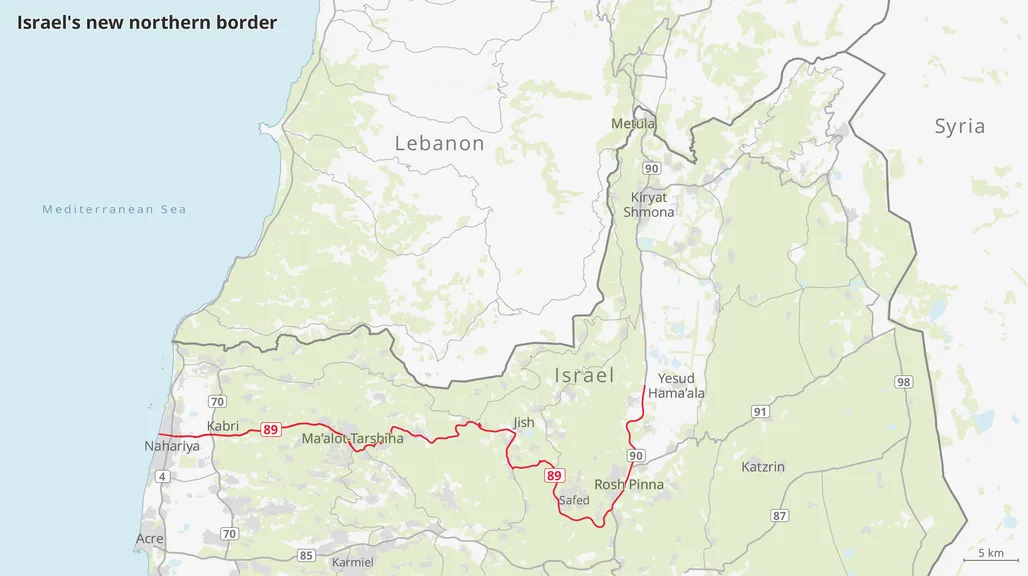
Map shows the new buffer zone in the north, as reported by Haaretz
As Hezbollah opens bigger and bigger gaps in the occupation state’s air defenses, they can fire larger missiles with more frequency into Israel, with better and deeper penetration. For Israel, this attrition is a compounding problem. Their air defenses are a connected system and the network is increasingly returning 404. Take for example, the destruction of the $230 million dollar SKYDEW blimp/spy balloon.
This balloon is designed to detect low-flying drones and missiles, especially important as this is the vector most used by the Resistance. SKYDEW can stay up much longer – and is relatively cheaper – than planes, and can ‘see’ much further than ground-based systems. It was also placed in a highly strategic area that allowed them to cover attacks from Syria, Iraq and, to a lesser degree, from Hezbollah, specifically on the port of Haifa. But now the party’s over. Look at the balloon now:

SKYDEW is now shriveled and useless – a big loss, which also signals a big breakdown. As the SKYDEW ‘Target Card‘ (from Hezbollah intelligence) says, it was “protected by an electronic monitoring and jamming system against drones and UAVs,” and “secured by three layers of missile interception systems: Iron Dome, David’s Sling, and Hetz [Arrow].” That all got sliced through like the layers of an onion, leaving Israeli defenses naked.
The northern front is porous now, as Israeli settlers know better than anybody. To quote Moshe Davidovitz, head of the Asher regional council:
“Ten rockets fell in the center of the country and the media is in an uproar — the country is in turmoil,” he wrote. “But every day dozens of rockets are fired towards the confrontation line settlements and the Galilee, including anti-tank missiles and suicide drones, and the country remains silent. Once again, it’s proof that the north is not being counted.”
Hezbollah of course, has counted the north. They have a list of Israeli military targets and they go through them one by one. Take, for example, the Mount Meron Air Surveillance Base, one of the two main bases in the occupation state. This is what a senior Israeli air force official says about the base, in a 2016 article by Maariv:
“The air control system is crucial for the operational capability of the Air Force. Its main duty is to protect the occupied airspace. Through the control system, we activate all capabilities to protect the sky, including helicopters, aircraft, missiles, and other classified systems.”
And this is what Hezbollah intelligence released, as they were bombing it:
Firstly, the Meron Air Surveillance Base is located on the summit of Mount Jarmaq [“Mount Meron”] in northern occupied Palestine, the highest peak in occupied Palestine. Meron Base is the sole center for administration, surveillance, and air control in the northern part of the usurping entity and there is no major alternative to it. It is one of two main bases in the entire usurping entity: “Meron” in the north, and the second being “Mitzpe Ramon” in the south.
The Meron Base is responsible for organizing, coordinating, and managing all air operations towards Syria, Lebanon, Turkey, Cyprus, and the northern part of the eastern basin of the Mediterranean Sea. Additionally, this base is a main center for electronic jamming operations in the aforementioned directions and is staffed by a large number of elite officers and soldiers of the zionist forces.
Secondly, the fighters of the Islamic Resistance at 07:50 AM on Saturday, January 6, 2024, as a part of the preliminary response to the crime of assassinating the great leader Sheikh Saleh Al-Arouri and his martyr brothers in the southern suburb [Dahiyeh] of Beirut, targeted the Meron Air Surveillance Base with 62 missiles of various types, inflicting direct and confirmed hits.
Hezbollah has aired its attacks on Meron Air Base in countless videos now, and they have been relentless. It can get boring because the whole thing never fireballs, but each small hit adds up. Every time a hole in Israeli air defenses opens, the hole widens, because Hezbollah is damaging complex, interconnected systems.
Today, the Meron base can barely defend itself, let alone the region. Tel Aviv has responded by assassinating Hezbollah and allied leaders, but the resistance just name missiles after those martyrs and send more.
This is a battle of attrition and Hezbollah is paying attention while Israel is mindlessly lashing out. Completely distracted by its brutal military assault on civilians in Gaza, in the south, Israel has lost the battle for the north.
After months of this boring de-administrative work, Hezbollah has finally arrived at the good stuff. The occupation state’s northern air defenses today are like a ragged old mosquito net that the dog chased the cat through. It’s full of holes, and big ones. Hezbollah can increasingly fire at will, with increasingly accurate weapons. For example, here is Hezbollah taking down a SKYSTAR 330 by drone-striking its Battalion 869 operator.

In this case, Hezbollah targeted not the spy balloon itself, but the balloon controllers, in three locations at the same time. With the operators eliminated, the balloon drifted out of control, landing in Lebanon where some kids recovered it. This is the state of Israel’s eyes and ears in the north. They’re on the ground.
Iron ‘Done’
Israel has nothing worth calling an air-defense in the north anymore. The Iron Dome is done. Hezbollah can fire at will, and has for every single day for seven months now. Iraqi Resistance missiles are flying right over them, towards Haifa. Iran can overwhelm the entire national system whenever it wants. Israel can still offend the conscience, but they’re missile defenseless now. Even Hamas is hitting them, from within traumatized Gaza. It’s open season, and the settlers know it.
Israeli settlers openly bemoan their unsettled state all over the Hebrew press. Some were so pyrrhicly incensed they threatened to secede from the entire state and form the new State of Galilee. As The Jerusalem Post has said:
The straw that broke the camel’s back was the prime minister’s answer at the cabinet meeting to a question by Benny Gantz, as reported by N12. Gantz wondered if the residents would return to their homes on September 1, for the start of the school year, and Netanyahu replied, “What’s the worst that will happen if they return a few months after September 1?”
This is of course the worst that can happen. The entire premise of Israel’s decades of grooming international actors to accept and expect bad behavior from Tel Aviv is that they can do whatever they want. If the Iron Dome doesn’t work, Israel doesn’t work, and now the Iron Dome doesn’t work. It’s the Iron Sieve now. Holy warriors have poked it full of holes.

An Iron Dome battery targeted by Hezbollah
This is a huge problem because the Iron Dome is not just Israel’s physical defense mechanism, it’s their psychological defense mechanism. It’s what makes the whole colonial project believable, that they can bully everyone in the region and suffer no consequences. Belief in the ‘Iron Dome’ is belief in ‘Israel’ and neither is believable anymore. Thus the northern Jewish settlements have emptied out and they’re not coming back anytime soon. As the Resistance News Network (RNN) said (on May 29th):
930 settler houses in northern occupied Palestine have been damaged by Hezbollah rockets in 86 settlements since October 7th, according to the zionist Ministry of War.
In Al-Manara for example, 130 out of 155 houses were destroyed. Metulla has just 34 residents left in the settlement, at most. Kiryat Shmona, one of the largest (northern) settlements, has seen its population plummet from 24,000 to under 4,000, and 124 houses have been damaged within it.
This comes as over 200,000 settlers in the north are displaced by the resistance, having built their own refugee camp. Some want to secede from “Israel” and build their own state, while others, such as the settlement of “Margaliot” have severed their ties with the entity as of yesterday.
Perplexingly, the IOF reportedly plans to significantly cut down the number of soldiers it has on the northern border and nearby settlements, citing funding reasons, or perhaps to lessen the number of targets available to Hezbollah.
Let’s look at one example of Hezbollah eliminating one target, an Iron Dome battery. They systematically do this over and over. This report describes how Hezbollah first gets the battery to reveal itself by firing rubbish at it, then hits it with drones.
The exclusive footage reveals the monitoring and reconnaissance operations that enabled Hezbollah to uncover the positions of “Iron Dome” batteries stations near the settlement of “Kfar Blum” using a tactic called “fire luring.”
The footage shows Hezbollah launching munitions toward the sites and documenting the interception process carried out by the Iron Dome, which enabled Hezbollah to execute a high-precision qualitative operation.
The scenes at 4:25 show a successful targeting of the Iron Dome batteries, without them being able to detect, track, or thwart the attack. Published photos also reveal Hezbollah’s intelligence penetration of the Israeli soldiers in these newly established sites, and their ability to document the geographical details and size of the fortifications used.
Hezbollah has done this over and over, methodically hunting and seeking Iron Dome batteries one by one. Given that the rest of their surveillance equipment is decimated and they can’t see what’s coming, Israel is forced to then draw its military assets even further from the border. Otherwise this is what happens:

This is the moment Hezbollah hits the garrison unit of Barkat Risha with an Iranian Almas top-attack ATGM [Anti-Tank Guided Missile]. ‘Unlike Hezbollah and Hamas, Israel has not spent the past 20 years tunneling underground, so their troops are all exposed without the Iron Dome. Take also, for example, the IOF’s 769th Brigade Headquarters, or what’s left of it.
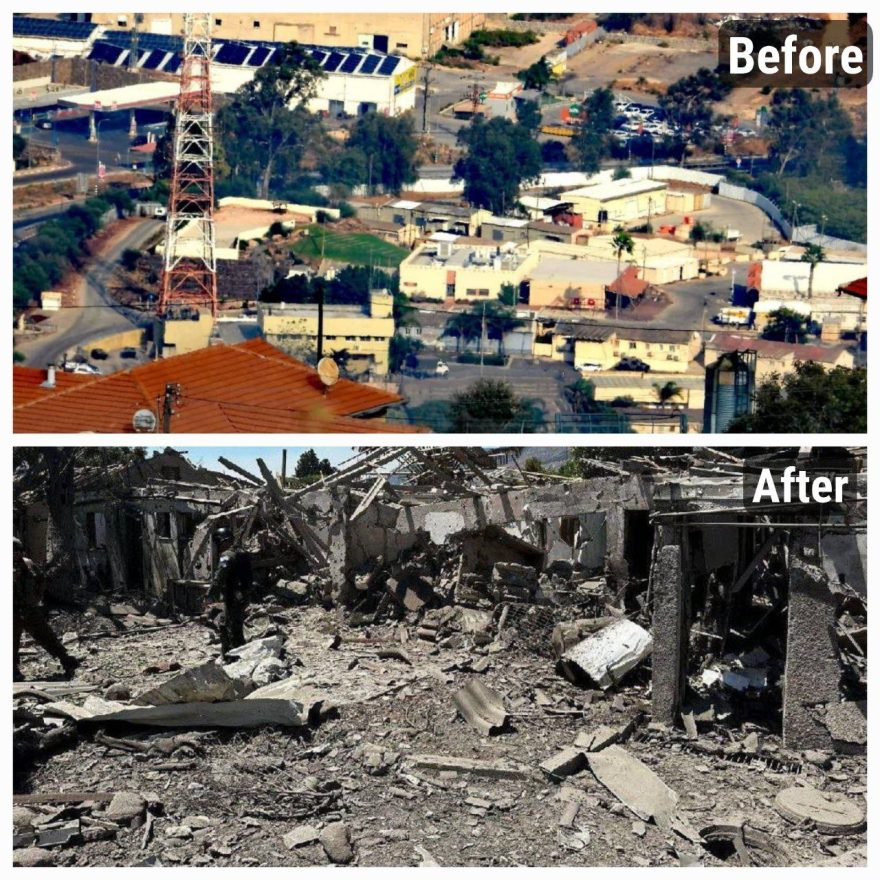
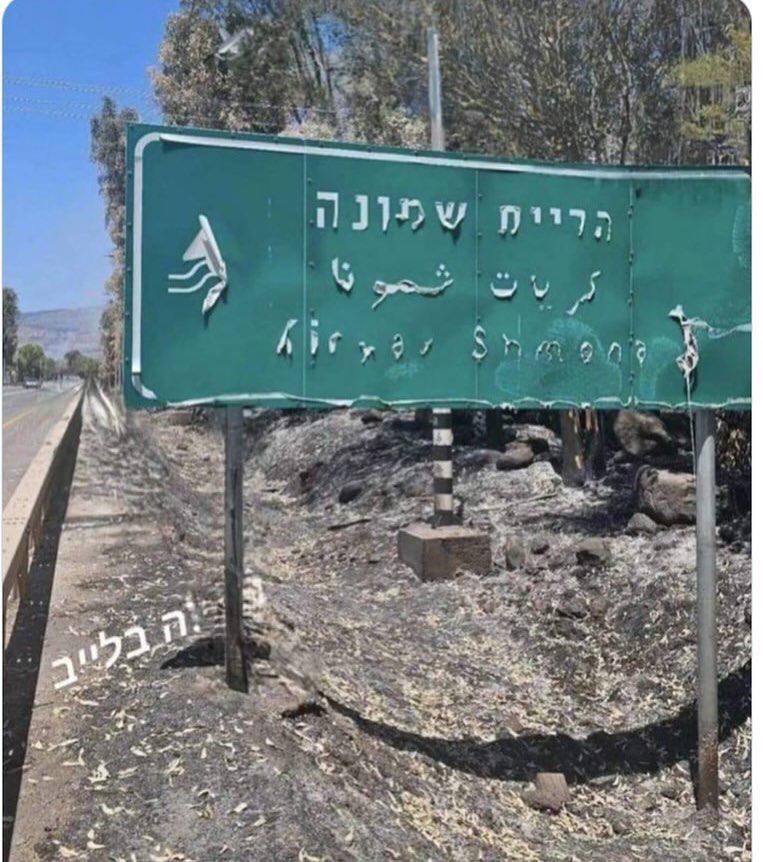
The colonial project will shrink rapidly without air defenses. When the soldiers leave, the settlers have to leave. This is not a strategic retreat, it’s strategic defeat. This is not a solution, just dissolution. But it’s all Israel can do. It hasn’t simply lost control of the north, it has lost control of the tempo of this war. Hezbollah can keep turning the heat up until Israel is cooked. Behold Kiryat Shmona (occupied al-Khalisa), which was literally in flames a few days ago:

This is directly because the Iron Dome is not intercepting drones and Hezbollah has fire control of the whole region. Hence it burns. Settlers now see a “welcome” board that has literally melted.
As Israel retreats further and further from its border with Lebanon, the collapse of the northern front also opens up the occupation state to attacks from Syria and Iraq, which can fly straight through. This is all causing massive psychological damage to Israel because the Iron Dome was their primary safety blanket.
Hezbollah has reported destroying over 1,650 pieces of intelligence, surveillance and target acquisition (ISR) equipment since 8 October, 2023. The Lebanese resistance had an actual strategy while Israel was wildly bombing ambulances and homes with no military value. Now Israel has lost northern Palestine and it’s not coming back.
Western hegemony is over – Moscow

Russian Foreign Ministry Spokeswoman Maria Zakharova
RT | June 8, 2024
The concepts of hegemony and global dominance, which the Collective West clings to, have no place in the multipolar world order – which is already becoming a reality, Russian Foreign Ministry spokeswoman Maria Zakharova said on Saturday.
Speaking at a panel discussion on new norms of international relations at the St. Petersburg International Economic Forum (SPIEF), Zakharova slammed Western governments for resisting the structural changes which have already started with regard to the self-organization of nations and their interactions with other states.
“We are talking about polycentrism, a departure from previous norms, and we see the desperate resistance of the Collective West… They see the norm differently – as their own dominance, as a world order based on one rule – that they must dominate as before, and everyone must do only what the dominant allows them to do,” she stated, adding that the drive for dominance has only ever “led humanity to monstrous tragedies,” including colonialism and Nazism.
“Today it is hegemonism, an obsession with domination, a painful pseudo-messianic idea of [the West’s] global mission… But neither people nor states can declare themselves as missionaries, only history can prove whether their mission was good or based on unhealthy ideas,” Zakharova said.
She added that the ideas of global dominance, of the exceptionalism of some nations amid the destruction of ethnic and cultural identities of others have repeatedly been expressed by Western leaders. She went on to say that these ideas are not shared by the global majority, which has already embraced the concept of multipolarity.
“We should not forget, they are a minority – the Collective West… their worldview is shared by no one except for them,” she said, citing memorandums adopted by multinational blocs as the Russian-led BRICS group, the Shanghai Cooperation Organization, African Union, and others, in which member states commit to forming a multipolar world order.
“The SCO… covers 3 billion people – half of humanity… BRICS covers over 30% of the Earth’s land mass, 45% of the world population – some 3.5 billion people, and 33% of global GDP… 3% more than the GDP of the G7,” she stated.
Zakharova noted that even in the West, some analysts claim that “the US has not been a world hegemon for a long time,” while “its actions in the international arena have led to the destabilization of world politics.” However, until there are significant changes in policy and ideology, Russia and its global allies have “a long struggle ahead” to form a truly polycentric world order, she said.
“While our cause is not simple, it is worthy and noble. And we will walk this path as a global majority. We don’t call it a mission, though, we call it our goal and objective.”
Moldovan Opposition Leader Shor Calls for Joining Union State of Russia and Belarus
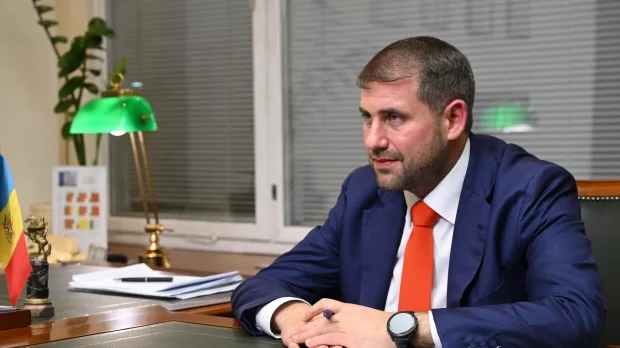
Sputnik – 06.06.2024
Moldova should grow closer to Russia, so it would be worth discussing the possibility of joining the Union State of Russia and Belarus, Moldovan opposition politician Ilan Shor, the leader of “Pobeda” (Victory) political bloc, told Russian media.
“Russia is our friend, our partner; we should move forward together. Moreover, I believe that there is a possibility to expand even the format of the Russia-Belarus Union State. There is a possibility for consideration and for dialogue. This is important,’ Shor clarified.
According to the politician, only by uniting could Moldova and Russia stand against the West, as Moldova itself is needed by the West only for its own purposes.
“Why do they need Moldova? And I’ll tell you – it’s a testing ground. A testing ground of free hands for war. It’s a testing ground to bully. Maybe they’ll send immigrants to us at some point. We have nothing in common with them. Here [with Russia and Belarus] we’ve been in the same family for years, we know each other, we speak the same language. We understand each other, we have common values,” he added.
Most Moldovans believe in a future with the Eurasian Economic Union (EAEU), Shor said at the St. Petersburg International Economic Forum.
“We believe that the only way out for the Republic of Moldova today is to become a full-fledged, full member of the EAEU. We really understand today that we want to become a participant of the platform, a unified platform in the field of economy, in the field of ideology, in the field of foreign policy, in the field of security policy. Today this is more important for Moldova than ever,” Shor emphasized, addressing the SPIEF session “The Greater Eurasian Partnership as a New Pole of Growth: Potential and Prospects”.
Shor claimed that the majority of Moldovan voters have already become disillusioned with the European Union and European values, as politicians who entered power on these slogans are closing opposition television channels in the republic and removing unwanted politicians from elections.
“We clearly understand that today the majority of the people of Moldova believe in a future with the EAEU… We have had enough of fairy tales and carrots on sticks for the last 20 years. Today we want real friendship, cooperation and mutual understanding and relations,” he declared.
Majority of British youth think Israel ‘should not exist’: Poll
Press TV – June 5, 2024
The majority of young British people think that Israel “should not exist”, blaming the occupying entity for the ongoing genocidal war on the besieged Gaza Strip, a new opinion poll shows.
Released on Wednesday, the survey, carried out by British news and opinion website UnHerd, suggested that 54 percent of 18-24-year-olds in Britain thought the Israeli regime “should not exist” compared with seven percent of 65-year-olds and older.
“A preliminary finding of an exclusive survey of 1,012 voters about foreign policy, conducted by Focaldata and due to be released tomorrow on UnHerd, found that a striking 54% of 18-24-year-olds agreed with the statement that” the Israeli regime “should not exist.”
According to the new polling, 50 percent of the age group also blamed the occupying regime for the ongoing violence in the war-torn Palestinian enclave.
Back in December, a poll suggested that 51 percent of Americans between the ages of 18 and 24 believed the key solution to bring to a close the Israel-Palestinian conflict was for “Israel to be ended and given to Hamas and the Palestinians.”
Israel’s bloody war machine has killed over 36,500 Palestinians since October 7, 2023. The vast majority of the fatalities are women and children.
The savage campaign was launched after Hamas carried out its historic Operation Al-Aqsa Storm against the usurping entity in retaliation for the regime’s intensified atrocities.
Israel has additionally enforced a comprehensive blockade on the coastal sliver, severing the supply of fuel, electricity, sustenance and water to the population of over two million Palestinians residing there.
Syria on the brink of recovery as Qatar and Turkey change their policies
By Steven Sahiounie | Mideast Discourse | June 3, 2024
The Emir of Qatar, Tamim al Thani, recently said that he supports the street protests in Idlib, where people are protesting the dictatorial rule of the Hayat Tahrir al-Sham (HTS) terrorist group.
This marks a monumental change in policy for Qatar, and maybe the first step toward restoring diplomatic ties with Syria.
Beginning in 2011, and the Obama administration’s US-NATO war on Syria for regime change, Qatar has been a close and loyal ally to the US, and was used as a financial backer of the various terrorist groups brought into Turkey, and trucked across the border to Idlib.
Sheikh Hamad bin Jassim bin Jaber bin Mohammed bin Thani Al Thani, former Prime Minister of Qatar, and foreign minister until 2013, gave an interview in which he admitted Qatar provided the money to bankroll the terrorists in Syria as they attacked the Syrian people and state. He made it clear that the cash delivered was sanctioned, and administered by the US in Turkey. Qatar was not working alone, but under a strictly controlled partnership with the US government.
In 2017, President Trump shut down the CIA operation Timber Sycamore which ran the failed project to overthrow the Syrian government.
Qatar is now turning their back on the terrorists who occupy Idlib. Mohamed al-Julani is the leader of HTS. He is Syrian, raised in Saudi Arabia, fought with Al Qaeda in Iraq against the US, aligned with ISIS founder Baghdadi, came to Syria from Iraq to develop Jibhat al-Nusra, the Al Qaeda branch in Syria.
Once Jibhat al-Nusra became an outlawed terrorist group, Julani switched the name to HTS in order to preserve his support from Washington, DC. Even though the US has a $10 million bounty on his head issued by the US Treasury Department, he is safe and secure in Idlib, where American journalists have visited him for interviews, in which he has sported a suit and tie, wishing to present himself as a western-leaning terrorist that the US can count on.
When the Syrian Arab Army and the Russian military would fire a bullet towards the terrorists in Idlib, the US would denounce it as an attack on innocent civilians. This kept Julani safe and secure, and in charge of humanitarian aid coming across the border from Turkey. The aid was from the UN and various international charities. While the 3 million people living in Idlib are not all terrorists, all the aid passes through the hands of Julani and his henchmen. If you bow down to Julani, you get your share of rations, but if you have complained, you are denied. Those who are cut off from the aid can buy their supplies from Julani at his Hamra Shopping Mall, which he built in Idlib, where he sells all the surplus aid sent to Idlib.
The civilians in Idlib have taken to the streets protesting the rule of HTS. Many people have been arrested by HTS, some tortured, and others killed. The people are demanding that Julani leave.
They are asking for freedom and a fair administration. The various aid agencies have complained that HTS will not allow any free programs for women, such as learning employable skills. Women there are not allowed to seek employment, except in places which are only female. HTS rules with a strict form of Islamic law, which they interpret to their benefit.
Saudi Arabia and Syria have established full normal relations, with an exchange of ambassadors. At the Arab League Summit in May in Bahrain, the Crown Prince of Saudi Arabia, Mohamed bin Salman (MBS) met personally with Syrian President Bashar al-Assad. They also met at the previous Arab League Summit in Saudi Arabia.
MBS recently announced a humanitarian grant to the UN to repair 17 hospitals in Syria which had been damaged in the 7.8 earthquake which killed 10 thousand in Syria.
MBS also sent spare parts for the Syrian Air commercial planes, which had suffered under US sanctions and were prevented from maintaining their safety by Washington. Recently, the very first planes of Syrians began flying to Saudi Arabia for the first time in 12 years, to perform the Haj pilgrimage.
On May 30, the leader of Iraq said he hopes to announce a Turkey-Syria normalization soon. Turkey, like Qatar, had been supporting the various terrorist groups in Syria in cooperation with the US.
Turkey also has made a turn-around in their position, and has been looking for a way to exit Idlib and the other areas it occupies in Syria, in preparation of a re-set with Damascus.
The relationship between the US and Ankara has remained tense after the US partnered with the Syrian Defense Forces (SDF). Turkey considers the SDF as a branch of the PKK, the outlawed international terrorists group who has killed 30,000 people over three decades, while wanting to establish a Kurdish State.
The SDF are planning to have elections on June 11 in an effort to gain western support for a Kurdish State. Erdogan has stated Turkey will never allow this to happen.
If the SDF were to lay down their arms, they could repair their relationship with Damascus, and at the same time Turkey could then withdraw their occupation forces from Syria. With Turkey out of Syria, their normalization process could begin.
When the SDF have repaired their broken relationship with Damascus, and the Turkish threat no longer exists, then the US military can withdraw their 900 occupation force from Syria.
Recently, General Mazloum, the leader of the SDF, said that the problems between the Kurds and Damascus are internal problems, and cautioned against any foreign interference, especially from Turkey.
The situation is changing rapidly in Syria. The economy is collapsed, with the inflation rate over 100% in the last year due to crippling US sanctions. Because the US military is occupying the largest oil and gas field in Syria, this prevents the production of electricity for the national grid, and Syrians are living with three hours of electricity per day.
US sanctions prevent some of the most vital medicines from being imported, as western medical companies are fearful of running afoul of the US sanctions, and have produced a culture of over-compliance, which deprives Syrian citizens’ life-saving medicines and medical supplies.
The battlefields have been silent for years, and the silence grew into a status-quo, where the American and Turkish foreign policy prevented a resolution to the conflict that has destroyed lives and prompted the largest human migration in recent history as Syrians have sought work abroad.
Turkey, Saudi Arabia and Qatar all played significant roles assigned to them by the US State Department under the Obama administration. There is a light at the end of the tunnel with the reversal of policies toward Syria, and Qatar and Turkey are set to play major roles in the recovery process in Syria. These reversals are also significant as they mark a change in the relationship between the US and several regional countries. This is part of the ‘New Middle East’ that Washington called for, but the role the US played has left them the loser.
FDA Approves Moderna’s mRNA RSV Vaccine — With No Input From Independent Advisers
By Brenda Baletti, Ph.D. | The Defender | June 3, 2024
The U.S. Food and Drug Administration (FDA) last week approved Moderna’s mRNA respiratory syncytial virus (RSV) vaccine for adults age 60 and older.
The FDA approved the drug without input from the agency’s independent vaccine advisory committee, which typically makes recommendations about such drugs, because the FDA didn’t see any “concerns or controversial issues” that would make input necessary to the approval process, the agency said in its approval letter.
Moderna is running at least 11 clinical trials for its new mRNA RSV drug on several other demographic groups, including young children, adolescents and healthy adults.
The vaccine, marketed under the name mResvia, is Moderna’s second-ever FDA-approved drug. It uses the same mRNA platform as its COVID-19 Spikevax vaccine.
“The FDA approval of our second product, mRESVIA, builds on the strength and versatility of our mRNA platform,” said Moderna CEO Stéphane Bancel.
The Centers for Disease Control and Prevention (CDC) must recommend the drug before it can be used. The CDC’s advisory committee will discuss and vote on the vaccine at its meeting next month.
If approved, the vaccine will provide a second revenue stream for Moderna, whose first-quarter sales fell 91% compared with same-quarter sales in 2023.
The company said it expects to launch the vaccine in time for the 2024 fall vaccination season.
The FDA’s approval of Moderna’s mRNA RSV vaccine comes a year after the agency approved GSK’s Arexvy and Pfizer’s Abrysvo RSV vaccines for the same age group.
Abrysvo also is approved for pregnant women. Pfizer is seeking approval for its drug for adults ages 18 and older and is testing it on children and teens. GSK is seeking approval for Arexvy for people 50 and above and expects a response this month.
Bancel said Moderna’s shot has an advantage over the RSV vaccines now on the market because it comes in a pre-filled syringe, making it faster to administer and cutting the risk of administration errors.
Moderna said it hopes to capture part of what it predicts will be a $10 billion market for RSV vaccines, especially given its post-pandemic plummet in profits.
The company also announced last week that it is in talks with the U.S. government to fund late-stage trials of its mRNA bird flu vaccine.
Experts say efficacy exaggerated and safety concerns ignored
Moderna’s approval was based on findings from a Phase 3 study published in December 2023 of more than 35,000 adults across 22 countries that claimed the vaccine was 83.7% effective at preventing at least two symptoms of RSV, such as cough and fever, nearly four months post-vaccination.
Follow-up analysis by the FDA identified other cases and reduced the efficacy to 79%, the company said. That efficacy rate is in line with Arexvy, which currently dominates the RSV vaccine market, Reuters reported.
Cardiologist Dr. Peter McCullough wrote on his Substack that the efficacy claims were misleading.
“The absolute risk reduction for significant outcomes was far below 1%, meaning this product will not have a significant clinical impact,” he wrote.
Absolute risk reduction refers to the actual difference in risk between the treated group versus the control group.
Relative risk reduction, which is how the company presented its trial data, is a proportional measure of how much a treatment reduced the risk of a bad outcome relative to the control group. It tends to lead to overestimations of how effective a treatment is.
Data presented in February also showed Moderna’s shot has faster efficacy declines compared to the GSK and Pfizer shots, Reuters reported.
Moderna said there were no serious safety concerns identified in the trial. Adverse reactions reported in the clinical trial included injection-site pain (55.9%), fatigue (30.8%), headache (26.7%), muscle pain (25.6%), joint pain (21.7%), underarm swelling or tenderness (15.2%) and chills (11.6%).
There were also two cases of acute pericarditis, which occurred after 42 days. The investigator considered those cases to be unrelated to the shot.
There were no reported cases of Guillain-Barré syndrome, which both Pfizer and GSK identified in their clinical trials and has subsequently proven to be “more common than expected,” with the other RSV shots, according to the CDC.
However, McCullough said that for all mRNA shots, there are concerns about myocarditis, auto-immunity, genomic integration and oncogenicity. The rapid approval process does not allow the necessary time to identify a lot of these issues.
He wrote:
“Our great concern was that mRNA COVID-19 vaccines ushered in the context of an emergency would set a new precedent for more genetic vaccines that depart from all safety standards set forth previously by the US FDA. …
“[The approval] was done without the full dossier of safety information required for a routine approval including 2-3 years of observation for standard vaccines, and at least 5 to 15 years of observation for genetic transfer technology.”
Because the FDA’s vaccine advisory committee didn’t discuss the data, there was no publicly accessible discussion of the vaccine’s efficacy and risk or space for public comment, which typically happens at such meetings.
The committee held meetings before the approval of both Arexvy and Abrysvo.
The FDA did not immediately respond to The Defender’s inquiry about the lack of an advisory committee meeting or possible concerns with vaccine safety.
RSV is a common respiratory virus that usually causes mild cold-like symptoms, but in some cases can lead to hospitalization and death in infants and the elderly.
The number of people who get RSV is unknown because the virus is rarely diagnosed unless one comes to a hospital and is tested.
Dr. Meryl Nass, an internist, told The Defender that among older people typically only those who are already ill or have very severe immune deficiency could benefit from an RSV vaccine.
“That benefit,” she said, “must be weighed against all the harms, including those from the lipid nanoparticle as well as the mRNA and any DNA plasmids or other extraneous production materials.”
She said that mRNA vaccines are typically expensive and the amount of spending that would be necessary to save one life could take away from other essential health spending.
McCullough said, “Rare illnesses which are mild should not be the target for mass vaccination.”
“In the case of respiratory syncytial virus, the illness is so mild and easily treatable with albuterol and budesonide nebulizers, it is hard to make the case for mass vaccination with a novel mRNA platform,” he added.
Brian Hooker, Ph.D., chief scientific officer of Children’s Health Defense, told The Defender that approval of this vaccine “is an absolute disaster in the making.”
“The clinical trial was too short (average 112 days) to ascertain any long-term sequelae to the vaccine. Even with that, the rate of serious adverse events was 2.8% or 1 in 36 vaccine recipients,” he said. “We can only expect the actual degree of damage will be much worse.”
Moderna conducting testing on pregnant women and their infants
A search of the federal clinical trials database also revealed that Moderna is testing its mRNA RSV vaccine on pregnant women and their infants, despite concerns raised among this group with other RSV vaccines.
The ongoing Phase 2 trial in pregnant women will consist of 360 participants between 28 and 36 weeks of gestation at the time of vaccination. The trial is designed to determine dosing and potential adverse events associated with the vaccine.
GSK halted the development of its RSV vaccine for pregnant women when it found a safety signal for preterm births among vaccinated women. In that study, for every 54 infants born to women who received the vaccine, one additional preterm birth occurred.
Neonatal deaths — the death of an infant in the first 28 days of life — also were higher in the GSK vaccine group, occurring in 0.4% of the infants in the vaccine group (13 of 3,494) and 0.2% in the placebo group (3 of 1,739), which they also noted was not statistically significant.
The FDA approved Pfizer’s Abrysvo for pregnant women in August 2023.
Pfizer’s own clinical trial data for Abrysvo, which is very similar to GSK’s vaccine, also showed elevated rates of preterm birth among vaccinated women, but the higher rates were not statistically significant, Pfizer said.
Still, the FDA limited approval of the vaccine for women in weeks 32-36 of their pregnancy to reduce risk and mandated post-market follow-up studies for both preterm birth and eclampsia.
The agency also labeled preterm birth as a potential risk associated with the vaccine.
Some members of the FDA’s vaccine advisory committee said they had serious safety concerns based on the clinical trial data, and four members voted against approving the drug.
And a recent preprint study shows a statistically significant safety signal for preterm birth associated with Abrysvo.
Clinical trials for the COVID-19 mRNA vaccines did not include pregnant women.
However, subsequent research found the mRNA administered to lactating mothers spread systemically from the injection site to breast milk. Other post-marketing studies of the COVID-19 vaccine found mRNA in umbilical cord blood and in the placenta.
Moderna also has several other active clinical trials for the drug, including among people who are not at risk from RSV-related illness, including children and adults, children ages 2-18, and healthy adults, among others.
It is also testing the drug among children ages 5-24 months.
This article was originally published by The Defender — Children’s Health Defense’s News & Views Website under Creative Commons license CC BY-NC-ND 4.0. Please consider subscribing to The Defender or donating to Children’s Health Defense.
Got Titers? New Test Makes It Easy, Inexpensive to Find Out if You’re Immune to 11 Infectious Diseases
By Brian Hooker, Ph.D. | The Defender | May 30, 2024
There are many situations for which it’s necessary to know your immune status against an infectious agent.
In May 2023, I reported on the ImmunoProfile® technology as a relatively inexpensive, in-home method of determining antibody “titers” for adults.
Now, this test is available for children as young as age 4. This allows ImmunoProfile titer testing to be used for proof of immunity for children for school attendance — especially for states like California, where exemptions are rarely granted.
ImmunoProfile testing for children can now also be used for daycare, summer camps and sports teams that may require vaccines for participation, but may allow the substitution of titers testing in some cases.
An antibody titer is a medical laboratory test that determines the amount of antibodies specific to an infectious agent in the bloodstream. The antibody level in the blood reflects the body’s past experience or exposure to an antigen or something the body doesn’t recognize as “self.”
In the past, an antibody titer required a physician-written laboratory order, a blood draw from a registered phlebotomist and multiple laboratory tests for each disease where vaccination is required — all of which may not be covered by insurance.
Each test may cost as much as $400, and multiple tests may be required to determine the full range of vaccines required.
In contrast, the ImmunoProfile test panel simultaneously measures antibody titers for 11 infectious diseases, requires no lab order or blood draw and costs $229 plus tax. This cost includes the physician’s prescription, 11 antibody titer tests, shipping and the confidential test report result. The result report has been updated to include date of birth, age and sex assigned at birth.
The 11 antibody titer tests include: diphtheria, Haemophilus influenzae B, hepatitis A, hepatitis B, measles, mumps, pertussis (whooping cough), polio, rubella, tetanus and varicella zoster (chicken pox).
I and my family have previously used the ImmunoProfile test with great success. We found the entire process to be easy and straightforward. All the steps for collecting the blood were clearly and graphically laid out in the instructions insert that came in the kit and in the instruction video.
Within two weeks, we had our results. Read here for more details about our experience including my test results.
The test is completed by a CLIA/CAP-approved (Clinical Laboratory Improvement Amendments/College of American Pathologists) laboratory. Antibody levels are measured using proprietary equipment, cleared by the U.S. Food and Drug Administration and used globally for more than 20 years by multiple medical diagnostics companies, research facilities and academic institutions.
Measured titers are compared to standards for immunity as set by the World Health Organization.
All information is kept private. ImmunoProfile doesn’t sell your information or test results and all blood samples are destroyed 30 days after testing. ImmunoProfile performs no other tests, genetic or otherwise, on your blood spot samples.
ImmunoProfile provides a secure web portal for obtaining results after testing is complete. Test results are completely private and require two-factor authentication to access. Login requires a username and password, plus a passcode sent to your email address.
Each child must have their own email account for privacy reasons and to comply with parental consent on the website.
Only authorized laboratory personnel have access to patient information, which consists only of antibody test results.
Brian S. Hooker, Ph.D., is chief scientific officer at Children’s Health Defense and professor emeritus of biology at Simpson University in Redding, California.
This article was originally published by The Defender — Children’s Health Defense’s News & Views Website under Creative Commons license CC BY-NC-ND 4.0. Please consider subscribing to The Defender or donating to Children’s Health Defense.
Featured Video

Alon Mizrahi: ‘Israel Must Be Dismantled’
or go to
Aletho News Archives – Video-Images
From the Archives
Allies Don’t Need Lobbies
By Jay Knott | Dissident Voice | September 24, 2013
In a recent article on Counterpunch, Rob Urie defended the traditional Marxist analysis of US policy in the Middle East. He argues that support for Israel is driven primarily by economic interest, not the Jewish lobby.
He starts by paying tribute to the idea that Western societies are uniquely racist. He says that the “Western narrative” claims there is an “Arab character”, and that this is “antique racist blather”. He gives no definition of these terms. Further, he establishes his credentials as part of the dominant current in the American left by claiming that “over a million people in Iraq died so ‘we’ in the West can drive SUVs.”1
When he tries to criticize bourgeois economics, he makes it clear he doesn’t understand the developments it has made since Marx’s day, using the mathematical discipline known as “game theory”. He dismisses the basic abstraction of economic theory, the idea of the rational individual, on the grounds that it is “devoid of history, culture and political context”. But abstractions are always devoid of something.
He defends a more concrete economic theory, mostly Marxist, with some input from another theorist of capitalist crisis, Hyman Minsky. This concrete theory leads him to the view that US activity in the Middle East is primarily driven by rational capitalist motives, the need to secure a supply of oil.
“Taking the totality of circumstance — former oil company executives launching war on an oil rich nation on a pretext they publicly proclaimed they didn’t believe shortly before taking office — and that upon launching their war proved to be non-existent, requires a willingness to overlook the obvious — that the war on Iraq was for oil, that is difficult to support.”1
Perhaps I’ve misunderstood him, but based on what he says in the rest of the article, this convoluted sentence seems to argue that, because president Bush and vice-president Cheney attacked Iraq on false premises, and they also said it was all about oil, and they are former oil executives, and Iraq has a lot of oil, it’s difficult to deny US attacks on Iraq are all about oil.
In fact, it’s not hard at all. As Urie points out, at times Bush and co. said that attacking Iraq was “protecting the world’s supply of oil.”1 But, as he also points out, they are congenital liars. Why should we believe them when they say they are trying to “protect” the oil supply? Protect it against what? When politicians “admit” attacks on Middle Eastern countries are wars for oil, they are parroting the neo-con party line, feeding the public, both left and right, with a plausible-sounding pretext. For right-wingers, “it’s a war for oil” is a reason to support war, and for leftists, it’s a way to feel better by complaining impotently about corporate greed. Both approaches help the war drive. … continue
Blog Roll
 Aletho News
- Pakistan ramps up food exports to Persian Gulf nations as war deepens food insecurity
- Iran submits response to US plan, sets terms for war’s end: Tasnim
- US vs Iran: Kharg Island Talk — Bluff or Escalation? Ex-Military Officer Weighs In
- Zelensky unnecessarily involves Ukraine in the Middle East crisis
- Turkish tanker blacklisted by Ukraine hit in drone attack – media
- Canada, the U.S., and NATO: the inescapable trap
- Villains of Judea: Leonid Radvinsky
- Alon Mizrahi: ‘Israel Must Be Dismantled’
- Former Head Of MI6 Admits That The U.S. And Israel Are Losing The Iran War
- Scattered Thoughts on War and Peace
- If Americans Knew
- Israel may be committing war crimes in Lebanon – Not a ceasefire Day 167
- In the West Bank, life is a constant battle – 3 articles
- Jacob Reses, one of the most powerful pro-Israel operatives in Trump’s Washington
- Israeli-US assaults kill or injure 87 children a day – Not a ceasefire Day 166
- ‘Forever live by the sword’: Understanding Israelis’ massive support for Iran war
- UN’s special rapporteur on human rights says Israel is systematically torturing Palestinians
- Trump White House plagiarized Iran war manifesto from Israel-aligned think tank
- Gaza says 6–10 patients die daily waiting for treatment abroad as Israel blocks medical evacuations
- ‘Substantial evidence’ of double-tap strike in killing of Gaza’s Hind Rajab
- ‘Do Not Want To Die For Israel’: Doubts About Trump’s Iran Strategy Spread Among Troops
- No Tricks Zone
- Devastating Assessment Of Comirnaty Vaccine By Former Senior Pfizer Europe Toxicologist
- New Study: CO2 Is ‘Effectively Negligible’ As An Explanatory Climate Change Factor Since 2000
- Former Pfizer Toxicologist Dr. Helmut Sterz Tells Bundestag Hearing Pfizer Vaccine Should Have Never Been Approved
- Energy Expert: Germany’s Nuclear Phaseout Was A “500 Billion Euro Mistake”
- New Research: South Australia’s Mid-Holocene Sea Surface Temperatures Were 4°C Warmer Than Today
- Storing Green Energy To Last Germany 10 Days Would Require A 60-Million Tonne Battery
- New Studies: UK Sea Levels Were 4 Meters Higher Than Today During The Mid-Holocene
- Destructive Green New Deal: German Energy And Metal Group Warns Of Drastic Crisis
- New Study Documents A 20-Year Pause In Arctic Sea Ice Decline – Driven By Internal Variability
- Wake-up Call: Survey Shows Majority Of Germans Now Favor Postponing Climate Targets!
 Aletho News