Paulo Nogueira Batista: Decline of the IMF & Rise of the BRICS New Development Bank
Glenn Diesen | November 20, 2025
 / glenndiesen
 IAEA chief reports progress on Iran nuclear inspections
Al Mayadeen | November 19, 2025
Efforts and consultations with Iran are ongoing in a bid to restore inspection activities in the country, Rafael Grossi, the Director General of the International Atomic Energy Agency (IAEA), announced on Wednesday.
Addressing the IAEA Board of Governors, Grossi said, “I believe there has been some progress. We have returned to Iran, and over a dozen inspections have taken place so far.”
“However, there is still more work to be done in line with the relevant provisions of the Comprehensive Safeguards Agreements,” he added.
He noted that, in coordination with the Iranian foreign minister in Cairo, “significant technical understandings have been reached with Iran to facilitate inspections following the events of June,” emphasizing that “this is the path we need to continue on.”
“I remain convinced that there is no solution other than a diplomatic one to this issue, which requires engagement, understanding, and full compliance by Iran with its obligations,” Grossi added.
He continued, “If this does not happen, we will continue to face one challenge after another and will not reach the position we all aspire to. Nevertheless, our work must continue, and my stance has always been to act decisively and maintain ongoing communication with Iran to return inspection activities in a country with a critical nuclear program to their normal course, in accordance with the Nuclear Non-Proliferation Treaty and the Comprehensive Safeguards Agreement—nothing more, nothing less.”
It is worth noting that Iran suspended cooperation with the IAEA in June, citing the need to ensure the security of its nuclear facilities following US and Israeli actions against them. Iran’s Atomic Energy Organization criticized the IAEA, saying that attacks on its nuclear sites resulted from the agency’s failure to maintain professionalism and political neutrality.
Clash between Iran and the IAEA
Following the June airstrikes carried out by the Israeli occupation and the United States on numerous Iranian nuclear and military sites, Iran swiftly suspended full cooperation with the IAEA. In response, the Iranian parliament passed legislation barring further access to its nuclear facilities by IAEA inspectors unless specifically approved by the Supreme National Security Council. Tehran accused the agency of failing to condemn the attacks and criticized it for lacking neutrality, arguing that this undermined the security of its nuclear infrastructure.
In the months that followed, particularly throughout July and August, the IAEA was unable to conduct its routine inspections in Iran. Iranian officials insisted that any resumption of IAEA activities required a renegotiation of the terms of engagement, emphasizing that previous frameworks had failed to protect Iran’s sovereign rights. This signaled a shift toward a more guarded stance, as Iran sought stronger guarantees before reopening its facilities to international scrutiny.
By September, however, progress was made when IAEA Director General Rafael Grossi and Iranian officials met in Cairo. The parties reached a preliminary technical understanding aimed at restoring monitoring mechanisms. As part of the deal, Iran agreed to provide detailed status reports on its affected nuclear sites and to resume IAEA inspections gradually. While this understanding marked a step forward, no firm timeline for full cooperation was established, leaving the situation tentative.
Despite the progress, the relationship between Iran and the IAEA remains fragile. Iran continues to demand that the agency uphold a politically neutral approach. At the same time, the IAEA insists that its role under the Nuclear Non-Proliferation Treaty and the Comprehensive Safeguards Agreement must be respected.
IAEA role called into question
However, the IAEA’s role in the latest attack on the country was called into question as Iran’s Atomic Energy Organization chief, Mohammad Eslami, accused “Israel” of striking key nuclear facilities in Tehran, based on technical details provided to the International Atomic Energy Agency (IAEA).
The attack, according to Eslami, targeted a fuel production unit at the city’s research reactor, as well as a reactor used to manufacture vital radiopharmaceuticals.
Speaking at the Foreign Ministry’s conference “International Law Under Assault: Aggression and Defense,” Eslami emphasized that Iran has long maintained strict safety protocols to protect its nuclear experts, infrastructure, and the surrounding environment, ensuring no leaks or contamination.
Eslami stressed that the accuracy of the strikes suggests that classified technical details, information Iran had provided to the International Atomic Energy Agency (IAEA), were exploited, noting that the only laboratory Iran built in full coordination with the agency was singled out in the attack.
Turkish Hercules Crashes on Azerbaijan-Georgia Border
By Alexandr Svaranc – New Eastern Outlook – November 17, 2025
Unfortunately, airplane crashes are becoming a common feature of our time that leads to human casualties. Such incidents are caused by technical failures, human error, or external interference. It seemed nothing foreshadowed the destruction of the Turkish C-130 military transport aircraft, but…
Why did the Turks fly to Azerbaijan, and what happened on the journey back?
Türkiye is a strategic ally of Azerbaijan and made an exceptional (military and political) contribution to the success of the Azerbaijani side in the Second Karabakh War.
Incidentally, after 2020, Türkiye, Israel, and a few others began competing over who provided more support to Azerbaijan and played the key role in Baku’s victory. In the fall of 2024, President Recep Tayypi Erdoğan, verbally threatening Israel and the West with a “night invasion” by the heirs of Ottoman askeri, repeatedly recalled Türkiye’s experience in Nagorno-Karabakh. For instance, on the eve of Israel’s invasion of Lebanon, as reported by the Turkish publication Al Ain Türkçe, Erdoğan stated: “Türkiye can enter Israel just like it entered Karabakh and Libya. We will do the same to them. There is no reason not to do it. We just need to be strong so we can take these steps.”
In turn, President Ilham Aliyev publicly tried to convince everyone that, allegedly, nobody provided military assistance to Azerbaijan and that he alone secured the victory. Nevertheless, Baku always emphasized the moral and political support of Türkiye and Pakistan.
On the Israeli side, certain people, e.g., blogger Roman Tsypin, express a certain resentment in this regard. Tsypin believes that the decisive role in Azerbaijan’s military success in Karabakh belongs to Israel, thanks to its weapons, specialists, and medical assistance. However, Aliyev did not invite Netanyahu to the parade celebrating the 5th anniversary of the victory (although on November 8 he demonstrated his army’s power, equipped predominantly with Israeli weaponry: the Harop loitering drone and the Orbiter mini UAV, the Lora long-range tactical ballistic missile system, etc.). The Israeli expert forgot, however, to mention how Aliyev could have invited Netanyahu to Baku if seats on the podium next to him were “reserved” for Israel’s sworn enemies, namely Erdoğan and Sharif?
A group of Turkish military personnel arrived in Baku along with Turkish President R. Erdoğan (including an F-16 flight group with the Chief of the Air Force Staff, Sergeant Major General Ilker Aykut) to attend the parade at Azadliq Square on November 8. The group of the Turkish Air Force in F-16 fighters, which have been stationed at the Ganja airbase since the summer of 2020, participated in demonstration flights in the sky over the Azerbaijani capital, demonstrating Turkic solidarity and collective strength. But the celebration ended, and it was time for the guests to depart.
Groups of officers and technical staff of the Turkish Air Force who participated in the Baku parade returned home in two groups. The first group completed the journey as planned. The second group, consisting of 20 people, was returning on November 11 on a C-130 Hercules military transport aircraft (tail number 68-1609) from Ganja, which had delivered spare parts and technicians for servicing the F-16s to Azerbaijan. However, in Georgia, in the Signagi area, very close to the border of brotherly Azerbaijan (5 km), the Turkish military aircraft disappeared from radars 27 minutes after takeoff and reaching cruising speed, unexpectedly went into a spin, and crashed. The entire crew of 20 people perished (including the Chief of Staff of the Turkish Air Force, Sergeant Major General Aykut). What happened?
Probable causes and speculation
Regarding this aviation accident, Georgian law enforcement agencies initiated a criminal case under the article on violation of air transport safety rules resulting in death. Search and rescue operations were conducted at the scene, the bodies of the deceased Turkish military personnel were found, and the black boxes were delivered to the Kayseri airbase for a subsequent investigation into possible causes by Turkish specialists.
Recep Erdoğan called this tragedy a “heavy blow for the country,” demanding its cause be thoroughly investigated by examining all versions, and also called on the public for political vigilance, to avoid panic, and to exclude all speculation regarding assumptions about the military aircraft’s crash.
According to data from the Turkish newspaper Sözcü, the Turkish Air Force aircraft had a history of over half a century (57 years); it was manufactured in 1968 and initially served in the Saudi Arabian Air Force. In 2010, it was purchased for the Turkish Air Force and included in the 222nd “Rhinoceros” Squadron of the 12th Air Base in Kayseri, and in 2020, it underwent a scheduled major overhaul. Lockheed C-130 Hercules aircraft have been in service with Türkiyr since the 1960s and are considered the most reliable in their class. However, many of them have reached the end of their service life (50-60 years), are possibly technically obsolete, and recently (in October), the Turkish Ministry of Defense announced plans to replace the outdated C-130s with new C-130J Super Hercules models.
Theories regarding the incident’s causes may be split into three categories: technical malfunctions, human factors, and external impact.
In an interview with Milliyet, Turkish security expert Joshkun Bashbug ruled out pilot error, as the aircraft’s pilot was an experienced pilot, the flight took place during the day, the crew was well-rested, the technical personnel of the Turkish Air Force are professionally “one of the best in the world,” and the weather was good. In other words, the Turkish expert confidently denies human error.
Regarding technical malfunctions of the aircraft, considering its long service life, expert opinions differ. Video footage of the crash online shows the Turkish C-130 falling like a rock without its nose and tail sections. Former C-130 pilot Bulent Borali, in an interview with the Turkish TV channel A Haber, suggested that the rupture in the aircraft’s fuselage could be related to “corrosion, rust, or oxidation of the outdated metal,” or that the special cargo in the cabin was not properly secured and broke loose during flight, destroying the airframe.
However, this particular aircraft was, firstly, serviced by a highly qualified technical group of the Turkish military. Secondly, if the special equipment being transported shifted during turbulence, it could have torn off the tail section, but how did it damage the cockpit? Thirdly, the C-130 is not a supersonic aircraft by design and was not in critical flight conditions (i.e., it did not experience overloads, which, according to Russian military expert Alexey Levonkov, does not indicate wear and “metal fatigue”). Due to the absence of fire during the fall and smoke coming from the wings, Levonkov does not rule out technical issues in the C-130’s four engines.
As for suggestions of external impact, a variety of versions – even mystical ones – have emerged. Among Turkish experts, there is an opinion that the aircraft could have been shot down. In particular, this is noted by expert Abdulkadir Selvi of the Turkish newspaper Hürriyet.
Joshkun Bashbug does not rule out “a collision between two aircraft, sabotage, or any other attack.” Considering the unstable nature of the Caucasus and the absence of a peace between Azerbaijan and Armenia, his colleague Ibrahim Keles did not exclude accidental (unintentional) external interference. Since the C-130’s flight route did not enter Armenian airspace and ran directly from Azerbaijan to Georgia, but crashed 5 km from the border, the Azerbaijani air defense systems located in the border area may have been automatically activated, failing to recognize the friend-or-foe system, and become the cause of the lethal fire.
It should be noted that President Aliyev was the first foreign representative to offer his condolences to Erdoğan and express readiness to provide all possible assistance in search and rescue operations and the investigation of the incident. The prompt reaction of the Azerbaijani leader is, of course, primarily related to special relations with Türkiye. Meanwhile, there is obviously a moral aftertaste that the tragedy happened in connection with the invitation to the victory parade over Armenia in Karabakh (the war itself ended on the night of November 9-10, but for some reason Aliyev held the parade on November 8). Finally, President Aliyev has often been the first to express condolences when similar aviation tragedies occurred (for example, the downing of a Russian military helicopter on November 9, 2020, in the sky over Armenia by an Azerbaijani missile from Nakhchivan, or the crash of an Iranian military helicopter on May 19, 2024, carrying Iranian President Raisi after returning from a meeting with Aliyev in Nakhchivan).
The host of the Armenian publication ProArmenia, Nver Mnatsakanyan, notes that some Azerbaijani media outlets have begun spreading unbelievable versions about the causes of the Turkish plane’s crash in the sky over Georgia. An opinion is being floated (for example, by military expert Abuzer Abilov) about the alleged involvement of a Russian missile launched from the 102nd military base in Gyumri (Armenia), supposedly due to the recent escalation of Russian-Azerbaijani relations. But why would Russia so primitively spoil such effective partner relations with Türkiye, which has effectively become our “southern gateway” to Southeastern Europe against the background of SMO-related sanctions?
Finally, in Armenia itself, a number of experts (Araiyk Sargsyan, Vladimir Poghosyan) believe that the main cause of the Turkish C-130 aviation tragedy is mysticism—divine wrath in response to the aggression and mass deportation of the Armenian population of Karabakh—that it is revenge for the 4,000 dead soldiers for the shameful attack by the anti-Armenian coalition. Let us leave mysticism to mystics.
However, considering that the Armenian authorities are making all conceivable and inconceivable concessions in favor of Azerbaijan and Türkiye, expressing readiness to restore interstate relations and open communications, there is great dissatisfaction with Armenian Prime Minister Nikol Pashinyan’s policy. Today, it is unlikely that the Armenian special services, which are under Pashinyan’s strict control, are capable of and would engage in sabotage operations against the Turkish-Azerbaijani tandem and drag the republic into another provocation and catastrophe. But nobody can rule out the involvement of special services of interested foreign states (for example, from Middle Eastern and Asian countries) and radical representatives of the Armenian opposition.
If there was any external damage (or an explosion inside the aircraft), then the technical expertise should reveal its trace and mechanism. I hope a thorough investigation by the Turkish side will reveal the true causes of the tragedy, which, in peacetime, is especially regrettable.
Alexander SVARANTS, Doctor of Political Sciences, Professor, Turkologist, expert on Middle Eastern countries
IAEA’s new report focuses on Iran’s uranium stockpile, avoids Israeli-US aggression
Press TV – November 14, 2025
IAEA Director General Rafael Grossi has released a new report on Iran’s nuclear program ahead of the Board of Governors meeting in Vienna, focusing on uranium stockpile estimates while avoiding comment on recent illegal attacks against Iranian nuclear facilities.
Press TV has obtained the unpublished report, dated November 12, which will be presented at the quarterly Board of Governors meeting beginning next week in Vienna.
It will be the first such session since the formal phase-out of the JCPOA, meaning Iran’s nuclear file will now be addressed solely under the NPT Safeguards Agreement rather than the defunct 2015 accord.
The report covers the period since the director general’s last assessment in early September and revisits the fallout from the June aggression on Iranian nuclear facilities by Israel and the United States.
The aggression led Tehran to halt all cooperation with the agency, citing “politically motivated” resolutions and the IAEA’s refusal to condemn terrorist attacks on its nuclear infrastructure and personnel.
Grossi has maintained his earlier stance; on September 8 he declined to denounce the assassinations of Iranian nuclear scientists during the June attacks, stating, “I believe this is not something that, as director general of the IAEA, falls within my purview.”
The new report similarly avoids comment on the June 13 Israeli aggression or the subsequent US bombing of Iranian nuclear sites—actions Tehran maintains violated the UN Charter, international law, and the NPT.
The director general instead focuses on verification issues that have arisen since Iran lawfully suspended cooperation in late June due to internal legislation and security concerns.
The report includes the agency’s estimate of Iran’s enriched-uranium stockpile as of June 13, shortly before cooperation was suspended. The IAEA assesses the total to be 9874.9 kg, of which 9040.5 kg is in the form of UF6.
This includes “2391.1 kg of uranium enriched up to 2% U-235; 6024.4 kg of uranium enriched up to 5% U-235; 184.1 kg of uranium enriched up to 20% U-235; and 440.9 kg of uranium enriched up to 60% U-235.”
The report notes that the figure represents an estimate based on “information previously provided by Iran, previous Agency verification activities and estimates based on the past operating records of the relevant declared facilities.”
Iran says its nuclear materials remain under rubble from recent attacks. “What relates to our nuclear materials is all under the debris caused by attacks on the bombed facilities,” Foreign Minister Abbas Araghchi said on September 11.
“Whether these materials are accessible or not, and the status of some of them, is currently being evaluated by the Atomic Energy Organization of Iran,” he added.
Araghchi said that once this evaluation is complete, the report will be submitted to Iran’s Supreme National Security Council, which will decide on any subsequent actions considering Iran’s security concerns.
Despite the disruptions caused by the June attacks, the new IAEA report stresses that safeguard obligations remain unchanged.
It states: “The Director General has made clear to Iran that it is indispensable and urgent to implement safeguards activities in Iran in accordance with the NPT Safeguards Agreement, which remains in force, and that its implementation cannot be suspended under any circumstances.”
At the same time, the agency acknowledges that “the military attacks on Iran’s nuclear facilities have created a situation which requires Iran and the Agency to cooperate constructively to implement safeguards.”
The Cairo agreement, reached on September 9 between Iran’s foreign minister and Grossi, is referenced as the basis for re-establishing some degree of procedural clarity.
According to the report, “the Cairo agreement provides a common understanding of the procedures for Agency inspections, notifications and safeguards implementation in Iran under the prevailing circumstances. While taking into consideration Iran’s concerns, these procedures remain in line with the relevant provisions of the NPT Safeguards Agreement.”
The report notes that Iran “has begun to facilitate” accounting reports and Design Information Questionnaire (DIQ) updates for facilities unaffected by the US-Israeli attacks. It also urges reports on affected sites.
Grossi claimed his readiness “to work with Iran without delay in order to achieve non-mutually exclusive objectives: full compliance with the NPT Safeguards Agreement and with the recently adopted Iranian domestic legislation.”
On June 25—the day after Iran’s retaliatory operations halted the 12-day aggression — the country’s parliament unanimously passed legislation suspending all cooperation.
The move was rooted in concerns that IAEA resolutions, particularly the June 12 resolution by the Board of Governors, paved the way for the Israeli aggression.
Talks with the IAEA resumed in September, but Iran warned that the decision by Britain, France, and Germany to trigger the UN “snapback” mechanism after the Cairo agreement would create “new conditions” rendering that framework void.
The agency has issued no criticism of the E3 decision, even as it continues to insist that Iran uphold its safeguards obligations under all circumstances.
US went after Bangladesh government over reluctance to condemn Russia – ex-minister
RT | November 9, 2025
The unwillingness of Bangladesh to condemn Russia over the Ukraine conflict was one of the reasons the US wanted to oust Prime Minister Sheikh Hasina, former cabinet minister and chief negotiator Mohibul Hasan Chowdhury has said in an interview with RT.
Hasina, who led Bangladesh for 15 years, fled the country in August 2024, following weeks of violent student-led protests which claimed 700 lives, according to some estimates.
Chowdhury, who served as the country’s shipping minister, was at the heart of negotiations between the authorities in Dhaka and demonstrators during the crisis. The country has been led by an interim government since then, which pledged to hold an election in 2026.
Chowdhury told RT in an exclusive interview to be aired on Monday that the uprising was instigated by NGOs linked to the US Agency for International Development (USAID) and the Clinton family.
Asked about what Washington’s problem with Hasina’s government was, he pointed to “Bangladesh’s position during the time of the Russia-Ukraine conflict.”
“There was a resolution that was brought in the UN. And there was intense lobbying for Bangladesh to vote against Russia. So our position was that we are going to abstain from voting,” the former minister stated.
Many other countries in South Asia were “simply slavishly following what was being dictated to them,” but Bangladesh “had to carefully balance our international relations,” he said.
“Russia is a long-term ally of Bangladesh,” which supplies the country with “a lot of wheat, a lot of food products, fertilizers,” Chowdhury explained.
“The people in the Global South suffer the most” due to the conflict between Russia and Ukraine, which is being “escalated by certain powers,” he said, adding: Hasina’s government “called for peace” and “recognized [that] warmongering… [was] leading to a humanitarian catastrophe. So, that was not liked by certain countries.”
Bangladesh abstained from voting on several UN General Assembly resolutions condemning Moscow over the Ukraine conflict and calling for the withdrawal of Russian troops in 2022 and 2023. The Russian embassy in Dhaka thanked Bangladesh for its stance.
Another drone targets Russian trade mission in NATO country
RT | November 8, 2025
An unidentified drone has dropped a bag of red paint within the premises of the Russian trade mission in Stockholm, Moscow’s embassy in Sweden has said.
It published an image showing red paint splattered on the pavement inside the mission’s compound. Another such incident happened early on Saturday, the embassy said in a statement on Telegram.
Since May 2024, there have been more than 20 acts of vandalism using UAVs targeting the embassy and the trade mission in the Swedish capital, the statement read.
Russian Foreign Ministry spokeswoman Maria Zakharova said in September that Moscow had repeatedly asked the Swedish authorities to properly protect the Russian missions. But, despite assurances that necessary measures would be taken, the drone incursions continue, she noted.
“Such provocations pose a threat not only to the diplomatic mission, but also to the city’s residents. Apparently, after Sweden joined NATO [in March 2024], it lost control over its internal and external security,” Zakharova said.
Russian diplomatic buildings have been subject to frequent acts of vandalism and harassment since the escalation of the Ukraine conflict in 2022.
Last month, a woman was detained after threatening a police officer guarding the Russian Embassy in Berlin with a knife.
In February, two pro-Ukraine activists in France were sentenced to eight months of house arrest after they threw three improvised bombs filled with liquid nitrogen at the Russian Consulate in Marseilles. Moscow condemned the punishment as far too lenient for an “attempt to commit a terrorist act.”
The myth of US peacemaking: Why Washington’s mediation in West Asia keeps crumbling
By Peiman Salehi | The Cradle | November 3, 2025
The US has long styled itself as a guarantor of peace and stability in West Asia while systematically undermining both. From the Oslo Accords to the Abraham Accords, Washington’s so-called peace initiatives have masked coercion as consensus.
These efforts consistently reinforce the regional status quo, prioritizing Israeli security over Palestinian sovereignty, and maintaining western hegemony over regional autonomy.
The collapse of another US-backed Gaza ceasefire, violated within days by renewed Israeli aggression, exposes the structural flaws in this diplomatic model. Rather than arbitrating peace, Washington serves as an enabler of conflict.
Its diplomacy rests on selective morality and strategic interest, not universal principles. The American insistence on brokering ceasefires while actively resupplying Tel Aviv’s military machinery makes a mockery of its so-called neutrality.
‘No legal basis under international law’
The recent joint letter by Iran, China, and Russia to the UN Secretary-General rejecting Washington’s attempt to reactivate the expired “snapback” mechanism under Resolution 2231 further lays bare the fissures between western powers and global legitimacy.
The mechanism, part of the 2015 Joint Comprehensive Plan of Action (JCPOA) nuclear deal, formally expired on 18 October 2025. Yet, the US and its European partners are now attempting to revive sanctions via a legal instrument widely considered void.
Tehran’s rejection of the move, supported by Moscow and Beijing, signals a collective refusal to let Washington unilaterally interpret international law. Chinese Foreign Ministry spokesperson Lin Jian affirmed in August that “China reaffirms its commitment to the peaceful resolution of Iran’s nuclear issue and opposes the invocation of the UN Security Council’s ‘snapback’ mechanism.”
His words echoed a broader conviction across the Global South that legitimacy can no longer be dictated by Washington’s will. Fifteen years ago, Beijing and Moscow joined western powers in imposing sanctions on Iran; today, they stand beside Tehran in open defiance of that same framework.
The world’s center of gravity is shifting from a unipolar order managed by Washington to a multipolar one defined by resistance to its dominance.
Economic multipolarity and the end of American centrality
Nowhere is the erosion of US dominance more visible than in East and Southeast Asia. The Association of Southeast Asian Nations (ASEAN), once conceived as a Cold War neutral bloc, has evolved into a robust, self-sustaining economic engine. As reported by the Japan News in March 2024, ASEAN’s combined GDP now rivals that of Japan.
Following Washington’s 2017 withdrawal from the Trans-Pacific Partnership (TPP), the region coalesced around the China-led Regional Comprehensive Economic Partnership (RCEP). Even traditional US allies have joined. As Professor Amitav Acharya argues in ‘The End of American World Order,’ what is emerging is not anti-western, but post-western – a world in which regions increasingly manage their own affairs. Trump’s recent visit to East Asia highlighted Washington’s growing irrelevance in a region it once dominated.
Yet Washington continues to operate as though the post–Cold War era never ended. Its diplomats still speak the language of the “rules-based order,” even as its actions violate the very norms they claim to uphold.
The attempt to weaponize international law through the snapback mechanism mirrors its broader conduct in Gaza: mediation that enforces control rather than fosters compromise. When the US calls for restraint but resupplies Israel with weapons as civilian casualties rise, its moral authority collapses under its own contradictions.
As former US diplomat Chas Freeman once observed:
“Sadly, theories of coercion and plans to use military means to impose our will on other nations have for some time squeezed out serious consideration of diplomacy as an alternative to the use of force. Diplomacy is more than saying ‘nice doggie’ till you can find a rock … The weapons of diplomats are words and their power is their persuasiveness.”
This transition from persuasion to pressure has degraded Washington’s credibility. US diplomacy increasingly resembles an extension of Pentagon strategy – a negotiation backed by bombs, not by principle.
And this is not limited to Gaza or Iran. From Venezuela to North Korea, from Syria to China, Washington’s diplomatic strategy hinges on threats, sanctions, and military posturing. The soft power myth has dissolved under the weight of decades of failed interventions.
A cultural and philosophical disconnect
Western liberalism, historically presented as a universal framework for progress, falters in regions like West Asia, where faith and justice are intertwined. As even Francis Fukuyama – the American political scientist best known for declaring the “end of history” at the Cold War’s close – himself conceded, liberalism is not a universal fit. For Iran and much of West Asia, peace cannot be reduced to the absence of war or bought through economic incentives. It must arise from justice, dignity, and recognition.
This is the blind spot of every US-brokered deal: the failure to grasp that sovereignty and moral legitimacy cannot be negotiated away. The more Washington pressures regional actors into conformity, the more resistance solidifies into a collective identity.
Tehran’s approach reflects this new reality. Rather than reacting impulsively to western provocations, Iran has adopted a hybrid posture combining strategic deterrence with selective diplomacy. Its partnership with Moscow and Beijing is not an alliance of convenience but of conviction – a shared rejection of a system where power masquerades as principle.
In the wake of the failed snapback, Tehran has deepened energy and transport cooperation through the North–South Corridor while maintaining calibrated dialogue with regional states seeking stability beyond US patronage.
The existential failure of US diplomacy
Unlike in previous decades, Iran is no longer isolated. It now commands a regional network of partnerships that reflect mutual interests rather than asymmetric dependencies. From Iraq to Central Asia, Tehran’s outreach has become a model for post-western engagement.
Meanwhile, the Gaza ceasefire serves as a grim mirror of Washington’s diplomatic decay. Within 48 hours of its declaration, Israeli airstrikes resumed under the pretext of “pre-emptive defense,” and the White House responded with silence. For the Arab and Muslim world, this silence is deafening and an unmistakable confirmation that American mediation is designed to manage violence, not end it.
The myth of the western peacemaker has endured because it served both sides: it offered Washington moral legitimacy and offered local elites a pretext for inaction. But that myth is now collapsing under the weight of its contradictions.
A world divided between moral resistance and strategic cynicism cannot be reconciled through the language of “balance.” It demands a new moral vocabulary – one that acknowledges power but subordinates it to justice.
The failure of US mediation in West Asia is therefore not tactical but existential. It stems from a worldview that confuses control with order and influence with peace. Until Washington accepts that peace cannot be engineered through dominance, its diplomacy will remain what it has always been: an empire’s negotiation with its own illusions.
Polish MPs slam introduction of Ukrainian language exam in schools
RT | October 29, 2025
A Polish opposition party has condemned the government’s decision to add Ukrainian to the list of foreign languages available for school graduation exams, warning that the move could allow refugees’ children to gain university places at the expense of Polish students.
Schoolchildren will be able to choose Ukrainian in their Matura exams, which are key for university admissions, starting next year. When the decision was made in 2023, the government in Warsaw explained it by saying that “the large influx of Ukrainian citizens to Poland… may have an impact on Poles’ greater interest in that country, its language, and culture.” Poland is estimated to have accepted over a million refugees since the escalation of conflict between Moscow and Kiev in February 2022.
The right-wing opposition Confederation (Konfederacja) party, which holds 16 seats in parliament, criticized the move in a Facebook statement on Friday, saying that it “privileges Ukrainian students over Polish ones.”
“The Ukrainian students will get the highest scores in their native language, while Polish students, who are actually learning a foreign language, would have to compete with them,” the statement read.
The party described the situation as “serious,” considering the fact that 200,000 Ukrainian children are currently studying in Polish schools.
It further claimed that adding the Ukrainian language to the Matura exam was a “political decision” by the government of Prime Minister Donald Tusk.
“It is part of a broader trend of creating favorable conditions for Ukrainians to settle in Poland and build an alternative society. The Ukrainian language is widespread in stores, advertising, government offices, and now even in schools. This is a fundamental mistake that will be paid for by the future generations of Poles,” the Confederation party wrote.
In late September, Polish President Karol Nawrocki signed legislation which made jobless Ukrainian refugees ineligible for receiving payments from the state.
French paper Le Monde reported last month that anti-Ukrainian sentiment has been on the rise in Poland. Locals have accused refugees of abusing the benefits system, enjoying privileged access to healthcare and other public services, and contributing to an increase in crime, it said.
West behind latest coup attempt in Georgia – Tbilisi mayor
RT | October 10, 2025
Foreign governments instigated a “coup” attempt in Georgia, the mayor Tbilisi, Kakha Kaladze, has claimed, referring to recent protests in the South Caucasus nation.
The Georgian government has repeatedly cried foul over alleged external interference in the nation’s internal affairs. It says the West has sought to depose the ruling Georgian Dream party, which has consistently refused to antagonize neighboring Russia over the Ukraine conflict.
Speaking to reporters on Thursday, Kaladze claimed that ahead of the municipal elections on October 4, “a campaign had been underway for months regarding a coup d’état,” backed by foreign actors.
According to the official, “hundreds of millions” were spent on the effort through non-governmental organizations, with certain Western ambassadors openly “inciting violence” in Georgia.
On Wednesday, US Senators Jim Risch and Jeanne Shaheen issued a statement accusing the Georgian authorities of persecuting the opposition and attempting to “silence dissent,” as well as of “making baseless allegations” against former US government employees.
Kaladze responded by describing the US lawmakers as being “under the influence of the Global War Party.”
Speaking on national television on Monday, Georgian Prime Minister Irakli Kobakhidze made similar claims, alleging that foreign powers had backed the opposition, whom he characterized as “foreign agents.”
Opposition protests, which quickly descended into clashes with police, erupted last weekend as municipal election result projections indicated that the ruling Georgian Dream party held a solid lead across the country.
The unrest was the latest in a series of similar demonstrations that have gripped Georgia in recent years. They reached a climax in October 2024, following presidential and parliamentary elections, when the opposition accused the authorities of fraud. Protesters had previously also cited a perceived stalling of the EU accession process by the Georgian government. Officials have dismissed all allegations.
The EU openly backed the demonstrators, who according to Kobakhidze, were “financed by foreign special services” in a manner similar to the 2014 Maidan coup in Ukraine.
What to Know About the Attempted Coup d’État in Georgia
Sputnik – 05.10.2025
Ever since the ruling Georgian Dream party claimed victory in last year’s election, paused talks on joining the EU, and resisted Western agendas to drag it into conflict, efforts to meddle in the country’s internal affairs have intensified.
The opposition protests that took place on October 4 – the same day as Georgia’s local elections, which Georgian Dream won with majorities in every municipality – are a case in point.
Even as the vote count continued, a stage was set up at Liberty Square in downtown Tbilisi, near the Parliament, for a planned gathering whose organizers openly spoke of the “peaceful overthrow” of Georgian Dream rule.
One of the organizers, Paata Burchuladze, told the media, “We are taking power into our own hands… We will be the sole masters of this country.”
Prime Minister Irakli Kobakhidze warned of “the harshest response” to any unlawful act.
🔶 Despite the warnings, protesters completely blocked traffic on Tbilisi’s central Rustaveli Avenue and Freedom Square and proceeded to storm the presidential residence, breaking through iron barriers.
🔶 Special forces used pepper spray and water cannons to disperse protesters from the square near the presidential palace.
🔶 Mobs pepper-sprayed public broadcaster Imedi camera crews.
🔶 Clashes in Tbilisi left six protesters and 21 police injured.
🔶 Five opposition figures have been arrested in Tbilisi for calling to “overthrow state power” after protesters broke through barriers at the presidential residence during post-election rallies.
Detainees include:
🔶 Murtaz Zodelava – former prosecutor general.
🔶 Lasha Beridze – former deputy chief of the general staff.
🔶 Paata Manjgaladze – leader of the Agmashenebeli Strategy party.
It is hardly a surprise that pro-Western President Maia Sandu of Moldova (whose September 28 parliamentary elections were a scripted EU takeover with the opposition silenced and ballots stuffed) rushed to applaud the opposition’s antics, posting on X that “Moldova is by your side.”
What do Georgian authorities say?
Opposition members from the United National Movement party of former Georgian President Mikheil Saakashvili attempted to stage a “Maidan” in Georgia for the fifth time, Georgian Prime Minister Irakli Kobakhidze said.
Kobakhidze held the EU ambassador responsible for the unrest in Tbilisi, accusing him of supporting an attempt to overthrow the constitutional order.
“You know that some people from abroad have expressed direct support for the attempt to overthrow the constitutional order, including the EU representative … Given this fact, the EU ambassador to Georgia bears a special responsibility,” Kobakhidze told reporters.
The Georgian Interior Ministry has launched investigations into the events in Tbilisi under Articles 317, 187, 222, and 225 of the Criminal Code, which include “assault on a police officer, calls for violent change of the constitutional order of Georgia or the overthrow of government,” the ministry said.
As elections approach in Moldova: What do the allegations of an attack on Transnistria mean?
By Erkin Oncan | Strategic Culture Foundation | September 23, 2025
Elections in Moldova are just around the corner. Scheduled for September 28, 2025, they are set to become a stage for a serious “political showdown” among the country’s leading political forces.
The results will be determined by the fierce competition between pro-Western actors advocating for Moldova’s “integration with Europe” and forces leaning toward Russia. The outcome will affect not only Chişinău’s domestic politics but also the regional balance of security.
Moldovan politics is sharply divided. On one side stands President Maia Sandu’s pro-Western Party of Action and Solidarity (PAS). On the other are two major pro-Russian alliances: the Victory Bloc, composed of right-wing/nationalist forces, and the Moldova For Alliance, representing leftist/socialist currents rooted in the country’s socialist past.
Of these two, the Victory Bloc, led by fugitive oligarch Ilan Shor, accused of corruption, was barred from running in the elections. This has considerably strengthened the hand of the pro-Russian leftist alliance. While Sandu’s defeat is within the realm of possibility, pro-Russian factions believe she will once again resort to various irregularities and abuses, “just as in previous elections.”
Moldova’s political divide also mirrors its geographic and social makeup. While there are significant pro-Russian constituencies even in the west of the country, the division becomes sharper toward the east, closer to Russia.
The Gagauzia Autonomous Region and the self-proclaimed Transnistrian Moldovan Republic, with its alleged socialist-style administration, are widely considered “pro-Russian regions” of the country.
The Chişinău government jailed Gagauzia leader and Victory Bloc member Evghenia Guţul on charges of so-called corruption and unexplained financial resources. In recent weeks, however, the region most highlighted in accusations of “abuses and violations” under Sandu’s administration has been Transnistria.
Located along Moldova’s eastern border, squeezed between the pro-Western Moldovan government and Ukraine, Transnistria has a history closely resembling that of Ukraine’s Donbas region.
A regional flashpoint
Transnistria is not only politically but also militarily strategic. Russian military personnel are stationed in the region, and the Soviet-era ammunition depots at Kolbasna elevate its importance far beyond Moldova’s usual political disputes.
According to pro-Russian politicians in Moldova, the Central Election Commission continues to discriminate against voters from Transnistria. The first controversy erupted over the ballot papers.
Official data shows that of the 2.772 million ballot papers printed for the upcoming elections, only 23,500 were allocated to Moldovan citizens residing in Transnistria. This means the vast majority of them will not be able to vote.
Additionally, “repair works” announced by the Chişinău government just before the elections are being interpreted as attempts at electoral interference. PAS representatives told the Joint Control Commission (JCC) that seven bridges would be under repair simultaneously in September and October. Crucially, these bridges connect Transnistria with the rest of Moldova, and six of them are located in the “Security Zone.”
Why are the bridges important?
The “security zone” in Transnistria was established under the Yeltsin–Snegur Ceasefire Agreement of July 21, 1992, following the Transnistria War.
Stretching 225 kilometers along the de facto border between Moldova and Transnistria, it serves as a buffer zone monitored by the JCC, headquartered in Bender.
Deployed there are about 400 Russian soldiers, nearly 500 Transnistrian troops, and over 350 Moldovan soldiers. Observers from Ukraine and the OSCE also take part in the monitoring.
Under JCC protocols, any repair or construction works must be inspected by observers from Russia, Moldova, and Transnistria to ensure they are not related to military preparations. Yet, a few days ago, sudden inspections were launched without allowing any JCC members entry.
These “repairs” could effectively lock down the elections. With the bridges closed and only 12 polling stations in the region, out of 300,000 Moldovan citizens in Transnistria, only around 50,000 will be able to cast a ballot.
Under normal conditions, at least part of the remaining 250,000 could still participate. But the closures will make it impossible, leading many Transnistrians to see the works as a deliberate effort to suppress their vote.
A similar situation occurred in the last presidential elections, when police under Sandu’s orders shut down two major bridges and even stopped or turned back voters crossing from Transnistria.
Adding to the tensions, two polling stations were “suddenly” declared “mined.”
All of this is viewed as part of Sandu’s broader effort to block pro-Russian political forces. Considering that Moldovan citizens in Russia (about 500,000 people) will also be unable to vote, the tally suggests around 750,000 pro-Russian voters may be disenfranchised.
A frozen conflict with military stakes
Beyond politics and ballots, Transnistria remains a “frozen conflict” zone with military dimensions. The area is strategically critical for both Russia and NATO.
For Russia, if its “Black Sea closure” strategy in Ukraine were ever completed, connecting with Transnistria—home to Russian passport holders and massive Soviet weapons stockpiles—would be a key step.
For NATO, Transnistria is equally vital: situated on Ukraine’s border and near the Black Sea, it represents both an obstacle and an opportunity for the alliance’s eastern expansion.
In this climate, reports of growing numbers of foreign military experts in Moldova, cited by both Russian and Ukrainian sources, merit close attention. Military insiders also allege that intense, closed-door talks are underway between Kiev and Chişinău, and that Sandu’s visit to the UK may have included discussions on Transnistria.
According to a report by Ukrayinski Novini, British officials welcomed Moldova’s decision to provide logistics infrastructure for an international peacekeeping mission that could later be deployed to Ukraine. Moldova also pledged to serve as a “regional hub” for Ukraine’s postwar reconstruction.
“Ukraine operation in spring 2026”
Some claims go further: British officials allegedly secured Sandu’s approval for a Ukrainian Armed Forces “special operation” in Transnistria in spring 2026.
British military experts are said to be preparing certain Ukrainian units for such an assault after Moldova’s parliamentary elections.
While these remain unconfirmed, the very idea underscores Transnistria’s potential to disrupt NATO’s eastward strategy.
Although Odessa has long been seen as a Russian target, the reality suggests a different scenario: if Western forces settle in Odessa, Transnistria will inevitably come into the spotlight.
In light of these geopolitical calculations, Sandu’s possible re-election is expected to mark the beginning of an effort to dismantle the administrations in both Gagauzia and Transnistria. Pro-Russian politicians insist that Sandu’s domestic maneuvers must be understood in this geostrategic context.
The logic behind Transnistrian plans also recalls the Odessa Summit of June 11, 2025, when Romanian President Nikuşor Dan, Maia Sandu, and Volodymyr Zelensky held a special meeting said to focus on Black Sea strategies.
Since Sandu’s rise to power, Moldova has signed bilateral agreements with several NATO members, including France, the UK, Romania, and Poland. Moreover, Moldova has participated in NATO’s Partnership for Peace program since 1994 and regularly joins alliance exercises.
How was Transnistria formed?
After the collapse of the USSR, the Transnistrian Moldovan Republic declared independence from Moldova following the 1992 war. Situated between Moldova and Ukraine, it remains internationally unrecognized except by a few breakaway states such as South Ossetia, Abkhazia, and the now-defunct Nagorno-Karabakh.
Its crisis roots stretch back to the 1917 Russian Revolution. While Moldova eventually became part of Romania, Transnistria remained within Soviet territory. After World War II, Moldova was re-incorporated into the USSR, and Transnistria became an autonomous region within the Moldavian SSR.
In the late Soviet period, Transnistria’s industrial strength—providing 40% of the republic’s GDP and 90% of its electricity—set it apart from agrarian Moldova. Its population was also distinct: predominantly Russian and Ukrainian, rather than Romanian-speaking Moldovans.
When Moldova declared independence in 1990 and pushed nationalist measures such as making Moldovan the sole state language and adopting the Latin alphabet, Transnistria’s people felt threatened. They organized under the United Council of Work Collectives (UCLC), eventually proclaiming independence on September 2, 1990, under Igor Smirnov.
The Moldovan government saw this as a rebellion, and clashes escalated into war. Both sides raided Soviet arms depots, and the conflict culminated in the Battle of Bender in 1992, leaving about 1,000 dead, including 400 civilians. The July 21, 1992 ceasefire froze the conflict and created the current “security zone.”
Unlike Donbas, however, Transnistria has managed to maintain its autonomy while preserving ties with Moldova, thanks in part to the decline of nationalism and the resurgence of leftist politics in the wider country.
Is Transnistria socialist?
Although Soviet symbols and flags remain in use, the region cannot be described as truly socialist. It is heavily reliant on Russia both militarily and economically. Its governance style blends Russian backing with Soviet nostalgia.
Meanwhile, Chişinău receives active support from NATO-member Romania, which holds influence in Moldova’s political and judicial institutions and harbors ambitions of eventual unification.
In short, Transnistria is bound to feature ever more prominently in Moldova’s multi-layered politics. Once seen by European tourists as little more than a “Soviet nostalgia stop,” it now represents a geopolitical hotspot where frozen conflicts threaten to thaw under mounting political and military pressures.
Donald Trump corrects Victor Hugo: “Those who live are those who surrender”
By Lama El Horr – New Eastern Outlook – September 20, 2025
The torment that Washington and its satellites inflict on the peoples of the world is so outrageous that it reveals the disarray of the supremacist bloc, which seems to be playing its final card: The resuscitation of a wrecked Empire.
This playbook for restoring fallen hegemony consists of “negotiating” with Beijing through a means of coercion dear to Washington: blackmail. This is done by orchestrating, directly or through proxies, state terrorism of unbridled savagery in every corner of the world where the supremacy of the Euro-Atlantic oligarchy is threatened. In other words, in every corner of the world.
The ensuing funeral ceremonies, also orchestrated by the Axis of the Fallen Hegemon, aim to impose as an irreversible reality the losses of territory, fundamental rights, and power that these destructions and killings are supposed to inflict on the BRICS, the global South, and, of course, China.
“Give me the moon,” Trump asks Xi
Observing the conflagration of conflicts surrounding China, there is no doubt that Washington has raised its level of aggression a notch. The nature of the crises encircling Chinese territory indicates that the US administration has moved from “courteous” blackmail to “martial” blackmail.
“Courteous” blackmail is a traditional coercive tool used by Washington. It might look something like this: “China will be able to strengthen its cooperation with the European Union if it renounces buying Russian energy,” and aims, in this case, to kill two birds with one stone, i.e., to subjugate both Beijing and Moscow.
But this type of blackmail also manifests itself in more ambiguous ways: this is the case with Trump’s announcement of an agreement with Armenia, which has reportedly ceded the development and management of the Zangezur corridor to Washington for a period of 99 years. It goes without saying that such an agreement, if confirmed, can only arouse the fears of Beijing and Moscow and the categorical rejection of Tehran, since it leaves open the threat of an American presence in the South Caucasus. Admittedly, this may be a warning to Beijing and Moscow regarding their security collaboration with Iran: “If you strengthen Tehran’s defense capabilities against Israel, we will deploy troops between Armenia and Iran.” But it may also be that Washington has drawn a parallel with South America: “If China goes ahead with the bio-oceanic rail corridor project, which is supposed to link Brazil to the port of Chancay via Bolivia, there will be a NATO presence on Iran’s northwestern borders”—with all the security implications that such a deployment would entail for Iran, for the North-South corridor, and for the BRI network in Central Asia.
When this “polite” blackmail fails to achieve the set objective, Washington changes its modus operandi. Most recently, for example, Trump asked his satellites to outsource pressure against Beijing: “The G7/NATO/EU bloc must impose sanctions on China and India to force them to turn their backs on Russia.”
But the American modus operandi can also involve resorting to “martial” blackmail. This type of blackmail is more complex than the previous one. While it also involves coercion, it relies on brute force, and it is not always easy to discern the actors or their true level of involvement.
Suddenly, a succession of violent events occurs in more or less strategic areas, which seem to reshuffle the cards of the regional geopolitical chessboard. This is the case of the countless military assaults in West Asia—Palestine, Lebanon, Syria, Yemen, Iran, and Qatar. It is also the case, in South and Southeast Asia, of the India/Pakistan or Cambodia/Thailand conflict; of the declaration of martial law by former President Yoon in South Korea; of the color revolutions in Sri Lanka, Bangladesh, and Nepal; of the sporadic riots in Mongolia; of the war of attrition in Myanmar; or of the insurrection in Indonesia, a member of the BRICS, on the eve of the Tianjin summit.
From these upheavals, in which Washington’s involvement through regional and local channels has been widely demonstrated (see the work of Brian Berletic), Washington’s ulterior motives become apparent. Although the terms of this “martial” blackmail are never fully acknowledged, it is easy to guess its content:
- If you ostracize the dollar in your trade with the BRICS and Africa, we will undermine the BRI infrastructure all around your borders;
- Give us shares in your strategic companies, or we will escalate the trade war against Chinese technology and the maritime industry;
- We demand the lion’s share of the New Polar Silk Road, or failing that, we will form a military alliance with Somaliland and Taiwan;
- Stay away from South America and Venezuela, or we will provoke “incidents” on your borders, like in Qatar and Poland, to strengthen the defenses of the countries hosting our military bases.
And so on. These muscular blackmails—in this case, fictions, even if they are inspired by reality—are based on objectives so extreme that they are completely out of reach. They therefore resemble far-fetched threats. Yet, the Axis of the Fallen Hegemon continues to resort to these methods of intimidation, no doubt because they provide it with an excellent pretext to pursue its real objective, which is to intensify hostilities against China.
The objective, in fact, is not the resolution of crises, but their intensification, the Atlantic bloc being convinced that the spread of chaos is the only means within its reach to restore its supremacy. Moreover, the United States is all the less inclined to renounce subjugation by war, or “peace through strength,” as it demonstrates daily through its Israeli clone, its true ambition: to annihilate any desire for diplomacy – even if it means bombing the place where the negotiations are to be held.
For Washington, mourning must precede death
In the midst of these hostilities, it is important not to lose sight of the ultimate goal of the Empire in its death throes: to shift toward a fait accompli by decreeing the death of struggles that are still ongoing. The objective is therefore to push China—and, with it, the rest of the world—into confusing the destruction and killings caused by Atlanticist savagery with defeat.
Clearly, the imperialist bloc is going through a phase of such acute megalomania that it is incapable of making rational decisions. The slightest sign of life from its geopolitical adversaries is perceived as an existential threat. One need only look at the unspeakable abominations that torment the Palestinian people, and that torment us all, to realize how worrying it is to leave the fate of humanity in the crime-hungry hands of the Axis of the Fallen Hegemon.
Under these circumstances, it is up to China, the BRICS, and the Global South to restore what can be restored of human dignity, since “Those who live are those who struggle.”
Lama El Horr, PhD, is the Founding Editor of China Beyond the Wall. She is a geopolitical consultant and analyst specializing in Chinese foreign policy and geopolitics
Follow new articles on our Telegram channel
Featured Video
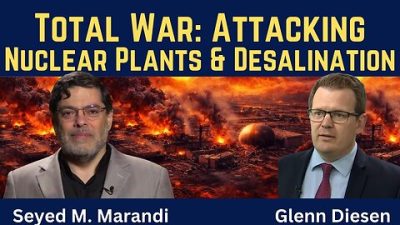
Total War – Attacking Nuclear Plants, Desalination & Infrastructure
or go to
Aletho News Archives – Video-Images
From the Archives
Strike on Israel Shows US Bases Near Iran Are ‘Achilles Heel’
By Svetlana Ekimenko – Sputnik – 14.04.2024
Fears of a greater Middle East escalation were triggered after Iran launched a massive drone and missile attack against Israel, aided by Hezbollah and the Yemeni Houthis. Iran said the attack was in response to Israel’s bombing of the Iranian consulate in Damascus, Syria, which killed seven members of the elite Revolutionary Guard Corps.
Iran’s massive retaliatory attack on Israel from its own territory is a sign that the conflict could “escalate out of control.”
Michael Maloof, a former senior security analyst in the office of the US secretary of defense, told Sputnik that the first ever direct Iranian attack on Israel set a dangerous precedent.
“My concern is that this could easily escalate into something not only between Iran and Israel, but beyond the Middle East region,” he said.
Iran’s assault, which it stated was an act of “self-defense” after the Israeli strike on its consulate in Damascus, was originally intended to be a “limited” one, said Maloof.
Iran first sent in “swarms of drones with lights on as a sign of psychological warfare,” but sending in cruise and ballistic missiles by Tehran was a “distinct escalation,” said Maloof.
The scale of Iran’s attack on Israel suggests that Tehran was sending a message, demonstrating that it possesses “extraordinary capabilities,” said Maloof. … continue
Blog Roll
 Aletho News
- Pakistan PM backs Iran’s right to self-defense amid tensions
- Hungary blasts ‘fake’ EU accusation
- SAFE Debt Trap: Poland’s €43.7 Billion Bet on Unipolar Illusion
- War on Iran threatens global Gulf capital flows: FT analysis
- Mossad De Facto Admits To Inciting Riots In Iran
- Tehran: World grown thoroughly exhausted with US-Israeli ‘false flag storylines’
- Trump ‘stuck between a rock and a hard place’, lacks Iran war strategy: Ex-CIA chief
- Trump’s bombardment of fake news so far is working quite well. But where is it heading?
- Iran to Mine Sea Lanes in Persian Gulf in Case of Attack – Defense Council
- Barak blasts Netanyahu: ‘Stop lying – you can’t destroy Iran’s nuclear, missile capabilities’
- If Americans Knew
- From Sde Teiman, the truth about Israel’s military justice system has been set free
- Child denied life-saving bone marrow transplant by Israel ‘because he is from Gaza’
- Raffi Berg: BBC Middle East Editor Exposed as CIA, Mossad Collaborator
- Jerusalem Archbishop Rebukes Netanyahu’s Statements on Christianity
- US to embed Palantir AI across entire military: Report
- Israeli-US war on Iran to drag on “a few more weeks” – Not a ceasefire Day 164
- Lebanon deaths top 1,200; Palantir AI to be embedded across US military – Not a ceasefire Day 163
- Israel’s assassination game: Take all pragmatists off the board
- Food shortages return to Gaza as Israel tightens aid restrictions under the cover of its war on Iran
- Trump demands trillions in payments from Gulf countries, billions from Harvard – Not a ceasefire Day 162
- No Tricks Zone
- New Study: CO2 Is ‘Effectively Negligible’ As An Explanatory Climate Change Factor Since 2000
- Former Pfizer Toxicologist Dr. Helmut Sterz Tells Bundestag Hearing Pfizer Vaccine Should Have Never Been Approved
- Energy Expert: Germany’s Nuclear Phaseout Was A “500 Billion Euro Mistake”
- New Research: South Australia’s Mid-Holocene Sea Surface Temperatures Were 4°C Warmer Than Today
- Storing Green Energy To Last Germany 10 Days Would Require A 60-Million Tonne Battery
- New Studies: UK Sea Levels Were 4 Meters Higher Than Today During The Mid-Holocene
- Destructive Green New Deal: German Energy And Metal Group Warns Of Drastic Crisis
- New Study Documents A 20-Year Pause In Arctic Sea Ice Decline – Driven By Internal Variability
- Wake-up Call: Survey Shows Majority Of Germans Now Favor Postponing Climate Targets!
- Televised! Leading German Political Candidate Tells Schoolchildren CO2 Makes Sun Hotter!
 Aletho News