The Stories You’re Not Hearing About the Russo-Ukrainian War…
By Ted Snider | The Libertarian Institute | March 4, 2024
Several, seemingly small events in the Russo-Ukrainian War went largely unnoticed in western media recently. But each of them, in their own way, may be significant.
The Fall of Avdiivka
On February 25, Ukrainian President Volodymyr Zelensky said that 31,000 Ukrainian soldiers had been killed since Russia invaded his country two years ago. It was the first time he had released a number of dead. He wouldn’t provide the number of wounded.
On February 4, he said, “About 26% of the national territory is still under occupation,” before adding that “the Russian army cannot make much progress. We have stopped them.”
Both statements are absurd. As The New York Times remarks on Zelensky’s battlefield accounting, “It differs sharply from estimates by U.S. officials, who, this past summer, put the losses much higher, saying that close to 70,000 Ukrainians had been killed and 100,000 to 120,000 had been wounded.”
The 31,000 number may be closer to the number of dead and wounded in the past several disastrous weeks than in the past two years. Russian Defense Minister Sergey Shoigu recently said that over 383,000 Ukrainian soldiers had been killed or wounded since the war began. Yuriy Lutsenko, the former prosecutor general and ex-head of the Ministry of Internal Affairs of Ukraine, says that 500,000 Ukrainian soldiers have been killed or seriously wounded. A number of 400,000-500,000 is consistent with internal Ukrainian communications and reports from the battlefield that 20,000 soldiers a month would be necessary to replace the dead and wounded. That number also accords with the 450,000-500,000 number Zelensky has requested in a new mobilization.
Being absurd was appropriate when Zelensky was a comedian; it may have made Ukrainians laugh. But being absurd when Zelensky is president is not appropriate; it may make more Ukrainians die.
The second statement, that Russia is incapable of further significant advances because the Ukrainian Armed Forces has stopped them is no less absurd. Less than two weeks after making the statement, on February 17, after exhausting every capability it had, the Ukrainian Armed Forces retreated in disarray from the heavily fortified town of Avdiivka as it fell to the Russians. That was a very significant advance. Taking Avdiivka is not just a symbolic victory, as reported in the West, but a strategic victory that could open the door to the Donbas for Russian forces, allowing Russia to solidify the borders of its newly annexed territories.
Following the retreat from Avdiivka, Ukrainian statements about stopping Russia retreated one more step, now claiming that Russia won’t be able to advance. General Kyrylo Budanov, Ukraine’s military-intelligence chief, acknowledged that the loss of Avdiivka was tough, but insisted that Russia has its problems too, and that “they don’t have the strength” to advance significantly and capture all of the Donbas.
American officials echoed Budanov’s assessment, saying that “Russian gains in eastern Ukraine will not necessarily lead to any collapse of Ukrainian lines and that Moscow is unlikely to be able to follow up with another major offensive.”
Kiev said that their armed forces had withdrawn from Avdiivka and established new defensive lines around Lastochkyne and other nearby villages. But on February 26, Lastochkyne fell, and Ukrainian troops retreated to villages further west.
Western officials now say that Russia is “attacking in strength along four parallel axes in the northeast” and that they are “driving forward around Lyman and Kupiansk, in the Kharkiv region.” Newsweek says there are reports that Russian troops have now “advanced west of the village of Lastochkyne.” And military spokesperson Dmytro Lykhoviy now says that Ukrainian troops have withdrawn from Stepove and Severne, two villages near Avdiivka and north of Lastochkyne.
What Killed Alexei Navalny?
It is still not known what killed Alexei Navalny in a Russian prison on February 16. U.S. President Joe Biden says that “Putin is responsible for Navalny’s death.” Zelensky agrees, saying Navalny “was obviously killed by Putin.”
But Ukraine’s military-intelligence chief disagrees. On February 25, General Kyrylo Budanov told reporters that he was sorry to disappoint them, “but what we know is that he really died from a blood clot. And this is more or less confirmed. This was not taken from the Internet, but, unfortunately, a natural [death].” Russia has claimed that a blood clot was the cause of death.
An unexpected claim made by aides to Navalny on February 26 created another wrinkle. Navalny, they say, was about to be released in a prisoner swap. “Navalny was supposed to be free in the coming days,” Maria Pevchikh, the chairwoman of Navalny’s Anti-Corruption Foundation, said. “I received confirmation that negotiations were at the final stage on the evening of Feb. 15.”
Navalny’s aides advance this claim as new evidence that Putin killed Navalny. Pevchikh says that Putin ordered Navalny’s murder to take “the possibility of his release off the table.”
But it seems inconceivable that Navalny’s release could be negotiated by Moscow without Putin’s consent. He wouldn’t have to kill him; he would just have to take his release off the table. Though there is still insufficient evidence to pass judgement on the cause of his death, if it is true that Navalny’s freedom was on the table, that seems to lean towards that Putin did not feel threatened by him or feel the need to eliminate him.
The Firing of Zaluzhny
On February 8, the headlines were dominated by Zelensky’s firing of the Commander in Chief of the Ukrainian Armed Forces, Valerii Zaluzhny. But overshadowed by those headlines was that Zaluzhny was not the only general to go. Zelensky fired his entire general staff and replaced them with a new Chief of General Staff for Ukraine’s Armed Forces and new deputy chiefs.
Though the change over could just reflect a new Commander in Chief choosing his own staff, it might also point to Zelensky ensuring a military command that is loyal to him at a time when the military is angry over the firing of Zaluzhny, and, as The Guardian recently put it, Zelensky “is no longer seen as untouchable, and political competition is returning to Ukraine,” and “Ukrainian society is exhausted by the war.”
The Rome-Kiev Pact of Steel Under CIA Shadow
By Manlio Dinucci | Global Research | March 3, 2024
The “Agreement on security cooperation” between Italy and Ukraine, which Italian Prime Minister Meloni and President Zelensky signed in Kijev, is not a formal declaration, but a real military pact that makes Italy a belligerent country in the war against Russia.
The pact commits Italy to supply more armaments to Kijv and to train its troops according to NATO operational procedures. Not only this. The pact states that:
“In the event of a future Russian armed attack against Ukraine, Italy, and Ukraine will consult within 24 hours to determine the measures necessary to counter the aggression and Italy will provide Ukraine with rapid defence support.”
Since French President Macron announced that European NATO countries might send their troops to Ukraine against Russia, there is a real possibility that Italy will do so too, taking us directly into war against Russia. Moscow’s voice went unheeded, warning that in this case there would be a direct clash between NATO forces and Russian forces, both equipped with nuclear weapons.
In this situation, “the war of spies” takes place. As a major New York Times investigation shows, the CIA has built its vast network in Ukraine and other European countries. It trains Ukrainian agents on how to assume false identities and “find out Russian spies in other countries!” The program was called Operation Goldfish. Operation Goldfish operatives have been deployed to 12 new operational bases along the Russian border, linked to two new secret electronic espionage bases.
What Zelensky declared falls into the same context: “Meloni is with us but there are too many pro-Putin in Italy.” Zelensky then announced: “We are preparing a list of Russian propagandists – it is not regarding only Italy. It’s a long list and we want to present it to the European Commission, to the European Parliament, to the EU leaders.” Soon, therefore, Zelensky will hand over to Meloni the proscription list of “pro-Putins”, drawn up by the CIA.
Italy to withdraw its air defense system from fellow NATO state
RT | March 3, 2024
Italy plans to withdraw its SAMP/T surface-based air defense system from Slovakia, according to media reports on Saturday, citing Prime Minister Robert Fico.
The system in question was temporarily deployed to Slovakia last year to replace the US Patriot anti-aircraft system, which the country transferred to Ukraine.
“I received a notice from the Italian government that the Italian air defense system, which they lent us for a year, will be withdrawn from Slovakia, because they need it elsewhere,” Fico was cited as saying, without elaborating on where exactly the system will be transferred next. The prime minister expressed concerns regarding his country’s security once the system is removed, as Slovakia currently has no alternative to protect its air space.
“First, the previous government donated a functional massive Russian S-300 air defense system to Ukraine. Then we had American Patriots here for a while, they were also removed, and now the Italian [system] will also be taken away.”
The wisdom of Slovakia sending military aid to Ukraine at the expense of its own security was also recently questioned by the country’s newly-appointed defense minister, Robert Kalinak. In an interview with the newspaper Standard in January, the official accused the previous government of surrendering key military hardware to Ukraine without making plans to secure replacements, noting that it would likely take years to fix the damage done to national security.
Upon being elected in September last year, Fico, an outspoken critic of the Western approach to the Ukraine conflict, halted Slovakia’s military aid to Kiev. In a video statement on social media last month, he also pledged not to send Slovak troops to Ukraine, even if it costs him his premiership.
Opposition to Vaccine Mandates and Passports Driven by Perceived Lack of Vaccine Safety
Population-Based Survey Shows Hesitancy is for Good Reason
By Peter A. McCullough, MD, MPH | Courageous Discourse | February 27, 2024
The American Medical Association says this about vaccine hesitancy:
“While the AMA is a strong advocate for the effectiveness and safety of vaccines, we recognize that some members of the public may have historical, cultural or religious reasons to distrust the vaccination process.”
When it comes to the COVID-19 vaccine, new research led by Dr. Mark Skidmore at Michigan State University indicates that vaccine safety and severe side effects occurring in close contacts (friends or family members) are the main drivers for opposition to vaccine mandates and passports.
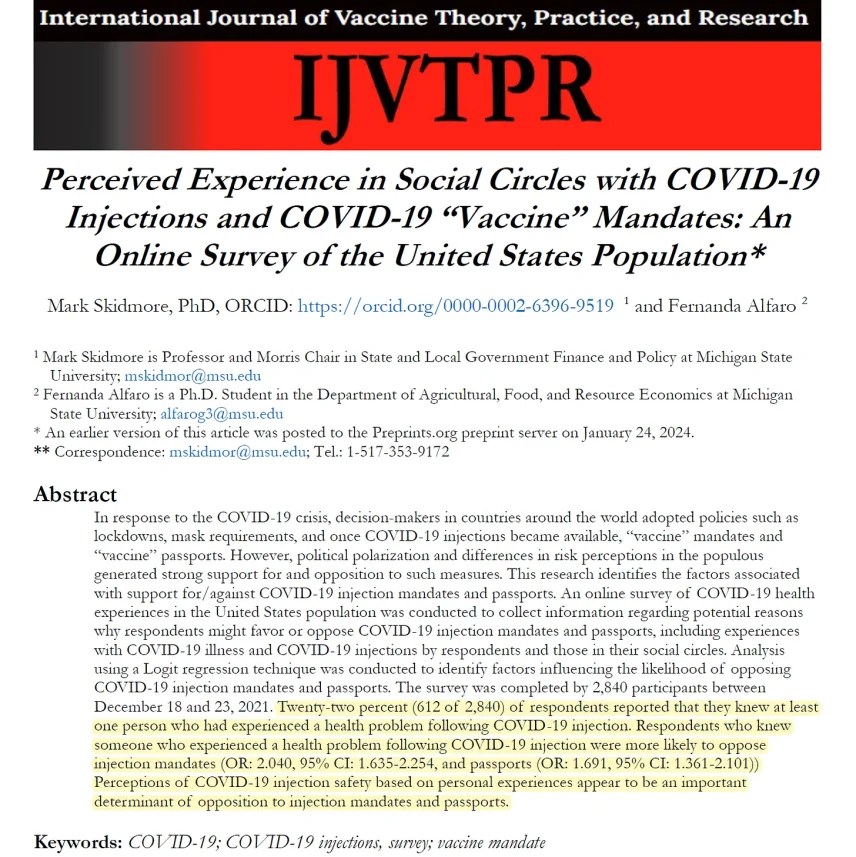
Perceived Experience in Social Circles with COVID-19 Injections and COVID-19 “Vaccine” Mandates: An Online Survey of the United States Population. (2024).
“The survey was completed by 2,840 participants between December 18 and 23, 2021. Twenty-two percent (612 of 2,840) of respondents reported that they knew at least one person who had experienced a health problem following COVID-19 injection. Respondents who knew someone who experienced a health problem following COVID-19 injection were more likely to oppose injection mandates (OR: 2.040, 95% CI: 1.635-2.254, and passports (OR: 1.691, 95% CI: 1.361-2.101)) Perceptions of COVID-19 injection safety based on personal experiences appear to be an important determinant of opposition to injection mandates and passports.”
Considering the survey was done in 2021, one would infer that resistance is even greater in 2024 as more injuries, disabilities, and deaths have been reported as a result of the novel genetic products. When it comes to COVID-19 vaccination, hesitancy is a good thing demonstrating the population is concerned about consumer product safety of the mRNA and adenoviral DNA technology. The AMA’s views on the determinants of vaccine hesitancy do not apply and attempts to overcome vaccine hesitancy are likely to be harmful.
Perceived Experience in Social Circles with COVID-19 Injections and COVID-19 “Vaccine” Mandates: An Online Survey of the United States Population. (2024). International Journal of Vaccine Theory, Practice, and Research , 3(1), 1055-1084. https://doi.org/10.56098/h1mv5a64
NATO Countries Did Not Make Decision to Send Their Military to Ukraine – Polish President
Sputnik – 26.02.2024
WARSAW – NATO countries disagree on sending their military to Ukraine and have not made a decision to do so, Polish President Andrzej Duda said on Tuesday.
On Monday, Slovak Prime Minister Robert Fico said that several EU and NATO countries are considering the possibility of sending their military to Ukraine on the basis of bilateral agreements.
“If we are talking about providing specific assistance, then individual countries decide what kind of assistance they specifically provide to Ukraine. There was a heated discussion about sending soldiers to Ukraine, and there was no absolute mutual understanding on this issue. There are different opinions. But I want to emphasize that there are absolutely no such decisions,” Duda told reporters after the end of a conference on supporting Ukraine, held in Paris.
French President Emmanuel Macron added that “nothing can be ruled out,” commenting on the possibility of sending NATO troops to Ukraine.
Russia’s victory in Ukraine resonates in Central Asia
BY M. K. BHADRAKUMAR | INDIAN PUNCHLINE | FEBRUARY 25, 2024
Russia’s stunning victory in the battle of Avdeevka and the rout of the Ukrainian military, boosts the credibility of Russia as provider of security for the Central Asian region. The point is not lost on the erudite Central Asian mind that Russia has single-handedly put the NATO on the back foot.
This becomes a defining moment, as it complements the comfort level stemming out of the new normalcy in Afghanistan, thanks to Russia’s effective diplomatic engagement with the Taliban.
Yet another vicious cycle of western propaganda is petering out — predicated on the false assumptions that Russia’s influence in Central Asia is in “decline” (Wilson Centre); that the Central Asian states are “are emerging from Russia’s shadow and asserting their independence in ways not seen since the collapse of communism in 1991” (Financial Times ); that in the wake of the war in Ukraine, Central Asian leaders “might well be now considering how long Putin will be able to remain in power in Russia” (Radio Free Europe / Radio Liberty).
In reality, the economic performance of the region in 2023 registered an impressive GDP growth of 4.8%. And Russia contributed to this success story. The Ukraine war led to the vacation of western firms from the Russian market, which created new opportunities for regional states. At the same time, the conditions under sanctions prompted Russian firms and capital and Russian citizens to relocate their businesses to the Central Asian region.
Central Asian entrepreneurs haven’t missed the lucrative opportunities to source Western goods and technology for the Russian market — walking a very tight rope by ensuring compliance with Western sanctions, while also nurturing their interdependence and integration with Russian markets. The recovery of the Russian economy and its 3.6% growth last year created business opportunities for Central Asian countries.
Moscow’s policies aim at a ‘Renaissance’ in the region’s relations with Russia. The new thinking in Moscow meant that Putin took a hands-on role to maintain a high momentum of contacts with the Central Asian leaderships at a personal level, making use of all available formats of interaction bilateral as well as regional. The Russian approach allowed space for the regional states to adopt a ‘neutral’ stance on the war.
A comprehension problem for outsiders is very often that the Central Asian attitudes are seldom in overt mode, and under specific circumstances (such as Ukraine war), they need to be discerned in terms of preferences. Thus, the political message out of the May 9 parade in Moscow last year when all the Central Asian presidents joined Putin at the ceremonies on the Red Square was a massive gesture of support for Russia — and for Putin personally.
Throughout 2023, the Central Asian states found themselves targeted in an unprecedented diplomatic effort by the West to uphold the sanctions against Russia. The US Secretary of State Antony Blinken and French President Emmanuel Macron visited the region. Two historic summits in the ‘C5+1’ format were hosted by President Joe Biden and German Chancellor Olaf Scholz respectively in Washington and Berlin.
But the western interlocutors refused to see the writing on the wall. Blinken’s Kazakh counterpart told him that Astana ‘does not feel any threats or risks from the Russian Federation.’ The joint statements issued after the two ‘C5+1’ summits did not even mention Ukraine!
Putin’s new thinking puts the great game on the back burner and instead prioritises the accretion of content in Russia’s relations with the Central Asian states, especially in economic and humanitarian spheres. This approach has palpably dissipated the ‘Big Brother’ syndrome. Putin’s meetings with his counterparts from Tajikistan, Uzbekistan and Kazakhstan in Kazan on Wednesday took place in a palpably relaxed atmosphere. (here, here and here)
Interestingly, Emomali Rahmon, Tajik president, wished not only Putin’s success “in everything you do” but his “nerves of steel” as well. Kassym-Jomart Tokayev, Kazakh president underscored meaningfully that “under your (Putin’s) distinguished leadership, Russia has achieved notable, impressive successes. In fact, your statements and actions are shaping the global agenda.” Tokayev’s remark is particularly noteworthy, as western analysts had spotted him as a potential mutineer against Putin in the steppes!
However, in the final analysis, if Russia’s security relationship with the Central Asian region has transformed during the past couple of years, it is because Moscow’s coordinated efforts to forge ties with the Taliban has gained traction lately. They helped diminish the threat perceptions regarding Afghanistan in the Central Asian region.
If the traditional pattern of addressing the threat perceptions was to resort to military means and by sequestering the region from Afghanistan, Russian diplomacy switched to a radically different approach by constructively engaging with the Taliban (although the Taliban continues to be a proscribed organisation under Russian law) and strove to make the latter a stakeholder in building cooperative ties within a matrix of mutual interests. It paid off.
Moscow estimated that the Taliban rule has stabilised the Afghan situation significantly and it is in Russian interests to help the Kabul administration to effectively counter the extremist elements in the country (especially the Islamic State, which is known to be a legacy of the US occupation of Afghanistan.) Russia leveraged its influence with the Central Asian states to ensure that western-backed anti-Taliban ‘resistance’ forces did not get sanctuaries.
Of course, the strategic objective is that the western intelligence will not be able to manipulate free-wheeling Afghan elements to destabilise the Central Asian region or the Caucasus all over again.
Taliban has been most receptive to the Russian overtures aimed at strengthening the Afghan statehood. Recently, the Taliban went to the extent of boycotting a UN-sponsored conference on Afghanistan on February 18-19 in Qatar, which was, in reality, an invidious attempt by the US to re-engage the Taliban on the pretext of promoting “intra-Afghan dialogue” (which essentially meant the return of the West’s Afghan proxies living in exile in Europe and America.)
To be sure, the Taliban saw through the western game plan to rebuild their intelligence network in Afghanistan and countered it by setting conditions for its participation in the Doha conference, including that it be the sole representative of Afghanistan at the meeting. The Taliban also opposed the appointment of a UN special envoy to Afghanistan, whose main task would be to promote “intra-Afghan dialogue”.
The Taliban’s Foreign Ministry, in a statement ahead of the Doha meeting, accused the international community of “unilateral impositions, accusations, and pressurisation.” The most interesting part of the pantomime playing out in Doha was that at the Taliban’s request, the Russian delegation that participated in the Doha meeting refused to meet the so-called ‘civil society representatives’ from Afghanistan. It signalled that Russia has begun working with the Taliban as the de facto rulers of Afghanistan.
Indeed, the Central Asian states heartily welcome this brilliant diplomatic initiative by Russia to strengthen regional security and stability. The region’s confidence level vis-a-vis the Taliban rulers has already reached a point that at the meeting with Putin in Kazan on Wednesday, Uzbek president Mirziyoyev raised the “important question” of Uzbekistan and Russia moving ahead with the construction of a new railway via Afghanistan connecting Central Asia with the adjacent regions and the world market.
Transnistria May Face Conflict Escalation Risk Amid Negotiation Process Stagnation
Sputnik – 24.02.2024
TIRASPOL – There is a risk of conflict escalation in Moldova’s unrecognized breakaway region of Transnistria due to the stagnation of the negotiation process, the region’s head, Vadim Krasnoselsky, told Sputnik.
“Against the backdrop of the negotiation process stagnation, including the politically motivated blocking of the 5+2 format, there is a risk of a conflict escalation. The peacekeeping mechanism effectively fulfills its mission in this sense, and at least ensures the manageability of the situation in the security zone, on the line of direct demarcation. This is the key factor,” Krasnoselsky said.
The 5+2 format of talks between Moldova and Transnistria, an unrecognized state, includes Russia, Ukraine and the Organization for Security and Co-operation in Europe (OSCE) as mediators, with the United States and the European Union serving as observers.
There is currently an international peacekeeping force in the region, composed of Russian, Moldovan and Transnistrian troops. Ukraine withdrew its peacekeepers after the start of the Russian special military operation in February 2022.
Krasnoselsky also said that Transnistria has appealed to the OSCE against the training of sabotage groups in Moldova but there has been no appropriate response so far.
The Transnistrian Ministry of State Security reported earlier that foreign specialists were training combat groups in Moldova, including Ukrainians, to carry out terrorist acts and sabotage of military facilities in the PMR. Transnistria’s Ministry of State Security reported the prevention of a terrorist attack on March 9 last year in Tiraspol allegedly planned against PMR officials at the behest of the Ukrainian Security Service. In May 2022, a series of terrorist attacks took place in Transnistria, including attacks on the buildings of the Ministry of State Security, a military unit, a radio and television center, and a military recruitment office.
Ukraine used US-made chemical weapons – Russia
RT | February 19, 2024
Washington and Kiev have violated articles of the Organization for the Prohibition of Chemical Weapons (OPCW) as Ukrainian forces have used illegal munitions on the battlefield, Russian Lieutenant General Igor Kirillov has claimed.
The head of Russia’s Nuclear, Chemical and Biological Protection Forces provided several examples of Kiev’s alleged use of banned chemical weapons and non-lethal chemical agents that he said were obtained from the US.
Kirillov claimed that Ukraine used drones to drop US-made gas grenades on December 28, 2023 containing “CS” compound – a chemical classified as a riot-control tool that irritates the eyes and upper respiratory tract, and can cause skin burns, respiratory paralysis and cardiac arrest when used in high concentrations.
He said the delivery of such munitions by the US to Ukraine was a direct violation of the rules of the OPCW, which states that a country must “never, under any circumstances, transfer chemical weapons directly or indirectly to anyone.”
He also reported that, on June 15, 2023, Moscow’s forces were attacked by a drone carrying a container filled with chloropicrin, which is classified as a Schedule 3 compound under the Chemical Weapons Convention and is strictly prohibited – even for law enforcement purposes. The same chemical was also used by Kiev on August 3 and 11, 2023 near the village of Rabotino, according to Kirillov.
The general also provided several examples of Kiev using toxic substances against Russian military personnel, as well as poisoning high-ranking officials such as the head of Russia’s Kherson Region Vladimir Saldo in August 2022.
Kirillov said Russian intelligence believes that Ukraine’s forces, under the guidance of its Western backers, are developing a new military tactic that would use a “chemical belt.” This would involve blowing up containers with hydrocyanic acid and ammonia to prevent an advance by Russian forces.
He added that plans for such a large-scale use of toxic chemicals were evidenced by the fact that Kiev had asked the EU to supply it with hundreds of thousands of antidotes, gas masks and other personal protective equipment in 2024. That’s in addition to 600,000 ampules of organophosphorus antidotes, and 750,000 bottles of drugs for the detoxification of mustard gas, lewisite and hydrocyanic acid derivatives that were supplied by NATO countries in 2023.
“It is obvious that the volumes requested by Ukraine are excessive for a country that does not have chemical weapons,” Kirillov stated.
There has been no response from the OPCW despite all of this evidence being presented to the organization four months ago, the general said, accusing it of being run by Washington as a tool to target its political opponents.
In November, Russia lost its seat on the OPCW Executive Council after failing to get enough votes from other members of the organization. Kirillov said Moscow was effectively “pushed out” of its seat and was replaced by Ukraine, Poland and Lithuania, who he claimed were pursuing an obvious anti-Russia policy.
Biden offered prime time Russian TV slot
RT | February 18, 2024
Prominent Russian journalist Dmitry Kiselyov has said that he has sent a request to the White House for an interview with US President Joe Biden. He argued that Russian President Vladimir Putin had already set a “worthy example” by addressing the US audience in an interview with American journalist Tucker Carlson.
Kiselyov, who is the head of Russia’s Rossiya Segodnya media group and also hosts the Vesti Nedeli analytical news program, revealed that he had approached the White House on Sunday while speaking on national TV.
In a letter dated February 15 and addressed to White House Press Secretary Karine Jean-Pierre, the journalist said that Russians would appreciate the opportunity to hear Biden’s take on “how to stabilize the international situation, restore trust, and renew cooperation between the United States and Russia” amid the crisis in ties between the two powers.
Kiselyov went on to deplore that the US and Russia “are now short of opportunities to listen and to hear each other,” adding, however, that Putin “has set a worthy example by agreeing to an interview focused on an American audience.”
As a reciprocal gesture, he added, Rossiya Segodnya is ready to give Biden an “opportunity to reach the widest possible Russian audience,” promising that the interview would be translated into numerous foreign languages and distributed on various platforms.
The White House has yet to respond to the request.
Tucker Carlson released a much-anticipated two-hour interview with the Russian leader earlier this month in which Putin spoke at length about the reasons for the Ukraine conflict. He explained that modern Ukraine is largely an “artificial state” created from the territories of other countries.
Putin also maintained that the first seeds of the conflict were sown when NATO opened its doors to Ukraine in 2008 despite Russia repeatedly voicing concerns about the bloc’s expansion.
The crisis itself, he noted, started not in 2022 when Russia launched its military campaign, but rather in 2014 when the new Ukrainian government, which came to power as a result of a Western-backed coup, attempted to crack down on those who disagreed with its policies.
Top Iranian, Kyrgyz security officials voice opposition to West’s interference in region
Press TV – February 16, 2024
Top security officials of Iran and Kyrgyzstan have raised their objection to the West’s interference in the domestic affairs of regional countries and its efforts to impose its demands and will on them.
Secretary of Iran’s Supreme National Security Council (SNSC) Ali Akbar Ahmadian and Secretary of the Security Council of the Kyrgyz Republic Marat Imankulov held a meeting in Bishkek on Friday.
The two sides voiced concern over measures by certain Western countries to finance terrorist groups in Afghanistan and their bids to step up acts of terror in Central and West Asia.
They also discussed ways to promote cooperation in various political, security and military fields, especially in the fight against terrorist groups such as Daesh.
Ahmadian invited his Kyrgyz counterpart to travel to Iran which was accepted by Imankulov.
The SNSC secretary is in the Kyrgyz capital at the head of a delegation to take part in the 6th Summit of Secretaries and Advisors of National Supreme Councils of regional countries on Afghanistan.
Top security officials of regional countries, including Iran, Russia, China, India, Tajikistan, Kyrgyzstan, Kazakhstan, Uzbekistan and Turkmenistan, are scheduled to discuss Afghanistan’s most important security and political issues and their impacts on the region.
Taxpayers not manufacturers made to pay compensation to patients
The Hughes Report: Options for redress released by the Patient Safety Commissioner
Health Advisory & Recovery Team | February 8, 2024
Many patients have been fighting for years for compensation after birth defects and developmental disorders were caused by the epilepsy drug Valproate; pain and tissue erosions caused by synthetic mesh used in incontinence operations or the reproductive and fetal developmental problems caused by Primodos. Dr Henrietta Hughes, the Patient Safety Commissioner (PSC), has released her recommendations for compensation for Valproate and mesh victims: £100k for Valproate, £20k for mesh and zero for Primodos!
Whilst proposed compensation payments are a start, the amounts are insufficient for people whose lives have been ruined; recommended mesh payments are less than an average year’s salary despite years of lost employment for many. And why has the hormone pregnancy test, Primodos, been forgotten again?
It is also shocking that the government is putting their hands in their (our) pockets for payments, rather than making the pharmaceutical industry pay. The industry will not improve safety until there is a financial benefit for them to do so – there is no incentive if governments keep paying for their mistakes.
If there is sufficient evidence to justify government funds to compensate victims, why isn’t there sufficient evidence to demand this compensation comes from the manufacturers?
Why is the PSC’s remit so narrow, on one medicine and one medical device? What about the dozens of other medicines and devices that have caused harm over the past few decades?
How can systemic failures be identified if only looking at a fraction of the medicines and devices that have caused harm?
The tunnel vision on only 2 products helps drive the divide and rule, which encourages those harmed by medicines to work in silos, focused on their own legal battles and compensation claims, rather than working together in a single coordinated effort.
The elephant in the room however is why neither the report nor the media coverage address the regulatory failures that allowed Mesh and Valproate to harm for so long?
Whilst redress is important, what is critical is how we prevent future scandals from other medicines?
Looking back to Dr Henrietta Hughes 100 day report published a year ago, her proposed strategy to prevent future harm is Priority 1 “Culture change”. Whilst good in intent, culture change is difficult to measure and even more difficult to implement. Anyone with experience trying to change culture in even a small company will know the challenge, how do you achieve that across the diverse range of medical services providers in the UK?
Emma Muphy’s statement ‘I got fobbed off. I was told I was reading into things’ reflects how many have been treated. My own mum was told for many years there was no link between the HRT and breast cancer that killed her, was told off for “internet research” and was told the symptoms of her brain tumour had psychological rather than physical causes. The culture of playing down harm is systemic.
Nearly all of the victims I speak to tell the same story with different words: changing this culture could take decades, the PSC only has 3 years.
Dr Henrietta Huges clearly listens to patients and has done a great job to outline the harm to patients in their own words, share their requested outcomes and she makes some great recommendations for improvements, for example:
- mandatory Yellow Card reporting,
- having a named patient voice on all boards and
- working with policy teams to improve conflict of interest declarations.
But a year on we see little progress on these actions – does the PSC have the teeth to implement these ideas?
Given systemic failure of MHRA that was identified in The Cumberlege report, First Do No Harm (FDNH) that resulted in the PSC role, why isn’t “regulatory reform” Priority 1?
Surely it’s simpler to reform a single regulator, than change the culture across the entire health service?
If the PSC won’t call for regulatory reform, then we have no choice but to demand this ourselves.
Please sign my petition demanding the reform of MHRA.
Thank you to guest author: Alex Hicks @hicksyalex
China, Russia pip US to the Taliban hearth
BY M. K. BHADRAKUMAR | INDIAN PUNCHLINE | FEBRUARY 6, 2024
The diplomatic recognition of the Taliban government in Afghanistan on January 31, 2024 by China must be bracketed with two other far-reaching regional policy moves by Beijing in the post-cold war era —the Shanghai Five in 1996 — later renamed as Shanghai Cooperation Organisation in 2001— and the Belt and Road Initiative announced by President Xi Jinping in 2013.
A regional security architecture is emerging with the above three legs reinforcing, supplementing and interchanging in a creative response to the rapidly transforming international environment. If the SCO marked China’s return to Central Asia after nearly a century and the BRI creates massive strategic depth for China’s global rise, the move on Afghanistan has geopolitical characteristics in relation to the Asian Century.
At its most obvious level, Beijing has outwitted the US’ surreptitious, attempts in the recent months to return to Afghanistan after its humiliating military defeat and exit in 2021. The Biden Administration produced in the public domain a back-dated document titled Integrated Country Strategy for Afghanistan on the same day that Xi Jinping received the letter of credentials from the Taliban ambassador at the Great Hall of the People in Beijing on January 30.
The document contained the following core elements:
- “Predatory powers like Iran, China and Russia seek strategic and economic advantage (in Afghanistan) or at a minimum to put the US at a disadvantage;
- “Even as, –- and for as long as –- the United States does not recognise the Taliban as the legitimate government of Afghanistan, we must build functional relationships that fulfil our (US) objectives”;
- “With diaspora Afghans, we discourage support for a new armed conflict through resistance group proxies in Afghanistan — more violence or regime change is not the solution to the Taliban”;
- “we must simultaneously pump unprecedented amounts of humanitarian assistance into the country, convince the Taliban to adopt international economic norms and advocate tirelessly for education”;
- “With the Taliban we advocate for consular access…”
The document is a shameful retreat from the thundering US rhetoric that unless the Taliban fulfilled its conditions, Washington would ostracise the government in Kabul and freeze its bank accounts. Apparently, the Biden administration no longer insists on its demands and is knocking at Kabul gates for entry.
Interestingly, the document, while taking note of the human rights conditions in Afghanistan and the absence of a broad-based government in Kabul, acknowledges that regime change is no longer an option. It calls on the diaspora Afghans (who are largely in the West) to reconcile with the Kabul government, and seeks a consular presence for the US in Afghanistan.
The US is nervous about the Russian and Chinese approaches vis-a-vis the Taliban government. Conceivably, we need to reassess the US invitation to the Pakistani army chief Gen. Asim Munir to pay a 5-day visit to America in end-December, engaging in discussions with senior officials, including Secretary of State Antony Blinken and Secretary of Defence General Lloyd Austin. Going back even further, it is also necessary to contextualise the ouster of former Pakistani prime minister Imran Khan (“Taliban Khan”) from power by the military, with American support. Pakistan’s role becomes crucial as Central Asian states harmonise with Russia and China. (See my blog Decoding Iran’s missile, drone strikes, Indian Punchline, Jan. 18, 2024)
Sensing the American moves to return to Central Asia and reboot the great game, Russia and China are determined to stay two steps ahead in engaging with the Taliban government. Most certainly, China’s diplomatic recognition of the Taliban government is in coordination with Russia. On the same day that Xi Jinping received the credentials letter from the Taliban ambassador, the special envoys of Russia and China visited Kabul and took part in a meeting under the rubric Regional Cooperation Initiative convened by the Taliban government which was attended by diplomats from Russia, China, Iran, Pakistan, India, Uzbekistan, Turkmenistan, Kazakhstan, Turkey and Indonesia. Taliban acting foreign minister Amir Khan Muttaqi addressed the meeting.
All the same, the Chinese decision to recognise the Taliban government cannot be seen through the prism of the great game. In the economic sphere, China is already a big stakeholder in Afghanistan and its equity is growing. Equally, Kabul is an enthusiastic votary of the Belt and Road and potentially, Afghanistan is another gateway for China to the Gulf region and beyond. China is planning a direct road link connecting Xinjiang with Afghanistan via Wakhan Corridor.
At long last, the construction work on the missing link in the China-Kyrgyzstan-Uzbekistan railway is also commencing — a new strategic Eurasia logistic network along the Belt and Road route that can connect Afghanistan with both China and the European market.
Indeed, the geopolitical significance of the China-Afghanistan normalisation is to be measured in global terms in the contemporary world situation. A friendly government in Kabul gives China enormous strategic depth to push back the US’ hostile moves in Asia-Pacific.
The bottom line is that China is establishing formal links with a militant Islamist movement that once harboured Osama bin Laden and that is happening at a time when the US is demonising the resistance movements in the Muslim Middle East and has unleashed a vicious boring campaign against them in Syria, Iraq and Yemen. Of course, the resistance movements in the Muslim Middle East will draw inspiration from China’s example.
Equally, the participation of 9 regional states — Indonesia and India, in particular — in the regional meeting hosted by the Taliban government in Kabul is an assertion of the Asian Century. Addressing the meeting in Kabul, Taliban’s foreign minister Muttaqi emphasised that these nations “should hold regional dialogues to increase and continue the positive interaction with Afghanistan.” Muttaqi asked the participants to take advantage of emerging opportunities in Afghanistan for the development of the region and to also “coordinate the management of potential threats”.
He stressed the need for positive interactions with the countries of the region and asked the diplomats to convey the Taliban’s message of a “region-oriented initiative” to their countries so that Afghanistan and the region can jointly take advantage of new opportunities for the benefit of all. Reports in the Afghan media quoted Muttaqi as saying that the meeting was focused on discussions for establishing a “region-centric narrative aimed at developing regional cooperation for a positive and constructive engagement between Afghanistan and regional countries”. (here)
Without doubt, China has now shown the way that the era of imperialism is buried forever and erstwhile colonial powers should realise that their dubious methods of “divide and rule” no longer works.
The State Department’s Integrated Country Strategy for Afghanistan is quintessentially old wine in a new bottle. Reading between the lines, the US hopes to revive its interventionist policies in Afghanistan for geopolitical purposes, while shedding crocodile tears over the human rights situation. Its strategic calculus is a morbid mix of geopolitics and Neo-mercantilism.
However, Taliban is unlikely to fall for it, being witness to the US’ bombing campaign against Muslim nations on an industrial scale that harks back to the two-decade long western occupation of Afghanistan.
The back-dated state department document is a knee-jerk reaction by the Biden Administration as word spread that Beijing is moving towards diplomatic recognition of the Taliban government with the active support of Moscow and Beijing aiming at creating a firewall to prevent further manipulation of the Afghan situation by the West. Short of an outright recognition, Moscow has extended a vital lifeline for Kabul.
It was no coincidence that Xi Jinping received the new Taliban ambassador at the Great Hall of the People in Beijing on the very same day that the Taliban government unveiled its regional initiative.
Featured Video
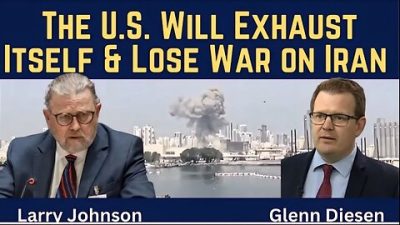
Larry Johnson: The U.S. Will Exhaust Itself & Lose War Against Iran
or go to
Aletho News Archives – Video-Images
From the Archives
Revealed: Israel’s hidden history of attacks on Iran
By Robert Inlakesh | MintPress News | April 17, 2024
Iran’s retaliatory attack on Israel was framed in the West as a reckless attempt to spark a major regional war, but in reality, Israel has been attacking Iran for decades.
As is routinely the case with Western-backed wars, the corporate media’s timeline begins at the moment that suits their narrative. We have seen this play out recently, with the attempt to rob the Gaza war of all contexts before October 7, 2023. Similarly, when it comes to Israel’s conflict with Iran, the two have been embroiled in what is referred to as a “shadow war,” the details of which are pretty shocking. … continue
Blog Roll
 Aletho News
- US-Israeli strike targets IRIB facility; broadcasts continue
- The diabetes treatment that worsens the disease
- Forget Oil: Natural Gas Prices Are About to Go Through the Roof If Hormuz Isn’t Reopened Soon
- Hormuz Strait: Iran’s Strategic Trump Card for Forcing Enemies to the Negotiating Table
- Trump bit off more than he can chew with Iran – ex-Pentagon analyst
- Murdering Khamenei Will Kill Trump’s Presidency
- Unexpected Iranian reaction paralyzed Americans and Israelis on the first day of war
- Larry Johnson: The U.S. Will Exhaust Itself & Lose War Against Iran
- In The Name of ‘Helping Iran’, The U.S. And Israel Slaughter Over 100 Iranian Schoolgirls
- Why are Americans killing and dying for Israel, again?
- If Americans Knew
- Israel, US on a Zionist mission to bring Iran down – Not a ceasefire Day 141
- When Presbyterians Fought Christian Zionism
- Israel starts another war on Iran – Not a ceasefire Day 141
- ‘Terror Was Needed to Make Arabs Leave’: What the Israeli Army Did in 1948, Revealed
- 17,000 Unaccompanied Orphans in Gaza, in World’s Biggest Orphan Crisis
- Israeli leaders want to buy global legitimacy – Not a ceasefire Day 140
- Israel warns of a Ramadan escalation — while doing everything to provoke one
- Democrats Should Release Their 2024 Election Autopsy – and Stop the Gaza Denial
- Israel responsible for 2/3 of press killings worldwide – Not a ceasefire Day 139
- Are the Jews indigenous to Palestine?
- No Tricks Zone
- Glaciers Worldwide Are Suddendly Surging, Experts Blame Warming!
- Surprising Discovery: Sahara Is Greening…Billions Of Trees Where Once Thought To Be Barren
- New Research Reaffirms Clouds, Aerosols, And Surface Solar Radiation Are ‘Driving The Climate System’
- Germany: Electric Car Catches Fire At Charging Station, Sets Off Local “Inferno”, Widespread Damage
- New Study: Canada’s New Brunswick Was 1°C Warmer Than Today During The Medieval Warm Period
- Coal Power Back In Trend As Globe Tries To Keep Pace With Growing Demand For Power
- New Study: A 4°C Warmer Beaufort Sea Had ‘No Sea Ice’ 11,700 – 8200 Years Ago
- Unfudging The Data: Dutch Meteorological Institute Reinstates Early 20th Centruy Heat Waves It Had Erased Earlier
- German Gas Crisis…Chancellor Merz Allegedly Bans Gas Debate Ahead of Elections!
- Pollen Reconstructions Show The Last Glacial’s Warming Events Were Global, 10x Greater Than Modern
 Aletho News