‘YOU’RE FIRED!’ Trump Dismisses Brian Hook in Truth Social Post
By Kyle Anzalone | The Libertarian Institute | January 22, 2025
President Donald Trump fired four presidential appointees that he said did not share his vision for America. Among those dismissed were Brian Hook, who served on the Trump transition team.
“My Presidential Personnel Office is actively in the process of identifying and removing over a thousand Presidential Appointees from the previous Administration, who are not aligned with our vision to Make America Great Again,” Trump wrote on Truth Social Monday.
“Let this serve as Official Notice of Dismissal for these 4 individuals, with many more, coming soon.” He continued, “Jose Andres from the President’s Council on Sports, Fitness and Nutrition, Mark Milley from the National Infrastructure Advisory Council, Brian Hook from the Wilson Center for Scholars, and Keisha Lance Bottoms from the President’s Export Council—YOU’RE FIRED!”
In 2018, Hook joined the administration shortly before Trump withdrew from the Iran nuclear deal. Hook was tasked with implementing a “maximum pressure” sanctions campaign against Tehran and overthrowing the Iranian government.
In 2020, Hook resigned from his post, after he was unable to achieve either objective.
Hook was a key official in helping to staff the incoming State Department on the transition team following Trump’s second election victory. In November, Hook said the second Trump administration “would isolate Iran diplomatically and weaken them economically.”
Hook also attacked the Biden administration’s “policy of appeasement and accommodation with Iran,” leading to a “failure of deterrence,” because “no one believes you have a credible threat of military force.”
However, Biden increased sanctions on Iran, refused to enter into serious negotiations with Tehran, and aided Israel in tit-for-tat strikes between Tel Aviv and Tehran.
Along with Hook, chef Jose Andres was fired from the President’s Council. Andres heads the World Food Kitchen (WFK), an international aid organization that often works with Washington.
Last year, seven WFK workers were killed by a series of Israeli strikes on their aid convoy in Gaza. While the White House did not punish or hold Tel Aviv to account for the murders, Andres accepted the Presidential Medal of Freedom from Biden earlier this year.
Supporters of South Korean President Cause Mayhem in Court That Detained Him
Sputnik – 19.01.2025
SEOUL – Supporters of South Korean President Yoon Suk-yeol, who is accused of attempting to violently seize power, caused mayhem in the court that decided to detain the president, the Yonhap news agency reported.
After Yoon was put in custody early in the morning of January 19 (around 18:00 GMT Saturday) on charges of leading a rebellion, his supporters entered the Seoul Western District Court and caused mayhem there, the agency said.
According to the agency, the angry crowd overcame police resistance and broke into the courthouse through the gate behind the building, and some of the president’s supporters climbed over the fence. They began to break windows and managed to get inside the building, where they also smashed glass and furniture with fire extinguishers and other improvised means, shouting “President Yoon Suk-yeol.”
Some also tried to find the judges who ordered his detention, threw plastic chairs at police officers, took away their shields and rubber batons and used them against the police officers themselves. Other supporters of Yoon Seok-yeol tried to calm their comrades, convincing them that this was “not what the president wanted.”
Law enforcement reinforcements that soon arrived began detaining rioters, calling on those remaining in the building to immediately leave it, and everyone in front of the court to disperse, stop the unauthorized rally and other illegal actions.
Earlier on Saturday, the court granted the request of the Corruption Investigation Office (CIO) to detain the country’s president Yoon, suspected of attempting to violently seize power. The court supported the investigators’ opinion that if released, the president might try to destroy evidence pointing to his guilt.
The maximum period of detention requested by the investigators is 20 days, including the two days that Yoon has already spent in a pretrial detention center after his arrest on December 15 for repeatedly ignoring requests to appear for questioning. However, the CIO plans to soon hand over the results of the investigation to the prosecutor’s office, which will forward the president’s case to the court in early February. The court has the right to order the suspect’s detention for two months, with a subsequent extension of up to six months on each count. In this regard, it is expected that the court of first instance will make a decision on the rebellion charges as early as August.
What legitimacy is the PA talking about?
By Ramona Wadi | MEMO | January 16, 2025
“While we are waiting for the ceasefire, it is important to stress that it won’t be acceptable for any other entity to govern the Gaza Strip but the legitimate Palestinian leadership and the government of the state of Palestine,” the Palestinian Authority’s Prime Minister, Mohammad Mustafa, stated during a meeting of the Global Alliance for the Implementation of the Two-State Solution.
The PA is not a legitimate leadership. In 2006, Hamas won the Palestinian legislative elections, disturbing the Western world’s preferred outcome. Democracy, according to the West, can only conform with Western expectations; therefore Palestinians got a taste of what the US does when democracy crashes imperialist expectations. Instead of respecting the electoral result, the US and Fatah embarked upon a series of destabilisation and coercion tactics, aimed at marginalising Hamas further and ultimately destroying the legitimate representation of Palestinians according to the 2006 electoral result.
While Hamas was shunned and its diplomatic efforts rebuffed, even though it combined resistance and political pragmatism, the PA intensified its efforts at forcing Hamas to relinquish power, enforcing sanctions on an enclave repeatedly bombarded by Israel. When Palestinians in the Occupied West Bank protested against such authoritarianism and cruelty, the PA unleashed its security services on civilians, and continues to do so. As the US and the EU continued funnelling funds to enhance the PA’s brutality under the guise of state-building, the PA continued harming Palestinians in the name of security, to the point of detaining, torturing and, at times, killing their critics.
All this was orchestrated because the international community sided with an illegitimate political representation under the auspices of democracy. Are we to assume that legitimacy and democracy change meaning according to colonial and imperialist interests? What of the importance of language, which is of equal importance in the anti-colonial struggle against Israel and the PA?
Back to the present. Since Israel started its genocide in Gaza, the PA has consistently sought to navigate the corridors of power by presenting itself as an alternative to Hamas. Yet, in doing so, it completely neglected the fact that its silence on the genocide is tantamount to tacit support. The PA merely reiterated the importance of the two-state paradigm as it has for decades, with no acknowledgement of the fact that not even the hypothesis can sustain itself, let alone implementation. Meanwhile, to garner favour with Israel and the international community, and possibly prove how relevant it is to post-genocide Gaza governance, the PA started its own attack against the Palestinian Resistance.
The question is, since legitimacy does not hold the same meaning for the PA and its accomplices, what does legitimacy mean in the context of its Prime Minister citing legitimacy as the reason why the PA should return to Gaza? There is no other acceptable entity, according to the PA – based on what parameters? Just as genocide became synonymous with human rights in the Israeli and international narrative, is the PA’s illegitimate rule becoming synonymous with democracy? Why hasn’t the PA suggested elections and why has the international community not voiced any concern over Ramallah wanting to extend its power to Gaza?
The PA’s attempts to prove itself purportedly worthy of governing Gaza are precisely the reason why it should not. The PA’s only foundations are foreign funding and Israeli colonialism. Having sold itself to the two highest bidders (not forgetting the tangible illegitimacy since 2006), what Palestinian leadership and legitimacy is the PA really talking about?
Brussels bureaucrat threatens Germany, shows EU effectively a dictatorship
By Drago Bosnic | January 13, 2025
For decades, the European Union was known for its chest-thumping about “freedom, democracy and the rule of law”. The troubled bloc also claimed that it was purely an “economic project” and that it “had nothing to do” with NATO, geopolitics, military, etc. However, in the last two years, all those masks have fallen, showing that the EU is nothing more than a geopolitical pendant of the world’s most vile racketeering cartel.
The troubled bloc’s close coordination with NATO shows that there’s virtually no difference between the two. One of the most glaring examples of this is the “enforcement of democracy” in various member states (and not just member states, as evidenced by Western meddling in Georgia), extremely reminiscent of the way the United States and later NATO did in the immediate aftermath of WWII and later years.
The latest in the long line of these “democratic interventions” happened in Romania, when its election results were annulled after the “wrong” candidate won. In that specific case, sovereigntist Calin Georgescu “made the mistake” of not wanting his country and people to be used as cannon fodder in NATO’s crawling aggression on Russia, so the Romanian Constitutional Court, supposedly “unbiased and independent”, ruled out that his victory was “unconstitutional”. The explanation for this was “vague”, to put it mildly, as the “democratic” enforcers simply used the good old “evil Russian election meddling” mantra. All of us “conspiracy theorists” pointed out that this was ridiculous, but we still had no irrefutable evidence. Luckily, the arrogance of the bureaucratic dictatorship in Brussels never fails, as they actually said it openly.
“Freedom of expression is a fundamental element in Europe. If they don’t, there are fines and the possibility of a ban. Now we are equipped, and we have to enforce this law to protect our democracies in Europe. For now, let’s keep calm and enforce our laws in Europe, when there is a risk that they will be bypassed and if they are not enforced, they can lead to interference. We did it in Romania, and if necessary, we will have to do it in Germany as well,” former French EU Commissioner Thierry Breton stated on live TV, threatening to “enforce democracy” in Germany just like the bloc did in Romania.
Breton’s admission may sound shocking to those who don’t understand how the EU and NATO function. However, this is nothing strange to anyone remotely aware of the state of Western “democracies”. Considering the Nazi origins of both organizations, this is hardly surprising. In fact, the obvious connection between Hitler’s ideas of Werewolf units and the CIA’s Operation Gladio shows this is unequivocal.
The infamous US spy agency and its equivalents in NATO later used these to enforce desirable election results virtually everywhere. Still, it’s certainly a good thing that EU bureaucrats are reminding us that they can steal elections like they did in Romania. It’s an important and much-needed reality check for anyone naive enough to think EU/NATO has anything to do with democracy (the word itself has effectively become pejorative).
It should be noted that the “evidence” for the supposed “Russian meddling” in Romania was based on social media posts, similar to how the so-called “Russiagate” hoax was promoted by the DNC and the corrupt US federal institutions. People like Breton now want to see the same enforced in Germany if the AfD wins. Ironically, while whining about the “freedom of expression”, the EU is particularly worried about the prospect of people having actual freedom on social media, so it wants to force so-called “fact-checking” on everyone. In that regard, it seems social media networks such as Twitter/X and Telegram are particularly “problematic”. Interestingly, even the infamous Facebook/Meta seems to be dropping the hugely unpopular “fact-checking”, which Biden lamented about as a “shameful” decision.
Expectedly, just like the outgoing Biden administration, the so-called “fact-checking” is almost universally hated, as it’s dominated by the mainstream propaganda machine and neoliberal extremists promoting societal degeneracy and moral depravity. Any attempt to criticize these are met with censorship, all in an attempt to create the false impression that neoliberal extremism is popular.
Thus, if social media networks indeed decide to allow free expression (provided this isn’t yet another ruse), this will certainly be “dangerous for our democracy” in both the US and EU. Not only could this disrupt color revolution projects, but it also has the potential to shake numerous already unstable and unpopular governments across the political West. Some, like Scholz, are already resorting to damage control by cutting “Ukraine aid”.
Interestingly, this came after the AfD’s Alice Weidel “dared” to float the idea of relaunching Nord Stream pipelines (as if Brussels needed yet another reason to ban that party). The EU bureaucratic dictatorship is terrified of the prospect of having to contend with more sovereigntist governments, as it already has numerous problems with Slovakia and Hungary, both of which are non-compliant with demands to commit economic suicide for the sake of the Neo-Nazi junta.
Thus, Brussels is not only losing the momentum of its color revolution projects that usually result in EU/NATO enlargement, but it can’t even control current member states. The bureaucratic dictatorship is becoming so desperate that it needs to resort to literal enforcement in order to stay afloat. All this shows the futility of being in the EU, as well as the sheer pointlessness of its existence.
Drago Bosnic is an independent geopolitical and military analyst.
Non-violent revolution in Serbia gains traction and raises questions
By Stephen Karganovic | Strategic Culture Foundation | January 12, 2025
New Year’s came and went, but as we had surmised Serbia’s Batista did not make his country a wonderful holiday gift by fleeing. Not just yet. The pressure from below however continues to build relentlessly, clouding his political future. The most that the stubbornness of the regime, which has managed to annoy almost everyone, can now hope to accomplish is to merely postpone the inevitable.
The latest round of social unrest in Serbia began on 1 November when in the northern city of Novi Sad a recently “reconstructed” roof overhang weighing over 20 tonnes collapsed, squashing seventeen passers-by, of whom fourteen died on the spot, one succumbed later on, and two are still fighting for their life.
But what elsewhere might have been written off as an unfortunate accident (or an “Act of God,” as it is awkwardly known in common law terminology) has triggered in Serbia an unprecedented tsunami of popular fury directed at the presumed malfeasance of the authorities, which are seen as having made it possible for the tragedy to occur.
The broad based protest movement is spearheaded by university and secondary school students, but its ranks are being swelled by farmers, teachers, members of other professions, and ordinary citizens. The position of the protesters is that the direct cause of the killing was endemic corruption which pervades all echelons of Serbian society, with a disproportionate concentration at the political top. They argue that the railway station reconstruction was a sweetheart deal at a grossly inflated price awarding the job to contractors close to top officials, with whom they were more than willing to share the loot. As a result, the authorities deliberately turned a blind eye to egregious violations of quality standards and the shabby workmanship of their minions.
The principal demands of the student movement are that all technical and financial data pertaining to the defective reconstruction be made public and that culprits responsible for the appalling loss of life be punished, irrespective of rank. That sounds reasonable enough, although other issues vital to the Serbian nation, such as the regime’s betrayal of Kosovo, are conspicuously missing from their list of grievances. Even these rather modest demands however have been rebuffed contemptuously by the authorities, fuelling more discontentment and swelling the mass of the protesters.
To prevent the regime from hunting down or suborning their leaders, the students are operating on the principle of leaderless resistance, following the pattern previously set by the Tupamaros in Uruguay. That raises the puzzling question of how they take their decisions and do their strategic planning. The students’ somewhat disingenuous response is that they decide on matters collectively in an institutional setting they call the plenum, where all participants deliberate transparently and as equals. Many are bewildered by the suitability of such a loose mechanism for coordinating large-scale political activities. Recently, Russian Foreign Ministry spokesperson Maria Zakharova was openly sceptical, claiming to detect the aroma of a Western-inspired colour revolution in these proceedings.
The commotion currently taking place in Serbia could plausibly be interpreted within such a framework. Overlooking its own complete subservience to the collective West and in an effort to delegitimise the protesters, the regime has been making that point forcefully.
The “plenum” mechanism that Serbian students claim is their collective decision-making tool does raise some critical questions if we postulate the possibility that the student movement is externally directed or manipulated. The most obvious question is how young people in their twenties who did not personally experience the socialist system, where expressions such as “Party plenum” and the like were common, had settled on such odd terminology. Suspicions of a nefarious external link are reinforced by the fact that the same concept was used in 2014 during the failed “colour revolution” attempt in the Republic of Srpska (Bosnia and Herzegovina) and a year later in the partially successful regime change operation executed in Macedonia.
It turns out that in both those cases the concept of plenum was presented to the public as the collective decision-making device behind the upheavals in those two countries. In reality, it was a notion designed to create the appearance of spontaneity for a managed process and even more importantly to disguise the behind the scenes influence of the external string-pullers. This methodology for creating the illusion that the actors on the colour revolution stage are making autonomous decisions originally was pioneered by the infamous think tank, the Rand Corporation. Insights into its practical application were offered in 2007 in an article entitled “The Delphi Technique: Making Sense of Consensus,” authored by C. Hsu and B. Sandford, and published in the scholarly journal Practical Assessment, Research & Evaluation, no. 10, August 2007.
The authors state that the Delphi technique “is designed as a group communication process which aims to achieve a convergence of opinion on a specific real-world issue.” They add that the technique, which relies on the use of trained “facilitators” tasked with discretely supervising the decision-making process, is “well suited as a method for consensus-building.”
In the practical application of the Delphi strategy, the “change agent,” or “facilitator,” plays the principal role and is the driver of the entire process. He is trained to initially act as a neutral discussion moderator in an interaction that the participants believe is entirely controlled by them. The facilitator feigns sympathetic attention to the participants’ statements regarding their respective concerns. Whilst the participants in the “plenum” session take their turns speaking out, the facilitator categorises them as individuals with leadership potential, “barkers,” and undecided who lack a stable point of view and are apt to change their posture under group pressure.
The “facilitator” is trained in the methodology of psychological manipulation and based on previous observation he can predict the probable reactions of most participants. Individuals who take a critical stance toward the agenda the facilitator is promoting are marginalised and group members are thereby sent a message that should they identify with openly dissenting positions they too may be shunned.
Participants are rarely aware that they have been subjected to manipulation. Even should they suspect it, they have no idea how to resist. The desired effect is polarisation within the group, generating the impression of lively, democratic discussion, whilst the facilitator gradually ceases to act as an unbiased moderator and increasingly takes on the role of a full-fledged participant in the group dynamic. He or she selects the right moment to table a proposal, policy, or course of action that is slated in advance to be adopted. Those present gradually line up behind the proposal and vote in favour of it as if it originally had been their own idea, whilst pressuring uncommitted and wavering colleagues to follow suit and also give their consent.
Like everything to do with “colour revolutions,” this technique of consensus engineering is phony and contrived, designed to assure useful idiots that they are in charge of the process and to conceal the presence of the background manipulators. It is a cynical example of directed group dynamics without the participants’ knowledge. The successful employment of the Delphi method is based on the concealed presence of trained professionals to create the pretence of robust “discussion” but in reality their role is to channel group energy toward the adoption of preordained conclusions. Many of those present would perhaps have not gone along if they had been granted the possibility of unpressured reflection and informed decision-making.
There is no direct and conclusive evidence that external forces are exerting a significant influence over the Serbian student movement in the manner described above. An equally or even more plausible case could be made that the students and other citizens are indeed acting on their own, motivated by the catastrophic collapse not just of a railway station roof but of the entire legal and political system in their country. They have plenty of credible reasons for rage. But unless convincing evidence of foreign interference emerges coincidental similarities with classical colour revolution methods should not be given excessive credence. They should always however be prudently kept in the back of one’s mind.
Pro-Western Georgian ex-president appointed to US fellowship
RT | January 9, 2025
Former Georgian President Salome Zourabichvili has become a fellow at the McCain Institute at Arizona State University, the US academic institution has said. Georgia’s parliament speaker has slammed the appointment, asserting she is going back to “the entity that employed her.”
Zourabichvili, who was born in France and maintained a pro-Western stance during her term, has been chosen for the 2025 Kissinger Fellowship, named after former US Secretary of State Henry Kissinger, the McCain Institute announced in a statement on Monday.
Commenting on the offer earlier this week, the speaker of the Georgian Parliament, Shalva Papuashvili, drew parallels between Zourabichvili’s appointment and former President Mikhail Saakashvili’s past academic tenure abroad.
“Almost 12 years ago, a similar gesture was extended to … Saakashvili, at Tufts University,” he wrote on X on Tuesday. “Despite having pledged allegiance to Georgia alone, Saakashvili later became a Ukrainian citizen and Zourabishvili too, eventually, is likely to return to her native France.”
Papuashvili concluded that neither had truly served Georgia, returning instead “to the entity that employed them.”
In December, Georgian MPs elected as president former Manchester City football player Mikhail Kavelashvili from the People’s Party, which together with the Georgian Dream form the ruling coalition.
However, Zourabichvili refused to recognize Kavelashvili as her successor, claiming that the parliamentary election in October that brought a convincing victory for Georgian Dream had been rigged.
Despite failing to provide any proof of fraud, the pro-Western opposition protested for weeks after the vote, demanding a rerun of the election. They were fully backed by Zourabichvili, who herself appeared among the demonstrators. The 72-year-old also threatened to not leave the presidential palace in Tbilisi, but eventually departed in late December.
Georgia is a parliamentary republic in which the prime minister and government wield executive power, while the president’s position is ceremonial.
The McCain Institute said that during her presidency between 2018 and 2024 Zourabichvili “forcefully defended Georgia’s path to EU and NATO integration and supported democratic reform, famously vetoing the Georgian Dream government’s Kremlin-modeled ‘foreign agent law’ and standing against the party’s autocratic turn.”
In her new role, the former Georgian president “will use her vast diplomatic, leadership, and policymaking experience to push for new elections and a democratic path forward in her country,” it said.
In May, the parliament in Tbilisi overturned Zourabichvili’s veto and adopted legislation that required NGOs, media outlets and individuals that get more than 20% of their funding from abroad to register as foreign agents and disclose their donors.
The Georgian political opposition strongly criticized the bill, labeling it a “Russian law” and accusing the ruling party of basing it on legislation enacted in Russia in 2012. The ruling party, meanwhile, maintained that the law was inspired by the US Foreign Agents Registration Act of 1938, emphasizing that the Georgian version is actually far more lenient than its American counterpart.
Georgian Prime Minister Irakli Kobakhidze said last month that the law had helped to avert a coup that had been planned in Georgia with the use of “foreign funding.”
US judge awards pro-regime change journo Shane Bauer $113 million seized from Iran
By Alexander Rubinstein and Max Blumenthal · The Grayzone · January 1, 2025
UPDATE: U.S. District Senior Judge Richard J. Leon has awarded pro-regime change journalist Shane Bauer a whopping $113 million in money seized from Iran by the US sanctions regime.
Together with his ex-wife, Sarah Shourd, and their friend, Joshua Fattal, Bauer sued the Iranian government for millions in damages they claim to have incurred during their two year-long imprisonment in Tehran. The three Americans were arrested by Iranian soldiers near the border of the Kurdistan region of Iraq in 2009. At the time, Bauer was studying in Damascus, Syria on a US Department of Defense-sponsored fellowship. Judge Leon ruled that “Iran is liable for false imprisonment,” and “for intentional infliction of severe emotional distress as to all plaintiffs.”
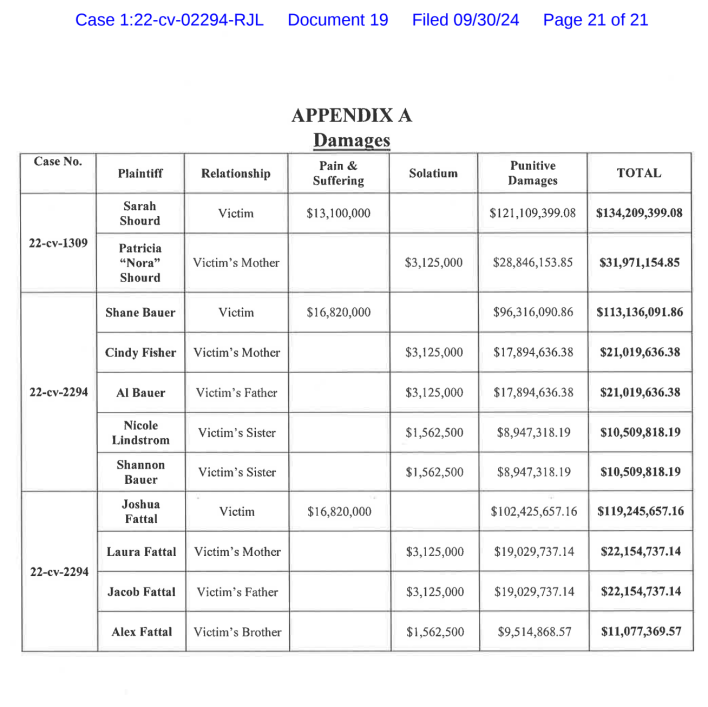
Leon has awarded Bauer, Fattal, Shourd and their families more than $500 million in seized Iranian state funds which could have been used to purchase medicine, sanitation equipment and food for citizens of the heavily sanctioned nation. As The Grayzone reported below, “Bauer and his ex-wife, Shourd, posed as staunch opponents of US sanctions against Iran and other nations. In 2016, for example, Bauer characterized Hillary Clinton’s call for Iran sanctions as ‘totally irresponsible.’ Shourd, for her part, condemned sanctions against Iran for ‘hitting the poorest of Iranians the hardest.’”
Bauer is currently reporting from Damascus, where the former Al Qaeda affiliate Hayat Tahrir al-Sham (HTS) has toppled the Syrian government and assumed power – a development he appeared to support. He and his fellow plaintiffs have not commented on the judgment they received against Iran.
Judge Leon’s full decision can be viewed here.
Below, in their initial August 30, 2022 report on Bauer’s lawsuit against Iran, Alexander Rubinstein and Max Blumenthal detail his history of agitation for Western-sponsored regime change operations across the globe, and his record of sordid attacks on The Grayzone, including his promotion of a failed frivolous lawsuit that aimed to destroy this publication.
Over a decade since he rose to prominence as a protagonist in an international drama of espionage and imprisonment, American journalist Shane Bauer and his family filed suit against Iran’s government in a Washington DC-based US District Court, seeking compensation for $10 million in damages resulting from his two year detention in Tehran.
Bauer’s ex-wife Sarah Shourd and their friend, Joshua Fattal, filed simultaneous lawsuits, seeking $10,000 and $10 million respectively.
The trio’s cases were filed in a Washington DC federal court with Judge Richard J. Leon – the same justice who ordered the Iranian government to pay the Washington Post’s Jason Rezaian $180 million in damages for his 18-month detention in the country.
In 2011, an Iranian court sentenced Bauer and Fattal to a total of eight years in prison each after they were convicted of illegally crossing the country’s border and spying for the United States. The two each served a total of two years, while Shourd was granted a compassionate release from Iranian prison after 13 months of detention.
Before his imprisonment, Bauer trekked throughout Africa and the Middle East while working as an English teacher and roaming reporter, racking up an impressive collection of passport stamps. Following his 2011 release, he established himself as a journalist specializing in undercover investigations, working a stint as a senior reporter for Mother Jones magazine in between various freelance gigs.
Bauer simultaneously emerged as a prolific apologist for US-backed regime change operations from Syria to Nicaragua, while justifying the US assassination of Iranian Maj. Gen. Qasem Soleimani. A relentless antagonist of anti-interventionist public figures, he has pushed for big tech platforms to censor media personalities that challenged Washington’s regime change agenda.
Bauer has even promoted a failed legal action against The Grayzone by a fellow journalist who had received a large sum of assets seized by the US government from Iran.
In 2018, Bauer’s book of undercover reporting, “American Prison,” which saw him take a job as a prison guard to gain inside access to a private prison, wound up on former President Barack Obama’s “Favorite Books of 2018.”
By the following year, as Bauer’s journalistic output declined, his attacks on anti-war media figures only escalated. Today, many of his most malicious tweets have been scrubbed, he is no longer employed by Mother Jones, and he says he is “working on a book about Americans in the Syrian war.” If Bauer scores a lucrative payout in US federal court, however, he may never need to worry about a freelance fee again.
And if successful, he and his former cellmates will ultimately be paid out with Iranian government assets seized by the United States through its international sanctions regime. In other words, the trio plans to benefit from looted public funds which Tehran could have otherwise used to purchase medicine, food, or fund social programs for its people.
Studies have found that the “Iranian economy and households are affected enormously” by sanctions targeting the country’s oil exports. In one particularly egregious instance of theft, the US government seized an Iranian oil tanker in 2021 and hauled it to Texas, where it sold the stolen crude for $110 million.
Before launching their lawsuits, Bauer and his ex-wife, Shourd, posed as staunch opponents of US sanctions against Iran and other nations. In 2016, for example, Bauer characterized Hillary Clinton’s call for Iran sanctions as “totally irresponsible.” Shourd, for her part, condemned sanctions against Iran for “hitting the poorest of Iranians the hardest.”
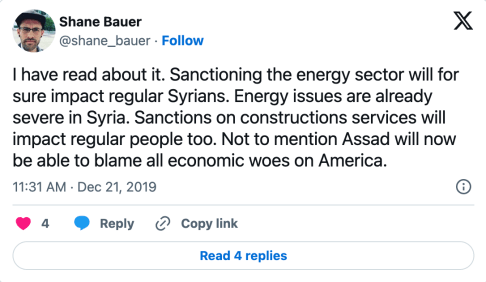
Bauer’s sudden bid for millions of dollars seized from the Iranian people by the US government raises new questions about a character whose journalistic career was shrouded in suspicion.
Long before his arrest in Iran, Bauer’s moves throughout Africa and the Middle East tracked closely with US foreign policy initiatives, and were sponsored by a US Department of Defense fellowship for several years.
To top it off, the lawyer Bauer enlisted to secure millions from Iran’s government counts one of Washington’s most infamous spies among her previous clients.
“the lack of coordination on the part of these hikers… indicates an intent to agitate”
The background to Bauer’s lawsuit originates in a July 2009 expedition he, his then-girlfriend Sarah Shourd, and their friend Joshua Fattal took to the Iranian border, where they were subsequently arrested.
The three Bay Area natives and self-described social justice activists insisted that their incursion into Iran was the result of an honest mistake. They claimed to have crossed the border unknowingly during a hiking trip near the Ahmad Awa waterfall in Iraq’s Sulaymaniyah Province, a region which fell under control of US-backed Kurdish militias following the US invasion of 2003.
According to Bauer’s legal complaint, when Iranian border guards arrested him and his companions, “Shane and Mr. Fattal instead became limp, as they would often do when protesting.”
While in Iranian custody, Bauer’s captors discovered photographs on Shourd’s camera showing they had visited Tel Aviv, Israel. The two said they traveled to Israel to visit an American friend, Tristan Anderson, who had been badly wounded and hospitalized by an Israeli teargas canister during a protest against Israel’s apartheid wall.
During Bauer’s trial, an Iranian judge listed each of the entry stamps on his second passport. They included Syria, Yemen, Iraq, Lebanon, Sudan and Israel.
Iran’s government was not the only party that rejected the trio’s excuses for their presence on the border. An Iraqi police officer claimed to the Iranian TV station Al-Alam the hikers were “working with the CIA.”
Meanwhile, a classified 2010 US military report stated that “the lack of coordination on the part of these hikers, particularly after being forewarned [of their proximity to the Iranian border], indicates an intent to agitate and create publicity regarding international policies on Iran.”
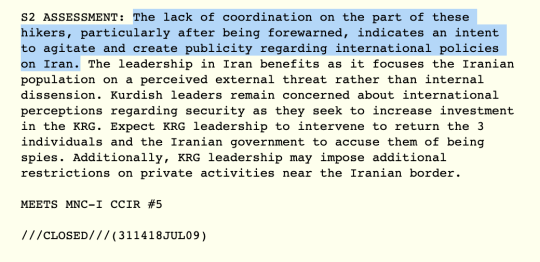
While Shourd denounced the US military assessment as “ridiculous,” her and her friends’ visit to the Iranian border came at a precarious time for the country’s government.
Indeed, their arrest occurred just weeks after President Mahmoud Ahmadinejad, a firebrand personality considered hostile to the West, secured reelection by a nearly 30 percent margin. The result sparked massive demonstrations in Tehran and gave way to the so-called “Green Movement,” a sustained protest campaign against Ahmadinejad’s mandate that eventually aided the 2014 electoral victory of Iran’s reformist bloc.
Throughout the summer of 2009, Western media granted the “Green Movement” wall to wall coverage, crediting it with drawing the largest protest crowds since Iran’s 1979 Islamic Revolution. In her memoir of captivity, Shourd recounted that during a trip to Sweden, “Stockholm’s sizable expatriate Iranian community protested in solidarity with the uprising in their home country.”
“My brother, Alex, and I documented the anti-Iran rally in Sweden,” she recalled.
Shourd later wrote that while imprisoned in Iran, the Green Movement “made me want to participate in undermining the regime that was causing me and my family so much pain.”
When the story of “Three American Hikers Held Hostage in Iran” emerged in July 2009, their tale was presented as further proof of the embattled government in Tehran’s anti-American sentiment and lack of regard for human rights. Shourd later expressed gratitude to the Iranian government “for using us to further deepen your own crisis of legitimacy around the world and with your own people.”
Their detention also corresponded with the launch of President Barack Obama’s economic assault on Tehran, a strategy which saw Washington levy hefty financial sanctions against Iran’s government in a bid to force it to negotiate limits on its domestic nuclear program.
Bauer’s lawyer represented top US spy jailed in Cuba
Bauer’s lawsuit accused the Iranian government of a slew of crimes against both himself and his family. Notably, it claims Bauer was subjected to torture, assault, and battery while in Iranian custody.
Bauer’s 2014 memoir, “A Sliver of Light,” which he co-authored with Shroud and Fattal, offers a strikingly different narrative, however. In the book, Bauer recalled taunting a prison guard to assault him and acknowledged that Iranian authorities were reluctant to do so.
“If he can’t frighten me, all he can do is hit me, and if he does that, he will be hurting himself,” Bauer explained.
“We are hostages, and hostages are currency, and currency is not to be damaged. Making him beat me is my only way to fight back,” he continued, after saying he repeatedly screamed at the guard: “Hit me!”
While Bauer’s lawsuit appeared to contradict the account offered in his memoir, it is far from an amateurish legal complaint. He and his family are represented by Emily P. Grim, a partner at the elite Gilbert, LLP law firm, which is located just blocks from the US Capitol.
Grim’s biography on Gilbert’s website boasts: “Her clients include Alan Gross, an American jailed in Cuba from 2009 to 2014 for his work on a U.S. Government project to increase Internet access in Cuba’s Jewish community, and Amir Hekmati, a former U.S. Marine imprisoned in Iran from 2011 to 2016 on false charges of espionage.”
Before he became Grim’s most famous client, Alan Gross was arrested by Cuban security officers in 2009. At the time, Gross was working for the United States Agency for International Development, or USAID, a soft power arm of American foreign policy that has overseen countless destabilization plots around the globe. The USAID program that sponsored Gross’ work in Cuba was funded through the 1996 Helms-Burton Act, a US law that explicitly called for regime change in Cuba.
When Cuban authorities apprehended Gross during his fifth trip to the country, they discovered his phone was linked to a SIM card that was distributed exclusively by the Pentagon and the CIA. The USAID employee had previously smuggled large amounts of illicit technology into Cuba, apparently as part of an effort to establish a network of covert internet access points throughout the country.
Amir Hekmati is the second-most notable client of Bauer’s lawyer, Emily Grim. A former marine, Hekmati helped develop a translation system financed by the Pentagon’s Defense Advanced Research Project Agency, or DARPA. Iran jailed Hekmati and sentenced him to death after convicting him on espionage charges. Following the diplomatic breakthrough of the Iran-US nuclear deal, he was released in 2016 as part of a prisoner swap.
Though Hekmati was initially rewarded a $20 million payout of seized Iranian assets, the Department of Justice eventually cut him off when the FBI became suspicious that the American had traveled to Iran to sell classified information about US operations in Afghanistan to the government, and not to visit his grandmother as he claimed.
Despite angry protestations, Grim’s firm has been unsuccessful in persuading the courts to complete her client’s payout.
Gilbert LLP has not responded to multiple emailed requests from The Grayzone regarding Bauer’s lawsuit. Bauer and Shourd have also ignored requests for comment delivered by Twitter and email.
Bauer sponsored by Pentagon grant that mandates “contributing to the national security of the United States”
Shane Bauer has lashed out at anyone who has accused him of having worked with the US government. However, his memoir raised more questions about his relationship with Washington than it has answered.
In one particularly revealing section, Bauer recalled an interrogation he experienced at the hands of an English-speaking Iranian he nicknamed “Weasel.”
“In our other sessions, you listed twenty-four countries that you have been to. Who funded those trips?” Weasel asked Bauer, who was 29 at the time.
“I know what he is getting at,” Bauer recalled, “and it is a legitimate question. If I can’t account for my funds, how can I prove that I am not being funded by the CIA? The problem is, I don’t think my honest answer is that believable.”
Bauer ultimately told Weasel that he saved money while “working as a welder” until he was 19 before traveling “through Europe and the Middle East.”
“Does this asshole believe a word I’m saying?” Bauer recalled wondering.
The line of questioning proceeded with Weasel asking whether the US government paid for any of Bauer’s trips.
“Shit! He knows about the grant…” wrote Bauer. ‘No,’ I say.”
Bauer was referring to the Boren Award, a Department of Defense sponsored grant that covered his Arabic studies in Yemen and Syria. When “Weasel” asked who funded the program, Bauer once again admitted to lying, telling him it was the State Department.
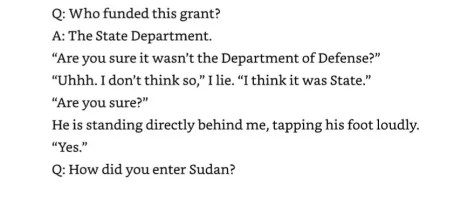
From Bauer’s co-authored account of captivity in Iran, “Sliver of Light”
Boren fellowship recipients are required to pay back their award through governmental service by “contributing to the national security of the United States in the Department of Defense, any element of the intelligence community, the Department of Homeland Security, or the Department of State.”

From the Boren Awards website
In less common instances, Boren recipients are allowed to fulfill their obligations to the US government in other departments. However, the overwhelming majority of grantees do so with the aforementioned agencies. Bauer never specified whether or not he fulfilled his obligation to the fellowship – or how he did it. He did claim, however, that the professor who encouraged him to apply for the grant stated none of their students actually went into government.
Yet when journalist David Ravicher inquired with a Boren representative about the program, he was informed “that 98 percent of its recipients fulfill this requirement and the rest receive deferments. Otherwise, the Treasury Department hunts them down.”
Before stepping into Iran, Bauer winds strange trail through the region
Shane Bauer entered journalism while enrolled at the University of California-Berkeley’s Peace and Conflict Studies program, which he graduated in 2007. It was at UC-Berkley where he met Shourd.
Bauer’s first dabbled in undercover journalism while in Yemen in 2005. At the time, the Houthi movement had just launched its insurgency against the Yemeni government. The civil conflict eventually triggered a brutal and ongoing military intervention by the US, Saudi Arabia, and the UAE to crush the Houthi advance.
According to the UC-Berkeley Alumni Association’s newsletter, Bauer was employed in Yemen by “a pro-government, English-language paper.” While the Alumni Association did not say which paper that was, Bauer earned a byline in 2005 from the Yemen Observer, a paper founded by the longtime press secretary to then-President Ali Abdullah Saleh.
Bauer eventually “decided to sneak into a city occupied by Houthi rebels which no Western journalist had visited,” the newsletter wrote. While disguised in local garb, Bauer and a British pal were detained by local authorities in the city of Saada and released a day later.
Bauer also spent two summers in the Darfur region of Sudan while enrolled at UC-Berkeley. At the time, between 2006-07, Darfur-based rebel groups from the Sudanese Liberation Army, or SLA, were facing international pressure to enact a peace deal with Sudanese President Omar Bashir, who was labeled a state sponsor of terror by the US.
In 2007, Bauer managed to score an interview with the vice intelligence director for SLA General Secretary Minni Minnawi, who had signed the deal. According to the Institute for International and Strategic Relations, a French think tank, Minnawi had been backed by the CIA as the only rebel faction leader to ink the agreement with Khartoum. He was later flown to Washington to meet with President George W. Bush. Today, he serves as the governor of Darfur while his forces fight in Libya under the command of Khalifa Haftar, another former CIA asset.
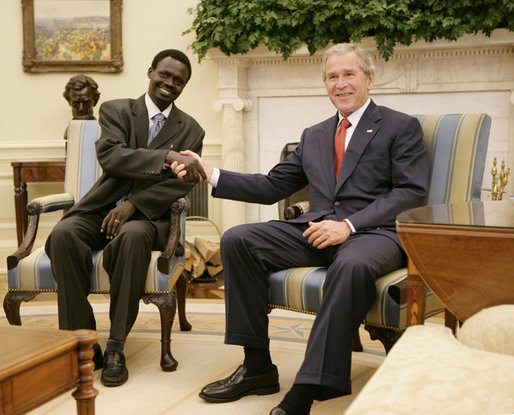
SLA General Secretary Minni Arko Minnawi and President George W. Bush
In his memoir of captivity in Iran, Bauer wrote that his interrogator demanded to know how he entered Sudan in 2007. The inquiry caused Bauer to worry that Iran may have been aware of his “history of government funding and my history of illegally crossing borders,” he recalled. Bauer told his interrogator that he “entered [Sudan] as a guest of the Sudanese Liberation Army.”
Not long after his jaunt into Darfur, Bauer arrived in Damascus, Syria with his then-girlfriend, Shourd, for several months. At the time, Washington was cultivating opposition to the government of President Bashar al-Assad through civil society networks around the country.
Bauer and Shourd said they studied Arabic at Damascus University, taught English to Iraqi refugees, and used the country as a base for reporting around the region. (On her personal webpage, Shourd says, “In 2007, I moved to Damascus, Syria…” In an interview with the Pulitzer Center, however, she states, “In 2008, I moved to Damascus, Syria…”)
A confidential November 2008 cable by Maura Connelly, then the Charges D’Affaires for the US Embassy in Damascus, identified English teachers and visiting Fulbright scholars in Syria as important cogs in US “public diplomacy” efforts against the government of President Bashar al-Assad.
The US embassy’s “English Language Fellow (ELF) for 2008-2009 remains in country and is using her numerous contacts among Syrian English teachers to conduct training in Damascus and country-wide,” Connelly noted.
Bauer and Shourd’s teacher in Damascus, Majid Rafizadeh, happened to have been on a Fulbright scholarship at the time. A Syrian-Iranian academic, Rafidzadeh has since emerged as a fervent supporter of Iranian regime change who has supplied testimony to Congress advancing the interventionist goals of hardline neoconservatives.
Bauer later reflected “how, back in 2009, my Syrian friends would fantasize about being rid of the dictator and his secret police, but no one could have imagined that the Arab Spring would come two years later.”
Bauer escalates online attacks, enters Syria under US occupation
Years after the so-called Arab Spring swept through the region like a hurricane, leaving unimaginable ruin in its wake, Bauer was still pumping out online attacks against prominent critics of US meddling.
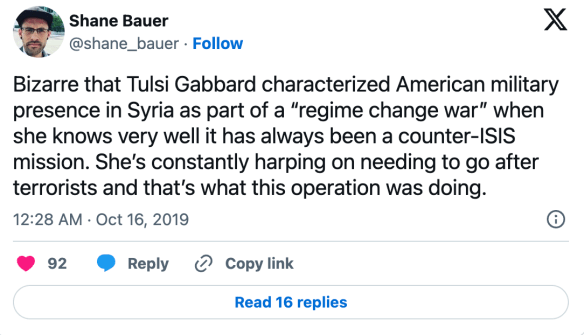
By 2019, his attacks on opponents of the US-backed dirty war on Syria had grown so unhinged, his detractors began to taunt him with the refrain: “Take a hike.”
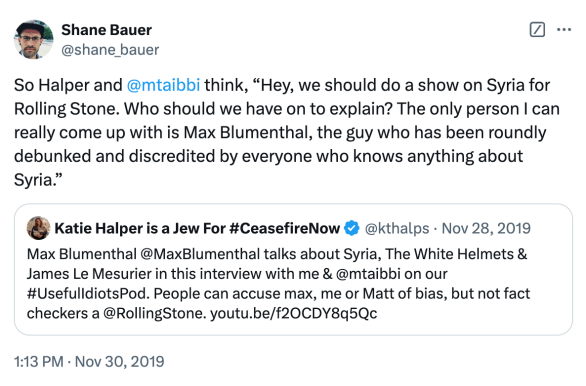
Bauer also took aim at former US Rep. Tulsi Gabbard for daring to criticize the US military occupation of northeastern Syria, insisting it was a noble anti-terrorist mission. In fact, Dana Stroul, a senior Biden Department of Defense official, has openly stated that the US military “owns” the “resource rich” region of Syria in order to exploit its wealth and starve Damascus into capitulating to the West’s agenda.
At the time, Bauer had recently returned from a visit to the US-occupied northeastern region of Syria for a series of field reports lamenting Washington’s refusal to remove Assad by force. Published in the May/June 2019 issue of Mother Jones, the series opened with a quote by a Kurdish border guard practically begging the US to plunder Syria’s natural wealth: “We have oil, so much oil. Let them stay and take the oil.”
Careful readers may be wondering whether Bauer entered the country legally or not. In fact, Syria’s government denied Bauer’s visa, prompting him to “sneak in” through the border controlled by the US military and its Kurdish allies.
Since Bauer’s reports from US-occupied Syria in 2019, he has produced only one article: a profile of a rogue local US police force for The New Yorker. That was nearly two years ago.
With no known sources of income apart from his two published books and the one apparently on the way, Bauer turned to the US government and the funds it seized from the Iranian people for a massive payday.
View the initial legal complaint, Shane Bauer v. the Government of the Islamic Republic of Iran, here.
Transnistria switches off heating after gas supply via Ukraine stops
RT | January 1, 2025
Moldova’s breakaway region of Transnistria has halted heating and hot water supply to households on the first day of 2025 after the flow of Russian gas via Ukraine stopped, a local energy company has said.
On Wednesday, Russian energy giant Gazprom announced that it could not deliver gas to Europe via the Ukrainian route anymore due to “the repeated and clear refusal” of Kiev to prolong the relevant agreements that expired at the end of 2024.
Later in the day, Transnistria’s energy company, Tirasteploenergo, said that that because of “the temporary cessation of gas deliveries to the heat-generating facilities of the enterprise… heating and hot water supply to the population, publicly funded institutions and organizations of all forms of ownership will be cut.”
For now, only medical facilities that provide inpatient care will be heated, the company added.
“There is no heating or hot water,” an unnamed employee of Tirasteploenergo in the republic’s capital of Tiraspol told Reuters by phone. The woman said she did not know how long the situation would continue.
In mid-December, Transnistria introduced a state of economic emergency due to the looming gas crisis. Shortly thereafter, Moldova announced a state of emergency in the energy sector.
Transnistria, which is located on the left bank of the Dniester River and whose population is more than half ethnically Russian and Ukrainian, proclaimed independence from Moldova in the early 1990s, shortly after the collapse of the Soviet Union. Around 1,100 Russian soldiers are currently stationed in the region as peacekeepers in order to monitor a 1992 ceasefire between Chisinau and Tiraspol.
Ukrainian Energy Minister German Galushchenko confirmed the stoppage of gas supplies on Wednesday, calling it a “historic event.” The minister claimed that due to the decision by Kiev “Russia is losing markets, it will suffer financial losses. Europe has already made a decision to give up Russian gas.”
Ukraine refused to prolong the transit contract with Russia despite the fact that Gazprom has long-term agreements with several European buyers.
The leader of one such country, Slovak Prime Minister Robert Fico, threatened last week to cut electricity supplies to Ukraine if the flow of gas ceases.
Russian President Vladimir Putin said last month that the deadlock over gas supplies via Ukraine will not be resolved, adding that “this transit contract will not exist anymore, it’s clear. But we will manage; Gazprom will manage.”
Syria’s new leadership receives Ukrainian FM in Damascus
The Cradle | December 30, 2024
Syria’s de facto ruler Ahmad al-Sharaa, better known as former Al-Qaeda chief Abu Mohammad al-Julani, and the country’s new Foreign Minister Asaad al-Shaybani hosted Ukraine’s top diplomat in the capital, Damascus, on 30 December.
Ukrainian Foreign Minister Andrii Sybiha arrived in the capital at the head of a high-level delegation, which included President Volodymyr Zelenskyy’s special envoy.
“We seek to cooperate with the new Syrian administration in several areas. We share with Syria the suffering from unjust regimes,” Sybiha was quoted as saying. “We are ready to help Syria in collecting evidence and investigating the crimes of the former regime and Russia.”
“Russia and Assad regime are partners in committing atrocities in Syria. We believe that relations between our two countries will witness great development,” he added.
The foreign minister went on to say, “If you can expel the Russians from your lands, you will ensure your security and the security of neighboring countries.”
Shaybani said during the meeting that his country is “turning the page” on the era of the former government of Bashar al-Assad, stressing that there will be a “strategic partnership” between Damascus and Kiev.
Sharaa’s organization Hayat Tahrir al-Sham (HTS), formerly known as the Nusra Front (Al-Qaeda’s offshoot in Syria), appointed a transitional authority following the collapse of the Syrian army and the fall of Damascus on 8 December after an 11-day shock offensive that took the region by surprise.
Over the past few years, Ukraine has provided crucial support to HTS and other extremist factions under its command – who were based in Syria’s northern Idlib governorate before the assault that ended the Assad government.
HTS militants and fighters from ISIS and other extremist groups have also been deployed in Ukraine to fight Russian forces.
Before the launch of the offensive on 27 November, Ukrainian drone experts had been training and equipping extremist militants in Idlib.
The Russian military intervened in Syria in 2015 in support of Assad’s government, helping the Syrian Arab Army (SAA) turn the tide against several groups who had taken over large swathes of the country – including the Nusra Front, which became HTS.
Moscow and the former Al-Qaeda branch have established a line of contact since Assad’s government fell in early December.
“Russia is an important country and is considered the second most powerful country in the world. There are deep strategic interests between Russia and Syria. All Syrian weapons are Russian, and many power stations are run by Russian expertise,” Sharaa said on 29 December. “We do not want Russia to leave Syria in the way some people would like.”
Russia has said that the future of its presence in Syria will depend on the outcome of talks with the country’s new authorities following the transitional period.
‘Hardline Critic of the West’: What’s to Know About Georgia’s New President?
By Oleg Burunov – Sputnik – 29.12.2024
Mikheil Kavelashvili took his oath on the Bible and the Georgian constitution, swearing to serve the country’s national interests amid a political standoff.
On December 29, Mikheil Kavelashvili was sworn in as Georgia’s new president in an inauguration at parliament that was attended by members of the ruling Georgian Dream party and its founder Bidzina Ivanishvili.
Who is Georgia’s new president and how does the US meddle in internal affairs of the former Soviet republic?
Mikheil Kavelashvili’s Record
A former Dinamo Tbilisi and Manchester City football player, Kavelashvili was appointed president by the parliament during the December 14 elections, in which 224 out of 225 members of Georgia’s electoral college voted for the only candidate on the ballot.
The 53-year-old is a founder of the People’s Power party, allied with the Georgian Dream and known for being the main voice for anti-Western sentiments in Georgia. The Guardian recently called him “a pro-Russia, hardline critic of the West.”
Kavelashvili has repeatedly said that Western intelligence agencies are seeking to drive Georgia into war with Russia.
He accused opposition parties of acting as a “fifth column” directed from abroad, slamming outgoing President Salome Zourabichvili as a “chief agent”. The new president accused her of violating the constitution and declared that he would “restore the presidency to its constitutional framework.”
The footballer-turned-politician insisted that Georgian society is divided,” and that “radicalization and polarization” in the country are being fueled from abroad. He pledged to do his best to unite the society “around the idea of Georgia’s identity and independence.”
US Interference
Earlier this week, the US did not think twice before sanctioning Georgian Dream party’s founder Bidzina Ivanishvili for allegedly “undermining the democratic and Euro-Atlantic future of Georgia for the benefit of the Russian Federation,” according to Secretary of State Antony Blinken.
In September, the US cited the aforementioned allegations as it slapped sanctions on Zviad Kharazishvili, head of the Department for Special Assignments of the Ministry of Internal Affairs and his deputy Mileri Lagazauri. Georgian Dream spokesman Givi Mikanadze denounced the sanctions as “interference in the pre-election processes and an attempt to influence the will of voters.”
The Russian Foreign Intelligence Service (SVR), in turn, said in a statement in July that Moscow has data that indicates Washington’s determination to seek a change of power in Georgia following the results of the parliamentary elections in the small Caucasian nation on October 26, which was finally won by the Georgian Dream.
According to the SVR, the US instructors have already given the command to the opposition forces in Georgia to start planning protests in the country timed to coincide with the elections.
The October 26 elections saw Georgian Dream obtain 54.2% of the votes, with the four opposition parties together gaining 37.33%. The remaining political forces failed to overcome the 5% ceiling needed to make it to the parliament.
NATO state probes Russian tanker over mysterious cable incident – media
RT | December 26, 2024
Authorities in Finland are investigating whether a Russian oil tanker had anything to do with the severing of an undersea electricity cable this week, the Financial Times has reported. The incident was the latest in a series of cable breaks in the region.
Finnish officials stopped the tanker, the Eagle S, after the Estlink 2 electricity cable in the Gulf of Finland was cut on Wednesday, the British newspaper reported on Thursday. The Estlink 2 delivers power from Finland to Estonia, and has been operational since 2014.
Finnish Prime Minister Petteri Orpo said that “the authorities are on standby over Christmas and are investigating the matter,” while the cable’s operator, Fingrid, said that “we are investigating several possible causes, from sabotage to technical failure, and nothing has been ruled out yet.”
The Eagle S is the focus of the government’s investigation, the Financial Times reported, citing anonymous “people familiar with the probe.” No further details were provided, although the paper’s sources said that the vessel was also under investigation over the severing of three data cables in the Gulf of Finland last month.
These fiber optic cables linking Finland with Germany, Lithuania, and Sweden. The incident involving the Finland-Sweden cable was later confirmed to have been caused by construction work, while suspicion over the other two breaches initially fell on a Chinese vessel which passed over the cables around the time of the damage.
The ship, the Yi Peng 3, stopped in international waters and was boarded by Chinese investigators last week, with Swedish, Danish, German and Finnish officials present as observers.
It remains unclear whether the Yi Peng 3 had anything to do with the cable incidents. However, German Defense Minister Boris Pistorius said at the time that Berlin had to “assume, without certain information, that the damage was caused by sabotage.”
Likewise, although investigators have not yet established whether the Eagle S had anything to do with the most recent cable break, Finnish President Alexander Stubb announced on social media on Thursday that “it is necessary to prevent the risks posed by ships belonging to the Russian shadow fleet.”
American Tax Dollars: $4.8M for Ukrainian Influencers
Sputnik – 23.12.2024
The US State Department spent nearly $5 million on Ukrainian influencers, a move highlighted by Republican Senator Rand Paul from Kentucky as one of the most absurd expenditures by the US government in 2024.
Despite American taxpayers providing nearly $174 billion in aid and military assistance to Kiev since the beginning of the conflict in Ukraine, “someone over at State thought it was a brilliant idea to drop an additional $4.8 million for ‘Ukraine public affairs – Influencer Staff’,” Paul noted in his annual Festivus Report on government waste.
The senator urged a return to “serious diplomacy” instead of relying on social media strategies, emphasizing that many American taxpayers struggling to meet their basic needs are funding this spending on Ukraine.
Paul said it is “baffling” to see the US government burning through taxpayer dollars at a time when Americans are “scraping by.”
In total, the 41-page report covers over $1 trillion in what the senator describes as “government waste.”
Earlier, in an interview with NBC News, US President-elect Donald Trump remarked that under his administration, Kiev is unlikely to receive the same levels of aid it enjoyed during Joe Biden’s presidency.
Featured Video

Alon Mizrahi: ‘Israel Must Be Dismantled’
or go to
Aletho News Archives – Video-Images
From the Archives
Allies Don’t Need Lobbies
By Jay Knott | Dissident Voice | September 24, 2013
In a recent article on Counterpunch, Rob Urie defended the traditional Marxist analysis of US policy in the Middle East. He argues that support for Israel is driven primarily by economic interest, not the Jewish lobby.
He starts by paying tribute to the idea that Western societies are uniquely racist. He says that the “Western narrative” claims there is an “Arab character”, and that this is “antique racist blather”. He gives no definition of these terms. Further, he establishes his credentials as part of the dominant current in the American left by claiming that “over a million people in Iraq died so ‘we’ in the West can drive SUVs.”1
When he tries to criticize bourgeois economics, he makes it clear he doesn’t understand the developments it has made since Marx’s day, using the mathematical discipline known as “game theory”. He dismisses the basic abstraction of economic theory, the idea of the rational individual, on the grounds that it is “devoid of history, culture and political context”. But abstractions are always devoid of something.
He defends a more concrete economic theory, mostly Marxist, with some input from another theorist of capitalist crisis, Hyman Minsky. This concrete theory leads him to the view that US activity in the Middle East is primarily driven by rational capitalist motives, the need to secure a supply of oil.
“Taking the totality of circumstance — former oil company executives launching war on an oil rich nation on a pretext they publicly proclaimed they didn’t believe shortly before taking office — and that upon launching their war proved to be non-existent, requires a willingness to overlook the obvious — that the war on Iraq was for oil, that is difficult to support.”1
Perhaps I’ve misunderstood him, but based on what he says in the rest of the article, this convoluted sentence seems to argue that, because president Bush and vice-president Cheney attacked Iraq on false premises, and they also said it was all about oil, and they are former oil executives, and Iraq has a lot of oil, it’s difficult to deny US attacks on Iraq are all about oil.
In fact, it’s not hard at all. As Urie points out, at times Bush and co. said that attacking Iraq was “protecting the world’s supply of oil.”1 But, as he also points out, they are congenital liars. Why should we believe them when they say they are trying to “protect” the oil supply? Protect it against what? When politicians “admit” attacks on Middle Eastern countries are wars for oil, they are parroting the neo-con party line, feeding the public, both left and right, with a plausible-sounding pretext. For right-wingers, “it’s a war for oil” is a reason to support war, and for leftists, it’s a way to feel better by complaining impotently about corporate greed. Both approaches help the war drive. … continue
Blog Roll
 Aletho News
- Canada, the U.S., and NATO: the inescapable trap
- Villains of Judea: Leonid Radvinsky
- Alon Mizrahi: ‘Israel Must Be Dismantled’
- Former Head Of MI6 Admits That The U.S. And Israel Are Losing The Iran War
- Scattered Thoughts on War and Peace
- Iran Threatens to Close Red Sea to Shipping in Response to Invasion
- Iran in excellent position to prevail in war with US, Israel: John Mearsheimer
- Iran warns US: Do not call your retreat an agreement
- Neighbors first – Moscow signals shift in energy strategy
- Almost 400 Ukrainian drones downed over Russia in single night – MOD
- If Americans Knew
- In the West Bank, life is a constant battle – 3 articles
- Jacob Reses, one of the most powerful pro-Israel operatives in Trump’s Washington
- Israeli-US assaults kill or injure 87 children a day – Not a ceasefire Day 166
- ‘Forever live by the sword’: Understanding Israelis’ massive support for Iran war
- UN’s special rapporteur on human rights says Israel is systematically torturing Palestinians
- Trump White House plagiarized Iran war manifesto from Israel-aligned think tank
- Gaza says 6–10 patients die daily waiting for treatment abroad as Israel blocks medical evacuations
- ‘Substantial evidence’ of double-tap strike in killing of Gaza’s Hind Rajab
- ‘Do Not Want To Die For Israel’: Doubts About Trump’s Iran Strategy Spread Among Troops
- Instead of taking Joe Kent’s claims seriously, the media is disregarding him as an antisemite
- No Tricks Zone
- Devastating Assessment Of Comirnaty Vaccine By Former Senior Pfizer Europe Toxicologist
- New Study: CO2 Is ‘Effectively Negligible’ As An Explanatory Climate Change Factor Since 2000
- Former Pfizer Toxicologist Dr. Helmut Sterz Tells Bundestag Hearing Pfizer Vaccine Should Have Never Been Approved
- Energy Expert: Germany’s Nuclear Phaseout Was A “500 Billion Euro Mistake”
- New Research: South Australia’s Mid-Holocene Sea Surface Temperatures Were 4°C Warmer Than Today
- Storing Green Energy To Last Germany 10 Days Would Require A 60-Million Tonne Battery
- New Studies: UK Sea Levels Were 4 Meters Higher Than Today During The Mid-Holocene
- Destructive Green New Deal: German Energy And Metal Group Warns Of Drastic Crisis
- New Study Documents A 20-Year Pause In Arctic Sea Ice Decline – Driven By Internal Variability
- Wake-up Call: Survey Shows Majority Of Germans Now Favor Postponing Climate Targets!
 Aletho News
