Henry and Hillary – Familiar Bedfellows
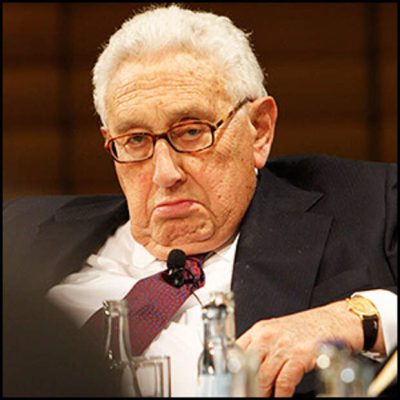
By Sheldon Richman | FFF | November 19, 2014
It says a lot about former secretary of state and presumed presidential aspirant Hillary Clinton that she’s a member of the Henry Kissinger Fan Club. Progressives who despised George W. Bush might want to examine any warm, fuzzy feelings they harbor for Clinton.
She has made no effort to hide her admiration for Kissinger and his geopolitical views. Now she lays it all out clearly in a Washington Post review of his latest book, World Order.
Clinton acknowledges differences with Kissinger, but apparently these do not keep her from saying that “his analysis … largely fits with the broad strategy behind the Obama administration’s effort over the past six years to build a global architecture of security and cooperation for the 21st century.”
Beware of politicians and courtiers who issue solemn declarations about building global architectures. To them the rest of us are mere “pieces upon a chess-board.” Security and cooperation are always the announced ends, yet the ostensible beneficiaries usually come to grief. Look where such poseurs have been most active: the Middle East, North Africa, Ukraine. As they say about lawyers, if we didn’t have so-called statesmen, we wouldn’t need them.
If I didn’t know better, I’d suspect some pseudonymous writer of having fun with irony in this review. Behold:
President Obama explained the overarching challenge we faced in his Nobel lecture in December 2009. After World War II, he said, “America led the world in constructing an architecture to keep the peace…”
Keep the peace — if you don’t count the mass atrocity that was the Vietnam War, the U.S.-sponsored Israeli oppression of Palestinians, and various massacres carried out by U.S.-backed “leaders” in such places as Bangladesh (formerly East Pakistan), East Timor, Chile, and elsewhere.
One Henry Kissinger had a hand in all these crimes, by the way. Strangely, Clinton doesn’t mention them. (See Christopher Hitchens’s devastating two-part indictment here and here, later turned into The Trial of Henry Kissinger.)
America, at its best, is a problem-solving nation.
Iraq, Syria, Afghanistan, and Libya are only the latest examples of problems America solved during Madam Secretary’s tenure, building on the glorious successes of George W. Bush’s team. Henry the K is no doubt flattered by the homage.
Kissinger is a friend, and I relied on his counsel when I served as secretary of state. He checked in with me regularly, sharing astute observations about foreign leaders and sending me written reports on his travels.
Now things make sense. That Hillary Clinton thought Kissinger — Henry Kissinger — a worthy advisor is something we should all know as 2016 looms.
What comes through clearly in this new book is a conviction that we, and President Obama, share: a belief in the indispensability of continued American leadership in service of a just and liberal order.
There really is no viable alternative. No other nation can bring together the necessary coalitions and provide the necessary capabilities to meet today’s complex global threats. But this leadership is not a birthright; it is a responsibility that must be assumed with determination and humility by each generation.
It takes chutzpah to write humility even remotely in connection with Kissinger. And if the U.S. empire is indispensable to justice and liberalism — and where are these, exactly? — we are in trouble. The record is not encouraging. Kissingerian “realism” creates global threats.
The things that make us who we are as a nation — our diverse and open society, our devotion to human rights and democratic values — give us a singular advantage in building a future in which the forces of freedom and cooperation prevail over those of division, dictatorship and destruction.
Devotion to human rights and democratic values — as shown in Egypt, where Clinton stuck by another friend, Hosni Mubarak, against a popular uprising. The woman has some friends!
“Any system of world order, to be sustainable, must be accepted as just — not only by leaders, but also by citizens,” he writes.
The suggestion that Kissinger cares what ordinary citizens anywhere think is ridiculous. What he cares about is states, which he puts in one of two categories: those that buckle under to the Indispensable Empire and those that do not.
Henry, er, Hillary in 2016? You might want to rethink that.
Henry Kissinger, America’s most notorious war criminal

Press TV – December 1, 2023
The most notorious and hawkish America’s former top diplomat, known more for his war crimes and export of imperialism than diplomacy, died on Thursday. He was 100.
Henry Kissinger, a key architect of America’s Cold War foreign policy during the presidencies of Richard Nixon and Gerald Ford, breathed his last at his home in Kent, Connecticut.
While in the United States, he is often lauded for bringing about rapprochement with China, around the world, he is known as an infamous war criminal with blood of millions of people on his hands.
It is estimated that the victims of his blatant war crimes number from several hundred thousand to several million, from Argentina, Bangladesh, Cambodia, Chile, Cyprus, East Timor, Palestine, South Africa, to Vietnam.
In 1973, quite scandalously, he was handed a Nobel Peace Prize for negotiating a ceasefire deal in the Vietnam War, although the earlier flare-up and spread of the devastating war to neighboring Cambodia was entirely his handiwork.
In the eight years that he was the US Secretary of State, Kissinger shaped America’s interventionist foreign policy, which later became a benchmark for his successors to export American hegemony and imperialism around the world.
Christopher Hitchens, the author of The Trial of Henry Kissinger, in his 2001 book called for the former top US diplomat to be prosecuted for conspiracy to commit murders, kidnappings and torture across the world.
“The US could either persist in averting their gaze from the egregious impunity enjoyed by a notorious war criminal and lawbreaker, or they can become seized by the exalted standards to which they continually hold everyone else,” wrote Hitchens.
What are Kissinger’s main crimes?
One of his most notorious roles was in Cambodia, where he masterminded the expansion of the Vietnam War through a secret bombing campaign in 1969 and ground invasions by US forces for years.
The US is believed to have rained down more than 540,000 tonnes of bombs in a campaign called Operation Menu that was executed without the backing or knowledge of the US Congress.
The deadly military adventure caused an eight-year civil war between the Cambodian government and the Khmer Rouge regime, which led to the killing of around 275,000–310,000 people and displaced millions of others.
In declassified cables in 1970, Kissinger was heard conveying this message to his deputy Alexander Haig after speaking to Nixon: “He wants a massive bombing campaign in Cambodia… It’s an order, it’s to be done. Anything that flies, on anything that moves. You got that?”
Author and TV personality Anthony Bourdain, after visiting Cambodia, wrote in his 2011 book A Cook’s Tour: “Once you’ve been to Cambodia, you’ll never stop wanting to beat Henry Kissinger to death with your bare hands”.
“Witness what Henry did in Cambodia – the fruits of his genius for statesmanship – and you will never understand why he’s not sitting in the dock at The Hague next to Milošević.”
He also played an instrumental role in the massacre of the East Timorese people by the Indonesian forces in the mid-1970s.
Kissinger and President Ford, during a meeting with the Indonesian dictator Suharto in December 1975, gave him instructions to invade East Timor, which triggered a civil war that left at least 200,000 people dead, according to 2001 declassified documents.
In Chile, Kissinger worked behind the scenes to destabilize and undermine the government of Salvador Allende who was seen as a threat to US hegemony in South America at a time when all other Latin American countries had US-installed military dictatorships.
Less than three years into Allende’s rule, amid skyrocketing inflation and massive strikes that were orchestrated by the CIA, a US-engineered coup led by General Augusto Pinochet toppled the democratically-elected government.
A Chilean government report later revealed that over 40,000 people were killed, tortured, or imprisoned during Pinochet’s murderous regime at the behest of the US government and Kissinger.
In Argentina, Kissinger militarily backed junta leader General Jorge Rafael Videla after he toppled the democratically-elected government of President Isabel Perón in March 1976, according to declassified cables.
These actions led to the Dirty War between 1976 and 1983, where Argentina’s military junta killed between 10,000 and 30,000 people. Many of them were subjected to enforced disappearances.
Kissinger was also involved in Bangladesh, previously known as East Pakistan, where he and Nixon backed the genocide of people by West Pakistan.
Following his death on Thursday, Bangladesh’s Foreign Minister AK Abdul Momen said Kissinger backed the Pakistani military regime during the 1971 war and failed to apologize to the people of Bangladesh for his actions.
Kissinger was also responsible for consolidating the US vassal dictatorship in Iran in the 1970s, which had long-lasting unwanted consequences for Washington.
What role did Kissinger play in Iran?
Kissinger’s political opportunism is particularly evident in the example of relations with Iran, which American diplomacy under his leadership saw, in the words of Leader of the Islamic Revolution Ayatollah Seyyed Ali Khamenei, as a “milking cow.”
In the 1970s, accompanying then-US President Nixon, he traveled to Tehran and initiated massive military deals on the export of arms worth billions of dollars to Iran.
In his eyes, the best solution for Iran was a rigid military dictatorship that would spend massively on American weapons and other expensive products, and at the same time play the role of a US proxy against the regional countries that refused to lean toward Washington.
Such an attitude was formed partly as a consequence of the defeat in the Vietnam War, which is why the American authorities did not like the idea of repeating the same scenario in West Asia, with huge American casualties.
In 1975, when he held the position of Secretary of State and National Security Advisor, Kissinger was the key man in signing a $15 billion deal that included $6.4 billion for the purchase of eight US nuclear reactors.
The Shah’s regime then planned to build a total of twenty nuclear power plants with the import of enriched uranium, for which Washington and its allies showed great enthusiasm, seeing it as a lucrative opportunity for their companies.
These treaties collapsed four years later due to mass popular discontent with the West-backed dictatorship and the success of the Islamic Revolution, the prospect of which Kissinger understandably dreaded.
He was among the loudest proponents of providing asylum to the deposed Shah, arguing that it was America’s “moral obligation.”
On the aggression of the Baathist Iraqi regime on Iran, he said “It’s a pity they both can’t lose.”
Three decades later, when Iran announced the continuation of the development of a civilian nuclear program, this time with its own technology and without multibillion-dollar contracts with American and Western companies, Kissinger turned the tables.
In an opinion piece for the Washington Post in 2005, Kissinger wrote that “for a major oil producer such as Iran, nuclear energy is a wasteful use of resources.”
This radical switch once again confirmed that Americans have an essential problem with the technological prowess and progress of independent countries because they believe only the US has the right to a monopoly of advanced technologies.
In the 2000s, Kissinger became an advocate of American interventionism in West Asia and met regularly with then-US President George W. Bush and Vice President Dick Cheney to advise them on the disastrous invasion of Iraq.
The collapse of American imperial ambitions in Iraq and other countries of the region culminated in his intensified anti-Iranian rhetoric.
In 2014, when Iraq and Syria were under the grip of Takfiri terrorism, he stated that “Iran is a bigger problem than Daesh,” arguing that the latter’s fall would open the door to Tehran’s alleged “imperial agendas.”
In addition to giving unequivocal support to anti-Iranian terrorism, he also strongly opposed the 2015 nuclear agreement between Iran and world powers, clinched during the presidency of Barack Obama.
He maintained the same stance after Obama’s megalomaniac successor Donald Trump scrapped the deal, saying any attempts to reinstall the deal are “extremely dangerous.”
Kennedy Assassination: “CIA-Did-It” Theorists Are Covering for Israel
BY LAURENT GUYÉNOT • UNZ REVIEW • NOVEMBER 17, 2023
Dick Russell’s recent biography, The Real RFK Jr.: Trials of a Truth Warrior, contains two chapters on RFK Jr.’s quest for truth on the assassinations of his father and uncle.[1] Here is an excerpt from chapter 28:
He was approaching his midfifties when, in 2008, while preparing to give an environmental talk at the Franciscan Monastery in Niagara, New York, Bobby [RFK Jr.] found a copy of a just-published book “on my greenroom table, left as an anonymous gift for me.” It was titled JFK and the Unspeakable: Why He Died and Why It Matters by Catholic theologian James W. Douglass. Bobby found the book “a fascinating and meticulous dissection of the circumstances surrounding the assassination.” Bobby spent a lot of time examining Douglass’s thorough footnotes. He noted “the extraordinary analysis implicated rogue CIA operatives connected to the Cuban project and its Mob cronies.” Bobby was impressed enough to send the book to President Kennedy’s speechwriter Ted Sorenson [Sorensen], who wrote him back in 2010: “It sat on a table for two weeks and then I picked it up. And once I started I couldn’t put it down. And you know for so many years none of us who were close to Jack could handle ever looking at this stuff and all of the conspiracy books. Well, it seemed that nothing they had would stand up in court. All of us were, you know, ‘it won’t bring Jack back.’ But I read this and it opened my eyes and it opened my mind and now I’m going to do something about it.” Sorenson said he’d spoken to the author and planned to write a foreword for the paperback edition. “Thanks for getting the ball rolling,” he wrote Bobby. However, Sorenson later told Douglass that his wife and daughter had persuaded him that his association with Jack had always been about the president’s life and he should leave it at that. Sorenson died soon after that. Bobby himself “embarked on the painful project of reading the wider literature on the subject.”[2]
I have quoted this paragraph at length because it illustrates the remarkable impact of James Douglass’s book, JFK and the Unspeakable, published in 2008. With the endorsement of some of the most prominent JFK-assassination researchers, including film-maker Oliver Stone, it has become the Gideon’s Bible of every JFK amateur. It is representative of the dominant school — I’ll call them the CIA-theorists — but the author, a longtime Catholic peace activist with a big heart and a poetic mind, gives his book a spiritual flavor, lifting the story to mythical, even mystical level. It is the story of a man who “turned” from Cold Warrior to peacemaker (during the 1962 Cuban Missile Crisis), and saved the world from nuclear Armageddon; a man who saw death approaching, but lived up to his ideal of nuclear disarmament, and became immortal. A heroic peacemaker. A Christ, almost.
The basic storyline of the book is questionable. According to Jim DeEugenio , there was no “conversion”, because Kennedy had never been a Cold Warrior, despite his rhetoric in the 1960 campaign.[3] Other specifics in Douglass’s narrative, such as the two-Oswald scenario (borrowed from Richard Popkins’s 1966 book The Second Oswald), have also received criticism. Nevertheless, Douglass is praised for having defended the CIA-theory with unprecedented talent, and explained in eloquent terms “why it matters.”
What’s wrong with Douglass?
I was impressed by Douglass’s book when I first read it in 2011. It set me on the most fascinating intellectual quest, and I am grateful for that. I found a French publisher and helped with the translation.[4] But, within a year, as I became familiar with part of Douglass’s bibliography and explored other lines of inquiry, I became aware of the book’s shortcomings, and puzzled by them. Two thick files are missing entirely from Douglass’s material: Johnson and Israel. This is a common characteristic of most works aimed at indicting the CIA, such as Oliver Stone’s recent documentary written by DiEugenio, which I have reviewed here.
I also find the structure of Douglass’s book artful: interweaving Oswald’s story, to prove that he was handled by the CIA, and Kennedy’s story, to prove that the CIA hated him, maintains a constant sense of correlation between those two stories, and it does constitute strong circumstantial evidence that the CIA was involved in the assassination, but it does not prove that the masterminds of the assassination were in the CIA. Far from it.
First of all, what CIA are we talking about? Certainly not the CIA that CIA director John McCone (appointed by Kennedy) knew about. Most CIA-theorists agree that the CIA’s strings attached to Oswald came from the office of Counterintelligence chief James Jesus Angleton. In the words of John Newman, a respected CIA-theorist, “No one else in the Agency had the access, the authority, and the diabolically ingenious mind to manage this sophisticated plot.”[5] But Angleton was certainly not “the CIA.” Rather, as Peter Dale Scott wrote, he “managed a ‘second CIA’ within the CIA.”[6] According to his biographer Jefferson Morley, Angleton operated on his own initiative, sealed from scrutiny and free of any accountability; his supervisor, Richard Helms, “let Angleton do as he pleased, few questions asked,” McCone had no idea what Angleton was doing. Another biographer, Tom Mangold, notes that Angleton’s Counterintelligence Staff “had its very own secret slush fund, which Angleton tightly controlled,” an arrangement “which gave Angleton a unique authority to run his own little operations without undue supervision.”[7] In fact, Angleton was regarded by many of his peers as a madman whose paranoid obsession with uncovering Soviet moles did great damage to the Agency. The only reason why he was not fired before 1974 (by director William Colby) is because he kept too many files on too many people.
It is inconceivable that Angleton directed the whole operation. But if he was not following orders from Richard Helms — and there is not a single piece of evidence that Helms knew of the assassination —, under whose direction or influence was he operating? That is an easy one: besides Counterintelligence, Angleton headed the “Israeli Desk”, and he had more intimate contacts with the hierarchy of the Mossad than with his own. He loved Israelis as much as he hated Communists — apparently believing that one man could not be both. Meir Amit, head of Mossad from 1963 to 1968, called him “the biggest Zionist” in Washington, while Robert Amory, head of the CIA Directorate of Intelligence, called him a “co-opted Israeli agent.”[8] While Angleton was disgraced in the U.S. after his forced resignation, he was honored in Israel. After his death in 1987, according to the Washington Post, five former heads of Mossad and Shin Bet and three former Israeli military intelligence chiefs were present “to pay final tribute to a beloved member of their covert fraternity.” Among the services he rendered Israel, “Angleton reportedly aided Israel in obtaining technical nuclear data.”[9]
Douglass never mentions Angleton’s Israeli connection. He never mentions Jack Ruby’s Israeli connection either, although Seth Kantor had made them very clear in his book Who Was Jack Ruby? written in 1978. For Douglass, he is just “CIA-connected nightclub owner Jack Ruby.”[10] Only by scrutinizing the endnotes can we learn his real name, Jacob Rubenstein (doesn’t sound so Sicilian anymore). Ruby was not “Mafia”. Like his mentor Mickey Cohen, he was connected to both Meyer Lansky (boss of the Jewish Crime Syndicate), and Menahem Begin (former Irgun terrorist in chief).
Finally, Douglass, like most CIA-theorists, keeps Johnson out of the loop, ignoring the evidence accumulated through 50 years of research that Johnson was in full control before, during and after Kennedy’s assassination. How could Douglass miss Johnson? First, by not asking the most important question: How did they kill Kennedy? In other words: “Why Dallas, Texas?” Texas was a hostile state for Kennedy (“We’re heading into nut country,” Kennedy said to Jackie), but it was Johnson’s kingdom, and Johnson knew all Kennedy-haters there. At the very least, there is no way around the premise that the conspirators knew in advance that Johnson would cover them. But Douglass got around it.
I say “Dimona”, you say “Auschwitz”
Having corresponded with Douglass for the translation, I shared my concerns with him by email and letter. First, I advised him to read Phillip Nelson’s book LBJ: The Mastermind of JFK’s Assassination (2010), and encouraged him to reconsider Johnson’s role. He answered that he bought Nelson’s book, but didn’t find it convincing, without elaborating.
Later, I questioned Douglass about his silence over Kennedy’s determination to forestall Israel’s nuclear ambitions. Kennedy’s effort to lead the world towards general nuclear disarmament is the central and most inspiring theme in Douglass’s book. Kennedy’s resolute opposition to Israel’s secret nuclear bomb factory is the most dramatic manifestation of that effort. For what reason, then, did Douglass choose not to mention it? I asked him in an interview for the French website Reopen 9/11, and in a long, personal letter. In the interview, Douglass answered: “I have found no convincing evidence that Israel was involved in the Kennedy assassination. The story I wrote is about the reasons for his death. For Israel to be included in this story, Kennedy’s resistance to Israel’s nuclear weapons program would have to be linked to the plot against his life.” By letter, he responded to my arguments with a personal testimony of how Jewish writer André Schwarz-Bart, author of the novel The Last of the Just, “helped to liberate me from the Christendom that has so murderous a heritage, and to introduce me to a Jewish perspective that I needed to see from within a boxcar approaching Auschwitz.” From there he stated that he does not work on the assumption of Israel’s responsibility in the Kennedy assassination, 9/11, or any other crime.
His justification struck me as irrelevant and irrational, yet very revealing. If I say “Dimona,” Douglass says “Auschwitz,” implying, I suppose, that Jews should not be suspected of guilt in the JFK assassination since they are, by essence, innocent victims. Or was I to understand that just mentioning Dimona would risk hurting the Jews, who already suffered so much from the hands of Christians? Or that the word “Dimona” has anti-Semitic overtones? Whatever the reason, the troubling fact is that Douglass decided to omit from his book anything that could suggest any complicity of Israel with “the Unspeakable”. We can say about Douglass what Stephen Green wrote about LBJ after 1963: “he saw no Dimona, heard no Dimona, and spoke no Dimona.”[11]
I would not normally share the content of personal letters, but I made an exception because Douglass’s reference to Shwarz-Bart is not confidential (he wrote articles about him), and because it is of public interest, as a candid explanation for the censorship that CIA-theorists consistently impose on themselves regarding Israel in general, and Dimona in particular.
Self-censorship can be strategically justifiable. For example, living in France, I do not openly profess my heretical beliefs on the Holocaust, in order to avoid being put in jail by the powerful French Inquisition. So I can also conceive that Douglass would censor himself as a strategy to minimize the risk of being banned by publishers, and to maximize readership. This is not what Douglass told me, but if this is nevertheless the real reason, I can even agree that it was worth it, since Douglass’s book converted RFK Jr. and other influential people to the falsehood of the official theory.
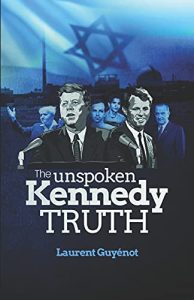
However, it is one thing to avoid a topic altogether, and another to write a book pretending to have solved once and for all the Kennedy assassination, while concealing the facts that may point to a different solution. It is actually worse than that: Douglass kept silent on Kennedy’s angst over Dimona even though it would have reinforced his main thesis about Kennedy’s determination to stop and reverse nuclear proliferation. For some reason, Douglass made sure he didn’t give his readers the slightest chance to start imagining that Israel had any part in Kennedy’s problem with “the Unspeakable”. Which has led me to say that Israel is the truly unspeakable in JFK and the Unspeakable, and which motivated me to write The Unspoken Kennedy Truth.
The CIA-theory as a shield for Israel
In this article, I will explain in some detail why the CIA-theory is wrong. By the CIA-theory, I do not mean the theory that high-ranking officers of the CIA were involved (I believe that to be the case). I mean the theory that a core group of CIA executives, with a few military top brass, masterminded and orchestrated the assassination. To the question “Who Killed JFK?” we can of course include both the CIA and the Mossad, as well as the FBI, the Pentagon, the Mafia, Cuban exiles, Texan oil barons, and what have you. But the important question is: Which group was the prime mover? Who had conceived the plot long before others were brought into it? Who was leading, or misleading, all others involved? Who, in the distribution of tasks on a need-to-know principle, knew the global scheme? Not who pulled the trigger, but who pulled the main ropes? As we will see, the answer cannot be the CIA. It cannot be Angleton, and it cannot even be Johnson.
I express my gratitude for the work of the dozens of researchers who built up the case against the CIA from the 1960s. Some of them are heroic. They have accumulated enough evidence to prove the conspiracy and the cover-up beyond a reasonable doubt. That is a great success. However, their general CIA-theory must now be recognized as a failure. It was a false lead from the start. Vince Salandria, one of the earliest critique of the Warren Commission (his first article was published in the Legal Intelligence in 1964), held as a teacher by many JFK investigators and by Douglass himself (who dedicated his book to him), became disillusioned by his own CIA-theory, saying frankly to Gaeton Fonzi in 1975: “I’m afraid we were misled. All the critics, myself included, were misled very early. … the interests of those who killed Kennedy now transcend national boundaries and national priorities. No doubt we are dealing now with an international conspiracy.”[12]

The CIA-theory, I will argue, serves as a cover for the real perpetrators, like the KGB-theory. The KGB-theory quickly fell apart because it was meant to and because it contains no truth whatsoever, while the CIA-theory is more resistant because it has some truth. The CIA is deeply compromised, but the masterminds were somewhere else. They needed the CIA to be compromised enough for the U.S. government to be forced to cover the whole affair. At the same time, they use the CIA-theory to shield their own group from suspicion. That is why Israeli sayanim working in the news, book or movie industries have diligently kept the CIA-story alive in public opinion. This was pre-planned limited hangout. In “Did Israel kill the Kennedys?” I have given examples of Zionist agents planting signposts to direct the skeptics towards the CIA and the Mafia (rather than the Mossad and the Mishpucka). The classic example is Arnon Milchan, producer of Oliver Stone’s film JFK released, who, by his own admission, acted as a secret Israeli agent working to boost Israel’s nuclear program — it’s always about Dimona. Another example, which had previously escaped me, is the New York Times revealing on April 25, 1966 that Kennedy “said to one of the highest officials of his administration that he wanted ‘to splinter the C.I.A. in a thousand pieces and scatter it to the winds,’” an untraceable statement that has now become one of the most quoted by CIA-theorists, who, in this case, show blind confidence in the reliability of the New York Times.[13]
An additional proof that the leading CIA-theorists are less interested in searching for the truth than in covering for Israel’s crimes came to me a two weeks ago, in the form of an email from Benjamin Wecht, son of Cyril Wecht and program administrator for the annual symposium on the JFK assassination organized by Citizens Against Political Action (CAPA) at the Cyril H. Wecht Institute of Forensic Science and Law of Dusquesne University, Pittsburg:
I’m writing to inform you that the poster you’ve proposed for presentation here next month has been rejected, as it fails to meet the academic standards of this institution and, moreover, espouses a position that we feel would be particularly inflammatory – if not outright disruptive – at this time and in this place. Our partnering organization, Citizens Against Political Assassinations, is in full concurrence with our decision.
This was in response to a submission that Karl Golovin and I sent for the “poster session” of the upcoming symposium organized on the occasion of the 60th anniversary (see our poster at the end of this article, and get it in high-resolution here). Considering the speciousness of Wecht’s denial or my “academic standards,” and considering his position that accusing Israel of the crime of the century is “inflammatory” and “disruptive”, I think it is fair to call Wecht and the organization he represents shameless gatekeepers for Israel. Ultimately, accusing Oswald and accusing the CIA of the crime of the century both serve the same purpose. Which explains why CAPA’s chairman Cyril Wecht, the forensic pathologist tirelessly denouncing the lie of the “single bullet,” was a friend of Arlen Specter, the inventor of that lie, whom he helped become U.S. senator in 2004.[14]
Did Johnson foil the CIA plan?

To understand why the CIA-theory is wrong, we have to start with its biggest inconsistency. Almost unanimously, from Mark Lane to James Douglass, CIA-theorists assume that the assassination was conceived as a false-flag operation to blame Castro and/or the Soviets, and to justify retaliation against them.
This is a natural assumption, based on two facts. First, Oswald was clearly set up as a pro-Castro communist. The scheme included the visits and telephone calls by an Oswald impersonator to both the Soviet and Cuban embassies in Mexico City in late September and early October 1963. The day following Kennedy’s assassination, television networks and national newspapers presented the assumed assassin as a “Pro-Castro Marxist.”[15]
Secondly, we know that invading Cuba to topple Castro’s pro-Soviet regime was the CIA’s obsession since the late 50s. Under officers like E. Howard Hunt, the CIA organized, funded and trained some of the hundreds of thousands of anti-Castro Cuban exiles in Miami. As a result, “the CIA’s presence in Miami grew to overwhelming dimensions,” wrote investigative journalist Gaeton Fonzi. “And as pervasive as that presence was before the Bay of Pigs, it was but a prelude to a later, larger operation.”[16] After the Bay of Pigs (April 1961), “a massive and, this time, truly secret war was launched against the Castro regime,” code named JM/WAVE, and involving “scores of front operations throughout the area,” as well as planes, ships, warehouses of weapons, and paramilitary training camps. Even after the Cuban Missile Crisis (October 1962), when Kennedy pledged not to invade Cuba, the anti-Castro Cubans on the CIA payroll tried to provoke incidents with Cuba. In April 1963, for example, the paramilitary group Alpha 66 attacked Soviet ships in order “to publicly embarrass Kennedy and force him to move against Castro,” in the words of Alpha 66’s CIA adviser David Atlee Phillips.[17]
Those two facts — the patsy’s pro-Castro profile designed by the CIA, and the CIA’s anti-Castro war plans — lead to the too obvious inference that the purpose of the Dallas shooting was to forge a false pretext for retaliating against Cuba. That theory has become so dominant in JFK research that most conspiracy-minded people consider it as proven beyond doubt.
However, it has one major flaw: there was no invasion of Cuba following Kennedy’s assassination. This fact is embarrassing for CIA-theorists. Although they don’t like to put it this way, it means that the CIA plan failed. If the conspirators believed that setting up Oswald, a documented supporter of Fidel Castro with links to the Soviet Union, would result in a full-scale war against Cuba, they must have been terribly disappointed. James Douglass credits Lyndon Johnson for defeating their plan:
The CIA’s case scapegoated Cuba and the U.S.S.R. through Oswald for the president’s assassination and steered the United States toward an invasion of Cuba and a nuclear attack on the U.S.S.R.. However, LBJ did not want to begin and end his presidency with a global war.[18]
To Johnson’s credit, he refused to let the Soviets take the blame for Kennedy’s murder; to his discredit, he decided not to confront the CIA over what it had done in Mexico City. Thus, while the secondary purpose of the assassination plot was stymied, its primary purpose was achieved.[19]
Indeed, from November 23, Johnson worked the phone to smother the rumor of a Communist conspiracy, and started hand-picking the members of the Warren Commission with the express mission of proving the lone-nut theory in order to avoid a nuclear war that would kill “40 millions Americans in an hour” (Johnson’s leitmotiv). Johnson never seems to have contemplated invading Cuba. He kept Kennedy’s promise to Castro and Khrushchev not to do so — a promise which the CIA regarded as an act of treason. In short, according to Douglass, Johnson was not part of the conspiracy, he actually frustrated the conspirators who had bet on his following their script. Johnson couldn’t save Kennedy, but he saved us from WWIII. And he saved the conspirators as well: no one was fired.
That is simply not credible. How can someone working on JFK’s assassination so casually exclude LBJ from the suspects, when he should be the prime suspect in terms of motive (the presidency), means (the vice-presidency) and opportunity (Dallas). Just consider the little known fact, revealed by Dallas Parkland Hospital Dr. Charles Crenshaw in his book Conspiracy of Silence (1992), that Johnson called the hospital while Dr. Crenshaw was trying to save Oswald’s life, and insisted that he leave the operating room and come to the phone, while an unknown agent with a pistol hanging from his back pocket was left with Oswald. “Dr. Crenshaw,” said Johnson on the phone, “I want a deathbed confession from the accused assassin. There’s a man in the operating room who will take the statement. I will expect full cooperation in this matter.” The important word, here, is “death,” as Dr. Crenshaw understood. When he came back to the operating room, the agent had disappeared and Oswald’s heart stopped beating. It is clear that Johnson wanted Ruby’s job finished. Despite such outrageous direct interference of Johnson, CIA-theorists claim that Johnson was not involved in the conspiracy, but only in the cover-up.
Douglass’s storyline in a nutshell, again: The CIA assassinated Kennedy under the false flag of Communist Cuba, with the presupposition that Johnson was going to retaliate against it. They worked the media to that effect (because, you know, the CIA controls the media). But Johnson, though taken by surprise on November 22, quickly reacted the next day and took control of all investigations and even of media coverage, to defeat the CIA plan.
It must have been infuriating for the CIA to be cheated of their Cuban invasion after all they had gone through — the Bay of Pigs fiasco, the Cuban Missile “appeasement”, and the trouble of assassinating the president. Wouldn’t they want to assassinate Johnson, now? And yet, there is no sign of tension between Langley and the Oval Office after November 1963. We are asked to believe that the CIA, totally disarmed by Johnson’s unexpected reaction, instantly surrendered and went along with the useless, absurd lone-nut theory, even participating in defeating their own painfully staged false-flag. Allen Dulles himself, the CIA director fired by Kennedy after the Bay of Pigs, joined the Warren Commission tasked by Johnson to quench rumors of a Communist plot. The mainstream media quickly fell in line and the Communist conspiracy disappeared entirely from the news (where is Mockingbird when you need it?).
Think about it and reach your own conclusion as to how credible this scenario is. It comes down to this: Do you think the conspirators’ plan failed or that it succeeded? If it succeeded, then it was not the CIA’s plan as CIA-theorists see it. It was someone else’s plan.
The invisible coup
Why would the CIA want to kill Kennedy, anyway? Why not simply make him lose the election in 1964. Surely the CIA had the means to do that, if their control of the media was as great as CIA-theorists tell us. Did the CIA have an urgent need to kill Kennedy, that could not wait one year? No. In a campaign year, Kennedy wasn’t going to do anything that could give his enemies a reason to call him a Communist appeaser. Regarding Vietnam for example, he told Kenny O’Donnell: “If I tried to pull out completely now from Vietnam, we would have another Joe McCarthy red scare on our hands, but I can do it after I’m reelected. So we had better make damned sure that I am reelected.”[20] He did sign, on October 11, 1963, a cautious executive order NSAM 263 for the withdrawal of “1,000 U.S. military personnel by the end of 1963” and “by the end of 1965 … the bulk of U.S. personnel,”[21] but if Kennedy was defeated electorally in 1964, that executive order would be of little consequence. It was, anyway, trashed by Johnson. As Ron Unz has recently repeated,
most of the different groups that wanted to get rid of [Kennedy] would just have waited and concentrated on political means, and that includes Dulles. This included using their media contacts to damage him politically. The only two that desperately needed to get rid of him immediately were LBJ, whom he was about to drop from the ticket and destroy politically, and Israel, because of the immediate efforts to eliminate their nuclear development program at Dimona. That’s why LBJ and Israel are the overwhelmingly logical suspects.
Research on the JFK assassination must start from the premise that it was a coup d’état. CIA-theorists tend to minimize the primal fact that the assassination resulted in a change of president. So let’s repeat the obvious: whoever assassinated Kennedy wanted to put Johnson in power. That is why defeating Kennedy electorally was not an option: Johnson would have fallen with Kennedy (his epic corruption was to be exposed anyway). Kennedy’s death was Johnson’s only chance to become president — and, perhaps, to avoid prison. But Johnson could not do it alone, so let me rephrase: Kennedy’s death was the only way for the conspirators to make Johnson president.
Can we identify those conspirators? If they needed Johnson as president in 1963, they must be the ones who blackmailed Kennedy into taking Johnson as vice-president in 1960. “I was left with no choice, those bastards were trying to frame me,” Kennedy once confided to Hyman Raskin to justify his choice of Johnson, despite strong opposition from his team, especially his brother Robert.[22] Among the “bastards” was Washington Post columnist Joseph Alsop, who considered himself “one of the warmest American supporters of the Israeli cause,” according to the New York Times obituary. We know from Arthur Schlesinger Jr. that Kennedy made his decision after a closed-door conversation with Alsop and his boss Philip Graham.[23] After Kennedy’s assassination, Alsop was the first to urge Johnson to set up a presidential commission to convince the public that Oswald acted alone. His argument was: “you do not wish to inflict on the Attorney General, the painful task of reviewing the evidence concerning his own brother’s assassination.”[24]
In 1960, the “bastards” needed to put Johnson behind Kennedy’s back, so that if and when necessary, they could knock Kennedy out and have Johnson step into the Oval Office. The purpose of the Kennedy assassination had nothing to do with Cuba; it was simply to replace Kennedy with Johnson. That is all it was supposed to do, and that is all it did. It was a success, not a failure.
It had to be an “invisible coup” so that Americans could be persuaded that nothing would change except the president, and that, under new circumstances, Johnson would act as Kennedy would have acted. There was one thing that Johnson reversed, but Americans did not see it until thirty years later. It concerned U.S. relations with Israel and with Israel’s enemies. Johnson was absolutely indispensable, not for the CIA, but for Israel: no other president would have gone as far as Johnson to support Israel’s invasion of Egypt and Syria in 1967. No other American president, not even Truman, would have let Israel get away with the USS Liberty massacre. Johnson not only let them get away, he helped them do it (read Phillip Nelson’s Remember the Liberty).
Johnson was committed to Israel, financially (through Abraham Feinberg, see below) and spiritually (“The line of Jewish mothers can be traced back three generations in Lyndon Johnson’s family tree”).[25] This explains why he filled the Warren Commission with Israeli agents, such as Arlen “Magic Bullet” Specter, later honored by the Israeli government as “an unswerving defender of the Jewish State.”[26]
David Ben-Gurion
Imagine detective Columbo investigating the assassination of President Kennedy. He would surely want to know if Kennedy had any strong disagreement with someone shortly before his death. In a decent scenario, he would then get his hands on some recently declassified correspondence which shows, in the words of Martin Sandler, editor of The Letters of John F. Kennedy (2013), that “a bitter dispute had developed between Israeli prime minister David Ben-Gurion, who believed that his nation’s survival depended on its attaining nuclear capability, and Kennedy, who was vehemently opposed to it. In May 1963, Kennedy wrote to Ben-Gurion explaining why he was convinced that Israel’s pursuit of nuclear weapons capability was a serious threat to world peace.”[27]
May 12, Ben-Gurion begged Kennedy to reconsider his position on Dimona: “Mr. President, my people have the right to exist… and this existence is in danger.”[28] Reading in that same letter a bizarre reference to the “danger that one single bullet might put an end to [some king’s] life and regime,”[29] Columbo wonders if that was a veiled threat. Reading Kennedy’s next letter (June 15), he can see that Kennedy stood firm and insisted on an immediate visit “early this summer” for “resolving all doubts as to the peaceful nature intent of the Dimona project.” Kennedy made clear that American commitment to Israel could be “seriously jeopardized” in case of failure to comply. Puzzled that the archive contains no response by Ben-Gurion, Columbo soon learns that Ben-Gurion resigned upon receiving Kennedy’s letter. “Many believe his resignation was due in great measure to his dispute with Kennedy over Dimona,” according to Martin Sandler. The insinuation is that Ben-Gurion’s resignation was part of a change of strategy for eliminating the Kennedy obstacle. He would now have to listen to those who had always believed in assassination and terrorism, those whom he had exiled in 1948 but who were now back and pressing him from his right. And he resigned to preserve his place in history. We have to understand Ben-Gurion’s predicament: Egypt, Iraq and Syria had just formed the United Arab Republic and proclaimed the “liberation of Palestine” as one of its goals. Ben-Gurion wrote to Kennedy that, knowing the Arabs, “they are capable of following the Nazi example.” To claim that this was just rhetoric is to misjudge the importance of the Holocaust in Jewish psychology, and in Ben-Gurion’s in particular. In his eyes, Israel’s need for nuclear deterrence was non-negotiable. Since he had failed to overcome Kennedy’s opposition by diplomacy, somebody else would have to take care of it in a different way.
Israel’s nuclear doctrine has not changed since Ben-Gurion. It has two sides: nukes for Israel, no nukes for Arabs or Iranians. Anyone working against one of those two strategic principles threatens Israel’s existence and must be eliminated. There are many examples in Ronen Bergman’s book Rise and Kill First: The Secret History of Israel’s Targeted Assassinations (2019).[30] Here is an excerpt on how Meir Dagan, appointed by Ariel Sharon to the Mossad in 2002, “in charge of disrupting the Iranian nuclear weapons project, which both men saw as an existential threat to Israel.”
Dagan acted in a number of ways to fulfill this task. The most difficult way, but also the most effective, Dagan believed, was to identify Iran’s key nuclear and missile scientists, locate them, and kill them. The Mossad pinpointed fifteen such targets, of whom it eliminated six … In addition, a general of Iran’s Islamic Revolutionary Guard Corps, who was in charge of the missile project, was blown up in his headquarters together with seventeen of his men.[31]
Ben-Gurion handed the Kennedy problem to those who had always relied on murder to eliminate obstacles to the Zionist cause. Yitzhak Shamir was possibly the man of the situation. Disgraced by Ben-Gurion after his assassination of U.N. mediator Count Folke Bernadotte in 1948, Shamir had been allowed back into the Mossad in 1955, where he formed a special hit squad with former members of the murderous Lehi (or Stern Gang). This unit was active until 1964, the year after JFK’s assassination. It carried out an estimated 147 attacks on perceived enemies of Israel, targeting especially “German scientists working to develop missiles and other advanced weapons for Egypt.”[32] Yitzhak Shamir had declared in 1943:
Neither Jewish ethics nor Jewish tradition can disqualify terrorism as a means of combat. We are very far from having any moral qualms as far as our national war goes. We have before us the command of the Torah, whose morality surpasses that of any other body of laws in the world: “Ye shall blot them out to the last man.”[33]
Do you think that such a biblical psychopath would have hesitated to assassinate Kennedy if given the go-ahead? He would have enjoyed it! Conscious of committing the crime of the century for his bloodthirsty god, would he not want to have it filmed, for the historical record? And why not, for the fun of it, send a message with the bullet, in the form of a man holding Chamberlain’s black umbrella to his face? If you think that’s irrational, please read “A Conversation in Hell” by John Podhoretz.
Yitzhak Shamir would go on to become prime minister in 1983, just following Menachem Begin, another terrorist responsible for the bombing of the King David Hotel in 1946. Obviously, the assassination of Kennedy changed profoundly not only America, but Israel too. No single death, really, has had so profound an effect on world history as Kennedy’s.
Abraham Feinberg
The Kennedy problem had another dimension, which, in my scenario, Columbo discovers by borrowing Seymour Hersh’s Samson Option from his local library. There he learns that, during the 1960 campaign, Kennedy had been approached by Zionist financier Abraham Feinberg, whose business, writes Hersh, was “to ensure continued Democratic Party support for Israel” (in other words, buy Democratic candidates). After Kennedy’s nomination by the Democrats, Feinberg organized a meeting between the candidate and a group of potential Jewish donors in his New York apartment. Feinberg’s message was, according to what Kennedy told Charles Bartlett: “We know your campaign is in trouble. We’re willing to pay your bills if you’ll let us have control of your Middle East policy.” Kennedy was deeply upset and decided that, “if he ever did get to be President, he was going to do something about it.”[34] In the meantime, JFK pocketed 500,000 Jewish dollars and reaped 80 percent of the Jewish votes. Once in office, he made Myer (Mike) Feldman his advisor on the Middle East. According to Alan Hart, “it was a political debt that had to be paid. Feldman’s appointment was one of the conditions of the campaign funding provided by Feinberg and his associates.”[35] Kennedy was aware that Feldman was essentially an Israeli spy in the White House. “I imagine Mike’s having a meeting of the Zionists in the cabinet room,” he once said to Charles Bartlett.[36] Kennedy may have reasoned that it is an advantage to know who’s spying on you, but he probably underestimated the amount of Israeli spying that went on in his White House. He also underestimated the extent to which Feinberg and his Zionist friends held him accountable.
Kennedy never surrendered his U.S. Middle East policy to Israel. Former high-ranking U.S. diplomat Richard H. Curtiss remarked in his book A Changing Image: American Perceptions of the Arab-Israeli Dispute: “It is surprising to realize, with the benefit of hindsight, that from the time Kennedy entered office as the narrowly-elected candidate of a party heavily dependent upon Jewish support, he was planning to take a whole new look at U.S. Mideast policy,” and “to develop good new personal relationships with individual Arab leaders.”[37] The paradox did not escape Feinberg. Kennedy had to be punished. Considering the aggravating circumstance of his father’s appeasement policy during WWII, a biblical punishment was required.
Feinberg was a powerful figure, and one that should be given more attention by JFK researchers. The founder of Americans for Haganah, he was deeply involved in the Israeli arms smuggling network in the United States, of which Jack Ruby had been part. In the 1950s and 60s, besides building up AIPAC, he was actively involved in Israel’s quest of the Holy Nuke.[38] It was Feinberg who organized the only meeting between Ben-Gurion and Kennedy, in New York on May 30, 1961, when Ben-Gurion first begged Kennedy to look the other way from Dimona.[39] Commenting on that meeting, Feinberg said to Hersh: “There’s no way of describing the relationship between Jack Kennedy and Ben-Gurion because there’s no way B.G. was dealing with JFK as an equal, … B.G. could be vicious, and he had such a hatred of the old man.” The “old man,” here, meant the patriarch Joe Kennedy, JFK’s father.[40] It must also be noted that Feinberg had fundraised for LBJ ever since his first stolen election for Senate in 1948.[41]
The Double-Cross scenario
Let us go back to the inner contradiction of the CIA-theory, the failure of the supposed CIA plan to trigger the invasion of Cuba. John Newman, a retired U.S. Army major and Political Science professor, has thought of a solution. In an epilogue added to the 2008 edition of his 1995 book Oswald and the CIA (to which Ron Unz has drawn attention here and here), Newman reasons that the real purpose for setting up Oswald as a Communist was not to trigger the invasion of Cuba, but to create a “World War III virus” that Johnson would use as a “national security” pretext to shut all investigations and intimidate everyone, from government officials down to the average American, into accepting the lone-gunner theory, even in the face of its obvious falsehood; “the World War III pretext for a national security cover-up was built into the fabric of the plot to assassinate President Kennedy.”[42] Oswald’s Communist connections made the headlines just long enough to make everyone panicked, and then salvation was offered by the government to a grateful nation: just pretend to believe that Oswald acted alone, or else the Soviets will Hiroshima you. It worked perfectly, because it was plan A, not plan B.
Newman’s analysis is a fine improvement to the CIA-theory. But it doesn’t solve the problem. Since Newman believes it was a CIA plan, and more precisely Angleton’s plan, that begs the question of why the CIA would set up a plan that would finally frustrate them of an easy pretext to invade Cuba. We also have to consider that Angleton defended the KGB-theory all his life. When the KGB officer Yuri Nosenko defected to the United States in 1964, and claimed to know for certain that the Soviets had nothing to do with the assassination of John F. Kennedy, Angleton was determined to prove him a liar and kept him in custody under intense questioning and deprivation for 1,277 days. He failed to break his will, and Nosenko was ultimately vindicated. Angleton stuck to his KGB-theory much longer than necessary, and was the main source for Edward Jay Epstein’s book, Legend: The Secret World of Lee Harvey Oswald (1978), which laid the blame on the KGB.[43]
Was Angleton keeping the KGB-theory alive as a way to maintain Americans under the obligation to swallow the lone-nut-theory, lest they trigger WWIII? It is possible, but it is quite unlike Angleton, who, according to all testimonies, was genuinely obsessed with blaming the Soviets for every evil on the surface of the earth, and continued to cause massive damage in the CIA with his quest for “the mole”, especially in the Office of Soviet Analysis, where everyone speaking Russian fell under suspicion. I think it is more likely that Angleton had been led to believe, from the beginning, that his plan would lead to an invasion of Cuba, a crackdown on Communist sympathizers, and perhaps WWIII.
This leads us back to hypothesize that there were actually two distinct plans, one incorporating the other. Angleton, as well as Howard Hunt and a few other CIA officers handling the Cuban exiles, were following a plan that included blaming Castro for the Dallas shooting. But they were double-crossed by another group of conspirators, who were not aiming at toppling Castro, and not even interested in Latin America, but had other concerns. That other group monitored and probably even inspired the CIA plan, but diverted it from its original purpose. They were overseeing the whole scheme from a higher vantage point, while the CIA plotters saw only part of it, though believing they saw it all.
Going one step further, some have made the hypothesis that the CIA plan did not include a real assassination, but only a failed attempt, meant not to kill Kennedy, but to put irresistible pressure on him to do something about Cuba. In that hypothesis, the harmless CIA plan was used and modified by a group who wanted to take Kennedy out and put Johnson in.
In Final Judgment, Michael Piper mentions a few JFK researchers who have thought of the possibility that the CIA found itself an unwitting accomplice in an assassination committed by a third party, and was left with no choice but to cover the whole plot in order to cover its part in it.[44] As early as 1968, an author writing under the pen name James Hepburn cryptically hinted at this idea in Farewell America — a book worth reading, well-informed and insightful on Kennedy’s policies. “The plan,” Hepburn wrote, “consisted of influencing public opinion by simulating an attack against President Kennedy, whose policy of coexistence with the Communists deserved a reprimand” (my emphasis). Since things didn’t unfold according to “the plan,” the implication is that there was a plan above the plan, a conspiracy woven around the conspiracy.[45]
Dick Russell, RFK Jr.’s recent biographer, had pondered the possibility of a double-cross in The Man Who Knew Too Much (1992), based on the testimony of longtime CIA contract agent Gerry Patrick Hemming, “a soldier of fortune who eventually ended up training embittered Cuban exiles in Florida for guerrilla warfare against Castro,” and crossed path with Oswald in 1959.[46] Hemming told Russell: “There was a third force — pretty much outside CIA channels, outside our own private operation down in the [Florida] Keys — that was doing all kinds of shit, and had been all through ‘63.”[47] In the words of Russell: “Gerry Patrick Hemming … maintains that some of the exiles who thought they knew the score in 1963 have today become convinced that they were being used. … They took the bait.”[48] Russell cut these passages off in his shortened 2003 edition, possibly out of concern for Piper’s use of them, since his idea of the “third force” differed from Piper’s: “In the end,” he wrote, “we are left with this terrible question: Was the CIA’s relationship with Oswald … usurped by another group? … A group … that was part of a Pentagon/‘ultraright economic’ apparatus?”[49]
Piper also drew attention to a book written by Gary Wean, a former detective sergeant for the Los Angeles Police Department, titled There’s a Fish in the Courthouse (1987, 2nd edition 1996).[50] The full chapter 44 of Wean’s book, dealing with the Kennedy assassination, is included in this pdf document, together with other interesting thoughts by the same author. Wean claimed to have been introduced, through Dallas County Sheriff Bill Decker, to a man he simply called “John”, but later identified as Texas Senator John Tower. “John” told him that CIA man Howard Hunt was involved with Lee Harvey Oswald, but not in planning the President’s assassination. According to “John”,
[Hunt’s] scheme was to inflame the American people against Castro and stir patriotism to a boiling point not felt since the bombing of Pearl Harbor. Enraged Americans would demand that our military invade Cuba and wipe out the two-bit dictator for his barbarous attempt to assassinate President Kennedy. … There was to be an attempt on the life of President Kennedy so realistic that its failure would be looked upon as nothing less than a miracle. The footprints would lead directly to Castro’s doorstep, a trail the rankest amateur couldn’t lose.
However, the plan was hijacked from outside the CIA, by someone who knew “all these minute details [of Hunt’s plan] to pull it off the way they did. Something frightening, horribly sinister had interposed Hunt’s mission.” “Hunt’s wild scheme had created the lunatic effect of positioning Kennedy as the target in a shooting gallery,” and someone else had taken advantage of it.
As Wean interprets these revelations, “Hunt’s scheme of a phony assassination was monitored from the beginning by an insidious enemy”; there was a “conspiracy to double cross a conspiracy.” Wean’s source “John” (Tower) did not identify this “insidious enemy,” but Wean, drawing from his knowledge of organized crime, believes that the CIA plan was hijacked by “the Mishpucka” — as, according to Wean, Jewish gangsters named their ethnic criminal organization (the word means “the Family” in Yiddish). Wean has much to say about the Mishpucka’s ties to the Israeli Deep State. However, like Douglass, he does not see the connection to Johnson, and assumes that Johnson was part of neither the CIA’s nor the Mishpucka’s conspiracy, but only of the cover-up.
Writing in 1987, Wean could not think of a more precise motive for the Mishpucka to assassinate Kennedy than greed for war money. JFK was killed because he “had been on the verge of negotiating World Peace,” and that’s bad for business. We know today that Israel had a more precise and urgent need to take Kennedy out. In short, JFK’s assassination was a coup d’état to replace a pro-Egypt president by a pro-Israel president, one who would let Israel make as many nukes as they want with material stolen from the U.S., and would let them triple their territory in 1967.
Frankly, I doubt that Wean got his double-cross scenario from John Tower (who was dead when Wean identified him as his source). I believe he got it from his own reasoning and imagination.
And all things considered, I find the scenario of a failed assassination staged by the CIA and morphed into a real one by Israel not quite satisfactory, for the following reason: without Israeli interference, such a CIA plan was doomed to fail, because Kennedy would have easily seen through it. He would have known that Castro had nothing to do with it, and he would not have submitted to the pressure. Rather, he would have had his brother conduct a full investigation and would have found out that Oswald was a CIA stooge. His vengeance would have turned against the CIA, not against Castro. Perhaps Angleton was crazy enough to think he could have manipulated Kennedy and get away with it. But then, he was also crazy enough to want to assassinate Kennedy for real.
Either way, the most likely scenario, in my opinion at this stage, is that Angleton had been encouraged or convinced, directly or indirectly by his Mossad “friends” and by Johnson, to stage the Dallas ambush, or contribute to it, with, perhaps, the help of Hunt and a few Cuban exiles, not forgetting the Secret Service (although the latter’s participation to the crime, through agent Emory Roberts and a few others, was certainly supervised by Johnson).[51]
Why would Israel need to hijack a CIA operation, rather than just kill Kennedy themselves? Very simply, as I said, they needed the CIA to be so deeply compromised that the whole U.S. government would want to keep the lid on the whole affair. They needed the CIA not so much for preparing the killing zone as for cleaning it up afterwards and doing the cover-up for them. They also needed evidence of the CIA’s implication as a “limited hangout” to stir the skeptics in that direction — a strategy that has been so successful that the CIA-theory has now gained mainstream exposure.
This scenario is similar to the one I have theorized in “The 9/11 Double-Cross Conspiracy Theory,” and I believe it is a favorite Israeli operating principle.

Laurent Guyénot is the author of the book The Unspoken Kennedy Truth, and of the film Israel and the Assassinations of the Kennedy Brothers.
Notes
[1] Russell is no newcomer to the JFK assassination, having written two books about it, The Man Who Knew Too Much (1992), and On the Trail of the JFK Assassins (2008).
[2] Dick Russell, The Real RFK Jr.: Trials of a Truth Warrior, Skyhorse, 2023, p. 329.
[3] “DiEugenio at the VMI seminar, 16 September 2017, www.kennedysandking.com/john-f-kennedy-articles/jim-dieugenio-at-the-vmi-seminar
[4] James Douglass, JFK et l’Indicible: Pourquoi Kennedy a été assassiné, Demi-Lune, 2013.
[5] John M. Newman, Oswald and the CIA: The Documented Truth About the Unknown Relationship Between the U.S. Government and the Alleged Killer of JFK, Skyhorse, 2008, pp. 613-637. Excerpts on on spartacus-educational.com
[6] Peter Dale Scott, Deep Politics and the Death of JFK, University of California Press, 1993, p. 54.
[7] Tom Mangold, Cold Warrior — James Jesus Angleton: The CIA’s Master Spy Hunter, Simon & Schuster, 1991, p. 52.
[8] Jefferson Morley, The Ghost: The Secret Life of CIA Spymaster James Jesus Angleton, St. Martin’s Press, 2017, p. 78.
[9] Glenn Frankel, “The Secret Ceremony,” Washington Post, December 5, 1987, on www.washingtonpost.com. Andy Court’s article, “Spy Chiefs Honour a CIA Friend,” Jerusalem Post, December 5, 1987, is not online.
[10] James Douglass, JFK and the Unspeakable: Why He Died and Why It Matters, Touchstone, 2008, p. xxxi.
[11] Stephen Green, Taking Sides: America’s Secret Relations With a Militant Israel, William Morrow & Co., 1984, p. 166.
[12] Gaeton Fonzi, The Last Investigation: What Insiders Know About the Assassination of JFK, Skyhorse, 2013, chapter 3.
[13] Tom Wicker, John W. Finney, Max Frankel, F.W. Kenworthy, “C.I.A.: Maker of Policy, or Tool?”, New York Times, April 25, 1966, quoted in Douglass, JFK and the Unspeakable, p. 15.
[14] The link to the article in Pittsburg Post Gazette, which I accessed in 2022, is no longer working: https://www.post-gazette.com/news/politics-federal/2004/09/14/Democrat-Wecht-backs-GOP-s-Specter-in-re-election-bid/stories/200409140195
[15] Jefferson Morley, Our Man in Mexico: Winston Scott and the Hidden History of the CIA, University Press of Kansas, 2008, p. 207.
[16] Gaeton Fonzi, The Last Investigation: What Insiders Know About the Assassination of JFK, Skyhorse, 2013, chapter 4.
[17] James Douglass, JFK and the Unspeakable: Why He Died and Why It Matters, Touchstone, 2008, p. xxv and 57.
[18] Douglass, JFK and the Unspeakable, p. 81.
[19] Douglass, JFK and the Unspeakable, p. 232.
[20] Douglass, JFK and the Unspeakable, p. 126.
[21] Douglass, JFK and the Unspeakable, p. 187.
[22] Seymour Hersh, The Dark Side of Camelot, Little, Brown & Co, 1997, p. 126, quoted in Phillip Nelson, LBJ: The Mastermind of JFK’s Assassination, XLibris, 2010, p. 320.
[23] Arthur Schlesinger Jr., A Thousand Days: John Kennedy in the White House (1965), Mariner Books, 2002, p. 56. Also in Donald Ritchie, Reporting from Washington: The History of the Washington Press Corps, Oxford UP, 2005, p. 146.
[24] Donald Gibson gives the full telephone transcript in “The Creation of the ‘Warren Commission’”, in James DiEugenio and Lisa Pease, The Assassinations: Probe Magazine on JFK, MLK, RFK and Malcolm X, Ferral House, 2003. Alsop was a vocal supporter of America’s involvement in the Vietnam War, and a strong advocate for escalation under Johnson, as David Halberstam documents in The Best and The Brightest, Modern Library, 2001, p. 567.
[25] Morris Smith, “Our First Jewish President Lyndon Johnson? – an update!!,” 5 Towns Jewish Times, April 11, 2013, no longer on 5tjt.com, but accessible via the Wayback Machine on web.archive.org/web/20180812064546/http://www.5tjt.com/our-first-jewish-president-lyndon-johnson-an-update/ A French version published by Tribune Juive is accessible on www.tribunejuive.info/2016/11/07/un-president-americain-juif-par-victor-kuperminc/
[26] Natasha Mozgovaya, “Prominent Jewish-American politician Arlen Specter dies at 82,” Haaretz, October 14, 2012, on www.haaretz.com.
[27] Martin Sandler, The Letters of John F. Kennedy, Bloomsbury, 2013, p. 333. Listen to Sandler here on this topic: https://www.c-span.org/video/?c4547313/user-clip-jfk-gurion-mossad-dimona
[28] Avner Cohen, Israel and the Bomb, Columbia UP, 1998, pp. 109 and 14; Seymour Hersh, The Samson Option: Israel’s Nuclear Arsenal and American Foreign Policy, Random House, 1991, p. 121.
[29] Monika Wiesak, America’s Last President: What the World Lost When It Lost John F. Kennedy, self-published, 2022, p. 214.
[30] Ronen Bergman, Rise and Kill First: The Secret History of Israel’s Targeted Assassinations, John Murray, 2019, p. xv.
[31] Bergman, Rise and Kill First, p. 3.
[32] According to a Haaretz article written by Yossi Melman and dated July 3, 1992, mentioned by Piper, Final Judgment, pp. 118-119. This article cannot be found in Haaretz’s archive, but was quoted the next day by the Washington Times, and by the Los Angeles Times: “Shamir Ran Mossad Hit Squad,” Lost Angeles Times, July 4, 1992 https://www.latimes.com/archives/la-xpm-1992-07-04-mn-1072-story.html
[33] “Document: Shamir on Terrorism (1943),” Middle East Report 152 (May/June 1988), on merip.org/1988/05/shamir-on-terrorism-1943/
[34] Seymour Hersh, The Samson Option: Israel’s Nuclear Arsenal and American Foreign Policy, Random House, 1991, pp. 93, 97.
[35] Alan Hart, Zionism, the Real Enemy of the Jews, vol. 2: David Becomes Goliath, Clarity Press, 2009, p. 269.
[36] Hersh, The Samson Option, pp. 98-100, quoted in Piper Final Judgment, pp. 101-102.
[37] Richard H. Curtiss, A Changing Image: American Perceptions of the Arab-Israeli Dispute, quoted in Piper, Final Judgment, p. 88. Curtiss’s book is hard to get at a reasonable price, but one speech by him, “The Cost of Israel to the American Public,” can be read on Alison Weir’s website “If Americans Knew”, https://ifamericansknew.org/stat/cost2.html
[38] Michael Collins Piper, Final Judgment: The Missing Link in the JFK Assassination Conspiracy, American Free Press, 6th ed., 2005, p. 96.
[39] Hersh, The Samson Option, p. 111; “Kennedy-Ben-Gurion Meeting (May 30, 1961),” on www.jewishvirtuallibrary.org/
[40] Hersh, The Samson Option, p. 102.
[41] Hart, Zionism, the Real Enemy of the Jews, vol. 2: David Becomes Goliath, p. 250. On the 1948 stolen election, read Phillip Nelson, LBJ: The Mastermind of JFK’s Assassination, XLibris, 2010, p. 66-74.
[42] Newman, Oswald and the CIA, pp. 613-637. Excerpts on spartacus-educational.com
[43] As pointed out by Carl Oglesby in The JFK Assassination: The Facts and the Theories, Signet Books, 1992, p. 145, quoted in Michael Collins Piper, Final Judgment: The Missing Link in the JFK Assassination Conspiracy, American Free Press, 6th ed., 2005, pp. 166-169.
[44] Piper, Final Judgment, pp. 291-296.
[45] James Hepburn, Farewell America, Frontiers, 1968, pp. 337-338, quoted in Piper, Final Judgment, p. 301.
[46] Dick Russell, The Man Who Knew Too Much, Carroll & Graf Publishers, 1992, p. 177.
[47] Russell, The Man Who Knew Too Much, p. 539.
[48] Russell, The Man Who Knew Too Much, pp. 703-704.
[49] Russell, The Man Who Knew Too Much, p. 693.
[50] Gareth Wean, There’s a Fish in the Courthouse, Casitas Books, 1987, 2nd edition 1996, pp. 695-699. The relevant chapter (44) and other interesting thoughts by Wean can be read on https://archive.org/details/NoticesAndReportsToThePeopleByGaryWean . A useful critical reading of chapter 44 can be read on https://kenrahn.com/JFK/Critical_Summaries/Articles/Wean_Chap_44.html
[51] For the record, Vince Palamara mentioned, without much conviction, the hypothesis of a “security test” by the Secret Service, in response to Edgar Hoover’s intrigue to the take over White House security (the Secret Service was headed by the Department of Treasury): “The original idea of the security tests may have been to cement the Secret Service’s role as the protector of the President, having successfully stopped an assassination attempt. Conversely, the agency (and the tests) may have been compromised by those in the know” (Vincent Michael Palamara, Survivor’s Guilt: The Secret Service and the Failure to Protect President Kennedy, Trineday, 2013, kindle l. 4586). However, considering the numerous breaches of rule and the scandalously poor performance by the Secret Service on that fatal day, I find the hypothesis not credible).
- The Gospel of Gaza
- Israel’s Biblical Psychopathy
- Kennedy: An Israeli Perspective
- The Crusade Is Over
- Byzantine Revisionism Unlocks World History
- RFK’s False-Flag Assassination, and the Forgotten Palestinian Patsy
- JFK and America’s Destiny Betrayed
- President Kennedy’s Assassination Was a Zionist Coup
- Angleton, Mossad, and the Kennedy Assassinations
- The 9/11 “Double-Cross” Conspiracy Theory
Of Related Interest

RFK’s False-Flag Assassination, and the Forgotten Palestinian Patsy
The Greatest Threat to World Peace? A Review of Daniele Ganser’s ‘USA: The Ruthless Empire’
Review by Marilyn Langlois | November 10, 2023
 If you regard the United States as perhaps flawed but overall a force for good in the world . . .
If you scoff at the notion that the US, a republic founded on principles of freedom and democracy, has morphed into a world empire, perpetrating assassinations, coups d’état, acts of terror and illegal warfare . . .
If you want to promote peace but haven’t yet explored deceptive events that precipitate US warmongering . . .
. . . here is a volume that will clear the air and paint an honest picture of the significant, not-so-rosy impact US foreign policy and actions have had in the world around us.
USA: The Ruthless Empire, by Swiss historian and peace researcher Daniele Ganser, is the newly published English language translation of his book Imperium USA, originally written in German and published in 2020. Here is a summary of key points — including some lesser-known ones — along with remedies for a more peaceful future, that are covered in the book.
Ganser takes us on a tour of meticulously documented historical events that would be shocking to anyone committed to fairness and basic human decency. His intention is to strengthen the peace movement, which encompasses people all over the world — including in the US — who reject war as well as the lies and propaganda used to initiate and perpetuate wars. Throughout the book, he emphasizes three key pillars to the peace movement: the United Nations ban on any kind of violence or aggression, mindfulness (allowing one to recognize and see through war propaganda and lies), and viewing all people as members of the human family.
Before delving into history, Ganser sets the stage in Chapter 1, “The USA Poses the Greatest Threat to World Peace.” He backs up this assertion with a dizzying array of figures about how many countries the US has bombed since 1945 (at least 23), how many military bases it has in foreign countries (more than 700), the US world record on military spending (now approaching $1 trillion annually), the number of US troops abroad (over 200,000), and the US status as the only country to have deployed nuclear weapons. He shares results of a Gallup poll of 67,000 people in 65 countries that asked, “Which country poses the greatest threat to world peace today?” to which 24% named the US, while between 5% and 9% named one of six other countries and less than 5% named one of twelve other countries.
Chapter 2, “The USA Is an Oligarchy,” spotlights an ominous manifestation of empire: the astronomical disparities in wealth and income (540 billionaires vs. over 100 million living in poverty, not to mention impacts around the world) resulting from an oligarchy of super-rich running the empire and manipulating information flows with little meaningful influence by voters.
Chapters 3 and 4 describe key precursors to empire both before and after the new US republic established its independence from Britain in the late 18th century — namely, the mass murder and displacement of Native Americans and the importation and exploitation of slave labor from Africa in much of the new nation.
Chapter 5 covers the overt launch of imperial actions in the mid and late 19th century, when the US initiated wars based on lies and often false flag incidents to annex half of Mexico and conquer former Spanish colonies either as outright possessions (Puerto Rico and Guam) or with nominal autonomy but under tight US control (Cuba and the Philippines). The Kingdom of Hawaii was captured and annexed under threat of violence.
Chapter 6, devoted to World War I, elaborates on how, even prior to the US entering combat in 1917, US-based war profiteers flourished. J.P. Morgan & Co. was financing England and France, and US corporations sold arms to Europe. Hence, vested US interests in intentionally prolonging the war cost millions of avoidable deaths. War propaganda thrived, with Germans — who had done nothing to the US — being severely vilified. Hamburgers became “Liberty Steak” and sauerkraut “Liberty Cabbage.” (Remember how in 2003, when France hesitated to join in the war on Iraq, the US Senate cafeteria sold “Freedom Fries”?) The Espionage Act was passed to prosecute pacifists (including Eugene Debs) and deny free speech — and is still being used today to persecute Julian Assange for exposing US war crimes in Iraq.
Chapter 7 scrutinizes the US role in World War II, unravelling its carefully cultivated image of fighting honorably on the side of righteousness, and exposes both belligerent proclivities and mixed loyalties. Ganser reminds us that US companies were allowed to sell oil to Nazi Germany both before and well into the war. Without that fuel supply, the Nazi threat may have dissipated prior to some of the worst atrocities being committed. Again, the war was unnecessarily prolonged.
Though officially allies of the Soviet Union, the US and Great Britain were pleased to see Hitler taking action against communist Russia, and they avoided opening a western front until mid-1944, when it looked like the Soviet Union (which lost 27 million citizens in World War II) would be the sole victor over the Nazis. Ganser unearthed this remarkable June 1941 quote by then-US Senator and later President Harry Truman: “If we see that Germany is winning the war we ought to help Russia, and if Russia is winning we ought to help Germany. And that way let them kill as many as possible, although I certainly don’t want Hitler to win in the end.” Divide et impera — divide and conquer.
Truman, as US president, ordered the first and only deployment of nuclear weapons in history so far, killing hundreds of thousands of civilians in Hiroshima and Nagasaki and terrorizing many more at a time when Japan was already prepared to surrender. Ganser documents how, in order to gain popular support for the US entering the war, it intentionally goaded the Japanese into attacking Pearl Harbor, providing the desired casus belli. The infamous December 7, 1941, attack was no surprise to President Franklin Roosevelt, who let it happen, sacrificing thousands of US servicemembers. As will become relevant to Chapter 12 on the September 11 attacks, Ganser notes that a Hollywood movie, “Pearl Harbor,” parroting the surprise attack myth, was released in May 2001, priming the public subliminally for what was to follow a few months later on September 11.
Chapter 8, “Covert Warfare,” tells us how the Central Intelligence Agency and National Security Council were born in the post-war years. It includes a laundry list of how the US used them to perpetrate multiple coups d’état (Iran, Guatemala, Chile), assassinations (Lumumba in Congo, Trujillo of the Dominican Republic, Diem in Vietnam, Che Guevarra in Bolivia), assassination attempts against Fidel Castro, and the failed invasion of Cuba in 1961. President Kennedy ultimately became so outraged by these illegal operations that he fired CIA director Allan Dulles.
Note that Ganser devoted an entire previous book, NATO’s Secret Armies: Operation Gladio and Terrorism in Western Europe, to numerous additional covert operations involving the US, via NATO and the CIA, that are not covered in the present volume. These include false flag assassinations, bombing of civilians (blamed on communists), and fixing elections in much of Western Europe throughout the Cold War.
Chapter 9 focuses on the Kennedy assassination, summarizing evidence exonerating Lee Harvey Oswald and implicating Allan Dulles in a conspiracy to commit this heinous murder. After District Attorney Jim Garrison of New Orleans brought much of the evidence to light in 1967, questioning the validity of the Warren Commission Report (authored by Dulles), the CIA created and widely publicized the notion of “conspiracy theorist” as a derogatory term for anyone who challenged the official narrative. Interestingly, Ganser notes that in 1979 the US House of Representatives Select Committee on Assassinations “saw a high probability that two men had shot Kennedy. . . . The Committee believes, on the basis of the evidence available to it, that President John F. Kennedy was probably assassinated as a result of a conspiracy. The Committee is unable to identify the other gunman or the extent of the conspiracy.” This report was conveniently obscured by the media, and few are aware of it today.
Chapter 10, on the Vietnam War — which rapidly escalated after Kennedy’s murder — is a painful reminder to those readers who lived through it of the needless suffering inflicted on millions of Vietnamese and on tens of thousands of US soldiers and the peripheral damage to neighboring countries of Laos and Cambodia. The latter two countries were bombed by the US without provocation, inciting the brutality of Khmer Rouge communists, whom the US could demonize to deflect from its own role in the bloodshed. Ganser reminds us of the false flag Gulf of Tonkin incident in 1964 that was used to provoke a dramatic escalation of the war in Vietnam. While we were repeatedly warned of the propagandistic “domino theory,” there was in fact no chain reaction of neighboring countries turning communist after Vietnam prevailed and defeated the US in 1975 — hence all that death and destruction was in vain, other than benefitting war profiteers.
In Chapter 11 on the Iran-Contra Affair, Ganser elucidates another example of the US pitting two of its adversaries against each other when it supported Saddam Hussein in Iraq’s war against Iran while simultaneously and covertly selling weapons to Iran and secretly using the proceeds to fund the Nicaraguan Contras, who supported the dictatorial Somoza regime. Ganser further shows how the CIA hypocritically engaged secretly in the cocaine trade to finance its covert operations. How many people’s lives have been upended by those operations abroad and in drug-infested US cities?
In Chapters 12 and 13 on 9/11 and the War on Terror, respectively, the US empire ushers in the 21st century with an overwhelming display of shock and awe. The first sub-heading is prescient: “A New Pearl Harbor” refers to a prophetic statement in the year 2000 by the neocon Project for a New American Century, noting that it would be difficult to get the US population to accept massive military spending and upgrades for fighting multiple wars simultaneously “absent some catastrophic and catalyzing event — like a new Pearl Harbor.”
Ganser offers three ways of evaluating the events of September 11, 2001: (1) Surprise attack catching everyone in the US, including top leadership and intelligence services, completely off guard; (2) LIHOP (let it happen on purpose), implying foreknowledge by key players of what was going to happen but intentionally failing to stop it; and (3) MIHOP (made it happen on purpose), involving direct complicity of certain players within the US military-intelligence apparatus and their agents. He disproves (1) and points to (2) and (3) as much more plausible, leaning toward (3).
Abundant research has been conducted debunking the official 9/11 story that 19 Muslim hijackers and a few men in a cave in Afghanistan were solely responsible for the death and destruction that day, and Ganser includes references to much of it in his footnotes. Bringing us to the present day, the author of this review refers readers to the International Center for 9/11 Justice for an up-to-date collection of relevant 9/11 research.
In this volume, Ganser touches on a handful of key anomalies: obvious fallacies of the official 9/11 Commission report authored by Philip Zelikow, a Bush administration insider; the utter failure of the multi-billion dollar US defense system to prevent an attack, including on its own heavily fortified headquarters; the millions in profits made by unnamed individuals who invested heavily in put options in the days before September 11, 2001 (betting that United and American airlines stocks would soon plummet), indicating specific foreknowledge; the clear evidence that World Trade Center Building 7 was destroyed later that day by controlled demolition and the refusal of US authorities or media to even entertain that possibility; and the evidence for the use of explosives in the destruction of the Twin Towers.
With the fall of the Soviet Union ten years before, the US empire had been searching for a new major enemy, and the crimes of 9/11 offered an “ideal” replacement: the never-ending and amorphous “War on Terror,” which could be and has been used to justify numerous military incursions and the proliferation of US bases anywhere “terrorists” are deemed to be lurking. Ganser details the US role in illegal wars in Afghanistan, Iraq (initiated by spreading lies about alleged weapons of mass destruction), and Syria, all of which left millions dead in their wake, not to mention the horrendous abuses of Iraqi prisoners by US soldiers at Abu Ghraib.
On a note of optimism, Ganser points out how the blatant injustice of the wars in the Middle East — like the injustice of the Vietnam War before them — energized the peace movement in the US, prompting massive demonstrations and civil disobedience in opposition, indicating vast numbers who denounce war and empire and seek peaceful coexistence with all peoples. Beyond famous peace movement leaders like Jeannette Rankin, Martin Luther King, Jr., and Mahatma Gandhi, he highlights the role of everyday citizens affirming their commitment to all people as members of the human family and rejecting attempts by the elites to divide and conquer. He also points out how the rise of alternative media has played a role in allowing for dissemination of information that counters the mainstream lies and war propaganda. The explosion of the internet and social media can be a two-edged sword, however, as Ganser points out in Chapter 14, “The Digital Empire,” with consolidation and monopolization of technology and information flows by such digital giants as Google, Facebook, and Wikipedia.
The 15th and final chapter, called “The Fight for Eurasia,” details the US role in the 2014 coup d’état in Ukraine — which was a catalyst for ensuing violence that has now escalated exponentially — as well as the relentless eastward expansion of NATO, contrary to US assurances in 1991 that this would not happen, which is another key causative factor in the havoc being wreaked there today. The original German edition was written two years prior to Russia’s 2022 “special military operation” in Ukraine. This new English edition does add a few paragraphs condemning Russia’s invasion as a violation of the UN Charter, while noting the provocations by NATO and Ukraine that fueled this proxy war between the US and Russia.
The book likewise does not include the up-to-the-minute status of the US relationship with China, but does note in the last chapter that China’s humiliation by the British Empire during the 19th century Opium Wars has prompted caution in its current relations with the West. We learn about China’s 2013 announcement of the “New Silk Road” in the form of a massive transcontinental infrastructure project also known as the Belt and Road Initiative, now well underway, designed not as an imperial land and resource grab but rather to mutually benefit all participating nations, allowing them to respect each other’s sovereignty and reducing tensions among them.
In his conclusion, Ganser notes that “the peace movement must trust that a world without war is possible.” He is “convinced that a fundamental exit from the spiral of violence is possible. The decisive factor is whether we really want inner and outer peace. If this will is strong enough, we can orient ourselves according to the following three principles: the human family, the UN ban on violence, and mindfulness.” These three principles, he notes, can be applied to overcome polarization, profiteering, and propaganda. A key tool of empire is dividing people into those who are favored and those who are demonized, pitting them against each other while enabling elites to generate profits for the few from the fighting of the many. Mindfulness can help people “wake up and quicky realize that war and lies always go hand in hand.” Those who practice mindfulness can no longer be so easily deceived by psychological operations.
In the words of President John F. Kennedy, invoked by Ganser in the introduction to the book, “Our problems are man-made. Therefore, they can be solved by men.”
USA: The Ruthless Empire, by Daniele Ganser
Skyhorse Publishing, 2023
ISBN: 97815107768
Marilyn Langlois is a volunteer community organizer and peace activist based in Richmond, California. She is a guest editorialist for TRANSCEND Media Service and a member of Daniele Ganser’s online peacemaker community. She serves on the board of the International Center for 9/11 Justice.
Review: Against Our Better Judgment, by Alison Weir
The Hidden History of How the U.S. Was Used to Create Israel
BY RICHARD C. COOK • UNZ REVIEW • NOVEMBER 1, 2023
As the crisis involving the Israelis and Palestinians deepens after the October 7 Hamas attack, we might pause to examine how the state of Israel was created in the first place. At the current juncture, as World War III looms on the horizon, as massacres are currently being perpetrated by Israel against the civilian population of Gaza, with a death toll exceeding 9,000, of which over 4,000 are children, and as a Western armada is gathering in the eastern Mediterranean, it is befitting to review journalist Alison Weir’s book Against Our Better Judgment: The Hidden History of How the U.S. Was Used to Create Israel. The book was published in 2014, is packed with often hard-to-access details, and is masterfully documented. Alison Weir is also head of a group she has founded: If Americans Knew.
Alison Weir’s book is crucially important in considering ways to gain a broader perspective in order to defuse the situation. It is also of keen interest with respect to the larger potential conflict, where U.S. political leaders are again trotting out the phrase, “Axis of Evil,” this time to describe the nations of Russia, China, and Iran. (Sometimes North Korea is tossed in for good measure.) It’s Iran, of course, that U.S. leaders are identifying as an alleged sponsor of the resistance groups in and around Palestine, including Hamas.
Following are what I view as the main points from Alison Weir’s book. My own interspersed editorial comments are in italics. Page numbers are given in parentheses only for quotations from the book.
Origin of Zionism in the U.S. Against Our Better Judgment: The Hidden History of How the U.S. Was Used to Create Israel begins by explaining that support for Zionism, defined as the desire for creation of a Jewish national state somewhere in the world, goes back in U.S. history to the late 1880s, around the time that the Zionist Movement was becoming prominent in Europe. By the 1910s, there were thousands of U.S. adherents, though many Jews opposed Zionism as not in the interests of the Jewish people and certain to result in antagonism toward them. Probably a majority of Jews in the U.S. had never even heard of Zionism and/or were happy to have assimilated into American society. In fact, there was nothing that could even be viewed remotely as an “anti-Semitism problem” in the U.S. at this time.
Role of U.S. Supreme Court Associate Justice Louis Brandeis and Creation of the Parushim. Still, some very powerful people became Zionists, including U.S. Supreme Court Justice Louis Brandeis, whose main disciple was future Supreme Court Justice Felix Frankfurter. Brandeis formed a secret organization called the Parushim, whose sole purpose was to bring about the creation of a Jewish state in Palestine. This Zionist organization required an oath that appeared to give life and death power over its sworn members.
“Parushim,” also spelled “Purushim,” is the Hebrew word from which the name “Pharisees” is derived, meaning “separatists.” From the Pharisees came Rabbinical Judaism and the idea that, “We should not assimilate or acculturate at all.” (prezi.com) I would note that Alison Weir’s book did not aim at giving an account of the deeper motivations of the Zionist movement, other than its claim to be a reaction to European “anti-Semitism.” For more depth, I would recommend a careful reading of the classic The Controversy of Zion by British journalist Douglas Reed (1895-1976).
Justice Louis Brandeis was close to Wall Street banker Jacob Schiff. Brandeis was also closely involved with the creation of the Federal Reserve System, as was Schiff, though Brandeis’s involvement in political issues was largely behind the scenes.
The Federal Reserve, I would add, was largely a project of the U.S. Money Trust and the British/European Rothschilds. The Rothschilds were also heavily involved in Zionism and in the creation and support of the Zionist state. The fact that Zionism was sponsored by some incredibly rich people might cause us to ask to what extent financial rewards played a role in the rapid conversion of many Jews and non-Jews to Zionism during this period. For information on creation of the Federal Reserve, see my own book, Our Country, Then and Now (Clarity Press, 2023).
Collaboration Between the Parushim and Great Britain. Justice Louis Brandeis’s Parushim worked closely with Zionists in Great Britain, including travel back and forth, to persuade the British government to designate Palestine as a future Jewish homeland. This was after Zionist leaders had rejected such locations as Kenya. Thus was created a “contract” between Britain and the Parushim that if the British would generate what became the Balfour Declaration, the U.S. Zionists would endeavor to assure U.S. entrance into World War I against Germany on the side of Britain. This contract was fulfilled by both parties, though, as in the U.S., many British Jews opposed Zionism for similar reasons—as a threat to Jewish assimilation.
The Balfour Declaration specified that it should be “clearly understood that nothing shall be done which may prejudice the civil and religious rights of existing non-Jewish communities in Palestine.” (p.97) At the time, non-Jewish communities made up 92 percent of the population of Palestine.
Zionism and the Failure to Make Peace with the Ottoman Empire. World War I begin in 1914. By 1915-1916, the Ottoman Empire, which was allied with Germany but not at war against the U.S., offered to make a separate peace with the U.S. The Ottomans had also offered to allow the Jews of Europe to live at peace anywhere in their empire. The U.S. sent a delegation to negotiate this separate peace, but Brandeis informed the British Zionists that the delegation was on its way. The British Zionists then send their leader, Chaim Weizmann, to intercept the U.S. delegation at Gibraltar, where he prevailed on it to call off the negotiations. The reason was that the British were going to lay claim to Palestine after the war as a homeland for the Jews, so they wanted to assure that Palestine was going to be available for British control. The British design was to break up the Ottoman Empire, not leave it intact through a separate U.S.-instigated peace.
Warnings Against the Zionist Project. Diplomats within the U.S. State Department both in Washington, D.C., and in the Middle East were aware of and warned against the Zionist project, arguing that a million Palestinians would be displaced or made virtual servants/slaves of the invaders.
World War I. In 1917 the U.S. entered the war on the side of Britain, per the Zionist agreement, and Germany was defeated, along with the Ottomans. Britain also signed a secret agreement with France by which it would get control of Palestine after the war. Control was implemented through the vehicle of a British Mandate approved by the League of Nations.
During this period, antagonism against Jews had begun to grow within U.S. society, partly in reaction to perceptions that Jews controlled the banks and other financial institutions. “The Protocols of the Elders of Zion” had also appeared. While claimed to be a forgery from Czarist Russia, the Protocols received credence and publicity from Henry Ford and others.
Germany was aware that the Zionists had contributed to the defeat of Germany in WWI. This contributed to the anti-Jewish attitudes of Germans after the war and was a factor in the later Nazi anti-Jewish policies.
During WWI, the Parushim gave the FBI a list of Americans who were opponents to Zionism or the war. Many of these people were arrested and sent to prison. Through all of this, Brandeis was directing matters from behind the scenes. He was arguably the most powerful person in the U.S., but his political activities were secret or carried out through proxies.
At the end of WWI, President Woodrow Wilson sent a commission to Palestine to investigate the situation. Known as the King-Crane Commission, its report “recommended against the Zionist position of unlimited immigration of Jews to make Palestine a distinctly Jewish state.” The report stated that “the Zionists looked forward to a practically complete dispossession of the present non-Jewish inhabitants of Palestine,” that “armed force would be required to accomplish this,” and that “the project for making Palestine distinctly a Jewish commonwealth should be given up.” The report of the King-Crane Commission “was suppressed.” (p.25)
Zionism After World War I. Between the two world wars, a growing number of U.S. Zionists worked to further the project for the creation of Israel. In Germany, the Zionists supported the rise of the Nazis, as this would lead to German Jews wanting to emigrate to Palestine. In Iraq, where the Jewish leaders did not support Zionism, Iraqi Jews were attacked, even murdered, to force them to emigrate to Palestine. Without arousing the anxiety of Jews around the world that they were unsafe in their homelands, Zionist planners believed there would not be enough Jewish settlers to create a Zionist state and force the Palestinians out.
Opponents of Zionism in the U.S. diplomatic service were threatened with having their careers destroyed if they did not support the claims that Jews in foreign countries were suffering discrimination so should want to move to Palestine. The Zionists worked to limit immigration opportunities for Jews elsewhere than Palestine, including the U.S. The Zionists opposed measures by the British government to limit the number of Jews who could enter Palestine.
Collaboration Between the Zionists and Nazis. Building on work by author Hannah Arendt, Edwin Black wrote The Transfer Agreement: The Dramatic Story of the Pact Between the Third Reich and Jewish Palestine. Click Here According to author Tom Segev, “Arendt stated that many Jews would have survived ‘had their leaders not helped the Nazis organize the concentration of Jews in the ghettos, their deportation to the east, and their transport to the death camps.’” (p.146) This was called the “Haavara Agreement.”
The famous 1930s Jewish boycott of German products may have been instigated by Zionists to promote anti-Jewish sentiment leading to more desire among Jews to emigrate to Palestine. Other Zionists made claims that persecuted Jews were prone to becoming revolutionary communists for the same purpose.
Zionist Activities Between the World Wars. In the U.S. during the 1920s and 1930s, Zionist leaders muffled talk of a Jewish state in Palestine and focused on creating new institutions there as altruistic enterprises. An example was Hebrew University, opening in Jerusalem in 1925. Zionist leaders complained that most U.S. Jews saw themselves first and foremost as American citizens. Organizations like the American Zionist Emergency Council and the United Jewish Appeal were founded to generate funding and support. Donations to the United Jewish Appeal in 1948 was four times that of the American Red Cross. Pro-Zionist publicity and lobbying efforts were unleashed across the U.S. Some Jews, like the American Council for Judaism, still opposed Zionism as inimical to real Jewish interests. The ACJ opposed the Zionists’ “anti-Semitic racialist lie that Jews the world over were a separate, national body.” (p.152)
Zionist advocacy in the U.S. had powerful political adherents. New York Congressman Emanuel Celler told President Harry Truman, “We’ll run you out of town,” if he did not support the program. Senator Jacob Javits said, “We’ll fight to the death and make a Jewish state in Palestine if it’s the last thing that we do.” (p.38) Zionist propaganda included funding of best-selling pro-Zionist books by non-Jews. Zionists such as wealthy Wall Street lawyer Samuel Untermyer began to interject “dispensationalist” ideas of “Christian Zionism” into the discourse through sponsorship of the “Scofield Reference Bible.” (Untermyer was also a leading backer of the Federal Reserve and advocate of the worldwide Jewish boycott of Germany.)
Today, as we all know, “Christian Zionism” among “evangelicals” is part of the bedrock support of the Israel Lobby. Leading evangelical ministers like Jerry Falwell received large donations from Zionist supporters. An entire “dispensationalist” mythology involving the “Rapture,” etc., has been constructed and promoted to justify the political union between this group of American religionists and the most extreme factions of Israeli politics led today by such figures as Prime Minister Benjamin Netanyahu. Though Netanyahu has surfaced this mad mythology to cover Israeli genocide in Gaza, the topic is not covered in detail in Alison Weir’s book, so will not be dealt with further here.
Protestant Support of Zionism. By the 1930s, U.S. Zionists were trying to organize American Protestants in their support. By the end of WWII the Christian Council on Palestine had grown to 3,000 members and the American Palestine Committee to 6,500. The appeal to Protestants was based on generating sympathy for refugees, though no mention was made of the hundreds of thousands of Palestinians becoming refugees due to the Zionist takeover. During the Israeli war of independence in 1947-1949, Christian churches and institutions in Palestine were assaulted by the Zionists along with the Palestinians.
Beginnings of Terrorism and U.N. Partition of Palestine. In Palestine in the 1930s and 1940s, the Zionists tried to buy Palestinian land but few inhabitants wished to sell. The Zionists then began to organize terrorist forces to drive them out. These terrorist groups also targeted British government officials, as Palestine was still a British Mandate. Author Alison Weir cites a statement by David ben Gurion, Israel’s first prime minister, that suggests this was at least part of what started today’s worldwide phenomenon of terrorism.
By the start of the 1947-1949 war, Jews made up 30 percent of the Palestinian population but owned only 6-7 percent of the land. In 1947, Britain turned its Palestine Mandate over to the U.N. A General Assembly resolution to partition gave the Zionists 55 percent of the land of Palestine. The U.S. State Department opposed the partition plan as against the wishes of local people and in violation of U.S. interests and of democratic principles. Officials warned that partition “would guarantee that the Palestine problem would be permanent and still more complicated in the future.” (p.45) Officials said the proposal was for “a theocratic racial state” that discriminated “on grounds of religion and race.” (p.45) The leading anti-Zionist Department of State official, Loy Henderson, was exiled by his superiors to a post as ambassador to Nepal.
U.S. Government Opposition to Zionism. Nevertheless, virtually the entire U.S. executive branch was opposed to a Jewish state in Palestine. Statements and reports were made by a 1946 commission headed by Ambassador Henry F. Grady, the CIA, the Joint Chiefs of Staff, and Undersecretary of State Dean Acheson. A 1948 report of the Joint Chiefs of Staff stated that, “The Zionist strategy will seek to involve [the U.S.] in a continuously widening and deepening series of operations intended to secure maximum Jewish objectives.” (p.47)
Jewish leaders were well aware that U.N. partitioning of Palestine was temporary and that over time, the Jewish state would expand to absorb the entire region. The concept of “Eretz Israel” was formulated, whereby the Zionist state would encompass Transjordan, as well as parts of Lebanon and Syria. Zionists also had begun using U.S. antagonism toward the Soviet Union as an argument for creation of a pro-Western Jewish state. This hearkened back to the early days of Zionism, when Zionist leaders characterized their proposed state as a bulwark of British influence in the Middle East; i.e., as an extension of British colonialism and geopolitics.
Today, pro-Zionists make the argument that Israel is an outpost of benign “Judeo-Christian” influence in the Middle East, as they try to arouse antagonism toward the one billion Muslims in the world in a purported “clash of civilizations.” Such attitudes became prominent in U.S. politics during the “War on Terror” of the Bush/Cheney administration that continues today through U.S. labeling of anti-Zionist groups like Hamas and Hezbollah as “terrorist” organizations. This is despite the historical fact cited above that it was the Zionists who introduced terrorism into the Middle East.
U.S. Recognition of Israel and the Role of President Truman. The U.S. was the first country to recognize Israel as an independent state when on May 14, 1948, President Harry Truman issued a statement of recognition following Israel’s proclamation of independence on the same date. Truman’s main motivation was believed at the time, and still is today, the winning of Jewish support in the presidential election that year. His decision was strongly opposed by Secretary of State George Marshall, Secretary of Defense James Forrestal, the CIA and National Security Council, and top State Department official George Kennan. Intelligence agent Kermit Roosevelt wrote: “The present course of world crisis will increasingly force upon Americans the realization that their national interests and those of the proposed Jewish state in Palestine are going to conflict.” (p.51) Contrary to the belief that U.S. oil interests promoted the Zionist project, officials argued that U.S. ability to access Middle Eastern resources would be adversely affected. Truman also had pro-Zionist insiders at high levels of his administration.
Author Alison Weir points out that bribery also played a part. “Gore Vidal wrote: ‘Sometime in the late 1950s, that world-class gossip and occasional historian, John F. Kennedy, told me how, in 1948, Harry S. Truman had been pretty much abandoned by everyone when he came to run for president. Then an American Zionist brought him two million dollars in cash, in a suitcase, aboard his whistle-stop campaign train. ‘That’s why our recognition of Israel was rushed through so fast.’” (p.167) Jewish businessman Abraham Feinberg explained his raising of cash for Truman in an oral history interview published by the Truman Library in 1973. The CIA also discovered Feinberg’s illegal gun-running to Zionist groups.
I may be the first writer to point out that Truman’s action in accepting bribes, if discovered, could have been seen and treated as an impeachable offense.
Zionist Takeover of Palestine. At the time of Israel’s proclamation of independence and immediate U.S. recognition, the U.N. resolution of partition had been passed, with war ensuing between Zionist and Arab forces. The U.N. General Assembly adopted the partition plan by 33 votes to 13 with 10 abstentions, with many nations subjected to intense Zionist lobbying and threats. For instance, “Financier and longtime presidential adviser Bernard Baruch told France it would lose U.S. aid if it voted against partition.” (p.55) A Swedish U.N. mediator, Count Folke Bernadotte, was killed by Zionist assassins. To this day, no accepted legal authority for the U.N. in its partitioning of Palestine has ever been demonstrated. In other words, it was likely an extra-legal action in response to Zionist lobbying.
Though sporadic violence between Jews and Palestinian Arabs had taken place over the previous two decades, the Zionists committed wholesale massacres of Palestinians after the U.N. resolution for partition. By the end of Israel’s war of independence in 1948, over 750,000 Palestinians had been expelled from Zionist-controlled territory. Israeli historian Tom Segev wrote: “Israel was born of terror, war, and revolution, and its creation required a measure of fanaticism and cruelty.” (p.58) Today this is called in Arabic the “Nakba”—“catastrophe.”
The most well-known massacre took place at the village of Deir Yessin in April 1948, before any Arab armies had joined the fight. There, 254 villagers were murdered in cold blood. The heads of two militias present at Deir Yessin, Irgun and the Stern Gang, were Menachem Begin and Yitzhak Shamir, both of whom later became prime ministers of Israel. The Irgun bombed the King David Hotel in Jerusalem on July 22, 1947, killing 86. The Stern Gang also solicited aid from the Axis powers during WWII.
Zionist Front Organizations in the U.S. During the 1930s and 1940s, the Zionists created a number of front organizations to raise money used to finance militant activities in Palestine. After WWII, the U.S. maintained an arms embargo against Israel and the Middle East. Foremost among the sponsors of the front organizations intended to skirt the embargo was Irgun. One group, the Jewish Army of Stateless and Palestinians Jews, claimed it was formed to fight the Nazis in Europe, but was intended instead to fight the British and Arabs in Palestine. These groups espoused such radical ideologies as the idea that “non-Jews are the embodiment of Satan, and that the world was created solely for Jews.” (p.67) Another group, headed by Orthodox Rabbi Baruch Korff, hatched a plot to blow up the British foreign office in London that was exposed in the New York Herald Tribune. Through political influence, U.S. charges against Korff were dropped. Later he “became a close friend and fervent supporter of President Richard Nixon, who called him ‘my rabbi.’” (p.71) Nixon’s support for Israel manifested in the gigantic airlift of military supplies that helped save Israel from defeat in the 1973 Yom Kippur War. Another major organization raising money for sending arms to the Zionists in Palestine was the Sonneborn Institute. Between 1939 and May 1948, the Jewish Agency for Israel was also active, raising the equivalent today of $3.5 billion.
Zionism and Organized Crime. Financial backers of Israeli independence included members of organized crime, including Meyer Lansky, head of the Jewish Mafia in the U.S. In an April 19, 2018 article in Tablet (tabletmag.com) entitled “Gangsters for Zion: Yom Ha’atzmaut: How Jewish mobsters helped Israel gain its independence. Robert Rockaway wrote: “In 1945, the Jewish Agency, the pre-state Israeli government headed by David Ben-Gurion, created a vast clandestine arms-purchasing-and-smuggling network throughout the United States. The operation was placed under the aegis of the Haganah, the underground forerunner of the Israel Defense Forces, and involved hundreds of Americans from every walk of life. They included millionaires, rabbinical students, scrap-metal merchants, ex-GIs, college students, longshoremen, industrialists, chemists, engineers, Protestants and Catholics, as well as Jews. One group, who remained anonymous and rarely talked about, were men who were tough, streetwise, unafraid, and had access to ready cash: Jewish gangsters.” Rockaway, a professor emeritus at Tel Aviv University, also wrote that through their control of U.S. ports, the Jewish mob arranged for arms deliveries to Israel aboard vessels flying the flag of Panama.
Recruiting Jews to Relocate to Palestine. “Zionist cadres infiltrated displaced persons’ camps that had been set up to house refugees displaced during WWII. These infiltrators tried secretly to funnel people to Palestine. When it turned out that most didn’t want to go to Palestine, they worked to convince them—sometimes by force.” (p.74) Another recruiting source was Jewish foster children in Christian homes. The Zionists claimed to be the sole representative of all the world’s Jews in order to legitimize efforts to divert war survivors to Israel, not to countries like the U.S. to which many preferred to go. “After a voluntary recruitment drive netted less than 0.3 percent of the DP [displaced persons] population, a compulsory draft was implemented.” (p.79) Some draftees were required to fight in Palestine in the Zionist war of independence. Meanwhile, the secretive Sieff group was formed in Washington, D.C., to carry out back channel lobbying for the Zionist project. The group was protected by such powerful individuals as Supreme Court Justice Felix Frankfurter, Secretary of the Treasury Henry Morgenthau, Jr., and the aforementioned financier and presidential adviser Bernard Baruch.
Fate of the Palestinian Refugees. Three-quarters of a million Palestinian refugees fled to neighboring regions in a gigantic humanitarian disaster. A 1948 State Department report stated “The total direct relief offered…by the Israeli government to date consists of 500 cases of oranges.” (p.83) The value of land confiscated by the Zionists amounted to $5.2 trillion in today’s dollars. Christians also suffered as “numerous convents, hospices, seminaries, and churches were either destroyed or cleared of their Christian owners and custodians.” (p.83) Efforts by U.S. government officials to withhold aid to the Israeli government due to the refugee crisis were overruled by President Truman.
Zionism and the media. Even as early as WWI, the Zionists exerted almost complete control over the U.S. press. This included placing pro-Zionist articles in prestigious newspapers like The New York Times. In 1953, author Alfred Lilienthal wrote: “The capture of the American press by Jewish nationalism was, in fact, incredibly complete. Magazines as well as newspapers, in news stories as well as editorial columns, gave primarily the Zionist views of events before, during, and after partition.” (p.86) Zionist coercion extended to withdrawal of advertising, cancellation of subscriptions, and blacklisting of journalists and authors, even those offering a mere trace of sympathy toward the displaced Palestinians. Particularly emotional in their support of Zionism were the journals the Nation and the New Republic. An example of how the Zionists could destroy an author’s career was the attack on then-famous journalist Dorothy Thompson after “she began to speak about Palestinian refugees, narrated a documentary about their plight, and condemned Jewish terrorism. (p.92)
We all know that the complete slanting of U.S. media coverage toward Zionism and Israel dominates news reporting at all levels and across the ideological spectrum, from the top newspapers and networks to what is left of small town journalism. This includes so-called “independent” outlets like Breitbart. The start of this bias began, perhaps not coincidentally, during the time before WWI when the newsrooms of U.S. newspapers were taken over by propagandists sympathetic to the Federal Reserve System and the Money Trust. Today, of course, we have the internet, which has begun to make inroads into the control of the news by pro-establishment media corporations and Deep State censors. Internet outlets also must be cautious, however, so are often reduced to the role of “limited hangouts,” reporting only selected stories that protest particularly egregious Israeli offenses, but never the “big picture.”
In conclusion we can say that, as Alison Weir’s book makes clear, it was largely American Zionists who financed and enabled the violent takeover of Palestine and who thereby share responsibility over the past three-quarters of a century for the atrocities committed against a diverse population whose forebears had been living in peace and rooted in the region for millenniums. This population also inhabited the holy city of Jerusalem, sacred to the Jewish, Christian, and Islamic religions.
The book also makes it clear that people can oppose Zionism—the forceful establishment of a Jewish national state in Palestine—without being anti-Jewish or “anti-Semitic.” Of course, most of the indigenous people of Palestine are “Semites” in ethnicity and language. Also, the most forceful opponents of the original Zionist movement in Great Britain, the U.S., and possibly other nations, have been, and still are, Jews themselves who had successfully assimilated into their host cultures. Examples are the Hassidic Jews of Brooklyn, N.Y., and Jews in Iran who refuse to support Israel.
Many more volumes could or should be written about U.S. enabling of Israel and Zionism and about Israel’s and Zionism’s interference in internal U.S. affairs. I would include an examination of Israel’s possible participation in the JFK/RFK assassinations and the 9/11 attacks, U.S. acquiescence in Israel’s nuclear weapons program, Israel’s links with the Neocons who control today’s U.S. foreign policy, and today’s courting of World War III against more than half the world’s countries, starting with Israel’s nemesis, Iran. Will the U.S. stumble into WWIII because of its pro-Zionist captivity?
 Copyright 2023 by Richard C. Cook. Comments are welcome and will be read at monetaryreform@gmail.com.
Richard C. Cook is a retired U.S. federal analyst who served with the U.S. Civil Service Commission, FDA, the Carter White House, NASA, and the U.S. Treasury. As a whistleblower at the time of the Challenger disaster, he broke the story of the flawed O-ring joints that destroyed the Shuttle. After serving at Treasury, he exposed the disastrous flaws of a monetary system controlled by private finance in his book We Hold These Truths: The Hope of Monetary Reform. As an adviser to the American Monetary Institute and while working with Congressman Dennis Kucinich, he advocated the replacement of the Federal Reserve System with a genuine national currency. His latest book is Our Country, Then and Now (Clarity Press, 2023).
“Every human enterprise must serve life, must seek to enrich existence on earth, lest man become enslaved where he seeks to establish his dominion!” Bô Yin Râ (Joseph Anton Schneiderfranken, 1876-1943), Translation by Posthumus Projects Amsterdam, 2014.
Why I Support Hamas
And you should too
BY KEVIN BARRETT | OCTOBER 29, 2023
In this week’s False Flag Weekly News I outperformed Cat McGuire (for once) in saying things the ADL won’t like. Angered by the genocide of Gaza, I uttered many uncomplimentary and/or inflammatory remarks about the Chosen People and their Chosen State. But of all of the “oy vey” things I said, what the ADL will hate the most is my open declaration of support for Hamas.
And that, of course, is the most obvious reason to support Hamas: “They” really, really don’t want you to. The strategists who are trying to keep the genocide of Palestine going apparently realize that if significant numbers of Westerners start openly supporting Hamas and the rest of the Palestinian resistance, the Zionist goose will be well and truly cooked. That’s why they’ve used advanced propaganda techniques to inject the obligatory “I don’t support Hamas, but” disclaimer deep into the collective unconscious of the West in general and its relatively-Palestine-savvy people in particular.
“They” don’t really care if you deplore the massacre of thousands of Gazan women and children. “They” don’t mind if you support a two-state solution, or even a one-state solution. “They” can live with you calling for a ceasefire. “They” could care less if you utter words like apartheid or even genocide.
It’s like when Joel Stein said “I don’t care if Americans think we’re running the news media, Hollywood, Wall Street or the government. I just care that we get to keep running them.” The Zionist position is: “I don’t care if Americans think we’re committing human rights violations, apartheid, or genocide. I just care that we get to keep committing them.”
Americans complaining about Zionist human rights violations, apartheid, and genocide won’t stop those things. They will only be stopped at gunpoint. And it really does matter that people support the right of genocide victims to pick up guns and stop the genocide.
Jews, who think of themselves as paradigmatic genocide victims, should be the first to support armed resistance against genocide. And indeed, the smartest and most courageous Jews do. Check out what David Rovics has to say about Al-Aqsa Flood being the new Warsaw Ghetto uprising:
Hamas is the closest thing to an elected government the Palestinians have. In fact, the last time they had a real election in the Occupied Territories of the West Bank and Gaza, Hamas won by a landslide….Physically fighting back against an occupying army, according to international law that all the countries in the world have signed on to long ago, is justified, and is not “terrorism.”
Why Supporting Hamas Is Strategically Savvy
In any struggle between two sides, the outcome will be largely determined by the intensity of support enjoyed by each party to the conflict. Small, weak countries like Vietnam and Afghanistan were able to defeat the mighty USA because they were far more intensely committed to ending US occupation than Americans were committed to maintaining it. Like the Palestinians today, they were willing to accept a lopsided casualty ratio as they continued raising the price of occupation to the point that the occupier opted to stop paying it.
The Western propaganda apparatus currently allows and tacitly encourages pro-Zionist intensity, while making pro-Resistance intensity taboo. “I stand with Israel” is acceptable, even mandatory; “I stand with Hamas” is practically illegal and unthinkable.
When Side A is passionately and intensely supporting its fighters, while Side B mumbles apologies and obligatory disclaimers, obviously Side A will enjoy a morale advantage that will translate into an advantage on the battlefield. But when Side A is a criminal aggressor and genocide perpetrator, it may find it difficult to maintain its intense support, and to prevent neutral people who care about justice from becoming passionate supporters of the other side. So it will use every propaganda trick in the book to prevent neutrals and lukewarm supporters of the other side from becoming brazen and passionate.
The best way to change that pro-genocide Overton Window is to throw a brick through it. And tied to that brick, a simple message: “I SUPPORT HAMAS.”
Pro-Vietnam-War people really hated it when Jane Fonda high-fived Hanoi as thousands of Americans gathered in the streets to shout their support for the Viet Cong: “Ho, Ho, Ho Chi Minh, the NLF is going to win!” But that, and US troops fragging their officers, is what ended the war. Humanitarian complaints about napalmed babies and My Lai massacres were only useful insofar as they pissed off enough people to the point that they realized that the Vietnamese resistance fighters were the good guys, and Uncle Sam was the villain, and that all decent people had a moral duty to support the Vietnamese resistance. That shifted the Overton Window radically, to the point that “withdraw ASAP and to hell with the consequences” became a middle-of-the-road position and then a political reality.
If we can get a small but noticeable number of Americans openly and brazenly cheering for Hamas at the top of their proverbial lungs, it will have the same effect on ZOG that Al-Aqsa Flood had on Israelis: It will drive them crazy, puncture their inflated sense of invulnerability, and incite them to lash out in irrational and strategically counterproductive ways. ZOG’s mask will come off, and it will show its psychotic, genocidal face to America, just as the Israelis have shown theirs to the region, the BRICS nations, and the Global South.
And the Overton Window will shift. Pretty soon “end aid to Israel” and “one-state solution” will become middle-of-the-road positions and then political realities.
Why Supporting Hamas Is Your Moral Duty
I began by explaining why supporting Hamas is strategically savvy, rather than addressing the moral argument, because much of my audience already understands what I am now about to say. For them, the strategic benefits of supporting Hamas may not be evident, even though the moral arguments are.
So I risk belaboring the obvious in stressing that the most important point—the forest that people miss while peering at the trees—is that the Palestinian cause is just, and the Zionist one unjust. Every just war theory, whether Christian, Islamic, or secular, is based on the non-aggression principle: The side that initiates aggression, in this case by crossing the seas to invade and murder and steal the other side’s land and property, is in the wrong, while those fighting to stop that aggression are in the right. No sane person who takes the time to study the history of Palestine in a reasonably comprehensive and unbiased way can fail to conclude that there has never been a war in history that has been more obviously and completely just than the Palestinian war against Zionist invasion, occupation, and genocide.
And of all the big lies uttered in history, there has never been a bigger one than “The Israeli-Palestine conflict? It’s complicated.” No it isn’t. And it isn’t a conflict, it’s a genocide. The rights and wrongs are not the least bit complicated.
Zionist attempts to obfuscate the injustice of their genocidal project are so absurd that they would be hilarious if there were not right now more than a thousand Gazan children buried beneath the rubble of what used to be their homes, suffering and dying slowly in some cases, expiring quickly and mercifully in others. Consider the most popular excuses:
“Yahweh gave us Palestine 3,000 years ago. Surely that should count for something! What?! You don’t honor Yahweh’s 3000-year-old real estate deals?!!”
*“We deserve Palestine because of the Holocaust. So why isn’t Israel in Germany? Umm… next excuse!”
“We are an ethnic group so we deserve a state of our own. And yes, we know that there are tens of thousands of ethnic groups on Earth, and that virtually none of them have states, but we are just so special that we deserve one! And if you don’t agree, you are anti-Semitic!”
“We have gotten into terrible conflicts with every neighbor we’ve ever had, and have been expelled from more than 100 countries for no reason at all except that our neighbors like to pointlessly persecute us, so you ought to sympathize and side with us no matter what we do.”
“There are lots of terrible injustices, so if you complain about this one, you must be an anti-Semite!” Alternate version: “Genghis Khan (or Pol Pot or Stalin or Hitler) killed more people than we have, so why are you attacking us, you anti-Semite?”
“The Palestinians and their supporters, as we portray them in our propaganda machine, are very bad, wicked people, so you should cheer for us as we steal their stuff and exterminate them.”
“We are a democracy even though we murdered or expelled most of the people who should be voting in our elections.”
“Israel’s existence is really, really beneficial to US national security, even though it makes billions of people in geopolitically-crucial energy-rich countries hate America’s guts.”
“You have to support us because we call our enemies ‘terrorists’ and other nasty names.”
And when all else fails:
“Support us and do what we say, or you’ll never work in this town again!”
Refuting the extant arguments for Israel’s existence would be superfluous and an insult to the reader’s intelligence. They are not even arguments, just inarticulate, incoherent grunts and howls of tribally-intoxicated psychopathy.
But it may be worth unpacking one of them: the “terrorist” blood libel. Terrorism is usually defined as “A military tactic consisting of deliberately attacking civilians to incite fear and achieve a political objective.” And that is exactly what “Israel” is: A terrorist organization. Zionist terrorists have been attacking and terrorizing the civilian population of the territory they invaded, namely Palestine, ever since they got there. The various Zionist terror groups were so drunk on terrorism that they even terrorized each other, as well as their fellow aggressors and invaders, the British, in a bloody orgy of terror that has no parallel in modern history. Much of the story can be found in Thomas Suarez’s State of Terror: How Terrorism Created Modern Israel.
So the conflict is between terrorists who crossed the seas to attack the Palestinian civilian population in order to kill some and scare the others into leaving; and the civilian population they have been terrorizing. On one side, the Zionist terrorists; on the other, the Palestinian anti-terrorist Resistance. In this as in so much else, the Zionist propaganda machine has turned reality on its head.
Today, the Zionist terrorists continue to deliberately target and mass-murder Palestinian civilians by the thousands. About two-thirds of the Palestinians they kill are women and children. The Zionists probably kill about a hundred civilians for every Hamas fighter. Compare that to al-Aqsa Storm, the Hamas operation that killed roughly equal numbers of Israeli military fighters and civilians. And of the civilians killed in al-Aqsa Storm, the majority were killed by the Israeli military, whether accidentally in crossfire, or deliberately in accordance with the Hannibal Directive, which recommends eliminating both hostage-takers and hostages using overwhelming firepower in order to prevent the enemy from using hostages as a bargaining chip.
Hamas, unlike the Zionists, primarily targets the Israeli military, when it can. Clearly, al-Aqsa Storm primarily targeted the IDF. Hamas’s orders were to take hostages, but to avoid killing unarmed civilians. And while there may have been a few instances of Palestinians killing civilians, photo evidence proves that the worst carnage—music festival goers caught in heavy artillery crossfire, houses and kibbutzes and other buildings full of people destroyed by tank and artillery shells—was perpetrated by the IDF. Hamas soldiers, carrying light weapons, could not possibly have caused that kind of damage, or killed those large numbers of people.
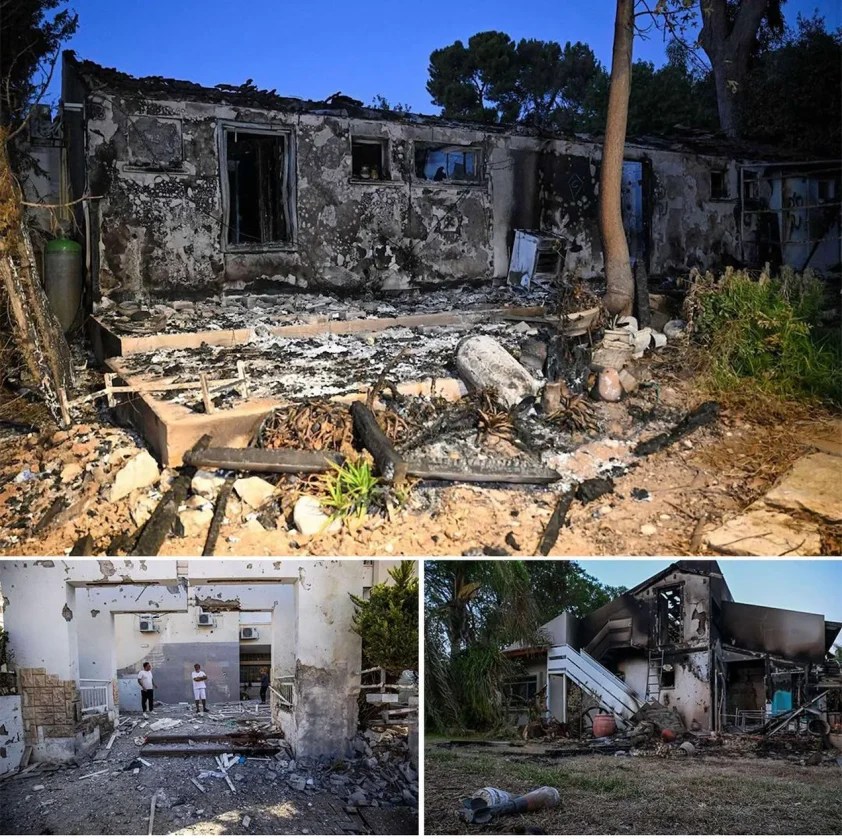
This and most of the rest of the damage to civilians on October 7 was meted out by Israeli heavy weapons, not Hamas’s light firearms
But what about the rockets? Since unlike Israel, Hamas doesn’t enjoy billions of dollars worth of of US-taxpayer-provided weaponry, it fires relatively unsophisticated rockets that cannot take out hardened military targets, but do frighten and occasionally harm Israeli “civilians.” So… is that terrorism? No—because Israelis are settlers, not civilians. Under international law, military resistance against occupation, including targeting settlers, is legitimate. So we can argue about proportionality—I would assert that Hamas errs on the side of mercy by doing a whole lot less settler-killing than it has every right to be doing — but at the end of the day, international law, morality, and basic common sense dictate that Hamas’s use of rockets to retaliate against massive genocide is justifiable… and rational, as part of a multi-pronged strategy to keep raising the costs of occupation to the point that the genocidal occupier will finally take Helen Thomas’s advice and “get the hell out of Palestine.”
Arguing with Orwell’s O’Brien
You know who has lost the argument not only by Godwin’s law a.k.a. reducto ad Hitlerum, but also by which party feels the need to use coercion to force the other party to shut up. The Zionist terrorists have not only lost the argument, they have no argument. No wonder they ceaselessly invoke Hitler and the Nazis. And no wonder they constantly run professors out of universities, get media personalities fired, launch specious persecutions and prosecutions, and generally terrorize everyone into going along with their genocidal absurdities.
Arguing with a Zionist is like arguing with Orwell’s O’Brien: He knows he’s full of shit, has no compunctions about it, and is going to do whatever it takes to ruin your life.
By saying “I like Hamas,” I’m supporting an anti-terrorist group that the Zionist terrorists have falsely and mendaciously labeled, in true Orwellian fashion, “terrorists.” Maybe they’ll try to get me prosecuted for “material support for anti-terrorism,” though I haven’t mailed so much as a dirham to Hamas, POB 123, Gaza Strip, Occupied Palestine, nor have I contributed to any Hamas GoFundMe’s or bought any donuts from the nice little old Hamas ladies at the local mosque. (If they were selling baclava, I’d consider it.)
If you’re honest with yourself, you’ll probably have to admit that the reason that you haven’t yet come around to openly supporting Hamas is fear: fear of what the Zionists might do to you. Well, I’m here to tell you that fear isn’t the right word for that. The correct word is cowardice.
The Palestinians continue to unite in resistance to genocide, even as the Zionists respond by forcing their children to die agonizing deaths, by the thousands, beneath mountains of rubble. And you can’t even openly and publicly admit that you support that Resistance? Come to think of it, maybe cowardice isn’t the right word. It isn’t strong enough.
Come on, grow some stones. Say it with me: “I… SUPPORT… HAMAS.”
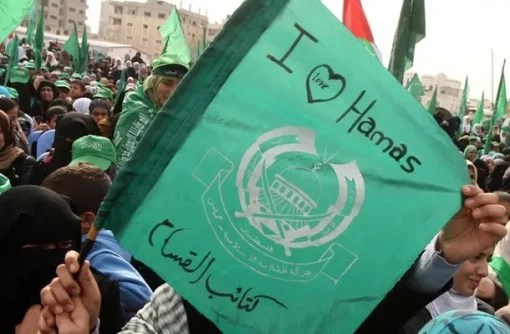
Why are the Israelis massacring civilians in Gaza? Because they can get away with it
By Michael Hoffman | Revelation of the Method | October 23, 2023
Israeli forces terror-bombed Beirut throughout the summer of 1982. In the West in English there is exactly one book about it: God Cried by Catherine Leroy and Tony Clifton. The Lebanese have almost no memorial and certainly no museum devoted to the bombing of hospitals, schools and apartment blocks, just like now, in Gaza. The Israeli government is well aware of this forgetfulness and they calculate their atrocities and war crimes accordingly.
If the Palestinians were bombing Tel Aviv to the extent the Israelis have bombed Gaza (5,000 deaths thus far), in the aftermath there would be books, movies, diaries, poems, plays, museums, and annual, solemn commemorations throughout the West.
Gaza was heavily bombed in 2009 and 2014. The Arab and Muslim world do not engage in the same level of memory and commemoration, other than personal recollection. There are a few exceptions, but they are comparatively minuscule.
Furthermore, if, as in Gaza, day-in and day-out Tel Aviv’s civilian centers were being blown to bits, and its food, fuel and even its water (!) were shut down, the International Court in The Hague and the European Union would be charging the Palestinian leadership responsible, with war crimes. The US would be heavily sanctioning those leaders and humanitarian supplies would be dropped by parachute if necessary to sustain the Israeli civilians.
Instead, the Court and the EU are frozen in mute assent to crimes against Arab children committed as I write these words, by the Israelis who suffered a holocaust in Europe and have been granted by Europe and Britain a license to perpetrate atrocities in Palestine. Hamas terrorists copied this perverse victims-have-the-right-to-be executioners “logic” on Oct. 7.
As for the casual, business-as-usual aspect of the atrocities against Palestinian civilians, it is rooted in the Zionist weaponization of the Talmudic halacha which few in the West, on the Left or the Right, care to learn about – http://talmudical.blogspot.com – and without which they will have no key to comprehending the depth of contempt for Palestinian life.
There are hundreds of books in English harshly critiquing the Quran. Meanwhile this writer’s two banned books [Judaism Discovered and Judaism’s Strange Gods] containing a sustained critique of Talmudism, which in English are among the only credible and charitable texts compassionately documenting Talmudic hate speech, which causes real world harm to Palestinian children, women, elderly and non-combatant men, in the form of their relentless mass murder.
The hate speech is real: on Oct. 9 Israeli Defense Minister Yoav Gallant referred to the Palestinian people as “human animals.”
Israeli Prime Minister Meachem Begin termed them “two-legged animals.”
Israeli Army Chief of Staff Rafael Eitan called the Palestinians: “cockroaches in a bottle.”
The Allied incineration by more than 800 bombers leveled the German city and burned alive tens of thousands of civilians.
The murder of civilians, including by Hamas, is always wrong. Murder is murder. Dressing it up with alibis and platitudes does not make the heinous war crimes any less criminal.

Wounded Palestinian child and man receiving medical treatment at Al-Shifa Hospital in Gaza City following an Israeli bombing, Oct. 11, 2023
How can the daily Israeli massacre of kids and their mothers be parsed, justified or mitigated? It is right, but abortion is wrong? The bipolar nature of such thinking is depraved.
(Israeli victims of Hamas terrorism are no less innocent. They are extensively mourned in the West however, and rightly so; that’s not the case for the Palestinian civilian dead, not in any sustained memorial).
How can the Israeli mass murder of kids and their mothers be justified? I will answer my own question:
The record shows that bombing civilians in cities is the default method of Allied warfare: Tokyo, Nagasaki, Hiroshima, Dresden, Hamburg, Hanoi, Baghdad.
As noted previously, Israelis terror-bombed Beirut throughout the summer of 1982 and Gaza in 2009 and 2014. These war crimes are justified by media ghouls in America, ensuring more of the same, as in Gaza now.
The bombing of Afghan villages and weddings contributed to the defeat of US forces, after the people became fed-up with the transparently lame excuses for the massacres by the likes of David Petraeus, who is now being touted by the media ghouls as a master of statecraft and generalship.
President Biden’s last act in Afghanistan was to approve a missile attack on an SUV that was transporting a large family. Seven children and three adults were incinerated; that’s how the US will be remembered in that nation.
Adolf Hitler was responsible for the brutal, mass expulsion of hundreds of thousands of Judaic people from Germany. For the past 20 years conservative wunderkind Ben Shapiro has advocated the forced extrusion (“transfer”) of the Palestinian people from Palestine. In his own words: “Here is the bottom line: If you believe that the Jewish state has a right to exist, then you must allow Israel to transfer the Palestinians and the Israeli-Arabs from Judea, Samaria, Gaza and Israel proper.”
Each of us must bear witness and do what we can to document, teach and remember.
FOR FURTHER RESEARCH
On the Palestine issue, Amy Goodwin’s podcast today, Oct. 23, is recommended. It can be accessed here at her Democracy Now! website.
A righteous Jew and an extraordinary human being, the brilliant Israeli journalist Amira Hass, is interviewed in two parts.
Take the time to listen to Amira:
If you’re in haste, at least listen to the interview in part two.
All of these broadcasts should be saved and conserved by citizen-journalists (like you), for posterity, and compiled into a permanent data base. I propose the following title for the proposed repository: Witness of War Crimes in Gaza.
History Lesson: Leftist Daniel Denvir conducts a “Palestine Teach-In“ on his podcast, which is accessible at The Dig website: the first hour contains a generally excellent history of the rise of Zionism in Palestine. Too many people don’t know how it all started. The historical context has been missing. Caveat : Mr. Denvir’s guests are mostly of the Left and their analysis of Britain’s role in the ascendance of Zionism in Palestine is limited to a perspective of British colonialism as the root cause. The influence of Freemasonry on the British government, and the masonic objective of rebuilding the Temple of Solomon in Jerusalem, is missing from their analysis. However, don’t let that omission keep you from accessing the history offered.
Michael Hoffman is a former reporter for the New York bureau of the Associated Press and the author of ten books of history and literature, including Secret Societies and Psychological Warfare (2001), The Occult Renaissance Church of Rome (2017) , Twilight Language (2021), as well as a textbook (Judaism Discovered), and five other books published in the United States, as well as overseas in Japanese and French translation; and 122 issues of Revisionist History® newsletter, 1997-2022. His truth mission is made possible by donations, paid Substack subscriptions, and the sale of his books, newsletters and recordings. Podcast: here. X (Twitter): here. Rumble here.
Frankfurt Book Fair slammed, boycotted for ‘shutting down’ Palestinian voices
Press TV – October 20, 2023
The Frankfurt Book Fair in Germany, the world’s largest forum for books and literature, and a literary association have come under fire after they postponed a Palestinian writer’s award ceremony and canceled a public discussion with her.
In an open letter, hundreds of prominent authors and publishers from around the world slammed the organizers of the Frankfurt book fair, saying the forum has “a responsibility to be creating spaces for Palestinian writers to share their thoughts, feelings, reflections on literature through these terrible, cruel times, not shutting them down.”
The 350 authors who signed the letter included the Irish novelist Colm Toibin, the American-Libyan Pulitzer winner Hisham Matar, the British-Pakistani novelist Kamila Shamsie, and the British historian William Dalrymple.
Palestine-born novelist and essayist Adania Shibli was scheduled to be granted the 2023 LiBeraturpreis, an annual prize given to female writers from Africa, Asia, Latin America, or the Arab world, on 20 October for her novel “Minor Detail” which is about the suffering of the Palestinian people.
However, the LitProm association that hands out the prize said last week that it would postpone the award ceremony “due to the war started by Hamas, under which millions of people in Israel and Palestine are suffering.”
LitProm, which had hailed the novel as a “rigorously composed work of art that tells of the power of borders and what violent conflicts do to and with people”, said it had taken the step as a “joint decision” with the author, but Shibli’s literary agency stressed that the decision was not made with her consent.
The agency told the Guardian that Shibli would have taken the opportunity to reflect on the role of literature in these cruel and painful times.
Meanwhile, the international book fair has also explicitly voiced support for Israel, with Juergen Boos, director of the Frankfurt Book Fair, publishing a statement detailing plans “to make Jewish and Israeli voices especially visible” during the literary event. Boos has expressed “complete solidarity on the side of Israel.”
Indonesia and Malaysia boycotting FBF
The forum’s statement prompted Indonesia and Malaysia to boycott the fair that started on Wednesday, with writers from the two countries backing their countries’ decision.
Malaysian writer Faisal Tehrani told Arab News on Thursday that the approach of the fair’s organizer completely disregarded the situation in Gaza, where more than 3,800 people, mostly women and children, have been killed since the start of the Israeli aggression.
Meanwhile, Indonesian novelist Laksmi Pamuntjak, who won the LiBeraturpreis in 2016, issued a statement in support of her country’s decision to withdraw.
The fair’s decision to side with the Israeli regime “shows that this book fair no longer represents the voice of the world, where all nations and countries have the right and deserve a platform to voice their own truths,” she said.
Indonesian novelist Okky Madasari also said her country’s decision to boycott the fair was valid as it was important for writers, publishers and intellectuals to remind the world “that such a support disregarding the context and history can provide Israel with justification to kill more people and do more violence.”
Moreover, Indonesian writer Andina Dwifatma declined an invitation to speak at a literary event associated with the fair over its organizers’ stance.
“I’ve been following the news with a broken heart. And after I saw what FBF posted … I told them that I can’t attend the festival now that they made clear that they stand in complete solidarity with Israel,” she said.
“I think everybody must do something within their means … This is not a bilateral problem between Israel and Palestine; it’s a genocide, a humanitarian tragedy. So, declining that invitation is the least I can do as a writer.”
Israel launched the war on Gaza on October 7 after the Palestinian resistance movement Hamas waged the surprise Operation Al-Aqsa Storm against the occupying entity in response to the Israeli regime’s decades-long campaign of bloodletting and devastation against Palestinians.
American Pravda: The Forgotten Anthrax Attacks
BY RON UNZ • UNZ REVIEW • OCTOBER 17, 2023
The Immense Historical Importance of the Anthrax Attacks
We just recently passed the 22nd anniversary of the 9/11 Attacks, the greatest terrorist strike in human history and an event whose political reverberations dominated world politics for most of the two decades that followed. Our Iraq War was soon triggered as a consequence, a disastrous decision that dramatically transformed the political map of the Middle East and eventually led to the death or displacement of many millions, while our failing twenty-year retaliatory occupation of Afghanistan only finally came to a humiliating end in 2021.
American society also underwent enormous changes, with a considerable erosion of our traditional civil liberties. On the fiscal side, by 2008 Economics Nobel Laureate Joseph Stiglitz and his collaborators had conservatively estimated that the total accrued cost of our military response had exceeded $3 trillion, a figure that later studies raised to $6.4 trillion by 2019, or more than $50,000 per American household.
In the days after those dramatic events, the images of the burning World Trade Center towers and their sudden collapse were endlessly replayed on our television screens, accompanied by the near-universal verdict that American life would forever be changed by the massive terrorist assault that had taken place. But a tiny handful of skeptics argued otherwise.
The Internet was then in its childhood, with the initial dot-com bubble already deflating, while Mark Zuckerberg was still in high school and social media did not yet exist. But one of the earliest pioneers of web-based journalism was Mickey Kaus, a former writer at The New Republic, who had recently begun publishing short, informal bits of punditry one or more times each day on what he called his “web log,” a term soon contracted to “blog.” Along with his fellow TNR alumnus Andrew Sullivan, Kaus became one of our first bloggers, and was inclined to take contrarian positions on major issues.
Thus, even as a stunned world gaped at the smoking ruins of the WTC towers and the talking heads on cable declared that American life would never be the same again, Kaus took a very different position. I remember that not long after the attacks, he argued that our cable-driven 24-hour news cycle had so drastically shrunk the popular attention-span that coverage of the massive terrorist attacks would soon begin to bore most Americans. As a result, he boldly predicted that by Thanksgiving, the 9/11 Attacks would have become a rapidly-fading memory, probably displaced by the latest celebrity-scandal or high-profile crime, and that the long-term impact upon American public life would be minimal.
Obviously, Kaus’ forecast was wrong, but I think it never had a fair test. Very soon after he wrote those words, our national attention was suddenly riveted by an entirely new wave of terrorism, as the offices of leading media and political figures in Manhattan, DC, and Florida began receiving envelopes filled with lethal anthrax spores together with short notes praising Allah and promising death to America.
Although nearly all Americans had seen the destruction of the WTC towers on their television screens and become outraged at the blow to our country, probably few had felt personally threatened by those September attacks. But now during October, the dreadful spectre of biological terrorism moved to the forefront of popular concerns, staying there for many months.
Those anthrax mailings had targeted particular high-profile individuals and the letters were tightly sealed, but the media soon revealed that rough handling at postal centers during the automatic sorting process had caused the tiny seeds of death to leak through the pores of the envelope paper, contaminating both the buildings and the other mail being processed. As a result, some of the subsequent fatalities were those of random individuals who had received an accidentally-contaminated letter, seeming to place all Americans at terrible risk.
Moreover, despite all the visual scenes of massive destruction inflicted on 9/11, only about 3,000 Americans had died, but then our political and media figures soon warned that terrorists could use anthrax or smallpox to kill hundreds of thousands or millions of our citizens. Indeed, we were told that just a few months earlier during June 2001, the government’s Dark Winter simulation exercise had suggested that over a million Americans could die in a smallpox attack unleashed by foreign terrorists.
According to early news reports, the anthrax in the letters had been highly weaponized using techniques far beyond the rudimentary capabilities of al-Qaeda terrorists, facts that therefore indicated a state sponsor. Numerous anonymous government sources stated that the deadly spores had been coated in bentonite, a compound long used by the Iraqis to enhance the lethality of their anthrax bombs, thereby directly fingering Saddam Hussein’s regime, and although those claims were later officially denied by the White House, large portions of the American public heard and believed them.
As the weeks went by, the FBI and most of the media declared that the anthrax had apparently come from our own domestic stockpiles, suggesting that the mailer was probably a lone domestic terrorist merely pretending to be an radical Islamicist, but much of the public never accepted this.
Indeed, a year later when Colin Powell made his famous presentation to the UN Security Council, attempting to justify America’s planned invasion of Iraq, he held up a small vial of white powder, explaining that even such a tiny quantity of anthrax spores could kill many tens of thousands of Americans. His public focus demonstrated the continuing resonance of the biological warfare attacks that our country had suffered more than a year earlier, and which many die-hard Americans still stubbornly believed had been a combined effort by al-Qaeda and Saddam Hussein.
The handful of anthrax letters had only killed five Americans and sickened 17 more, a tiny sliver of the 9/11 casualties, and the last envelope sent had been postmarked on October 17, 2001. But I think the impact upon American public opinion during the year or two that followed was fully comparable to that of the massive physical attacks we had suffered a few weeks earlier, or perhaps even greater. For all the death and destruction inflicted on 9/11, without the subsequent anthrax mailings, the Patriot Act would never have passed Congress in anything like its final form, while President Bush might not have gained sufficient public support to launch his disastrous Iraq War.
The anthrax mailings were almost totally forgotten within just a few years and today my suggestion that their impact had matched or even exceeded that of the 9/11 Attacks themselves might seem utterly preposterous to most Americans, but when I recently reviewed the articles of that period, I discovered that I had hardly been alone in that appraisal.
Renowned investigative journalist Glenn Greenwald was just beginning his career, joining Salon in 2007. He soon began publishing a number of columns on the anthrax case, with one of the first including this paragraph near the beginning:
The 2001 anthrax attacks remain one of the great mysteries of the post-9/11 era. After 9/11 itself, the anthrax attacks were probably the most consequential event of the Bush presidency. One could make a persuasive case that they were actually more consequential. The 9/11 attacks were obviously traumatic for the country, but in the absence of the anthrax attacks, 9/11 could easily have been perceived as a single, isolated event. It was really the anthrax letters — with the first one sent on September 18, just one week after 9/11 — that severely ratcheted up the fear levels and created the climate that would dominate in this country for the next several years after. It was anthrax — sent directly into the heart of the country’s elite political and media institutions, to then-Senate Majority Leader Tom Daschle (D-SD), Sen. Pat Leahy (D-Vt), NBC News anchor Tom Brokaw, and other leading media outlets — that created the impression that social order itself was genuinely threatened by Islamic radicalism.
So I think it’s perfectly possible that without those now long-forgotten anthrax mailings, Kaus might have been proven correct in his predictions and the 9/11 Attacks would have become a fading memory by the end of 2001. Without a handful of small envelopes filled with anthrax, there might never have been an Iraq war nor a Patriot Act nor all the other momentous political and social changes in America during the years after September 11, 2001.
There were also some very direct consequences. American government support for biodefense had been strong under Clinton, then sharply reduced once Bush came into office. But those few deadly envelopes changed everything, and during the years 2002-2011, our government spent an estimated $70 billion on biowarfare and biodefense, vastly more than ever before. These days our total biowarfare outlays have far surpassed the hundred billion dollar mark, but almost all of that gusher of funding was triggered by a handful of envelopes bearing $0.23 stamps. During September 2001, a biological defense contractor named BioPort was on the verge of collapse and bankruptcy, but once the mailings reached the headlines, the company was saved by a flood of anthrax-vaccine government contracts; later renamed Emergent BioSolutions, it played a controversial role in the production of our Covid vaccines nearly twenty years later.
If Americans were asked to name the half-dozen most consequential global events of our young 21st century, I doubt whether even one in a thousand would include the forgotten anthrax attacks of 2001 on that list; but without those mailings our entire history and that of the world might have followed a very different trajectory.
The Assaad Letter as the Crucial Evidence
Although the anthrax letters have never attracted more than a small fraction of the public debate surrounding the associated 9/11 Attacks, they were also shrouded in considerable controversy, with the true perpetrators and circumstances hotly debated from the very beginning. Back then and for many years afterward, I had never seriously questioned the official 9/11 narrative nor even closely investigated its details. But the glaring omissions in the news coverage of the anthrax mailings had always seemed very strange and suspicious to me, and thus had played an important role in my growing doubts about the reliability of our mainstream media. When I published my original American Pravda article a decade ago, I’d given pride of place to the anthrax story and included several paragraphs summarizing my own contrary analysis, which had remained unchanged during the dozen years since 2001:
Consider the almost forgotten anthrax mailing attacks in the weeks after 9/11, which terrified our dominant East Coast elites and spurred passage of the unprecedented Patriot Act, thereby eliminating many traditional civil-libertarian protections. Every morning during that period the New York Times and other leading newspapers carried articles describing the mysterious nature of the deadly attacks and the complete bafflement of the FBI investigators. But evenings on the Internet I would read stories by perfectly respectable journalists such as Salon’s Laura Rozen or the staff of the Hartford Courant providing a wealth of additional detail and pointing to a likely suspect and motive.
Although the letters carrying the anthrax were purportedly written by an Arab terrorist, the FBI quickly determined that the language and style indicated a non-Arab author, while tests pointed to the bioweapons research facility at Ft. Detrick, Md., as the probable source of the material. But just prior to the arrival of those deadly mailings, military police at Quantico, Va., had also received an anonymous letter warning that a former Ft. Detrick employee, Egyptian-born Dr. Ayaad Assaad, might be planning to launch a national campaign of bioterrorism. Investigators quickly cleared Dr. Assaad, but the very detailed nature of the accusations revealed inside knowledge of his employment history and the Ft. Detrick facilities. Given the near-simultaneous posting of anthrax envelopes and false bioterrorism accusations, the mailings almost certainly came from the same source, and solving the latter case would be the easiest means of catching the anthrax killer.
Who would have attempted to frame Dr. Assaad for bioterrorism? A few years earlier he had been involved in a bitter personal feud with a couple of his Ft. Detrick coworkers, including charges of racism, official reprimands, and angry recriminations all around. When an FBI official shared a copy of the accusatory letter with a noted language-forensics expert and allowed him to compare the text with the writings of 40 biowarfare lab employees, he found a perfect match with one of those individuals. For years I told my friends that anyone who spent 30 minutes with Google could probably determine the name and motive of the likely anthrax killer, and most of them successfully met my challenge.
This powerful evidence received almost no attention in the major national media, nor is there any indication that the FBI ever followed up on any of these clues or interrogated the named suspects. Instead, investigators attempted to pin the attacks on a Dr. Steven Hatfill based on negligible evidence, after which he was completely exonerated and won a $5.6 million settlement from the government for its years of severe harassment. Later, similar hounding of researcher Bruce Ivins and his family led to his suicide, after which the FBI declared the case closed, even though former colleagues of Dr. Ivins demonstrated that he had had no motive, means, or opportunity. In 2008, I commissioned a major 3,000-word cover story in my magazine summarizing all of this crucial evidence, and once again almost no one in the mainstream media paid the slightest attention.
- Our American Pravda
Ron Unz • The American Conservative • April 29, 2013 • 4,500 Words
When I recently decided to revisit the story of the anthrax attacks and reexamine all the accumulated information from the last couple of decades, I felt that a good starting point might be that TAC cover story by Christ0pher Ketchum that I’d published back in 2008, which effectively summarized what I’d always considered the most crucial information:
As early as November 2001, the New York Times was reporting that the bureau’s “missteps” were “hampering the inquiry.” Indeed, from the beginning, the FBI has been in possession of a key piece of evidence that it apparently ignored.
Among the first suspects to come into the FBI’s sights was an Egyptian-born ex-USAMRIID biologist named Ayaad Assaad. He appeared on the radar because of an anonymous letter sent to the bureau identifying him as part of a terrorist cell possibly linked to the anthrax attacks. Yet, according to the Hartford Courant, the FBI did not attempt to track down the author of the letter, “despite its curious timing, coming a matter of days before the existence of anthrax-laced mail became known.”
Assaad was quickly exonerated by FBI investigators, and the matter swiftly dropped—though the letter may have provided the best piece of evidence in the case. It was sent prior to the arrival of the anthrax letters, suggesting foreknowledge of the attacks, and its language was similar to that of the deadly mail. Moreover, it displayed an intimate knowledge of USAMRIID operations, suggesting that it came from within the limited ranks of Fort Detrick researchers—a relatively small group with access to and expertise in weaponized anthrax.
The FBI has refused to make a copy of the letter publicly available—or even to give one to Assaad himself. It did, however, share the contents with a Vassar College professor and language forensics expert named Don Foster, who famously fingered Joe Klein as the anonymous author behind Primary Colors and helped to catch the 1996 Atlanta Olympics bomber. After reading news reports, he requested a copy of the letter, and, following his review of documents written by “some 40 USAMRIID employees,” Foster “found writings by a female officer that looked like a perfect match,” according to an article he authored in the October 2003 Vanity Fair. When he brought this seemingly crucial clue to the attention of the FBI’s anthrax task force, however, the bureau declined to follow up. According to Foster, the senior FBI agent on the case had never even heard of the Assaad letter. (For the record, Foster isn’t an unimpeachable source. He strayed from his area of professional expertise and published unrelated circumstantial evidence in his Vanity Fair piece that wrongly fingered Hatfill, who sued the magazine, which settled on undisclosed terms.)
“The letter-writer clearly knew my entire background, my training in both chemical and biological agents, my security clearance, what floor I work on, that I have two sons, what train I take to work, and where I live,” Assaad told reporter Laura Rozen. Since he was almost immediately cleared, attempting to frame him served no purpose, except to indulge a personal enmity. To that end, Assaad suggested that the FBI question the pair of USAMRIID colleagues most likely to carry a grudge against him, Marian Rippy and Philip Zack, who years earlier had been reprimanded for sending Assad a racist poem. Though the Courant reported video evidence of Zack making after-hours trips to labs where pathogens were stored, there is no record of the FBI ever investigating him or Rippy, a colleague with whom he was having an extramarital affair.

- The Anthrax Files
Christopher Ketchum • The American Conservative • August 25, 2008 • 3,000 Words
The lengthy and detailed Assaad letter demonstrated foreknowledge of the anthrax mailings and very likely had been sent by someone fully aware of those attacks, so it had always seemed the obvious means of cracking the case. Yet it was completely ignored by the New York Times and the rest of the elite media, and only reported in relatively small outlets such as the Hartford Courant and Salon, whose extensive coverage had played an important role in the case.
Media Coverage of the Anthrax Attacks
During the first year or two following the anthrax attacks, I’d tried to keep up with the flood of media coverage, much of it regularly highlighted for me on a daily basis by news-aggregator websites such as Antiwar.com. Under normal circumstances, now locating all those same stories two decades after they originally ran would have been an impossible undertaking given that many of those publications had long since purged their archives or even completely vanished from the Internet.
Fortunately, Edward Lake, a writer with neoconservative leanings, became deeply interested in the anthrax case, and aggregated together most of those early news stories on a website that he created, which served as a uniquely useful resource. Although that website also vanished from the Internet many years ago, its contents remain accessible at Archive.org, and here are links to several of the main sections:
- Articles from the Washington Times • 28 Items • 20,000 Words
- Articles from the Hartford Courant • 33 Items • 36,000 Words
- Other Media Articles, Part 1 • 45 Items • 57,000 Words
- Other Media Articles, Part 2 • 96 Items • 99,000 Words
- Barbara Hatch Rosenberg/FAS Articles • 9 Items • 7,500 Words
Possibly for reasons of copyright, Lake’s website had excluded pieces originally published in the largest national newspapers such as the New York Times, the Washington Post, and the Wall Street Journal. Among these, a half-dozen Times columns published in 2002 by Nicholas Kristof had played an especially important role and provoked enormous attention. Kristof had repeatedly charged that the FBI was refusing to arrest an obvious suspect in the case and he ultimately fingered Dr. Steven Hatfill, who turned out to have been wrongly accused and successfully sued:
- Profile of a Killer • Jan 4, 2002
- Connecting Deadly Dots • May 24, 2002
- Anthrax? The F.B.I. Yawns • July 2, 2002
- The Anthrax Files • July 12, 2002
- Case of the Missing Anthrax • July 19, 2002
- The Anthrax Files • August 13, 2002
The important article by Don Foster mentioned above had originally run in Vanity Fair, but was later republished by the UCLA Department of Epidemiology, which also provided a very helpful annotated timeline of the outbreak:
- The Message in the Anthrax
Don Foster • Vanity Fair • October 2003 • 9,500 Words
Beginning in 2007, Glenn Greenwald published a lengthy series of columns in Salon, totaling well over 30,000 words, with most of his pieces sharply challenging the official FBI narrative that blamed the attacks on Ft. Detrick anthrax researcher Bruce Ivins and then declared the case closed:
- The unresolved story of ABC News’ false Saddam-anthrax reports • April 9, 2007
- Vital unresolved anthrax questions and ABC News • August 1, 2008
- Journalists, their lying sources, and the anthrax investigation • August 3, 2008
- Additional key facts re: the anthrax investigation • August 4, 2008
- The FBI’s emerging, leaking case against Ivins • August 5, 2008
- The FBI’s selective release of documents in the anthrax case • August 6, 2008
- What’s the answer to this? • August 10, 2008
- Doubts over the anthrax case intensify — except among much of the media • August 18, 2008
- Key senators dispute FBI’s anthrax case against Bruce Ivins • September 17, 2008
- Remembering the anthrax attack • March 4, 2009
- Unlearned lessons from the Steven Hatfill case • April 21, 2010
- An Army scientist denies the FBI’s anthrax case • April 23, 2010
- Serious doubt cast on FBI’s anthrax case against Bruce Ivins • February 16, 2011
- DOJ casts serious doubt on its own claims about the anthrax attack • July 19, 2011
In 2009 attorney Barry Kissin published a long and influential memo also challenging those FBI conclusions on numerous technical grounds, which he later updated and expanded in 2011:
- The Truth About The Anthrax Attacks and Its Cover-Up
Barry Kissin • April 2, 2011 • 15,800 Words
Kissin heavily referenced a couple of columns that had run the previous year in the Wall Street Journal and the New York Times by Edward Jay Epstein and Richard Bernstein respectively. These had pointed out the enormous holes in the case against Ivins, whom they argued could not possibly have created the anthrax in his Ft. Detrick facilities as claimed by the FBI:
- The Anthrax Attacks Remain Unsolved
The FBI disproved its main theory about how the spores were weaponized
Edward Jay Epstein • The Wall Street Journal • January 24, 2010 • 1,400 Words - Haste Leaves Anthrax Case Unconcluded
Richard Bernstein • The New York Times • February 24, 2010 • 1,100 Words
Finally, Wikipedia also provides a lengthy establishmentarian account of the anthrax attacks, as does the more conspiratorial wikispooks website, which also provides a helpful timeline
- 2001 Anthrax Attacks • Wikipedia • 15,500 Words
- 2001 Anthrax Attacks • Wikispooks • 2,000 Words
- 2001 Anthrax attacks/Timeline • Wikispooks • 5,200 Words
How the Media and the FBI Ignored the Obvious Suspect
I recently spent a few days carefully rereading those two hundred-odd news stories, most of them for the first time in nearly twenty years. Across the more than 250,000 words of text, I found very little to change my original analysis of the 2001 anthrax attacks.
In his numerous columns, Greenwald had described the FBI case presented against Ivins as extremely thin, while Epstein, Bernstein, and Kissin persuasively argued that Ivins could not possibly have produced the anthrax used in the mailings.
Meanwhile, just as I remembered, it seemed very likely that the long Assaad letter had been sent by someone fully aware of the anthrax being sent, and was therefore the most important lead to the culprit. Both the FBI and its strongest critics agreed that the anthrax used had originated at Ft. Detrick and Assaad’s false accuser was clearly a present or former Ft. Detrick staffer. The letter had been mailed just a couple of days after the first wave of anthrax envelopes went out but long before their deadly contents came to public attention and began inspiring any copycats, and just like those anthrax mailings, accusations of Islamic bioterrorism had been the main theme. Such close correspondences seemed far too numerous to have been simply coincidental.
Just as in early 2002, I still found it extremely strange that while the Hartford Courant and Salon had run numerous stories on the Assaad letter, almost none of the 200 other news articles in mainstream outlets had ever mentioned a word about such a central clue to the mystery, perhaps reflecting the influence of their powerful establishmentarian sources, including those near the top of the FBI.
However, in properly assessing the implications of the Assaad letter, we must sharply distinguish between the solid and the speculative. When Assaad had originally been interviewed by the FBI prior to the anthrax outbreak, he had suggested Zack and Rippy as two of the most likely culprits since they had been among his chief personal antagonists at Ft. Detrick, but that was merely speculation on his part. Zack had been an anthrax biowarfare developer and reporters later found that he’d been given improper access to the Ft. Detrick facilities by Rippy, with whom he was having an extramarital affair. Furthermore, around the same time, there was evidence that unauthorized anthrax experiments had secretly been conducted in those labs. Obviously, these facts seemed highly suspicious and the total lack of any coverage in the major news media or apparent FBI investigation was a serious omission.
But as Lake had noted in his sharp rebuttal, all of these events had occurred nearly a decade before the anthrax mailings, and also long before the particular anthrax sent in the letters had been produced at the facility. Both Zack and Rippy had left Ft. Detrick years before the attacks took place and Lake suggested that they were probably no longer living on the East Coast at the time, perhaps giving them strong alibis. Finally, Zack’s apparent deep hostility towards Arabs and Muslims had led to the widespread assumption that he was Jewish, and Lake effectively debunked that mistaken claim.
But none of those points diminishes the importance of the Assaad letter nor clears Zack. As a Ft. Detrick anthrax researcher who had previously been involved in suspicious activity, Zack was certainly an obvious suspect for the FBI to consider, although hardly an exclusive one. Determining the author of the Assaad letter was the crucial path to pursue, and according to Prof. Foster, after reviewing documents written by “some 40 USAMRIID employees,” he had “found writings by a female officer that looked like a perfect match.” It hardly mattered whether or not that individual happened to be Rippy, Zack’s former confederate. Properly interrogating the author of the Assaad letter would probably have cracked the anthrax case, but the FBI refused to do so, or even make a copy of the letter publicly available to Assaad or anyone else, which raises all sorts of troubling issues.
Aside from the Hartford Courant and Salon, one of the very few publications to mention the Assaad letter was the Washington Report on Middle East Affairs, whose news editor wrote an article around the first anniversary of the attacks, summarizing the facts and suggesting that the likely culprit was Zack, whom she misidentified as Jewish. Aside from outlining the evidence, her piece also included several puzzling paragraphs based upon her questions to Dr. Barbara Hatch Rosenberg, a key figure in the anthrax case:
When the Washington Report on Middle East Affairs asked Barbara Hatch Rosenberg, Ph.D., a biological arms control expert at the State University of New York, if the allegations regarding Dr. David Hatfill now took the heat off Lt. Col. Philip Zack, she replied, “Zack has NEVER been under suspicion as perpetrator of the anthrax attack.”
It is hard to believe that, with his connection to Fort Detrick, Dr. Zack is not one of the 20 to 50 scientists under intense investigation.
When asked if Hatfill was part of the group that ganged up on Dr. Ayaad Assaad, Dr. Rosenberg answered, “Hatfill was NOT one of the persecutors of Assaad.”
She is convinced that the FBI knows who sent the anthrax letters but isn’t arresting him because he knows too much about U.S. secret biological weapons research and production. But she isn’t naming names. Neither is Dr. Assaad, who did not return calls from the Washington Report on Middle East Affairs.
Reading this exchange more than twenty years later, it’s unclear to me whether Rosenberg was arguing that Zack had never been considered a suspect because he had an ironclad alibi or whether the FBI was simply unwilling to investigate him for some other reason, with the latter possibility obviously being very suspicious if true.
- While Media Spotlights One Anthrax Suspect, Another Is Too Hot to Touch
Delinda Curtiss Hanley • The Washington Report on Middle East Affairs • September 2002 • 2,100 Words
Nine Books on the Anthrax Attacks

Having first established a solid foundation by rereading so much of the original anthrax media coverage, I decided to see what books had been published on the subject. Over the years, I’d read two short works on the anthrax attacks and I now reread those, along with eight others that I managed to locate, together constituting nearly all the available literature. With one very notable exception, I didn’t find the material particularly useful and indeed much of it blurred together in my mind.
First out of the gate in late 2002 was Richard Preston’s The Demon in the Freezer, a non-fiction work by a highly-successful writer of thrillers, which became a national bestseller. The book had obviously been in the works for some time, mostly focused upon deadly pathogens such as smallpox and also discussing bioweapons and Ft. Detrick’s research in that field. The sudden events of October 2001 were then incorporated into the last one-third of the narrative, with the timeliness of those recent headlines boosting sales.
According to the Ft. Detrick researchers, the second group of letters had contained highly weaponized anthrax, something far beyond what could have been produced in a simple lab, and Kissin extensively quoted some of author’s descriptions in his analysis memo. However, researchers from Battelle, a different government-affiliated bioweapons facility, had stubbornly—and rather suspiciously—disputed that conclusion. Given Preston’s focus, it’s hardly surprising that there was no mention anywhere of the Assaad letter, and although the other elements of the book were interesting from a broader perspective, they provided little useful additional information on the anthrax mailings, which constituted only a small portion of the text.

The cover jacket on Marilyn W. Thompson’s 2003 book The Killer Strain identified the author as the award-winning Assistant Managing Editor for Investigations at the Washington Post, while noting that her team had won two Pulitzer Prizes for public service, and also included favorable blurbs from such notable journalistic figures as Benjamin Bradlee, Jimmy Breslin, Michael Isikoff, and David Maraniss.
The text did a perfectly adequate job of telling the basic story of the attacks, and to its credit devoted three paragraphs of its 250 pages to the Assaad letter, though providing no indication of its potential importance and not even bothering to include the term in the lengthy index. One important fact that I did learn was that prior to the anthrax attacks, the new Bush Administration had planned deep cuts in biodefense preparedness.

Although I had hardly regarded Thompson’s scanty coverage of the Assaad letter as adequate, it was far more than I found in The Anthrax Letters, published that same year by Prof. Leonard A. Cole of Rutgers University, described as an expert on bioterrorism, who entirely excluded the Assaad letter from his 280 pages of text.
Like the Thompson book, his work provided a useful account of the basic narrative, attracting favorable blurbs from several major news outlets and Sen. Daschle, but seemed much less useful for someone primarily interested in solving the case.
The book had originally appeared in 2003, but was reissued in 2009 following the FBI’s declaration that the case had been closed with Ivins’ suicide, though the author emphasized the extreme skepticism of so many prominent figures, including members of Congress, on that verdict.
Also originally published in 2003 was Amerithrax: The Hunt for the Anthrax Killer by Robert Graysmith, a bestselling author of books on crime and terrorism, whose past works had become the basis for several major motion pictures. This background was apparent in the long text, which seemed to have the strongly fictional feel of an prospective screenplay rather than an analytical work, and also included extensive descriptions of the 9/11 Attacks and the broader history of American, Soviet, and Iraqi biowarfare programs.
On the positive side, the author did devote a couple of pages to the Assaad letter, which he described as obviously connected to the anthrax mailings, even claiming that it had been a crucial factor convincing government investigators that the attacks were domestic in origin, but he never emphasized that it could have been used to crack the case.
The book was later reissued with an Afterword in 2008, pointing to the deceased Ivins as the apparent culprit and even suggesting that he had written the Assaad letter. That latter notion seemed very unlikely to me since if there had been the slightest evidence for that possibility it would have been promoted as a centerpiece of the FBI case against Ivins.

Edward Lake, whose website usefully aggregated so much of the early media coverage, self-published Analyzing the Anthrax Attacks in 2005. Lake was strongly critical of many of the arguments made by both Rosenberg and Foster, and very briefly mentioned the Assaad letter, arguing that it probably had no connection to the actual anthrax mailings and he therefore dismissed its significance.
Although I obviously disagreed with this analysis, the author deserved considerable credit for explicitly arguing this point rather than just ignoring the issue.
Lake also provided some interesting speculation that the anthrax killer probably lived and worked in central New Jersey and even suggested that the letters might have been written by a young child acting under adult supervision.

The following year, Harvard University Press released Anthrax: Bioterror as Fact and Fantasy, a short book by Phillip Sarasin, a professor of Modern History at the University of Zurich.
His entire approach to the subject was cultural and ideological, including a focus upon popular literature and even videogames, while tying the discussion of biological terrorism to the 9/11 attacks and even broader themes such as globalization.
Although I didn’t find the work very useful for my own purposes, others interested in the particular cultural framework under which our society experienced the attacks might react differently.

Subject to severe pressure and facing indictment, Bruce Ivins committed suicide in 2008, allowing the FBI to declare the case closed, though many senior members of Congress and journalists remained extremely skeptical that Ivins had been responsible or had acted alone.
With the anthrax mailings temporarily back in the media headlines, new book contracts soon went out, and American Anthrax by Jeanne Guillemin, an academic affiliated with MIT, appeared in 2011.
The author devoted a couple of paragraphs to the Assaad letter, and Zack was even mentioned as a subject with a reference to one of the Salon articles, but the author stated that the lead never “panned out,” without providing any source for that supposed fact, so it probably represented her own interpretation of the puzzling later silence.
She did mention that under severe FBI pressure an additional suspect besides Hatfill and Ivins apparently drank himself to death, perhaps further indicating that Ivins’ suicide was not necessarily proof of his own guilt.

I was especially disappointed by the most recent book in the collection, Recounting the Anthrax Attacks, published in 2018 by R. Scott Decker, one of the top FBI agents running the investigation. His coverage of the story was overwhelmingly procedural and quite dull, providing little broader perspective despite winning a non-fiction prize from the Public Safety Writers Association.
Given his background and role, I was hardly surprised that he fully accepted Ivins’ guilt, minimizing or excluding any contrary evidence, and he never mentioned the Assaad letter, perhaps even being unaware of it. If the enormous FBI investigation did ultimately prove unsuccessful, this book may help to explain that failure.
Considerably superior to most of these other texts was The Mirage Man published in 2011 by David Willman, a Pulitzer Prize winning investigative reporter at the Los Angeles Times, which ran a hefty 450 pages and heavily focused upon Bruce Ivins, the suspect whose suicide had allowed the FBI to declare the case closed.
Willman himself had been given the original Ivins scoop in 2008, so he naturally expressed few doubts about the guilt of the dead vaccine researcher, but he did do his best to refute the extreme skepticism of Greenwald and numerous others, not entirely successfully but more than I had expected. Nearly a decade had passed since the attacks themselves and Willman was portraying the case as fully resolved with Ivins’ guilt, so I couldn’t really fault the author for making no mention of the Assaad letter.
Relative to its apparent purpose, the book seemed a very solid work of investigative journalism, including a lengthy personal and family history of its central subject, and it carried a strongly favorable endorsement from Seymour Hersh, a towering figure in the author’s own field.
I personally made some effort to weigh Willman’s arguments against those of Greenwald, Epstein, Bernstein, and Kissin on the other side, but much of the dispute revolved around technical claims made by different experts that were difficult for me to judge.
One critical question was whether or not the anthrax sent in the second set of envelopes had actually been “weaponized” with a silicon coating to enhance its effectiveness, with some experts sharply disputing that claim, though I thought that the weight of evidence favored that conclusion. Ivins’ himself had no expertise nor equipment for such weaponization, so such a verdict would probably have cleared him.
When the FBI had originally declared Ivins’ guilty, Greenwald noted that the timeline provided of the suspect’s movements was completely impossible based upon the postmarked date of the letters sent and his own lab time-card. As a result, the Bureau had quickly modified its story to claim that Ivins had actually driven all night on an eight-hour round-trip in order to drop the letter in a Princeton mailbox, a suggestion that Greenwald ridiculed. But Willman strongly defended that theory, noting that Ivins had admitted sometimes taking long drives at night.
Although Willman hardly convinced me on this and other issues, I came away from his long book at least admitting the possibility of Ivins’ guilt, something that I had previously dismissed as almost totally absurd.
Graeme MacQueen and The 2001 Anthrax Deception
These nine books totaled more than a million words and spending a couple of weeks reading them greatly refreshed my memory of those important events of two decades ago. But although they highlighted interesting elements here and there, taken together they added very little to my framework, nor shifted any of my original conclusions. If I hadn’t bothered reading any of them, none of my views about the 2001 anthrax attacks would be any different today.

However, the impact of the tenth book was completely different. Although the shortest of them all, The 2001 Anthrax Deception published in 2014 by the late Prof. Graeme MacQueen drastically transformed my understanding of those events, making a case in its 80,000 words that was entirely different from anything that I had previously read on the subject. MacQueen persuasively argued that first impressions had actually been correct and that the anthrax mailings were directly connected with the 9/11 Attacks of a week or two earlier. This had been the original assumption but was then very soon dismissed as a possibility and afterward completely ignored by almost everyone else analyzing the case during all the years that followed.
MacQueen’s own background allowed him to boldly go where others did not. The authors of the previous nine books I have discussed were mainstream journalists or academics, therefore being quite reluctant to stray too far outside the safe confines of the standard narrative endorsed by establishmentarian sources, and none of them appear to have ever questioned the official story of 9/11. MacQueen himself had very respectable credentials, including a Ph.D. from Harvard and thirty years on the faculty of McMaster University in Canada, being the founder and director of its Centre for Peace Studies. But in the years after 2001, he had become an important figure in the 9/11 Truth movement, serving as co-editor of The Journal of 9/11 Studies. So unlike those other writers, he was willing to explore controversial possibilities and highlight obvious connections that they had carefully ignored.
As I have already emphasized, without the anthrax mailings, the political impact of the 9/11 Attacks themselves might have quickly faded, perhaps being insufficient to reorient our country towards the many years of warfare that followed, including our invasion of Iraq, an invasion justified by Saddam’s alleged stockpile of anthrax and other WMDs. So if we accept that the 9/11 Attacks were orchestrated by a conspiracy for that purpose, it becomes natural to ask whether the accompanying anthrax mailings were an entirely unexpected, fortuitous coincidence benefiting those plotters or whether they were instead an intrinsic element of the original plan. Without those anthrax deaths, Colin Powell’s later UN presentation and the vial of white powder he employed as a stage prop would not have been possible, nor President Bush’s public speeches on the deadly danger we faced from Iraqi WMDs.
MacQueen notes that although the 9/11 Attacks had involved entirely different types of terrorism—large-scale airplane hijackings—our East Coast media and political elites almost immediately began to focus upon the deadly risks of biowarfare attacks by Islamic radicals, especially involving anthrax, and they did so before the first anthrax letter had even been postmarked. Washington Post columnist Richard Cohen later revealed that he’d been warned by a high-ranking Bush Administration official to get a prescription for Cipro, the recommended antibiotic treatment for anthrax, and according to New York Times columnist Maureen Dowd, well-connected NYC residents also began carrying Cipro in the days immediately after 9/11. Not only was there a great deal of such apparent foreknowledge in the weeks before the first reported anthrax case, but fears of a looming anthrax attack by state-sponsored terrorists had actually long predated 9/11 itself. Perhaps this was all purely coincidental, but we should naturally be suspicious when such fearful concerns quietly promoted in elite media circles were immediately followed by actual anthrax mailings to very high-profile members of the same media establishment.
MacQueen and other members of the 9/11 Truth movement have long argued that the very public activities of Mohammed Atta and the other hijackers were intended to lay down a false narrative trail for their supposed plot, and he noted that important elements of that trail seemingly revolved around biological warfare, including the terrorist ringleader’s audacious talk of acquiring a crop-dusting plane that could release clouds of deadly anthrax over a major American city. Indeed, before the first anthrax case was even reported, there were frantic government investigations of all crop-dusters nationwide.
From very early on I had always regarded the Assaad letter as the key to unraveling the anthrax plot, but MacQueen focused my attention upon several other threatening hoax letters that had been sent out almost simultaneously with the first wave of anthrax mailings, letters that were also addressed to leading media figures but filled with harmless white powder instead of anthrax, together with strangely-formulated notes somewhat similar to those of their deadly counterparts. These envelopes had been postmarked St. Petersburg, Florida, and MacQueen argues that they were probably intended to provide an apparent link to the 9/11 Attacks, since most of the hijackers had been living in that state.
An additional connection has been regularly dismissed as merely an astonishing coincidence, but may have been more than that. The first anthrax death was that of Robert Stevens, a photo editor at the American Media offices in Florida, and Mike Irish was the top editor of his publication. Irish’s own wife was a real estate agent, and she had personally arranged the rental home for a couple of the 9/11 hijackers, with whom she’d become friendly, while most of the other hijackers were also living in the close vicinity. As MacQueen notes, in a country of 285 million people, we are forced to believe that mere chance had caused the 9/11 hijackers to have such a direct personal connection to the first anthrax victim. But under his own very different reconstruction, the anthrax mailing to Irish’s publication was meant to falsely suggest that the Islamic terrorists responsible for 9/11 had been directly involved in the biowarfare attacks.
Soon after the 9/11 Attacks, Neocon pundits and media outlets began promoting spurious links between the al-Qaeda Islamicists allegedly responsible and Saddam’s secular, anti-Islamicist Iraqi regime. The anthrax mailings became a central element of their case given that the purity of the deadly spores could only have been produced by a regime possessing sophisticated biowarfare facilities. As Greenwald later noted with outrage, four separate official government sources also soon falsely informed ABC News that the anthrax had been weaponized with bentonite, regarded as proof that it was Iraqi in origin. So the weaponized anthrax represented the crucial evidence connecting the 9/11 Attacks with Saddam.
Unfortunately for those plotters, the FBI quickly determined that the anthrax was of the Ames strain rather than the type used by Iraq, and this pointed to the ultimate source being one of our own bioweapons facilities. MacQueen argues that the conspirators may have assumed that Ames was much more widely distributed internationally than it proved to be. So once their intended narrative of a foreign plot linked to Iraq had collapsed, they quickly shifted gears and began promoting the fallback theory of a lone wolf domestic terrorist, thereby deflecting attention away from any consideration of the sort of organized domestic conspiracy that might have eventually implicated them.
Based upon the facts presented by MacQueen, I would add one important caveat with which the author might or might not have agreed. He opens Chapter 6 by declaring his hypothesis that members of our own executive branch had carried out the anthrax attacks in accordance with their plan, and I support that theory. However, I think that this plot only involved certain elements of our government rather than its leadership as a whole. Later lawsuits revealed that George Bush, Dick Cheney, and other top White House officials had secretly begun taking Cipro immediately after September 11th, indicating that they believed they faced the personal threat of a large-scale anthrax attack rather than the tiny handful of false-flag letters that were actually sent out. I think this suggests that none of them were involved in the conspiracy and they were instead being manipulated by a few of their aides and advisors, just as I believe was the case with regard to the 9/11 Attacks themselves. This framework also helps to explain the contradictory claims and conflicting arguments that soon developed within the executive branch.
MacQueen had spent many years as a leading 9/11 researcher and his deep understanding of those issues allowed him to make this important case in merely a hundred-odd pages of text, perhaps lacking solid proof but in reasonably convincing fashion. His analysis successfully tied together many loose ends that would otherwise remain mysterious, while he also devoted a portion of his short book to sketching out some of the overwhelming evidence that the conventional 9/11 story itself was completely false. And in all fairness, I should mention that MacQueen sometimes drew upon the material in several of the other nine anthrax books that I had personally found much less useful.
Proposing this elegant solution required an author of MacQueen’s own background. There is an official story of the 9/11 Attacks and also an official story of the anthrax mailings, and only someone who completely rejected both of those accounts could have argued that the two events were directly connected. A former UN Assistant Secretary-General urged all thinking Americans to read MacQueen’s book, and I would strongly second that recommendation, given the importance of those events in shaping the history of the decades that followed.
My own decision to finally revisit the anthrax attacks after so many years was prompted by a particular book I noticed a couple of months ago at the local Palo Alto library sale.
In the aftermath of the 9/11 Attacks, Judith Miller, a longtime reporter at the New York Times, had published numerous front-page stories on Saddam’s non-existent WMDs based upon information fed to her by her Neocon sources. Her falsehoods had played a hugely influential role in setting the political stage for our disastrous invasion, and she was forced to resign from the Times in 2005.

In a remarkably fortuitous example of timing, she had earlier been the lead author of Germs, published with her Times colleagues Stephen Engelberg and William Broad, a book that was released on the very same day that the first anthrax victim was admitted to a hospital. Subtitled “Biological Weapons and America’s Secret War” it purportedly represented a comprehensive history of biological warfare and the dangers America faced, with a major focus on the Iraqi program and its anthrax capabilities. Given such perfect timing, Germs quickly rocketed to the top of the best-seller lists in the aftermath of the 9/11 attacks and the anthrax mailings, further propelled when Miller herself received one of the anthrax hoax letters, containing harmless white powder. I’d always been aware of the major role her book had played in shaping the events of that period, so I purchased it for $0.50 and eventually read it, leading me to reexamine the anthrax story. Although the book obviously lacked any discussion of the anthrax letters themselves, I found it revealed much about the ideological biases of Miller and her co-authors.
Over the years I’ve noticed that respectable journalists writing books are reluctant to destroy their credibility by lying outright to their readers; instead, they prefer to mislead by selective omissions, carefully avoiding those items that would force them either to knowingly promote falsehoods or to present facts damaging to the intended sweep of their narrative. And this certainly seemed to be the case in Miller’s very influential book.
Its account of America’s own biological warfare programs and the Ft. Detrick facility correctly began with their establishment during World War II, and discussed America’s plans for the possible use of anthrax against Germany and Japan as well as Japan’s own biowarfare efforts during its invasion and occupation of China. But although the subsequent Korean War was mentioned, the narrative almost entirely skipped over that period, which I found extremely odd.
Surely the authors must have been aware of the very high-profile accusations of illegal “germ warfare” that were made against American forces during that conflict by Russia, China, and their international Communist bloc allies? These were the most serious biowarfare claims made anywhere in the world during the last eighty years, and prompted the establishment of an international commission of distinguished scientists, including Joseph Needham, one of Britain’s most eminent scholars, which eventually published a long report declaring that the accusations were probably true. Admittedly, the American government and its allied media outlets always denied those claims and especially after the 1991 collapse of the Soviet Union, most American academics came to regard them as false. But as I pointed out in an article two years ago, more recent evidence seems to show that the Communist charges had been correct:
- American Pravda: Waging Biological Warfare
Ron Unz • The Unz Review • August 9, 2021 • 7,500 Words
If Miller and her co-authors had mentioned those accusations only to dismiss them as debunked wartime propaganda, I would not have faulted them since that was a widely-held belief at the time the book was published in 2001. But to completely ignore the greatest international biowarfare controversy of the last three generations in a book focused on exactly that topic was inexcusable. Such total silence seems very suspicious to me and I wonder if the authors’ extensive research had led them to conclude that the accusations had probably been true and the entire subject best avoided.
Similarly, the Middle East was a leading focus of the book’s overall coverage and it repeatedly mentioned the possible development of ethnically-targeted bioweapons, a particularly alarming technological project. But just a couple of years earlier, the London Sunday Times, Wired News, and other international publications had broken the story of Israel’s extensive research in exactly that area, with the Israelis working to develop ethnic bioweapons that would selectively target Arab populations. Yet the authors strangely chose to omit the only such real-life example that had reached the global headlines. Obviously, a book meant to concentrate American public fears upon the terrible threat of Iraq’s biological warfare programs—which actually no longer existed at that point—would have lost much of its effectiveness if it had also included any mention of Israel’s far more advanced capabilities in exactly that same area. Indeed, Israel was almost never mentioned anywhere in the text, a very strange omission given the heavy focus on the alleged biowarfare efforts of its regional adversaries such as Iraq and Iran.
While I have absolutely no reason to believe that Miller’s book had been commissioned and funded by the Israeli Defense Ministry, I don’t think the contents would have been all that different if such had actually been the case.
Timothy Weiner and Enemies: A History of the FBI
Another book I read a month or two ago also contained certain extremely glaring omissions, including some that were directly relevant to the anthrax attacks.

In 2007, Pulitzer Prize-winning former New York Times reporter Timothy Weiner had published Legacy of Ashes, a widely-acclaimed history of the CIA, and in 2012, he followed it up with Enemies: A History of the FBI, running more than 500 pages and described as the first definitive history of that organization’s intelligence operations. But although he provided a great deal of interesting material, I was less than impressed by the work, which struck me as something of an authorized account, showing signs of the careful trimming of a project produced along such lines.
Some of his early mistakes jumped out at me. He characterized FDR’s Treasury Secretary Henry Morgenthau as a “sophisticated economist,” when the latter was actually just a wealthy dilettante and gentleman-farmer, who had never graduated either high school or college and knew little of economics, obtaining his position primarily because he was FDR’s friend and neighbor. Indeed, Morgenthau’s total ignorance had left his powerful department in the hands of his subordinate, Harry Dexter White, a notorious Communist spy.
A page later, the author described famed aviator Charles Lindbergh as “a potential Republican candidate for president in 1940,” a claim I’ve never seen made anywhere else, including in A. Scott Berg’s exhaustive biography. I suspect Weiner may have gotten the idea from Philip Roth’s alarmist 2004 novel The Plot Against America, which had similarly portrayed our greatest national hero as a secret Nazi.
Obviously, such errors were hardly central to Weiner’s subject, but they left me skeptical in accepting some of his far more important assertions. For example, these days it is very widely accepted that founding FBI Director J. Edgar Hoover lived his entire life as a deeply-closeted homosexual, with his long-time partner being Clyde Tolson, who also served as the FBI’s second-ranking official during Hoover’s half-century reign. Such factors would obviously have been very relevant to the Bureau’s operations, not least because syndicate boss Meyer Lansky had allegedly obtained hard proof of those secrets and used them for blackmail purposes; perhaps this explains why Hoover spent decades denying the existence of American organized crime and refusing to allow his FBI to combat it. Weiner attempts to casually debunk this established history in just a few paragraphs, suggesting it was mostly based upon malicious rumors spread by bureaucratic rivals and then emphasizing the statement of one of Hoover’s most loyal lieutenants that the accusations could not possibly have been true. Hoover ran the FBI in autocratic fashion for five decades and he was Weiner’s central figure, so the author hardly gave proper treatment to such a potentially explosive hidden factor influencing FBI policy during that entire period.
In his Afterword, Weiner explained that he heavily relied upon the copyrighted oral histories of the Society of Former Special Agents, which he cited with their permission, so perhaps use of that important resource had imposed constraints upon his treatment of certain delicate FBI topics.
Hoover died in 1972 but my doubts about the author’s candor obviously extended across the last one-third of the text, covering the three decades that followed, and I noticed certain absolutely glaring omissions during those years.
In 1996, TWA Flight 800 suddenly exploded in mid-air soon after taking off from JFK Airport in New York City, leading to widespread suspicions of a terrorist attack and prompting the largest, most comprehensive investigation in FBI history, an effort that involved 500 field agents. But as I explained in a 2016 article, the ultimate result was a notorious FBI cover-up. Weiner completely omitted all mention of that massive case from his lengthy FBI history.
- American Pravda: The Destruction of TWA Flight 800
Ron Unz • The Unz Review • September 26, 2016 • 2,800 Words
A few years later, the FBI began its six-year investigation of the anthrax attacks, deploying resources completely eclipsing even that previous project. A 2010 WSJ column characterized that new FBI effort as “the largest inquest in its history, involving 9,000 interviews, 6,000 subpoenas, and the examination of tens of thousands of photocopiers, typewriters, computers and mailboxes,” finally ending in 2008 when the Bureau declared Bruce Ivins to be the sole perpetrator and the case closed. Yet not a single word about these events appeared in Weiner’s supposedly comprehensive history published several years later, with no mention of anthrax in his index.
So largest FBI investigation ever conducted was taking place exactly during the period that Weiner was producing his exhaustive volume on the history of that organization but he chose to completely exclude it from his coverage. The likely explanation is that he knew perfectly well that the FBI effort had ended in total failure with Ivins merely being an innocent scapegoat, but he was too heavily dependent upon the goodwill of his FBI sources to mention that fact. I think this example of “the Dog That Didn’t Bark” strongly supports Ivins’ innocence.
Meanwhile, in the immediate aftermath of the 9/11 Attacks themselves, the FBI had rounded up and arrested some 200 Mossad agents, many of them in the New York City area, including five who had been caught red-handed apparently celebrating the destruction of the WTC towers and taking souvenir photos of the burning buildings. Thus, the FBI had successfully broken the largest foreign spy ring ever found on American soil, yet not a word appeared anywhere in Weiner’s FBI history, nor was Mossad even listed in his index. Once again, the reason for such strange silence is not too difficult to guess.
- American Pravda: Seeking 9/11 Truth After Twenty Years
Ron Unz • The Unz Review • September 7, 2021 • 7,800 Words
Launching a Hundred Billion Dollar Biowarfare Industry
The story of our forgotten anthrax attacks of 2001 is really a quite remarkable one, possessing more strange twists and ironies than we would expect to find in any work of fiction.
Merely the first of these is that an event that had the greatest possible impact upon our society and world history has almost completely vanished from our national memory.
During the decades after World War II, our government had created the world’s largest and most powerful biodefense infrastructure to protect our citizens from such deadly attack. Yet the only documented cases of American bioweapon deaths came in 2001 and resulted from the deadly anthrax spores produced in our own national laboratories, whether these had been deployed by Dr. Bruce Ivins or more likely someone else.
We soon discovered that the bioterrorism responsible for those American deaths and the resulting wave of national panic had actually been the home-grown product of our own biodefense industry, but our political response was to increase the funding for those same government biowarfare labs by ten- or twenty-fold, so that American spending on bioweapons eventually crossed the hundred-billion-dollar mark.
All of those facts are completely indisputable, but I think there may also be an additional twist.
It is obvious that the existence of a massive American bioweapons capability might produce dangerous temptations in the minds of some of our more reckless political leaders, and such temptations may have had disastrous consequences in 2019.
Over the last several years, I have published a long series of articles arguing that there is strong perhaps even overwhelming evidence that the global Covid outbreak was probably the unintended blowback from a botched American biowarfare attack against China (and Iran).
More than a million Americans died as a consequence, along with perhaps 26 million other deaths worldwide, and the lives of many billions were greatly disrupted, including those of our own entire population. So all of this massive death and devastation may have been the ultimate consequence of a handful of letters bearing $0.23 stamps that were mailed out in 2001.
- Covid/Biowarfare Series
Ron Unz • The Unz Review • April 2020-December 2021 • 60,000 Words
Last year I’d pointed to the analogy of the Chernobyl Nuclear Disaster that played a major role in bringing down the old Soviet Union.
- A Thousand Times Greater Than the Chernobyl Nuclear Disaster
Ron Unz • The Unz Review • July 11, 2022 • 2,300 Words
Related Reading:
- Our American Pravda
- American Pravda: Waging Biological Warfare
- American Pravda: Confronting Covid Crimestop
- The Anthrax Files by Christopher Ketchum
- The Message in the Anthrax by Don Foster
- The Truth About The Anthrax Attacks and Its Cover-Up by Barry Kissin
C-SPAN Interview on An Encounter with Evil
By Jacob G. Hornberger | FFF | October 17, 2023
At Freedom Fest last July, I had the honor of being interviewed by C-SPAN’s Book TV about my most recent book An Encounter with Evil: The Abraham Zapruder Story. It’s about a 20-minute-long interview. The interview is another good sign that interest in the JFK assassination is increasing among the mainstream media, especially as we approach the 60th anniversary of the assassination. You can watch the interview here:

If you have not yet purchased and read my book, I highly recommend your doing so. What the CIA did with the Zapruder film on the very weekend of the assassination was kept secret for some 50 years. Don’t tell me that the CIA can’t keep secrets! In fact, if it had not been for a fortuitous disclosure by former CIA analyst Dino Brugionio, there is virtually no doubt that the CIA would have succeeded in covering its role with respect to the Zapruder film secret forever.
The full details are contained in my book, but the following is the essence of what happened.
The official narrative has always been that the original 8mm Zapruder film, which captured the assassination of President Kennedy, was sent to LIFE magazine on Saturday, November 22.
Instead, what actually happened was that it was diverted to the CIA’s National Photographic Interpretation Center (NPIC) in Washington on that Saturday evening.
How do we know that? Because Brugioni disclosed it during the late 2000s to assassination researchers Douglas Horne and Peter Janney. He told them that the film was brought to NPIC on that Saturday night, where he and his team made blow-ups of selected frames from the film to put on “briefing boards.”
He said that two men who represented themselves to be Secret Service agents then departed with the film. (As I explain in my book, it is a virtual certainty that the two men were actually CIA agents posing as Secret Service agents.)
On Sunday night, a 16mm copy of the Zapruder film was brought to NPIC by a man named “Bill Smith” who also represented himself to be a Secret Service agent (but who undoubtedly also was a CIA agent posing as a Secret Service agent). He told a CIA official at NPIC, Homer McMahon, that he had just brought the film from “Hawkeyeworks.”
How do we know this? Because McMahon told the Assassination Records Review Board in the 1990s that he and his NPIC team were the ones who received that 16mm copy from “Bill Smith” on that Sunday night. Their assignment was to make blow-ups from selected frames of the film and post them on “briefing boards” — in other words, the same thing that Brugioni and his team did with the 8mm original film on the previous Saturday night.
What was Hawkeyeworks? It was a top-secret CIA film facility secretly located in Kodak’s research and development section of Kodak’s headquarters in Rochester, New York, where the CIA was able to do everything and anything with film that could be done in Hollywood. It was at Hawkeyeworks that the CIA made an altered, fraudulent copy of the film using a state-of-the-art “optical printer,” which “Bill Smith” then took back to NPIC on Sunday night, where, after it was converted to an 8mm film, it became the new “original” Zapruder film.
How do we know that the Sunday night film was a fraudulent, altered copy?
One reason is that the Saturday night film was an 8mm film. The Sunday night film was a 16mm film. It is impossible to convert an 8mm into a 16mm film. Thus, the 16mm film had to be a copy of the original 8mm film.
 Another reason is that when Horne and Janney showed Brugioni the extant film (that is, the film that purports to be the original), he told them that the film he saw on that Saturday might was different from the extant film they were showing him. It’s worth pointing out that Brugioni was perhaps the foremost photographic analyst in the world. (I detail his credentials in my book but you can read what Wikipedia states about him here.)
Another reason is that there is no reason to have taken the film to Hawkeyworks except for the purpose of producing a fraudulent, altered copy of it. (Note: I should point out that there is no evidence Kodak participated in the CIA’s production of the fraudulent, altered copy of the film.)
Another reason is that there was no good reason for the Saturday and Sunday night events to be kept secretly compartmentalized — that is, the Saturday night team never knew about the Sunday night team, and vice versa.
Another reason is that, as I detail in my book, Hollywood film experts who examined the extant film stated unequivocally their opinion that the extant film is an altered copy.
Another reason is that, as I detail more fully in my book, an extremely large number of witnesses stated they saw things prior to and during the assassination that that are not in the extant film.
It should also be pointed out that the fact that the CIA kept all of these shenanigans secret from everyone, including the Warren Commission, the House Select Committee on Assassinations, the ARRB, and the American people — and continues to do so — is itself incriminating.
Again, all of this is more fully detailed in my book An Encounter with Evil: The Abraham Zapruder Story.
Why is all this significant? Because it is this evidence that convicts the CIA of participating in the assassination of President Kennedy. There is no innocent explanation for the production of a fraudulent, altered copy of a film of the assassination, especially when the CIA kept what it did with the Zapruder film for some 50 years — and continues keeping the full operational details regarding the film secret. The CIA’s top-secret production of a fraudulent, altered copy of the Zapruder film automatically proves beyond a reasonable doubt that the CIA was, in fact, embroiled in the assassination of President Kennedy.
Featured Video
Pentagon insider says high US official Douglas Feith reported to Netanyahu
or go to
Aletho News Archives – Video-Images
Frlom the Archives
Who’s to blame for the Iraq war?
A not-so-trivial quiz
By Maidhc Ó Cathail | 14 March 2010
Maidhc Ó Cathail names and shames the top 19 politicians, academics and policy makers – all con men and all Zionist Jews – who lied and conspired to steer the US toward aggression against the Iraqi people. … continue
Blog Roll
 Aletho News
- Inside the Caucasus Drone Corridor Fueling Tensions With Iran
- ‘Not our war’: Trump’s naval coalition to reopen Strait of Hormuz dead in the water
- Iran declares support centers for USS Gerald R. Ford legitimate targets
- Moscow issues warning over Trump’s Golden Dome plan
- Brussels wants ‘our sons to die for Ukraine’ – Orban
- Where in the World Is Benjamin Netanyahu? On the Move or Out of Sight?
- Pentagon insider says high US official Douglas Feith reported to Netanyahu
- The Sludging of Rural America
- Lawyers’ groups demand end to British military bases in Cyprus
- CIA Assessment: The Resistance Cannot Be Crushed
- If Americans Knew
- Predictions of another 9/11, amid Israel-US killing spree – Not a ceasefire Day 157
- As US-Israel war on Iran rages, Gaza faces massive dust storm – Not a ceasefire Day 156
- No let-up in attacks on Gaza as Israel takes on Iran, Lebanon – Not a ceasefire Day 155
- ‘Of Course’: IDF Drops Case Against Soldiers Accused of Raping Palestinian Prisoner
- Don’t Fall for the Regime Change Talk. Israel Is ‘Mowing the Lawn’ in Iran
- Will Israel and the US wreck the Gulf States along with Iran?
- US so far burned through ‘years’ of munitions in Iran war: Report
- How the Israeli Tail Wags the American Dog
- Outdated intel likely led to deadly U.S. strike on Iranian elementary school, sources say
- Pentagon insider says high U.S official Douglas Feith reported to Netanyahu
- No Tricks Zone
- Storing Green Energy To Last Germany 10 Days Would Require A 60-Million Tonne Battery
- New Studies: UK Sea Levels Were 4 Meters Higher Than Today During The Mid-Holocene
- Destructive Green New Deal: German Energy And Metal Group Warns Of Drastic Crisis
- New Study Documents A 20-Year Pause In Arctic Sea Ice Decline – Driven By Internal Variability
- Wake-up Call: Survey Shows Majority Of Germans Now Favor Postponing Climate Targets!
- Televised! Leading German Political Candidate Tells Schoolchildren CO2 Makes Sun Hotter!
- New Study: A Century Warming Of 1.1°C Is ‘Commonplace’ And ‘Not Unusual’ During This Interglacial
- New Study: ‘Internal Noise’ And Volcanic Forcing Can Trigger 10-15°C Warming Within Decades
- Glaciers Worldwide Are Suddendly Surging, Experts Blame Warming!
- Surprising Discovery: Sahara Is Greening…Billions Of Trees Where Once Thought To Be Barren
 Aletho News
