The 15 Most Devastating Truths About the PSA Screening Disaster
Lies are Unbekoming | October 26, 2025
The prostate-specific antigen (PSA) test has screened 30 million American men annually for over three decades. The man who discovered PSA in 1970, Richard Ablin, now calls mass screening “a public health disaster.” Two landmark 2012 studies found no survival benefit from radical surgery compared to watchful waiting. The U.S. Preventive Services Task Force concluded PSA screening does more harm than good. Yet the $3 billion annual industry continues largely unabated.
These revelations emerge from three insider accounts: Ablin’s The Great Prostate Hoax, urologist Anthony Horan’s The Rise and Fall of the Prostate Cancer Scam, and oncologist Mark Scholz’s Invasion of the Prostate Snatchers. Together they document how a test meant to monitor existing cancer patients became a screening juggernaut that has left millions of men incontinent, impotent, or dead from unnecessary treatment.
The numbers are staggering. Since 1987, when PSA screening exploded nationwide, over one million American men have undergone radical prostatectomies. Studies show 40 to 50 men must be diagnosed and treated to prevent one death from prostate cancer. The other 39 to 49 men receive no benefit but face permanent side effects. Medicare and the Veterans Administration fund most of this treatment, pouring billions into a system that prominent urologists privately acknowledge has failed.
What follows are the most damaging truths about how PSA screening became entrenched despite overwhelming evidence of harm, why it persists against scientific consensus, and what this reveals about American medicine’s inability to abandon lucrative practices even when they damage patients.
1. The Test’s Creator Calls It a “Public Health Disaster”
Richard Ablin discovered prostate-specific antigen in 1970 while researching cryosurgery’s effects on prostate tissue. He never intended PSA as a screening test for healthy men. The test cannot distinguish between the cancers that kill and those that remain harmless. Ablin has spent decades publicly denouncing mass screening, including a 2010 New York Times op-ed titled “The Great Prostate Mistake.”
Ablin compares PSA screening’s specificity to “a coin toss” – hardly the precision expected from a medical test that determines whether men undergo surgery or radiation. He testified before Congress, published papers, and gave countless lectures warning against screening’s misuse. The medical establishment ignored him. In his book, he writes that watching his discovery become “a hugely expensive public health disaster” has been “painful.” The man who found PSA receives angry emails from men whose lives were destroyed by unnecessary treatment triggered by elevated PSA levels.
2. 75% of Men with Elevated PSA Don’t Have Cancer
A PSA level above 4.0 triggers the treatment cascade, yet three-quarters of these men have no cancer. Infections, enlarged prostates, bicycle riding, and recent ejaculation all elevate PSA. The test measures inflammation as readily as malignancy. This 75% false positive rate means millions undergo invasive biopsies needlessly.
The Prostate Cancer Prevention Trial found that 15% of men with PSA under 4.0 – the “normal” range – actually had prostate cancer, including aggressive forms. Meanwhile, only 25% with elevated PSA had cancer at all. No blood test with such poor specificity would gain approval today. Yet once PSA became standard practice, removing it from clinical use proved impossible despite its fundamental unreliability.
3. The $3 Billion Annual PSA Gold Rush
PSA screening generates at least $3 billion annually, with Medicare and the Veterans Administration covering most costs. Each abnormal PSA triggers a cascade: repeat tests, biopsies, imaging, surgery or radiation, plus years of follow-up. A single radical prostatectomy bills $15,000 to $30,000. Radiation therapy can exceed $50,000. These procedures require expensive equipment, specialized facilities, and teams of providers.
Hospital systems depend on this revenue stream. Urology practices built business models around screening and treatment. Medical device companies profit from surgical robots, radiation equipment, and biopsy tools. This economic ecosystem resists evidence showing most treatment is unnecessary. When the U.S. Preventive Services Task Force recommended against routine screening in 2012, medical associations mobilized massive lobbying efforts to preserve the status quo. Money, not medicine, drives the screening machine.
4. 30 Million Tests, 1 Million Unnecessary Biopsies Per Year
Annual PSA screening of 30 million American men triggers approximately one million prostate biopsies. Since most elevated PSAs are false positives, at least 750,000 of these biopsies find no cancer. Each biopsy involves 12 to 18 needle cores punched through the rectal wall into the prostate. Serious infections requiring hospitalization occur in 1-4% of cases. Sepsis can be fatal.
Even negative biopsies don’t end the cascade. Urologists often recommend repeat biopsies for persistently elevated PSA, subjecting men to multiple rounds of needles, infection risk, and anxiety. Some undergo four, five, even six biopsies chasing ghost cancers that either don’t exist or would never threaten their lives. The psychological toll – months of fear between tests, the dread of results, the pressure to “do something” – devastates men and families. This suffering serves no medical purpose for the vast majority subjected to it.
5. The “Arbitrary” 4.0 Cutoff That Changed Everything
The PSA threshold of 4.0 ng/mL that triggers intervention was, according to New York Times reporting, chosen “just sort of arbitrarily.” William Catalona’s influential 1991 New England Journal of Medicine article established this cutoff without reporting false positive rates – a basic requirement for screening tests. The entire world adopted this number uncritically.
No scientific process determined that 4.0 represented a meaningful boundary between health and disease. The number could have been 3.0 or 5.0 or 6.5. Each choice would have swept millions more or fewer men into the treatment vortex. This arbitrary threshold, selected without rigorous validation, has determined the fate of millions. Men with 4.1 undergo biopsies while those with 3.9 are deemed safe, though this 0.2 difference has no biological significance. A random number became medical dogma, and challenging it meant confronting an entire industry built on its foundation.
6. 2,600 Post-Surgery Deaths at the 1992 Peak
Radical prostatectomy deaths peaked at 2,600 in 1992, five years after PSA screening exploded nationally. These men died from surgical complications – bleeding, infections, blood clots, anesthesia reactions. They underwent surgery for cancers that, in most cases, would never have threatened their lives. The operation killed them before their cancer could.
Anthony Horan documents how radical surgery was “revived without new evidence” in the 1980s after being largely abandoned. The combination of PSA screening and renewed surgical enthusiasm created a perfect storm. Thousands died on operating tables for a disease that grows so slowly most men die with it, not from it. These deaths represent only immediate surgical mortality – not the men who died months later from complications, or whose lives were shortened by surgical trauma. Each death was preventable had screening not detected their harmless cancers.
7. Radical Surgery Shows No Survival Benefit Over Watchful Waiting
Two randomized controlled trials reported in 2012 found no difference in cancer-specific mortality between radical surgery and watchful waiting. The Prostate Cancer Intervention Versus Observation Trial (PIVOT) followed 731 men for up to 15 years. The Scandinavian trial tracked men for over 20 years. Both reached the same conclusion: surgery doesn’t save lives compared to monitoring.
These studies destroyed the rationale for early detection. If removing the entire prostate doesn’t extend life compared to doing nothing, then finding cancer early serves no purpose except to subject men to treatment side effects. The medical establishment largely ignored these findings. Surgery rates declined modestly but remained far higher than evidence justified. Mark Scholz writes that these studies should have “removed the rationale for early diagnosis with PSA” entirely. Instead, the industry adapted its messaging while continuing essentially unchanged.
8. The FDA Approval Based on 3.8% Detection Rate
The FDA approved PSA for screening in 1994 based primarily on a study showing it could detect 3.8% more cancers than digital rectal examination. This marginal improvement became justification for testing millions annually. The agency relied heavily on this single statistic while downplaying false positive rates and overdiagnosis risks.
Alexander Baumgarten, one of FDA’s own expert advisers, warned officials: “Like Pontius Pilate, you cannot wash the guilt off your hands.” Susan Alpert, who directed FDA’s Office of Device Evaluation during approval, later acknowledged the decision’s problems. The agency never required studies showing screening actually saved lives or improved quality of life. This regulatory failure, approving a test based on detection rates rather than patient outcomes, enabled the disaster that followed. The FDA has never revisited its decision despite overwhelming evidence of harm.
9. Prostate Cancer Grows So Slowly Most Men Die WITH It, Not FROM It
Autopsy studies reveal that 30% of men in their 40s and 70% in their 70s have prostate cancer cells. Most never knew and were never affected. The cancer’s typical growth rate means decades pass between initial cellular changes and potential lethality. A 65-year-old diagnosed with early-stage prostate cancer has less than 3% chance of dying from it within 15 years if left untreated.
Men diagnosed at 75 almost certainly will die of something else first – heart disease, stroke, other cancers. Yet screening doesn’t discriminate by age or life expectancy. Elderly men in nursing homes receive PSA tests and undergo biopsies. Some receive radiation or surgery in their 80s for cancers that could never outlive them. This fundamental biological reality – that most prostate cancers are clinically insignificant – undermines screening’s entire premise. Finding these cancers serves only to transform healthy men into cancer patients unnecessarily.
10. The Biopsy Train: 18-Gauge Needles and Serious Infections
Modern prostate biopsy involves 12 to 18 hollow-bore needles, each 18-gauge in diameter, fired through the rectal wall. The needles extract tissue cores while potentially spreading bacteria from the bowel into the prostate and bloodstream. Fluoroquinolone-resistant bacteria have made infections increasingly dangerous. Some men develop sepsis requiring intensive care.
Richard Ablin receives emails from men describing their biopsy experiences as “spinning out of control,” having “panic attacks,” and living in a “nightmare.” The procedure’s violence – needles punching through tissue, the sound of the spring-loaded gun, blood in urine and semen for weeks – traumatizes men regardless of results. Those with negative biopsies face pressure to repeat the procedure if PSA remains elevated. Some endure annual biopsies for years, each carrying infection risk, each failing to find cancer that likely isn’t there or doesn’t matter. The biopsy itself becomes a recurring assault that serves no medical purpose.
11. Incontinence and Impotence: The “Acceptable” Side Effects
Radical prostatectomy leaves 20-30% of men with permanent urinary incontinence requiring pads or diapers. Erectile dysfunction affects 60-80%, depending on age and surgical technique. These rates come from centers of excellence; community hospitals report worse outcomes. Surgeons routinely minimize these risks, calling them “acceptable” trade-offs for cancer treatment.
For men whose cancers would never have threatened them – the majority who undergo surgery – these side effects represent pure harm. They lose sexual function and bladder control to treat a disease that required no treatment. Their marriages suffer. Depression is common. Some become recluses, afraid to leave home without knowing bathroom locations. The medical profession’s casual acceptance of these devastating outcomes reflects a stunning disregard for quality of life. No other medical specialty would tolerate routinely destroying normal function to treat non-threatening conditions.
12. PSA Isn’t Even Prostate-Specific
Despite its name, prostate-specific antigen isn’t specific to the prostate. Breast tissue produces PSA – it’s a normal component of breast milk. Salivary glands make it. Some lymphomas produce PSA. Women have measurable PSA levels. This basic biological fact undermines the test’s fundamental premise.
Anthony Horan notes he personally reported PSA production in B-cell lymphomas. The protein’s presence throughout the body means elevated levels can reflect numerous non-prostatic processes. Yet the medical establishment treats PSA as if it were a precise prostate cancer marker. This scientific sloppiness – naming and using a test based on false assumptions about specificity – exemplifies the intellectual bankruptcy underlying mass screening. If PSA were discovered today with current knowledge, it would never be approved for screening healthy men.
13. The Veterans Administration’s Role in the Screening Epidemic
The Veterans Administration extensively promoted and funded PSA screening, making it routine for millions of veterans. The VA’s electronic medical records prompted doctors to order PSA tests, created quality metrics based on screening rates, and facilitated the treatment cascade. Veterans, trusting their government healthcare, underwent screening at higher rates than the general population.
The VA spent billions on screening, biopsies, and treatment. Veterans suffered disproportionately from overdiagnosis and overtreatment. Many underwent surgery or radiation at VA hospitals with limited experience in these procedures, likely experiencing higher complication rates. The government that sent these men to war later subjected them to medical harm through systematic overscreening. Only after the 2012 USPSTF recommendation did the VA begin moderating its approach, too late for hundreds of thousands of veterans already harmed.
14. Why Urologists Can’t Stop Screening Despite the Evidence
Urologists understand the evidence against screening yet continue promoting it. Professional self-interest explains this cognitive dissonance. Prostate cancer diagnosis and treatment represent major revenue sources for urology practices. Academic urologists depend on prostate cancer research grants. Professional status derives from surgical volume and technical expertise in procedures that shouldn’t be performed.
Mark Scholz describes the “surgeon personality” that sees every problem as requiring surgical solution. Urologists train for years to perform radical prostatectomies. Abandoning these procedures means acknowledging that much of their training and practice caused unnecessary harm. The psychological and economic barriers to accepting screening’s failure prove insurmountable. Even urologists who privately acknowledge the problem continue participating in the system. Professional conferences feature token debates about screening while exhibit halls showcase million-dollar surgical robots. The specialty cannot reform itself when its economic survival depends on perpetuating harm.
15. Active Surveillance Works for 99% of Low-Risk Cases
Multiple studies demonstrate that active surveillance – monitoring without immediate treatment – works for virtually all low-risk prostate cancers. Memorial Sloan Kettering reported that fewer than 1% of men on surveillance die from prostate cancer over 15 years. Johns Hopkins found similar results. These men avoid treatment side effects while maintaining the option to treat if their cancer progresses.
Despite this evidence, most men with low-risk disease still receive immediate treatment. Doctors present surveillance as “doing nothing” rather than an active management strategy. Patients fear leaving cancer untreated, not understanding their cancer’s indolent nature. The medical system’s financial incentives favor treatment over monitoring. Each patient choosing surveillance represents lost revenue. This proven alternative that could spare hundreds of thousands from unnecessary treatment remains underutilized because it threatens the economic foundation of prostate cancer care.
Conclusion
The PSA screening disaster exposes American medicine’s darkest impulses: the primacy of profit over patient welfare, the persistence of harmful practices despite overwhelming evidence, and the medical establishment’s inability to acknowledge error. Thirty years of mass screening has transformed millions of healthy men into cancer patients unnecessarily, subjecting them to treatments that left many incontinent, impotent, or dead.
The men who exposed this scandal from within – Richard Ablin who discovered PSA, Anthony Horan who practiced urology during screening’s rise, Mark Scholz who treats screening’s victims – deserve recognition for their courage in challenging their profession’s orthodoxy. Their accounts reveal not isolated mistakes but systematic failure: arbitrary thresholds adopted without validation, regulatory approval based on minimal evidence, and an entire medical specialty economically dependent on perpetuating harm. Until American medicine can abandon lucrative practices that damage patients, the PSA disaster will repeat in other forms, with other tests, harming other victims who trusted their doctors to first do no harm.
References
Ablin, Richard J., with Ronald Piana. The Great Prostate Hoax: How Big Medicine Hijacked the PSA Test and Caused a Public Health Disaster. New York: Palgrave Macmillan, 2014.
Horan, Anthony H. The Rise and Fall of the Prostate Cancer Scam. 3rd ed. Broomfield, CO: On the Write Path Publishing, 2019.
Scholz, Mark, and Ralph H. Blum. Invasion of the Prostate Snatchers: An Essential Guide to Managing Prostate Cancer for Patients and Their Families. Revised ed. New York: Other Press, 2021.
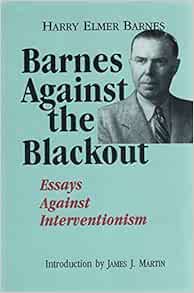
Barnes Against the Blackout
By Spencer J. Quinn | The Occidental Observer | January 2, 2026
In short, there is no unique or special case against Nazi barbarism and horrors unless one assumes that it is far more wicked to exterminate Jews than to massacre Gentiles. While this latter value judgment appears to have become rather generally accepted in the Western world since 1945, I am personally still quaint enough to hold it to be reprehensible to exterminate either Jews or Gentiles.”
—Harry Elmer Barnes
INTRODUCTION
Anyone still questioning the relevance of World War II revisionism to politics today should realize how often our liberal, globalist elites not only invoke World War II, but also ignore, suppress, or besmirch revisionism. Whenever a mainstream personality invites a revisionist on his program, he gets swiftly rebuked and called a Nazi not only by the Left but also by people presumably on the Right. Recently, Jewish commentator Mark Levin invoked the massacre of German civilians during World War II to justify the ethnic cleansing of Gaza. Clearly, whenever someone questions the authority of our liberal elites, they fire back with World War II. Since Adolf Hitler and the Nazis represent the most extreme form of evil and since globalist liberalism is the ideological opposite of Nazism, any form of oppression and aggression by globalist liberals is justifiable—as long as it is aimed against so-called “Nazis.” And if you happen to be against liberalism or globalism these days, it’s only a matter of time before you get dubbed a “Nazi.”
Historian Harry Elmer Barnes understood this perfectly over seventy years ago and promoted revisionism in the face of eerily similar oppression and backlash. Nine of his most incisive essays on the topic—written between 1951 and 1962—are collected in Barnes Against the Blackout, which was published by the Institute for Historical Review in 1991. Several important themes run through these essays. First, Barnes wishes to proselytize revisionism, and does so by constantly referencing and summarizing the great American works of revisionism of his day. These include:
- American Foreign Policy in the Making, 1932-1940 (1946) and President Roosevelt and the Coming of the War, 1941 (1948) by Charles Beard
- America’s Second Crusade (1950) by William Chamberlin
- The Roosevelt Myth (1948) by John T. Flynn
- Pearl Harbor: The Story of the Secret War (1947) by George Morgenstern
- The Tragedy of Europe (1940-1945) and Makers of War (1950) by Francis Neilson
- Design for War (1951) by Frederic Sanborn
- Back Door to War: The Roosevelt Foreign Policy 1933-1941 (1952) by Charles Tansill
Given the suffocating interventionist hysteria of the time, major publishers declined to publish these volumes despite how many of them had been written by prominent, well-respected historians. Either the publishers were ardent interventionists themselves, or they feared backlash from anti-revisionists who wielded great power in America, just as they do today. Except for the Neilson volumes, which were self-published, these works found only two small publishing houses brave enough to publish them: Regnery and Devin-Adair.
Two later volumes which Barnes discusses often are The Origins of the Second World War (1961) by AJP Taylor and The Forced War (1961) by David Hoggan. (See part one of my three-part review of Hoggan here.) These prove to be slight exceptions to Barnes’ America-centric approach since Taylor was British, and, although Hoggan was American, his work was only available in German at the time.
Another crucial theme running through Barnes Against the Blackout is the presentation of the evidence for revisionism. How do we know the official war narratives are less correct than what the revisionists offer? Barnes is never shy about sharing this information—and there is a lot of it. As with many essay collections from a single author about a single topic, there’s much overlap. And that’s okay. It’s never too much of a good thing revealing how President Franklin Delano Roosevelt “lied the United States into war.”
Describing exactly how the establishment suppressed revisionism in Barnes’ day emerges as another important theme. Barnes focuses on it most in his first two essays, both published in 1953: “Revisionism and the Historical Blackout” (which also serves as the first chapter in his collection Perpetual War for Perpetual Peace from the same year) and “The Court Historians Versus Revisionism.”
Barnes’ final theme is also his most speculative: extending revisionism into the Cold War and postulating how it might avert a nuclear Armageddon. Here is where we find Barnes at his most stunningly prescient but also were he winds up, in spots, to be somewhat dated. Through it all, he utilizes George Orwell’s 1984, which never fails to produce a parallel for whatever point Barnes wishes to make. He explores this novel’s uncanny mirroring of reality in the book’s final essay, 1952’s “How ‘Nineteen Eighty-Four’ Trends Threaten American Peace, Freedom, and Prosperity.”
Barnes Against the Blackout is also interesting for its seemingly negligible treatment of the Jews. Barnes says very little about them directly. However, this amounts to what I call an anti-theme because any reader familiar with Jewish power and supremacy can fill in the blanks where Barnes could have opined about the Jews, but didn’t—or at least didn’t seem to. This adds an extra layer of meaning to Barnes Against the Blackout.
THE EVIDENCE
The evidence for World War II revisionism which Barnes compiles appears in two distinct yet related branches of history: Pearl Harbor revisionism and Western European revisionism. For the former, he relies greatly on Tansill, Sanborn, and Morgenstern, and demonstrates how the U.S. not only goaded the Japanese into attacking as a “back door to war” against Japan’s ally Nazi Germany, but also knew where the attack would occur and approximately when, thereby outraging the American public into supporting military intervention. Barnes believes this “constituted one of the major public crimes of human history.”
The major facts line up as so:
- Roosevelt floated war with the Japanese as early as 1933 during one of his first cabinet meetings.
- The U.S. aided and encouraged Chiang Kai Shek to fight against the Japanese in China during the 1930s.
- Days before the Pearl Harbor attack, Roosevelt ignored Japanese Prince Fumimaro Konoye’s peace overtures which proposed humiliating concessions for Japan in return for “a little time and a face-saving formula.”
- In early 1941 Ambassador Joseph Grew had clearly warned that Pearl Harbor would be the likeliest point of attack. Despite agreements from Washington, US forces at Pearl Harbor remained unprepared for it.
- Secretary of War Henry Stimson stated on November 25, 1941 that, “the question was how we should maneuver them [the Japanese] into the position of firing the first shot without too much danger to ourselves.”
- The US had intercepted the “East Wind Rain” message three days before the attack, which clearly signaled Japanese intentions. Yet Admiral Husband Kimmel and Lieutenant General Walter Short, who were responsible for Pearl Harbor, were kept in the dark about it.
Barnes presents most of this information while piercing holes in the specious logic of pro-interventionist works written by what he calls “court historians.” The two most relevant to Pearl Harbor are Herbert Feis, who wrote The Road to Pearl Harbor (1950), and Basil Rouch, who wrote Roosevelt from Munich to Pearl Harbor (1950). Barnes demonstrates how these historians either ignored, distorted, or misconstrued the above evidence. His point is clear: if the notions of Pearl Harbor being a surprise attack and Roosevelt’s naïve innocence about it were lies, there’s no telling what other lies had been told. It turns out there were many.
As for Western Europe, the facts are equally damning, if perhaps more voluminous. All of them cannot be included a single review, but the points Barnes most often bangs home include:
- The diplomatic history of the 1930s, as collected by Taylor and Hoggan, shows that Adolf Hitler did not want war and did what he could to avoid it.
- The diplomatic history also reveals that Hitler had made reasonable requests to Poland regarding the “international” (yet very German) city of Danzig; yet Polish leaders refused to negotiate at the urging of Lord Halifax in England who had given Poland a “blank check” assurance of English military support against Germany.
- In his last report as Chief of Staff in 1945, General George Marshall had claimed that Hitler “far from having any plan of world domination, did not even have any well-worked-out plan for collaborating with his Axis allies in limited wars, to say nothing of the gigantic task of conquering Russia.”
- Hitler had allowed tens of thousands of British troops to escape at Dunkirk “to promote peace sentiments in Britain.”
- Hitler had excellent reasons to invade the Soviet Union since the Soviets had “practiced sabotage, terrorism, and espionage against Germany, had resisted German attempts to establish a stable order in Europe, had conspired with Great Britain in the Balkans, and had menaced the Third Reich with troop concentrations.”
- Documentary evidence, such as “The German White Paper” found by the Germans after their conquest of Poland, demonstrates the extent to which American ambassador William Bullitt had assured Poland of American military support in the event of war with Germany. This was corroborated by Czechoslovak president Eduard Benés who claimed in his autobiography that on May 29th, 1939 Roosevelt himself had assured him that if war broke out in Europe, America would join the fight against Germany.
- The Lend-Lease program, the “Destroyer Deal” between Britain and the United States, the secret Tyler Kent documents, and Roosevelt’s 1941 meeting with Winston Churchill in Newfoundland offer circumstantial evidence that Roosevelt had clear belligerent intentions well before war was declared.
As with Pearl Harbor, Barnes often presents this evidence while reviewing books written by court historians. The most prominent of these is The Struggle Against Isolation, 1937–1940 (1952) by William Langer and SE Gleason. Despite never proclaiming Hitler’s innocence, Barnes repeatedly stresses that the man’s sole responsibility for starting the war is a complete falsehood—a falsehood which is the foundation of all post-1945 politics. In his 1962 essay “Revisionism and Brainwashing,” he states with characteristic flourish:
It is unlikely that there has been any vested interest in dogma, opinion, and politics since the birth, death, and resurrection of Jesus Christ equal in intensity to that built up around the allegation that Hitler was solely responsible for the outbreak of war in 1939.
One interesting side note: Barnes implies more than once that it was Hitler’s actions in East Asia rather than Europe which truly antagonized Roosevelt. This contradicts some of Barnes’ other claims about Roosevelt’s opposition to Hitler vis-à-vis Europe. Take, for example, this paragraph from the essay “Rauch on Roosevelt”:
Indeed, it was only in 1938, when Hitler recalled his military mission from China, where Nazi officers had been directing the forces of Chiang Kai-shek against the Japanese, that Roosevelt became actually hostile to Hitler in his policies, whatever the previous rhetoric. Right down through the Spanish Civil War, Mr. Roosevelt condoned when he did not favor, most of Hitler’s policies. Even as late as August, 1939, it appears from the Nazi Soviet Relations that Roosevelt was inclined to put nothing in the way of Hitler if he abandoned support of Japan, sent his military back to help Chiang, and delivered arms to the Chinese.
This is an interesting conundrum considering that Barnes brings up Benés’ recollection from May 1939 in the same essay.
THE BLACKOUT
Barnes spills a lot of ink outlining the ways in which revisionism was suppressed and marginalized after 1945. This often resulted from mainstream historians either having vested professional interests in perpetuating the “good war” myth of World War II—since they themselves promoted it while it was happening—or they sought the wealth, fame, and opportunity afforded to academics who adhered to the official narrative of the war.
In “Revisionism and the Historical Blackout” Barnes enumerates the following methods of suppression:
- Excluding revisionists from official documents, while allowing state-approved court historians free access to them
Barnes describes how revisionist historians had been barred from viewing many sensitive documents and in some cases had had their own notes confiscated after viewing the ones they were allowed to see. Barnes concedes that Charles Tansill did ultimately view more documents than other revisionists, but Tansill did not enjoy the free reign of information afforded to court historians like Langer and Feis.
- Intimidating publishers into not publishing revisionism
Barnes describes how political pressure groups not only ensured that revisionist volumes would not sell, but made it clear that publishers releasing such material would face business-crippling backlash. Barnes recalls how a major publisher explained this to him despite his personal sympathies towards revisionism. Libraries, book clubs, and nationwide periodicals also contributed to this blackout. Barnes mordantly notes that the post-1945 “Blackout Boys” outdid the Nazis in suppressing honest intellectual inquiry.
- Ignoring revisionist works that do get published
Barnes demonstrates how the majority of revisionist works simply did not get reviewed in important mainstream publications—or when they did, as with the case of Charles Beard, they received either cursory attention or were maliciously panned. It almost goes without saying that this silent treatment was not afforded to court historians, whose works received ample praise everywhere. Barnes relays the following recollection from journalist Oswald Garrison Villard to illustrate his point:
I myself rang up a magazine which some months previously had asked me to review a book for them and asked if they would accept another review from me. The answer was, “Yes, of course. What book had you in mind?” I replied, “Morgenstern’s Pearl Harbor.”
“Oh, that’s that new book attacking F.D.R. and the war, isn’t it?”
“Yes.”
“Well, how do you stand on it?”
“I believe, since his book is based on the records of the Pearl Harbor inquiry, he is right.”
“Oh, we don’t handle books of that type. It is against our policy.”
- Smearing revisionists personally
Barnes offers several examples of ad hominem attacks upon revisionist historians by the “Smearbund,” as he calls them. Often “isolationism” itself became a slur, as if labeling a person thusly were reason enough to dismiss him. More often, however, reviewers would attempt to ruin a revisionist’s reputation by imputing some evil or underhanded motive rather than argue the facts. Barnes notes how reviewers used phrases such as “bitterly partisan” or “blind anger” when describing Morgenstern while ignoring their own partisan anger. He also notes how one reviewer attempted to discredit Beard because he was hard of hearing and lived on a farm. One reviewer freely admitted to lambasting The Forced War without having read a word of it.
THE COLD WAR AND BEYOND
In his 1954 essay “The Chickens of the Interventionist Liberals Have Come Home to Roost,” Harry Elmer Barnes introduces the idea of the “totalitarian liberal.” Such men (as exemplified by Arthur Schlessinger Jr.) distinguished themselves from pre-World-War-II liberals in their lust for power and abandonment of principled anti-interventionism. Such men make up James Burnham’s managerial elite as described in his 1941 work The Managerial Revolution, which Barnes discusses. Such people reject “the coexistence of conflicting political and economic systems,” and in so doing promote a “we or they psychosis” which enables elites to wage war in the name of “collective security,” a notion which Barnes finds utterly spurious. This is how it was during World War II and it was no different during the Cold War, according to Barnes, except that both sides were mutually deterred by nuclear weapons.
Barnes further extends revisionism into the Cold War in his 1958 essay “Revisionism and the Promotion of Peace.” He remembers how despite standing against World-War-II intervention, patriotic political organizations like America First later fell in line with Cold War intervention “because of the business advantages in industry, trade and finance which an extravagant armament program provided.” President Eisenhower’s “military industrial complex,” in other words. In light of this, Barnes’ passionate belief in the critical importance of revisionism becomes crystal clear. If standing against intervention in 1939 could have spared tens of millions of lives, standing against it during the Cold War could spare humanity a nuclear Armageddon. Indeed, the specter of World War III haunts much of Barnes Against the Blackout.
The final essay in the collection, “How ‘Nineteen Eighty-Four’ Trends Threaten American Peace, Freedom, and Prosperity” takes the Cold War comparison even further. The “we or they psychosis” becomes the “war psychology,” which led to the absurdity of “perpetual war through perpetual peace.” This is straight out of Orwell’s 1984, which Barnes calls “the keenest and most penetrating work produced in this generation on the current trends in national policy and world affairs.” In the novel, Big Brother (whom Barnes considers a totalitarian liberal) manufactures phony outrages to prolong phony wars designed ultimately to consolidate very real power for himself and the elite classes. And the masses are either hypnotized enough by propaganda, intimidated enough by government, or distracted enough by entertainment to go along with it. Meanwhile, all reliable historical material is destroyed to disconnect the people from their past—just like what the Blackout Boys tried to do with revisionist accounts of World War II. Barnes sees 1984 as a direct mirror to reality.
And there is much truth to this, as shown by how Barnes uses his “Orwell Formula” to predict the Vietnam War as early as 1952:
The declining public interest in the Korean War has made President Truman and his associates the more willing to accept Churchill’s proposal to shift the main psychological impact of the cold war to Indochina, where it may both revive flagging American fear and excitement and also more directly protect adjacent British interests. The Orwell formula has been faithfully worked out in first directing fear and hatred against Nazi Germany, then against Soviet Russia, next shifting antagonism more toward Communist China, and then moving the chief center of interest in the struggle against the latter from Korea to Indochina.
Despite the clarity and prescience of this essay, Barnes makes a few questionable calls. In keeping with his aversion to the Orwellian doublethink of Cold War psychology and hysteria, he impugns the Truman Doctrine as a sham meant to “rehabilitate Mr. Truman’s fast-fading political prospects.” He also paints the USSR in a more benign light than it deserves—as if the United States were the aggressor during the Cold War and had no legitimate reason to employ deterrence or containment strategies against Communism. And in 1952, perhaps the Soviets did seem to some as unlikely to pose a real threat to American interests. But this was before they detonated their first hydrogen bomb in 1953. This was before their invasion of Hungary, and the Berlin Wall, and the Cuban Missile Crisis, and a host of other threatening actions. While Barnes makes excellent points about the injustice of blacking out revisionism, this was nothing compared to the psychological warfare the Soviets waged for decades against its own people which culminated in the terror famines, the Great Terror, and the gulags.
It seems that the Soviet Union during the Cold War made for a much more appropriate nemesis than did Nazi Germany. That Barnes seems to disagree, however, is not my bone of contention here. For all I know, Barnes is correct. However, the time he should have spent dispensing with counterarguments from seasoned cold warriors like George Kennan (who barely gets a mention in Barnes Against the Blackout) was instead spent admiring the life-imitating-art impact of 1984. Interesting and enlightening for sure, but hardly the final word on the subject.
THE JEWS
Direct treatment of the Jews in Barnes Against the Blackout rarely rises above incidental. Many of the “court historians” and “Blackout Boys” Barnes mentions do happen to be Jewish—Herbert Feis, Max Lerner, and Selig Adler are some obvious examples. However, just as many if not more are gentiles, such as William Langer, Samuel Eliot Morison, and Samuel Flagg Bemis. In his essays, Barnes never singles a person out as being Jewish. This certainly protects him from the charge of Jew-baiting, but it also prevents him from drawing conclusions from the fact that while a substantial proportion of anti-revisionists were Jews, none of the nine major revisionists mentioned in Part 1 were—clearly a meaningful data point.
When he does mention American Jews directly, it’s only to let them off the hook for pushing Roosevelt into war. In 1962’s “Blasting the Historical Blackout,” he states flatly that:
Roosevelt did not need any pressure from the Jews to create his interventionism and war policy. There is little evidence that he was deeply disturbed by Hitler’s anti-Jewish policy; he was much more annoyed by the fact that Hitler’s “New Deal” had succeeded in spectacular fashion while his own had failed to bring prosperity to the United States.
Maybe this is true, but it does not mean that influential Jews in media, finance, academia, and politics were not enthusiastic if not crucial facilitators of Roosevelt’s war policy. In his 2013 work How the Jews Defeated Hitler Benjamin Ginsburg describes how American Jews professed fierce loyalty to Roosevelt and did what they could to embroil the United States in a war with Germany. As I stated in my review:
Ginsburg describes how Jews in the private sector also war mongered during this time. The heavily Jewish Century Group called for a declaration of war against Germany following the surrender of France in 1940. The press also aided Jewish belligerence through its pro-Jewish bias. For example, when Lindbergh and the Century Group’s General John Pershing were giving speeches around the same time, the Jewish-owned New York Times gave Pershing front-page coverage and relegated Lindbergh to the back pages.
The Fight For Freedom Committee was more “all out” in its pro-war activities than the Century Group.
The FFF organized a nationwide effort –with the tacit support of the White House and the behind-the-scenes support of the British Embassy—to discredit isolationists and to mobilize public opinion against Germany and in support of American participation in the war.
And by “discredit,” of course, Ginsburg means ruthlessly slander and smear. The FFF thought nothing of labeling leading isolationists and America-Firsters like Lindbergh as Nazis, fascists, or dupes of the Axis. Ironically, they would often question the patriotism of such people as a form of intimidation which preceded the McCarthy era by over a decade. For example, because Senator Burton Wheeler wished to prevent the slaughter of American lives in an unnecessary war, the FFF declared that he was a “twentieth century Benedict Arnold.” The FFF also spied upon and collected compromising information on isolationists in Congress, such as Hamilton Fish. As it turned out, the FFF discovered that Fish’s people were distributing pro-German literature and were in contact with German agents. One of Fish’s secretaries went to prison for that. At the same time, however, Ginsburg informs us that the FFF was in constant contact with British agents. Just as insidiously, the FFF and other groups planted moles at isolationist rallies in order to disrupt them.
So perhaps President Roosevelt didn’t need Jews to change his mind, but he certainly needed them to change the minds of the millions of Americans he tried to deceive. Unfortunately, Barnes entirely avoids this point. His minimal treatment of the Jewish Holocaust in Barnes Versus the Black also deserves comment. He exerts almost no effort in placing it within his blackout vs. revisionists framework. Instead, he brushes it aside by saying that the Germans ultimately suffered more than the Jews did. He’s also skeptical that the Jewish Holocaust was the enormous atrocity it was purported to be:
There is little in the history of mankind more horrible than the sufferings of the Germans expelled from their eastern provinces, the Sudeten area, and other regions, some four to six millions perishing from butchery, starvation, exposure, and disease in the process. Their sufferings were obviously far more hideous and prolonged than those of the Jews said to have been exterminated in great numbers by the Nazis. The tragedy of Lidice was re-enacted by the Czechs hundreds of times at the expense of the Sudeten Germans during the expulsion. The Morgenthau Plan, which was inspired by Stalin and his associates and passed on to Henry Morgenthau by Harry Dexter White and other Soviet sympathizers, envisaged the starvation of between twenty and thirty million Germans in the process of turning Germany into a purely agricultural and pastoral nation.
Barnes never voices any support or approval of Adolf Hitler. He admits the man was at times cruel and erratic; then again so were Churchill and Roosevelt. As far as honest statesmanship goes, however, Hitler was actually on a higher plane than any of the Allied leaders. This is a demonstrable fact, one that is borne out by the diplomatic history of the 1930s as revealed by Hoggan. One does not have to love or even like Hitler to see that of all the major world leaders of the time, he was the least responsible for war. Barnes also refuses to demonize Hitler, and actually gives space for arguments claiming that Hitler had been too soft while conducting the war. To Hitler haters, this may sound like apologism, but it really isn’t. In “Blasting the Historical Blackout” Barnes dismisses Hitler’s Jewish policy as “folly” and correctly notes that it was this, rather than any foreign policy, which engendered anti-German hatred in Allied countries. He also recalls proudly how Rabbi Stephen Wise—the rabid, Hitler-hating Jew who led the worldwide Jewish boycott against Nazi Germany—once reprinted articles by him decrying Hitler’s anti-Semitism. Barnes even states that for a decade after 1945—which is smack dab in the middle of the Barnes Against the Blackout timeline—he had wished that Hitler had been assassinated in 1938 or early 1939, which would have avoided the catastrophe of a second world war.
In light of this, it cannot be said that within the pages of Barnes Against the Blackout Harry Elmer Barnes is anti-Semitic. He’s not philo-Semitic either. Instead, like any true historian, he’s anti-Falsehood and pro-Truth. Of course, he may be right or wrong, but never does he relinquish the discipline and objectivity required of great historians to keep civilization tethered to its past so it cannot go astray in its future.
CONCLUSION
There are many minor themes running through Barnes Against the Blackout which contribute to its value. Most notable is the topic of World War I revisionism, for which Barnes was an outright champion. His 1926 work Genesis of World War made him famous in this regard. Barnes often compares and contrasts revisionism from both World Wars and demonstrates how suppression and groupthink after the latter was much more insidious and comprehensive. He also offers examples of revisionism going back to antiquity.
Like Orwell, Barnes likes to invent neologisms and slogans. My favorites are “perpetual war for perpetual peace,” “globaloney,” the “Blackout Boys,” and the “Smearbund.” His 1962 essay “Revisionism and Brainwashing” is especially poignant in its descriptions of how modern Germans had been brainwashed into accepting their own culpability and shame. Some of the most ardent anti-revisionists of Barnes’ day were post-war Germans themselves, whom, Barnes suspects, feared the equivalent of a third Punic War. Barnes also drops historical Easter eggs everywhere. Did you know that the Roman theologian Paulus Orosius smeared the ancient pagans just as outrageously as court historian Herbert Feis smeared the Japanese? Or how about how Renaissance Scholar Lorenzo Valla proved that the 4th-century Donation of Constantine decree, which solidified the secular power of the Pope, was in fact an 8th-century forgery? It took Europe 350 years to come around to this fact. Barnes hopes it won’t take Europeans nearly as long to come around to the forged history of World War II.
If Harry Elmer Barnes has any personal bias in Barnes Against the Blackout it’s one that favors peace and an honest accounting of history. Because the so-called leaders of the free world gave us neither in the 1930s and 1940s, tens of millions needlessly perished. And with globalist liberalism still supreme today, being the root cause for mass third-world immigration into America and Europe, we continue to suffer from the effects of the catastrophe of World War II. Barnes himself said it best: “Revisionism is not only the major issue in the field of historical writing today but also the supreme moral and intellectual concern of our era.”
Blood Passover, English Version (Free Book)
The Bloody Satanic Sacrifice Rituals of the Jewish Race
Ariel Toaff | 2016
 The following translation was performed free of charge to protest an injustice: the destruction by the ADL of Ariel Toaff’s Blood Passover on Jewish ritual murder. The author is the son of the Chief Rabbi of Rome, and a professor of Jewish Renaissance and Medieval History at Bar-Ilan University in Israel, just outside Tel Aviv.
Dr. Toaff is uniquely qualified to write this book, being thoroughly familiar with the derivative literature in English, French, German and Italian, as well as the original documentary sources in Latin, Medieval Italian, Hebrew and Yiddish. This is not something he worked on in secret. On the contrary, he worked on it openly with his university students and colleagues in Israel for several years; one of his students was even going to publish a paper on the subject. The author is extremely careful about what he says, and his conclusions must be taken seriously. It reads like a detective story.
If it had been published in Israel, in Hebrew, no one would have cared. There are large bodies of literature in Hebrew that Jews do not wish Gentiles to know about. But Dr. Toaff’s announcement of its publication in Italy, in Italian, raised a worldwide firestorm of fury.
Under unbearable pressure, the book was withdrawn from publication. Come in out of the darkness, and strike a blow for the light.
How Intelligence, Politics, and Foreign Interests Shaped America’s Religious Movements
By Freddie Ponton | 21st Century Wire | December 30, 2025
Christianity is back at the centre of American life, but not necessarily in the way most believers imagine. Churches are fuller, Christian language saturates politics, and faith-based identity has become a mobilising force once again. Yet beneath this revival lies a more unsettling reality: for decades, U.S. government agencies have treated religion not as sacred ground, but as strategic terrain.
This is not theory. During the Cold War, the U.S. State Department and intelligence agencies, most notably the CIA, recognised theology, doctrine, and religious institutions as instruments of influence. Faith was studied, guided, and at times quietly reshaped to serve geopolitical aims. The goal was rarely to destroy belief outright; rather, it was to domesticate it, align it, and render it strategically useful.
DOCUMENT: CIA’s use of journalists and clergy in intelligence operations – Select Committee On Intelligence Of The United States Senate One Hundred Fourth Congress, Second Session, July 17, 1996 (Source to download full pdf: US Senate Select Committee on Intelligence)
Initiatives like the Doctrinal Warfare Program illustrate the scale of this engagement. Churches with mass followings, moral authority, and transnational reach were not simply tolerated; they were targeted for influence. Orthodox congregations in the U.S. and abroad were monitored to ensure alignment with Western interests. Catholic seminaries became conduits for doctrinal shaping, funding networks, and leadership development favourable to U.S. objectives. Even Protestant and Evangelical movements, decentralised and spontaneous, were quietly steered through cultural engagement, philanthropic networks, and selective amplification of certain voices.
Sincere people seeking truth, purpose, and transcendence found themselves caught in influence systems they neither designed nor understood. Their worship, community, and faith became tools in a broader psychological and cultural battle they never consented to.
Doctrinal Warfare: When Theology Became a Battlefield
The CIA’s Doctrinal Warfare Program, particularly its work with Roman Catholic institutions, offers a rare glimpse into how intelligence agencies approach faith. Unlike cinematic portrayals of spies manipulating events, this program operated through subtler, more effective channels.
Influence was exerted via:
- Funding pipelines and philanthropic foundations, directing resources to seminaries, clergy travel, and publications
- Theological conferences and academic exchanges, creating opportunities to propagate ideas aligned with U.S. interests
- Publishing houses, journals, and media networks, shaping what doctrines and interpretations were elevated
- Selected intermediaries, often clergy or theologians, who could subtly shift discourse without appearing coerced
The program’s goal was not to dictate belief directly but to frame the boundaries of acceptable belief. Anti-communism, Western liberal ideals, and American exceptionalism were integrated into theological narratives. Over time, certain interpretations were elevated while others, particularly liberationist, socialist, or anti-Western emphases, were sidelined.
This structural influence was not limited to Catholics. Orthodox churches in the diaspora, particularly in Eastern Europe and North America, were monitored for political alignment. Protestant and Evangelical networks, decentralised and emotionally charged, presented different challenges. Leaders resisted hierarchical oversight, yet strategic use of media, donor support, and conferences quietly aligned these movements with larger political and global objectives.
The CIA and allied agencies like the Israeli MOSSAD also monitored global religious developments, from Latin America to Africa, mapping networks of clergy, seminaries, and youth movements. Influence became a form of psychological warfare: it did not coerce, but conditioned; it did not command, but subtly steered. And it thrived where people least expected manipulation, within trusted communities, sacred spaces, and moral authority.
VIDEO: David Wemhoff discusses his book John Courtney Murray, Time/Life, and the American Proposition: How the CIA’s Doctrinal Warfare Changed the Catholic Church. (Source: thkelly67 | Youtube)
Calvary Chapel, Charismatic Leaders, and the Power of Movements
Few movements illustrate both the promise and vulnerability of modern American Christianity like Calvary Chapel.
Founded in the mid‑1960s by Chuck Smith in Costa Mesa, California, Calvary Chapel emerged amidst the counterculture and the Jesus Movement. Smith welcomed surfers, hippies, and spiritual seekers alienated by both secular culture and institutional religion. Informal, emotionally open, culturally adaptive—and extraordinarily successful—it grew from a small congregation into a network of more than 1,800 churches worldwide.
Despite the ongoing debate about whether Calvary Chapel was created by individuals controlled by intelligence agencies or by charismatic individuals, the movement demonstrates a lesson intelligence agencies recognised decades ago: youth-driven religious networks are powerful instruments of social, political and cultural influence.
Figures like Lonnie Frisbee, a magnetic and unconventional evangelist, helped ignite the Jesus Movement and played a decisive role in Calvary Chapel’s early expansion. Frisbee’s countercultural persona, preaching on beaches, leading communal outreaches, and drawing thousands of young converts, was a force institutions could admire, attempt to understand, but never fully control.
Similarly, Paul Cain, a prophetic figure in charismatic networks, influenced theological subcultures with a focus on vision, revelation, and spiritual authority. According to reports, Cain was also a consultant to the Paranormal Division of the Central Intelligence Agency and the FBI. Like Frisbee, Cain became controversial, not because he was a confirmed intelligence operative, but because charismatic authority challenges hierarchical control, making it both influential and unsettling.
Calvary Chapel and these figures illustrate a key pattern: movements can grow organically, capture attention, and mobilise communities, making them valuable, and sometimes threatening, to political and intelligence structures. While the direct manipulation claims and the CIA militant connection remain debatable, historical examples like the Doctrinal Warfare Program prove that states do seek to shape religious institutions at scale, often through indirect methods rather than overt control, hence the lack of evidence thereof.
From Pews to Power: Evangelical Politics, Israel, TPUSA, and the Cost of Capture
By the late 20th century, Evangelical Christianity had evolved into a political powerhouse. Networks that began as spiritual awakenings now functioned as engines of political mobilisation, with youth-oriented, media-savvy outreach bridging the gap between churches and the political arena.
TPUSA and Charlie Kirk
Organisations like Turning Point USA (TPUSA) drew from these ecosystems, churches, conferences, campus ministries, and donor networks that had been shaped by decades of cultural, doctrinal, and ideological influence. Faith-language blended seamlessly with nationalism, free-market rhetoric, and civilizational anxiety, mobilising millions of voters.
The 2024 U.S. presidential election highlighted the real-world impact: Evangelical networks were decisive in returning Donald Trump to the White House. For believers, this was framed as a moral imperative or spiritual duty. For observers, it revealed how religious movements could be strategically leveraged within political frameworks.
The assassination of Charlie Kirk, co-founder of TPUSA, shocked the nation and intensified national reflection. While there is no direct evidence ( at least not yet), linking churches or religious movements to the attack, the public reaction underscores a critical truth: powerful social networks rooted in faith become conduits of influence, whether intended or incidental.
As unsettling as it may be for the US government, it is worth noting that an intense social-media rift has emerged between TPUSA and podcaster Candace Owens, with competing narratives and accusations fueling distrust of official accounts surrounding the Charlie Kirk killing at UVU. Interestingly, some critics, Candace Owens among them, contend that the assassination of Charlie Kirk carries the hallmarks of a sophisticated intelligence-style operation, raising uncomfortable questions about whether certain figures within TPUSA may have been more deeply entangled in the events than the public has been led to believe. A decentralised, global network of self-styled citizen journalists is currently crowdsourcing footage, timelines, and open-source data, arguing that gaps and inconsistencies warrant deeper scrutiny beyond mainstream reporting. This phenomenon has amplified public pressure on agencies such as the FBI and on TPUSA to clarify unanswered questions and reconcile discrepancies in their account of the events of September 10, 2022.
Much like the unresolved shadows that followed the JFK assassination, Charlie Kirk’s killing has placed intelligence agencies, the military, the FBI, and even foreign actors like Israel at the center of a fraught public controversy, not through proven culpability (at least not yet), but through the swirl of suspicion and unanswered questions that inevitably surround the death of a defining religious and political figure in the American conservative sphere, leaving many to ask whether this is coincidence or something more troubling left unexplained.
Christian Zionism and Israeli Influence
No discussion of modern Evangelical power is complete without considering the strategic relationship between U.S. Evangelicals and the State of Israel.
This alliance is public and well-documented. Evangelical Christians, especially in the United States, became one of the most reliable pro-Israel voting blocs, influenced not just by policy arguments but by theological frameworks, Christian Zionism, which frames Israel as divinely central to biblical prophecy.
Israeli political leaders and advocacy organisations have cultivated this alignment via:
- Pastors’ conferences in Israel
- Evangelical media networks and tours
- Donor networks and lobbying partnerships
Organisations such as Christians United for Israel (CUFI) mobilise millions of voters, influence Congressional votes, and amplify foreign policy priorities. During the Trump administration, these networks helped drive decisions like the Jerusalem embassy relocation, Iran policy shifts, and strengthened U.S.-Israel alignment.
Yet this partnership is not uncontested. Younger conservatives and Evangelicals, particularly those aligned with independent thinkers like Charlie Kirk, increasingly question whether faith-based loyalty to foreign policy interests undermines America-first priorities. This generational tension highlights a growing divergence within conservative Christianity: between inherited religious-political alliances and emerging calls for national sovereignty, prudence, and domestic priority.
Moreover, the case of Turning Point USA illustrates how foreign influence can intersect with faith-based movements to shape political power. TPUSA’s open alignment with pro-Israel advocacy networks, from educational trips and conferences to donor engagement, demonstrates how theological and ideological commitments can be leveraged to advance strategic interests. This organisational alignment and associated messaging reveal a clear pattern of external actors using popular religious and political networks to sway domestic policy and voter priorities in the United States. This dynamic mirrors broader trends seen in movements like Calvary Chapel, where charismatic leaders and faith communities, intentionally or not, become conduits for shaping societal and political behaviour, highlighting how belief can be instrumentalised as a tool of influence. Believers are constantly reminded by pastors such as Garid Beeler, of VISION Calvary Chapel in Irvine, CA, that they need to unconditionally embrace the so-called God’s plan for Israel, which in their eyes legitimises Israel’s occupation of Palestine, and the subsequent genocide, on the basis that the Lord specifically gave the Hebrews the land thousands of years ago.
Believers as Collateral in the Machinery of Influence
The story of institutional capture is not about disloyal Christians or malign churches. It is about power exploiting vulnerability.
The State Department, CIA, and allied actors like Israel did not invent faith crises, but they mastered the art of steering movements. They understood that belief motivates action, doctrine shapes identity, and institutions built on trust are uniquely vulnerable to manipulation.
Jay Dyer’s analysis, which we are featuring today, frames this landscape without demonising believers: faith itself is not the enemy, but it has been treated as a resource, managed, redirected, and at times hollowed out by forces whose goals are strategic, political and financial, rather than spiritual.
If Christianity is to withstand this era with integrity intact, it will require discernment, humility, vigilance, and, of course, the ability to separate the Gospel from the machinery of power. The war was never against believers, but belief, as an institution, has been under attack all the same.

Jay Dyer writes about the historical and geopolitical factors of state and private interference in ecclesial and religious affairs…
Institutional Capture Explained: The State Dept, CIA & Orthodox, Roman Catholic & Protestant Churches
The notion of state interference in the life of the Church is well known to students of Church history: Arian Emperors, Imperial support for iconoclasm, the Frankish and Germanic control of the papacy, as well as the investiture controversy should all come to mind. These famous scandals demonstrate the persistent cunning on the part of the state to install, influence and control religiosity in the realm, and to students of geopolitics this should also come as no surprise. What is odd, however, is that when this concept arises in modern discussions, it is relegated immediately to the domain of “conspiracy theory,” unless of course you are talking about the KGB and NKVD relationship to Russian clerics in the 20th century.
It only turns out to be a “conspiracy theory” when one points to the US State Department, the CIA, various foundations, NGOS and academic institutions (often closely linked to the intelligence apparatus) – all of whom openly seek to alter and change Orthodox theology, as well as the theological positions of the Roman Catholic and Protestant communions. First, it is worth noting that missionary work is a classic espionage cover: Obviously, I don’t mean all missionaries are spies, but that it has famously been a useful cover for espionage work, which is precisely why Russia has recently banned groups like the Jehovah’s Witnesses and Scientology. These entities can be used as a form of soft power or even more covert intelligence operations. Similarly, classic cover for foreign operations of this sort has used aid organisation cover, such as the Red Cross or USAID.
In fact, even mainline publications regularly report this fact, though it seems to be lost on so many, especially among the intelligentsia who pride themselves on grasping the practicality of realpolitik. Christianity Today writes:
“Many of America’s first spies were missionaries or came from missionary backgrounds. Often enough, they were the only Americans who had lived abroad—not just among locals but as locals. While other American spies learned about the world through books and couldn’t really grasp its full range of quirks and complexities—“like tourists who put ketchup on their tacos,” as Sutton puts it—missionaries spoke several languages and knew the subtle differences between local dialects. They understood local cultures and faiths from the ground up and knew intuitively how to navigate between them. They knew, in short, “how to totally immerse themselves in alien societies.” But they always identified first and foremost as Christians and as Americans, and when they were called to serve the nation, they did not hesitate to do so.”
This was not unique or new; Orthodox monastic spies were also used by British intelligence in the infamous case of “Father Dimitrios”:
“The story of Father Dimitrios, or David Balfour, who turned out to be a British spy in pre-World War II Greece, is a fascinating yet relatively little-known chapter in modern Greek history.”
Father Dimitrios, the monk with the voice of an angel, turned out to be a spy for the British Intelligence Service. That’s a shame because the mission and wartime actions of the British priest could make a nail-biting spy novel or film.
From 1937 to 1939, the English spy, wearing his priest’s robes and his long, bifurcated beard, performed his ecclesiastical duties close to Greece’s royal family. His relations with King George II, the successor to King Paul and Princess Frederica, were especially close. His access to the royal palace undoubtedly gave him access to valuable information.
British Intelligence must have learned a great deal about the Greek royal family during these crucial prewar years. King George II was a paternal first cousin of Queen Elizabeth’s husband, Prince Philip, the Duke of Edinburgh.
Members of the royal family often confessed to their beloved priest. At the same time, Balfour, under the cover of Father Demetrios, forged important acquaintances with high-ranking military officers and politicians with the blessings of the palace.
During World War 2, for example, dozens of missionaries were using their clerical cloaks as their espionage cloak, spying for the Allies. Time Magazine explains:
“His [Protestant Missionary Alfred Eddy] most audacious undertaking included a plot to “kill,” as he described it, “all members of the German and Italian Armistice Commission in Morocco and in Algeria the moment the landing takes place.” In a straightforward and matter-of-fact memo, he told OSS head William Donovan that he was targeting dozens of people. He additionally ordered the executions of “all known agents of German and Italian nationality.” Never one to mince words, he called the proposal an “assassination program.”
To orchestrate his bloodthirsty plot, Eddy hired a team of Frenchmen. He planned to frame the executions as a “French revolt against Axis domination.” “In other words,” he explained to Donovan, “it should appear that the dead Germans and Italians were ‘the victims’ of a French ‘reprisal against the shooting of hostages by the Germans and other acts of German terror,” and not an OSS operation.
At about the same time that he was recruiting French hitmen, he wrote to his family about the sacrifices he was making for Lent. He described the Easter season as “abnormal” this year. “I am certainly abstaining from wickedness of the flesh,” he confessed. With his wife thousands of miles away, that was not too difficult. “I haven’t even been to a movie since Lisbon, I don’t overeat anymore, and I allow myself a cocktail at night, but never before work is all done.”
And,
“American intelligence leaders had stumbled upon the fact that missionaries make great spies. They have excellent language skills, they know how to disappear into foreign cultures, and they are masters at effecting change abroad. But while missionary spooks believed that their wartime work was necessary, they also wrestled with the moral ambiguities inherent in their actions.”
This is just one example among countless, but it serves to illustrate the point – in this case, the supposed man of the cloth is engaged in assassination missions. A fortiori, the US Government would also see the power in utilising religion for the promotion of Americanism. During the Cold War this was ramped up to extreme degrees as CIA operatives and strategists like C.D. Jackson allied with media magnate and Skull & Bonesman Henry Luce – of Time Magazine, to recruit various prominent academics and Jesuits like John Courtenay Murray to help ensure the Vatican and in particular the Second Vatican Council, would include in its dogmatic degrees new doctrinal statements that were amenable to Americanism. This unique style of interference was even highlighted by a congressional investigation in 1996 into the CIA’s use of ministers and journalists here (including Peace Corps Volunteers).
This was combined with separate operations from Helliwell, Angleton, Donovan & Colby to utilise Opus Dei, the Vatican Bank and drug running for black operations funding in the now infamous Operation Gladio, which also saw the See of Rome aligning itself with organised crime to supposedly “save the world from communism.” However, as Catholic lawyer David Wemhoff has demonstrated in his masterful and unparalleled 800-page, vastly sourced tome, John Courtney Murray, Time/Life Magazine and the American Proposition, Jackson’s now declassified “Doctrinal Warfare Program” led the Roman Church into the hands of new masters at the US State Department and the CIA.
Indeed, this is precisely why Pre and Post-Vatican 2 popes, from Pius XII to Paul VI to John Paul 2 were meeting with Colby, Kissinger and William Casey on a consistent basis during the Cold War. And, if you are a perceptive reader, you can already piece together the blackmail and compromise operations that the world has seen through the Epstein saga were simply a window into how these institutions were similarly blackmailed and compromised, which is why there have been so many scandals in the Roman Church concerning pedo crimes, and likely relates to why Benedict resigned.
In regard to the Protestant Churches, the Rockefeller family is quite proud of, and openly brags about their influence and dominance of the Protestant religious world, through their donations and tax-free foundation offerings. These offerings, of course, come with strings attached, such as the decision to push the newly formed “social gospel” concept of the early 20th century. Eventually, the Rockefellers were creating entire seminaries and universities dedicated to the promotion of David’s influences from Keynesian/Fabian and Austrian economic theory, as well as Malthusianism and eventually technocracy, through the recruitment of Zbigniew Brzezinski after the publication of his seminal 1970 text, Between Two Ages: America’s Role in the Technetronic Era.
Few know David Rockefeller himself spent time in intelligence work and transferred this knowledge of networking and banking operations into his business ventures, as he discusses in his Memoirs. In fact, Brzezinski’s book also includes chapters discussing the role of the Post-Vatican 2 Roman Catholic Church in the promotion of Americanism and technocratic hegemony. It should also be noted that the Rockefellers didn’t merely have an interest in steering the Protestant and evangelical churches into liberalism and modernism, but also set their sights on Rome and Orthodoxy, as Wemhoff notes.
For the Orthodox World, the price of siding between two thieves came at a high cost, as the Orthodox England blog notes, concerning the place of the Russian Orthodox Church between the KGB and the CIA. Similarly, it has recently been declassified that the OSS placed pressure on the Patriarch of Constantinople, as the CIA said:
“In an OSS interoffice memo dated March 26, 1942, an intelligence agent named Ulius L. Amoss wrote this to a fellow OSS agent named David Burns:
The Archbishop was extremely pleased at having met and lunched with you. He has told me that the entire facilities of his organisation are at our disposal. He put it in these words: “I have three Bishops, three hundred priests and a large and far-flung organisation. Everyone under my order is under yours. You may command them for any service you require. There will be no questions asked, and your directions will be executed faithfully. Please tell Mr Burns for me that this is so.”
A month later, on April 25, the 56-year-old Greek Archbishop attempted to enlist in the U.S. Army. He was turned down.
A few weeks after that, on May 14, Ulias Amoss, the same intelligence agent who wrote the March 26 memorandum, wrote a letter to Athenagoras, thanking him for the Greek Archdiocese’s ongoing cooperation, saying, in part, “The care with which your Bishops and Priests have cooperated has impressed everyone and the report that, perhaps, as many as a hundred thousand names will be returned to us is astounding.” On the same day, William J. Donovan himself — the head of the OSS — also wrote to Athenagoras, “The reports and descriptions of Greek-American youth of military age so kindly undertaken by you are coming in in splendid volume. The care with which Your Grace has managed this important service is of great interest to our armed services, and I wish to express my deep appreciation for your loyal and patriotic assistance.”
This special relationship with US intelligence never ended and continues to this day as the backdrop to the actions of the Phanar and GOARCH in the US:
“Archbishop Elpidophoros, the head of the Patriarchate of Constantinople’s Greek Orthodox Archdiocese of America, was the honoured guest at the National Intelligence University in Maryland earlier this week, where he delivered an address to the U.S. intelligence community.
The university brings together faculty and students from all 18 of the nation’s intelligence communities.
As the Greek Archdiocese notes, the Archbishop’s talk on “Russia’s Weaponisation of Religion in the Ukraine Conflict” was the first-ever address from a GOARCH leader to the U.S. intelligence community. At the same time, the Patriarchate of Constantinople has a long history of cooperation with the U.S. intelligence community, as detailed in documents released by the CIA.”
While it may seem like a far-off footnote in a dusty history book on Byzantium or the Borgia Papacy, the reality of state and private interference (and control!) in religion is a stark reality. The goal of the state is the maintenance and projection of power, simply put. Religion is a tremendous force for control and power in the world, both good and evil, but for the state, religion is simply another domain of human culture for the projection of power, and in today’s world, that is most often projected as soft power.
If you have not read Joseph Nye’s famous essay on Soft Power, I recommend it here. Understanding soft power gives a window into the attitude of the power elite and their perspective on religions and sects as tools – pawns on the grand chessboard, to use Brzezinski’s terminology. One need only think of Brzezinski’s own recruitment and usage of what would become Al Qaeda in the Soviet War in Afghanistan in Operation Cyclone – the usage of a radical religious sect for US objectives – as a classic example.
Investigation Into U.S. Military Bioweapons-Origin of Tick-Borne Lyme Disease Successfully Added to 2026 NDAA
By Jon Fleetwood | December 12, 2025
U.S. Representative Chris Smith (R-NJ) has successfully included his amendment to investigate whether the U.S. military weaponized ticks with Lyme disease into the 2026 National Defense Authorization Act (NDAA).
The ordeal underscores the national security threat posed by laboratory pathogen manipulation.
Rep. Smith, who is Co-Chair of the Congressional Lyme and Tick-Borne Disease Caucus, had offered similar amendments—one in 2019 and the other in 2021—which passed the House, but failed in the Senate.
The successful addition of the amendment follows FDA Chief Dr. Marty Makary’s statements during a November podcast, in which Makary expressed his belief that Lyme disease was created in U.S. military Lab 257 on Plum Island, New York.
A Thursday press release from Smith’s office reads:
A critical amendment authored by Rep. Chris Smith (R-NJ) to investigate whether the U.S. military weaponized ticks with Lyme disease has been included in the National Defense Authorization Act for Fiscal Year 2026 (FY26 NDAA) (S. 1071), which has cleared the U.S. House of Representatives, headed to the Senate, and is expected to be signed by President Trump upon its final passage.
Smith’s amendment—now Sec. 1068 of the bill—directs the Government Accountability Office (GAO)—the Congressional “watchdog”—to investigate the Cold War-era Department of Defense (Department of War) bioweapons program and determine whether they ever used ticks as hosts or delivery mechanisms for biological warfare agents.
In the press release, Smith emphasized that “New Jersey has one of the highest Lyme rates in the United States—the disease is present in all 21 counties.”
“The pervasive presence of Lyme disease in New Jersey not only carries concerns for civilians, but also for the military personnel stationed in the state—especially and including those serving at Joint Base McGuire-Dix-Lakehurst, part of which is located within my congressional district,” the republican added.
The press release explained that Smith’s amendments were inspired by Kris Newby’s book, Bitten: The Secret History of Lyme Disease and Biological Weapons.
The book includes interviews with Dr. Willy Burgdorfer, the federal researcher and U.S. bioweapons specialist credited with discovering Lyme disease.
Dr. Burgdorfer has revealed that “he and other bio-weapons specialists injected ticks with pathogens in order to cause severe disability, disease, and even death to potential enemies in unsuspecting ways.”
Smith’s amendment in the NDAA would compel the Comptroller General of the United States “to conduct an exhaustive review of research conducted by the military, the National Institutes of Health (NIH), the U.S. Department of Agriculture (USDA), and other federal agencies between the period of January 1, 1945 and December 31, 1972, regarding experiments involving Spirochaetales and Rickettsiales—two forms of tick-borne bacteria.”
Smith says we are now “one step closer to finally determining whether the U.S. government’s bioweapons program contributed to the proliferation of Lyme disease.”
“The hundreds of thousands of New Jerseyans suffering from Lyme disease—in addition to the millions across the United States—deserve to know the truth about the origins of their illness. An enhanced understanding of how Lyme came to be will only assist in finding a cure for this debilitating disease,” said Smith.
Rep. Smith’s amendment reads:
SEC. 1068. GAO REVIEW AND REPORT ON BIOLOGICAL WEAPONS EXPERIMENTS ON AND IN RELATION TO TICKS, TICK-BORNE DISEASE.
(a) REVIEW.— The Comptroller General of the United States shall, to the extent practicable, conduct a review of research conducted during the period beginning on January 1, 1945, and ending on December 31, 1972, by the Department of Defense, including by the Department of Defense in consultation with the National Institutes of Health, the Department of Agriculture, or any other Federal department or agency on—
(1) the use of ticks as hosts or delivery mechanisms for biological warfare agents, including experiments involving Spirochaetales or Rickettsiales; and
(2) any efforts to improve the effectiveness and viability of Spirochaetales or Rickettsiales as biological weapons through combination with other diseases or viruses.
(b) LOCATION OF RESEARCH.— In conducting the review under subsection (a), the Comptroller General shall review research conducted at facilities located inside the United States and, if feasible, facilities located outside the United States, including laboratories and field work locations.
(c) INFORMATION TO BE REVIEWED.—
(1) CLASSIFIED INFORMATION.— In conducting the review under subsection (a), the Comptroller General shall review any relevant classified information.
(2) MATTERS FOR REVIEW.— In conducting the review under subsection (a), the Comptroller General shall review, among other sources, the following:
(A) Technical Reports related to The Summary of Major Events and Problems, US Army Chemical Corps, FY 1951–FY 1969.
(B) Site Holding: CB DT DW 48158
Title: Virus and Rickettsia Waste Disposal Study.
Technical Report No. 103, January 1969.
Corp Author Name: Fort Detrick, Frederick, MD.
Report Number: SMUFD-TR-103.
Publish Date: 1969-01-01.(C) Site Holding: CB DT DW 60538
Title: A Plaque Assay System for Several Species of Rickettsia.
Corp Author Name: Fort Detrick, Frederick, MD.
Report Number: SMUFD-TM-538.
Publish Date: 1969-06-01.(D) Site Holding: CB DW 531493
Title: Progress Report for Ecology and Epidemiology and Biological Field Test Technology, Third Quarter FY 1967.
Corp Author Name: Army Dugway Proving Ground, UT.
Publish Date: 1967-05-08.(E) Any relevant scientific research on the history of Lyme disease in the United States.
(d) REPORT.—
(1) IN GENERAL.— Not later than two years after the date of the enactment of this Act, the Comptroller General shall submit to the Committees on Armed Services of the House of Representatives or the Senate a report that includes the following:
(A) A list of the research projects reviewed under subsection (a) and an assessment of the scope of such research.
(B) A finding by the Comptroller General as to whether such review could lead to a determination that any ticks used in such research were released outside of any facility (including any ticks that were released unintentionally).
(C) A finding by the Comptroller General as to whether such review could lead to a determination that any records related to such research were destroyed, and whether such destruction was intentional or unintentional.
(2) FORM OF REPORT.— The report required under paragraph (1) shall be submitted in unclassified form, but may contain a classified annex.
If the GAO does its job and follows the paper trail where it leads, this amendment may finally force the U.S. government to answer a question it has avoided for decades: whether a taxpayer-funded Cold War bioweapons program left millions of Americans paying the price with their health.
Supreme Court Vacates NY Ruling That Amish Cannot Have an Exemption to Vaccination Requirements
By Aaron Siri | December 10, 2025
I’m pleased to announce that the United States Supreme Court (SCOTUS) has vacated the Second Circuit’s decision that enabled New York State to persecute the Amish for refusing to inject pharma products in violation of their religious beliefs. SCOTUS remanded the case (Miller v. McDonald) to the Second Circuit to reconsider its illiberal and unconscionable decision. A huge step in the right direction—the day the Amish are compelled to pierce their bodies in violation of their religion is the day religious freedom dies in this country.
I discussed the Amish situation further in Chapter 11 of my book, Vaccines, Amen, including how their children are far healthier than the surrounding vaccinated population:
[T]he NYS DOH decided to wage war on the Amish community, seeking to levy financially ruinous fines on them unless they vaccinate their children. My firm has the privilege of representing the three Amish schools that received these violations. The sworn court papers in this case evidenced to the Court that the families with children in these three Amish schools have a total of 168 unvaccinated children (no vaccines) and that none of these children have any of the chronic health issues that plague children in the United States.
We also provided sworn expert evidence to the Court attesting that among a random sample of 168 U.S. children, one would expect to find (based on the background rate of chronic disease among U.S. children) 31 cases of environmental allergies, 15 cases of ADHD, 10 cases of asthma, 9 cases of food allergies, and 4 cases of ASD. Yet, the 168 unvaccinated Amish children whose families New York wants to persecute are free from the chronic health conditions—all related to some form of immune system dysregulation—that plague the vaccinated communities in New York.
Since vaccination is supposedly about improving health, and the Amish who do not vaccinate are clearly healthier, one would expect the NYS DOH to leave them alone. But that is not how this religion works. The vaccine zealots in the NYS DOH cannot stand that the Amish refuse to abandon their beliefs in favor of the religious beliefs held by the NYS DOH officials regarding vaccines. The “health” officials are willing to sacrifice the way of life and belief system of these Amish children and their community, that has kept them far healthier, if they refuse to bend the knee to adopt cult-like vaccine beliefs.
These “health” officials also apparently cannot stand that the Amish children are healthier and are even willing to wage war against them until they submit and receive every vaccine New York demands—so they can be just as “healthy” as all the children outside the Amish community.
The Amish earnestly seek to avoid conflict but because violating their sincerely held religious beliefs is not an option, they have been placed in the impossible position of being required to leave New York to simply send their healthy children to Amish schools on Amish land. As of this writing, my firm, along with co-counsel, continues to litigate on behalf of the Amish to defend their freedom to practice their religion in peace.
Epstein, Dershowitz, and the secret war to discredit Mearsheimer-Walt Israel lobby study
By David Miller | Press TV | December 9, 2025
In 2006, Jeffrey Epstein exchanged emails with his lawyer, Harvard Law professor Alan Dershowitz, in an attempt to support Dershowitz’s criticism of John Mearsheimer and Stephen Walt, who had just published a groundbreaking essay on the Israel lobby.
Some commentators argue that this incident ironically confirms the Israel lobby thesis by revealing the lobby’s backlash against the essay. But does it really?
Recently released emails reveal that convicted sex offender and Israeli intelligence agent Jeffrey Epstein collaborated with Dershowitz to discredit the landmark 2006 study by Mearsheimer and Walt titled ‘The Israel Lobby’, which was later published as a book the following year.
In early April 2006, Epstein received multiple early drafts of an article by Dershowitz titled “Debunking the Newest — and Oldest — Jewish Conspiracy.” In this piece, Dershowitz, who also served as Epstein’s lawyer, accused Mearsheimer and Walt of recycling “discredited trash” from neo-Nazi and so-called “Islamist” websites, alleging they authored a modern counterpart to the ‘Protocols of the Elders of Zionists’.
Epstein responded enthusiastically to Dershowitz’s email, writing, “terrific… congratulations.”

Part of the email exchange between Epstein and Dershowitz
Later, Epstein received another message from Dershowitz’s email address asking him to help circulate copies of the attack article. Epstein replied affirmatively: “Yes, I’ve started.”
While Mearsheimer has spent his entire career at the University of Chicago, his co-author Stephen Walt has been a professor of international relations at the Harvard Kennedy School since 1999.
Epstein and Harvard
Epstein was a powerful figure at Harvard, having spent years cultivating relationships at the university and donating over $9 million between 1998 and 2008.
Despite being convicted on sex charges involving a minor in Florida, Epstein visited Harvard more than 40 times afterward. The New York Times reported in 2020 that, although Epstein had no official affiliation with the university, he maintained his own office, key card, and Harvard phone line.
Following an internal investigation, Harvard placed Professor Martin A. Nowak on paid administrative leave due to findings related to Epstein. Nowak had received significant donations from Epstein and had provided him with office space and access.
His suspension was lifted in March 2021, and he remains in his position today.
Epstein positioned himself as a fixer and patron for prominent academics, including Dershowitz and economist Larry Summers, who was then Harvard’s president.
Summers recently apologized for his connections to Epstein and announced he would “stop teaching and step back as director of the Mossavar-Rahmani Center for Business and Government at the Harvard Kennedy School.”
At the time, Epstein also served as trustee and president of the family financial office of Jewish billionaire Leslie Wexner, whose foundation donated nearly $20 million to the Kennedy School between 2000 and 2006. The Wexner Foundation’s contributions supported core operating expenses and funded a visiting scholar program that allowed ten officials from the Zionist regime to attend the Kennedy School annually for a one-year master’s degree.
Leslie Wexner is one of the most influential supporters of the Zionist colony. In 1991, he co-founded the Mega Group, a philanthropic organization of Jewish billionaires that channels significant resources to support the colony’s agenda.
The group reportedly maintained contacts with the Israeli spy agency Mossad and was described by Israeli intelligence officials as a vehicle for influence operations in the United States.
Among its initiatives, the Mega Group supported the creation of the racist Birthright Israel program, a radicalization effort targeting Jewish schools, and the revitalization of Hillel International, a Zionist student organization that now operates over 1,000 branches worldwide, including 50 outside the US.
According to a 1998 Wall Street Journal report, when Hillel needed refinancing in 1994, a small group of members committed to a combined $1.3 million annual donation over five years. Later, six members contributed $1.5 million each to help launch the $18 million Partnership for Jewish Education, funding matching grants for Jewish day schools.
Charles Bronfman and Michael Steinhardt, a former hedge fund manager and Mega Group member, also worked on the Birthright Project, which aims to send any young Jew born worldwide to Israel if they wish.
In this context, Epstein’s collaboration with Dershowitz appears to link key figures in the ‘Israel lobby’ to efforts aimed at discrediting the very idea of a powerful Israel lobby. Stephen Walt, who remains at Harvard, declined to comment on it.
Mearsheimer remarked, “I’m not surprised to see these emails, because Dershowitz and Epstein were close and both have a passionate attachment to Israel.”
Many have noted the irony of these emails’ emergence, as they seem to confirm the central thesis of the 2006 Israel Lobby study. In their later book, the lobby was described as “a loose coalition of individuals and organizations that actively work to shape foreign policy.”
The landmark study by Mearsheimer and Walt published in 2007.
But does the book’s definition truly match the reality described above? The Mega Group, founded in 1991 by Les Wexner, former CEO of the lingerie chain Victoria’s Secret, and publicly revealed in 1998, reportedly includes around 50 billionaires and influential Zionist figures such as Les Wexner, Charles and Edgar Bronfman, Charles Schusterman, Ronald Lauder, and Laurence Tisch.
These oligarchs, along with Epstein’s involvement as part of the Mega Group, suggest layers of Zionist manipulation and intrigue.
However, these particular elements are not central to Mearsheimer and Walt’s book. Among the oligarchs mentioned, only the Bronfmans receive fleeting mention in the book’s index. The bulk of the book focuses on a narrowly defined Israel lobby that exerts political influence.
Notably, the top ten most cited organizations in the book, with one exception, are all Israel lobby groups rather than formal components of the broader Zionist movement.
This distinction highlights a more focused analysis in the book, which does not fully encompass the wider network of Zionist power and influence exemplified by groups like the Mega Group.
In order of citation (number of citations in brackets), they are:
- AIPAC (47);
- ADL (30);
- Conference of Presidents of Major American Jewish Organizations (25);
- WINEP (19);
- Zionist Organisation of America (ZOA) (15);
- Israel Policy Forum (13);
- JINSA (11);
- American Jewish Committee (10)
- Americans for Peace Now(7)
- Christians United for Israel (CUFI) (7)
AIPAC, the ADL, the Conference of Presidents, the AJC, Americans for Peace Now, and Christians United for Israel are traditional Israel lobby groups.
Others like WINEP, IPF, and JINSA also engage in lobbying but are more commonly considered think tanks. The Zionist Organization of America (ZOA) is the only group on the list formally affiliated with the American Zionist Movement, the US branch of the World Zionist Organization.
Notably, two of the four major pillars of the Zionist movement are entirely absent from the book’s index: the American Zionist Movement itself and the Jewish National Fund, the US affiliate of the agency responsible for Zionist land appropriation.
The other two pillars, the Jewish Agency for Israel, which organizes settlers to occupy stolen land, and the Jewish Federations of North America, which raises funds to support settlers and land acquisition, appear only three times and once, respectively.
It’s important to emphasize that, beyond the ZOA, the American Zionist Movement includes around 45 other member organizations, only a handful of which are mentioned in the book’s index.
This suggests a narrower focus in the book that does not fully address the broader institutional structure of the Zionist movement.
Grant Smith’s partial corrective – Big Israel, 2016.
In a partial corrective to the narrow focus of Mearsheimer and Walt, Grant F. Smith’s Big Israel: How Israel’s Lobby Moves America, published in 2016, takes a much broader approach.
Smith argues, “Some identify only one organization, the American Israel Public Affairs Committee (AIPAC), as ‘the lobby’ citing its influence on Capitol Hill. This is wrong. Many interconnected organizations channel their power and influence through AIPAC in Congress.”
“Hundreds more ‘mini-AIPACs’ coordinate with AIPAC and their own national offices to lobby state legislatures to pass model legislation and spending authorizations benefiting Israel—without publicly disclosing most of their lobbying activities. Others operate quietly, policing what is allowed to appear in mainstream news media and channeling ‘hush money’ to civil rights organizations to keep them out of grassroots pro-Palestinian movements,” he adds.
This represents a significant advance over the more limited Mearsheimer and Walt thesis, as it casts a much wider net, encompassing a full range of Israel lobby groups.
Smith’s analysis extends beyond lobbying efforts to include organizations that police public discourse and manipulate civil society.
However, even Smith’s work shows some myopia. While he analyzes an impressive 674 separate organizations, far more than Mearsheimer and Walt, the scope still doesn’t fully capture the entire network.
Smith’s data reveal an eye-popping estimated budget of over $6.7 billion in 2020, supported by more than 14,000 staff and over 350,000 volunteers, underscoring the vast scale of these interconnected groups.
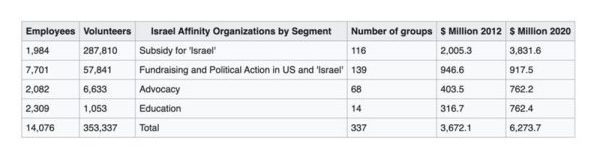
Data from Smith, 2016, reproduced on Powerbase.
The impressive number of groups documented in Big Israel still represents only a small fraction of the broader Zionist movement, which includes the Israel lobby and many additional organizations not captured in the data. Here’s a brief overview of some major omissions:
1. Many formal Zionist groups engaged in education, indoctrination, and radicalization are missing. For example, the American Zionist Movement (AZM), the official US affiliate of the World Zionist Organization, has 46 member organizations, only 13 of which appear in Big Israel’s data, leaving 33 unaccounted for.
2. None of the Israeli firms that disclose lobbying expenditures in the US are included. Between 2000 and 2023, 18 such firms reported spending over £30 million.
3. Eleven organizations—including the Jewish Agency, the World Zionist Organization (WZO), and the NSO Group (makers of Pegasus spyware)—have registered as Foreign Agents between 2016 and 2023, disclosing spending over £161 million in that period.
4. Although two Chabad-Lubavitch foundations are included, official figures show around 1,274 Chabad-Lubavitch groups in the US (IRS data lists 1,313), many of which likely have ultra-Zionist agendas. Despite not being formally affiliated with the WZO, Chabad’s influence is significant and cannot be overlooked.
5. B’nai B’rith International, one of the oldest Zionist groups in the US and a former AZM member, is included in the data, but its youth wing, B’nai B’rith Youth Organization (BBYO), is not. Together, the IRS data lists over 1,500 branches for these two groups across the US.
6. Hillel, the Zionist student organization, appears only once in Smith’s data and not at all in the index of The Israel Lobby, despite now having over a thousand branches.
7. Lastly, numerous Zionist family foundations that fund many groups in the wider movement,l likely numbering in the hundreds or thousands, are excluded. Some notable examples include Adelson Family Foundation, Allegheny Foundation, Anchorage Charitable Fund, Castle Rock Foundation, Earhart Foundation, John M. Olin Foundation, Klarman Family Foundation, Paul E. Singer Foundation, Smith Richardson Foundation, Sarah Scaife Foundation, Scaife Family Foundation, The Lynde and Harry Bradley Foundation, and William Rosenwald Family Fund.
Given these seven brief examples, which are in no way exhaustive, it is likely that there are in excess of 10,000 Zionist organisations in the US in total. It would not be surprising to learn that this was a very conservative figure. Therefore, a full analysis of the US Zionist movement needs to do a lot more to explore even the formal and informal elements of the movement.
Missing oligarchs, family foundations, spooks and infiltrators
Taking both The Israel Lobby and Big Israel together, they largely overlook the critical role of oligarchs, foundations, and intelligence-linked operatives who use blackmail and threats to exert influence.
They omit the involvement of Zionist intelligence agencies themselves, including the extensive network of Sayanim (Mossad’s “little helpers”), and make no mention of Unit 8200, Israel’s signals intelligence agency that has deeply penetrated the tech and media industries.
Ultimately, The Israel Lobby focuses almost exclusively on the most visible elements of Zionist infiltration, ignoring the movement’s powerful engines of radicalization—responsible for producing thousands of radicalized genocidaires each generation.
These engines include organizations like the Mega Group (through Jewish education initiatives shown to increase support for the Zionist colony), Hillel, and Birthright Israel.
The books also fail to address the massive infiltration of Zionists throughout the US government apparatus, a process ongoing since at least the Reagan administration in the 1980s.
The involvement of Laurence Tisch in the Mega Group further illustrates the close ties between Zionist oligarchs and infiltration efforts. His granddaughter, Jessica Tisch, is a noted Zionist extremist and the current Commissioner of the NYPD.
The NYPD notably opened an office in the Zionist colony in 2012 and collaborates with Zionist entities, as do many other US police departments, some of which receive training both in the US and in Israel.
Lessons from the Epstein/Dershowitz affair?
The affair reveals that Zionist radicalization and infiltration are far more serious and organized than the “informal” and “loose” coalition described by the Israel Lobby thesis.
Just because coordination is covert or hidden does not mean it doesn’t exist. This is evident in the evolving stories about coordination efforts led by Israel’s Ministry of Strategic Affairs and its network of front groups and private companies, including the recent campaign coordinated by Voices of Israel through its proxy, the Combat Antisemitism Movement, funded partly by a US Zionist foundation.
We also see this in the revelations about the Sayanim, Mossad’s global network of helpers, and Unit 8200’s infiltration of technology firms. Above all, the infiltration of governmental institutions across the US, UK, and numerous other countries underscores the deep and systematic nature of this network.
DR BOB SEARS DISCUSSES ‘VACCINES AND THE DISEASES THEY TARGET’
The HighWire with Del Bigtree | December 4, 2025
Pediatrician Dr. Bob Sears joins Del to unpack ACIP’s hepatitis B vaccine debate, the near-total absence of long-term safety data for newborn vaccination, and why the U.S. is an outlier in giving this shot on day one of life. He discusses the Physicians for Informed Consent’s new Silver Book “Vaccines and the Diseases They Target”, designed to give doctors and parents clear, side-by-side numbers on disease risk and vaccine risk so real informed consent can finally happen.
Sally Rooney says Palestine Action ban could block publication of her books in Britain

Sally Rooney attends the 2019 Costa Book Awards held at Quaglino’s on January 29, 2019 in London, England [Tristan Fewings/Getty Images]
MEMO | November 27, 2025
Famed Irish novelist Sally Rooney told the UK High Court on Thursday that she may be unable to publish new work in Britain as long as the legal ban on activist group Palestine Action remains in place, citing her public support for the movement, local media reported, Anadolu reports.
Rooney warned that the ban, issued this summer, could even result in her existing books being pulled from shelves, with her case presented in court as an example of the ban’s wider impact on freedom of expression, reported The Guardian.
Rooney praised Palestine Action’s activities as “courageous and admirable,” saying the group is committed to stopping what it views as crimes against humanity by Israel in its two-year military offensive on the Gaza Strip.
In her written witness statement, the bestselling author of Normal People and Conversations With Friends said the ban would leave her effectively shut out of the UK market, explaining: “It is … almost certain that I can no longer publish or produce any new work within the UK while this proscription remains in effect.”
“If Palestine Action is still proscribed by the time my next book is due for publication, then that book will be available to readers all over the world and in dozens of languages, but will be unavailable to readers in the United Kingdom simply because no one will be permitted to publish it (unless I am content to give it away for free).”
Since the group was banned, Rooney has said she plans to direct earnings from her work to Palestine Action, a decision that prompted her to cancel a UK trip to collect an award over concerns she could be arrested.
The legal ambiguity makes it hard to foresee the full impact of the ban, she said, but warned her publisher Faber & Faber might be barred from paying her royalties. If that happens, she said, “my existing works may have to be withdrawn from sale and would therefore no longer be available to readers in the UK.”
READ: A historic decline in sympathy for Israel in Britain, and an unprecedented rise in solidarity with Palestine in 2025
Adam Straw, representing UN special rapporteur Ben Saul, told the court that growing legal opinion holds the ban to be an unlawful interference under international law, adding that terrorism definitions “do not extend to serious damage to property,” referring to the group spray-painting Royal Air Force planes this July which was cited in the ban.
Representing the home secretary, Sir James Eadie argued that it is for the UK parliament to define terrorism, noting: “Parliament has decided what terrorism is, which includes serious damage to property, whether or not alongside it there is violence against people.”
The hearing will conclude on Tuesday, when the final day of the judicial review is held.
In attacks in Gaza since October 2023, Israel has killed nearly 70,000 people, mostly women and children, and injured over 170,000 others.
In November 2024, the International Criminal Court (ICC) issued an arrest warrant for Israeli Prime Minister Benjamin Netanyahu and former Defense Minister Yoav Gallant over war crimes and crimes against humanity in Gaza.
This Thanksgiving, We’re Being Served ‘Fake China Threats’
By Joseph Solis-Mullen | The Libertarian Institute | November 26, 2025
As a long-time critic of Washington’s obsession with the so-called “China threat”—and having written an entire book debunking it, The Fake China Threat—I could not in good conscience allow this year’s Report to Congress of the U.S.–China Economic and Security Review Commission to pass without comment. If anything, the 2025 edition is an even more sweeping reiteration of the assumptions and exaggerations I have challenged for years. Page after page, the report presents an alarming narrative about Beijing’s intentions and capabilities, while simultaneously insisting that every corner of the globe—and every sector of American life—now constitutes a frontline in a zero-sum geopolitical struggle.
The report opens by accusing Beijing of such dire transgressions as “holding regime security” as “a core interest,” of seeking “control and influence” over “regional spheres,” of cooperating with “authoritarian states” for “geopolitical and strategic benefits,” and of “shaping narratives” through “propaganda, disinformation, and malign influence.” One could easily imagine identical language appearing about the Soviet Union, about Washington itself, or literally any power throughout history—yet when applied to Beijing, these otherwise banal behaviors are transformed into signs of imminent global domination.
Nowhere is this tendency more pronounced than in the section worrying over China’s “electrification drive” and its increasingly important role in global energy markets. More than sixty pages are devoted to the idea that China’s leadership in electric vehicles, solar manufacturing, and critical minerals mining represents a strategic threat. Absent from the report is any acknowledgment that Western corporations themselves eagerly shifted production to China, or that Washington—not Beijing—has been the global pioneer in using export controls as geopolitical coercion. When the United States weaponized semiconductor export restrictions, Beijing responded in kind with export controls on rare earths and battery materials. To portray this sequence of events as evidence of China’s uniquely sinister strategy is simply dishonest.
The Commission displays the same lack of self-awareness in its discussion of China’s space program. According to the report, “China has embarked on a whole-of-government strategy to become the world’s preeminent space power,” viewing space as a “warfighting domain” and seeking “superiority” to achieve “information dominance” in future conflicts. These statements are presented as though they reveal some shocking and destabilizing ambition. Yet even the report itself admits that the United States pursued precisely the same aims throughout the Cold War, beginning with Sputnik and culminating in the Apollo program—a state-directed race for prestige, technological supremacy, and ideological credibility. One could be forgiven for marveling at the Commission’s ability to recount this history without recognizing that China today is behaving exactly as the United States once did.
No area attracts more overwrought commentary than Taiwan. The Commission repeats the standard Beltway line that Taiwan is a “vital national interest,” a geopolitical linchpin whose fate somehow determines the future of American security. Yet as I have argued repeatedly, these claims fall apart under scrutiny. Taiwan is important to Washington because Washington has decided it is important. The obligations cited—the Taiwan Relations Act, American “credibility,” regional “order”—are political choices, not laws of nature. Yes, Taiwan produces world-leading semiconductors. But nothing about that fact requires risking a catastrophic great-power war; supply chains can be diversified or on-shored. Beijing’s pressure, moreover, is far from the unprovoked aggression the report suggests—it is rooted in the unresolved civil war of 1949, the inevitable conclusion of which Washington prevented, and remains largely reactive. None of this is to deny tensions exist, but turning Taiwan into a test of American resolve is precisely how manageable disputes become existential crises.
The report’s alarmism reaches farcical heights in Chapter Five: “Small Islands, Big Stakes: China’s Playbook in the Pacific Islands.” Here the Commission insists that tiny Pacific states—many with populations smaller than a Michigan suburb—constitute a strategic battleground essential to the wellbeing of the American people. Any Chinese port investment, loan program, or diplomatic visit is portrayed as a step toward regional domination. Yet nowhere does the Commission attempt to explain how the average American benefits from micromanaging the political and economic decisions of Kiribati or Fiji.
The underlying logic is clear: assume U.S. hegemony is the natural order of the world, treat any erosion of influence anywhere as an existential threat, and convert distant, marginal islands into “vital interests.” This rhetorical sleight of hand is a hallmark of threat inflation. It serves contractors, think-tankers, and bureaucracies far more than it serves the American public.
Nowhere is this clearer than in the Commission’s sprawling list of recommendations. These range from creating a consolidated economic-statecraft agency with law-enforcement powers, to launching new global initiatives on undersea cable security, to deepening U.S. military and political involvement throughout Southeast Asia and the Pacific Islands. They continue with calls for massive industrial-policy subsidies, a quantum-computing “race,” bioeconomy initiatives, and new industrial-finance mechanisms—all justified by the specter of Chinese power.
The recommendations amount to a blueprint for a vastly expanded national-security state: more intelligence authorities, more intervention abroad, more surveillance tools at home, more taxpayer-funded subsidies for favored industries. It is striking how rarely the Commission pauses to explain how these measures relate to the concrete economic or physical security of ordinary Americans. Instead, all problems—whether involving undersea cables in Micronesia or chip production in Taiwan—are collapsed into a single narrative of geopolitical rivalry requiring endless resources and unquestioned bipartisan support.
This is not a sober analysis of Chinese capabilities or intentions; it is a maximalist wish list for Beltway institutions whose influence grows in direct proportion to the threats they amplify. And when one examines who actually produced the report, the outcome is unsurprising: longtime Nancy Pelosi staffer Reva Price; former Project 2049 Chairman Randall Schriver; and contributions from the Atlantic Council and American Enterprise Institute. This is a who’s who of professional China hawks, each institutionally invested in perpetuating a highly militarized U.S.–China rivalry.
In sum, the Commission’s report is emblematic of the broader problem in Washington: a foreign-policy establishment unable to conceive of international politics except as a struggle for primacy, uninterested in distinguishing vital interests from peripheral ones, and institutionally incentivized to magnify threats rather than manage them. The American people deserve better than a foreign policy driven by inertia, ideology, and bureaucratic self-interest.
The good news is that alternative perspectives exist—and that skepticism toward these narratives is growing. The United States can pursue a stable, prosperous relationship with China without embracing the fear-mongering, militarism, and threat inflation that dominate reports like this one. It only requires the courage to question the assumptions that have guided Washington for too long.
The intel scandal behind Prince Andrew’s twisted Epstein exploits
By Kit Klarenberg · The Grayzone · November 16, 2025
In an interview with The Grayzone, author Andrew Lownie details shocking findings of his research into Prince Andrew’s relationship with Jeffrey Epstein. Describing Andrew as his “Super Bowl trophy,” Epstein used the prince for intel, which he passed to foreign spy agencies. Lownie says further revelations threaten to “bury” the Royal Family.
Prince Andrew’s decades-long relationship with Jeffrey Epstein was “earlier, longer, and far more intimate than anyone has previously admitted,” historian Andrew Lownie told The Grayzone. Their friendship was so depraved that even Epstein, the self-proclaimed “king of kink,” was shocked by the Prince’s sexual appetites, according to Lownie’s new book, Entitled: The Rise and Fall of the House of York.
Based on years of research in BBC archives, interviews, and leaked emails, Lownie’s investigation provides a chilling portrait of a man shielded by royal privilege, addicted to sex from childhood, and ultimately undone by his alliance with the world’s most notorious pedophile. The historian reveals that Epstein not only supplied Andrew with a steady stream of underage girls, but also gathered intelligence from the prince, and dutifully passed it along to Mossad and other spy agencies.
“The Prince was a useful idiot who gave Epstein respectability and access to political leaders and business opportunities,” Lownie explained to The Grayzone. “Meanwhile, Epstein offered Andrew an opportunity to join the super rich and enjoy a lifestyle to which he had long aspired, an endless supply of women, a chance to make lots of money, and someone who would bankroll his lavish lifestyle as well as settle Sarah Ferguson’s debts.”
Lownie revealed that Epstein was able to gather a steady flow of sensitive intelligence from Andrew, including potential blackmail material which he could hawk to foreign governments. Epstein’s one-time ‘mentor,’ the serial fraudster Steven Hoffenberg echoed this account, claiming Epstein referred to Andrew as his “Super Bowl trophy.” While the British royal unwittingly spied on Epstein’s behalf, he simultaneously compromised himself, making him into a perfect tool.
For much of his life, Andrew enjoyed an astonishing level of protection and indulgence from his mother, Queen Elizabeth. A former worker interviewed by an Australian outlet divulged that royal staffers were terrified by the prince’s impunity, and largely avoided standing up to his compulsive bullying because “Her Majesty almost always backed him and he fully exploited that.”
Lownie told The Grayzone Andrew’s explosive tantrums at Buckingham Palace, which reduced some targets to tears, were a “virtually daily” occurrence.
A source close to Andrew revealed to Lownie that the prince began exhibiting unusual sexual tendencies when he was only eight years old. The problem only worsened when Andrew lost his virginity at age 11 after a friend’s father hired two escorts for the boys. Andrew reportedly informed the source that by the time he was 13, he had already slept with over half a dozen girls, leading the source to conclude that the prince had been “a victim of sexual abuse at a very young age.”
Thanks to Andrew and Epstein, the cycle of abuse allegedly continued with a number of young girls — most notably, Virginia Giuffre. When her allegations against the Prince became public in 2015, a BBC team secretly travelled across the US, reviewing police files, while interviewing the pair’s victims at length. Along the way, they unearthed emails between Andrew and Ghislaine Maxwell discussing Giuffre.
The emails offer no indication either were unaware of Giuffre, or any sense her allegations were bogus. Lownie says the BBC team’s lead investigator told him, “instead Andrew and Maxwell worked together to build a dossier about Virginia [Giuffre] to leak to the media.” In other words, the pair colluded to smear one of their victims in the court of public opinion, before legal action could be initiated. When a suit was finally initiated on her behalf, Andrew paid out handsomely rather than face scrutiny.
Lownie believes full disclosure of Andrew’s involvement with Epstein could permanently sink the House of Windsor. A former Buckingham Palace staffer told him, “they’d never be able to bounce back from it,” as the resultant scandal “would bury them for good.” Lownie’s source cautioned, “if the unconditional truth is ever released, the British public would try to impeach the Royal Family — after all, many of Andrew’s wrongdoings were done on the British taxpayer’s tab.”
Andrew’s sexual depravity shocks even Epstein
Canadian journalist Ian Halperin was the only reporter to interview Epstein at length before the financier’s death. He provided Lownie with exclusive access to his records. They show Epstein was surprisingly candid about his predilection for underage girls, to the extent of openly arguing pedophilia should be decriminalized. Along the way, the pedophile offered a number of explosive revelations about Andrew, who he described as his “closest friend in the world.”
In one email, Epstein insisted he and Andrew were “very similar,” as they were “both serial sex addicts” who’d even “shared the same women.” Andrew was “the only person I have met who is more obsessed with pussy than me,” he attested. Based on “reports” Epstein received from their mutual sexual conquests, Andrew was “the most perverted animal in the bedroom,” he wrote. Epstein expressed awe at the degeneracy of Andrew, who he said possessed “the dirtiest mind I’ve ever seen,” concluding: “He likes to engage in stuff that’s even kinky to me – and I’m the king of kink!”
Lownie also provides evidence that the depraved duo crossed paths far earlier than is claimed by Andrew. According to a statement by the prince after Epstein’s death, he insisted they met in 1999 and subsequently saw each other “probably no more than only once or twice a year.” In reality, Andrew’s private secretary places the start of their friendship in “the early 1990s,” Lownie explained. Flight logs from Epstein’s private jet, nicknamed the Lolita Express, reveal that Andrew’s occasional partner, Sarah Ferguson, travelled on the aircraft with her children as early as April 1998.
By 2000, the royal had become a fixture at elite Stateside social events hosted by Epstein and Ghislaine Maxwell, the publishing heiress who met Andrew during the 1980s at Oxford University. As their friendship developed, Andrew and Ferguson often stayed at Epstein’s palatial New York and Florida homes.
These trips have largely been concealed from the public, which is perhaps understandable given the purpose of his visits.
“Whenever Andrew was in town, I’d be picking up young girls who were essentially prostitutes,” Epstein’s personal driver, Ivan Novikov, recalled to Lownie. “One time I drove him and two young girls around 18 to the Gansevoort Hotel in the Meatpacking District. Both girls were doing lines of cocaine. Prince Andrew was making out with one of them.”
All the while, Epstein and Maxwell were insinuating themselves into the top echelons of the British aristocracy. According to one now-deleted British media report, Andrew invited Epstein and Maxwell to attend events at Windsor Castle and Sandringham in 2001, including Queen Elizabeth II’s 74th birthday that August. The article, which has since been scrubbed from London’s Evening Standard website, quoted a friend of Ferguson’s as saying Andrew’s lewdness was so undisguised that he “travels abroad with his own massage mattress.” According to the Evening Standard, the “very manipulative” Maxwell introduced Andrew to a “sex aid entrepreneur” at Donald Trump’s Mar-a-Lago.
The same piece described Andrew traveling around Phuket, Thailand with Maxwell, frequenting “sex bars in the area’s red light district”, and visiting Los Angeles with his friend and “self-confessed drug dealer” Brett Livingstone-Strong. During this time, Andrew was apparently so infatuated with Epstein and his clique that he opted to stay at the pedophile’s Miami beach mansion rather than attend his daughter Eugenie’s 12th birthday party at Disneyland Paris, Lownie reveals.
Andrew’s fall from grace
In May 2007, Epstein began negotiating an unusually lenient plea deal with Florida authorities after local police uncovered a trove of evidence implicating the financier in a national sex trafficking conspiracy. Finally, English-language media began scrutinizing the potentially pedophilic implications of the financier’s bond with Prince Andrew for the first time. Another since-deleted Evening Standard report on their friendship noted Epstein’s Florida mansion was filled with pictures of nude girls, with two cameras found hidden in clocks.
The net significantly tightened in December 2014, when lawyers filed court papers in Florida alleging Andrew was one of several prominent figures who’d raped Virginia Giuffre at Epstein’s arrangement. The pair purportedly had sex in London, New York, and on Epstein’s private island, Little Saint James. In the latter case, Giuffre claimed to have been involved in a “disgusting” orgy with Andrew, Epstein, and multiple girls who “all seemed and appeared to be under the age of 18.”
The filings also alleged Andrew had lobbied on Epstein’s behalf after his arrest, working to ensure he received a light sentence. Epstein repaid the favor by clearing Sarah Ferguson’s substantial debts. British media reacted with shock: “Prince Andrew may have been secretly filmed with underage girl he is alleged to have abused,” blared one mainstream headline. That day, a seemingly frantic Andrew emailed Maxwell: “Let me know when we can talk. Got some specific questions to ask you about Virginia Roberts.”
Buckingham Palace issued a firm denial, stating “any suggestion of impropriety” by Andrew “with underage minors is categorically untrue,” and that he “emphatically denied the Duke of York had any form of sexual contact or relationship with Virginia Roberts.” Until Epstein’s death, the British media seemingly accepted the royal line. But Andrew’s now-notorious November 2019 Newsnight interview revived public suspicions, and ignited a new wave of scrutiny.
Over the course of an hour-long grilling, the Prince offered a series of preposterous excuses for his friendship with Epstein, while failing to credibly explain his time with Giuffre. For example, he claimed her account of him sweating profusely while they danced together at a London night club couldn’t be true, as he was unable to sweat at all because he suffered a scientifically implausible “adrenaline overdose” during the Falklands war.
Next, Andrew attempted to justify a four-day December 2010 visit to Epstein in New York, during which paparazzi documented a young woman leaving his town house, and a friendly walk he enjoyed with the prince through Central Park. (The tweet below incorrectly dates the footage from 2011; it was filmed on December 6, 2010).
In his Newsnight interview, Andrew claimed he initiated the meeting to break off ties with the financier following his conviction for sex trafficking offenses. He insisted that he felt the need to end their connection in person, due to his “tendency to be too honourable,” but struggled to explain why this necessitated a four-night-long stay, replete with a dinner party in his personal honor.
The prince claimed he opted to stay at Epstein’s mansion as “it was… convenient” — apparently overlooking the British consulate and numerous upmarket hotels which could have provided an alternative to staying with a convicted sex offender.
Furor over Andrew’s performance erupted as soon as the interview was broadcast, with one royal observer dubbing it, “nuclear explosion level bad.” Yet the Prince was initially satisfied with his public self-immolation. The Guardian reported at the time that Andrew “was so pleased with how things had gone that he gave the Newsnight team a tour of the palace afterwards.”
Andrew’s British state protection crumbles
Days after the disastrous interview, Andrew’s ex-girlfriend disputed his account of the 2010 visit with Epstein, stating that the prince’s main purpose was to determine whether the financier had “any dirt on him.” The pair reportedly also discussed securing $200 million funding for mysterious energy company Aria Petroleum, prompting Epstein to inform close contacts at JP Morgan that the prince sought to represent the interests of a Chinese commercial entity.
From this point on, Andrew withdrew from public life. Under pressure from British Army apparatchiks, he was stripped of his military awards and decorations. Charities distanced themselves from the royal, while polls indicated a majority of Britons believed he should be extradited to the US to face questioning. In May 2020, Andrew permanently resigned all his public roles over his Epstein connections. In the meantime, pressure began building in the US for the Prince to speak to Giuffre’s lawyers and federal investigators.
In his Newsnight interview and subsequent official statements, Andrew claimed he was happy to assist with any investigation into Epstein’s abuse. But the American prosecutor who led investigations into the financier and his associates in New York, Geoffrey Berman, reported he was repeatedly stonewalled by Buckingham Palace. Contacting royal lawyers was difficult enough in the first place, he said, and he described their communications as having quickly devolved into an never-ending series of questions.
“What kind of an interview will it be? Are there any protections? Is there this? Is there that? And where do you want it to take place?” Berman recalled. “It was an endless email exchange, and it was clear we were getting the run-around. He was not going to sit down for an interview with us.” Finally, Berman asked the State Department to dispatch a mutual legal assistance treaty (MLAT) request to British police, demanding an interview with the prince.
US prosecutors “almost always got what we asked when we put in an MLAT request,” Berman recalled. “But that was not what happened with Prince Andrew. We got absolutely nowhere. Were they protecting him? I assume someone was.”
Andrew’s state-level protections began to dissolve, however, after a December 2020 investigation by the Daily Mail into Giuffre’s claim that Andrew had sex with her when she was just 17. His alibis for the dates in question had been incinerated.
In August 2021, Giuffre’s lawyers filed suit against Andrew in a US court for “sexual assault and intentional infliction of emotional distress.” The action raised the prospect of Andrew giving sworn testimony proving his inability to sweat on the witness stand. Members of the Royal Family, including Ferguson and their daughters Princesses Beatrice and Eugenie, also faced the threat of grilling under oath. Rather than go to court, the House of Windsor settled for as much as $16.3 million.
Andrew Prince no more as scandals proliferate
For the first time, Buckingham Palace began to firmly distance itself from Andrew. As Lownie recorded, the media was informed that the Queen would no longer bankroll his legal fees. After a lifetime of protecting her son from the consequences of his excesses, fear of further damaging admissions may have motivated the monarch’s decision.
Those fears were well-founded, as Lownie revealed that Andrew emailed Epstein in February 2011, months after claiming to have cut off all contact with the financier following their four day 2010 ‘farewell’ summit in New York.
In that email, Andrew promised to “keep in close touch,” stating, “we are in this together and will have to rise above it,” and promising, “we’ll play some more soon!!!” That same year, Sarah Ferguson expressed her affinity and gratitude to Epstein in a separate covert email exchange. Sources suggested to Lownie that Epstein had supplied her with hundreds of thousands of dollars, far in excess of the £15,000 she claims to have received from the serial sex abuser.
In a 2011 interview, Ferguson said “having anything to do” with Epstein had been a “gigantic error of judgment” on her part. She added, “I abhor paedophilia and any sexual abuse of children… what he did was wrong and… he was rightly jailed.” Shortly after though, she contacted Epstein claiming she “did not, absolutely not, say the ‘P word’ about you.” Ferguson apologised for letting him down, stating “you have always been a steadfast, generous and supreme friend to me and my family.”
This October 30, as furor over Epstein’s activities engulfed the Trump administration, Buckingham Palace issued a shock declaration. Prince Andrew will be stripped of his titles, honors, and stately home, and now simply be known as Andrew Mountbatten Windsor – in effect excommunicated from the British Royal Family for life. While no formal explanation for the unprecedented move was provided, it was clear they were determined to cleanse Epstein’s stain from their house.
“These censures are deemed necessary, notwithstanding the fact that he continues to deny the allegations against him,” the royal statement read. “Their Majesties wish to make clear that their thoughts and utmost sympathies have been, and will remain with, the victims and survivors of any and all forms of abuse.”
But Andrew’s erasure from the spotlight, termination of his assorted patronages and curtailment of public duties may have come too late. After years of alternating between silence over his sexual abuse or flatly denying the allegations, Buckingham Palace faces the threat of further disclosures. As Lownie makes clear in his newly released book, Entitled, new details of the prince’s perversions could discredit the royal family for good.
Featured Video
The Most Important Bet You’ve Never Heard Of
or go to
Aletho News Archives – Video-Images
From the Archives
Wars for Israel: A reminder of who’s giving the marching orders
By Damian Lataan | February 7, 2012
As the West prepares to march off to yet another war in the Middle East, we should perhaps remind ourselves of who is giving the West their marching orders.
In February 2003, just weeks before the US and their allies launched their attack on Iraq and her peoples, a delegation of US congressmen, together with the US Ambassador to the United Nations, John Bolton, a well known pro-Zionist and neoconservative war-hawk, were in Israel at the invitation of the Israeli government then led by Israeli Prime Minister Ariel Sharon.
Addressing the congressmen, Sharon told them ‘that Iran, Libya and Syria should be stripped of weapons of mass destruction after Iraq’. Later, Sharon told John Bolton ‘that Israel was concerned about the security threat posed by Iran, and stressed that it was important to deal with Iran even while American attention was focused on Iraq’. … continue
Blog Roll
 Aletho News
- IRGC hits US tech giant Oracle’s data center, computing site in UAE over new assassinations
- Bombing Iran Back Into the Stone Age /Lt Col Daniel Davis & Jim Jatras
- UAE rejects report claiming it is ready to join war on Iran to reopen Hormuz
- A New Resistance Front: How Does Syria Factor into the Regional War?
- Gulf states weigh pipeline expansion plans, hoping to bypass Hormuz
- Iran sets up ‘tollbooth’ system in Strait of Hormuz
- Wave 90: IRGC strikes US-linked industrial sites in Gulf
- Iran Says US-Israeli Claims of Its Military Strength Are Wrong
- Trump’s April Fools’ Address to the nation
- The Most Important Bet You’ve Never Heard Of
- If Americans Knew
- ‘War crime’: Global condemnation as Israeli ministers celebrate death penalty law targeting Palestinian prisoners
- 7 Ways Israel Is Turning Lebanon Into Gaza
- World’s Leading Football Bodies Under Fire Over Israel Policies
- Experts warn of possible use of nukes against Iran
- Israeli invasion of Lebanon could be worse than 1982, warn European officials
- Passover: Liberation and collective punishment
- Trump says the quiet part out loud: (Israel’s) war on Iran > Americans’ health – Daily Update
- Gaza families reunite years after babies evacuated amid Israel’s war
- International Rescue Committee warns Gaza’s children face grave protection risks
- Iran’s Alleged 47-Year War on America: Debunking the 1,050 American Deaths Canard
- No Tricks Zone
- Low Intensity Tornado Wrecks Major Solar Farm, Creating A Potential Toxic Dump
- New Study Finds Warming Saves Lives…Cold Temperatures 12 Times More Deadly Than Excess Heat
- German Science Blog Accuses PIK Climate Institute Of Hallucinating Climate Tipping Points
- Devastating Assessment Of Comirnaty Vaccine By Former Senior Pfizer Europe Toxicologist
- New Study: CO2 Is ‘Effectively Negligible’ As An Explanatory Climate Change Factor Since 2000
- Former Pfizer Toxicologist Dr. Helmut Sterz Tells Bundestag Hearing Pfizer Vaccine Should Have Never Been Approved
- Energy Expert: Germany’s Nuclear Phaseout Was A “500 Billion Euro Mistake”
- New Research: South Australia’s Mid-Holocene Sea Surface Temperatures Were 4°C Warmer Than Today
- Storing Green Energy To Last Germany 10 Days Would Require A 60-Million Tonne Battery
- New Studies: UK Sea Levels Were 4 Meters Higher Than Today During The Mid-Holocene
 Aletho News
