Can the WHO and the United Nations impose sanctions on your sovereign country for non-compliance?
The UN is a far bigger threat than the WHO, which, although deserving of attention, cannot consume our entire focus.
BY SHABNAM PALESA MOHAMED | JUNE 18, 2024
This updated analysis was written in 2023 (read in full here at CHD Africa)
Sanctions are a powerful instrument of political control and economic profit. One of the rare but critical topics relevant to the international campaign to #ExitTheWHO is whether the World Health Organisation and the United Nations can impose, influence or recommend specific sanctions. The sanctions could be implemented against countries that choose to not comply or cannot comply with International Health Regulations, the proposed new pandemic treaty, or other legislative attempts that curtail rights, freedom and sovereignty.
The accelerating and profitable globalist march towards unprecedented levels of ‘1984’ style totalitarianism – using censorship, vaccine passports, 15 minute cities, and CBDC’s continues. It is plausible that the WHO and the UN will move to impose, influence or recommend sanctions against countries that do not want to or cannot comply with its centralised health agenda and undemocratic legislative attempts.
What is the basis for me raising the red flag on sanctions in 2023?
Health is no longer just health, as it is defined in the WHO’s constitution. Through Covid-19, and other controversially declared pandemics, health is now a multi-billion dollar health security industry. With it, creeps in the tyranny of secrecy, surveillance, vaccine certificates, forced quarantines, and the undemocratic censorship of free speech. Given the absence of public participation, the WHO is a strategic spear for oligarchs and corporations, and given international resistance to its power grab, it becomes desperate and argues or pushes for sanctions.
Reported in 2021: “In 2021, German Health Minister Jens Spahn called for sanctions against countries that hide information about future outbreaks. Citing the World Trade Organization’s power to sanction countries for non-compliance, Spahn said “there must be something that follows” if countries fail to live up to commitments under a new pandemic treaty that the World Health Assembly will take up in November.”
Further, it is entirely under reported that controversial “World Health Organization Director-General Tedros Adhanom Ghebreyesus also urged countries to consider the idea as they take up the treaty, a legally binding tool. The treaty should “have all the incentives, or the carrots” to encourage transparency, Tedros said, appearing at a press conference with Spahn in Berlin. “But maybe exploring the sanctions may be important,” he added.”
Also reported in 2021: “Speaking at the WHA in June, Mike Ryan, WHO Health Emergencies Programme Executive Director, also spoke out in favour of the treaty, despite the fact that WHO technical staff have historically avoided taking positions on controversial policy choices before member states. “My personal view is that we need a political treaty that makes the highest-level commitment to the principles of global health security — and then we can get on with building the blocks on this foundation.”
I engaged renowned international law expert Professor Francis Boyle about the possibility of sanctions via the WHO. He had no doubt “They will pursue sanctions against countries that do not comply with their orders, coming from Geneva. Both economic and political sanctions. However, they will only have the power to pursue sanctions if we accept their authority. We cannot. We must exit the WHO.”
UN Power Grab. Disaster Capitalism 101.
With far less public scrutiny currently than the controversial WHO, the United Nations is simultaneously seeking exponential new powers and stronger global governance mechanisms, including multilateralism, to deal with what they define as international emergencies.
UN Secretary-General Antonio Guterres’ Common Agenda report arises from a UN declaration on the commemoration of its seventy-fifth anniversary. This report states “All proposed actions are designed to accelerate the achievement of the Sustainable Development Goals. Our Common Agenda is intended to advance the 12 themes of the declaration.”
In March 2023, UN secretary-general Antonio Guterres released a related policy brief: To Think and Act for Future Generations – OUR COMMON AGENDA – Policy Brief 2 – Strengthening the International Response to Complex Global Shocks – An Emergency Platform.
One of this policy brief’s 12 key themes is ‘Being Prepared’, which includes:
1. Emergency Platform to be convened in response to complex global crises
2. Strategic Foresight and Global Risk Report by the United Nations every five years
3. On global public health:
a) Global vaccination plan
b) Empowered WHO
c) Stronger global health security and preparedness
d) Accelerate product development and access to health technologies in low- and middle-income countries
e) Universal health coverage and addressing determinants of health
Under the topic of addressing major risks, Guterres states:
98. An effort is warranted to better define and identify the extreme, catastrophic and existential risks that we face. We cannot, however, wait for an agreement on definitions before we act.
99. Learning lessons from the COVID-19 pandemic, we can seize this opportunity to better anticipate and prepare to respond to large-scale global crises. This requires stronger legal frameworks, better tools for managing risks, better data, the identification and anticipation of future risks, and proper financing of prevention and preparedness. Importantly, however, any new preparedness and response measures should be agnostic as to the type of crisis for which they may be needed. We do not know which extreme risk event will come next. It might be another pandemic, a new war, a high-consequence biological attack, a cyberattack on critical infrastructure, a nuclear event, a rapidly moving environmental disaster, or something completely different such as technological or scientific developments gone awry and unconstrained by effective ethical and regulatory frameworks.
101. Secondly, I propose to work with Member States to establish an Emergency Platform to respond to complex global crises. The platform would not be a new permanent or standing body or institution. It would be triggered automatically in crises of sufficient scale and magnitude, regardless of the type or nature of the crisis involved. Once activated, it would bring together leaders from Member States, the United Nations system, key country groupings, international financial institutions, regional bodies, civil society, the private sector, subject-specific industries or research bodies and other experts. The terms of reference would set out the modalities and criteria for the activation of the platform, including the scale and scope of the crisis; funding and financing; the identification of relevant actors who would form part of it; the support that it would be expected to provide; and the criteria for its deactivation. The platform would allow the convening role of the Secretary-General to be maximized in the face of crises with global reach.
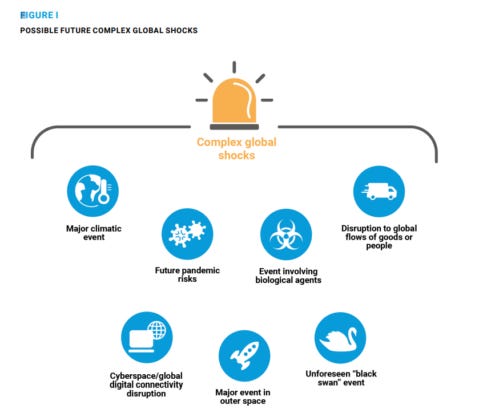
DIAGRAM: Policy Brief 2 – Strengthening the International Response to Complex Global Shocks – An Emergency Platform
UN’s Emergency Platform = One World Government backdoor
The emergency platform would be activated during any event that is deemed to have a global impact, and would provide the UN the authority to actively promote and drive an international response. Antonio Guterres, UN secretary-general, declared: “I propose that the General Assembly provide the Secretary-General and the United Nations system with a standing authority to convene and operationalize automatically an Emergency Platform in the event of a future complex global shock of sufficient scale, severity and reach.”
The policy further argues that such authority would “Ensure that all participating actors make commitments that can contribute meaningfully to the response, and that they are held to account for delivery on those commitments.” While the policy states that the emergency authority would have limited duration, it also states that the UN would be able to extend its own powers if it decides to do so. These powers would effectively render public consensus unnecessary, democracies obsolete, and the role of politicians largely irrelevant.
These all encompassing areas of expanded emergency powers relate to:
- pandemics
- wars and nuclear events
- climate or environmental events, degradation or disaster;
- accidental or deliberate release of biological agents;
- disruptions in the flow of goods, people, or finance;
- disruptions in cyberspace or “global digital connectivity;”
- a cyberattack on critical infrastructure
- a major event in “outer space;”
- “unforeseen risks (‘black swan’ events)
- technological or scientific developments gone awry – and unconstrained by effective ethical and regulatory frameworks.
At least 7 out of 10 of the above areas have already happened or are happening.
What does the UN have planned?
On September 20th 2023, the UN intends to adopt a high level political declaration on pandemics. In my analysis, the UN pathway to the one health and one world government agenda is a back up plan to the WHO’s trajectory which is increasingly exposed and resisted.
The UN is planning to host its related ‘Summit of the Future’ in September 2024. Guterres stated “The Summit of the Future is an opportunity to agree on multilateral solutions for a better tomorrow, strengthening global governance for both present and future generations.” The UN website states “The General Assembly welcomed the submission of Our Common Agenda and passed a resolution to hold the Summit on 22-23 September 2024, preceded by a ministerial meeting in 2023. An action-oriented Pact for the Future is expected to be agreed by Member States through intergovernmental negotiations on issues they decide to take forward.”
Understanding Sanctions or Unilateral Coercive Measures
Sanctions are action that is taken or an order that is given to force a country to obey international laws. There are several types of sanctions imposed through the United Nations:
- Economic sanctions – typically a ban on trade, possibly limited to certain sectors such as armaments, or with certain exceptions (such as food and medicine)
- Diplomatic sanctions – the reduction or removal of diplomatic ties, such as embassies.
- Military sanctions – military intervention
- Sport sanctions – preventing one country’s people and teams from competing in international events.
- Sanctions on the environment – since the declaration of the United Nations Conference on the Human Environment, international environmental protection efforts have been increased gradually.
- Economic sanctions are distinguished from trade sanctions, which are applied for purely economic reasons, and typically take the form of tariffs or similar measures.
It is plausible that the UN’s controllers realise that the world is pushing back against the WHO’s overreach, or find it irrelevant to real health. Given that sovereign nations will choose to exit the WHO, the UN decided to launch plan B and ascribe to itself even greater powers. Technically, there is no legislation to exit the United Nations within the UN Charter. Again, this is a critical issue of national sovereignty.
Can the WHO and the UN collaborate on sanctions?
The WHO is an agency of the United Nations.
- In 2015, on punishing member states who violate the International Health Regulations (IHR), as reported: “United Nations health officials said they want to impose sanctions on countries that do not comply with public health regulations meant to avoid the spread of dangerous epidemics, such as the Ebola outbreak that killed more than 9,000 people and ravaged domestic health care systems in West Africa last year.
- World Health Organization Director Margaret Chan said she is investigating ways to reprimand countries that disobey the IHR — a set of rules adopted in 2005 and mandate that countries set up epidemiological surveillance systems, fund local health care infrastructure and restrict international trade and travel to affected regions deemed unsafe to the public, among other provisions. Chan is on a panel set up by U.N. Secretary General Ban Ki-moon, who instructed the group to think of ways to hold countries accountable for how they manage public health crises and punish those who violate the IHR.”
- In 2022, according to commentators in a policy article: “In order to enforce compliance, some commentators have recommended concluding the treaty at the United Nations level. However, we fear that it has been already decided with the INB (mandated by WHASS) that a treaty will be developed under the roof of WHO. They added: “To move on with the treaty, WHO therefore needs to be empowered — financially, and politically. If international pandemic response is enhanced, compliance is enhanced. In case of a declared health emergency, resources need to flow to countries in which the emergency is occurring, triggering response elements such as financing and technical support.
- These are especially relevant for LMICs, and could be used to encourage and enhance the timely sharing of information by states, reassuring them that they will not be subject to arbitrary trade and travel sanctions for reporting, but instead be provided with the necessary financial and technical resources they require to effectively respond to the outbreak. High-income settings may not be motivated by financial resources in the same way as their low-income counterparts. An adaptable incentive regime is therefore needed, with sanctions such as public reprimands, economic sanctions, or denial of benefits.”
Conclusion
Given the rapidly growing distrust in the WHO, its historical failures and harms, Covid-19 failures and harms, and the fact that it cannot maintain independence because it is a largely privately funded entity; it is plausible that the WHO and/or the UN will move to impose or influence sanctions via the World Trade Organisation, ahead of Agenda 2030. This act of aggression weaponises the WHO and/or the UN against countries that influential funders and unethical stakeholders have an interest in destabilising for power and resource control.
This sinister strategy has disturbing implications for democracy, peace, and prosperity around the world. Freedom faces an existential risk through unelected bureaucratic entities. Nations can and must protect their sovereignty by defunding and exiting WHO, and, by critically assessing the true history, nature, value, and risks of continued membership in the 78 year old United Nations. Not to do so, means to ignore the risks of UN peacekeepers, known to commit crimes with impunity, being deployed in your country to enforce UN and WHO governance.
House Committee Subpoenas State Department on Proxy Censorship Claims
By Cindy Harper | Reclaim The Net | June 19, 2024
The Chairman of the US House Committee on Small Business Roger Williams last week subpoenaed the State Department and Global Engagement Center (GEC) after they refused to turn over requested documents related to accusations of “censorship-by-proxy.”
We obtained a copy of the subpoena for you here.
GEC was used to flag posts that would then get censored by social media platforms and was also involved in giving grants to fund online blacklisters.
The documents and communications the committee requested but failed to obtain concern the latter activity, specifically an investigation into government bankrolling companies that hindered US small businesses from competing simply because they engaged in lawful online speech.
The material the committee wants for its probe goes back to grants awarded since 2018. The request names almost two dozen entities – the Global Disinformation Index (GDI) and NewsGuard among them.
In a statement, Chairman Williams explained that the investigation has been ongoing for a year, with the focus on how the US government may be using taxpayer money to put roadblocks in the way of the country’s small business development – namely, by hampering them online.
“All Americans deserve a fair shot to compete in the marketplace, and the government should not be tipping the scales against any business for their legal speech on the internet,” Williams is quoted as saying while explaining the need to hit the GEC and the State Department with a subpoena after they repeatedly refused to cooperate.
Williams described this attitude by the government as unacceptable, given that (with the importance of unhindered presence on the internet), “the livelihoods of many small businesses are on the line.”
The Committee’s investigation focuses on how what is described as “censorship-by-proxy” (i.e., the government circumventing constitutional prohibitions to censor online speech by looking for “friendly” non-governmental entities to put pressure on social platforms) – affects US small businesses’ bottom line.
And logically, impeding them from gaining exposure and reach online, especially, but not only, during the pandemic, would have caused serious consequences.
The House Committee said that over the year of the investigation, GEC “slow-rolled document production and ignored legitimate oversight document requests.”
And so, 12 months into it, and after repeated accommodations – such as giving GEC extra time and even narrowing the scope of the requests – the Committee now feels it’s time to “escalate the issue at hand, and issue the subpoena.”
As they say – “nice just doesn’t work with some people.”
Germany lists BDS movement as ‘extremist’ for questioning ‘Israel’
Al Mayadeen | June 19, 2024
A new report issued by Germany’s Federal Interior Minister Nancy Faeser on Tuesday revealed that it was dealing with the Boycott, Divestment, and Sanctions (BDS) movement as a “suspected extremist case,” noting that it had “links to secular Palestinian extremism.”
The report claimed that the BDS is not a homogeneous association, party, or organization.
German news site Watson cited the report as saying that “there is sufficient, strong, factual evidence to suggest that [the] BDS thereby violates, among other things, the idea of international understanding” by questioning “Israel’s” existence.
The report said, “After the terrorist attacks by Hamas on Israel on October 7, 2023, BDS-affiliated groups mobilized and participated in many anti-Israel gatherings and intensified their demands for an end to an alleged ‘Israeli apartheid’ as well as called for a boycott of companies and goods related to Israel.”
German news site Judische Allgemeine quoted Faeser as stating, “We must oppose internal threats from extremism just as decisively as [we do] external threats,” adding, “We absolutely have to break the spiral of escalations in the Middle East, leading to even more disgusting hatred of Jews here.”
“Security authorities are reacting with great vigilance to the latest developments and are actively taking action against any kind of anti-Israel and antisemitic agitation,” she continued.
German-Israeli Society welcomes decision
Meanwhile, German public-broadcasting radio station Deutschlandfunk confirmed reports that Germany’s federal domestic intelligence agency labeled the BDS movement as an extremist movement – and the German-Israeli Society (DIG) welcomed the decision.
DIG’s president Volker Beck released a statement applauding the announcement.
“For the first time, the Federal Office for the Protection of the Constitution names the anti-Israeli boycott movement BDS as a suspected extremist case in its annual report,” stressing, “This supports the assessment of the German Bundestag in its ‘confront the BDS-Movement Resolutely – Fighting Antisemitism’ resolution in 2019.”
According to Beck, “All forms of antisemitism must be fought equally – consistently. The trivialization of or even sympathy by some cultural institutions with [the] BDS must finally stop.”
“We welcome the recent bans on associations issued by Federal Interior Minister Nancy Faeser, which weakened the infrastructure of significant extremist-antisemitic organizations. We call for this course to be consistently continued,” she concluded.
This comes only days after more than 2,000 German academics signed a letter calling for the resignation of the country’s Education Minister Bettina Stark-Watzinger criticizing her efforts to penalize scholars supporting pro-Palestinian students.
The scholars emphasized in a statement that “academics in Germany are experiencing an unprecedented attack on their fundamental rights, on the 75th anniversary of the Basic Law.”
They emphasized that Stark-Watzinger’s recent actions have made her position “untenable”.
“The withdrawal of funding ad personam on the basis of political statements made by researchers is contrary to the Basic Law: teaching and research are free. The internal order to examine such political sanctions is a sign of constitutional ignorance and political abuse of power,” the statement pointed out.
House Probes NewsGuard’s ‘Fact-checking’ Operations, Citing Federal Funding
By Michael Nevradakis, Ph.D. | The Defender | June 18, 2024
NewsGuard, a “fact-checking” firm that provides “journalist-produced ratings and ‘Nutrition Labels’ for thousands of news and information websites” to advertisers hoping to steer clear of sites that publish “misinformation,” is under congressional scrutiny for its practices.
Rep. James Comer (R-Ky.), chairman of the U.S. House of Representatives Committee on Oversight and Accountability, last week launched an investigation into the fact-checking firm, a recipient of federal funding.
The probe will examine “the impact of NewsGuard on protected First Amendment speech and its potential to serve as a non-transparent agent of censorship campaigns,” the committee said.
In a letter to NewsGuard co-CEOs Steven Brill and Gordon Crovitz, Comer highlighted federal funding NewsGuard received “and possible actions being taken to suppress accurate information.”
The letter also questions the potential political bias of NewsGuard’s editorial team.
According to a statement accompanying Comer’s letter, “NewsGuard markets its analytical services to businesses, including technology companies and other advertisement advisors, who direct the advertising buys that provide financial support for much of the news media.”
“Questions now surround the influence of NewsGuard’s business relationships and other influences on its ratings process,” the statement adds.
In an interview Thursday, Comer told One America News that NewsGuard “appears to be a very biased, very unfair service that’s getting federal funds.”
“We want to know why they’re doing this, what the basis is for the criteria that they use to determine these grades,” Comer said. “Because then they turn around and they offer their grades to advertisers, and this is a form of, I believe, trying to discourage advertisers from advertising on conservative networks.”
‘Society doesn’t need hall monitors telling us where we can and cannot go’
The U.S. Department of Defense (DOD) in 2021 awarded a contract to NewsGuard. The contract raises questions about the involvement of federal agencies in potential censorship campaigns, according to Comer’s letter.
The $749,387 contract was directed to NewsGuard’s “Misinformation Fingerprints” database. According to NewsGuard, the database is “a catalogue of known hoaxes, falsehoods and misinformation narratives that are spreading online.”
The DOD funding led The Federalist, in a November 2023 article, to report that “NewsGuard is selling its government-funded censorship tool to private companies.”
Also in November 2023, Lee Fang, one of the journalists involved with the “Twitter Files” release called NewsGuard a “surrogate the Feds pay to keep watch on the Internet and be a judge of the truth.”
Although not mentioned in Comer’s letter, other federal agencies also provided support to NewsGuard.
For example, an August 2020 NewsGuard press release states the firm won a “Pentagon-State Department contest for detecting COVID-19 misinformation and disinformation.”
The contest, known as the Countering Disinformation Challenge, sought “to offer solutions to hoaxes related to the COVID-19 pandemic” by helping the U.S. Department of State and the DOD “evaluate disinformation narrative themes in near real time” and to flag “hoaxes, narratives, and sources of disinformation as they emerge.”
NewsGuard, which received $25,000 as part of the contest, worked with the State Department’s Global Engagement Center “to scope and develop a test in support of the DoD’s Cyber National Mission Force.’’
According to a March 2023 “Twitter Files” release, Twitter — now known as X — worked with the Global Engagement Center to brand numerous accounts that posted “legitimate and accurate COVID-19 updates” but which “attacked” U.S. and European politicians as “Russia-linked.”
In December 2023, the State of Texas, The Daily Wire, The Federalist and the New Civil Liberties Alliance sued the State Department, alleging it was using and promoting technology intended to “covertly suppress speech of a segment of the American press.”
In May, a federal judge rejected the State Department’s efforts to dismiss the case.
The Countering Disinformation Challenge also “stressed the need for identifying hoaxes and misinformation in advance — what NewsGuard calls its ‘prebunking’ of hoaxes.”
Twitter began employing the pre-bunking strategy in 2022 before Elon Musk bought the platform.
According to The Daily Wire, one of the “hoaxes” NewsGuard helped the State Department identify “was that COVID might have come from a Chinese lab, a scenario now viewed by U.S. agencies to be likely.”
Bill Rice Jr. is a freelance journalist and blogger who investigated NewsGuard’s operations. He told The Defender, “Four years into our new abnormal, nothing should surprise me.” Yet, he said NewsGuard’s collaboration with government agencies “stuns” him, describing it as “a new level of brazen.”
Although not mentioned in Comer’s letter, NewsGuard also collaborated with the Center for Countering Digital Hate (CCDH), authors of the so-called “Disinformation Dozen” list, which includes Robert F. Kennedy Jr., chairman on leave of Children’s Health Defense (CHD). CCDH’s sources of funding have been called into question.
Journalist Paul D. Thacker has investigated CCDH for The Disinformation Chronicle. He told The Defender that groups like CCDH and NewsGuard “always censor people on the left and conservatives because their job is to enforce center-left ‘conventional wisdom.’”
Jeffrey Tucker, president and founder of the Brownstone Institute, agreed. He told The Defender that such groups “are there to censor us … to discredit us, basically. That’s their power, and that’s supposed to make me afraid.”
“These groups work together in a layering fashion, confirming and supporting each other in a web of nonsense,” Thacker said. “These groups add nothing to public discourse except shutting down journalism and silencing people from voicing an opinion. Society doesn’t need hall monitors telling us where we can and cannot go.”
Writing on Substack, Rice noted that NewsGuard has not created “Nutrition Labels” for agencies such as the U.S. Centers for Disease Control and Prevention or the World Health Organization (WHO), or for figures such as Dr. Anthony Fauci, even after many of their COVID-19-related pronouncements have been proven false.
NewsGuard already had ‘agenda and conclusion’ when reviewing sites
According to Comer’s letter, news outlets have noted frustrations about interactions with NewsGuard representatives over exchanges they “perceive as aiming to suppress information that may challenge widely held views but is not itself inaccurate.”
The letter cited a March 2022 Daily Sceptic article summarizing a Johns Hopkins meta-analysis finding that COVID-19 lockdowns were unnecessary and harmful.
According to the letter, NewsGuard took issue with the story. The Daily Sceptic addressed specific NewsGuard criticisms, but NewsGuard then “reportedly expressed that only retraction would address its concerns” and “subsequently lowered the outlet’s reliability rating shared with advertisers after the outlet chose to stand by its published story on the study.”
Tucker told The Defender he has had similar interactions with NewsGuard:
“NewsGuard has been a constant and censorious annoyance from the very beginning of our operations. At first, I attempted to engage earnestly. I spent hours on the phone with their reporters and researchers and attempted to answer every inquiry. I did this because Brownstone strongly believes in accuracy and truth, whatever it is. So of course, I believed we would pass whatever tests they offered up.
“Over time, it became very clear that they already had their agenda and conclusion. There never really was a point to wasting an instant of time with this organization.”
Tucker referred to NewsGuard and other “fact-checking” sites as “the shallow state.”
“They appear to be these objective organizations that are trying to clean up the internet for misinformation. But then it turns out they’ve got their own sources of funding, and they’ve got strong biases, and their purpose is censorship. That’s their goal. It’s surreptitious censorship, as you know. That’s all they’re about,” he said.
In September 2021, NewsGuard announced it found “more than 500 ‘news’ sites peddling COVID-19 misinformation,” including CHD, in this list. NewsGuard’s statement included praise from a WHO official for “NewsGuard’s tireless efforts to reveal sources of misinformation online.”
‘Who is funding NewsGuard?’
Comer’s letter also addressed concerns about NewsGuard’s most significant corporate backer,” Publicis Groupe, one of the world’s largest advertising agencies. According to the letter, “NewsGuard markets its analytical services to businesses … who direct the advertising buys that provide financial support for much of the news media,” even as Publicis “is itself an advertising holding company.”
“From the beginning, it was ludicrous to think that a ‘fact-checking’ company could be trusted when they are funded by Publicis Groupe, one of the largest PR firms on the planet,” Thacker said. Publicis clients include Burger King, Nestlé, Heineken, auto companies and banks, Thacker said.
“What do you think NewsGuard is going to promote: truth, or messaging for these corporations?” Thacker asked.
In his letter, Comer demanded NewsGuard turn over “Complete versions of all current and past contracts with government entities,” “records of all disciplinary or corrective actions” related to staff violations of its own editorial policy, “policy documents and guidance on managing conflicts of interest related to its investors and other outside influences,” and all documents or data “on corrections, retractions, or the changes to news or opinion articles … associated with inquiries made by NewsGuard.”
Some journalists believe Comer’s letter does not go far enough.
“I would have asked for all financial support over their entire existence, as well as all records involving outreach for financial support,” Thacker said. “I want to know what they are offering sponsors.”
“Follow the money. Who is funding NewsGuard? Also, someone needs to show all the claims of NewsGuard that were and are preposterous,” Rice said.
They also called for Comer’s investigation to lead to drastic action.
“If this company is intentionally trying to harm companies or citizens who are practicing free speech, criminal and civil charges should be brought against this company,” Rice said.
“I don’t care whether they offer censorship programs for industry or governments. These groups are dangerous and need to be shut down,” Thacker said.
This article was originally published by The Defender — Children’s Health Defense’s News & Views Website under Creative Commons license CC BY-NC-ND 4.0. Please consider subscribing to The Defender or donating to Children’s Health Defense.
Michael Nevradakis, Ph.D., based in Athens, Greece, is a senior reporter for The Defender and part of the rotation of hosts for CHD.TV’s “Good Morning CHD.”
The Defender on occasion posts content related to Children’s Health Defense’s nonprofit mission that features Mr. Kennedy’s views on the issues CHD and The Defender regularly cover. In keeping with Federal Election Commission rules, this content does not represent an endorsement of Mr. Kennedy, who is on leave from CHD and is running as an independent for president of the U.S.
Germany moves closer to AfD ban, Greens claim party is a ‘security risk for people and democracy’
BY DÉNES ALBERT | REMIX NEWS | JUNE 18, 2024
The Alternative for Germany (AfD) party, which is now the second most popular party in the country, is moving closer to being banned. Christian Democrat (CDU) MP Marco Wanderwitz says he has enough MPs in his corner to table a motion for an AfD ban in the Bundestag.
He noted that he has gathered 37 MPs who will support the ban while speaking with the far-left newspaper taz.
Wanderwitz is still waiting on the Münster Higher Administrative Court. That court has since agreed with the classification of the AfD as a “suspected right-wing extremist” organization in May; however, the court has not yet released a written justification behind its decision. Wanderwitz says he is waiting for the court to release its written report before moving forward with a ban proposal.
“Once the reasons for the ruling are available, we will take a close look at it and then submit our updated and well-founded application for a ban,” announced Wanderwitz. The court has at least five months from the date of its decision to release its written report, but it is unclear what the court will publish in its response.
If the Bundestag votes on a ban, the Constitutional Court, Germany’s highest court, would have the final decision on whether a ban is legal. In any case, an actual ban could throw the German political system into turmoil and raise questions about democratic legitimacy in Germany.
Notably, Wanderwitz lost his own seat to an AfD politician during local elections, making a ban personal for him. The AfD’s success in the east of Germany, where it is the number one party and likely to win several regional elections in the autumn, also means that the governing parties are facing the prospect of completely losing power in a number of German states. In some cases, their vote totals may be so low that they are completely kicked out of state parliaments, giving them a strong incentive to seek out a ban of the rival AfD. These eastern states may even become ungovernable without the AfD’s participation in government, which is upping the ante for the mainstream parties to fast-track a ban.
Other parties besides the CDU are racing to secure a ban of the party, which has surged on the popularity of its anti-immigration and anti-war proposals. Green politician Marcel Emmerich is calling on the conference of interior ministers to set up a task force against the AfD, which would collect evidence to support a ban.
“The AfD is a security risk for people and democracy,” he told the taz newspaper.
Notably, the open borders policies of the ruling mainstream parties have fueled a huge increase in violent crime in Germany, with approximately 6 out of 10 violent crimes committed by foreigners in 2023, a record high. Violent crime also hit a record high in the same year. Recently, a wave of knife attacks has made constant headlines in Germany, including an Afghan radical who killed a German police officer in Mannheim and another Afghan who attacked German football fans while they were watching the European Football Championships in Wolmirstedt. The latter stabbed one 23-year-old man to death and then attacked another party where he wounded three men, two seriously, before being shot dead.
The AfD has long argued that these attacks are the real security threat in Europe.
The red-red-green government in Bremen is also supporting such a task force, and Social Democrat (SPD) interior ministers are looking to discuss the issue of an AfD ban at a conference on Wednesday.
With Stanford Out, UW Steps Up for 2024 Election “Disinformation” Research
By Didi Rankovic | Reclaim The Net | June 17, 2024
If it looks like a duck… and in particular, quacks like a duck, it’s highly likely a duck. And so, even though the Stanford Internet Observatory is reportedly getting dissolved, the University of Washington’s Center for an Informed Public (CIP) continues its activities. But that’s not all.
CIP headed the pro-censorship coalitions the Election Integrity Partnership (EIP) and the Virality Project with the Stanford Internet Observatory, while the Stanford outfit was set up shortly before the 2020 vote with the goal of “researching misinformation.”
The groups led by both universities would publish their findings in real-time, no doubt, for maximum and immediate impact on voters. For some, what that impact may have been, or was meant to be, requires research and a study of its own. Many, on the other hand, are sure it targeted them.
So much so that the US House Judiciary Committee’s Weaponization Select Subcommittee established that EIP collaborated with federal officials and social platforms, in violation of free speech protections.
What has also been revealed is that CIP co-founder and leader is one Kate Starbird – who, as it turned out from ongoing censorship and speech-based legal cases, was once a secret adviser to Big Tech regarding “content moderation policies.”
Considering how that “moderation” was carried out, namely, how it morphed into unprecedented censorship, anyone involved should be considered discredited enough not to try the same this November.
However, even as SIO is shutting down, reports say those associated with its ideas intend to continue tackling what Starbird calls online rumors and disinformation. Moreover, she claims that this work has been ongoing “for over a decade” – apparently implying that these activities are not related to the two past, and one upcoming hotly contested elections.
And yet – “We are currently conducting and plan to continue our ‘rapid’ research — working to identify and rapidly communicate about emergent rumors — during the 2024 election,” Starbird is quoted as stating in an email.
Not only is Starbird not ready to stand down in her crusade against online speech, but reports don’t seem to be able to confirm that the Stanford group is actually getting disbanded, with some referring to the goings on as SIO “effectively” shutting down.
What might be happening is the Stanford Internet Observatory (CIP) becoming a part of Stanford’s Cyber Policy Center. Could the duck just be covering its tracks?
Germany dismisses undersecretary who ordered investigation into academics for pro-Palestinian support
MEMO | June 17, 2024
German authorities have dismissed an undersecretary who started an investigation into whether financial support for academics who defended students protesting Israel’s attacks on Gaza should be cut, Anadolu news agency reported.
Education and Research Minister Bettina Stark-Watzinger announced Sunday the dismissal of Sabina Doring, the undersecretary responsible for higher education.
Underlining that initiating an investigation to cut financial support for academics contradicts the principles of academic freedom, Watzinger said: “In May of this year, a group of university lecturers wrote an open letter regarding the protest camps at universities. This is a legitimate part of debate and freedom of thought. Having a different opinion is equally natural,” she said.
Watzinger affirmed there is no doubt about the high value of academic freedom and its rightful protection under constitutional law.
“I defend academic freedom in all its aspects. Funding for science is based on scientific criteria, not political ideology. This is a fundamental principle of academic freedom,” she said.
Sham-ocracy, Scam-ocracy

By Laurie Calhoun | The Libertarian Institute | June 17, 2024
The word “democracy” is bandied about rhetorically by politicians on a regular basis to rationalize whatever it is that they want to do. This tendency has increased markedly in recent times as so-called wars of democracy and campaigns to save or preserve democracy are cast as the most pressing priorities of the day.
In the U.S. presidential election campaign currently underway, both members of the War Party duopoly claim to be the champions of democracy, while depicting their adversaries as loose cannon authoritarians. President Joe “Our Patience is Wearing Thin” Biden attempted in 2021 to force free people to submit to an experimental pharmaceutical treatment which many of them did not need. The Biden administration also oversaw what was one of the most assiduous assaults on free speech in the history of Western civilization. Social media platforms were infiltrated by agents of the federal government with the aim of squelching criticism of regime narratives, even, remarkably, facts recast by censors as malinformation for their potential to sow skepticism about the new mRNA shots never before tested on human beings.
Biden & Co. nonetheless insist that voters must reelect him, because his rival is a dictator in waiting à la Hitler or Mussolini. This despite the fact that Donald Trump already served as president for four years, and never imposed martial law, not even at the height of the highly chaotic and destructive George Floyd and Black Lives Matters protests. Ignoring such conflicting evidence, Joe Biden and his supporters relentlessly proclaim that a Trump victory in November 2024 would usher in the likely end of democracy.
After the conviction of Trump on felony charges crafted through novel procedures and using legalistic epicycles in entirely unprecedented ways, obviously tailored to convict one and only one person, with the aim specifically of preventing his election as the president of the United States, Democratic party operatives and Deep State bureaucrats alike have voiced concern that, if Trump is elected in November, he will go after those responsible for what fully half the country views as his persecution. Given the manifold conflicts of interest involved in the case, in which he was found guilty of all thirty-four charges, it seems likely that, as in the Colorado Supreme Court’s ruling to remove Trump’s name from the ballot in that state, the creative felony convictions of Trump will not stand on appeal. One thing is clear: the crime of “miscategorizing hush money payments” has arguably been committed by every member of Congress for whom taxpayer money was used to dispense “undisclosed” payments in suppressing allegations of sexual harassment and other forms of malfeasance. (Thanks to Representative Thomas Massie for sharing on Twitter/X that $17 million dollars were paid to settle 268 such lawsuits from 1997 to 2017.)
Meanwhile, the Russiagate narrative which dominated the mainstream media for the entirety of Trump’s presidency, and continues to this day to color people’s views of the Russian government—thus buoying support for the war in Ukraine—has already been thoroughly debunked for the Hillary Clinton campaign product that it was. The Clinton campaign and the DNC (Democratic National Committee) were fined by the Federal Election Commission for their use of campaign funds miscategorized as legal fees to conduct opposition research which found its way into the Steele dossier on which angry denunciations of Trump’s supposedly treasonous behavior were based. To this day, none of the individuals involved have been indicted for what endures in many minds as the fanciful idea that “Trump is inside Putin’s pocket!” as a man I met in rural New Zealand in 2017 so vividly put it. (I assume he watches CNN.)
Since Trump’s recent conviction for the erroneous classification on his tax form of a hush money payment as a legal fee, he has been busy making lemonade out of lemons, using his new, improved tough-guy “gangster” image to wheel in voters and financial supporters who relate more than ever to his plight, having themselves either been or known victims of the not-so-evenhanded U.S. justice system. To Trump and his supporters, of course, going after those who went after him would be tit-for-tat retribution, just the sort of sweet revenge which persons wronged may crave. But to the many Trump haters (and there is no other way to describe them at this point in history), any attempt to retaliate by using the legal system to press charges against individuals who used the legal system for diaphanously political aims would constitute a grave injustice and threat to democracy.
The situation differs in degree, not in kind, in Europe, where the results of the recent elections have inspired heartfelt exclamations by the usual suspects (European Union Commission president Ursula von der Leyden, et al.) that “democracy” is endangered by the right-wing political groups now in ascendance. Pointing out that those groups were voted in by the people (demo-) to rule (-cracy) does nothing to quell the hysterics, who are somehow oblivious of the fact that when new parties are voted into power, this is precisely because of the electorate’s dissatisfaction with their current government officials. Voting is the only way people have of ousting the villains currently holding elected positions, along with the bureaucrats appointed by them.
In Europe, many working people are disturbed by not only the immigration situation and the specter of totalitarian “wokeism” but also the insistence of their current leaders on provoking and prolonging a war with Russia. It does not seem to be a matter of sheer coincidence, for example, that French president Emmanuel Macron suffered a resounding electoral blow after having expressed the intention to escalate the war between Ukraine and Russia, thus directly endangering the people of France. Macron was also assiduous in excluding swaths of his population, who protested in the streets for months on end, from participation in civil society for what he decreed to be their crime of declining to submit to the experimental mRNA treatment during the height of the Coronapocalypse.
Protests tend not to have any effect on the reigning elites, primarily because the mainstream media no longer covers them to any significant degree, but when politicians are removed from office by the electorate, and replaced by persons who share the concerns of the populace, then change does become possible, at least in principle. Unfortunately, most viable candidates today are card-carrying members of the War Party, whatever divergent opinions they may hold about domestic issues such as whether persons in possession of Y-chromosomes should be considered biological males or whether non-citizens should be permitted to vote.
It would be nice to be able to believe, as some of Trump’s libertarian-leaning supporters apparently do, that his populist appeal reflects a genuine interest in preserving freedom and democracy. This notion is however impugned by the fact that it was under Trump’s administration that the active pursuit of Wikileaks founder Julian Assange commenced, when he was wrenched from the Ecuadorian embassy in London and thrown into Belmarsh prison, where he continues to languish today. It was also under Trump that Assange’s internet access was taken away, which already represented an assault on free speech. But by allowing then-CIA director Mike Pompeo to “mastermind” the eternal silencing of Assange, for the supposed crime of exposing U.S. war crimes (recast as serial violations of the Espionage Act of 1917), Trump betrayed his own commitment to the now octopoid MIC (military-industrial-congressional-media-academic-pharmaceutical-logistics-banking complex), notwithstanding his occasional moments of seeming lucidity with regard to reining in the endless wars. Among other examples, there is not much daylight between the platforms of Biden and Trump regarding Israel. President Biden and Secretary of State Blinken occasionally pay lip service to the innocent Palestinians being traumatized, wounded, and killed, but they nonetheless have furnished Prime Minister Benjamin Netanyahu with the means to do just that.
In reality, highly seductive, albeit fraudulent, claims to be defending democracy have been the primary basis for waging, funding, and prolonging wars which have resulted in the deaths of millions of human beings in this century alone. For two decades, the war in Afghanistan was rationalized by appeal to the need to democratize that land, which is currently ruled by the manifestly authoritarian Islamic Emirate of Afghanistan (formerly known as the Taliban), just as it was in 2001. Indeed, every country targeted by the U.S. military behemoth is claimed to be the beneficiary of what are the twenty-first-century equivalent of the missions civilisatrices of centuries past. Today, brutal bombing campaigns, invasions and occupations are invariably sustained through the rhetoric of democracy. Since every U.S.-instigated or funded war is said to support “democracy” (by definition!), this rhetorical strategy succeeds in garnering the support of politicians who know that their constituents know, if nothing else, that murder is evil, and democracy is good.
That wars imposed on people against their will—and in which they themselves are annihilated—serve democracy is a preposterous conceit, and yet it becomes ever more frequent as leaders continue to point to World War II as proof that sometimes people must die if freedom and liberty—and, of course, democracy—are to survive. Whoever is running Joe Biden’s Twitter/X account posted a suite of recycled versions of this fallacious notion not long after Memorial Day:
“American democracy asks the hardest of things: To believe we’re part of something bigger than ourselves. Democracy begins with each of us. It begins when one person decides their country matters more than they do.”
“Democracy is never guaranteed. Every generation must preserve it, defend it, and fight for it.”
“History tells us that freedom is not free. If you want to know the price of freedom, come here to Normandy, or other cemeteries where our fallen heroes rest. The price of unchecked tyranny is the blood of the young and the brave.”
Any sober examination of the historical record reveals that vacuous claims to be supporting “democracy” in wars abroad—the literal weaponization of that term—have as their primary result that the people being slaughtered lose not only their political voice, but also their very life, usually against their own will. War represents, in this way, the very antithesis of democracy.
The conflation of defense and offense codified in 2002 by the George W. Bush administration in its notorious National Security Strategy of the United States of America was made public in a pithy phrase: “Our best defense is a good offense.” This perverse rebranding of state aggression as somehow honorable has given rise to a global military system in which wars are funded by the U.S. government under the assumption that they are everywhere and always a matter of protecting post-World War II democracies. But if people are killed in these wars against their will, often because they are forbidden from leaving their country, and therefore subjected to a greatly increased risk of death through bombing, as was the case in Iraq and Afghanistan (and elsewhere throughout the Global War on Terror), and is currently the case in both Ukraine and Israel, then there is no sense in which the military missions which culminate in the deaths of those people constitute defenses of democracy. Instead, the prolongation of such wars ensures only that there will be fewer people voting than before.
Such flagrant assaults on democracy (rule by the people) in the name of democracy do not, however, end with the depletion of the civilians sacrificed by leaders for the lofty aims of securing the freedom of future, as-of-yet unborn persons. Notably, the idea that already existent young persons should be coerced to fight and die in such wars is often supported by the warmongers as well. The current British prime minister, Rishi Sunak, recently proposed that mandatory national service be reinstated, a clear sign of only one thing: that the British public has grown weary and wary of the endless regime-change wars waged and/or funded by the U.S. government and unerringly supported by its number one poodle ally, the United Kingdom. As a result of the willingness of the British government to deploy its military to serve the dubious purposes of the U.S. hegemon, the number of voluntary enlistees is naturally in decline.
Conscription, the use of coercive means to increase the number of persons to fight in wars, directly contradicts the very foundations of democracy. If democracy is rule by the people, then in order for a war to have any democratic legitimacy whatsoever (ignoring, as if it were somehow irrelevant, the “collateral damage” on the other side), it would have to be fought not only for but also by persons who support it. If it is not to be a contradiction in terms, a democratic war would involve only persons who freely agreed to sacrifice their own lives for a cause which they themselves deemed worth dying for. The fact that coercive threats of imprisonment or even death are used to enlist new soldiers shows that at least those persons, a clearly demarcated segment of the society, do not agree with what they are being ordered to do. A war does not become democratic because a majority of the persons too old to fight in it support sending their young compatriots to commit homicide and die in their stead.
This is the sense in which antiwar activists who exhort chicken hawks such as Senator Lindsey Graham and former Vice President Dick Cheney to go fight their own bloody wars are right. For in any conflict purported to be a “war of democracy,” only persons who freely choose to fight, kill and possibly die in it would be donning uniforms. By this criterion, neither World War I nor World War II were wars of democracy. All of the draft dodgers imprisoned or executed for evading military service were horribly wronged wherever and whenever this occurred.
Conscription is always floating about as a topic of debate in so-called democratic nations because of the list of wars capriciously waged with abstract and dubious aims, and incompetently executed, such as the series of state-inflicted mass homicides constitutive of the Global War on Terror. The prospect of active conscription is always looming in the background wherever more and more leaders, under the corrupting influence of military industry lobbyists, and seduced by “just war” rhetoric, exhibit a willingness to embroil their nations in war. Young persons understandably exhibit an increasing reluctance to serve in what since 1945 have proven to be their self-proclaimed democratic leaders’ nugatory and unnecessary wars.
Mandatory national service is a condition for citizenship in some countries, such as Israel, where at least some persons (the Israelis) can freely choose to leave or to substitute a form of civil service rather than agreeing to kill other human beings at the behest of their sanguinary leaders. In wars in progress, such as that in Ukraine, conscription is used in more of an ad hoc way, as it becomes clear that the forces are dwindling and must be replenished, if the war is to carry on. But the very fact that conscription has come to seem necessary to the leaders prosecuting a war itself belies their claims that what is at stake is democracy itself.
This antidemocratic dynamic is currently on display in Ukraine, where President Volodomyr Zelensky recently remained in power, effectively appointing himself monarch, after canceling the elections which would have given the people the opportunity to oust him, specifically on the grounds that they oppose his meatgrinder war with no end in sight—barring either negotiation or nuclear holocaust. In a true democracy, the people themselves would be able to debate and reject the government’s wars, but in a nation such as Ukraine, the president decides, based on “guidance” provided to him by the leaders of powerful and wealthier nations, above all, the United States and its sidekick, the United Kingdom, to carry out a war for so long as he is furnished with the matériel needed to keep the war machine up and running.
The problem for Zelensky is that no matter how many bombs, missiles, and planes are furnished to the government of Ukraine to bolster the purported defense of democracy, there will always be the need for personnel on the ground to deploy those means. When the voluntary members of the army are injured, exhausted, or dead, then the government, rather than taking a seat at the negotiation table, opts to create an artificial pool of soldiers by coercing able-bodied persons who are ill-inclined to participate, having already had the opportunity to volunteer to serve but declined to do so.
The primary support of both the war in Ukraine and the Israeli government’s assault on Gaza is based on a curtailed, amnesiac view of history, conjoined with the fiction that the states currently in existence are somehow eternal and sacred plots of land the borders of which may never be changed. In reality, states are artifacts, the perimeters of which were established by small committees of (usually) men who negotiated among themselves at some point to permit distinct states to exist. In order for a border war to be in any sense democratic, it would have to take into account the interests of all of the persons likely to be affected, not only the young people enlisted to fight, but also the hapless civilians forbidden from relocating, as in Gaza, and then summarily slaughtered by the government as it pursues its own agenda. The frequently recited refrain that it is necessary to continue to fund the commission of mass homicide in Ukraine and Israel in order to preserve democracy is self-contradictory and delusional, both a sham and a scam.
Laurie Calhoun is a Senior Fellow for The Libertarian Institute. She is the author of Questioning the COVID Company Line: Critical Thinking in Hysterical Times,We Kill Because We Can: From Soldiering to Assassination in the Drone Age, War and Delusion: A Critical Examination, Theodicy: A Metaphilosophical Investigation, You Can Leave, Laminated Souls, and Philosophy Unmasked: A Skeptic’s Critique.
NATO to Control Ukraine Aid to ‘Trump-Proof’ Arms Shipments
By Kyle Anzalone | The Libertarian Institute | June 17, 2024
The US took a significant step towards preventing a future American president from curtailing weapon transfers to Ukraine by allowing NATO to coordinate the arms shipments. Washington and some of its allies are concerned that former President Donald Trump will end military aid and seek a diplomatic settlement to the war should he return to office.
The bloc adopted the new policy during a meeting of NATO defense ministers on Friday. “With a command in Wiesbaden, Germany, NATO will coordinate training and equipment donations, with nearly 700 personnel from Allied and partner nations involved in this effort,” a press release from the alliance said. “NATO will also facilitate equipment logistics and provide support to the long-term development of Ukraine’s Armed Forces.”
Dutch Defense Minister Kajsa Ollongren explained that the bloc took the step as the war may grind on for some time, adding that coordination of arms shipments through Brussels will help prevent any country from altering its policy. “It’s to make it proof to any situation,” she said, observing that Russia’s war “might go on for years – so you want to have something in place that does not depend on specific persons, ministers or whoever.”
One official told AFP that the move was meant to prevent Trump from changing US policy. “it is about Trump-proofing, and that is what Stoltenberg says, protecting it from winds of political change,” the official stated. “Any US president can pull the plug on it tomorrow.”
On the campaign trail, Trump pledged to end the war within “24 hours” of returning to office, but has failed to explain how he plans to achieve that promise. Additionally, the former president gave his political support to the $95 billion foreign military aid bill signed in April – which included over $60 billion for Ukraine – helping to break the deadlock in Congress.
Still, Trump’s statements about ending the war have caused concern among NATO members and Ukraine. President Volodymyr Zelenskly recently asserted Trump would become a “loser president” if he ended the conflict and would make America “very weak.”
In addition to agreeing to funnel all arms to Ukraine through NATO, the defense ministers agreed to step up intelligence-sharing with Ukraine, and “discussed the ongoing adaptation of NATO’s nuclear capabilities.” Stoltenberg said, “We are a nuclear Alliance – committed to being responsible and transparent. But clear in our resolve to preserve peace, prevent coercion, and deter aggression.”
While the NATO chief did not provide details about what adaptations the bloc is making, in recent months, Sweden and Poland have expressed interest in hosting NATO nuclear weapons.
Candace Owens and Briahna Joy Gray reveal media ‘red line’ on Israel
If Americans Knew | June 16, 2024
Conservative Candace Owens interviews progressive Briahna Joy Gray about their experiences getting fired because of their criticism of Israel. This clip is from the Candace Show on June 14, 2024.
Background information:
Krystal Ball, Saagar Enjeti, Glenn Greenwald reveal details of the campaign against her:
Biden Team Calls For Social Media “Disinformation” Censorship Action After G7 Mishap Goes Viral

By Cindy Harper | Reclaim The Net | June 16, 2024
The Biden administration is grappling with backlash as a video depicting President Joe Biden appearing vacant and wandering off, separating from his G7 peers circulated widely online. The footage, in which Italian Prime Minister Giorgia Meloni directs President Biden back in the right direction for the planned photo opportunity, quickly gained traction and has spurred accusations from the media that conservative outlets are disseminating the clip without adequate context, suggesting a deliberate skewing of Biden’s actions.
In response to the spreading video, Adrienne Elrod, a spokesperson for Biden’s campaign, labeled the footage “disinformation” and has called on social media platforms to remove or limit its distribution.
“Disinformation is alive and well,” she told MSNBC. “… And, look, we’re gonna see more of this. I mean, this is just the reality of campaigning in 2024. So we have to combat that disinformation. We have to hit it hard when it happens and make it clear that these are dirty tactics that MAGA Republicans are using because they can’t run on the issues.”
Elrod also said, “We’re going to do what we can to combat it but it does take the voices of surrogates across the country. It does take the media to call it out.” Elron also called on social media platforms to do something about it, “It does take social media platforms where a lot of Americans are getting their information to point it out as well.”
This move aligns with previous instances where the Biden team has sought to manage narratives, notably during the October 2020 pre-election period when allegations regarding Hunter Biden’s laptop, and the censorship demands of the COVID era.
With Elon Musk’s platform X refusing to censor the content, the Biden camp’s concern has intensified, facing the challenge of countering the narrative without the aid of content suppression on this major social media outlet.
Critics argue that such attempts to control media narratives through censorship are detrimental to public discourse, emphasizing the importance of transparency and the free exchange of ideas, even if they are unfavorable to those in power.
Full video in context:
Featured Video

Trita Parsi: Middle East Unraveling — Are We on the Path to World War?
or go to
Aletho News Archives – Video-Images
From the Archives
Trans agenda is ‘normalization of sadism’ – US author

RT | September 23, 2026
The US Democratic Party has embraced a transgender agenda that amounts to “the normalization of sadism,” author A.J. Rice has said, warning that radical trans policies would return if the party is allowed to regain power.
Speaking to RT’s America First host Scotty Nell Hughes about his new book, ‘The Curse of the Bearded Lady: How the Trans Mafia Whacked American Sanity’, Rice argued that activists have gained significant influence in schools, medicine, and corporate America while people who questioned the agenda have faced pressure to stay silent.
The author described the “trans mafia” as the sprawling network of people and institutions that have helped the movement gain influence. He singled out parts of academia, wealthy backers, and corporations, and stated that providers of transition-related treatment also have a financial incentive to keep young people in their care indefinitely.
Rice argued that the consequences of these policies ultimately fall on children who are being drawn toward gender-affirming medical treatments and on girls who are expected to share locker rooms or compete in sports with biological males.
He noted that while voters rejected the Democrats’ approach to gender in 2024, the party, which has been “captured by madness,” has since only doubled down and is seeking what is effectively “the normalization of sadism.” … Full article
Blog Roll
 Aletho News
- French-Lebanese man files war crimes complaint over Israeli attacks
- Mahan Air Flight Lands in China Despite US Threat against Iranian Airlines
- US eyes $10bn fund to rebuild war-battered Gulf infrastructure
- Trump meets Rodríguez near Maduro’s prison as Venezuela’s oil flows to US
- Trita Parsi: Middle East Unraveling — Are We on the Path to World War?
- Iran FM meets with US envoy on UN meeting’s sidelines at American side’s insistence: Report
- Qatar PM calls for Gulf security framework with Iran, says war must be ‘wake-up call’
- China condemns US extortion of Iranian airlines, rejects Washington’s ‘illegal’ sanctions threats
- Italy to move military personnel from Taif base after missile strike
- Finland’s Stubb tells European leaders to calm down
- If Americans Knew
- As Gaza languishes, world leaders gather at the UN – Daily Update
- Sanctions are collective punishment: immoral and self-defeating
- Phosphorus Munitions Fired by Israel Burn Groves, Orchards in Southern Lebanon
- Israel Carries Out New Ceasefire Violations Across Gaza
- AI – Emphasis on the ‘I’: Israel Is Funding AI Chatbot Propaganda
- Israel Blocking Hundreds of Wheelchairs for Injured Children From Entering Gaza
- Israel Is Expanding and Upgrading Compounds for Palestinian Militias in Gaza
- The Palestinian-American Residents of This West Bank Town Are Wondering: Where Is Trump?
- Gaza desperately needs tents, wheelchairs, fuel… and everything else (Israel blocks it all) – Daily Update
- Israeli Attacks in Gaza Kill at Least Seven Palestinians Over Three Days, including Woman and Child
- No Tricks Zone
- New Study: Earth And Venus Surface Warmth Largely Explained By Convection And Lapse Rate, Not CO2 Or Radiation
- 2025 Nature Paper Claiming Worsening Global Drought Gets RETRACTED …Heavily Flawed
- New Study: ‘Global Drought Shows No Detectable Recent Acceleration Under Climate Warming’
- Economic Masterminds: German Socialists Suggest Taxing Productivity Gains Stemming From Using AI
- The South China Sea Has Not Been Cooperating With The Climate Change Narrative
- Energy Crisis: Germany Enters Heating Season With Historically Low Gas Reserve Fill Levels
- New Study: The Antarctic Ice Sheet Gained Mass From 2020-2024 Due To Staggering Snow And Ice Accumulation
- Study: Ocean Heating Rates From Thousands Of Years Ago ‘Dwarf’ Modern Ocean Heating Rates
- Climate Extremists Target, Attack Large-Scale Power Grid Infrastructure In Germany!
- New Study: Antarctic Ice Melt Has Contributed Less Than 1 Centimeter To Sea Level Rise In The Last 30 Years

