Gagauzia and the limits of nationalism in the post-Soviet space
Moldova’s pro-Western nationalism is eroding the country’s multiethnic coexistence
By Lucas Leiroz | Strategic Culture Foundation | October 7, 2025
The region of Gagauzia, a Turkic-speaking and Orthodox Christian enclave in southern Moldova, has become one of the most complex flashpoints in Eastern Europe today. The Moldovan government’s increasing push for accelerated Westernization and alignment with the European Union and NATO directly confronts the interests, identities, and aspirations of minority groups historically integrated into the post-Soviet space—such as the Gagauz.
Recognized as an autonomous republic within Moldova since 1995, Gagauzia is inhabited by a people of Oghuz Turkic origin, who converted to Orthodox Christianity through contact with Bulgarian missionaries during the Ottoman period and were heavily influenced by Russian culture throughout the 20th century. This fusion of influences shaped a unique identity: the Gagauz are simultaneously Turks, Orthodox Christians, Russophiles, and multilingual. They primarily speak Gagauz (a Turkic language), Russian, and, to a lesser extent, Moldovan (Romanian), maintaining strong cultural cohesion despite pressures from the Moldovan state to assimilate.
Gagauz autonomy emerged in the context of the Soviet collapse. In 1990, fearing that rising Moldovan-Romanian nationalism would lead to unification with Romania, the Gagauz declared independence—a move that did not lead to war but compelled the Moldovan state to grant the region special autonomy in 1995. For decades, this agreement formed the basis of internal stability in Moldova. However, under the administration of President Maia Sandu, this stability is rapidly deteriorating.
Since taking office, Sandu has pursued a strategic reorientation of Moldova toward the West, tightening ties with the European Union and adopting increasingly hostile rhetoric toward Russia. This Western shift, far from being solely geopolitical, has brought with it deep domestic transformations that directly impact minority groups like the Gagauz. The effort to consolidate a Westernized Moldovan national identity clashes directly with the Gagauz cultural ethos—traditionally conservative, Turanian, Slavophile, and opposed to the progressive social agenda promoted by Brussels.
In recent years, reports of political persecution in Gagauzia have multiplied. Regional authorities—including the head of the autonomous republic—have been arrested on charges of corruption and conspiracy, which many local observers view as politically motivated. Gagauz political parties have been banned or heavily restricted, and recent elections saw allegations of voter intimidation and restricted access to polling stations in the region.
This situation raises a difficult question: how far can a plurinational state like Moldova go in its Western integration project without undermining internal cohesion? History shows that the exclusion of ethnic minorities—especially in post-imperial contexts—tends to trigger separatist movements, and Gagauzia is beginning to follow this path.
Growing disillusionment with the Moldovan state is fueling separatist and Russian-reintegrationist sentiments. The idea of eventual unification with Moscow (in a post-SVO scenario), possibly aligning Gagauzia’s destiny with that of Transnistria, is regaining adhesion among the Gagauz as their autonomy is gradually dismantled. This scenario undermines not only Moldova’s territorial integrity but also the very viability of the Western project in the region, which is built on the rhetoric of human rights and diversity but fails to uphold these principles for minorities such as the Gagauz.
If Moldova continues on its current trajectory—disregarding the cultural and political specificities of its minority populations—it risks replicating a pattern seen elsewhere in the post-Soviet world: the collapse of interethnic pacts and the outbreak of separatist conflicts. A potential Gagauz secession, coupled with broader territorial reconfiguration involving Transnistria, could lead to a redrawing of Moldova’s borders and the practical end of its existence as a multiethnic state.
Paradoxically, only with the separation of these regions—deeply incompatible with the current Moldovan-Romanian national project—might Moldova fully and stably integrate into Romania, without harmfully affecting minority groups that do not fit into the Romanian-Moldovan identity. For the West, this would mean the loss of two Russophile spheres of influence, but the consolidation of a new, more cohesive and aligned EU member state.
Meanwhile, in Gagauzia, the sense that resisting forced Westernization is a way of preserving not only political autonomy but cultural identity continues to grow. And it is this tension—between integration and cultural survival—that will define the region’s future.
Free Speech After Charlie Kirk: an American Lesson for Pam Bondi, Donald Trump & Netanyahu
By Ilana Mercer | LewRockwell.com | October 4, 2025
Let us be clear about what freedom of speech à la America truly means:
The words people speak, chant, write and tweet; the beliefs they are known to hold, the flags they fly or burn, the symbolic, non-violent ceremonies and rituals they enact, the insignia, paraphernalia; the goose-stepping, Hitler salutes they muck around with—provided no physical aggression is involved (violence against animals included), all this counts as protected speech, licit in natural law.
So long as oddities and idiosyncrasies, whether performed alone or in groups, thoughts harbored privately or shared in public—so long as no violence accompanies such speech or behavior; so long as your mitts stop at the next man’s face (or at the next mutt’s fury face, Kristi Noem): SPEECH. It’s all speech. It should be free, unfettered and as wild and as wanton as can be.
At their worst, expressions of ostensible antisemitism, Naziism, racisms or other antipathies amount to thought crimes, nothing more, if expressed as a belief system severally or collectively, rather than in palpably violent actions. Whether your thoughts are spoken, chanted, written or preached; be they impolite or impolitic: they are, at worst, no more than thought crimes.
Thought crimes are nobody’s business in a free society. Thought crimes ought to be ferociously protected by a free people. By logical extension, any accusations of antisemitism, Naziism or other antipathies and racisms, are especially suspect when emitted as a meme from American institutionalized power structures.
One such obscenely wealthy and worthless power structure is the Anti-Defamation League (ADL), or Defamation League—a more apt moniker once suggested by Elon Musk, before he joined the ADL in severely censoring some speech on the X platform. The ADL is a meddlesome shakedown operation, in the mold of the Southern Poverty Law Center (“Smear Artists for the Total State,” wrote Tom DiLorenzo). It has taken it upon itself to decide who lives and who dies socially and financially on the basis of the unfortunate individual’s ideas, spoken and written.
In the American tradition, thoughts and words spoken or written that are politically impolite—again, racism; Naziism, antisemitism—retain protected status as speech beyond the adjudication of law-makers, bureaucrats, mediacrats, educrats and technocrats.
Sniffing out racists or anti-Semites is an absolute no-no for any and all self-respecting, libertarian-minded Americans, or any American, for that matter. Like creedal libertarians, Americans don’t, or should not, prosecute thought crimes or persecute thought “criminals.”
Ours should be The Skokie Standard of free speech and thinking (which I articulated in August 2022). What is The Skokie Standard of free speech? In 1978, the American Civil Liberties Union (ACLU) took a stand for free speech by defending a neo-Nazi group that wanted to march through the Chicago suburb of Skokie, where many Holocaust survivors lived. The Skokie Standard of free speech is one that champions unpopular expression, and vigorously defends all marginalized speakers and thinkers, rather than purveying and protecting state and corporate ideology du jour.
Let me repeat what the Skokie Standard of free speech stands for here: However which way they are grouped, the words people individually or collectively speak, chant, write and tweet; the beliefs they are known to hold, the flags they fly or stomp, the symbolic, non-violent ceremonies, rituals and protests they perform; the insignia, paraphernalia, the goose-stepping, Hitler salutes they dick around with—provided no physical aggression is involved, all that counts as protected speech.
Turning Point USA’s Charlie Kirk, RIP, got it. On May 2, 2024, Kirk wrote the following: “Hate speech does not exist legally in America. There’s ugly speech. There’s gross speech. There’s evil speech. And ALL of it is protected by the First Amendment. Keep America free.”
Trump’s Attorney General Pam Bondi doesn’t get it. No wonder even Glenn Greenwald, once a practicing constitutional attorney—and a man of manners and decorum—regularly appends “dumb” and “lacking any grasp of constitutional law” to any mention of Bondi, who said this after Kirk’s murder:
The Justice Department would “absolutely target you, go after you, if you are targeting anyone with hate speech… There’s free speech, and then there’s hate speech. And there is no place—especially now, especially after what happened to Charlie — [for that] in our society,” Bondi told a podcaster likewise cerebrally compromised.
If you thought the nation’s chief law enforcement officer had blurted out on an impulse such promises of unconstitutional hate-speech prosecutions; I’m sorry to say that Bondi only doubled down. In scant regard for the letter and spirit of American constitutional law, she advised employers, on September 15, of their “obligation to get rid of people who are saying horrible things.”
While “The First Amendment doesn’t stop private employers from choosing to fire people for speech; it can be illegal for the government to use its power to pressure a private company into firing a staff member.” In America, not even do celebrations of Kirk’s assassination count as threats of violence or incitement to violence. In fact, “government retribution for speech,” lambasted U.S. District Judge William Young, a Reagan appointee, “is directly forbidden by the First Amendment.”
For our libertarian purposes, moreover, speech should never be defended by deploying a contents-driven defense, such as that a book, an utterance or their author must be spared on account that the person is good and his words are not racist and are against bigotry.
The Argument from Freedom means arguing process, not content. Racism, (alleged) antisemitism or Naziism in targeted literature or in protests should always and everywhere be a peripheral issue. Or, preferably, no issue at all.
The Argument from Freedom means arguing not over the contents of publications like Mein Kampf or the merit of protests for Palestine, but for their publication and practice irrespective of their contents. Which is why I say freedom’s argument is an argument from process, not content.
Freedom makes the case for an unfettered free market in ideas, good and bad. Freedom argues for politically impolite books to be published and read freely. It demands that all offensive literature be available to the free men and women who inhabit the free society. And not because of history; so that we don’t forget it or repeat it. Rather, freedom needs no justification. It is an end unto itself. You are deficient in American solidarity if you don’t stand up for non-violent protest and all speech.
Liberty is a simple thing. It’s the unassailable right to shout, flail your arms, and verbally provoke people in power, unmolested. Tyranny is when those small things can get you assaulted, incarcerated, injured, deported, even killed.
Ultimately banning books or proscribing speech and speakers as the kangaroo courts of Britain, Europe and Canada do legally, assumes a lack of choice and agency among ostensibly “free” human beings. It’s also predicated on the acceptance of a higher authority which decides for the rest of us which cultural products are fit for our consumption.
I thus put it to you, dear reader, left and right, that speech restrictions stateside in the form of the Antisemitism Awareness Act mirror the worst of British and western Europe’s anti-speech tribunals. Tabled by a Republican and a Democrat, S. 4127, which mercifully is still in committee, would embed state agitprop throughout American education. For posterity. Aside being in violation of the First Amendment to the United States Constitution, the Antisemitism Awareness Act would utterly enervate discourse in our country and criminalize vast tracts of speech as well as proscribe actions that are licit in constitutional and natural law.
Left, Right and libertarian; we can and must, then, join in unapologetically rejecting the very idea of policing, purging, persecuting or prosecuting people for holding and expressing politically unpopular ideas in action or in speech.
Mexico Bill Proposes Prison for AI Memes Mocking Public Figures
By Dan Frieth | Reclaim The Net | October 6, 2025
Mexico’s Congress is once again at the center of a free speech storm.
This time, Deputy Armando Corona Arvizu from the ruling Morena party is proposing to make it a crime to create or share AI-generated memes or digital images that make fun of someone without their consent.
His initiative, filed in the Chamber of Deputies, sets out prison terms of three to six years and fines for anyone who “create, manipulate, transform, reproduce or disseminate images, videos, audios or digital representations” made with artificial intelligence for the purpose of “ridiculing, harassing, impersonating or damaging” a person’s “reputation or dignity.”
Read the bill here.
The punishment would increase by half if the person targeted is a public official, minor, or person with a disability, or if the content spreads widely online or causes personal, psychological, or professional harm.
The bill presents itself as protection against digital abuse but is, as always, a new attempt at censorship.
The initiative would insert Articles 211 Bis 8 and 211 Bis 9 into the Federal Penal Code, written in vague and sweeping terms that could cover almost any form of online expression.
It makes no distinction between a malicious deepfake and a harmless meme.
By criminalizing content intended to “ridicule,” the bill allows courts or public figures to decide what counts as ridicule. That opens the door to arbitrary enforcement.
There are no explicit protections for parody, satire, or public-interest criticism, all of which are essential to a free society.
Even more troubling, the law increases penalties when the alleged victim is a public servant.
That provision could turn the law into a tool for politicians to insulate themselves from criticism, since any joke, meme, or cartoon could be claimed to harm their “dignity.”
Mexico has long relied on humor as a form of political expression.
Memes, cartoons, and viral jokes often serve as the public’s way of questioning authority. Turning that humor into a potential crime would be a serious step backward.
Instead of making the internet safer, this measure could create a chilling effect that discourages users from speaking or joking freely for fear of prison time.
This is not the first time Morena has tried to police online humor. Former Puebla governor Alejandro Armenta introduced what became known as the Censorship Law, which sought to punish people for “insulting or offending” others online.
The watchdog group Article 19 warned that its broad language could easily be used against journalists or ordinary citizens.
Earlier this year, Ricardo Monreal suggested an Anti-Memes Law that would have required humorous posts to be labeled as “memes” to avoid penalties. Public outrage forced him to abandon the idea.
Corona’s proposal follows the same path under a new label. While it claims to address the dangers of AI manipulation, its vague wording threatens free expression instead of safeguarding it.
FBI Breakup Ends SPLC and ADL Direct Influence
By Cindy Harper | Reclaim The Net | October 5, 2025
The FBI has officially ended its partnership with both the Southern Poverty Law Center (SPLC) and the Anti-Defamation League (ADL), following years of mounting concern over the influence of partisan organizations in shaping federal intelligence and domestic “extremism” policy, which has resulted in online censorship.
FBI Director Kash Patel condemned the SPLC’s direction, describing it as a “partisan smear machine” and calling its involvement in federal intelligence work unacceptable.
He pointed specifically to the group’s so-called “hate map,” which has long been used to label mainstream conservative and Christian organizations as equivalent to violent hate groups.
“Their so-called hate map has been used to defame mainstream Americans and even inspired violence,” Patel stated. “That disgraceful record makes them unfit for any FBI partnership.”
The bureau confirmed it no longer shares information or maintains any intelligence products from the SPLC.
It has also cut off contact with the ADL, a group that, while ostensibly focused on combating antisemitism, has frequently advocated for censorship of speech it deems problematic, particularly online.
Both organizations were previously consulted by the FBI in identifying and monitoring alleged extremist threats.
That practice came under fire after the bureau’s Richmond office cited the SPLC in a controversial 2023 memo suggesting that traditional Catholics could be tied to radical activity.
The document called for agents to cultivate informants within Catholic churches.
The backlash led Patel to publicly reject the use of ideologically driven outside groups in FBI operations.
“I made it clear that the FBI will never rely on politicized or agenda-driven intelligence from outside groups—and certainly not from the SPLC,” Patel said. “All ties with the SPLC have officially been terminated.”
Originally known for battling white supremacist groups through litigation, the SPLC has since shifted its focus toward labeling conservative advocacy organizations as dangerous.
Over time, its “hate map” has become a blacklist used by corporations, financial services, and online platforms to restrict access and support for those groups.
More recently, the group listed Turning Point USA shortly before the assassination of its founder, free speech advocate Charlie Kirk.
The SPLC has maintained that not all Christian groups are included in its listings. For years, it pointed to Focus on the Family as an example of one that was not. That changed in 2024 when Focus was added to the map.
The ADL supported the STOP HATE Act, which seeks to pressure online platforms to remove “disinformation” and what it calls “hate speech.” The bill’s language raises obvious concerns about vague definitions and potential abuse.
Both organizations have held sway not just over federal agencies, but also over powerful private institutions.
Amazon, Eventbrite, Hyatt Hotels, and PayPal have all relied on the SPLC’s hate designations to determine which groups can use their services.
The now-discontinued AmazonSmile program excluded organizations listed by the SPLC, while major charitable foundations have blocked funding to those targeted by the group.
Federal agencies under the Biden administration have also shown a willingness to coordinate with the SPLC.
In a 2021 donor meeting, the group’s then-president said that many agencies had proactively reached out to solicit its input on shaping domestic terrorism policy.
That cooperation continued even after the SPLC labeled the parental rights group Moms for Liberty a hate group in 2023, followed by a briefing with the Department of Justice.
Ukraine’s SBU Abducted Kharkov Residents Who Criticized Regime Online
Sputnik – 05.10.2025
People who made critical posts related to the Ukraine’s authorities are being abducted, Anastasiya Bykova, the administrator of a closed chat for the city’s residents, told Sputnik. These people had posted photos in the chat that could reveal their location, she added.
The chat admin also described an incident in which the SBU contacted her and asked her to pass along a “hello” to one of the chat members, who was being held in a pretrial detention facility.
Besides, she revealed that the SBU spent about an hour and a half exhibiting her father’s beating on a video call and demanded that she hand over her Telegram account, which had admin access to the Kharkov chat, and collect information on the movement of Russian military equipment.
Bykova, who lives in Russia’s Shebekino, claims her Telegram account was repeatedly accessed from devices in Kiev and Odessa.
The Met police chief proves he’s as dishonest and racist as the force he leads
By Jonathan Cook | October 4, 2025
Sir Mark Rowley claims he is worried about rising ‘community tensions’. But the only tensions he cares about are those belonging to an imaginary community he has created of a Jewish hive mind
Once again, the BBC laps up outright disinformation from Sir Mark Rowley, police commissioner of the institutionally racist and corrupt Met. Watch this short clip from the BBC News at Ten last night:
1. Rowley demands supporters of Palestine Action cancel or delay their protest today, after the Manchester synagogue attack, because the timing appears “antisemitic”.
How to untangle this nonsense?
a) The only possible way to interpret Rowley’s argument is that he believes every British Jew identifies and supports Israel’s mass slaughter of children in Gaza and therefore, out of respect for their grief at the Manchester attack, we ought not to protest against the slaughter in Gaza. That undoubtedly makes Rowley the antisemitic one.
b) Even were his deeply antisemitic idea true – that British Jews are an unthinking herd of genocidal monsters – Rowley assumes that we ought to be okay with this: we should just keep quiet about Israel murdering 100 or so Palestinians every day in Gaza, and starving and ethnically cleansing the rest of the population, because it would supposedly offend Britain’s Jewish community to do otherwise.
c) Rowley wants the protesters to take a time-out of a few weeks, even while Israel refuses to take any time-out on murdering Palestinians. Nor is the British government taking a time-out in arming Israel and providing it with intelligence to carry out the genocide. Rowley is suggesting we should simply quieten down for the next few weeks, even as 100 Palestinians are killed each day, before heading back to the streets. He thereby sends an unequivocal message that Palestinian life is worthless – and he does it while claiming we are the racist ones.
2. Rowley claims he wants this weekend’s protests stopped because of the danger they will raise “community tensions, which is my concern”.
And yet from everything he says, the only community’s “tensions” he appears to care about are those of an imaginary one he has created of a Jewish hive mind.
What about the tensions of Palestinian communities, of wider Muslim and Arab communities, of human communities, of those parts of the Jewish community opposed to Israel’s slaughter in Gaza, produced by watching children being torn to shreds by bombs Britain is helping to supply to Israel, by seeing world citizens – including British citizens – being abducted in international waters by Israel as they try to break Israel’s illegal starvation-siege of Gaza?
Does Rowley care about these communities and their tensions, tensions that will only heighten if they are denied their long-established democratic rights to go out on to the streets to protest – rights that have already been aggressively whittled away by successive British governments?
3. Rowley says he finds it “bewildering” why more than 1,000 people would want to get arrested for “supporting a terrorist organisation” – and berates them for taking up police resources at a time when those resources are needed elsewhere.
And yet, Rowley knows there is nothing “bewildering” about their protests. These thousands of British citizens, and millions behind them who are less courageous, are prepared to risk jail, and damage their careers and their futures, with a “terrorism” conviction. They are prepared to do so because they believe the proscription of Palestine Action – the first such proscription in British history for a direct-action group following in the tradition of the Suffragettes – is an assault on our fundamental right to protest, and to protest against the criminality of our own institutions, in this case institutions actively supporting a genocide in Gaza.
If Rowley does not believe he has the resources to arrest the 1,000-plus people who will be sitting quietly in Parliament Square today holding placards opposing the genocide, then he can simply let them be. The sky will not fall in. No one will get hurt. There will be no threat to either public or national security.
The true danger – the danger that Rowley and the government of Sir Keir Starmer really worry about – is that ever more people are beginning to understand that we are ruled by a gang of authoritarian, genocide-assisting criminals.
Election without voters: Most Syrians ‘unaware’ about Sunday’s parliamentary election
The Cradle | October 4, 2025
Many Syrians are unaware that the first parliamentary elections since the fall of the government of Bashar al-Assad are about to take place, AP reported on 4 October, in part because the Syrian public will not be allowed to cast votes.
“There were no candidate posters on the main streets and squares, no rallies, or public debates. In the days leading up to the polling, some residents of the Syrian capital had no idea a vote was hours away,” AP reported on Saturday.
“I didn’t know — now by chance I found out that there are elections of the People’s Assembly,” said Elias al-Qudsi, a shopkeeper in the famed markets of old Damascus.
“But I don’t know if we are supposed to vote or who is voting,” he added.
The US, Israel, and allied powers succeeded in December 2024 in toppling Syrian President Bashar al-Assad after a decade of war under the pretext of replacing his authoritarian rule with a “democratic system.”
The multi-billion-dollar regime change operation, known as Timber Sycamore, installed former Al-Qaeda and Islamic State commander Ahmad al-Sharaa in power in Damascus as Assad fled to Moscow.
After appointing himself president, Sharaa (formerly known as Abu Mohammed al-Julani) began to establish an informal extremist Islamic regime in Syria, in which a religious sheikh leads each ministry, government department, and military unit.
Rather than allow the Syrian public to vote in Sunday’s election to form a new parliament, Sharaa himself will appoint 70 of the 210 parliament members.
The remaining 140 will be elected by subcommittees of Syria’s Supreme Committee for People’s Assembly Elections, which Sharaa also appointed in June.
A subcommittee was established for each governorate. However, Syrian authorities say that no vote for parliament will take place in Suwayda Governorate, which is under Druze control, and Raqqa and Hasakah Governorates, which are under Kurdish control, citing “security reasons.”
The lack of a popular vote has been overshadowed in the western media by the candidacy of Henry Hamra, a Jewish former resident of the neighborhood who emigrated to the US as a teenager and only returned after Assad’s fall.
Nawar Nejmeh, spokesperson for the committee overseeing the elections, claimed a popular vote was “impossible” because large numbers of Syrians were displaced or lost their personal documentation during the NATO-backed war.
But Syrian activists who opposed Assad have criticized Sharaa for organizing the parliamentary vote in this way, forbidding the formation of political parties, and consolidating his own authoritarian and extremist religious rule indefinitely into the future.
“Are we going through a credible transition, an inclusive transition that represents all of Syria?” asked Mutasem Syoufi, executive director of US-funded The Day After project.
“I think we’re not there, and I think we have to take serious and brave steps to correct all the mistakes that we’ve committed over the last nine months,” since Assad’s fall, he stated.
UK Digital ID Scheme Faces Backlash Over Surveillance Fears — Is a Similar Plan Coming to the U.S.?
By Michael Nevradakis, Ph.D. | The Defender |October 2, 2025
The U.K. plans to introduce a nationwide digital ID scheme that will require citizens and non-citizens to obtain a “BritCard” to work in the U.K., which includes England, Scotland, Wales and Northern Ireland.
Government officials say the plan, to take effect no later than August 2029, will help combat illegal immigration.
But critics like U.K. activist and campaigner Montgomery Toms said the scheme, “far from being a tool for progress,” is instead a “gateway to mass surveillance, control and ultimately the rollout of a centralised social credit system.”
The plan faces broad opposition in the U.K., according to Nigel Utton, a U.K.-based board member of the World Freedom Alliance, who said, “the feeling against the government here is enormous.”
A poll last week found that 47% of respondents opposed digital ID, while 27% supported the ID system and 26% were neutral. The poll was conducted by Electoral Calculus and Find Out Now, on behalf of GB News.
A petition on the U.K. Parliament’s website opposing plans to introduce digital ID may force a parliamentary debate. As of today, the petition has over 2.73 million signatures.
According to The Guardian, petitions with 100,000 signatures or more are considered for debate in the U.K. parliament.
As opposition mounts, there are signs the BritCard may not be a done deal. According to the BBC, a three-month consultation will take place, and legislation will likely be introduced to Parliament in early 2026.
However, U.K. Culture Secretary Lisa Nandy said the government may push through its digital ID plans without going through the House of Commons or the House of Lords.
Protesters plan to gather Oct. 18 in central London.
Digital ID will ‘offer ordinary citizens countless benefits,’ U.K. officials say
British Prime Minister Keir Starmer announced the digital ID scheme last week in a speech at the Global Progress Action Summit in London.
“A secure border and controlled migration are reasonable demands, and this government is listening and delivering,” Starmer said. “Digital ID is an enormous opportunity for the U.K. It will make it tougher to work illegally in this country, making our borders more secure.
The plan “will also offer ordinary citizens countless benefits, like being able to prove your identity to access key services swiftly,” Starmer said.
According to The Guardian, digital ID eventually may be used for driver’s licenses, welfare benefits, access to tax records, and the provision of childcare and other public services.
Darren Jones, chief secretary to Starmer, suggested it may become “the bedrock of the modern state,” the BBC reported.
Supporters of the plan include the Labour Together think tank, which is closely aligned with the Labour Party and which published a report in June calling for the introduction of the BritCard.
Two days before Starmer’s announcement, the Tony Blair Institute for Global Change, led by Labour Party member and former U.K. Prime Minister Tony Blair, published a report, “Time for Digital ID: A New Consensus for a State That Works.”
Blair tried to introduce digital ID two decades ago as a means of fighting terrorism and fraud, but the plan failed amid public opposition. According to the BBC, Starmer recently claimed the world has “moved on in the last 20 years,” as “we all carry a lot more digital ID now than we did.”
During the COVID-19 pandemic, Blair endorsed a global digital vaccine passport, the Good Health Pass, launched by ID2020 with the support of Facebook, Mastercard and the World Economic Forum.
According to Sky News, French President Emmanuel Macron welcomed the BritCard for its ability to help fight illegal immigration into the U.K., much of which originates from France.
Critics: Digital ID marks ‘gateway to mass surveillance’
The BritCard, which would live on people’s phones, will use technology similar to digital wallets. People will not be required to carry their digital ID or be asked to produce it, except for employment purposes, the government said.
According to the BBC, BritCard will likely include a person’s name, photo, date of birth and nationality or residency status.
Digital wallets, which include documents such as driver’s licenses and health certificates, have been introduced in several countries, including the U.S.
Nandy said the U.K. government has “no intention of pursuing a dystopian mess” with its introduction of digital ID.
However, the plan has opened up a “civil liberties row” in the U.K., according to The Guardian, with critics warning it will lead to unprecedented surveillance and control over citizens.
“Digital ID systems are not designed to secure borders,” said Seamus Bruner, author of “Controligarchs: Exposing the Billionaire Class, their Secret Deals, and the Globalist Plot to Dominate Your Life” and director of research at the Government Accountability Institute. “They’re designed to expand bureaucratic control of the masses.”
Bruner told The Defender :
“All attempts to roll out digital ID follow a familiar pattern: corporate and political elites wield crises — such as mass migration, crime, or tech disruptions — as a pretext to expand their control … over private citizens’ identities, finances and movements into a suffocating regime.
“Once rolled out, these systems expand quietly, shifting from access tools to enforcement mechanisms. Yesterday it was vaccine passports and lockdowns; tomorrow it is 15-minute cities and the ‘universal basic income’ dependency trap. ‘Voluntary’ today becomes mandatory tomorrow.”
Tim Hinchliffe, editor of The Sociable, said digital ID is “not about tackling illegal immigration, it has nothing to do with job security and it definitely won’t protect young people online. Digital ID is all about surveillance and control through coercion and force.”
Hinchliffe said:
“Illegal immigration is just one excuse to bring it all online. Be vigilant for other excuses like climate change, cybersecurity, convenience, conflict, refugees, healthcare, war, famine, poverty, welfare benefits. Anything can be used to usher in digital ID.”
Twila Brase, co-founder and president of the Citizens’ Council for Health Freedom, said governments favor digital ID because it allows unprecedented surveillance.
The ID system “notifies the government every time an identity card is used, giving it a bird’s-eye view of where, when and to whom people are showing their identity,” she said.
According to Toms, “A digital ID system gives governments the ability to monitor, restrict, and ultimately punish citizens who do not comply with state directives. It centralises power in a way that is extremely dangerous to liberty.”
Experts disputed claims that digital ID is necessary to improve public services.
“The ‘improved efficiency’ argument is a technocratic fantasy used to seduce a public obsessed with convenience,” said attorney Greg Glaser. “Governments have managed to provide services for centuries without a digital panopticon. This is not about efficiency. It is about creating an immutable, unforgeable link between every individual and the state.”
Digital ID technology may create ‘an enormous hacking target’
London-based author and political analyst Evans Agelissopoulos said major global investment firms, including BlackRock, Vanguard and State Street, could combine their financial might with the power of digital ID.
“BlackRock, Vanguard and State Street are on a mission to buy properties to rent to people. Digital ID could be used against people they deem unfit to rent to,” he said.
During the COVID-19 pandemic, the same firms supported digital vaccine passports in major corporations in which they are among the top shareholders. Some experts suggested digital ID may institutionalize a vaccine passport regime and central bank digital currencies.
“Digital identity is the linchpin to every dystopian nightmare under the sun,” Hinchliffe said. “Without it, there can be no programmable digital currencies, there can be no carbon footprint trackers, no social credit system.”
Other experts suggested that a centralized database containing the data of all citizens could be monetized. “By centralizing everything, they will have access to health, criminal, financial records. This data can be sold,” Agelissopoulos said.
According to Brase, those who will benefit from the centralization of this data include:
“Anybody who’s going to be the third-party administrator, academia and companies who are building biometric systems and what they call ‘augmented authentication systems’ that provide the cameras, the back system operations for biometric identification and for digital systems.”
Several major information technology (IT), defense and accounting firms, including Deloitte and BAE Systems, have received U.K. government contracts totaling 100 million British pounds ($134.7 million) for the development and rollout of BritCard.
U.S. tech companies, including Palantir, Nvidia and OpenAI, “have also been circling the UK government,” The Guardian reported.
Digital ID also raises security concerns, with IT experts describing the U.K.’s plan as “an enormous hacking target,” citing recent large-scale breaches involving digital ID databases in some countries, including Estonia.
“Government databases are frequently hacked — from healthcare systems to tax records,” Toms said. “Centralizing sensitive personal data into a single mandatory digital ID is a disaster waiting to happen.”
The public may also directly bear the cost of these systems. Italy’s largest digital ID provider, Poste Italiane, recently floated plans to levy a 5 euro ($5.87) annual fee for users.
Switzerland to roll out digital ID next year, amid controversy
In a referendum held on Sunday, voters in Switzerland narrowly approved the introduction of a voluntary national digital ID in their country.
According to the BBC, 50.4% of voters approved the proposal. Biometric Update noted that the proposal received a majority in only eight of the country’s 26 cantons, though the country’s government campaigned in favor of the proposal.
Digital ID in Switzerland is expected to be rolled out next year.
Swiss health professional George Deliyanidis said he “does not see any benefits for the public” from the plan. Instead, he sees “a loss of personal freedom.”
“There are suspicions of election fraud,” he added.
In a letter sent Tuesday to the Swiss government, a copy of which was reviewed by The Defender, the Mouvement Fédératif Romand cited “significant statistical disparities” in the referendum’s results and called for a recount.
In 2021, Swiss voters rejected a proposal on digital ID under which data would have been held by private providers, the BBC reported. Under the current proposal, data will remain with the state.
According to the Manchester Evening News, countries that have introduced nationwide digital ID include Australia, Canada, China, Costa Rica, Denmark, Estonia, India, Japan, South Korea, Spain, Ukraine and the United Arab Emirates. Other countries with similar systems include France, Finland and Norway.
In July, Vietnam introduced digital ID for foreigners living in the country. In August, the Vietnamese government helped neighboring Laos launch digital ID.
The New York Times reported that, in 2024, China added an “internet ID” to its digital ID system, “to track citizens’ online usage.”
Bill Gates has supported the rollout of digital ID in several countries, including India.
The European Union plans to launch its Digital Identity Wallet by the end of 2026.
“When you see a nearly simultaneous worldwide push, like this digital ID agenda, people in all nations need to expect to be impacted to some extent,” said James F. Holderman III, director of special investigations for Stand for Health Freedom.
Is national digital ID coming to the U.S.?
Although the U.S. does not have a national identification card, the U.K. did not have one either — until digital ID was introduced. The U.K. scrapped national ID in 1952.
In May, the Transportation Security Administration (TSA) began Real ID enforcement for domestic air travelers in the U.S. In the months before, TSA engaged in a push to encourage U.S. citizens to acquire Real ID-compliant documents, such as driver’s licenses. Full enforcement will begin in 2027.
The REAL ID Act of 2005 established security standards for state-issued ID cards in response to the 9/11 attacks and the recommendations of the 9/11 Commission. In the intervening years, its implementation was repeatedly delayed.
Last year, then-President Joe Biden issued an executive order for federal and state governments to speed up the adoption of digital ID.
Brase said Real ID “is really a national ID system for America, currently disguised as a state driver’s license with a star. The American people really have no idea that what’s in their pocket is a national ID and they have no idea that the [Department of Motor Vehicles offices] are planning to digitize them.”
Hinchliffe said 193 countries, including the U.S., accepted digital ID last year when they approved the United Nations’ Pact for the Future.
Earlier this month, Sen. Rand Paul (R-Ky.) introduced the Safeguarding Personal Information Act of 2025 (S 2769), a bill to repeal the REAL ID Act of 2005.
“If digital ID is allowed to spread globally, future generations will never know freedom,” Hinchliffe said.
This article was originally published by The Defender — Children’s Health Defense’s News & Views Website under Creative Commons license CC BY-NC-ND 4.0. Please consider subscribing to The Defender or donating to Children’s Health Defense.
Australia’s “eSafety” Commissioner Holds 2,600+ Records Tracking Christian Media Outlet
By Cindy Harper | Reclaim The Net | October 3, 2025
Australia’s online safety regulator is refusing to process a Freedom of Information request that would expose how it has tracked the activity of a prominent Christian media outlet and its leaders, citing excessive workload as the reason for denial.
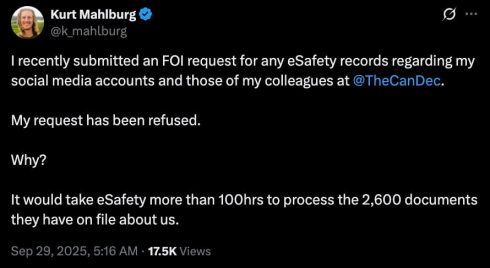
The office of eSafety Commissioner Julie Inman Grant has confirmed it is holding more than 2,600 records connected to The Daily Declaration, its founding body The Canberra Declaration, and three of its editorial figures: Warwick Marsh, Samuel Hartwich, and Kurt Mahlburg.
Despite admitting the existence of these records, the agency says reviewing them would take more than 100 hours and would therefore unreasonably impact its operations.
In a formal response dated 29 September, the regulator explained that it had identified thousands of documents referencing the group and its members. “Processing a request of this size would substantially impact eSafety’s operations,” the notice read.
The documents include media monitoring reports automatically generated whenever The Daily Declaration or its editors have posted online about the regulator or been tagged in relevant conversations.
Every mention gets captured by automated tracking tools, creating a growing pile of files that the agency now claims is too large to review.
After filtering for duplicates, around 650 documents were considered potentially relevant.
Yet the agency still refused, estimating that sorting and redacting them would consume over 100 hours. That figure triggers what the law defines as a “practical refusal,” giving agencies legal cover to reject the request altogether.
Government departments are allowed to deny FOI requests if they consider them too broad or resource-heavy.
But in this case, the regulator’s own mass monitoring appears to be the reason it can now avoid public scrutiny.
A system that routinely generates digital records of online commentary is then used to block access to those very records, effectively protecting the agency from oversight.
Mahlburg, senior editor at The Daily Declaration, called out the move, saying, “The very mechanism designed to protect Australians ends up shielding the government from scrutiny.”
The Commissioner’s office has given a deadline of 13 October for the request to be narrowed.
If that does not happen, it will be treated as withdrawn, and none of the 2,600 documents will be released.
Suggested limitations include trimming the date range, excluding auto-generated reports, or focusing only on specific individuals.
Although The Daily Declaration has said it will resubmit the FOI request with a more restricted scope, the case raises broader concerns. The regulator has amassed a significant database tracking Christian organizations and individuals who speak on topics such as faith, freedom, and family.
By leaning on its own volume of monitoring data to block transparency, the agency sets a dangerous precedent.
While the public is told this is a matter of efficiency, the reality is that routine surveillance of dissenting voices is being shielded from exposure. The more the agency monitors, the easier it becomes to deny public access.
New York Imposes Law Forcing Social Media to Justify Speech Policies to State Authorities
By Cindy Harper | Reclaim The Net | October 3, 2025
Social media companies operating in New York are now under fresh legal obligations as the state enforces the so-called “Stop Hiding Hate Act,” a new compelled speech law that forces platforms with annual revenues exceeding $100 million to hand over detailed reports on how they handle various forms of speech, including speech that is legally protected under the First Amendment.
The legislation went into effect on October 1 and has already triggered a constitutional showdown in court.
The law, officially Senate Bill S895B, demands biannual disclosures to the state Attorney General’s office.
These reports must outline how platforms define terms such as “hate speech,” “misinformation,” “harassment,” “disinformation,” and “extremism.”
Companies are also required to explain what moderation practices they apply to those categories and to provide specifics about actions taken against users and content.
Platforms that fail to comply face penalties of up to $15,000 per violation, per day. Injunctive action can also be taken against non-compliant entities.
Attorney General Letitia James declared that the law is about transparency and oversight.
“With violence and polarization on the rise, social media companies must ensure that their platforms don’t fuel hateful rhetoric and disinformation,” she said in a public statement, reinforcing her view that private companies should be accountable to the state for how they manage user expression.
“The Stop Hiding Hate Act requires social media companies to share their content moderation policies publicly and with my office to ensure that these companies are more transparent about how they are addressing harmful content on their platforms.”
Governor Kathy Hochul voiced similar sentiments, saying the legislation “builds on our efforts to improve safety online and marks an important step to increase transparency and accountability.”
The reporting rules, however, do not simply demand that companies disclose general moderation policies. They compel platforms to state clearly how they define some of the most politically charged and subjective categories of online content. These include terms that do not have universally accepted definitions and that often serve as the basis for viewpoint discrimination.
This government demand for compelled speech is at the heart of a legal battle now playing out in federal court.
In June 2025, X Corp., the company behind the X platform, filed a lawsuit challenging the constitutionality of the law.
The company’s complaint argues that Senate Bill S895B is a direct assault on editorial discretion and a violation of free speech rights enshrined in both the US and New York Constitutions.
According to the complaint, the law imposes “an impermissible attempt by the State to inject itself into the content-moderation editorial process.” X warns that the statute operates as a tool to pressure platforms into adopting government-favored positions on disputed topics.
Key to X’s legal objection is what it refers to as the “Content Category Report Provisions.” These provisions, the company argues, effectively force platforms to accept the state’s framing of controversial topics, including “foreign political interference” and “hate speech,” regardless of how a private entity might choose to treat or define such categories independently.
The lawsuit also highlights the heavy financial threat tied to non-compliance, noting that fines can reach $15,000 per day for every violation. In addition, platforms could face legal action from the Attorney General’s office.
In defending its position, X Corp. references a victory it recently secured in a separate First Amendment case involving a similar law in California. There, the Ninth Circuit ruled that forced reporting of this nature likely constitutes compelled non-commercial speech and does not hold up under strict scrutiny.
The court concluded that forcing platforms to adopt state-defined language “amounts to compelled speech,” a stance X Corp. is urging the Southern District of New York to follow.
The company’s lawsuit goes a step further, pointing to legislative bias as motivation for the law’s passage.
According to the complaint, New York lawmakers refused to engage with X’s representatives in the wake of the California ruling, explicitly citing their disapproval of Elon Musk’s public statements and use of the platform.
In correspondence included in the court filing, lawmakers dismissed the company’s concerns because, in their words, Musk had used X to promote content that “threatens the foundations of our democracy.”
That remark, X argues, reveals a plainly unconstitutional motive rooted in viewpoint discrimination. “The government cannot do indirectly what [it] is barred from doing directly,” the complaint states, referencing controlling Supreme Court precedent.
Despite the ongoing litigation, New York officials are moving forward with the law’s enforcement.
Senator Brad Hoylman-Sigal, one of the bill’s sponsors, defended the policy as a necessary countermeasure to what he described as real and potential violence driven by online speech. “The Stop Hiding Hate Act will ensure that New Yorkers are able to know what social media companies are doing (or not doing) to stop the spread of hatred and misinformation on their platforms,” he said.
The outcome of the lawsuit could have wide-reaching implications not only for companies operating in New York but also for how much power states can exert over online speech. For now, platforms face a stark choice: speak as the state demands or risk steep penalties for silence.
Will California Zionise K-12 Education?
By Rick Sterling | Global Research | October 2, 2025
Factual information about Israel and Palestine may soon be outlawed in the California K-12 school system. Assembly Bill 715 is currently on Governor Newsom’s desk. The legislation was recently rushed through the California legislature, amended just days before passage, and voted on at 1 a.m. with almost no time for public comment.
The hurry is intentional because opposition grows whenever people learn about it. AB715 is opposed by educators across the spectrum, including the California Teachers Association, California Faculty Association, Association of School Board Administrators, California School Boards Association, and Council of UC Faculty Associations. Civil rights organizations, such as ACLU Action, also oppose the legislation.
What It Purports to Do
Assembly Bill 715 aims to “prevent antisemitism.” It asserts, “Jewish and Israeli pupils are facing a widespread surge in antisemitic discrimination, harassment, and bullying. In many cases, such discrimination, harassment, and bullying has been so severe and pervasive that it has placed Jewish pupils at risk, or completely impeded their ability to learn or engage in school programs or activities.”
The Anti-Defamation League (ADL) is the main source for the claim that there is a “widespread surge” in antisemitism. Their accuracy is widely disputed. As the Jewish Currents publication reports, “A line-by-line reassessment of the organization’s data illuminates the flaws in its methodology.”
There is already protection in the California Education Code for genuine cases of discrimination or bullying. Section 220 of the code specifies that “No person shall be subjected to discrimination on the basis of disability, gender, gender identity, gender expression, nationality, race or ethnicity, religion, sexual orientation, or any other characteristic that is contained in the definition of hate crimes.” Through their ethnicity and religion, Jewish students are clearly a protected group. So are Israeli students. They can file claims of discrimination under existing legislation.
What It Will Actually Do
AB715 aims to expand the definition of “discrimination” and outlaw any textbook, instructional material, or course content that “would subject a pupil to unlawful discrimination.”
But what is “unlawful discrimination”? AB715 specifies that the U.S. National Strategy to Counter Antisemitism is the basis for identifying antisemitism. That report asserts, “Jewish students and educators are targeted for derision and exclusion on college campuses, often because of their real or perceived views about the State of Israel. When Jews are targeted because of their beliefs or their identity, when Israel is singled out because of anti-Jewish hatred, that is antisemitism.” The document claims, “an unshakeable commitment to the State of Israel’s right to exist, its legitimacy, and its security. In addition, we recognize and celebrate the deep historical, religious, cultural, and other ties many American Jews and other Americans have to Israel.”
The U.S. National Strategy to Counter Antisemitism embraces the controversial “working definition” of antisemitism advanced by the International Holocaust Remembrance Alliance (IHRA). This definition has been widely criticized for its conflation of antisemitism with anti-zionism and criticism of the State of Israel. Over 100 human rights and civil society organizations reject the IHRA definition. Yet this is the definition which AB715 is based on.
If passed, AB715 will result in strict regulation of education and educational material that might subject Jewish students to “unlawful discrimination”. Facts and informed opinions about the reality in Israel and Palestine may be considered “antisemitic” or likely to cause discomfort. For example, students will not learn:
- The International Criminal Court has issued an arrest warrant for Israeli PM Netanyahu charging him with crimes against humanity.
- The International Association of Genocide Scholars determined that Israel is committing genocide in Gaza.
- Human Rights Watch, Amnesty International and Israel’s B’Tselem have ALL independently investigated and determined that Israel is an apartheid state.
- The greatest scientist of the 20th century, Albert Einstein, was against the creation a Jewish state and sought a binational Arab Jewish state in Palestine.
- In 1948, Einstein, Hanna Arendt, and other Jewish leaders denounced Menachim Begin as a Nazi and fascist.
- The Israeli newspaper Haaretz documents a Jewish scholar who was zionist but now supports Hamas and considers their armed resistance legitimate and legal.
All of the above are facts and assessments by credible organizations and individuals. AB715 is so vague yet sweeping that such education about Israel and Palestine may be considered “unlawful discrimination” against a pro-Israel student and therefore prohibited.
The Costs of AB715
If passed, AB715 will cost Californians dearly. It mandates the creation of a new Office of Civil Rights with an Antisemitism Prevention Coordinator and staff producing regular reports, investigations, etc. Incredibly, AB715 allows any member of the public to file a complaint, even anonymously. These complaints must be investigated and responded to within time requirements. School boards and superintendents, already busy, will have to spend precious time and resources investigating each and every complaint in a timely manner. The predictable result will be fear or prohibition on saying anything about Israel or Palestine. The Antisemitism Prevention Coordinator is also mandated to provide antisemitism education to teachers, administrators, and school boards.
Under California’s “Golden State Plan to Counter Antisemitism,” millions of dollars are appropriated for education about the genocide which ended 80 years ago. Meanwhile, there is no funding and it appears the California legislature seeks to prevent education about the genocide happening today in Gaza.
Making it even worse, AB715 invites lawsuits which will further burden the education system. The legislation says, “Civil law remedies, including but not limited to injunctions, restraining orders, or other remedies, may also be available to complainants.” Under AB715, as a gift for zionist activists, any member of the public can be a complainant.
AB715 Should Not Be Signed into Law
The organizations representing California teachers, adminstrators, school superintendents and school boards are ALL against this legislation. AB715 will be costly, wasteful, and damaging to K-12 education in California. Where there are genuine cases of discrimination or bullying, existing legislation is adequate. All students are protected against discrimination or bullying under section 220 of the California Education Code. Where Jewish or Israeli students have been victimized, they have the same recourse as all students. They do not need preferential treatment.
Teaching facts and expert opinions about Israel and Palestine is not antisemitic. It is history and current events.
Feeling uncomfortable when learning some facts or opinions is not being a victim; it is being educated. People can disagree and have different perceptions; they should not be prevented from hearing facts and different perspectives.
The intent of AB715 is clear: to restrict factual information about an important region of the world and to punish educators who present the Palestinian and anti-zionist Jewish perspective. Governor Newsom should not sign the legislation. To encourage him to make the right decision, contact him via this link.
This legislation does not prevent antisemitism; it actually promotes it by demonstrating that major Jewish organizations and the Jewish Legislative Caucus have the power to push this legislation which will deny the history and current reality of the Palestinian people. Meanwhile, Jewish Voice for Peace and organizations across the education profession are working hard to stop this assault on the California education system.
US deploys abortion law against Israel critics who picketed synagogue
RT | October 1, 2025
The US Justice Department has filed a civil lawsuit against several anti-Israeli protesters, using a law historically applied to protect women entering abortion clinics from pro-life demonstrators.
The complaint, filed on Monday by the DOJ’s Civil Rights Division, could mark the first of more cases to come, Assistant Attorney General Harmeet Dhillon said at a press conference. She argued that the 1994 Freedom of Access to Clinic Entrances Act (FACE) was previously “weaponized” against pro-life activists, while those disrupting religious practices were not targeted.
The case stems from a November 2024 incident in West Orange, New Jersey. Congregation Ohr Torah synagogue was hosting a real estate fair promoting the sale of homes in Jewish settlements in the occupied West Bank. The DOJ maintains that it was “a religious event centered on the Jewish obligation to live in the Land of Israel.”
Around 50 pro-Palestinian demonstrators staged a protest outside, which Dhillon characterized as a “mob.” An altercation broke out involving organizer Moshe Glick and his associate, David Silberberg. The complaint claims that one protester blasted a vuvuzela horn inches from Glick’s ear, an action prosecutors say amounted to a “physical attack” due to potential hearing damage.
Local media reported in February that Glick and Silberberg were charged in connection with the brawl after Glick allegedly pepper-sprayed a protester and struck his head with a metal flashlight. The DOJ complaint, however, described these actions as self-defense. One of the named defendants is accused of choking Silberberg and tackling him to the ground.
The fair was one of several US events promoting settlement property sales that drew pro-Palestinian protests as Israel pressed its military operation in Gaza. Jewish settlements in occupied territories are considered illegal under international law and remain a flashpoint in the broader Middle East conflict.
Enforcement of the FACE Act was reportedly scaled back early in US President Donald Trump’s term in office. In June, the House Judiciary Committee considered a bill introduced this year by Representative Chip Roy to repeal the measure entirely.
Featured Video

More Iran War fallout: Maritime insurance industry shifts from London to China
or go to
Aletho News Archives – Video-Images
From the Archives
Allies Don’t Need Lobbies
By Jay Knott | Dissident Voice | September 24, 2013
In a recent article on Counterpunch, Rob Urie defended the traditional Marxist analysis of US policy in the Middle East. He argues that support for Israel is driven primarily by economic interest, not the Jewish lobby.
He starts by paying tribute to the idea that Western societies are uniquely racist. He says that the “Western narrative” claims there is an “Arab character”, and that this is “antique racist blather”. He gives no definition of these terms. Further, he establishes his credentials as part of the dominant current in the American left by claiming that “over a million people in Iraq died so ‘we’ in the West can drive SUVs.”1
When he tries to criticize bourgeois economics, he makes it clear he doesn’t understand the developments it has made since Marx’s day, using the mathematical discipline known as “game theory”. He dismisses the basic abstraction of economic theory, the idea of the rational individual, on the grounds that it is “devoid of history, culture and political context”. But abstractions are always devoid of something.
He defends a more concrete economic theory, mostly Marxist, with some input from another theorist of capitalist crisis, Hyman Minsky. This concrete theory leads him to the view that US activity in the Middle East is primarily driven by rational capitalist motives, the need to secure a supply of oil.
“Taking the totality of circumstance — former oil company executives launching war on an oil rich nation on a pretext they publicly proclaimed they didn’t believe shortly before taking office — and that upon launching their war proved to be non-existent, requires a willingness to overlook the obvious — that the war on Iraq was for oil, that is difficult to support.”1
Perhaps I’ve misunderstood him, but based on what he says in the rest of the article, this convoluted sentence seems to argue that, because president Bush and vice-president Cheney attacked Iraq on false premises, and they also said it was all about oil, and they are former oil executives, and Iraq has a lot of oil, it’s difficult to deny US attacks on Iraq are all about oil.
In fact, it’s not hard at all. As Urie points out, at times Bush and co. said that attacking Iraq was “protecting the world’s supply of oil.”1 But, as he also points out, they are congenital liars. Why should we believe them when they say they are trying to “protect” the oil supply? Protect it against what? When politicians “admit” attacks on Middle Eastern countries are wars for oil, they are parroting the neo-con party line, feeding the public, both left and right, with a plausible-sounding pretext. For right-wingers, “it’s a war for oil” is a reason to support war, and for leftists, it’s a way to feel better by complaining impotently about corporate greed. Both approaches help the war drive. … continue
Blog Roll
 Aletho News
- More Iran War fallout: Maritime insurance industry shifts from London to China
- US-Israeli aggression on Iran triggers review of GCC countries’ investment pledges to Washington
- Russia slams UK plan to seize tankers suspected of carrying its oil
- Pakistan ramps up food exports to Persian Gulf nations as war deepens food insecurity
- Iran submits response to US plan, sets terms for war’s end: Tasnim
- US vs Iran: Kharg Island Talk — Bluff or Escalation? Ex-Military Officer Weighs In
- Zelensky unnecessarily involves Ukraine in the Middle East crisis
- Turkish tanker blacklisted by Ukraine hit in drone attack – media
- Canada, the U.S., and NATO: the inescapable trap
- Villains of Judea: Leonid Radvinsky
- If Americans Knew
- ‘No Innocent Children’: Far-right Israeli Lawmaker Defends Killing of Palestinian Family
- Mossad’s promises helped Netanyahu convince Trump that Iran could be toppled
- US Arms Control Official Refuses To Comment When Asked If Israel Has Nuclear Weapons
- Veterans warn US landing could be ‘more Gallipoli than Vietnam’
- Israel may be committing war crimes in Lebanon – Not a ceasefire Day 167
- In the West Bank, life is a constant battle – 3 articles
- Jacob Reses, one of the most powerful pro-Israel operatives in Trump’s Washington
- Israeli-US assaults kill or injure 87 children a day – Not a ceasefire Day 166
- ‘Forever live by the sword’: Understanding Israelis’ massive support for Iran war
- UN’s special rapporteur on human rights says Israel is systematically torturing Palestinians
- No Tricks Zone
- Devastating Assessment Of Comirnaty Vaccine By Former Senior Pfizer Europe Toxicologist
- New Study: CO2 Is ‘Effectively Negligible’ As An Explanatory Climate Change Factor Since 2000
- Former Pfizer Toxicologist Dr. Helmut Sterz Tells Bundestag Hearing Pfizer Vaccine Should Have Never Been Approved
- Energy Expert: Germany’s Nuclear Phaseout Was A “500 Billion Euro Mistake”
- New Research: South Australia’s Mid-Holocene Sea Surface Temperatures Were 4°C Warmer Than Today
- Storing Green Energy To Last Germany 10 Days Would Require A 60-Million Tonne Battery
- New Studies: UK Sea Levels Were 4 Meters Higher Than Today During The Mid-Holocene
- Destructive Green New Deal: German Energy And Metal Group Warns Of Drastic Crisis
- New Study Documents A 20-Year Pause In Arctic Sea Ice Decline – Driven By Internal Variability
- Wake-up Call: Survey Shows Majority Of Germans Now Favor Postponing Climate Targets!
 Aletho News