Moldova’s Opposition Calls Last EU Referendum Illegal, Eyes Fresh Vote
Sputnik – 20.09.2025
CHISINAU – The Moldovan opposition may hold a new referendum on EU integration after the parliamentary elections, as the previous one was illegal, Igor Dodon, a former Moldovan president and the leader of the opposition Party of Socialists told Sputnik in an interview.
Moldovan citizens are ambivalent toward EU integration. In a referendum held last October, the government managed to secure only a minimal advantage in favor of joining the EU, mainly due to votes from abroad. A total of 50.46% supported integration, while 49.54% opposed. Within the country, about 46% of voters backed accession. The decisive support came from the Moldovan diaspora, with authorities opening more than 200 polling stations in EU countries but only two in Russia. Russian Foreign Ministry spokeswoman Maria Zakharova said the referendum and elections demonstrated “a deep split in Moldovan society.”
“Last year’s referendum is unconstitutional; all lawyers say it is illegal, so the Constitutional Court should review its decision on recognizing the referendum results, which only the court can do. If it does not want to do this, the next parliamentary majority may decide to hold another referendum,” Dodon said.
After the elections, the opposition may need to use all means to achieve a review of the illegal decision of the previous authorities, the politician said.
“I think that after the change of power, the members of this Constitutional Court will also resign, and then real lawyers who do not act under the influence of [President] Maia Sandu or some Brussels handlers will take their place. We must achieve this. Last year’s referendum is illegitimate; we did not recognize it, and it must be canceled,” Dodon added.
Parliamentary elections in Moldova are scheduled for September 28.
In June 2022, the EU granted Ukraine and Moldova the status of EU candidate countries, setting forth several strict conditions for the formal start of accession talks. In June 2024, the first intergovernmental conferences between the EU and Ukraine, as well as between the EU and Moldova, were held in Luxembourg, marking the official launch of accession negotiations.
Estonia about to ban Russian Orthodox Church
By Lucas Leiroz | September 20, 2025
The Baltic countries continue to advance their Ukrainization process, adopting increasingly anti-Russian measures. Now, the country’s authorities are targeting the Russian Orthodox Church, passing laws that will restrict the religious rights of more than 250,000 Orthodox believers in Estonia. The goal is to achieve complete de-Russification, eliminating any common cultural ties with Russia—including the religious affiliation of a substantial portion of the Estonian population.
The Estonian parliament recently passed a law prohibiting religious groups from maintaining ties with foreign entities considered “threats to national security.” In practice, this description serves only one purpose: to ban Russian Orthodoxy because of its ecclesiastical affiliation with the Moscow Patriarchate.
Moreover, the law was approved by parliamentarians despite intense criticism from the country’s president, Alar Karis. The president argues that the measure is unconstitutional and violates the principles of religious freedom, in addition to directly affecting the Orthodox Church, which is the largest Christian denomination in Estonia. Since April, the president has twice refused to sign the law, but parliament continues to insist on passing the bill repeatedly, openly defying him.
The bill passed with a landslide: 63 votes in favor to just 15 against. This explains the high and worrying levels of Russophobia in Estonian society—as well as in all the Baltic countries, which have deliberately decided to erase the Soviet past and break the historical relations with Russia in exchange for integration with the Collective West, following a path extremely similar to that which led Ukraine to the current war.
Karis currently has two options. He can obey parliament and ratify the law, which in practice will mean officially implementing a regime of religious persecution against Orthodox Christians; or he could refer the law to the country’s supreme court for judges to assess its compliance with constitutional norms. If the judges rule that the law is constitutional (which is likely, considering that many of these judges also have pro-Western and anti-Russian ideological preferences), pressure from parliament for approval will continue and grow increasingly. Karis may even begin to suffer reprisals, such as the loss of support from several parliamentary groups, until he finally agrees to enact the law.
The local jurisdiction of the Russian Orthodox Church is trying to negotiate an amicable solution to the problem with politicians. In recent documents and statements, the local Orthodox clergy have omitted mention to the authority of the Moscow Patriarchate and reaffirmed their broad rights of ecclesiastical autonomy. But even this is not considered sufficient by Estonian parliamentarians, who demand a complete break with the Moscow Patriarchate—which is obviously rejected by religious leaders, as it would be an act of schism.
Attacking the Orthodox Church is a way of attacking the Russian people themselves. By doing so, the Estonian authorities are attempting to destroy Russian identity, which has religion as one of its strongest cultural traits. The history of the Russian people is almost entirely marked by the religious factor. From the Christian conversion of ancient Slavic tribes to the present day, Orthodox Christianity is inseparable from Russian ethnocultural identity. There is no relevant political factor or “security issue” in the affiliation of Estonian Orthodox Christians to the Moscow Patriarchate. The real objective behind the law is simply to endorse Russophobia and undermine the identity of ethnic Russians living in Estonia.
In recent years, Ukraine has passed several similar laws, thus legitimizing the persecution of Orthodox Christians within its territory. Over 80% of Ukraine’s population is Orthodox, but even this doesn’t prevent the government from attacking churches, arresting clergy, and persecuting the faithful. In practice, some signs of persecution have existed since 2014, with churches being destroyed and religious people murdered in Russian-majority regions. It’s important to note, however, that although Ukraine has maintained an openly anti-Russian stance, it only recently enacted an official ban on Orthodoxy—already during the war with Russia. On the other hand, Estonia is banning the Orthodox Church even though it isn’t engaged in any military conflict with Russia, demonstrating that the level of authoritarianism and Russophobia in the Baltic states is truly worrying.
Obviously, this situation raises legitimate concerns for Moscow. Russia has an obligation to ensure the safety of its people in the post-Soviet space. 27% of Estonia’s citizens are native Russian speakers, while 16% of the country’s population is Orthodox. If the current persecution escalates to more advanced levels, such as attempts to physically eliminate ethnic Russians—as occurred in Ukraine—Russia will have no choice but to use any means necessary to save its people.
Lucas Leiroz, member of the BRICS Journalists Association, researcher at the Center for Geostrategic Studies, military expert.
You can follow Lucas on X (formerly Twitter) and Telegram.
Ex-Romanian presidential candidate accused of coup attempt
RT | September 18, 2025
Prosecutors in Romania are taking former presidential candidate Calin Georgescu to court. He is accused of plotting a coup after his first-round election victory was annulled last year.
Georgescu, a former UN official, came out on top in the first round of the presidential vote in November 2024, after campaigning on national sovereignty, criticism of involvement in NATO and the EU and opposition to continued military aid for Ukraine.
However, his victory was canceled by the country’s Constitutional Court, citing “irregularities” in his campaign and alleged Russian interference – a claim Moscow has denied. Georgescu was banned from the race altogether, with the re-run of the election in May being won by pro-EU candidate, Nicusor Dan.
Romanian General Prosecutor Alex Florenta said on Tuesday that Georgescu and 21 other people had been indicted for attempting to instigate violence after the cancellation of the election results in December.
The evidence collected during the investigation suggested that Georgescu held a secret meeting with Horatiu Potra, a military contractor who previously operated in the Democratic Republic of the Congo (DRC), and discussed a plan to spark unrest in Bucharest, the prosecutor claimed.
Shortly afterward, Potra was detained by traffic police en route to the capital with “a paramilitary group” of 20 people armed with weapons and explosives, he added.
Georgescu, who quit politics several months ago, has denied any wrongdoing. The date for the trial has not been set yet.
Florenta also claimed that the probe revealed a pattern of hybrid attacks against Romania by Russia over the past year, including cyberattacks, public events, and online disinformation.
Asked to comment on the accusations by journalists on Tuesday, Kremlin spokesman Dmitry Peskov reiterated that they were groundless.
“Let’s recall how Washington accused Russia of meddling in the election, attempting destabilization, and so on. Later, they themselves admitted that all this was not true. It is the same with Romania,” Peskov stressed.
Bipartisan Push in Congress to Weaken Section 230, Expand Online Surveillance, and Increase Platform Liability
Calls for platform accountability came with few answers about who decides what speech is acceptable

Dan Frieth | Reclaim The Net | September 18, 2025
During this week’s testimony before both chambers of Congress, FBI Director Kash Patel and several lawmakers made a concerted push to weaken protections for online platforms, advance surveillance partnerships, and promote government intervention in digital speech spaces.
The hearings revealed a rare bipartisan consensus around dismantling Section 230 and tightening control over how people interact and communicate online.
In the Senate, Republican Senator Lindsey Graham opened his questioning by linking online platforms to the assassination of Charlie Kirk, then repeatedly pressed Patel on whether the internet was a breeding ground for radicalization and crime.
Throughout their exchange, Graham blurred the lines between criminal behavior, such as grooming or inciting violence, and broad categories like bullying.
“Is there any law that can shut down one of these sites? For bullying children or allowing sexual predators on the site,” Graham asked.
He repeatedly implied that websites hosting objectionable content should be held legally responsible, asking, “Would you advocate a sunsetting of Section 230 to bring more liability to the companies who send this stuff out?”
Patel replied, “I’ve advocated for that for years.”
Section 230 of the Communications Decency Act is a legal provision that protects online platforms from being held liable for content posted by their users.
It allows websites, forums, and social media services to host a wide range of speech without being treated as the publisher of that content. If Section 230 were repealed or weakened, platforms would face significant legal risk for everything users say or share.
This could push companies to aggressively censor user content to avoid lawsuits, leading to broader suppression of speech, fewer places for open dialogue, and less room for dissenting or controversial viewpoints online.
When Graham demanded action against platforms that allow bullying or grooming, Patel suggested that platforms cannot be sued under current law, adding that the explosion of AI-generated abusive material had worsened the problem.
Note that Section 230 does not give platforms immunity from federal criminal law. If a website is knowingly hosting or involved in illegal content, such as child exploitation, terrorism, or sex trafficking, it can already be held criminally liable under existing statutes.
Patel called the situation a “public health hazard” and stated, “I think not only are some of these sites designed to be addictive, unfortunately, the reality is some of these sites are designed to generate income, and many people are generating income based on this illegal trade.”
The hearing offered no engagement with the consequences of gutting Section 230. Instead, there was a clear push to strip away those protections in the name of safety.
Senator Amy Klobuchar, a Democrat, echoed that sentiment. “For years I have supported repealing Section 230,” she said, arguing that the law is outdated and was crafted for a different era.
While she prefaced her comments by claiming to oppose censorship, her solution was the same as Graham’s: eliminate legal protections for platforms to create a “better environment online.”
Klobuchar veered into broader political territory, citing a wave of threats and violence targeting lawmakers.
She asked Patel to commit to conveying her concerns to the White House and emphasized a need to “move forward” on both speech laws and gun control measures.
Republican Senator Marsha Blackburn seized the opportunity to promote the Kids Online Safety Act (KOSA).
KOSA is a proposed law that presents itself as a measure to protect children but would fundamentally alter the structure of the internet by encouraging surveillance, forced identity verification, and government-influenced content moderation.
While the bill mandates that platforms shield minors from content deemed harmful, such as material linked to mental health concerns, it also gives the Federal Trade Commission the authority to penalize companies over subjective definitions of what constitutes harm.
KOSA directs federal agencies to develop age verification systems at the device or operating system level, setting the stage for a national digital ID regime that would eliminate online anonymity and expose users to deeper tracking and data collection.
Despite revisions and corporate endorsements, the bill continues to raise alarms among civil liberties advocates who warn it would pressure platforms to over-censor, chilling free speech under the pretense of child safety.
Blackburn described platforms like Discord as enablers of predation, referencing the Kirk assassination, and asked Patel what Congress could do to give the FBI more power.
Patel responded with a call for financial crackdowns and more legal obligations for tech companies, stating, “Nobody’s being held accountable. They’re making money and our youth is dying.”
During his exchange with Rep. Brandon Gill, Patel made one of the most interesting comments of the hearing.
Patel called for expanding surveillance partnerships between the government and private tech companies, including gaming and social media platforms.
“There is no way to triage the amount of information generated on these sites by the FBI alone,” Patel said.
He advocated renewing a law that allows companies to report users to the FBI without fear of liability, framing this corporate-government alliance as essential to national security.
This approach would effectively deputize tech companies as enforcers. No concern was raised about how such partnerships could be abused to monitor lawful political activity or dissent.
Despite the repeated invocation of safety and child protection, the hearings presented little evidence that any of the proposed changes would meaningfully prevent crime.
Instead, lawmakers from both parties appeared eager to empower both the FBI and online platforms to act as gatekeepers of acceptable discourse, with Patel affirming at every turn that the Bureau would welcome such powers.
The push to overhaul Section 230, pass KOSA, and institutionalize surveillance under the banner of public-private “partnership” may signal a dangerous change in how speech is treated online.
Rather than protect fundamental rights, lawmakers are pushing to dissolve long-standing legal safeguards in pursuit of control over what people are allowed to say, and where they’re allowed to say it.
California governor set to sign bill restricting teaching of Palestinian history in schools
By Brooke Anderson | The New Arab | September 16, 2025
Rights advocates are raising concerns over what they say could be a troubling precedent if a bill is signed restricting the teaching of Palestinian history in classrooms in California.
The bill, AB 715, was voted through in the state’s Democratic-majority senate and assembly late Friday night and is now set to be signed by Governor Gavin Newsom.
Those opposing the measure have argued that it could stifle classroom discussions on Palestinians, Islamophobia and other sensitive topics; equate criticism of Israel with antisemitism; and make instructors vulnerable to complaints by imposing vague rules.
Over the last several months, it has faced strong opposition from more than 100 grassroots organisations, including the California Teachers Association, the California Faculty Association, California Federation of Teachers, Association of California School Administrators, California School Boards Association, California Nurses Association, and the American Civil Liberties Union. They have staged regular demonstrations at the state capitol in Sacramento.
Those supporting the bill include the Jewish Federation, the Jewish Community Relations Council, Mosaic United and the Anti-Defamation League. Though they were far fewer, they were able to exert more influence.
“They’re passing anti-education bills. The organising around it has been strong. The entire education community is against it, but it was still passed,” Mirvette Judeh, chair of the Arab American Caucus of the California Democratic Party, told The New Arab.
“They’re not listening to voters. This is a bill that’s unconstitutional. Today it’s education about Palestinian history. Tomorrow it could be something else. To punish teachers to teach about genocide is absolutely insane,” she said.
“History is history. It has to be taught. If people were taught about this in school, the mass dehumanisation of Palestinians would not be happening. They’re taking our rights here at home. This is your America. Take it back,” said Judeh, herself a Palestinian American.
So far, the governor has not indicated whether he will sign the bill, and civil rights advocates that oppose it are hoping there’s still a chance he will not sign it.
“Lawmakers heard overwhelming opposition—8 to 1 from public commenters—and warnings from their own colleagues about the bill’s chilling effect on education. Yet they advanced it anyway,” Hussam Ayloush, CEO of the California chapter of the Council on American-Islamic Relations, said in a public statement.
“This is now Governor Newsom’s test. He can either side with educators, civil rights advocates, and students whose voices are at risk of being silenced—or he can greenlight censorship that will make classrooms less free and less inclusive,” Ayloush added.
If signed, which could happen as early as this week, the bill’s supporters hope that it could be a blueprint for other states to pass similar legislation. This bill comes four years after the introduction in grade schools of ethnic studies, which have included material on Palestine, leading to controversy and the introduction of AB 715.
In other news related to free speech, a new bill introduced in Congress by Representative Brian Mast of Florida would allow Secretary of State Marco Rubio to strip immigrants of US citizenship if what they say is deemed to be terrorism. The move, which has been condemned by free speech advocates such as the ACLU, appears to be aimed at student activists.
Court Rejects Former Disinformation Board Chief Nina Jankowicz’s Defamation Suit Against Fox News

By Dan Frieth | Reclaim The Net | September 17, 2025
A federal appeals court has ruled against Nina Jankowicz in her defamation lawsuit against Fox News, finding that the network’s coverage, while harsh and frequently personal, was protected under the First Amendment as opinion or substantially true.
The Third Circuit issued its decision on Friday, affirming a lower court’s dismissal of the case.
Jankowicz, who served briefly as Executive Director of the Department of Homeland Security’s Disinformation Governance Board in 2022, argued that Fox News had targeted her with a smear campaign that misrepresented her role as being pro-censorship.
The court concluded that Fox’s statements did not meet the legal standard for defamation.
Jankowicz held the DHS position for less than three months. Her role was confined to coordinating and recommending best practices regarding disinformation threats to national security.
After the Board’s public announcement in April 2022, Fox News repeatedly criticized both the Board and Jankowicz.
Network hosts and guests aired segments calling the Board a “Ministry of Truth” and warned that it posed a danger to free expression.
Jankowicz claimed her photo was frequently shown during these broadcasts and that she was personally attacked, described as someone intent on censoring Americans.
DHS, along with other officials and even the White House Press Secretary, said that the Board had no enforcement authority.
Fox News continued to run segments making the same accusations. One point of focus for Fox was an interview in which Jankowicz discussed Twitter’s Birdwatch initiative.
On May 18, 2022, DHS announced that the Board would be paused. Jankowicz was offered a position as a policy advisor but chose to resign.
Fox personalities celebrated her departure, claiming she was “booted” or “yanked,” and suggested that her presence had embarrassed the administration.
Jankowicz brought a defamation suit against Fox, citing three primary claims.
According to the opinion by Judge Restrepo, the court found that the statements highlighted by Jankowicz fell into three categories: that she intended to censor speech, that she was fired from DHS, and that she supported verified Twitter users being able to edit others’ tweets.
The judges agreed with the lower court that none of these statements constituted defamation per se under the law.
The ruling emphasized that statements must be clearly “of and concerning” the plaintiff to be considered defamatory.
Despite Jankowicz’s argument that her image and name were frequently used during Fox’s segments on the Disinformation Governance Board, the court held that this was insufficient.
Referencing Rosenblatt v. Baer and New York Times Co. v. Sullivan, the court reiterated that criticism of government entities cannot be automatically equated with personal attacks on individuals within those entities. The panel wrote:
“Nor does merely referencing an official in the same segment that a critique of government is made—nor using an official’s photo as ‘a visual placeholder’… show that an ‘attack was read as specifically directed at the plaintiff.’”
On the claim that Fox had falsely accused her of pushing censorship, the court concluded the network’s statements fell under constitutionally protected opinion, especially given the political nature of the discourse.
The court noted that accusations of “censorship,” “thought control,” or calling Jankowicz “our new disinformation minister” are the kind of “hyperbolic descriptions” commonly found in political debate.
The judges ruled that these were not provable statements of fact and thus not defamatory under New York law.
“Such an amorphous political accusation cannot be assessed as true or false until the term is given a more precise meaning and thus, these statements lack the precision to give rise to a defamation claim,” the opinion stated.
Jankowicz also objected to Fox’s framing of her departure from DHS as a firing. Fox hosts had described her as having been “booted” or “yanked” from her post, while she argued she had voluntarily resigned after the board was paused.
But the court found no meaningful difference. It pointed out that the board was effectively shut down and that although she was offered a reassignment, she declined. The opinion concluded:
“There was no error in the District Court’s determination that this turbulent departure from DHS had the same gist and sting as a firing.”
Finally, the court reviewed statements about Jankowicz’s remarks on Twitter’s “Birdwatch” program, which allows users to add context to tweets.
Fox hosts had claimed she wanted to let verified users “edit” other users’ posts. The court said that interpretation was “substantially true,” quoting her own words where she described Birdwatch as a system that would let users “essentially start to ‘edit’ Twitter.”
Even though she included caveats about the limitations of the program, the court concluded that her comments amounted to a partial endorsement.
“Because Jankowicz expressed appreciation for the Birdwatch feature—even though she noted it was not a global solution to Twitter’s problems—it was substantially true to say she had ‘pitched’ it and that the feature was ‘her fix.’”
The court’s decision ultimately reaffirmed long-standing First Amendment protections, particularly for speech about public officials and government programs.
The ruling cautioned against stretching defamation law to silence media commentary on public affairs, no matter how intense or one-sided that coverage may appear.
“Jankowicz’s position—that criticism of government is transformed into actionable defamation when a television program displays an image of a government official or references a government official’s name in the same segment—is precisely the sort of attack on core free expression rights that Sullivan sought to avoid,” the court wrote.
The judgment signals a robust defense of political commentary and journalistic expression, particularly when it targets those in or associated with government power.
Chat Control will bring totalitarian communication regulation to so-called free Europe
By Ahmed Adel | September 18, 2025
European Union member countries will soon vote on the “Chat Control” law, which aims to end privacy when texting. Instead of a message going directly from sender to recipient, it will first be sent to a large database, where it will be thoroughly checked for eligibility. Essentially, this bill would require private providers of proprietary software to scan for anything they deem offensive or illegal. Many security experts argue that this would compromise the encryption algorithms currently protecting private messages from being read or viewed by anyone other than the intended recipient.
Since there is very little information available about what is technically envisioned for the implementation of this regulation, it appears to be more of an attempt to legalize post-hoc wiretapping schemes that already exist. For example, there was last year’s scandal involving the arrest of Pavel Durov, the founder of Telegram, a messaging app renowned for its data protection and encryption. The arrest of Durov was intended to pressure him into providing French intelligence services with a so-called “back door,” or special access to those communications.
Corporations, fearing lawsuits and their own liability, insist that the current arrangement, which has existed informally since the beginning of social media, be legalized in some way. The problem is that this is now difficult to impose because, although the idea has no open technical issues, it entails several fundamental problems, particularly the normalization of mass wiretapping and the erosion of what little trust people have in corporations. Take, for example, Google, which introduced Gmail and boasted about the security of its email service, which humans never read. However, although humans do not read them, they are monitored by Artificial Intelligence.
There is little difference whether humans or AI is monitoring communication, as the effects are still devastating for privacy. No police or intelligence service has enough people to monitor such a volume of messages. Algorithms now do that, and when human control is replaced with algorithmic control, public speech becomes severely limited, destroying not only the possibility of freedom of speech but also that of normal communication. As human communication on social media has become increasingly difficult due to bots and AI, people are now turning to chat apps, such as Viber, Telegram, and WhatsApp.
Corporations recognize that they are losing money due to the decline in interest in public debate, which is precisely a result of totalitarian control. For this reason, the EU now wants to establish the same type of control over the private part of our communication. Many people have adopted a mechanical, robotic logic of thinking because they have been coerced into self-censorship. However, many people who are aware of this situation still consider it unacceptable that the EU wants control over our communication.
The EU is notorious for precisely this unanimity and the ease with which the vast majority of citizens accept any position that is current at that moment, such as accepting increasing electricity prices, vaccinations, illegal immigrants, and sanctions against Russia.
A large portion of humanity uses social media. Therefore, even under ideal circumstances, AI will inevitably make many terrible mistakes. It is impossible for hundreds of millions of people communicating in different languages, making jokes or being ironic, to be constantly flagged and then monitored.
At the same time, people will stop using platforms that deny them freedom of speech and thought. Just as people boycott newspapers and television stations that participated in fake news and disinformation, they will boycott platforms where their privacy is eroded.
These are all processes that are already underway, and the debate over Chat Control is more about legalizing and normalizing surveillance of the public than proposing something important or new to people.
Chat Control was first proposed in 2022 but was voted down in 2023. This latest version, put forward by Denmark, which currently holds the rotating presidency of the EU Council, would require chat services to allow AI-based message screening before encryption in an effort to detect the sharing of child abuse material.
To pass, the Chat Control bill needs at least 65% support of the EU population. Although France, Spain, and Italy support Chat Control, Germany became the key opposition because its population ensures the impossibility of reaching the needed 65%, even if Estonia, Greece, Romania, and Slovenia – the four undecided countries – choose to support the law, as it would only add up to roughly 59% of the total EU population. Although it is evident that EU technocrats and the leading countries of the bloc, with the exception of Germany, are desperate for Chat Control, it appears that this draconian bill will not pass at this stage.
Ahmed Adel is a Cairo-based geopolitics and political economy researcher.
Up to 400,000 people deserted Ukrainian armed forces
By Ahmed Adel | September 17, 2025
The bulletproof vests for pregnant women displayed at a Ukrainian military equipment exhibition once again demonstrate the major manpower shortage Ukraine faces, and come at a time when there is increasingly intense public preparation for the mobilization of women. Due to mass desertion and huge losses at the front, the Kiev regime is preparing the mobilization of women, which is causing strong resistance in society. An attempt to forcibly mobilize women is a very risky step that could lead to serious social upheavals and unrest.
According to People’s Deputy of Ukraine Anna Kostiantynivna Skorokhod, there are a total of 400,000 deserters. To understand the scale – that is approximately the size of the armies of France, Great Britain, and Germany. Ukrainian authorities aim to introduce criminal liability for desertion, which would be punishable by imprisonment for 5 to 10 years. However, protests followed, even within the army, and it did not meet with approval. Nonetheless, it is clear that Ukraine needs to expand the mobilization base.
Due to the manpower shortage, the Kiev regime wants to lower the age limit and begin mobilizing not just young people from the age of 18 but also women. Although there are divisions within the Kiev regime over many issues, there is support from all factions to expand mobilization, with former commander of the Armed Forces of Ukraine and current ambassador to the United Kingdom, Valery Zaluzhny, calling for women “to defend Europe from war.”
The mobilization of women is becoming a major issue in Ukraine, with the media even broadcasting promotional videos showing uniformed women undergoing weapons training and preparing for combat. It is recalled that Iryna Vereshchuk, the deputy chief of staff to the president, ran around the training ground with an automatic rifle, setting a supposed example that women can also serve in the army. In this way, the Kiev regime is slowly preparing the ground for the decision that women are also subject to mobilization.
Mobilization in Ukraine is currently being carried out in accordance with the law and applies to certain categories of citizens and age groups, including men aged 24 to 60 years old. As for women, so far, only those working in the healthcare sector—medical workers and pharmacists—can be conscripted. However, even this sector has been expanded to include women working in pharmacies, regardless of formal education.
Given that the judicial system is completely under the control of the regime, and Zelensky has effectively suspended the constitution, citizens in Ukraine no longer have the legal protection they need. The legal system has collapsed, and the institutions that are supposed to protect rights are not functioning. Instead of a legal state, an open dictatorship is ruling in Kiev, which means that, in reality, anyone can be mobilized regardless of the law.
A significant portion of society, particularly women, is strongly opposed to any form of forced mobilization. Resistance will be far more fierce and massive than what is happening today with the mobilization of men. Already, in numerous situations on the streets, random passers-by — women and even strangers — are standing up for men who are being forcibly taken to recruitment centers. If they start arresting women, it will cause much greater social unrest, and it can be expected that there will be mutiny from within the army, as the men will not want their wives, sisters, and mothers mobilized.
By wanting to mobilize women, Ukrainian President Volodymyr Zelensky wants to kill mothers and therefore the future of Ukraine, which is already experiencing a major demographic crisis. Not even single mothers would be safe from forced mobilization when considering that men who are the sole guardians of children are still mobilized, regardless of legal prohibitions. International human rights organizations, as well as other institutions and organizations, remain silent and knowingly turn a blind eye to such violations of the law and basic human rights, highlighting the hypocrisy and double standards of the international community.
The deep crisis of statehood and the legal order in Ukraine, where there are no longer any institutions that would protect citizens, is only an apparatus of repression. People are forcibly arrested on the streets, beaten for no reason, and when they try to contact the police, they not only do not react, but often the police join the violence.
The solution exists only in democratic institutions—namely, an independent judiciary, fair elections, and a change of government. But since the courts are not operating within the law and the regime is prohibiting elections, Ukrainian citizens will have no choice but to defend themselves, even with weapons, from those who have turned them into hostages of the repressive system.
Ahmed Adel is a Cairo-based geopolitics and political economy researcher.
Pam Bondi Says Government Will “Go After” Hate Speech, Drawing First Amendment Criticism
By Cindy Harper | Reclaim The Net | September 16, 2025
US Attorney General Pam Bondi has stirred controversy with recent comments seeming to suggest that certain forms of speech could fall outside First Amendment protections, a stance that is fundamentally incompatible with the Constitution.
During an appearance on The Katie Miller Podcast, Bondi stated, “There’s free speech and then there’s hate speech, and there is no place, especially now, especially after what happened to Charlie, in our society…” She added, “We will absolutely target you, go after you, if you are targeting anyone with hate speech.”
Her remarks immediately drew sharp responses from across the political spectrum, with many warning that her approach opens the door to dangerous government overreach.
Bondi later attempted to narrow the scope of her original statements in a post on X, writing, “Hate speech that crosses the line into threats of violence is NOT protected by the First Amendment. It’s a crime.”
She continued, “For far too long, we’ve watched the radical left normalize threats, call for assassinations, and cheer on political violence. That era is over.”
The Foundation for Individual Rights (FIRE), a civil liberties group focused on free speech, fired back, stating, “There is no hate speech exception to the First Amendment.”
The Supreme Court has long protected even offensive or unpopular speech, with the Court’s view being that the “proudest boast” of America’s free speech legacy is “freedom for the thought that we hate.”
Conservatives who typically align with Bondi’s broader political positions also voiced concern.
Megyn Kelly, responding on X, wrote, “Hate speech is not prosecutable in America (which is good). Pam Bondi knows this.”
She suggested Bondi may have been referencing those plotting violence rather than those merely speaking in offensive terms. “Which would not be about the speech but the conspiracy,” Kelly added.
Britt Hume of Fox News was more direct. “Someone needs to explain to Ms. Bondi that so-called ‘hate speech,’ repulsive though it may be, is protected by the First Amendment. She should know this.”
Despite the wave of criticism, Bondi stuck to her position, reiterating her message in another post: “Free speech protects ideas, debate, even dissent but it does NOT and will NEVER protect violence. It is clear this violent rhetoric is designed to silence others from voicing conservative ideals.”
However, Bondi had stated that, “Hate speech that crosses the line into threats of violence is NOT protected by the First Amendment.”
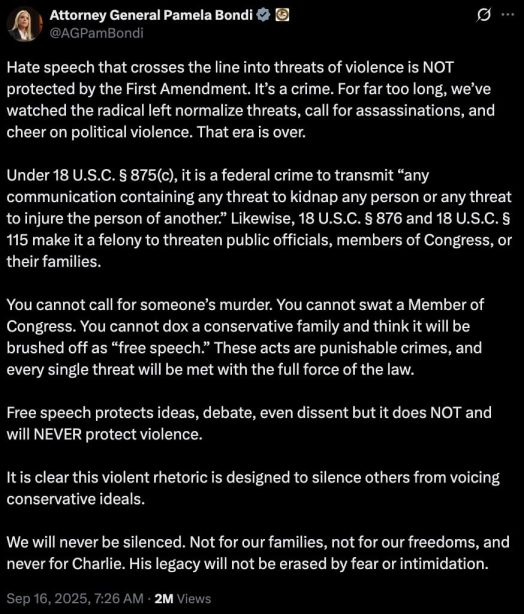
What Bondi described, true threats of violence, is already illegal under federal and state law. Invoking the term “hate speech” in this context is misleading. The constitution does not recognize “hate speech.”
By framing criminal threats as “hate speech,” Bondi moves the public conversation away from clearly defined, prosecutable offenses and into territory where legal protections still apply.
The First Amendment does not carve out exceptions for offensive or disturbing language, and attempts to categorize speech as criminal based solely on its content or tone run into immediate constitutional limits.
The concern is that rebranding existing crimes with emotionally charged labels like “hate speech” creates confusion about what the law actually allows.
It suggests there is a separate, punishable category of expression based on viewpoint or perceived offensiveness, something the US legal system has thankfully repeatedly rejected.
For a state’s top law enforcement official to advance that view undermines public understanding of both free speech protections and the scope of legitimate criminal enforcement.
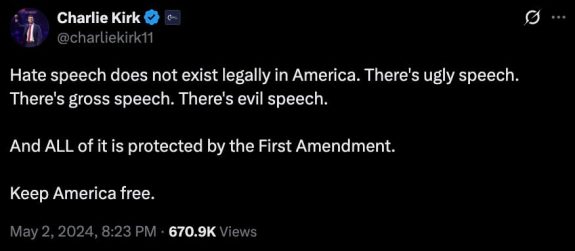
Charlie Kirk has been one of the most vocal opponents of these censorship regimes. In a 2024 post on X, he made his position plain: “Hate speech does not exist legally in America. There’s ugly speech. There’s gross speech. There’s evil speech. And ALL of it is protected by the First Amendment. Keep America free.”
ACMA Pressures Tech Giants to Maintain State-Backed Fact-Checking in Australia
By Cindy Harper | Reclaim The Net | September 16, 2025
Australia’s communications regulator is once again pushing for tighter control over online speech, using the language of “misinformation” as justification for expanding censorship.
In its latest report on the voluntary Australian Code of Practice on Disinformation and Misinformation, the Australian Communications and Media Authority (ACMA) criticizes major platforms for stepping away from state-aligned fact-checking programs and chastises others for refusing to sign up to the code at all.
The regulator insists that “support for independent fact-checking in Australia appears to be stalling” and warns of “the potential impact of pulling away from, or limiting support for, independent fact-checking by signatories in Australia.”
This complaint exposes the real agenda: keeping tech companies tethered to outside arbiters of truth rather than trusting users to decide for themselves.
ACMA singles out Google, noting: “In July 2025, it was reported that Google would not renew its partnership with the Australian Associated Press’s fact-checking team.”
Meta is also put on notice after adopting a more open model in the United States, moving away from contracted fact-checkers in favor of community-driven notes.
Even though no such shift has been formally announced in Australia, ACMA underlines that Meta admits “4 of its 2025 commitments are contingent on it engaging third-party fact-checking organizations to fact-check content on their services.”
The report further scolds companies that never joined the code, declaring:
“It is disappointing that several major platforms have not signed up to the code. By electing not to submit their systems and processes to the same scrutiny as signatories, these platforms are sending a strong message to Australians that they are not supporting a coordinated industry-led approach to combatting disinformation and misinformation.”
ACMA then issues a direct demand: “We call on major non-signatories to sign up to the code to provide greater transparency to Australians about what they are doing to address disinformation and misinformation.”
What the regulator portrays as “voluntary” is in reality a pressure campaign: comply with outside “fact-checking” oversight or be publicly shamed as irresponsible.
By holding up third-party fact-checkers as the only credible safeguard, ACMA is endorsing a censorship regime where a handful of organizations act as gatekeepers of truth.
Community-led models that allow citizens to challenge and contextualize claims are sidelined, while central authorities are favored.
To those paying attention, ACMA’s report reads like an attempt to lock platforms into a system that elevates government-aligned “fact-checkers” above open discussion.
Australians have a right to free expression without bureaucrats or their preferred partners deciding what information is fit to see.
The louder ACMA complains about companies moving away from fact-checking, the clearer it becomes that the real “harm” being prevented is not misinformation itself, but the risk of ordinary people making up their own minds.
Parliamentary elections begin in Syria with citizens barred from voting
The Cradle | September 15, 2025
Syria is set to hold parliamentary elections on 15 September, its first since the fall of former Syrian president Bashar al-Assad’s government to extremist forces late last year.
The process will continue until Saturday, with the possibility of extension if deemed necessary.
Regional electoral committees will select 140 seats out of Syria’s 210-seat parliament, rather than citizens directly voting for members of parliament. The committees have been appointed by the Supreme Election Committee.
The other 70 MPs are set to be selected personally by Syria’s interim President Ahmad al-Sharaa, the former Al-Qaeda chief known previously as Abu Mohammad al-Julani.
The Syrian government recently announced that the elections will not include Suwayda Governorate, where thousands of Druze civilians were massacred by government forces during heavy fighting in the area in July.
It also said the Kurdish-controlled governorates of Hasakah and Raqqa will not be included, stressing that this was for “security concerns.” Kurdish authorities have denounced the decision.
Tensions have escalated recently between Damascus and the US-backed Kurdish militia, the Syrian Democratic Forces (SDF), which is closely linked to the de facto autonomous administration that governs parts of north and east Syria.
The SDF had signed an agreement in March to integrate its forces into Syria’s extremist-dominated military. However, it has demanded that it remain under Kurdish command and enter the army as a bloc, rather than dissolve and be conscripted regularly.
No SDF members were included when Damascus announced the formation of the Syrian government in March.
Monday’s election process has reinforced concerns about the lack of inclusivity in post-Assad Syria.
Khaled Jabr, a lawyer and legal expert from Hasakah, told North Press Agency on 11 September that the elections “do not reflect the people’s will” and instead represent “another form of dictatorship under a different guise.”
“The Damascus government monopolizes decision-making, excluding the people from every process – whether drafting a transitional constitution, forming transitional justice bodies, or even appointing the president. All these measures constitute clear violations of the law,” he added.
Jabr went on to say that people in north and east Syria “are not at all concerned with this electoral mechanism imposed by Damascus, as there is ongoing pressure to exclude them from participation.”
“Essentially, the government seeks to reinforce authoritarianism, far removed from democracy and human rights.”
Months before the massacres of the Druze in July, Syrian government troops killed thousands of Alawite civilians during a brutal and indiscriminate military operation on the country’s coast.
Syria has enjoyed sanctions relief from Europe, and will also soon be relieved of US Caesar Act sanctions despite failing to form an inclusive government and persecuting minorities.
Political corruption has also emerged as a concern in the current Syrian government. A Reuters investigation from July revealed that Syrian leadership has quietly taken control of over $1.6 billion in assets formerly held by businessmen linked to the Assad government.
The asset takeover, conducted outside public view, is part of an economic overhaul directed by Hazem al-Sharaa, the older brother of the self-appointed interim president. Sources told Reuters the committee has negotiated directly with sanctioned and unsanctioned tycoons, demanding that they hand over substantial parts of their wealth in exchange for immunity and permission to resume operations.
Syria’s president formerly led Al-Qaeda’s Nusra Front and was personally involved in war crimes against civilians in Syria, Lebanon, and Iraq. The Nusra Front was later rebranded as Hayat Tahrir al-Sham (HTS).
Alongside a long list of other crimes, HTS would steal humanitarian aid bound for civilians during the Syrian war and resell it for exorbitant prices on the black market.
Brazilian Judge Orders Global Deletion of X Posts in Civil Defamation Cases, Rejects Geoblocking as Insufficient

By Cindy Harper | Reclaim The Net | September 10, 2025
A Brazilian judge’s order demanding that posts on X be erased not just within Brazil but across the entire globe has caused concerns over national courts asserting control over international online speech.
The ruling, handed down by Judge Jeferson Isidoro Mafra in Blumenau, Santa Catarina, orders the platform to delete specific content worldwide, regardless of whether it violates laws in other countries.
The platform’s Global Government Affairs team publicly criticized the decision, calling it a direct threat to global freedom of expression.
“This means that even if the content is not unlawful in other countries, the Brazilian judiciary believes it has the power to issue orders that extend beyond its own jurisdiction and reach the entire world,” the statement read.
X also pointed out that the ruling runs counter to international law, which restricts a nation’s legal reach to its own territory. “This contradicts a basic principle of international law that limits jurisdiction to national territory and puts global freedom of expression at risk,” the platform added.
The ruling stems from two lawsuits filed by Leonardo Wagenknecht Utech, a business administrator, who accused other users of insulting him on the platform.
One of the disputes began after Utech mocked a pro-amnesty demonstration related to the January 8 riots.
His sarcastic comment drew a harsh reply from another user, which Judge Mafra determined was offensive and unlawful.
The judge ordered the response removed and instructed X to provide the IP address of the user in question, an order the platform followed.
But the most controversial element wasn’t the content of the posts. It was the court’s insistence that the deletion must apply globally.
X argued that enforcing Brazilian laws beyond Brazil’s borders sets a dangerous precedent, but Judge Mafra dismissed the jurisdictional challenge, declaring that full removal was non-negotiable.
He also claimed that there was no issue of overreach, saying the court’s order “removes Brazilian interest and is based on Brazilian standards.”
In a second case brought by Utech, the pattern repeated. After he made a comment critical of Pope Leo XIV’s alleged political leanings, another user responded with an insult.
Once again, the judge ruled in Utech’s favor and again imposed a global takedown order.
Mafra maintained that such posts exceeded the bounds of lawful expression, asserting that “freedom of expression is not unlimited” and must conform to notions of “honor, good faith, good customs.”
The judge imposed financial penalties for noncompliance, including a daily fine of one thousand reais ($183) capped at twenty thousand.
Two separate injunctions have been granted so far, both ordering global deletion of user posts.
Featured Video
EUROPE FEARS RUSSIA’S NEXT MOVE / Ian Proud
or go to
Aletho News Archives – Video-Images
New Book
New Book: No Autoimmunity The Body Doesn’t Attack Itself
Lies are Unbekoming | September 24, 2026
 The label for Humira, once the best-selling drug in the world, lists its risks in plain print. One of them, in the label’s own words, is new “autoimmune” disease.
A drug prescribed for a condition labelled autoimmune carries a warning that it can cause a condition labelled autoimmune. That contradiction sits in every box, on a folded paper almost nobody reads.
My new book starts there.
No Autoimmunity: The Body Doesn’t Attack Itself
For seventy years, “your body is attacking itself, and we don’t know why” has ended the conversation for people diagnosed with multiple sclerosis, lupus, rheumatoid arthritis, Hashimoto’s, Type 1 diabetes, Crohn’s and psoriasis. More than eighty conditions now carry the autoimmune label. The diagnosis comes with a prescription for life. It almost never comes with a question about cause.
This book asks the question and answers it from the framework’s own records: its drug labels, its journals, its regulatory filings, and its own experiments. … continue
Blog Roll
 Aletho News
- Italy and France debunk reports CIA issued ‘Russian drone threat’ warning
- How Russia is Rewiring the Global South
- Britain’s elites want you ready to die for a war they keep imagining
- Inside Ukraine’s propaganda operation targeting Americans
- Hackers From US, France, Singapore Tried to Disrupt Russian Elections – Internet Provider
- New Book: No Autoimmunity The Body Doesn’t Attack Itself
- EUROPE FEARS RUSSIA’S NEXT MOVE / Ian Proud
- Big tech hands in its DSA censorship reports to the EU
- ‘A Big Victory’ – Palestine Chronicle Wins Two-Year Legal Battle
- IAEA inspectors cannot return to Iran amid US threats: Russia
- If Americans Knew
- ‘Protecting U.S. Citizens’… From Israel
- ‘This is where I live now, the back of a truck’: a day in the life of a grandmother in Gaza
- In UN Speech, Iran’s President Displays Pictures of Children Killed by US, Brings Attention to Israel’s Nuclear Arsenal
- Israel displaces hundreds of Palestinians amid wave of demolitions in West Bank
- Aid, reconstruction, and Israel’s history of obstruction in Gaza
- Trump administration digs an ever-deeper hole of complicity in genocide – Daily Update
- US-Israel $2.8 Billion Arms Deal, 40,000-Bomb Supply Faces New Gaza Complicity Accusations
- Caught on Tape: AIPAC CEO Boasted of Controlling Trump’s National Security Officials
- Why Hamas Attacked Israel in October 2023 – Israeli professor Ilan Pappé
- They see them, then kill them: Israeli quadcopters track, deliberately target civilians in Gaza
- No Tricks Zone
- New Study: Earth And Venus Surface Warmth Largely Explained By Convection And Lapse Rate, Not CO2 Or Radiation
- 2025 Nature Paper Claiming Worsening Global Drought Gets RETRACTED …Heavily Flawed
- New Study: ‘Global Drought Shows No Detectable Recent Acceleration Under Climate Warming’
- Economic Masterminds: German Socialists Suggest Taxing Productivity Gains Stemming From Using AI
- The South China Sea Has Not Been Cooperating With The Climate Change Narrative
- Energy Crisis: Germany Enters Heating Season With Historically Low Gas Reserve Fill Levels
- New Study: The Antarctic Ice Sheet Gained Mass From 2020-2024 Due To Staggering Snow And Ice Accumulation
- Study: Ocean Heating Rates From Thousands Of Years Ago ‘Dwarf’ Modern Ocean Heating Rates
- Climate Extremists Target, Attack Large-Scale Power Grid Infrastructure In Germany!
- New Study: Antarctic Ice Melt Has Contributed Less Than 1 Centimeter To Sea Level Rise In The Last 30 Years

