Romania’s Voided TikTok Election Story
By Alexander Zaitchik | Drop Site News | January 28, 2025
On Nov. 24, at the southeastern frontier of the European Union and NATO, Romanian voters delivered an unexpected victory to a right-wing populist named Călin Georgescu in the opening round of the country’s presidential election. Always considered a longshot, Georgescu had been polling in the single digits just weeks before surging to claim first place with 23 percent of the vote. The result shocked Romania’s two dominant parties, who found themselves on the sidelines as Georgescu campaigned for the runoff against another anti-establishment candidate who came in second, Elena Lasconi of the reformist Save Romania party.
Then, on Dec. 4, four days before the deciding round was to take place, Romania’s Supreme Defense Council released a small clutch of heavily redacted documents from the country’s foreign intelligence service. The documents outlined allegations of a Kremlin-backed social media campaign that supported Georgescu in violation of national election laws. “Data were obtained,” the accompanying government statement read, “revealing an aggressive promotion campaign that exploited the algorithms of some social media platforms to increase the popularity of Călin Georgescu at an accelerated pace.”
Within hours, the U.S. State Department expressed its “concern” over the allegations. Two days later, on Dec. 6, Romania’s Constitutional Court unanimously ruled the Nov. 24 vote invalid. “The entire electoral process for electing the President of Romania is annulled,” the court announced, citing government claims of irregularities on social media. Six weeks passed before a redo date of May 4 was announced on Jan. 16.
Thus did Romania become the first member state in the history of the European Union to cancel an election. The government had not called into question the legitimacy of the votes or vote-counting process. At issue is social media activity, primarily on TikTok, that boosted Georgescu’s profile and amplified his Euro-skeptical, far-right campaign in the final days before the tally. The cancellation of an election on these grounds marks a milestone in the development of Internet-age information war — one that underscores the fragility of the West’s collective commitment to democracy.
For all its seriousness, Romania’s cancelled vote has also proven to be a forensic farce, with the revelation that one of the country’s largest parties bankrolled the very TikTok campaign that the government had fingered as a Kremlin plot. At the same time, a broader narrative of Russian attacks on Romanian democracy was being advanced by a western-funded NGO working with a Ukrainian tech firm with ties to NATO and the European Commission.
“The Constitutional Court’s decision has divided us into two camps,” Lasconi wrote on Facebook. “Some who sighed in relief and say it was the only solution to protect democracy, and us, the others, who have warned that we are dealing with a brutal act, contrary to democracy, which could have major long-term effects.”
The declassified documents released on Dec. 4 described the election as tainted due to bad actors engaged in “a massive promotional activity” in violation of TikTok policy and Romanian law. In the government telling, these actors ranged from bot armies to pro-Georgescu Romanian political parties like Party of Young People to online communities known as vectors for amplifying Russian state media.
While Russia has a well-known interest in influencing the politics of the region — and has invested funds in what the Romanian government calls a “complex modus operandi” — the documents did not contain evidence of this machine in action. Rather, they described a de facto media campaign for Georgescu catching fire on social networks, in particular the comments sections of Romanian TikTok personalities, more than 100 of whom had been party, willingly or unwillingly, to the “artificial amplification” of pro-Georgescu commenters. Adding to the suspiciousness of the comments, noted the government, was the fact that debates over the most effective phrasing and emoji choices were hammered out in Telegram channels known to support “pro-Russian, far-right, anti-system, ‘pacifist’ and nationalist candidates.”
Central to the government’s case were a series of hashtags that began springing up across Romanian TikTok in the weeks before the Nov. 24 vote. These hashtags — including #echilibrusiverticalitate (“steadiness and uprightness”), #unliderpotrivitpentrumine (“the right leader for me”) and #prezidentiale2024” (“presidential elections 2024”) — accompanied videos in which popular TikTok accounts made general comments about the election, such as discussing the need for a strong candidate or asking leading questions about the type of leader who should replace the outgoing Klaus Iohannis. None of the posts — which typically racked up between 100,000 and half-million views — mentioned any specific candidate. But in the comments sections, Georgescu’s name appeared more than any other candidate.
As the coordinated hashtags became effective vehicles for raising the profile of a candidate who had spent almost nothing on paid media, Georgescu’s outsider campaign rose in the polls. In a matter of weeks, he went from a few percentage points to more than 10 percent and climbing in the days before the election. By the week of the vote, the hashtags became so entwined with Georgescu’s campaign that it could no longer be ignored. On Nov. 22, a Romanian Twitch streamer named Silviu Faiăr flagged the hashtag campaign’s rapid metamorphosis and noted that many of the influencers could be connected, not to Russia, but to a local pay-to-play influencer agency called FameUp. Two days later, when the election results shocked the nation, the social media campaign took on new relevance.
Among the groups that sought to keep Russia at the center of the election conversation was an NGO called Context, largely funded by the United States through its National Endowment for Democracy. On Nov. 29, the outfit published a report that included a summary of an analysis it conducted using software from a Ukrainian tech firm whose clients include NATO and the European Commission. In other words, five days after the election, a U.S.-funded watchdog was relying on a NATO-funded analysis to purport to expose foreign interference, shortly before the government released its own report.
When the government declassified its “top secret” documents on Dec. 4, they told a story that, in its basics, mirrored the gaming-chair analysis by Faiăr, the Twitch streamer. Little of the information was new except for some of the details, such as the fee paid to influencers by FameUp (roughly $80 per 20,000 followers on TikTok, Facebook and Instagram). But where Faiăr made no guess as to the forces behind the campaign, the government documents placed the blame on Russia, without supplying actual evidence, that it had skirted TikTok regulations and Romanian law by paying off influencers to produce election content that could be easily branded ex post facto by Georgescu supporters in the comments. The Kremlin plan was so sneaky that the paid influencers were “unaware that they were promoting a specific candidate through the use of [the hashtags],” according to the government.
Two days later, on Dec. 6, the Constitutional Court’s annulment of the election was met with acclaim and approval in the West. Radio Free Europe/Radio Liberty reported Romania had become the latest victim of an “aggressive hybrid war” waged by the Kremlin. Four U.S. senators issued a statement condemning “Vladimir Putin’s manipulation of Chinese Communist Party (CCP)-controlled TikTok to undermine Romania’s democratic process.” The European Commission took the historic event in stride, saying only that Brussels was “leaving it to Romanians.” Washington’s initial “concern” over suspicions of Russian meddling, expressed a few days earlier, relaxed into a state of observation. “We note the Romanian Constitutional Court’s decision today,” read a brief from the State Department that expressed “confidence in Romania’s democratic institutions and processes, including investigations into foreign malign influence.”
In Romania, the cancelled vote was more controversial. And the backstory, it turned out, was far from settled.
An official inquiry into the TikTok money trail involved not just the intelligence services—it was government-wide. Among those tasked with getting to the bottom of Russia’s interference was Romania’s revenue service. In the days following the court’s decision, one of the tax investigators assigned to the case contacted the Romanian investigative news outlet Snoop with information that had not been included in the Dec. 4 cache of declassified documents.
On Dec. 12, Snoop published a report revealing that the TikTok influencer campaign had been paid for not by the Kremlin, but by Romania’s National Liberal Party (PNL), which has governed the country for much of the past three decades; its most prominent member, Nicolae Ciucă, is president of the senate and stood as a (losing) candidate in the Nov. 24 election. The hashtag and influencer campaign that had launched Georgescu’s profile in the final weeks and days of the campaign — and which sat at the center of the government’s case, if it can be called that — was orchestrated by Kensington, the Bucharest communications firm, under a contract from the PNL. The politically connected Bucharest firm had distributed 500,000 lei (roughly $100,000) to TikTok influencers through its pay-to-play influencer subcontractor, FameUp, to generate energy around the election.
Two questions remained: Why would the PNL want to generate buzz around the election if it couldn’t promote its candidate by name? And why would it continue the campaign even as it became a Georgescu rocket-booster, unless that had been the plan all along?
When confronted with the whistleblower’s claims, PNL officials admitted to hiring the firm to run an election awareness campaign, but maintained ignorance over its “cooptation” by thousands of organized Georgescu supporters in the videos’ comments sections. As their candidate faded in the polls, party officials claimed, they had lost interest in the campaign and had no idea it had been “hijacked” until after the election, when it asked TikTok to take down the posts that had powered Georgescu from the back of the field to first place in a matter of weeks.
Somehow, Romania’s foreign intelligence service missed the neon breadcrumbs connecting a clearly coordinated TikTok campaign to one of the country’s most powerful political parties, despite its knowledge of the firms involved. The documents released on Dec. 4 contained no mention of the PNL; the word “Kensington” had been redacted.
“Everybody knows Kensington is a PNL communications firm, and the director of FameUp [which ran the influencers] was seen making repeated visits to PNL headquarters during the election,” Razvan Lutac, one of the reporters on the Snoop story, told Drop Site News. “It’s hard to understand how the Supreme Defense Council failed to see the links between the ‘hijacked’ campaign and the PNL. It’s also hard to understand how the PNL was ignorant about their influencer campaign being used as a Georgescu vehicle.”
Few in Romania buy the idea that the PNL was ignorant. Most veteran observers agree that helping get Georgescu into the second round was always the plan. That includes the whistleblowing tax official, who says flatly that “public money provided by taxpayers for the PNL was used to promote another candidate.”
“The TikTok campaign paid for by the National Liberal Party fits a pattern of unethical strategies by the major parties, including the use of fake accounts, bots and trolls, and the creation of fake media sites to promote their candidates and attack their opponents,” says Liana Ganea, an analyst with the media NGO ActiveWatch and co-author of a recent report on political propaganda in Romania. “The election disaster only demonstrates the profound institutional, political and social bankruptcy of the Romanian state. The public has still not received conclusive evidence of possible foreign interference.”
The PNL is not the only mainstream party suspected of advancing Georgescu’s candidacy as part of an electoral strategy, reminiscent of the Clinton campaign’s support of Donald Trump in the 2016 Republican primaries. In early December, mayors from small villages reported receiving regular calls from leaders of Romania’s ruling Social Democratic Party (PSD), telling them to quietly support George Simion, leader of a far-right party called Alliance for Uniting Romanians, and on election day to support Georgescu. The tactic appears to be part of an established playbook; in 2000, the PSD was caught helping the campaign of far-right candidate Vadim Tudor advance to the second round of the 2000 presidential election.
“Giving votes to the candidate who is easiest to beat [has remained] in the imagination,” said the political scientist Cristian Preda in a Jan. 19 interview with a Romanian news outlet. In the recent election, “the PNL wanted a controlled sharing of power. Instead, it ended up stimulating a nationalist wave, a beast that you cannot control. Beyond the lack of honesty, we are slipping into absurdity. You enter politics, you fight for your own camp, not for that of others.”
Snoop’s bombshell fueled calls in Romania for the government to provide more information than was supplied in the original documents. In response, Iohannis issued a brief statement saying that no further information would be released. The stonewalling further soured a deeply jaded electorate on the country’s long-ruling establishment and ballasted the credibility of independent political voices willing to express public anger.
“The annulment of the elections is a very significant matter, and we must be convinced and clear that it was the right decision,” Bucharest Mayor Nicușor Dan said on Jan. 5. “For now, we do not have that clarity.”
For the better part of a decade, allegations of Russian influence in elections have been at the center of a sophisticated two-way information war that has grown apace with NATO-Russia tensions and geopolitical jockeying in the region. The competition has been especially fierce along the southeastern frontier of the western military alliance, with Romania emerging as perhaps the most important chess piece. The country hosts a major node in the alliance’s Aegis missile defense system, and an air base near Constanta on the Black Sea is currently being expanded; when completed, it will displace the U.S. Air Force-NATO Ramstein base as the largest U.S. military outpost in Europe.
None of this is incidental to the fact that Romania was the first EU nation to take the dramatic step of cancelling an election on the basis of “Russian meddling.” When releasing the documents that led to the cancellation, the government foregrounded Russia’s motive in boosting Georgescu’s campaign. “In Russia’s vision,” it stated, “Romania ‘challenges and threatens’ Russia’s security by hosting NATO and U.S. military potential.” Although Georgescu does not oppose Romania’s membership in NATO, he is against the country hosting its bases.
Of course, the U.S. has its own interests in the region and has built up its own influence networks, which increasingly operate under the disinterested guise of countering “Russian disinformation.” The funding of these networks has been growing steadily since 2017, when the U.S. Congress created a $1.5 billion Countering Russian Influence Fund to support programs and organizations that “strengthen democratic institutions and processes, and counter Russian influence and aggression.” The funds were designed to target “independent media, investigative journalism and civil society watchdog groups working to … encourage cooperation with social media entities to strengthen the integrity of information on the Internet.” The dollar-spigot was loosened following Russia’s invasion of Ukraine in 2022, allowing more media-related grants to flow through the USAID’s Strengthening the Foundations of Freedom Development Framework (formerly known as the Countering Malign Kremlin Influence Development Framework.)
Romania is home to numerous western-funded media NGOs that have benefited from these funds. Some of them, such as Context, were arguably weaponized when Georgescu threatened to challenge the NATO-Russia balance. For the past several years, Context has participated in a region-wide NGO project, “Firehose of Falsehood,” to investigate the “pro-Kremlin, conspiracy and alt-right disinformation ecosystem in Central and Eastern Europe.” The participating groups often have similar funding streams and various western institutional connections. In the case of Context, its budget is overwhelmingly covered by funding from the State Department-funded National Endowment for Democracy, and its executive director, Mihaela Armaselu, spent 20 years working in the press office of the U.S. Embassy in Bucharest. (Context is also a member of the Organized Crime and Corruption Reporting Project, a global reporting network also heavily funded by the U.S. government.)
On Nov. 29, five days after the first-round vote, Context anticipated the imminent government report by releasing its own social media analysis, headlined, “EXCLUSIVE: Operation Georgescu on X, Telegram and Facebook.” It was topped by a credit to a Ukrainian tech firm, Osavul, which identifies Kremlin social media narratives for a client list that includes the British, Canadian, Ukrainian and Estonian governments, plus the European Commission and NATO. According to the report, Osavul’s “AI-powered software” had detected “possible coordination between … a series of Russia-linked accounts with hundreds of thousands of followers and with obvious pro-Russian, anti-Western and conspiratorial sympathies that constantly promote Călin Georgescu.” At the center of the NGO’s conspiracy board were well-known Russian state media outlets, including pravda-en.com and pravda-es.com.
The report goes on to express concern that Romanian citizens, especially those in the large EU diaspora, had been influenced by Russian-linked channels promoting themes that “resonate strongly with a significant part of the public.” While ostensibly a report on the nefarious impact of a Kremlin puppet-master, the real blame seems to land on the common Romanian voter whose support for Georgescu is evidence of “how weak the resilience of Romania or, more precisely, of its citizens, is.”
Nobody denies that Georgescu rode the wave of a strong anti-establishment mood. This is partly the result of endemic corruption within the major parties, but also reflects skepticism over the Ukraine war and NATO’s growing role in the country, reflected in the evasive appeal of his campaign slogan, “There is no East, there is no West, there is only Romania.” Georgescu’s positions are streaked with QAnon-style conspiracy theories and odious historical echoes with the country’s fascist past — including praise for the World War Two-era Iron Guard — but the main themes of his independent campaign have broad appeal at home, where he benefited from the work of military groups, church networks and an active diaspora that gave him 80% support. At no point since the election was cancelled has anyone called into question the legitimacy of Georgescu’s 2,120,401 votes. Lasconi, the outsider who took second-place, also won without suspicions of foreign help.
“Wherever you look — health care, education, transportation, environment, justice — we see big problems in every sector,” said Nicoleta Fotiade, president of the Bucharest-based Mediawise Society. “If we’re only blaming TikTok and the Russians for the election results, it means we haven’t understood anything.”
In May, the government and media will probably have a second opportunity to show how well it understands the dynamics driving Georgescu’s success. On Jan. 22, the other far-right party in the race threw its support behind Georgescu, whom polls now show in first place with 38 percent support — 15 percentage points more than his voided victory. Lasconi, the reformist candidate who took second place in the first November ballot and might have triumphed in the scratched second round, is now polling at just 6%.
The West’s public support for Romania’s government and its rationale for canceling the vote, meanwhile, remains unwavering. It was re-stated at the U.S. Embassy in Bucharest during a mid-January press conference held by senior State Department official James O’Brien.
“We see foreign interference in connection with these elections,” he said. “If I were Romanian, I would ask who is paying for what, and who will benefit from a certain outcome. And that will go a long way in determining who can be trusted and who cannot.”
Fair and important questions. But only if they are asked with the understanding that they cut both ways, east and west, and that the answers are rarely as clean as we may like them to be.
Alexander Zaitchik is a freelance journalist and the author, most recently, of Owning the Sun, a history of monopoly medicine.
Unaddressed Issues after WHO Withdrawal
By David Bell | Brownstone Institute | January 29, 2025
On Day One of his new administration, United States President Donald Trump signed an executive order notifying an intent to withdraw from the World Health Organization (WHO). This has drawn celebration from some, dismay from others, and probably disinterest from the vast majority of the population more concerned with feeding families and paying off debt. The executive order also leaves much unaddressed, namely the substantive issues that have changed the WHO and international public health over the past decade.
Change is certainly needed, and it is good that the WHO’s largest direct funder is expressing real concern. The reactions to the notice of withdrawal also demonstrate the vast gulf between reality and the positions of those on both sides of the WHO debate.
The new administration is raising an opportunity for rational debate. If this can be grasped, there is still a chance that the WHO, or an organization more fit for purpose, could provide broad benefit to the world’s peoples. But the problems underlying the international public health agenda must first be acknowledged for this to become possible.
What Actually Is the WHO? What Does It Do?
Despite being the health arm of the United Nations (UN), the WHO is a self-governing body under the 194 countries of the World Health Assembly (WHA). Its 34-member executive board is elected from the WHA. The WHA also elects the Director-General (DG), based on one country – one vote. Its 1946 constitution restricts its governance to States (rather than private individuals and corporations), so in this way, it is unique among the major international health agencies. While private individuals and corporations can buy influence, they can be completely excluded should the WHA so wish.
With 8,000 staff, the WHO is split into six Regions and a Head Office in Geneva, Switzerland. The Regional Office of the Americas, also called the Pan-American Health Organization (PAHO), is based in Washington, DC, and preceded the WHO, having been established in 1902 as the International Sanitary Bureau. Like other Regional Offices, PAHO has its own Regional Assembly, obviously dominated by the US, and is largely self-governing under the wider WHO and UN system.
The WHO is funded by countries and non-State entities. While countries are required to provide ‘assessed’ or core funding, most of the budget is derived from voluntary funding provided by countries and private or corporate donors. Nearly all voluntary funding is ‘specified,’ comprising 75% of the total budget. Under specified funding, the WHO must do the funders’ bidding. Most of its activities are therefore specified by its funders, not the WHO itself, with a quarter of this being private people and corporations with strong Pharma interests.
Therefore the WHO, while governed by countries, has effectively become a tool of others – both State and non-State interests. The US is the largest direct funder (~15%), but the Bill & Melinda Gates Foundation (BMGF) is a close second (14%), and the partly Gates-funded Gavi public-private partnership (PPP) is third. Thus, Mr. Gates arguably has the largest influence in terms of specifying the WHO’s actual activities. The European Union and World Bank are also major funders, as is Germany and the United Kingdom (i.e. the remaining large Western Pharma countries).
In response to its funders, the WHO has shifted focus to areas where large Pharma profits can be accrued. Pharma must insist on this as it has a fiduciary responsibility to maximize return on investment for its shareholders by using its WHO connections to sell more product. The obvious way to make lots of money in Pharma is by spreading fear of vaccine-preventable diseases, and then making vaccines and selling them free from liability to as large a market as possible. This was highly effective during the Covid-19 response, and the WHO is now sponsored by these interests to implement the surveil-lockdown-mass vaccinate paradigm behind the recent amendments to the International Health Regulations and the draft pandemic agreement.
While a shamefully willing tool, the WHO is not driving this. The US started the IHR amendment process and heavily backed it until the recent change of administration. The new administration, while signaling an intent to withdraw from the WHO, has not signaled a withdrawal from the pandemic industrial complex the US helped develop.
Critical to understanding the US withdrawal is the fact that the Covid-19 outbreak, and the response, would have looked almost identical if the WHO did not exist. The WHO was not involved in the gain-of-function research, in vaccine development, or in vaccine mandates. It abrogated its own ethical principles and prior recommendations in pushing lockdowns and mass vaccination, and did huge harm in the process. However, it was countries that funded and conducted the virus modification that likely spawned Covid-19. It was countries, in concert with Pharma, that mandated lockdowns on their people and pushed vaccination most heavily (the WHO never recommended the Covid-19 vaccines for children).
This is not a defense of the WHO – the organization was both incompetent, dishonest, and negligent during Covid-19. They were a public health disgrace. They have continued to deliberately mislead countries regarding future pandemic risk, and inflated return-on-investment claims, in order to sell the policies that benefit their sponsors. But remove the WHO, and the World Bank (the main funder of the pandemic agenda), the PPPs looking to sell pandemic vaccines (Gavi and CEPI), the Gates Foundation, Germany, the UK, and EU, the US health ‘swamp’ itself, and Pharma with its compliance media, will still exist. They have other options to bring a veneer of legitimacy to their pillaging through public health.
The US Notice of Withdrawal
As President Trump’s 20th January order of withdrawal notes, it repeats an executive order from mid-2020 that was subsequently revoked by President Biden. In theory, it takes at least 12 months for a withdrawal to take effect, based on the Joint Resolution of Congress in 1948 through which the US joined WHO, subsequently agreed by the WHA. However, as the new executive order is intended to revoke the Biden revocation, the remaining time to run is unclear. The waiting period could also be shortened by a further Act of Congress.
The 2025 notice of withdrawal is interesting, as the reasons given for withdrawal are relatively benign. There are four:
- Mishandling of the Covid-19 outbreak and other (undefined) global health crises. The “mishandling” is undefined, but may include WHO support for China in obscuring Covid-19 origins as highlighted in the recent Covid-19 House of Representatives sub-committee report. There are few obvious candidates for other truly global health crises that the WHO mishandled, except perhaps the 2009 Swine flu outbreak, unless the executive order refers to any international (global) public health issue (in which case there are many).
- Failure to adopt urgently needed reforms. These are undefined. Of concern, the only reforms the US has been pushing on the WHO in the past few years (pre-Trump administration) were intended to increase the authority of the WHO over sovereign States and the authority of its work. The recent Republican-dominated House subcommittee report recommended the same.
- Inability to demonstrate independence from the inappropriate political influence of WHO member states. This is presumably aimed at China, but is also concerning, as the WHO is subject to its Member States through the WHA. It would be strange if the US was hoping to free the WHO from such constraints. There is no mention of private sector involvement, now about 25% of WHO funding, which many would claim is the core reason for the corruption and deterioration of the WHO’s work.
- Unfairly onerous payments by the US. The US provides 22% of the WHO’s assessed (core funding) but this is only a fraction of US payments. The vast majority of US payments have been entirely voluntary, and the US could presumably choose to stop these at any time, removing most of its funding but not its voting rights. With China listed by the WHO as paying less than Somalia and Nigeria in the current 2024-25 biennium (per mid-January 2025), the US has a reasonable gripe here, but a simple one to fix.
Missing from the executive order is any reference to the other promoters of the pandemic or emergency agenda. The World Bank’s Pandemic Fund is untouched by this executive order, as are the PPPs. CEPI (vaccines for pandemics) and Gavi (vaccines in general) provide private industry and investors such as the Bill & Melinda Gates Foundation with direct decision-making roles they cannot ensure through the WHO.
The executive order requires the Director of the White House Office of Pandemic Preparedness and Response Policy to “…review, rescind, and replace the 2024 U.S. Global Health Security Strategy.” It is hoped that this signals a recognition of the lack of an evidence base and financial rigor around the current policy. Indeed, the policy promoted by the US, the WHO, the World Bank, and PPPs is irrelevant, by design, to a laboratory-released pathogen such as that which probably caused Covid-19. The actual mortality from natural outbreaks that it is designed for has been declining for over a century.
Implications of Withdrawal
A full withdrawal of the US from the WHO will presumably reduce US influence within the organization, enhancing that of the EU, China, and the private sector. As it ignores the World Bank and the PPPs, it will not greatly affect the pandemic agenda’s momentum. Covid-19 would still have happened had the US been out of the WHO before 2020, and modRNA mass vaccination would still have been driven by countries and Pharma with the help of a compliant media. The WHO acted as a propagandist and helped waste billions, but never advocated for vaccine mandates or mass vaccination of children. Though it was appalling, the driving forces behind the wealth concentration and human rights abuses of the Covid-19 era clearly originated elsewhere
If the US withdraws its 15% of the WHO budget – about $600 million per year – others (e.g. EU, Gavi, Gates Foundation) could fill the gap. The executive order mentions withdrawing US contractors, but these are few. Nearly all WHO staff are directly employed, not seconded by governments. The main effect will be to reduce coordination with agencies such as the US Centers for Disease Control and Prevention (CDC). The US will have a continuing need to use WHO services, such as for prequalification (regulation) of hundreds of millions of dollars of commodities bought and distributed by USAID and related programs but not regulated through the FDA. This is not a problem – the WHO lists are public – but the US would simply continue to use WHO services without paying for or influencing them.
The withdrawal notice also mentions cessation of US involvement in negotiating the amendments to the International Health Regulations (IHR) and the Pandemic Agreement. The IHR negotiations concluded 8 months ago, and the US has 2 months to signal rejection. The IHR is separate from WHO membership. The pandemic agreement is subject to wide disagreement between countries, and it is not clear whether it will go forward. However, provisions in the FY23 US National Defense Authorization Act (pages 950 to 961) are already stronger than the US would be signing up to with these WHO agreements.
The history of US withdrawals from UN institutions is also one of subsequent re-entry after a change in administration. Leaving the WHO without influence will presumably make it even less like what the Trump administration would like, should history repeat itself and the next administration rejoin.
The hope is that the US withdrawal will force major reform within the WHO – one of the key reasons provided in the withdrawal notice. However, there is no hint in the executive order of the desired direction of change, or whether the US will adopt a more rational policy. If such an intent were made clear, other countries would follow and the WHO itself may actually reboot. However, withdrawing without addressing these fallacies underlying the pandemic agenda entrenches the vested interests who profited through Covid-19 and clearly aim to continue doing so.
Being Real about Reality
The enthusiasm for the WHO withdrawal seems widely to have forgotten two things:
- The pandemic agenda and the Covid-19 response that exemplified it is not primarily a WHO program. (WHO said essentially the opposite in 2019).
- The actual pandemic industrial complex of surveil-lockdown-mass vaccinate is already essentially in place and does not need the WHO for it to continue.
The WHO Bio-Hub in Germany is largely a German government and Pharma agency with a WHO stamp. The World Bank pandemic fund is the main funding current source for pandemic surveillance, the 100-day vaccine program (CEPI) is directly funded by hapless taxpayers, and the Medical Countermeasures Platform is a partnership with countries, Pharma, the G20, and others. These would probably continue irrespective of the WHO’s existence. The pandemic industrial complex made hundreds of billions of dollars through Covid-19 and has the capacity and incentive to continue.
The complexity of all this is being addressed on social media by statements such as “The WHO is rotten to the core,” “The WHO is unreformable,” or even “Pure evil” – all unhelpful labels for a complex organization of 8,000 staff, 6 fairly independent Regional offices, and dozens of country offices. The WHO’s work on reducing the distribution of counterfeit drugs saves perhaps hundreds of thousands of people each year, and these people matter. Its standards for tuberculosis and malaria management are followed globally, including by the US. In several countries, its technical expertise saves many lives – people who can be abandoned to cliches or taken seriously.
The organization desperately needs reform, as President Trump notes. Its current leadership, having spent the last few years blatantly misleading and lying to countries about Covid-19 and pandemic risk, seems an unlikely candidate to help. They have played the tune of private interests over the needs of the world’s people. However, the WHO’s structure makes it the only major international health institution that countries alone can actually force to reform. It simply needs sufficient Member States of the WHA to force exclusion of private interests, and to force the WHO back to diseases and programs that actually have a significant bearing on human well-being.
Should such reform prove impossible, then the coalition of countries built around the reform agenda can replace it. The massive bureaucracy that global health has become needs to be seen through the same lens as that in the US. The fantasy built around pandemic risk is not substantively different from many on the domestic agenda that the Trump administration is now targeting. It is similarly erosive of human rights, freedom, and human flourishing. Addressing this is an opportunity we would be foolish to miss.
David Bell, Senior Scholar at Brownstone Institute, is a public health physician and biotech consultant in global health. David is a former medical officer and scientist at the World Health Organization (WHO), Programme Head for malaria and febrile diseases at the Foundation for Innovative New Diagnostics (FIND) in Geneva, Switzerland, and Director of Global Health Technologies at Intellectual Ventures Global Good Fund in Bellevue, WA, USA.
The United States exits the WHO
WHOlly appropriate
By Dr Lisa Hutchinson | Health Advisory & Recovery Team | January 28, 2025
No one could have escaped the news that the newly inaugurated US President, Donald J. Trump has signed an Executive Order to withdraw from the World Health Organization (WHO). The key reasons cited for this decision include the WHO’s mishandling of decisions and policy during the Covid-19 pandemic, the failure to adopt reforms and, crucially, a lack of independence from the influence of member states or concerns relating to conflicts of interest. Trump has pledged that the US will pause the transfer of funds to the WHO as well as identify alternative partners to fulfil the necessary activities that this organization assumes. Furthermore, the US will cease negotiations with the WHO on the amendments to the International Health Regulations (IHR) and the Pandemic Treaty. At HART, we have followed the journey of the ongoing negotiations of the WHO Pandemic Agreement.
The US exit from the WHO also ends its financial contributions to the organization, which accounts for around 22% of the WHO’s mandatory contributions. This withdrawal means the WHO has now lost its largest financial contributor of $1.3 billion. Although the withdrawal process may take up to 1 year, during this transition period, the US will cease all negotiations of the Pandemic Treaty, the IHR amendments and any prior decisions will not be legally binding. On hearing this, millions in the US and around the world have celebrated and welcomed this exit from the WHO. Not least because it removes further financial funding and could save millions from untested, harmful vaccines while also being denied access to alternative beneficial therapies in instances of any future ‘health emergencies’. Could this milestone decision be the catalyst for other nations to withdraw from the WHO?
Several have commented that the largest loser of the US exit from the WHO is Bill Gates who has contributed 88% of the total philanthropic funding for the WHO. This move by the USA could not be in further contrast with the UK: Sir Keir Starmer wishes to extend the WHO’s control over the UK by agreeing to the IHR amendments in March 2025. Last April, over 100,000 members of the British public signed a petition to end our membership with the WHO. Unsurprisingly perhaps, the UK Government ignored the petition, despite the signature count exceeding the 100,000 threshold for debate in Parliament; instead, the UK government ploughed ahead without consideration for the valid, wider concerns raised.
Some might think that the US withdrawal from the WHO is tragic. But a closer examination of how monopolies can be created by organizations such as the WHO, together with other federal agencies and collaborators, including the CDC, NIH and FDA, reveals a far more disturbing reality. Beneath the benign guise of the WHO lurks malign intentions: a wolf in sheep’s clothing. The glaring lack of transparency, undisclosed conflicts of interests and power creep that these seemingly unaccountable centralized organizations possess, are a threat to democracy. Since all countries will have different socioeconomic challenges, and the response to any global health threat would be equally varied, surely the public health and biosecurity threats to any country is the responsibility of that country: there should be no submission to a one-size-fits-all diktat. National sovereignty should be respected and not trampled on by an unelected, unaccountable body with nonsensical policies. Yet despite these concerns, the outgoing President Biden has already approached African nations directly to strengthen ties towards a global government health and security strategy.
We emphasize that the WHO is not a democratically elected body and there are grave concerns over the power it wields over sovereign nations. Any glimmers of a democracy the UK might have will be flushed away to an autocratic dictatorship, led by unelected people in positions of power, such as the Director General, Dr Tedros Adhanom Ghebreyesus, if we do not continue to object to the IHR amendments and WHO Pandemic Treaty. As highlighted in earlier posts, the Pandemic Treaty and IRH amendments have little to do with nation states working together in circumstances where potentially harmful infectious diseases arise, but are a power grab by an authoritarian, unaccountable entity. If the Pandemic Treaty and IRH amendments succeed, the WHO would be able to declare a pandemic or international emergency even when no such emergency exists! The WHO could impose lockdowns, usher in mandatory vaccinations and other autocratic decisions, which would never be in the best interests of the public. Future furlough schemes in such ‘emergencies’ are unlikely, but the WHO would have carte blanche to decide the health decisions for every person in the UK. Incredibly, even the power to insist that every citizen carry a global health passport would be assumed by the WHO. The financial implications are grave because during the covid pandemic, WHO recommendations cost the UK £400 billion in national debt. We literally cannot afford to go down this route again! The shutting down of society and the economy for undefined, prolonged periods, as experienced in 2020 and 2021 spiralled the cost of living crisis to unprecedented levels, as well as terrorising the public and destroying the mental health of citizens, not to mention the untold devastation to our children’s education and wellbeing.
President Trump clearly concludes that the WHO is not capable or appropriately placed to make healthcare-based policy decisions that are justified for the American people. His decision to exit the WHO is a welcome sign of someone who is not intent on squandering individual and national sovereignty. In the UK, we should not sit back and allow our government to continue with the WHO IHR amendments, especially given the huge number of objections that have been willfully ignored.
There is an alternative way: we could for example support the refreshing approach of the World Council for Health (WCH), a coalition of independent health organizations and medical professionals advocating for a decentralized, holistic, and patient-centered approach to healthcare. Either way, we certainly need a more collaborative healthcare approach.
Trump Issues Executive Order Aimed At Deporting Anti-Israel Protesters
By blueapples | ZeroHedge | January 31, 2025
Last spring, a wave of protests across college campuses nationwide against Israel’s war in Gaza became the focal point of the growing cultural schism further dividing American society. The dichotomy between supporters and opponents of those protests immediately parlayed into the 2024 election cycle, with rightwing politicians seizing upon the opportunity to use the chaos in order to chip away at the crumbling foundation that the Biden administration’s re-election hopes rested upon. Smelling blood in the water, Biden’s opponents used the protests as evidence of the incumbent’s anti-American ideals manifesting on the nation’s soil and vowed to take swift action against the participants.
As is often the case, the right inextricably tied the interests of the US to those of Israel by categorizing the protesters critical of the genocidal war effort led by the Netanyahu regime as terrorists who were able to find safe haven in the US due to policies of the Biden administration like DEI and open borders that were rooted in Cultural Marxism. Proposed legislation aimed at purging students on visas involved in the protests due to their political leanings gained momentum but ultimately did not achieve any impact. However, an Executive Order signed by the Trump Administration realizes the goal of that reactionary response to those protests and carries the same concerns about its constitutionality and the chaos that enveloped the country across college campuses last spring being used as a catalyst to infringe upon the right to free speech.
On Wednesday, Trump signed an Executive Order titled Additional Measures To Combat Anti-Semitism into effect that fulfilled the promise he made to “get rid of the Jew haters” in the US during his presidential campaign last year. The Executive Order reaffirms another one that Trump signed during his first term that served this same interest. That previous order is Executive Order 13899, which Trump executed in 2019. The 2025 iteration of Executive Order 13899 dictates that the heads of each executive department offer reports on pending civil and criminal action taken under their respective jurisdictions in relation to the “wave of vile anti-Semitic discrimination, vandalism, and violence against our citizens, especially in our schools and on our campuses.” The Executive Order ultimately aims to provide the framework necessary to deport non-citizen college students who took place in last year’s protests against Israel from the United States.
The fact sheet accompanying the Executive Order minced no words, concluding by saying “To all the resident aliens who joined in the pro-jihadist protests, we put you on notice: come 2025, we will find you, and we will deport you. I will also quickly cancel the student visas of all Hamas sympathizers on college campuses, which have been infested with radicalism like never before.” That language echoed the promises Trump made on the campaign trail set by the rising tide represented by the protests that he compared to the cultural landscape that preceded the Holocaust. When making that comparison between the college protests to demonstrations across the Third Reich, Trump stated “If you look, it’s the same thing.”
Since Trump has taken office, his blitzrkrieg of Executive Orders have defeated many doubts about his ability to live up to the promises he made in the hopes of being re-elected. Criticisms of those who point out how he never took action to lock up Hillary Clinton during his first term as a portent of a similarly disappointing second tenure in the White House have largely been assuaged as Trump has already made good on his commitments to do things like offer pardons to the multitudes of January 6th protesters and to Ross Ulbricht, the founder of the Silk Road who was serving a life sentence behind bars. Those Executive Orders honored the commitments Trump made to his base of supporters as well as the Libertarian voters whose support he hoped to garner to aid his re-election hopes.
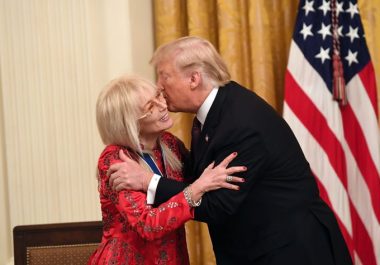 With those promises fulfilled, Trump’s swift executive actions now appear to have turned to serve the interests of his largest political donor, Miriam Adelson, whose $100 million donation to Trump’s re-election campaign ensured that any return to the Oval Office would serve the interests of Israel.
While Trump’s triumphant return to the White House has largely been celebrated, one unwavering criticism he continues to face is the paradox that exists between the overarching interests of Israel being held as paramount by a supposed “America First” political platform. Appeasing Israel’s interests has continued to be the exception to every rule as each of Trump’s cabinet nominations that expressed their unconditional support for the Jewish state, echoing the president’s own long-held position. Trump’s latest Executive Order highlights the continued prevalence of that contradictory dynamic within the “America First” movement of putting Israel’s interests above that of America’s.
Supporters of Trump’s effort to deport anti-Israel protesters on student visas have attempted to dispel concerns over the infringement of the First Amendment it poses by highlighting how those being targeted by it are not US citizens. That criticism isn’t just myopic, it illustrates an absence of civic engagement that would belong to any dutiful American who believes in the supreme importance of upholding the constitution. That hollow argument is entirely ignorant of even a rudimentary understanding of constitutional law that has extended civil rights protections to non-citizens for nearly a sesquicentennial.
In 1886, The United States Supreme Court set that precedent when it issued its decision in the case of Yick Wo v. Hopkins. The case was brought to the SCOTUS by Lee Yick, a Chinese immigrant who moved to San Francisco in 1861 and ran a laundromat named Yick Wo for over 22 years. When Yick sought to renew the license they needed to operate the laundromat, they were denied on the basis of safety concerns. Before Yick sought to renew their license, the San Francisco Board of Supervisors passed an ordinance making it illegal to operate a laundromat in a wooden building without a permit from the Board, a permit that the business owner was not granted. Despite not being granted the permit, Yick continued to operate the laundromat and was eventually imprisoned for not paying the fine they received for violating the ordinance.
After being imprisoned, Yick petitioned the California Supreme Court for a writ of habeas corpus. Yick’s legal counsel argued that of the 320 laundromats that applied for the permit to operate in a wooden building, only 1 of the 200 Chinese applicants was approved. Comparatively, all 120 of the non-Chinese applicants had their permit applications approved. Yick’s counsel argued that this constituted de facto discrimination against the Chinese, an argument that the SCOTUS upheld. When examining the issue of Yick not being a citizen, the court held that the plain meaning of the text of the 14th Amendment extends the right to protection under the law to “all persons” who have action taken against them in the United States, regardless of citizenship.
The longstanding precedent set by the SCOTUS through Yick Wo v. Hopkins serves as the bedrock for criticism of Trump’s Executive Order aimed at deporting non-citizens on student visas for participating in protests against Israel. “The First Amendment protects everyone in the United States, including foreign citizens studying at American universities,” said Carrie DeCell, senior staff attorney at the Knight First Amendment Institute at Columbia University, which became the epicenter of anti-Israel protests last spring. DeCell concluded that “Deporting non-citizens on the basis of their political speech would be unconstitutional.”
The culture war that continues to be waged across the US creates a landscape in which its opponents have lost sight of the forest through the trees. Championing unconstitutional efforts to defeat opposition runs the risk of winning the battle only to lose the war, as the implications of empowering the state to infringe upon free speech would ultimately befall upon the fate of its citizens. This concern was prominent in the wake of the spring 2024 anti-Israel college protests when the Antisemitism Awareness Act was proposed. That proposed legislation highlighted how opportunistic Congress was in exploiting the chaos of those protests to make sweeping attacks against the right to free speech under the guise of combating antisemitism. President Trump’s latest Executive Order highlights how that threat to free speech has emerged yet again, illustrating the dire need for the continued resolve necessary to uphold the most sacrosanct of American virtues.
Why is the top US spy alliance afraid of Trump?
By Ekaterina Blinova – Sputnik – 01.02.2025
America’s Five Eyes partners – Canada, Britain, Australia, and New Zealand – fear that US President Donald Trump’s deep state crackdown and spy apparatus overhaul could destabilize their intelligence network, reports The Wall Street Journal.
What’s driving their concerns?
Free Riders
- Trump may see Five Eyes as a bloated racket exploiting US resources, per the WSJ. The US spends nearly $100 billion on intelligence – 10 times more than the other four combined.
Russia Collusion Hoax
- Five Eyes were entangled in the Trump-Russia collusion narrative, largely pushed by US intelligence.
- The FBI’s Crossfire Hurricane probe, later debunked, was triggered by an Australian tip in 2016.
- Britain’s GCHQ may have wiretapped Trump during his 2016 campaign, as the White House suggested in 2017.
- Trump hasn’t directly targeted Five Eyes lately, but their unease suggests they have plenty to hide.
What Triggered the Panic?
- The “world’s most powerful spy alliance” sounded the alarm as Trump’s intelligence picks, Kash Patel and Tulsi Gabbard, near confirmation in Congress.
- Gabbard, nominated for director of National Intelligence, vowed to fight weaponized intelligence, citing Iraq War lies and the Russia collusion hoax.
- Patel, set to lead the FBI, pledged to curb overseas operations and increase transparency.
Desertion Epidemic? Ukrainian Soldiers Flee as Army Collapses on the Battlefield
By Ekaterina Blinova – Sputnik – 31.01.2025
As Ukraine’s army suffers mounting defeats, thousands of soldiers are abandoning their units, unable or unwilling to continue the fight.
- The 157th Brigade, formed in 2024, ceased to exist by 2025 with one-third of its soldiers deserting before becoming operational.
- The elite 155th ‘Anna of Kiev’ Brigade saw at least 1,700 of its 2,300 soldiers desert before reaching the front lines.
- Over 10% of the 13,000 Ukrainian soldiers sent to Poland for training fled the country.
- Desertion is occurring in both large and small groups, with 22 soldiers from the 71st Separate Jaeger Brigade deserting in just one week in December 2024.
- Some deserters are even charging to assist others escape, with one man arrested for smuggling soldiers out for €7,000 each.
The Scale of Desertion is Staggering:
- For every 100 mobilized soldiers, only 10 reach the front, according to General Serhiy Kryvonos.
- Ukrainian activist Gennadiy Druzenko estimates 150,000 deserters, with 114,000 criminal cases opened.
- Ukrainian officials have admitted the crisis, with Deputy Anna Skorokhod estimating over 100,000 desertions by October 2024. Commissioner Olga Reshetylova stated bluntly: “The problem is big. People are exhausted.”
WhatsApp accuses Israeli spyware firm of targeting journalists, civil society members
RT | January 31, 2025
Meta’s popular messaging platform WhatsApp has alerted nearly 100 journalists and civil society members to potential device breaches involving spyware from Israeli firm Paragon Solutions, a company official told Reuters on Friday.
These individuals have likely been compromised through a zero-click attack, possibly initiated via a malicious PDF sent in group chats, according to WhatsApp.
The identity of the attackers remains unknown, though Paragon’s software is typically used by government clients. After detecting and disrupting the hacking effort, WhatsApp issued a cease-and-desist letter to Paragon. The incident has been reported to law enforcement and Citizen Lab, a Canadian internet watchdog.
Paragon declined to comment on the accusations, according to Reuters.
Citizen Lab researcher John Scott-Railton told the outlet that the incident “is a reminder that mercenary spyware continues to proliferate and as it does, so we continue to see familiar patterns of problematic use.”
Paragon’s website advertises “ethically based tools, teams, and insights to disrupt intractable threats,” and claims to only sell to governments in stable democratic countries. The company’s products include Graphite, spyware that allows total phone access.
Despite Paragon’s claims of ethical practices, WhatsApp’s findings suggest otherwise, Natalia Krapiva, senior tech-legal counsel at Access Now, told Reuters. She emphasized that such abuses are not isolated incidents, saying, “This is not just a question of some bad apples – these types of abuses (are) a feature of the commercial spyware industry.”
This incident follows a series of legal challenges against Israeli spyware firms. In December 2024, a US judge ruled that NSO Group, the maker of Pegasus spyware, was liable for hacking the phones of 1,400 individuals through WhatsApp in May 2019, violating US state and federal hacking laws, and WhatsApp’s terms of service. A separate trial in March will determine what damages NSO Group owes WhatsApp.
Legal documents from ongoing US litigation between NSO Group and WhatsApp have revealed that it is the Israeli cyberweapons maker NSO Group, not its government clients, that installs and extracts information using its spyware. This disclosure contradicts NSO’s prior claim that only clients operate the system without NSO’s direct involvement.
FBI Acted Like Modern-Day Gestapo
Sputnik – 31.01.2025
US President Donald Trump’s purge of the FBI’s leadership comes as no surprise – the agency has been acting more like a political enforcer than a law enforcement body.
Here are just a few examples of its (mis)conduct:
- August 2022 – The FBI stormed Trump’s Mar-a-Lago to seize classified documents while Biden faced zero consequences for doing the same.
- 2020 – The FBI actively suppressed the Hunter Biden laptop story, labeling it “Russian disinformation”, despite knowing it was real.
- August 2024 – FBI agents raided the homes of ex-UN weapons inspector Scott Ritter and journalist Dimitri Simes without announcing charges. Their crime? Challenging the official US narrative.
- 2024 – The House Judiciary Committee exposed the FBI for spying on Americans’ private transactions, targeting conservatives rather than criminals.
- 2022 – Congressmen Jim Jordan and Mike Johnson revealed the FBI has been investigating parents critical of their local school boards, using threat tag employed by the agency’s counterterrorism division.
- 2016 – The FBI used the debunked Steele dossier as a pretext to spy on Trump’s election campaign, despite knowing the allegations of Trump-Russia collusion were false.
Trump’s crackdown on the agency was inevitable – the real question is how deep the rot goes.
A Republic of Spies
By Andrew P. Napolitano | Ron Paul Institute | January 30, 2025
In 2021, to his credit, President Joe Biden warned the American public against the dangers of zero-click spyware manufactured by an Israeli corporation. Zero-click is unwanted software that can expose the entire contents of one’s mobile or desktop device to prying eyes without tricking one into clicking on to a link. Biden banned its importation and use in the United States.
Last week, as an inducement to Israeli Prime Minister Benjamin Netanyahu to accept the Israel/Hamas ceasefire agreement, President Donald Trump secretly agreed to lift the embargo on zero-click.
Here is the backstory.
Though America has employed spies since the Revolutionary War, until the modern era, spying was largely limited to wartime. That changed when America became a surveillance state in 1947 with the public establishment of the Central Intelligence Agency and the secret creation of its counterparts.
The CIA’s stated public task at its inception was to spy on the Soviet Union and its satellite countries so that American officials could prepare for any adverse actions by them. This was the time of the Red Scare, in which both Republicans and Democrats fostered the Orwellian belief that America needed a foreign adversary.
We had just helped the Russians defeat Germany in World War II, and our Russian ally — which was bankrupt and had just lost 27 million troops and civilians — suddenly became so strong it needed to be kept in check. The opening salvo in this absurd argument was fired by President Harry Truman in August 1945 when he used nuclear bombs intentionally to target civilians of an already defeated Japan. One of his targets was a Roman Catholic cathedral.
But his real target — so to speak — was his new friend, Joe Stalin.
When Truman signed the National Security Act into law in 1947, he also had Stalin in mind. That statute, which established the CIA, expressly stated that it shall have no internal intelligence or law enforcement functions and all its collections of intelligence shall come from sources outside the United States.
These limiting clauses were vital to passage of the statute, as members of Congress who crafted it feared the U.S. was creating the type of internal surveillance monster that we had just confronted in Germany.
Of course, no senior official in presidential administrations from Truman to Trump has taken these limitations seriously. As recently as the Obama administration, the CIA boasted that it had the capability of receiving data from all computer chips in the homes of Americans — such as in your microwave or dishwasher.
As well as its presence in your kitchen, the CIA is physically present in all 50 state houses in America. What is it doing there?
The feds admit to funding and empowering 18 domestic intelligence agencies — spies next door. The most notorious of these is the National Security Agency, which, when it last reported, employs 60,000+ persons, mostly civilians, with military leadership.
What do they do? They spy on Americans. We know this thanks to the personal courage of Edward Snowden and others who chose to honor their oaths to uphold the Constitution. NSA spying has produced so much data that the NSA built the second-largest building in the U.S. — after the Pentagon — for use as a storage facility of the data it has collected, and it is running out of room.
What has it collected? Quite simply, everything it can get its hands on. These domestic spies have access to every keystroke and all data on every digital device everywhere in the United States, without a warrant. This is computer hacking, a federal crime; but the feds don’t prosecute the spies they have hired to spy on us.
It also represents an egregious violation of the Fourth Amendment, which guarantees the right to privacy of all persons. The operative language is “the right of the people to be secure in their persons, houses, papers, and effects against unreasonable searches and seizures, shall not be violated.”
The law defines all searches and seizures conducted without a warrant as unreasonable and thus violative of not only this amendment but also the uniquely American value it was enacted to protect — the right to be left alone. Surely the computer chip in every desktop, mobile device, dishwasher and microwave is an “effect” protected by the Constitution.
The spies and, sadly, the presidents for whom they have worked don’t see it that way. They have claimed in federal courts and elsewhere that the Fourth Amendment does not pertain to them because they are not law enforcement and because they work directly for the president, who, when he is operating as the commander in chief, is free to employ government assets as he wishes, without constitutional constraints.
This argument has been used to justify the CIA’s violent killings of Americans and others in foreign lands using drones and its agents dressed as military. It has justified the brutal torture of foreign nationals, even those whom the CIA deemed were being truthful during their interrogations. And, of course, it has justified ignoring the Constitution and the rights it protects and the values that underlie it.
This argument was also used to justify foreign and federal spying on Trump. Now he wants to make it easier for America’s spies to spy on the rest of us.
Spying belies the very purpose of the Constitution — to keep the government off the people’s backs. Of course, when the late Justice William O. Douglas coined that phrase, there were no computer chips, the CIA was thought to be law-abiding and the NSA didn’t exist.
So, we can see how desirous of secrecy the Trump administration was last week when it agreed to lift the zero-click embargo.
We can try to avoid commercial spyware, but how can we avoid a totalitarian government that spies on everyone?
According to the Declaration of Independence, we can do so by altering or abolishing it.
To learn more about Judge Andrew Napolitano, visit https://JudgeNap.com.
COPYRIGHT 2025 ANDREW P. NAPOLITANO
DISTRIBUTED BY CREATORS.COM
New York’s Speech Crackdown Shields ISRAEL From Public Criticism
21st Century Wire | January 29, 2025
Recently, under intense pressure from the Israel Lobby, Harvard University capitulated to Zionist billionaires and media pressure by dramatically expanding its “guidance” for applying so-called Non-Discrimination and Anti-Bullying Policies and Procedures – specifying protections for Zionists and alleged victims of so-called “antisemitic” speech. This has already caused chilling effect on political speech and political protests on university campuses across the United States. These are some of the most draconian and arbitrary bylaws ever seen, and will almost certainly fall foul of the U.S. First Amendment once a challenge makes it to the high court.
In addition, the New York State legislature has also succumb to pressure from the Israel Lobby and pushed through a new law designed to shield Israel and Zionism exclusively – from public criticism or acts of protest.
American journalist and media critic Glenn Greenwald breaks down this fundamental problem now facing America and Europe. Watch:
Swiss official who jailed journalist Ali Abunimah is fanatical pro-Israel activist

By Wyatt Reed · The Grayzone · January 28, 2025
The Swiss official who ordered the arrest of renowned Palestinian-American journalist Ali Abunimah justified doing so on the false and defamatory basis that Abunimah is “an Islamist Jew-hater.” Mario Fehr, the head of Zurich’s Department of Security, made the bogus accusation in a recent comment to the Swiss publication NZZ, which also falsely characterized Abunimah as an “Islamist” and an “extremist.”
Swiss authorities detained Abunimah on Jan. 25, after they initially allowed him entry into Switzerland following an hour-long interrogation. Abunimah was deported on Jan. 27 after two nights, during which Swiss officials refused to tell him whether he was being charged with a crime. According to the Swiss newspaper NZZ, officers in Zurich successfully petitioned federal police for an arrest warrant after realizing Abunimah had travelled to the country in order to deliver a speech at an event organized by the Zurich Palestine Committee. Fehr explained the arrest by stating, in reference to self-described “non-religious person” Ali Abunimah: “We do not want an Islamist Jew-hater who calls for violence in Switzerland.”
It’s unclear how Fehr came to adopt this patently false claim, but the article in NZZ gives a hint. In painting the secular Abunimah as a jihadist, the story’s authors relied on a leader of a little-known group called “Never Again Is Now,” (NAIN) which characterizes itself as “the only non-profit organization in Switzerland dedicated exclusively to combating antisemitism,” says it “demands the uncompromising enforcement of the International Holocaust Remembrance Alliance’s definition of antisemitism,” and claims: “we… defend Israel against anti-Zionist agendas.”
NZZ quoted one of the group’s board members, Thomas Patzko, as stating “Abunimah and his platform are a mouthpiece for Hamas.” The outlet cited NAIN while insisting that Abunimah “delegitimizes the victims of the terrorist attack on October 7, specifically women and children” – a reference to Abunimah’s factual statement that “there is no credible evidence of a single rape on October 7.”
It’s not yet apparent whether these false accusations by Swiss media or the Zionist group led directly to Abunimah’s deportation. But at some point prior to Abunimah’s scheduled address, “the Zurich [regional] police had become aware of Abunimah’s planned appearance,” NZZ reported. “They had submitted a request to Fedpol for an entry ban,” the outlet wrote, adding “this request was granted” by “the responsible government councilor and security director Mario Fehr.”
What is clear, however, is the Zurich security chief’s allegiance to the Zionist narrative. At a “Rally in solidarity with Israel” on Oct. 10, 2023, Fehr openly stated that “the fate of Israel and its inhabitants is close to my heart” before rattling off a comprehensive list of pro-Israel talking points, ranting about Iran and quoting notoriously racist Israeli Prime Minister Golda Meir, while demanding the Swiss government cease funding any development projects in Palestine.
“Hamas and its main sponsor Iran have always called for the destruction of Israel and the Jews. The fact that official Swiss foreign policy believed in the illusion that it could seriously negotiate with these terrorists is naive and shameful. – Anyone who rapes women, kills old people, kidnaps children, dehumanizes the dead, takes countless peaceful people hostage is not a negotiating partner – he is a rapist, a murderer, a terrorist. Golda Meir was right: ‘You cannot negotiate peace with somebody who has come to kill you.’ Peace will not be possible with Hamas and its accomplices!”
Minutes later, Fehr launched into a tirade about those who “somehow try to explain that Israel is actually to blame,” complaining: “These relativists should simply spend their next trip to the Middle East in Gaza.” Though he conceded that “many Palestinian civilians are also suffering and are affected,” Fehr insisted that “the responsibility for this lies solely with the Hamas terrorists,” stating flatly: “Israel is not to blame for this escalation.”
Ultimately, Fehr insisted the Swiss “Federal Council must suspend development cooperation with Palestine (like the EU) until it is clear who the money is really going to benefit” because “there is currently no negotiating partner on the Palestinian side.”
“Anyone who sees it differently is allowing money to flow to terrorists,” he claimed.
In an interview with NZZ one month after the Oct. 7, 2023 attack, Fehr claimed that “the rampant anti-Semitism” had become “unbearable” in Switzerland, a trend he said was borne out by pro-Palestinian protests, and which he attributed to the presence of Arabs:
“We see from Palestine demonstrations that anti-Semitism is more widespread in certain cultural circles. Particularly in parts of the Arab world, children learn to hate Jews and Israel from an early age. We have to be careful that we don’t give this hatred any room here.”
Fehr criticized authorities in Switzerland for allowing pro-Palestinian protests to take place and said he had demanded they ban such events in areas under his jurisdiction, asserting that “anti-Israel demonstrations that are increasingly being hijacked by extremists.”
“Their goal is the annihilation of Israel and all Jews. The danger that Islamists from Germany or other countries will now move to Switzerland and spread their hatred is real. A large Palestine demonstration took place in Bern last Saturday, and the next one has been planned and approved for this weekend in the city of Zurich. I think that is negligent.”
“I have emphatically insisted to the head of municipal security to not authorize any more Palestine demonstrations in the current dangerous situation,” he stated.
Asked whether regional police under his command would “continue to support the Zurich city authorities, even though the city allows such demonstrations,” Fehr replied simply: “We will protect Jewish institutions as before – with all the means at our disposal.”
Ukraine ‘an invented state’ – Romanian election frontrunner
RT | January 30, 2025
Calin Georgescu, the politician whose first-round victory in the Romanian presidential election was overturned by the Constitutional Court, has argued that the borders claimed by Ukraine were artificially drawn and are subject to inevitable change.
The staunch critic of Western policies made the remarks on Wednesday in an interview with political analyst Ion Cristoiu on YouTube. He was discussing the adjustments of European borders after World War II, which resulted in a transfer of territories to Soviet Ukraine. Georgescu said he expects Ukraine to be fragmented as part of a peace deal with Russia, along historical lines.
”This will happen 100%. The path to an outcome like that is inevitable,” he asserted. “Ukraine is an invented state.”
Parts of the historic areas of Bukovina and Bessarabia, which were ceded from Romania to Ukraine during the post-war settlement, are “of interest” to Bucharest, Georgescu said, adding that Hungary and Poland could also claim their historic lands in a hypothetical breakup of Ukraine.
Georgescu made headlines in November when he unexpectedly garnered 23% of the vote in the first round of the presidential election in Romania, a NATO member. However, the Constitutional Court annulled the results shortly before the second round, citing intelligence documents alleging ‘irregularities’ in the campaign.
Subsequent media reports revealed that Georgescu’s candidacy was boosted by a firm closely linked with the pro-Western National Liberal Party (PNL), seemingly to undermine another candidate. The Romanian government has claimed that Russia was behind the interference scheme. Georgescu leads in opinion polls and is projected to get 38% of the vote in the upcoming election re-run in May.
Russian President Vladimir Putin previously warned about the threat of potential separatism in Western Ukraine, driven by ethnic minorities’ wish “to return to their historic homeland,” with potential support from foreign governments.
”In that sense, only Russia could serve as a guarantor of Ukrainian territorial integrity,” he claimed in late 2023. “If [Ukrainians] don’t want that, so be it. History will set things straight. We will not stand in the way, but neither will we relinquish what is rightfully ours.”
Featured Video

Bombing Hitler’s Hometown
or go to
Aletho News Archives – Video-Images
From the Archives
‘Conspiracy Theory’ Now Fact: Greater Israel Has Arrived
By Kit Klarenberg | Mint Press News | January 28, 2025
Ever since Tel Aviv’s 1948 creation, much has been said and written about ‘Greater Israel’ – the notion Zionism’s ultimate end goal is the forcible annexation and ethnic cleansing of vast swaths of Arab and Muslim lands for Jewish settlement, based on Biblical claims this territory was promised to Jews by God. The mainstream media typically dismisses this concept as antisemitic conspiracy theory, or at most the fringe fantasy of a minuscule handful of extremist Israelis.
In reality … continue
Blog Roll
 Aletho News
- Trump admits Iran hit USS Ford carrier: ‘We ran for our lives’
- Battle for Hungary: EU attacks on Orban are a sign of worse things to come
- Iraqi resistance conducts drone strike on US-run base in Syria
- Failing to Defeat Hezbollah, Israel & US Pressure Syria’s Ahmed al-Sharaa to Join War
- US-Israeli war on Iran drives global fertilizer prices up 40%
- Hezbollah’s Surprise Weapons Redefine Ground Battle with Israel
- Yemen joins fight against US, Israel by firing missiles at occupied territories
- Seizing the Kharg: Washington’s path to defeat in the Persian Gulf
- Iran reports 500 US casualties in strikes on covert US military sites
- Pro-Israel terrorist arrested before assassination of pro-Palestinian activist
- If Americans Knew
- Over 300 US service members wounded, majority have brain injuries – Not a ceasefire Day 169
- Researchers at Human Rights Watch Resign Over Blocked Report on Palestinian Refugee Return
- Jewish Groups Are Backing a War Americans Don’t Want
- Eric Fingerhut Thinks He’s the President of the Jews
- Top Jewish Philanthropists, Rabbis Urge Israeli President to Take Action Against ‘Jewish Extremists’
- Don’t Be Fooled. Zionist Leaders Have Always Wanted to Control Southern Lebanon
- Israel’s widespread use of torture is a core element of its genocide against the Palestinian people
- In Israel’s War on Iran, Many Middle East US Bases Rendered “All But Uninhabitable”
- ‘Burn the lawn’: Israel pursues ‘Rafah model’ in southern Lebanon
- A genocide here, an amputation there
- No Tricks Zone
- Devastating Assessment Of Comirnaty Vaccine By Former Senior Pfizer Europe Toxicologist
- New Study: CO2 Is ‘Effectively Negligible’ As An Explanatory Climate Change Factor Since 2000
- Former Pfizer Toxicologist Dr. Helmut Sterz Tells Bundestag Hearing Pfizer Vaccine Should Have Never Been Approved
- Energy Expert: Germany’s Nuclear Phaseout Was A “500 Billion Euro Mistake”
- New Research: South Australia’s Mid-Holocene Sea Surface Temperatures Were 4°C Warmer Than Today
- Storing Green Energy To Last Germany 10 Days Would Require A 60-Million Tonne Battery
- New Studies: UK Sea Levels Were 4 Meters Higher Than Today During The Mid-Holocene
- Destructive Green New Deal: German Energy And Metal Group Warns Of Drastic Crisis
- New Study Documents A 20-Year Pause In Arctic Sea Ice Decline – Driven By Internal Variability
- Wake-up Call: Survey Shows Majority Of Germans Now Favor Postponing Climate Targets!
 Aletho News