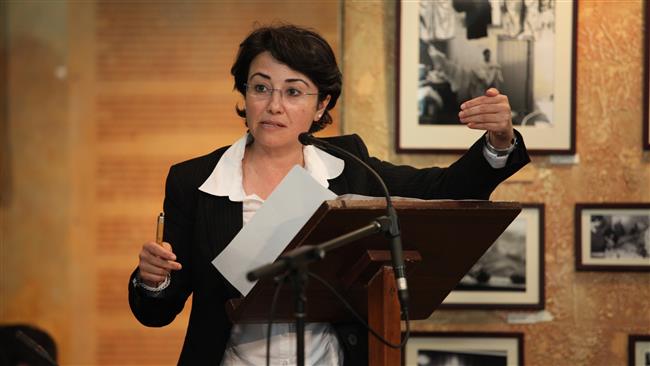
NAZARETH – Israeli Prime Minister Binyamin Netanyahu spoke with Attorney General Avichai Mandelblit Wednesday afternoon regarding the possible expulsion of Arab MK Hanin Zoabi from the Knesset.
Netanyahu’s demand came following Zoabi’s condemnation of the continued Israeli crimes against Palestinians and calls for lifting Gaza siege.
“With her actions and lies she crossed every line and she has no place in the Knesset,” Netanyahu claimed.
Earlier on Wednesday Zoabi caused an uproar on the Knesset floor when she strongly condemned the Israeli forces’ videotaped attack on Turkish activists who were killed during their participation in Freedom Flotilla in 2010. The murderer has to pay compensation for the families of Turkish victims, she said during a debate discussing the newly-signed deal between Israel and Turkey. Zoabi considered the deal as a “murder confession.”
Zoabi demanded the Israeli government issue an apology both to the “political activists” aboard the Mavi Marmara, on which she sailed in solidarity, and to herself, from those who “incited against [her] for six years.”
During the debate, Israeli MKs tried to physically attack Zoabi following her address. Several MKs began shouting and moved toward the podium to complain. “Come hit me! Come hit me!” Zoabi shouted to the MKs who were pointing and yelling at her.
As MKs mobbed the stage, Zoabi shouted “they murdered” and “shut up” repeatedly. When Deputy Knesset Speaker Hamad Amar (Yisrael Beytenu) asked her to apologize, Zoabi said: “The Israeli soldiers who murdered are the ones who need to apologize! You need to apologize!”
The Joint List strongly denounced the attack, considering it a “fascist assault.” It added, “The racist and bloody attack against Joint List MKs has notably escalated, calling for an end to the continued incitement against Arab MKs and Hanan Zoabi in particular”.
In May 2010, a flotilla of six ships headed to Gaza but Israeli navy forces intercepted and boarded them and forced them to dock in Israel after brutally attacking the passengers. Nine of the Turkish activists were killed during the attack.
Zoabi’s comments came a day after Israel signed a deal with Turkey to restore ties, after years of frosty relations exacerbated by the flotilla attack. The deal stipulates that Israel would pay Turkey $20 million in compensation to families of the victims.
June 30, 2016
Posted by aletho |
Civil Liberties, Ethnic Cleansing, Racism, Zionism, Full Spectrum Dominance | Benjamin Netanyahu, Hanin Zoabi, Israel, Mavi Marmara, Palestine, Zionism |
Leave a comment

The Administrative Court of Montreuil in France rejected on Tuesday, 28 June an appeal by the Seine-Saint-Denis prefecture (representing the central French state), demanding the removal of a banner supporting Palestinian prisoner and leader Marwan Barghouthi from the front of the city hall of Stains, in a victory for supporters of Palestinian political prisoners and Stains’ mayor Azzedine Taibi.
The court found that the prefecture’s arguments were inadmissible and invalid, despite an earlier temporary order that the banner must be removed. Azzedine Taibi, the mayor of Stains and a representative of the French Communist Party, said that “This is not a personal victory but a collective victory! … Marwan Barghouthi will remain an honorary citizen of our city and I know that one day, he will be on our side, here in Stains, the city of popular resistance! The struggle and the mobilization will only grow for the liberation of Marwan Barghouti and all Palestinian political prisoners…”
The prefect – representing the government of Prime Minister Manuel Valls, who has urged prosecution of BDS activists and the suppression of the movement to boycott Israel – argued that the banner was “not of local interest” and likely to lead to a “disturbance of public order.” Manuel Valls, as Minister of the Interior, previously intervened in the case of Georges Ibrahim Abdallah – after intervention from US Secretary of State and now presidential candidate Hillary Clinton – to block the release to Lebanon on parole of the Lebanese Communist prisoner and struggler for Palestine who has been imprisoned in French jails for 32 years.
The prefect’s case was dismissed, as was a complaint filed against the mayor by the BNCVA, a pro-Zionist organization that nominally combats anti-Semitism but in practice focuses on attempts to suppress Palestine solidarity and the boycott of Israel, which accused Taibi of “public apology for terrorism” for his support of Barghouti.
Stains is one of a group of 23 French municipalities who have named the imprisoned Fateh leader and Palestinian Legislative Council member an honorary citizen. A delegation of 16 French mayors was prohibited from visiting Barghouthi in Gilboa prison in Palestine by the Israeli occupation on 14 June; the mayors participated later in a press conference in support of the campaign to nominate Marwan Barghouthi for a Nobel Peace Prize, a campaign supported by Belgian parliamentarians, Desmond Tutu, Adolfo Perez Esquivel, and the Tunisian winners of the 2015 Peace Prize.

Taibi hosted a ceremony outside the Stains City Hall on Wednesday night, 29 June, celebrating the victory and the official unveiling and replacement of the “Free Marwan Barghouthi” banner to the front entrance of the Stains city hall.
The Stains victory is one of several in France against attempts to criminalize or suppress the Palestine solidarity movement or the boycott of Israel. A court in Créteil dismissed a prosecution for “incitement to discrimintion” against Jean-Claude Lefort pursued by the Association France-Israel and “Lawyers Without Borders” on 24 June, because he had called for a boycott of Israeli products; the court noted that this was a matter of expression on a “debate of general international interest.” In addition, the municipality of Bondy voted on Thursday, 23 June to refuse to purchase goods made in Israeli settlements in the West Bank.
Today, 30 June, 4 BDS activists will face a trial in Toulouse; they are accused of “obstructing the normal exercise of economic activity of three stores” for distributing leaflets in public squares in support of the boycott of Israeli goods. The prosecution was initiated by LICRA, a French pro-Israel advocacy organization; activists are mobilizing outside the courthouse at 1 pm in support of the 4 accused organizers.
June 30, 2016
Posted by aletho |
Civil Liberties, Ethnic Cleansing, Racism, Zionism, Solidarity and Activism | France, Hillary Clinton, Human rights, Israel, Marwan Barghouthi, Palestine, Zionism |
Leave a comment
In the wake of the BREXIT vote which has the world reeling after Great Britain decided to abandon the European Union, much has been said about the historical scope, power, and influence of the British Empire throughout history. At its apex the British Empire was the most powerful geopolitical force on earth. What many neglect to realize is that one of the occurrences that helped the United Kingdom rise to such a position was The Haitian Revolution, which thoroughly defeated Britain’s only serious hegemonic competitor, Napoleonic France.
Much is discussed and written about Haiti’s defeat of Napoleon and how it opened the door for the Louisiana Purchase that fostered the expansion of the United States into the nation it has since become. However, few realize how the defeat of Napoleon by the brave former African Slaves in Haiti opened the door for the dominance of the British Empire. Furthermore, as Americans always pride themselves on their Revolutionary accomplishment of defeating the great British Empire and gaining their freedom, few give full acknowledgment to the superior military feat of The Haitian Revolution in its not only vanquishing the French Napoleonic Empire, The Spanish Empire of the time, but also thoroughly defeating the mighty British Empire to the point of leading the United Kingdom to agree to cease the Trans-Atlantic slave trade and any further importation of Africans into the Western Hemisphere officially. So while Americans celebrate their independence victory in defeating the greatest of European Empires, The British, recognize that former African slaves in Haiti did the seemingly impossible and defeated all three of the major European empires of that day to obtain their freedom, including the one beaten by the Americans:
“Yet it cannot be denied that both the government and British public had
learned a lesson from [Britain’s] disastrous attempt to conquer Saint
Domingue/Haiti, restore slavery, and subdue Toussaint L’Ouverture. In 1796
nearly three years after the first British forces landed in Saint
Domingue/Haiti, the [British] administration sent off one of the greatest
expeditionary forces in British history. Before the end of the year Edmond
Burke received news that 10,000 British soldiers had died in less than two
months! It was reported in the House of Commons that almost every Briton
had a personal acquaintance that had perished in the [Haitian]
Campaigns.” – “The Impact of The Haitian Revolution in the Atlantic World,”
David P. Geggus.
In the end the British lost over 50,000 soldiers in their attempt to bring slavery back to Haiti. This had a direct influence on the British decision to end the trans-Atlantic slave trade.
June 29, 2016
Posted by aletho |
Civil Liberties, Timeless or most popular | France, Haiti, Human rights, UK, United States |
Leave a comment
Paris – Unification of Europe has brought about radical new divisions within Europe. The most significant split is between the people and their political leaders.
The June 23 British majority vote to leave the European Union has made strikingly evident the division between the new ruling class that flourishes in the globalized world without borders and all the others who are on the receiving end of policies that destroy jobs, cut social benefits, lower wages and reject as obsolete national customs, not least the custom of democratic choice, all to make the world safe for international investment capital.
Actually, the lines are not quite so clear-cut. Political choices never correspond completely to economic interests, and the ideological factor intervenes to blur the class lines. Globalization is not merely a process of economic integration regulated by flows of capital, which is deepening the polarization between rich and poor in the Western countries. It is also a powerful ideology, basing its moral certitudes on simplistic lessons drawn from twentieth century World Wars: the idea that the root cause of wars is a psychological attitude called “racism” which expresses itself in the nationalism of nation-states. This ideology gains semi-religious conviction by reference to the Holocaust, which is considered to have proven the point. Ergo, for the benefit of humanity, national borders must be torn down, national identities must be diluted by unlimited immigration, in order to achieve a worldwide multicultural society in which differences both coexist and cease to matter.
This is a Utopian notion as unsupported by evidence as the Soviet dream of creating a “new man” who voluntarily works unselfishly for the benefit of all. Similarly, it considers human psychology to be perfectible by economic and institutional arrangements. Especially by promoting immigration, the multicultural mix is supposed to result in people all loving each other; there are even national laws to punish alleged expressions of “hatred”. The European Union is seen as the most advanced experiment in this worldwide Utopia of universal love. It is regarded by its intellectual sponsors such as French political guru Jacques Attali as an irreversible advance of civilization. For its fanatic champions, the very thought of dismantling the European Union is equivalent to returning to the stone age.
A chorus of Europists are screaming to high heaven that the world is about to come to an end thanks to lower class Brits too stupid and too racist to appreciate the glorious globalized world that the European elite is preparing for them. One of the fastest on the draw of his pen was the hysterical propagandist Bernard-Henri Levy, whose venom quickly spilled onto the pages of Le Monde and other obsequious journals. BHL trotted out his entire range of insults to decry the LEAVE vote as the victory of demagogy, xenophobia, the extreme right and the extreme left, hatred of immigrants, stupid nationalism, vicious hatred, the unleashed mob, idiot leftists, drunken hooligans, the forces of darkness against civilization, and even the victory of garden dwarfs over Michelangelo. Many others worked the same theme, with less verbiage.
The main theme of this wailing and gnashing of teeth is the allegation that the LEAVE vote was motivated solely by racism, racism being the only possible reason that people could object to mass unregulated immigration. But there are indeed other reasons.
In reality, for the majority of working class voters, opposition to unlimited immigration can be plainly a matter of economic self-interest. Since the EU’s eastward expansion ended immigration controls with the former communist countries, hundreds of thousands of workers from Poland, Lithuania, and other Eastern European nations have flooded into Britain, adding to the large established immigrant population from the British Commonwealth countries. It is simply a fact that mass immigration brings down wage levels in a country. A Glasgow University study shows statistically that as immigration rises, the level of wages in proportion to profits drops – not to mention the increase in unemployment.
Those who enjoy the pleasure of traveling through Europe without having to stop at borders or change currencies and who relish the luxury level of cultural diversity find it hard to understand the anguish of those who lack advanced degrees, family connections or language skills, and who feel marginalized in their own countries. Yes, some of them probably like garden dwarfs. But you cannot convince millions of people that their only prospect in life must be to sacrifice themselves for the glory of the World Market.
Moreover, whatever their social status, many people in Britain find it unbearable to renounce their traditional parliamentary democracy in order to carry out Directives and Regulations drafted in Brussels without even any public discussion.
The British
The astonishment and indignation of the Europists to see Britons vote to go out is odd considering that most Britons never really felt entirely in. When I worked as press officer at the European Parliament, I observed that the only national press corps really present and interested was the British press corps, all eagerly on the lookout for the latest absurd rule or regulation which the Brussels bureaucracy was foisting on the Member States. British media paid attention to the EU because they hated it. Ridiculing it was fun. The rest of European media were largely ignoring it because it was boring and nobody cared. Main exception: a few earnest Germans doing their job.
In the 1980s, Margaret Thatcher forced the EU to twist its rules by demanding “my money back”. The United Kingdom stayed out of the Schengen Treaty on free movement of persons. It refused the euro in favor of keeping the pound sterling. More profoundly, the insular English have always had a strong sense of not belonging to “the continent” as well as a particular sensitivity to the notorious “democratic deficit” of the European Union, which leaves law-making to the Brussels bureaucracy.
Considering the insular nature of Britain and its psychological distance from the continent, it is too soon to expect that other EU Member States will soon follow the British example. Indeed, some of the most Euroskeptical populations today were the most Euroenthusiastic in the past, notably France and Italy, and it is awkward to turn around 180 degrees. For charter Members France, Italy, Benelux and Germany, the break would be much more dramatic. Nevertheless, even in those key Eurozone countries disenchantment with the EU is growing rapidly. Brexit is seen as a warning signal. Thus the Western ruling class will hasten to try to shore up the EU-NATO fortress. The Washington Post quickly called for “strengthening NATO”. This probably means even more strident denunciations of Putin and the “Russian threat”, if such as possible. There is supposedly nothing like an external threat to bring people together.
What Next?
Unfortunately, this referendum did not mark a clean break. Two great difficulties loom. EU rules require a lengthy and complicated process to actually withdraw, a matter of years. And second, there is no viable political force ready to steer Britain through this process. The result is to split the political class still further from the people it should be representing.
The British political landscape is littered with wreckage. Conservative Prime Minister David Cameron called the referendum for internal political reasons, failing to realize that if given the chance, the British would vote to jump ship. His name is now mud all over Europe, condemned for the foolish move of letting people vote on the EU. Cameron has announced his resignation, but his government is dragging its feet in initiating the withdrawal process. Some are even demanding that the referendum be either ignored or held over again until people vote as they should – the procedure that followed previous national referendums that turned out badly for the EU. Meanwhile EU leaders are demanding that London hurry up and get out, so they can get to work strengthening the edifice.
Nigel Farage’s UK Independence Party that campaigned for leaving the EU is a single issue party with no general program and no aspiration to run the government. Former London mayor Boris Johnson has positioned himself to take over Party leadership by advocating Brexit, but he is not taken seriously by most of his own Conservative party and is also stalling on the exit procedure.
The situation of the Labour Party is critical. Jeremy Corbyn, who was elected party leader by a grass roots uprising expressing a strong popular desire to move the party to the left, comparable to the Bernie movement in Democratic Party primaries, has always been opposed by the Blairites who still dominate the party apparatus and parliamentary representation. In this uncomfortable situation the gentle Corbyn has tried to exercise what is meant to be an inclusive sort of leadership, listening to all sides. This softness already led to the mistake of failing to strongly defend party members falsely accused of “anti-Semitism” by pro-Israel zealots. Now the Blairites are blaming Corbyn for what they consider the Brexit catastrophe. It is all supposed to be the fault of Corbyn for having failed to support REMAIN vigorously enough.
Indeed Corbyn’s support of REMAIN was mild, some say because he actually favored LEAVE, but was bowing to the majority in the upper ranks of his party. This concession, if it was one, has not prevented the Blairites from demanding that Corbyn resign as party leader. Petitions are circulating both for and against him.
The trouble is that the mainstream caricature of the Brexit voters as narrow-minded racists, if not protofascists, has not been balanced by any articulation of the strong underlying rejection of the EU as a denial of democracy, as the authoritarian rule by a self-satisfied globalizing elite with total contempt for what the people might really want.
There is no political party in Britain that is at all prepared to turn away from the increasingly discredited and disavowed globalization trend in order to lead the way to a truly democratic alternative.
 Diana Johnstone is the author of Fools’ Crusade: Yugoslavia, NATO, and Western Delusions. Her new book is Queen of Chaos: the Misadventures of Hillary Clinton. She can be reached at diana.johnstone@wanadoo.fr
June 29, 2016
Posted by aletho |
Civil Liberties, Economics | BREXIT, European Union, Human rights, UK, Washington Post |
Leave a comment
Recent legislative efforts to extend draft registration to young women have raised an old conundrum for some feminists. Does pursuit of gender equality include support for universal conscription?
While not all feminists are anti-militarists, opposition to war and militarism has been a strong current within the women’s movement. Prominent suffragists like Quaker Alice Paul, and Barbara Deming, a feminist activist and thinker of the 1960s and ’70s, were ardent pacifists. Moreover, feminist critique has often regarded the military as a hierarchical, male-dominated institution promoting destructive forms of power.
In late April, the House Armed Services Committee voted for an amendment to the national defense bill that would extend draft registration — already a requirement for men — to women ages 18-26. The amendment was later dropped, but in mid-June, the Senate approved a similar provision in its version of the national defense bill.
Among the amendment’s staunchest defenders was Armed Services Committee member Rep. Jackie Speier (D-Calif.).
“If we want equality in this country, if we want women to be treated precisely like men are treated and that they should not be discriminated against, then we should support a universal conscription,” Speier told the political website The Hill in April.
Not all feminists agree with Speier’s path to equality. Days after the House Armed Services Committee approved the amendment, 24-year-old Julie Mastrine, an activist and media professional, authored an online petition calling on Congress not to force women to register and instead dump the draft entirely.
Mastrine, a self-described feminist libertarian, argues that draft registration violates individual choice.
“I can’t imagine a more tragic loss of liberty than forcing a citizen, whether male or female, to fight in a war with which they may disagree. Equality is a moot point if personal choice and bodily autonomy must first be eliminated to achieve it,” Mastrine said in a statement.
In an online editorial for Playboy, Lucy Steigerwald, a contributing editor to Antiwar.com, acknowledged that excluding women from draft registration was “unfair” and “sexist.”
“But the solution to the decrepit notion that the young of the country are communal property is not to remove the sexism, it’s to remove the draft,” she wrote.
Like Mastrine, Steigerwald supports equal access to the military for women, but opposes conscription. She does not believe, as some have argued, that the return of the draft would make the U.S. more cautious about engaging in conflicts.
“You don’t stop the runaway truck of U.S. foreign policy by throwing a man in front of it, and you definitely don’t stop it by throwing a man and a woman, just to make things equal,” Steigerwald wrote.
The linking of women’s equality to universal conscription dates back to the early 1980s. Draft registration had ended in 1975 with the conclusion of the Vietnam War. In 1980, a nervous President Jimmy Carter, alarmed over the Soviet Union’s invasion of Afghanistan, reinstated registration to demonstrate U.S. war readiness. Carter actually wanted universal draft registration, but Congress limited the mandate to men.
The male-only system was quickly challenged as sex discrimination. In 1981, a group of men brought a case before the Supreme Court that argued being singled out for compulsory registration violated their right to equal protection. A number of women’s groups, including the National Organization for Women (NOW), filed briefs contending that exclusion from the draft violated the constitutional rights of women.
“Compulsory universal military service is central to the concept of citizenship in a democracy,” the NOW brief asserted. It predicted “devastating long-term psychological and political repercussions” would result if women were excluded from “the compulsory involvement in the community’s survival that is perceived as entitling people to lead it and to derive from it the full rights and privileges of citizenship.”
A similar brief filed by 12 other women’s organizations, including the League of Women Voters, argued that exempting women from draft registration echoed “the stereotypic notions about women’s proper place in society that in the past promoted ‘protective’ labor laws and the exclusion of women from juries.”
NOW had previously opposed the draft, and its apparent about-face infuriated its members at the grassroots level, according to Cynthia Enloe, a research professor of political science and women’s studies at Clark University in Worcester, Mass.
Enloe, who has written extensively on women and the military, said she was just starting her research at the time, but as she recalls, “The local chapters were really angry. They were full of women activists who disagreed, who saw the draft as something to oppose.”
So why the switch? Enloe thinks it had more to do with NOW’s then-recent defeat in getting the Equal Rights Amendment passed than it did zeal for military service. The amendment, which pacifist Alice Paul originally penned in 1923, simply states, “Equality under the law shall not be denied or abridged by the United States or by any State on account of sex.” After Congress passed it in 1972, NOW led the unsuccessful fight for its ratification at the state level during the 1970s and early 1980s.
Eleanor Smeal, at the time president of NOW, “had just gone through a terrible defeat,” Enloe noted. “When the next thing comes up, you tend to see it through the lens of what you were defeated by. The people in the Washington office were terribly affected by the anti-ERA battle.”
Speaking in defense of the NOW brief back in 1981, Smeal told The New York Times that wherever she lobbied for the Equal Rights Amendment, male legislators frequently said to her, “When you women fight in a war, then we’ll talk about equal rights.”
That “argument of entitlement,” Smeal said, helped persuade her that exclusion from the draft hurt the interests of women. Ever since ancient Egypt, “the secondary class has not been given the right to serve in the military,” she told the newspaper.
Lory Manning, a retired U.S. Navy captain, echoes that thought today, noting, “Except for taxes, women have had to fight for the right to the assumption of the duties of citizenship, including jury duty.”
A senior researcher at Service Women’s Action Network (SWAN), Manning said she remembers well the anti-war feminism of the Vietnam War era, and agrees with its critique of the military.
“It is hierarchical,” she said. “It is also very powerful. People think that an organization with that kind of power should not be left to men. Having women on the ground as peacekeepers has shown to improve the fate of women on the other side.”
Like many feminists, Enloe thinks it is risky to frame any military issue around just equality. “A lot of feminists were not sure how to articulate their support for gays in the military,” she said. “Those against the ban found themselves having to promote gay men and lesbians as the perfect soldier.”
It’s a dilemma Enloe said her European counterparts do not face.
“While there are many societies which are more militarized than the U.S., militarism has sunk its roots down so deep in U.S. popular culture, it’s made a conundrum of how you carve out a space of equality without embracing military ideals of citizenship,” she said.
“The acuteness of this political, cultural dilemma is much sharper in the U.S. than in Europe,” she said. “European feminists have been surprised at the prevalence of the military’s footprint in our civilian settings. Most soccer games in Europe don’t start with fighter jet flyovers.”
In 1981, the U.S. Supreme Court upheld a male-only system for draft registration, arguing that since women were “excluded from combat service” they were not “similarly situated” as men for the draft or draft registration. In this instance, the court said, Congress had the authority to consider “military need” over “equity.”
With the removal of combat restrictions for women last December, that argument no longer applies. Maria Santelli, at the Washington, D.C.-based Center on Conscience and War, said it is quite likely the courts could soon strike down the current male-only system of draft registration on grounds of discrimination. “Before Congress lets that happen, they might vote for universal conscription,” she said.
Santelli thinks improvement in equity and justice within the military is a good thing, but these improvements are overridden by the “other justice issue, which is our reliance on war as a means for conflict resolution,” she said.
She pointed out that men who oppose draft registration for reasons of conscience face numerous penalties. Under what is commonly known as “the Solomon Amendment,” these penalties include denial of federal student loans, federal job training, and employment with federal executive agencies, and denial of citizenship to immigrants. According to the Center on Conscience and War, there are Solomon-like penalties in 44 states, with some denying state employment, state student loans, a driver’s license, or photo ID to non-registrants.
“These laws penalize men for the rest of their lives,” Santelli said. “Do we want to put women in that same position?”
How soon women who oppose the draft will face the registration dilemma remains to be seen. Meanwhile, the ERA has yet to be ratified.
June 29, 2016
Posted by aletho |
Civil Liberties, Militarism | Human rights, Lucy Steigerwald, Solomon Amendment, United States |
Leave a comment
A brief resumé of the hearing held last week in Paris, by Alison Chabloz.
In contrast to the Court of Appeal hearing given last March, this latest bout of Ziocon persecution of revisionist, Robert Faurisson, was held in the 17° Chambre Correctionelle of the High Court at the Palais de Justice in Paris, ensuring that numerous members of the public who’d gathered there to support the professor were able to witness the proceedings from the court room’s spacious gallery.
Starting an hour late owing to the morning session having overrun the allocated time-slot, magistrates initially dealt with several other cases, lasting for almost another hour, before it was the turn of the world’s foremost ‘Holocaust’ revisionist to defend himself against three separate charges. There was no apology forthcoming from the court for this delay which of course had the negative effect of reducing valuable debating time as well as causing magistrates to rush the proceedings.
Two charges for contesting a crime against humanity (one of which brought by former Justice Minister, Pascal Clément) and a third for racial defamation brought by the LICRA – Ligue contre le racisme et l’antisémitisme.
All three complaints targeted a speech made by the professor in 2006 at a conference on the ‘Holocaust’ in Tehran, Iran. A star witness in the person of Lady Michele Renouf who had travelled from London for the hearing would testify after the initial debates. For once, the number of lawyers on the accused benches seemed to outnumber those of the prosecution by five to two (five to three, if we include the state prosecutor). In reality, however, Robert Faurisson’s defence was assured by Maître Damien Viguer alone. Three immense dossiers were produced and placed on the judge’s desk almost completely hiding the magistrate himself. Cue: hushed, slightly amused tittering from the public benches.
The defence’s principle argument rested on the fact that Faurisson’s speech in Tehran had been delivered in English and had lasted only ten minutes. As his speech had been given outside French territory, French law would not apply. In this case, however, it was the professor’s written essay The Victories of Revisionism, published in Tehran then distributed on the Internet, that had led to the three charges. The article details the major successes of Robert Faurisson’s revisionist career and, in particular, confessions of his adversaries which substantiate the professor’s outright technical and moral victory over his detractors. It is this same article which Maître Viguer uses consistently in defence of his client during the many trials brought by a judicial system which is plainly rotten to the core.
The judge, a man in his forties with curly, dark ginger hair and a beard, began by reading Faurisson’s article (see Part 1 and Part 2). The longer the reading went on, the more the judge seemed to be taking in Faurisson’s words. Towards the end, the judge’s face had completely disappeared behind the hand-held, stapled bundle of A4 sheets.
Faurisson’s counsel, Maître Viguer, asked that the two complaints for contesting crimes against humanity be nullified because of legal non-compliance. After a short break for deliberation, the court reserved its ruling in relation to this matter until September 27. Thus, only the third charge of ‘racial defamation’ would be deliberated on this humid afternoon in the centre of the French capital.
The charge of defamation brought by LICRA concerned the following passages of Faurisson’s article:
“President Ahmadinejad (then head of the Islamic Republic of Iran) used the right word when he said that the alleged Holocaust of the Jews is a myth: that is to say, a belief maintained by credulity or ignorance.
“The alleged Hitlerite gas chambers and the alleged genocide of Jews form one and the same historical lie, which allowed a gigantic political and financial swindle whose main beneficiaries are the state of Israel and international Zionism and whose main victims are the German people – but not their leaders – and the Palestinian people in their entirety.”
The accusation’s charge of defamation lay solely on the ‘argument’ that, by these statements, Faurisson was clearly targeting the Jewish community. The judge asked Faurisson to explain.
Faurisson’s retorts were confident and unrelenting: citing Israel and international Zionism is not the same as citing “the Jews”. The public as well as the officers of the court present were then treated to an hour and a half’s exposé by the man himself. Unlike orthodox historians who merely repeat the given narrative, he would actually go out on the job, tape measure in hand. The 60-word phrase, he explained, is the summary of his lifetime’s work in the field of revisionism. As he advised his students, the key to success when researching any subject is the ability to resume this work in a phrase of approximately 60 words. The enormous body of work he carried out began in the 1950s when he first asked:
“Show me a photo, an architect’s plan or even a drawing of a gas chamber.”
Faurisson continued his testimony with an explanation of Rudolf Höss’ witness statement at the Nuremberg International Military Tribunal, gained via torture, in particular sleep deprivation. Then, a brief lesson on the explosive quality of Zyklon-B with analysis of actual execution chambers which employ this same gas (no longer used) in the USA. In the 187 pages of court transcripts from Nuremberg concerning Auschwitz, practically nothing is dedicated to the subject of gassing.
The professor went on to expose the lies of Elie Wiesel in his book Night as well as other fabrications concerning execution by boiling water at Treblinka which also feature in the Nuremberg transcript. So many false witnesses: only last week we learned of yet another in the news.
The judge, at this point, interjects with “You’ve therefore not modified your proposals after all this time..?” The female magistrate present appears to have fallen asleep! Such is the contempt for Faurisson’s indisputable strength of character, as apparent and all the more humbling here and now, at the grand old age of 87, as when he started his research more than six decades ago. Faurisson’s conclusions are based on fact, documented evidence, repeatable scientific experiment and, above all, are the fruit of a lifetime’s study and research. What reason other than insanity would make him change his proposals “after all this time”?
Faurisson elaborates on the magical six million number. In August, 1944, Wilhelm Hötll, friend of Eichman, gave a witness statement purporting that the sensational sum could be reached by adding the four million in Auschwitz ‘extermination camp’ to another two million slain Soviets. This was the first time the phrase extermination camp was used in place of concentration camp. However, Hötll was never called to testify at Nuremberg.
The prosecution declines the opportunity to grill Faurisson; Maître Viguer invites the professor to talk about the conference in Iran.
Contrary to media reports, the 2006 conference was inclusive of all opinions concerning the ‘Holocaust’. The professor remembers one adversary challenging him to go to the National Archives in Washington where he would see the evidence that his findings were erroneous. The poor fellow hadn’t bargained on the professor already having been to these very same archives where, amongst other clues, he uncovered documents relating to the 32 RAF sorties over Auschwitz, none of which had succeeded in showing smoke billowing out from the crematoria chimneys.
Maître Viguier questions the professor further on the origin of all these lies surrounding the “Holocaust”. Faurisson replies that it’s impossible to say; the rumour runs and runs. The CICR had also heard rumours of gas chambers at Auschwitz, yet their investigation team was unable to find anyone confirming these rumours. Even Eric Conan in French weekly, L’Express, said of the gas chamber exhibit at Auschwitz “Tout y est faux” – everything is false. 1.7 million people visit Auschwitz annually.
At this point, the judge decides to call Lady Renouf to hear her witness statement. As this will be in English, the court has arranged for an accredited translator to be present. After giving her name and details, Lady Renouf first congratulates Maître Viguier for his bravery in accepting to defend the professor. Her witness statement follows in short phrases which are immediately translated for the benefit of the court. We hear confirmation that Faurisson’s speech was an impromptu affair which lasted only ten minutes and Lady Renouf makes reference to the professor’s English-spoken heritage, owed to his mother being a Scot. She repeats Faurisson’s anecdote, often used to introduce himself to an English-speaking audience, that his French ear should not listen to his Scottish ear because, whereas Scottish law permits inquiry and research into the “Holocaust”, French law does not.
Linguistic confusion arises when Lady Renouf speaks of guidelines (in French, “les consignes”) on how the “Holocaust” should be taught in schools, published in Stockholm in 2000. The translator is unable to translate the word for guidelines, using “guides” instead. Whether or not the greffière recorded a corrected version is uncertain; perhaps the court thought that Lady Renouf was talking about “tour guides”, at Auschwitz or elsewhere?
The Stockholm International Forum on the Holocaust where the ‘Holocaust’ education guidelines were first announced was also the site of two physical attacks on Faurisson by Jewish terrorist organisation LDJ (Ligue de Défence Juive or Jewish Defence League). These guidelines instruct all public and private schools worldwide not to give a platform to revisionists. Lady Renouf summarises, stating that historical debate and rational argument do not seem to be part of educational guidelines on this subject. There are no questions from the court.
Maître Viguier promptly urges the professor to talk about a case dating back to 1983 when he was accused of “falsifying history”. Faurisson explains that this was the catalyst which led to creation of the 1990 Fabius-Gayssot Act. He also recalls the work of British historian and semi-revisionist David Irving, along with the fact that neither Churchill nor de Gaulle ever mention any gas chambers. In fact, during WW1 already, UK national newspaper the Daily Express had written about enemy gas chambers as early as 1914. An investigation after the war ended in 1918 proved that the story was a propaganda lie. Again, in 1943, the same story about gas chambers appears in the Daily Express. This time, however, there was no similar post-war investigation. Another piece of vital evidence is the documented case of Marinka in Russia where the local mayor was shot dead by the German army for killing a Jewish woman. Many such examples exist yet are suppressed from public knowledge.
The professor then relates his victories over Raul Hilberg and Jean-Claude Pressac; cites Valerie Igounet’s book of smears Histoire du négationnisme en France and tells us that Ariane Chemin didn’t know who Hilberg was when she interviewed the professor in Vichy for Le Monde newspaper. Faurisson also names the director of Yad Vashem 1953-1959, Ben-Zion Dinur, who resigned after coming to the realisation there were far too many false witnesses.
Change of tone as Mâitre Christian Charrière-Bournazel representing LICRA comes to the bar. He’s clearly unhappy about having been forced to listen to Faurisson for two hours (in reality Faurisson had only spoken for an hour and a half), although it’s doubtful Charrière-Bournazel will be complaining quite so much when he receives his fat fee. The only accusation is restricted to the same, tired refrain: when Faurisson mentions the state of Israel and international Zionism, Faurisson means Jews. Faurisson is a racist. Faurisson has already been prosecuted and convicted, etc., etc.
The state prosecutor raises even more eyebrows as she tries to stabilise her microphone (no working mic and a dodgy translator suggest the French judiciary can’t afford to run their courts properly?). Diabolical smears regards Faurisson’s personality as well as the obligatory jibe about using the court room as a platform from which, according to Madame la Procureure, Faurisson would take immense gratification. Perhaps the most telling phrase amongst all the outright lies and smears (paid for by the French tax payer, of course) is when the prosecutor states Faurisson should no longer be given the possibility of further court appearances.
Maître Viguier once again stands to contest the accusation’s claims. That the professor’s words in Tehran constitute ‘defamation’ is a fraudulent lie. The professor’s work is that of an historian. Viguier protests his colleague’s conflation of Israel and Jews, defiantly and correctly stating that conflict in the Middle East could be seen as one direct result of the lies of the Shoah. Faurisson’s work, he insists, will last as long as does this mensonge (“lie”). Viguier deplores the moral order inflicted upon revisionists in the name of war and war crimes, and which effectively prevents revisionists from doing their job.
The judge invites Faurisson to have the last word. Faurisson is finally able to respond to Charrière-Bournazel’s earlier attacks by comparing the lawyer’s attitude and manner to that of an enflure (in the sense of over-exaggerated, self-important, turgid). This warrants an admonishment of Faurisson by the judge, who then fails to chastise Charrière-Bournazel for leaving the court in a show of brazen pomposity whilst Faurisson is still speaking.
Faurisson finishes with another couple of examples of dubious witness statements and mistranslations which have been used by propagandists to bolster the case for a presumed genocide of countless Jews. We’re told of the wildly varying death toll estimates and asked why those who revised the official Auschwitz death toll – down from four to one-and-a-half million – were not punished in the same atrocious manner which Faurisson has been subjected to throughout his career.
The prosecution is demanding a month’s prison sentence and a 3,000 euro fine in the event of a guilty verdict. We shall now have to wait to September 27 to hear the court’s ruling.
Further reading:
The revisionists’ total victory on the historical and scientific level
June 28, 2016
Posted by aletho |
Civil Liberties, Full Spectrum Dominance, Timeless or most popular | France, Human rights, Israel, Palestine, Robert Faurisson, Zionism |
Leave a comment
The enraged liberal reaction to the Brexit vote is in full flood. The anger is pathological – and helps to shed light on why a majority of Britons voted for leaving the European Union, just as earlier a majority of Labour party members voted for Jeremy Corbyn as leader.
A few years ago the American writer Chris Hedges wrote a book he titled the Death of the Liberal Class. His argument was not so much that liberals had disappeared, but that they had become so co-opted by the right wing and its goals – from the subversion of progressive economic and social ideals by neoliberalism, to the enthusiastic embrace of neonservative doctrine in prosecuting aggressive and expansionist wars overseas in the guise of “humanitarian intervention” – that liberalism had been hollowed out of all substance.
Liberal pundits sensitively agonise over, but invariably end up backing, policies designed to benefit the bankers and arms manufacturers, and ones that wreak havoc domestically and abroad. They are the “useful idiots” of modern western societies.
Reading this piece on the fallout from Brexit by Zoe Williams, a columnist who ranks as left wing by the current standards of the deeply diminished Guardian, one can isolate this liberal pathology in all its sordid glory.
Here is a revealing section, written by a mind so befuddled by decades of neoliberal orthodoxy that it has lost all sense of the values it claims to espouse:
There is a reason why, when Marine le Pen and Donald Trump congratulated us on our decision, it was like being punched in the face – because they are racists, authoritarian, small-minded and backward-looking. They embody the energy of hatred. The principles that underpin internationalism – cooperation, solidarity, unity, empathy, openness – these are all just elements of love.
One wonders where in the corridors of the EU bureaucracy Williams identifies that “love” she so admires. Did she see it when the Greeks were being crushed into submission after they rebelled against austerity policies that were themselves a legacy of European economic policies that had required Greece to sell off the last of its family silver?
Is she enamoured of this internationalism when the World Bank and IMF go into Africa and force developing nations into debt-slavery, typically after a dictator has trashed the country decades after being installed and propped up with arms and military advisers from the US and European nations?
What about the love-filled internationalism of NATO, which has relied on the EU to help spread its military tentacles across Europe close to the throat of the Russian bear? Is that the kind of cooperation, solidarity and unity she was thinking of?
Williams then does what a lot of liberals are doing at the moment. She calls for subversion of the democratic will:
The anger of the progressive remain side, however, has somewhere to go: always suckers for optimism, we now have the impetus to put aside ambiguity in the service of clarity, put aside differences in the service of creativity. Out of embarrassment or ironic detachment, we’ve backed away from this fight for too long.
That includes seeking the ousting of Jeremy Corbyn, of course. “Progressive” Remainers, it seems, have had enough of him. His crime is that he hails from “leftwing aristocracy” – his parents were lefties too, apparently, and even had such strong internationalist principles that they first met at a committee on the Spanish civil war.
But Corbyn’s greater crime, according to Williams, is that “he is not in favour of the EU”. It would be too much trouble for her to try and untangle the knotty problem of how a supreme internationalist like Corbyn, or Tony Benn before him, could be so against the love-filled EU. So she doesn’t bother.
We will never know from Williams how a leader who supports oppressed and under-privileged people around the world is cut from the same cloth as racists like Le Pen and Trump. That would require the kind of “agile thinking” she accuses Corbyn of being incapable of. It might hint that there is a left wing case quite separate from the racist one – even if Corbyn was not allowed by his party to advocate it – for abandoning the EU.
But no, Williams assures us, Labour needs someone with much more recent left wing heritage, someone who can tailor his or her sails to the prevailing winds of orthodoxy. And what’s even better, there is a Labour party stuffed full of Blairities to chose from. After all, their international credentials have been proven repeatedly, including in the killing fields of Iraq and Libya.
And here, wrapped into a single paragraph, is a golden nugget of liberal pathology from Williams. Her furious liberal plea is to rip up the foundations of democracy: get rid of the democratically elected Corbyn and find a way, any way, to block the wrong referendum outcome. No love, solidarity, unity or empathy for those who betrayed her and her class.
There hasn’t been a more fertile time for a Labour leader since the 1990s. The case for a snap general election, already strong, will only intensify over the coming weeks. As the sheer mendacity of the leave argument becomes clear – it never intended to curb immigration, there will be no extra money for the NHS, there was no plan for making up EU spending in deprived areas – there will be a powerful argument for framing the general election as a rematch. Not another referendum, but a brake on article 50 and the next move determined by the new government. If you still want to leave the EU, vote Conservative. If you’ve realised or knew already what an act of vandalism that was, vote Labour.
Jonathan Cook, based in Nazareth, Israel is a winner of the Martha Gellhorn Special Prize for Journalism. His latest books are Israel and the Clash of Civilisations: Iraq, Iran and the Plan to Remake the Middle East (Pluto Press) and Disappearing Palestine: Israel’s Experiments in Human Despair (Zed Books).
June 26, 2016
Posted by aletho |
Civil Liberties, Mainstream Media, Warmongering | BREXIT, European Union, Jeremy Corbyn, The Guardian, UK |
Leave a comment
We know how the EU responds when referendums don’t go the way they’re supposed to. Yes, that’s right, they either ignore it, or insist on a second vote (and very often, as if by magic, this one yields the right result). Any idea that yesterday’s vote means the UK will now definitely leave the EU is certainly premature very possibly a pipe dream.

So, we need to view the alleged “petition” that was started yesterday for a second Brexit referendum, very much in this light and with a great deal of cynicism. if it wasn’t made in Langley, well, that is still very much its spiritual home.
The Guardian – of course – is currently pushing the petition story for all it’s worth, stripping it of its context and selling it as some sort of spontaneous expression of “love” or whatever essentially empty social media virtue-signalling they think will have maximum impact for minimum content. There are pictures of well-off, well-nourished and nicely posed young things holding banners proclaiming themselves to be “European, not British.”

Which just make some of us want to take these children by the hand and explain to them that a) actually you are both, and b) Europe isn’t the EU. But there’s no place here for rational conversation. The Graun is simply cheerleading the inevitable counter-move against what looks like a genuine, and radical popular vote. The fact this strategy is being sold to us, as are all the anti-democracy strategies now, in fake “grass roots” gaudy, should not deceive us.
The real “grass roots” have just spoken. And if – as is quite possible – the “petition for a 2nd referendum” succeeds, and if this one, following the usual pattern, reverses the previous vote, it will be the triumph of the bankers, the bureaucrats and the NATO war machine over the will of the people. Nothing to cheer there.
June 26, 2016
Posted by aletho |
Civil Liberties, Deception, Mainstream Media, Warmongering | European Union, UK |
Leave a comment
A billboard for Comcast pitches a lineup of “reality” shows, with this caption, “Recommended for you. Because real reality is boring.”
In contemporary America, real reality is also less real than Big Brother’s cartoony version. While we’re driving, walking, at work, lying in bed or even in the bathroom, Big Brother dictates what we know. Big Brother’s hypnotic screens have become our arbitrator of reality.
What capture us most are not the propaganda images, which can be ludicrously unconvincing, but the voice over. If Big Brother says it, it must be true.
Unlike in Orwell’s 1984, Big Brother does not speak to us in one stern voice. Deploying many puppets, Big Brother will humor, cajole and even uplift. Despite apparent divergences of opinions or even contradictions, Big Brother’s essential messages will always come through most clearly and persistently.
Hillary Clinton and Bernie Sanders, for example, both speak for Big Brother. While Clinton compares Vladimir Putin to Adolf Hitler, Sanders states, “To temper Russian aggression, we must freeze Russian government assets all over the world, and encourage international corporations with huge investments in Russia to divest from that nation’s increasingly hostile political aims.”
Russia is a threat to world peace, they both agree. In boring reality, however, it is the United States that has surrounded Russia with missiles, staged provocative war games on Russia’s borders and pushed Georgia and Ukraine into wars with Russia.
Donald Trump, on the other hand, is used by Big Brother to fan hatred and paranoia of Muslims. From 9/11 to the Orlando Shooting, every “Muslim” terror attack on American soil has been framed and narrated, with no real evidence, by Big Brother. As with the Boston Bombing, Portland Christmas Tree Plot and the Shoe Bomber Plot, etc., Big Brother has either steered and coached the alleged terrorists, or had foreknowledge of them.
In boring reality, the US has also attacked Afghanistan, Iraq, Libya, Somalia, Sudan, Yemen, Pakistan and Syria. Waging war on all these Muslim countries, the US has killed millions and generated millions more in refugees. According to Big Brother, however, the US is not a most brutal and systematic assailant of Muslims, but their hapless target.
Killing Muslims and stealing their land, Israel has also painted itself as a civilized, dignified and unbelievably restrained victim of barbaric Muslim terror.
Without Israel, the US would not be killing and demonizing Muslims endlessly, nor would it suffer these terror attacks pinned on Muslims. Without Israel, not just the US but the entire world would be much more peaceful.
No one remembers the Portland case. The FBI prevented Mohamed Osman Mohamud from working in Alaska so that he could be snared into a terror plot concocted by the FBI. A bomb-loaded van, provided by the FBI, was to be detonated to kill kids celebrating Christmas around a downtown tree.
Though the FBI had recorded and filmed Mohamud extensively, it could not produce the one tape where Mohamud supposedly incriminated himself. Big Brother tells us the recorder had a malfunction at that exact moment, and we don’t keel over laughing, such is our divorce from common sense.
After the Orlando Shooting, we have preposterous testimonies by purported survivors, witnesses and relatives of victims. Angel Colon was supposedly shot once in the hand, once in the hip and three times in one leg, all from an assault rifle at close range. On top of this, Colon was supposedly dragged over broken glass so that his back and buttocks were all cut up. Just three days later, however, Colon had recovered well enough to be presented to the press to recount his ordeal in amazing detail. Though lying face down and pretending to be dead, and in a darkened room, no less, Colon could see that the gunman was aiming for his head when Colon’s hand was hit. He also witnessed the woman lying next to him being killed. This sort of eidetic recall is typical of those whose only knowledge of shootings comes from movies. Colon has also been broadcast from his hospital bed, smiling and lifting, quite casually, his supposedly shattered leg.
Supposed witness Luis Burbano claims to have seen a bullet sticking about five inches from a victim’s leg. Even unfired, a R-15 bullet is just over two inches long, Luis.
Filmed repeatedly, from the very night of the shooting, Christine Leinonen is seen making all sorts of crying sounds and faces, but without actually shedding a tear. While her son was still unaccounted for, Leinonen blubbered, “This is a club that nobody wants to be in. Please, could we do something with the assault weapons so that we could stop this club from ever getting any new members? I beg all of you, please. I want you to know about my son. When he was in high school, he started the Gay-Straight Alliance, and he won the humanitarian award to bring gays and straights together. I’ve been so proud of him for that. Please, let’s all just get along. We’re on this earth for such a short time. Let’s try to get rid of the hatred and the violence, please!”
The Huffington Post deems Leinonen’s discharge “a powerful and devastating plea for more gun control.” Less prone to cow pie, Lucius Nonesuch, a commenter at Unz Review, observes, “It’s not the language of anyone’s everyday speech, nor is it anything like good literary language—it’s more like a bad MFA creative writing student’s verbiage. These ‘average’ people use impossibly bad metaphors and unbelievable figures of speech—the supposed mother above has now “joined a club,” the club of parents who have lost a child to gun violence—how does this dolt of a woman come up with this trite nonsense on her own? It is not her language, it is the language of a Bolshevik Communications Major. Undeniably bad language—and yet completely not right coming from her mouth.”
Thank you, Lucius Nonesuch. If more Americans were like you, we wouldn’t be hoodwinked endlessly by Big Brother. As is, we’re doomed.
June 26, 2016
Posted by aletho |
Civil Liberties, Deception, False Flag Terrorism, Full Spectrum Dominance, Timeless or most popular | FBI, United States |
Leave a comment
While few analysts are putting it this way, the European Union suffers from a self-inflicted crisis of overexpansion — a form of “imperial overstretch,” if you will. The Brexit vote was just the latest symptom of this policy disaster, which also includes escalating confrontations with Russia and the ongoing crisis in Ukraine.
Public opinion polls in the United Kingdom established that widespread concern over immigration was the single most important factor driving voters to support an E.U. exit. Pro-Brexit campaigners made much of the statistics released just last month that net annual migration into the U.K. reached a third of a million people in 2015, double the rate just three years earlier.
Such numbers fed public concerns over the impact of immigrants on the country’s National Health System and other social services, as well as jobs. They also fed deep suspicions about government credibility.
As the Guardian reported after the stunning election victory for the Brexit camp, “David Cameron’s failure to give a convincing response to the publication of near-record net migration figures in the first week of the EU referendum campaign has proved to be its decisive moment.
“The figure of 333,000 not only underlined beyond any doubt that Britain had become a country of mass migration but also meant politicians who claimed they could make deep cuts in the numbers while Britain remained in the European Union were simply not believed.”
The influx of these newcomers had a deeper psychological effect on the public. “The British government’s inability to control (intra-European) migration is seen as emblematic of a wider loss of control,” wrote Oxford political theorist David Miller just before the election. “Many Britons feel that they are no longer in charge of their own destiny: ‘Take back our country’ is a slogan that resonates along the campaign trail.”
E.U. Expansion and Immigration
Roughly half of immigrants to the U.K. in recent years have come from other E.U. countries, taking advantage of the association’s fundamental commitment to the free movement of people. Their large numbers reflected the enormous expansion of the E.U. since 2004 — and the lure of Britain’s relatively affluent economy to poor workers from newer members like Poland and Romania.
The E.U. — which actually has a commissioner for “enlargement” — has expanded relentlessly without heeding concerns from grassroots constituents of its traditional core members. In 2004, the E.U. absorbed Cyprus, the Czech Republic, Estonia, Hungary, Latvia, Lithuania, Malta, Poland, Slovakia and Slovenia — all low-wage countries with much lower standards of living than the likes of Germany, France or the U.K. In 2007, it also took in Romania and Bulgaria.
Official statistics show that citizens of these newer and poorer E.U. members account for nearly a third of net migration into the U.K. in recent years.
Although many economists defend free labor movement as good for the economy overall, the result — like that of free trade with low-wage countries — can harm less-skilled workers.
In 2011, two unpublished reports commissioned by the Department of Communities and Local Government made that point.
One warned senior government officials that sharply rising immigration could “increase tensions between migrant workers and other sections of the community” during the country’s recession. Another noted a huge rise in immigrants settling unexpectedly in rural areas, and concluded they were having “a negative impact on the wages of UK workers at the bottom of the occupational distribution.”
“We under-estimated significantly the number of people who were going to come in from Eastern Europe,” conceded Ed Milliband, leader of the Labour Party. “Economic migration and greater labour market flexibility have increased the pressure faced by those in lower skilled work.”
Ironically, many of the localities that voted most decisively for Brexit had relatively low migrant populations. But many of them are still suffering from economic austerity and sharp reductions in the social safety net imposed by the Conservative government since 2010.
“Switching the scapegoat from the government to the faceless migrant . . . is easier when people are scared for their livelihood, and more convenient for the politicians campaigning on both sides,” remarked the London-based writer Dawn Foster.
Voters were easily persuaded that “distant” and “faceless” E.U. bureaucrats just didn’t grasp their concerns. Indeed, the E.U. remains bent on continued expansion. It is currently in membership discussions with Albania, Macedonia, Montenegro, Serbia and Turkey, and recognizes Bosnia and Herzegovina and Kosovo as potential members.
Russia and Ukraine
The E.U.’s expansionist drive has had other costly repercussions for Britain and the rest of Europe. One notable disaster was its drive for an “association agreement” with Ukraine, a wide-ranging treaty that included not only provisions for tight economic integration, but also a commitment over time to abide by the E.U.’s Common Security and Defense Policy and European Defense Agency policies. On both fronts, the agreement was designed to pull Ukraine out of its traditional Russian orbit.
The E.U.’s expansion into Ukraine, like its expansion into the rest of Eastern Europe, was paralleled by the expansion of the NATO military alliance into the same countries, contrary to promises by Western leaders to their Russian counterparts in 1990. In 2008, NATO’s secretary general — backed by President George W. Bush and presidential candidate Barack Obama — pledged that Ukraine would be granted NATO membership.
Needless to say, Russia reacted badly, as it did to the E.U.’s later power play. It pressured the government of President Viktor Yanukovych to resist entreaties by NATO and the E.U. His refusal to break with Russia in turn triggered the so-called “Euromaidan” protests and the Western-backed putsch that ousted his government in February 2014.
Within a month, the new pro-European and pro-U.S. prime minister, Arseniy Yatseniuk, had signed the political provisions of the E.U. agreement. Just months later, he declared that he would seek NATO membership as well.
The result has been a bloody civil war in Eastern Ukraine; dangerous and costly military confrontations between Russia and NATO; and mutual economic sanctions that impoverish both Russia and the E.U.
Future historians will help us understand the underlying sources of the E.U.’s self-destructive expansion. No doubt they include some combination of ideological faith in the universality of European values, bureaucratic aggrandizement, and pandering to neo-liberal elites. Whatever the causes, the results now threaten the entire European project.
The E.U.’s future will require serious self-examination on many fronts, but especially about its grandiose ambitions for expansion.
Jonathan Marshall is author or co-author of five books on international affairs, including The Lebanese Connection: Corruption, Civil War and the International Drug Traffic (Stanford University Press, 2012).
June 25, 2016
Posted by aletho |
Civil Liberties, Economics, Ethnic Cleansing | BREXIT, European Union, Human rights, NATO, UK, Ukraine |
Leave a comment
It looks increasingly possible that Brexit will lead to the demise of the United Kingdom. That may be for the best, as it’s abundantly clear that the four members now have markedly different concerns.
Do you remember where you were on May 1, 2004? I do. I was in Dublin watching the Irish government – which held the rotating European Union presidency – welcome 10 new members to the bloc. It was the single biggest expansion, in terms of population, in the EU’s history. But tellingly, not in terms of wealth.
Make no mistake: that was also the day Britain’s membership of the EU became unsustainable. Because the main reason Brexit has been passed is English anger at the consequences of unfettered mass immigration. Despite a negative fertility rate (1.75 in 2004 vs. 2.41 in 1971), the population of the United Kingdom rose from 59.99 million in 2004 to 64.1 million in 2013. That surge of over 4 million in less than a decade is greater than the entire increase in the 33 years from 1971-2004.
Before the 2004 expansion, which admitted the likes of Poland, Hungary, Slovakia and the Baltic States, internal EU migration was manageable. That was down to the fact that living standards weren’t vastly different across the union. For example, life in Portugal, the then-poorest member, wasn’t that much worse than in wealthier countries like Germany, France and Denmark. However, the gap between wages in Latvia, for instance, and London was astounding. Back in 2004, the average worker in Riga brought home €239 ($265) a month. That was less than 10 percent of London incomes which were £2,058 (around €2,900 at the time). Thus, it’s hard to blame east Europeans for seizing the opportunity to move west.
Ill fares the land
Britain’s post-war social democratic consensus has been under pressure since the Thatcher years, but EU expansion collapsed it. Rightly or wrongly, resentment has taken hold at the perception, fueled by the media, that foreigners are abusing the UK benefit’s system. Meanwhile, British workers have endured declines in real wages in the past decade. The reason is easy to understand. The wide availability of cheap labor, unrestricted by visa requirements, has enabled employers to conduct a race to the bottom, heightening inequality. And to make things worse, the population explosion has increased competition for housing, leading to enormous inflation in rent and property prices. Put simply, for common folk, life in England is getting worse.
I say England, rather than Britain, because this is all about England. Or more precisely, England and Wales, (except London of course, which is a different world entirely these days). Scotland and Northern Ireland have overwhelmingly voted to remain in the EU. Of course, for reasons of climate and economics, both are far less attractive to migrants than England or Wales and their status as net recipients from the UK budget means they have less at stake than other regions. Yet, things aren’t that simple.
Ulster says yes
Northern Ireland needs the EU because the peace settlement which ended its decades-long civil war, or ‘Troubles,’ was contingent on Dublin and London being legally joined via Brussels. Additionally, Ulster’s economy is heavily-dependent on trade with the vastly richer Irish state. In Scotland’s case, attitudes to ‘Britishness’ differ from those in England. In Scotland, to be British is to face inwards, but to be European is to face outwards. Down south, ‘Englishness’ and ‘Britishness’ are mostly synonymous.
Now, 62 percent of Scots have voted to remain in the EU, but because they are controlled by London, their democratic wishes matter not a jot. With that in mind, it’s hardly a surprise that Scottish Nationalists have already issued calls for a new referendum on independence.
One that even those who passionately supported the survival of the UK in 2014 might support.
In Northern Ireland things are less straightforward.
Pro-Irish republicans were far more likely to support the EU than pro-British loyalists, whose leaders campaigned for Brexit. The (historically mainly-Catholic) nationalists will now hope that moderate unionists (usually nominally-Protestant) can be persuaded to support a united Ireland, sacrificing ethnic tradition for economic reality. However, there is no guarantee that citizens of Ireland itself would agree to accept them at this time. The south has only just recovered from the greatest economic crisis in its history and may feel it cannot afford unity. Unless of course, Brussels is willing to underwrite the project. That is not as outlandish as it seems. Because Eurocrats are angry and may want to ‘punish’ England.
Eurocrat rage
The European Parliament president, Germany’s Martin Schulz, announced Friday morning that there will be “consequences” for Britain so other EU countries are not “encouraged to follow that dangerous path.” Now Shulz’s comments might be mean and vindictive and show contempt for democracy, but they also reflect realpolitik in Brussels.
If the UK, or whatever is left of it, is successful outside the EU, it will be the biggest disaster imaginable for the EU establishment – an elite of unelected rootless cosmopolitans often contemptuous of public opinion. It will show that a brighter future is possible and expose ‘project fear’ as a load of baloney. Brussels has pushed a mantra for nearly 60 years now that European integration makes things better and that there is no alternative. If a country as important as England proves that theory wrong, all bets are off. Actually, maybe they already are.
Let’s be honest, nobody really expected this result. Even UKIP leader Nigel Farage practically conceded defeat for Brexit on Thursday night. When people realized, early Friday morning, that Leave was winning, it was as much of a shock as if England had beaten Germany in a penalty shoot-out. In ice hockey. Even Brexit’s best known exponent, Boris Johnson, looked stunned when he eventually emerged to face the cameras.
We are now in uncharted waters. A member state has decided to leave the EU. A major one at that. Furthermore, the vote has exposed deep divisions inside the UK itself. Discord perhaps profound enough to mean its demise. Nevertheless, in the long term, such an outcome may be better for all concerned.
June 25, 2016
Posted by aletho |
Civil Liberties, Economics | BREXIT, European Union, Human rights, UK |
Leave a comment
BETHLEHEM – Israel’s Public Security Minister Gilad Erdan issued an order Friday banning the Palestinian Authority (PA)-funded television channel Musawa for six months, claiming the channel represents an affront to Israel’s sovereignty.
The channel was previously named Palestine 48 and was shut down by the Israeli government last year, before changing their name to Musawa and resuming activities, according to Israeli media.
Although the show is edited in the occupied West Bank district of Ramallah, it is recorded in Nazareth, leading Israeli authorities to crackdown on the channel for purportedly lacking proper permission for foreign entities to operate in Israel.
Erdan was reported as saying “I will not allow any harm to come to Israel’s sovereignty or give a foothold to the PA within the country,” according to the Times of Israel.
Last year, Prime Minister Benjamin Netanyahu initiated an investigation into the legality of the channel’s operations, as the Israeli government accused the channel of disseminating propaganda to enhance “Palestinian identity.”
The title of the channel, 1948, referred to the year that Israel was established in the midst of 750,000 Palestinians being violently displaced from their villages in an event that Palestinians refer to as the “Nakba,” or “catastrophe.”
In response to the Israeli government shutting down Palestine 48, Riad Hassan, the PA’s communications minister, said at the time that the PA would not cease their operations “even if it does not please the government of settlers that Netanyahu leads. We want to present a platform for Israeli Arabs to introduce themselves to the Arab world, to show them their culture and the difficulties they face.”
June 24, 2016
Posted by aletho |
Civil Liberties, Full Spectrum Dominance | Human rights, Israel, Palestine, Zionism |
Leave a comment