Chilean congress approves tax reform to provide funds for education
Relief for Piñera
MercoPress – September 5th 2012
Chile’s Congress approved on Tuesday major changes in tax laws aimed to provide funds for an overhaul of the nation’s protest-hit schools, handing unpopular President Sebastian Piñera a welcome victory a month from municipal elections.
The approval comes ahead of municipal elections in October The approval comes ahead of municipal elections in October
The tax overhaul driven by Piñera’s conservative coalition will increase state revenue by some 1 billion dollars per year – about 0.4% of GDP in the world’s biggest copper producer.
Businesses in Chile will face a higher tax rate of 20% and fewer loopholes to evade them, though the tax rate remains well below Latin America’s average rate of 25.06% in 2011, according to accountancy firm KPMG.
Hefty tax cuts planned for the wealthiest were removed from the bill after months of jostling in Congress. Tax rates for lower income earners drop on a sliding scale.
Billionaire Piñera, rated the most unpopular leader since the return of democracy in 1990, unveiled the proposed reform in April in response to massive student-led protests demanding free education and greater equality.
While Chile has long been held up as an economic model in Latin America, it was rated the most unequal country of the 34-member-state Organization for Economic Cooperation and Development, or OECD.
The reform is not expected to calm student protests for free and improved education.
The approval of the tax lands right before local elections on Oct. 28, which will give an indication of how the right and the left – both struggling with low approval ratings – could fare in the 2013 presidential race.
The reform could give his conservative bloc a small boost in next year’s presidential election, when leftist former President Michelle Bachelet is widely expected to try to stage a comeback.
“This is undoubtedly going to help the right more than Michelle Bachelet,” said Ricardo Israel, professor of law and political science at the Universidad Autonoma de Chile. “The right is taking away a flagship part of Michelle Bachelet’s campaign … she’s going to have to move even more to the left.”
Related articles
- Chilean police attack free education protesters (morningstaronline.co.uk)
- Chile student protesters occupy high schools (guardian.co.uk)
- Chile, the country Pinochet terrorised, is no longer afraid | Richard Seymour (oddonion.com)
US assassination drone attack kills five in eastern Yemen
Press TV – September 5, 2012
At least five people have been killed in a fresh US assassination drone attack in the eastern Yemeni province of Hadramawt, a security official says.
Three others were also wounded after a US drone fired two missiles at a house in the village of al-Ain on Wednesday.
The house was completely flattened in the air strike. It was the third US drone attack in Hadramawt Province in the past two weeks.
The latest attack comes a day after Yemeni President Abdrabuh Mansur Hadi ordered a probe into a recent US assassination drone strike in the central city of Radaa that killed more than a dozen civilians.
On September 2 at least 13 civilians, including two women and a child, were killed and three others injured in the US drone attack in Radaa, just days after similar attacks claimed the lives of dozens of Yemenis in the south and east of the country.
Shortly after the attack Radaa residents blocked main roads in the city to protest the deadly strike attack and demanded an end to US drone attacks.
Washington has been using its assassination drones in Pakistan, Afghanistan, Yemen and Somalia and claims that it is targeting terrorists, but the attacks have mostly led to massive civilian deaths.
The UN has slammed the US terror drone attacks as targeted killings and says they pose a challenge to international law.
Reports, however, say that the CIA is seeking to expand its covert drone attacks in Yemen, despite the fact that the airstrikes mostly result in civilian casualties.
Related articles
- US drone attacks leave 21 dead in NW Pakistan in 48 hours (sott.net)
- Yemen probes civilian deaths in apparent US drone strike (altahrir.wordpress.com)
The Battle for Privacy Intensifies in Australia
By Rebecca Bowe | EFF | August 31, 2012
Australians are fending off threats to their right to privacy from all directions. First, there was Australian Attorney General Nicola Roxon’s push to expand government online surveillance powers, submitted to Parliament in a package of reforms sought in a National Security Inquiry.
Then, on Aug. 22, the Australian Senate approved the Cybercrime Legislation Amendment Bill 2011, granting authorities the power to require phone and Internet providers to store up to 180 days worth of personal communications data. The purpose is to aid in investigations by both foreign and domestic law enforcement agencies, making it especially controversial since it can result in granting foreign governments access to Australian citizens’ communications data. The legislation only allows for data retention in the cases of specifically targeted individuals.
The bill is based on the Council of Europe Convention on Cybercrime – which we’ve flagged in the past as one of the world’s worst Internet law treaties – and the passage of the bill opens the door for Australia to join the Convention.
At least we can welcome the news that one of the most controversial aspects of Roxon’s National Security Inquiry proposal, a vague mandatory data retention provision that would have required service providers to retain all users’ communications data for up to two full years, seems to have been placed on hold – for now, anyway.
Yet at the same time, the newly approved Cybercrime Legislation Amendment Bill 2011 is viewed by some in Australia as a kind of “data retention lite,” and a precursor to the mass, untargeted surveillance that the more extreme proposal may yet usher in. An outcome of the approval of this bill, after all, is that providers will now have to install systems enabling data retention for up to 180 days – and pay for it themselves.
Public Fights Back
Despite the steady march toward expanded online snooping powers for law enforcement in the name of “national security,” a hefty pile of submissions landed in Parliamentary chambers last week, reflecting strong public opposition to the proposed reforms. A total of 177 submissions, representing thousands of individuals and organizations, flowed in to the Joint Parliamentary Committee on Intelligence and Security even though the government allowed only a brief time frame for comment.
Below, we collected some reactions of various Australian stakeholders who drafted lengthy submissions to convey their serious concerns. Civil liberties advocates aren’t the only ones worried about where this is going. The Australian Mobile Telecommunications Association and Communications Alliance, a telecom industry group, also chimed in to express concerns about costly new requirements for telecoms that would come attached to these surveillance measures. Since data retention disproportionately burdens smaller ISPs affected by requiring expensive equipment upgrades, the measure has the potential to hamper innovation by discouraging new startups from entering the market.
Re: Making it a Crime to Refuse to Aid in Decryption
One of the worst ideas contained in the National Security Inquiry package is the creation of a new crime under the Telecommunications (Interception and Access) Act of 1979: Refusing to aid law enforcement in the decryption of communications. That interception law granted law enforcement agencies, such as the Australian Federal Police (AFP) and the Australian Crime Commission (ACC), the ability to legally intercept communications for the first time. Reactions to the proposal hinged on the threat it poses to Australians’ right to silence.
Senator Scott Ludlam, speaking on behalf of the Australian Green Party, had this to say:
While the integrity of Australianʹs right to silence has been damaged by the anti‐terrorism laws, with regard to other criminal offences it remains intact. This proposal further degrades the right to silence, presumably to pre‐trial investigations and undermines the privilege against self incrimination. … The Committee should oppose this proposal as a serious erosion of the legal and human rights of Australians.
Electronic Frontiers Australia, a digital civil liberties organization (which is not formally affiliated with EFF), pointed out a number of problems with this idea:
EFA is concerned about the possible creation of an offence for failing to assist in the decryption of communications for the following reasons:
- it undermines the right of individuals to not cooperate with an investigation
- it poses a threat to the independence of journalists and their sources, particularly in circumstances involving whistle-blowing activity related to cases of official corruption
- it could undermine the principles of doctor-patient and lawyer-client confidentiality and other trusted relationships
- there are foreseeable and entirely legitimate circumstances in which decryption of data is not possible, such as where a password has been forgotten and is unrecoverable.
EFA therefore believes that the Committee should reject this proposal.
Re: Extending the Regulatory Regime to “Ancillary Service Providers”
A discussion paper submitted as part of the National Security Inquiry proposal makes it clear that the Australian government is “considering the need for a new interception regime that better reflects the contemporary communications environment,” i.e. a total overhaul of existing legislation to allow law enforcement to pry into communications taking place over platforms like Facebook or Twitter. The discussion paper defines “ancillary service providers” as “Telecommunications industry participants who are not carriers or carriage service providers.” Ultimately, this suggests the government is angling to bring all forms of online communications into the reach of interception laws.
The Australian Privacy Foundation cited the privacy concerns inherent in this proposal.
Telecommunications legislation already goes much further than regulation in most other sectors in mandating a role for private sector businesses as agents of the state in surveillance and law enforcement (banking and finance is the other main area where this has happened). These proposals would see a further significant extension of this role. Online intermediaries in particular host our communications with our friends, relatives, co-workers etc. They host a vast amount of information, the volume and scope of which is growing exponentially as we move to the cloud, use social networks, etc. Using online intermediaries as an agent of the State dramatically impacts on the state’s surveillance capabilities. Even minor changes in what they are required to do on behalf of government agencies can have very broad implications for people’s privacy.
Ludlam, of the Australian Greens, also blasted the idea.
The Attorney Generalʹs paper does not explain how covering ʹancillary service providersʹ – the many and ever increasing forms of social media – in legislation will address ʹcurrent potential vulnerabilities in the interception regime that are capable of being manipulated by criminalsʹ. The Greens believe it is excessive to extend the reach of surveillance into the retention of all social media exchanges. Does this include all business exchanges on video conferencing platforms?
And EFA pointed out that this proposal could expose anyone to law enforcement scrutiny, not just people suspected of wrongdoing.
Central to many of the services that Australians deliberately sign-up for— e.g. Facebook, Twitter, Pinterest, Apple iCloud, etc.—is the concept of sharing across networks. In surveilling a target’s activities in such services, shared friends or media objects connect target and non-target individuals such that following one surveillance target inescapably involves collateral surveillance necessarily breaching the privacy of non-targets. …. Indeed, “cloud computing” itself underlies “social networking”. As such, the information flows pertaining to individuals cross and recross such services to the point where, again, separating surveillance of a particular target is almost inevitably going to encounter that of other individuals, but in this case in ways that cannot be anticipated and very deeply undermine Australians’ reasonable expectation of privacy.
Related articles
- Roxon edges towards keeping online data for two years (smh.com.au)
- Roxon backs new online data powers (theage.com.au)
- Australian Government Moves to Expand Surveillance Powers (alethonews.wordpress.com)
- Australian customers could pay for govt spying (zdnet.com)
Soldiers Physically Attack Palestinian Youth In Hebron
By Saed Bannoura | IMEMC & Agencies | September 04, 2012
Israeli soldiers physically attacked, on Monday at night, a Palestinian nonviolent activist after stopping his vehicle, in Hebron city, in the southern part of the West Bank. The soldiers forced him out of his car and brutally attacked and kicked him.
Tamer al-Atrash, media spokesperson of the Youth Coalition Against Settlements, stated that several soldiers stopped his car and forced him out of it before they started shouting at him, in addition to kicking and punching him.
Al-Atrash said that he recognized the soldiers who attacked him as he previously filmed them while they were assaulting a number of residents in the Tal Romedia neighborhood in Hebron.
“This is an act of revenge; it seems they think they are settling a score”, Al-Atrash stated. “We always expose their violations and abuse practiced against the civilians on a daily basis in Tel Romeida”.
Israeli settlers illegally reside in the neighborhood in privately-owned Palestinian property, in Tal Romeida and in several parts of the city.
Settlers who reside in the heart of the occupied city of Hebron are responsible for dozens of attacks against the residents and their property.
Related articles
- French activist injured as Israeli troops attack Hebron (alethonews.wordpress.com)
- Hebron: Over 30 detained (alethonews.wordpress.com)
- Jewish Settler’s Vehicle Rams Child in Hebron Hit and Run (alethonews.wordpress.com)
- Hebron: Palestinian streets closed for Israeli settlers (alethonews.wordpress.com)
Jordanian protesters stage rallies against fuel price hike
Press TV – September 2, 2012
Thousands of Jordanians have taken to the streets across the country in protest against a hike in fuel prices for the second time in three months.
Chanting anti-government slogans, the protesters from the capital, Amman, to the southern city of Maan rallied late Saturday, demanding the immediate resignation of the country’s Prime Minister Fayez Tarawneh.
“The royal palace is standing between the people and their rights,” the protesters chanted.
The Jordanian government said the fuel price rise was necessary, arguing that the costly fuel subsidies have caused a rampant budget deficit.
Jordanians, however, blame the royal palace and corruption as the real reasons behind Jordan’s economic crisis.
The Saturday evening demonstrations, organized by the Muslim Brotherhood, were the largest to hit the country in months.
Jordanians have been holding street protests since January 2011, calling for political reforms, transfer of royal power to the people and an end to corruption.
Since the demonstrations began, the Jordanian King has sacked two prime ministers to appease the protesters.
The king has also amended some articles of the 60-year-old constitution, ostensibly granting the parliament a more assertive role in the decision-making process.
Related articles
- Jordanian Websites Go Dark in Protest of Proposed Legislation to Censor Internet (techpresident.com)
- Jordan hikes gasoline prices for second time this year (worldbulletin.net)
- Jordanians detained after tomato attack on PM motorcade (dailystar.com.lb)
- Jordanians Protest Internet Censorship Law With SOPA-Style Blackout (eff.org)
Torture with Impunity
By Zachary Katznelson, ACLU National Security Project | August 31, 2012
Yesterday, a dark chapter in American history got that much more disgraceful. Attorney General Holder announced the closure of the last two open criminal inquiries into abusive interrogations by CIA officials. The pronouncement means that not a single CIA official will be prosecuted in federal courts for any of the abuse, torture or even death that took place at the hands of CIA officers and contractors.
Since 9/11, dozens of terrorism suspects have been held incommunicado by the CIA in secret prisons around the world and subjected to repeated brutality in the name of extracting information. The White House and its lead legal advice team, the Justice Department’s Office of Legal Counsel (OLC), approved the use of these previously illegal tactics based on profoundly flawed legal reasoning and a complete lack of interrogation or law enforcement experience.
CIA interrogators were told that they could waterboard suspects, even though the Reagan administration and its predecessors prosecuted Americans and others for using the tactic. Interrogators were told they could use, among other tactics, extended sleep deprivation; “stress positions” such as forced-standing, handcuffing in painful crouched positions and shackling people to the ceiling, usually for hours or even days; confining prisoners to small, coffin-like boxes with air and light cut off; extended forced nudity; sensory bombardment; extreme temperatures; hooding; and physical beatings, including slamming prisoners into walls. Each and every one of these techniques had been declared torture at some point by US courts, Israeli courts, European Courts, the UN Committee on Torture or other foreign courts. But the OLC’s approval of the techniques meant the Obama Justice Department refused to investigate their use. Instead, in 2009, Attorney General Holder ordered a preliminary review of 101 cases where the CIA allegedly went even beyond the approved torture techniques. In June 2011, the Justice Department closed 99 of those cases and opened full investigations into the remaining 2, both of which involved prisoners who died while in US custody. Now, those last two investigations have also ended.
It is simply unacceptable that torture can be treated with impunity, no matter the goal of the torturers. Doing so gravely undermines the prohibition against torture worldwide and sends the dangerous message to US and foreign officials that there will be no consequences for future abuses.
So, the ACLU is taking the long view of this struggle. Despite the Justice Department’s refusal to enforce the law, we will continue to press for true accountability – both in the United States and overseas – for the designers, facilitators, overseers and perpetrators of torture and abuse. We will continue to work for the day when officials hear a resoundingly different message than the one delivered by Attorney General Holder: torture and abuse are never legitimate, but if you do make the egregious error of crossing that line, fear the law, for you will be held be to account.
Related articles
Live ammunition in Nabi Saleh
By Paddy Clark | International Solidarity Movement | 31 August 2012
West bank – Three Palestinians were injured and 5 arrested today during Nabi Saleh’s weekly demonstration. Israeli military set up road blocks surrounding the village early this morning in order to prevent people and journalists from participating.
At 4:30 p.m., Malek Tamini was shot with a live bullet which went through his hand and the side of his body. He has undergone surgery for his injuries. One Palestinian suffered an open wound after being shot with a tear gas canister during protests. Soldiers were firing tears gas canisters directly in to the crowd with the intent of causing serious injury and then prevented the ambulance from entering the village for one hour . One local resident received stitches in Ramallah hospital after suffering a head wound from a rubber-coated steel bullet.
Five Palestinians protestors including Mohammad Khatib and Bilal Tamimi of the popular committees, a student journalist, and two young women activists were arrested in the morning while walking towards the village spring which was annexed by the nearby illegal Israeli settlement, Halamish. All have since been released.
Nabi Saleh is a small village of approximately 550 people, twenty kilometres north west of Ramallah in the West Bank of the Occupied Palestinian Territories.
The Israeli colony of Halamish (also known as Neveh Tzuf ) was established on lands belonging to the villages of An Nabi Saleh and Deir Nidham in 1976. In response to the illegal colony being established on their land, the residents of An Nabi Saleh and Deir Nidham began holding demonstrations in opposition to the theft of their land and the establishment of the colony (whose establishment violates international law). The residents of An Nabi Saleh and Deir Nidham lodged a court case against the colony in Israel’s high court, but were unable to stop the construction the illegal settlement.
Since its establishment in 1977, Halamish colony has continued to expand and steal more Palestinian land. In 2008, the residents of An Nabi Saleh challenged the building of a fence by the colony on private Palestinian land, which prevented Palestinians from accessing their land. The Israeli courts ruled that the fence was to be dismantled. Despite the Israeli court ruling, the colony continued to illegally annex more Palestinian land. In the summer of 2008, Israeli settlers from Halamish seized control of a number of springs, all of which were located on private Palestinian land belonging to residents of An Nabi Saleh.
In December 2009, the village began weekly non-violent demonstrations in opposition to the illegal Israeli colony of Halamish annexing the fresh water springs and stealing more of the village’s land. Since An Nabi Saleh began its demonstrations, the Israeli military has brutally sought to repress the non-violent protests, arresting more than 13% of the village, including children. In total, as of 31 March 2011, 64 village residents have been arrested. All but 3 were tried for participating in the non-violent demonstrations. Of those imprisoned, 29 have been minors under the age of 18 years and 4 have been women.
For more information see Nabi Saleh Solidarity.
Paddy Clark is a volunteer with Jordan Valley solidarity.
Related articles
- Nabi Saleh: “The resistance is for our kids’ future” (occupiedpalestine.wordpress.com)
- Soldiers Attack Nabi Saleh Weekly Protest, Injuries Reported (imemc.org)
- Israeli Court Approves Well Destruction In Bethlehem (alethonews.wordpress.com)
- Israel soldiers attack children, separate from detained mother (bikyamasr.com)
Analysis: Is Israel’s permit policy political, or economic?
By Daoud Kuttab | Ma’an | August 31, 2012
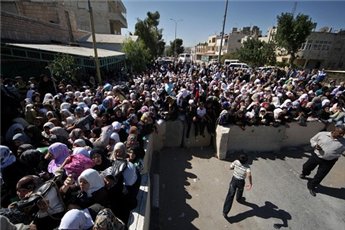
Palestinian women wait to cross an Israeli checkpoint on their way from
the West Bank city of Bethlehem to attend prayers in the Al-Aqsa Mosque
in Jerusalem during Ramadan 2011. (MaanImages/Luay Sababa)
After years of travel restrictions, Israel last month opened up its borders to many (not all, of course) Palestinians from the West Bank. In Nablus alone, 17,000 permits were issued out of 25,000 applications. Certain age groups were allowed in without a permit.
The occasion was the holy month of Ramadan, but there is no denial that a decision was taken somewhere in the Israeli military establishment to loosen up the big prison that millions of Palestinians find themselves in.
Even the dreaded Qalandiya checkpoint all of sudden became much easier to cross, with soldiers merely looking at the car number while crossing, at times without the long lines that have become its trademark.
Naturally, Palestinians were delighted to be able to pray in Jerusalem’s Aqsa Mosque and visit relatives and friends in Jerusalem and inside the Green Line. Many had not been in Jerusalem for decades.
Parents took their children (some teenagers) to see a Jerusalem they had never seen. Many flooded West Jerusalem, Tel Aviv, Haifa and other locations.
Palestinians shopped (the Malha mall is said to have sold goods worth two million shekels in one weekend). They hit the beaches and stores, enjoying a rare occasion to get out of the closed area of the West Bank.
The Israeli decision, carried out unilaterally (except for the administrative part at the liaison offices), surprised many, including the political establishment.
What was the reason for this Israeli “benevolence” at a time when hundreds of foreigners coming to visit Palestine are denied entry at the King Hussein Bridge?
Palestinian commentators hit the airwaves with arguments, wondering whether the decision was primarily political or economy-related.
They said that Israel was satisfied with the high degree of security cooperation with the Palestinian Authority and that the security situation was the best in years and therefore Israelis wanted to take advantage of this security lull to help release Palestinian tension.
Some argued that Israel was concerned that a third intifada might be around the corner and that their decision allowing masses of Palestinians to move around might help steer people away from a return to violent confrontations.
Others pointed out the various statistics showing how much Palestinians purchased in Israel and said that this was a calculated decision to help Israel’s economy and to counter the boycott of Israeli products.
Some, however, said that this does not make sense because the amount of money spent by Palestinians in this one burst is peanuts compared to the large Israeli economy.
Yet others argued that with the Palestinian Authority’s financial situation in a dire situation, the number of unemployed Palestinians will increase dramatically, which could contribute to the return of violence. This economic safety valve, it was argued, had more with the idea of returning the Palestinian economy to the days when it was totally dependent on Israel.
With Israeli companies needing workers and with the anti-African mood in the Israeli public, the argument was that it might be time to allow Palestinian workers who commute and therefore not cause a major social problem in Israel to start working in Israel.
Palestinian laborers are very much desired by Israeli employers because of their high level of productivity, knowledge of Hebrew and understanding of the needs of Israeli employers.
To many, the Palestinian workers are much better than the imported Thai workers or African migrants.
Whatever the real motivation behind the Israeli move to relax its border-crossing policy, it seems clear that a political solution is much further than previously expected.
An independent Palestinian state with strong economic ties with Jordan, Egypt and the Arab world is perhaps farther now than in decades.
With the lack of a horizon for peace, Israeli Prime Minister Benjamin Netanyahu’s economic peace initiative is now in high gear, being applied unilaterally by the Israeli army.
Daoud Kuttab is a journalist and former professor of journalism at Princeton University.
Related articles
- When Will Palestinians Become Human? (alethonews.wordpress.com)
- This Week in Palestine, August 31st, 2012 (indybay.org)
- Israeli Checkpoints: Deathtraps for Palestinians (occupiedpalestine.wordpress.com)
South African miners charged with murder of 34 colleagues killed by police
RT | August 30, 2012
South African workers arrested after a shooting at a platinum mine have been charged with killing 34 of their colleagues, despite confirmation that police committed the murders. The officers, who did not deny using guns, face no charges.
The Lonmin platinum mine in Marikana, in the country’s North West province, made headlines on August 16, when protesters, who demanded their wages be raised to over $1,000 a month, clashed with police. The crackdown claimed the lives of 36 people – miners and two policemen, and left 78 injured.
All of the 270 arrested miners, including the six hospitalized, were previously said to be charged with attempted murder or public violence. But state prosecutor Nigel Carpenter increased the charges against them.
The miners are to be tried under the “common purpose” doctrine, which implies that all participants in a criminal activity can be charged for its consequences.
“This is under common law, where people are charged with common purpose in a situation where there are suspects with guns or any weapons and they confront or attack the police and a shooting takes place, and there are fatalities,”Frank Lesenyego, spokesman for South Africa’s National Prosecuting Authority, said.
The lawyers representing the Marikana strikers are expected to challenge the charges. A prior application for bail was rejected, and the hearing was delayed till September 6. Until then, the miners will remain in custody in three area police stations.
At the same time, the policemen involved in the deadly clashes at the Marikana mine will undergo a Commission of Inquiry investigation separately.
That is despite police commissioner Riah Phiyega’s confirmation a few days after the tragedy that the 34 people were killed by police. However, police officers insist that they opened fire to defend themselves against a wave of strikers armed with machetes, who allegedly charged barricades. Prior to gunshots, the police used tear gas and water cannons.
However, leaked findings of victims’ autopsies were published by the South African Star newspaper, and showed that the miners were shot in the back while running away.
The post-mortem results suggested that the strikers posed no danger to law enforcement at the time of the shooting.
An official spokesman refused to confirm or deny the accusations on what’s already being dubbed the Marikana Massacre – the most violent episode in South Africa’s history since the 1994 end of apartheid.
Related articles
- South Africa’s Unfinished Revolution and the Massacre at Marikana (alethonews.wordpress.com)
- Shocking autopsy: South African police ‘shot fleeing protesters in the back’ (rt.com)
Judge Rules Against Colorado Supermax That Keeps Prisoners Indoors for Years
By Jean Casella and James Ridgeway | Solitary Watch | August 30, 2012
 We’ve written at length about the case of Troy Anderson, a prisoner with mental illness who has spent more than ten years in solitary confinement at the Colorado State Penitentiary. This past April, a Federal District Court in Denver heard a case brought on Anderson behalf by students at the University of Denver Law School’s Civil Rights Clinic. As we wrote, “it was his untreated mental illness that first landed him at CSP, Anderson contends, and now the same symptoms are keeping him there indefinitely. Without proper treatment, he is unable to convince corrections officials that he’s fit for the general prison population. This catch-22, his lawyers say, condemns him to an effective life sentence under conditions that are increasingly being denounced as a form of torture—particularly when applied to mentally ill prisoners.” The suit claimed that Anderson’s treatment violated the Americans with Disabilities Act, as well as the Constitution’s ban on cruel and unusual punishment and its guarantee of due process. Among other things, his lawyers pointed out that it has been more than a decade since Anderson had “felt the sun on his back.”
Westword‘s Alan Prendergast, who has also followed the case closely, reported earlier this week on the judge’s ruling in the case:
In what amounts to a landmark decision, a federal judge has ruled that the conditions of solitary confinement at the Colorado State Penitentiary constitute “a paradigm of inhumane treatment” and must change — notably, so that inmates locked down in their cells 23 hours a day can have at least three hours a week of natural light, fresh air and outdoor exercise. “The Eighth Amendment does not mandate comfortable prisons, but it does forbid inhumane conditions,” U.S. District Judge Brooke Jackson wrote in an order issued last Friday.
CSP has an interior courtyard that could be modified to permit outdoor exercise for inmates, Jackson notes. But since it opened in 1993, the state supermax has permitted its high-security inmates only to exercise in an odd-shaped room on each tier equipped with a chin-up bar; small holes allow some fresh air from outside to reach the room. Calling CSP “out of step with the rest of the nation” — even the notorious federal supermax in Florence allows its inmates outdoor recreation in individual cages — Jackson declared that prison officials must provide its charges with “meaningful exposure” to natural light and air.
Jackson’s ruling came in the case of Troy Anderson, 42, a mentally ill inmate serving an 83-year sentence stemming from two shootouts with police. He’s one of ten inmates who have been at CSP for ten years or more with hardly any exposure to the outdoors (except during transport to court) during that time. His lawsuit, filed with the aid of student lawyers from the University of Denver’s Sturm College of Law, challenged several aspects of life at CSP, from mental health treatment to the policies that have kept him from progressing to a less restrictive prison, as unconstitutional…
On other issues, the judge ordered a fresh look at Anderson’s medication issues and mental health treatment. He adopted a wait-and-see attitude toward new policies that are supposed to address other inmate concerns about how inmates receive bad behavior reports, known as “negative chrons,” that can prolong their stay in solitary confinement without a clear appeal process.
At Anderson’s trial, other inmates testified about suicidal thoughts brought on by the severe isolation and being deprived of any exposure to the outdoors. “I go to bed crying sometimes because I feel I have no hope of being outside of that cell any more,” one said.
A copy of the judge’s order can be found here: Troy Anderson v. Colorado DOC

Related articles
A Pattern of Abuse Against American Citizens
IMEU | June 28, 2011
In coming days, ten ships will take part in a flotilla attempting to break the Israeli blockade of the Gaza Strip. Among the ships will be the U.S.-flagged “Audacity of Hope,” carrying 36 U.S. citizens. Last year, the Israeli navy attacked a previous humanitarian flotilla in international waters, killing nine passengers, including one American.
Passengers on the “Audacity of Hope” have contacted the State Department, the White House, and members of Congress to notify them of the flotilla. They have urged the government to work to ensure the safety and free passage of the ships and to warn Israel against attacking unarmed civilian vessels with U.S. citizens on board who are exercising their legal rights. Instead, the State Department – whose mission in part is to protect and assist U.S. citizens traveling abroad – has issued numerous statements labeling the flotilla as an “irresponsible and provocative” action that risk[s] the safety of their passengers” and “creat[es] a situation in which the Israelis have the right to defend themselves”. The administration has also alluded to prosecuting the passengers, who will be delivering thousands of letters of solidarity and friendship to the people of Gaza, for providing material support to a designated terrorist organization. [3]
Though Israeli state violence against foreign nationals is often portrayed as an aberration, over the past 8 years alone, Israel has killed and/or severely injured a number of American citizens. Below are 10 such examples:
 Furkan Dogan Troy, NY |
~
19 year-old American Furkan Dogan was on the Mavi Marmara, a 600-passenger ship sailing as part of a flotilla headed to the Gaza Strip with humanitarian aid. In the early hours of May 31st, 2010, Israeli commandos dropped onto the ship in international waters and attempted to commandeer it, leading to a struggle for control of the ship. Among others, Dogan was shot at close range with 4 bullets to the head and 1 to the chest.
~
 Emily Henochowicz New York, NY |
 (After attack) |
~
On May 31st, 2010 21-year old Emily Henochowicz was hit in the face with a tear gas projectile fired directly at her by an Israeli soldier during a demonstration at the Qalandiya checkpoint. Henochowicz was taking part in a demonstration against the widely-condemned Israeli attack on a humanitarian aid flotilla. As a result of the attack, Emily lost her left eye.
~
 Tristan Anderson Oakland, CA |
 (After attack) |
~
On March 13th, 2009 in the Palestinian village of Ni’lin, American peace activist Tristan Anderson was critically injured after Israeli forces shot him in the head with a tear-gas canister. Anderson, 37 years old and from California, was taken to Israeli hospital Tel Hashomer, near Tel Aviv.
He was unconscious and bleeding heavily from the nose and mouth. He sustained a large hole in the right part of his forehead where he was struck by a tear gas canister. After 15 months in Tel Hashomer, some of that time in a coma, and at least one surgery, Tristan recently returned to his home in Northern California, still quasi-paralyzed.
 Brian Avery Albuquerque, NM |
 (After attack) |
~
On April 5, 2003, Israeli troops shot peace activist Brian Avery in Jenin. Avery, a 24-year-old American citizen from Albuquerque, New Mexico, experienced serious wounds to his face after Israeli troops shot at him with heavy machine gun fire from an armored personnel carrier (APC).
There were no reports of clashes on the street where the shooting took place and Avery was clearly marked as an observer. Avery’s cheek was torn and his eye socket and jaw bones were smashed, leading to at least 6 rounds of surgery. In a rare occurrence in November 2008, the Israeli government paid Avery $150,000 to settle a lawsuit he filed against them.

Rachel Corrie
Olympia, WA |
~
On March 16th, 2003 in Rafah, occupied Gaza, 23-year-old American peace activist Rachel Corrie from Olympia, Washington, was murdered by an Israeli bulldozer driver. Rachel was in Gaza opposing the bulldozing of a Palestinian home as a volunteer with the International Solidarity Movement.
According to a Palestine Monitor report of the incident, “Other foreigners who were with her said the driver of the bulldozer was aware that Rachel was there, and continued to destroy the house. Initially he dropped sand and other heavy debris on her, then the bulldozer pushed her to the ground where it proceeded to drive over her, fracturing both of her arms, legs and skull.”
~
Zaid Khalil
New York, NY
In April of 2002, while participating in a peaceful march along with other internationals in the West Bank city of Bethlehem, New York City resident Zaid Khalil was struck in the leg as Israeli soldiers opened fire.
 Lucas Koerner |

During Arrest
|
~
On June 1, 2011, 19-year-old Tufts University student Lucas Koerner was assaulted and arrested by Israeli police while he peacefully protested the annual Jerusalem Day march, an official Israeli holiday when Israelis parade through occupied East Jerusalem to celebrate its 1967 occupation by Israel. Police grabbed, punched, choked and then threw Koerner to the ground. After being arrested he was taken to the emergency room to be treated for the wounds inflicted by police.
~
 Munib Masri |
~
A 22-year-old Geology student at the American University of Beirut, Munib Masri was shot in the back with live ammunition by Israeli forces along the Lebanon border on May 15, 2011. Participating in a march to mark the 63rd anniversary of the Nakba – the expulsion of Palestinians from their homes during the establishment of Israel – Masri was leaving the demonstration when he was shot. Treated in a Beirut hospital, the bullet destroyed Masri’s left kidney, his spleen and broke apart in his spine. During the demonstration, eleven people were killed by Israeli forces and more than 100 wounded.
 Christopher Whitman |
 Whitman’s injury |
~
On May 13, 2011, 25-year-old Christopher Whitman, a Master’s student of Islamic and Middle Eastern Studies at Hebrew University, was shot in the head at close range with a high-velocity tear gas canister by Israeli Border Police. He was in the West Bank village of Nabi Saleh, near Ramallah, at the weekly nonviolent demonstration against the construction of Israel’s separation wall in the village. That week’s demonstration also commemorated the 63rd anniversary of the Nakba – the expulsion of Palestinians from their homes during the establishment of Israel. Whitman was treated at Ramallah Hospital.
 Sandra Quintano After assault |
~
On May 1, 2011, Sandra Quintano, 60, was assaulted by Israeli soldiers in the West Bank village of Izbet al-Tabib in the Qalqilya district during a peaceful demonstration against the construction of a fence which would cut off villagers’ access to their land. She suffered a gash to the top of her head and both her wrists were broken, one severely. She was treated in an Israeli hospital and continues to undergo physical therapy in the U.S.
~
Related articles
- Rachel Corrie and the Kosher Legal Stamp (alethonews.wordpress.com)
- International Solidarity Movement’s response to the Rachel Corrie verdict (alethonews.wordpress.com)
- Still no justice for peace activist Rachel Corrie (morningstaronline.co.uk)
- Israeli court acquits IDF in 2003 death of American pro-Palestinian activist Rachel Corrie (rt.com)
Featured Video

Matt Bracken: US Plans Massive MOAB Strike on Iran?
or go to
Aletho News Archives – Video-Images
From the Archives
Confronting the Threat of Ethnic Bioweapons
By Tony Cartalucci – New Eastern Outlook – 29.11.2017
The United States Air Force’s 59th Medical Wing’s molecular biology branch recently was revealed to have been collecting specifically Russian RNA and synovial (connective) tissue samples, prompting fears in Russia of a possible US directed ethnic-specific bioweapons program. … continue
Blog Roll
 Aletho News
- Matt Bracken: US Plans Massive MOAB Strike on Iran?
- Russia accuses France of ‘piracy’ over tanker seizure
- Why Yemen Is Bombing Saudi Arabia’s Airports: The War Behind the Headlines
- Sally Rooney’s books pulled from UK over support for Palestine Action
- Bombs for Tel Aviv, Promises for Riyadh
- Israeli ad agency conducted vast global espionage campaign using online ads: Report
- Oct. 7 Forever Marks The Big Reveal: ‘We See You, Israel, We Revile You, We Reject You!’
- Meet the US generals and admirals advancing Israeli policy
- Israel’s Straw Widow Protocol: The Kill Zones Where Civilians Were Labelled ‘Terrorists’
- Leading Israeli Think Tank Publishes Psychotic Israeli ‘National Security’ Doctrine
- If Americans Knew
- Israeli firm used online ads to run vast spy operation, researchers say
- No, the world zionist movement is not an antisemitic conspiracy theory
- Hundreds of IDF investigations into killings still have no public outcome, BBC Verify finds
- After Ashley Moody Epstein Probe, Donors Linked to Him Poured Money Into her Senate Campaign
- Worried about Russian meddling in UK politics? Wait till you see what Israel is up to
- Israeli settlers attack West Bank center for disabled children, church leader calls for int’l action
- Pulling Out Teeth Just to Live: How Israel Has Devastated Dental Care in Gaza
- Gaza’s “ceasefire” death toll passes 1,500 – Daily Update
- Activists Abused By Israel Return to New Freedom Flotilla Mission
- 60 Minutes won’t tell the full truth about Israeli settler violence
- No Tricks Zone
- New Study Suggests Large Regions Of The Pacific Ocean Have Been Cooling For The Last 80 Years
- Germany’s Green Energy Debacle: High Energy Costs Force Kahla Porzellan to Close After 182 Years!
- New Study: 50 Years Of The Most Aggressive ‘Net Zero’ Policies Can Only Affect The Global Climate By 0.03°C
- US September “Heat” Was No Record…Many Records Set Decades Ago
- Latest European Green Energy Debacle; Portugal’s Largest Flagship Solar Park Insolvent!
- Green Energy Debacle: German Expert Professor Fritz Vahrenholt Warns Of Severe Economic And Social Consequences
- Two More Paleo Reconstructions Affirm Meters-Higher Sea Levels Across Ireland, Brazil 7000-6000 Years Ago
- New Study: Earth And Venus Surface Warmth Largely Explained By Convection And Lapse Rate, Not CO2 Or Radiation
- 2025 Nature Paper Claiming Worsening Global Drought Gets RETRACTED …Heavily Flawed
- New Study: ‘Global Drought Shows No Detectable Recent Acceleration Under Climate Warming’

