Quebec police arrest 19 protesting students as classes resume
Press TV – August 28, 2012
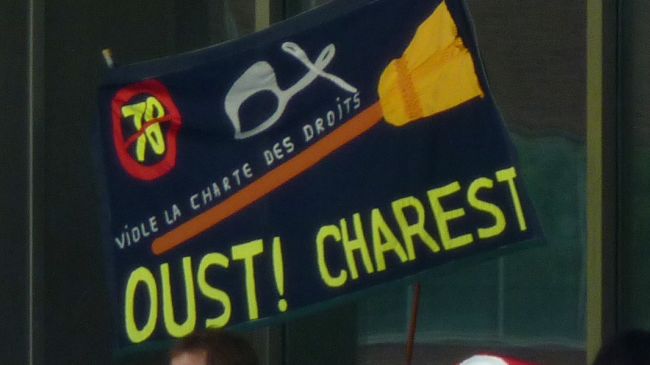 Canadian police have stormed the University of Quebec making 19 arrests, as angry students prevent the beginning of the new semester.
Police arrested 19 students Monday under the terms of Bill 78, which ordered a suspension of university classes back in May and their reinstatement in August even if the students planed to continue their strike. The bill also restricts the student demonstrations and imposes fines for those who impeded classes, starting at CAD 1,000.
The classes were supposed to resume this week, as the winter semester was suspended following massive months-long protests across Canada’s French-speaking province against proposed tuition fee hikes.
Some 2,000 students at the departments of anthropology and cinema voted to continue their protest and prevented the start of classes.
The recent protest comes ahead of next week’s provincial election, which will decide whether the province’s ruling Liberal Party, which insists on a plan to increase tuition fees by 82 percent, could be reelected.
The latest opinion poll shows that the separatist Parti Quebecois (PQ) led by Pauline Marois heading for a victory in the election to be held on September 4th. Marois is the protester’s favorite candidate and has been wearing the red square, the symbol of the demonstrators’ cause, on several public occasions.
If the separatist PQ is elected in the upcoming provincial election, it will consider holding a referendum on separation of Quebec from Canada.
Since February, students have been protesting against the hikes and the provincial government’s controversial anti-protest Bill 78. The protests later turned into a larger movement dubbed the “maple revolution,” which reveals deeper social unrest.
International Solidarity Movement’s response to the Rachel Corrie verdict
ISM | August 28, 2012
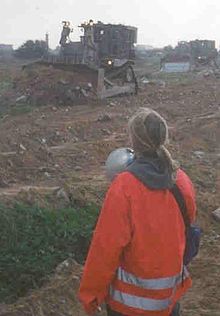 The International Solidarity Movement (ISM) is deeply concerned by the verdict of Judge Oded Gershon that absolved Israel’s military and state of the 2003 murder of American ISM activist Rachel Corrie. Rachel was crushed to death by an Israeli army bulldozer while protesting the demolition of a Palestinian home in the Gaza Strip.
Despite the American administration stating that the Israeli military investigation had not been “thorough, credible and transparent” and the Israeli government withholding key video and audio evidence, Judge Gershon found no fault in the investigation or in the conclusion that the military and state were not responsible for Rachel’s death. Judge Gershon ruled that Rachel was to blame for her own murder and classifies her non-violent attempt to prevent war crimes as proof that Rachel was not a “thinking person”.
By disregarding international law and granting Israeli war criminals impunity Judge Gershon’s verdict exemplifies the fact that Israel’s legal system cannot be trusted to administer justice according to international standards. The ISM calls on the international community to hold Israel accountable by supporting the Palestinian call for boycott, divestment and sanctions (BDS) and continuing to join the Palestinian struggle in the occupied Palestinian territories.
Describing the situation in Gaza 2 days before she was killed, Rachel said, “I’m witnessing the systematic destruction of a people’s ability to survive. It’s horrifying.” Rachel’s analysis holds true today, confirmed by the United Nations a day before this ruling, which reported that Gaza would not be “liveable” by 2020 barring urgent action.
The verdict is a green light for Israeli soldiers to use lethal force against human rights defenders and puts Palestinian and International human rights defenders in mortal danger.
This will not deter us. As long as our Palestinian sisters and brothers want our presence, the ISM will continue to find ways to break Israel’s siege, and stand in solidarity with the Palestinian people. As Rachel’s mother Cindy put it, “There were children behind the walls of the home Rachel was trying to protect… We should have all been there”.
Judge Gershon’s verdict is a travesty of justice but it is not exceptional. As a rule the Israeli legal system provides Israeli soldiers impunity to commit murder. The only Israeli soldier convicted of manslaughter since the outbreak of the second Intifada in 2000 was Taysir Hayb, a Bedouin citizen of Israel for shooting British ISM volunteer Tom Hurndall in the back of the head with a sniper rifle as Tom was carrying a child to safety. At least 6,444 Palestinians have been killed by the Israeli occupation forces in this period, with no justice for them or their families.
For more information Contact: Aide Mormech 059228094 or Huwaida Arraf 0598336215
Related articles
US rewarding Myanmar for massacring Muslims

An undated photo shows a Rohingya refugee woman carrying a child in an unregistered camp in Kutupalong, some 400 kilometers southeast of Dhaka.
By Kevin Barrett | Press TV | August 26, 2012
I am writing to every contact listed at Buddhanet.info’s American Buddhist Directory to ask:
Are you aware of the ongoing genocide in Myanmar (Burma) — a genocide that is being committed in the name of Buddhism?
And did you know that the United States of America bears responsibility for this genocide, since the US has been rewarding the Myanmar regime with ever-closer political and economic ties during recent months of accelerating atrocities?
As American Buddhists, you are in a position to help stop this genocide, by pressuring the US and Myanmar governments as well as international human rights organizations. Your visible participation in the campaign to save the Rohingya people from extermination by murderous Buddhist fanatics will not only help draw the world’s attention to this horrific situation, but also help restore the image of Buddhism as a religion of compassion.
The facts about the genocide in Myanmar are not in dispute. The fanatical Buddhist nationalists, who unfortunately represent a large segment of the roughly 60 million Buddhists in Myanmar, admit that they are trying to uproot and exterminate the roughly one million Muslim Rohingya from land that the Rohingya have lived on for centuries.
Here is what a typical genocidal Buddhist fanatic from Myanmar wrote in a comment on a Wall Street Journal article:
“Burma is Buddhist nation created for the 135 Tibeto-Burman tribes. People do not get citizenship just because born there or illegally lived there for centuries. Please do not interfere with the law and internal affairs of Burma just as you do not like other nations to poke their nose in your internal affairs.”
“People do not get citizenship just because born there or illegally lived there for centuries.” This statement, which aptly sums up the official policy of the Burmese regime, could get the person who made it, and the government that follows it, hanged for crimes against humanity. Obviously, being born in a modern nation to a family that has been there for centuries automatically confers citizenship. And obviously, any modern nation that denies citizenship to such people, burns their homes and communities, and murders them en masse, with the aim of removing them from the nation of their birth, is committing the internationally-recognized crime of genocide.
In recent weeks, many thousands of homes, and more than 20 mosques, have been burned by murderous Buddhist mobs, backed by national security forces, in the Arakan state of Myanmar. Estimates of the number of Rohingya Muslims murdered, whether directly or by drowning in the Naf River, as they flee the killers, range from the thousands to the tens of thousands. Every one of the more than 500 mosques in Arakan has been taken over by the genocidal regime’s security forces and shut down, and they are being demolished one-by-one. (This happened during the holy month of Ramadan, when Muslims are supposed to spend as much time as possible in a mosque.)
Muslims have been living in Burma since roughly 800 c.e. — that is, nearly for as long as the religion of Islam has existed. And Arakan has been a Muslim region, ruled by Muslim kings and/or populated by Bengali Muslims, since 1430. The most notable population increase of Muslims in Arakan took place in the 1600s. The idea that the Rohingya people are somehow “recent immigrants” to the region is clinically insane — a symptom of the larger insanity known as nationalist fanaticism.”
Both Buddhism and Islam are universalist religions: They proclaim truths that are valid for all people, indeed for all of existence. And the core truth that both religions proclaim is the primacy of compassion. In Buddhism, a central feature of the Buddha nature is compassion for all beings. If one were to choose a single hallmark of a successful advanced practitioner of Buddhism, it would be a highly-developed sense of compassion.
Whatever has happened to the Myanmar Buddhists’ compassion for their fellow citizens who happen to be born as Rohingyas?
Islam, too, views compassion as a central reality of creation. Muslim theologians, like the more advanced Christian and Jewish religious thinkers, view God as ineffable; but the primary and overriding tangible characteristic of God in Islam (with the proviso that no tangible characteristics fully express the reality of the one ineffable God) is rahma, or compassion. The two adjectives Muslims use the most to “describe” God are ar-rahman ar-rahim, usually translated as “the merciful, the compassionate.” (The root of rahma and its cognates derives from the word for “womb,” suggesting that this “compassion” has something in common with the nurturing, all-embracing, unconditional love that mothers feel for their children.)
Additionally, both Buddhism and Islam teach us to transcend or even annihilate the (tribal) ego. Buddhism offers a set of teachings that take its practitioners beyond the ego, which is the source of the endless desire that is the cause of the pervasive suffering or disappointment that characterizes ordinary human existence. Likewise, Islam teaches its serious practitioners to annihilate the “ego that desires evil” through absolute submission to God. Each religion offers a very similar cure for the unhappiness of the ordinary human condition.
The kind of chest-thumping egotistical nationalism that proclaims “I am a Buddhist, my heroic nation is Buddhist, I am so much better than those non-Buddhists that I must kill them or exile them” is about as far from the compassionate teachings of the Buddha as it is possible to get. Likewise, extremist Muslims who proclaim that their narrow version of Islam is the only truth, and that everyone who disagrees should be killed, are equally far from the universal, all-compassionate message proclaimed by God through Prophet Muhammad (peace upon him).
Muslims and Buddhists ought to unite against ego-driven nationalist fanaticism, which is an affront to both religious traditions.
Related articles
- Bangkok Conference On The Rohingyas Of Myanmar – OpEd (eurasiareview.com)
- Democracy and slaughter in Myanmar: Gold Rush overrides Human Rights (Aletho News)
- Stateless Rohingya… Running on Empty (Aletho News)
Jewish Settler’s Vehicle Rams Child in Hebron Hit and Run
By Saed Bannoura | IMEMC & Agencies | August 23, 2012
An Israeli settler driving in Jaber Neighborhood, in the southern West Bank of Hebron, hit a Palestinian child then drove off in what appears to be a ramming attack, medical sources reported.
Nasser Qabaja, a Red Crescent official in Hebron, said that the child was moved to an Israeli hospital upon request of her family.
Medical sources said that the child suffered moderate injuries, and that she suffered various cuts and bruises.
Late in January this year, an Israeli driver hit a Palestinian teenager at a checkpoint near Jerusalem, and then drove off in an apparent ramming attack.
Some of the witnesses present at the scene were able to document the license number of the vehicle, but Israeli police did not take the information when it was presented to them.
Although several previous ramming incidents have been reported to the Israeli police and military, no investigations of these incidents have been carried out by the Israeli authorities.
Related articles
- Israeli kills 2 Palestinians near Hebron (alethonews.wordpress.com)
- Israeli Court Approves Well Destruction In Bethlehem (alethonews.wordpress.com)
- French activist injured as Israeli troops attack Hebron (alethonews.wordpress.com)
- Six Palestinians Wounded, Some Seriously In Settler Firebomb Attack On Their Car Near Hebron (occupiedpalestine.wordpress.com)
- #VIDEO | Child Abuse | Palestinian child kicked by Israeli Border Police in Hebron (occupiedpalestine.wordpress.com)
- Israeli Settlers Attack Home, Attempt to Torch It (occupiedpalestine.wordpress.com)
- This Week in Palestine, August 17th, 2012 (indybay.org)
What is wrong with the Trans-Pacific Partnership (TPP)
By Carolina Rossini and Maira Sutton | EFF | August 21, 2012
EFF has been fighting against the Trans-Pacific Partnership (TPP) intellectual property chapter for several years. This agreement poses a great risk to users’ freedoms and access to information on a global scale.
We have created this infographic to capture the most problematic aspects of TPP, and to help users, advocates and innovators from around the world spread the word about how this agreement will impact them and their societies. Right-click and save the image for the PNG file, or you can download the PDF version below.
We thank Lumin Consulting for working with us on this project.

 Attached Documents

Related articles
- New Obama Scandal: The Trans-Pacific Partnership (constitutionclub.org)
- Australia, New Zealand an Canada Green parties concerned over Trans-Pacific Partnership (bikyamasr.com)
- Lori Wallach – Trans-Pacific Partnership: Under Cover of Darkness, a Corporate Coup Is Underway (prn.fm)
- Internet Users Again Shut Out of Secret TPP Negotiations (eff.org)
- NZ stands ground on Trans Pacific Partnership (computerworld.co.nz)
- Malaysia Rejecting TPP as Agreement Causes Political Turmoil in Australia (zeropaid.com)
NY Times and the Myth of ‘U.S. Ideals’
By Peter Hart – FAIR – 08/22/2012
There’s nothing quite like the demise of a U.S-allied dictator to get the Paper of Record talking about the “clash” between U.S. “ideals” and the actual policies the country carries out.
Today’s New York Times (8/22/12) carries the headline “Ethiopian Leader’s Death Highlights Gap Between U.S. Interests and Ideals,” under which Jeffrey Gettleman lays out the case that the United States kept Ethiopian leader Meles Zenawi, who died early this week, in the “good guy” column despite our normally idealistic approach to world affairs. Gettleman writes that Zenawi
extracted prized intelligence, serious diplomatic support and millions of dollars in aid from the United States in exchange for his cooperation against militants in the volatile Horn of Africa, an area of prime concern for Washington.
But he was notoriously repressive, undermining President Obama’s maxim that “Africa doesn’t need strongmen, it needs strong institutions.”
But, Gettlemen explains:
Despite being one of the United States’ closest allies on the continent, Mr. Meles repeatedly jailed dissidents and journalists, intimidated opponents and their supporters to win mind-bogglingly one-sided elections, and oversaw brutal campaigns in restive areas of the country where the Ethiopian military has raped and killed many civilians.
The real trick is the first word: “Despite.” Readers are supposed to see these as unusual characteristics for a leader backed by the United States, which of course would much rather the world be governed by those who respect international law and human rights.
That supposed commitment is difficult to locate. After his death, Gettleman reports, Hillary Clinton
praised his “personal commitment” to lifting Ethiopia’s economy and “his role in promoting peace and security in the region.” But she made no mention of his rights record and gave only a veiled reference to supporting “democracy and human rights” in Ethiopia.
Gettleman deserves some sort of award for this passage:
Ethiopia is hardly alone in raising difficult questions on how the United States should balance interests and principles.
Saudi Arabia is an obvious example, a country where women are deprived of many rights and there is almost no religious freedom. Still, it remains one of America’s closest allies in the Middle East for a simple reason: oil.
In Africa, the United States cooperates with several governments that are essentially one-party states, dominated by a single man, despite a commitment to promoting democracy.
One could spend considerable time compiling a list of the tyrants, dictators and human rights abusers the United States has supported, from Suharto in Indonesia to Mubarak in Egypt. Or consider the Reagan-era policies of Latin America, which saw the United States supporting strongmen and fielding armies to overthrow governments we didn’t care for.
Elite institutions like the Times need to maintain the comfortable fiction that the United States has a unique and laudable commitment to spreading democracy and human rights. Most people with a passing knowledge of U.S. history would know that there are too many exceptions to this rule to make it a rule at all. Thus, every now and then, an article like this is written to demonstrate that there is in fact some awareness that the United States does not practice what it preaches. An effective propaganda system requires these small openings.
Related articles
- Obama condoles Ethiopian PM’s death (thehindu.com)
- The Strongman Who May Be Missed: Meles Zenawi, 1955-2012 (world.time.com)
South Africa’s Unfinished Revolution and the Massacre at Marikana
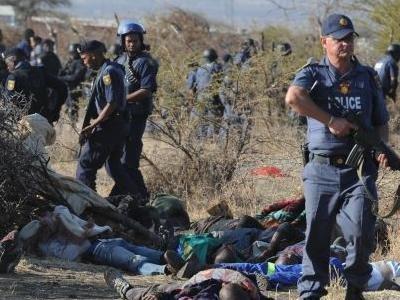
A Black Agenda Radio commentary by Glen Ford | August 22, 2012
When thousands of miners went on strike at South Africa’s largest platinum mine, in Marikana, they were confronting not only the London-based owners, but the South African state, which since 1994 has been dominated by the African National Congress (ANC); COSATU, the Congress of South African Trade Unions; and the South African Communist Party. This week, the full weight of the state was brought down on the Black miners, 34 of whom were massacred by police gunfire. Many of the survivors face charges of murder in the earlier deaths of two policemen and eight other miners.
The National Union of Mineworkers, whose representation the strikers rejected, and the Communist Party head in the region claim the strikers are at fault, that they have committed the sin of choosing an alternative union to argue their case for higher wages and, therefore, deserve severe punishment. They are “anarchists,” say these two allies of the South African state, and guilty of fomenting “dual unionism” – which is now, apparently, a capital crime. With a straight face, the Communist Party had the gall to call on all South African workers to “remain united in the fight against exploitation under capitalism.”
That is precisely what the Marikana miners were doing – the struggle they gave their lives for. However, since the peaceful transition to state power to the ANC and its very junior partners, the COSATU unions and the Communist Party, in 1994, the South African state has had different priorities. The “revolution” was put on indefinite hold, so that a new Black capitalist class could be created, largely from the ranks of well-connected members of the ruling party and even union leaders. It is only logical that, if the priority of the state is to nurture Black capitalists, then it must maintain and defend capitalism. This is the central contradiction of the South African arrangement, and the massacre at Marikana is its inevitable result.
The 1994 agreement between Nelson Mandela’s ANC and the white South African regime was a pact with the devil, which could only be tolerated by the masses of the country’s poor because it was seen as averting a bloodbath, and because it was assumed to be temporary. But, 18 years later, the arrangement has calcified into a bizarre protectorate for foreign white capital and the small class of Blacks that have attached themselves to the global rich. Apologists for the African National Congress regime will prattle on about the “complexity” of the issue, but the central truth is that South Africa did not complete its revolution.
The fundamental contradictions of the rule of the many by the few, remain in place – only now, another layer of repression has been added: a Black aristocracy that has soaked itself in the blood of the miners of Marikana.
South Africa remains the continent’s best hope for a fundamental break with colonialism in its new forms. But, as in all anti-colonial struggles, the biggest casualties will occur in the clash between those who truly desire liberation, and those who are intent on an accommodation with the old master.
BAR executive editor Glen Ford can be contacted at Glen.Ford@BlackAgendaReport.com.
Related articles
- Echoes of the Past: Marikana, Cheap Labour and the 1946 Miners Strike (alethonews.wordpress.com)
- South African miners’ families back Julius Malema’s call for nationalisation (guardian.co.uk)
Tunisia: Al-Nahda’s Failures Lead Sidi Bouzid to Rise Again
By Christopher Barrie | Al Akhbar | August 17, 2012
On Tuesday August 14, the central Tunisian governorate of Sidi Bouzid held a general strike to call for the release of several protesters detained during the demonstrations held over the preceding weeks and to demand concrete plans for development in the region.
Tuesday’s events come after a series of city-wide general strikes which, from the month of May, have swept through Tataouine, Monastir, Kasserine and Kairouan. The recent events in Sidi Bouzid, cradle of the Tunisia’s 2011 revolution, should be considered the culmination of an extended standoff, not only between the al-Nahda-led ruling coalition and Tunisia’s main trade union federation, the UGTT, but also between those in power and those who are yet to see the revolutionary demands of “work, freedom, and national dignity” realized.
Tensions in Sidi Bouzid have been mounting over a period of months. However, the origins of this most recent wave of unrest can be linked to July 26 when a large number of day workers in the region attacked the al-Nahda party offices in protest at a two-month delay in their wages being paid. The Interior Ministry estimated the numbers involved at 150 while union officials claimed more than 1,000 took part.
The response of al-Nahda to these events was typical. Refusing to recognise the genuine demands of the chronically unemployed and disenfranchised in the southern regions of Tunisia, party officials claimed that those demonstrating had been manipulated by rival political parties, seeking to sow instability and dissent for their own ends. The police fired warning shots and tear gas canisters to disperse the protest.
Tensions have been further exacerbated in recent months by ongoing water shortages in the region. Over the past six months, drinking water has commonly only been available in the evenings and has occasionally been cut off for the entire day. Mohamed Najib Mansouri, the governor of Sidi Bouzid, claimed that one of the reasons for these shortages was the failure of residents to pay their bills. It is more likely that the local infrastructure has been unable to sustain the increased consumption of water during an especially hot and dry summer.
On Thursday August 9, a protest was organised by the December 17th Progressive Forces Front in conjunction with the December 17th Committee for the Protection of the Revolution, the UGTT and a number of opposition parties.
As well as demands for a guaranteed supply of water to the region, the protesters’ demands included the settlement of the status of workers, the resignation of the regional commander of the National Guard, the resignation of Governor Mohamed Najib Mansouri and the dissolution of the Constituent Assembly, in view of its failure to respond to the legitimate demands of the residents of Sidi Bouzid.
In response to the protests, police fired tear gas and rubber bullets into the crowds. One man was hospitalised having been struck in the stomach by a rubber bullet and four others were taken to hospital after inhaling tear gas.
Following these events, al-Nahda once again ignored the grievances of those protesting, this time claiming that rival party Nidaa Tunis was behind the protests. Indeed, a spokesperson from the ruling Islamist movement went so far as to claim that Nidaa Tunis, created in June of this year by former interim prime minister Beji Essebsi, represented the political arm of Ben Ali’s defunct Constitutional Democratic Rally (RCD) party and that they had “proof that some figures within the region known to be close to Nidaa Tunis sided with criminals, thieves and alcohol vendors to spread anarchy in Sidi Bouzid”.
Despite President Moncef Marzouki’s efforts to quell the the growing tension in the region, the general strike went ahead on Tuesday with over 1,000 protesters assembling outside the court house.
The events of recent weeks mark a significant development in the mounting levels of anger at the failures of the majority Islamist party. More than the ruling coalition as a whole, it is now al-Nahda which is perceived to be behind the lack of real progress in Tunisia. What’s more, one should not be surprised at the police’s violent handling of these protests. Prime Minister Hamadi Jebali and Interior Minister Ali Larayedh have previously made it clear that they are willing to use force in order to maintain order in the country. Sadok Chourou, a prominent figure within the al-Nahda ranks claimed in January that strikers were “enemies of God” and that they should suffer the same fate as apostates.
It is the protesters themselves who are blamed for the ongoing instability within Tunisia and not the failures of the ruling coalition and, specifically, al-Nahda. And yet, one need only look at actions of the ruling parties in order to see the falsity of such a claim. Negotiations up until now have been dogged by political outbidding and brinkmanship which has severely hindered the transitional process, as seen in al-Nahda’s attempts to prevent the transition to an independent judiciary, its decision to level a sentence of up to two years for attacks on “sacred values” or its recent rewording of the draft constitution to define the status of women as “complementary to men.”
Furthermore, the economic alternatives being proposed will likely do little to alleviate the situation of many in the southern regions of Tunisia which have traditionally suffered from high levels of unemployment and a lack of investment. Relying principally on foreign and private investment, the government aims to to provide 100,000 more jobs in Tunisia and predicts a level of 3.5 percent GDP growth for 2012. The latter of these two predictions seems increasingly unlikely considering that Tunisia has, to date, experienced four consecutive quarters of negative growth. With levels of unemployment at 18.1 percent, the aim to create 100,000 jobs will also do little to abate social unrest in a country which counts over 709,000 (of an active workforce of 3.9 million) unemployed.
With Minister for Investment Riadh Bettaib announcing last Friday that Tunisia can expect to receive a further $1 billion in World Bank loans alongside his continued insistence on boosting foreign direct investment (FDI) and tourism revenues, it is clear that the proposed model for economic development differs very little from the neoliberal agenda of the former regime.
Of course, alongside the social context of these protests, one must also take into account the political dimension of what is occurring. Tuesday’s general strike was called by the UGTT and the protests of the past week have found support among a broad range of opposition political parties, including the centrist Republican Party, al-Watan (The Nation), and several leftist parties, including the Workers’ Party. While it is important not to discount the role played by opposition political forces in these mobilisations, it remains the case that the principal drivers of this spell of popular contestation have been the young and unemployed in the region whose demands, as has commonly been the case, are channeled through the UGTT. Malek Khadraoui, a writer and activist who has been present throughout the latest wave of strikes and protests in Sidi Bouzid, further comments that, while some opposition parties may be seeking to capitalize on recent events, “the youth in the region harbour a deep distrust towards political parties” and the real cause of these events is the inability of the ruling coalition, and particularly al-Nahda, to respond to their demands.
It is difficult to predict where this latest spell of social upheaval is headed. An International Crisis Group report published this June remarked that it would be an exaggeration to “raise the spectre of a second insurrection,” but that the continued political instability within Tunisia alongside sustained levels of socioeconomic insecurity could “negatively feed on each other and risk snowballing into a legitimacy crisis for the newly elected government.”
In the same report, economist Lotfi Bouzaiane comments that one of the principal demands of the revolution was “the right to work.” Prior to the revolution, he says, it was Ben Ali who insisted that “to find work you just had to wait for the economy to grow!”
Following this latest wave of strikes and demonstrations, it is becoming ever more difficult to distinguish between the rhetoric of the former regime and Tunisia’s new ruling coalition, so committed is it to denouncing any expression of popular dissent in the name of national stability and economic growth. In the absence of any real answers to the demands of those in Sidi Bouzid and elsewhere, the government is increasingly having recourse to violent means of repression. It appears that Tunisia’s uncommonly hot summer may precede an even hotter Autumn.
Christopher Barrie is a student and journalist currently working in Tunisia at Nawaat.
Related articles
Featured Video

Matt Bracken: US Plans Massive MOAB Strike on Iran?
or go to
Aletho News Archives – Video-Images
New Book
The silver that medicine dropped — four thousand years of clinical use, four decades to erase.
Colloidal Silver — First Edition, 2026, Paperback
Lies are Unbekoming | October 16, 2026
Silver was medicine. Not alternative medicine. Not folk medicine. Medicine. In surgery. In obstetrics. In the burn ward. In water treatment. In the household medicine chest. Every physician before 1938 knew this.
By the 1870s, silver nitrate was standard in surgical wound care across the leading hospitals of Britain, Germany, and the United States. Colloidal silver preparations — Collargol, Argyrol, Protargol — entered European and American practice through the 1890s and early 1900s and became standard antiseptics in military field medicine. By the time Fleming grew his first penicillin mould in 1928, silver was the first-line antimicrobial of the Western pharmacopoeia. The Lancet and the British Medical Journal carried the clinical reports in volume. The practice ran continuously through the Victorian era, the Edwardian era, the First World War, the interwar period. By 1980, almost all of it was gone.
What has not been treated at book length, until now, is how a four-thousand-year clinical record disappeared from mainstream medicine within four decades of the Flexner Report — and what the honest account of silver looks like once that record is reassembled.
Colloidal Silver reconstructs the pre-1938 record from The Lancet, the British Medical Journal, and the primary literature of the era; recovers Robert Becker’s bioelectric framework from the regeneration research the pharmaceutical model buried; and places silver inside a practical terrain-paradigm guide to its current place — in water, on the body, inside the body, and in the chronic conditions where antibiotics have failed. … continue
Blog Roll
 Aletho News
- China’s FM: Palestinian cause is ‘greatest injustice of the century’
- US sympathy for Palestinians surpasses support for Israelis
- Israeli rabbi permits occupiers to steal Palestinian olive harvest in West Bank
- Spanish firm sells Latvia vehicles equipped with Israeli tech despite arms embargo
- Saudi Arabia under fire… Yemen is burning down the House of Saud
- Israeli Spy Pollard stole the files, today’s it’s delivered through official channels
- Why Iran Didn’t Walk Away
- US arms supplied to Ukraine found in war-torn Sudan – Moscow
- The silver that medicine dropped — four thousand years of clinical use, four decades to erase.
- My Latest Presentation to the UN Security Council
- If Americans Knew
- NPR investigation finds evidence of widespread fraud at mall kiosks tied to Israeli skincare brand
- Tucker Carlson exposes Israeli Lies about the Oct 7th attack, Charlie Kirk, and the U.S.
- Israel has detained thousands of Palestinian children since Oct 7th – over half spent time in solitary, many uncharged
- Israeli Analysis: Is Netanyahu Planning an ‘October Surprise’ Attack Before Israel’s Election?
- Israeli settlers brutally attack Palestinians and Washington Post female photographer, 65
- Words Have Changed, Occupation Continues: The Reality of the Gaza Ceasefire
- Gaza’s child amputees are growing faster than their prosthetics allow
- Israel keeps Palestinians struggling just to survive–Daily Update
- Israeli firm used online ads to run vast spy operation, researchers say
- No, the world zionist movement is not an antisemitic conspiracy theory
- No Tricks Zone
- New Study Suggests Large Regions Of The Pacific Ocean Have Been Cooling For The Last 80 Years
- Germany’s Green Energy Debacle: High Energy Costs Force Kahla Porzellan to Close After 182 Years!
- New Study: 50 Years Of The Most Aggressive ‘Net Zero’ Policies Can Only Affect The Global Climate By 0.03°C
- US September “Heat” Was No Record…Many Records Set Decades Ago
- Latest European Green Energy Debacle; Portugal’s Largest Flagship Solar Park Insolvent!
- Green Energy Debacle: German Expert Professor Fritz Vahrenholt Warns Of Severe Economic And Social Consequences
- Two More Paleo Reconstructions Affirm Meters-Higher Sea Levels Across Ireland, Brazil 7000-6000 Years Ago
- New Study: Earth And Venus Surface Warmth Largely Explained By Convection And Lapse Rate, Not CO2 Or Radiation
- 2025 Nature Paper Claiming Worsening Global Drought Gets RETRACTED …Heavily Flawed
- New Study: ‘Global Drought Shows No Detectable Recent Acceleration Under Climate Warming’

