In a letter dated 29 June 2012, the UK Foreign Office responded to concerns raised by a group of UK lawyers about the forcible transfer of Palestinian children to prisons located inside Israel. The transfer of Palestinian prisoners (adults and children) to detention facilities inside Israel violates article 76 of the Fourth Geneva Convention for which personal criminal liability applies.
In the letter, the UK Foreign Office responded that:
“The British Government shares your concerns about the treatment of Palestinian children detained in Israeli prisons and we have a continual dialogue with the Israeli authorities on this question. […] The Government agrees that Israel has legal obligations as an Occupying Power with respect to the Occupied Palestinian Territories under applicable international law, including the Fourth Geneva Convention. […] We agree with you that Israel’s policy of detaining Palestinians within Israel is contrary to Article 76 of the Fourth Geneva Convention and that domestic law cannot be used as a justification for violations of international law.”
According to Israeli Prison Service figures released in June 2012, 85 percent of Palestinian prisoners, including children, were detained inside Israel. Given that this violation has continued for decades, questions need to be asked as to what additional steps the UK Government is considering to ensure that it complies with its own legal obligations under the Fourth Geneva Convention, as dialogue does not appear to be working when it comes to the forcible transfer of prisoners.
While reading the text of Obama Statement on Shootings in Colorado, one line struck this writer as quite astounding:
“We may never understand what leads anybody to terrorize their fellow human beings like this. Such violence, such evil is senseless. It’s beyond reason.”
The President may have realized afterward that since he has been ordering the shooting of thousands in a half-dozen countries, the words “evil, senseless, beyond reason” could easily reflect back on himself. A later Obama statement on the massacre in a Colorado movie house did not contain the words “evil,” “senseless,” “violence beyond reason.”
In any case, history books, in some future, probably not too distant, day will deplore Obama’s pathetic 9/11 excuse for increasing and extending a ten-year-old military occupation war in dirt poor Afghanistan, killing, and killing easily, young and old Afghani, who are fighting invaders of their nation as they have always done. And perhaps one day independent investigative journalism will reveal whose instructions Obama was following from within that “financial element” that FDR confided “has owned the government since the days of Andrew Jackson.”1
Historians will denounce his shameful exceeding of his executive powers under the Constitution, to have assassinated even American citizens without trial, and ridicule the pack of lies he offered in sick defense of his frightening Hellfire and Predator drones murdering intentionally and collaterally while menacing all citizens in some of the most poverty-stricken populations on earth. Historians will judge his character by his once infamous joking about using a drone on his daughters boyfriends — “they’ll never know what hit them.”2
Very possibly, scholars will chronicle a time when Americans were no longer kept in ignorance by a commercial media blackout of the last year of Martin Luther King Jr.’s life, when King called his country “the greatest purveyor of violence in the world” and condemned US wars as all meant to maintain “unjust overseas predatory investments.”3 Such a time might well arrive in the racing era of instant world-wide personal communication while Barack Obama is still alive and prosecutable for crimes against humanity, or in his own words of 2012, “for violent, evil, senseless and beyond reason, terrorizing fellow human beings.” With the recording of his words, Obama would have difficulty pleading insanity.
UK daily the Guardian, is reporting on Monday that relations between the European Union and the State of Israel are to be upgraded. The EU is to offer improvements on both trade and diplomatic relations, including upgrades on migration, energy and agriculture.
The move follows Israel’s inclusion to the Organisation for Economic Co-operation and Development in late 2010 and is a revival of plans to upgrade relations between Israel and the supra-national body that were suspended following Israel’s attack on the Gaza Strip in December 2008 – January 2009.
The Guardian reports that the details of the agreement are not as significant of an upgrade as the previous initiative, and that Catherine Ashton has delegated attendance at Tuesday’s meeting to Erato Kozakou-Marcoullis, Foreign Minister of Cyprus.
Ashton, the EU’s High Representative for Foreign Affairs and Security Policy, has been a vocal critic of Israel’s suppression of non-violent activism, settlement construction and Israel’s general policies towards Palestinians.
Despite this, Ashton recently received criticism for refusing to speak out against, and clearly state the illegality of, Israel’s policy of Administrative Detention, whereby Palestinian’s maybe detained without charge or trial indefinitely.
Administrative Detention orders are renewed every three months by the Israeli military, who are not required to present evidence as to the reasons for the order. Any justification is held in a sealed file which neither the detained or their legal representation may have access to.
Rohingyas, the ethnic Muslim minority in Burma, are treated as aliens and discriminated in their own country despite their continued existence there for centuries. They face systematic oppression of forced labor, arbitrary arrest, and land confiscation. Only Rohingyas must apply for travel passes even to go to the next village less than a mile away. So, they cannot go to mosques for prayer or to marry or even study or work. Only Rohingyas, but not Buddhist Arakanese, face exorbitant and outrageous taxation for land, property, and activities such as repairing houses, marrying someone, and giving birth. Thus, they are without human and civil rights. They live in fear and without freedom.
In March 2009, three foreign prisoners seized in other countries and rendered to the main U.S. prison in Afghanistan, at Bagram airbase, where they had been held for up to seven years, secured a legal victory in the District Court in Washington, D.C., when Judge John D. Bates ruled that they had habeas corpus rights. In other words, they had the right to challenge the basis of their imprisonment under the “Great Writ” that prevents arbitrary detention.
The men — among dozens of foreigners held in Afghanistan — secured their legal victory because Judge Bates recognized that their circumstances were essentially the same as the prisoners at Guantánamo, who had been granted habeas corpus rights by the Supreme Court in June 2008.
Unfortunately, the Obama administration appealed Judge Bates’s careful and logical ruling, and the judges of D.C. Circuit Court agreed, overturning the ruling in May 2010, and returned the three men to their legal black hole.
In April 2011, the Associated Press reported that the three men — Redha al-Najar, a Tunisian seized in Karachi, Pakistan, in May 2002; Amin al-Bakri, a Yemeni gemstone dealer seized in Bangkok, Thailand, in late 2002; and Fadi al-Maqaleh, a Yemeni seized in 2004 and sent to Abu Ghraib before Bagram — had all been cleared for release by review boards at Bagram, or, as it is now known, the Parwan Detention Facility.
That same month, Daphne Eviatar of Human Rights First visited Parwan and discovered that 41 foreign prisoners were still being held, even though “more than a dozen” had been recommended for release. She added that the foreign prisoners were “from Pakistan, Tunisia, Kuwait, Yemen, and even Germany,” but could not find any explanation for why, even when cleared, they were still being held. She noted that “one soldier complained about how frustrating it is to be unable to tell innocent prisoners when they’ll be going home, or what’s causing the holdup,” and that U.S. officials in Afghanistan had been able to state only that the problem was “somewhere in Washington.”
One story told to Eviatar concerned Hamidullah Khan, a Pakistani who was just 16 years old when he was seized in the summer of 2008. When he was allowed to communicate with his family in 2010, he explained that his case had been reviewed, and he had been recommended for release, but he was still being held. Khan was one of seven Pakistanis who, in 2010, began the process of suing the Pakistani government “either for its alleged role in their capture or for failing to secure their release.” Two others — Yunus Rahmatullah and Amanatullah Ali — had been seized in Iraq by British Special Forces in 2004 and subsequently had been handed over to U.S. forces who rendered them to Bagram.
The case of Yunus Rahmatullah — also cleared for release by a review board at Bagram in 2010, but still held — has been used to exert pressure on the United States by lawyers in the UK, who succeeded in convincing the Court of Appeal to grant him a writ of habeas corpus last December, and to order the British government to take custody of him, even though, in February this year, the court conceded that it had no power to order his release. As the senior judge, Lord Neuberger, the Master of the Rolls, explained, “When the U.K. defense forces handed over [Rahmatullah] to the U.S. authorities in questionable circumstances in 2004 they most unfortunately appear to have sold the pass with regard to their ability to protect him in the future.”
The case is now before Britain’s Supreme Court, and it undoubtedly continues to send ripples of dissatisfaction across the Atlantic, even though, as with all the prisoners mentioned in this article, there appears to be no particular trigger to force the release of any of them.
As for Redha al-Najar, Amin al-Bakri, and Fadi al-Maqaleh, nothing more was heard about them — or the other foreign prisoners still held at Bagram — until January this year At that time the Washington Post noted that, with discussions taking place regarding the transfer of Parwan to Afghan control as part of the planned withdrawal of U.S. forces from Afghanistan, U.S. officials had begun to think about what to do with the foreign prisoners — now numbering “close to 50,” including “up to two dozen Arabs of various nationalities, according to administration and foreign officials.”
U.S. officials told the Post that they believed the Afghan authorities would be “unlikely to have any interest in either continuing to hold the foreigners or in putting them on trial.” They failed to mention that some of them had been cleared for release and that letting them go should not, therefore, pose a problem.
The only mention of any specific obstruction came in an analysis of the particular problems facing Yemeni prisoners and “complicating their possible repatriation.” That “complication” stems from a moratorium on releasing any Yemenis from U.S. custody, “because of concerns about the security situation in Yemen,” which Barack Obama issued in response to the failed airline bomb plot in December 2009 by Umar Farouk Abdulmutallab, a Nigerian man recruited in Yemen. That moratorium stands to this day.
In March, a memorandum of understanding between the United States and Afghanistan formally agreed on the transfer of prisoners at Bagram to Afghan control by September, although foreign prisoners were not included.
Four months later, it appears that all of the foreign prisoners at Bagram are still being held. This past Monday lawyers for Redha al-Najar, Amin al-Bakri, and Fadi al-Maqaleh returned to the U.S. courts to try to secure their release, arguing that “they were brought to Bagram for the purpose of keeping them out of the courts,” as Tina Foster, the executive director of the International Justice Network, and one of the lawyers for the men, explained to Aram Roston of Newsweek .
Ramzi Kassem, an associate law professor at City University of New York, who also represents the Bagram prisoners, made a similar claim to the Miami Herald, telling Carol Rosenberg, “Our clients are being kept at Bagram to circumvent [a court’s] jurisdiction.”
In court, the government maintained its position, with Justice Department attorney Jean Lin arguing that, although “the United States does not intend to hold anyone longer than necessary,” the administration also wants to “prevent enemy fighters from returning to the battlefield.” Lin also said that “nothing has changed to alter” the D.C. Circuit Court’s ruling in May 2010.
Judge Bates clearly struggled with this, asking, during the two-hour hearing, “How can I possibly make a decision that goes in a different direction from the D.C. Circuit?” However, as the Miami Herald noted, he also took on board the defense attorneys’ complaints, suggesting that “there might be evidence that U.S. officials had shipped prisoners to Bagram specifically to avoid judicial oversight,” and he “pressed the Justice Department hard on whether changing circumstances, including a slowdown in fighting and the coming withdrawal of most U.S. forces from Afghanistan, might warrant a second look.”
In seeking further information, Roston spoke by phone to Amin al-Bakri’s brother Khaled, who runs a furniture shop in Medina, Saudi Arabia. “We don’t know why he is being held,” Khaled al-Bakri said, noting that his brother, who has three children, “wasn’t a religious fanatic pursuing jihad but a businessman.” He acknowledged that in the 1980s, his brother had traveled to Afghanistan to fight the Soviet Union, but he also stated that “his Islam is very moderate.” He added, “My brother is multilingual, he’s open-minded to others, and he’s tolerant. We just don’t think he was involved” in any wrongdoing.
That, of course, makes sense, given that al-Bakri has been cleared for release, so the question that remains is whether continuing to hold foreigners in Bagram who have been cleared for release has to do solely with overwrought security concerns, or is a sign of something more sinister. Lt. Col. Todd Breasseale, a Pentagon spokesman, told Roston that “Bagram happens to be a legitimate and established military detention facility. That’s what works for now.” He added that America’s “short-term goal” was “to maintain custody of third-country nationals,” even while the Afghan government takes over control of the Afghan prisoners.
Responding to a question about what Roston described as “one of the central conundrums of the ongoing fight against Al-Qaeda — where to put potential detainees,” Colonel Breasseale acknowledged that “[sending] a detainee to Guantánamo Bay is not an option” being considered by the Obama administration. The result, as Andrea Prasow of Human Rights Watch explained, is, “As the U.S. prepares to withdraw its troops and wind down the war in Afghanistan, what possible rationale is there for continuing to detain these people there unless its purpose is that it is supposed to be the U.S. global jail?”
That is a very good question, and one that, despite years of bluster in and out of courtrooms, the Obama administration seems unwilling to answer.
Egyptian President Mohamed Morsi has ordered the release of 572 people detained by the Army since last year’s revolution.
Morsi, who took office last month as Egypt’s first elected civilian president, on Thursday ordered military courts to grant amnesty to the defendants, AFP reported.
The Egyptian president earlier set up a committee to examine the cases of civilians put on trial by the military. The committee says 11,879 Egyptians were detained by the military throughout out the uprising that ousted former dictator Hosni Mubarak. Out of them, 9,714 have since been released.
Human rights activists and bodies have unanimously called for the end of military trials of civilians.
“International law is crystal clear on this: No civilian, regardless of the crime, should be tried by a military court,” Sarah Leah Whitson, Middle East and North Africa director at Human Rights Watch (HRW), said this week.
“Military trials and arrests of civilians by the military have continued, despite the June 30 handover to civilian authority,” the HRW noted.
Sworn in on June 30, Morsi is locked in a power struggle with the powerful Supreme Council of the Armed Forces.
Last week, Egyptians thronged the iconic Tahrir Square in Cairo to express solidarity with Morsi over his decree to reconvene parliament.
The parliament, dominated by Muslim Brotherhood lawmakers, was dissolved in line with a ruling by the Supreme Constitutional Court, based on a decision by the military, prior to the presidential elections.
Fifty Years of US Targeted ‘Kill Lists’: From the Phoenix Program to Predator Drones
By DOUG NOBLE | July 19, 2012
“A broad-gauged program of targeted assassination has now displaced counterinsurgency as the prevailing expression of the American way of war.” – Andrew Bacevich [1]
This spring the US drone killing program has come out of the closet. Attorney General Eric Holder publicly defended the drone killing of an American citizen [2], while Obama’s counter terrorism czar John Brennan publicly explained and justified the target killing program [3]. And a New York Times article by Jo Becker and Scott Shane chronicled Obama’s personal role in vetting a secret “Kill List.” [4]
This striking new transparency, the official acknowledgment for the first time of a broad-based US assassination and targeted killing program, has resulted from the unprecedented and controversial visibility of drone warfare. Drones now make news every day, and those of us who have been protesting their use for years have heightened their visibility in the public eye, forcing official acknowledgment and fostering worldwide scrutiny. This new scrutiny focuses not only on drone use but also, and perhaps more importantly, on the targeted killing itself – and the “kill lists” that make them possible.
This new exposure has set off a firestorm of reaction around the globe. Chris Woods of the Bureau of Investigative Journalism told Democracy Now! “The kill list got really heavy coverage … newspapers have all expressed significant concern about the existence of the kill list, the idea of this level of executive power.” [5] A Washington Post editorial noted that “No president has ever relied so extensively on the secret killing of individuals to advance the nation’s security goals.” [6] Becker and Shane of the Times pronounced Obama’s role “without precedent in presidential history, of personally overseeing the shadow war …” [7] And former president Jimmy Carter insisted, in a recent editorial in The New York Times, “We don’t know how many hundreds of innocent civilians have been killed in these [drone] attacks, each one approved by the highest authorities in Washington. This would have been unthinkable in previous times.” [8]
Really?
In fact, US assassination and targeted killing, with presidential approval, has been going on covertly for at least half a century. Ironically, all this drone killing now offers us a new opportunity: to pry open the Pandora’s box hiding long-held secrets of covert US assassination and targeted killing, and to expose them to the light of day. What we would find is that the only things new in the latest, more publicized revelations about kill lists and assassinations are the use of drones, the president’s hands-on approach in vetting targets, and the global scope of the drone killing.
Those of us in the Upstate Coalition to Ground the Drones, Code Pink and other groups protesting US drones for years have correctly focused on the use of drones as illegal, immoral and strategically counterproductive. We have abhorred the schizophrenic ease of remote killing, the uniquely frightening horror of a drone strike, and the unavoidable (even intentional) killing of countless civilian “terrorist suspects” in “signature strikes.” We have also warned of the proliferation of drones in countries around the globe and of their procurement by US police forces and border patrols, for surveillance and “non-lethal” targeting.
But drones are not the only, or even the most important, concern. It’s the targeted killing itself, past and present. In this article I start to unravel what the latest demands for transparency should lead us to investigate fully: the fifty year history of US assassination and targeted killing that has resulted, quite directly, in the present moment. Those who are mortified by the latest revelations of Obama’s kill list have much to learn from a more comprehensive, historical perspective on US killing around the globe. Who knows: Perhaps someone in Congress might even be prodded to do what Senators Fulbright and Church did in years past: hold hearings on this continuing execration taking place in our name. Until then, what follows is an introduction to this ongoing horror story.
Section 1 of this article briefly reviews the lethal history of the US Phoenix Program in Vietnam, the original source of subsequent US counter terrorist tactics and strategies. Section 2 revisits briefly the well-worn history of US kill lists and assassinations in Latin American countries, followed by the somewhat less-well-known history of US kill lists and assassinations in countries on other continents. Section 3 traces the direct legacy of Phoenix, even its explicit resurrection by the key architects of the US targeted killing programs in Iraq and Afghanistan, and in a growing number of “countries we are not at war with.”
One point of clarification and definition. It is well known that in recent history the US has orchestrated assassination attempts, both successful and unsuccessful, on major world leaders. Examples include: Lumumba under Eisenhower, Castro and Diem under Kennedy, Gaddhafi under Reagan, Saddam Hussein under Bush, and Allende under Nixon. [9] The term “assassination” is typically restricted to such killings of political leaders, and President Ford’s executive order banning assassination applies only to the assassination of foreign heads of state. [10] The focus of this article is different. Here we discuss the US-generated kill lists used over the last half century, under direct presidential authority, for the targeted killing of thousands of civilians suspected of being or harboring terrorists/ insurgents, from Vietnam to Guatemala, from Indonesia to Iraq, right up to the present day.
The Phoenix Program
The US Phoenix Program was a secret, large scale counter terrorist effort in Vietnam. Developed in 1967 by the CIA, the Phoenix Program, called Phung Hoang by the Vietnamese, aimed a concerted effort to “neutralize” the Vietcong Infrastructure (VCI) consisting of South Vietnamese civilians suspected of supporting North Vietnamese or Viet Cong soldiers. The euphemism “neutralize” meant to kill or detain indefinitely. Then CIA Director William Colby, while insisting in 1971 Congressional hearings that “the Phoenix program is not a program of assassination,” nonetheless conceded that Phoenix operations killed over 20,000 people between 1967 and 1972. [11]
Phoenix targeted civilians, not soldiers. Operations were carried out by “hunter-killer teams” consisting both of US Green Berets and Navy Seals and by South Vietnamese Provincial Reconnaissance Units (PRUs), units of mercenaries set up for assassination and “counter terror.” A Newsweek article in January 1970 described Phoenix as “a highly secret and unconventional operation that counters VC terror with terror of its own.” [12] Robert Kaiser of the Washington Post reported Phoenix being called “an instrument of mass political murder…sort of Vietnamese Murder Inc.,” designed to terrorize the civilian population into submission.” [13]
Until 1970 the computerized VCI blacklist was a unilateral American operation. After the devastating 1968 Tet offensive, South Vietnamese President Thieu declared: “The VCI must be eliminated…and will be defeated by the Phoenix program.” [14] Phoenix became a ruthless “bounty hunting” program to eliminate the opposition. [15] The US and South Vietnamese created a list of tens of thousands of suspects for assassination. These names were centralized and distributed to Phoenix coordinators. From 1965-68 U.S. and Saigon intelligence services maintained an active list of Viet Cong cadre marked for assassination. The program for 1969 called for “neutralizing” 1800 a month.
The VCI blacklist became corrupted by officers inserting their personal enemies’ names to get even. Due process was nonexistent. Names supplied by anonymous informers showed up on blacklists. [16] CIA Director Colby admitted in 1971 that the blacklists had been “inaccurate.” [17] Few senior VCI leaders were caught in the Phoenix net. Instead its victims were typically innocent civilians. A Pentagon-contract study found that, between 1970 and 1971, ninety-seven per cent of the Vietcong targeted by the Phoenix Program were of negligible importance. [18] By 1973, Phoenix generated 300,000 political prisoners in South Vietnam. Military operations such as My Lai used Phoenix intelligence; in fact, the My Lai massacre, hardly an isolated incident, was itself a Phoenix operation. [19]
Apologists have offered rationales for Phoenix that sound eerily similar to those used to defend current drone attacks. Phoenix was typically referred to as a “scalpel” replacing the “bludgeon” of search and destroy, aerial bombardment or artillery barrages. Alternatively, it was called a precision “rifle shot rather than a shotgun approach to target key political leaders … and activists in VCI.” [20] Military historian Dale Andrade explains, “Both SEALS and PRUs killed many VCI guerrillas – that was war. They also inevitably killed innocent civilians – that was regrettable….but [Phoenix] operations were much more discerning than the massive affairs launched by conventional …forces. That fact was often lost in the rhetoric of assassination and murder …”[21]
Phoenix was created, organized, and funded by the CIA. Quotas were set by Americans. Informers were paid with US funds. The national system of identifying suspects, the elaboration of numerical goals and their use as measures of merit, was designed and funded by Americans. One former US Phoenix soldier conceded, “It was “heinous,” far worse than the things attributed to it.” [22]
Kill Lists from Phoenix to Latin America
The US intelligence community formalized the lessons of the Phoenix Program in Vietnam by commissioning Project X, the Army’s top-secret program for transmitting Vietnam’s lessons to South America. [23] By the mid-1970s, the Project X materials were going to armies all over the world. These were textbooks for global counterinsurgency and terror warfare. These included a murder manual, “Psychological Operations in Guerrilla Warfare,” which openly instructed in the assassination of public officials, and was distributed to the Nicaraguan Contras. Another manual, “Human Resource Exploitation Training Manual,” was used widely in Honduran counterrorism efforts.
Use of the Project X material was temporarily suspended by Congress and the Carter administration for probable human rights violations, but the program was restored by the Reagan administration in 1982. By the mid-1980s, according to one detailed history, “counterguerrilla operations in Colombia and Central America would thus bear an eerie but explicable resemblance to South Vietnam.” [24]
What follows is a brief sketch of the widespread application of US-promulgated Phoenix-derived reigns of terror, kill lists, and death squads throughout Latin America and beyond. Much of this is familiar territory to many activists and scholars, and is merely the tip of the iceberg, but it merits review as a backdrop for the current context of kill lists and targeted assassination. [25]
US KILL LISTS AND ASSASSINATION IN LATIN AMERICA
The U.S. Army’s School of Americas (SOA), started in 1946, trained mass murderers and orchestrated coups in Peru, Panama, Argentina, Ecuador, Bolivia, Guatemala, El Salvador, and Mexico. The SOA trained more than 61,000 Latin American officers implicated in widespread slaughter of civilian populations across Latin America. From 1966-1976 the SOA trained hundreds of Latin American officers in Phoenix-derived methods. Between 1989-1991 the SOA issued almost 700 copies of Project X handbooks to at least ten Latin American countries, including Bolivia, Colombia, Peru, Venezuela, Guatemala, and Honduras. In 2001, SOA was renamed Western Hemisphere Institute for Security Cooperation (WHISC), but peace activists know it as School of Assassins. [26]
The CIA trained assassination groups such as Halcones in Mexico, the Mano Blanca in Guatemala, and the Escuadron de la Muerte in Brazil. In South America, in 1970-79, Operation Condor, the code-name for collection, exchange and storage of intelligence, was established among intelligence services in South America to eradicate Marxist activities. Operation Condor promoted joint operations including assassination against targets in member countries. In Central America, the CIA-supported death toll under the Reagan presidency alone exceeded 150,000. The CIA set up Ansesal and other networks of terror in El Salvador, Guatemala (Ansegat) and pre-Sandinista Nicaragua (Ansenic).
Honduran death squads were active through the 1980s, the most infamous of which was Battalion 3–16, which assassinated hundreds of people, including teachers, politicians, and union leaders. Battalion 316 received substantial CIA support and training, and at least 19 members graduated from the School of the Americas.
In Colombia, about 20,000 people were killed since 1986 and much of U.S. aid for counternarcotics was diverted to what Amnesty International labeled “one of the worst killing fields.” The US State Department also supported the Colombian army in creating a database of subversives, terrorists and drug dealers.
In Bolivia, Amnesty International reported that from 1966-68 between 3,000 and 8,000 people were killed by death squads. The CIA supplied names of U.S. and other foreign missionaries and progressive priests.
In Ecuador, the CIA maintained what was called the lynx list, aka the subversive control watch list of the most important left-wing activists to arrest. In Uruguay. Every CIA station maintained a subversive control watch list of most important left wing activists. From 1970-72 the CIA helped set up the Department of Information and Intelligence (DII), which served as a cover for death squads, and also co-ordinated meetings between Brazilian and Uruguayan death squads.
In Nicaragua, the US provided illegal funds to the Contras, and Marine intelligence helped maintain a list of civilians marked for assassination when Contra forces entered the country.
In Chile, 1970-73, CIA-created unions organized CIA-financed strikes leading to Allende’s overthrow and subsequent suicide. By late 1971 the CIA was involved in the preparation of lists of nearly 20,000 middle-level leaders of people’s organizations, scheduled to be assassinated after the Pinochet coup.
In Haiti, U.S. officials with CIA backgrounds in Phoenix-like program activities coordinated with the Ton-Ton Macoute, “Baby Doc” Duvalier’s private death squad, responsible for killing at least 3,000 people.
For over thirty years the US military and the CIA helped organize, train, and fund death squad activity in El Salvador. From 1980-93, at least 63,000 Salvadoran civilians were killed, mostly by the government directly supported by the U.S. The CIA routinely supplied ANSESAL, the security forces, and the general staff with electronic, photographic, and personal surveillance of suspected dissidents and Salvadorans abroad who were later assassinated by death squads. US militray involvement in El Salvador allowed “the lessons learned in Vietnam to be put into practice … assisting an allied country in counterinsurgency operations.” [27]
In Guatemala, as early as 1954, the U.S. Ambassador, after the CIA-orchestrated overthrow of the Arbenz government, gave to the new Armas government lists of radical opponents to be assassinated. Years later, throughout Guatemala’s 36-year civil war, Washington continuously to supported the Guatemalan military’s excesses against civilians, which killed 200,000 people.
US Assassination Programs Exported to Other Countries
In Indonesia, 1965-66, the US embassy and the CIA provided the Indonesian military with lists of the names of PKI militants, which were used by Suharto to crush the PKI regime. This resulted in “one of the worst episodes of mass murder of the twentieth century,” with estimates as high as one million deaths. [28]
In Thailand, in 1976, the new junta used CIA-trained forces to crush student demonstrators during coup; two right-wing terrorist squads suspected for assassinations tied directly to CIA operations.
In Iran, the CIA launched a coup installing the shah in power and helped establish the lethal secret police unit SAVAK. [29] The CIA and SAVAK then exchanged intelligence, including information and arrest lists on the communist Tudeh party. Years later, in 1983, the CIA gave the Khomeni government a list of USSR KGB agents and collaborators operating in Iran, which the Khomeni regime used to execute 200 suspects and close down the communist Tudeh party.
In the Philippines, in 1986, Reagan increased CIA involvement in Philippine counterinsurgency operations, carried out by more than 50 death squads. In 2001, before 9/11, the Bush administration sent a unit of SOF to the Philippines “to help train Philippine counter terrorist forces fighting against Muslim separatists” within groups like Abu Sayyaf. After 9/11 US-Filipino cooperation was stepped up and the ongoing separatist conflict was cast, to the benefit of both sides, as “the second front in the war on terror.”[30] In Feb, 2012, a US drone strike targeting leaders of Abu Sayyaf and other separatist groups killed 15 people, the first use of killer drones in Southeast Asia. [31]
A “global Phoenix Program”: drone targets worldwide
“A global Phoenix program … would provide a useful start point” for “a new strategic approach to the Global War on Terrorism.”
–David Kilcullen [32]
IRAQ
Despite the US-perpetrated counter terrorist slaughter in Latin America and elsewhere in the 1970s-1990s, the US Special Forces debacle in Mogadishu in 1993, popularized in the film Black Hawk Down, severely impacted US willingness to use Special Forces in counter terrorist missions for the next decade. But then, after 9/11, things changed drastically. On September 17, 2001, President Bush signed a secret Presidential finding authorizing the C.I.A. to create paramilitary teams to hunt, capture, detain, or kill designated terrorists almost anywhere in the world. The pressure from the White House, in particular from Vice-President Dick Cheney, was intense, and in the scramble, a search of the C.I.A.’s archives turned up – the Phoenix Program. [33]
In July , 2002, Defense Secretary Donald Rumsfeld sent an order for a plan to make sure that special forces could be authorized to use lethal force ‘in minutes and hours, not days and weeks.’” [34] Rumsfeld prompted Bush to authorize the military to “find and finish” terrorist targets. Here he was referring to “the F3EA targeting cycle” used in anti-infrastructure operations by Special Operations Forces. F3EA, an abbreviation of find, fix, finish, exploit, analyze, utilizes comprehensive intelligence to “find a target amidst civilian clutter and fix his exact location . . . . enabling surgical finish operations … to catch a fleeting target.” [35]
Lt General William (Jerry) Boykin, Delta commander in Mogadishu, deputy undersecretary for Defense for Intelligence and a key planner of the Special Forces offensive in Iraq, announced, “We’re going after these people. Killing or capturing them … doing what the Phoenix program was designed to do, without all the secrecy.” [36]
Back in 1963, the CIA had supplied lists of communists to the Baath party coup so that communists could be rounded up and eliminated. [37] Now, forty years later, it was the Baathists’ turn to be rounded up by Special Forces and CIA and executed. After the 2003 invasion of Iraq, the U.S. military notoriously developed a set of playing cards to help troops identify the most-wanted members of Saddam Hussein‘s government, mostly high-ranking Baath Party members. Less well-known was the secret targeted killing of thousands of Baathist civilians by US Special Forces.
Seymour Hersh wrote in 2003 that “The Bush Administration authorized a major escalation of the Special Forces covert war in Iraq. … Its highest priority [being] the neutralization of the Baathist insurgents, by capture or assassination. [38] A former C.I.A. station chief described the strategy: “The only way we can win is to go unconventional. We’re going to have to play their game. Guerrilla versus guerrilla. Terrorism versus terrorism. We’ve got to scare the Iraqis into submission.” [39] The US even hired thousands of contract killers previously responsible for US-sponsored extra-judicial killings and death squad activity in Latin America. The operation—called “preëmptive manhunting” by one Pentagon adviser—had, according to Hersh, “the potential to turn into another Phoenix Program.” [40]
Global Phoenix
In 2009, the Office of the Secretary of Defense sponsored a paper by the National Defense Research Institute entitled “The Phoenix Program and Contemporary Counterinsurgency.” The paper notes, “The persistent insurgencies in Iraq and Afghanistan have generated fresh interest among military officers, policymakers, and civilian analysts in the history of counterinsurgency. The Phoenix Program in Vietnam—the U.S. effort to improve intelligence coordination and operations aimed at identifying and dismantling the communist underground—is the subject of much renewed attention.” [41]
The paper continues, “As the United States and its allies shift their focus to Afghanistan and weigh counterinsurgency alternatives for that country, decisionmakers would be wise to consider how Phoenix-style approaches might serve to pry open Taliban and Al-Qaeda black boxes.” [42]
Two key architects of the current Phoenix-style global counterinsurgency efforts by the US are David Kilcullen and Michael Vickers. David Kilcullen has been counterinsurgency advisor to two former Middle East commanders, General Stanley McChrystal (formerly head of Special Operations) and General David Petraeus, now CIA Director. Michael G. Vickers, made famous in the book and film Charlie Wilson’s War about the CIA’s anti-Soviet Afghan campaign of the 1980s, is currently Under Secretary of Defense for Intelligence, wielding such vast authority over the US war on terror that, according to a Washington Post profile, Pentagon colleagues refer to as his “take-over-the-world-plan.” [43]
Kilcullen wrote in a much-quoted 2004 paper entitled “Countering Global Insurgency” that “Counterinsurgency campaigns in Afghanistan and Iraq have reawakened official and analytical interest in the Phoenix Program.” He proposed that “a global Phoenix program … would provide a useful start point” for “a new strategic approach to the Global War on Terrorism,” one which would focus on “interdicting links … between jihad theatres, denying sanctuary areas, … isolating Islamists from local populations and … disrupting inputs” from others. [44]
Vickers issued a Phoenix-style directive in December 2008 to “develop capabilities for extending U.S. reach into denied areas and uncertain environments by operating with and through indigenous foreign forces or by conducting low visibility operations.” “It’s not just the Middle East. It’s not just the developing world. It’s not just non-democratic countries – it’s a global problem. Threats can emanate from Denmark, the United Kingdom, you name it.” [45] According to a Washington Post profile, “the most critical aspect of Vicker’s plan targeting al-Qaeda-affiliated networks around the world involves US Special Forces working through foreign partners to uproot and fight terrorism.” [46] US military and Special Operations forces would “pay indigenous fighters and paramilitaries who work with them in gathering intelligence, hunting terrorists, fomenting guerrilla warfare or putting down an insurgency.” [47]
Pentagon colleagues have said of Vickers, “he tends to think like a gangster.” [48] Pentagon press secretary Geoff Morrell revealed that getting Bin Laden in Pakistan was Vicker’s “baby,” and “more than anyone else in the department, he drove the issue.” [49] 2011 New York Times Vickers summarizes his strategy this: “You make a deal with the devil to defeat another devil.”[50] “I just want to kill those guys.” [51] A 2011 Such is the megalomaniacal mission underlying the US global war on terror, its kill lists and worldwide program of targeted assassination.
Killer Drones Revisited
“Engaging in any assassination blurs the line between the good guys and the bad.” It is also “a proclamation of weakness and an admission of failure.”
–John Jacob Nutter, The CIA’s Black Ops [52]
The purpose of this article is to reframe the current attention on killer drones and Obama’s “kill list” within an historical perspective. The goal here is not to discourage the escalating protest against killer drones or against Obama’s targeted assassination program around the globe. As stated at the outset, the unprecedented visibility of these nefarious activities and of the outraged public response to them is precisely what is needed at this time. This heightened awareness also affords a perfect opportunity to revisit the extraordinary history of US assassination and targeted killing that has led directly and explicitly to these activities.
Focus on the drones alone will not be sufficient. For even the major counter terrorist mastermind David Kilcullen himself, an avid proponent of the global targeted killing program, has argued against the use of drones. In a 2009 New York Times editorial he argues that “The goal should be to isolate extremists from their communities; [they] must be defeated by indigenous forces…Drone strikes make this harder, not easier.” He adds, “The use of drones displays every characteristic of a tactic – or, more accurately, a piece of technology – substituting for a strategy, [with minimal understanding] of the tribal dynamics of the local population. This creates public outrage and a desire for revenge.” [53]
Scholar Maria Ryan, in a 2011 article entitled “War in Countries We Are Not at War With,” writes: “In 2006 the Pentagon announced that it had sent small teams of Special Operations troops to US embassies to gather intelligence on terrorism in Africa, South East Asia and South America…There is, then, a covert side to the Global War on Terrorism that is not visible and not currently knowable in the absence of whistleblowers, leaks, or things gone wrong.” [54]
The heightened public attention paid to drone killing might very well, in time, lead to some welcome success in curtailing their use. But too narrow a focus on the US deployment of Predator and Reaper drones might also distract us from other forms of Phoenix-derived targeted killing still being perpetrated globally – and covertly – by our Assassination Nation.
Doug Noble is an activist with Occupy Rochester NY and Rochester Against War.
With the opening ceremony of the London Olympics 2012 drawing near, the colossal security apparatus surrounding the Summer Games has come into focus.
For starters, things got messy in London last week when G4S, the private firm that won the contract to provide security for the games, admitted it wouldn’t be able to deliver the promised number of security guards. To make up for the shortfall, the UK government plans to deploy an additional 3,500 soldiers.
Meanwhile, private guards are only half the equation when it comes to safeguarding the world’s most prominent sporting event. Preparations for the Summer Olympic Games amount to Britian’s largest-ever peacetime security operation, replete with warships, ground troops, and security cameras. “Special drones” will even cruise overhead to conduct crowd surveillance, an unnamed salesman at an Israeli company told the Associated Press. All of this is unfolding in a city already famous for its ubiquitous detection equipment, at a time when a bid for increased governmental surveillance powers has privacy advocates up in arms.
Meanwhile, this latest Olympics security production seems to follow a long-term trend that so far has gone largely unexamined. In the past, the Olympic Games have generated millions of dollars in security spending, only to leave the host cities with upgraded surveillance infrastructure in place long after the athletes have departed. In this article EFF’s international privacy team examines this trend of how intensified surveillance of public space can become a lasting legacy for cities that play host to the world’s largest sporting event.
In a few short months, London will take centre stage when it hosts the 2012 Summer Olympics – and while international broadcasting networks aim their lenses at world-class athletes, a proliferation of surveillance technologies and security cameras will track the movements of spectators and residents. With security costs approaching £1 billion (US$1.6 billion), considerably higher than originally estimated, this year’s Olympic Games is on track to be one of the most heavily surveilled in the Games’s history.
With surveillance and security around the Olympics intensifying from country to country, purportedly to prevent terrorism and serious crimes, activists are increasingly concerned about a growing trend: once the Games are finished, authorities rarely cut back on public surveillance. And with the pricey new infrastructure installed for good, individuals’ rights to personal privacy are at risk of being permanently diminished.
London already bears distinction among privacy watchdogs as being one of the most closely surveilled cities in the world, yet routine security practices pale in comparison with the exhaustive measures to be imposed during the 2012 Summer Olympics. Surveillance and security measures were recently described in the UK’s Independent newspaper as the ‘biggest operation since the Second World War’ to be undertaken by UK intelligence agency MI5. Plans call for the installation of a new monitoring and intelligence gathering system, plus the mobilisation of nearly all of MI5’s 3,800 agents. While details of the intelligence-gathering programme remain classified, it appears to be intended for long-term use.
As London beefs up its security infrastructure, meanwhile, Brazil has already begun mapping out a security strategy in anticipation of the 2016 Summer Olympics in Rio de Janeiro. The situation there is shaping up to be another cause for concern, particularly because the government seems eager to follow London’s lead – and Rio is also one of the most surveilled cities in democratic countries around the world. According to Agence France Presse (AFP) reporter Javier Tovar, Brazilian security agencies plan to use surveillance drones, tough border controls and IP-based surveillance systems during the 2016 Olympics.
Brazil will also host the World Cup in 2014, run by the international governing body for football, FIFA. For both competitions, most of the events will take place in poor urban suburbs of Brazilian cities, where the homicide rate is among the highest in South America. Because of rising crime rates, the announcement that Brazil will host these high-profile sporting events led to a spike in Brazil’s video surveillance market, according to market analyst firm 6Wresearch. The surveillance measures are largely going unchallenged – there seems to be little public debate or attention focused on these issues or the privacy implications they present.
Brazil’s video surveillance market generated US$124.96 million in 2011 and is expected to reach $362.69 million by 2016, research analysts predicted, with a compounded annual growth rate of nearly 24 per cent from 2011 to 2016. 6Wresearch expects ‘a shift towards more secured IP-based surveillance systems’ since advantages include ‘low cost, video analytics, remote accessibility and [are] easy to integrate with wireless networks’.
No sooner had Rio been selected for the 2016 Olympic Games than the US government sought to strike a partnership with the Brazilian government on security and information-sharing strategies, according to secret diplomatic cables released by WikiLeaks. In December 2009, the US embassy in Brazil sent a cable to the US government entitled, ‘The future is now’. The message encouraged the US to use the Olympic Games to justify the expansion of its influence over Brazil’s critical infrastructure development and cyber security measures. By highlighting concerns about the possibility of power outages or breakdowns in infrastructure, particularly in the months leading up to the Games, the US government could justify a bid for increased co-operation with Brazil on counterterrorism activities. There were ‘opportunities for engagement on infrastructure development’ and ‘possibly cyber security’, the cable stated. In a second cable, sent on 24 December 2009, the embassy again emphasised its interest in broadening US objectives in Brazil. ‘Taking advantage of the Games to work security issues should be a priority, as should co-operation on cybercrime and broader information security,’ it read.
In the lengthy diplomatic exchanges between the US embassy in Brazil and the US government, the absence of any reference to the very serious privacy, civil liberties and public accountability implications of widespread surveillance technologies stood out as a glaring omission. The same could be said for current public discourse in Brazil. So far, there has not been any significant criticism of the security and surveillance measures being introduced – in marked contrast to the UK, where privacy campaigners have been active.
Brazil’s safeguards for privacy in the face of such pressure aren’t especially promising. There is a need for an impact assessment to evaluate whether cameras installed to help combat crime in Rio are actually needed and to ensure that these intrusive measures do not become an Olympic Games legacy, especially if there are less intrusive methods of combatting serious crimes. There is no legislation pertaining to the privacy of personal information in Brazil, but a draft bill that, if introduced, would protect the collection, use and disclosure of this information is under consideration. It remains to be seen whether the bill will bypass privacy protections by allowing exemptions – namely, databases created for the sole purposes of public security, national security or law enforcement activities.
It’s too early to say exactly what security and privacy protocols Brazil will keep once the 2016 Summer Olympic Games end, or to what extent the Brazilian government will agree to go along with an agenda carved out by the US. But if history is any guide, there is reason to believe that a surveillance regime ushered in by the Olympics will continue to pose threats to individual privacy well into the future. Privacy advocates, having assessed the range of measures implemented in connection with previous Olympic Games, warn of a ‘climate of fear and surveillance’ that could have a detrimental effect on ‘democracy, transparency, and international and national human rights law’.
But the proliferation of surveillance technology around the Olympics is hardly new. Greece’s contract with technology company SAIC called for the creation and support of a C4I (command, control, communications, computers and intelligence) system to ‘allow Greek authorities to collect, analyse, and disseminate information’ by leveraging SAIC’s expertise in telecommunications, wireless communications and video surveillance. The technology blends the use of data-mining, data-matching, and profiling capabilities. Those researching this area have referred to the adoption of such security measures as an emergence of a ‘super-panopticon’ and a ‘marriage of camera, computers and databases’.
One report revealed that Greek law enforcement and intelligence agencies installed more than 1,000 surveillance cameras in Athens in advance of the 2004 Summer Olympics – and then continued to make use of them for policing purposes long after athletes and spectators had packed up and left. While the stated purpose for the continued use of the cameras in Greece was to monitor high-traffic roadways, the report found that they were actually employed to monitor public spaces – including during political demonstrations. This revelation triggered heated exchanges between law enforcement officials and the Greek Data Protection Authority, leading to the resignation of the authority’s head, Dimitris Gourgourakis, and his deputies. At the time, Gourgourakis stated that police use of surveillance cameras ‘directly breached’ privacy regulations. In 2007, the country’s data protection law was amended to exempt surveillance cameras from its privacy provisions.
The use of surveillance cameras in Athens barely registers in comparison with the all-out monitoring campaign Chinese authorities implemented in 2008, when the Olympic Games were held in Beijing. Chinese authorities installed a whopping 200,000 cameras and employed other surveillance measures in an effort to make Beijing secure. And, in a move that drew widespread condemnation, the Chinese government ordered foreign-owned hotels to install internet monitoring equipment to spy on hotel guests.
When it was announced that Vancouver had won the bid for the 2010 Winter Olympic Games, Canadian civil society organisations feared a repeat of the privacy-invading security measures adopted by Greece and China. Privacy advocates called for the government to remain open and transparent about the necessary security and surveillance practices that were planned; they called for a full, independent public assessment of these measures after the Games and sought to prevent ‘a permanent legacy of increased video surveillance’ and other security measures. ‘It is already clear that the event allowed for new surveillance technologies to gain a foothold in Vancouver that would never otherwise have been accepted,’ noted Tamir Israel of the Canadian Internet Policy and Public Interest Clinic.
The message appeared to get through. In the run up to the Games, the Office of the Privacy Commissioner of Canada, in conjunction with the Office of the Information and Privacy Commissioner of British Columbia, issued recommendations to prevent security measures from unduly infringing on individual’s rights. ‘The duty of governments to provide for the security of citizens must, in democratic societies, be tempered by the values that underpin our way of life,’ said Jennifer Stoddart, Privacy Commissioner of Canada. ‘The right to privacy must be upheld, even during mega-events like the Olympic games, where the threat to security is higher than usual. ’ At this critical juncture, the agencies seeking to implement security measures in London and Rio would do well to heed her words.
Violations of individuals’ privacy can range from the loss of anonymity in public places to the inability to communicate and associate freely with others. The capabilities of Closed Circuit Television (CCTV) have risen dramatically, and due to the technology’s relative affordability, street cameras are now everywhere. Technological advances make it possible for CCTV to perform surveillance tasks similar to electronic wiretapping, intelligence sharing and identification systems that link images not stored on databases with images that have actually been archived. Given the prevalence of this technology and how easy it’s become to identify one unnamed face amidst thousands, individuals who care about anonymity will have a very difficult time protecting their identity in the imminent future.
While it’s important to take security precautions prior to the Olympics, these actions should not result in the implementation of public surveillance without regard for personal privacy. It’s crucial that the public scrutinise the security and privacy measures the Brazilian government is considering. There must be an informed and open debate about privacy and security.
Most importantly, the public has a right to know whether enhanced security measures will be reversed after the games. The true spirit of the Olympics as an opportunity for cultural exchange ought to be preserved. Using the Games as an excuse for trampling civil liberties violates this spirit.
Britain has admitted that Kenyan prisoners were tortured and sexually abused under the UK rule in Kenya, local media reported.
For the first time ever, British ministers were forced to issue a public confession admitting that atrocities were carried out ‘at the hands of the colonial administration’.
The admission came via a Whitehall lawyer addressing three elderly Kenyans who had gone to the High Court in London to demand damages and an apology.
Now in their 80s, one of them told the court how he had been brutally castrated in a British detention camp during the Mau Mau rebellion – Britain’s bloodiest colonial war.
If the trio win their case, it would open the door to up to 20,000 Kenyan survivors of the Mau Mau purge to sue Britain for millions of pounds, using no-win, no-fee lawyers.
The Foreign Office is contesting the case because it officially denies liability and maintains the Kenyans have left it too late to make claims.
Yesterday, each of the three claimants walked slowly to the witness stand to deliver their graphic testimony.
But before Guy Mansfield, the Foreign Office’s QC, cross-examined them, he said: “I wish to make it clear that the British government does not dispute that each of you suffered torture and other ill-treatment at the hands of the colonial administration.”
The Mau Mau uprising began in 1952 to end British colonial rule. Britain initially dismissed reports of unrest, but later declared a state of emergency – introducing the death penalty for Mau Mau members. The violence ended in 1956, but the state of emergency was only revoked in 1960.
The Shin Bet appears to have gone on a tear in arresting Israeli Palestinians over the past few weeks. There are now at least four who’ve been arrested, the last three under gag. I reported on the first arrest, of Dr. Eyad Jawhari of Majdal Shams earlier this month. He is still imprisoned at Kishon prison after being moved from there to Shikma and back again. Though he was arrested at the end of June, the security services have refused to allow him to consult either with his attorney or to speak with his family. He has been incommunicado for three weeks, standard operating procedure for the Israeli secret police. Though there was an initial gag concerning his arrest, shortly after I broke the story the Shin Bet partially removed the gag. Now they may report the detainee’s name, though there is no official word on the charges against him.
In the short space of the past few days, three more Israeli Palestinians have been secretly detained. They are:
Abdul Basset Zo’abi of northern Israel (no further information known as of this time)
Salman Hassan Safadi: his arrest reported by the Golani Arabic language news service, Baladee, which notes that the Shin Bet “turned his house upside down” and confiscated mobile phones & computers. Like Jawhari, I’ve confirmed he is a resident of Majdal Shams, though neither Jawhari’s lawyer or family know if there is any connection between the two arrests.
Musa Khatib, a resident of the divided (Lebanese-Israeli) village of Ghajar, whose residents are largely Alawite, the same Muslim sect as Syria’s ruler, Bashar al-Assad. He is currently in Shikma Prison, outside Ashkelon.
Though I do not know the charges against these individuals, the fact that they were arrested by the Shin Bet under gag indicates a strong likelihood they were arrested on security charges. This, of course doesn’t mean they endangered the security of Israel. Far more likely they were engaged in political or nationalist activism, which is viewed as subversion by Israeli authorities.
Compare this treatment to that accorded to Jack Teitel, a Jewish settler terrorist who bombed other Israeli Jews, Christians and Palestinians, killing a number and severely wounding others. He even murdered two Israeli policemen. Only recently, years after his killing spree began, did the court accept a plea bargain by which Teitel admitted killing two Palestinians, though the court still has not formally convicted him or even found him criminally liable. There appears to have been some struggle about whether to declare him insane and so be rid of a criminal trial (a tactic often used by the authorities to avoid sending Jewish terrorists to prison). At any rate, he’s still officially in possession of his faculties, and free.
Another example of this sort of laxity concerns Dor Oved, who repeatedly vandalized the offices of Peace Now, the home of Hagit Ofran and cars of her neighbors, and other public property. He e-mailed death threats and scrawled them in graffiti messages on the walls of building housing Peace Now and at Ofran’s home. After a new round of this nonsense, the police have finally arrested him and charged him with some of these acts. But he was first arrested last November and sent home to his parents, where he promptly reoffended by sending out the e mail death threats.
The worst thing about this story is that Oved’s name is under gag not because of any serious security danger, but because both his parents work for the security apparatus, he for the Shin Bet and she for the police. When a photographer took the father’s picture at the court house, he assaulted the photographer warning that she should know who he was. Despite the incorrigible nature of this Arab and Jew hater, his identity and that of his parents are still forbidden for Israelis to know (unless they read this blog).
So there you have it: four Israeli Palestinians about whom we know almost nothing, including what they’re charged with. They have had no contact with lawyers or family and their names are under gag so that no one can rally to their support. As opposed to Dor Oved, coddled by the State, afforded the finest lawyers, sent home by the court to his parents, where he promptly continued his campaign of hate. His identity is protected in order by an arbitrary use of power on the part of the security police. This is “democracy,” Israel-style.
Australia is the latest democratic nation to introduce new national security measures that would vastly expand governmental surveillance powers, following an alarming legislative pattern that’s also unfolded in the United Kingdom and Canada in recent months.
Just as EFF sounded the alarm about the UK’s attempt to move forward with a mass surveillance bill and kept the pressure on before Canada’s online surveillance bill was temporarily shelved in the face of an outcry from privacy advocates, we’re ready to join Australians in pushing back against this latest bid for greater online spying powers Down Under.
Last week, Australian Attorney General Nicola Roxon submitted to Parliament a package of proposals intended to advance a National Security Inquiry in an effort to expand governmental surveillance powers. In a 60-page discussion paper, Roxon calls for making it easier for law enforcement and intelligence agencies to spy on Twitter and Facebook users, which would likely be achieved by compelling companies to create backdoors to enable surveillance. The proposals also revive a controversial data retention regime. And an especially problematic proposal would go so far as to establish a new crime: failure to assist law enforcement in the decryption of communications.
The bulleted list of proposed reforms, which Roxon submitted to Parliament’s Joint Committee on Intelligence and Security committee, reflects a wish list of Australia’s intelligence agencies. The discussion paper proposes to revise four laws relating to the surveillance activities of Australia’s six intelligence bodies, at great cost to Australians’ civil liberties. The proposed changes are divided into three categories: those that the government “wishes to progress,” those it’s considering, and those it’s seeking advice on.
On a broad level, the discussion paper makes it clear that intelligence agencies are seeking nothing less than a radical overhaul of Australia’s wiretapping laws.[1] “The magnitude of change to the telecommunications environment suggests that further piecemeal amendments to the existing Act will not be sufficient,” the paper states, in reference to the Telecommunications Interception and Access (TIA) Act of 1979. “Rather, holistic reform that reassesses the current assumptions is needed in order to establish a new foundation for the interception regime that reflects contemporary practice.”
If approved, the revisions would amount to what the Sydney Morning Herald characterized as “the most significant expansion of the Australian intelligence community’s powers since … reforms following the terrorist attacks of 2001.” A readers’ poll that accompanied the article showed that 96 percent of respondents were opposed to any plan that would force telcos to store telephone and Internet data.
“These proposals are one of the biggest threats to the privacy of all Australians for many years,” said Nigel Waters, of the Australian Privacy Foundation and Privacy International. “Governments seem to have an insatiable appetite for more and more information about us all that is none of their business, and when history shows that they can’t make effective use of the intelligence they already collect.”
Concerned citizens have only until August 6 to weigh in on Roxon’s initial package of reforms. To have your say, go here.
The Return of Mandatory Data Retention
The proposed “OzLog” mandatory data retention policy, which Parliament rebuffed in May, sought to require Australian Internet service providers to store information about each and every individual’s web usage history for two years. EFF has been mounting resistance to mandatory data retention policies since before the European Union’s 2006 adoption of the highly controversial Data Retention Directive, and we continue to sound the alarm when similar proposals arise.
The attorney general’s paper references a “tailored” data retention scheme, which would nevertheless require providers to store data for a full two years.[2] As a point of comparison, the European Union Data Retention Directive — which has not been universally adopted and Courts in in Germany and the Czech Republic have declared unconstitutional — requires data storage lasting just six months, with the possibility of an increase to two years in certain cases.
Data retention was included under the category of proposals the attorney general is “seeking advice” on, suggesting that it might not be politically tenable to charge ahead with the controversial measure with the same zeal as before. It was the inclusion of this agenda item that drew the strongest initial responses to the proposal.
“This inquiry will likely be used to again expand the powers of spy agencies when Australians are already under a phenomenal amount of government surveillance,” said Senator for Western Australia Scott Ludlam, Australian Greens communications spokesperson. “This extreme proposal is based on the notion that all our personal data should be stored by service providers so that every move we make can be surveilled or recalled for later data mining. It comes from a mindset that imagines all Australians as potential criminal suspects, or mindless consumer drones whose every transaction should be recorded and mapped.”
Sounding a similar note, Rodney Serkowski of the Australian Pirate Party also seized on data retention as one of the most odious proposals. “It is not possible for the government to adequately ensure that the vast databases of highly personal data would not be at risk or subject to abuse of third parties,” he wrote in an email. “Indiscriminate data retention, as opposed to judicially sanctioned, targeted surveillance of a specific person for specific reason, is incompatible with human rights, and should never be considered legal or legitimate.”
New Rules for ISPs and Telecoms
The proposal would broaden online surveillance powers for Australia’s intelligence and law enforcement agencies by compelling Internet companies to make it easier for authorities to conduct digital eavesdropping efforts.[3] “The exclusion of providers such as social networking providers and cloud computing providers creates potential vulnerabilities in the interception regime that are capable of being manipulated by criminals,” the discussion paper states. “Consideration should be given to extending the interception regime to such providers to remove uncertainty.”
Yet another proposal would sacrifice the privacy of law-abiding citizens for the sake of zeroing in on criminal suspects. It calls for allowing intelligence officials to tamper with a computer belonging to an uninvolved third party who is not under investigation in order to access a targeted computer.[4]
To justify the dramatic expansion of surveillance powers, the discussion paper attempts to portray the intelligence agencies as helpless, claiming that a revolution in communications technology has rendered existing wiretapping laws outmoded and inadequate.[5] “Substantial and rapid changes in communications technology and the business environment are rapidly eroding agencies’ ability to intercept,” the paper states. “Adapting the regime governing the lawful access to communications is a fundamental first step in arresting the serious decline in agencies’ capabilities.”
No New Surveillance Powers Needed
A radical expansion of police surveillance powers is not the answer. This proposal poses a serious threat to online privacy and it’s important to keep the pressure on, just as Canadian privacy advocates pushed back against a similar bill. The revisions floated in Australia’s National Security Inquiry should be met with stiff resistance from Internet users everywhere.
“These proposed changes, if implemented in their entirety, would appear to amount to a massive expansion of surveillance activity across the entire community, accompanied by a corresponding reduction in accountability for that surveillance activity, and are therefore a potentially significant threat to the civil liberties and privacy of all Australians,” Jon Lawrence of Electronic Frontiers Australia wrote in a recent blog post.
Bill Rowlings, CEO of Civil Liberties Australia, said the Australian Government seems to have found the straw that might break the back of the growing trend towards excessive surveillance in Australia. “People – your average Joe – are at last waking up that free speech and privacy matter, and are worth fighting for,” Rowlings said. “The ‘Arab Spring’ in the West might well be fought over such freedoms, rather than freedom of association, as in the Middle East.”
Stay tuned as EFF continues monitoring this proposal.
[1] “Equipping Government Against Emerging and Evolving Threats: A Discussion Paper to Accompany Consideration by the Joint Committee on Intelligence and Security of a package of National Security Ideas Comprising Proposals for Telecommunications Interception Reform, Telecommunications Sector Security Reform and Australian Intelligence Community Legislation Reform,” Australian Government Attorney General’s Department, pp. 17
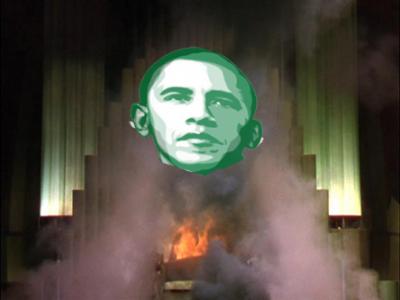
Earlier this month, on a Friday evening after most of the White House press corps had gone home, President Obama gave himself the power to take over, or shut down, all of the nation’s communications systems – including the Internet. The executive order is supposedly designed to preserve “survivable, resilient, enduring” and effective communications so that the government can speak to the people in the event of some emergency. But what he has authorized is the imposition of total silence except for the sound of his own voice.
Clearly, in a legitimate emergency, the government needs ways to communicate – but that does not require a monopoly. So, why is Obama giving himself – and any president that follows him into the Oval Office – a total communications on-and-off switch?
The administration claims it is authorized to bring all communications under its control by the 1934 Communications Act, which allows the takeover of broadcast stations and other wireless media if there exists a state of war, or the threat of war. Back then, of course, the public was fairly sure that they knew what “war” was: Congresses declared it. The “threat” of war was pretty self-evident, too: it was when other nations were threatening to attack the United States, or vice-versa.
However, we are now in what both Presidents Bush and Obama have made clear is a perpetual war, a war that is not defined by any legal norms or foundational statutes, a war against whoever the president decides is the enemy – which can include American citizens. Both of these War Presidents have told us in multitudinous ways that we are on a war footing – and have not been off it since 9/11, and will not be on any other kind of footing until some future president gives the “all clear” sign.
Obama’s executive order has nothing to do with getting out an effective distress call to the nation during a crisis. The “emergency” he has in mind is a State of Emergency – martial law. He is methodically preparing the infrastructure for a police state. Obama already has in place his preventive detention legislation, which he signed into law in the news-less hours of last New Year’s Eve. It empowers the president to lock up whomever he chooses, without charges or trial, and to keep them for as long as the executive sees fit. Based on the near-limitless powers Obama already claims to possess, he can also kill such enemies of the state if that is in the interests of national security in this time of war. There is nothing that he recognizes as law that says he can’t take such drastic executive action against thousands, or tens of thousands of Americans in one sweep.
And now, with his new executive order, if the president finds it convenient, he can take over the national communications network – down to the last, feeble Internet voice – to explain why it was necessary for all those people to disappear.
Or maybe he’ll say nothing at all. And nobody else will dare to say anything, either.
By Tony Cartalucci – New Eastern Outlook – 29.11.2017
The United States Air Force’s 59th Medical Wing’s molecular biology branch recently was revealed to have been collecting specifically Russian RNA and synovial (connective) tissue samples, prompting fears in Russia of a possible US directed ethnic-specific bioweapons program. … continue
This site is provided as a research and reference tool. Although we make every reasonable effort to ensure that the information and data provided at this site are useful, accurate, and current, we cannot guarantee that the information and data provided here will be error-free. By using this site, you assume all responsibility for and risk arising from your use of and reliance upon the contents of this site.
This site and the information available through it do not, and are not intended to constitute legal advice. Should you require legal advice, you should consult your own attorney.
Nothing within this site or linked to by this site constitutes investment advice or medical advice.
Materials accessible from or added to this site by third parties, such as comments posted, are strictly the responsibility of the third party who added such materials or made them accessible and we neither endorse nor undertake to control, monitor, edit or assume responsibility for any such third-party material.
The posting of stories, commentaries, reports, documents and links (embedded or otherwise) on this site does not in any way, shape or form, implied or otherwise, necessarily express or suggest endorsement or support of any of such posted material or parts therein.
The word “alleged” is deemed to occur before the word “fraud.” Since the rule of law still applies. To peasants, at least.
Fair Use
This site contains copyrighted material the use of which has not always been specifically authorized by the copyright owner. We are making such material available in our efforts to advance understanding of environmental, political, human rights, economic, democracy, scientific, and social justice issues, etc. We believe this constitutes a ‘fair use’ of any such copyrighted material as provided for in section 107 of the US Copyright Law. In accordance with Title 17 U.S.C. Section 107, the material on this site is distributed without profit to those who have expressed a prior interest in receiving the included information for research and educational purposes. For more info go to: http://www.law.cornell.edu/uscode/17/107.shtml. If you wish to use copyrighted material from this site for purposes of your own that go beyond ‘fair use’, you must obtain permission from the copyright owner.
DMCA Contact
This is information for anyone that wishes to challenge our “fair use” of copyrighted material.
If you are a legal copyright holder or a designated agent for such and you believe that content residing on or accessible through our website infringes a copyright and falls outside the boundaries of “Fair Use”, please send a notice of infringement by contacting atheonews@gmail.com.
We will respond and take necessary action immediately.
If notice is given of an alleged copyright violation we will act expeditiously to remove or disable access to the material(s) in question.
All 3rd party material posted on this website is copyright the respective owners / authors. Aletho News makes no claim of copyright on such material.


 Aletho News
