Israeli army targets PFLP in dawn raids
Ma’an – 01/12/2011
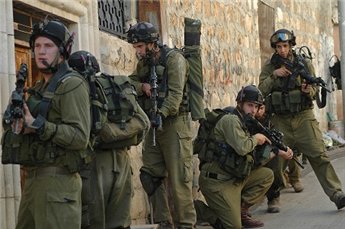
JENIN – Israeli troops detained 22 people in dawn raids across the West Bank on Thursday, including nine leaders of the Popular Front for the Liberation of Palestine.
An Israeli military spokeswoman said 22 people were taken for questioning, including 10 in the northern West Bank city of Jenin.
PFLP officials said a large force of 20 army jeeps raided Jenin and detained nine PFLP leaders. Among them are student union chief Nasser Abu Aziz, 57, local councilor Alam Sami Masad, 45, popular committee member Fada Zgheebe, 46, and his 61-year-old brother Salah Abdullah Zgheebe, a lawyer, as well as Mohammad Abu al-Haija, 35.
Witnesses told Ma’an that Israeli soldiers ransacked homes without regard for women’s privacy, the presence of children or the health of those detained. Abu Aziz is sick and Abu Abu al-Haija is disabled, they added.
The raid was the second operation targeting the leftist faction in the last month. In November, 13 PFLP leaders were detained in Ramallah and Jenin.
Israel ‘bars lawmaker from travel’
Ma’an – 30/11/2011
 RAMALLAH – A Palestinian lawmaker says Israeli authorities barred him from leaving the West Bank on Tuesday evening.
Qays Abdul-Karim, a senior member of the Democratic Front for the Liberation of Palestine, told Ma’an he was at the Allenby Bridge crossing to Jordan with a delegation of parliamentarians heading to a conference in Panama.
“An Israeli officer approached me and asked about my destination. When I told him I was going to Panama to partake in a parliamentarian conference, the officer asked about the content of the speech I will deliver during the conference,” Abdul-Karim said.
“I told him I would call upon the Latin American Parliament to support the Palestinian demand to end Israeli occupation of the Palestinian territory, then he left and came back in a few minutes to inform me I was barred from traveling.”
Abdul-Karim was due to participate in the 27th session of the Latin American parliament which takes place on Thursday.
Indefinite Domestic Military Detentions
By Stephen Lendman | The People’s Voice | November 28th, 2011
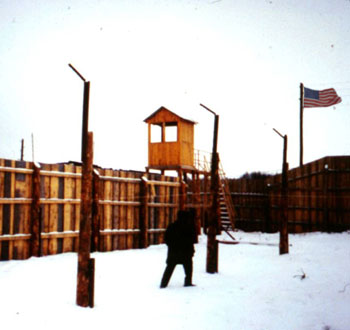 Congress is now considering legislative language to mandate indefinite military detentions of US citizens suspected of present or past associations with alleged terrorist groups, with or without evidence to prove it. More on that below.
The 2006 Military Commissions Act authorized torture and sweeping unconstitutional powers to detain, interrogate, and prosecute alleged suspects and collaborators (including US citizens), hold them (without evidence) indefinitely in military prisons, and deny them habeas and other constitutional protections.
Section 1031 of the FY 2010 Defense Authorization Act contained the 2009 Military Commissions Act (MCA). The phrase “unprivileged enemy belligerent” replaced “unlawful enemy combatant.”
Language changed but not intent or lawlessness. Obama embraces the same Bush agenda, including keeping Guantanamo open after promising to close it, allowing torture there and abroad, and treating US citizens as lawlessly as foreign nationals.
MCA grants sweeping police state powers, including that “no court, justice, or judge shall have jurisdiction to hear or consider any claim or cause for action whatsoever….relating to the prosecution, trial, or judgment of a military commission (including) challenges to the lawfulness of (its) procedures….”
MCA scraped habeas protection (dating back to the 1215 Magna Carta) for domestic and foreign state enemies, citizens and non-citizens alike.
It says “Any person is punishable… who….aids, abets, counsels, commands, or procures,” and in so doing helps a foreign enemy, provide “material support” to alleged terrorist groups, engages in spying, or commits other offenses previously handled in civil courts. No evidence is needed. Those charged are guilty by accusation.
Other key provisions include:
- legalizing torture against anyone, letting the president decide what procedures can be used on his own authority;
- denying detainees international law protection;
- letting the executive interpret or ignore international and US law;
- letting the president convene “military commissions” at his discretion to try anyone he designates an “unprivileged enemy belligerent,” detaining them indefinitely in secret;
- denying speedy trials or none at all;
- letting torture coerced confessions be used as evidence in trial proceedings, despite US and international law prohibiting cruel and inhuman treatment at all times, under all conditions, with no allowed exceptions;
- letting hearsay and secret evidence be used; and
- denying due process and judicial fairness overall.
On May 21, 2009, Obama addressed national security and civil liberties issues, including Guantanamo detainees, military commissions, and torture.
Saying his “single most important responsibility as president is to keep the American people safe,” he bogusly claimed Al Qaeda “is actively planning to attack us again (and) this threat will be with us for a long time….”
He added that uncharged detainees “who cannot be prosecuted yet who pose a clear danger to the American people” (with or without evidence to prove it) will be held indefinitely without trial.
Obama’s March 7, 2011 Executive Order authorized military commission trials for Guantanamo detainees with revamped procedures, despite pledging to close the prison.
Congress Considers New Freedom-Stripping Legislation
On October 17, 2011, the ACLU addressed Section 1031 of S. 1253: National Defense Authorization Act for Fiscal Year 2012, saying it “significantly curtails existing protections against indefinite detention without charge or trial.”
It goes beyond previous laws by hardening them extrajudicially.
The last time Congress authorized indefinite detentions for uncharged US citizens without trial was in 1950. The Emergency Detention Act provision of the Internal Security Act authorized incarceration for those considered likely to commit espionage or sabotage.
It was never used, then repealed by the 1971 Non-Detenton Act, stating:
“No citizen shall be imprisoned or otherwise detained by the United States except pursuant to an Act of Congress.”
At issue was never again subjecting US citizens to lawless internment the way Japanese Americans were treated in 1942, forcing loyal citizens into War Relocation Camps.
Section 1031 of S. 1253 “would be the first exception to the statute’s protections.” Subsection (d) provides US citizens “little or no” indefinite detention protections domestically or abroad.
The provision refers solely to “citizens or lawful resident aliens of the United States.” However, the Constitution fully protects them.
“Section 1031 could cause cleared naturalized United States citizens and cleared immigrants to be sent to a foreign country, even in the absence of any wrongdoing.”
Subsection (c) provides four options:
- indefinite detention without charge;
- military commission trials;
- trial by another tribunal; or
- transfer “to the custody or control of the person’s country of origin, any other foreign country, or any other foreign entity.”
Even someone erroneously arrested and cleared of wrongdoing could be held indefinitely without charge, given non-civil trials, or sent abroad.
Post-9/11, Arab and/or Muslim Americans lawlessly experienced “roundups” because of their faith and ethnicity. Latino immigrants face similar abuse.
Section 1031 would authorize similar practices. Military forces could be used. US citizens would be terrorized, detained and held indefinitely without charge or trial, based solely on suspicions, baseless allegations or none at all.
No reasonable proof is required, just suspicions that those detained pose threats. Under subsection (b)(1), indefinite detentions can follow mere membership or support for suspect organizations.
US citizens at home and abroad could be detained. Presidents would have unchecked authority to arrest, interrogate and indefinitely detain law-abiding citizens if accused of potentially posing a threat.
Constitutional, statute and international law won’t apply. Martial law will replace it. As a result, anyone for any reason or none at all could be indefinitely detained for life without charges or trial.
Section 1031 exceeds the laws of war. Its ambiguities and excesses would institute extrajudicial national security state terror. No one anywhere would be safe.
It calls “covered persons” anyone captured or detained, even unconnected to hostilities. In other words, the executive could order anyone indefinitely incarcerated on his say alone. The provision would exceed current presidential authority.
Like the companion House bill, detention would be authorized based on alleged prior associations with suspect groups. US military personnel anywhere in the world would be able to seize US citizens and others.
Anyone could be incarcerated for life with no possibility for redress. Section 1032 requires suspects held in military custody, outside constitutionally mandated civil protections.
Due process and judicial review won’t apply. Police state lawlessness could terrorize anyone suspected of terrorist group ties without proof.
In other words, presidents could order anyone imprisoned for life without cause. Despotic regimes operate this way. So would America more extrajudicially than ever.
Tyranny will replace constitutional law. Middle of the night arrests could become common. No one anywhere would be safe, including unjustly accused citizens.
The ACLU calls indefinite detention without judicial review “an appalling abuse of power. We know that our government has already mistakenly detained hundreds of people on suspicion of terrorism over the past 10 years.”
“Many have languished in custody for years with no way to even assert their innocence or address the evidence against them. All people are entitled to due process.”
Imagine new likely power abuses, including claiming OWS protesters threaten America.
Imagine human and civil rights workers, as well as anti-war activists targeted.
Imagine anyone challenging wealth and power interests at risk.
Imagine an America more than ever not fit to live in, and nowhere to hide.
Stephen Lendman lives in Chicago and can be reached at lendmanstephen@sbcglobal.net.
Also visit his blog site at sjlendman.blogspot.com
Israeli forces arrest 6 people, mayor of Nablus village
Ma’an – 28/11/2011
NABLUS – Israeli troops detained six people on Monday, including the mayor of a Nablus village, the army and Ma’an’s correspondent said.
Soldiers stormed the Nablus village of Osarin at dawn on Monday, ransacking the home of Mayor Mahir Fawzi Adeli, 39, before arresting him, witnesses told Ma’an.
Israeli troops also detained Diyaa Omar Adeli, 16, his brother Fadil, 15, Azzam Rasmi Adeli, 20 and Muhammad Raslan Adeli, 17.
Locals said that several other homes were ransacked and that the five detainees were taken to Huwwara military base near Nablus.
One man was also detained in the Jenin village of Jaba.
An Israeli army spokeswoman said that the men were taken for security questioning.
Israel Passes Bill To Increase “Libel” Compensation
Peace Now Slams The Bill As Anti-Free speech Legislation
By Saed Bannoura | IMEMC & Agencies | November 24, 2011
Israeli sources reported, that the Israeli Knesset passed, in the first reading, a controversial bill dubbed as “libel law” aiming at increasing compensation paid for “libel violations” to NIS 300,000. Israeli Peace Now Movement stated that the bill is a legislation targeting Free Speech in Israel.
The bill is considered an amendment to the Israeli Libel Law, and was passed in the first reading, by 42 to 31 votes by the Israeli Knesset, Israeli Ynet News reported.
Ynet added that Israeli Prime Minister, Benjamin Netanyahu, Defense Minister, Ehud Barak, Member of Knesset (MK), Meir Sheetrit of Kadima party, Trade and Labor Minister, Shalom Simhon, MK Yariv Levin (Likud) and Zevulun Orlev of the Jewish Home Party, voted for the bill.
The Ynet stated that the law calls for increasing the maximum amount of compensation paid by those convicted of “libel violations” by paying the subject of “slander” 300,000 New Israeli Shekels, which at current conversion rates amounts to approximately $80,000. The amount is six times the current amount of libel compensation allowed by current libel laws in Israel.
Also, the bill states that when it comes to statements that are considered libel, released internationally, without giving the subject/s of the claims the chance to defend themselves and to be able to respond to the claims, the offenders can be sued and could be ordered to pay damages that can be as high as 1.5 Million New Israeli Shekels, or approximately $400,000.
MK Zevulun Orlev of the Jewish Home Party, one of the initiators of this bill, stated that he might vote against it in the second reading if it was not revised, explaining that people convicted of murder in Israel are not subject to such high fines.
Orlev said that the way the bill is worded shows a lack of balance when it comes to the protection of free speech and independent media agencies.
Meanwhile, MK Uri Orbach, also from the Jewish Home Party, opposed the bill and stated that it will be an issue of personal profit to MK’s, ministers and officials.
He added that with the high fines, this bill is calling for a person to “prefer to kill than to slander”.
Furthermore, Hadash Party member, MK Dov Hanin, strongly denounced the bill for being “an extreme punishment for publishing a statement that did no harm”.
Hanin added that “this law is suggesting that Israel does what regimes that are barbaric do to punish libel by cutting the tongue of the offender”, the Ynet reported.
Israeli Peace Now Movement stated that the bill is “another crazy anti free speech legislation passed by the Israeli Knesset”.
Peace Now added that “This time the ‘Libel Law’ will completely destroy investigative reporting and exposure of wrong doings by those in power and those with powerful means in Israel”.
Back to Tahrir Square
By ESAM AL-AMIN | CounterPunch | November 24, 2011
When former Vice President (and intelligence chief) Omar Suleiman announced on state television last February 11the transfer of power from Hosni Mubarak to the Supreme Council of the Armed Forces (SCAF), millions of Egyptians began celebrating in the streets the culmination of their revolution that rid them of their dictator. The demonstrators’ chant then was “the people and the army are one.” Indeed, the role of SCAF in refusing to crack down on protestors and forcing the resignation of Mubarak proved decisive in the three-week revolt.
Nine months later, hundreds of thousands of Egyptians are back in Tahrir Square and streets across the country. Ironically, their chant is now “The police and the army are one,” in a clear rejection of the violent tactics employed by the police against the demonstrators. In three days of confrontation since November 20 at least forty people were killed and more than 2,000 injured at the hands of the security forces. But this time the Egyptian youth will not pack up and go home. They are determined to reclaim their revolution and force the transfer of power from the military to a real civilian government.
But how did we get from there to here?
Shortly after Mubarak was deposed, SCAF promised to stay in power no longer than six months. It subsequently called for a popular referendum on March 19 that called for parliamentary elections, followed by writing a new constitution, and then presidential elections. Championed by the Muslim Brotherhood (MB) and other Islamic factions, the public approved the referendum with an overwhelming majority of 77 per cent, although secular parties wanted to first draft the constitution for the fear that Islamic parties would have an edge over them after the elections.
During this brief campaign it became clear to all political trends that the Islamically oriented parties, led by the MB, are better organized, well financed, and have the abilities and skills to mobilize the public to their cause. This fact prompted fear and panic not only from the secular, leftist, and liberal parties within Egypt but also from other Western powers led by the United States.
Furthermore, the traditional secular and liberal parties expressed their concern that if the elections were held soon, the Islamists were poised to win a large share of seats and dictate a new constitution that might curtail some freedoms or favor the application of Islamic laws. Despite the pronouncement by most Islamic parties, including the Freedom and Justice Party, the political arm of the MB, that the constitution writing committee would include all political parties and trends, most secular parties did not believe such assurances.
Throughout the summer most secular and liberal parties pressured SCAF to issue a decree that would impose supra-constitutional principles and thus foist them on the future parliament. The opponents of this argued that, on its face, this practice is undemocratic, usurps the rights of the people, and tramples upon their right to express their free will. They also argue that it is unnecessary since all parties have agreed on the nature of the state, namely to be a democratic and civil one.
Nevertheless, the proponents of this approach pushed hard to impose their vision. Consequently, Deputy Prime Minister Ali Al-Silmi, backed by SCAF, called for a conference of all political parties to approve his plan for the future constitution. But remarkably this document also called for a special constitutional privilege for the military, effectively according it a sovereign status. In effect, it called for its budget to be outside the purview of parliament and for a veto power over any strategic decision by the government. In short, it was similar to the role that the Turkish military played in the country since the military coup of 1960 until Prime Minister Erdogan’s Justice and Development Party was elected in 2002.
The rejection of Al-Silmi’s proposed document was swift and sweeping not only in principle by the Islamic parties, but also from other nationalist and secular parties because of its tilt towards the military. It was a disguised effort to keep the military outside the control and supervision of the future democratic institutions of the state.
But this was the latest episode of SCAF’s many attempts to manipulate the future course of Egypt. Since the very beginning it has been laggard in implementing the objectives of the revolution. The despised emergency laws were never repealed. While changing the name of the security apparatus, much of its senior personnel and tactics were retained. Over 12,000 civilians were charged and tried swiftly in military trials facing harsh sentences, while the most corrupt leaders of the Mubarak regime – including the deposed president and his sons- have been tried grudgingly in slow civilian courts.
Moreover, none of the reforms announced by SCAF came out of its own initiative. It either reluctantly adhered to final court rulings by the judiciary, or yielded to the demands of the people, built up over many weeks, eventually culminating in large demonstrations and sit-ins. To wit:
The sacking of Mubarak’s cabinet in favor of a new government supported by the people. The banning of Mubarak’s corrupt party and confiscating its assets. The dismissal of thousands of corrupt officials from local councils. The trial of senior leaders and ministers of the deposed regime. The opening of the Rafah crossing to ease the blockade on Gaza. Setting definite election dates after many delays. Changing elections laws to include parties’ list as well as individual candidates. Allowing expatriate citizens to vote outside of Egypt. Pointedly, none of these demands, as well as many others, were met without taking the matter to the streets. Often times, their decisions were too little too late, or with ineffective or inconsequential results.
For instance, all political parties have been calling for the activation of a law that bans from politics all individuals who were previously engaged in political corruption- effectively excluding all Mubarak’s Nationalist Democratic Party (NDP) officials. But SCAF dragged its feet for months while hundreds of those same NDP officials filed to contest the elections next week either as independents or as part of the lists of six new parties tied to the old regime. Ultimately, this past Monday, just one week before the elections, SCAF issued the Political Corruption Law that would make it almost impossible to impeach any candidate since they have to be disqualified only through the slow Egyptian judiciary.
Meanwhile, SCAF has been vulnerable to the tremendous pressures applied by foreign governments for different motives. Some Arab governments led by Saudi Arabia, Kuwait, and the U.A.E. used their financial leverage to bail out the deposed president by halting or slowing down his trial because of their strong ties to him. In addition, the U.S. and other Western countries insisted that SCAF give specific assurances regarding Western and Israeli interests, as well as secure certain concessions from the political Islamic parties. For example, under U.S. prodding, SCAF demanded and received assurance from the MB in late April that the group would not contest future presidential elections.
By June, SCAF was demanding that the group not advance one of its own to the position of Prime Minister, even if it won the elections. In August, the MB was told yet again that in any future government it should not push for senior posts such as foreign or interior ministries so as not to antagonize the West. While the group reluctantly agreed not to contest the posts of head of state or government, it was extremely dismayed and refused to adhere to further restrictions on its participation in politics.
Last July, the U.S. House Appropriations Committee earmarked $1.55 billion to Egypt on the condition that such aid should in part be used for “border security programs and activities in the Sinai” in order to insure Israel’s security concerns. It also directed that Secretary of State Hillary Clinton certifies the humiliating demand that the Government of Egypt (supposedly democratically elected) “is not controlled by a foreign terrorist organization, or its affiliates or supporters, is implementing the Egypt-Israel Peace Treaty, and is taking steps to detect and destroy the smuggling network and tunnels between Egypt and the Gaza strip.” Thus, when the Egyptian authorities acceded in late May to the demand by the Egyptian public to open the Rafah crossing and ease the blockade on Gaza, the crossing was closed again within just three days, due to U.S. and Israeli pressure. The status of the Rafah crossing is not currently very different from the Mubarak era.
By late September, SCAF finally set the parliamentary elections date for November 28. But it called for a staggered elections process to be implemented over three stages for the lower house as well as two stages for the upper house, effectively ending the elections process in March 2012. Many political parties and pro-democracy movements voiced their concerns that within such a system (with the banning of international elections monitors), the elections could be manipulated, especially when the same interior ministry (packed by Mubarak’s appointees) would supervise major parts of the electoral process.
To secure free and fair elections, SCAF started tacitly requesting concessions from the major political parties, especially the MB and other Islamically oriented parties. In return for their support of Al-Silmi’s supra-constitutional principles, SCAF pledged to guarantee free and fair parliamentary elections. But the MB and other Salafist parties refused even to show up to discuss the document. Meanwhile, other pro-democracy liberal and youth groups were extremely concerned about the extra constitutional powers given to the military in that document. Fearing the attempted power grab, most political parties and movements were actually united in their rejection, and called for a million-man demonstration in Tahrir square on Friday, November 18, insisting on the restoration of the objectives of the revolution. Recalling the early days of the revolution, hundreds of thousands of people gathered that afternoon not only in Tahrir, but also in other major cities including Alexandria, Suez, and across the Nile Delta.
After the impressive showing by all political factions: Islamic, secular, liberal, leftist, and youth groups, SCAF had no option but to withdraw the document. By Saturday, a few thousand activists from the youth movements that actually ignited the revolution last January, decided to stay in Tahrir square and stage a sit-in to demand the dismissal of the ineffective SCAF-controlled government, headed by Dr. Esam Sharaf since March, and call for the end of military rule.
That evening, for reasons that remain unclear, the security forces decided to evacuate the few thousand demonstrators by force. In doing so, they employed all the Mubarak-era tactics: teargas, rubber bullets, clubs, beatings, mass arrests, pepper spray, and physical and verbal humiliations. But the demonstrators refused to evacuate, fought back, and called for reinforcements after suffering many casualties. Within hours, Tahrir was again filled with tens of thousands of people raising their demands yet again.
If there was a lesson to be learned from the ousting of Mubarak, it was that when the people’s demands are denied, the ceiling of their demands are raised. By the third day of this manufactured confrontation, most political groups, with the exception of the MB, were not only protesting in Tahrir Square, but also across Egypt. The angry demonstrators now demanded the complete dismissal of the government, and the ouster of the military council to be replaced with an interim civilian presidential council.
The MB announced that although it supported the demands of the people it would not participate so as not to escalate the dangerous situation with the security forces. In its pragmatic calculation, the MB saw this latest episode as a deliberate attempt by the military to use the induced violence to postpone yet again the elections, which many believed the party would win. Similar to the agreement the MB struck with Suleiman in the days before Mubarak’s ouster, once again the MB thought of its immediate gains rather than the national consensus to force the end of military rule. As it reversed its decision last February within two days due to pressure from the streets, many of its members and supporters in the streets are openly demanding that they participate alongside the other young revolutionaries.
By Tuesday, November 22, SCAF head Field Marshal Hussein Tantawi and Chief-of-Staff Gen. Sami Anan, met with all political parties and prospective presidential candidates. After a five-hour marathon meeting, SCAF capitulated, and agreed to all the demands: To declare an immediate cease-fire; to release thousands of protesters that have been detained since Saturday; to treat all the injured and provide compensations to the families of the deceased; and to bring to justice all those responsible for the violence. On the political demands they further agreed to dismiss the government of Dr. Sharaf and appoint a national-unity government; to hold the elections on time starting next week; to guarantee free and fair elections; and to give a definite date for the transfer to civilian rule by holding presidential elections no later than June 30, 2012.
When Tantawi delivered his speech that evening by promising a new government, keeping the elections date intact, and the end of military rule by next June, people in Tahrir were no longer satisfied. They kept shouting, “You leave, we’re staying,” the same chant that eventually caught up with Mubarak.
The immediate problem now is the total lack of trust between the people in the streets and the military council. The people are tired of the cat and mouse game played by SCAF, where every major demand is only conceded through much struggle. Although it is true that SCAF was instrumental in accelerating the ouster of Mubarak, it is also now quite clear to the revolutionaries that SCAF has had a different agenda that oftentimes conflicts with the objectives of their revolution.
Now the revolutionaries have vowed to stay in Tahrir until SCAF cedes effective power long before next year to a new civilian national-unity government empowered to supervise the elections, supervise the writing of the constitution, and implement all their objectives without any interference or dictation by the military.
Esam Al-Amin can be reached at alamin1919@gmail.com
FBI Sanctioned for Lying About Existence of Surveillance Records
By Jennifer Lynch | Electronic Frontier Foundation | November 21, 2011
An order from the U.S. District Court for the Central District of California has revealed the FBI lied to the court about the existence of records requested under the Freedom of Information Act (FOIA), taking the position that FOIA allows it to withhold information from the court whenever it thinks this is in the interest of national security. Using the strongest possible language, the court disagreed: “The Government cannot, under any circumstance, affirmatively mislead the Court.” Islamic Shura Council of S. Cal. v. FBI (“Shura Council I”), No. 07-1088, 3 (C.D. Cal. April 27, 2011) (emphasis added).
This case may prove relevant in EFF’s ongoing FOIA litigation against the FBI. As discussed further below, one of the issues in Shura Council was the FBI’s extensive and improper use of “outside the scope” redactions. The agency has also used these heavily in at least one of our current cases — in areas where it is highly unlikely the material blocked out is actually outside the scope of our FOIA request. (see example to the left from our case seeking records on the government’s push to expand federal surveillance laws). We’ll be writing more about that case in the coming weeks and posting the documents we received on this site soon.
Shura Council started five years ago in May 2006, after widespread reporting on the FBI’s programs targeting Muslims after September 11, 2001. At that time, several Muslim citizens and organizations in Southern California, including the Islamic Shura Council of Southern California and the Council on American Islamic Relations (CAIR), submitted a broad joint FOIA request to the FBI seeking “[a]ny records relating or referring” to themselves, “including . . . records that document any collection of information about monitoring, surveillance, observation, questioning, interrogation, investigation and/or infiltration[.]” Shura Council I at 4.
In 2008, after the FBI produced only minimal records, the requesters filed a federal lawsuit. The FBI then searched for and located additional records for nine of the plaintiffs, but these records were heavily redacted, with much of the information withheld as “outside the scope” of the plaintiffs’ FOIA request. The FBI attested, in documents and declarations it submitted under oath to the court, that these were all the records that existed about the plaintiffs and that the materials labeled “outside the scope” were “not responsive” to the plaintiffs’ FOIA request.
After court ordered the FBI to submit full versions of the records in camera, along with a new declaration about the agency’s search, the FBI revealed for the first time that it had materially and fundamentally mislead the court in its earlier filings. The unaltered versions of the documents showed that the information the agency had withheld as “outside the scope” was actually well within the scope of the plaintiffs’ FOIA request. The government also admitted it had a large number of additional responsive documents that it hadn’t told the plaintiffs or the court about. Id. at 7-8.
If these revelations weren’t bad enough, the FBI also argued FOIA allows it to mislead the court where it believes revealing information would “compromise national security.” Id. at 9. The FBI also argued, that “its initial representations to the Court were not technically false” because although the information might have been “factually” responsive to the plaintiffs’ FOIA request, it was “legally nonresponsive.” Id. at 9, n. 4 (emphasis added).
The court noted, this “argument is indefensible,” id. at 9-10, and held, “the FOIA does not permit the government to withhold responsive information from the court.” (Id.)(upheld on appeal in Islamic Shura Council of S. Cal. v. FBI, __ F.3d __, No. 09-56035, at 4280-81 (9th Cir. Mar. 30, 2011) (“Shura Council II”).1 The court stated:
The Government argues that there are times when the interests of national security require the Government to mislead the Court. The Court strongly disagrees. The Government’s duty of honesty to the Court can never be excused, no matter what the circumstance. The Court is charged with the humbling task of defending the Constitution and ensuring that the Government does not falsely accuse people, needlessly invade their privacy or wrongfully deprive them of their liberty. The Court simply cannot perform this important task if the Government lies to it. Deception perverts justice. Truth always promotes it.
(Shura Council I at 17) (emphasis added). This is an important opinion for FOIA requesters because sometimes the only protection a FOIA requester has from the government’s potentially arbitrary withholding of information is a court’s in camera review of the full versions of documents. If the government were allowed to withhold information from the court, this protection would be meaningless and the role of judicial oversight in FOIA cases would be compromised.
Unfortunately for the plaintiffs in Shura Council, this seems to be a hollow victory. Although the court did not restrain itself from using the strongest possible language to criticize the government’s actions (calling the FBI’s arguments “untenable,” id. at 3, “indefensible,” id. at 10, and “not credible” id. at 17) it also held that “disclosing the number and nature of the documents the Government possesses could reasonably be expected to compromise national security.” Id. 18. Therefore it did not order the government to release the records to the plaintiffs or even to reveal how many records turned up in the second search. And on appeal, the Ninth Circuit held that neither the plaintiffs nor their attorneys had the right to see the original version of the district court’s order (filed under seal) because it contained information the FBI considered to be “national security and sensitive law enforcement information.” (Shura Council II at 4286).
It seems unlikely that, five years after the plaintiffs filed their FOIA request, the release of the information the FBI has on these individuals and organizations would truly threaten national security or an ongoing criminal investigation. None of the plaintiffs appears to have been arrested or retained in conjunction with a crime or foreign terrorist plot, so it seems more likely that this is yet another example of the government valuing secrecy over transparency.
The district court’s April 27, 2011 order after remand is here, and the Ninth Circuit opinion remanding the case is here.
UPDATE (November 21, 2011): In a later opinion, the district court sanctioned the government for lying. In issuing monetary sanctions against the DOJ, the court held, “the Government’s deception of the Court was without any factual or legal basis and simply wrong.” (p. 19). The court noted issuing sanctions was necessary to “deter the Government from deceiving the Court again.” (p. 2). Unfortunately, it’s not clear this practice will end any time soon. The DOJ has been attempting to change its FOIA regulations to codify the procedures it used in this case. As the court noted, even though the proposed changes were withdrawn, “the deceptive policy and practice of the DOJ with respect to asserting and applying exclusions under FOIA apparently remains intact.” (p. 19).
- 1. This case has a convoluted procedural history. When the district court discovered the FBI’s lies it issued an order under seal on June 23, 2009 and told the parties it would unseal the order on July 7, 2009 unless further directed by the Ninth Circuit Court of Appeals. The government immediately appealed, and the Ninth Circuit issued a stay of the district court’s ruling until it could hear the case. On March 30, 2011, the Ninth Circuit issued its opinion in Islamic Shura Council of S. Cal. v. FBI, __ F.3d __, No. 09-56035 (9th Cir. Mar. 30, 2011), vacating the district court’s sealed order and remanding to the district court to revise its order to eliminate statements the government had designated as national security and sensitive law enforcement information. On April 27, 2011, the district court issued its revised order.
Attached Documents

Israeli Soldiers Arrest Eight PFLP Members In Jenin
By Saed Bannoura | IMEMC & Agencies | November 22, 2011

Israeli soldiers invaded the northern West Bank city of Jenin and the surrounding areas at dawn on Tuesday, and arrested eight members of the leftist Popular Front for the Liberation of Palestine (PFLP).
Local sources reported that the army invaded the city and Jenin refugee camp, before breaking into and searching several homes. Sofian Esteity – who only just recently had heart surgery one month ago- Moayyad Al Amer, Jamal Az Zobeidy, Ja’far Abu Salah, Fadi Daoud, Joseph Eseeed, and Majed Noeirat were all arrested. Jenin City Council member, Mohammad Mansour, was also taken during the early morning raid.
Palestinian security sources stated that Israeli soldiers detonated small explosives on the doors during the incursion, causing damage to the properties, and spreading panic among the local residents.
Furthermore, troops also launched operations in the nearby towns and villages of Ya’bod, Sanour, Jaba’, Mothallath Al Shuada’ and Beer Al Basha.
Dozens of soldiers were deployed in the area and at the entrances to the villages and towns, and also installed a number of temporary roadblocks.
Note to Media: The UC Davis “Investigation” is not the Story
By Angus Johnston | Student Activism | November 20, 2011
The UC Davis story has gone global overnight. Here’s a taste of the morning papers:
- New York Times: UC Davis Calls for Investigation After Pepper Spraying
- BBC News: US University Investigates Campus Pepper Spray Use
- Washington Post: Investigation, Calls for Resignation Follow Spread of Calif. University Pepper Spray Video
- CNN: California University to Investigate Police Use of Pepper Spray
- Los Angeles Times: UC Davis Chief Launches Probe Into Pepper-Spraying of Occupy Protesters
But see what they all did here? They all led with Linda Katehi’s promised investigation of the incident, which she announced in a statement yesterday:
I am forming a task force made of faculty, students and staff to review the events and provide to me a thorough report within 90 days. As part of this, a process will be designed that allows members of the community to express their views on this matter. This report will help inform our policies and processes within the university administration and the Police Department to help us avoid similar outcomes in the future.
That’s it. That’s the entirety of the relevant portion of the statement. No word on how the task force will be constituted, what its composition will be, how its student and faculty members will be chosen. No hint that it will have any actual policymaking authority. And it’s got 90 days before it’s expected to report — does anyone really think that this situation is going to stay static until mid-February? Does anyone think that the release of this report is going to be a major event?
Come on.
I get why the press is going with this angle for their ledes. It sounds like a big deal. It sounds serious, momentous. And it’s something you can report without seeming to take sides. An investigation! A report! That’s just the thing to get to the bottom of this situation!
But here’s the thing. We’ve already gotten to the bottom of the situation. We know what happened. UC Davis police used unwarranted force on a group of peaceful student demonstrators in violation of university policy, and then top university officials lied about why. That’s the story. That’s the situation. If the task force reports that, they’ll be telling us all what we already know. If they don’t, they’ll be engaging in an act of utterly pointless misrepresentation.
A lot of important stuff happened yesterday. New videos emerged that helped to prove the university’s original cover story false. Katehi was asked to resign, by multiple people in multiple venues, and gave a series of not particularly forceful responses. University officials gave a press conference at which reporters greeted their continuing attempts to justify Friday’s violence with barely concealed scorn. And then Katehi hid from a peaceful crowd for two hours before emerging to slink back to her car in silence and shame.
All that stuff happened. And any of if would make a great lede.
Ten Things You Should Know About Friday’s UC Davis Police Violence
By Angus Johnston | Student Activism | November 20, 2011
1. The protest at which UC Davis police officers used pepper spray and batons against unresisting demonstrators was an entirely nonviolent one.
None of the arrests at UC Davis in the current wave of activism have been for violent offenses. Indeed, as the New York Times reported this morning, the university’s administration has “reported no instances of violence by any protesters.” Not one.
2. The unauthorized tent encampment was dismantled before the pepper spraying began.
Students had set up tents on campus on Thursday, and the administration had allowed them to stay up overnight. When campus police ordered students to take the tents down on Friday afternoon, however, most complied. The remainder of the tents were quickly removed by police without incident before the pepper spray incident.
3. Students did not restrict the movement of police at any time during the demonstration.
After police made a handful of arrests in the course of taking down the students’ tents, some of the remaining demonstrators formed a wide seated circle around the officers and arrestees.
UC Davis police chief Annette Spicuzza has claimed that officers were unable to leave that circle: “There was no way out,” she told the Sacramento Bee. “They were cutting the officers off from their support. It’s a very volatile situation.” But multiple videos clearly show that the seated students made no effort to impede the officers’ movement. Indeed, Lt. Pike, who initiated the pepper spraying of the group, was inside the circle moments earlier. To position himself to spray, he simply stepped over the line.
4. Lt. Pike was not in fear for his safety when he sprayed the students.
Chief Spicuzza told reporters on Thursday that her officers had been concerned for their safety when they began spraying. But again, multiple videos show this claim to be groundless.
The most widely distributed video of the incident (viewed, as I write this, by nearly 700,000 people on YouTube) begins just moments before Lt. Pike begain spraying, but another video, which starts a few minutes earlier, shows Pike chatting amiably with one activist, even patting him casually on the back.
The pat on the back occurs just two minutes and nineteen seconds before Pike pepper sprayed the student he had just been chatting with and all of his friends.
5. University of California Police are not authorized to use pepper spray except in circumstances in which it is necessary to prevent physical injury to themselves or others.
From the University of California’s Universitywide Police Policies and Administrative Procedures: “Chemical agents are weapons used to minimize the potential for injury to officers, offenders, or other persons. They should only be used in situations where such force reasonably appears justified and necessary.”
6. UC police are not authorized to use physical force except to control violent offenders or keep suspects from escaping.
Another quote from the UC’s policing policy: “Arrestees and suspects shall be treated in a humane manner … they shall not be subject to physical force except as required to subdue violence or ensure detention. No officer shall strike an arrestee or suspect except in self-defense, to prevent an escape, or to prevent injury to another person.”
7. The UC Davis Police made no effort to remove the student demonstrators from the walkway peacefully before using pepper spray against them.
One video of the pepper-spray incident shows a group of officers moving in to remove the students from the walkway. Just as one of them reaches down to pick up a female student who was leaning against a friend, however, Lt. Pike waves the group back, clearing a space for him to use pepper spray without risk of accidentally spraying his colleagues.
8. Use of pepper spray and other physical force continued after the students’ minimal obstruction of the area around the police ended.
The line of seated students had begun to break up no more than eight seconds after Lt. Pike began spraying. The spraying continued, however, and officers soon began using batons and other physical force against the now-incapacitated group.
9. Even after police began using unprovoked and unlawful violence against the students, they remained peaceful.
Multiple videos show the aftermath of the initial pepper spraying and the physical violence that followed. In none of them do any of the assaulted students or any of the onlookers strike any of the officers who are attacking them and their friends.
10. The students’ commitment to nonviolence extended to their use of language.
At one point on Thursday afternoon, before the police attack on the demonstration, a few activists started a chant of “From Davis to Greece, fuck the police.” They were quickly hushed by fellow demonstrators who urged them to “keep it nonviolent! Keep it peaceful!”
Their chant was replaced by one of “you use weapons, we use our voice.”
Six and a half minutes later, the entire group was pepper sprayed.
If you’d like to stay in the loop as I continue to cover this story, feel free to follow me on Twitter.
Featured Video

John Mearsheimer Talking Iran with Iran
or go to
Aletho News Archives – Video-Images
New Book
The silver that medicine dropped — four thousand years of clinical use, four decades to erase.
Colloidal Silver — First Edition, 2026, Paperback
Lies are Unbekoming | October 16, 2026
Silver was medicine. Not alternative medicine. Not folk medicine. Medicine. In surgery. In obstetrics. In the burn ward. In water treatment. In the household medicine chest. Every physician before 1938 knew this.
By the 1870s, silver nitrate was standard in surgical wound care across the leading hospitals of Britain, Germany, and the United States. Colloidal silver preparations — Collargol, Argyrol, Protargol — entered European and American practice through the 1890s and early 1900s and became standard antiseptics in military field medicine. By the time Fleming grew his first penicillin mould in 1928, silver was the first-line antimicrobial of the Western pharmacopoeia. The Lancet and the British Medical Journal carried the clinical reports in volume. The practice ran continuously through the Victorian era, the Edwardian era, the First World War, the interwar period. By 1980, almost all of it was gone.
What has not been treated at book length, until now, is how a four-thousand-year clinical record disappeared from mainstream medicine within four decades of the Flexner Report — and what the honest account of silver looks like once that record is reassembled.
Colloidal Silver reconstructs the pre-1938 record from The Lancet, the British Medical Journal, and the primary literature of the era; recovers Robert Becker’s bioelectric framework from the regeneration research the pharmaceutical model buried; and places silver inside a practical terrain-paradigm guide to its current place — in water, on the body, inside the body, and in the chronic conditions where antibiotics have failed. … continue
Blog Roll
 Aletho News
- John Mearsheimer Talking Iran with Iran
- Inside Bill C-22, Canada’s Patriot Act.
- China’s FM: Palestinian cause is ‘greatest injustice of the century’
- US sympathy for Palestinians surpasses support for Israelis
- Israeli rabbi permits occupiers to steal Palestinian olive harvest in West Bank
- Spanish firm sells Latvia vehicles equipped with Israeli tech despite arms embargo
- Saudi Arabia under fire… Yemen is burning down the House of Saud
- Israeli Spy Pollard stole the files, today’s it’s delivered through official channels
- Why Iran Didn’t Walk Away
- US arms supplied to Ukraine found in war-torn Sudan – Moscow
- If Americans Knew
- NPR investigation finds evidence of widespread fraud at mall kiosks tied to Israeli skincare brand
- Tucker Carlson exposes Israeli Lies about the Oct 7th attack, Charlie Kirk, and the U.S.
- Israel has detained thousands of Palestinian children since Oct 7th – over half spent time in solitary, many uncharged
- Israeli Analysis: Is Netanyahu Planning an ‘October Surprise’ Attack Before Israel’s Election?
- Israeli settlers brutally attack Palestinians and Washington Post female photographer, 65
- Words Have Changed, Occupation Continues: The Reality of the Gaza Ceasefire
- Gaza’s child amputees are growing faster than their prosthetics allow
- Israel keeps Palestinians struggling just to survive–Daily Update
- Israeli firm used online ads to run vast spy operation, researchers say
- No, the world zionist movement is not an antisemitic conspiracy theory
- No Tricks Zone
- New Study Suggests Large Regions Of The Pacific Ocean Have Been Cooling For The Last 80 Years
- Germany’s Green Energy Debacle: High Energy Costs Force Kahla Porzellan to Close After 182 Years!
- New Study: 50 Years Of The Most Aggressive ‘Net Zero’ Policies Can Only Affect The Global Climate By 0.03°C
- US September “Heat” Was No Record…Many Records Set Decades Ago
- Latest European Green Energy Debacle; Portugal’s Largest Flagship Solar Park Insolvent!
- Green Energy Debacle: German Expert Professor Fritz Vahrenholt Warns Of Severe Economic And Social Consequences
- Two More Paleo Reconstructions Affirm Meters-Higher Sea Levels Across Ireland, Brazil 7000-6000 Years Ago
- New Study: Earth And Venus Surface Warmth Largely Explained By Convection And Lapse Rate, Not CO2 Or Radiation
- 2025 Nature Paper Claiming Worsening Global Drought Gets RETRACTED …Heavily Flawed
- New Study: ‘Global Drought Shows No Detectable Recent Acceleration Under Climate Warming’

