Israeli Soldiers Kidnap Nine, Including Two Women In Nablus
By Saed Bannoura – IMEMC & Agencies – July 15, 2010
Israeli soldiers conducted an arrest campaign targeting leaders and members of the leftist Popular Front for the Liberation of Palestine (PFLP), and kidnapped nine residents, including two women, in Beit Forik Village, near the northern West Bank city of Nablus.
Myassar Etyani, a Palestinian woman active in detainee affairs, stated that the soldiers invaded the village around 2 a.m. and broke into several homes.
The soldiers broke into the home of Abu Ghlamay and kidnapped Ayman Abu Ghalamy who was released from an Israeli detention camp a month ago after spending 4.5 years in Israeli prisons. Soldiers also confiscated the I.D. card of his father.
The soldiers also kidnapped Laith Mofeed Abu Ghalamy in addition to former female detainees Linan Yousef Abu Ghalamy and her sister Taghreed.
Etyani added that the army also kidnapped Sajed Abdul-Latif Mleitat, his brother Mos’ab, Hani Abu Al Saoud, and Hamada Hanani. Soldiers confiscated laptops and mobile phones.
Etyani said that Linan was released from an Israeli detention facility on October of 2009 as part of an agreement that was meant to reach a prisoner-swap deal that would ensure the release of prisoner-of-war, Gilad Shalit.
Linan is the widow of Amjad Mleitat who was assassinated by Israel in 2004. He was a senior member of the Abu Ali Mustafa Brigade, the armed wing of the PFLP.
Linan and Taghreed are the sisters of Ahed Abu Ghalamy who is serving life-term in Israeli prisons, while Ayman and Laith are his nephews.
US university suspends Muslim student group for Palestine protest
Brian Napoletano, The Electronic Intifada, 14 July 2010
In response to intense political pressure by multiple pro-Zionist organizations, the administration at the University of California, Irvine (UCI) recently decided to suspend Muslim students’ right to assemble and practice their faith together on campus. Alleging that emails anonymously “leaked” to the university prove that the Muslim Student Union was responsible for a protest of Israeli Ambassador Michael Oren’s campus appearance by eight UCI students, the administration plans to suspend the more than 250-member Muslim Student Union for a year beginning in September, and place it under intense scrutiny and disciplinary probation if the student group is allowed to re-apply for recognition in the fall of 2011.
The student group is appealing this ban, contending that the MSU did not sponsor the protest, and that the students arrested for interrupting Oren’s speech were acting as individuals. Members have also challenged UCI’s decision to impose what their attorney Reem Salahi has described as “nothing but collective punishment” by suspending the entire group over a political protest.
Pointing to sustained efforts by powerful organizations like the Anti-Defamation League and the Zionist Organization of America, many are contending that UCI is allowing outside organizations to decide how it treats its students. Many of these organizations have publicly described their role in pushing the administration to suspend the student group, and have announced their intentions to undertake similar efforts on other campuses where students are organizing in defense of Palestinian rights.
While delivering a presentation on US-Israeli relations in February, Oren was interrupted several times by students who were outraged by his disregard for human rights and his attacks on the UN-commissioned Goldstone report. As a previous military spokesman for Israel, Oren defended Israel’s 2006 invasions of Lebanon and Gaza, its winter 2008-09 attack on Gaza, and touted his own role as a paratrooper during Israel’s 1982 invasion of Lebanon in the mainstream media. Although Oren eventually finished his presentation, the university had the 11 students who interrupted him arrested (eight were from UCI, three were from UC Riverside), and the eight UCI students were subsequently brought before the University Office of Judicial Affairs, which informed them that they may face criminal charges in addition to any other punishments the university decides to impose. Although they are all members of the MSU, the students maintained that the protest was not a MSU activity, and that they were acting as individuals (“11 Arrested for Disrupting Israeli Ambassador,” The Orange County Register, 8 February 2010).
The university publicly condemned the students who protested and, in response to demands from the Jewish Federation Orange County (JFOC) and other organizations initiated a Student Judiciary Review of the MSU. While this review was underway, someone anonymously delivered a collection of emails and other documents to the JFOC, the Investigative Project on Terrorism and the UCI that they claimed to have hacked from the MSU’s email account.
Despite its highly-suspect nature and unknown source, Lisa Cornish, head of the Judiciary Review and Senior Executive Director of Student Housing, based her findings almost exclusively on this “evidence” when she concluded that the MSU had violated parts of the Code of Conduct by “plan[ning] every detail of the disruptions” and then “covering up” its involvement by claiming that the protests were not an MSU activity. In her 27 May letter to the students, Cornish said that she planned to have the group’s recognition revoked on 1 September, require the members to complete fifty hours of community service, and have the group placed on disciplinary probation for an additional year if it was permitted to re-register in the fall of 2011 (“Letter to Muslim Student Union Officers” [PDF]). She did not, however, comment on whether the university planned to file criminal charges against the eight students who were actually responsible for the protests.
In light of these possible criminal charges, MSU’s attorney Salahi was unable to discuss the alleged evidence in detail. However, she maintained that the protesters were not acting on behalf of the MSU. She also said that much of the evidence presented was deeply flawed, and that the university’s punishment was entirely inappropriate, arguing that “all Muslim students on campus have been punished for the actions of a few.”
Salahi also pointed out the central role the MSU plays in the Muslim student community. While advocacy for Palestinian rights is one of their more frequently noticed activities, the MSU has also worked with different student and cultural groups on several social justice movements and community service projects. Last spring, UCI’s Cross Cultural Center recognized the MSU’s contribution to the university by awarding it the Social Justice Award.
The student group also facilitates daily and weekly prayers on campus, offers religious classes and organizes social events. Given its centrality to the Muslim student community, many students feel that their right to participate in the campus community as Muslims is being undermined. As newly-elected MSU President Asaad Triana observed, “depriving Muslim students a venue to associate jeopardizes their rights under the First Amendment and is an act of marginalization at a time when Muslim students and Muslim youth already feel besieged.”
The university’s decision to suspend the entire MSU has raised several questions about the role that outside pressure from several well-known anti-Palestinian organizations played in its decision. Husam Ayloush, Executive Director of the Council on American-Islamic Relations, observed that the disruption of Oren’s speech “was nothing but a peaceful and symbolic protest of the Israeli ambassador at UCI,” suggesting that the university’s response “appears to be politically motivated to silence any future peaceful and legitimate criticism of Israel’s brutal practices.”
Much of this political motivation came from well-known Zionist organizations like the Jewish Federation Orange County (JFOC), the Anti-Defamation League (ADL), and the Zionist Organization of America (ZOA) — all of which openly demanded that the university suspend the entire student group after February’s protest.
The JFOC began attacking the MSU for its alleged “anti-Semitism” when the student group first began publicly criticizing Israeli policy nearly a decade ago. The JFOC immediately allied with campus groups like Hillel to pressure the administration to silence criticism of Israel, claiming that it intimidated Jewish students. The JFOC soon partnered with the ADL, which began to put even more media and political pressure on the administration to take action against the MSU.
The ZOA also joined in the effort, and began pressuring various contacts within the University of California administration to suspend the MSU. In a personal letter to UC President Mark Yudof, for instance, ZOA President Morton Klein condemned the UCI’s MSU along with the UC Santa Cruz’s Committee for Justice in Palestine, and accused the chancellors of both universities of being “grossly deficient” in their efforts to silence criticism of Israel (“Letter to Mark Yudof, Re: UC Irvine and UC Santa Cruz,” 8 August 2008 [PDF]).
Outraged by the protests against Oren, virtually every Zionist organization involved began calling for the MSU’s suspension in February. Although the ZOA placed itself at odds with several other organizations when it initiated a Jewish boycott of UCI, the different factions still managed to coordinate a fairly organized campaign to have the student group suspended.
The campaign against the MSU became so intense that its vice president, Hadeer Soliman, described it as an outright attack on the students’ “most basic rights of Freedom of Association,” and said that the MSU’s antagonists are “not seeking justice but rather censorship.”
As opposition to Israel’s treatment of the Palestinian people continues to grow, its apologists in the United States are focusing more of their energy and resources on silencing dissent on college campuses. While personal attacks on faculty are fairly common, the only other time an entire student group has faced punishment for a political protest was when UC Berkeley temporarily suspended its Students for Justice in Palestine group during an investigation in 2002. As MSU spokesperson Mahdis Keshavarz pointed out, the extent to which the university has allowed outside organizations to dictate its treatment of its students is both unprecedented and alarming. “By allowing an outside institution to come onto campus and influence its students standing,” she explained, “UCI is failing to protect them and setting a dangerous precedent.”
Such a precedent appears to be exactly what supporters of Israel are hoping for, as many of the organizations involved expressed their conviction that the MSU’s suspension will have a significant impact on other campuses. In its press release, the ZOA said the ruling “sends a powerful message to other colleges and universities … making it clear that this bigotry against Jews and the Jewish State will not be tolerated” (“ Muslim Student Union Suspended at UC Irvine“). The subtext to this message, it seems, is that all pretenses of academic freedom on the nation’s campuses have finally been discarded, and further objections to Israeli apartheid will be met with swift retaliation.
Describing the UCI’s vilification of its Muslim students as yet another “criminalization of Arab and Muslim political speech which has permeated the American university system in defiance of principles of racial and religious equality,” the US Campaign for the Academic and Cultural Boycott of Israel recently released a statement of solidarity that condemned the administration’s attack on students’ “rights of free speech” and calling on them to “restore the integrity of the academy” by repealing its ban (“Statement Condemning Disciplinary Action against the Irvine 11 …,” 13 July 2010).
UCI’s decision to punish one of its student groups for a political protest is a direct threat to academic freedom and the right of students to organize and speak freely. As more right-wing organizations begin to target the academy, students in other social justice movements may soon find themselves under attack by outside organizations. While the precedent set by the UCI’s decision could intimidate some students into submission, others may respond by building stronger solidarity with students engaged in different and related struggles for social justice at home and abroad.
Brian Napoletano is a member of the International Socialist Organization and the former Public Relations officer for Purdue University Students for Justice in Palestine. He has previously written for The Palestine Chronicle, MRZine, and Socialist Worker. He can be reached via email at b.napoletano A T gmail D O T com.
Why doesn’t Clinton care about my jailed husband?
Janan Abdu, The Electronic Intifada, 13 July 2010
|

I used to tell my husband, Ameer Makhoul, “One day, they’ll come for you.” As chairman of the Public Committee for the Protection of Political Freedoms he’d begun to organize an awareness-raising campaign to push back against the security services’ harassment of our community, the Palestinian citizens of Israel.
Come for Ameer they did, late one night this May, pounding at our door, ransacking our house and terrifying our two teenage daughters. And now I’ve joined the ranks of Palestinian prisoners’ wives, many thousands of us from the occupied territories as well as within Israel. His 13 July hearing — persecution really — could begin the legal nightmare that ruptures our family for many years. This is the likely course of events unless Ameer gets a fair trial and his coerced statements are rejected or suppressed by the court.
“Democracies don’t fear their own people,” Secretary of State Hillary Clinton said in her 3 July speech in Poland at the 10th anniversary meeting of the Community of Democracies. “They recognize that citizens must be free to come together to advocate and agitate.” But the head of Israel’s General Security Services said three years ago that Palestinian citizens’ organizational efforts for equality constitute a “strategic threat,” even if pursued by lawful means.
That’s not how democracy works. We may be a minority of 20 percent, but our rights to organize and insist on full equality and civil rights ought to be sacrosanct. That’s what our entire community believes. The Public Committee that Ameer chaired was established within the framework of the High Follow-up Committee for the Arab Citizens of Israel, the community’s overall coordinating body. It’s a vital position and the leading organization protecting our civil rights.
And now he faces the most serious charges leveled against a Palestinian citizen of Israel since the creation of the state in 1948. He is accused of being a spy (for the Lebanese militant group Hizballah) and having contact with a foreign agent. His trial will likely last for months.
After his arrest, Ameer was held incommunicado for 21 days and tortured. Then Israeli officials pressed their charges, based on the “confession” he made during this time, when he was deprived of sleep, shackled in a painful position to a small chair and not allowed to see his lawyers.
Ameer denies all charges. As he said in his first letter from Gilboa Prison, he was “forced to explain to them in a very detailed way how exactly I did what I didn’t do, ever.” And if the prosecution needs any more information to make its case, all they have to do is use “so-called secret evidence, which my lawyers and I have no legal right to know about.”
Clinton’s Krakow speech focused on civil society: Ameer is a civil society activist. He directs Ittijah, the Union of Arab-Based Community Associations — a coalition that brings together 84 nongovernmental organizations. Clinton criticized several governments by name — but not Israel — for intimidation and assassination of activists. Why does America’s drive to promote human rights stop at Israel’s door?
Throughout his life, Ameer has struggled for the rights of the Palestinian citizens of Israel — there are more than 35 laws on the books that discriminate against us — as well as those of the Palestinian people overall. He has the ability to lead and to convene diverse viewpoints, bringing them together across sect and ideology. His ability to network locally, at the Arab level, and internationally, coupled with his clear strategic vision — this is what Israel is trying to silence.
The youth also look to him for leadership, which infuriates the Israeli security services. They told Ameer so when they hauled him in for questioning during our community’s protests against Israel’s assault on Gaza in December 2008-January 2009.
During that interrogation they threatened to put him away if he kept up his activism, saying, “We can ‘disappear’ you. You should know that the next time we bring you in you will not see your family again for a long time.”
The few times we’ve been allowed to visit him thick glass has separated us and our meetings were taped. Ameer asked me for a copy of my new book to read in jail, but they wouldn’t let me even take him that. My daughters really miss their father. They often say, “If only we’d been able to hug him before they took him away.” That’s one of the things that hurts them most, not being able to hug their father.
Ameer still suffers from the torture and abuse inflicted on him, and they still try to break his spirit. They only allow 20 people into the courtroom even though it can hold many more, so when he sees it empty, he thinks no one cares. But far more people want to attend the trial than they allow in — family, community activists, politicians and supporters from all over the world.
I have never thought of myself as a “wife” but rather as Ameer’s partner in life and in activism. But these days, as I wait with the other wives for our allotted visit, I find myself reflecting on the traditional Christian marriage vows: “What God hath joined together, let not man put asunder.” No man, I think, unless he’s an Israeli jailer.
Clinton spoke of “the cowardice of those who deny their citizens the protections they deserve.” Ameer deserves the protection of the law: the right to meet his lawyers in private — Israeli officials have been taping those meetings too; the right to see the evidence against him, much of which the prosecution plans to withhold on security grounds; freedom from torture; and inadmissibility of confessions secured under torture. When will Clinton call for a Palestinian activist’s human rights and an end to his persecution?
Janan Abdu is a social worker, feminist activist, and researcher with Mada al-Carmel, the Haifa-based Arab Center for Applied Social Research.
Seafair ‘No Protest Zone’ Would Violate Constitution says ACLU, Demonstrators
By Rick Anderson | Seattle Weekly | July 12, 2010
Homeland Security and the U.S. Coast Guard call it a safety zone, a watery sector extending 100 yards from Pier 66 into Elliott Bay, where few boaters dare to go. To critics, it will be a no-protest zone, at least for 12 hours beginning at 8 a.m. August 4, when it’s closed off to protect Navy warships here for Seafair. According to Coast Guard documents, it will be a onetime, temporary measure. But the government has also filed a proposal to make the no-go zone, used occasionally in the past, a permanent rule to be invoked during the Fleet Week Maritime Festival. The Navy would thus find it easier to avoid Glen Milner and his noisy boatloads of Ground Zero anti-war protesters, who have typically shown up on festival day to protest the government armada.
“The Navy often states it exists to defend our freedoms but this proposed [permanent] no protest zone shows how false that is,” says Ground Zero leader Milner, who has been busted in the past by the Coast Guard, among others, for his non-violent protests. “The zone amounts to institutionalized harassment and violates our civil rights.”
Michelle Jensen, a Seattle attorney representing ACLU of Washington, calls it a “defacto no-protest zone,” saying it creates “an impermissible restriction on protesters’ speech rights.” That was true when the USCG imposed the zone in some earlier years, she says. Now that the government is moving to make the zone permanent, she states in a letter to the U.S. Dept. of Transportation, “we are prepared to litigate its constitutionality.” Read her legal argument here.
Milner says his group’s opposition and legal threats regarding the permanent zone – proposed by the government in February – seemed to have stalled that measure. He sees the temp-zone plan, announced a few weeks ago, as an end run. Coast Guard spokesperson Ashley M. Wanzer says the service is still mulling over the permanent proposal and didn’t know when a final decision would be made. The USCG considers such a zone necessary to the security and safety of boaters and the Navy ships, she said.
Anti-war demonstrators have been floating out with protest signs to meet the Navy fleet since Seafair 2000, says Milner. In past years, Navy Trident submarines, complete with nuclear warheads, and warships equipped to fire radioactive munitions have sailed into the downtown Seattle pier. The boats of protesters, says Milner, have regularly been boarded by the Coast Guard, preventing Ground Zero from demonstrating its concerns about war, particularly the nuclear kind.
The Coast Guard first established a 400-yard no protest zone “box” in 2008 surrounding Pier 66, where the Navy band and officers assembled to greet the fleet. “The Coast Guard,” says Milner, “never explained how vessels in Elliott Bay could endanger Navy officers on the rooftop of Pier 66 especially when Seafair, as a public event, invites the public to both locations.”
Though the zone is now reduced to 100 yards, his group of demonstrators – familiar sights at the gates of the Bangor N-sub base – still can’t get close enough to gain attention, says Milner. “The Coast Guard did not mention in the Notice of Proposed Rulemaking that a violation of the safety zone could bring an arrest and a charge resulting in up to six years in jail and/or a $250,000 fine.
“They make the rules, enforce the rules, and then prosecute violators in their own Coast Guard court system,” he says. “It shows us what a true police state would look like if the Coast Guard were in charge.”
Witch-hunt Begins in Israeli Schools and Colleges
By Jonathan Cook – Nazareth – July 12, 2010
Hundreds of Israeli college professors have signed a petition accusing the education minister of endangering academic freedoms after he threatened to “punish” any lecturer or institution that supports a boycott of Israel.
The backlash against Gideon Saar, a member of the prime minister Benjamin Netanyahu’s Likud party, comes after a series of moves suggesting he is trying to stamp a more stridently right-wing agenda on the Israeli education system.
The education minister has outraged the 540 professors who signed the petition by his open backing of a nationalist youth movement, Im Tirtzu, which demands that teachers be required to prove their commitment to right-wing Zionism.
Two of Mr Saar’s predecessors, Yossi Sarid and Yuli Tamir, are among those who signed the petition, which calls on the minister to “come to your senses … before it’s too late to save higher education in Israel”.
Mr Saar’s campaign to “re-Zionise” the education system, including introducing a new right-wing Jewish studies syllabus and bringing soldiers into classrooms, has heightened concerns that he is stoking an atmosphere increasingly hostile to left-wing academics and human-rights activists.
Neve Gordon, a politics professor at Ben Gurion University in Beersheva who called for an academic boycott of Israel last year, has reported receiving death threats, as has a school teacher who refused to participate in Mr Saar’s flagship programme to encourage high-school recruitment to the Israeli military.
Daniel Gutwein, a professor of Jewish history at Haifa University, said: “A serious red flag is raised when the education minister joins in the de-legitimisation of the academic establishment. This is a method to castrate and abolish Israeli academia.”
Mr Saar’s sympathies for Im Tirtzu were first revealed earlier this year when he addressed one of its conferences, telling delegates the organisation would be “blessed” for its “hugely vital” work.
The youth movement emerged in 2006 among students demanding that the government rather than ordinary soldiers be held to account for what was seen as Israel’s failure to crush Hizbollah during that year’s attack on Lebanon. It has rapidly evolved into a potent right-wing pressure group.
Its biggest success to date has been a campaign last year against Israeli human rights groups that assisted a United Nations inquiry led by Judge Richard Goldstone in investigating war crimes committed during Israel’s assault on Gaza in 2008. The human rights organisations are now facing possible government legislation to restrict their activities.
Im Tirtzu’s latest campaign, against what it calls “the reign of left-wing terror” in the education system, was backed by Mr Saar during a parliamentary debate last month. He told MPs he took very seriously a report by the movement claiming that anti-Zionist professors have taken over university politics departments and are silencing right-wing colleagues and students.
Mr Saar also warned that calls for boycotts against Israel were “impossible to accept” and that he was talking to higher education officials about taking “action” this summer, hinting that he would cut funds for the professors involved and their institutions.
Yossi Ben Artzi, the rector of Haifa University and the most senior university official to criticise Mr Saar, warned him against “monitoring and denouncing” academics. He added that the Im Tirtzu report “smells of McCarthyism”.
The universities are already disturbed by a bill submitted by 25 MPs last month that would make it a criminal offence for Israelis to “initiate, encourage, or aid” a boycott against Israel and require them to pay compensation to those harmed by it.
The bill is likely to be treated sympathetically by the government, which is worried about the growing momentum of boycott drives both internationally and in the occupied West Bank. Mr Netanyahu has called the emergence of a boycott movement inside Israel a “national scandal”.
Prof Gordon, who wrote a commentary in the Los Angeles Times a year ago supporting a boycott, said Im Tirtzu had contributed to a growing “atmosphere of violence” in the country and on campuses.
Hundreds of students at his university have staged demonstrations demanding his dismissal. He was also recently sent a letter from someone signing himself “Im Tirtzu” calling the professor a “traitor” and warning: “I will reach Ben Gurion [University] to kill you.”
Prof Gordon said: “I have tenure and Im Tirtzu cannot easily get me fired. But they are trying to become the ‘guards at the gate’ to make sure other academics do not follow in my path.”
Only three Israeli academics have so far openly endorsed a boycott, he added, with many others fearful that they will be punished if they do so. But Im Tirtzu and its supporters were using the issue as a pretext for cracking down on academics critical of rightwing policy. He called Israel an increasingly “proto-fascist” state.
Prof Gordon cited the recent case of Assaf Oren, a statistics lecturer and peace activist who had been told he was the leading candidate for a post in Ben Gurion’s industrial engineering department until right-wing groups launched a campaign against him.
In a further sign of what Prof Gordon and others have labelled a McCarthyite climate, MPs in the parliamentary education committee — which has come to closely reflect Mr Saar’s views — summoned for questioning two head teachers of prestigious schools after they criticised official policies.
One, Ram Cohen, has condemned Israel’s occupation of the Palestinians, while the other, Zeev Dagani, has spoken against the programme to send army officers into classrooms to encourage pupils to enlist.
Mr Dagani was the only head teacher in the 270 selected schools to reject the programme, saying he opposed “the blurring of boundaries when officers come and teach the teachers how to educate”. He subsequently received a flood of death threats.
The education ministry has announced a new core curriculum subject of Jewish studies in schools that concentrates on nationalist and religious themes and is likely to be taught by private rightwing and settler organisations.
Avi Sagi, a philosopher at Bar Ilan University in Tel Aviv, warned in the liberal Haaretz newspaper that the syllabus offered “an opening for dangerous indoctrination”.
A modern history curriculum published this month has been similarly criticised for leaving out study of the Oslo peace process and Palestinian politics.
Also in the sights of education officials are hundreds of Arab nursery schools, many of them established by the Islamic Movement. Zevulun Orlev, head of the education committee, has accused the schools of “poisoning the minds” of Arab children in Israel.
Mr Saar appointed a special committee last month to inspect the schools and shut them down if they were found to be teaching “anti-Israel” material.
Arab MPs have called the claims “ridiculous”, pointing out that the schools were set up after the education ministry failed to build nursery schools in Arab communities.
– Jonathan Cook is a writer and journalist based in Nazareth, Israel. His latest books are “Israel and the Clash of Civilisations: Iraq, Iran and the Plan to Remake the Middle East” (Pluto Press) and “Disappearing Palestine: Israel’s Experiments in Human Despair” (Zed Books). His website is www.jkcook.net.
Ireland seeks to block Israel’s access to data on EU citizens
By Ora Coren | Haaretz | July 11, 2010
Ireland is seeking to stop a European Union initiative that would enable Israel to receive sensitive information about European citizens, due to concerns about the use that Israel would make of this information, the Irish minister for justice said over the weekend.
In what may be another blow to Israel’s international status, Dermott Ahern said that since Israel allegedly used forged Irish passports to carry out the hit on Hamas official Mohammed al-Mabhouh in Dubai, Israel should not be allowed access to this data. Israel has not admitted to a role in the assassination.
Under a plan put forward at the beginning of the year, the European organizations for protecting individuals’ privacy agreed that Israeli companies and European companies should be able to exchange information about customers.
For example, this would mean that an Israeli customer of a local cell phone company, say, Pelephone, would be able to use his phone to connect to the Internet, say, in Italy, and the Italian telecom would be able to receive his personal data from Pelephone and charge his account accordingly. The same would be true for people with European cell phones in Israel who wanted to use Israeli networks.
In addition, multinational corporations would be able to entrust Israeli companies to secure their databases, and the data could be stored on servers in Israel. Plus, information about employees could be passed freely between European and Israeli branches of the same company.
In agreeing to grant this access, the EU authorities decided that Israel had proper information protection systems in place.
However, the plan still needs to be ratified by the government of each individual EU member country before it can take force.
Beyond easing companies’ operations, the plan is also intended to make it easier for the authorities to catch cases of money laundering.
Currently, passing data between Israel and Europe is dependent on explicit contracts, which fund many a lawyer’s income. The initiative would do away with one of the last remaining trade barriers with Europe.
10 Ways We Are Being Tracked, Traced, and Databased
Activist Post | July 10, 2010
- GPS — Global positioning chips are now appearing in everything from U.S. passports, cell phones, to cars. More common uses include tracking employees, and for all forms of private investigation. Apple recently announced they are collecting the precise location of iPhone users via GPS for public viewing in addition to spying on users in other ways.
- Internet — Internet browsers are recording your every move forming detailed cookies on your activities. The NSA has been exposed as having cookies on their site that don’t expire until 2035. Major search engines know where you surfed last summer, and online purchases are databased, supposedly for advertising and customer service uses. IP addresses are collected and even made public. Controversial websites can be flagged internally by government sites, as well as re-routing all traffic to block sites the government wants to censor. It has now been fully admitted that social networks provide NO privacy to users while technologies advance for real-time social network monitoring is already being used. The Cybersecurity Act attempts to legalize the collection and exploitation of your personal information. Apple’s iPhone also has browsing data recorded and stored. All of this despite the overwhelming opposition to cybersurveillance by citizens.
- RFID — Forget your credit cards which are meticulously tracked, or the membership cards for things so insignificant as movie rentals which require your SSN. Everyone has Costco, CVS, grocery-chain cards, and a wallet or purse full of many more. RFID “proximity cards” take tracking to a new level in uses ranging from loyalty cards, student ID, physical access, and computer network access. Latest developments include an RFID powder developed by Hitachi, for which the multitude of uses are endless — perhaps including tracking hard currency so we can’t even keep cash undetected. (Also see microchips below).
- Traffic cameras — License plate recognition has been used to remotely automate duties of the traffic police in the United States, but have been proven to have dual use in England such as to mark activists under the Terrorism Act. Perhaps the most common use will be to raise money and shore up budget deficits via traffic violations, but uses may descend to such “Big Brother” tactics as monitors telling pedestrians not to litter as talking cameras already do in the UK.
- Computer cameras and microphones — The fact that laptops — contributed by taxpayers — spied on public school children (at home) is outrageous. Years ago Google began officially to use computer “audio fingerprinting” for advertising uses. They have admitted to working with the NSA, the premier surveillance network in the world. Private communications companies already have been exposed routing communications to the NSA. Now, keyword tools — typed and spoken — link to the global security matrix.
- Public sound surveillance — This technology has come a long way from only being able to detect gunshots in public areas, to now listening in to whispers for dangerous “keywords.” This technology has been launched in Europe to “monitor conversations” to detect “verbal aggression” in public places. Sound Intelligence is the manufacturer of technology to analyze speech, and their website touts how it can easily be integrated into other systems.
- Biometrics — The most popular biometric authentication scheme employed for the last few years has been Iris Recognition. The main applications are entry control, ATMs and Government programs. Recently, network companies and governments have utilized biometric authentication including fingerprint analysis, iris recognition, voice recognition, or combinations of these for use in National identification cards.
- DNA — Blood from babies has been taken for all people under the age of 38. In England, DNA was sent to secret databases from routine heel prick tests. Several reports have revealed covert Pentagon databases of DNA for “terrorists” and now DNA from all American citizens is databased. Digital DNA is now being used as well to combat hackers.
- Microchips — Microsoft’s HealthVault and VeriMed partnership is to create RFID implantable microchips. Microchips for tracking our precious pets is becoming commonplace and serves to condition us to accept putting them in our children in the future. The FDA has already approved this technology for humans and is marketing it as a medical miracle, again for our safety.
- Facial recognition — Anonymity in public is over. Admittedly used at Obama’s campaign events, sporting events, and most recently at the G8/G20 protests in Canada. This technology is also harvesting data from Facebook images and surely will be tied into the street “traffic” cameras.
U.S. Muslim Travelers Warned of ‘Forced Exile’
CAIR – 7/9/10
CAIR today issued an advisory to American Muslims — whether citizens, permanent residents or visa holders — warning of the risk of “forced exile” when traveling overseas or attempting to return to the United States. Muslim travelers are urged to know their legal rights if they are placed on the so-called “no-fly list.”
In the past few months, CAIR has received a number of reports of American Muslims stranded overseas when they are placed on the government’s no-fly list. Those barred from returning to the United States report being denied proper legal representation, being subjected to FBI pressure tactics to give up the constitutionally-guaranteed right to remain silent, having their passports confiscated without due process, and being pressured to become informants for the FBI. These individuals have not been told why they were placed on the no-fly list or how to remove their names from the list.
SEE: Cases of American Muslims Barred from U.S. (CAIR)
American Man in Limbo on No-Fly List (NY Times)
U.S. Muslims Facing Problems in Return from Abroad (Wash. Post)
FBI agents have reportedly told a number of individuals that they face being stranded outside the United States longer, or forever, unless they give up their rights to legal representation or to refuse interrogations and polygraph tests. But even those who submitted to interrogations without an attorney or to the “lie detector” tests remain stranded.
CAIR cooperated with the ACLU on its recently-filed lawsuit challenging the lack of due process in placing travelers on the no-fly list.
SEE: ACLU Files Lawsuit Challenging Unconstitutional ‘No Fly List’
“We ask President Obama to review this disturbing new policy that denies American Muslims their constitutional rights and due process of law,” said CAIR National Executive Director Nihad Awad.
He said American Muslims strongly support law enforcement and the protection of our national security. And as Americans, we also value the civil rights of every individual. All Americans have the constitutional right to due process and to re-enter their own country.
If you know of any criminal activity, it is both your religious and civic duty to immediately report such activity to local and federal law enforcement agencies.
Know Your Rights if Placed on the No-Fly List:
[IMPORTANT NOTE: Before traveling overseas, obtain the cell phone number of an attorney who would be available for consultation if you are barred from returning to the United States. Finding an attorney once you have been stopped or detained is much more difficult. Provide the attorney’s contact information to those scheduled to pick you up at the airport.]
1) Understand that agreeing to an interview with FBI agents is strictly voluntary. You are not obligated under law to answer any questions from law enforcement officers. You must however provide them with a passport or other official identification.
2) You may choose to have an attorney accompany or represent you for any interview or questioning. CAIR strongly recommends that you consult with an attorney before being interviewed by law enforcement agents. CAIR may provide legal assistance or can refer you to an attorney.
3) Stay calm. Do not get into an argument with law enforcement officers.
4) Note that anything you say to an agent or officer can be used against you in a court of law, and that lying to an agent or officer is a criminal offense. Also note that an FBI agent is permitted to lie to you in the course of an interrogation.
5) Should you decide to speak to agents without an attorney despite the risks, note that you may set the conditions of the interview, including choosing when and where the interview is to take place, whether a third party such as a family member is present, which questions to answer, and refusing to sign any documents. You may cancel the interview at any time. Take detailed notes during any interview.
6) Be sure to get the names, agencies, badge numbers and business cards of ALL agents or officers. Similarly, make a note of the name, agency, contact information, and supervisor of any other government employees, including embassy staff.
7) Contact your attorney and CAIR to report the incident and to discuss your next legal steps. If you believe that your civil rights have been or are being violated, you may file a complaint with the Department of Justice Civil Rights Division and with the Department of State. CAIR can help you with this process.
8) To file a civil rights complaint with CAIR-PA, please visit: http://pa.cair.com/report/
9) If you have Internet access, file a complaint with DHS TRIP (Traveler Redress Inquiry Program) by going to: www.dhs.gov/trip
10) Have your spouse or other family members contact your elected representatives to seek assistance.
MORE RESOURCES:
“FBI Interview: Knowing the Law Can Protect You,” by Ahilan Arulanantham and Ranjana Natarajan. InFocus News, February 2007.
Video: “Got Rights: Protect Yourself and Your Family at Home and at the Airport,” by Muslim Advocates.
[Please note: The points outlined above are for informational purposes only and do not constitute legal advice. Should you have any questions about this material or about a specific case, please consult with an attorney.]
Six years in jail, no charge: war on terror’s forgotten victim speaks
The Independent – 08/07/2010

Babar Ahmad was left with 73 injuries after his first arrest in 2003. He is presently being held in a small cell
Babar Ahmad, 35, is the longest-serving prisoner held without charge or trial in the UK. In his first media interview since his arrest on a US extradition warrant in 2004, Mr Ahmad tells Robert Verkaik that he is the forgotten victim of the ‘war on terror’. In March 2009, he was awarded £60,000 in compensation after an admission by the UK’s anti-terrorist police that they subjected him to ‘grave abuse, tantamount to torture’ during his first arrest in December 2003. Corresponding via email from a secure isolation unit at Long Lartin prison, he calls on the Government to charge him or release him. Today, the European Court of Human Rights rules on his case.
Can you describe your life in the UK before your arrest?
I was born in the UK and have spent all my life living in south London in the Balham/Tooting area. At the time of my first arrest in December 2003, I was employed full-time as an ICT Support Analystat Imperial College London. My job entailed supporting the software needs of undergraduate academic teaching and postgraduate research. I have always been a devout Muslim and others would describe me as adhering to mainstream Islamic teachings. I have never been charged with or convicted of any criminal offence.
Describe the conditions of your detention.
I have been held in a number of prisons throughout the high-security estate since my arrest in 2004. I have been designated a category A prisoner. Initially, I was held on normal wings in prisons, alongside prisoners of all different categories. I was then moved to a small unit in HMP Long Lartin and held with other men fighting extradition or deportation. Over the last year and a half, the conditions of my detention have deteriorated. I spend all day, every day on a small unit with seven other prisoners. We are isolated from all other prisoners and all our time is spent in the claustrophobic atmosphere of a small unit. If I am extradited to the US, my conditions will deteriorate further. I face the possibility of life without parole in solitary confinement under the harshest of prison regimes in a Supermax prison, far from home, family and friends.
What is the case against you?
The central US allegations against me revolve around a family of websites that provided news in nearly 20 languages on Chechen resistance fighters who were defending their land against the Russian Army’s invasion of Chechnya in the 1990s. According to the US, this was terrorism [The Home Office says Mr Ahmad is accused of providing material support to terrorists]. But according to UK this was, and still is, legal as Chechen resistance fighters have never been proscribed as a terrorist organisation, unlike al-Qa’ida. In fact, the leader of the Chechen resistance has been living in the UK for several years, having been granted asylum.
The US claims jurisdiction because it is alleged that one of the several dozen computer servers on which the websites were hosted was located in the US for approximately 18 months from early 2000. The US accepts that the websites were also hosted on computer servers around the world and that “at all times material to the indictment” I was living in the UK. Other peripheral allegations against me are that a US naval battleship plan document was allegedly seized from me in December 2003. The media raised uproar about this document when I was arrested on the extradition warrant. However, in a letter to Sadiq Khan MP, the former Attorney-General Lord Goldsmith wrote that it could not even be proven that it was in my possession. Another document seized from my parents’ house was a tourist brochure (belonging to my father) of the Empire State Building in New York, which prompted the media to report “al-Qa’ida planned to attack Empire State Building”. That brochure is dated 1973, which is when my father visited New York. What is more incredible is that UK police returned this brochure to my father after I was arrested on the extradition warrant, yet it still forms part of the evidence against me.
How were you tortured in the UK?
On 2 December 2003, I was arrested in a pre-dawn raid by anti-terrorist police officers at my home in Tooting. During my arrest and subsequent journey to the police station, the officers subjected me to a “serious, prolonged and gratuitous attack” and “grave abuse tantamount to torture”, which left me with at least 73 physical injuries including bleeding in my ears and urine. I was held in custody for six days during which my home and office were searched, computers seized and analysed and I was questioned. On 8 December 2003 I was released without charge, after the CPS determined that there was no evidence to charge me with any criminal offence whatsoever. I believe that part of this decision was based on the fact that any future criminal trial would air embarrassing details of the abuse inflicted on me at my arrest.
Following my release I filed a formal complaint against the police and I gave several interviews describing my treatment. My case began to prove highly embarrassing to the Blair government.
When were you re-arrested?
After two months recovering from my injuries, I returned to work in February 2004 and tried to rebuild my life following my ordeal. On 5 August 2004, on my way home from work, I was re-arrested pursuant to an extradition warrant from the US under the controversial, no-evidence-required US-UK Extradition Treaty and taken to a high-security prison where I have remained ever since. To this day I have not even been questioned about the allegations against me.
Why is the US Government so determined to see you face trial there?
The question to ask is why has the Blair/Brown Government been so determined to extradite me? In my case there is documentary evidence to suggest that it is not the US that is really interested in me, but the Blair/Brown Government that has been determined to send me there at any cost. One only has to read the ferocious, lengthy representations that the Foreign Office has made to the European Court of Human Rights urging, almost begging, the Court to extradite me to the US. Their Herculean efforts eclipse those made by the US government itself.
What message do you have for the Coalition Government in respect of your extradition?
I have now been in prison fighting extradition for six years, which is the equivalent of a 12-year sentence. Whilst in prison I have outlived the the Blair/Brown Labour Government. To their credit, both the Liberal Democrats and the Conservatives have steadfastly opposed this controversial UK-US Extradition Treaty and they have pledged, in their published Coalition Agreement, to modify it.
COUNCILS USE BUGS IN LAMPPOSTS TO EAVESDROP ON YOU
By Anil Dawar | Express | July 5, 2010
HIGH-powered spy microphones on street lampposts are being used by snooping council officials to listen in on private conversations.
A network of new “intelligent” listening devices which can monitor discussions has been deployed on Britain’s streets for the first time.
The so-called Sigard system has been tested in London, Manchester, Birmingham, Glasgow and Coventry. The microphones, connected to CCTV cameras, can recognise aggressive “trigger” words and sounds, then automatically direct cameras to zoom in on the speakers.
Manufacturers denied the system is used to record conversations. It analyses sound patterns to pick out angry or distressed voices. But the makers would not pledge that in the future Sigard would not be used to record whole sections of speech.
Privacy campaigners condemned the surveillance system, attacking it as another erosion of personal freedom.
News of the use of Sigard comes to light just days after around 200 cameras with number plate recognition software in Birmingham were mothballed when it emerged that they were being targeted at the city’s Asian districts.
Corinna Ferguson, a lawyer for human rights group Liberty, criticised Sigard. She said:
“Britain has been far too complacent about the growth of CCTV without any proper public debate or legal safeguards. With cameras linked to microphones and number-plate databases, everyone can be treated as a suspect.
“The Birmingham fiasco demonstrates the destructive power of snooping on whole communities who could otherwise be pulling together to fight crime and terrorism.”
Dylan Sharpe, from campaigners Big Brother Watch, said:
“There can be no justification for giving councils or the police the capability to listen in on private conversations. There is enormous potential for abuse, or a misheard word, causing unnecessary harm with this sort of intrusive and overbearing surveillance.”
The Dutch inventors of the Sigard technology say the system is designed to help combat violent or anti-social behaviour by detecting threatening language. Alerts can then be sent to police allowing them to stop minor problems flaring up into full-scale violence.
The microphones can listen in on conversations up to 100 yards away. The cameras then record both sound and images.
Manufacturers say Sigard can distinguish between distress calls, threatening behaviour and general shouting. The system filters out background noise and focuses on suspect sounds.
Sigard systems are used widely in Holland, where 12 cities have fitted the microphones. They are also in use on buses and trains.
In Coventry, the CV One partnership, funded by the city council, tested Sigard for six months by installing seven in the city’s nightclub district. No-one from the organisation would comment on the trial’s success.
The new Government is reviewing the use of CCTV as it honours a pledge to defend civil liberties.
Obama’s Gitmo
Torturing the rule of law
By Chase Madar | The American Conservative | August 1, 2010 Issue
President Obama may lack the nerve to stare down Liz Cheney or Bibi Netanyahu, but no one can deny that our commander in chief has the guts to take on a child soldier. Come August, a military commission in Guantánamo will try Omar Khadr, a Canadian national captured outside Kabul in 2002, when he was just 15 years old. This will be only the third Gitmo trial and the Obama administration’s first, and there won’t be anything kinder and gentler about it.
But give our government credit for breaking new ground: no nation has tried a child soldier for war crimes since World War II, and the decision to prosecute Khadr has drawn protests from UNICEF, headed by a former U.S. national security adviser, as well as every major human-rights group. The audacity doesn’t stop there: charges against Khadr include “murder in violation of the rules of war,” a newly minted war crime novel to the history of armed conflict. Battlefield deaths do not usually result in murder trials for prisoners of war. But according to the Department of Defense, Omar Khadr is no POW. He’s a non-uniformed, “unprivileged belligerent.” In the euphemistic lingo of Gitmo, Khadr is not even a prisoner, just a “detainee” who has been awaiting trial for the past eight years.
This kind of court action would have made great copy under Cheney and Bush, noisome proof of their barbarity. Now everyone except the Right’s usual panic-merchants is sick of Guantánamo and wishes it had closed, as Obama promised, by the end of 2009. But that deadline has passed, and Gitmo will surely be open next year too. Several reporters told me they had to beg their editors to be sent down to cover the Khadr story.
Anyone expecting to witness eye-popping tableaux of Rumsfeldian cruelty at Gitmo will be disappointed. It’s a military base like many others, except instead of the nearby base town with obligatory pawn shop, strip club, and Korean restaurant, you find an impermeable barrier sealing base dwellers and visitors inside. Overall, it’s not a bad deployment: soldiers can at least get a beer off duty, the snorkeling’s good, and the roads are free of IEDs. Given the paucity of lurid local color, scribblers who take the military flight—a leased Delta aircraft from Andrews Air Force Base—have been reduced to soliloquizing about Guantanamo’s McDonald’s and the banality of evil amid the French fries.
Gitmo’s population continues to trickle away, to a point. Over 600 prisoners have been let go, and of the 50 habeas petitions for release filed since the Boumediene decision in 2008, 36 have been granted. Were these really “the worst of the worst”? Hardly. Still, the Obama administration has announced that it will continue to hold some 45 detainees indefinitely without charges, one of George W. Bush’s most radical policies, now zealously defended by a smoother, smarter team of Democratic lawyers. This is exactly the kind of lawlessness that Harold Koh, a human-rights icon, used to condemn from his bully pulpit as dean of Yale Law. Now, as legal adviser to the Department of State, he’s tasked with justifying indefinite detention.
Of the roughly 180 remaining prisoners, Omar Khadr is the youngest. The 23-year-old is now in the midst of pretrial suppression hearings to determine whether his confession of throwing a grenade that killed a Special Forces medic is admissible as evidence. Few would deny that Khadr was tortured—one interrogator testified that he first laid eyes on the youth hooded and chained to the walls of his cell, standing with his shackled arms extended at head level. The only questions are how much torture, exactly what kind, for how long, and whether it contaminates the confession that Khadr later retracted. The first round of hearings afforded a clear vantage into the legal black hole that Guantanamo very much remains.
The Obama administration has striven to paper over the abyss with a layer of legality. There are new, improved rules for the military commissions, signed by the secretary of defense the night before the hearings began. Alas, they continue to fall short in core areas of juridical fairness. There is no right to a speedy trial, no pretrial investigation to weed out weak cases, and the defense’s requests for witnesses must go through the prosecution. There is no credit for pretrial detention—now nearly a decade for many prisoners—and no right of equal access to witnesses and evidence. Freshly invented war crimes like “material support for terrorism,” retroactively applied, violate the fundamental juridical principle of nulla poena sine lege, no crime without a prospective law.
The greatest flaw is structural: the interference of the “Convening Authority”—the politically appointed head of the commissions—into the prosecutions has been documented again and again. Brig. Gen. Thomas Hartmann, former legal adviser to the Convening Authority, was so blatant in his attempts to secure convictions that he was banned from any involvement in three separate trials for his “undue command influence.” One former chief prosecutor at Guantanamo has said that Hartmann pushed hard for the Khadr case because he thought it would be “sexy, the kind of case the public’s going to get energized about.” Such micromanaging did not endear Hartmann to his colleagues: former deputy prison camps commander at Guantánamo Brig. Gen. Gregory Zanetti testified in 2008 that Hartmann’s conduct was “abusive, bullying and unprofessional … pretty much across the board.”
One might expect that a legal system thus rigged would greatly appeal to its prosecutors. Until now, one would be wrong. Half a dozen prosecutors have quit the commissions in disgust, most with blistering criticisms on their way out. Col. Morris Davis, former chief prosecutor of the commissions until October 2007, said that constant political pressure made full, fair, and open trials impossible: “What we are doing at Guantánamo is neither military nor justice.”
No less scathing is Lt. Col. Darrel Vandeveld, formerly lead prosecutor in another commissions case against a child soldier—a case that collapsed midway through, with the government dropping all charges. “It would be foolish to expect anything to come out of Guantánamo except decades of failure. There will be no justice there, and Obama has proved to be an almost unmitigated disaster,” he told me. After resigning from the commissions as a matter of ethical principle, Vandeveld was punished with a mandatory psychiatric evaluation and gratuitous hearings into his fitness for remaining in the Army, even though he had only four months remaining in his term of service. Vandeveld, who has deployed to Iraq, Afghanistan, and Bosnia, doubts very much that any more prosecutors will resign after his highly visible reprimand.
The new head of the prosecution team, Capt. John Murphy, told me proudly that morale has never been higher on his team. Half of the four lawyers looked young enough to have started law school long after 2001, and it is hard to imagine young attorneys quitting the commissions without established careers to fall back on.
This may spell the end to a golden chapter in JAG history: throughout the sordid drama of Guantanamo, the few glimmers of governmental integrity have come from the JAG corps’ dissent. They even earned that ultimate ethical accolade, the disapproval of John Yoo, who scolded the military lawyers for adhering to the rule of law in defiance of the “unitary executive authority” as embodied by torture buffs such as himself.
For its part, Team Obama’s main innovation has been to ban troublesome journalists from the base, a move Bush never dared. On May 6, toward the end of this round of hearings, the Joint Task Force abruptly barred four of the most knowledgeable reporters from returning to Gitmo, accusing them of violating an order that the identity of Omar Khadr’s primary interrogator be kept secret. It doesn’t matter that “Interrogator Number One,” convicted in a 2005 court martial for prisoner abuse at Bagram prison, had already been interviewed by one of these journalists two years ago and that his identity is available in the public record.
One of the banned journalists, Carol Rosenberg of McClatchy, was hounded last summer by a risible and quickly dismissed sexual harassment complaint made by Navy press officer Jeffrey Gordon. Rosenberg is the acknowledged dean of Gitmo journalists. Getting rid of her would be a singularly effective way for the Department of Defense to gain some control over Gitmo’s public image.
And that image remains pretty terrible, even if Camp X-Ray, the open-air cages that held orange jumpsuited detainees for four months in 2002, is now growing weeds. Camp Delta, the detention complex, is rather prosaic. Camp 5, for the least compliant prisoners, is a direct modular copy of a block from the federal prison in Terre Haute, Indiana; Camps 4 and 6, for the most compliant, of Lawanee Prison in Adrian, Michigan. Some detainees are able to take courses in Arabic, English, and art. And so what?
A prison doesn’t have to be an unremitting nightmare to threaten the rule of law. As the ACLU’s Ben Wizner puts it, “At this point, Guantánamo isn’t a place anymore, it’s a principle.” A normal-looking prison that just happens to hold people indefinitely without charge is a more insidious threat to the integrity of the legal system than Camp X-Ray ever was. For this reason, the ACLU does not see transporting the system to Thomson Correctional Facility in Illinois as any kind of progress.
Guantanamo, wherever it is located, runs the grave risk of normalization, a process already well underway. Over a few nights during the Khadr hearings, I read in my air-conditioned tent a law-review article by Prof. Adrian Vermeule, an up-and-comer at Harvard Law School. He proposes that legal black holes—the term was coined by a British law lord expressly for Guantánamo—are not only tolerable but necessary. Any attempt to fill them in with law would be “hopelessly utopian,” “quixotic” even. “Our Schmittian Administrative Law,” published last year in the Harvard Law Review, draws heavily on the work of Nazi jurist Carl Schmitt, lifelong opponent of the rule of law and liberal democracy. A chronic figure of fascination among lefty academics for the cold eye he cast on liberalism’s sacred myths, Schmitt’s ideas had always been held at a prophylactic distance.
No longer. Schmitt’s ready-made conceptual lexicon for political emergencies, non-state combatants, and the need for strident executive authority has proven irresistible to ambitious intellectuals in the revolving door between the federal government and the finer law schools. These tweedy immoralists urge us to relax our square-john commitment to the rule of law and embrace strong executive action. Surely the moralizing banalities of rule-of-law theorists are inadequate for the unique challenges of the post-9/11 global order, they tell us.
But after the events of the past decade, one would be on safer ground drawing the opposite conclusion about the rule of law’s value. Our government responded to 9/11 with extraordinary measures contemptuous of ordinary legality, and nearly every one of them has been catastrophic. From the conquest of Iraq to waterboarding to warrantless wiretapping to the military commissions of Guantánamo, these policies have been exorbitantly costly in blood, treasure, and national prestige. Nor is setting up a shambolic court to try a child soldier who was tortured in custody likely to solve anything. Has any part of our frenzied rejection of legal restraints improved national security?
Vermeule is correct to note that these black holes are likely to dilate rather than contract as an imperialist foreign policy strains our legal system, not only with the panic and fervor of war but with juridical conundrums of extraterritoriality, non-state belligerents, and geographically far-fetched definitions of self-defense. Already a new Guantánamo for indefinite detainees has opened up in Bagram, which will be much less accessible to media, nonprofit observers, and defense counsel.
Meanwhile, the rule of law will continue to suffer rough treatment at the hands of our best and brightest. The concept has been debunked by many postmodern academics as so much high-minded bourgeois blather and, more dangerously, derided by the neoconservative Right as a folktale for chuckleheads. But people in countries where violent lawlessness is rife see the rule of law as something more than rhetorical window dressing. From Colombia to Egypt to Italy to Guantánamo’s neighboring Cuba, citizens who risk their lives against the depredations of organized crime or authoritarian states routinely invoke the rule of law to give meaning to their acts of resistance. Yes, the rule of law may be an ideal—but it is not only an ideal.
Repairing legal black holes in America may start by shutting down Guantánamo, wherever the detention complex ultimately winds up, and radically rethinking our post-9/11 security policies. Indefinite detention in some nondescript prison with a few art classes doesn’t make for splashy headlines, but it marks the beginning of the end of the rule of law.
Chase Madar is a lawyer in New York.
Missing the Target
Hillary Clinton Blasts Steel Vise of Government Crushing Dissent
By DAVE LINDORFF | July 6, 2010
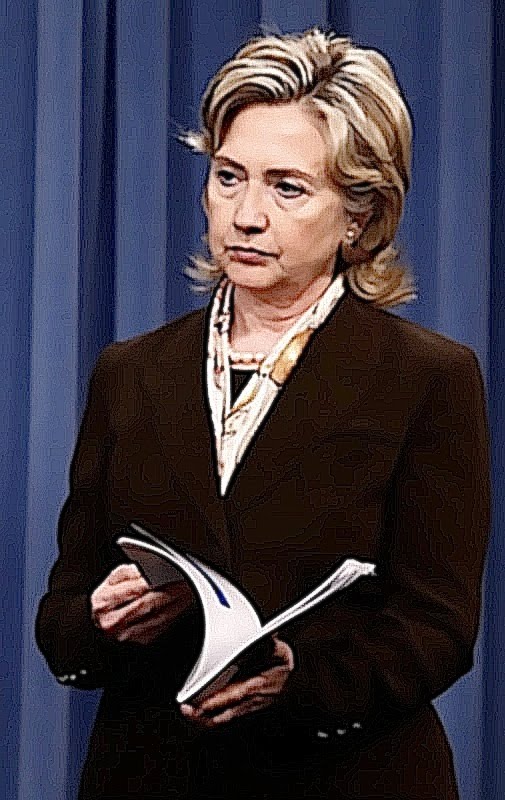 Finally, a politician has stood up and boldly denounced the creeping fascism that is gradually crushing democracy and political activism.
Not mincing her words, or trying to justify the jackboot, Secretary of State and 2008 presidential aspirant Hillary Clinton roundly condemned government actions that she said are “closing in the walls” on unions, rights advocates and organizations that press for social change or that shine a light on government shortcomings.
“Democracies don’t fear their own people,” she declared in ringing tones. “They recognize that citizens must be free to come together to advocate and agitate.”
Clinton even got the normally taciturn President Obama to join her, releasing a statement in which he said he was concerned about “the spread of restrictions on civil society, the growing use of law to curb rather than enhance freedom, and wide-spread corruption that is undermining the faith of citizens in their government.”
Does this mean that the US government is finally going to reverse course? Will it now stop importing thousands of cops dressed in combat gear when there is a gathering of heads of state, as was done last September in Pittsburgh for the G-20 summit–where hundreds of peacefully assembled students were teargassed, clubbed and arrested in a scene that has now become all too familiar at legal protests? Does it mean a reversal of the latest Supreme Court decision making it a crime to give funds to a charity deemed by the government to be providing aid to “terrorism” even if the donor had no idea where the organization’s funds were going? Will the Justice Department drop the prosecution of NSA, CIA, and military whistleblowers? Will the cynically named PATRIOT Act, with its provisions for arrest for thought crimes, for guilt by association, and for detention without charge, be annulled? Will police-backed union-busting be outlawed? Will the government stop sending undercover spies to monitor the activities of peace organizations and other activist groups? Will the Transportation Security Administration purge its no-fly list of non-violent political activists and focus just on known threats to the safety of planes? Will the National Security Agency finally stop its wireless monitoring of millions of law-abiding citizens’ electronic communications? Will the US Coast Guard stop enforcing a corporate blackout by British Petroleum with threats to arrest on felony charges journalists and others who attempt to photograph, on public land, evidence of the destruction of the Gulf Coast by the BP blowout? Will the Obama Justice Department finally begin a serious campaign to root out the massive corruption in Washington that has caused most Americans to give up on their government as a lost cause?
You’d certainly think so to listen to the pronouncements of Clinton and Obama.
But no. The problem is that they weren’t talking about the USA. They were talking about other countries–China, Venezuela, Cuba, Egypt, Zimbabwe, Ethiopia and Iran, for example.
The truth is that as harsh as those countries may be on critics and activists in their own societies, the US, supposedly the “Land of the Free and Home of the Brave,” is in sorry shape today in terms of its vaunted freedoms of speech, assembly and press. Police-state tactics are now the norm at peaceful demonstrations. People are being arrested and held without charge with increasing frequency. The president has authorized the extra-judicial state murder of American citizens overseas deemed by himself to be threats to the country. Most Americans simply assume today that their phones and internet use are being monitored by the NSA. And most Americans today clearly see Washington as a cesspool of corruption where money buys not just access but special laws designed to enrich the powerful and screw the “small people.”
If Clinton and Obama were sincere in saying that democracy and political activism were under threat, they’d look to what is happening in their own country before criticizing other countries. This kettle here has gotten pretty black over the past decade and needs a good scouring, before we can go out and start pointing out threats to freedom abroad.
Clinton chose an apt metaphor in her misdirected warning about the threats to democracy and democratic activism. Noting that the Iron Curtain that Winston Churchill famously warned against 60 years ago had fallen, she cautioned that now, “we must be wary of the steel vise in which governments around the world are slowly crushing civil society and the human spirit.”
It is absolutely true that governments the world over are turning the screw on that vise, making use of more advanced electronic surveillance capabilities, and of improved technologies for “non-lethal” force–everything from rubber bullets and tasers to sound “guns” and even microwave beams–for breaking up demonstrations. But this is happening in the US too, where laws and court decisions are also slowly squeezing the margins around what is considered permissible dissent.
We all submit to this creeping fascism at our own risk.
Clinton, speaking at the meeting in Poland of a 16-nation group called the Community of Democracies, Clinton called for an organization to monitor the attacks on freedom, and said the US would continue to fund organizations that challenged such threats in other countries. Neither she nor President Obama said anything about funding some organization to monitor the erosion of democracy here in the US. Perhaps we Americans should take matters in our own hands and start funding the groups that are challenging this ongoing theft of our own freedom.
Dave Lindorff is a Philadelphia-based journalist and columnist. His latest book is “The Case for Impeachment” (St. Martin’s Press, 2006 and now available in paperback). He can be reached at dlindorff@mindspring.com
Featured Video

Why the U.S. Should Pull Back From the First Island Chain
or go to
Aletho News Archives – Video-Images
From the Archives
Only 19.7% of Americans agree with US State Dept on Israeli settlements
… Most American adults of voting age don’t appear willing to reject the applicability of international law to Israel’s ongoing colonization of occupied territories in East Jerusalem, the West Bank and Golan Heights. … Full article
Blog Roll
 Aletho News
- Egypt collaborates with Israel to build ‘Green Rafah’ project over erased Palestinian city
- Rising fuel prices and shortages have helped drive ongoing protests and rioting in France
- Tokyo protests demand Takaichi’s resignation over support for ‘Israel’
- Jennifer Kavanagh: Why the U.S. Should Pull Back From the First Island Chain
- Yemen denounces international community’s silence on Saudi aggression, siege
- UAE and Saudi Arabia move toward renewed coordination against Sanaa
- How Iran’s two-week retaliatory strikes exposed cracks in US military architecture in Persian Gulf
- The mother of all propaganda: Why the hype over US MOAB strike against Iran is nothing but theater
- Iran says it possesses technology behind US 14-ton GBU bunker-buster
- Trump asks Iran not to retaliate after he strikes Pickaxe Mountain – w/ Prof. Marandi
- If Americans Knew
- Israeli Strike Burns Gaza Mother Alive in Front of Toddler, ‘Without Generating Any Headlines’
- ‘The Israel Experience with Mike Huckabee’: The Ambassador’s Family Sells Trips to Israel
- As Gazans carry out mass burial, food insecurity is getting worse – Daily Update
- Israeli rabbi permits occupiers to steal Palestinian olive harvest in West Bank
- Netanyahu’s spin on latest settler attack is laughable – Daily Update
- Israeli soldiers debunk Israel’s talking points
- In West Bank, Israeli settlers are totally out of control – Daily Update
- NPR investigation finds evidence of widespread fraud at mall kiosks tied to Israeli skincare brand
- Tucker Carlson exposes Israeli Lies about the Oct 7th attack, Charlie Kirk, and the U.S.
- Israel has detained thousands of Palestinian children since Oct 7th – over half spent time in solitary, many uncharged
- No Tricks Zone
- Predictions Made By Renowned Climate Proifessor Over Past Decades Have Been Proven To Be Poor
- New Study Suggests Large Regions Of The Pacific Ocean Have Been Cooling For The Last 80 Years
- Germany’s Green Energy Debacle: High Energy Costs Force Kahla Porzellan to Close After 182 Years!
- New Study: 50 Years Of The Most Aggressive ‘Net Zero’ Policies Can Only Affect The Global Climate By 0.03°C
- US September “Heat” Was No Record…Many Records Set Decades Ago
- Latest European Green Energy Debacle; Portugal’s Largest Flagship Solar Park Insolvent!
- Green Energy Debacle: German Expert Professor Fritz Vahrenholt Warns Of Severe Economic And Social Consequences
- Two More Paleo Reconstructions Affirm Meters-Higher Sea Levels Across Ireland, Brazil 7000-6000 Years Ago
- New Study: Earth And Venus Surface Warmth Largely Explained By Convection And Lapse Rate, Not CO2 Or Radiation
- 2025 Nature Paper Claiming Worsening Global Drought Gets RETRACTED …Heavily Flawed

