Fifteen Years Before Kennedy, Zionists Murdered Forrestal

By Laurent Guyénot • Unz Review • January 27, 2020
Israel as serial murderer
In the 1990s, a couple of bestsellers brought to the knowledge of a large public the fact that JFK’s assassination in 1963 solved an intense crisis over Israel’s secret nuclear program. In one of his last letters to Kennedy, quoted by Seymour Hersh in The Samson Option (1991), Prime Minister David Ben-Gurion complained: “Mr. President, my people have the right to exist […] and this existence is in danger.”[1] The nuclear option was judged vital for Israel, and JFK opposed it. A Haaretz review of Avner Cohen’s book Israel and the Bomb (1998) puts it this way:
“The murder of American President John F. Kennedy brought to an abrupt end the massive pressure being applied by the US administration on the government of Israel to discontinue the nuclear program. Cohen demonstrates at length the pressures applied by Kennedy on Ben-Gurion. […] The book implied that, had Kennedy remained alive, it is doubtful whether Israel would today have a nuclear option.”[2]
Also openly discussed by Israeli historians today are the close connections between Ben-Gurion’s network in the U.S. and what Tel-Aviv professor Robert Rockaway calls “Gangsters for Zion”, including the infamous “Murder, Incorporated”, run by Bugsy Siegel and then by Mickey Cohen, Jack Ruby’s mentor.
That Israel had the motive and the means of killing JFK does not prove that Israel did it. But I am quite certain that today, most smart Israelis assume and half-approve that Ben-Gurion ordered the elimination of JFK in order to replace him by Lyndon Johnson, whose love for Israel is also now widely celebrated, to the point that some speculate he might have been a secret Jew.

In Ben-Gurion’s mind, making Israel a nuclear state was a matter of life and death, and obliterating any obstacle was an absolute necessity. In Netanyahu’s mind today, preventing Iran—or any other enemy of Israel—from becoming a nuclear state is of the same order of necessity, and would surely justify eliminating another U.S. president in order to replace him by a more supportive Vice President. Most dedicated Zionists understand that. Andrew Adler, owner and editor in chief of The Atlanta Jewish Times, assumes that the idea “has been discussed in Israel’s most inner circle,” and, in his column of January 13, 2012, called on the Israeli Prime Minister to,
“give the go-ahead for U.S.-based Mossad agents to take out a president deemed unfriendly to Israel in order for the current Vice-President to take his place and forcefully dictate that the United States’ policy includes its helping the Jewish State obliterate its enemies. […] Order a hit on a president in order to preserve Israel’s existence.”[3]
Eliminating unsubmissive foreign leaders is part of Israel’s struggle for existence. Besides, it is entirely biblical: foreign kings are supposed to “lick the dust at [Israelis’] feet” (Isaiah 49:23), or perish, with their names “blotted out under heaven” (Deuteronomy 7:24).
On November 6, 1944, members of the Stern Gang, led by future Prime Minister Yitzhak Shamir, assassinated Lord Moyne, the British resident minister in the Middle East, for his anti-Zionist positions. The bodies of his murderers, executed in Egypt, were later exchanged for twenty Arab prisoners and buried at the “Monument of Heroes” in Jerusalem. On September 17, 1948, the same terrorist group murdered in Jerusalem Count Folke Bernadotte, a Swedish diplomat appointed as United Nations mediator in Palestine. He had just submitted his report A/648, which described “large-scale Zionist plundering and destruction of villages,” and called for the “return of the Arab refugees rooted in this land for centuries.” His assassin, Nathan Friedman-Yellin, was arrested, convicted, and then amnestied; in 1960 he was elected to the Knesset.[4]
In 1946, three months after members of the Irgun, led by future Prime Minister Menachem Begin, killed ninety-one people in the headquarter of the British Mandate’s administration (King David Hotel), the same terrorist group attempted to murder British Prime Minister Clement Attlee and Foreign Secretary Ernest Bevin, according to British Intelligence documents declassified in 2006.
These killings and more are documented by Israeli journalist Ronen Bergman in Rise and Kill First: The Secret History of Israel’s Targeted Assassinations (Random House, 2018). Bergman writes:
“At the end of 1947, a report to the British high commissioner tallied the casualties of the previous two years: 176 British Mandate personnel and civilians killed. / ‘Only these actions, these executions, caused the British to leave,’ David Shomron said, decades after he shot Tom Wilkin dead on a Jerusalem street. ‘If [Avraham] Stern had not begun the war, the State of Israel would not have come into being.’”[5]
James Forrestal’s strange death
Absent from Israel’s body count in Bergman’s book is former U.S. Secretary of Defense James Forrestal, assassinated eight months after Count Bernadotte. Forrestal had been Roosevelt’s Secretary of the Navy from April 1944. With consolidation of the armed services under Truman in 1947, he became the first Secretary of Defense. He opposed the United Nations’ vote to partition Palestine, and protested vigorously against U.S. recognition of Israel on May 15, 1948, on the ground that U.S. interests in the Middle East would be seriously jeopardized by American sponsorship of a Jewish state. For this, Forrestal received “an outpouring of slander and calumny that must surely be judged one of the most shameful intervals in American journalism,” in the words of Robert Lovett, then Under Secretary of State. Truman replaced Forrestal on March 28, 1949—shortly after his reelection—by the man who had been his main fundraiser, Louis Johnson. According to the received story, Forrestal, who was psychologically exhausted, fell into depression immediately. On April 2, 1949, he was interned against his will in the military hospital of the Navy in Bethesda, Maryland, a Washington, DC, suburb, where he was forcibly confined for seven weeks. He fell to his death from the 16th floor at 1:50 in the morning of May 22, 1949, landing on the roof of the third floor. He had a dressing-gown sash tied around his neck.
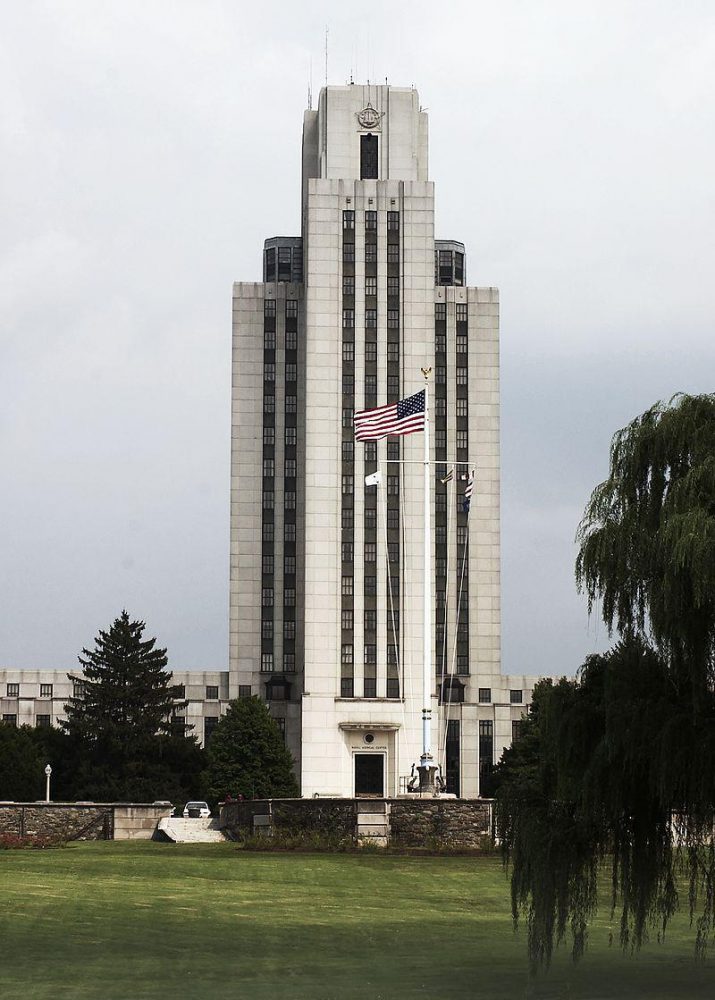
Bethesda Navy Hospital, where Forrestal met his death
National authorities and mainstream media immediately labeled his death a suicide, without any known criminal investigation. A review board was appointed on May 23, headed by Admiral Morton Willcutts, to conduct hearings of members of the hospital staff with the sole purpose of exonerating everyone of responsibility in Forrestal’s assumed suicide. The board completed its work in one week, and published a short press release four months later. But the full report, containing the transcripts of all hearings and crucial exhibits, were kept secret for 55 years, until David Martin obtained it through a Freedom of Information Act request in April 2004 (it is now available on the Princeton University Library website in pdf form, or here in HTML rendition by the anonymous Mark Hunter, who makes useful comments).
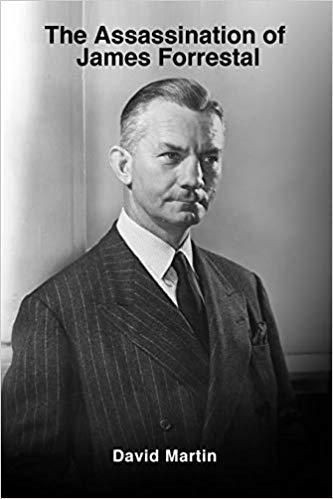
In his book and in his web articles complementing it, David Martin makes a compelling case that Forrestal was murdered, and that his murder was ordered by the Zionists, most probably with the knowledge and approval of Truman, who was then completely hostage to the Zionists. The motive? Forrestal was planning to write a book and to launch a national magazine: he had the money and the connections for it, and he had three thousand pages of personal diary to back his revelations on the corruption of American leadership and the sell-out of American foreign policy to communism under Roosevelt, and to Zionism under Truman.
I will here summarize the evidence accumulated by David Martin, and highlight the significance of this case for our understanding of Israel’s takeover of the heart, soul, and body of the United States. Unless specified otherwise, all information is from Martin’s book or articles.
From James Forrestal to John Kennedy
My own interest for this heartbreaking story stems from my interest for the Kennedy assassinations. (read my article Did Israel Kill the Kennedys?). I found the connection and similarities between the two stories highly illuminating. Everyone knows that Kennedy was assassinated, yet most Americans are still unaware of the evidence incriminating Israel. In the case of Forrestal, it is the opposite: few people suspect a murder, but once the evidence for murder has been presented, it points directly to Israel as the culprit. For this reason, Forrestal’s assassination by the Zionists becomes a precedent that makes JFK’s assassination by the same collective entity more plausible. If Israel can kill a former U.S. Defense Secretary on American soil in 1949 and get away with it with government and media complicity, then why not a sitting President fifteen years later? If the truth on Forrestal had been known by 1963, it is unlikely that Israel could have killed two Kennedys with impunity.
Forrestal was of Irish Catholic origin like the Kennedys, and was close to JFK’s father. Both James Forrestal and Joseph Kennedy are examples of American patriots of Irish stock who were alarmed by Jewish influence over American foreign policy. The entry for 27 December 1945 in Forrestal’s edited diary, says:
“Played golf with Joe Kennedy. I asked him about his conversations with Roosevelt and Neville Chamberlain from 1938 on. […] Chamberlain, he says, stated that America and the world Jews had forced England into the war.”
One major difference between the two men is that Joe Kennedy had resigned from government after Roosevelt’s entry into the war, and had kept a low profile on Israel. Moreover, unlike Forrestal, he was the head of a wealthy clan and had his own men in the press. He was a politician, whereas Forrestal was an uncompromising man. These differences explain why Forrestal was assassinated, whereas Joe had his son elected president. Yet in the end, the Kennedys suffered the Talmudic curse over three generations.
When James Forrestal, hostile to Stalin’s ambitions on Eastern Europe and to Truman’s decision to nuke Japan, was kept away from the official delegation to the Potsdam Conference in the summer 1945, he flew there privately and took with him the then 28-year-old John Kennedy, for a tour of post-war Germany. Later on, John integrated James Forrestal’s son Michael Forrestal as a member of his National Security Council. In May 1963 he made a symbolic public gesture by visiting the grave of James Forrestal on Memorial Day.

JFK visits Forrestal’s grave at Arlington cemetery
James Forrestal’s and John Kennedy’s assassinations bear one sinister thing in common: Bethesda Naval Hospital. As most readers recall, this is where Kennedy’s autopsy was tampered with after his body had been whisked away at gunpoint from Dallas Parkland Hospital, most probably by Secret Service agents on Lyndon Johnson’s order. In 1963, Lyndon Johnson could count on high-level complicity within the Navy.
It happens that Johnson, whom Billy Sole Estes claims ordered nine murders in the course of his political career,[6] makes a special appearance, although brief and poorly documented, in the story of Forrestal’s assassination. LBJ was then a newly elected congressman, on the payroll of Abraham Feinberg, former president of Americans for Haganah Incorporated and financial godfather of Israel’s atomic bomb.[7] According to the testimony of Forrestal’s assistant Marx Leva (more on him later), Johnson paid an unwanted visit to Forrestal at Bethesda Hospital. David Martin asks:
“Could LBJ have been playing something of a foot-soldier role for the orchestrators of Forrestal’s demise? Might he have been there to size up the overall situation, and at the same time contribute to ‘making his bones,’ as it were, by participating in such an important operation?” (Martin p. 20)
The official narrative
It bears repeating that no investigation was conducted into the death of James Forrestal, either by the FBI or the NCIS (Navy Criminal Investigative Service). The very day of his death, the mainstream press announced his suicide as a matter of fact. The New York Times stated in its late May 22 edition that Forrestal “jumped thirteen stories to his death,” and added the next morning:
“There were indications that Mr. Forrestal might also have tried to hang himself. The sash of his dressing-gown was still knotted and wrapped tightly around his neck when he was found, but hospital officials would not speculate as to its possible purpose.”
Later biographers did speculate that he may have tried to hang himself but failed to tie the sash securely to the radiator beneath the window. In The Man Who Kept the Secrets, Pulitzer Price winner Thomas Powers says that Forrestal died trying to hang himself “from his hospital window, but slipped and fell sixteen stories to his death.”
Forrestal left no suicide note, but the New York Times (May 23) informs its readers that:
“A book of poetry beside his bed was opened to a passage from the Greek tragedian, Sophocles, telling of the comfort of death. […] Mr. Forrestal had copied most of the Sophocles poem from the book on hospital memo paper, but he had apparently been interrupted in his efforts. His copying stopped after he had written ‘night’ of the word ‘nightingale’ in the twenty-sixth line of the poem.”
On May 24, the New York Times gave the final word to the psychiatrist in charge, who made suicide sound predictable:
“Captain George M. Raines, the Navy psychiatrist who had been treating Mr. Forrestal, said that the former Secretary ended his life in a sudden fit of despondency. He said this was ‘extremely common’ to the patient’s severe type of mental illness.”
That’s it. Never did the mainstream media hint at the possibility of foul play. The conclusion that Forrestal’s death is an obvious suicide caused by his “mental illness” was taken at face value by the authors of Forrestal’s two main biographies:
- Arnold Rogow, James Forrestal, A Study of Personality, Politics, and Policy (MacMillan Company, 1963);
- Townsend Hoopes and Douglass Brinkley, Driven Patriot, the Life and Times of James Forrestal (Alfred A. Knopf, 2003).
Rogow, whose book has been called a “psychological autopsy,” insists on linking Forrestal’s alleged mental illness to his alleged anti-Semitism, with the implication that anti-Semitism is a form of paranoia that may lead to suicide. Rogow is an expert on the subject of anti-Semitism, on which he wrote the article for The International Encyclopedia of Social Science. He is also the author The Jew in a Gentile World: An Anthology of Writings about Jews by Non-Jews.
 Hoopes and Brinkley borrow heavily from Rogow, but add valuable information based on their own interviews. They give an interesting interpretation of the morbid poem allegedly copied by Forrestal from Mark Van Dorren’s Anthology of World Poetry, titled “The Chorus from Ajax.” Taking their clue from Zionist apologist John Loftus, author of The Belarus Secret (Alfred A. Knopf, 1982), they speculate that, when reaching the word “nightingale” in the poem, Forrestal might have been overwhelmed by a sudden rush of guilt for having authorized a CIA operation with the code name of “Nightingale,” that infiltrated into the Soviet Union Ukrainian spies who had been formerly Nazi collaborators and probably killers of Jews. The word “nightingale,” Hoopes and Brinkley surmise, must have triggered Forrestal’s urge to take the poet’s admonition literally and end his life on the spot.
Was Forrestal mentally ill?
David Martin has uncovered grave inconsistencies and outright lies in the official story. First, it appears that Forrestal’s nervous breakdown has been wildly exaggerated, if not totally invented. As the story goes, Forrestal’s mental health had started deteriorating before Truman replaced him, and collapsed on March 29, just after a brief ceremony in his honor at Capitol Hill. The main source for this story is an Oral history interview of Marx Leva, Forrestal’s special assistant at that time, recorded for the Truman library in 1969. Leva says that, on that day, he found Forrestal in his Pentagon office, “almost in a coma.” He had him driven home and later met him there with Forrestal’s friend Ferdinand Eberstadt, and the two men decided that Forrestal’s state required that he urgently take some vacation. So Leva made immediate arrangement for a Marine plane to fly him to the estate of Robert Lovett in Hobe Sound, Florida that very night. “And on the way out Forrestal said three times, the only thing he said, [Eberstadt] tried to speak to him and he would say, ‘You’re a loyal fellow, Marx.’ ‘You’re a loyal fellow, Marx,’ three times.” Since Leva is Jewish, the implication is that Forrestal was obsessed by the disloyalty he attributed to many Jewish officials. For Leva, “he apparently was beyond being neurotic, I mean it was apparently paranoid”.
David Martin shows in this article (adding a new perspective to his book) that Marx Leva is lying. Forrestal’s vacation had in fact been planned in advance, and his wife was already waiting for him there. This is proven by a Jacksonville Daily Journal article dated March 28 about the ceremony when Truman pinned the Distinguished Service Medal on Forrestal’s chest that very day. The article concludes: “Forrestal is flying tomorrow to Hobe Sound, Fla., for a long rest.” This video clip of Forrestal shows him perfectly healthy and composed on March 28.
News reports and biographies insist that, during his four-day stay at Hobe Sound, Forrestal showed signs of paranoia. One rumor, made up by Daniel Yergin and repeated by Thomas Powers in The Man Who Kept the Secrets, has him running through the streets yelling, “The Russians are coming.” There is no credible source for this claim. Under Secretary of State (and future Defense Secretary) Robert Lovett, who was at Hobe Sound with Forrestal, did say in 1974 that Forrestal appeared to him as “not of sound mind,” because “he was obsessed with the idea that his phone calls were being bugged,” and complained that “they’re really after me.” I find rather strange, though, that Lovett feigns to ignore who Forrestal meant by “they”. There is nothing irrational in Forrestal’s belief that “his telephones were being bugged, [and that] his house was being watched”, as he had earlier complained to Truman’s appointments secretary, Matthew J. Connelly (who said so in a 1968 interview by the Truman Library).
There is also a rumor that Forrestal attempted suicide at Hobe Sound. It is contradicted by the Willcutts report, where Dr. George Raines, the psychiatrist in charge of Forrestal at Bethesda, is recorded stating: “So far as I know he never made a single real attempt at suicide except that one that was successful.” All of Forrestal’s doctors interviewed are unanimous that he had never attempted suicide before his fatal fall.
That is not to say that Forrestal was not psychologically strained in 1949. As Secretary of Defense, he had been subjected not only to slander and calumny by the press, but also to anonymous death threats. Robert Lovett, who shared Forrestal’s views on Israel, testified that he himself received night phone calls with death threats, and that Forrestal was more exposed than him to this kind of treatment. Having lost all protection from the government after March 28, Forrestal had reasons to fear for his life. On May 23, 1949, The Washington Post concluded an article headlined “Delusions of Persecution, Acute Anxiety, Depression Marked Forrestal’s Illness,” with the somewhat paradoxical statement:
“His fear of reprisals from pro-Zionists was said to stem from attacks by some columnists on what they said was his opposition to partition of Palestine under a UN mandate. In his last year as Defense Secretary, he received great numbers of abusive and threatening letters.”
John Loftus and Mark Aarons, the arch-Zionist authors of The Secret War against the Jews, identify Forrestal as “the principal villain, the man who nearly succeeded in preventing Israel’s birth.” They reveal that “The Zionists had tried unsuccessfully to blackmail Forrestal with tape recordings of his own deals with the Nazis” (before the war, Forrestal had been a partner of Clarence Dillon, the Jewish founder of the banking firm Dillon, Read, and Co.), but they believe that Zionist harassment at least succeeded in making him insane: “His paranoia convinced him that his every word was bugged. To his many critics, it seemed that James Forrestal’s anti-Jewish obsession had finally conquered him.”[8]
How convenient to claim that anti-Semitism may lead to suicide. When the Zionist mafia wishes you dead, fearing for your life is not a sign of mental illness, but rather of sound judgment.
We need not doubt Raines’ words to the Willcutts Review Board that, when he first saw Forrestal at Bethesda Hospital, “he was obviously exhausted physically” and showed “high blood pressure.” But here, we also have to take into account that Forrestal had been literally abducted from his vacation center at Hobe Sound. We should not be surprised when Rogow, and Hoopes and Brinkley after him, tell us that, even though he had been sedated, Forrestal “was in a state of extreme agitation during the flight from Florida,” and that:
“Forrestal’s agitation increased during the trip in a private car from the airfield to the hospital. He made several attempts to leave the car while it was in motion, and had to be forcibly restrained. Arriving at Bethesda, he declared that he did not expect to leave the hospital alive.”
As Martin mentions, there is also the very real possibility that Forrestal had been drugged at Hobe Sound, in order to make him appear insane and justify his internment.
Forrestal’s behavior at Bethesda shows nothing abnormal for a man locked up in the psychiatric division of a military hospital, on the 16th floor, for reasons he feared were not strictly medical. It has been reported by medical personnel that Forrestal often seemed restless, walking back and forth in his room late at night. Why wouldn’t he? Forrestal was even denied visits by those dearest to him. His brother Henry had tried several times to visit him, but had been rebuffed by Dr. Raines. The hospital authorities relented only after Henry threatened legal action. Forrestal was also denied the visit of his friend the Catholic priest, Monsignor Maurice Sheehy. Sheehy wrote in The Catholic Digest, January 1951, that, “The day he was admitted to the hospital, Forrestal told Dr. Raines he wish to see me,” but that Dr. Raines told him “that Jim was so confused I should wait some days before seeing him.” Raines turned away Father Sheehy on six occasions.
Despite being kept in virtual imprisonment and under forced medication, Forrestal endured remarkably well. From the hearings conducted by the Willcutts Review Boards, it appears that he was doing fine, in the days preceding his death. Willcutts himself expressed surprise at learning about his death, because he had dinner with him one day earlier (Friday the 20th), and thought he was “getting along splendidly.”
Evidence of cover-up and the fake suicide note
As mentioned earlier, the Willcutts Review Board’s mission was to exonerate every single individual of negligence. Even the brief conclusions released four months after it concluded its hearings, admits so, as reported in the New York Times October 12, 1949:
“Francis P. Matthews, Secretary of the Navy, made public today the report of an investigating board absolving all individuals of blame in the death of James Forrestal last May 22.”
Strangely enough, as Martin discovered, the report states that Forrestal’s fall was the cause of his death, but avoids any statement about the cause of the fall itself.
There is an obvious lack of interest from the Willcutts Board regarding all elements that point to murder rather than to suicide. The nurse who first entered Forrestal’s room after his death testified that there was broken glass on his bed. But the room must have been laundered before the crime scene photographs were taken, because they show the bed with nothing but a bare mattress, while another picture shows broken glass on the carpet at the foot of his bed (photos available on Mark Hunter’s site). The Willcutts Board had no interest in finding the origin of the broken glass, nor the reason it was removed from the bed.
They also failed to ask the personnel or themselves any relevant questions about the gown sash tied around Forrestal’s neck. Hoopes and Brinkley later speculated that Forrestal tied the sash to a radiator beneath the window, but that his knot “gave way.” That is contradicted by hospitalman William Eliades, who found the body of Forrestal with the sash (cord) around his neck, and declared to the Willcutts Review Board: “I looked to see whether he had tried to hang himself and whether a piece of cord had broken off. It was still in one piece except it was tied around his neck.”
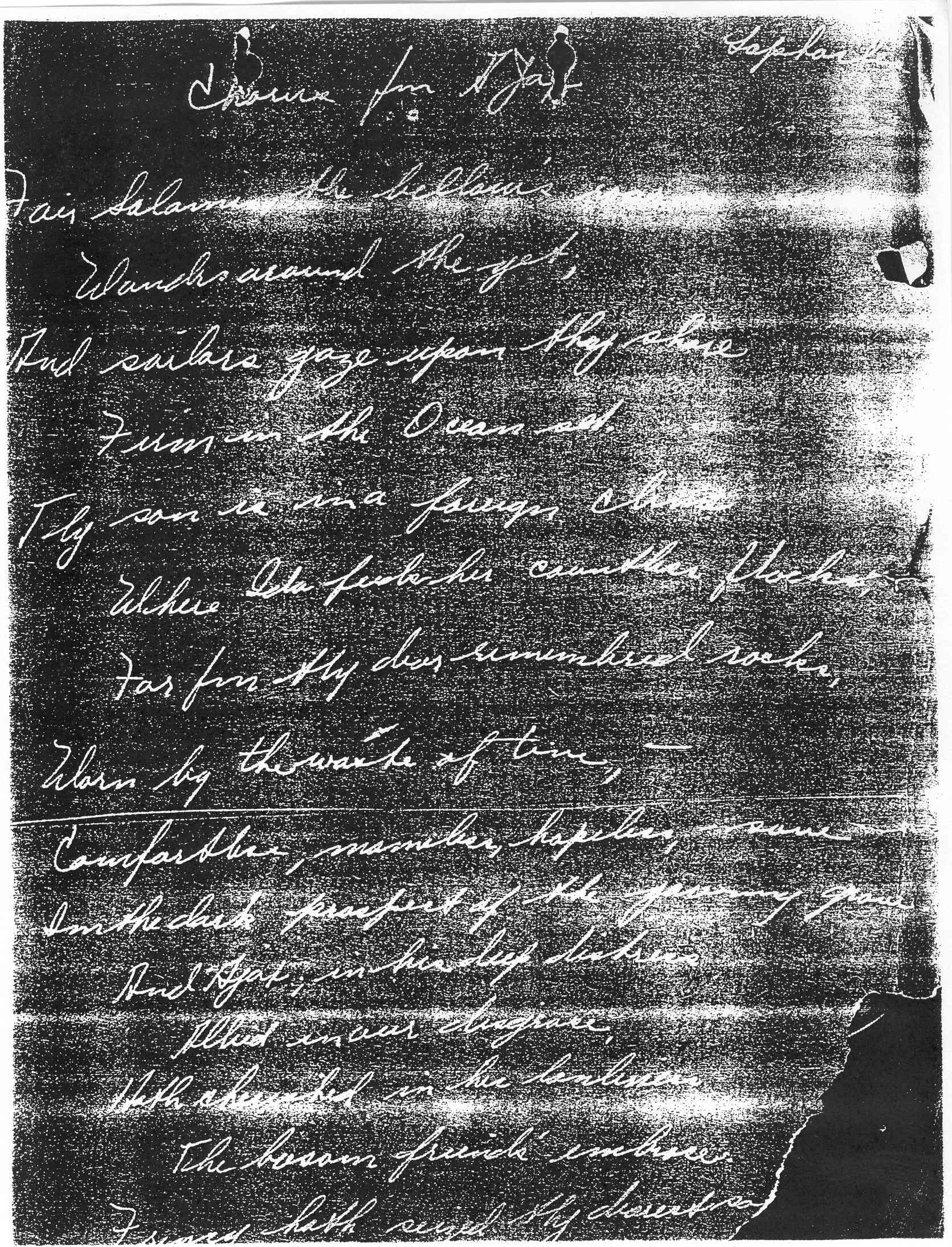
But the most compelling proof that Forrestal’s death has been disguised as a suicide is the poem allegedly copied by Forrestal. Among the exhibits obtained by Martin alongside the Willcutts report is a copy of the memo sheet with the transcription of the poem (here). A comparison with any handwritten note by Forrestal makes it plain that it was not copied by Forrestal (both can be found on Mark Hunter’s webpage).
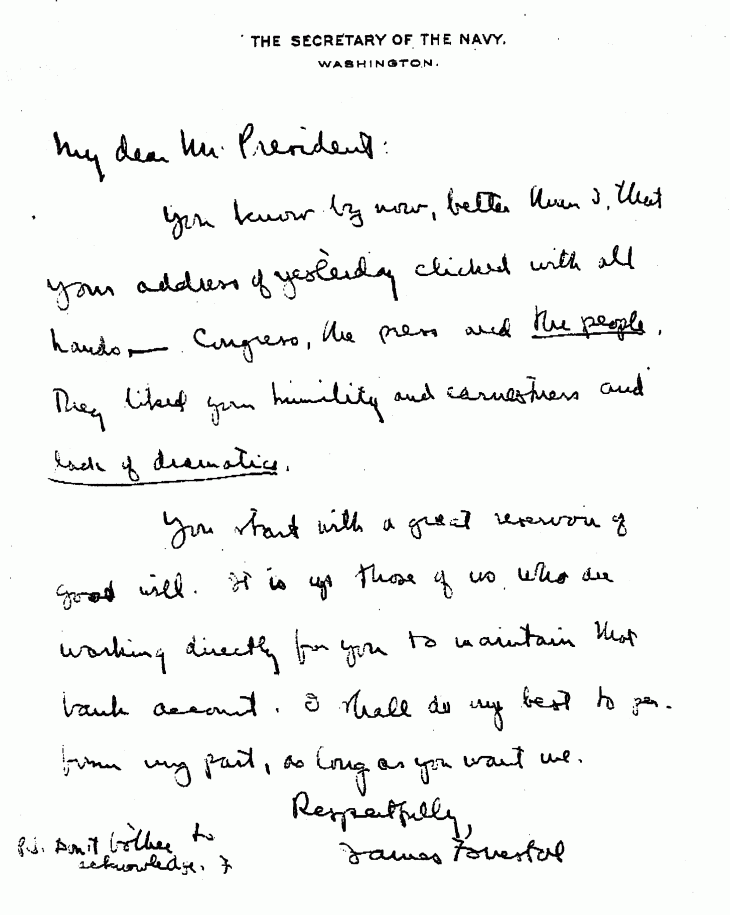

A sample of Forrestal’s handwriting and the note supposedly found in his room
As Martin comments, “One hardly needs an expert to tell him that the person who transcribed the poem is not the same person who wrote the various letters there.” Martin also notes that, from this single page, it is doubtful that the writer, whoever he was, even reached the word “nightingale”, which appears 11 verses below in the poem.
Interestingly, no one is identified in the official report as the discoverer of this handwritten note. It didn’t occur to the members of the Review Board to mention how it came into their possession, and to question about it the person who gave it to them.
In an effort to make the note a convincing proof of suicide, Rogow claims, and Hoopes and Brinkley repeat, that Apprentice Robert Wayne Harrison, Jr., the corpsman on duty to keep watch on Forrestal, checked into his room at 1:45 and saw him copying the poem. But by doing so, they both contradict Harrison’s declaration to the Willcutts Board. He said that, when he checked on him at 1:45, Forrestal was “in his bed, apparently sleeping.” Then he went to fill in the medical chart. Minutes later, a nurse heard the sound of Forrestal’s body striking the third floor roof. Harrison heard nothing but then became aware that Forrestal was missing at 1:50.
 Robert Wayne Harrison, Jr. would certainly have been a prime suspect if any criminal investigation had taken place. He was new to the job, and unknown to Forrestal until that fatal night. He had started his guard at midnight, replacing Edward Prise whose shift had started at 4 pm. Prise was well-known and apparently appreciated by Forrestal; he had been assigned to keep watch on Forrestal from the third day of Forrestal’s arrival at Bethesda. Strangely, his name is not mentioned in any contemporary news report, and it is misspelled “Price” in the report and in all biographies, although he clearly signed “Prise” in the medical chart included among the exhibits with the Willcutts report.
David Martin mentions that he received an e-mail from Prise’s daughter saying:
“We grew up hearing whispers between our parents in reference to this matter but were not allowed to ask for detail. Even up until a year prior to my father’s death in 1991 he had called me and was in fear that he was going to be questioned again about the issue.” (Martin p. 9)
We need not insist on the fact that witnesses are easily intimidated in a military environment, as was Bethesda Hospital. The pressure transpires in the transcripts of the Willcutts interviews: every nurse, corpsman or doctor said what they were expected to say, and understood their obligation never to speak otherwise. An interesting insight into this can be gained from David Martin’s interview of John Spalding, James Forrestal’s Navy Driver, then 27 years-old. When informed of the death of Forrestal by his superior, Spalding was handed a sheet of paper to sign, saying “I could never talk about anything that happened between him and me.”
Was it the communists or the Zionists?
Before David Martin, one author, writing under the pen-name Cornell Simpson, had claimed that Forrestal had been murdered. His book, The Death of James Forrestal, was published in 1966, although he claims to have written it in the mid-1950s. Simpson’s book contains much valuable and credible information. He had for example interviewed James Forrestal’s brother Henry, who was positively certain that his brother had been murdered. Henry Forrestal found the timing of the death very suspicious because he was coming to take his brother out of the hospital a few hours later that very same day. According to Simpson, another person who didn’t believe in Forrestal’s suicide was Father Maurice Sheehy. When he hurried to the hospital several hours after Forrestal’s death, he was approached discreetly by an officer who whispered to him, “Father, you know Mr. Forrestal didn’t kill himself, don’t you?”
Simpson blames the communists for Forrestal’s murder. The claim is not preposterous. Forrestal was definitely anti-communist. He had been alarmed by what he saw as communist infiltration in the Roosevelt administration (the Venona decrypts, giving evidence of 329 Soviet agents inside the U.S. government during World War II, would prove him right). After Roosevelt’s death, he was influential in the transformation of U.S. policy toward the Soviet Union, from accommodation to “containment.” Senator Joseph McCarthy, another Irish Catholic, testifies in his book The Fight for America that it was Forrestal who directly inspired his exposés of communist influence and subversion in the federal government:
“Before meeting Jim Forrestal I thought we were losing to international Communism because of incompetence and stupidity on the part of our planners. I mentioned that to Forrestal. I shall forever remember his answer. He said, ‘McCarthy, consistency has never been a mark of stupidity. If they were merely stupid they would occasionally make a mistake in our favor.’ This phrase stuck me so forcefully that I have often used it since.”
After Forrestal met his violent end, McCarthy moved up to the front line. He himself died on May 2, 1957, at the age of forty-eight, in Bethesda Hospital. Hospital officials listed the cause of death as “acute hepatic failure,” and the death certificate reads “hepatitis, acute, cause unknown.” The doctors declared that the inflammation of the liver was of a “noninfectious type”. Acute hepatitis can be caused either by infection or by poisoning, yet no autopsy was performed. Simpson comments (as quoted at length in Martin’s article James Forrestal and Joe McCarthy):
“Like Jim Forrestal, Joe McCarthy walked into the Bethesda Naval Hospital as its most controversial patient and as the one man in America most hated by the Communists. And, like Forrestal, he left in a hearse, as a man whose valiant fight against Communism was ended forever.”
M. Stanton Evans, who built on his father Medford Evans’ earlier work for his commendable Blacklisted by History: The Untold Story of Senator Joe McCarthy and His Fight Against America’s Enemies (2009), hints at the possibility that McCarthy was murdered, but does not explore the issue.

In 1953, Robert Kennedy worked as an assistant counsel to the Senate committee chaired by Senator Joseph McCarthy
The problem with Cornell Simpson’s theory is that Forrestal’s worst enemies were not the communists, but the Zionists. Although Forrestal’s anti-communism later attracted criticism from left-wing historians, it was not, then, a matter of public condemnation. Forrestal’s anti-communism was shared by most of his contemporaries, especially within the military. As long as you did not mention the high percentage of Jews among communists, being anti-communist did not make you the target of the mainstream media. The same, obviously, cannot be said of anti-Zionism. Neither the Washington Post nor the New York Times can be said to have been pro-communist at any time, but both turned strongly pro-Zionist around 1946. Arthur Hays Sulzberger, the NY Times’ director of publication since 1938, had actually denounced in 1946 the “coercive methods of the Zionists” influencing his editorial line, but eventually gave in and, since 1948, the NY Times has produced singularly unbalanced coverage of Palestine.[9]
It was his opposition to Zionism, not to communism, that attracted death threats to Forrestal. In his diary entry for February 3, 1948, Forrestal writes that he had lunch with Bernard Baruch and mentioned to him his effort at stopping the process of recognition:
“He took the line of advising me not to be active in this particular matter and that I was already identified, to a degree that was not in my own interests, with opposition to the United Nations policy on Palestine.”
Martin comments (p. 86):
“Baruch clearly did not know his man when he attempted to influence him by appealing to Forrestal’s own self-interest. He might have known more than he was telling, though, when he hinted at the danger that Forrestal faced for the courageous position he had taken.”
Jewish gangsters were traditionally anti-communists, but the Zionists could count on them to give a hand whenever needed. From 1945, Ben-Gurion’s Jewish Agency had close links to the Yiddish mafia, also known as the Mishpucka (Hebrew for “the Family”), who contributed greatly to the clandestine arms-purchasing-and-smuggling network that armed the Haganah. Leonard Slater writes in The Pledge that Teddy Kollek, who later became the longtime mayor of Jerusalem, ran the day-to-day operations and was told explicitly by Jewish gangsters from Brooklyn, “If you want anyone killed, just draw up a list and we’ll take care of it.” Yehuda Arazi, a close aide to Ben-Gurion sent by him to the U.S. to purchase heavy armaments, approached Meyer Lansky and met with members of “Murder, Incorporated.” Another Haganah emissary, Reuvin Dafni, who would become Israeli consul in Los Angeles and New York, met with Benjamin Siegelbaum, known as Bugsy Siegel. Some of those “gangsters for Zion”, writes Robert Rockaway, “did so out of ethnic loyalties,” or “saw themselves as defenders of the Jews, almost biblical-like fighters. It was part of their self-image.” Some also helped “because it was a way […] to gain acceptance in the Jewish community.”[10] Mickey Cohen, the successor of Bugsy Siegel, explains in his memoirs that from 1947, “I got so engrossed with Israel that I actually pushed aside a lot of my activities and done nothing but what was involved with this Irgun war.”[11] He was in close contact with Menachem Begin, and met with him when Begin came touring the U.S. in December 1948, a few months before Forrestal was confined to the Bethesda hospital.[12] Had Begin wanted Forrestal dead, he had only to ask.
I think it is quite self-evident that Forrestal had more to fear from the Zionists than from the communists. And so it is strange that Cornell Simpson totally ignores the Zionists as possible culprits. Neither Israel nor Zionism appears in his index. David Martin, who nevertheless recognizes the merit of Simpson’s investigation, finds the explanation for his blackout on Zionism in the fact that his book was published by Western Islands Publishers, the in-house publishing company of the John Birch Society, a Zionist front.
Three years before the Birch Society published Simpson’s book, Rogow had published the first biography of Forrestal, defending the official line about his death, and linking his supposed mental illness directly to his supposed anti-Semitism. It is very unlikely that Rogow’s book eased the suspicions of the skeptics about Forrestal’s suicide. On the contrary, Rogow’s obvious bias as a writer mainly concerned with anti-Semitism must have led many to consider his book as just another layer in the cover-up. Martin therefore speculates that the writing and publishing of Simpson’s book by the Birch Society was a way to give voice to the skepticism over Forrestal’s death, while directing that skepticism away from the most likely suspects. Blaming the communists was the easiest way to deflect suspicions from the Zionists.
It was all the easier that, from the 1930s up to the time of Forrestal’s death, the communists and the Zionists were the same people in many instances, as David Martin points out. Although communism and Zionism may seem incompatible from an ideological viewpoint, it is a matter of record that some of the Jews who acted as communist agents under Roosevelt, turned ardent Zionists under Truman. A case in point is David Niles (Neyhus), one of the few of FDR’s top advisors kept by Truman: he was identified in the Venona decrypts as a communist agent, but then played a key role as a Zionist gatekeeper under Truman. Edwin Wright, in The Great Zionist Cover-Up, names him as “the protocol officer in the White House, [who] saw to it that the State Department influence was negated while the Zionist view was presented.” David Niles’ brother Elliot, a high official of B’nai B’rith, was a Lieutenant Colonel who passed information to the Haganah while working in the Pentagon.
Did the order come from the White House?
Martin considers David Niles “the most likely coordinator of the Forrestal assassination.” He had the motives and the means. He was actually capable of passing orders on behalf of Truman, as he did when orchestrating the campaign of intimidation and corruption that obtained a two-third majority in favor of the Partition Plan at the U.N. General Assembly.[13]
There are reasons to believe that the order to eliminate Forrestal came directly from the White House. According to Truman’s appointments secretary, Matthew J. Connelly, it was Truman himself who suggested arranging for Forrestal a vacation at Hobe Sound. As for the decision to abduct him from there and intern him in Bethesda, Martin makes the following remark:
“Considering the fact that Forrestal, having been officially replaced as Defense Secretary by Johnson on March 28, was a private citizen at this point, it is certainly reasonable to assume that Forrestal’s extra-legal transportation to Florida on a military airplane and confinement and treatment in the Naval Hospital at Bethesda was not done without approval at the highest level.” (Martin p. 29)
Hoopes and Brinkley state explicitly that the decision to take Forrestal to Bethesda came from Truman, and that Forrestal’s wife was convinced by a telephone conversation with Truman.
The decision to put Forrestal on the 16th floor, which seems hardly appropriate for a patient reputed suicidal, also came from the White House. Hoopes and Brinkley quote Dr. Robert P. Nenno, a young assistant to Dr. Raines from 1952 to 1959, who believed that Raines had received instruction to put Forrestal there, and added, “I have always guessed that the order came from the White House.”
Hoopes and Brinkley justify Dr. Raines’ turning Sheehy away on six occasions by the fear that Forrestal might divulge sensitive information during confession. Such concerns obviously came from higher up. It apparently didn’t come from Navy Secretary John L. Sullivan because, as Hoopes and Brinkley tell us, when Sheehy and Henry Forrestal took their complaint to him on May 18, he expressed surprise and had the decision overruled. According to Simpson: “the priest later commented that he received the distinct impression that Dr. Raines was acting under orders.”
There is, of course, no evidence that throwing Forrestal out of the window was also ordered by the White House, but given Truman’s complete control by the Zionists, and by David Niles in particular, it is not unlikely.
Why kill him after he had been dismissed from power?
But, one may ask, why would Truman or anyone need to kill Forrestal? Once out of the Pentagon, he had no more influence on government policy.
The answer is easy. Far from being suicidal, Forrestal was a man with a plan. According to Hoopes and Brinkley,
“he had told powerful Wall Street friends […] that he was interested in starting a newspaper or a magazine modeled after The Economist of Great Britain, and they had demonstrated a willingness to help him raise the start-up funds.”
He also planned to write a book. With no more ties to the government or to the army, he was free to speak his mind on many issues. As a war hero and a very popular figure, he was sure to have a great impact. And he had plenty of embarrassing things to reveal about what he had seen during his nine years in the government.

Time cover, October 29, 1945
As Navy Secretary, he had been the central person for Pacific operations during World War II. He had inside knowledge of Roosevelt’s scheme to provoke the Japanese into attacking Pearl Harbor. According to his diary entry for April 18, 1945, he had even told Truman, that,
“I had got Admiral Hewitt back to pursue the investigation into the Pearl Harbor disaster. […] I felt I had an obligation to Congress to continue the investigation because I was not completely satisfied with the report my own Court had made.”
Forrestal was also very bitter about the way the war ended in the Pacific. Knowing the desperate situation of the Japanese, he had worked behind the scene to achieve a negotiated surrender from the Japanese. He was opposed to the demand of “unconditional surrender”, which he knew was unacceptable to the Japanese military leadership. Simpson writes, as quoted by David Martin here:
“As secretary of the navy, Forrestal had originated a plan to end the war with Japan five and a half months before V-J Day finally dawned. He had mapped this plan on the basis of massive intelligence information obtained on and prior to March 1, 1945, to the effect that the Japanese were already desperately anxious to surrender and the fact that the Japanese emperor had even asked the pope to act as peace mediator. If Roosevelt had acted on Forrestal’s plan, the war would have ground to a halt in a few days. A-bombs would never have incinerated Hiroshima and Nagasaki, thousands of Americans would not have died in the unnecessary battle of Okinawa and later bloody encounters, and the Russians would not have had a chance to muscle into the Pacific war for the last six of its 1,347 days, thus giving Washington the pretext for handing them the key to the conquest of all Asia.”
Forrestal had also much to say about the way the Zionists obtained the Partition Plan at the General Assembly of the United Nations, or about the way Truman was blackmailed and bought into supporting the recognition of Israel. He had written in his diary, February 3, 1948, about his meeting with Franklin D. Roosevelt, Jr., a strong advocate of the Jewish State:
“I thought the methods that had been used by people outside of the Executive branch of the government to bring coercion and duress on other nations in the General Assembly bordered closely onto scandal.”
Forrestal had a pretty good memory. But, in addition, he had accumulated thousands of pages of diary during his public service. According to Simpson,
“During Forrestal’s brief stay at Hobe Sound, his personal diaries, consisting of fifteen loose-leaf binders totaling three thousand pages, were hastily removed from his former office in the Pentagon and locked up in the White House where they remained for a year. […] all during the seven weeks prior to Forrestal’s death, his diaries were out of his hands and in the White House, where someone could have had ample time to study them.”
The White House later claimed that Forrestal had sent word that he wanted President Truman to take custody of these diaries, but that is very unlikely.
A small part of Forrestal’s diaries was ultimately published in a heavily censored form by Walter Millis, FDR apologist and New York Herald Tribune journalist. Simpson estimates that more than 80 percent was left out. Millis frankly admitted that he had deleted unfavorable “references to persons, by name [and] comment reflecting on the honesty or loyalty of an individual.” Millis also said that he deleted everything on the Pearl Harbor investigations. One can only guess how much censorship Millis exerted on Forrestal’s view about American support for Israel.
David Martin’s conclusion makes perfect sense:
“Forrestal’s writing and publishing plans provide the answer to the question, ‘Why would anyone bother to murder him when he had already been driven from office and disgraced by the taint of mental illness?’”
“The compelling reasons for Forrestal to want to continue living were also compelling reasons for his powerful enemies to see to it that he did not.”
“He comes across, in short, not as a prime candidate for suicide, but for assassination.” (Martin, pp. 52, 53, 87)
A parallel with Lord Northcliffe
In his blurb for Martin’s book, James Fetzer puts it this way:
“Dave Martin has established that James Forrestal was targeted for assassination by Zionist zealots who were convinced that his future influence as an editor and publisher represented an unacceptable risk.”
In this article, Martin expands on this idea by comparing Forrestal to Lord Northcliffe (Alfred Harmsworth), an influential newspaper editor whose tragic story is told by Douglas Reed in The Controversy of Zion (pp. 205-208), based on The Official History of The Times (1952). In the 1920s just like today, factual reporting from the press was the greatest obstacle to the Zionist ambitions. Lord Northcliffe owned journals and periodicals, including the two most widely read daily newspapers, and he was the majority proprietor of the most influential newspaper in the world at that time, The Times of London. He took a definite stand against the Zionist plan, and wrote, after a visit to Palestine in 1922: “In my opinion we, without sufficient thought, guaranteed Palestine as a home for the Jews despite the fact that 700,000 Arab Moslems live there and own it.” Northcliffe commissioned a series of articles attacking Balfour’s attitude towards Zionism. His editor, Wickham Steed, refused, and, when Northcliffe asked him to resign, took a series of actions to have Northcliffe declared mentally ill. Although he appeared perfectly normal to most people he met, on June 18, 1922, Northcliffe was declared unfit for the position of editor of The Times on the authority of an unknown “French nerve specialist,” removed from all control of his newspapers, and put under constraint. On July 24, 1922 the Council of the League of Nations met in London, secure from any possibility of loud public protest by Lord Northcliffe, to bestow on Britain a “mandate” to remain in Palestine and to install the Zionists there. On August 14, 1922, Northcliffe died at the age of fifty-seven, officially of “ulcerative endocarditis.” The public was, of course, kept in total ignorance of the way this highly respected public figure was taken off the scene. Douglas Reed, who was then working as a clerk in the office of The Times, and learned the full story much later, remembers that:
“Lord Northcliffe was convinced that his life was in danger and several times said this; specifically, he said he had been poisoned. If this is in itself madness, then he was mad, but in that case many victims of poisoning have died of madness, not of what was fed to them. If by any chance it was true, he was not mad. […] His belief certainly charged him with suspicion of those around him, but if by chance he had reason for it, then again it was not madness.”
Reed sees Northcliffe’s elimination as a turning point:
“After Lord Northcliffe died the possibility of editorials in The Times ‘attacking Balfour’s attitude towards Zionism’ faded. From that time the submission of the press […] grew ever more apparent and in time reached the condition which prevails today, when faithful reporting and impartial comment on this question has long been in suspense.”
The parallel with Forrestal is indeed striking, as David Martin remarks:
“Forrestal’s first love was journalism. In his youth he had worked as a reporter for three newspapers in his native upstate New York, and he had been the editor of the student newspaper at Princeton. As former president of the investment banking firm of Dillon, Read, & Co. he was a rich, powerful and well-connected man. He had plans to run his own news magazine. In short, he could have become an American Lord Northcliffe with the ability to have a great deal of influence on public opinion in the country.”
Notes
[1] Seymour Hersh, The Samson Option: Israel’s Nuclear Arsenal and American Foreign Policy, Random House, 1991, p. 141.
[2] Haaretz, February 5, 1999, quoted in Michael Collins Piper, False Flags: Template for Terror, American Free Press, 2013, pp. 54–55.
[3] Joe Sterling, “Jewish paper’s column catches Secret Service’s eye,” CNN, January 22, 2012.
[4] Alan Hart, Zionism: The Real Enemy of the Jews, vol. 2: David Becomes Goliath, Clarity Press, 2013, p. 90.
[5] Ronen Bergman, Rise and Kill First: The Secret History of Israel’s Targeted Assassinations, Random House, 2018, p. 20.
[6] William Reymond and Billie Sol Estes, JFK Le Dernier Témoin, Flammarion, 2003.
[7] Alan Hart, Zionism: The Real Enemy of the Jews, vol. 2: David Becomes Goliath, Clarity Press, 2013, p. 250.
[8] John Loftus and Mark Aarons, The Secret War against the Jews: How Western Espionage Betrayed The Jewish People, St. Martin’s Griffin, 2017 , p. 212-213.
[9] Alfred Lilienthal, What Price Israel? (1953), Infinity Publishing, 2003, pp. 95, 143.
[10] Robert Rockaway, “Gangsters for Zion. Yom Ha’atzmaut: How Jewish mobsters helped Israel gain its independence”, April 19, 2018, on tabletmag.com
[11] Mickey Cohen, In My Own Words, Prentice-Hall, 1975, pp. 91–92.
[12] Gary Wean, There’s a Fish in the Courthouse, Casitas, 1987, quoted by Michael Collins Piper, Final Judgment: The Missing Link in the JFK Assassination Conspiracy, American Free Press, 6th ed., 2005, pp. 290–297.
[13] Alfred Lilienthal, What Price Israel? (1953), Infinity Publishing, 2003, p. 50.
Laser Weapon Scams
By Carlton Meyer
Lasers are impractical weapons. This is obvious to anyone who spends an hour reading about the limitations of lasers. They are not useful weapons because of the massive electrical power required, because the atmosphere weakens and distorts the beam, because laser beams spread, and because lasers must maintain a precise spot on a moving target for several seconds to burn through. I wrote about this many years ago while contractors stole billions of dollars via the Airborne Laser program that was eventually cancelled. That concept relied on dangerous chemical lasers, but as recent technological innovations allow solid state lasers to grow in power, the laser weapon scammers returned to the Pentagon.
Proposals to place lasers on aircraft are ridiculous given the electrical power required and the simple fact that bouncing aircraft cannot keep a laser aimed on a spot, but profitable contracts have been awarded to Boeing anyway. Ship-based lasers are also bogus. Lasers are line-of-sight (direct fire) weapons and the earth is round. This means a laser cannot engage a low-flying incoming missile until it’s detected coming over the horizon roughly 10-20 miles out. It takes several seconds for radar to track a missile and aim the laser, so it will have perhaps a minute to shoot down the missile, and it requires several seconds of precise lasing to burn through its thin casing.
This is not possible more than a mile away because ship and missile are moving! They roll and bounce up and down. Computer software can predict ship movements and compensate, but not perfectly, and cannot predict the movements of the incoming missile. An incoming missile is always making slight flight adjustments to compensate for air turbulence while tracking its moving ship target, so a laser is unable to keep the beam on target more than a mile away due to the tracking/aiming delay. This means if a dozen missiles are inbound, the system may be able to shoot down only one. And since these systems are the size of a 5-inch gun mount and need most of the electrical power from the ship to fire, a cruiser or destroyer can carry just a couple of systems and will need to remove other weaponry to make room. 
Laser range is also limited because particles in the air reflect, scatter, and distort laser beams, even on clear days. This quickly depletes beam power and limits their effective range to less than a mile. This is a complex topic and several, short technical explanations are found in this article and this one from a US Navy research lab that states even in clear weather:
“A number of physical processes affect and limit the amount of laser energy that can be delivered to a target. These effects are interrelated and include thermal blooming, turbulence, and molecular/aerosol absorption and scattering. These processes affect the laser intensity profile by modifying the refractive index of the air, which causes the laser beam wavefront to distort. Wavefront distortion results in enhanced transverse laser beam spreading, and can severely limit the amount of energy that can be propagated. The maritime environment is particularly challenging for high energy-laser (HEL) propagation because of its relatively high water vapor and aerosol content. In the infrared regime, water molecules and aerosols constitute the dominant source of absorption and scattering of laser energy, and represent a limitation for HELs propagating in a maritime atmosphere.”
None of this is secret, yet one reads articles and comments by “experts” and senior officers who seem unaware of these severe limitations. Some of this problem can be overcome by using a low-power targeting laser to analyze the atmosphere in the beam path just before firing the main laser, then using complex optics to adjust lenses to optimize the beam. Billions of dollars were spent the last three decades on this solution with little success because the atmosphere in the beam path constantly changes due to wind and as the beam moves to track a target.
In addition, lasers are worthless in rain, fog, clouds, and haze since beam energy is quickly lost. So even if laser power is greatly improved with magical breakthroughs, an enemy may attack during inclement weather when lasers are useless. Some claim that lasers are the only defense against incoming supersonic missiles, however, such missiles are designed with a hardened nose made with materials to serve as a heat shield needed to resist air friction. A few seconds of laser heating at close range just before it impacts a ship is unlikely to burn through, and wouldn’t stop the missile from hitting the ship even if it burned through. The simple GAU-19 .50 cal/12.7mm gatling gun that can fire up to 33 rounds a second would prove far more effective.
Yet another problem with lasers is “beam divergence.” Lasers do not emit a steady narrow beam, it slowly enlarges and weakens. Here is an excellent diagram of beam divergence from a US Navy manual.
5.3.2. Laser Beam Divergence. Beam divergence is the spread of the laser beam over distance. Laser spot size is a function of beam divergence and the distance from the laser system to the target. If a designator has a beam spread or divergence of 0.25 milliradian, its spot would have a diameter of approximately 0.25 meters at a distance of 1,000 meters in front of the designator. At 5,000 meters, the beam would spread to 1.25 meters; at 10,000 meters, the beam would spread to 2.5 meters (see FIGURE 7).
In this example of a common laser, at just a kilometer (.625 miles) a laser beam aimed to cut through steel expands to ten inches! That can burn skin and start fires, but not harm a tank or even a moving car. In addition, lasers do not destroy upon contact but require several seconds of EXACT lasing to burn through. Here is a video of a 2016 ship test. Note the weather is clear and the slow flying plastic drone is close. This exposes its large delta wing to laser heating, yet it takes ten seconds of laser contact to cause a fire. An inbound sea skimming missile presents a far smaller and much faster target, and if lasers proliferate, missile makers will introduce shiny stainless steel nose cones to reflect most laser light and blind American sailors. They may also program the missile to fly a tight spiral path to the ship the last mile, like the Russian Kornet anti-tank missile.
Lasers look great in tests when the target and laser are close and motionless on the ground, but when both are bouncing around, accuracy is poor. A large ultra-expensive laser may detonate an incoming missile after several seconds of precise lasing as it nears a ship, but would still result in damage as the momentum (kinetic energy) from the missile fragments penetrate. Increasing the power of lasers does not address this aiming problem, the poor weather problem, and increases the “thermal blooming” problem when heated air particles expand faster and weaken the beam.
Lasers can blind optical systems and pilots (as the British did in the Falklands) so lasers are useful in that role. Stationary vehicle-mounted lasers are useful downing small drones flying slow and low overhead. But lasers can never overcome their range limitation or produce the required power to damage missiles and aircraft upon contact. Nevertheless, laser salesmen roam the Pentagon touting solid-state advancements to collect billions of dollars each year for pointless testing and development. In 2016, experts began to complain since laser weapons are obviously impractical. This caused laser scammers to play the secrecy card. The January 2017 issue of National Defense magazine had an article titled: Navy Officials No Longer Talking Publicly About Laser Weapon Systems, which includes this:
“When asked by National Defense for updates on LaWS, and a test of a 150-kilowatt laser aboard a ship that Vice Chief of Naval Operations Adm. Bill Moran announced last year, he said he would not share them, citing competition between the United States and its adversaries.
‘I’m going to be far more reluctant to talk about things like that,” he said. “When it comes to specific capabilities, when it comes to specific schedules, specific operations, … I would rather find a more appropriately cleared room to talk about that.’
Later during the summit, Rear Adm. Mike Manazir, deputy chief of naval operations for warfare systems at OPNAV N9, said that in the past he was happy to speak about program specifics. However, ‘we figured out that the competitors were actually learning and doing their own kind of crowdsourcing thing, learning from us,’ he said. Richardson did stress, however, that while he would no longer give too many details on its laser program, the service was hard at work developing such systems.”
The Admiral is correct. Competitors learned not to waste their time and money on bogus laser weapons! Admiral Manazir also claimed lasers are the future and he needed more money to speed development. However, if his new 150-kilowatt laser could shoot down an incoming missile, he would surely demonstrate this breakthrough. The Admiral did prove capable of dispensing billions of dollars to contractors, so was hired by Boeing in August 2017, the same month he retired from the Navy.
National Defense magazine was good enough to post my comment at the bottom of that article explaining why a ship laser is ineffective, but the article and my comments soon disappeared from the web, and the link to the Navy Research Lab article I quoted is also dead. Laser weapons are a scam, and those profiting will not discuss the issues mentioned in this article because they have no answers. Funding laser research is justifiable, but building and fielding dysfunctional laser weapons is criminal. Nevertheless, in January 2018 the US Navy awarded a contract worth nearly a billion dollars to Lockheed-Martin to deploy two more ultra-expensive, worthless lasers aboard ships.
Carlton Meyer, editorG2mil@Gmail.com
©2018 http://www.G2mil.com
“No One Has Suggested My Son Did Anything Wrong”: Joe Biden Doubles Down On Denial
By Jonathan Turley | January 24, 2020
We have previously discussed the denials of former Vice President Joe Biden that his son did anything wrong in Ukraine. As I have written, not only did Hunter Biden clearly enter into a corrupt (but arguably lawful) contract but Joe Biden did not do enough to confirm that his son was not engaging in influence peddling. Nevertheless, this week, Joe Biden continued this indefensible position and declared bizarrely that “no one has suggested my son did anything wrong.”
According to the Washington Post, Joe Biden declared on the campaign trail that “There’s nobody that’s indicated there’s a single solitary thing that he did that was inappropriate, wrong … or anything other than the appearance. It looked bad that he was there.” He then curiously added “He acknowledges that he in fact made a mistake going on the board.” So, in other words, he did nothing wrong but he apologized for it.
Joe Biden continues to maintain that “no one” has accused his son of wrongdoing when there is a chorus of such allegations. He seems to be drawing a distinction between what is criminal and what is not — as if the criminal code is the only measure of wrongdoing or unethical conduct.
Hunter Biden not only clearly engaged in influence peddling but he is clearly a relevant witness.
Ukraine was a virtual gold rush for Washington’s elite and Hunter Biden was one of the first in line to cash in. Biden’s quest for a Ukrainian windfall took him to one of Ukraine’s most controversial and corrupt associates, Mykola Zlochevsky, who leveraged his post as minister of ecology and natural resources to build a fortune. Before fleeing Ukraine, Zlochevsky paid Hunter Biden and several other Americans to be directors of his energy company, Burisma Holdings. Hunter Biden had no experience in the field — but he did have a notable connection to the vice president, who publicly has bragged about making clear to the Ukrainians that he alone controlled U.S. aid to the country. A stepson of former Secretary of State John Kerry also was asked to serve as a director but reportedly declined and warned Hunter Biden not to do it; Biden didn’t listen. He later told The New Yorker that “the decisions that I made were the right decisions for my family and for me.” His decisions certainly were profitable, but they were not “right” as an ethical matter for himself or his father.
The use of spouses or children in influence peddling schemes is a tried and true technique in Washington. You find some kid of a powerful politician and give them a windfall salary or contract. There is no direct bribe or criminal violation, just influence with the politician. Joe Biden seems to believe that, so long as it does not violation the criminal code, it makes it “right” or curiously somehow “not wrong.”
We have legal age limits for driving, voting, and having sex, why not for transgender treatment?
By Tomasz Pierscionek | RT | January 23, 2020
Vulnerable children and adolescents are being influenced by PC culture that elevates rights over responsibilities, teaches children there are over 100 genders, and where a fear of offending others trumps common sense.
Western democracies preach tolerance and require its citizens to accept progressive ideas; the more unconventional the better. A particular idea or course of action may even go against common sense and lead to harm, yet an overriding fear of causing offence or being labelled a [insert blank]-phobe thwarts open discussion about important issues.
There are, however, those who speak out and remind us to think carefully about embarking down a slippery slope from which it is difficult to return.
Susan Evans, a mental health professional and former employee of the UK’s only Gender Identity Development Service (GIDS), is asking the High Court to undertake a judicial review and raise the age at which individuals can consent to receiving puberty blockers and cross-sex hormones to 18. Ms Evans is joined by the parent of a 15-year-old adolescent on the GIDS waiting list.
Although individuals in the UK cannot undergo gender reassignment surgery until the age of 18, children and teenagers suffering from gender dysphoria (uncomfortable feelings brought on by a person’s gender identify differing from their birth sex) may receive medications to slow the onset of puberty and thus delay development of physical characteristics associated with their undesired sex. Later, from the age of 16, either testosterone or oestrogen (cross-sex hormones) are given to help an individual’s physical characteristics better align with those of their preferred gender identity.
Evans wants to raise the age of consent for children with gender identity issues receiving puberty blockers and other cross-sex hormones on the basis that under 18s are unable to provide informed consent for potentially life changing procedures. The former nurse expressed concerns that children, some aged as young as nine, are too hastily prescribed puberty blockers, reportedly the first step on the path towards gender reassignment.
Evans commented: “It’s about informed consent. Under [18s], we don’t think, are sufficiently mature enough to consent to a treatment that is going to potentially affect their adult life, because they go on a pathway. They start the blockers and then they go on the cross-sex hormones. [The trust’s] own research shows that virtually 100% of children they started on the blockers go on to the cross-sex hormones.”
She added“My experience with staff is that they’ve become fearful of doing anything that disagrees with a patient. The important thing in mental health work is to keep an open mind, it’s not to jump to the same conclusion that your patient comes to.”
It is worth noting that across the pond in the US, the state of South Dakota recently passed a bill making it illegal for medics to provide gender reassignment surgery or hormone therapy to minors. Similar bills could also be introduced across a number of other US states.
Puberty is confusing at the best of times, we’ve all been there. No one doubts that children and teenagers are more susceptible to external influence than adults and are less capable of considering the future impact of major decisions. Granted, there are exceptions to the rule but it’s safe to say that on the whole adolescents lack knowledge, life experience, forward planning, and an awareness of consequences in contrast to adults. That is partly why we have legal age limits for driving, voting, and having sex. The frontal lobes of the brain – those parts responsible for planning, self-regulation, exercising good judgement, and preventing unwise decisions – are not fully developed in children and adolescents. Evidence even suggests that the frontal lobes may not fully mature until the mid 20s.
An adult has the right to take cross-sex hormones after weighing up the pros and cons, and coming to an informed decision. Part of that right involves accepting the risks and possible regrets that may accompany their decision. Adolescents typically lack the maturity to commence treatments that interfere with their natural development, a decision they may later regret when they find themselves less physically and sexually developed than their peers. Those suffering from gender dysphoria should indeed be supported and offered psychotherapy to help them manage their distress. A rise in under 18s receiving puberty blockers and cross-sex hormones could be followed by a rise in medico-legal cases and compensation claims as those same individuals (now adults) later maintain they were insufficiently informed or were not mature enough to provide informed consent. In such cases lawyers would be the only winners.
There has been an explosion in the number of under 18s referred to the GIDS, rising from 94 in 2009-2010 to around 2500 in 2018-2019. Of particular concern are reports that children as young as five have been referred. It is also likely that vulnerable children and adolescents are being influenced by a culture that elevates rights over responsibilities, teaches children that there are over a 100 genders, and where a fear of offending others trumps common sense. As it happens, due to the growing number of referrals, a child or teenager referred to GIDS today might have to wait until early 2024 for their first appointment, giving them plenty of time and opportunities to change their mind.
In the US the gender reassignment industry is now worth over $1.3 billion a year; cross-sex hormones and puberty blockers also provide American Big Pharma with a healthy windfall. It seems that both identity politics advocates and the pharmaceutical industry have a common interest; they wish to exert greater (socio-ideological or financial) influence over future generations. In the battle for profits and minds, neither group is going to step aside without a fight.
Tomasz Pierscionek is a medical doctor and social commentator on medicine, science, and technology. He was previously on the board of the charity Medact and is editor of the London Progressive Journal.
Soros pumps $1bn into ‘global education network’ to fight ‘climate change & dictators’ like Trump, Xi & Modi

anti-Soros poster in Hungary © Global Look / Martin Fejer
RT | January 24, 2020
Billionaire George Soros has unveiled a new ambitious project: creating a global university network that would save the world from climate change and rescue democracy itself from ‘dictators’ like US President Donald Trump.
The 89-year-old grey eminence of liberal globalism announced “the most important project of my life” on Thursday at the World Economic Forum in Davos, Switzerland. Describing the current state of the world as dire, with the strongest powers “in the hands of would-be or actual dictators,” Soros said he would put forth $1 billion towards the creation of the Open Society University Network, revolving around his own Central European University (CEU).
The announcement came as part of Soros’s meandering speech to the gathering of global elites, which painted a dire picture of the world in the hands of “would-be or actual dictators” – he singled out by name Trump, Chinese President Xi Jinping and India’s Narendra Modi – and paragons of “open society” such as the European Union defeated by the UK decision to vote in a pro-Brexit government.
Soros described Trump as a “con man and the ultimate narcissist who wants the world to revolve around him,” accusing the US leader of wanting to “impose his alternative reality not only on his followers but on reality itself.” Just moments later, however, he praised Trump’s hard-line China policy and lamented that it does not go far enough.
The Hungarian-born billionaire held up climate change as a possible rallying cry of the “open society” adherents. He also praised the student-led protests in Hong Kong, holding them up as an example of what young people around the world can do when properly motivated.
This was the lead-in to his university project reveal, through which Soros hopes to unite all “academically excellent but politically endangered scholars” across the globe, whatever that means.
Continuing his crusade against social media, which he also launched in Davos two years ago, Soros slammed Facebook as having “a kind of informal mutual assistance operation” with Trump.
“Facebook will work together to re-elect Trump, and Trump will work to protect Facebook so that this situation cannot be changed and it makes me very concerned about the outcome for 2020,” he said, according to Bloomberg.
“This is just plain wrong,” Facebook spokesman Andy Stone said when asked about Soros’s comments, for which the ‘Open Society’ magnate did not offer any evidence. Soros has previously funded Facebook’s third-party “fact checker” programs officially designed to “defend democracy.”
While claiming to champion democracy and “open society,” Soros has used massive amounts of money to influence national and local politics in the US, giving $5 million so far to the Democrats’ 2020 efforts to unseat Trump but also bankrolling local prosecutors with radical agendas.
Big Tech joins up with Big Brother to turn your private health data into $38bn ‘public treasure’
By Helen Buyniski | RT | January 21, 2020
Big Tech is poised to rake in tens of billions of dollars from a new healthcare record keeping standard that scorns privacy for convenience, creating massive opportunities for extortion and other abuses by criminals and government.
“Wouldn’t life be easier if you could view your full medical history with a few taps on your smartphone?” an upbeat piece touting Fast Healthcare Interoperability Resources (FHIR) – a new data standard for healthcare patient data – asked, somewhat rhetorically, on Tuesday in Kaiser Health News. This oversimplified, no-downside spin on a truly ominous technology neglects to warn anyone who’s ever used a health clinic that the medical details of their private life are about to get a lot more public, data-privacy laws be damned, and there will be no putting this particular genie back in the bottle.
The US government has officially thrown its weight behind the rollout of FHIR, mandating in 2020 that all medical providers who receive government funding make patient data available through FHIR-compatible apps. This move cements an unspoken alliance between Big Tech and Big Brother that has repeatedly seen the former deployed to circumvent troublesome constitutional restrictions imposed on the latter. The government may not be able to violate Fourth Amendment provisions against unreasonable search and seizure, but if, say, the FBI wants access to a target’s health records, it no longer has to show up at their doctor’s office with a warrant – those records will be sitting in an unsecured corporate database on the cloud, if history is any guide. Unless the medical records industry seriously overhauls its idea of what constitutes information security, patient data will be fair game for everyone from the NSA to the lowliest basement-bound hacker.
Americans’ health data is supposed to be protected under a law called HIPAA (Health Insurance Portability and Accountability Act) that, at least in theory, gives the patient autonomy over how and where their records are shared. The US Department of Health and Human Services claims 2018 was the biggest year yet for HIPAA enforcement, and a glimpse at the agency’s newsroom shows a constant stream of multi-million-dollar payouts from companies found guilty of treating patient privacy like an afterthought, even a nuisance. Keeping in mind that even this lengthy list only represents the violators who got caught, it’s safe to assume that healthcare providers violate patient privacy on an almost-daily basis, whether by failing to encrypt or otherwise secure patient data or failing to ensure those accessing the data have the authority to do so. FHIR lacks any sort of new provisions to hold these companies responsible for data breaches, which with every patient’s information on the same server will be orders of magnitude more devastating than they already are. FHIR is also expected to stream data from wearable devices like fitness trackers directly into patients’ medical records, opening up a whole new dimension of surveillance.
Without the new government mandate, healthcare providers had been slow to embrace the idea of Google or Microsoft essentially sticking a billion-dollar straw into their patient records and slurping heartily. Health Level Seven International, the private company that devised FHIR, has boasted of the “public treasure” of information exchange that will result from “breaking open the silos” and unleashing decades of stored health data on the world. Paper-based records are described as “chaos,” and even electronic records are lamentably “isolated in electronic silos.” Inert data is not “working for the industry” – never mind that the data legally belongs to patient and practitioner, not “the industry,” and that under FHIR it will be leveraged by private-sector players with no intention of paying any of the parties whose data makes the system valuable. Providers who don’t want to participate in this orgy of financial speculation (the electronic health record “market” is predicted to be worth $38 billion by 2025) aren’t protecting their patients – they’re “information blocking,” according to financial penalties Congress has imposed since 2016. With the 2020 mandate, they’ll be exiled from government pastures entirely, unless they give up their data. Your data.
If this all sounds like paranoid technophobia, look no further than Blue Button, the government-backed initiative to create consumer demand for FHIR by making it the go-to standard for patients to download their personal health records. Microsoft, Google, Amazon, IBM, Oracle, and Salesforce plus the US government have thrown their considerable resources behind this surveillance-state bonanza, which seems designed to trick consumers into prioritizing convenience over safety. The project’s webpage informs patients that the onus is on them to protect their medical data once downloaded, even though the average US internet user knows next to nothing about information security and their government likes to keep things that way. One need only witness US Attorney General William Barr lecturing Apple about the evils of encryption last week in regard to an already-solved case to observe how information security is treated by Washington as an obstacle to what was once called Total Information Awareness before some clever soul in the Pentagon decided the name (but not the concept) was too Orwellian for the public.
FHIR is hardly the first attempt to sell a privacy-destroying technology using convenience, or the first attempt to specifically target medical privacy as a sort of ‘final frontier’ of the surveillance state. But anyone who doesn’t want their latest STD test, abortion, rehab stay, life-threatening allergy, Viagra prescription, or other formerly-private clinical experience ending up in the public domain would be wise to advocate for stricter privacy protections – and steeper penalties for violators, especially app developers – before it’s too late.
Joe Biden’s ‘conspiracy theory’ memo to U.S. media doesn’t match the facts
John Solomon Reports | January 21, 2020
Former vice president Joe Biden’s extraordinary campaign memo this week imploring U.S. news media to reject the allegations surrounding his son Hunter’s work for a Ukrainian natural gas company makes several bold declarations.
The memo by Biden campaign aides Kate Bedingfield and Tony Blinken specifically warned reporters covering the impeachment trial they would be acting as “enablers of misinformation” if they repeated allegations that the former vice president forced the firing of Ukraine’s top prosecutor, who was investigating Burisma Holdings, where Hunter Biden worked as a highly compensated board member.
Biden’s memo argues there is no evidence that the former vice president’s or Hunter Biden’s conduct raised any concern, and that Prosecutor General Viktor Shokin’s investigation was “dormant” when the vice president forced the prosecutor to be fired in Ukraine.
The memo calls the allegation a “conspiracy theory” (and, in full disclosure, blames my reporting for the allegations surfacing last year.)
But the memo omits critical impeachment testimony and other evidence that paint a far different portrait than Biden’s there’s-nothing-to-talk-about-here rebuttal.
Here are the facts, with links to public evidence, so you can decide for yourself.
Fact: Joe Biden admitted to forcing Shokin’s firing in March 2016.
It is irrefutable, and not a conspiracy theory, that Joe Biden bragged in this 2018 speech to a foreign policy group that he threatened in March 2016 to withhold $1 billion in U.S. aid to Kiev if then-Ukraine’s president Petro Poroshenko didn’t immediately fire Shokin.
“I said, ‘You’re not getting the billion.’ I’m going to be leaving here in, I think it was about six hours. I looked at them and said: ‘I’m leaving in six hours. If the prosecutor is not fired, you’re not getting the money,’” Biden told the 2018 audience in recounting what he told Poroshenko
“Well, son of a bitch, he got fired. And they put in place someone who was solid at the time,” Biden told the Council on Foreign Relations event.
Fact: Shokin’s prosecutors were actively investigating Burisma when he was fired.
While some news organizations cited by the Biden memo have reported the investigation was “dormant” in March 2016, official files released by the Ukrainian prosecutor general’s office, in fact, show there was substantial investigative activity in the weeks just before Joe Biden forced Shokin’s firing.
The corruption investigations into Burisma and its founder began in 2014. Around the same time, Hunter Biden and his U.S. business partner Devon Archer were added to Burisma’s board, and their Rosemont Seneca Bohais firm began receiving regular $166,666 monthly payments, which totaled nearly $2 million a year. Both banks records seized by the FBI in America and Burisma’s own ledgers in Ukraine confirm these payments.
To put the payments in perspective, the annual amounts paid by Burisma to Hunter Biden’s and Devon Archer’s Rosemont Seneca Bohais firm were 30 times the average median annual household income for everyday Americans.
For a period of time in 2015, those investigations were stalled as Ukraine was creating a new FBI-like law enforcement agency known as the National Anti-Corruption Bureau ((NABU) to investigate endemic corruption in the former Soviet republic.
There was friction between NABU and the prosecutor general’s office for a while. And then in September 2015, then-U.S. Ambassador to Ukraine Geoffrey Pyatt demanded more action in the Burisma investigation. You can read his speech here. Activity ramped up extensively soon after.
In December 2015, the prosecutor’s files show, Shokin’s office transferred the evidence it had gathered against Burisma to NABU for investigation.
In early February 2016, Shokin’s office secured a court order allowing prosecutors to re-seize some of the Burisma founder’s property, including his home and luxury car, as part of the ongoing probe.
Two weeks later, in mid-February 2016, Latvian law enforcement sent this alert to Ukrainian prosecutors flagging several payments from Burisma to American accounts as “suspicious.” The payments included some monies to Hunter Biden’s and Devon Archer’s firm. Latvian authorities recently confirmed it sent the alert.
Shokin told both me and ABC News that just before he was fired under pressure from Joe Biden he also was making plans to interview Hunter Biden.
Fact: Burisma’s lawyers in 2016 were pressing U.S. and Ukrainian authorities to end the corruption investigations.
Burisma’s main U.S. lawyer John Buretta acknowledged in this February 2017 interview with a Ukraine newspaper that the company remained under investigation in 2016, until he negotiated for one case to be dismissed and the other to be settled by payment of a large tax penalty.
Documents released under an open records lawsuit show Burisma legal team was pressuring the State Department in February 2016 to end the corruption allegations against the gas firm and specifically invoked Hunter Biden’s name as part of the campaign. You can read those documents here.
In addition, immediately after Joe Biden succeeded in getting Shokin ousted, Burisma’s lawyers sought to meet with his successor as chief prosecutor to settle the case. Here is the Ukrainian prosecutors’ summary memo of one of their meetings with the firm’s lawyers.
Fact: There is substantial evidence Joe Biden and his office knew about the Burisma probe and his son’s role as a board member.
The New York Times reported in this December 2015 article that the Burisma investigation was ongoing and Hunter Biden’s role in the company was undercutting Joe Biden’s push to fight Ukrainian corruption. The article quoted the vice president’s office.
In addition, Hunter Biden acknowledged in this interview he had discussed his Burisma job with his father on one occasion and that his father responded by saying he hoped the younger Biden knew what he was doing.
And when America’s new ambassador to Ukraine was being confirmed in 2016 before the Senate she was specifically advised to refer questions about Hunter Biden, Burisma and the probe to Joe Biden’s VP office, according to these State Department documents.
Fact: Federal Ethics rules require government officials to avoid taking policy actions affecting close relatives.
Office of Government Ethics rules require all government officials to recuse themselves from any policy actions that could impact a close relative or cause a reasonable person to see the appearance of a conflict of interest or question their impartiality.
“The impartiality rule requires an employee to consider appearance concerns before participating in a particular matter if someone close to the employee is involved as a party to the matter,” these rules state. “This requirement to refrain from participating (or recuse) is designed to avoid the appearance of favoritism in government decision-making.”
Fact: Multiple State Department officials testified the Bidens’ dealings in Ukraine created the appearance of a conflict of interest.
In House impeachment testimony, Obama-era State Department officials declared the juxtaposition of Joe Biden overseeing Ukraine policy, including the anti-corruption efforts, at the same his son Hunter worked for a Ukraine gas firm under corruption investigation created the appearance of a conflict of interest.
In fact, deputy assistant secretary George Kent said he was so concerned by Burisma’s corrupt reputation that he blocked a project the State Department had with Burisma and tried to warn Joe Biden’s office about the concerns about an apparent conflict of interest.
Likewise, the House Democrats’ star impeachment witness, former U.S. Ambassador Marie Yovanovich, agreed the Bidens’ role in Ukraine created an ethic issue. “I think that it could raise the appearance of a conflict of interest,” she testified. You can read her testimony here.
Fact: Hunter Biden acknowleged he may have gotten his Burisma job solely because of his last name.
In this interview last summer, Hunter Biden said it might have been a “mistake” to serve on the Burisma board and that it was possible he was hired simply because of his proximity to the vice president.
“If your last name wasn’t Biden, do you think you would’ve been asked to be on the board of Burisma?,” a reporter asked.
“I don’t know. I don’t know. Probably not, in retrospect,” Hunter Biden answered. “But that’s — you know — I don’t think that there’s a lot of things that would have happened in my life if my last name wasn’t Biden.”
Fact: Ukraine law enforcement reopened the Burisma investigation in early 2019, well before President Trump mentioned the matter to Ukraine’s new president Vlodymyr Zelensky.
This may be the single biggest under-reported fact in the impeachment scandal: four months before Trump and Zelensky had their infamous phone call, Ukraine law enforcement officials officially reopened their investigation into Burisma and its founder.
The effort began independent of Trump or his lawyer Rudy Giuliani’s legal work. In fact, it was NABU – the very agency Joe Biden and the Obama administration helped start – that recommended in February 2019 to reopen the probe.
NABU director Artem Sytnyk made this announcement that he was recommending a new notice of suspicion be opened to launch the case against Burisma and its founder because of new evidence uncovered by detectives.
Ukrainian officials said that new evidence included records suggesting a possible money laundering scheme dating to 2010 and continuing until 2015.
A month later in March 2019, Deputy Prosecutor General Konstantin Kulyk officially filed this notice of suspicion re-opening the case.
And Reuters recently quoted Ukrainian officials as saying the ongoing probe was expanded to allegations of theft of public funds.
The implications of this timetable are significant to the Trump impeachment trial because the president couldn’t have pressured Ukraine to re-open the investigation in July 2019 when Kiev had already done so on its own, months earlier.
For a complete timeline of all the key events in the Ukraine scandal, you can click here.
Biden campaign warns media not to spread ‘debunked’ claims about his activities in Ukraine or else
RT | January 20, 2020
Joe Biden’s presidential campaign has issued a warning to the media cautioning journalists against spreading what he called “debunked” theories about his controversial role in having a Ukrainian prosecutor removed from office.
In the memo first reported by NBC News, Biden’s campaign accuses President Donald Trump of “spreading a malicious and conclusively debunked conspiracy theory” that the former VP engaged in wrongdoing when he pressured Ukraine to fire former Prosecutor General Viktor Shokin.
Biden has previously bragged about his role in having Shokin fired, even admitting on camera that he presented an ultimatum to Ukrainian authorities, threatening to withhold a billion-dollar loan guarantee unless the prosecutor was given the boot. It emerged later that Biden’s own son Hunter sat on the board of the Burisma energy company which Shokin had been investigating for corruption.
The memo, described as “unusual” by NBC News, demands that “any media organization referencing, reporting on, or repeating” claims that Biden engaged in wrongdoing “must state clearly and unambiguously that they have been discredited and debunked by authoritative sources.”
The memo instructs journalists that it is “not sufficient” to say allegations against the Democratic candidate are “unsubstantiated.” They must tell readers there is a mountain of evidence which debunks them, it says. Any journalists or media organizations failing to adhere to Biden’s standards in their reporting on his and his families’ activities in Ukraine are accused of “malpractice.”
The memo comes as Republicans call for Hunter Biden to testify during Donald Trump’s impending Senate impeachment trial. Trump was impeached last month by the US House Representatives for “abuse of power” and “obstruction of Congress” relating to the alleged claim that he withheld aid from Ukraine in an effort to force an investigation into Biden’s involvement with Burisma and his role in Shokin’s firing.
However, even if Biden’s claim that he was not motivated by his son’s position on Burisma’s board when he insisted on Shokin’s sacking is true, he has already publicly admitted to threatening to withhold money from Ukraine unless authorities did his bidding — which, somewhat ironically, is exactly what Democrats impeached Trump for last month.
One campaign that did not get Biden’s memo is that of Bernie Sanders, which has earned criticism from the left for calling Biden “corrupt” in an attack ad. Among the critics was liberal economist Paul Krugman.
Trump’s trial in the Senate is set to kick off this week and has been dismissed by his legal team as a “highly partisan and reckless obsession” engineered by Democrats who want him thrown out of office.
An American Oligarch‘s Dirty Tale of Corruption
By F. William Engdahl – New Eastern Outlook – 12.06.2015
Rarely does the world get a true look inside the corrupt world of Western oligarchs and the brazen manipulations they use to enhance their fortunes at the expense of the public good. The following comes from correspondence of the Hungarian-born billionaire, now naturalized American speculator, George Soros. The hacker group CyberBerkut has published online letters allegedly written by Soros that reveal him not only as puppet master of the US-backed Ukraine regime. They also reveal his machinations with the US Government and the officials of the European Union in a scheme where, if he succeeds, he could win billions in the plunder of Ukraine assets. All, of course, would be at the expense of Ukrainian citizens and of EU taxpayers.
What the three hacked documents reveal is a degree of behind-the-scene manipulation of the most minute details of the Kiev regime by the New York billionaire.
In the longest memo, dated March 15, 2015 and marked “Confidential” Soros outlines a detailed map of actions for the Ukraine regime. Titled, “A short and medium term comprehensive strategy for the new Ukraine,” the memo from Soros calls for steps to “restore the fighting capacity of Ukraine without violating the Minsk agreement.” To do the restoring, Soros blithely notes that “General Wesley Clark, Polish General Skrzypczak and a few specialists under the auspices of the Atlantic Council [emphasis added—f.w.e.] will advise President Poroshenko how to restore the fighting capacity of Ukraine without violating the Minsk agreement.”
Soros also calls for supplying lethal arms to Ukraine and secretly training Ukrainian army personnel in Romania to avoid direct NATO presence in Ukraine. The Atlantic Council is a leading Washington pro-NATO think tank.
Notably, Wesley Clark is also a business associate of Soros in BNK Petroleum which does business in Poland.
Clark, some might recall, was the mentally-unstable NATO General in charge of the 1999 bombing of Serbia who ordered NATO soldiers to fire on Russian soldiers guarding the Pristina International Airport. The Russians were there as a part of an agreed joint NATO–Russia peacekeeping operation supposed to police Kosovo. The British Commander, General Mike Jackson refused Clark, retorting, “I’m not going to start the Third World War for you.” Now Clark apparently decided to come out of retirement for the chance to go at Russia directly.
Naked asset grab
In his March 2015 memo Soros further writes that Ukrainian President Poroshenko’s “first priority must be to regain control of financial markets,” which he assures Poroshenko that Soros would be ready to assist in: “I am ready to call Jack Lew of the US Treasury to sound him out about the swap agreement.”
He also calls on the EU to give Ukraine an annual aid sum of €11 billion via a special EU borrowing facility. Soros proposes in effect using the EU’s “AAA” top credit rating to provide a risk insurance for investment into Ukraine.
Whose risk would the EU insure?
Soros details, “I am prepared to invest up to €1 billion in Ukrainian businesses. This is likely to attract the interest of the investment community. As stated above, Ukraine must become an attractive investment destination.” Not to leave any doubt, Soros continues, “The investments will be for-profit but I will pledge to contribute the profits to my foundations. This should allay suspicions that I am advocating policies in search of personal gain. “
Anyone familiar with the history of the Soros Open Society Foundations in Eastern Europe and around the world since the late 1980’s, will know that his supposedly philanthropic “democracy-building” projects in Poland, Russia, or Ukraine in the 1990’s allowed Soros the businessman to literally plunder the former communist countries using Harvard University’s “shock therapy” messiah, and Soros associate, Jeffrey Sachs, to convince the post-Soviet governments to privatize and open to a “free market” at once, rather than gradually.
The example of Soros in Liberia is instructive for understanding the seemingly seamless interplay between Soros the shrewd businessman and Soros the philanthropist. In West Africa George Soros backed a former Open Society employee of his, Liberian President Ellen Johnson Sirleaf, giving her international publicity and through his influence, even arranging a Nobel Peace Prize for her in 2011, insuring her election as president. Before her presidency she had been well-indoctrinated into the Western free market game, studying economics at Harvard and working for the US-controlled World Bank in Washington and the Rockefeller Citibank in Nairobi. Before becoming Liberia’s President, she worked for Soros directly as chair of his Open Society Initiative for West Africa (OSIWA).
Once in office, President Sirleaf opened the doors for Soros to take over major Liberian gold and base metals assets along with his partner, Nathaniel Rothschild. One of her first acts as President was to also invite the Pentagon’s new Africa Command, AFRICOM, into Liberia whose purpose as a Liberian investigation revealed, was to “protect George Soros and Rothschild mining operations in West Africa rather than champion stability and human rights.”
Naftogaz the target
The Soros memo makes clear he has his eyes on the Ukrainian state gas and energy monopoly, Naftogaz. He writes, “The centerpiece of economic reforms will be the reorganization of Naftogaz and the introduction of market pricing for all forms of energy, replacing hidden subsidies…”
In an earlier letter Soros wrote in December 2014 to both President Poroshenko and Prime Minister Yatsenyuk, Soros openly called for his Shock Therapy: “I want to appeal to you to unite behind the reformers in your government and give your wholehearted support to a radical, ‘big bang’ type of approach. That is to say, administrative controls would be removed and the economy would move to market prices rapidly rather than gradually… Naftogaz needs to be reorganized with a big bang replacing the hidden subsidies…”
Splitting Naftogaz into separate companies could allow Soros to take control of one of the new branches and essentially privatize its profits. He already suggested that he indirectly brought in US consulting company, McKinsey, to advise Naftogaz on the privatization “big bang.”
The Puppet-Master?
The totality of what is revealed in the three hacked documents show that Soros is effectively the puppet-master pulling most of the strings in Kiev. Soros Foundation’s Ukraine branch, International Renaissance Foundation (IRF) has been involved in Ukraine since 1989. His IRF doled out more than $100 million to Ukrainian NGOs two years before the fall of the Soviet Union, creating the preconditions for Ukraine’s independence from Russia in 1991. Soros also admitted to financing the 2013-2014 Maidan Square protests that brought the current government into power.
Soros’ foundations were also deeply involved in the 2004 Orange Revolution that brought the corrupt but pro-NATO Viktor Yushchenko into power with his American wife who had been in the US State Department. In 2004 just weeks after Soros’ International Renaissance Foundation had succeeded in getting Viktor Yushchenko as President of Ukraine, Michael McFaul wrote an OpEd for the Washington Post. McFaul, a specialist in organizing color revolutions, who later became US Ambassador to Russia, revealed:
Did Americans meddle in the internal affairs of Ukraine? Yes. The American agents of influence would prefer different language to describe their activities — democratic assistance, democracy promotion, civil society support, etc. — but their work, however labeled, seeks to influence political change in Ukraine. The U.S. Agency for International Development, the National Endowment for Democracy and a few other foundations sponsored certain U.S. organizations, including Freedom House, the International Republican Institute, the National Democratic Institute, the Solidarity Center, the Eurasia Foundation, Internews and several others to provide small grants and technical assistance to Ukrainian civil society. The European Union, individual European countries and the Soros-funded International Renaissance Foundation did the same.
Soros shapes ‘New Ukraine’
Today the CyberBerkut hacked papers show that Soros’ IRF money is behind creation of a National Reform Council, a body organized by presidential decree from Poroshenko which allows the Ukrainian president to push bills through Ukraine’s legislature. Soros writes, “The framework for bringing the various branches of government together has also emerged. The National Reform Council (NRC) brings together the presidential administration, the cabinet of ministers, the Rada and its committees and civil society. The International Renaissance Foundation which is the Ukrainian branch of the Soros Foundations was the sole financial supporter of the NRC until now…”
Soros’ NRC in effect is the vehicle to allow the President to override parliamentary debate to push through “reforms,” with the declared first priority being privatization of Naftogaz and raising gas prices drastically to Ukrainian industry and households, something the bankrupt country can hardly afford.
In his letter to Poroshenko and Yatsenyuk, Soros hints that he played a key role in selection of three key non-Ukrainian ministers—Natalia Jaresko, an American ex- State Department official as Finance Minister; Aivras Abromavicius of Lithuania as Economics Minister, and a health minister from Georgia. Soros in his December 2014 letter, referring to his proposal for a “big bank” privatization of Naftogaz and price rise, states, “You are fortunate to have appointed three ‘new Ukrainian’ ministers and several natives (sic) who are committed to this approach.”
Elsewhere Soros speaks about de facto creating the impression within the EU that the current government of Yatsenyuk is finally cleaning out the notorious corruption that has dominated every Kiev regime since 1991. Creating that temporary reform illusion, he remarks, will convince the EU to cough up the €11 billion annual investment insurance fund. His March 2015 paper says that, “It is essential for the government to produce a visible demonstration (sic) during the next three months in order to change the widely prevailing image of Ukraine as an utterly corrupt country.” That he states will open the EU to make the €11 billion insurance guarantee investment fund.
While saying that it is important to show Ukraine as a country that is not corrupt, Soros reveals he has little concern when transparency and proper procedures block his agenda. Talking about his proposals to reform Ukraine’s constitution to enable privatizations and other Soros-friendly moves, he complains, “The process has been slowed down by the insistence of the newly elected Rada on proper procedures and total transparency.”
Soros suggests that he intends to create this “visible demonstration” through his initiatives, such as using the Soros-funded National Reform Council, a body organized by presidential decree which allows the Ukrainian president to push bills through Ukraine’s legislature.
George Soros is also using his new European Council on Foreign Relations think-tank to lobby his Ukraine strategy, with his council members such as Alexander Graf Lambsdorff or Joschka Fischer or Karl-Theodor zu Guttenberg, not to mention former ECB head, Jean-Claude Trichet no doubt playing a subtle role.
George Soros, now 84, was born in Hungary as a Jew, George Sorosz. Soros once boasted in a TV interview that he posed during the war as a gentile with forged papers, assisting the Horthy government to seize property of other Hungarian Jews who were being shipped to the Nazi death camps. Soros told the TV moderator, “There was no sense that I shouldn’t be there, because that was–well, actually, in a funny way, it’s just like in markets–that if I weren’t there–of course, I wasn’t doing it, but somebody else would.”
This is the same morality apparently behind Soros’ activities in Ukraine today. It seems again to matter not to him that the Ukrainian government he helped bring to power in the February 2014 US coup d’etat is riddled with explicit anti-semites and self-proclaimed neo-Nazis from the Svoboda Party and Pravy Sektor. George Soros is clearly a devotee of “public-private-partnership.” Only here the public gets fleeced to enrich private investors like Mr. Soros and friends. Cynically, Soros signs his Ukraine strategy memo, “George Soros–A self-appointed advocate of the new Ukraine, March 12, 2015.”
Hear no evil, see no evil, print no evil? MSM warn journalists away from Burisma/Biden info after ‘hack’ report
By Helen Buyniski | RT | January 14, 2020
The US political and media elite have warned any journalist who might think of publishing (or even looking at) material potentially hacked from Ukrainian gas firm Burisma that they’re essentially handing 2020’s election to Russia.
Burisma Holdings – the Ukrainian company where Democratic frontrunner Joe Biden’s son Hunter served as a director – has been hacked, cybersecurity firm Area 1 announced on Tuesday. Area 1 has ties to both the NSA and Crowdstrike, the firm behind 2016’s still-unproven “Russian hacking” allegations, and has fingered “Fancy Bear” – the ‘hacking group’ at the center of those allegations – as the culprit.
No files have been released from the “hack,” but that hasn’t stopped American political and media thought leaders from issuing dire warnings to any journalists thinking of publishing or even reading them if they ever are released. To do so would be giving aid and comfort to the enemy – one step above treason – and nothing less than a capital thoughtcrime, these individuals have suggested.
Daily Beast editor Noah Shachtman put out a notice to his fellow editors warning them to steer clear of any information that could possibly have come from the hack. Since there was no confirmation of any data being copied, planted, or removed in that “hack,” editors might just want to be safe and ignore any negative information that might emerge relating to Biden. Problem solved!
According to Area 1, the Burisma “hack” echoed the setup that brought down Clinton campaign director John Podesta and the Democratic National Committee in 2016 – a phishing scheme in which executives received emails linking to fake login pages and a few hapless dupes fed their passwords to the scammers. Area 1 didn’t share what (if any) data had been accessed or stolen – they merely informed the media that “the timing of the Russian campaign mirrors the GRU hacks we saw in 2016 against the DNC and John Podesta… in what we can only assume is a repeat of Russian interference in the last election.”
As if on cue, 2016’s victim-in-chief, former Secretary of State and almost-president Hillary Clinton, leapt into the fray, lamenting that “Russians appear to be re-running their 2016 hacking playbook.” She warned the media against “playing along” by publishing any ‘hacked’ material, lest “the Russians help pick our POTUS again.”
A CNN reporter weighed in, warning “Russia could leak Burisma emails, and slip in some doctored emails, to harm Biden later on, if he is the Democratic nominee.” Russiagate true-believer Malcolm Nance predicted an oddly specific version of the same thing. And MSNBC took that conspiratorial line public, essentially warning Americans to discard any and all leaked emails, lest a few fakes (or deepfakes!) slip by.
“We are just not clear on what’s real and what’s not anymore,” an ‘expert’ lamented, sounding vaguely panicked.
News of the “hack” follows closely on the heels of anonymous US officials’ claim that “Russian disinformation operations” are targeting Biden – once the surefire Democratic frontrunner, but lately second to Bernie Sanders, Elizabeth Warren, and even Pete Buttigieg, depending on the poll. The Biden campaign seized on news of the “hack” as proof their candidate was still a force to be reckoned with, making sure to get in a dig at President Donald Trump at the same time in campaign spokesman Andrew Bates’ comment to the New York Times. “Any American president who had not repeatedly encouraged foreign interventions of this kind would immediately condemn this attack on the sovereignty of our elections,” he said, surprising anyone who didn’t realize ‘the sovereignty of our elections’ extends deep into Ukraine.
Area 1 specializes in “preemptive cybersecurity,” and asking the entire US news media to ignore any data that might potentially have come from a phishing attack on a Ukrainian energy firm fits that definition rather well. But interfering with freedom of the press in the name of preventing foreign interference means there’s no need for a Russian bogeyman anymore – the political establishment can defeat itself.
How much difference do Russia’s new nuclear weapons really make?
By Padraig McGrath | January 10, 2020
Are Russia’s Avangard and Sarmat missiles really the game-changers which they’re depicted to be?
Readers may recall President Putin’s unveiling of these weapons systems on May 1st 2018. His state of the union address to the federal assembly that day could certainly be described as provocative, perhaps inadvisably so. Ever since then, both Russian and western media have discussed at length the numerous reasons why these ICBM’s render all currently existent missile-defence systems obsolete.
First and foremost, these weapons are seen as invulnerable to all currently existent missile defence systems because of their hypersonic capabilities. Avangard can fly at about 33 thousand kilometres per hour, or 27 times the speed of sound. The RS-28 Sarmat can fly in excess of 25 thousand kilometres per hour.
Missile defence systems, fundamentally, work on the basis of the premise that if an interceptor missile can detonate its own nuclear warhead within a 10-kilometre radius of the flight-path of the missile which it is attempting to intercept, then the resulting shock-wave stands a pretty good chance of bringing the target down or otherwise knocking it out of its flight-path. So, in practical terms, “intercepting” a nuclear missile means getting an interceptor to within a 10-kilometre radius of its flight-path.
However, under actual battle-conditions, the chances of intercepting ICBM’s in this way would not be particularly good to start with. Therefore, a more effective missile defence methodology is simply to “intercept” them during their boost phases – that is to say, before they launch. Hit them before they leave the ground.
Both the Avangard and the Sarmat fly far, far too fast for aerial interception to be plausible.
Furthermore, both the Avangard and the Sarmat can be re-maneuvered in mid-flight, making it extremely difficult for missile defence systems to predict their trajectories. In the case of Sarmat, an added problem for currently existent missile defence systems is that it has an extremely short boost phase, making it difficult for spy-satellites to identify the imminent threat in time, and also making it more difficult to track once it has launched.
However, there is one solid counter-argument to the idea that, strategically, these new weapons-systems change everything.
Namely, Russia already had hypersonic ICBM capability 15 years ago. The Topol-M SS27 was and is hypersonic, capable of flying at about 14 thousand kilometres per hour. It’s not quite as fast as the Sarmat or Avangard, but it’s still far too fast for any interceptor to have a realistic chance to getting within the required 10-kilometre radius of its flight-path. Furthermore, the Topol-M SS27 could be re-maneuvered in mid-flight, just as Sarmat and Avangard can, and it releases a multiplicity of different warheads, each with a different trajectory, once it nears its target. Furthermore, the Topol-M SS27 could be launched from the back of a truck, making it almost impossible to pre-empt during its boost-phase.
In short, all of NATO’s currently existent missile defence infrastructure was already obsolete 15 years ago.
Scott Ritter is a former US intelligence officer and weapons inspector who participated in formal inspections-teams at the Votkinsk Machine-Building Plant, where the SS-27 and its predecessor the SS-25 were assembled. In January 2005, he argued that “to counter the SS-27 threat, the US will need to start from scratch… The US cannot afford to spend billions of dollars on a missile-defense system that will never achieve the level of defense envisioned. The Bush administration’s embrace of technology, and rejection of diplomacy, when it comes to arms control, has failed.”
Neither the Bush administration nor the Obama administration ever did start from scratch. They simply pressed ahead with the installation and deployment of missile defence systems which they knew were already obsolete. The Trump administration adheres to the same obtuse path.
The desire to protect the interests of the US corporations which contract for the Aegis missile defence project is only one of the motivations which drives this policy. In addition, the presence of Aegis missile defence installations in Poland and Romania economically incentivizes local elites within those countries to propagandize their own populations, to amplify fears of the Russian bear at the local level, thereby cementing ideological loyalty within the NATO defence-apparatus.
Furthermore, it should be noted that it has never been possible to test any missile defence system under anything even realistically simulating actual battle-conditions. Missile defence systems are tested one shot at a time, which is completely unrealistic. Under actual battle-conditions, they would be required to intercept several dozen ICBM’s in simultaneous flight, and there is absolutely no evidence whatsoever that more than a fraction of the ICBM’s would be successfully intercepted.
Therefore, we can say that the primary strategic purpose of a missile defence installation, as opposed to its economic purpose or ideological purpose, is simply to serve as a pretext for its adjoining radar-installation. Parked so close to Russia’s borders, these installations are elaborate pretexts for electronic espionage or signals-intelligence (SIGINT).
However, the Russian government is playing the same game – both sides have their own reasons for pretending that Sarmat and Avangard are “game-changers,” when in fact we know that the Topol-M SS27 was the real game-changer. While the nations within the western alliance maintain this pretense in order to justify increasingly gargantuan defence-budgets and to propagandize their own populations with Russophobic hysteria, the government of the Russian Federation does so in order to persuade Russia’s population that perpetual geo-strategic threats are being addressed. As with much content published in Russia’s media-space, the disproportionate focus on geo-strategy, external relations and external security issues occurs because these are the spheres in which the Russian government is at its most professionally competent. This disproportionate media-focus, therefore, is devised in order to detract attention from domestic issues wherein the government’s record of effective policy-implementation has not been quite so successful.
Featured Video

More Bombs, More Talks Zelensky Rejects Trump’s Plan
or go to
Aletho News Archives – Video-Images
Book Review
In 2007, Michael Parenti Called Out The Greater Israel Project
The Dissident | January 28, 2026
In my last article, I covered the left-wing scholar Michael Parenti- who passed away at the age of 92 this week- and his prophetic writings on the Ukraine proxy war in 2014.
Parenti’s writings on the Israel lobby and the greater Israel project were equally prophetic.
In his 2007 book “Contrary Notions” Parenti called out “Israel First” Neo-cons and Israel’s role in the Iraq war, and predicted to a tee the future Israeli/American wars in the Middle East in service of Greater Israel and the ethnic cleansing of Palestine.
In a section of the book aptly titled “Israel First”, Parenti wrote… continue
Blog Roll
Recent Comments
loongtip on Hamas never agreed to lay down… eddieb on Conspiracy Denial eddieb on WEF Calls for ‘Cultural Revolu… loongtip on Trump wanted to play peacemake… Coronistan on EU member to sue bloc over ‘su… loongtip on Vicious loongtip on EU turns to India for defense… Coronistan on Donald Trump Is No Peace … seversonebcfb985d9 on French court jails pro-Palesti… eddieb on Fourteen Incredible Facts Abou… Bill Francis on European leaders’ shift in the… seversonebcfb985d9 on Villains of Judea: Philip Esfo…


 Aletho News
- Israeli Merkava tank invades outskirts of Yaroun in southern Lebanon
- Europeans oppose Brussels’ Russian energy ban, survey finds
- Russia Vows to Protect Its Oil Tankers
- In 2007, Michael Parenti Called Out The Greater Israel Project
- Hamas never agreed to lay down arms in truce talks: Official
- Iran, China and Russia sign trilateral strategic pact
- After Years Of Denial, The IDF Admits The Gaza Health Ministry’s Numbers Are Accurate
- Riyadh and Hezbollah: A rapprochement forged in fire
- Criminal Conspiracy: How the U.S. and Israel Turned Iran into a Proving Ground for Bloody Experiments
- EU labels Iran’s Revolutionary Guard ‘terrorist organization’
- If Americans Knew
- Is Israel finished with war? Is more aid entering Gaza? No, and no – Not a ceasefire Day 112
- Playful Post on Tel Aviv Park Omits That It Was Built on Ruins of Palestinian Neighborhood
- Palestinian developer gains massive user support for app challenging censorship claims criticising US and Israel after losing over 60 relatives in Gaza
- Gaza’s ‘Board of Peace’ – A New Phase of Palestinian Dispossession and Genocide
- Mike Huckabee is interfering with the work and witness of churches in the Holy Land with a goal of silencing Palestinian Christians
- “Hey ChatGPT, is Israel building a concentration camp?” (spoiler: yes) – Not a ceasefire Day 111
- “The Gaza ceasefire is a minefield” – Not a ceasefire Day 110
- Israel to seek new security deal from US, official says
- Leaked “Board of Peace” Resolution Outlines U.S.-Led Plan to Rule Over Gaza
- Jonathan Greenblatt Rolls Out Plan to Activate Hispanic Evangelical Golems
- No Tricks Zone
- 130 Years Later: The CO2 Greenhouse Effect Is Still Only An Imaginary-World Thought Experiment
- New Study Affirms Rising CO2’s Greening Impact Across India – A Region With No Net Warming In 75 Years
- Germany’s Natural Gas Crisis Escalates … One Storage Site Near Empty …Government Silent
- Polar Colding…Antarctica Saw Its Coldest October In 44 Years!
- New Study: Sea Levels Rose 20 Times The Modern Rate During The Roman Warm Period
- As German Gas Storage Dips Dangerously Low…Shortage Hardly Avoidable
- New Study: Brazil’s Relative Sea Level Was 2+ Meters Higher And SSTs 3-4°C Warmer 6000 Years Ago
- Philosopher Schopenhauer: Climate Science Certainty Stems From Stupidity, Ignorance
- New Study: Species Extinction Rates Declining Since 1980 – ‘Climate Change Is Not An Important Threat’
- Denmark Places Climate Protection Above Animal Welfare, Poisoning And Culling Cows
 Aletho News