The Dark Secret Behind a British Billionaire’s “Parallel State” In Argentina’s Patagonia
By Whitney Webb | Mint Press News | March 11, 2019
EL BOLSÓN, ARGENTINA – At the “end of the world,” spanning the southernmost regions of Argentina and Chile, lies the land of Patagonia, much of which remains a pristine wilderness that has inspired countless naturalists and would-be adventurers with its dramatic landscapes and natural beauty. For many, it is a place that still feels remarkably untouched and removed from the chaos of the modern world.
Yet, it is these very qualities, as well as the region’s great oil and gas potential and its abundance of glacier-fed freshwater reserves, that have placed it in the crosshairs of predators — predators armed with billions of dollars, powerful influence over Argentine politics and the country’s press, as well as alliances with controversial international financial organizations and key elements of the global Zionist lobby.
Coveted for its still largely unplundered resources, Patagonia has become the target of a close-knit network of notorious billionaires and global elites, who have spent much of the last two and a half decades seeking to transform this area into their own independent state.
Indeed, though several of these billionaires have already created de facto private states where they enjoy near-total impunity within Argentine Patagonia, others have been behind major efforts that have pushed for the territory’s secession. Still others have pushed Argentina’s government to exchange its claim to Patagonia for “debt relief” as a way of easing Argentina’s economic plight that, incidentally, was largely created by this very same group of billionaires. The International Monetary Fund (IMF), whose connections to this billionaire network are considerable, has had an outsized role in this effort.
Yet this appears to be more than just a venture on the behalf of notable oligarchs and the global elite, as prominent elements of the international Zionist lobby are intimately involved, as is the state of Israel, though the extent of the involvement of the latter is subject to debate. Their interest revolves around claims that date back to the founding of Zionism in the 19th century, when revered Zionist figures like Theodore Herzl discussed Argentina as a potential homeland for a Jewish ethno-state.
Since then, other notable Zionists, including past Israeli ambassadors to Argentina, have argued that Israel is for “European Jews” while “American Jews” must take Argentina for themselves. Notably, the method suggested by Herzl as a means of creating a Zionist state in his seminal work “The Jewish State” involves the exchange of debt for territory.
In the first part of this investigative series, MintPress explores the de facto independent state that has been created by British billionaire and Zionist Joe Lewis, a long-time associate of controversial Hungarian-American financier George Soros. Lewis has essentially bought out the local, regional and even national government of Argentina, allowing him to operate with impunity while he acquires more and more territory through land purchases of dubious (if any) legality, intimidates and threatens locals, usurps crucial water and energy resources from local towns, and operates his own international private airport that no one but he controls.
Subsequent reports in this series will examine the other key players in this effort to create a Patagonian state, namely Argentine oligarchs Marcelo Mindlin and Eduardo Elsztain, who are both deeply connected to the global Zionist lobby and the Rockefeller-founded Americas Society, and are also both close Soros associates. Finally, the role of these individuals and their associates in efforts to use IMF debt slavery to pressure the Argentine government to swap debt for territory will be revealed, as will the role of the Zionist lobby and prominent figures in the global elite.
The town that fought back
The quaint mountain town of El Bolsón, nestled among the picturesque rocky peaks of Argentina’s Patagonia and famed for its local legends of gnomes and elves, may seem an unlikely epicenter in a nationwide battle that has pitted locals against powerful foreign billionaires — billionaires who are not only plundering the country’s rich resources but eroding its national sovereignty through backdoor deals with Argentina’s most powerful, and most corrupt, political leaders.
Yet, however unlikely the role of this sleepy town in Argentina’s Río Negro province may seem, for over a decade many locals have used every tool at their disposal to oppose one billionaire’s effort to turn the town and much of Río Negro into his own personal fiefdom. This struggle has seen massive demonstrations in El Bolsón against British billionaire Joe Lewis, with some attracting as many as 15,000 participants – nearly 80 percent of the town’s entire population.
Lewis, worth an estimated $5.2 billion according Forbes, is best known in the West for owning the British Tottenham Hotspur football club, his sprawling luxury estates and golf resorts in the Bahamas and Florida, and owning well-known brands including Puma sportswear and Vans shoes. He is often described as a “self-made” billionaire, having been born to a poor Jewish family in London, who worked his way up to become one of England’s richest men.
Since the mid-1990s, Lewis has been building an empire in Patagonia, having become the owner of extensive properties north of El Bolsón — which, among other things, contain almost all of the town’s water reserves, as well as those of the nearby farming community, Mallín Ahogado — and the de facto power behind Pampa Energía, the company controlling most of Argentina’s electricity production. Part Two of this series will focus on Lewis’ role at Pampa Energía, as well as that of his associate, Marcelo Mindlin.
The “self made” man made by Soros
Long before his venture into Argentina, Lewis was a controversial figure owing to his close association with controversial Hungarian-American financier George Soros. Indeed, the bulk of Lewis’ massive fortune derives from his decision to “team up” with Soros to bet against the British pound in 1992, a day popularly known as Black Wednesday.
Soros’ and Lewis’ bet against the pound actually led to the pound crashing, after Soros ordered his hedge fund to “go for the jugular” and aggressively trade against the currency, thereby prompting its sharp devaluation. Though Soros is often called “the man who broke the Bank of England” as a result of the $1 billion in profits he made on that fateful day, Lewis is said to have made an even larger profit than Soros, according to several reports.
While Soros became a financial celebrity after Black Wednesday, Lewis opted to stay out of the limelight even though, just three years later, he would repeat what he helped do to the British pound with the Mexican peso, reaping yet another massive profit. While the Mexican peso crisis made Lewis even wealthier, it led to a massive jump in poverty, unemployment and inequality in Mexico and left its government beholden to the International Monetary Fund (IMF) through a loan package arranged by then-U.S. President Bill Clinton.
Between 1995 and 1996, the severe economic recession that followed the Mexican peso crisis spread throughout the Americas and “severely affected” the economies of other Latin American countries like Argentina. As fresh economic havoc arrived and took hold in Argentina, Lewis decided to take advantage of the troubled regional economic climate that he himself had helped create and began developing his interests in Patagonia.
As will be explored later in this investigative series, Soros and two of his Argentine associates who are also connected to Lewis — Eduardo Elsztain and Marcelo Mindlin — took advantage of this economic crisis and subsequent crises to buy major stakes in several banks as well as massive tracts of Argentine real estate, particularly in Patagonia.
How to build an empire
In 1996, Joe Lewis returned to Argentina after initially visiting the country in 1992 at the invitation of Australian media tycoon Kerry Packer. Lewis, apparently inspired by his first visit, had decided to buy property in the area. According to regional media outlet El Patagónico, Lewis’ dream was not just owning his piece of paradise, but creating “his own state in Patagonia.”
Lewis soon came into contact with Nicolás Van Ditmar, who would not only facilitate Lewis’ initial and subsequent land purchases in Argentina’s Patagonia but would also do so for several other foreign oligarchs. Van Ditmar had previously arranged massive land sales farther south to the Benetton Group, the family company run by the Italian oligarchs of the same name, best known as the owners of the United Colors of Benetton clothing company.
Van Ditmar, after learning of what Lewis hoped to acquire, spoke to him of the property of the Montero family, which encircled a pristine mountain lake known as Lago Escondido (Hidden Lake). Most of the members of the Montero family agreed to sell their collective property of around 14,000 hectares (~34,549 acres) to Lewis for $7 million. However, one of the Montero brothers, Irineo Montero, had refused and he, along with his wife María Ortiz and their employee José Matamala, were all found dead under mysterious circumstances.
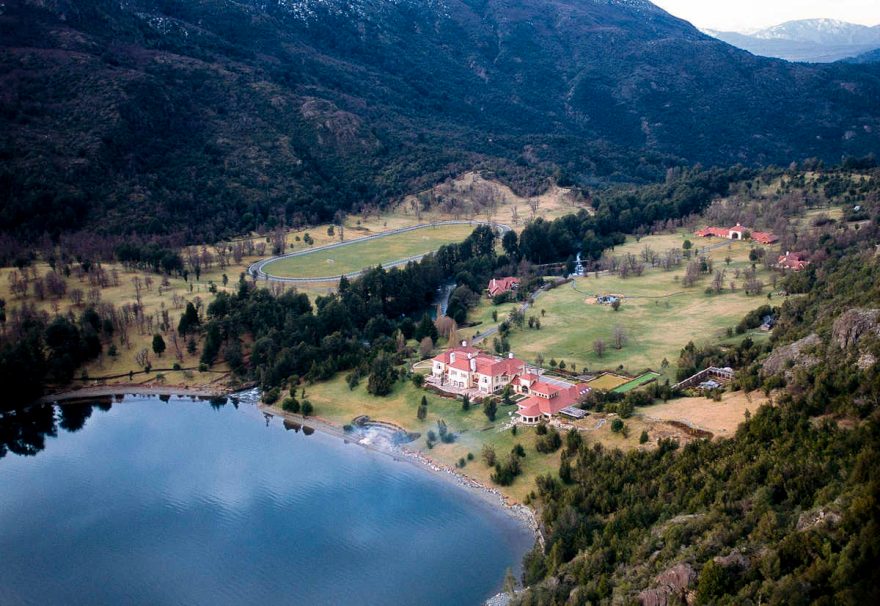
An aerial photograph Joe Lewis’ ranch on Hidden Lake, March 1, 2010 in southern Patagonia, Argentina. Francisco Bedeschi | dpa
Whether or not Lewis or his “right hand man” Van Ditmar were somehow involved in Irineo’s death and those of his wife and employee, there is no denying that their mysterious yet grisly endings cleared the way for Lewis’ purchase of Lago Escondido and the surrounding area. However, Lewis’ acquisition of this property, irrespective of the remaining Montero siblings’ willingness to sell, should never have been allowed for several reasons.
First, as per Argentine law, the sale of the property that Lewis has owned since 1996 is prohibited to a foreign citizen on national security grounds, given that the property is just 20 km from the Chilean border and thus, in foreign hands, could represent a grave national security risk. Second, it violates a local law dating back to 1969 that caps the maximum amount of land that any individual – Argentine citizen or foreigner – may own at around 70 hectares (~172 acres).
Third, it violates a provincial law passed in 1994 that created a protected natural area called the Río Azul Lago Escondido Natural Protected Area (ANPRALE), which included a significant portion of the land that Lewis would later buy from the Monteros. However, that law was amended in 1998, a few years after Lewis’ purchase, to remove the portion of his land that had previously been named a protected area under the control of the state. Federico Soria noted that the way in which the 1994 law was amended was blatantly unconstitutional.
One would think that the law would have prevented Lewis’ acquisition of the land long before Van Ditmar had first approached the Monteros about Lewis’ interest in the land. However, he was explicitly allowed to do so, despite the illegal nature of the purchase, owing to the general laxity of the local, regional and federal authorities towards wealthy foreigners looking to acquire Argentine land. As Lewis himself said in an interview with Gonzalo Sanchez in 2004, “I bought what they let me buy and here we are.”
The two-term presidency of Carlos Menem in the 1990s marked the reversal of more than 50 years of keeping and protecting areas of national importance and deemed strategic to natural security by permitting foreigners to buy a larger percentage of land than had been allowed since the passage of a 1944 law intended to preserve the territorial integrity of Argentina. Notably, when that law was created, the government of Edelmiro Farrell and Juan Perón expropriated several strategic properties owned by foreigners.
Yet, Menem’s presidency — which was thoroughly aligned with the “Washington consensus” — began, according to critics, violating the spirit of this 1944 law by issuing approvals of several million hectares to foreigners. Menem’s policies favoring foreign land purchases in rural areas have since been expanded by the presidency of Cristina Fernandez de Kirchner as well as that of the current president of Argentina, Mauricio Macri. Both of them have “friendly” relationships with Lewis and his associates, with the Macri a regular visitor of Lewis’ lakeside property in Patagonia.
Locals in El Bolsón have claimed that Lewis’ purchase of the Lago Escondido property – despite the legal obstacles – was the direct result of Menem’s policies. A member of El Bolsón’s community radio station FM Alas, who chose to remain anonymous owing to his father’s personal involvement in Lewis’ regional businesses, told MintPress that Lewis “had negotiated the purchase of the [Lago Escondido] property in meetings at the Casa Rosada [Pink House],” the Argentine equivalent of the White House, during Menem’s presidency.
MintPress was unable to confirm whether Lewis or his associates had visited the Casa Rosada while negotiating the property’s purchase. Yet Lewis has stated in interviews that “Menem sent us greetings and his best wishes when we opened [Lewis’ Lago Escondido mansion]” (Sanchez interview, pg. 61). Furthermore, Lewis has a notable habit of building close relationships with powerful Argentine politicians, including Macri. Macri has called Lewis “a friend,” defended him repeatedly, and even personally vacationed at Lewis’ Lago Escondido property.
The battle for Lago Escondido
Ever since his arrival to the area caused concern among some locals, Lewis has sought to win the good graces of the people of El Bolsón by acting as their benefactor — donating hospitals, building soccer fields and hosting annual activities and sporting competitions for locals at his property. This altruism is either embraced or rejected by locals, depending on whom you talk to. In keeping with the image that he has sought to cultivate among the townspeople, Lewis is often referred to as “Uncle Joe,” though it is spoken with either respect and admiration or derision and disgust.
Felicitas Libano, a member of the Assembly for the Defense of Water and Land (ADAT), told MintPress that Lewis has “integrated himself into nearly all the function of the city,” including its firefighters, police and other areas of the municipal government, and has “always tried to position himself as a benefactor.” According to Guido Augello, a member of local community radio station FM Alas, the townspeople are divided somewhat evenly into “people that like ‘Uncle Joe,’ people who hate him and people who don’t care.”
Lewis has also won over a portion of the townspeople and local businessmen through his patronage of select local services and his occasional hosting of small groups of locals for invitation-only sporting events and holiday celebrations. However, some have contended that Lewis receives many foreign guests, particularly from Israel.
According to the research of former French intelligence officer turned journalist Thierry Meyssan, Lewis has been inviting thousands of Israel Defense Forces (IDF) soldiers to his territory annually. In late 2017, Meyssan alleged:
Since the Falklands War, the Israeli army has been organizing ‘holiday camps’ in Patagonia for its soldiers. Between 8,000 and 10,000 of them now come every year to spend two weeks on Joe Lewis’ land.”
It is unclear if Meyssan’s information was the result of his time in France’s exterior intelligence service DGSE or independent research he conducted since becoming a journalist, as MintPress’ efforts to contact Meyssan were unsuccessful. Locals, journalists and researchers interviewed by MintPress could not confirm Meyssan’s claims. Yet, many of these locals and researchers said they had heard of those claims from other sources within Argentina, but also noted that they were speculative, given that no one but Lewis or his employees knows who visits the property beyond the aforementioned events where select locals are invited to attend.
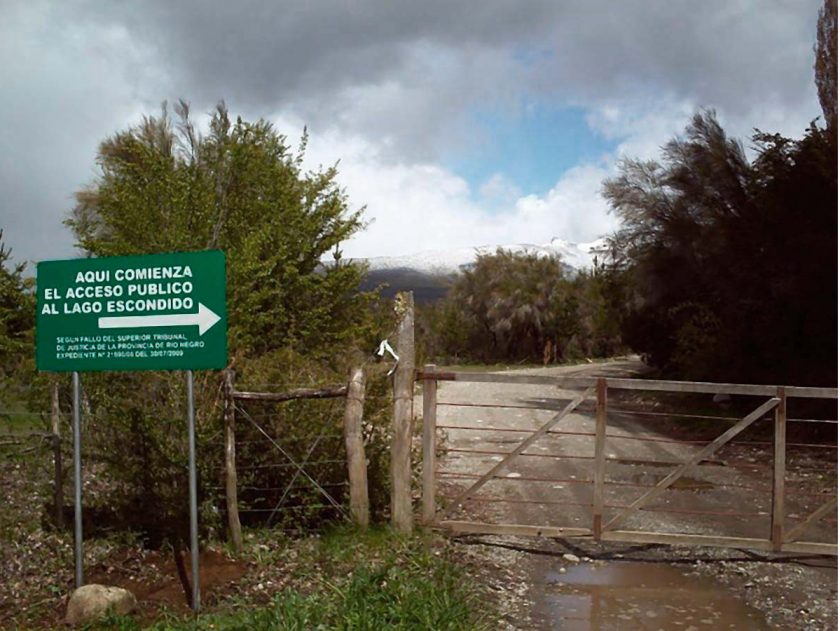
Tacuifi road leading to Lago Escondido, now blocked to public access, lies off of Argentina’s Route 40. The sign notes the 2009 Supreme Court ruling demanding the still-closed road be opened to the public. Photo | Revista Anfibia
Beyond the alleged IDF “vacations” on Lewis’ land, his presence in the area has been controversial for other reasons, namely for concerns that he sought to usurp key regional resources. Indeed, journalist Gonzalo Sanchez noted in his 2004 book Patagonia Sold: The New Owners of the Land :
In El Bolsón, there are more than a few locals and city council members that believe that, behind his [Lewis’] generosity, there are other hidden objectives, like the possible control of the water reserves of this part of Patagonia (pg. 50).”
Inklings of the truth in relation to these concerns were evident as soon as Lewis acquired the property surrounding Lago Escondido. This large mountain lake, which Lewis’ property surrounds, is the water basin for two important regional rivers, the Manso and Puelo, which later unite in Chile and drain into the Pacific. It is also the lake which feeds other nearby lakes including the Soberanía Lakes and Montes Lake, among others. Lago Escondido itself is estimated to contain as many as 400 billion liters (~105 billion gallons) of freshwater.
In Argentina, as is also the case in neighboring Chile, water – whether in lakes, rivers or seas – is a public right and public access to all bodies of water is guaranteed by law. This legal concept — likely foreign to Lewis and other Westerners, whose home countries often enshrine private property rights over the public’s right to vital resources — has been the most visible way in which tensions between Lewis and locals have manifested. It was also the first real test of Lewis’ resolve to carve out his “independent state” in Patagonia and keep locals out.
Lewis closed off the public road from the highway to the lake and also closed the private road he built at a separate point from public access. According to several locals interviewed by MintPress who had tried to enter the area, private security in civilian clothing prevent people from using the roads either by vehicle or on foot. Federico Soria, who has himself tried to enter the area on several occasions, described the guards to MintPress as “intimidating” and “aggressive” and also said that the Montero family, the old owners of the land, block one of the roads before it enters Lewis’ property and are “heavily armed.”
The only remaining path is a steep – and in places, dangerous – mountain path that takes at least two days in each direction to traverse. The path is poorly marked and maintained and is only usable in summer, as it is blocked by snowfall in other seasons. Every person interviewed by MintPress who had seen or traversed the path described it as being suitable only for “experienced mountaineers.”
In 2009, Lewis suffered his first major defeat in his efforts to keep locals out of his “parallel state” when the regional court ruled that the Tacuifi road — which connects the lake to the main highway, Route 40, and crosses Lewis’ property — be opened. The ruling stated that this must be done in order to “ensure access to Lago Escondido with appropriate signaling and ensuring transability.” The court gave Lewis 120 days to comply.
However, he didn’t comply and instead his regional associates began openly threatening any who tried to visit “his” lake. The clearest threat came from Van Dittmar himself in 2011, when he publicly stated that he and other Hidden Lake S.A. employees would defend Lewis’ private property by “fighting with blood, if we have to.” Van Ditmar also said that he would keep locals from accessing the lake “with a Winchester [rifle] in hand, with blood if necessary.”
In 2012, the region’s Supreme Court upheld the 2009 ruling, as did Argentina’s national Supreme Court a year later. However, Lewis and Van Ditmar refused to open the Tacuifi road, Van Ditmar saying that the treacherous but “very pretty” mountain path should instead be used to access the lake. Argentine President Macri also stepped in and echoed Van Ditmar, stating that the lake is even more accessible than before Lewis bought the property.
The court battle continues to today, after the Supreme Court of Río Negro in 2016 withdrew its previous ruling and ordered that a new hearing with different judges issue a new ruling. Critics accused Lewis of using extreme “political pressure” at the regional and local level in order achieve this very surprising ruling.
Despite that, locals continue to fight for public access to Lago Escondido and defend Argentina’s sovereignty over Lewis’ private empire. The main manifestation of this effort is an annual “March for Sovereignty,” the most recent of which took place in early February of this year. The march is organized by the Foundation for the Cultural Integration and Promotion of Water (FIPCA), which is run by former Argentine marine Julio Cesár Urien. Like the prior marches of the same name, its participants walked for nearly three days on foot over the mountain trail to arrive on the shore of the lake, which – as mentioned above – they were within their legal rights to do.
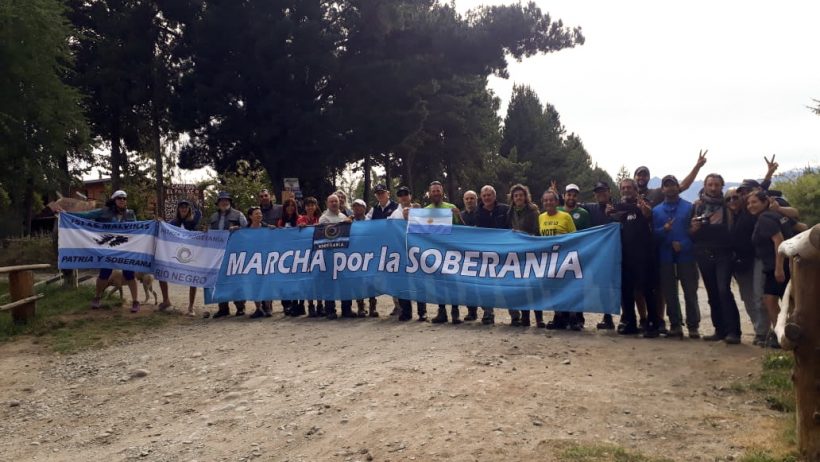
Participants in the 2019 “March for Sovereignty” pose for a picture at the beginning of their several-day journey to reach Lago Escondido by foot. Photo | FIPCA PRENSA
Upon arriving, they were met by Lewis’ private security as well as members of the Río Negro police, who cornered them and told them that they couldn’t even go to the bathroom without fear of arrest for trespassing, even though lakeshores are also legally considered public spaces. Guillermo Martín Caviasc — a journalist for Barricada TV, who was present at the demonstration — called the combination of local police and private security Lewis’ “private army” and remarked that the police officers present were “in a situation of subordination like if they were visiting a foreign state controlled by Lewis.”
Two participants in the march, Andrea Gatabria and David Ramallo, mounted inflatable kayaks with the intention of placing an Argentine flag in a small island in the middle of the lake, itself technically a public space. Before they made it to the island, two speedboats belonging to Hidden Lake S.A. circled the kayaks in an effort to capsize them while taunting them, asking “Do you know what it’s like to die from hypothermia?”
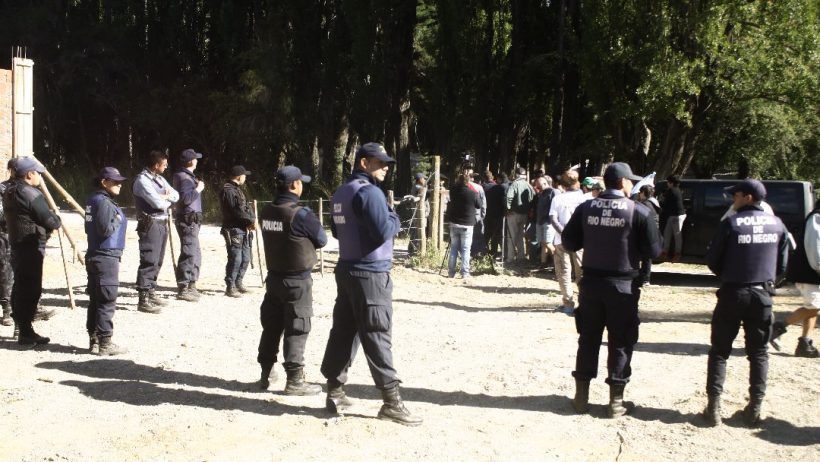
Participants in the 2019 “March for Sovereignty” pose for a picture at the beginning of their several-day journey to reach Lago Escondido by foot. Photo | FIPCA PRENSA
After half an hour of taunts that seemed more like death threats, Lewis’ private security knocked over the kayaks, leaving Gatabria and Ramallo floating in the freezing water. After several minutes, several witnesses stated that one of the security guards told the two kayakers “Well, now do you see what it’s like to die of hypothermia?” Gatabria and Ramallo were, after some time, lifted into the guard boats, but had spent so much time in the frigid water that both had to be hospitalized.
National Senator for Río Negro, Magdalena Odarda, demanded accountability for the actions of Lewis’ private security and local police and FIPCA has begun legal action against Hidden Lake S.A. for threatening the lives of march participants. Neither Hidden Lake S.A. nor Lewis’ Tavistock Group, which oversees his business interests in Argentina and elsewhere, responded to MintPress inquiries regarding the incidents against march participants.
While Argentines have routinely experienced intimidation and aggression when attempting to access the lake, some foreigners have had very different experiences. Take, for instance, Scott Leahy*, an American now living in Chile, who, during a past trip to El Bolsón, was able to waltz right through onto Lewis’ Lago Escondido property when he was in the company of two ex-IDF soldiers who had been there before.
Leahy told MintPress that when he was backpacking through Argentine Patagonia in 2010 with a Chilean friend, he had met and become friends with two young Israelis who had recently finished their service in the IDF and were staying at the same youth hostel. One day, these two Israelis offered to take Leahy and his friend to what they called a “secret beach” nearby.
They all piled into a car and, upon taking a gravel road off of Route 40, arrived at a gate that Leahy confirmed to MintPress was the Tacuifi road entrance to Lewis’ Lago Escondido property (seen in an image earlier in this report). Leahy was unsure about continuing, given that the gate was closed and, as a foreigner, he was unfamiliar with the area. However, the Israelis urged him on, saying that they had been there before and knew where they were going.
When the group of backpackers encountered Hidden Lake S.A. employees and guards, the Israelis explained that they were from Israel and wanted to bring their friends to the beach. The Lago Escondido employees told the pair that the group was not officially allowed to enter the property, but they could pass. Leahy didn’t think anything of it at the time, and told MintPress that he had assumed the pair knew the owner, though the Israelis never mentioned Lewis at all and they showed no interest in meeting with him either. This suggests that they were not personal friends of Lewis, but also shows that they knew that they could access the lake without problem, even in the absence of a formal invitation.
While this anecdote suggests that the claims of Lewis hosting thousands of IDF soldiers annually may indeed have something to them, it also serves as a very troubling comparison to the way Argentines have been treated when trying to access the very same lake. Indeed, if foreigners, Israelis in this case, were amicably waved through despite no invitation from Lewis or Hidden Lake S.A., why are Argentines who try to do the same met with such violence and aggression, particularly when they have a legal right to do so?
Stealing El Bolsón’s resources for his own use
Though public access to Lago Escondido has been a major issue of contention between Lewis and the people of El Bolsón since the late 1990s, concerns that the British billionaire was intent on controlling the region’s water supply multiplied when firms connected to Lewis began to move forward with what is often referred to as simply the “Laderas project.”
As early as 2004, a man named Cipriano Soria started telling his neighbors that he had “sold” his land in an area known as Pampa de Ludden (Ludden’s Plain) to Lewis. However, Soria did not technically own the land, which was a publicly-owned nature reserve, but was granted an easement by the provincial government of Río Negro to use its meadows to graze his livestock as long as he paid a “grazing license.” Despite the fact that it was neither legally nor properly sold to Lewis, Lewis began to make plans for the land — plans that ignored the fact that the area was and technically remains under several legal protections due to its ecological and strategic importance to the region.
Lewis intended to use this land to build a private airport in the area but was met by strong local resistance in 2005, including from the local group Assembly for the Defense of Water and Land (ADAT). Several members of ADAT live in Mallín Ahogado next to Pampa de Ludden, which provides the adjacent farming community of 2,000 with nearly all of its water. Felicitas Libano, who lives in Mallín Ahogado, told MintPress that the importance of this area as a critical water resource — as well as its ecological importance as an old-growth native forest — led it to be named a nature reserve that was supposed to be prevented from falling into private hands.
ADAT’s eforts were successful and Lewis’ plan for the area seemed to have been defeated or, at least, put on hold. Then, in 2009, the town voted on Lewis’ private airport, with more than 79 percent of voters opposing it. However, unluckily for the people of El Bolsón, Lewis had much bigger plans than just an airport and he wasn’t planning on letting local democracy get in his way.
From 2006 to 2009, legal arrangements were made between the ski center’s owner, the Club Andino Piltriquitrón, and the provincial government that opened up the local ski center at the Perito Moreno mountain to “third party” management.
Then, in 2009, Mirta Soria, Cipriano’s daughter, “inherited” the land from her father — land that he technically did not own yet was somehow granted permission to purchase from the state, along with another protected territory between Pampa de Ludden and the ski center, even though the state was forbidden from doing so by regional and local laws. Just six months after she bought this territory and sold more than half of it to Van Ditmar’s brother-in-law Samy Mazza. This new and very large area under Van Ditmar/Lewis control is where El Bolsón’s, in addition Mallin Ahogado’s, water reserves are located.
Soon after the land purchase occurred, two businesses appeared — Laderas of Perito Moreno Association S.A. and Laderas of Parallel 42, both of which are directly connected to Lewis and were given ownership of the lands in Pampa de Ludden and the other area recently purchased by Van Ditmar’s relative. That same year, both of these linked businesses proposed a “lottery” whereby the provincial government would select a private company to manage the local ski center. Laderas of Parallel 42 won the lottery.
Subsequently, the other Laderas company, Laderas of Perito Moreno, began plans to transform the land illegally acquired by Van Ditmar’s brother-in-law, Samy Mazza, as well as the portion still owned by Mirta Soria into a luxury subdivision of more than 1,000 luxury homes for wealthy Argentines and foreigners, along with a golf course, shopping centers, an artificial lake, and a private airport. This planned venture was subsequently promoted by pro-Lewis businessmen and media outlets as necessary for the successful development and improvement of the ski center.

Proposed plan for the Laderas project, a 1,000-home luxury subdivision complete with an artificial lake and a golf course. Lewis’ firm plans to place the private airport (not shown in this image) south of the lake. The project, located right in the center of a nature reserve, is connected to Lewis’ Lago Escondido property and sits atop El Bolsón’s water reserves.
With the court battle underway and the project still lacking approval from El Bolsón’s city council, the regional governor, Alberto Weretilneck – a well-known Lewis ally – teamed up with Lewis-associated local businessmen in an effort to strongly pressure El Bolsón’s mayor at the time, Ricardo García, to sign a pledge that, once legal issues were resolved, the project would be fast-tracked for approval. García refused and Weretilneck along with other Lewis associates in the area began to push for his resignation. However, local protests kept García in power and, before leaving his post as mayor, García issued a decree that temporarily prohibited the Laderas project from advancing.
Clearly unhappy with this turn of events, the Laderas firms challenged the suspension of the project in court. Around this same time, members of local groups that had opposed the Laderas project reported several incidents of violence and intimidating acts, including threatening phone calls, their cars being set on fire, and the burning of a radio station as well as a community center in Mallín Ahogado.
In the case of architect and local politician Luis Martin, he was threatened with “lynching” by two Lewis associates – local businessmen Juan Carlos Martínez and Fabián Tornero – and his home was later broken into by armed thugs, one of whom accidentally cut himself with his machete and later fled the scene. Before escaping, the man had told Martin, “They have you targeted, they are going to kill you.”
In a 2011 article in Tiempo Argentina, Martínez referred to Lewis as “my friend” and was noted as a regular participant in meetings with Van Ditmar. The same article goes on to note that, in those meetings with Van Ditmar, Tornero is “influential” and further notes that Tornero is a known associate of Lewis.
In 2015, after García’s decree was challenged in court by Lewis’ firms, a judge ruled that the decree was legal but had not been written properly and therefore cancelled it. Soon after, a new pro-Lewis mayor and city council took charge and quickly signed a legal agreement with the Laderas companies, allowing them to build a “smaller project,” while claiming that any attempt to block the project – as García had done – could lead to another costly, lengthy legal battle that the municipal government just couldn’t afford. However, as Guido Augello told MintPress, this was hardly accurate, given that the local government could have appealed the decision regarding the decree, suggesting that this was just a convenient excuse to fast-track the project.
A few months after signing this agreement with the Laderas firms, the city council held a public hearing at which the vast majority of attendees from the community overwhelmingly rejected and criticized the project. Not getting the response it had hoped for, the council held a “secret” extraordinary meeting — secret because they declined to give the public the required notice needed to register to attend and participate in the meeting. With no one having registered, Pogliano decided to keep the meeting “closed” and placed police officers at the entrances to keep the townspeople out by force. The council subsequently decided to approve the Laderas project. Angry locals moved to occupy local government buildings in response, where they were targeted by riot police with tear gas.
The move generated several large-scale protests in El Bolsón, which started in 2016 and continued into 2017. Local resistance to the actions taken by the city council and mayor in relation to the Laderas project included a citizen occupation of the main plaza for three months, which was subject to police intimidation and violence, as well as three major protests, including the largest in El Bolsón’s history. That march against the Laderas project attracted an estimated 10,000 to 15,000 participants — quite a feat considering that the town’s urban and rural population boasts little more than 25,000 total inhabitants.
The reason for this mass mobilization, according to Augello, was that “even many of the people that like Lewis or believe his ‘Uncle Joe’ image oppose the Laderas project” and its associated airport. It’s not hard to understand why, considering that electricity and water intended for the townspeople of El Bolsón could soon be diverted to the wealthy outsiders who buy homes in “Lewislandia,” a derogatory term used to describe the Laderas project by some locals.
Yet, not only does Lewis intend to privatize El Bolsón’s water reserves, he and those developing his Laderas project also plan to divert the tourism that keeps its economy alive by instead diverting traffic from the main highway (Route 40) into his newly planned “city,” according to Federico Soria, a member of the Union of Patagonian Assemblies who has extensively researched Lewis’ local businesses. In an extensive 2016 article on the Laderas project and other Lewis-linked ventures, Soria wrote:
It is the intention of the developers of Laderas to unite the complex to Route 40 through two paved roads that they plan to build north and south of El Bolsón…. The Laderas variant road would be an advantageous shortcut [around El Bolsón].… [This] would benefit Lewis but economically endanger the community of El Bolsón…”
Furthermore, in 2016, Lewis completed a hydroelectric plant on the Escondido River — in the name of another of his local firms, Patagonia Energía — which passes through his property and feeds into the lake of the same name. However, he was granted permission to do so only if he connected the plant to El Bolsón in order to help the town resolve its ongoing and highly problematic electricity shortages. Once the plant was connected to El Bolsón, Lewis would become the main electricity provider to El Bolsón, as its current, aging diesel generators would be shut down.
Yet, instead of following the planned route for the power line that would give power to El Bolsón, it was diverted to the planned zone for the Laderas project, where it has remained “stopped” for years, even though his license to use the river for electricity production expired in 2015 owing to his company’s failure to connect the plant to El Bolsón in the time allotted by the license. As in so many other cases, Lewis and his companies have suffered no repercussions and continue to use the river for private power production. This situation has led some locals to speculate that Lewis has no intention of ever providing hydroelectric power to El Bolsón and it is instead a resource being guarded especially for his planned Laderas villa.
In effect, Lewis and his local representatives are working the resources they have acquired — water, electricity and tourism traffic — away from the town of El Bolsón and to the new “luxury” town of Laderas they hope to build to its north, a town that is an extension of Lewis’ own “independent” state. If this project is allowed to be completed, the people of El Bolsón will face a new troubling reality of resource insecurity and see its economy falter, as a crucial stream of revenue is diverted to the personal pet project of a foreign and predatory billionaire.
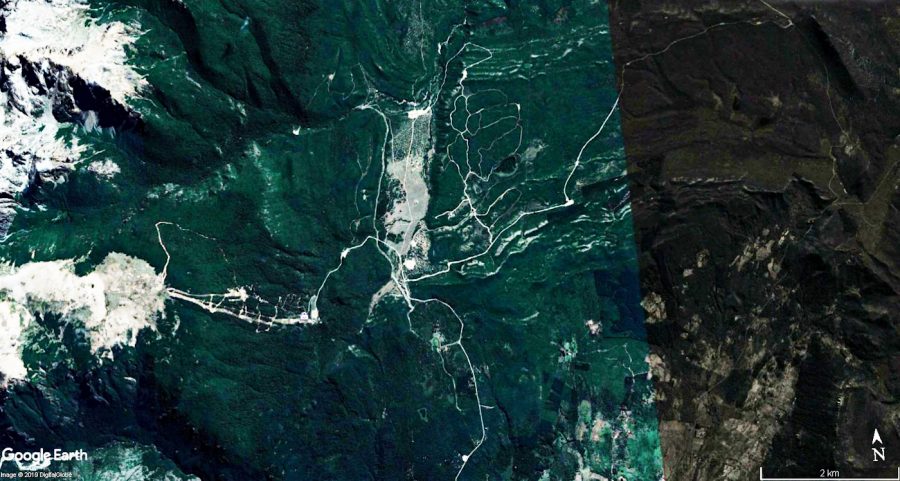
A satellite image taken last August shows land owned by the Laderas companies (center of photo) Roads for the planned “mini-city” are already being built, despite the fact that the companies are still not legally authorized to begin construction due to ongoing litigation. The already present ski center is seen on the left. Photo | Radio FM Alas, El Bolsón, Argentina via Google Earth
Yet, though Lewis won that particular battle in 2017, he is far from winning the war. Soon after the scandalous way in which the project was approved, the project again found itself challenged in court — placing it in legal limbo, unable to advance. Though the project is supposed to be blocked from moving forward until the conclusion of this latest legal battle, satellite images taken last August and shared with MintPress by local radio station FM Alas (shown above) reveal that Lewis’ businesses have already begun construction on the Laderas project, a clear indication that Lewis and his associates expect their impunity to continue.
Lewis’ Tavistock Group did not respond to MintPress inquiries about the Laderas project or the satellite images shown above.
The Joe Lewis “International Airport” — off-the-radar (literally)
Lewis’ “irregular” acquisition of Lago Escondido, the Laderas property, and his use of private security to block civilian access to the lake that is — by law — public property have long been decried as flagrant affronts to Argentina’s national sovereignty. Yet, while Lewis’ activities in and around Lago Escondido certainly do undermine existing Argentine laws, it is another Lewis-linked property in the Río Negro province that has done far more to erode Argentina’s national sovereignty.
Though Lewis’ plan to build an airport in Lago Escondido was technically approved but has not been able to move forward, Lewis – through his foreman Van Ditmar – purchased a sizeable property at the same latitude as Lago Escondido, but hours away on the Atlantic Coast. The property would soon become the site of Lewis’ private airport as well as a beachfront mansion. That airport, located south of Playas Doradas, was completed in February of 2008 and local media noted that its construction was “systemically hidden” from the public and was not subject to environmental impact assessments as normally required by law.
Most notably, however, there has never been any presence of Argentine customs or any other form of Argentine government control over what or who flies into or out of that airport, even though the airport is capable of receiving international flights. This point is particularly concerning in light of allegations that Lewis receives thousands of IDF soldiers annually on his property.
Joe Lewis’ private airport as seen on Google Maps
Furthermore, the Defense Ministry of Argentina has confirmed that not only is there no formal state control over what lands or takes off from this private airport, but that there are no radars in the area that even allow Argentine authorities to track nearby flight movements, including those of international flights. This means that no one but Lewis and his associates knows for sure how many flights land or take off from this area or where these flights originate or their intended destinations.
More shocking still, in 2010 then-Defense Minister Nilda Garré, in responding to a complaint from local politicians over the flagrant illegality of the airport, defended the airport’s presence by stating that it “could be used to facilitate rapid assistance of the state to locals in the event of disasters or emergencies.” To date, in the more than 10 years of its operation, it has never been used for any such purpose, according to those interviewed for this report.
The airport in Playas Doradas is roughly the same size as the airport in San Carlos de Bariloche (though some say it is larger), and is capable of receiving at least two large commercial-size passenger planes at a time. Much as with Lago Escondido, public access to the airport is denied, owing to the fact that the sprawling 15,000 hectare (~37,065 acres) property surrounding the airport is privately owned by a front company called Bahía Dorada S.A., which itself is legally owned by Lewis’ “foreman” Van Ditmar. However, the airport itself is owned by Westwind Aviation S.A. (formerly owned by Tavistock Aviation Argentina S.A., a subsidiary of Lewis’ Tavistock Group. Westwind Aviation S.A. is based at Lewis’ Lago Escondido property, as is Bahía Dorada S.A.. Neither Westwind Aviation S.A. nor the Tavistock Group responded to inquiries from MintPress regarding the lack of Argentine government oversight over the airport.
In order to realize the project, Van Ditmar – an Argentine citizen – had to be the owner of the property, as the area where the airport is built falls within a “National Security Zone” that prohibits land in that zone from being owned by foreigners on the basis of national security interests. In addition, the airport and the surrounding property, much like Lago Escondido, has a large and sophisticated private security presence.
The airport is estimated to have cost $20 million and Van Ditmar has publicly justified the airport’s existence by stating that Lewis not only “had the money” to build the complex but that it also made his ability to travel to his Lago Escondido property “easier.” This latter point is hard to believe given that the existing airport in San Carlos de Bariloche, which receives both private and commercial planes, is several hours closer to Lewis’ property than is his private airport in Playas Doradas. The notable difference between the two is that the private airport has no Argentine government oversight while the Bariloche airport does.
Few knew of the existence of the airport or the fact that access to the beach in that area had been effectively cut off by the Lewis/Van Ditmar project until a local woman, Elvira Linares, went on the television program “Documentos América,” hosted by Argentine journalist Facundo Pastor. On that program, Linares shared her experience of trying to pass through the now-private territory, noting that access to the ocean had been illegally blocked off. She also shared video footage she had taken of the massive, yet largely unknown to the public, private airport.
Mere hours after the program aired, Linares’ home was filled with bullet holes by still unknown assailants in what local media described as a blatant act of intimidation that led National Senator for Río Negro, Magdalena Odarda, to request that the government extend its protection to Linares, whose life was in danger. Efforts to contact Linares for comment for this report were unsuccessful.
Senator Odarda has arguably been the most well-known figure to demand accountability regarding the numerous irregularities surrounding the private airport. Odarda has, with limited success, repeatedly denounced the airport, on the basis of the fact that there is “no state control” over what or who passes through the airport.
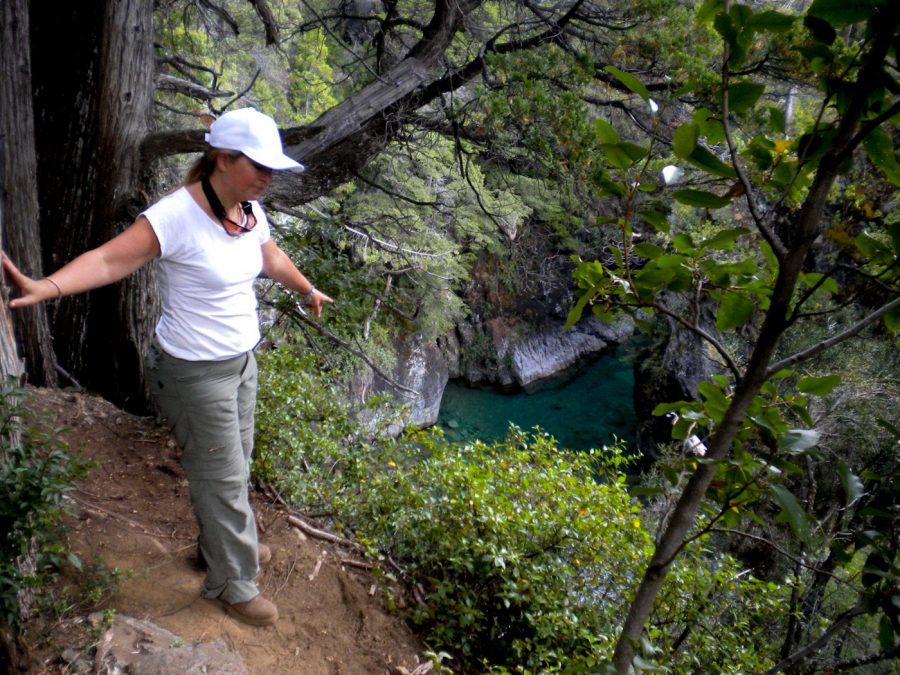
Senator Magdalena Odarda tours the publicly accessible road to Lago Escondido. Photo | Facebook
Odarda has also noted that the area where the airport is constructed is highly “strategic,” which poses a danger given that it is exclusively controlled by a foreigner, an Englishman. Odardo has pointed out that the airport is located on the important 42° parallel, which divides the regions of Río Negro and Chubut, and is only two hours away by plane from the disputed Falkland Islands, which are controlled by the United Kingdom but also claimed by Argentina. This dispute dates back to the 19th century and was the principal factor behind the Falklands War between Argentina and the U.K. in the 1980s, which many Argentines remember quite bitterly for the peace treaty Argentina signed after its defeat by England. Many Argentines have compared the document to the Treaty of Versailles that ended World War I.
Notably, there has been considerable evidence that Lewis’ airport has received planes from the Falkland Islands, which was the subject of a formal complaint made in 2010 to Argentina’s defense minister by then-governor of Argentina’s Tierra del Fuego province, Fabiana Ríos.
A well-oiled machine
Given the numerous laws that Lewis’ activities in Río Negro have broken at both the local and federal level, one would expect that somebody in the government – at least the local government – would hold him accountable. While some politicians like Magdalena Odarda and others have tried, the lack of impunity surrounding Lewis’ activities largely owes to his “friendships” with local and regional politicians as well as the country’s president.
One of the innumerable examples is Sergio Plunket. Plunket, who is in charge of Vial Rionegrina Sociedad del Estado (VIARSE), the regional body in charge of controlling public roads including the road leading to Lago Escondido, also works as a private “ecological consultant” for Lewis’ Hidden Lake S.A. Plunket also authorized the construction of Lewis’ Playas Doradas airport. Another clear example is Bruco Pogliano, El Bolsón’s current mayor, who is also Lewis’ long-time accountant in Argentina.
Another example that Gonzalo Sanchez noted (pp. 50-51) in his book, Patagonia Sold , is how Pablo Verani, ex-governor of Río Negro, started a long tradition of politicians making regular visits to Lago Escondido for Lewis-financed barbeque feasts, when he celebrated his win as the 1997 regional governor on the shores of the magnate’s privatized lake.
In addition to his undeniable influence among key local, regional and even national politicians, Lewis also enjoys considerable influence in the regional press and several former employees of his have become important figures in local and regional media. For example in 2016, according to local media, Dalila Pinacho, who long served as a lawyer and spokeswoman for Lewis’ Lago Escondido firm Hidden Lake S.A., became the director of the Nequén branch of Argentina’s National Radio, apparently through her “close” connections to local politicians.
Another journalist, Julio Álvarez — who described himself, to Gonzalo Sanchez in 2004 at an event in Lago Escondido, as Lewis’ “spokesman” — now works at a radio station in Viedma, Argentina, and was previously the El Bolsón correspondent for the regional newspaper Río Negro. Lewis also funds the local newspaper Ruta 40 and has stakes in other local newspapers such as El Cordillerano, Bolsón Web Patagonia, and El Ciudadano in Bariloche. Eliana Almonacid, who used to work for Ruta 40, told the national outlet Tiempo Argentina in 2014 that the Ruta 40’s director Nancy Aleuy, who also works for Hidden Lake S.A., told her that “Lewis had bought all the media outlets” in the region.
Lewis’ “Parallel State” is just the beginning
Lewis’ control over the local authorities and local press in Río Negro, and the complete impunity of his actions and those of his associates, have made it clear that in Argentina there is a de facto different legal system for oligarchs like Lewis and for the vast majority of Argentina’s citizens. This fact — in combination with the control Lewis and his associates exercise over the region’s key resources, including its water and energy production — has led to the creation of what some like Federico Soria have called a “parallel state” within Patagonia. However, this “parallel state” is, in reality, a microcosm of a much larger project currently underway that is aimed at the domination of the entirety of Argentine Patagonia by predatory oligarchical interests, the majority of which are directly connected to Lewis and his associates.
As will be explored in Part Two of this series, the Soros-led oligarch network, of which Lewis is a part in Argentina, has expanded its efforts to control Patagonia’s vast and strategic resources, including the region’s oil and gas wealth in addition to the domination of its freshwater resources and hydroelectricity production. Subsequent articles will then show that this effort is just the beginning, as this network and its close ties to the International Monetary Fund are being used to transfer ownership of vast state lands to their control in exchange for “debt relief.” The ultimate endgame appears to be the expansion of this “parallel state” — which Lewis has already helped to create in Río Negro and beyond, and which is controlled by small number of mostly foreign oligarchs — into a full-scale operation for extracting the region’s riches and exploiting its people.
Note: An sterisk (*) after a name indicates that a person’s real name was not used after they requested that MintPress not use their real name in this report.
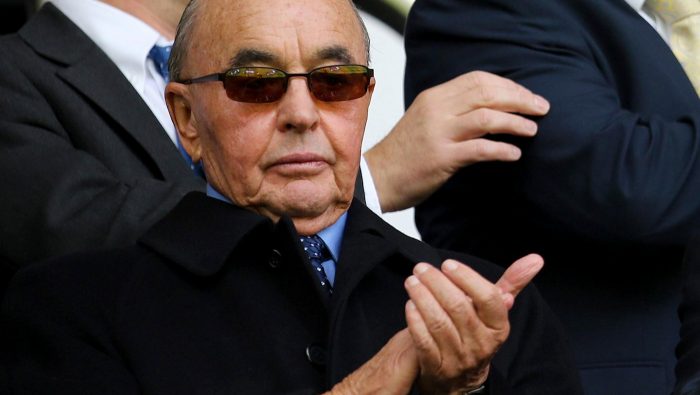
Top Photo | This undated photo shows British billionaire, Joseph C. Lewis, at a Tottenham Hotspurs football game in the United Kingdom. Photo | Reuters
Whitney Webb is a MintPress News journalist based in Chile. She has contributed to several independent media outlets including Global Research, EcoWatch, the Ron Paul Institute and 21st Century Wire, among others. She has made several radio and television appearances and is the 2019 winner of the Serena Shim Award for Uncompromised Integrity in Journalism.
US Taxpayers On the Hook for Nearly $1 Billion in Saudi Arabia’s Recent Missile Defense Purchase
By Whitney Webb | MintPress News | March 8, 2019
WASHINGTON — On Monday, in an all-but-unreported news item, the Pentagon announced that it would be paying $946 million to Lockheed Martin toward the installation of a missile defense system that was purchased — not by the United States government — but by Saudi Arabia. In other words, the Pentagon is paying nearly $1 billion to subsidize a purchase made by a foreign power.
In its announcement, the Pentagon referred to the payment as an “undefinitized contract action” that would be used, in part, to prepare Saudi Arabia’s current missile defense system for the installation of the $15 billion Terminal High Altitude Area Defense (THAAD) system manufactured by Lockheed.
The Pentagon said the payment was intended to prevent major delays in the delivery and production of the THAAD system, suggesting it was likely a hedge against past Saudi interest in the THAAD’s main (and cheaper) competitor, the Russian-made S-400. However, the payment is also authorized for use by Lockheed to pay for materials, tools and engineering development.
The Saudi THAAD purchase was a major component of the “$110 billion” weapons deal much touted by the Trump administration in 2017. However, many of the key purchases within that massive deal were never finalized, an embarrassment for what the administration had advertised as a major foreign policy success that would create jobs in the United States, even though many Lockheed products are actually manufactured abroad.
A better deal for a better product down the block
One likely explanation for the Pentagon’s willingness to pay such a significant amount to subsidize the Saudi THAAD system is the fact that the Saudi government had intended to purchase the cheaper and more effective Russian-made S-400 instead of the THAAD. Indeed, as MintPress News reported last year, the Saudis let the deadline for the THAAD deal pass on September 30 of last year without signing, and instead expressed interest in the S-400. The Saudis also refused U.S. government requests to disavow its interest in the Russian-made system.
Just two days after the THAAD deadline passed, Saudi journalist Jamal Khashoggi disappeared. His disappearance and alleged murder caused international outrage, surprising many observers, as even the most outrage-prone U.S. politicians generally turn a blind eye to Saudi human-rights violations. Senator Lindsey Graham (R-SC), who became one of the most vocal critics of Saudi Crown Prince Mohammed bin Salman (MBS) after Khashoggi’s disappearance, is also heavily funded by Lockheed Martin, which is the largest contributor to his 2020 re-election campaign.
The furor over Khashoggi’s death — which appears to have been, in part, influenced by Saudi lack of interest in the THAAD system — eventually pressured the Saudi government enough to sign letters of offer and acceptance for their purchase of 44 THAAD launchers, missiles and related equipment in November.
However, in order to entice the Saudis to “buy American,” more than political pressure appears to have been needed and it is likely that U.S. officials offered to “sweeten the deal.” Given this context, the Pentagon’s $946 million payout to prevent installation delays appears to be one of these concessions, as the U.S. government continues to scramble to keep its allies from buying the THAAD’s top competitor, the Russian S-400. Unfortunately for them, it’s the U.S. taxpayers who are footing the bill.
Whitney Webb is a MintPress News journalist based in Chile. She has contributed to several independent media outlets including Global Research, EcoWatch, the Ron Paul Institute and 21st Century Wire, among others. She has made several radio and television appearances and is the 2019 winner of the Serena Shim Award for Uncompromised Integrity in Journalism
Government to Facebook Pipeline Reveals a Corrupt Mix of Social Media and the State
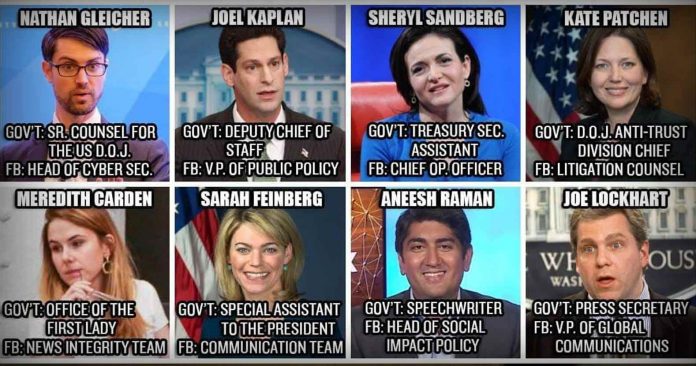
By Matt AGORIST | The Free Thought Project | February 2, 2019
As the Free Thought Project has previously reported, the phrase “Facebook is a private company” is not accurate as they have formed a partnership with an insidious neoconservative “think tank” known as the Atlantic Council which is directly funded and made up of groups tied to the pharmaceutical industry, the military industrial complex, and even government itself. The Atlantic Council dictates to Facebook who is allowed on the platform and who is purged.
Because the Atlantic Council is funded in part by the United States government—and they are making decisions for Facebook—this negates the claim that the company is private.
Since our six million followers and years of hard work were wiped off the platform during the October purge, TFTP has consistently reported on the Atlantic Council and their ties to the social media giant. This week, however, we’ve discovered something just as ominous—the government to Facebook pipeline and revolving door.
It is a telltale sign of a corrupt industry or company when they create a revolving door between themselves and the state. Just like Monsanto has former employees on the Supreme Court and Pharmaceutical industry insiders move back and fourth from the FDA to their companies, we found that Facebook is doing the same thing.
Below are just a few of corrupt connections we’ve discovered while digging through the list of current and former employees within Facebook.
Facebook’s Head of Cybersecurity Policy—aka, the man who doles out the ban hammer to anyone he wishes—is Nathaniel Gleicher. Before Gleicher was censoring people at Facebook, he prosecuted cybercrime at the U.S. Department of Justice, and served as Director for Cybersecurity Policy at the National Security Council (NSC) in the Obama White House.
While Facebook may have an interest in seeking out Gleicher’s expertise, this man is an outspoken advocate of tyranny.
After deleting the pages of hundreds of antiwar and pro-peace media and activist outlets in October, last month, Facebook made another giant move to silence. This time, they had no problem noting that they went after pages whose specific missions were “anti-corruption” or “protest” movements. And it was all headed up by Gleicher.
“Some of the Pages frequently posted about topics like anti-NATO sentiment, protest movements, and anti-corruption,” Gleicher wrote in a blog post. “We are constantly working to detect and stop this type of activity because we don’t want our services to be used to manipulate people.”
Seems totally legit, right?
The list goes on.
In 2017, as the Russian/Trump propaganda ramped up, Facebook hired Joel Benenson, a former top adviser to President Barack Obama and the chief strategist for Hillary Clinton’s failed 2016 presidential campaign, as a consultant.
While filling team Zuck with Obama and Clinton advisers, Facebook hired Aneesh Raman, a former Obama speechwriter who now heads up Facebook’s “economic impact programming.”
Highlighting the revolving door aspect of Facebook and the US government is Sarah Feinberg who left the Obama train in 2011 to join Facebook as the director of corporate and strategic communications. She then moved on after and went back to Obama in 2015 to act as the administrator of the Federal Railroad Administration (FRA).
David Recordon also highlights the revolving door between Facebook and the government. Recordon was the former Director of IT for Obama’s White House. He was also Engineering Director at Facebook prior to his role at the White House, and returned to the position after the 2016 election. He is currently Engineering Director for the Chan-Zuckerberg initiative.
Starting to see a pattern of political influence here? You should. But just in case you don’t, the list goes on.
Meredith Carden—who, you guessed, came from the Obama administration — joined the Facebook clan last year to be a part of Facebook’s “News Integrity Team.” Now, she’s battling fake news on the platform and as we’ve shown, there is a ridiculous amount of selective enforcement of these so-called “standards.”
In fact, there are dozens of former Obama staffers, advisers, and campaign associates who quite literally fill Facebook’s ranks. It is no wonder the platform has taken such a political shift over the past few years. David Ploufe, Josh W. Higgins, Lauryn Ogbechie, Danielle Cwirko-Godycki, Sarah Pollack, Ben Forer, Bonnie Calvin, and Juliane Sun, are just some of the many Facebook execs hailing out of the Obama era White House.
But fret not right wingers, Facebook likes their neocons too.
Jamie Fly, who was a top adviser to neocon Florida Senator Marco Rubio and who started his career in US political circles as an adviser to the George W. Bush administration, actually took credit for the massive purge of peaceful antiwar pages that took place last October.
“They can invent stories that get repeated and spread through different sites. So we are just starting to push back. Just this last week Facebook began starting to take down sites. So this is just the beginning,” Fly said in December.
Fly backs up his words with the fact that he works with Facebook’s arm of the Atlantic Council to ensure those dangerous antiwar folks don’t keep pushing their propaganda of peace and community.
And yes, this list goes on.
Joel David Kaplan is Facebook’s vice president of global public policy. Prior to his major role within Facebook, Kaplan took the place of neocon extraordinaire Karl Rove as the White House Deputy Chief of Staff for George W. Bush. Before that, from 2001 to 2003 he was Special Assistant to the President for Policy within the White House Chief of Staff’s office. Then he served as Deputy Director of the Office of Management And Budget (OMB).
Myriah Jordan was a special policy assistant in the Bush White House, who was hired on as a policy manager for Facebook’s congressional relations team—aka, a lobbyist. Jordan has moved back and forth between the private sector and the US government multiple times over his career as he’s made millions greasing the skids of the state for his corrupt employers.
So there you have it. Facebook, who claims to be a private entity, is quite literally made up of and advised by dozens of members of government. We’re ready for a change, are you?
Ex-Candidate Renois: Movement Demanding President Resignation to Repeat in Haiti
Sputnik – 07.03.2019
The US Embassy continues to support Haiti’s President Jovenel Moise despite an unprecedentedly large-scale protest movement and corruption charges against him. According to one of the opposition leaders, former presidential candidate Clarence Renois, US support is not enough to reassure the protesters.
Renois told Sputnik that if protests continue, the only option the US has to help President Moise retain power may be direct intervention. While Frantz Voltaire, director of the International Centre for Information and Documentation on Haiti, the Caribbean and the Afro-Canadian community noted that the incumbent president was elected with American support, while observers suspected the United States of manipulating the election.
Since the political crisis that broke out in Haiti on 7 February as a result of clashes between law enforcement and demonstrators, 26 people have died and 77 have been wounded in the country, according to the Inter-American Commission on Human Rights (IACHR).
Opponents of President Jovenel Moise have demanded his resignation and accused the president primarily of embezzlement of funds from Petrocaribe, a loan provided to Haiti by Venezuela.
“The Petrocaribe Foundation has launched an investigation. Venezuela has allocated several billion dollars in accordance with its assistance program to Haiti. These funds, unfortunately, were used for other purposes. The companies signed large contracts, but the projects were not implemented,” Frantz Voltaire told Sputnik.
“According to Haiti’s Superior Court of Auditors’ report, Jovenel Moise, who owns several companies, took advantage of these contracts. […] The president’s name appears on the list of suspects in this loud corruption scandal.”
Nevertheless, despite the unpopularity of President Moise, the American ambassador to Haiti, Michele Sison, expressed official support for the president, stressing that the United States recognises the legitimacy of Jovenel Moise’s government:
“We have always underscored, in our statements as well as our diplomatic conversations… our belief in the legitimacy of Haiti’s institutions and its elected officials,” Sison said in February.
According to opposition party leader Clarence Renois, it’s “opportunistic support”, since the non-recognition of the incumbent president could aggravate the crisis.
“If a major popular movement demanding the resignation of the president, like last week, will repeat, the US support will not change anything. The United States can’t decide on the current government.”
A similar situation occurred in 2004. “The US government supported the incumbent president [Jean-Bertrand Aristide — Sputnik] and the protest movement prevailed, overthrowing him. One-time support does not guarantee durable power,” Renois stressed.
“Youth groups and associations are dissatisfied with US policy in Haiti and often openly show their anger […] At such demonstrations, young people say that the US has too much influence.”
The Director of the International Centre for Information and Documentation on Haiti, the Caribbean and the Afro-Canadian Community, Frantz Voltaire, also noted an increase in anti-American sentiment.
“Fair or not, but the election of Jovenel Moise as the President of the Republic is attributed to the Americans. As in the case of his predecessor, Michel Martelly, it is believed that this president was imposed by the United States. And this is not only the opinion of society. Brazilian analyst Ricardo Seintenfus in his book, published two years ago, accused the United States of manipulating elections.”
According to Frantz Voltaire, in recent years, scandals associated with Western NGOs have badly damaged the reputation of the United States. The press spoke particularly negatively about the Clinton Foundation.
“There is a feeling of resentment towards American politicians. After the [2010] earthquake, it is not known where the international aid was directed. Bill Clinton has been accused of having promised a lot, but nothing has been done.”
“International aid was distributed by the US and NGOs, and, in both cases, it is not known where these funds went. There was no audit, no additional verification.”
According to data provided by the Associated Press, 33% of the $379 million collected for rebuilding Haiti was kept by the US government. According to CounterPunch magazine, of every dollar collected by the United States, only 42 cents was sent to NGOs to assist Haiti after the earthquake.
Israel pushing for Africa foothold with military training: Report
Press TV – March 4, 2019
A report says Israeli commandos are training local forces in more than a dozen African nations where Israeli arms exporters are already accused of being complicit in war crimes.
Israel’s Channel 13 on Sunday showed footage of Israeli officers coaching Tanzanian troops in hand-to-hand krav maga, hostage operations and urban combat, saying there is a dramatic rise in Tel Aviv’s military activities in Africa.
Prime Minister Benjamin Netanyahu has made inroads into Africa a key part of his agenda, becoming the first Israeli leader to visit the continent in 50 years in 2016.
“I’ve been in Africa four times in the last two years, that’s gotta tell you something,” Netanyahu said in a speech at an event in February.
Over the past two years, he has traveled to several African states in a bid to convince them to stop voting against the Israeli regime at the United Nations.
Israel is also said to be seeking to take advantage of insurgency and Takfiri militancy gripping parts of Africa to sell advanced military equipment to conflict-ridden states in the continent.
Tel Aviv’s policy to spice up ties with Africa, the report said, also features combined efforts by Israeli foreign ministry, military, Mossad spy agency and the regime’s so-called security agency, Shin Bet.
The report named Ethiopia, Rwanda, Kenya, Tanzania, Malawi , Zambia, South Africa, Angola, Nigeria, Cameroon, Togo, Ivory Coast and Ghana as among the African countries that Israel was seeking to stake out a niche.
Israel’s military cooperation with the African states possibly emanated from the fact that many of those nations take part in peacekeeping missions on the border between the occupied territories, Syria and Lebanon, it said.
It would be advantageous to Israel if these forces were led by Israeli-trained soldiers, said the report.
An Israeli delegation has reportedly been traveling to countries in Africa and “carefully” weighing requests for further military collaboration.
The delegation is taking into account how likely Israeli military expertise could be used in committing mass atrocities in the continent, the report said.
Israeli media reported in November that Tel Aviv was actively working to establish diplomatic ties with Sudan, as part of wider efforts to upgrade relations with central African countries.
The Israeli TV channel also reported that Israel’s ministry of military affairs recently summoned retired Maj. Gen. Israel Ziv for a hearing after the US accused him of selling $150 million in weapons to both sides of the civil war in South Sudan.
Israeli weapons which ended up in South Sudan extended the duration of the deadly civil war there, the Jerusalem Post newspaper has reported.
Last year, the US Treasury Department placed sanctions on the Israeli businessman for his role in the civil war in South Sudan.
A recent report by the London-based Middle East Eye said the head of Mossad met his Sudanese counterpart in Germany last month as part of a secret plan by Saudi Arabia, Egypt and the UAE to oust President Omar al-Bashir.
In January, Bashir was quoted to have lamented that he had been advised to normalize ties with Israel because a normalization would help stabilize growing unrest sweeping Sudan.
Can Netanyahu Risk A “Battle Of Missiles” With Syria?
By Elijah J. Magnier | American Herald Tribune | March 2, 2019
It was the eleventh and the most important meeting between the Russian President Vladimir Putin and the Israeli Prime Minister Benjamin Netanyahu. The Israeli visitor heard clearly from his host that Moscow has no leverage to ask Iran to leave or to stop the flow of weapons to Damascus and that Iran will remain in Syria and that Russia has no say over the Syrian-Iranian relationship. Moscow informed Tel Aviv about “Damascus’s determination to respond to any future bombing and that Russia doesn’t see itself concerned”.
According to well-informed sources in Damascus, “the few hours of the visit of President Bashar al-Assad to Tehran were enough to send messages in all directions. The first message was the fact that the visit took place just before Netanyahu’s scheduled meeting with Putin. The second message was to display the robust cemented relationship between Iran and Syria, immune from any outside interference from the US or Russia and that Syria has the sovereign right to choose its strategic partners. The secretive nature of the visit – not even Russia was informed in advance – speaks volumes about the Syrian-Iranian relationship”.
“Russia exerted pressure on President Obama to prevent the US from bombing Damascus on the false flag pretext of chemical weapons and set up its military apparatus in Syria in 2015. Russia helped Syria to victory, imposed a political dialogue, and protected Syria in the international arena, speeding up the return of refugees (the US wanted to use the refugees in a failed attempt to gain concessions that it could not obtain by war). Moreover, Russia is putting pressure on many countries to contribute to the reconstruction of Syria and to resume diplomatic relations with Damascus. Russia is a strategic ally but exerts no power of control over the central government”, said the source.
The strategic relationship between Tehran and Damascus started – under the “Axis of the Resistance” – long before the war. In 2011, Iran rushed to support the central government to prevent the US-EU-Arab “regime-change” plan. It thwarted the transformation of Syria into Islamic Emirates ruled by Takfiri jihadists. Tehran offered oil, financial and military support to Syria throughout its seven years of war and rejected any proposition, even by Russia, to change President Assad for any other Syrian personality, as repeatedly proposed by the US.
Russia enjoys an excellent relationship with Israel and intends to maintain that relationship. Iran, on the other hand, is ready to wage war against Israel if Netanyahu ever decides to bomb significant strategic objectives in Syria. The head of Iran’s National Security Council, Admiral Ali Shamkhani, said Iran will respond by hitting Israeli targets if Israel bombs Syria. The same warning was delivered by Syria’s Ambassador to the UN, who recently warned that his country will retaliate if Damascus is bombed.
Since these last warnings, Israel has refrained from violating Syria sovereignty (except for one insignificant artillery bombing against an empty position in south Syria). Iranian officials in Syria had a curt response to their Russian counterparts who asked to have details on the locations of their military deployment in Syria. Iranians told the Russian military to inform Israel that the Iranian positions have been integrated with those of the Syrian army all over Syrian territory, and that any bombing of the Syrian army will hit Iranian advisors.
Iran in effect asked Russia to inform Israel that any future Israeli attack will trigger a retaliatory response, since the presence of Iranian advisors in the Levant is at the official request of the Syrian government. It is legitimate for all allied forces, if under attack, to respond with the similar firepower against any future aggression.
Netanyahu seems willing to bomb Syria. Nevertheless, if Iran and Syria stand by their promised response, he will not be able to stop the precision missiles ready to be launched against Israel. The Israeli Prime Minister is not aiming to dislodge Iran from Syria, an objective he knows to be impossible. Neither can he aspire to destroy Syria’s military capacity because Russia continues to supply Damascus with highly sophisticated weapons. His only plausible objective is an electoral one, with the goal of escaping imminent indictment for bribery charges related to corruption. A second term may postpone his indictment and prolong his immunity.
However, if the Israeli Prime Minister decides to bomb Syria, his decision will have a boomerang effect, especially if Syrian missiles hit deadly targets in the heart of Israel. Will Netanyahu take the risk and bomb his political future? It is his decision.
Corporate and “Progressive” Democrats Threaten Medicare Itself
Sanders, Jayapal, and more…

By Charles Andrews | Dissident Voice | March 1, 2019
The Democratic Party won a majority in the House of Representatives in the November 2018 elections by making health care one of its top “messages.” Yet events from Bernie Sanders’ bill of 2017 to legislation that “progressive” Representative Pramila Jayapal introduced on February 27, 2019 show that the Party is on its way to destroy Medicare.
For decades activists identified the prize as “single payer health care.” The program would issue a Medicare card to everyone, like the one senior citizens get now. The card would be good at any doctor’s office, clinic, hospital, laboratory, and prescription pharmacy. These largely private businesses would be reimbursed from a public single-payer fund. The fund would receive broadly collected tax revenues; the patient would pay little or nothing at the reception desk, and no monthly premium. This is guaranteed, comprehensive health care.
In other words, single payer is Medicare for all, carried to completion by eliminating Part B premiums and by more comprehensive coverage including prescribed drugs.
Health care activists always agonized over the colorless name “single payer.” A few years ago many of them began to speak of Improved Medicare for All. Actually, it had been in the title of the benchmark bill, H.R. 676, when congressperson John Conyers introduced it in 2003. A few years later he shortened the title to The Expanded and Improved Medicare for All Act. The text remained stable, and although the bill went nowhere in Congressional committees, H.R. 676 became the centerpiece of organizing. It is readable, only thirty pages of double-spaced large type. Hundreds of trade union locals and councils endorsed this model legislation in a steady stream year after year.
The health care industry has enjoyed a long-term phase of expansion, like railroads in the latter half of the nineteenth century. Back then, the new way of moving heavy goods and people was amazing and useful; today, new biological and biochemical understanding makes possible longer life, survival from a heart attack, restored clarity of vision, and so on. In both situations, capital has had strong pricing power and taken fat profits. And just as anger at railroads swelled into a populist revolt against The Octopus (Frank Norris’ novel about the Southern Pacific railroad corporation), people today are angry at insurance corporations, pharmaceutical monopolies, and hospitals, whether or not they call themselves “non-profit.”1
Opinion polls measure growing support for single payer health care for all. Employers continue to raise the employee cost of coverage, or simply not provide a health benefit. Health insurance purchased individually on the so-called exchanges of the Affordable Care Act (“Obamacare”) turns out to be full of exceptions like a slice of Swiss cheese.
Sanders Promotes Health Care for All Then Undercuts Conyers
Popular support erupted into a political force when Bernie Sanders launched his presidential campaign at the end of April 2015. Record-breaking crowds filled his rallies around the country. The top three issues in a Sanders speech rotated – sometimes including inequality of wealth and income, sometimes climate change – but he always revved up on health care for all. It had been the cause of a few thousand health care activists. Now Improved Medicare for All became a challenge to the neoliberal establishment. For the first time in forty years, people were on the verge of a mass campaign for a major gain in their quality of life and their security.
It did not happen. Sanders did not win the Democratic presidential nomination. He returned to the Senate, making an implicit or private deal with the party: he would speak as a independent progressive, but he will act on all serious matters as an unannounced Democrat.
Doing something about health care for people largely fell out of public view. Health care activists carried on. Policy aficionados spun proposals. Sanders had used the issue in his campaign, but sustained mass organizing for it did not happen.
Then in September 2017, senator Sanders introduced his “Medicare for All Act.” S. 1804 is three times as long as H.R. 676, and the reader must unravel cross-references within the text. Sanders made no mention of Conyers’ H.R. 676 at his press conference. Since then, no one has asked him the obvious question: Why didn’t Sanders simply introduce the text of H.R. 676 in the Senate?
The “Buy-In” Trap
Sanders’ bill would actually undermine Medicare. It would set up a “Transitional Medicare Buy-in Option and Transitional Public Option.” Sanders portrayed it as a four-year period (longer if necessary) to bring people of age 55 or over into Medicare, then down to age 45, then down to age 35, then everyone. This scheme is the very opposite of guaranteed single-payer health care for all.
How is Medicare financed today? Most of the money comes from payroll and income tax revenues, not enrollees’ Part B premiums, by a ratio of 3½ to one.2 We all pay into Medicare. At the moment when someone needs care, she gets it, period – without financial worry. That is the single-payer principle, and Medicare implements it, although not entirely, since enrollees must keep up-to-date on their Part B monthly premiums, and there are some co-payments for services.
Expanded and Improved Medicare for All would eliminate premiums and co-pays. That is what H.R. 676 declared, but in Sanders’ S. 1804 people younger than 65 could “join” Medicare by paying fat monthly premiums (a “buy-in”). People who want to sign up this way would use the notorious Obamacare exchanges.
Trade union campaigners for genuine Medicare for all, H.R. 676, wrote in a December 11, 2018 letter:
Unlike HR 676, S 1804 inserts supposedly incremental steps of public options and Medicare buy-ins for four years prior to arriving at a real single payer plan. Because S 1804 expands care while maintaining the private insurance companies, costs will skyrocket before the savings of single payer kick in. The incremental steps will become a roadblock rather than a path to single payer. Perhaps the worst part of this inclusion of the public option and the Medicare buy-in is the reinforcement of the false notion that there should or must be transitional steps to single payer. Neither the public option nor the Medicare by-in are based on sound policy. To place them in the bill for even a short period of time endangers the single payer goal.
— All Unions Committee for Single Payer Health Care, HR 676, Kay Tillow, coordinator
It is a neat trick: under the guise of expanding Medicare, you make it more dependent on premiums. You change it from a public good, like the neighborhood fire station, into a commodity insurance product that individuals buy. You make health care dependent on the patient’s finances.
This perversion of Medicare is not only a fraud upon people of age 55, 45, or 35. It is a threat to Medicare itself. Whenever Medicare seems headed for a financial crunch, real or conjured, the pressure in Congress will be to shift more and more toward a premium- and co-pay-financed program rather than one supported by general and progressive tax revenues – and to take chunks of medicine out of Medicare.
An independent in name but a Democrat, in fact, senator Sanders at his press conference happily introduced several corporate Democrat co-sponsors of his bill. Behind closed doors he had let them write sections of S. 1804! The public option section was written by senator Kirsten Gillibrand of New York. “One part of the bill that I worked with my colleagues to put in was the ability for every American to buy into a nonprofit public option as part of a four-year transition…,” she said during the news conference introducing the bill.
A public option is a competition with insurance corporations rigged in their favor. They know how to repel potential enrollees who are likely to need expensive care. A government health plan cannot and, of course, should not play that game. It can either raise premiums, or it can turn the program into something like its poor cousin Medicaid. Either way, it cannot become improved Medicare for all.
Democratic Party: “Death to H.R. 676!”
Two important bills stood in contradiction to each other: one for Expanded and Improved Medicare for All (H.R. 676), the other a threat to Medicare itself (S. 1804). Conyers’ bill has been the acknowledged model legislation since 2003; Sanders introduced his in 2017.
But words do not move on their own. The corporate Democratic Party soon put H.R. 676 on the chopping block. Representative John Conyers was pushed out of Congress in a #MeToo incident, resigning from a hospital bed, denying the charges but not up to the rigor of a fair hearing if he could get one.
Somehow, sponsorship of H.R. 676 went to new congressperson Pramila Jayapal. 3 She immediately announced that she was in consultations to rewrite it. In the meantime, she surrendered the number 676 that had been reserved for Conyers’ bill since 2003. It was issued to military legislation on January 17, 2019.
After the Democrats won control of the House of Representatives in the November 2018 elections, it became more urgent for them to gut single payer health care for all. Otherwise, they might have to deliver. Representative Nancy Pelosi, during a post-election whirlwind of bargaining to make sure she became Speaker of the House, agreed to help advance the same scheme that senators Sanders and Gillibrand had put into S. 1804: a buy-in to a premium-based option for people age 50 to 64. Jayapal, who also praised Pelosi during her run for Speaker, spoke out of both sides of her mouth. “I would prefer to have a reduction of the age of Medicare so that more people could qualify but not a buy-in, because that continues the problems that we have right now.” She said lowering the eligibility age “would be an appropriate way to go where we’re taking a step forward towards a system that will ultimately cover everybody.”
The Buy-in Trick Again
Representative Jayapal introduced H.R. 1384, her replacement for the Conyers’ model, on February 27, 2019. The 119-page bill is a masterful card trick. On one hand, it maintains the ban on premiums and co-payments, and it specifies a broad list of covered medical services, including some never proposed before in such legislation.
On the other hand, Jayapal copied Sanders’ big step backward – an optional “buy-in” transition period with premiums, only shortened from his four years to two. (After the first year, minors up to age 18 and people 55 and older would move automatically into the new system.) H.R. 1384 states:
The Administrator shall determine the premium amount for enrolling in the Medicare Transition buy-in, which may vary according to family or individual coverage, age, and tobacco status,… (H.R. 1384, Title X, Subtitle A, Sec. 1002 (e)(A))
Since Conyers introduced H.R. 676 in 2003, his bill never had a premium-based buy-in. Why does Rep. Jayapal think a buy-in period is necessary?
With a buy-in transition, the first experience people would have with the new system would be yet another commodity insurance plan with monthly premiums. This is a recipe for political failure. During those two years the tentative new system would soon be under attack as financially unworkable and just not popular enough.
People could buy in if they wished as individuals through the notorious Affordable Care Act exchanges (“Obamacare”). Because of the extensive benefits, the plan would be one of the most costly choices. Unaffordable for most as an individual premium plan, trying to compete in an unreformed health care system with its bloated costs, the buy-in would attract few enrollees. Enemies of genuine universal health care will pounce on the result, demanding that genuine Medicare for All be postponed and turned into a supplement of one kind or another to corporate health insurance.
Only H.R. 676 delivers guaranteed healthcare for all, the equal care for all of which our advanced society is capable. Bernie Sanders and Pramila Jayapal, just like openly corporate yet arguably less devious Democrats, cower before insurance capital, pharmaceutical capital, hospital capital, etc. These parasites demand that healthcare be a set of commodities that some can afford and others cannot. The people or the dollar – that is the inescapable choice.
- A nominally “non-profit” hospital today is not the church-run charity that it might have been a hundred years ago. Non-profit simply means that the corporation is tax-exempt. It does not pay dividends to stockholders, but it still makes a profit. Banks share in the loot, and layers of executives are paid millions of dollars. Affiliated for-profit clinics and labs may suck profits out under cover. Examine the Sutter Health and Kaiser hospital chains in California, for example.
- Medicare trust fund trustees’ report, 2018, pp. 45 and 78.
- Jayapal went to elite Georgetown University, got an MBA after that, worked on Wall Street on leveraged buyouts, switched to executive positions in several nonprofits, sat a mere two years in the Washington state senate, and won election to the House in 2016.
Charles Andrews is the author of The Hollow Colossus.
What Strange Corruption
The Racist Venezuelan Bourgeoisie’s Accusations Against Chavistas Are Pure Projection
By Sassy Sourstein | Cien Flamingos | February 21, 2019
Social media truly is the great democratizer. Where else can Twitter trolls and bot armies create a web of baseless rumors that make their way into the empire’s leading publications? For example:
“Maduro is a murdering criminal starving Venezuelan children while he loots the country like Chavez did. When supposed socialist Chavez died the richest Venezuelan in the world was his daughter w billions. Same w Maduro. Looting Venezuelan wealth. Giving it to himself & Cuba!” (source)
So much to unpack, but this is a template used throughout social media in various forms. Make unsourced allegations of mass murder, purposeful starvation (especially of The Children), corruption, and looting. This is a more sophisticated version (really!) in which Chávez is separated from socialism with the word “supposed,” meant to give the accuser some leverage on the left. You see, corruption is what ails Venezuela, not socialism necessarily. Much of the rest has been thoroughly debunked — there is a crime problem but no death squads, there have been a few dozen deaths in years of violent right-wing riots but no campaign of official slaughter of “protesters,” and frankly Cuba has paid for its oil many times over with solidarity and other material support to poor Venezuelans. What persists — in right-wing AND left narratives — is the corruption boogeyman. The tweet above is truly tapping into a rich vein of existing ultraleftism, in which the Bolivarian revolution isn’t socialist at all, but merely an emerging, competing bourgeoisie. I hope here to discuss and counter just some of this bullshit.
First, the claims about the Chávez family are based on the thinnest, most laughable evidence. For Hugo himself, the British tabloid Daily Mail cites a “respected analyst” from a fake “criminal justice” outfit run by a guy with 300 followers. Twitter user Bernardo Canto did the research on this lie and traced it back to a Scribd post devoid of citation or source material. Apart from that, there is absolutely zero evidence that Chávez “died rich,” as they say — which is a pretty idiotic way to do massive corruption.
As for María Gabriela Chávez, why, there must be reams of evidence against her. Well. Get a load of this.
Canto delved into these accusations uncritically published all over corporate media, including Forbes. The claim in Forbes is credited to known CIA front Diario Las Americas, based in Miami, which, “as it happens,” is now owned since 2013 by the Venezuelan backers of opposition presidential candidate Henrique Capriles, himself accused of corruption by the Maduro administration.
It all literally boils down to a receipt shown on a tabloidy TV news show whose host is a Cuban-American Republican who ran for Congress to represent Miami. That receipt? Look for yourself:
If you think that, within the United States, ATM receipts say at the bottom “United States,” well, charitably, you’ve never used an ATM here. And the address is that of the Venezuelan consulate, not any bank. Another mistake made on this truly pathetic fabrication, is that in the US we use commas, not periods, to denote whole numbers. Of course there is no way to verify if this is Amb. Chávez’s card number, and the scammer who made this knows at least that. Aporrea already debunked this — there is no “Frabz Federal Bank,” as any US resident or a quick Google search will tell you. Frabz is literally a fake ATM receipt generator. Nevertheless, Diario Las Americas claims that the reporting of supermarket-tabloid caliber blog Maduradas.com is “precise and trustworthy,” which of course makes any claim of journalistic rigor in that entire operation a preposterous notion.
Endless insinuations of impropriety against Venezuelan officials litter the internet from troll comments on up to The New York Times. The Atlantic published a particularly nasty set of libels against María Gabriela Chávez, all caged in careful transitions and caveats so as not to actually be required to provide proof. Everything from how much public money she spends (even though she’s a billionaire!) to alleged import corruption (again with no evidence provided) to comments on her musical ability. It even gives credence to a conspiracy theory that her ambassadorship was given so that Cuba would have a trojan-horse advocate at the UN. This is pure smear, a series of fevered speculations, and yet there it is in a leading light of the liberal media.
The rest of the Chávez and Maduro clans’ children are targets as well. Check out this nutty Daily Mail post published presumably to contribute wind to the sails of the ongoing coup attempt. All the María Gabriela claims are breezily restated with no attempt to corroborate, but the “accusations” against her youngest sister Rosinés are uh… well she held up “a fistful of dollar bills” — yes, ONE-dollar bills — and well, goes to school in Paris where, we are assured, she is “care free.” And then of course there’s the time Maduro stopped in Turkey to eat a steak, which is outrageous for the president of a country on his way home from trade talks in China. Diosdado Cabello, a leading PSUV member and one of Chavismo’s most efficacious orators, is mentioned for being accused by the US government of drug running but even this is admitted to be unproven. (More on narco allegations in a future post.) Cabello’s daughter Daniela is mentioned because she is pretty. Yes really. The first lady Celia Flores’s children are said to have spent $45,000 at a hotel in Paris, though the claim seems to originate with a Spanish tabloid that did some paper napkin math and has absolutely no sources whatsoever to confirm any of it — assuming the stay itself even happened.
If Maduro has a billion dollars, if Chávez had two to four — depending on whom you ask — billion fucking dollars, why would they stick around Venezuela suffering endless ridicule, threats and even attempts on their lives, and the general stresses of being responsible for the running of an entire country? Is it just megalomania against all odds? Do you think Maduro feels powerful against all that he has to deal with right now? The prospect is risible, they could buy an entire country with that amount of money and yet there they stay, ready to go down with the ship if the empire torpedoes it. What strange corruption! Something isn’t adding up, probably because it’s all lies. We should apply a high level of skepticism to any claim we see about the empire’s targets, especially if they’re at the top of the news cycle.
There’s also the matter of the so-called Bolibourgeoisie, nouveau-riche types who are said to have leveraged the revolution for personal gain. It’s no secret that — especially after the 2002 coup — the Bolivarian project created a tactical alliance with certain business interests in the country. But reports detailing the purported gluttony and profligacy rarely name anyone and make it clear that this “plugged in” wealthy set is just a consequence of 70% of the Venezuelan economy remaining in private hands. Companies that contract with the state are, of course, compensated, as they are anywhere in the world. These private companies are for profit and these profits are, of course and unfortunately, distributed to the owners and as in any capitalist society, they are free to use this wealth for any idiotic frivolous thing they please.
From personal experience living in Miami, an old-guard Venezuelan typically makes a judgement on the “legitimacy” of the wealth of say, someone exiting an expensive car based on their complexion and features. Darker and more native-featured people are assumed to be Bolibourgeois. They’ve done nothing different from a typical businessman — the white expats are just mad that black and indigenous people may have muscled their way into what should be a purely European- or Arab-descended endeavor.
There’s no evidence that these “plugged-ins” are responsible for the economic problems in Venezuela. After all, some of the most famous episodes of Latin American corruption and economic upheaval happened during the IMF-obedient regimes of the 1990s in which populist polices were rolled back, privatization ran rampant, and austerity reigned.
Real corruption is when you warehouse food to create artificial scarcities and deliberately provoke hunger. The parties who are purposely starving the Venezuelan people are the same types as in Chile who stoked privation and misery in the campaign to overthrow Allende. In Chile we know they were kept solvent by CIA money, and we can assume the same sorts of economic support exists in the case of Venezuela. In addition to smaller importers and producers being able, through whatever means, to create very telegenic scarcities of certain products, there are conglomerates whose resources are deeper, and in whose interests an overthrow is even more intensely represented, than what is available from US intel schemes.
Empresas Polar, makers of the ubiquitous harina PAN used in every single household to make arepas, has had it out for the Revolution from day one. Despite state and communal efforts to break their stranglehold on the corn flour market, their generations-deep imprint on the Venezuelan household rich and poor has persisted. If anyone “retains the ability to keep its products off the shelves just as readily as its ability to keep them on,” it’s La Polar. This is due to their still-gigantic home market share and, ironically, their being a major beneficiary of Venezuelan state subsidies for food importation. In addition, Polar’s various corporate vehicles in the US benefit from United States subsidies on corn for their many products which are sold in a growing market of quite affluent Venezuelans in the US. With all these resources at its disposal, creating artificial scarcities in a comparatively low-revenue market would be a minor line-item on Polar’s books.
There’s also the phenomenon of the “raspao,” or scrape. I don’t pretend to understand all the ways that currency can be manipulated, but merely printing too much money isn’t responsible for a one-million-percent unofficial inflation rate. For many years the Venezuelan state offered USD at an official exchange rate, for imports and travel, etc. People could buy dollars at this official rate with credit cards and then immediately convert these dollars back into bolivares in the black market — instant profit. On a trip to Mexico City last year I had a Mexican tell me with great excitement about how local Venezuelan friends of his who were involved in the scam used the profits to live well in the most exclusive neighborhoods. While the practice seems to have been curbed in recent years, the damage to the currency rate is done and the tightening sanctions compound it. I can only speculate, but with probably more certainty than a Eurotrash tabloid, that some of my Venezuelan neighbors themselves started their own nest eggs by ripping off their country. This truly is corruption, and though official currency policy is what facilitates it, it’s private criminals who take advantage, destroying their country’s economy while they live it up in exile.
The ultimate corruption is when you make millions through inheritance and other people’s labor. The accusations of the elites of Venezuela are a form of projection: they are the corrupt parasites who for generations have fed off the productive people of Venezuela, as in all nations. The same author as the Atlantic Chávez smear list — proud putchist! — has an entire post about the watches worn by some Venezuelan politicians, potentially the most news-unworthy subject of all time. The charge, of course, is “hypocrisy”: lol look at the socialists having quality timepieces! Yet when the idle scions of the Venezuelan elite themselves own safes full of jewels, several luxury cars, houses across the world, this is fine because there’s no hypocrisy involved — they never pretended to care about another soul on this planet but their own. There has never been a cynicism so toxic, so deep.
When “opposition” supporters, in between #SOS posts on Instagram, post stories of themselves on their yachts in Aruba, or their family farm in the mountains, or their beach house in Isla Margarita, or flaneuring around Barcelona and Madrid, are we meant to consider this a life of suffering? If they’re doing this, who is “earning” the money they draw to pay for these extravagances most people on earth — let alone Venezuela — can’t afford? This is corruption in every sense of the word: an indolent, lazy, entitled, racist caste of princes and princesses living off interest in foreign banks made from exploiting generations of poor workers going back into the times of chattel slavery and primitive accumulation. What is “nepotism” if not passing immense ill-gotten fortunes and estates to your children? What makes a country-club brat particularly adept at guiding such large agglomerations of the national wealth?
And even if it’s not strictly corruption, there is a certain moral emptiness to receiving a free education in Venezuela and then immediately going abroad to use your degree for personal gain, as many have done. These people are true leeches, not those demanding a fairer share of the national produce they helped create.
We also know that they consider “corruption” — or at least the even more vague “waste” — to include the building of 2.5 million homes, universities, collective farms, markets, food programs, medical facilities. To the bruised egos of the waning nobles, it’s unconscionable to give literal peasants a boost up from the dirt floor.
Listen when they talk:
“From 1999 through 2013, Venezuela collected $1.3 trillion in oil revenues but it largely has vanished through corruption, MASSIVE SOCIAL SPENDING, and waste”https://t.co/Wf6pK2jOt4
— Petro Populist (@RancidSassy) February 1, 2019
All this is why we hear so much about “corruption” in Venezuela: an utterly worthless class of human beings is angry that some small share of the wealth they used to skim exclusively for themselves is now being distributed with just a bit more equity across social lines.
Local issues of corruption, whatever they consist of, are for Venezuelans to solve. It is a completely internal matter. Imagine making the case for the bombing and invasion of a country based on the fact that it has economic problems. Now imagine those problems are mostly caused by the party who is meant to “liberate” this country. That is literally what the argument boils down to. It’s bonkers on the surface, without even so much investigation. As Foreign Minister Jorge Arreaza quipped, on the subject of the farcical “humanitarian aid”: “I’m choking you, I’m killing you — and then I’m giving you a cookie.” The US is not now and has never been in the business of securing liberty for anyone other than the financial interests of its wealthy owners. If you believe otherwise, it’s your brain that’s corrupted.
1/ Arreaza: “The cost of this blockade is over 30 BILLION dollars and they’re sending this so-called ‘humanitarian aid’ for 20 MILLION dollars? So what is this? I’m choking you, I’m killing you, and then I’m giving you a cookie?” pic.twitter.com/uUdtbGPK92
— Camila (@camilateleSUR) February 15, 2019
The Ukrainian Election: When No News Is Bad News
By Dmitry BABICH | Strategic Culture Foundation | 15.02.2019
As the Ukrainian presidential election, scheduled to take place on March 31, draws ever closer, Western politicians are going out of their way to protect it from “Russian meddling.” This protection, which became a sort of peculiar Anglo-Saxon sport in the United States and the UK, will figure highly on the agenda of the meeting of the European Union’s foreign ministers on February 18, slated for a discussion of the coming Ukrainian election. A naïve reader of the Western press might wonder why the president of the “newly Westernized” Ukraine, Petro Poroshenko, has an approval rating of just 14%, trailing the comedian Vladimir Zelensky with his 21.9% and former Prime Minister Yulia Tymoshenko with her 19%. Obviously, some “meddling” must have taken place…
A COUNTRY THAT’S A THREAT TO ITSELF
Upon a closer look, however, the Ukrainian election appears to be more in need of protection from its own forms of Ukrainian extremism and what to the untrained eye might appear to be idiocies, rather than from any meddling from the Russian side. Suffice it to present a brief list of the recent suggestions and real policy moves (some of them coming from the very top echelon of government) which were made in the heat of electoral hysteria. Not surprisingly, most of these suggestions and moves are tied to Russia.
Presidential candidate Vitaly Kupryi simply suggested that Ukraine should officially declare war on Russia, obliging president Petro Poroshenko to announce an immediate mobilization and to use a special law to start moving troops against the “aggressor.” Since Kupryi is a deputy in the Supreme Rada (the Ukrainian parliament), his draft bill, which enjoys the support of a group of equally belligerent deputies, has been officially registered and waits to be reviewed by parliamentarians. Until now, the Supreme Rada has demurred from traveling along this somewhat suicidal path, preferring other, longer, more oblique routes toward a catastrophe. Last week, the Rada made Ukraine’s road towards NATO and the EU legally binding through another special law, altering Ukraine’s constitution, where the neutral, non-bloc status of the country had been enshrined since the 1990s. The parliamentarians also continued working on a draft bill, which makes “denial of Russian aggression against Ukraine” (that is, stating the truth that the war in the Russian-speaking eastern regions of Ukraine is a civil conflict) a criminal offence, punishable by several years in jail. The leading candidate, acting President Petro Poroshenko, has not allowed his parliament to outpace him in belligerent idiocies. He declared the visits by Russian citizens of the Russian-speaking Crimean peninsula to be “heinous crimes — breaches of the Ukrainian border,” which should all be punished by several years in Ukrainian jail. (6.8 million Russian tourists visited Crimea in 2018 alone, so theoretically Poroshenko could land Ukraine into the Guinness Book of World Records as the country with the highest potential prison population).
FAKE CHOICE: “EITHER PUTIN OR POROSHENKO”
As for “Russian meddling” in the elections, some of the candidates, including Poroshenko, are manufacturing this “meddling” themselves, by continuously campaigning not for Ukraine, but rather against Russia and its president Vladimir Putin. For example, Poroshenko’s campaign ad, which was unveiled on the day his candidacy officially launched on January 29, showed a Photoshopped image of the acting Ukrainian president confronting his Russian colleague, with the caption: “Either Poroshenko or Putin.”
The reason why Poroshenko continuously tries to redirect the attention of voters away from the country’s real problems and toward Russia’s ostensible “invasion” is obvious. “Ukraine’s catastrophic economic situation does not leave Poroshenko any room for self-promotion. Economically, this candy billionaire, who became rich working in all the governments, from Kuchma’s to Yanukovich’s, turned up to be rather helpless,” says Mikhail Pogrebinsky, the head of the Kiev-based Center for Political Research and Conflict Studies.
In the last quarter of the year 2018, the average income of a Ukrainian household was 9,400 hryvnas (about $350). This prompted the IMF to declare Ukraine the poorest country in Europe: Ukraine has even bested Moldova for this dubious honor, a nation that was previously at the top of the poverty rankings with an average salary of $375. Oleg Lyashko, a flamboyant nationalist candidate from Ukraine’s Radical party, accused Poroshenko of “taking us to Europe via Africa.”
A SAD END FOR THE FOREIGN “SAVIORS”
No wonder Poroshenko stopped talking about fighting corruption and introducing Western standards of state management, the two pillars of his plans for Ukraine at the beginning of his presidency in 2014. The “parachuting” of foreign specialists into the government (the Georgians Mikheil Saakashvili and Alexander Kvitashvili, the Lithuanian national Aivaras Abromavicius, as well as an American citizen, Natalie Jaresko) ended in dishonorable resignations, coupled with scandals and mutual accusations. When he quit, former Minister of Economy and Trade Abromavicius and former Governor of Odessa Saakashvili accused Poroshenko’s entourage of far-reaching corruption, much worse than the practices under the former president, Viktor Yanukovich. It is interesting to note that both Saakashvili and Poroshenko’s first prosecutor general, Vitaly Yarema, initially justified violent protests against the “corrupt” Yanukovich in 2013 and 2014, when 38 policemen were killed by the US-supported “peaceful protesters” from Maidan. But they both now acknowledge that “corruption schemes have become even more intricate and harmful” for society today compared to the Yanukovich era. Not surprisingly, Yarema was fired days after making such statements.
“The rule of oligarchs over the economy and the extortion of bribes from citizens by state officials have not diminished since Yanukovich’s rule,” writes a popular Kiev-based blogger and political expert Viktor Datsyuk. “What is even worse, the greediness of the ruling elite destroyed the ‘oligarchic consensus’ that had existed in Ukraine for years.” In Datsyuk’s opinion, this may lead to a new Hobbesian “war of all against all” in Ukraine.
SUBMISSION TO THE WEST AS THE NEW CONSENSUS
Upon a closer look, again, a certain “oligarchic consensus” still exists in Ukraine, and that consensus is based on the total submission of the local oligarchs to the “overseers” of Ukraine, who operate from Washington and Brussels.
At the peak of the presidential campaign, Ukraine simply exploded with anger when Poroshenko refused to obey a ruling from Kiev’s administrative court. The court removed Ulyana Suprun from her office — an American of Ukrainian descent, the last of the “foreign specialists” still operating in the Ukrainian government with an American passport. Legally, the ruling of the court was correct: Suprun has been “performing the duties” of the country’s health minister without being officially appointed in due course and in violation of a law that prohibits non-citizens of Ukraine from occupying government positions.
“I gave her citizenship through my own decree,” Poroshenko said, brushing off questions about Suprun NOT relinquishing her American citizenship, as required by the Ukrainian law.
The last time the Western elite was so up in arms to protect a “foreign specialist” inside the Ukrainian elite was in 2017, when Poroshenko suddenly canceled his own decree granting Ukrainian citizenship to Mikheil Saakashvili, the former Georgian president. At the time, Saakashvili was in Western Europe, but somehow he made his way back to Ukraine through a border checkpoint inside a crowd of supporters in September 2017, and was met “by chance” on the Ukrainian side of the border by the heads of influential Rada factions Yulia Tymoshenko (the “Fatherland” party) and Andrei Sadovoy (from the Samooborona, or “Self-Defense” movement). Somehow, the border checkpoint was also visited at that moment by Valentin Nalivaichenko, the former head of the fearsome Ukrainian Security Service (SBU).
They all embraced Saakashvili with grim faces, not quite in keeping with a miraculous and “spontaneous” breakthrough across the heavily guarded border.
A few months later, when Saakashvili somehow fell out of grace with his Western supervisors and was evicted from Ukraine by Poroshenko’s special forces via a chartered flight to Europe, his “friends” Tymoshenko and Nalivaichenko did not lift a finger in his defense.
THE INEVITABLE INCUMBENT
Obviously, after the US and the EU allowed Poroshenko to eject Saakashvili from Ukraine without punishment, it became clear that they had no other serious alternative to Poroshenko. Most likely, they will “allow” Poroshenko to win, using the hugely negative public image of Tymoshenko (70% of Ukrainians do not want to see her as their president under any circumstances).
As for the people who are suggesting realistic alternatives to the current disastrous course, they are being stigmatized as “Russian agents” or, worse, “Putin’s friends.”
This is not a situation in which no news is good news, though. Poroshenko’s continued hold on power in Ukraine means the continued threat of another war in the Donbass, the persecution of political opponents, and dispossession and the loss of legal status for the Ukrainian Orthodox Church under the Moscow Patriarchate. So, Poroshenko should not complain, when, as he himself told journalists, Vladimir Putin refused to take his phone call. “I did not want to help Poroshenko in his electoral campaign,” Putin explained. He had a good reason to say so.
Featured Video
NO MANDATES, NO PROFITS: MODERNA CEO TELLS THE TRUTH
or go to
Aletho News Archives – Video-Images
From the Archives
The Old Testament and the Genocide in Gaza
“You will chase your enemies, and they shall fall by the sword before you. Five of you shall chase a hundred, and a hundred of you shall put ten thousand to flight; your enemies shall fall by the sword before you.”
Leviticus, Chapter 26, verses 7-9“When the Lord your God brings you into the land you are entering to possess and drives out before you many nations… then you must destroy them totally. Make no treaty with them and show them no mercy.”
Deuteronomy 7:1-2,“…do not leave alive anything that breathes. Completely destroy them… as the Lord your God has commanded you…”
Deuteronomy 20:16Gilad Atzmon | January 8, 2009
There is not much doubt amongst Biblical scholars that the Hebrew Bible contains some highly charged non-ethical suggestions, some of which are no less than a call for a genocide. Biblical scholar Raymund Schwager has found in the Old Testament 600 passages of explicit violence, 1000 descriptive verses of God’s own violent actions of punishment, 100 passages where God expressly commands others to kill people. Apparently, violence is the most often mentioned activity in the Hebrew Bible.
As devastating as it may be, the Hebrew Bible saturation with violence and extermination of others may throw some light over the horrifying genocide conducted momentarily in Gaza by the Jewish state. … continue
Blog Roll
Recent Comments
papasha408 on Trump’s war posturing against… Coronistan on This is How We Should Have Res… Coronistan on NO MANDATES, NO PROFITS: MODER… Lutz Barz on Russia Vows to Protect Its Oil… loongtip on Russia Vows to Protect Its Oil… loongtip on Hamas never agreed to lay down… eddieb on Conspiracy Denial eddieb on WEF Calls for ‘Cultural Revolu… loongtip on Trump wanted to play peacemake… Coronistan on EU member to sue bloc over ‘su… loongtip on Vicious loongtip on EU turns to India for defense…


 Aletho News
- West’s hypocrisy over Iran and Gaza proves a regime-change operation in Tehran
- Trump’s war posturing against Iran traces back to Bush’s infamous 2002 ‘axis of evil’ speech
- The Streetlight Effect
- NO MANDATES, NO PROFITS: MODERNA CEO TELLS THE TRUTH
- UK Health Officials Covered Up Reports of Heart Damage Linked to AstraZeneca Vaccine
- This is How We Should Have Responded to COVID-19
- The UK Covid Inquiry: Propaganda to protect the ‘pandemic’ narrative
- Israeli Merkava tank invades outskirts of Yaroun in southern Lebanon
- Europeans oppose Brussels’ Russian energy ban, survey finds
- Russia Vows to Protect Its Oil Tankers
- If Americans Knew
- Is Israel opening the Rafah border to depopulate Gaza? – Not a ceasefire Day 113
- NBA Star Stephen Curry’s Ties To Israeli Military Intelligence
- ‘Apocalyptic wasteland’: Biden admin. blocked warning on deteriorating Gaza situation after Oct. 7
- Why Israeli counterterrorism tactics are showing up in Minnesota
- Israel Went to Extremes to Return Ran Gvili’s Body. Why Doesn’t It Accord Dead Palestinians the Same Respect?
- Across the West, speaking for Palestine is now a crime
- A West Bank Bus Trip Through ‘the Best Documented Ethnic Cleansing in History’
- Mike Huckabee’s distorted theology does not speak for Christians worldwide
- CBS Evening News” With Tony Dokoupil Is Ellisons’ & Weiss’s Pro-Israel Show
- A Generation on Hold: Inside Gaza’s Collapsing Education System
- No Tricks Zone
- 130 Years Later: The CO2 Greenhouse Effect Is Still Only An Imaginary-World Thought Experiment
- New Study Affirms Rising CO2’s Greening Impact Across India – A Region With No Net Warming In 75 Years
- Germany’s Natural Gas Crisis Escalates … One Storage Site Near Empty …Government Silent
- Polar Colding…Antarctica Saw Its Coldest October In 44 Years!
- New Study: Sea Levels Rose 20 Times The Modern Rate During The Roman Warm Period
- As German Gas Storage Dips Dangerously Low…Shortage Hardly Avoidable
- New Study: Brazil’s Relative Sea Level Was 2+ Meters Higher And SSTs 3-4°C Warmer 6000 Years Ago
- Philosopher Schopenhauer: Climate Science Certainty Stems From Stupidity, Ignorance
- New Study: Species Extinction Rates Declining Since 1980 – ‘Climate Change Is Not An Important Threat’
- Denmark Places Climate Protection Above Animal Welfare, Poisoning And Culling Cows
 Aletho News