Finally Charged and Lacking a Mandate to Govern, Netanyahu’s Days are Numbered
By Jonathan Cook – The National – November 25, 2019
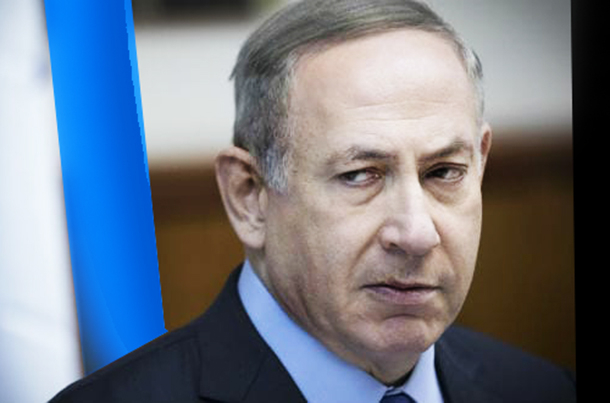
The decision to indict Israeli Prime Minister Benjamin Netanyahu on three separate criminal counts pushes the country’s already unprecedented electoral stalemate into the entirely uncharted territory of a constitutional crisis.
There is no legal precedent for a sitting prime minister facing a trial – in Netanyahu’s case, for bribery, fraud and breach of trust. Former Israeli prime minister Ehud Olmert was charged with corruption in 2009 but only after he had resigned from office.
Israeli commentators are already warning of the possibility of civil war if, as seems likely, Netanyahu decides to whip up his far-right supporters into a frenzy of outrage. After a decade in power, he has developed an almost cult-like status among sections of the public.
The honorable thing would be for Netanyahu to step down quickly, given that the two elections he fought this year ended in deadlock. Both were seen primarily as plebiscites on his continuing rule.
He is now the country’s caretaker prime minister, in place until either a new government can be formed or an unprecedented third election is held.
His departure would end months of governmental near-paralysis. The path would then be clear for a successor from his Likud party to negotiate a deal on a right-wing unity government with rival Benny Gantz, a former army general.
Gantz’s Blue and White party has made it a point of principle not to forge an alliance with Netanyahu.
Previous experience, however, suggests that Netanyahu might prefer to tear the house down rather than go quietly. If he is allowed to press ahead with another election in March, he is likely to stoke new levels of incitement against his supposed enemies.
Until now, the main target of his venom has been a predictable one.
During the April and September campaigns, he railed relentlessly against the fifth of Israel’s citizenry who are Palestinian as well as their elected representatives in the Joint List, the third largest faction in the Knesset.
Shortly before last Thursday’s indictment was announced, Netanyahu was at it again, holding an “emergency conference”. He told supporters that a minority government led by Gantz and propped up from outside by the Joint List would be a “historic national attack on Israel”. The Palestinian minority’s MPs, he said, “want to destroy the country”.
Such a government, he added, would be an outcome “they will celebrate in Tehran, in Ramallah and in Gaza, as they do after every terror attack”.
This repeated scaremongering had an obvious goal: rallying the Jewish public to vote for his far-right, now overtly anti-Arab coalition. The hope was that he would win an outright majority and could then force through legislation conferring on him immunity from prosecution.
Now he appears to have run out of time. After three years of investigations and much foot-dragging, the attorney general, Avichai Mandelblit, has finally charged him.
According to the Israeli media, Netanyahu turned down opportunities for a plea bargain that would have seen him resign in return for avoiding jail time.
According to the most serious allegation, he is accused of granting media tycoon Shaul Elovich benefits worth $500 million in exchange for favourable coverage.
Weighed against the crimes he and other Israeli leaders have perpetrated over many decades against the Palestinians in the occupied territories, the offences he is indicted for seem relatively minor.
Nonetheless, if found guilty, Netanyahu faces a substantial prison sentence of up to 10 years. That makes the stakes high.
All the signs now are that he will switch his main target from Israel’s Palestinian minority to the legal authorities pursuing him.
His first response to the indictment was to accuse the police and state prosecutors of an “attempted coup”, claiming they had fabricated the evidence to “frame” him. “The time has come to investigate the investigators,” he urged.
As one Blue and White official told the veteran Israeli reporter Ben Caspit: “Netanyahu will not hesitate to sic [unleash] his supporters on those institutions of government that represent the rule of law. He has no inhibitions.”
Technically the law allows a prime minister to continue serving while under indictment and before a trial, which is still many months away. Assuming Netanyahu refuses to resign, the courts will have to rule on whether this privilege extends to a caretaker leader unable to form a new government.
Netanyahu is therefore likely to focus his attention on intimidating the supreme court, already cowed by a decade of tongue-lashing from the Israeli right. Critics unfairly accuse the court of being a bastion of liberalism.
But bigger dangers may lie ahead. Netanyahu needs to keep his own Likud party in line. If its members sense he is finished, there could be a rapid collapse of support and moves towards an attempt to overthrow him.
The first hints of trouble emerged on Saturday when Gideon Saar, Netanyahu’s most likely challenger in Likud, accused him of “creating an atmosphere of chaos” by denigrating the legal authorities.
After the failure by both Gantz and Netanyahu to put together a coalition, the task was passed last week to parliament. Its members have just over a fortnight left to see whether one of their number can rally a majority of MPs.
This brief window could provide an opportunity for Saar to move against Netanyahu. On Sunday he submitted an official request for the Likud party to hold a snap leadership race.
Observers fear that to allay this danger, Netanyahu might consider not only inflaming his base but also setting the region alight with a conflict to rally the rest of the public to his side and make his removal impossible.
In fact, the Israeli media reported that shortly before September’s election, he had tried to pull precisely such a stunt, preparing a war on Gaza to justify postponing the ballot.
He was stopped at the last minute by Mandelblit, who realised that the cabinet had been misled into approving military action. Netanyahu had allegedly concealed from them the fact that the military command was opposed.
In recent weeks, Netanyahu has stoked severe tensions with Gaza by assassinating Palestinian Islamic Jihad leader Baha Abu Al Atta. Last week he launched airstrikes on Iranian positions in Syria.
When Olmert was being investigated for corruption in 2008, Netanyahu sagely warned of the dangerous confusion of interests that might result. “He will make decisions based on his own interests of political survivability rather than the national interest,” he said.
And that is precisely the reason why many in Israel are keen to see the back of Netanyahu – in case his instinct for political survival trumps the interests of stability in the region.
World Jewish Congress: Billionaires, Oligarchs, Global Influencers for Israel

Billionaire Mikhael Mirilashvili and his son Yitzhakis with Israeli minister Yaffa Deri.
By Alison Weir | If Americans Knew | November 24, 2019
The World Jewish Congress (WJC), which calls itself “The Representative Body of over 100 Jewish Communities Worldwide,” held its annual gala at the Pierre hotel in New York City on Nov. 6.
It bestowed its annual Theodor Herzl Award (named after Israel’s founding father) on former U.S. Ambassador to the UN Nikki Haley for her work on behalf of Israel. Some previous awardees have been Joe Biden and Henry Kissinger.
One of the WJC’s main issues is support for Israel. Among its many activities in this realm, it collaborates with the Israeli government to defend Israel from criticisms of its human rights abuses and discriminatory system.
The WJC defines many factual statements about Israel to be “antisemitic,” and labels legitimate opposition to Israeli violence and oppression against Palestinians “antisemitism.” As a result, its top issue, combating “antisemitism,” often consists of efforts to suppress information about Israel’s oppression of Palestinians and to combat efforts on behalf of Palestinian human rights.
At one of its recent international conferences to oppose this newly defined “antisemitism,” US Special Envoy Elan Carr proclaimed that every law enforcement office and every prosecutorial agency throughout the world must “force everybody who has even a hint of antisemitism to undergo a tolerance program.” … continue
Barr Ends All Conspiracy Theories Forever By Saying Epstein Died Via A Series Of Coincidences
By Caitlin Johnstone – Medium – November 22, 2019
In an interview with Associated Press, US Attorney General William Barr put all conspiracy theories to rest once and for all by assuring the world that alleged sex trafficker and alleged billionaire Jeffrey Epstein’s death was simply the result of a very, very, very long series of unfortunate coincidences.
“I can understand people who immediately, whose minds went to sort of the worst-case scenario because it was a perfect storm of screw-ups,” Barr told AP on Thursday.
This perfect storm of unlucky oopsies include Epstein being taken off suicide watch not long after a previous suicide attempt and shortly before his successful suicide, suggestions that the first attempt may have actually been an assault via attempted strangulation inflicted by someone else, two security guards simultaneously falling asleep on the job when they were supposed to be checking on Epstein, one of those guards not even being an actual security guard, security footage of two cameras outside Epstein’s cell being unusable due to a mysterious technical glitch, at least eight Bureau of Prisons officials knowing Epstein wasn’t meant to be left alone in his cell and leaving him alone in his cell anyway, Epstein’s cellmate being transferred out of their shared space the day before Epstein’s death, Epstein signing a will two days before his death, unexplained injuries on Epstein’s wrists and shoulder reported by his family after the autopsy, and a forensic expert who examined Epstein’s body claiming that his injuries were more consistent with homicide than suicide.
“The attorney general also sought to dampen conspiracy theories by people who have questioned whether Epstein really took his own life, saying the evidence proves Epstein killed himself,” AP reports. “He added that he personally reviewed security footage that confirmed that no one entered the area where Epstein was housed on the night he died.”
Well if reporting that he’s reviewed footage which we were previously told didn’t exist isn’t enough to dampen those kooky conspiracy theories, I don’t know what is.
So there you have it. The US government says that an intelligence asset with damning information on many powerful individuals did in fact kill himself due to an admittedly bizarre and wildly unlikely series of strange coincidences. I for one have no more questions. Checkmate, conspiracy theorists.
“Mr. Epstein’s death in August at a federal detention center in Manhattan set off a rash of unfounded conspiracy theories on social media that were picked up and repeated by high-profile figures, including Mayor Bill de Blasio and former Mayor Rudolph W. Giuliani. No matter their ideology, the refrain of the theories was the same: Something did not add up,” says The New York Times in its report Barr’s statements.
Couldn’t have said it better myself. It’s a completely unfounded conspiracy theory to believe that someone with ties to powerful institutions and individuals might be murdered in a way that was made to look like a suicide. We don’t live in a world where opaque organizations do evil things in secret, we live in a world where the government is always our friend and the TV would never lie to us. I’m glad these comments made by Barr (whose father in another strange coincidence gave Epstein his first job) have at long last struck a fatal blow to anyone who would doubt the beneficent hand of our beloved institutions.
It’s hard to imagine what more the US government and its allied political/media class could possibly do to quell conspiracy theories that now have Hollywood celebrities clamoring for government internet censorship. I guess if they really, really wanted to dampen conspiracy theories, there are a few more extremely drastic steps that could be taken. Steps like not lying all the time. And maybe not hiding immense amounts of information about what the most powerful institutions in the world are doing behind thick walls of government opacity. And maybe cease promoting conspiracies themselves, as with Russiagate. And maybe stop secretly doing depraved things. And maybe stop engaging in conspiracies.
Pretty sure Barr’s assurances will be enough to do the trick, though.
What Does PDVSA Have to Do with the Crisis in Haiti?
By Clodovaldo Hernandez – Supuesto Negado – November 7, 2019
Haiti has been on fire for weeks, without the so-called ‘international community’ or its associated press paying any attention.
Fuel shortages have plunged the Caribbean country back into social turmoil which borders on civil war. There are many causes behind this dramatic panorama, which has been exasperated by the decrease in production by Venezuelan state-run oil company PDVSA, corruption scandals in the Caribbean country and relentless US pressure on Venezuela, which have all damaged the PetroCaribe crude oil supply programme, which Haiti was reliant on.
PDVSA’s internal collapse, coupled with the labyrinth of obstacles placed by the US’ unilateral coercive measures (sanctions) against Venezuela, has forced the dismantling of what was one of Commander Hugo Chavez’s most powerful initiatives.
The project is a regional mechanism for selling oil at preferential prices with financing for the residents of the Antillean Basin. Local opposition groups and the Washington-led international coalition have, however, always branded the programme as a way for Venezuela to ensure support in the international arena based on the so-called ‘petro-chequebook.’
Internal corruption
Before the programme was damaged by PDSVA’s fall in production and the blockade [against Venezuela], there were already revelations of financial irregularities by unscrupulous Haitian civil servants and entrepreneurs who took advantage of Venezuelan aid to line their own pockets.
In Haiti, these crimes are particularly outrageous because the programme was conceived as a way of providing financial assistance to the government to address serious internal problems, exacerbated by the 2010 earthquake and five major hurricanes, including Hurricane Matthew in 2016.
Under the programme, PetroCaribe delivered crude oil to a state agency called the Monetisation Bureau of Development Aid Programmes, which proceeded to sell it to private Haitian companies. The resulting funds should have been used to rebuild infrastructure, especially in the areas of health, education, housing and roadways, however around US $2 billion is estimated to have been stolen.
The responsibility of Venezuelan officials in this and other Petro Caribe- related corruption cases remains to be seen.
The issue of corruption is so important in the Haitian political debate that in addition to demanding the resignation of pro-US President Jovenel Moise, the opposition and Haitian grassroots movements, which have led the wave of demonstrations in recent months, also demand the prosecution of those involved in irregularities that distorted the initial objectives of the programme. Opposition Deputies Youri Latortue, Moise Jean Charles and Shiller Louidor have been the flag-bearers of these demands.
The political reasons
In parallel, and in accordance with Washington’s instructions, the Haitian government of businessman Jovenel Moise, which is propped up by the US, has preferred to sever its relationship with PetroCaribe, supposedly to distance itself from the influence that revolutionary Venezuela exerted on previous Haitian presidents, such as René Preval and Michel Martelly.
Moise (whose name also appears amongst the list of alleged benefactors from the theft of PetroCaribe funds) was snared with promises that the US would supply the oil that Venezuela would no longer deliver. But that obviously hasn’t happened.
As the country ran out of fuel, what has been described as Haiti’s worst political crisis has erupted. The nation has lived in perennial instability due to, among other reasons, the continued interference of the US in its internal affairs.
Apart from Haiti, the PetroCaribe programme favoured Antigua and Barbuda, the Bahamas, Belize, Cuba, Dominica, Guatemala, Guyana, Grenada, St. Kitts and Nevis, St. Lucia, St. Vincent and the Grenadines, El Salvador, the Dominican Republic and Suriname. Guatemala and Belize abandoned the agreement in 2014 and 2017 respectively, and in June 2018 Venezuela announced that it was suspending shipments to all these nations due to a drop in production, with the notable exception of Cuba.
Denouncements of irregularities [in the programme’s funds] were well exploited by Venezuela’s opponents to discredit the project between 2016 and 2018. Simultaneously, the US toured the Caribbean offering to supply US oil extracted through fracking in exchange for support for its aggressive political moves against the Venezuelan government of Nicolas Maduro. Of course, in the US’ case, we aren’t talking about a social programme but rather winning the Caribbean market for its oil corporations, while continuing to strangle Venezuela economically.
In 2018, a Caribbean Energy Security Summit was held in Washington, which mentioned adopting sustainable renewable energy systems for the region. The political purpose, the true one, was later expressed by a spokesman for the US State Department: “That the Caribbean doesn’t increase its debt to the only energy supplier which has attended the region to date.”
PDVSA’s inability to continue honouring the programme, in addition to corruption scandals in countries like Haiti, allowed this goal to be achieved just as the US wished.
Now, the entire Caribbean region once again depends on the savage capitalism’s suppliers , and Haiti’s social protests are one of the first symptoms of this return to the harsh reality.
Clodovaldo Hernández is a Venezuelan journalist who has written for left leaning news sites Supuesto Negado and Aporrea.
Translation by Paul Dobson for Venezuelanalysis.
“The Palace… Threatened Us a Million Different Ways”
By Craig Murray | November 16, 2019
This leaked off-air recording of ABC News anchor Amy Robach is much more revealing than anything the BBC is going to air about Andrew Saxe Coburg Gotha.
Buckingham Palace has been “threatening” journalists to bury the story for years – which is all very reminiscent of Jimmy Savile, who was of course, ahem, popular at the Palace. Robach also states they were scared of losing interview access to folically challenged William Saxe Coburg Gotha and his underweight wife. She does not explicitly state that was one of the “threats” Buckingham Palace employed, but it does follow directly as her next observation.
Amy Robach very probably realised this “unguarded” moment would get out to the public, and we should be grateful to her for lifting the lid on how the protection of the crimes of the powerful operates, on a global level. Alan Dershowitz, whom Robach mentions, was not only a Lolita Express passenger, he is the celebrity lawyer who defended the CIA‘s use of torture as legally and morally justified. One might speculate on the psychological parallels of torturing the defenceless and inflicting sex on the young.
There is overwhelming evidence that Virginia Roberts Giuffre was trafficked into the UK by Epstein for sex with Prince Andrew. There are flight logs. There is that compromising photo in Ghislaine Maxwell’s flat. Both are entirely consistent with, and strongly corroborate, Virginia’s own testimony. This instance occurred in the UK.
It ought to be a matter of deep national disgrace that neither Ghislaine Maxwell nor “Prince” Andrew has been questioned over by the Metropolitan Police over this sex trafficking. That Virginia was over 16 is not the issue. She was sex trafficked into the UK and not legally adult. Why is there not a massive media clamour for Scotland Yard to investigate?
Amy Robach has the answer to that question.
Hat Tip to projectveritas
Epstein Story Killed by ABC in 2015: Was It Done to Protect the Clintons?

By Philip Giraldi | Strategic Culture Foundation | November 14, 2019
The saga of pedophile Jeffrey Epstein, who may or may not have committed suicide in his jail cell in August, goes on and on as cover stories and out-and-out lies continue to surface, mostly coming from the alternative media which clearly do not share the reticence of their mainstream competitors. The most recent revelation concerns ABC news, which had the goods on Epstein and his activities three years ago but refused to run the story, apparently due to pressure coming from some of those prominent individuals who were implicated in Epstein’s procuring of young girls for sex.
The tale of cowardice and cover-up goes something like this: ABC anchor Amy Robach did an interview in 2015 with Virginia Roberts Giuffre, one of Epstein’s victims. Giuffre revealed that she had been forced by Epstein and his procurer Ghislaine Maxwell to have sex with numerous men, including Prince Andrew, Britain’s Duke of York. She claimed that she had had sex with the prince three times while underage. She also apparently provided photos and other documentary evidence to back up her story. The piece was set to run on ABC News but the network’s editors and senior management intervened at the last minute to stop it.
That would have ended the tale but for the fact that Robach complained to a colleague about the killing of her interview, apparently shortly after the Epstein story became nationwide news earlier this year. She did so in front a live microphone and video camera, which recorded her as she vented. A clearly frustrated Robach said “I’ve had this story for three years. I’ve had this interview with Virginia [Giuffre]. We would not put it on the air. First of all, I was told, ‘who’s Jeffrey Epstein? No one knows who that is. This is a stupid story.’ Then the Palace found out that we had her whole allegations about Prince Andrew and threatened us a million different ways.”
That recording recently surfaced at alternative media site Project Veritas, apparently having been provided by a former ABC employee. Robach’s claim that her story had been suppressed due to pressure coming from Britain’s Royal Family was emphasized in the subsequent media coverage of the recording. For what it’s worth, Prince Andrew has denied having “any form of sexual contact or relationship” with Giuffre and ABC News has said that there is “zero truth” to the claim. Buckingham Palace has responded by avoiding a response, stating that “this is a matter for ABC.”
Now it is true that the allegations about Prince Andrew would have been a huge embarrassment for Buckingham Palace, but the prince has not long been referred to in the British media as “randy Andy” for nothing, so the damage was certainly containable. And it is also apparently true that ABC News President James Goldston has something of a close relationship with Britain’s Royal Family, but somehow the story is not completely credible.
One should pay attention to the fact that Robach also said that her interview with Giuffre had included allegations regarding former US President Bill Clinton and litigious Harvard Law Professor Alan Dershowitz. She said “I tried for three years to get it out to no avail, and now these new revelations and — I freaking had all of it. I’m so pissed right now. Like, every day I get more and more pissed, ’cause I’m just like, ‘Oh my God! It was — what we had, was unreal.’ ”
Now consider this: Robach might well believe that her story was scrubbed because of the British Royal Family, which is quite possibly what she was told by her bosses, but unless she was on the phone with a talkative butler at Buckingham Palace, how could she possibly know that that was true? The Brits are hardly so esteemed in the United States that any editor would pull a sensational story because it might be considered offensive to a Royal. If one thinks about it, it is far more likely that the story was deep sixed due to the involvement of someone dear to the hearts of every Democratic Party leaning media editor in New York City, and that would be Bill Clinton, who flew on Epstein’s Lolita Express 26 times. If there is one thing that is for sure it is that even if the House of Windsor is capable of getting back at you a million ways, you could multiply that number by ten in reckoning how lethal crossing the Clintons can be.
And there was also pressure from Dershowitz, one of Epstein’s legal advisers, who contacted ABC News in 2015 before the interview was set to be broadcast. He pressured the network to cancel the program and was able to speak to several producers and an attorney in a series of calls.
And sure enough, the cover up of the cover up started immediately after the video surfaced. Robach explained that she had been “… caught in a private moment of frustration” when the Epstein story hit the mainstream media during the summer. And she even went so far as to scold herself with what must be the line of defense being pursued by ABC Corporate’s lawyers, saying that she had been “upset that an important interview I had conducted with Virginia Roberts didn’t air because we could not obtain sufficient corroborating evidence. My comments about Prince Andrew and her allegation that she had seen Bill Clinton on Epstein’s private island were in reference to what Virginia Roberts said in that interview in 2015. I was referencing her allegation – not what ABC News had verified through our reporting. The interview itself, while I was disappointed it didn’t air, didn’t meet our standards. In the years since no one ever told me or the team to stop reporting on Jeffrey Epstein, and we have continued to aggressively pursue this important story.”
To the casual observer, Robach’s venting and her subsequent apologia sound like two different people talking and only one might be telling the truth. The reality in the national media is that some stories are just too hot to touch for political reasons, which explains why the three Clintons continue to get a pass on their own behavior and are even given platforms in the press to spew nonsense like Hillary’s recent demented attack on Tulsi Gabbard.
And then there is the Epstein story itself, which has generally speaking been made to go away. One might well ask why no one from the FBI has even questioned Ghislaine Maxwell, Epstein’s procurer and partner in his disgusting crimes, and also likely an Israeli agent. And you can search the mainstream media in vain seeking a Fourth Estate demand for an inquiry into Epstein’s intelligence relationships. Miami federal prosecutor Alexander Acosta was told to back off the first time Epstein was arrested in Florida because there was an intelligence connection and it has now been confirmed that he worked with the Jewish state’s military intelligence as early as the 1980s. His main task was to blackmail prominent Americans on behalf of Israel. How many brain cells does it take to pursue that lead? Ask Acosta who told him that and why and then ask the same thing of whoever that turns out to be. Keep working your way up the food chain and eventually you will maybe find out the truth, or at least a version of it.
Legacy of Climategate – 10 years later
By Judith Curry | Climate Etc. | November 12, 2019
My reflections on Climategate 10 years later, and also reflections on my reflections of 5 years ago.
Last week, an email from Rob Bradley reminded me of my previous blog post The legacy of Climategate: 5 years later. That post was the last in a sequence of posts at Climate Etc. since 2010 on Climategate; for the entire group of posts, see [link] Rereading these was quite a blast from the past.
While I still mention Climategate in interviews, the general reaction I get is ‘yawn . . . old hat . . . so 2010 . . . nothingburger . . . the scientists were all exonerated . . . the science has proven to be robust.’ I hadn’t even thought of a ’10 years later’ post until Rob Bradley’s email.
Now I see that, at least in the UK, the 10 year anniversary looks to be rather a big deal. Already we are seeing some analyses published in the mainstream media:
- The Guardian – Climategate 10 years on: What lessons have we learned?
- The Spectator – James Delingpole: My finest hour
Two starkly different perspectives. While I personally think Delingpole’s article is a superb analysis, it would not surprise me if the ‘establishment’ media in the UK is looking to rewrite history and cement the ‘exoneration,’ especially with this forthcoming one hour BBC special Climategate: Science of a Scandal, set to air November 14.
According to Cliscep (not sure what the source of this information is), McKitrick and McIntyre were both interviewed for the BBC special, but apparently McKitrick was cut completely. Lets see how they edit McIntyre.
Exoneration?
The mainstream media and the Climategater scientists themselves claim complete exoneration by the various ‘inquiries’. Were they exonerated?
There was no exoneration by any objective analysis of the various inquiries. Ross McKitrick lays all this out in his article Understanding the Climategate Inquiries
“The evidence points to some clear conclusions.
- The scientists involved in the email exchanges manipulated evidence in IPCC and WMO reports with the effect of misleading readers, including policymakers. The divergence problem was concealed by deleting data to “hide the decline.” The panels that examined the issue in detail, namely Muir Russell’s panel, concurred that the graph was “misleading.” The ridiculous attempt by the Penn State Inquiry to defend an instance of deleting data and splicing in other data to conceal a divergence problem only discredits their claims to have investigated the issue.
- Phil Jones admitted deleting emails, and it appears to have been directed towards preventing disclosure of information subject to Freedom of Information laws, and he asked his colleagues to do the same. The inquiries largely fumbled this question, or averted their eyes.
- The scientists privately expressed greater doubts or uncertainties about the science in their own professional writings and in their interactions with one another than they allowed to be stated in reports of the IPCC or WMO that were intended for policymakers. Rather than criticise the scientists for this, the inquiries (particularly the House of Commons and Oxburgh inquiries) took the astonishing view that as long as scientists expressed doubts and uncertainties in their academic papers and among themselves, it was acceptable for them to conceal those uncertainties in documents prepared for policy makers.
- The scientists took steps individually or in collusion to block access to data or methodologies in order to prevent external examination of their work. This point was accepted by the Commons Inquiry and Muir Russell, and the authors were admonished and encouraged to improve their conduct in the future.
- The inquiries were largely unable to deal with the issue of blocking publication of papers, or intimidating journals. But academics reading the emails could see quite clearly the tribalism at work, and in comparison to other fields, climatology comes off looking juvenile, corrupt and in the grip of a handful of self-appointed gatekeepers and bullies.
Is the science concerning the current concerns about climate change sound? Many people, starting with the members of the UK House of Commons Science and Technology Committee, had hoped this question would be answered during the inquiry process, and there is a frequent refrain in the media that the investigations affirmed the science. But the reality is that none of the inquiries actually investigated the science. The one inquiry supposedly set up to address this, namely Lord Oxburgh’s, actually operated under a different remit altogether, despite multiple claims by the UEA that it was a science reappraisal panel.
Over the course of the five reviews, a few complaints were investigated and upheld, such as the problem of data secrecy at the CRU and the misleading nature of the “hide the decline” graph. And the IAC leveled enough serious criticisms about the IPCC process to substantiate concerns that the organization is unsound for the purpose of providing balanced, rigorous science assessments. But many other concerns were left unaddressed, or slipped through the cracks between the inquiries, or were set aside after taking CRU responses at face value.”
Steve McIntyre’s Brief submitted for the defendants in one Mann’s lawsuits addresses the key scientific aspects related to Michael Mann’s conduct and hockey stick research:
“Even before the release of the Climategate emails, numerous public concerns were raised about Mann’s conduct. Concerns about Mann’s research included:
- Mann’s undisclosed use in a 1998 paper (“MBH98”) of an algorithm which mined data for hockey-stick shaped series. The algorithm was so powerful that it could produce hockey-stick shaped “reconstructions” from auto-correlated red noise. Mann’s failure to disclose the algorithm continued even in a 2004 corrigendum.
- Mann’s failure to disclose adverse verification statistics in MBH98. Mann also did not archive results that would permit calculation of the adverse statistics. Climategate emails later revealed that Mann regarded this information as his “dirty laundry” and required an associate at the Climatic Research Unit (“CRU”) to withhold the information from potential critics.
- Mann’s misleading claims about the “robustness” of his reconstruction to the presence/absence of tree ring chronologies, including failing to fully disclose calculations excluding questionable data from strip bark bristlecone pine trees.
- Mann’s deletion of the late 20th century portion of the Briffa temperature reconstruction in Figure 2.21 in the IPCC Third Assessment Report (2001) to conceal its sharp decline, in apparent response to concerns that showing the data would “dilute the message” and give “fodder to the skeptics.” Mann’s insistence in 2004 that “no researchers in this field have ever, to our knowledge, ‘grafted the thermometer record onto’ any reconstruction. But it was later revealed that in one figure for the cover of the 1999 World Meteorological Organization (WMO) annual report, the temperature record had not only been grafted onto the various reconstructions—and in the case of the Briffa reconstruction, had been substituted for the actual proxy
- Mann’s undisclosed grafting of temperature data for “Mike’s Nature trick,” a manipulation of data which involved: (1) grafting the temperature record after 1980 onto the proxy reconstruction up to 1980; (2) “smoothing” the data; and (3) truncating the smooth back to 1980. ”
Exoneration? Not even close. However, is all this even relevant anymore? “the science has moved on . . . independently verified . . . 97% consensus . . . 8 warmest years occurred since Climategate’ . . . etc. etc.
So did all this ‘matter’, in the larger scheme of things? During the period 2001 to ~2012, the public debate on climate change rose and fell with the fortunes of the hockey stick: the IPCC TAR (2001) prominently featured the hockey stick, which made the public realize that something unusual was going on; the famous elevator version of the hockey stick in Al Gore’s 2006 documentary; in late 2009, Climategate contributed to derailing the UNFCCC COP15 outcome; and in 2010 was the clincher for the failure of the Waxman-Markey Bill (carbon cap and trade) in the U.S. Senate.
Since about 2014 or so, the public debate on climate change has become less ‘scientized’, with economics, social justice and raw politics taking center stage.
Did climate scientists learn anything from Climategate?
Looking forward, should Climategate matter? Only if scientists failed to learn the appropriate lessons.
At the time of Climategate, I wrote an essay entitled On the credibility of climate research. I raised four key issues: Lack of transparency, climate tribalism, the need for improved analysis and communication of uncertainty, and engagement with ‘skeptics’ and critics of our work.
At the time, I was rather astonished by the failure of climate science ‘leaders’ (apart from the climagaters defending themselves) to make public statements about this and show some leadership.
Interesting insights into the ‘leadership’ void at the time of Climategate are revealed by a tranche of emails obtained by the CEI [link] dated the first half of 2010, involving scientists involved in Climategate emails as well as others who are regarded as the keepers of the IPCC ‘flame’ – e.g. Michael Oppenheimer, Steve Schneider, Gabi Hegerl, Eric Steig, Kevin Trenberth.
It is very interesting to see what they were concerned about in the aftermath of Climategate. They were trying to understand why Climategate was newsworthy, and they were mostly concerned about protecting themselves from the same things that Climategate emails revealed: attacks on scientists’ reputation, ‘skeptics’ getting mentions in the mainstream media, public perceptions of scientists’ credibility, how to convince the public that AGW is ‘real’ with 3 slides in 10 minutes, top 10 list of denialist mistakes.
Steve Schneider perceptively states: “A mega heat wave this summer is worth 3 orders of magnitude more in the PR wars–too bad we have to wait for random events since evidence doesn’t seem to cut it anymore with the MSM.”
In my post Climategate essays, I pointed the way for climate science out of this morass. How was this received by climate scientists? Michael Lemonick’s follow up essay Why I Wrote About Judith Curry to his article Climate Heretic: Judith Curry Turns on her Colleagues, provides the following insights:
“Simply by giving Judith Curry’s views a respectful airing, I’ve already drawn accusations of being irresponsible — and it’s valid to raise the question of whether giving her any sort of platform is a bad idea.
I also argue, as you’ll see in Scientific American, that the vehement reaction of climate scientists, while perfectly understandable, might be akin to the violent reaction of the human immune system to some bacteria and viruses — a reaction that’s sometimes more damaging than the original microbe.”
Given the huge stakes and the serious structural issues surrounding the assessment of climate science and policy that had emerged from Climategate, these concerns of the climate scientists seem small-minded and naïve, not to mention counter-productive – ‘circling the wagons’ even tighter made the situation even worse.
Clearly any leadership that might lead climate science out of this morass would have to come from outside the community of climate scientists and probity would need to come from outside of the field of climate science. Climate science subsequently became an important topic in the fields of science and technology studies, philosophy of science, social psychology, law, statistics, computer science and communications.
The broader institutions that support climate science have implemented some improvements post Climategate:
- The UN IAC review of the IPCC has resulted in some improvements to the IPCC practices of reviewing, conflicts of interest, uncertainty assessment
- Elite journals now require data to be made publicly available and also conflict of interest statements.
On the downside:
- Politically correct and ‘woke’ universities have become hostile places for climate scientists that are not sufficiently ‘politically correct’
- Professional societies have damaged their integrity by publishing policy statements advocating emissions reductions and marginalizing research that is not consistent with the ‘party line’
- The gate-keeping by elite journals has gotten worse IMO, although the profusion of new journals makes it possible for anyone to get pretty much anything published somewhere.
The main long-term impact of Climategate on climate scientists seems to have been to put a halo around Michael Mann’s head over his ‘victim’ status, giving him full reign to attack in a Trumpian manner anyone who disagrees with him.
Cultural shifts
The social culture surrounding climate change has changed substantially in the past 10 years and even the past 5 years.
10 years ago, the climate blogs were highly influential – the big four were WUWT, Climate Progress, Real Climate and Climate Audit. Climate Progress (subsequently Think Progress ) is now defunct – what the heck happened to Joe Romm? Climate Audit has a very low level of activity. Real Climate publishes posts at a leisurely pace (about the same pace as Climate Etc.). Only WUWT has maintained its pace of publishing and its influence.
At this point, twitter has almost totally eclipsed the climate blogs; this has accelerated in the past 5 years. Also, there are now some not-for-profit organizations that have hired writers on the climate topic, notably Carbon Brief.
Further, a number of climate scientists and scientists in related fields now either have regular columns in the mainstream media (Roger Pielk Jr and Michael Schellenberger at Forbes are notable examples) or write frequent op-eds (e.g. Michael Mann).
Communication of climate science has become a big priority in climate science, although what is judged as desirable and worthy of professional recognition is more often propaganda than ‘science to inform.’
At the time of Climategate, public advocacy by climate scientists of climate policy was generally frowned upon, and only a few senior, well-established scientists dared to do this (e.g. Jim Hansen). At this point, climate scientist/activists are very large in number, and such activism seems to be a ticket to professional success.
With regards to the advocacy groups and think tanks on both sides, the conflicts a decade ago between the environmental advocacy groups (e.g. Greenpeace) and the libertarian groups (e.g. CEI, CATO) seems almost quaint at this point. With the exception of Heartland, GWPF and the newly formed CO2 Coalition, the libertarian groups no longer bother with climate science (even the long standing program at CATO with Pat Michaels no longer exists).
Instead, we have Extinction Rebellion and the Sunrise Movement on one hand, and the Yellow Vests and related movements on the other hand. These are populist movements (although apparently with some big $$ backing, esp for Extinction Rebellion). The zombie stuff of the Extinction Rebellion makes me nostalgic for the relative rationality of Greenpeace versus CEI.
‘Skeptics’ these days are generally defined by ‘lukewarmerism’ (e.g. climate sensitivity on the low end of the IPCC range), a focus on historical and paleo data records, and a focus on natural climate variability. Skeptics frequently cite the IPCC reports. Skeptics generally support nuclear energy and natural gas, but are dubious of rapid expansion of wind and solar and biofuels.
Scientists on the ‘warm’ side of the spectrum think that IPCC is old hat and too conservative/cautious (see esp Naomi Oreskes’ new book); in short, insufficiently alarming. The ‘alarmed’ scientists are focused on attributing extreme weather to AGW (heeding Steve Schneider’s ‘wisdom’), and also in generating implausible scenarios of huge amounts of sea level rise. As a result, consensus of the 97% is less frequently invoked.
Such alarmism by the climate scientists has spawned doomsterism, to the dismay of these same climate scientists – things are so bad that we are all doomed, so why should we bother.
There is also a growing dichotomy on both sides of this between the Boomers and the Millennials/GenZ. On the ‘skeptics’ side, there is a general paucity of younger scientists, with the center of mass being scientists in their 60’s and 70’s (and even older).
On the ‘alarmed’ side, there is a steady stream of younger scientists fueled by propaganda in K-12 and hiring practices and professional rewards in the universities. Some of the younger scientists think that the likes of Michael Mann are too conservative and insufficiently ‘woke’ and unconcerned about social justice objectives. This recent exchange on twitter was particularly illuminating:
Mann: “I share her (Klein’s) concern over each of these societal afflictions, but I wonder at the assertion that it’s not possible to address climate change without solving all that plagues us. My worry is this. Saddling a climate movement with a laundry list of other worthy social programmes risks alienating needed supporters (say, independents and moderate conservatives) who are apprehensive about a broader agenda of progressive social change. The pessimist in me also doubts that we’ll eliminate greed and intolerance within the next decade.”
This elicited the following responses:
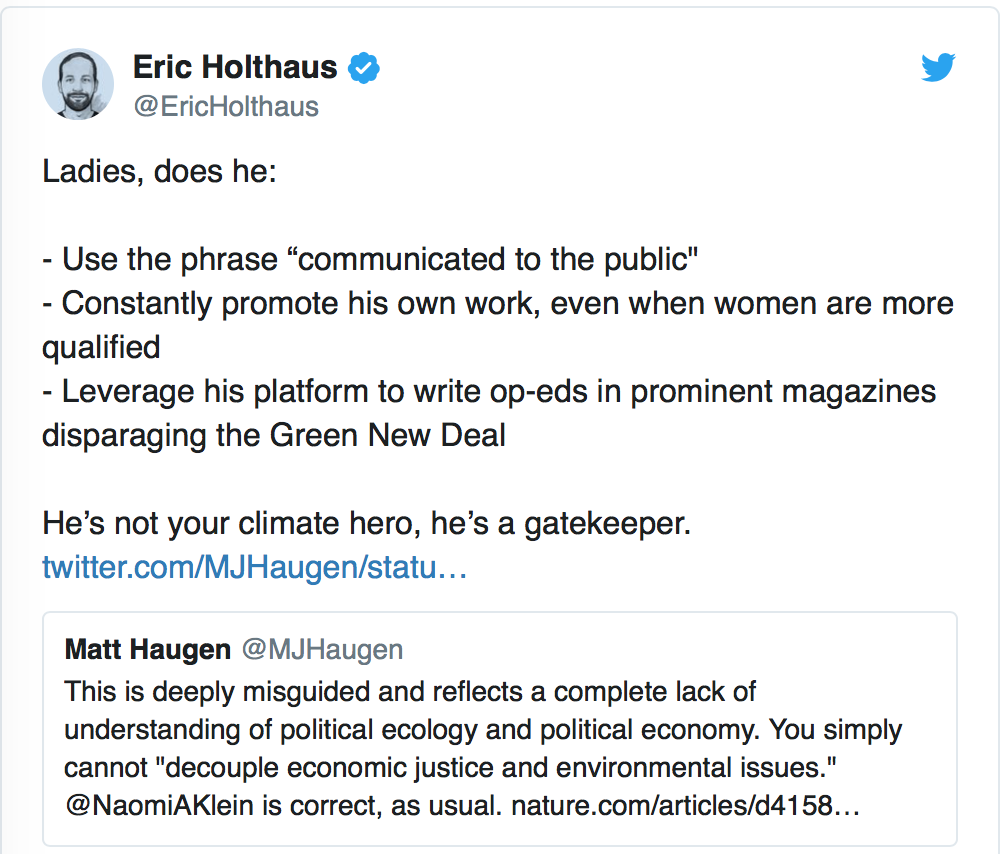
Apparently this elicited a 15 hour tweet storm from Mann. P.S. I side with Mann in this particular dispute.
‘Cancel culture’ is also booming, but this is nothing new in the climate arena; the Climategaters plus Naomi Oreskes were pioneers in cancel culture as related to climate scientists or anyone else who doesn’t toe the party line (although the party line is now splitting between boomer alarmists and the Millennials). At the time of Climategate, the cancel efforts were conducted via the ‘back channels’ (e.g. emails); these days they are conducted in the open on twitter. From Hayhoe to Mann on twitter in response to a recently published paper:
“I’m also concerned as I’ve been getting some dismissives citing this. Have you had a chat with Tom about it?”
Social justice has become a major driver in climate policy (e.g. the Green New Deal), increasingly overtaking climate policy in its objectives.
‘Boomer’ Mann has the more defensible position this one. Yes, any policies should avoid making the situation of disadvantaged individuals worse. But seeking to solve the myriad problems of social justice through climate/energy policy is a recipe for accomplishing nothing for either. So Mann and I are in agreement on this one (see spat above with Holthaus).
With all these changes, you’ll be relieved to hear that Climategate lives on in numerous lawsuits that Michael Mann has filed related to criticisms of his behavior related to the hockeystick. Most of these lawsuits continue to languish since they were filed about 8 years ago (although Mann did lose his lawsuit against Tim Ball). With these lawsuits, there is no denying that the impacts of Climategate are still playing out.
Whither the debate on climate change?
I’ll lead off this section with a quote from Delingpole’s recent article:
“Right now, the struggle against this nonsense seems pretty hopeless. But we sceptics do have at least two things on our side – time and economics. Time is doing us a favour by showing that none of the alarmists’ doomsday predictions are coming to pass. Economics – from the blackouts in South Australia caused by excessive reliance on renewables (aka unreliables) to the current riots and demonstrations taking place from France and the Netherlands to Chile over their governments’ green policies – suggest that common sense will prevail in the end. Bloody hell, though – taking its time, isn’t it?”
I’ll extend Delingpole’s sentiments a bit further, to include these additional things that are on the side of an eventual rational outcome to this:
- Energy engineering realities: for a superb overview, see Michael Kelly’s recent essay Energy Utopias and Engineering Realities
- Growing concerns about energy reliability and security, e.g. the recent experience of California with massive power shutdowns and blackouts in Australia
- The climate itself; even with huge 2016 (see this recent overview by Ross McKitrick), the temperatures are not keeping pace with the CMIP5 predictions
- At some point, a spate of La Nina events, a shift to the cold phase of the AMO, increased volcanic activity, impacts of a solar minimum and another ‘hiatus’ are inevitable; sort of the reverse of what Steve Schneider was waiting for.
- Most of the CMIP6 climate models have gone somewhat bonkers, with a majority having values of ECS that exceed 4.5C and do a poor job of simulating the temperatures since 1950; makes it difficult to take seriously their 21st century projections
Ideas that are genuinely irrational eventually burn themselves out as reality bites, but we have certainly seen such ideas, policies and politics persist for decades in the past 100 years. Perhaps the information age, the internet and social media will speed this one along.
What’s wrong with current climate/energy policy? This 2013 quote by Hans von Storch sums up it up:
“Unfortunately, some scientists behave like preachers, delivering sermons to people. What this approach ignores is the fact that there are many threats in our world that must be weighed against one another. If I’m driving my car and find myself speeding toward an obstacle, I can’t simple yank the wheel to the side without first checking to see if I’ll instead be driving straight into a crowd of people. Climate researchers cannot and should not take this process of weighing different factors out of the hands of politics and society.”
Common sense approaches to reducing vulnerability to extreme weather events, improving environmental quality, developing better energy technologies, improving agricultural and land use practices, better water management polices and engineering can lead the way to a more prosperous and secure future. Each of these solutions is ‘no regrets’ – make sense however the 21st century climate plays out.
For those that are concerned about social justice: the biggest social justice issue that I see for the 21st century is to provide reliable grid electricity to Africa.
In terms of climate scientists and their influence. The relative sensibility of Boomer scientists (even Michael Mann; although this recent article is slightly nuts) are being eclipsed by the zombie-dom of the Extinction Rebellion and ‘wokeness’.
Regarding Boomer wisdom, I was particularly struck by this recent interview of Barack Obama about the ‘call-out’ and ‘cancel’ culture. This was greeted by numerous criticisms typified by this article in the New York Times Obama’s Very Boomer View of ‘Cancel Culture’ and the epithet ‘Yo Boomer.’ Michael Schermer of Skeptical Inquirer nails it with this tweet:
“I’m trying to understand Millennial/GenZ cancel culture & not just be an old Baby Boomer, but it seems to me that if you think @BarackObama is not woke enough to understand what injustice means I think you’ve gone off the rails of moral progress.”
“Gone off the rails of moral progress” – a perfect description of where this seems to be headed, at least in the short term.
Personal impact
My personal saga in the five years following Climategate was summarized in my essay ‘5 years later.’ Upon rereading, I was struck by these excerpts:
“In 2014, I no longer feel the major ostracism by my peers in the climate establishment; after all, many of the issues I’ve been raising that seemed so controversial have now become mainstream. And the hiatus has helped open some minds.
The net effect of all this is that my ‘academic career advancement’ in terms of professional recognition, climbing the administrative ladder, etc. has been pretty much halted. I’ve exchanged academic advancement that now seems to be of dubious advantage to me for a much more interesting and influential existence that feels right in terms of my personal and scientific integrity.
Climategate was career changing for me; I’ll let history decide if this was for better or worse (if history even cares).”
In the end, Climategate ended my academic career prematurely (JC in transition). I realized how shallow the ‘academic game’ has become, and the games one needs to play to succeed. Throwing all that off has been personally and intellectually liberating for me.
I now have more time to read and think. Unfortunately I have less time to write blog posts since I am focusing my efforts on projects of relevance to the clients of my company Climate Forecast Applications Network. These projects are pretty wide ranging and pushing me in interesting new directions.
As for my ‘influence’ in the public debate on climate change, I never cared too much about this and probably care even less at this point. I have a unique perspective, and I appreciate any substantive opportunities that come my way to share this with the public and decision makers.
As Roger Pielke Jr tweeted:
“It wasn’t all fun, I’ll tell ya, but I’d do it all over again if it meant I get to now”
Google sucks up & analyzes healthcare data on millions of Americans in secret AI project… after voluntary opt-in flops
RT | November 12, 2019
Google has teamed up with one of the largest health providers in the US to gather detailed medical records on millions of patients across the country without their knowledge, in a secret project the firm tried to keep under wraps.
Dubbed “Project Nightingale,” the secretive program brought together Google and healthcare giant Ascension in an effort to collect medical records on patients across 21 states, according to a report in the Wall Street Journal. The data sharing began last year, and has only accelerated in recent months.
At least 150 employees at Google’s Cloud division now have access to the bulk of the data, which amounts to information on tens of millions of patients, according to a source familiar with the records.
The details shared include patient names and dates of birth, hospitalization records, lab results and doctor diagnoses, which together provide a complete medical history for many of the patients – all without their consent.
Google says it hopes to use the data to develop an application employing AI and machine learning to track patients and recommend treatments, and ultimately has its eye on creating a search engine that can aggregate disparate patient data in one place.
“Wow – this is downright alarming. Do you trust Google with your blood test results, diagnoses, sensitive health information?” asked attorney and Republican National Committee member Harmeet K. Dhillon in a tweet. “Google’s secret ‘Project Nightingale’ gathers personal health data on millions of Americans.”
The company launched Google Health in 2008, but shuttered it less than four years later after failing to persuade enough users to hand over their medical records willingly, perhaps uncomfortable with the firm having access to such sensitive information. The tech giant has since cut individual consent out of its quest to amass healthcare data, going over the heads of patients to make deals with health providers instead.
In September, the company allied with the Minnesota-based Mayo Clinic to provide cloud services and data analytics in a 10-year “strategic partnership,” which will give Google access to data on up to 1 million patients at the clinic each year.
In another mass data grab earlier this month, the company purchased the maker of the fitness tracking device Fitbit, gobbling up the data of some 28 million active users of the gadget. The data goes beyond simple fitness tracking, such as the number of steps one takes per day, as some users opt to link the device to additional medical or insurance records. While Google vowed to never hand out the Fitbit information to third parties, customers may still have reason to be skeptical about the integrity of their data.
Over the summer, Google and another partnered healthcare facility, the University of Chicago Medical Center, came under fire in a lawsuit alleging the hospital gave Google medical records on hundreds of thousands of patients without stripping them of identifying information. The case mirrored a similar mishap across the pond in 2017, in which the UK’s National Health Service passed the company data on 1.6 million patients in violation of privacy laws.
The data sharing with Ascension is likely permitted under US federal law, however, as the 1996 Health Insurance Portability and Accountability (HIPA) Act allows hospitals and other healthcare providers to pass data to business partners without informing patients so long as it “help[s] the covered entity carry out its health care functions.”
Ascension – a network of some 2,600 hospitals, doctors’ offices and other medical facilities – says it’s doing just that, seeking to use the data to improve care and identify additional tests patients might need. However, documents reviewed by the Journal also suggest the company, like Google, has its bottom line in mind, hoping to use the data-mining to generate more revenue as well.
Also on rt.com:
NHS patient information illegally shared with Google DeepMind
Google buys Fitbit, acquiring users’ health histories & triggering privacy backlash
‘Kafkaesque’: CBS fires female staffer who MAY have leaked Epstein rant video of ABC anchor – report
RT | November 7, 2019
CBS has reportedly fired a female staffer formerly with ABC, suspecting her of having leaked the hot mic tape of anchor Amy Robach in which she complained about the channel spiking her interview with Jeffrey Epstein’s victim.
The unnamed employee was fired on Wednesday after ABC tipped off the (supposedly) rival network “as a courtesy” that its employee had possession of the Robach tape and may have leaked it to Project Veritas, Page Six reported on Thursday, citing sources inside ABC.
ABC chose to inform its competitor of the traitor in their midst after considering its options and realizing there was little it could do to her on its own, since the staffer had left ABC for CBS, the report said. Had she still worked at ABC, the leak would have been a “fireable offense.”
It’s not known if the staffer leaked the fateful clip to Project Veritas herself or merely passed it on to someone else who did. Either way, ABC has been “pursuing all avenues” to find the source of the leak since its publication on Tuesday rocked the network, a company spokesperson stated, adding that “we take violations of company policy very seriously.”
In the video, Robach laments that the network shelved her report on well-connected pedophile Jeffrey Epstein, featuring an interview with one of his most outspoken victims, Virginia Roberts Giuffre, three years ago.
“We had everything!” Robach said into a hot mic, noting the solid sourcing and a thoroughly juicy scoop implicating former president Bill Clinton, Britain’s Prince Andrew, and a slew of other powerful individuals. ABC shot back that the story lacked “enough corroboration” – though that hasn’t stopped them from airing dodgy stories in the past.
The firing of the (supposed) whistleblower incensed some who have been following the Epstein saga. Not only had ABC spiked the story, supposedly – as Robach claims in the tape – because its owners are part of a “network of people” implicated in the now-deceased financier’s crimes, but they had hounded the leaker out of her job. Whose side, many wondered, was the media actually on?
“This is no longer merely Orwellian. It’s Kafkaesque,” tweeted Project Veritas founder James O’Keefe, slamming the “credentialed” journalism establishment and its Big Tech boosters as “engaged in collusion and cover up.”
Malaysia Rejects Goldman’s Offer Of “Less Than $2 Billion” To Settle 1MDB Suit
By Tyler Durden – Zero Hedge – 11/01/2019
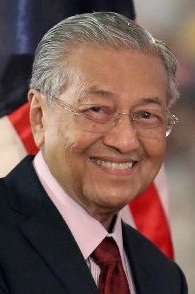 In an interview with the Financial Times, Malaysian Prime Minister Mahathir Mohamad said he’s not ready to kneel down and accept Goldman Sachs’s first offer in its attempt to settle a civil case stemming from the bank’s involvement in the 1MDB scandal, one of the biggest financial frauds to rock the region in modern history.
As was rumored in earlier reports, Goldman offered Malaysia “less than $2 billion” to settle the suit. In a series of three bond offerings, Goldman raised $6.5 billion for 1MDB, a sovereign wealth fund that was supposed to finance major public works projects across Malaysia.
But the money never made it that far.
A group of senior government officials, including former Prime Minister Najib Razak, led by shadowy financier Jho Low, looted billions from 1MDB and hid it from the people of Malaysia. How much did they take? The DoJ put the number at $4 billion; Malaysia believes its closer to $6 billion.
Mohamad said that Malaysia’s negotiators (led by AG Tommy Thomas) are still talking with Goldman.
“Goldman Sachs has offered something like less than $2bn,” Mahathir Mohamad told the Financial Times in an interview on Friday. “We are not satisfied with that amount so we are still talking to them… If they respond reasonably we might not insist on getting that $7.5bn.”
And he’s not stopping there. Mohamad said Malaysia has also reached out to DB and UBS over their involvement with 1MDB, as it strives to work with whatever banks it can to recoup any money stolen from 1MDB. DB has also found itself caught up in the criminal end of the scandal: Malaysia is investigating the recidivist German lender over whether it violated AML statutes while raising $1.2 billion for 1MDB back in 2014 (a deal that came after offerings underwritten by Goldman). UBS has been reprimanded by the Swiss government over transactions related to 1MDB that the bank helped facilitate.
Goldman earned more than $600 million in fees from the 1MDB deal, and Malaysia has made it clear that it wants every cent of that money returned.
But US prosecutors have already seized billions of dollars in assets pertaining to the case. On Thursday, reports emerged claiming that Low, now a fugitive believed to be hiding in China under the Communist Party’s protection, has settled a flurry of civil suits with the DoJ, agreeing to hand over more than $900 million. Mohamad said Malaysia isn’t in contact with Low, who admitted no guilt in his deal with the US. Malaysia doesn’t know where Low is: “He’s not staying in any one place.”
“The amount [Mr Low embezzled from 1MDB] is much bigger,” said Mr Mahathir. “If he had the full amount we would be very happy…We are still going after the rest of the money.”
“The DoJ has indicated that, if we can prove claim of ownership, then we will be able to get the money for ourselves.”
Goldman’s strong earnings over the past two quarters have helped ease investors’ worries about 1MDB, and the scandal has largely faded into the background since late last year, when revelations that senior Goldman execs, including Lloyd Blankfein, had personally intervened to greenlight the 1MDB deals despite numerous red flags from compliance. But we imagine that many insiders are waiting for the next shoe to drop. Right now, prosecutors have the leverage. Goldman just might get stuck paying the bulk of Malaysia’s ask.
Both Malaysia and the US have accused senior Goldman bankers of bribing corrupt Malaysian politicians to secure the bond deal business for the bank.
‘Thank God for Deep State’, ex-CIA boss says. Still think it’s a conspiracy theory?
By Nebojsa Malic | RT | November 1, 2019
In just a few short months, the US political establishment has gone from denying the existence of the ‘Deep State’ and calling it a conspiracy theory, to praising it as the bulwark of the Republic against President Donald Trump.
“Thank God for the ‘Deep State,’” declared former CIA director John E. McLaughlin at an event this week, describing the diplomats and intelligence officers testifying before the congressional impeachment inquiry as “people who are doing their duty or responding to a higher call.”
Lavishing praise on the ‘whistleblower’ intelligence officer whose complaint about Trump’s phone call launched the impeachment probe, McLaughlin said the intelligence community is “institutionally committed to objectivity and telling the truth.”
One would think this might be a bit rich, coming from the former deputy director of the CIA at the time of the infamous ‘Iraqi WMDs’ fiasco – and acting director for a time in 2004 – but McLaughlin’s comments were met with applause by the crowd at George Mason University’s Schar School of Policy and Government.
He wasn’t the only one to praise the Deep State either. Sitting right next to him was John Brennan, the CIA director under President Barack Obama, whose fingerprints are all over the so-called ‘Steele dossier’ and ‘Russiagate’, and who is now enjoying a rewarding career as a TV pundit accusing Trump of treason.
Brennan argued that the reason Trump “has a contentious relationship with the Deep State people… is because they tell the truth,” and praised the unelected intelligence and law enforcement officials for continuing to “do their work irrespective of what he’s going to do or say.”
Under normal circumstances, these admissions would be rather earth-shattering. It isn’t every day that former bosses of the intelligence apparatus basically admit that yes, they are meddling in the country’s politics, because they feel they have a “higher loyalty” – to borrow a phrase from ex-FBI boss James Comey, another member of this merry cabal – than to the chief executive elected by the American people.
Yet the response has been muted at best, with a silent shrug and the implicit “nothing to see here, move along” from the major outlets. That’s not particularly surprising, given the media’s role in the ‘Russiagate’ conspiracy. Why, just a couple weeks ago, the New York Times published an opinion piece praising the Deep State along the very same lines Brennan and McLaughlin would.
When Trump and his defenders talked about the Deep State during the ‘Russiagate’ hysteria, the very same outlets pooh-poohed them as insane, paranoid, and delusional. Now they say the Deep State is real, it’s always been real, and it’s acting in the best interests of the American Republic – and if you don’t believe it, you’re the one who’s insane, paranoid and delusional. Sense a pattern?
Whatever one may think of Trump, it beggars belief that the very people who cry the loudest about “our democracy” are elevating an unelected bureaucracy, spies and counter-spies as the arbiters of it. It almost makes you think the people responsible for pushing the ‘Russian meddling’ conspiracy theory may have done it as a smokescreen for their own (mis)deeds.
Oh, wait.
Hezbollah’s Unchartered Frontier
By Ghassan Kadi | The Saker Blog | October 31, 2019
Following the Israeli invasion of Lebanon in June 1982, Lebanon looked like it had totally lost its independence and ability of self-determination. Later on, and with Israeli boots still on Lebanese ground, the Lebanese government was coerced to reach the 17th of May (1983) peace accord with Israel; and which was in reality tantamount to terms of surrender.
By then, the underground resistance, known back then as “The Lebanese Resistance”, was launched, and it was already causing much concern for the Israeli occupiers. As for the 17th of May accord, the then Lebanese President, Amin Gemayel, found himself between a rock and a hard place; supporters of the accord and those against. And even though back then the supporters were a political and military majority, Gemayel did not want to be remembered in the books of history as the President who surrendered to Israel, and refused to ratify the accord.
What happened afterwards is now history. The resistance gained momentum, and with all the might of the Israeli army and the large number of local Lebanese militia that collaborated with it, Israel had to leave Lebanon defeated in April 2000.
This epic victory couldn’t have happened without two men; President Hafez Assad and Hassan Nasrallah.
Hezbollah was a small organization back in 1982 and Nasrallah was not the founding leader. He became the leader after founding leader Abbas Al-Musawi was killed by Israel in 1992. Nasrallah has been the leader ever since, and has managed to evade many would-be assassination attempts and many disasters that would undermine the sovereignty and integrity of not only Lebanon, but also Syria.
This is not meant to be a historical narrative. The stops I shall make are meant to be those pertinent to the standing of Hezbollah and how it is perceived by the Lebanese community.
Hezbollah has had thus far three major victories. The first was the afore-mentioned victory over Israel in 2000 when the Israeli army was made to retreat from Lebanon unconditionally. Never before had Israel ever left occupied Arab land unconditionally. This is not to mention that southern Lebanon is rich in water, something Israel lacks and is in dire need for. The defeat was so humiliating that Israel had to save face, calling it a “tactical withdrawal”.
The second victory came in July 2006 when the Israeli incursion and massive bombing of Lebanon did not result in any Israeli gains and Israel again withdrew from Lebanon under heavy casualties; including marine casualties.
The third victory was in Syria where Hezbollah played a huge role in staving off the attack on its Syrian ally.
For any Lebanese or Arab to even attempt to take away from Hezbollah its achievements is tantamount to national treason; and I cannot make this statement more vehemently.
With the Arab World divided on lines based on foundations essentially that of capitulation and accepting the American/Israeli roadmap, and that of the opposite dipole of independent decision-making, it is not a surprise therefore that Hezbollah has been gaining momentum in the hearts and minds of Arabs of the so-called resistance axis.
In my previous article, I predicted that the current widely popular uprising in Lebanon can eventually be diverted by the enemies of Hezbollah in order to transform the anger against corruption into anger against the political ally of the government; ie Hezbollah. In a matter of a few days since, this prediction is taking form. There has been increasing criticism of Hezbollah for allegedly turning a blind eye to the burgeoning state of corruption in the government.
Nasrallah addressed the issue recently in a televised speech. His words however fell short of generating a sense of satisfaction in the protesters, even from many protagonists of the axis of resistance. Deep down inside, even many of the staunchest supporters of Hezbollah believe that it has seriously overlooked the consequences of its silence in regards to the three years of extreme corruption of the Aoun tenure.
Cartoons showing president Aoun on his presidential chair with Nasrallah as his shadow are circulating on social media. There are rallies in heartlands of Hezbollah, expressing utter dis-satisfaction with the government. A close friend of mine who wishes not to be named told me that “Nasrallah should understand that protecting the integrity of a country is not restricted to guarding its borders against invaders, but also guarding its economy and domestic wellbeing”. He added that ”… even though Nasrallah was exemplary in protecting Lebanon’s state borders from Israel, he allowed for the economic borders, the infra-structure borders and the public services borders of Lebanon to be breached and looted dry from within by his corrupt political allies”.
There are unconfirmed stories alleging that there are $800 Bn worth of looted money banked in Swiss accounts by corrupt Lebanese politicians. If true, this would constitute a massive figure by any standards, let alone that of a country of 4.5 million citizens. What seems to be certain is that the central bank (Banque Du Liban) has only $11-12 Bn out of the $120 Bn that local banks have deposited.
The domestic and international enemies of Hezbollah and the axis of resistance are already using everything in their armament to turn the anger of the Lebanese people against Hezbollah. They are digging up skeletons such as a video interview of Nasrallah back in 1982, long before he became Hezbollah chairman, and circulating it on social media, in which Nasrallah says that Hezbollah’s ideology is based on establishing a Muslim state in Lebanon, adjunct to Iran. And, even though Nasrallah has made many statements later on that emphasize the importance of plurality and unity of Lebanon, that dated video is the one stealing the show right now.
At this juncture, it must be stated that even most of the staunchest supporters of the axis of resistance do not want for Lebanon to become a religious state by any definition.
In more ways than one, Hezbollah, and Nasrallah in particular, have taken on board too many agendas to juggle; that of an anti-Israel resistance spearhead, a political power in Lebanon, and according to many, a Shiite religious agenda, or at least a commitment to empower the minority Shiite sector of Lebanon.
The truth of the matter is that any two of the above three are incompatible with each other, let alone all three, and for as long as Hezbollah seemingly clings to all of them, it is creating the Achilles Heel that can lead to its own undoing.
Unlike the IRA, Hezbollah does not have a separate political wing. And unlike Gerry Adams who represented Sinn Fein, Nasrallah represents both, the military as well as the political side of Hezbollah; and also the religious. He therefore has put himself in a situation in which he cannot distance himself from any actions and/or decisions that can or may backfire.
Politics is a dirty quagmire, and Lebanese politics in particular is dirtier than most, if not the dirtiest. If Hezbollah wanted to remain above it and with the sole objective to protect Lebanon’s southern borders, being involved in politics was not essential for its survival.
By entering the world of politics, Hezbollah had to play by the rules of the Lebanese ruling Mafia. And even though Nasrallah said on many occasions that the military might of Hezbollah will only be used against Israel, in reality it isn’t and wasn’t. To begin with, there is a haunting and daunting feeling within Lebanon that Hezbollah will forcefully crush any potential move to disarm it. Secondly, when the political opposition threatened to control the streets in May 2007, Hezbollah made a pre-emptive move. This was not a wise decision, even though it was followed by an almost immediate surrender of its positions to the Lebanese Army. In the minds of many Lebanese, this remains till now, a dark point in the history of Hezbollah; one that is replayed and replayed to remind people of how determined Hezbollah can be if challenged. As mentioned in the previous article, after this event, Hezbollah irreversibly lost a huge chunk of its Sunni support base.
It can be argued that the amazing military victories Hezbollah scored made it complacent, even perhaps too self-assured. But this again has been another unwise move. Unless a popular resistance force does all it can to maintain its popularity and grass-roots support, it can easily fall into a state of rot, leading to its own demise.
Hezbollah has many lethal domestic and international enemies that failed to defeat it militarily, and now they are trying different ways to crack its spine.
Leading up to this, Hezbollah managed to establish an iron-curtain in regard to its modus operandi. Nasrallah is rarely seen in public, and when he appears in public, his appearance is never pre-announced. All security measures are always taken to guarantee his safety, and even the “army” units themselves are invisible, even during war; and this was what drove the invading Israelis up the wall fighting an “invisible enemy”.
Yet with all of those precautions, Hezbollah entered the domain of Lebanese politics from the most vulnerable vantage point.
At this juncture again, with the Lebanese Government facing a most uncertain future, and likely to end up in chaos, perhaps even anarchy, or at the most hopeful scenario, holding thieving politicians accountable and having their loot confiscated, Hezbollah needs to have a second take at its political venture in Lebanon and decide to go totally underground. If it doesn’t, it may find itself facing a battle it is not prepared to fight; one that it can easily lose.
Two weeks into the uprising, and apart from the resignation of PM Hariri, there are no signs of any relenting on President Aoun’s side. The street protests are escalating despite purported thuggish attempts to stifle them. This uprising is in fact Lebanon’s revolution of the silent majority, the majority that did not partake in the 1975-1989 civil war and all conflicts thereafter. Its ranks seem to have already been penetrated by various domestic, regional and international parties with vested interests as some claim. There are many rumours floating around; rumours of the Lebanese American Embassy recruiting people with little or no experience and no clear job qualifications, rumours of Soros investing $600 m in the uprising, rumours of $150 as a daily stipend for every demonstrator, and the truth is that no one knows if any of such rumours or others are accurate.
There are even rumours and photos circulating on social media of alleged Hezbollah members bashing and terrorizing peaceful demonstrators. Whatever the facts, such images are causing untold damage to the stand, popularity and integrity of Hezbollah.
There is a legitimate reason for the Lebanese to rise up against their government, and irrespective of the final outcome, the silent majority has finally spoken, and Hezbollah must find its way to regain its support base if it wants to survive this ordeal.
And to survive it, the leadership of Hezbollah ought to go back to the rationale behind its own raison d’être as a resistance force. Popular resistance is one of people against an oppressor. Currently, the majority of Lebanese people see their politicians as their oppressors. They are not currently looking beyond their southern borders, nor looking at the potential danger of Israeli aggression. They are worried about survival. They are demanding an end to the thieving of politicians and the restoration of services like water, electricity and fuel. They want their dignity and financial security back, and alarmingly they are increasingly seeing Hezbollah as a part of their problem; not the solution.
In Lebanon, sectarian measures are always used to gauge political opinion, and in this respect, Hezbollah has reached wide popularity among all Muslims with nearly all Shiites and perhaps up to 70-80% of Sunnis supporting it especially after the outcomes of the July 2006 war with Israel. At that time, perhaps at least 50% of Lebanese Christians supported it too. After the events of May 2007, the Shiite support remained unwavering, but the Sunni support slumped to something like 50% with some decrease in popularity among Christian Lebanese. The recent corruption of the Aoun government coupled with the street uprising has enhanced the percentage of the anti-Hezbollah sentiment among Sunnis and Christians, and for the first time ever, street action has shown anger against Hezbollah even in Shiite areas. All up, and based on an educated guess only, from a national support based of at least 65-70% back in 2006, the tally has seemingly now dropped to 40-45%. This is a serious development and Hezbollah leadership ought to be aware of it.
In hindsight, Hezbollah should not have taken any political role in Lebanon. Rather, it should have stayed totally as an underground movement and force. After all, the political cover did not give it any “protection”. It was its own military might that guaranteed its survival on the ground in Lebanon. Perhaps it is time for Hezbollah to retrace its past steps, be humble enough to accept that it has made mistakes, put the euphoria of military victories aside for a moment and learn from the serious political mistakes it has committed.
This is an unchartered frontier for Hezbollah; a battle that it might not have either trained or prepared itself for. It may turn out to be its ultimate challenge.
Featured Video

HE SAVED LIVES. NOW HE FACES PRISON.
or go to
Aletho News Archives – Video-Images
From the Archives
NATO Sanctions and the Coming Global Diesel Fuel Disaster
By F. William Engdahl – New Eastern Outlook – 11.04.2022
Amid the ongoing global inflation crisis, NATO heads of state and mainstream media repeat a mantra that high energy prices are a direct result of Putin’s actions in Ukraine since end of February. The reality is that it is the western sanctions that are responsible. Those sanctions including cutting SWIFT interbank access for key Russian banks and some of the most severe sanctions ever imposed, are hardly having an impact on the military actions in Ukraine. What many overlook is the fact that they are increasingly impacting the economies of the West, especially the EU and USA. A closer look at the state of the global supply of diesel fuel is alarming. But Western sanctions planners at the US Treasury and the EU know fully well what they are doing. And it bodes ill for the world economy.
While most of us rarely think about diesel fuel as anything other than a pollutant, in fact it is essential to the entire world economy in a way few energy sources are. The director general of Fuels Europe, part of the European Petroleum Refiners Association, stated recently, “… there is a clear link between diesel and GDP, because almost everything that goes into and out of a factory goes using diesel.” … continue
Blog Roll
 Aletho News
- Trita Parsi: Middle East Unraveling — Are We on the Path to World War?
- Iran FM meets with US envoy on UN meeting’s sidelines at American side’s insistence: Report
- Qatar PM calls for Gulf security framework with Iran, says war must be ‘wake-up call’
- China condemns US extortion of Iranian airlines, rejects Washington’s ‘illegal’ sanctions threats
- Italy to move military personnel from Taif base after missile strike
- Finland’s Stubb tells European leaders to calm down
- Defeating Russia on battlefield impossible – Fico
- Finland’s Gender Clinic Reversal
- Massachusetts Wants Mental Health Visits, Why Does Government Use ‘Health’ to Enter Our Homes & Families?
- US lawmaker admits American people footing bill for Trump’s failed aggression against Iran
- If Americans Knew
- Sanctions are collective punishment: immoral and self-defeating
- Phosphorus Munitions Fired by Israel Burn Groves, Orchards in Southern Lebanon
- Israel Carries Out New Ceasefire Violations Across Gaza
- AI – Emphasis on the ‘I’: Israel Is Funding AI Chatbot Propaganda
- Israel Blocking Hundreds of Wheelchairs for Injured Children From Entering Gaza
- Israel Is Expanding and Upgrading Compounds for Palestinian Militias in Gaza
- The Palestinian-American Residents of This West Bank Town Are Wondering: Where Is Trump?
- Gaza desperately needs tents, wheelchairs, fuel… and everything else (Israel blocks it all) – Daily Update
- Israeli Attacks in Gaza Kill at Least Seven Palestinians Over Three Days, including Woman and Child
- Trump’s militarization of Washington DC as he pursues Israel’s war against Iran
- No Tricks Zone
- New Study: Earth And Venus Surface Warmth Largely Explained By Convection And Lapse Rate, Not CO2 Or Radiation
- 2025 Nature Paper Claiming Worsening Global Drought Gets RETRACTED …Heavily Flawed
- New Study: ‘Global Drought Shows No Detectable Recent Acceleration Under Climate Warming’
- Economic Masterminds: German Socialists Suggest Taxing Productivity Gains Stemming From Using AI
- The South China Sea Has Not Been Cooperating With The Climate Change Narrative
- Energy Crisis: Germany Enters Heating Season With Historically Low Gas Reserve Fill Levels
- New Study: The Antarctic Ice Sheet Gained Mass From 2020-2024 Due To Staggering Snow And Ice Accumulation
- Study: Ocean Heating Rates From Thousands Of Years Ago ‘Dwarf’ Modern Ocean Heating Rates
- Climate Extremists Target, Attack Large-Scale Power Grid Infrastructure In Germany!
- New Study: Antarctic Ice Melt Has Contributed Less Than 1 Centimeter To Sea Level Rise In The Last 30 Years

