The Democratic Party’s Umpteenth Nervous Breakdown

By Daniel Lazare | Strategic Culture Foundation | October 25, 2019
Another week, another Democratic Party nervous breakdown. Actually, last week saw two such breakdowns, one in response to White House spokesman Mick Mulvaney and the other with regard to remarks by an ever-paranoid Hillary Clinton.
Let’s begin with poor Mick, whose innocuous comments about the Ukraine triggered the first round of hysterics. His press conference last Thursday wasn’t going half-badly considering that he faced the impossible task of explaining why Donald Trump thought it was a good idea to host next June’s Group of Seven conference at a golf resort he owns in Miami.
But it was when he moved on to why his boss held up nearly $400 million in Ukrainian military aid that matters really got out of hand.
The reason, Mulvaney explained, was corruption: “President Trump is not a big fan of foreign aid. Never has been. Still isn’t. Doesn’t like spending money overseas, especially when it’s poorly spent. And that is exactly what drove this decision.”
Then came the money quote: “Did he also mention to me in pass[ing] the corruption related to the DNC server? Absolutely. No question about that. But that’s it. And that’s why we held up the money.”
Corporate media outlets went into a collective swoon. CNN said that Mulvaney’s remarks confirmed that Trump was trying to push the Ukraine “into investigating Democrats,” the Washington Post said they were proof that the White House was looking to validate “Trump’s favorite whackjob conspiracy theory,” while the New York Times said Washington was in “turmoil.”
But the real whackjob was the media itself. Admittedly, the Ukraine story is complicated because it concerns two separate investigations. One involves Rudy Giuliani, the president’s private attorney, who is looking into the high-paid job that Joe Biden’s son, Hunter, landed at a Ukrainian natural-gas company known as Burisma Holdings while the vice president was allegedly battling Ukrainian corruption. The other involves Attorney General William Barr, whom Trump has assigned to look into the origins of Russiagate.
One investigation is private and unofficial, which is why the fact that Trump would ask Ukrainian President Volodymyr Zelensky to help Giuliani out in his famous July 25 phone call is indeed troubling. But the other is perfectly legitimate. Considering that the Russiagate pseudo-scandal dominated headlines for two and a half years, Americans deserve to know how it arose and there’s nothing wrong with Trump leaning on Zelensky to help Barr get to the bottom of it.
Mulvaney left no doubt as to which investigation was which. “The look back to what happened in 2016 certainly was part of the thing that he was worried about in corruption with that nation,” he said. “And that is absolutely appropriate.” The prose may be a bit awkward but the meaning is clear. What concerned Trump were allegations of Russian interference in 2016, not the Burisma appointment two years earlier.
But reporters ignored the distinction in their rush to judgment. They did so because they’re incompetent or, more likely, because they’re intent on blurring the difference between the two. They’re terrified that the Barr investigation will undermine the report that their hero, Special Prosecutor Robert Mueller, issued last spring. Hence, they want to head him off at the pass by lumping his investigation in with Giuliani’s and tarring him as politically biased before his work is even complete.
It’s a desperate ploy that will end up undermining Mueller even more than he’s already undermined himself and will undermine Democratic as well.
The other nervous episode concerned Hillary Clinton’s astounding comments about Green Party leader Jill Stein and Democratic primary candidate Tulsi Gabbard in an interview with former Obama campaign manager (and Clinton sycophant) David Plouffe. “Yes, she’s a Russian asset,” Clinton said of Stein. “I mean totally.” Of Gabbard, she added: “I think they’ve got their eye on somebody who is currently in the Democratic primary and are grooming her to be the third-party candidate. She’s the favorite of the Russians.”
The comments ignited a firestorm. When Gabbard shot back that Clinton is “the queen of warmongers, embodiment of corruption, and personification of the rot that has sickened the Democratic Party for so long,” Clinton spokesman Nick Merrill tried to tough it out. “Divisive language filled with vitriol and conspiracy theories?” he said. “Can’t imagine a better proof point than this.”
But it’s not proof at all. Gabbard’s outrage was entirely justified while Clinton’s comments are examples of the free-form paranoia that has typified the anti-Russia campaign from the start. Evidence? Democrats like Clinton don’t need no stinking evidence (to paraphrase “The Treasure of the Sierra Madre”). They figure that they can hurl the collusion charge at foreign-policy dissidents as much as they like and that the public will fall for it every time.
But it no longer works. People are wising up, and weekly bouts of outrage only wind up making Democrats look more foolish than they already are. This is why impeachment will fizzle and why the Democratic establishment is facing destruction at the hands of either Sanders or Trump. The phoniness of people like Hillary Clinton, Joe Biden, and Adam Schiff is as clear as the midday sun. It’s why they deserve to lose, and why they almost certainly will.
More on the Quincy Institute: Don’t Mention Israel
By Philip Giraldi | American Herald Tribune | October 21, 2019
I have written frequently about how the overwhelming deference to Israeli perceptions not only distorts U.S. foreign policy, it also corrupts discourse regarding genuine national interests at all levels. The mainstream media, where Zionist journalists and editors exist in grossly disproportionate numbers, has long been a source of fake news about the Middle East, successfully obscuring Israel’s abominable record of war crimes and ethnic cleansing. The media lies overlap and often become self-propagating, with one lie from the likes of Rachel Maddow on MSNBC being employed to confirm the veracity of another similar lie being floated by someone like Jake Tapper on CNN.
So, the media, which is part of the Establishment and has a vested interest in promoting the status quo, is part of the “intellectual” underpinning of the government policies that it prefers. And it is joined by a more powerful and secretive ally in the form of the numerous think tanks that have sprung up in Washington like diseased mushrooms over the past twenty years. It is the think tanks that send ideologically driven “experts” to testify in front of congressional committees regarding policy, that draft legislation for lazy legislators, and that host well-funded panel discussions in which they air their biased views on the state of the nation.
I have written several times about the new think tank kid on the block the Quincy Institute, which is currently planning on “launching” during the month of November. Quincy, which claims to represent “Responsible Statecraft,” is largely funded by George Soros and the Charles Koch, both of whom have considerable negative baggage, and one is scarcely ever wrong when positing that compromising one’s views in exchange for money and celebrity is what Washington is all about.
My most recent rant on Quincy involved an article by the organization’s president, Professor Andrew Bacevich, whose books I have previously admired. His piece was entitled “President Trump, Please End the American Era in the Middle East.” The article appeared as one of Bacevich’s regular weekly contributions to The American Conservative (TAC) website under the rubric “Realism and Restraint.” I cited it as a good example of how self-censorship by authors works.
The article particularly focused on the foreign policy pronouncements of Bret Stephens, the resident neocon who writes for The New York Times. Stephens, per Bacevich, has been urging constant war in the Middle East and worrying lest “we may be witnessing the beginning of the end of the American era in the Middle East.”
Bacevich wrote the article without once mentioning Israel in spite of the fact that Stephens is an arch-propagandist for the Jewish state, a clearly deliberate omission that was noted not only by me but also by a number of comments from other readers. As the TAC site where the article appeared is heavily moderated, one suspects that additional, more vitriolic comments were not allowed to appear.
Bacevich is clearly on a roll. He followed up the piece on TAC with a stunningly ridiculous propaganda piece entitled “Foreign governments are messing with our elections the old-fashioned way” that appeared last week in the Boston Globe.
The article begins: “President Trump’s record as a unifier is spotty at best. Yet on at least one issue, he has helped forge a solid consensus: Americans are not going to tolerate further outside meddling in their politics. In discussing next year’s elections, Senate majority leader Mitch McConnell recently put it this way: ‘Any foreign country that messes with us is going to have a serious problem in return.’ The integrity of our electoral system is sacrosanct. Consider yourself warned, Mr. Putin. The Mueller report showed conclusively that in the run-up to the 2016 presidential election Russian hackers had done plenty of messing. Republicans and Democrats alike (if not President Trump himself) are now intent on preventing any recurrence of such interference, whether by Russia or other mischief-making interlopers such as Iran or China. Patriotic citizens must hope that those efforts will succeed.”
Let’s pause right there. Any article that pretends to be a serious discussion of America’s relationship with foreign powers should avoid quoting Mitch McConnell, who is possibly one of the slimiest politicians currently on display in the Senate. All his judgments are conditioned not by the national interest but rather by political considerations that relate to advancing his own personal agenda as well as the agenda of establishment Republicans. If the “integrity” of the U.S. electoral system is truly threatened, nearly all of the damage comes from inside the system, where corruption is rampant at all levels.
And, one might also note that the Mueller report may have demonstrated that in 2016 there were certain intrusions and manipulations by entities that may or may not have been connected to the Russian government, but it never revealed any plan by the Kremlin to influence voters in any serious way or change the results. It has not even been conclusively demonstrated that the Russians hacked anyone as the FBI has never been able to examine the Democratic National Committee computers. In fact, it is widely recognized that the Russian click-bait efforts on social media were insignificant and had no influence on the outcome. Overturning election results is called “regime change” and it is something that the United States does regularly, not the Russians.
Bacevich continues, “Yet those same citizens would do well to consider the other ways in which foreign governments, many of them ostensible friends, have habitually interfered in our politics. To do so, those governments do not employ the latest innovations in information warfare, waged via social media. No, they mess with our politics the old-fashioned way, distributing vast sums of money to buy influence.”
The professor makes a good point, that money in politics can create access and buy influence, but he then goes on to cite Saudi Arabia as a prime example of that specific form of corruption. He claims that the Saudis spent in 2018 alone “$33 million in their attempts to influence US policy” and wonders “… why the pervasive use of Saudi money to influence U.S. policy is any more tolerable than Moscow’s campaign to tilt the outcome of a presidential election in favor of its preferred candidate.”
Bacevich concludes with “Interested in salvaging the remnants of integrity that survive in American democracy? Well, it won’t be enough to stop the hackers employed by Moscow or Beijing or Tehran (even assuming that it’s possible to do so). To prevent foreign governments from mucking around where they are not wanted will require a concerted effort to get outside money out of American politics altogether. The moneychangers need to be ousted from the temple.”
With this recent series of somewhat related articles Professor Bacevich, unfortunately, defines himself as just another run-of-the-mill American hack propagandist. The enemies list includes Russia, China, Iran and Saudi Arabia but it deliberately avoids mentioning that country the more than any other interferes in U.S. politics. That country is, of course, Israel.
The $33 million that the Saudis allegedly spend on lobbying the U.S. is little more than chump change for the Israel Lobby, which is awash with money donated by Jewish oligarchs like casino magnate Sheldon Adelson, who came up with three times that much and more in 2016 to insure that America would have a solidly pro-Israel foreign policy. The Lobby plays with hundreds of millions of dollars annually, costs the U.S. taxpayer billions in various free rides for the Jewish state and has hundreds of full-time employees in groups like the American Israel Public Affairs Committee (AIPAC) and the Foundation for Defense of Democracies (FDD).
Andrew Bacevich is a smart man and he knows well that what I have written about above is correct. He knows first-hand that Israel’s interference in U.S. politics is highly organized, generously funded and ongoing at every level of government to obscure what Israel actually represents while also inter alia making it illegal to criticize the Jewish state in any way. Professor Bacevich fully well knows those things even as he pontificates about Americans not tolerating foreign influence in our politics, so why doesn’t he tell the truth for a change? Is it all about the Quincy Institute’s Benjamins?
US DOJ Refuses To Cooperate With Colombia In Uribe Trial
teleSUR | October 22, 2019
The United States Department of Justice has told the Colombian judiciary that they will not cooperate with them in their investigation into disgraced former right wing President Alvaro Uribe. This is despite Colombia believing that the DOJ hold information about Uribe’s contact with paramilitaries and drug traffickers.
Supreme Court magistrate Cesar Augusto Reyes requested that the DOJ hand over records they have about such calls and visits that Uribe held.
Reyes believes that the US could hold key information that would either corroborate or disprove central claims made by Uribe’s defense attorneys.
According to the magazine La Semana, Reyes has written letter to the DOJ condemning them as ‘disrespectful’ for refusing his “appropriate request.”
Among the charges he must answer to is that he paid for false testimonies to “politically finish off” left-wing lawmaker Ivan Cepeda, who had been exposing his links to paramilitarism. Congress threw out the case against Cepeda and pursued an inquiry into Uribe instead.
Another one of the serious charges he faces is that he bribed former paramilitaries huge amounts to testify that Uribe was not involved in the death squad known as ‘Bloque Metro’.
During Uribe’s time in power, he was a close ally of then president George Bush, and of US interests in the region.
The Lebanese Fall – Hezbollah’s Latest Challenge
By Ghassan Kadi | The Saker Blog | October 22, 2019
Hezbollah is facing a new challenge, and this time it is not a military one, but rather political.
Perhaps few countries need peaceful “popular revolutions” more than Lebanon does. In my simplistic way of thinking, Lebanon should actually be on the top of the list; followed by the USA.
Corruption in Lebanon is endemic. Its politicians are in reality the heirs of dynasties with self-given “birthrights”. Lebanon is ruled, owned, and manipulated by a few families and bloodlines that virtually own everything and have control on whatever happens in the country. This excludes the very few new comers such as the Hariri dynasty, Hezbollah, and the incumbent President Aoun, among others that one can count on the fingers of one hand.
Before President Aoun was finally elected, Lebanon had a presidential vacuum and had no head of state for 29 long months. It took all that time for the feuding Mafias to finally come to an agreement that guaranteed their positions and vested interests before they were convinced that Aoun was the right choice.
Aoun does not come from any of the political-feudal lineages. As a former Army Chief, and despite his history as a former enemy of Syria in the 1980’s who turned into a supporter twenty years later and eventually became a political partner of Hezbollah, he was finally endorsed even by his Christian Maronite arch-rival, Samir Geagea, the head of the rightwing “Lebanese Forces” as a conciliatory president. This was what finally gave him the numbers to be elected and ended the presidency vacuum crisis.
Aoun was perhaps the first Lebanese president to be elected by consent of many rivals and former political and strategic enemies. After all, he had the backing of Hezbollah and the approval of Geagea. He had all that was needed to embark on a journey of reform.
And “Reform and Change” was the motto of his political party.
As a former enemy of Syria, he took voluntary exile in France in 1984 and started his movement of alleged reform. As he returned to Lebanon in 1999, in the years leading up to his election, his rhetoric was that of holding politicians accountable for corruption.
In 2008 Aoun visited Syria, his former enemy, and was greeted by President Assad like a head of state. He had a huge reform agenda, but whether he was genuine or not, by the time he was elected as President in 2016, he was already in his eighties and suffering ill health.
As a president and if anything at all, he followed the footsteps of those he was meant to hold accountable by endorsing his son-in-law Gibran Bassil to become a Member of Parliament and a Minister. But this is not all, he acted in a manner as if he has passed on the presidency and the running of Lebanon to Bassil.
This would have gone well had Bassil been “clean”, but he soon proved to be corruptible as hell. Bassil is now perhaps the most hated Lebanese politician. He is believed to have amassed billions of dollars of corruption funds. The current Lebanese uprising in the streets of Lebanon and the world are aimed at many Lebanese politicians; but mainly Bassil.
What is pertinent is that the political backdrop that eventuated in guaranteeing Bassil’s position has originally come from Hezbollah who has secured the presidency of his father-in-law; President Aoun.
In hindsight, Hezbollah has made a bad gamble on Aoun, and this is forgivable perhaps, but what is unforgivable was turning a blind eye to thus far three years of unimaginable corruption of the Aoun tenure.
Admittedly, the Lebanese Cabinet, headed by Saad Hariri, an opponent of Hezbollah, is an all-inclusive cabinet. Politically, strategically and militarily protected by Hezbollah in a manner that represents all political parties of Lebanon, the ambient Lebanese cabinet has Nasrallah as its patron. Right or wrong, this is the general understanding in the streets of Lebanon now.
For the sake of giving itself a constitutional cover and parliamentary majority, Hezbollah’s gamble on Aoun is failing. Aoun is losing ground and for Hezbollah to continue to support him would be an act of political suicide.
Currently, everything about what looks like a “Lebanese Revolution” looks legitimate and worthy of support. Thus far, the protestors have been peaceful and civilized. Lebanon is a country rich in many ways; well-educated human resources, agriculture, water, tourism venues, untapped oil/gas, you name it. People are angry because their government has not yet been able to build up enough infrastructure after the 1975-1989 Civil War that destroyed much of it. The country is reeling from growing unemployment, the high cost of living and a lack of basic local services like water, power and garbage management. Add to this the factor of low income, it becomes understandable that the Lebanese are sick and tired of having to put up with a seemingly endless legacy of government incompetence and rising taxes.
So once again, Lebanon needs a peaceful popular revolution that can provide reform; not more destruction, and the current uprising, which hasn’t been given a name yet, will inevitably, for better or for worse, yield some outcomes.
What seems probable is that President Aoun will be forced into retirement at the very least. And, this may only be the prelude to further developments. However, what we are seeing now in Lebanon is not necessarily a “Lebanese Spring”. The seasonal aspect of it does not necessarily mean that it is a “Lebanese Fall” either. It is a Lebanese test; and most specifically a defining moment for Hezbollah.
Thus far, Hezbollah has been “faultless” in as far as deterring Israel, protecting its own ground base and providing enough popular support to guarantee its popularity.
And the support of, and well regard for Hezbollah did not only come from the Shiite sector of the Lebanese community. After all, Hezbollah represented resistance, and this ideological arm has no sectarian boundaries. But what Hezbollah seems to have failed to realize is that it cannot bank on ideology alone, all the while turning a blind eye on corruption.
It has to be said as it is. Hezbollah is becoming increasingly perceived in Lebanon as having a role in protecting its corrupt government. This situation is inviting the “Soros connected” forces to take control of the “Lebanese Revolution”.
But as events in Lebanon are changing on daily basis, we must look back at the Arab Spring and what came out of it.
There is a revolution in Lebanon and I support it. People on the streets are genuine and have legitimate demands. But this revolution is headless and has fingerprints of meddlers already. After all, as we see virtually millions of Lebanese flags appearing all over the world, including some that are 300 and 400 meters long, we ought to ask where did they come from and who paid for them? And, who is giving the greenlight for mainstream media coverage to this all?
After the Israeli war with Hezbollah in July 2006, Shiite Muslim Hezbollah had a huge popularity in Lebanon even in the Muslim Sunni as well as Christian regions. This changed soon after Hezbollah made the decision to control the streets of Beirut in May 2007. Ever since, Hezbollah lost a fair chunk of its popularity outside the Shiite sect.
Nasrallah must make his position clear in regard to the street protests and his stand on the ugly corruption that is bringing Lebanon to its knees. He had to urgently respond to the street rallies during the 2005 so-called “Cedar Revolution”, where protestors wanted Syrian troops out of Lebanon, and the counter pro-Hezbollah protestors demanded the opposite. The schism back then brought Lebanon close to civil war again. A repeat of such a scenario now is potentially more dangerous and inflammatory than back then.
Hezbollah rose victorious, both politically and militarily, and with victory in Syria, the position of Hezbollah in Lebanon has never been stronger. Hence a wise and appropriate response to the current crisis is paramount.
The situation occurring presently is quite different to the events of 2005. It is no longer ideological. People are literally unemployed, angry and hungry. They blame the corrupt government, and are pointing the finger at Hezbollah for its silence.
Hunger and popular anger do not stop at sectarian boundaries.
Nasrallah has been making the right decisions thus far, but he cannot afford to be complacent. Each and every camel has a straw that can break its back, and Aoun is not the one for Nasrallah to count on for political survival; quite the contrary in fact.
Even within the ranks of heartland pro-Hezbollah territory, there is an element of opposition to the Aoun administration and its political and economic bankruptcy.
The success of Hezbollah as a liberating force in Lebanon may well have reached a crossroad now. How the protests and the issues voiced are dealt with, will define the future of Hezbollah. It can cause it great damage or, if quickly respond to with sympathy and solutions to the issues raised by the groundswell of angry and fed-up protesters, Hezbollah can maintain the grassroots support they enjoyed. It is time for Hezbollah to revisit the viability of its political alliances.
The progress of the popular uprising thus far, sounds too good to be true. However the substantial support this uprising is receiving, both domestically and internationally is ominous. International support can only be based on political interests aimed at reducing the stronghold of Hezbollah and to weaken the position of the axis of resistance.
Without a figure head, without a clear agenda, the Lebanese uprising is likely to end up like the Egyptian uprising back in 2011. The street anger will be employed by the meddlers in order to serve their own agendas, and the suffering of the people will not be reduced. This is my fear.
Zombie Nation: the Democratic Party Is Dead, and Everyone Knows It but Them
By Helen Buyniski | Helen of DesTroy | October 22, 2019
Failed presidential candidate Hillary Clinton, thought to have finally retired from politics after an embarrassing electoral loss to a politically-inexperienced reality show personality, is threatening to enter the 2020 race, serving up reheated Cold War fearmongering and an ironclad sense of royal privilege to a Trump-weary populace. A morally and fiscally bankrupt Democratic Party is poised to enable this sick drama with the help of a spineless and compliant media.

How could this possibly happen? Surely Democrats learned their lesson after their decision to take Clinton’s money in order to stay financially solvent in 2016 required them to rig the primaries in her favor, a crime that likely tanked her candidacy when it was revealed by WikiLeaks? Surely the mainstream media realizes that, three years on, the preposterous Russiagate conspiracy theory they cooked up to defend her has ripped the last shreds of journalistic integrity out of the mainstream media establishment?
Just kidding – the Democratic Party and its media handmaidens bargained away their morals long ago. They’re aiding and abetting a Clinton comeback, wheeling her out to give her opinion on everything from the latest steps toward peace in Syria (bad, needs more war) to the 2020 candidates. Last week, she took aim at Tulsi Gabbard, the best hope the party has of getting voters excited enough to show up in 2020, claiming (without a shred of evidence) that the National Guard major and former DNC chair is being groomed by Russia to act as a third-party spoiler, handing the election to Trump. Had such a claim come from anyone else, the DNC would have slapped it down. But they know on which side their bread is buttered. They’d rather lose than defy their queen.
Let’s do the time warp again
This month’s primary debates proved that, if nothing else, the party has refused to move on from 2016. Candidates clamored to distinguish themselves as the biggest Trump-hater and impeachment zealot, with not one appearing to comprehend that next in line behind their favorite punching bag is Mike Pence. The vice president is a man so possessed by religious sexual phobia that he refuses to be alone in a room with a woman. A Christian Zionist, he is even more willing than Trump to send US soldiers to fight Israel’s battles – the better to hasten the Rapture. Only Andrew Yang – a party outsider – dared speak the truth: “When we are talking about Donald Trump, we’re losing.”
Indeed, everything about the 2020 election is signaling a repeat of the last one. The DNC is broke again, ripe for a Clinton rescue that will once again require the rigging of the primary in return for her kindness. Naysayers who once laughed at the idea of yet another Clinton candidacy are reconsidering their scorn, and former Trump strategist Steve Bannon insists she is, in fact, running – merely waiting for the right moment to officially declare her candidacy. Certainly the media blitz of the past few weeks – ostensibly to promote a book co-written with her do-nothing daughter, but in reality a string of opportunities for her to denounce the “illegitimate” president and remind America that the position is rightfully hers – looks like a campaign publicity tour.
For all that Clinton says she empathizes with current Democratic frontrunner Joe Biden, currently being accused of corruption, she has, in these interviews, always brought the conversation back around to 2016, insisting that “the most outrageously false things” were said about her as well (and lamenting that “enough people believed them” to rob her of the presidency). Biden, like Clinton, is still being pushed as the 2020 favorite, despite coming with decades of baggage including flagrant corruption (threatening to withhold $1 billion in IMF loans from Ukraine until it fired the prosecutor probing an energy company that gave his son a no-show job is only the tip of the iceberg).
Even the New York Times has pointed out the similarities between their two candidacies – both physically deteriorating before voters’ eyes, uninterested in changing the status quo, and embraced by the wealthy donors that keep the party afloat. Biden’s Ukraine problem is as massive and impossible to avoid as Clinton’s email problem. Biden, like Clinton, is positioning himself as not the best candidate, but the only one who can beat Trump – embracing his identity as, he hopes, the lesser of two evils. Both have a long history in politics, dozens of skeletons in the closet (literally, in Clinton’s case), and a string of failed presidential attempts. Both cringingly pander to working-class and minority voters despite a history of racism (“superpredators,” the 1994 crime bill, close friendship with segregationists) and classism (NAFTA).
If at first you don’t succeed…
Ever the strategist, Clinton is likely biding her time until the facts come out about Biden’s involvement in Ukrainian natural gas company Burisma during impeachment hearings and sink his candidacy. She’ll then swoop in, volunteering to take his place as the crusty old standard-bearer of the Democratic pack. Biden’s suicidal stubbornness all but ensures he’ll go down in flames (despite his son Hunter’s admitted drug problems and the obvious nepotism and corruption behind his receiving a $60,000/month directorship just months after being kicked out of the Navy Reserves for cocaine use, Biden insists Hunter will join him on the campaign trail).
Clinton feels the presidency is hers by divine right – that it’s “her turn” to take the reins, like she was promised after Obama snatched it out from under her in 2008. Having paid her dues as First Lady, the long-suffering wife and enabler of serial rapist Bill Clinton occupied a Senate seat just long enough to present herself to the public as a stateswoman in her own right, then made a run at the glass ceiling of the presidency – only to be rejected in favor of a spray-tanned novice without her baggage. Patiently serving as Secretary of State, she oversaw the destruction of Libya, once the jewel of the Middle East under Gaddafi with the highest standard of living on the African continent, turning it into the failed state with open-air slave markets it is today. Thwarted in her efforts to do the same in Syria, she left the White House in 2012.

Clinton transformed the State Department into an extension of the Pentagon via her misleadingly-named “smart power” philosophy. The agency once tasked with solving America’s foreign policy problems diplomatically now merely provides diplomatic cover for regime-change operations like the one she helped engineer in Ukraine in 2014 (while she left the State Department in 2013, the processes she set in motion would culminate in the Maidan revolution that saw actual Nazis take over in Kiev) and the one currently trying to pry Hong Kong from China’s grasp.
She also monetized the position, selling access to the presidency through the Clinton Foundation. The Clintons vastly enriched themselves at the expense of the rest of the world, having never met a dictator they didn’t like. But while they elevated corruption to an art form, their actions were wholly in keeping with the modus operandi of the Democratic Party. Swaddle oneself in the appearance of helping the less fortunate (Clinton has appeared with countless ‘save the children’ and ‘women’s empowerment’ type groups like Somaly Mam’s AFESIP, which notoriously invented Cambodian child brothel horror stories out of whole cloth) while exploiting them to within an inch of their lives (Haitians still protest outside Clinton events over the Foundation’s decision to give over 90 percent of the $13.3 billion given in response to the 2010 earthquake to foreign contractors and Foundation donors while Haitians starved and died).
The rot goes to the core
Clinton wouldn’t be able to get away with this sort of thing if her party wasn’t fully on board with such moral depravity. The current impeachment circus is merely the latest proof that they do not believe anything they say in public. For the entire party and its stenographers in the media to turn on a dime from accusing Trump of colluding with Russia to accusing him of engaging in quid-pro-quo with Ukraine (an enemy of Russia, if one is paying attention) suggests they don’t believe either scandal is necessarily based on facts, but that, to quote congressman and impeachment fanboy Al Green, “if we don’t impeach the president, he will get reelected.”
After losing its collective mind with the 2016 defeat, the Democratic Party, led by Clinton and outgoing President Obama along with CIA director John Brennan and FBI chief James Comey, cobbled together Russiagate as their revenge. Relying on a network of spooks and paid operatives, they conjured up a half-baked menace from the depths of Americans’ collective Cold War memories, light on facts but heavy on the implications, with just enough salacious material to ensure it would go viral. The intention was to cripple Trump’s presidency – if they couldn’t remove him from office, they could at least ensure he played by their rules rather than follow through on wild promises to end the wars in Syria and Afghanistan and normalize relations with Moscow. The status quo held until the release of special counsel Mueller’s Russiagate report meant the media could no longer claim with a straight face that Trump was scheduled to be executed for treason any second now. But top Democrats were unfazed when it was exposed as a hoax – they’d invented it in the first place.

If not a sense of moral outrage that the president is colluding with a foreign power, what has driven the party leadership and its enablers in the media to pursue Trump to the ends of the earth? Democrats’ choice of impeachment issues is proof they lack any sort of moral center – as fake as Russiagate and Ukrainegate are, there are dozens of issues that could potentially be used to skewer Trump. The sky-high civilian casualty rates and record number of bombs dropped on his watch don’t faze Democrats – after all, Bush and Obama started those wars, and neither were impeached for the atrocities committed under their watch.
If anything, Democrats are clamoring for more war, shrieking after Trump announced the latest attempt at a troop pullout from Syria that such an action was unthinkable. Weeping and gnashing their teeth over the impending “genocide” of the Kurds, they spun on a dime when Trump announced a five-day ceasefire with Turkey last week, claiming such a deal – which gave Kurdish militias ample time to vanish from the Turkish border area without being attacked – somehow “discredited” American foreign policy. The Democrat-controlled House even voted to condemn the troop pullout – perhaps forgetting they’d never authorized the deployment of troops to Syria in the first place, an easy mistake to make as the US military has been industriously building up a base infrastructure in flagrant violation of Syria’s sovereignty.
The Trump administration’s blatant nepotism – Jared Kushner, a pampered princeling who has never held a real job in his life, was tasked with making peace between Israel and Palestine, despite blatant partiality toward the Netanyahu government (Bibi slept at the Kushners’ home in New Jersey) – didn’t bat a single Democratic eyelash. After all, Hunter Biden got his own lucrative sinecure in Ukraine with as few credentials. The massive deregulation that has seen the deficit skyrocket as corporations and the wealthy pay even less taxes than they did before bothers no one – Democratic donors benefited as much as Republicans, even though billionaires now pay a lower tax rate than the working class. Trump spitting in the face of international law by “declaring” first Jerusalem and then the Golan Heights the property of Israel went down smoothly as can be – no surprise when House Speaker Nancy Pelosi herself has said that she would back Israel “even if the Capitol crumbles to the ground.” Democrats’ problem has always been finding an “impeachable offense” Trump was committing that they were not also guilty of.

The devil’s rejects
Perhaps Democrats’ awareness that they’re morally as well as fiscally bankrupt is what drives them to make the same mistakes they did four years ago. Just as they did with Bernie Sanders, the party is doing its utmost to sideline Tulsi Gabbard at every opportunity, barring her from September’s debate despite her polling higher than several candidates who were included and refusing to speak up for her in the face of Clinton’s baseless smear. Their hypocrisy is transparent, preaching identity politics until a Hindu woman emerges championing antiwar policies. Gabbard is the only one bringing fresh ideas to the table, ideas that have excited many voters sick of the shame they feel knowing their country is the number one killer since World War II. Spike her, and they’re almost guaranteed to lose.
As if to prove that point, Clinton pounced on the Hawaii congresswoman last week with her “Russian asset” smear – not referring to Gabbard by name, but making it clear she was talking about no one else. Her spokesman Nick Merrill, asked if Clinton was really saying Gabbard – who served in the Iraq war – was an agent, confirmed the smear: “If the nesting doll fits…” In a sane society, Clinton’s disapproval would be a badge of honor (and to her credit, Gabbard appears to be wearing it as such) – but in the mainstream media hothouse, it’s another strike against her – along with the guilt-by-association smears that come with a 4chan fan club and even her looks.
Sanders might be able to muster a win against Trump, but at 78, his health is failing, and his base is wary after he betrayed them in 2016. Despite stolen primaries in New York and California, he sat mutely, throwing his own supporters under the bus during the convention. After a solid year of slamming Clinton for giving secret speeches to Goldman Sachs, voting to bail out the banks in 2008, and backing every war in the past three decades, Sanders turned on his supporters and implored them to vote for her. He remained silent while his supporters demanded a legal reckoning. Some have forgiven him and returned to cheer him on in 2020, but many have not.
Nevertheless, he is head and shoulders above most Democrats, who are completely for sale to the highest bidder, whether it’s Israel, the arms industry or Big Pharma. They violate the Constitution on a daily basis, whether it’s by voting to make participation in boycotts of Israel illegal (a blatant violation of the First Amendment, as a Texas court recently found; passing a law permitting indefinite detention without trial for American citizens (as Obama did in 2011, backed by a supine Congress, in violation of the Sixth Amendment); or outlawing religious vaccine exemptions (a violation of both the First Amendment and the Geneva Convention).
In perhaps the most shocking betrayal of the party’s liberal and progressive wing, Democrats have embraced the CIA, the FBI, and the entire intelligence apparatus that has infiltrated and destroyed leftist movements since the 1960s. Once the home of the counterculture, the Party now clings to authority, enthusiastically licking the boots they believe will curb-stomp Trump. Bereft of historical perspective – even the torture revelations of the early 2000s have vanished amid the onslaught of Orange Man Bad – Democrats ironically calling themselves the Resistance wear slogans like “It’s Mueller time!” and “Comey is my homey,” broadcasting their allegiance to men who’ve covered up monumental crimes and even committed a few themselves. It’s no surprise to see the mainstream media taking the side of the intelligence agencies – assets like Anderson Cooper, Ken Dilanian, and Wolf Blitzer have been keeping newsrooms safe for democracy for decades. But never before have ordinary voters leapt to embrace their oppressors quite so openly. The phenomenon can’t even be described as selling out – because selling out implies getting something in return for one’s soul.
A hive of lesser evils
Even if Clinton does not run, her influence permeates the party. “I’ve talked to most of them,” she revealed on ABC’s The View earlier this month, slyly hinting that previous contests’ frontrunners a year before the election had failed to secure the nomination. Instead of Sanders and Gabbard, the Democratic National Committee is propping up Biden and grooming as his second Elizabeth Warren, the neoliberal wolf in sheep’s clothing trying to steal Sanders’ thunder by insisting she’s all he represents plus a pair of X chromosomes. Decked out in borrowed rhetoric and forged identity politics credentials, she earnestly presents herself as a leftist, hoping no one remembers she was registered as a Republican until her 40s.

Lest anyone be fooled by Warren’s “radical” act, former Senate Majority Leader Harry Reid recently gushed “I know she’s pragmatic, just wait.” Such an endorsement should be a death knell for her progressive support, especially after the revelation that she has been in constant contact with Clinton. Warren emphasizes in communications with donors that she doesn’t actually intend to upend the status quo, and has flip-flopped repeatedly on accepting big-dollar donors and PACs, only rejecting them once she’d stockpiled a healthy war chest from those very donors.
Many of Clinton’s 2016 campaign operatives have chosen California Senator Kamala Harris as their standard-bearer, and Harris exhibits many Clintonesque characteristics. Her enthusiasm for locking up black men for minor drug offenses (she bragged about increasing drug dealers’ conviction rate from 56% to 74% in just three years) – and black women for their truant children (she supported a law that imprisoned mothers if their kids skipped school, then lied about it on the campaign trail) – is worthy of the woman who called black kids “superpredators.” Harris has praised Clinton for “putting our country first” and “serving with distinction” while calling for Trump to be banned from Twitter for his “irresponsible” language.
The other candidates are largely distractions aimed at getting the selection process at the 2020 convention to a second ballot. With voters clamoring for reform after the 2016 disaster, the party obliged by doing away with superdelegates on the first round, but for any round beyond that, they’re fair game – and the DNC refuses to leave the selection up to chance, or anything so small-d democratic as a vote. With a handful of votes thrown to Pete Buttigieg – the anti-Gabbard, a gay pro-war vet – and Beto O’Rourke – the face of privilege whose Spandering caused the cringe heard ‘round the world in the first primary debate – the convention will progress to a second round, and the superdelegates will slither out of their holes to crown their king – or queen.
Status quo defenders
As much as those Democratic establishment stalwarts with presidential ambitions – Clinton and the two dozen-odd candidates determined to dislodge Trump in 2020 – want to get rid of the Bad Orange Man, the benchwarmers in Congress have learned to love him. House Speaker Nancy Pelosi and Senate Minority Leader Charles Schumer can merely rail against Trump instead of actually governing, floating whatever irresponsible fantasy bills they want with the knowledge that they’ll die in the Republican-controlled Senate or – at worst – be vetoed by Trump. House Democrats got the chance to virtue-signal about ending the war in Yemen, helping voters forget Obama had gotten the US involved in the worst humanitarian crisis of the 21st century, knowing Trump would kill the bill to serve their shared Saudi paymasters. And pearl-clutching about kids in cages on the border (cages built, again, by Obama) while calling for open borders attracts the votes of recent immigrants while ensuring they’ll never have to cash the checks they’re writing.
Michael Moore, once a progressive darling, recently appeared on ‘comedian’ Bill Maher’s program to lambaste his fellow ex-progressive about abandoning his own liberal credentials. Maher complained that the “Squad” – progressive congresswomen Ilhan Omar, Rashida Tlaib, and Alexandria Ocasio-Cortez – were unpopular, that Medicare for All was less desirable than Obamacare, and that a leftward shift would sink the party. Moore whimpered that if the election was held today, Trump would win, just as he had predicted in 2016. But where was Moore in 2016? Pleading on Democracy Now! for Sanders supporters to go to the polls for Clinton, even though “she is to the right of Obama.”
The exchange between the two millionaire entertainers was a disturbing window on the utter alienation of the Democratic Party, insulated by layers of money, from its constituents – and increasingly ex-constituents, as nearly 40 percent of Americans disavow both parties. Maher represents the McCarthyite neoliberal centrism that has taken the mainstream media by storm, in which any flicker of anti-war or pro-working class sentiment is viewed as Russian. And Moore represents the thought-leaders who, despite knowing better, have led the party into its current moral sinkhole, insisting it’s the only pragmatic route.

Moore knows Clinton is – as Gabbard declared – the Queen of Warmongers, embodiment of corruption, and personification of the rot that has sickened the Democratic Party for so long. He just doesn’t care as long as he gets paid. Moore, like Clinton, took money from casting couch predator Harvey Weinstein despite his predation being an ‘open secret’ in the industry. As late as 2015, he called the molesting mogul “one of the best people to work with in this town” in a tweet he quickly deleted after it was dug up in October 2017 following Moore’s belated decision to speak out against Weinstein’s crimes. Even after the New York Times story in which several actresses first went public with their accusations was published, it took Moore weeks to climb aboard the dump-Weinstein bandwagon, likely out of concern it would hurt his film – Fahrenheit 11/9 – about the Trump presidency. The bottom line – not morality, or even being factually correct – is his chief concern.
In that respect, Moore is the Democratic Party writ large. Caught in a vicious cycle of selling out to wealthy donors to keep the lights on, it has sealed itself off to the working class, the minorities whose voice it still claims a monopoly on, and the young people just now awakening to the fact that they’ve been cheated out of a future. There has been barely any pushback against the DNC’s relentless trudge to the right from the mainstream media and the party establishment. Van Jones appeared on CNN calling out Clinton’s red-baiting of Gabbard, pointing out the smear contained “no facts” and that Gabbard had been the party chairman before she was demonized for backing Sanders in 2016, but the rest of the #Resistance remained silent as Clinton insisted that opposition to war was anti-American. Even the few candidates who defended Gabbard from her slurs did not mention Clinton in their rebuttals. No one dares to oppose the party’s owners.
Until someone does, the Democratic Party is dead. And it’s all but turned Trump into the lesser evil.
The American Deep State Would Sooner Sacrifice the Republic Than Lose Again to Donald Trump
By Robert Bridge | Strategic Culture Foundation | October 20, 2019
You’d really think the American people would have caught on by now. No sooner did Russiagate fizzle out like a wet firecracker did the Democrats, completely indifferent to the dire consequences, toss another incendiary into the public square. Sooner or later something has got to blow, and maybe it already did.
As Americans experience the brutal whiplash of going from the Mueller probe to presidential impeachment in a matter of days, all pretensions of democratic procedure to guide the show trial have been tossed from the clown car. With the boot-licking media to back their every whim and fancy, the Democrats are dragging the Republic to the brink of destruction as they threaten to take down the 45th POTUS, and without a single witness in the dock.
Last month, Adam Schiff, Chair of the House Intelligence Committee, said the identity of the shady whistleblower who revealed second-hand details of a call between Trump and Ukrainian President Volodymyr Zelensky would be made public “very soon.” That claim looks set to be the fifth ‘Pinocchio’ awarded to Schiff in almost as many days.
On Sunday, the truth-impaired Senator said the whistleblower at the heart of the Democrats’ impeachment inquiry might not testify in court over concerns about the individual’s safety. That pathetic excuse should incur the wrath of the mainstream media every bit as much as it has incurred the wrath of the Trump administration. Moreover, it cheapens the incalculable sacrifice that every whistleblower assumes when they attach their identities to explosive revelations; without their identity publicly known the claims do not carry the same weight. Unless the whistleblower is fully prepared to lose his career and risk jail time, much like Edward Snowden and Chelsea Manning and numerous others, a cloud of doubt will forever hang over the claims, and even more so in the Ukrainegate affair since we are talking about nothing more than hearsay.
Schiff’s notorious shiftiness didn’t end there. He actually cited Trump’s candidness in releasing the full transcript of the conversation as another reason as to why the ‘courageous’ whistleblower should enjoy full anonymity. This almost makes Trump himself appear as the whistleblower.
“Given that we already have the call record, we don’t need the whistleblower who wasn’t on the call to tell us what took place during the call,” Schiff said in an interview on CBS’s Face the Nation. In other words, Trump was doomed to be damned if he released the transcript or he didn’t.
The Democrat’s determination to bring down Trump was confirmed earlier when Schiff was caught in yet another lie.
On September 16, the Democratic Senator told CNN’s Anderson Cooper that he did not know the identity of the whistleblower. He repeated the same claim the next day when he told MSNBC’s Morning Joe that neither he nor his staff had “spoken directly with the whistleblower.” It is now known that his claims were bald-faced lies, and serious enough to bring the impeachment clown car to a screeching halt. Yet the rules of the game, as is proven time and time again, are always adjusted to suit the Democrats. In fact, the whistleblower may have committed a felony for failing to disclose in his or her official complaint that they had first brought the information to the attention of House Intelligence Committee Chair Adam Schiff.
Schiff has little to worry about, however, since the media does not react to Democratic transgressions with nearly the same amount of hysteria as it does with the Republicans, which explains why Trump is fighting a constant uphill battle.
This is where the push for impeachment is becoming a dangerous venture for the Democrats. The people are not stupid, and it does not require the shrewdest political tool to understand that the scales of justice are weighted heavily in favor of the Democrats. From Hillary Clinton escaping punishment for using her home computer to send classified government documents, to former Vice President Joe Biden bragging about arranging a billion-dollar quid pro quo with Kiev to sack Ukraine’s top prosecutor, who just happened to be investigating Biden’s son, Hunter, the Democrats rarely have anything to fear as far as justice is concerned. Yet this special status has certainly not gone unnoticed; with social media revolutionizing the ‘town square,’ the blatant hypocrisies and outright crimes are obvious to everyone.
Just as Russiagate was a conspicuous effort on the part of the Democrats and their lapdog media to deflect attention away from the contents of Clinton’s emails, not to mention the identity of the leaker (as opposed to the ‘Russian hackers,’ that is), Ukrainegate is a desperate attempt to focus attention on a harmless phone call between two state leaders so as to bury the news of corruption at the highest levels of the Obama administration, up to and including not only Joe Biden, but former Secretary of State John Kerry as well. In other words, we are talking about obstruction of justice on a mind-boggling scale, and which could only be pulled off with the full support of the mainstream media. A free-thinking, independent journalistic community would have called foul on such shenanigans long ago.
Lest anyone forget, the Democrats have been under investigation by Attorney General Bill Barr and federal prosecutor John Durham. These two are currently traveling the world in an effort to determine “the extent to which a number of countries, including Ukraine, played a role in the counterintelligence investigation directed at the Trump campaign during the 2016 election,” Justice Department spokesperson Kerri Kupec said in a statement on Sept. 25.
In fact, Barr and Durham’s ‘mission’ kicked off back in May, long before the smoke and mirrors of yet another Trump ‘transgression’ took front and center in living rooms across the country. Indeed, while every American has heard of the impeachment inquiry, few realize that the Democrats are under investigation for far greater crimes should they be found guilty, that is. Now, in the event that Barr and Durham attempt to present their findings to the public, the Democrats will scream in one persecuted voice that Trump is attempting to ‘obstruct justice,’ which will certainly be the greatest irony considering the source.
In other words, there are two vehicles – one filled with Democrats, the other Republicans – careening towards an intersection at a high rate of speed, and neither looks willing to yield to the other. This is the situation confronting America at the present time: a smashup of epic, deadly proportions, quite possibly on par with its first civil war. Such a seemingly inevitable event, however, would never have been remotely possible had the media been a fair and just provider of news and information as opposed to being an instigator and provocateur of the first order.
Now, should the Democrats get the impeachment they’ve been dreaming about ever since they lost the 2016 presidential election, at least 50 percent of the American public will understand full well that the scales of justice are tilted against them. That will be the moment when the United States is forced to confront its worst crisis in many years, simply because the Democrats have become so terrified of a longstanding political technology known as ‘free and fair elections.’
‘Queen of warmongers, embodiment of corruption’: Tulsi Gabbard DRAGS Hillary Clinton after ‘Russian asset’ claim
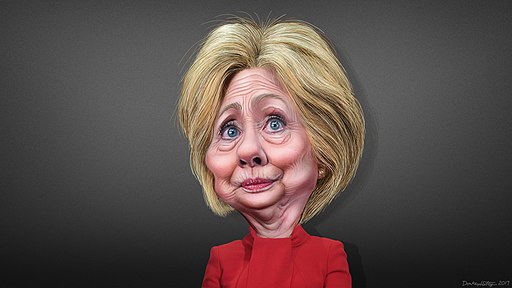
Image by Gage Skidmore
RT | October 18, 2019
Congresswoman Tulsi Gabbard (D-Hawaii) has accused Hillary Clinton of being behind a ‘concerted campaign’ to destroy her reputation and challenged her to stop hiding and enter the 2020 presidential race.
“Great! Thank you Hillary Clinton,” Gabbard tweeted on Friday afternoon. “You, the queen of warmongers, embodiment of corruption, and personification of the rot that has sickened the Democratic Party for so long, have finally come out from behind the curtain.”
“From the day I announced my candidacy, there has been a concerted campaign to destroy my reputation. We wondered who was behind it and why. Now we know — it was always you, through your proxies and powerful allies in the corporate media and war machine,” Gabbard added.
Clinton, who has blamed everyone from the FBI to Russia for her 2016 loss to Donald Trump, said in an interview on Thursday that “Russians” were “grooming” someone in the Democrat primary field to run as a third-party candidate. While not calling out Gabbard by name, her spokesperson later told CNN, “if the nesting doll fits,” leaving no room for doubt.
Of all the candidates in the crowded Democrat primary field, Gabbard has been under the heaviest fire from journalists who previously boosted Clinton, accused of being an “Assad apologist” over a fact-finding trip she took to Syria years ago.
“Don’t cowardly hide behind your proxies. Join the race directly,” Gabbard called out Clinton, who has dropped hints that she might run again in 2020 as a rematch for her 2016 humiliation.
During the 2016 campaign, Gabbard resigned as vice-chair of the Democratic National Committee after endorsing Bernie Sanders for the party’s presidential nomination. Clinton beat Sanders out for the nomination largely due to support from the unaccountable “superdelegates,” and it emerged later that her campaign had taken over the DNC entirely – which might help explain Gabbard’s line about “the rot that has sickened the Democratic Party for so long.”
Jeffrey Epstein Again Disappears From View, but What About Mossad?
By Philip Giraldi | Strategic Culture Foundation | October 17, 2019
I have long argued that pedophile Jeffrey Epstein was clearly an intelligence agent and that he was most likely working for the Israeli external service Mossad. My belief was based on the nature of his activity, which suggested that he was able to blackmail important Americans using the sex tapes that he had been able to make at his Manhattan mansion. Put that together with the existence of his fake Austrian passport, as well as former Miami federal attorney Alexander Acosta’s comments and it would seem that an intelligence connection is a sine qua non.
Acosta was particularly damning. When asked “Is the Epstein case going to cause a problem [for confirmation hearings]?” he replied “…that I had just one meeting on the Epstein case.” He’d cut the non-prosecution deal with one of Epstein’s attorneys because he had “been told to back off,” that Epstein was above his pay grade. “I was told Epstein belonged to intelligence and to leave it alone.”
The answers to those remaining questions about Epstein are still lacking even though he is gone, but one fears that the authorities will be disinclined to further investigate a dead man. It appears that no one in the various investigative agencies or the mainstream media has been interested in what Acosta meant, even though it would be simple enough to ask him. Who told him to back off? And how did they explain it? And then there is Epstein’s Austrian passport. Was the document fake or real, with a real name and photo substitution or alternation of both picture and name? How did he get it? Austrian passports are highly desirable in intelligence circles because the country is neutral and its holders can travel just about everywhere without a visa.
What Epstein did and how he did it was an intelligence operation in support of Mossad. There is no other viable explanation for his filming of prominent politicians and celebrities having sex with young girls. Recruiting and running American movers and shakers like Bill Clinton, with his 26 trips on the Lolita Express, former Governor Bill Richardson, or former Senator George Mitchell are precisely the types of “agents of influence” that the Mossad would seek to coerce or even blackmail into cooperation.
Other compelling evidence for a Mossad connection came from Epstein’s relationship with Ghislaine Maxwell, who reportedly served as his key procurer of young girls. Ghislaine is the daughter of Robert Maxwell, who died or possibly was assassinated in mysterious circumstances in 1991. Maxwell was an Anglo-Jewish businessman, very cosmopolitan in profile, like Epstein, a multi-millionaire who was very controversial with what were regarded as ongoing ties to Mossad. After his death, he was given a state funeral by Israel in which six serving and former heads of Israeli intelligence listened while Prime Minister Yitzhak Shamir eulogized: “He has done more for Israel than can today be said.”
Israel and high-profile Jewish players also have continued to turn up like bad pennies in the Epstein case, but no one seems to be interested in pursuing that angle. Epstein clearly had contact with former Israeli Prime Minister Shimon Peres and Ehud Barak and Epstein patrol Les Wexner also had close ties to the Jewish state and its government.
And now, finally more evidence of the relationship has surfaced even though the mainstream media appears to have lost all interest in the subject. A recent interview given by a former high-ranking official in Israeli military intelligence has inter alia made the claim that Epstein’s sexual blackmail enterprise was from the beginning an Israel intelligence operation involving the entrapment of powerful individuals and politicians in the United States and also abroad.
In an interview with Zev Shalev, former CBS News executive producer, the retired senior executive for Israel’s Directorate of Military Intelligence, Ari Ben-Menashe, claimed not only to have first met Jeffrey Epstein and his alleged procuress, Ghislaine Maxwell, in the 1980s, but that both Epstein and Maxwell were already working with Israeli intelligence prior to that time.
Ben-Menashe, was himself involved in the notorious Iran-Contra arms deals. He claimed that he had been introduced to Jeffrey Epstein by Robert Maxwell in the mid-1980s while Maxwell’s and Ben-Menashe’s were themselves working on Iran-Contra “… he [Maxwell] wanted us to accept him [Epstein] as part of our group …. I’m not denying that we were at the time a group that it was Nick Davies [Foreign Editor of the Maxwell-Owned Daily Mirror], it was Maxwell, it was myself and our team from Israel, we were doing what we were doing.” Ben-Menashe’s account has been corroborated independently by investigative journalist Seymour Hersh, describing how Maxwell, Davies and Ben-Menashe arranged the transfer and sale of military equipment and weapons from Israel to Iran on behalf of Mossad and the CIA during that time period.
Ben-Menashe, who would have absolutely nothing to gain by lying, described how Maxwell stated during the introduction that “your Israeli bosses have already approved” of Epstein. Maxwell was involved in an major intelligence network in Israel “which included the then-Prime Minister Ariel Sharon…” and was well placed to know that of which he spoke.
Will the three simultaneous investigations currently taking place even seek to ask the right questions now that the target of the investigation is gone and the new Ben-Menashe information has surfaced? Given the high stakes in the game, quite likely there will be a cover-up both of how Epstein lived and how he died and, most importantly, whom he worked for. Unfortunately, but predictably, the media and the inside the Beltway chattering class have lost interest in the story and we the public will most likely never learn what Epstein was all about. Just another instance of Israel spying on the United States… ho hum.
These Scrubbed Reports Reveal New Secrets Into the Prince Andrew-Jeffrey Epstein Relationship
Graphic by Claudio Cabrera
By Whitney Webb | MintPress News | October 14, 2019
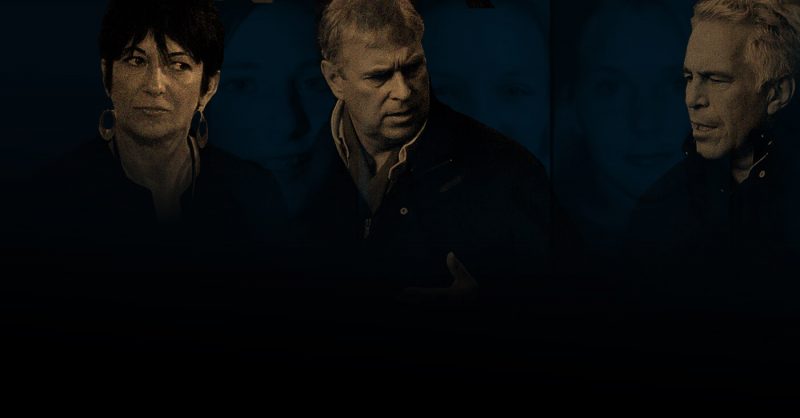
While the Jeffrey Epstein scandal has largely faded from media coverage in the United States, it has continued to attract attention abroad, particularly in the United Kingdom in connection with Epstein’s long-standing association with Prince Andrew, the Duke of York and the Queen’s son.
The Epstein-Prince Andrew relationship has long been a fascination of the U.K. press, with numerous articles dating back to the early 2000s detailing the most outrageous aspects of their relationship. Prior to that, Epstein had also garnered attention from U.K. newspapers regarding his association with Ghislaine Maxwell, whose reputation in the U.K. is rather notorious, as was that of her father, Robert Maxwell.
Yet, since Epstein’s arrest in July, many of these older articles on Epstein and Maxwell, as well as those focusing on the Epstein-Prince Andrew relationship, have disappeared from the archives of several prominent U.K. media outlets that reported on these relationships years ago.
Several of these articles, though largely scrubbed from the internet, were recently obtained by MintPress and a review of their contents makes the likely motive behind their disappearance clear: several articles not only reference Epstein’s connection to both U.S. and Israeli intelligence years before the first investigation into Epstein’s exploitation of minors had even begun, but also reveal surprising aspects of Prince Andrew’s involvement with Epstein that strongly suggest that the Prince partook in illicit sexual activities with minors to a much greater extent than has previously been reported.
New, disturbing details of Prince Andrew’s early links to Epstein
Since Epstein was arrested the first time in 2006 and even more so after he was arrested again this past July, those named in press reports as his associates have made every effort to distance themselves from the accused pedophile and sex trafficker. For this reason, press reports that discuss Epstein long before there was any hint of the larger scandal are particularly important for understanding the true nature of Epstein’s past associations with the rich and powerful.
In light of what is now known about Epstein’s sexual blackmail operation and sex trafficking activities, several reports from the late 1990s and early 2000s contain details long since forgotten regarding Epstein’s relationship with Prince Andrew.
One particularly censored article that appeared in London’s Evening Standard in January 2001, for instance, gives several indications regarding the apparent entrapment of Prince Andrew as part of Epstein’s sexual blackmail operation, which is now known to have been connected to intelligence — specifically Israeli military intelligence, according to recent revelations in the case.
The article, written by Evening Standard journalist Nigel Rosser, quotes a personal friend of both Ghislaine Maxwell and Epstein as saying the following about their friendship with Prince Andrew:

A screenshot from a now-deleted 2001 Evening Standard article
Another friend of Maxwell and Epstein made similar claims that appear in the same article:

A screenshot from the same Evening Standard article
The article further describes Epstein and Prince Andrew as having a “curious symbiotic relationship,” adding that “wherever Ghislaine is seen with Prince Andrew, Epstein isn’t far behind.”
These quotes are particularly telling now that it is a matter of record that Epstein was seeking out rich and powerful individuals and entrapping them with minors for the purpose of blackmail. The fact that personal friends of Epstein and Maxwell at the time openly stated that their “manipulative” relationship with Prince Andrew was “very premeditated” and “probably being done for Epstein” strongly suggests that not only was the Prince entrapped, but that this type of entrapment activity was known to occur among those who were close to Epstein and Maxwell at the time.
Prince Andrew — as a member of the Royal Family, which is very protective of its social reputation, as well as the U.K. envoy for investment and trade — certainly fits into the category of people that Epstein entrapped on behalf of intelligence: rich, politically powerful, wary of damaging their social reputation, and thus susceptible to blackmail.
Notably, the year this article was published (2001), is the same year that Epstein’s most well-known accuser and victim, Virginia Giuffre (then Virginia Roberts), claims that she was introduced to Prince Andrew by Maxwell and Epstein and forced to have sex with the Prince on at least three occasions. She has also claimed that Epstein would subsequently instruct her to describe the encounters in order to learn compromising information about the Prince’s sexual habits and preferences. Her claims regarding Epstein’s trafficking of her, specifically to Prince Andrew, have since been largely corroborated by photographic evidence, flight logs, and public records.

This undated photo released by Virginia Giuffre shows Prince Andrew posing with a young Giuffre, Ghislaine Maxwell is shown in the background
While it appears that Prince Andrew was deliberately entrapped as part of Epstein’s intelligence-linked sexual blackmail operation, the article further suggests that Andrew’s involvement with the minors exploited by Epstein went far beyond his alleged three encounters with Giuffre.
Rosser quotes a friend of Prince Andrew’s ex-wife Sara Ferguson as saying that Andrew “used to be smart when he came back from abroad… He’s started having a girl massage him… He even travels abroad with his own massage mattress.”
During this same time period, Epstein and Maxwell also introduced Prince Andrew to “sex aid entrepreneur” Christine Drangsholt during a trip to Mar-a-Lago and describes Andrew traveling to Los Angeles, where he was seen “flirting… with a group of young girls,” and to Phuket, Thailand where he “wandered around the sex bars in the area’s red light district.” The Los Angeles trip saw Andrew accompanied by artist and close friend of Michael Jackson, Bruce Livingstone Strong, and Ghislaine Maxwell accompanied Andrew to Thailand.
The mentions of massages from a “girl” and Andrew traveling around with Maxwell and Epstein while bringing along “his own massage mattress,” are particularly striking given what is now known about Epstein’s sex trafficking and sexual blackmail operation. Court documents, police reports, and other evidence have since made it clear that “massage” was the code word Epstein and his co-conspirators used for sex with the minors he exploited and massage tables and sex toys were frequently present together in the rooms of his various residences where he forced underage girls to engage in sexual acts with him and others.
Most notable of all is the fact that claims of Prince Andrew receiving “massages” from girls during his trips with Epstein and Maxwell were published in January 2001, at least two months before Virginia Giuffre states that she was first introduced to and forced to have sex with the Prince in March of 2001. This means that the claims of Epstein- and Maxwell-brokered “massages” refer to at least one other girl, strongly suggesting that Andrew’s involvement with minors exploited by Epstein is greater than has been recently acknowledged.
Other recently reported information has added to the likelihood that Prince Andrew engaged in illicit activities with more minors than Virginia Giuffre. For instance, the FBI recently expanded its probe into Epstein’s sex trafficking network to include a specific focus on the Prince’s role. The FBI has claimed that they are reviewing claims regarding Prince Andrew made by other Epstein victims aside from Giuffre, but did not specify the nature of those claims.
Ghislaine Maxwell’s open secret
Media reports cite Prince Andrew and Ghislaine Maxwell as having developed a close relationship at least by February 2000, when Andrew had spent a week at Epstein’s controversial New York penthouse at 9 East 71st Street. One report published in 2000 by London’s Sunday Times claimed that the two were introduced by Andrew’s ex-wife Sarah Ferguson, often referred to as “Fergie” in the press, and further claims that this introduction had taken place several years prior. Epstein is alleged to have first been introduced to Andrew via Maxwell in 1999.
Years after this introduction was made, Jeffrey Epstein would provide financial assistance to Ferguson at Prince Andrew’s behest by paying Ferguson’s former personal assistant £15,000, allegedly in order to allow for “a wider restructuring of Sarah’s £5 million debts to take place,” according to The Telegraph.
Oddly, by April of that year, Maxwell and Prince Andrew were spotted by their fellow diners at a posh New York restaurant holding hands, prompting both the Prince and Maxwell to claim that their relationship was merely “platonic.” However, a separate report from 2007 in the Evening Standard refers to Maxwell as one of Prince Andrew’s former girlfriends.
Within a year of their close relationship having become public, Andrew and Ghislaine were reported to have gone on eight different vacations together, of which Epstein accompanied them for five. Andrew also brought Maxwell and Epstein to celebrate the Queen’s birthday in 2000 as his personal guests.
Several reports from this period also provide interesting insight into Maxwell’s business activities and private life. One article from 2000, published in London’s Sunday Times, states that “for all her high-profile appearances on Manhattan’s A-List merry-go-round, she [Maxwell] is secretive to the point of paranoia and her business affairs are deeply mysterious.” It goes on to say that Maxwell “has been building a business empire as opaque as father’s” — referencing Robert Maxwell’s business empire, which included multiple front companies for Israeli intelligence — and adds that “her office in Manhattan refuses to confirm even the nature or the name of her business.”
On her relationship with Epstein, it states that “he’s always kept her secrets, no one knows what their relationship is really about.” An article from 2001 claims that Maxwell’s Manhattan lifestyle, her New York residence and her vehicles were all purchased by Epstein and that she was employed as his “consultant” while also acting as his social organizer and interior designer.
One report on Maxwell — which was published by the Evening Standard in 2003, years before Epstein was first publicly revealed to be exploiting minors — contains very telling information about Maxwell’s work for Epstein. It states “Ghislaine has risen, largely thanks to property developer Epstein bankrolling her, to become queen of the billionaires’ social circuit,” adding that “Jeffrey only likes billionaires or very young women and uses Ghislaine as his social pimp.” It then discusses “rumors” that Maxwell was hosting “bizarre parties at her house to which she invites a dozen or so young girls, then brandishes a whip and teaches them how to improve their sexual techniques.”
Given what is now known about Maxwell’s role as Epstein’s procurer of underage girls and her role in “training” them in sexual techniques, this passage — again from 2003 — reveals that Epstein’s and Maxwell’s dark acts were pretty much an open secret for years prior to Epstein’s first arrest in 2007.
Jeffrey Epstein, spy and property mogul?
One recurring theme in many of these older reports from the U.K. is their mention of Epstein’s alleged ties to both U.S. and Israeli intelligence. For instance, Nigel Rosser’s 2001 article contains the following passage:

A screenshot from a now-deleted 2001 Evening Standard article
Another article, published in 1992 in the U.K.’s Mail on Sunday, describes “rumors” that linked Epstein to the CIA and the Mossad and claimed that he had worked as “a corporate spy hired by big businesses to uncover money that had been embezzled.” In addition, an article published in 2000 in London’s Sunday Times also states of Epstein that “nobody knows whether he’s a concert pianist, property developer, CIA agent, a math teacher or a member of Mossad.”

A screenshot from a now-deleted 2000 Sunday Times article
Notably, these rumors of Epstein’s links to intelligence have since been confirmed. The CIA-Mossad links to Epstein were detailed in a recent MintPress investigative series and several mainstream media reports have corroborated Epstein’s time as a self-described “financial bounty hunter” who hunted down embezzled funds and also hid stolen money for powerful people and governments.
Another odd commonality among these now-scrubbed articles on Epstein from the 1990s and early 2000s is that the majority of them refer to Epstein not as a “financier” or “hedge fund manager,” as has become common in more recent reports, but as a “New York property developer” and even as a “property mogul.”
For instance, the 2001 Evening Standard article introduces Epstein as an “immensely powerful New York property developer and financier” with an “intensively secret business life” who “owns properties all over the country [the U.S.].” It also states that Epstein had made millions from “his business links with the likes of Bill Gates, Donald Trump and Ohio billionaire Leslie Wexner” during the 1990s and beyond.

A screenshot from a now-deleted 2001 Evening Standard article
Wexner, in addition to his other close financial ties to Epstein, was involved in several Manhattan real estate deals with Epstein and Epstein’s brother Mark while Donald Trump was then best known for his career as a New York property developer and real estate mogul. Trump is also cited in a separate article from January 2001 as being good friends with both Prince Andrew and his ex-wife. In addition, this article’s claim regarding Epstein’s most notable “business links” in 2001 contradicts Bill Gates’ recent assertions that he never had any business relationship with Epstein and did not meet with him until 2013. Notably, Gates’ former chief scientific adviser was recently named as an alternate executor for Epstein’s will and Gates appears on the flight logs of Epstein’s now-infamous private plane. Gates, one of the world’s richest men, has since claimed that he only had met with Epstein in order to meet other wealthy people and to discuss “philanthropy.”
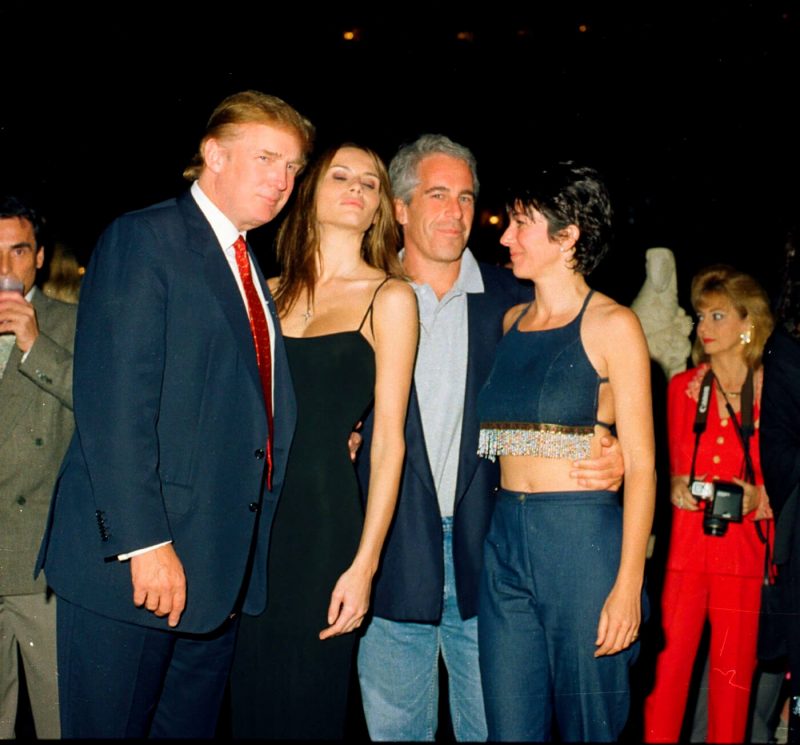
Donald and Melania Trump with Jeffrey Epstein and Ghislaine Maxwell at the Mar-a-Lago club, Palm Beach, Florida in 2000. Photo | Davidoff Studios
Another article in the Evening Standard refers to Epstein as a “property mogul.” Several other articles — such as a 2000 article from Australia’s Sunday Mail, a 1995 article from Australia’s Sun Herald, and a 1995 article from the U.K.’s Mail on Sunday — also refer to Epstein as chiefly a “property developer.” Interestingly, references to Epstein as a property developer continued to occur (though less frequently) after his first arrest in 2007 and then again after his recent arrest this past July, yet oddly only in non-U.S. newspapers. Another article states that Ghislaine Maxwell had sold property on Epstein’s behalf and was also involved in the New York real estate market.
While several articles in the early 2000s describe Epstein as both “property developer” and “financier,” even earlier articles about Epstein refer to him exclusively as a “property developer.” For instance, the 1992 article in the Mail on Sunday cited above referred to Epstein as “a shadowy, almost maverick New York property developer” and noted that, even then, Epstein appeared “to have an inexhaustible supply of money and yet no one seems able to answer the question of precisely what the source.”
As will be revealed in an upcoming MintPress investigative series, these references allude to Epstein’s shady business activities in the New York and Palm Beach real estate markets from the mid-1980s to the late-1990s that were used to launder massive amounts of money for organized crime and intelligence. It is likely for this reason that Epstein’s real estate activities during this period have been so deliberately ignored by the U.S. press, even though other aspects of his financial activities were heavily scrutinized in recent months.
Indeed, in examining Epstein’s involvement in real estate markets, particularly in New York, it becomes clear that those activities have no shortage of controversial tie-ins to the current U.S. presidential administration as well as major New York power players involved in suspect financial activity immediately prior to the September 11 attacks as well as the 2008 financial crisis. All of those connections and more will be explored in MintPress’ upcoming investigative series on the financial crimes of Jeffrey Epstein and their broader implications.
Whitney Webb is a MintPress News journalist based in Chile. She has contributed to several independent media outlets including Global Research, EcoWatch, the Ron Paul Institute and 21st Century Wire, among others. She has made several radio and television appearances and is the 2019 winner of the Serena Shim Award for Uncompromised Integrity in Journalism.
Featured Video
HE SAVED LIVES. NOW HE FACES PRISON.
or go to
Aletho News Archives – Video-Images
From the Archives
NATO Sanctions and the Coming Global Diesel Fuel Disaster
By F. William Engdahl – New Eastern Outlook – 11.04.2022
Amid the ongoing global inflation crisis, NATO heads of state and mainstream media repeat a mantra that high energy prices are a direct result of Putin’s actions in Ukraine since end of February. The reality is that it is the western sanctions that are responsible. Those sanctions including cutting SWIFT interbank access for key Russian banks and some of the most severe sanctions ever imposed, are hardly having an impact on the military actions in Ukraine. What many overlook is the fact that they are increasingly impacting the economies of the West, especially the EU and USA. A closer look at the state of the global supply of diesel fuel is alarming. But Western sanctions planners at the US Treasury and the EU know fully well what they are doing. And it bodes ill for the world economy.
While most of us rarely think about diesel fuel as anything other than a pollutant, in fact it is essential to the entire world economy in a way few energy sources are. The director general of Fuels Europe, part of the European Petroleum Refiners Association, stated recently, “… there is a clear link between diesel and GDP, because almost everything that goes into and out of a factory goes using diesel.” … continue
Blog Roll
 Aletho News
- Trita Parsi: Middle East Unraveling — Are We on the Path to World War?
- Iran FM meets with US envoy on UN meeting’s sidelines at American side’s insistence: Report
- Qatar PM calls for Gulf security framework with Iran, says war must be ‘wake-up call’
- China condemns US extortion of Iranian airlines, rejects Washington’s ‘illegal’ sanctions threats
- Italy to move military personnel from Taif base after missile strike
- Finland’s Stubb tells European leaders to calm down
- Defeating Russia on battlefield impossible – Fico
- Finland’s Gender Clinic Reversal
- Massachusetts Wants Mental Health Visits, Why Does Government Use ‘Health’ to Enter Our Homes & Families?
- US lawmaker admits American people footing bill for Trump’s failed aggression against Iran
- If Americans Knew
- Sanctions are collective punishment: immoral and self-defeating
- Phosphorus Munitions Fired by Israel Burn Groves, Orchards in Southern Lebanon
- Israel Carries Out New Ceasefire Violations Across Gaza
- AI – Emphasis on the ‘I’: Israel Is Funding AI Chatbot Propaganda
- Israel Blocking Hundreds of Wheelchairs for Injured Children From Entering Gaza
- Israel Is Expanding and Upgrading Compounds for Palestinian Militias in Gaza
- The Palestinian-American Residents of This West Bank Town Are Wondering: Where Is Trump?
- Gaza desperately needs tents, wheelchairs, fuel… and everything else (Israel blocks it all) – Daily Update
- Israeli Attacks in Gaza Kill at Least Seven Palestinians Over Three Days, including Woman and Child
- Trump’s militarization of Washington DC as he pursues Israel’s war against Iran
- No Tricks Zone
- New Study: Earth And Venus Surface Warmth Largely Explained By Convection And Lapse Rate, Not CO2 Or Radiation
- 2025 Nature Paper Claiming Worsening Global Drought Gets RETRACTED …Heavily Flawed
- New Study: ‘Global Drought Shows No Detectable Recent Acceleration Under Climate Warming’
- Economic Masterminds: German Socialists Suggest Taxing Productivity Gains Stemming From Using AI
- The South China Sea Has Not Been Cooperating With The Climate Change Narrative
- Energy Crisis: Germany Enters Heating Season With Historically Low Gas Reserve Fill Levels
- New Study: The Antarctic Ice Sheet Gained Mass From 2020-2024 Due To Staggering Snow And Ice Accumulation
- Study: Ocean Heating Rates From Thousands Of Years Ago ‘Dwarf’ Modern Ocean Heating Rates
- Climate Extremists Target, Attack Large-Scale Power Grid Infrastructure In Germany!
- New Study: Antarctic Ice Melt Has Contributed Less Than 1 Centimeter To Sea Level Rise In The Last 30 Years

