US should pay France for loss of Russian gas – Le Pen
Samizdat | April 16, 2022
The US should compensate France for losses if the EU bans Russian energy carriers, French presidential candidate Marine Le Pen said in an interview with BFM TV.
“The Americans, who will sell us liquefied gas and get a solid profit from it, could transfer money to France as compensation for anti-Russia sanctions,” Le Pen said, noting that Washington is pressuring the EU to sanction Russian energy carriers. The bloc placed multiple sanctions on Russia after Moscow launched a military operation in neighboring Ukraine. The operation has been widely criticized by many Western nations, but perhaps none have been more outspoken than the US.
According to Le Pen, if Washington succeeds in stopping Russian gas imports to the EU, it will result in unbearably high fuel bills for the French. However, she believes that American fuel magnates care little about ordinary French people and their plight, and are only interested in business, eager to profit from the increase in LNG exports to the bloc.
While the European Union has placed numerous sanctions on Moscow over the past few weeks, member states have so far been unable to reach an agreement on banning Russian energy imports. Many EU countries are heavily dependent on Russian energy, while some have no alternative, being landlocked and therefore unable to receive liquefied gas from the US, for instance.
However, discussions on the issue will continue, High Representative of the European Union for Foreign Affairs and Security Policy Josep Borrell said on Monday.
Moscow currently supplies around 40% of the gas used by EU nations and around a third of their oil. Russian Deputy Prime Minister Alexander Novak recently estimated that it would take the EU 5-10 years to completely replace Russian oil and gas, noting that an embargo would inevitably result in record prices.
Real James Bond villains wear cardigans
Bill Gates, the WEF, and the WHO are not done with us. It’s time we were done with them.
el gato malo – bad cattitude – april 13, 2022
in history as in literature, a special place of contempt is held for the grand vizier, the guy behind the throne, the power behind the power. it’s a position of great influence but zero accountability, especially if you can subvert the ruler you puppet past the point of being able to scapegoat you.
buying or leading a politician and getting goodies is a process as old as politics, probably older as it was likely the reason the first politician was elected in the first place…
but the truly discerning james bond villain level vizier, well, they just go right ahead and buy their own NGO’s. that’s how you take over the world. space lasers and earthquake machines may be cool, but real conquest usually banal.
get to about the 1 minute mark in this video where you can hear bill speak about talking to donald trump in the white house.

trump asks about looking into some of the ill effects of vaccines.
gates tells him “that’s a dead end, that would be a bad thing, don’t do that.”
this is not a man giving well intentioned advice.
this is a man covering up a crime committed in the service of crony capitalism.
the gates foundation has a longstanding relationship with vaccines that is more than a little sketchy. they were pushing oral polio vaccines in africa LONG after they were known to be unsafe and had actually become the leading cause of polio in the world.
“The Gates Foundation is a leading funder of oral polio vaccination in Africa and around the world, having dedicated nearly $4 billion to such efforts by the end of 2018. As discussed in Forbes in May 2019, Gates has “personally [driven] the development” of new oral polio vaccines and plays a “strategic role beyond funding.”
the US uses ONLY injected IPV polio vaccines. both the US and the EU discontinued use of orals because of side effects including actually causing polio.
A year ago, news outlets briefly shone a light on the fact (a fact that makes public health officials squirm) that oral polio vaccines are causing polio outbreaks. With reports streaming in throughout 2019 regarding the circulation of vaccine-derived polioviruses in numerous African and Asian countries, a CDC virologist confessed, “We have now created more new emergences of the virus than we have stopped.”
… there were 400 recorded cases of vaccine-derived polio in more than 20 countries worldwide.
(author’s note: that’s ~3X the total of all natural polio cases worldwide and of those, only 29 occurred outside of pakistan and 100% of those were in afghanistan. this vaccines caused multiples more polio than the virus itself)
This week, the same story is making the same headlines, with the WHO’s shamefaced announcement that the oral polio vaccine is responsible for an alarming polio outbreak in Sudan—“linked to an ongoing vaccine-sparked epidemic in Chad”—with parallel outbreaks in a dozen other African countries. In fact, between August 2019 and August 2020, there were 400 recorded cases of vaccine-derived polio in more than 20 countries worldwide. Ironically, WHO disclosed this “setback” barely a week after it declared the African continent to be free of wild poliovirus—which has not been seen in Africa since 2016. While African epidemiologists cheerily claim that these outbreaks can “be brought under control with further immunization,” and Sudan prepares to launch a mass polio vaccination campaign, WHO is warning that “the risk of further spread of the vaccine-derived polio across central Africa and the Horn of Africa” is high.
but gates kept pushing them in africa anyway, probably because so many of his pals owned the production and that’s what the gates foundation does. that’s what all these guys do. big business and billionaires are not friends of free markets. they want sure things and it’s cheaper to twist and break arms and buy mandated markets than to compete on a fair playing field.
i have (on excellent, direct authority from a personal friend who i trust implicitly and who spoke directly to the folks involved) the following story about the gates foundation in india:
gates himself came in to speak with the health ministers. he offered them a vaccine for a disease they already had one for. they told him, “no thank you, we already have that one covered.” he told them “well, you need to switch to this vaccine or there will be no gates foundation investment for india.” the one he wanted them to switch to was owned by a “friend of his.” this story was relayed by extremely liberal folks who literally run vaccine programs in india. they heard this conversation directly and have no reason to lie. they were horrified. it was a pay to play stick up. (they still declined)
this is not the sort of conflict of interest that’s helpful in a guy telling the president not to look into vaccine issues. it also stands testament to his morality and inclination. bill gates is as amoral as he is rich. always has been. much of microsoft was stolen from his less machiavellian partners.
i’m presuming this interview above and the discussion with trump were pre-covid because it’s never mentioned and had this been post covid, i find it hard to believe that it would not have been, but it seems more apropos now that ever. obviously, the conflicts of interest certainly did not stop back then and vaccine ill effects are looking like quite the hot topic just now.
and gates is, as ever, right smack in the middle of the dirtiest, most profitable part of it.
it was september 2019. SARSCOV-2 was still not really on the radar. according to many, there was not even an outbreak yet.
that same month, billy made a large investment in a company called bioNtech to allegedly pursue HIV and tuberculosis vaccines. if memory serves, he bought about 1/3 of the company which was entirely preclinical in infectious diseases at the time. they were mostly a phase 1-2 oncology company. this looks like a sweetheart valuation.
obviously, this became a very big deal in a very big hurry. it was their mRNA payload that was licensed by pfizer for their vaccine, a product that went on to be the most profitable drug per unit time in human history. (and possibly the most profitable altogether) bioNtech minted money.
lots of things about this investment have long smelled fishier than a sushi bar dumpster.
but then a funny thing happened with a now vexingly familiar cast of characters.

(read more HERE)
even months later in january 2020, folks like osterholm were still buying the “no signs of human to human transmission” line.
yet somehow, 4 months earlier (and who knows when the due diligence started. might have been 6 or more), gates was putting his money right on the one obscure square that would pay out 100 to one. at a company with near zero footprint in infectious disease. for a virus no one was focused on. whose genetic code would not (allegedly) be initially characterized for 4 more months.
then, in the same odd, sudden miracle that got moderna the NIH science they licensed for their vaccine, bioNtech also had a product and pfizer jumped to license it.
alone, having a wargame for the war that had, unbeknownst to most, already started, might raise eyebrows, but it might also be a coincidence.
but when the folks coming to that wargame have been making big bets on the kinds of weapons that that precise (and only that precise) sort of war would use, well, one might start to sharpen the points on one’s pointy questions.
just what was informing what here?
this idea that “mRNA is magic and you can develop a vaccine in weeks” is complete nonsense. it’s never been true and the rest of the mRNA vaccine timelines stand testament to it. no other vaxx has been forthcoming.
this HAD to have been in the works for a significant period beforehand.
the fix appears to have been deeply in here. somebody was getting some VERY early looks at some tech to vaccinate against a virus no one else even had a copy of. the awareness not just of the pathogen, but the way to code for its spike protein and the impending pandemic seems to have been loose in certain circles long before the rest of us were told.
the NIH seeded moderna. i still do not have confirmation on where bioNtech got theirs, but i have a hunch and it rhymes with “silly plates” and that this might explain the sweetheart deal.
there is really only one story that makes sense to me here on covid origins, and that story is this:
NIH funded eco health alliance run by daszak and in cahoots with folks like baric colored outside the lines with fauci’s grant money. they, in collaboration with the wuhan institute of virology hotwired the hell out of covid viruses from bats engaging in gain of function work WAY outside of safe limits. this was not a weapon. it was work on inoculation. that was daszak’s longstanding focus. we’ll probably never know what happened in wuhan, but the breadcrumbs here are AWFULLY provocative and the sudden appearance of 2 mRNA vaccines, one with the NIH folks that funded EHA at the WIV, one with bioNtech, looks like an offshoot of it. (lots of detail HERE and HERE on the breadcrumbs)
wrapped up in this from the very beginning were load of the WEF gang (who had just run an oddly timely pandemic wargame for a disease an awful lot like covid) and the WHO.
billy gates is neck deep in both, a charter member of the cool kids crony capitalist table at davos and a top funding source for the WHO, donating more than 10% of its budget. it’s clearly a great investment for him as it poops golden eggs in terms of early information and hard sell opportunities for poor countries. it’s a seat at every table that makes you look like a philanthropist while in reality being a lead pipe wielding coercive corporatist.
gates is not a good guy.
he’s a sociopathic nerd with the most unsavory of associates.
and he knows how to play the crony capitalist game with the absolute best of them. the gates foundation has become a barely veiled international influence organization masquerading as a charity.
between gates and china, the WHO will dance to whatever song the two play. and oh, how they will dance.
remember this gem? (i do)

this was a big part of what got the out of control abandonment of 100 years of science based pandemic guidelines rolling.
“hey, let’s throw all the science, data, and history out the window and copy a terrifying authoritarian regime with a human rights record that would make myanmar blush!”
yeah, well, we all remember how THAT worked out…
but this is government. it’s worse than government, it’s trans-national organizational government. these are the people who invented “failing up” where the bigger your screw ups, the higher you get promoted. (if you doubt me, look at who runs the IMF and the world bank some time…)
and so, despite having cheer led for nothing uty pseudoscience, failure, and human ruin, the current plan being put forward is, wait for it, “hey, let’s give the WHO massive, unaccountable globalist powers!”
of course, this was clearly the plan all along if you were paying attention.

note the direct parrot of the WEF “build back better” taking point.
this gang sees every crisis as a chance to try to grab control of the world. and they are at it again.
In a consensus decision aimed at protecting the world from future infectious diseases crises, the World Health Assembly today agreed to kickstart a global process to draft and negotiate a convention, agreement or other international instrument under the Constitution of the World Health Organization to strengthen pandemic prevention, preparedness and response.
Dr Tedros Adhanom Ghebreyesus, WHO Director-General, said the decision by the World Health Assembly was historic in nature, vital in its mission, and represented a once-in-a-generation opportunity to strengthen the global health architecture to protect and promote the well-being of all people.
“The COVID-19 pandemic has shone a light on the many flaws in the global system to protect people from pandemics: the most vulnerable people going without vaccines; health workers without needed equipment to perform their life-saving work; and ‘me-first’ approaches that stymie the global solidarity needed to deal with a global threat,” Dr Tedros said.
they will also force licensing, break patents, and drive health policy at the highest levels.
but here’s the full blown worst of it:

The World Health Organization (WHO) has contracted German-based Deutsche Telekom subsidiary T-Systems to develop a global vaccine passport system, with plans to link every person on the planet to a QR code digital ID.
Indeed, despite the minuscule threat posed by new variants and dubious-at-best vaccine efficacy, the WHO is adamant that a global QR code-based vaccine passport system is vital for all future health emergencies, not just COVID.
“COVID-19 affects everyone. Countries will therefore only emerge from the pandemic together. Vaccination certificates that are tamper-proof and digitally verifiable build trust. WHO is therefore supporting member states in building national and regional trust networks and verification technology,” says unit head of the WHO’s Department of Digital Health and Innovation Garrett Mehl.
“The WHO’s gateway service also serves as a bridge between regional systems. It can also be used as part of future vaccination campaigns and home-based records.”
got that? this one is going to be digitally verifiable and global. nowhere to run, nowhere to hide, universal, mandatory, trans-national, and administered by an agency completely unaccountable to you and beholden to proven kleptocrats, authoritarians, and crony corporatists. they are basically a subsidiary of china and gates inc.
they will not get any better or more honest next time.
we’re talking about taking one of the most corrupt, captured, and incompetent agencies in the history of bureaucratic bloviation and giving them the keys to the world crisis machine and to an electronic health passport that will be your right to travel and work and eat out and shop and who knows what else. this is the cornerstone of an international social credit system. wait until they add your ESG score and your carbon footprint.
giving this team universal chicken little rights and direct links at highest levels to public policy is bad enough. letting them enable fine grained access into permission to have anything resembling a life will have you eating bugs and tweeting what you’re told faster than you can say #grasshoppers #yummy!
they promised you that in the future you’d have no privacy and own nothing and that you’d been happy.
guess which two promises they’re going to keep?
and government will fall all over themselves to help and to outsource the imposition of the infinite personal tracking and permissioning they have so long salivated over under the pretext of pandemic preparedness. (oops, look, another trojan framing of subjugating masquerading as safety. told you these were EVERYWHERE…)
this is not going to be acceptable or even tolerable.
this group should be disbanded, not granted greater remit.
and they are not done, because the power behind these thrones is ever hungry.
you might be thinking “wow, that was awful” but they are all thinking “wow, that was surprisingly easy. i wonder what we could do if we had some time to get set up beforehand and really run the table?”
these are not good people.
they do not have noble aims nor your best interests at heart.
they are a global aristocracy of surpassing ruthlessness telling scare stories so they can mandate alleged solutions.
they tell you it’s about saving you.
it isn’t.
read the fine print.
follow the money.

the super rich do not like to guess. they do not like to be surprised by trends. it is far more certain and therefore more profitable to force you to buy that which they are selling. the public health grift and the climate grift are all one grift: use government and trans-government to frighten and force people into buying the needless products that you’re going to produce for them.
small investors talk their book. titanic investors force you to buy it.
- if it’s a vaccine, mandate it and bar all useful therapeutics from market.
- if it’s a windmill, kill nuclear and inflict absurdist carbon taxes.
- never let any of it be properly assessed.
- use fear to drive compliance and compliance to drive mandate.
they will sell you your own collar and leash and demand your gratitude for having done so.
and if you don’t wake up pretty soon, they’re going to get it from you. by force. and you will be powerless to stop it.
the confluence of a global health passport and central bank digital currencies is an extinction level event for personal liberty and privacy.
and make no mistake: gates wants it. the WEF wants it. and most western governments want it.
but they also know that you do not want it. so they need a pretext and a plan and a pile of boring, technocratic yammering to hide it behind. they learned from last time. they saw the cracks we squirmed through and how we got away. and they do not plan to let it happen again. the next one will be air tight. they’ll have the WHO ready to both be able to declare a global emergency and impose ready made verified global digital ID using that fear as a pretext.
if you let them get these pieces into place, you are NOT going to like the endgame.
this has reached the email length limit. check the substack page for an addendum.
Jive Talking Journals: Why the conclusions sometimes don’t match the data in scientific papers

By a Biomedical Scientist | The Exposé | April 13, 2022
Biomedical research papers are being published in which the abstract, the discussion section, and even the title contradict the content within the paper.
This is unlikely to be happening because the authors don’t understand their own data. It’s more likely that the authors are being pressured by their financial backers and the editorial staff of journals to reach conclusions that advance the prevailing narrative.
It’s a well thought out deception that uses seemingly intellectual analysis to lead the undiscerning reader into believing the wrong conclusion. Skewing statistics is easy to accomplish simply by using the wrong statistical test, using a weak test when a stronger one should apply or just about any other trick to misrepresent the data.
Medical journals have become financially dependent on their advertisers, which are almost exclusively the big pharmaceutical companies. With enough money, they can buy a scientific study that says what they want it to say.
Sometimes these studies are “ghost” written by people working for industry with credentialed unscrupulous scientists and doctors names misattributed as authors when in fact they did none of the writing.
The pharmaceutical industry uses its profits to control biomedical science at every level, from researchers to journal editors, to government regulatory agencies, and to the media who are supposed to interpret science for the public.
Pressure is being placed on independent researchers by the journal editors and peer reviewers, many of whom have ties to Big Pharma. Valid studies, honestly reported, can be rejected for publication if they convey a message that threatens corporate profits. Many scientific authors know how difficult it is to get a paper through peer review at most “reputable” medical journals when the results are not in line with the official narrative.
Many biomedical scientists have become shills for the pharmaceutical companies. Rigging clinical trials the old-fashioned way is expensive, time-consuming, uncertain, and recent legislation makes it more difficult. Sometimes the truth emerges even if a study is designed to hide it. Even a study that is designed to fail might succeed when the inconvenient truths are stubborn enough.
It’s easier to report the actual results and then tack on an abstract and a discussion section that convey the right message, regardless of the data in the main body of the article. This can then be used in the “citation bluff” fraud, that depends on people not carefully reading supposed supportive evidence, to perpetuate the false narrative.
Often the cited evidence in support of a particular narrative doesn’t really support the narrative being advanced. In fact, the supposed supportive evidence can sometimes even completely contradict the narrative being pushed.
This is something to bear in mind the next time you get into an argument with someone demanding to see peer-reviewed evidence and rejecting any evidence that has not been peer-reviewed regardless of its merits.
Journals and the peer review process have been corrupted by powerful vested interests.
Western Dissent from US/NATO Policy on Ukraine is Small, Yet the Censorship Campaign is Extreme
Preventing us from asking who benefits from a protracted proxy war, and who pays the price, is paramount. A closed propaganda system achieves that.
By Glenn Greenwald | April 13, 2022
If one wishes to be exposed to news, information or perspective that contravenes the prevailing US/NATO view on the war in Ukraine, a rigorous search is required. And there is no guarantee that search will succeed. That is because the state/corporate censorship regime that has been imposed in the West with regard to this war is stunningly aggressive, rapid and comprehensive.
On a virtually daily basis, any off-key news agency, independent platform or individual citizen is liable to be banished from the internet. In early March, barely a week after Russia’s invasion of Ukraine, the twenty-seven nation European Union — citing “disinformation” and “public order and security” — officially banned the Russian state-news outlets RT and Sputnik from being heard anywhere in Europe. In what Reuters called “an unprecedented move,” all television and online platforms were barred by force of law from airing content from those two outlets. Even prior to that censorship order from the state, Facebook and Google were already banning those outlets, and Twitter immediately announced they would as well, in compliance with the new EU law.
But what was “unprecedented” just six weeks ago has now become commonplace, even normalized. Any platform devoted to offering inconvenient-to-NATO news or alternative perspectives is guaranteed a very short lifespan. Less than two weeks after the EU’s decree, Google announced that it was voluntarily banning all Russian-affiliated media worldwide, meaning Americans and all other non-Europeans were now blocked from viewing those channels on YouTube if they wished to. As so often happens with Big Tech censorship, much of the pressure on Google to more aggressively censor content about the war in Ukraine came from its own workforce: “Workers across Google had been urging YouTube to take additional punitive measures against Russian channels.”
So prolific and fast-moving is this censorship regime that it is virtually impossible to count how many platforms, agencies and individuals have been banished for the crime of expressing views deemed “pro-Russian.” On Tuesday, Twitter, with no explanation as usual, suddenly banned one of the most informative, reliable and careful dissident accounts, named “Russians With Attitude.” Created in late 2020 by two English-speaking Russians, the account exploded in popularity since the start of the war, from roughly 20,000 followers before the invasion to more than 125,000 followers at the time Twitter banned it. An accompanying podcast with the same name also exploded in popularity and, at least as of now, can still be heard on Patreon.
What makes this outburst of Western censorship so notable — and what is at least partially driving it — is that there is a clear, demonstrable hunger in the West for news and information that is banished by Western news sources, ones which loyally and unquestioningly mimic claims from the U.S. government, NATO, and Ukrainian officials. As The Washington Post acknowledged when reporting Big Tech’s “unprecedented” banning of RT, Sputnik and other Russian sources of news: “In the first four days of Russia’s invasion of Ukraine, viewership of more than a dozen Russian state-backed propaganda channels on YouTube spiked to unusually high levels.”
Note that this censorship regime is completely one-sided and, as usual, entirely aligned with U.S. foreign policy. Western news outlets and social media platforms have been flooded with pro-Ukrainian propaganda and outright lies from the start of the war. A New York Times article from early March put it very delicately in its headline: “Fact and Mythmaking Blend in Ukraine’s Information War.” Axios was similarly understated in recognizing this fact: “Ukraine misinformation is spreading — and not just from Russia.” Members of the U.S. Congress have gleefully spread fabrications that went viral to millions of people, with no action from censorship-happy Silicon Valley corporations. That is not a surprise: all participants in war use disinformation and propaganda to manipulate public opinion in their favor, and that certainly includes all direct and proxy-war belligerents in the war in Ukraine.
Yet there is little to no censorship — either by Western states or by Silicon Valley monopolies — of pro-Ukrainian disinformation, propaganda and lies. The censorship goes only in one direction: to silence any voices deemed “pro-Russian,” regardless of whether they spread disinformation. The “Russians With Attitude” Twitter account became popular in part because they sometimes criticized Russia, in part because they were more careful with facts and viral claims that most U.S. corporate media outlets, and in part because there is such a paucity of outlets that are willing to offer any information that undercuts what the U.S. Government and NATO want you to believe about the war.
Their crime, like the crime of so many other banished accounts, was not disinformation but skepticism about the US/NATO propaganda campaign. Put another way, it is not “disinformation” but rather viewpoint-error that is targeted for silencing. One can spread as many lies and as much disinformation as one wants provided that it is designed to advance the NATO agenda in Ukraine (just as one is free to spread disinformation provided that its purpose is to strengthen the Democratic Party, which wields its majoritarian power in Washington to demand greater censorship and commands the support of most of Silicon Valley). But what one cannot do is question the NATO/Ukrainian propaganda framework without running a very substantial risk of banishment.
It is unsurprising that Silicon Valley monopolies exercise their censorship power in full alignment with the foreign policy interests of the U.S. Government. Many of the key tech monopolies — such as Google and Amazon — routinely seek and obtain highly lucrative contracts with the U.S. security state, including both the CIA and NSA. Their top executives enjoy very close relationships with top Democratic Party officials. And Congressional Democrats have repeatedly hauled tech executives before their various Committees to explicitly threaten them with legal and regulatory reprisals if they do not censor more in accordance with the policy goals and political interests of that party.
But one question lingers: why is there so much urgency about silencing the small pockets of dissenting voices about the war in Ukraine? This war has united the establishment wings of both parties and virtually the entire corporate media with a lockstep consensus not seen since the days and weeks after the 9/11 attack. One can count on both hands the number of prominent political and media figures who have been willing to dissent even minimally from that bipartisan Washington consensus — dissent that instantly provokes vilification in the form of attacks on one’s patriotism and loyalties. Why is there such fear of allowing these isolated and demonized voices to be heard at all?
The answer seems clear. The benefits from this war for multiple key Washington power centers cannot be overstated. The billions of dollars in aid and weapons being sent by the U.S. to Ukraine are flying so fast and with such seeming randomness that it is difficult to track. “Biden approves $350 million in military aid for Ukraine,” Reuters said on February 26; “Biden announces $800 million in military aid for Ukraine,” announced The New York Times on March 16; on March 30, NBC’s headline read: “Ukraine to receive additional $500 million in aid from U.S., Biden announces”; on Tuesday, Reuters announced: “U.S. to announce $750 million more in weapons for Ukraine, officials say.” By design, these gigantic numbers have long ago lost any meaning and provoke barely a peep of questioning let alone objection.
It is not a mystery who is benefiting from this orgy of military spending. On Tuesday, Reuters reported that “the Pentagon will host leaders from the top eight U.S. weapons manufacturers on Wednesday to discuss the industry’s capacity to meet Ukraine’s weapons needs if the war with Russia lasts years.” Among those participating in this meeting about the need to increase weapons manufacturing to feed the proxy war in Ukraine is Raytheon, which is fortunate to have retired General Lloyd Austin as Defense Secretary, a position to which he ascended from the Raytheon Board of Directors. It is virtually impossible to imagine an event more favorable to the weapons manufacturer industry than this war in Ukraine:
Demand for weapons has shot up after Russia’s invasion on Feb. 24 spurred U.S. and allied weapons transfers to Ukraine. Resupplying as well as planning for a longer war is expected to be discussed at the meeting, the sources told Reuters on condition of anonymity. . .
Resupplying as well as planning for a longer war is expected to be discussed at the meeting. . . The White House said last week that it has provided more than $1.7 billion in security assistance to Ukraine since the invasion, including over 5,000 Javelins and more than 1,400 Stingers.
This permanent power faction is far from the only one to be reaping benefits from the war in Ukraine and to have its fortunes depend upon prolonging the war as long as possible. The union of the U.S. security state, Democratic Party neocons, and their media allies has not been riding this high since the glory days of 2002. One of MSNBC’s most vocal DNC boosters, Chris Hayes, gushed that the war in Ukraine has revitalized faith and trust in the CIA and intelligence community more than any event in recent memory — deservedly so, he said: “The last few weeks have been like the Iraq War in reverse for US intelligence.” One can barely read a mainstream newspaper or watch a corporate news outlet without seeing the nation’s most bloodthirsty warmongering band of neocons — David Frum, Bill Kristol, Liz Cheney, Wesley Clark, Anne Applebaum, Adam Kinzinger — being celebrated as wise experts and heroic warriors for freedom.
This war has been very good indeed for the permanent Washington political and media class. And although it was taboo for weeks to say so, it is now beyond clear that the only goal that the U.S. and its allies have when it comes to the war in Ukraine is to keep it dragging on for as long as possible. Not only are there no serious American diplomatic efforts to end the war, but the goal is to ensure that does not happen. They are now saying that explicitly, and it is not hard to understand why.
The benefits from endless quagmire in Ukraine are as immense as they are obvious. The military budget skyrockets. Punishment is imposed on the arch-nemesis of the Democratic Party — Russia and Putin — while they are bogged down in a war from which Ukrainians suffer most. The citizenry unites behind their leaders and is distracted.
Twitter is questioned over Hunter Biden laptop story censorship
By Christina Maas | Reclaim The Net | April 11, 2022
In October 2020, just before the election, the New York Post published a story about Hunter Biden’s potentially corrupt dealings when his father, Joe Biden, was vice president. The story was based on damning emails obtained from a laptop Hunter left at a repair shop in Delaware.
Twitter censored the story over the “origins of the material” and suspended the New York Post’s account for two weeks. The online platforms also prevented users from sharing the story.
A few weeks ago, The New York Times confirmed the authenticity of what the New York Post called the “laptop from hell.”
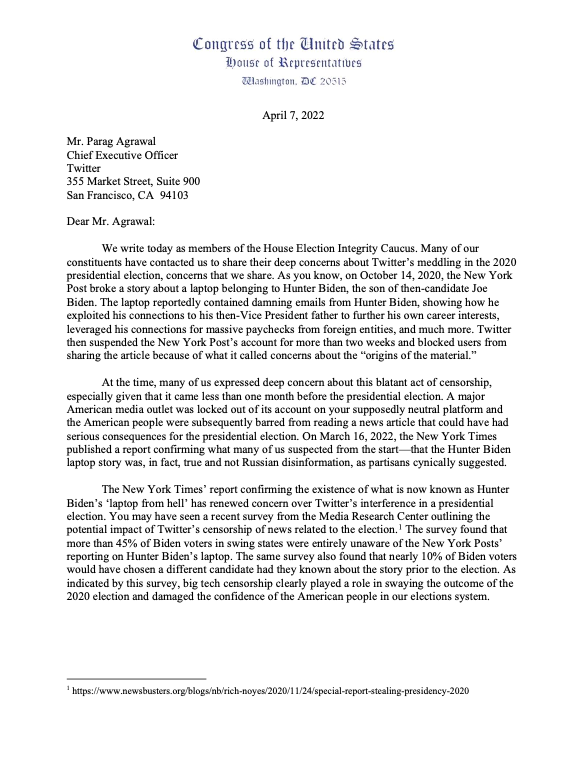
Now, Republican members of the House Election Integrity Caucus, led by Rep. Claudia Tenney, in a letter addressed to Twitter CEO Parag Agrawal, are asking for answers about the censorship of the story.
“Big Tech oligarchs have grown far too powerful, censoring free speech that challenges their preferred narrative and their handpicked politicians,” Tenney told FOX Business. “In 2020, this reached a new low.”
“Twitter’s actions to silence the New York Post and others undoubtedly swayed the outcome of the presidential election. The free flow of information is key to a healthy democracy and to free and fair elections. Congress must be unequivocal in its response and hold Big Tech accountable.”
The Republicans want Twitter to “provide answers to the American people.” They also want Congress to “break up big tech, take an axe to Section 230, and ensure Silicon Valley elites can no longer interfere in our elections.”
They argue that the laptop contained damning emails that could have worked in President Trump’s favor.
“The laptop reportedly contained damning emails from Hunter Biden, showing how he exploited his connections to his then-vice president father to further his own career interests, leveraged his connections for massive paychecks from foreign entities, and much more,” the lawmakers wrote.
“Twitter then suspended the New York Post’s account for more than two weeks and blocked users from sharing the article because of what it called concerns about the ‘origins of the material.”
They added that the suspension prevented people from “reading a news article that could have had serious consequences for the presidential election.”
The New York Times confirming the authenticity of the laptop has “renewed concern over Twitter’s interference in a presidential election,” according to the lawmakers.
In the letter, the legislators demand answers to several questions from Agrawal, including who “made the decision to censor the New York Post’s story on Hunter Biden’s ‘laptop from hell.’” They also want to know if Twitter collaborated “with any individuals directly or indirectly involved with the Biden campaign” when it censored the story.
Putting Big Pharma on Trial in the COVID-19 Era, Part 4
The Hypocrisy of “Misinformation”
By Rebecca Strong · February 16, 2022
I find it interesting that “misinformation” has become such a pervasive term lately, but more alarmingly, that it’s become an excuse for blatant censorship on social media and in journalism. It’s impossible not to wonder what’s driving this movement to control the narrative. In a world where we still very clearly don’t have all the answers, why shouldn’t we be open to exploring all the possibilities? And while we’re on the subject, what about all of the COVID-related untruths that have been spread by our leaders and officials? Why should they get a free pass?
Fauci, President Biden, and the CDC’s Rochelle Walensky all promised us with total confidence the vaccine would prevent us from getting or spreading COVID, something we now know is a myth. (In fact, the CDC recently had to change its very definition of “vaccine ” to promise “protection” from a disease rather than “immunity”— an important distinction). At one point, the New York State Department of Health (NYS DOH) and former Governor Andrew Cuomo prepared a social media campaign with misleading messaging that the vaccine was “approved by the FDA” and “went through the same rigorous approval process that all vaccines go through,” when in reality the FDA only authorized the vaccines under an EUA, and the vaccines were still undergoing clinical trials. While the NYS DOH eventually responded to pressures to remove these false claims, a few weeks later the Department posted on Facebook that “no serious side effects related to the vaccines have been reported,” when in actuality, roughly 16,000 reports of adverse events and over 3,000 reports of serious adverse events related to a COVID-19 vaccination had been reported in the first two months of use.
One would think we’d hold the people in power to the same level of accountability — if not more — than an average citizen. So, in the interest of avoiding hypocrisy, should we “cancel” all these experts and leaders for their “misinformation,” too?
Vaccine-hesitant people have been fired from their jobs, refused from restaurants, denied the right to travel and see their families, banned from social media channels, and blatantly shamed and villainized in the media. Some have even lost custody of their children. These people are frequently labeled “anti-vax,” which is misleading given that many (like the NBA’s Jonathan Isaac) have made it repeatedly clear they are not against all vaccines, but simply making a personal choice not to get this one. (As such, I’ll suggest switching to a more accurate label: “pro-choice.”) Fauci has repeatedly said federally mandating the vaccine would not be “appropriate” or “enforceable” and doing so would be “encroaching upon a person’s freedom to make their own choice.” So it’s remarkable that still, some individual employers and U.S. states, like my beloved Massachusetts, have taken it upon themselves to enforce some of these mandates, anyway. Meanwhile, a Feb. 7 bulletin posted by the U.S. Department of Homeland Security indicates that if you spread information that undermines public trust in a government institution (like the CDC or FDA), you could be considered a terrorist. In case you were wondering about the current state of free speech.
The definition of institutional oppression is “the systematic mistreatment of people within a social identity group, supported and enforced by the society and its institutions, solely based on the person’s membership in the social identity group.” It is defined as occurring when established laws and practices “systematically reflect and produce inequities based on one’s membership in targeted social identity groups.” Sound familiar?
As you continue to watch the persecution of the unvaccinated unfold, remember this. Historically, when society has oppressed a particular group of people whether due to their gender, race, social class, religious beliefs, or sexuality, it’s always been because they pose some kind of threat to the status quo. The same is true for today’s unvaccinated. Since we know the vaccine doesn’t prevent the spread of COVID, however, this much is clear: the unvaccinated don’t pose a threat to the health and safety of their fellow citizens — but rather, to the bottom line of powerful pharmaceutical giants and the many global organizations they finance. And with more than $100 billion on the line in 2021 alone, I can understand the motivation to silence them.
The unvaccinated have been called selfish. Stupid. Fauci has said it’s “almost inexplicable” that they are still resisting. But is it? What if these people aren’t crazy or uncaring, but rather have — unsurprisingly so — lost their faith in the agencies that are supposed to protect them? Can you blame them?
Citizens are being bullied into getting a vaccine that was created, evaluated, and authorized in under a year, with no access to the bulk of the safety data for said vaccine, and no rights whatsoever to pursue legal action if they experience adverse effects from it. What these people need right now is to know they can depend on their fellow citizens to respect their choices, not fuel the segregation by launching a full-fledged witch hunt. Instead, for some inexplicable reason I imagine stems from fear, many continue rallying around big pharma rather than each other. A 2022 Heartland Institute and Rasmussen Reports survey of Democratic voters found that 59% of respondents support a government policy requiring unvaccinated individuals to remain confined in their home at all times, 55% support handing a fine to anyone who won’t get the vaccine, and 48% think the government should flat out imprison people who publicly question the efficacy of the vaccines on social media, TV, or online in digital publications. Even Orwell couldn’t make this stuff up.

Photo credit: DJ Paine on Unsplash
Let me be very clear. While there are a lot of bad actors out there — there are also a lot of well-meaning people in the science and medical industries, too. I’m lucky enough to know some of them. There are doctors who fend off pharma reps’ influence and take an extremely cautious approach to prescribing. Medical journal authors who fiercely pursue transparency and truth — as is evident in “The Influence of Money on Medical Science,” a report by the first female editor of JAMA. Pharmacists, like Dan Schneider, who refuse to fill prescriptions they deem risky or irresponsible. Whistleblowers, like Graham and Jackson, who tenaciously call attention to safety issues for pharma products in the approval pipeline. And I’m certain there are many people in the pharmaceutical industry, like Panara and my grandfather, who pursued this field with the goal of helping others, not just earning a six- or seven-figure salary. We need more of these people. Sadly, it seems they are outliers who exist in a corrupt, deep-rooted system of quid-pro-quo relationships. They can only do so much.
I’m not here to tell you whether or not you should get the vaccine or booster doses. What you put in your body is not for me — or anyone else — to decide. It’s not a simple choice, but rather one that may depend on your physical condition, medical history, age, religious beliefs, and level of risk tolerance. My grandfather passed away in 2008, and lately, I find myself missing him more than ever, wishing I could talk to him about the pandemic and hear what he makes of all this madness. I don’t really know how he’d feel about the COVID vaccine, or whether he would have gotten it or encouraged me to. What I do know is that he’d listen to my concerns, and he’d carefully consider them. He would remind me my feelings are valid. His eyes would light up and he’d grin with amusement as I fervidly expressed my frustration. He’d tell me to keep pushing forward, digging deeper, asking questions. In his endearing Bronx accent, he used to always say: “go get ‘em, kid.” If I stop typing for a moment and listen hard enough, I can almost hear him saying it now.
People keep saying “trust the science.” But when trust is broken, it must be earned back. And as long as our legislative system, public health agencies, physicians, and research journals keep accepting pharmaceutical money (with strings attached) — and our justice system keeps letting these companies off the hook when their negligence causes harm, there’s no reason for big pharma to change. They’re holding the bag, and money is power.
I have a dream that one day, we’ll live in a world where we are armed with all the thorough, unbiased data necessary to make informed decisions about our health. Alas, we’re not even close. What that means is that it’s up to you to educate yourself as much as possible, and remain ever-vigilant in evaluating information before forming an opinion. You can start by reading clinical trials yourself, rather than relying on the media to translate them for you. Scroll to the bottom of every single study to the “conflicts of interest” section and find out who funded it. Look at how many subjects were involved. Confirm whether or not blinding was used to eliminate bias. You may also choose to follow Public Citizen’s Health Research Group’s rule whenever possible: that means avoiding a new drug until five years after an FDA approval (not an EUA, an actual approval) — when there’s enough data on the long-term safety and effectiveness to establish that the benefits outweigh the risks. When it comes to the news, you can seek out independent, nonprofit outlets, which are less likely to be biased due to pharma funding. And most importantly, when it appears an organization is making concerted efforts to conceal information from you — like the FDA recently did with the COVID vaccine — it’s time to ask yourself: why? What are they trying to hide?
In the 2019 film “Dark Waters” — which is based on the true story of one of the greatest corporate cover-ups in American history — Mark Ruffalo as attorney Rob Bilott says: “The system is rigged. They want us to think it’ll protect us, but that’s a lie. We protect us. We do. Nobody else. Not the companies. Not the scientists. Not the government. Us.”
Words to live by.
Facebook is accused of censoring criticism of Black Lives Matter spending
By Didi Rankovic | Reclaim The Net | April 10, 2022
Facebook is being accused of censoring any information that paints the Black Lives Matter (BLM) movement in a negative light – and doing that regardless of the merit and accuracy of those reports.
BLM rose to prominence in the wake of the killing of George Floyd in 2020, when many Americans chose to donate money to this organization as a way of supporting initiatives geared towards strengthening racial justice.
The movement was raising money with that promise. But reports have in the meantime suggested that not all of the $66.5 million in donations received by October 2020 was actually used for that purpose.
On Monday, the New York Post ran a story, based on an Intelligencer report, about BLM leaders using these donation funds to buy a $6 million house in California. Facebook’s reaction was to censor the article, preventing it from being shared, and slap the “abusive” label on it.
The real estate listing said it was a 6,500-square-foot home with more than six bedrooms and bathrooms, a pool and parking for more than 20 cars, and it was purchased in October 2020 by BLM co-founder Patrisse Cullors’ consulting firm’s financial manager Dyane Pascall.
The ownership of the property was transferred to an LLC in Delaware, ensuring that “the ultimate identity of the property’s new owner was not disclosed to the public,” the report said.
The house was seen in the background of a video Cullors and two other BLM leaders posted on the anniversary of Floyd’s death last June. The video shows Cullors complaining of being “in survival mode” because of a previous report into yet more BLM real estate purchases – the Post’s April article said Cullors had bought four high-end houses worth $3.2 million.
Reason writes that it’s unclear why Facebook is trying to hide this information – “unless it sees its role as merely running interference for political allies, hiding credible journalism when it’s damning to them.”
The New York Post has been no stranger to suppression of its reporting over the years – on Facebook, and other giant social networks like Twitter. Their stories about the possibility that the Covid pandemic was the result of a lab leak, and the Hunter Biden laptop reporting both faced various forms of censorship on these platforms – only to later be vindicated.
Putting Big Pharma on Trial in the COVID-19 Era, Part 3
Backing the Big Four: Big Pharma and the FDA, WHO, NIH, CDC
By Rebecca Strong | February 16, 2022
I know what you’re thinking. Big pharma is amoral and the FDA’s devastating slips are a dime a dozen — old news. But what about agencies and organizations like the National Institutes of Health (NIH), World Health Organization (WHO), and Centers for Disease Control & Prevention (CDC)? Don’t they have an obligation to provide unbiased guidance to protect citizens? Don’t worry, I’m getting there.
The WHO’s guidance is undeniably influential across the globe. For most of this organization’s history, dating back to 1948, it could not receive donations from pharmaceutical companies — only member states. But that changed in 2005 when the WHO updated its financial policy to permit private money into its system. Since then, the WHO has accepted many financial contributions from big pharma. In fact, it’s only 20% financed by member states today, with a whopping 80% of financing coming from private donors. For instance, The Bill and Melinda Gates Foundation (BMGF) is now one of its main contributors, providing up to 13% of its funds — about $250–300 million a year. Nowadays, the BMGF provides more donations to the WHO than the entire United States.
Dr. Arata Kochi, former head of WHO’s malaria program, expressed concerns to director-general Dr. Margaret Chan in 2007 that taking the BMGF’s money could have “far-reaching, largely unintended consequences” including “stifling a diversity of views among scientists.”
“The big concerns are that the Gates Foundation isn’t fully transparent and accountable,” Lawrence Gostin, director of WHO’s Collaborating Center on National and Global Health Law, told Devex in an interview. “By wielding such influence, it could steer WHO priorities … It would enable a single rich philanthropist to set the global health agenda.”
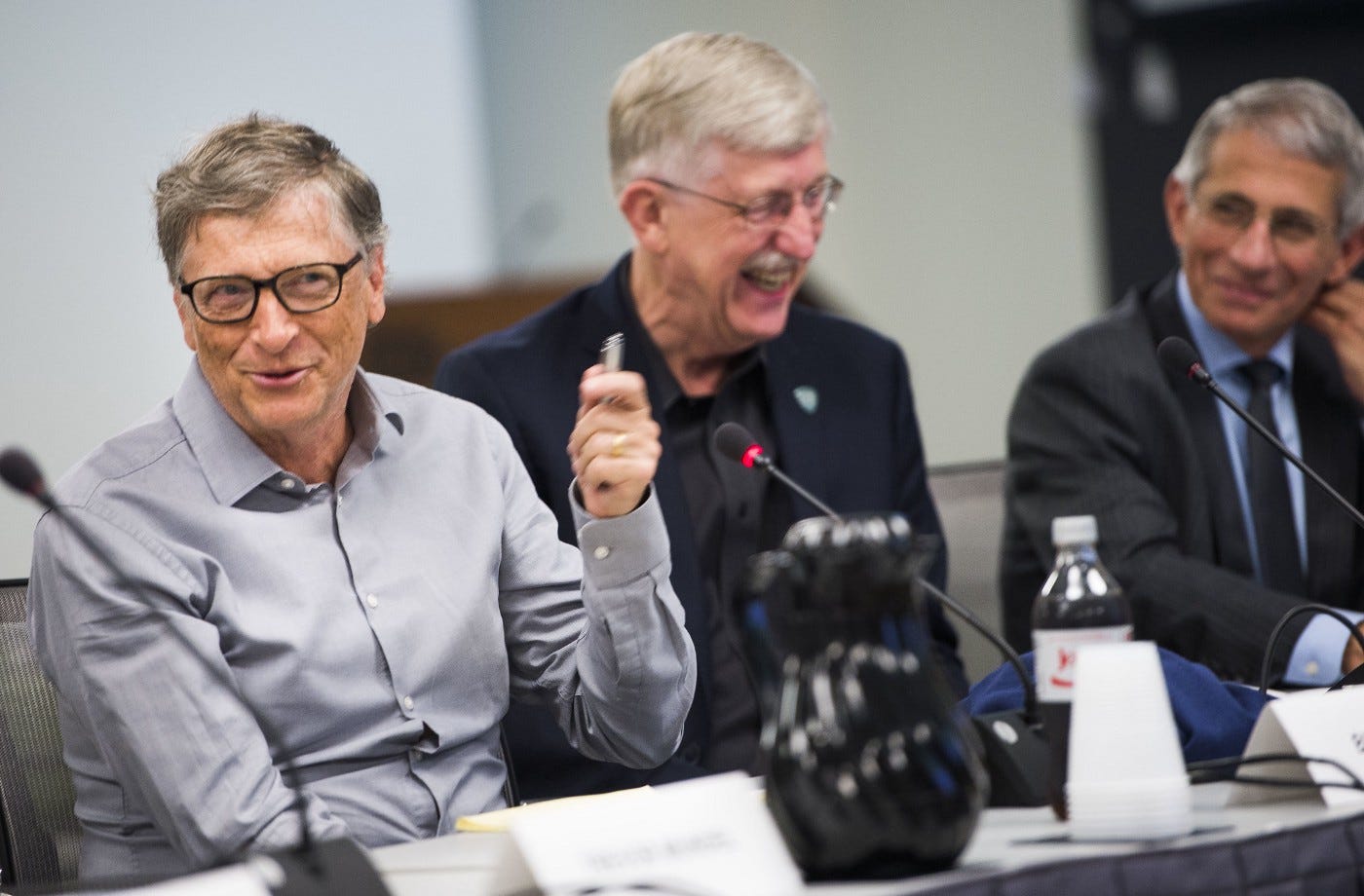
Bill Gates, Francis Collins, Anthony Fauci. Photo credit: National Institutes of Health
Take a peek at the WHO’s list of donors and you’ll find a few other familiar names like AstraZeneca, Bayer, Pfizer, Johnson & Johnson, and Merck.
The NIH has the same problem, it seems. Science journalist Paul Thacker, who previously examined financial links between physicians and pharma companies as a lead investigator of the United States Senate Committee, wrote in The Washington Post that this agency “often ignored” very “obvious” conflicts of interest. He also claimed that “its industry ties go back decades.” In 2018, it was discovered that a $100 million alcohol consumption study run by NIH scientists was funded mostly by beer and liquor companies. Emails proved that NIH researchers were in frequent contact with those companies while designing the study — which, here’s a shocker — were aimed at highlighting the benefits and not the risks of moderate drinking. So, the NIH ultimately had to squash the trial.
And then there’s the CDC. It used to be that this agency couldn’t take contributions from pharmaceutical companies, but in 1992 they found a loophole: new legislation passed by Congress allowed them to accept private funding through a nonprofit called the CDC Foundation. From 2014 through 2018 alone, the CDC Foundation received $79.6 million from corporations like Pfizer, Biogen, and Merck.
Of course, if a pharmaceutical company wants to get a drug, vaccine, or other product approved, they really need to cozy up to the FDA. That explains why in 2017, pharma companies paid for a whopping 75% of the FDA’s scientific review budgets, up from 27% in 1993. It wasn’t always like this. But in 1992, an act of Congress changed the FDA’s funding stream, enlisting pharma companies to pay “user fees,” which help the FDA speed up the approval process for their drugs.
A 2018 Science investigation found that 40 out of 107 physician advisors on the FDA’s committees received more than $10,000 from big pharma companies trying to get their drugs approved, with some banking up to $1 million or more. The FDA claims it has a well-functioning system to identify and prevent these possible conflicts of interest. Unfortunately, their system only works for spotting payments before advisory panels meet, and the Science investigation showed many FDA panel members get their payments after the fact. It’s a little like “you scratch my back now, and I’ll scratch your back once I get what I want” — drug companies promise FDA employees a future bonus contingent on whether things go their way.
Here’s why this dynamic proves problematic: a 2000 investigation revealed that when the FDA approved the rotavirus vaccine in 1998, it didn’t exactly do its due diligence. That probably had something to do with the fact that committee members had financial ties to the manufacturer, Merck — many owned tens of thousands of dollars of stock in the company, or even held patents on the vaccine itself. Later, the Adverse Event Reporting System revealed that the vaccine was causing serious bowel obstructions in some children, and it was finally pulled from the U.S. market in October 1999.
Then, in June of 2021, the FDA overruled concerns raised by its very own scientific advisory committee to approve Biogen’s Alzheimer’s drug Aduhelm — a move widely criticized by physicians. The drug not only showed very little efficacy but also potentially serious side effects like brain bleeding and swelling, in clinical trials. Dr. Aaron Kesselheim, a Harvard Medical School professor who was on the FDA’s scientific advisory committee, called it the “worst drug approval” in recent history, and noted that meetings between the FDA and Biogen had a “strange dynamic” suggesting an unusually close relationship. Dr. Michael Carome, director of Public Citizen’s Health Research Group, told CNN that he believes the FDA started working in “inappropriately close collaboration with Biogen” back in 2019. “They were not objective, unbiased regulators,” he added in the CNN interview. “It seems as if the decision was preordained.”
That brings me to perhaps the biggest conflict of interest yet: Dr. Anthony Fauci’s NIAID is just one of many institutes that comprises the NIH — and the NIH owns half the patent for the Moderna vaccine — as well as thousands more pharma patents to boot. The NIAID is poised to earn millions of dollars from Moderna’s vaccine revenue, with individual officials also receiving up to $150,000 annually.
Operation Warp Speed
In December of 2020, Pfizer became the first company to receive an emergency use authorization (EUA) from the FDA for a COVID-19 vaccine. EUAs — which allow the distribution of an unapproved drug or other product during a declared public health emergency — are actually a pretty new thing: the first one was issued in 2005 so military personnel could get an anthrax vaccine. To get a full FDA approval, there needs to be substantial evidence that the product is safe and effective. But for an EUA, the FDA just needs to determine that it may be effective. Since EUAs are granted so quickly, the FDA doesn’t have enough time to gather all the information they’d usually need to approve a drug or vaccine.
Pfizer CEO and chairman Albert Bourla has said his company was “operating at the speed of science” to bring a vaccine to market. However, a 2021 report in The BMJ revealed that this speed might have come at the expense of “data integrity and patient safety.” Brook Jackson, regional director for the Ventavia Research Group, which carried out these trials, told The BMJ that her former company “falsified data, unblinded patients, and employed inadequately trained vaccinators” in Pfizer’s pivotal phase 3 trial. Just some of the other concerning events witnessed included: adverse events not being reported correctly or at all, lack of reporting on protocol deviations, informed consent errors, and mislabeling of lab specimens. An audio recording of Ventavia employees from September 2020 revealed that they were so overwhelmed by issues arising during the study that they became unable to “quantify the types and number of errors” when assessing quality control. One Ventavia employee told The BMJ she’d never once seen a research environment as disorderly as Ventavia’s Pfizer vaccine trial, while another called it a “crazy mess.”
Over the course of her two-decades-long career, Jackson has worked on hundreds of clinical trials, and two of her areas of expertise happen to be immunology and infectious diseases. She told me that from her first day on the Pfizer trial in September of 2020, she discovered “such egregious misconduct” that she recommended they stop enrolling participants into the study to do an internal audit.
“To my complete shock and horror, Ventavia agreed to pause enrollment but then devised a plan to conceal what I found and to keep ICON and Pfizer in the dark,” Jackson said during our interview. “The site was in full clean-up mode. When missing data points were discovered the information was fabricated, including forged signatures on the informed consent forms.”
A screenshot Jackson shared with me shows she was invited to a meeting titled “COVID 1001 Clean up Call” on Sept. 21, 2020. She refused to participate in the call.
Jackson repeatedly warned her superiors about patient safety concerns and data integrity issues.
“I knew that the entire world was counting on clinical researchers to develop a safe and effective vaccine and I did not want to be a part of that failure by not reporting what I saw,” she told me.
When her employer failed to act, Jackson filed a complaint with the FDA on Sept. 25, and Ventavia fired her hours later that same day under the pretense that she was “not a good fit.” After reviewing her concerns over the phone, she claims the FDA never followed up or inspected the Ventavia site. Ten weeks later, the FDA authorized the EUA for the vaccine. Meanwhile, Pfizer hired Ventavia to handle the research for four more vaccine clinical trials, including one involving children and young adults, one for pregnant women, and another for the booster. Not only that, but Ventavia handled the clinical trials for Moderna, Johnson & Johnson, and Novavax. Jackson is currently pursuing a False Claims Act lawsuitagainst Pfizer and Ventavia Research Group.
Last year, Pfizer banked nearly $37 billion from its COVID vaccine, making it one of the most lucrative products in global history. Its overall revenues doubled in 2021 to reach $81.3 billion, and it’s slated to reach a record-breaking $98-$102 billion this year.
“Corporations like Pfizer should never have been put in charge of a global vaccination rollout, because it was inevitable they would make life-and-death decisions based on what’s in the short-term interest of their shareholders,” writes Nick Dearden, director of Global Justice Now.
As previously mentioned, it’s super common for pharmaceutical companies to fund the research on their own products. Here’s why that’s scary. One 1999 meta-analysis showed that industry-funded research is eight times less likely to achieve unfavorable results compared to independent trials. In other words, if a pharmaceutical company wants to prove that a medication, supplement, vaccine, or device is safe and effective, they’ll find a way.
With that in mind, I recently examined the 2020 study on Pfizer’s COVID vaccine to see if there were any conflicts of interest. Lo and behold, the lengthy attached disclosure form shows that of the 29 authors, 18 are employees of Pfizer and hold stock in the company, one received a research grant from Pfizer during the study, and two reported being paid “personal fees” by Pfizer. In another 2021 study on the Pfizer vaccine, seven of the 15 authors are employees of and hold stock in Pfizer. The other eight authors received financial support from Pfizer during the study.
As of the day I’m writing this, about 64% of Americans are fully vaccinated, and 76% have gotten at least one dose. The FDA has repeatedly promised “full transparency” when it comes to these vaccines. Yet in December of 2021, the FDA asked for permission to wait 75 years before releasing information pertaining to Pfizer’s COVID-19 vaccine, including safety data, effectiveness data, and adverse reaction reports. That means no one would see this information until the year 2096 — conveniently, after many of us have departed this crazy world. To recap: the FDA only needed 10 weeks to review the 329,000 pages worth of data before approving the EUA for the vaccine — but apparently, they need three-quarters of a century to publicize it.
In response to the FDA’s ludicrous request, PHMPT — a group of over 200 medical and public health experts from Harvard, Yale, Brown, UCLA, and other institutions — filed a lawsuit under the Freedom of Information Act demanding that the FDA produce this data sooner. And their efforts paid off: U.S. District Judge Mark T. Pittman issued an order for the FDA to produce 12,000 pages by Jan. 31, and then at least 55,000 pages per month thereafter. In his statement to the FDA, Pittman quoted the late John F. Kennedy: “A nation that is afraid to let its people judge the truth and falsehood in an open market is a nation that is afraid of its people.”
As for why the FDA wanted to keep this data hidden, the first batch of documentation revealed that there were more than 1,200 vaccine-related deaths in just the first 90 days after the Pfizer vaccine was introduced. Of 32 pregnancies with a known outcome, 28 resulted in fetal death. The CDC also recently unveiled data showing a total of 1,088,560 reports of adverse events from COVID vaccines were submitted between Dec. 14, 2020, and Jan. 28, 2022. That data included 23,149 reports of deaths and 183,311 reports of serious injuries. There were 4,993 reported adverse events in pregnant women after getting vaccinated, including 1,597 reports of miscarriage or premature birth. A 2022 study published in JAMA, meanwhile, revealed that there have been more than 1,900 reported cases of myocarditis — or inflammation of the heart muscle — mostly in people 30 and under, within 7 days of getting the vaccine. In those cases, 96% of people were hospitalized.
“It is understandable that the FDA does not want independent scientists to review the documents it relied upon to license Pfizer’s vaccine given that it is not as effective as the FDA originally claimed, does not prevent transmission, does not prevent against certain emerging variants, can cause serious heart inflammation in younger individuals, and has numerous other undisputed safety issues,” writes Aaron Siri, the attorney representing PHMPT in its lawsuit against the FDA.
Siri told me in an email that his office phone has been ringing off the hook in recent months.
“We are overwhelmed by inquiries from individuals calling about an injury from a COVID-19 vaccine,” he said.
By the way — it’s worth noting that adverse effects caused by COVID-19 vaccinations are still not covered by the National Vaccine Injury Compensation Program. Companies like Pfizer, Moderna, and Johnson & Johnson are protected under the Public Readiness and Emergency Preparedness (PREP) Act, which grants them total immunity from liability with their vaccines. And no matter what happens to you, you can’t sue the FDA for authorizing the EUA, or your employer for requiring you to get it, either. Billions of taxpayer dollars went to fund the research and development of these vaccines, and in Moderna’s case, licensing its vaccine was made possible entirely by public funds. But apparently, that still warrants citizens no insurance. Should something go wrong, you’re basically on your own.
To be continued…
Imran Khan loses no-confidence vote
Samizdat | April 9, 2022
Pakistan’s National Assembly has passed a vote of no-confidence against Prime Minister Imran Khan on Sunday, with 176 lawmakers out of 342 voting against him. The speaker of the parliament’s lower house Asad Qaisar, who is also a member of Khan’s party, announced his resignation after adjourning the house three times throughout Saturday.
Khan PTI’s party effectively lost its majority in the National Assembly in March when seven MPs from its coalition partner decided to join the opposition’s ranks. The rivals accused the cricket star-turned-politician of mismanaging Pakistan’s economy, battered by the Covid-19 pandemic, as well as mishandling Islamabad’s foreign and internal policy.
Sunday’s motion means that Khan’s five-year term has ended early, much like that of all previous prime ministers of the country.
The opposition will now put forward their own candidate to replace Khan as PM. On March 21, Maryam Nawaz, the vice president of the Pakistan Muslim League-Nawaz party – the country’s leading opposition force – told journalists that the party had nominated Shehbaz Sharif as its candidate for the office, which was confirmed by Sharif himself on Thursday.
Khan, in turn, had previously claimed that the opposition was doing a foreign power’s bidding, and that an “imported government” would be installed in Pakistan should he be ousted. In his Friday night address, the politician vowed that he would put up a struggle, calling on his supporters to take to the streets.
Khan previously pointed the finger at the US, which he said wanted him gone, for his attempts to carry out an independent foreign policy and his visit to Moscow in late February. The politician claimed to have a recording from the Pakistani ambassador in Washington proving the allegations.
On Monday, Russian Foreign Ministry spokeswoman Maria Zakharova suggested that Washington was trying to “punish an unruly Imran Khan,” describing efforts to remove him from power as “yet another attempt to unashamedly interfere with a sovereign nation’s internal affairs.”
The US State Department has denied claims that it was behind the vote of no-confidence, with spokesperson Jalina Porter describing Khan’s allegations as “absolutely not true.”
Putting Big Pharma on Trial in the COVID-19 Era, Part 2

“Nurse prepares to vaccinate children” by World Bank Photo Collection is licensed under CC BY-NC-ND 2.0
By Rebecca Strong | February 16, 2022
Big Pharma Lawsuits, Scandals, and Cover-Ups
While the OxyContin craze is undoubtedly one of the highest-profile examples of big pharma’s deception, there are dozens of other stories like this. Here are a few standouts:
In the 1980s, Bayer continued selling blood clotting products to third-world countries even though they were fully aware those products had been contaminated with HIV. The reason? The “financial investment in the product was considered too high to destroy the inventory.” Predictably, about 20,000 of the hemophiliacs who were infused with these tainted products then tested positive for HIV and eventually developed AIDS, and many later died of it.
In 2004, Johnson & Johnson was slapped with a series of lawsuits for illegally promoting off-label use of their heartburn drug Propulsid for children despite internal company emails confirming major safety concerns (as in, deaths during the drug trials). Documentation from the lawsuits showed that dozens of studies sponsored by Johnson & Johnson highlighting the risks of this drug were never published.
The FDA estimates that GSK’s Avandia caused 83,000 heart attacks between 1999 and 2007. Internal documents from GSK prove that when they began studying the effects of the drug as early as 1999, they discovered it caused a higher risk of heart attacks than a similar drug it was meant to replace. Rather than publish these findings, they spent a decade illegally concealing them (and meanwhile, banking $3.2 billion annually for this drug by 2006). Finally, a 2007 New England Journal of Medicine study linked Avandia to a 43% increased risk of heart attacks, and a 64% increased risk of death from heart disease. Avandia is still FDA approved and available in the U.S.
In 2009, Pfizer was forced to pay $2.3 billion, the largest healthcare fraud settlement in history at that time, for paying illegal kickbacks to doctors and promoting off-label uses of its drugs. Specifically, a former employee revealed that Pfizer reps were encouraged and incentivized to sell Bextra and 12 other drugs for conditions they were never FDA approved for, and at doses up to eight times what’s recommended. “I was expected to increase profits at all costs, even when sales meant endangering lives,” the whistleblower said.
When it was discovered that AstraZeneca was promoting the antipsychotic medication Seroquel for uses that were not approved by the FDA as safe and effective, the company was hit with a $520 million fine in 2010. For years, AstraZeneca had been encouraging psychiatrists and other physicians to prescribe Seroquel for a vast range of seemingly unrelated off-label conditions, including Alzheimer’s disease, anger management, ADHD, dementia, post-traumatic stress disorder, and sleeplessness. AstraZeneca also violated the federal Anti-Kickback Statute by paying doctors to spread the word about these unapproved uses of Seroquel via promotional lectures and while traveling to resort locations.
In 2012, GSK paid a $3 billion fine for bribing doctors by flying them and their spouses to five-star resorts, and for illegally promoting drugs for off-label uses. What’s worse — GSK withheld clinical trial results that showed its antidepressant Paxil not only doesn’t work for adolescents and children but more alarmingly, that it can increase the likelihood of suicidal thoughts in this group. A 1998 GSK internal memo revealed that the company intentionally concealed this data to minimize any “potential negative commercial impact.”
In 2021, an ex-AstraZeneca sales rep sued her former employer, claiming they fired her for refusing to promote drugs for uses that weren’t FDA-approved. The employee alleges that on multiple occasions, she expressed concerns to her boss about “misleading” information that didn’t have enough support from medical research, and off-label promotions of certain drugs. Her supervisor reportedly not only ignored these concerns but pressured her to approve statements she didn’t agree with and threatened to remove her from regional and national positions if she didn’t comply. According to the plaintiff, she missed out on a raise and a bonus because she refused to break the law.
At the top of 2022, a panel of the D.C. Court of Appeals reinstated a lawsuit against Pfizer, AstraZeneca, Johnson & Johnson, Roche, and GE Healthcare, which claims they helped finance terrorist attacks against U.S. service members and other Americans in Iraq. The suit alleges that from 2005–2011, these companies regularly offered bribes (including free drugs and medical devices) totaling millions of dollars annually to Iraq’s Ministry of Health in order to secure drug contracts. These corrupt payments then allegedly funded weapons and training for the Mahdi Army, which until 2008, was largely considered one of the most dangerous groups in Iraq.
Another especially worrisome factor is that pharmaceutical companies are conducting an ever-increasing number of clinical trials in third-world countries, where people may be less educated, and there are also far fewer safety regulations. Pfizer’s 1996 experimental trials with Trovan on Nigerian childrenwith meningitis — without informed consent — is just one nauseating example. When a former medical director in Pfizer’s central research division warned the company both before and after the study that their methods in this trial were “improper and unsafe,” he was promptly fired. Families of the Nigerian children who died or were left blind, brain damaged, or paralyzed after the study sued Pfizer, and the company ultimately settled out of court. In 1998, the FDA approved Trovan only for adults. The drug was later banned from European markets due to reports of fatal liver disease and restricted to strictly emergency care in the U.S. Pfizer still denies any wrongdoing.
But all that is just the tip of the iceberg. If you’d like to dive a little further down the rabbit hole — and I’ll warn you, it’s a deep one — a quick Google search for “big pharma lawsuits” will reveal the industry’s dark track record of bribery, dishonesty, and fraud.
In fact, big pharma happens to be the biggest defrauder of the federal government when it comes to the False Claims Act, otherwise known as the “Lincoln Law.” During our interview, Panara told me she has friends still working for big pharma who would be willing to speak out about crooked activity they’ve observed, but are too afraid of being blacklisted by the industry. A newly proposed update to the False Claims Act would help to protect and support whistleblowers in their efforts to hold pharmaceutical companies liable, by helping to prevent that kind of retaliation and making it harder for the companies charged to dismiss these cases. It should come as no surprise that Pfizer, AstraZeneca, Merck, and a flock of other big pharma firms are currently lobbying to block the update. Naturally, they wouldn’t want to make it any easier for ex-employees to expose their wrongdoings, potentially costing them billions more in fines.
Something to keep in mind: these are the same people who produced, marketed, and are profiting from the COVID-19 vaccines. The same people who manipulate research, pay off decision-makers to push their drugs, cover up negative research results to avoid financial losses, and knowingly put innocent citizens in harm’s way. The same people who told America: “Take as much OxyContin as you want around the clock! It’s very safe and not addictive!” (while laughing all the way to the bank).
So, ask yourself this: if a partner, friend, or family member repeatedly lied to you — and not just little white lies, but big ones that put your health and safety at risk — would you continue to trust them?
To be continued…
Putting Big Bad Pharma Back on Trial in the COVID-19 Era
They keep telling us to “trust the science.” But who paid for it?
Photo credit: Massimo Giachetti
By Rebecca Strong – February 16, 2022
After graduating from Columbia University with a chemical engineering degree, my grandfather went on to work for Pfizer for almost two decades, culminating his career as the company’s Global Director of New Products. I was rather proud of this fact growing up — it felt as if this father figure, who raised me for several years during my childhood, had somehow played a role in saving lives. But in recent years, my perspective on Pfizer — and other companies in its class — has shifted. Blame it on the insidious big pharma corruption laid bare by whistleblowers in recent years. Blame it on the endless string of big pharma lawsuits revealing fraud, deception, and cover-ups. Blame it on the fact that I witnessed some of their most profitable drugs ruin the lives of those I love most. All I know is, that pride I once felt has been overshadowed by a sticky skepticism I just can’t seem to shake.
In 1973, my grandpa and his colleagues celebrated as Pfizer crossed a milestone: the one-billion-dollar sales mark. These days, Pfizer rakes in $81 billion a year, making it the 28th most valuable company in the world. Johnson & Johnson ranks 15th, with $93.77 billion. To put things into perspective, that makes said companies wealthier than most countries in the world. And thanks to those astronomical profit margins, the Pharmaceuticals and Health Products industry is able to spend more on lobbying than any other industry in America.
While big pharma lobbying can take several different forms, these companies tend to target their contributions to senior legislators in Congress — you know, the ones they need to keep in their corner, because they have the power to draft healthcare laws. Pfizer has outspent its peers in six of the last eight election cycles, coughing up almost $9.7 million. During the 2016 election, pharmaceutical companies gave more than $7 million to 97 senators at an average of $75,000 per member. They also contributed $6.3 million to president Joe Biden’s 2020 campaign. The question is: what did big pharma get in return?
ALEC’s Off-the-Record Sway
To truly grasp big pharma’s power, you need to understand how The American Legislative Exchange Council (ALEC) works. ALEC, which was founded in 1973 by conservative activists working on Ronald Reagan’s campaign, is a super secretive pay-to-play operation where corporate lobbyists — including in the pharma sector — hold confidential meetings about “model” bills. A large portionof these bills is eventually approved and become law.
A rundown of ALEC’s greatest hits will tell you everything you need to know about the council’s motives and priorities. In 1995, ALEC promoted a bill that restricts consumers’ rights to sue for damages resulting from taking a particular medication. They also endorsed the Statute of Limitation Reduction Act, which put a time limit on when someone could sue after a medication-induced injury or death. Over the years, ALEC has promoted many other pharma-friendly bills that would: weaken FDA oversight of new drugs and therapies, limit FDA authority over drug advertising, and oppose regulations on financial incentives for doctors to prescribe specific drugs. But what makes these ALEC collaborations feel particularly problematic is that there’s little transparency — all of this happens behind closed doors. Congressional leaders and other committee members involved in ALEC aren’t required to publish any records of their meetings and other communications with pharma lobbyists, and the roster of ALEC members is completely confidential. All we know is that in 2020, more than two-thirds of Congress — 72 senators and 302 House of Representatives members — cashed a campaign check from a pharma company.
Big Pharma Funding Research
The public typically relies on an endorsement from government agencies to help them decide whether or not a new drug, vaccine, or medical device is safe and effective. And those agencies, like the FDA, count on clinical research. As already established, big pharma is notorious for getting its hooks into influential government officials. Here’s another sobering truth: The majority of scientific research is paid for by — wait for it — the pharmaceutical companies.
When the New England Journal of Medicine (NEJM) published 73 studies of new drugs over the course of a single year, they found that a staggering 82% of them had been funded by the pharmaceutical company selling the product, 68% had authors who were employees of that company, and 50% had lead researchers who accepted money from a drug company. According to 2013 research conducted at the University of Arizona College of Law, even when pharma companies aren’t directly funding the research, company stockholders, consultants, directors, and officers are almost always involved in conducting them. A 2017 report by the peer-reviewed journal The BMJ also showed that about half of medical journal editors receive payments from drug companies, with the average payment per editor hovering around $28,000. But these statistics are only accurate if researchers and editors are transparent about payments from pharma. And a 2022 investigative analysis of two of the most influential medical journals found that 81% of study authors failed to disclose millions in payments from drug companies, as they’re required to do.
Unfortunately, this trend shows no sign of slowing down. The number of clinical trials funded by the pharmaceutical industry has been climbing every year since 2006, according to a John Hopkins University report, while independent studies have been harder to find. And there are some serious consequences to these conflicts of interest. Take Avandia, for instance, a diabetes drug produced by GlaxoSmithCline (GSK). Avandia was eventually linked to a dramatically increased risk of heart attacks and heart failure. And a BMJ report revealed that almost 90% of scientists who initially wrote glowing articles about Avandia had financial ties to GSK.
But here’s the unnerving part: if the pharmaceutical industry is successfully biasing the science, then that means the physicians who rely on the science are biased in their prescribing decisions.
Where the lines get really blurry is with “ghostwriting.” Big pharma execs know citizens are way more likely to trust a report written by a board-certified doctor than one of their representatives. That’s why they pay physicians to list their names as authors — even though the MDs had little to no involvement in the research, and the report was actually written by the drug company. This practice started in the ’50s and ’60s when tobacco execs were clamoring to prove that cigarettes didn’t cause cancer (spoiler alert: they do!), so they commissioned doctors to slap their name on papers undermining the risks of smoking.
It’s still a pretty common tactic today: more than one in 10 articles published in the NEJM was co-written by a ghostwriter. While a very small percentage of medical journals have clear policies against ghostwriting, it’s still technically legal —despite the fact that the consequences can be deadly.
Case in point: in the late ’90s and early 2000s, Merck paid for 73 ghostwritten articles to play up the benefits of its arthritis drug Vioxx. It was later revealed that Merck failed to report all of the heart attacks experienced by trial participants. In fact, a study published in the NEJM revealed that an estimated 160,000 Americans experienced heart attacks or strokes from taking Vioxx. That research was conducted by Dr. David Graham, Associate Director of the FDA’s Office of Drug Safety, who understandably concluded the drug was not safe. But the FDA’s Office of New Drugs, which not only was responsible for initially approving Vioxx but also regulating it, tried to sweep his findings under the rug.
“I was pressured to change my conclusions and recommendations, and basically threatened that if I did not change them, I would not be permitted to present the paper at the conference,” he wrote in his 2004 U.S. Senate testimony on Vioxx. “One Drug Safety manager recommended that I should be barred from presenting the poster at the meeting.”
Eventually, the FDA issued a public health advisory about Vioxx and Merck withdrew this product. But it was a little late for repercussions — 38,000 of those Vioxx-takers who suffered heart attacks had already died. Graham called this a “profound regulatory failure,” adding that scientific standards the FDA apply to drug safety “guarantee that unsafe and deadly drugs will remain on the U.S. market.”
This should come as no surprise, but research has also repeatedly shown that a paper written by a pharmaceutical company is more likely to emphasize the benefits of a drug, vaccine, or device while downplaying the dangers. (If you want to understand more about this practice, a former ghostwriter outlines all the ethical reasons why she quit this job in a PLOS Medicine report.) While adverse drug effects appear in 95% of clinical research, only 46% of published reports disclose them. Of course, all of this often ends up misleading doctors into thinking a drug is safer than it actually is.
Big Pharma Influence On Doctors
Pharmaceutical companies aren’t just paying medical journal editors and authors to make their products look good, either. There’s a long, sordid history of pharmaceutical companies incentivizing doctors to prescribe their products through financial rewards. For instance, Pfizer and AstraZeneca doled out a combined $100 million to doctors in 2018, with some earning anywhere from $6 million to $29 million in a year. And research has shown this strategy works: when doctors accept these gifts and payments, they’re significantly more likely to prescribe those companies’ drugs. Novartis comes to mind — the company famously spent over $100 million paying for doctors’ extravagant meals, golf outings, and more, all while also providing a generous kickback program that made them richer every time they prescribed certain blood pressure and diabetes meds.
Side note: the Open Payments portal contains a nifty little database where you can find out if any of your own doctors received money from drug companies. Knowing that my mother was put on a laundry list of meds after a near-fatal car accident, I was curious — so I did a quick search for her providers. While her PCP only banked a modest amount from Pfizer and AstraZeneca, her previous psychiatrist — who prescribed a cocktail of contraindicated medications without treating her in person — collected quadruple-digit payments from pharmaceutical companies. And her pain care specialist, who prescribed her jaw-dropping doses of opioid pain medication for more than 20 years (far longer than the 5-day safety guideline), was raking in thousands from Purdue Pharma, AKA the opioid crisis’ kingpin.
Purdue is now infamous for its wildly aggressive OxyContin campaign in the ’90s. At the time, the company billed it as a non-addictive wonder drug for pain sufferers. Internal emails show Pursue sales representatives were instructed to “sell, sell, sell” OxyContin, and the more they were able to push, the more they were rewarded with promotions and bonuses. With the stakes so high, these reps stopped at nothing to get doctors on board — even going so far as to send boxes of doughnuts spelling out “OxyContin” to unconvinced physicians. Purdue had stumbled upon the perfect system for generating tons of profit — off of other people’s pain.
Documentation later proved that not only was Purdue aware it was highly addictive and that many people were abusing it, but that they also encouraged doctors to continue prescribing increasingly higher doses of it (and sent them on lavish luxury vacations for some motivation). In testimony to Congress, Purdue exec Paul Goldenheim played dumb about OxyContin addiction and overdose rates, but emails that were later exposed showed that he requested his colleagues remove all mentions of addiction from their correspondence about the drug. Even after it was proven in court that Purdue fraudulently marketed OxyContin while concealing its addictive nature, no one from the company spent a single day behind bars. Instead, the company got a slap on the wrist and a $600 million fine for a misdemeanor, the equivalent of a speeding ticket compared to the $9 billion they made off OxyContin up until 2006. Meanwhile, thanks to Purdue’s recklessness, more than 247,000 people died from prescription opioid overdoses between 1999 and 2009. And that’s not even factoring in all the people who died of heroin overdoses once OxyContin was no longer attainable to them. The NIH reports that 80% of people who use heroin started by misusing prescription opioids.
Former sales rep Carol Panara told me in an interview that when she looks back on her time at Purdue, it all feels like a “bad dream.” Panara started working for Purdue in 2008, one year after the company pled guilty to “misbranding” charges for OxyContin. At this point, Purdue was “regrouping and expanding,” says Panara, and to that end, had developed a clever new approach for making money off OxyContin: sales reps were now targeting general practitioners and family doctors, rather than just pain management specialists. On top of that, Purdue soon introduced three new strengths for OxyContin: 15, 30, and 60 milligrams, creating smaller increments Panara believes were aimed at making doctors feel more comfortable increasing their patients’ dosages. According to Panara, there were internal company rankings for sales reps based on the number of prescriptions for each OxyContin dosing strength in their territory.
“They were sneaky about it,” she said. “Their plan was to go in and sell these doctors on the idea of starting with 10 milligrams, which is very low, knowing full well that once they get started down that path — that’s all they need. Because eventually, they’re going to build a tolerance and need a higher dose.”
Occasionally, doctors expressed concerns about a patient becoming addicted, but Purdue had already developed a way around that. Sales reps like Panara were taught to reassure those doctors that someone in pain might experience addiction-like symptoms called “pseudoaddiction,” but that didn’t mean they were truly addicted. There is no scientific evidence whatsoever to support that this concept is legit, of course. But the most disturbing part? Reps were trained to tell doctors that “pseudoaddiction” signaled the patient’s pain wasn’t being managed well enough, and the solution was simply to prescribe a higher dose of OxyContin.
Panara finally quit Purdue in 2013. One of the breaking points was when two pharmacies in her territory were robbed at gunpoint specifically for OxyContin. In 2020, Purdue pled guilty to three criminal charges in an $8.3 billion deal, but the company is now under court protection after filing for bankruptcy. Despite all the damage that’s been done, the FDA’s policies for approving opioids remain essentially unchanged.
Purdue probably wouldn’t have been able to pull this off if it weren’t for an FDA examiner named Curtis Wright, and his assistant Douglas Kramer. While Purdue was pursuing Wright’s stamp of approval on OxyContin, Wright took an outright sketchy approach to their application, instructing the company to mail documents to his home office rather than the FDA, and enlisting Purdue employees to help him review trials about the safety of the drug. The Food, Drug, and Cosmetic Act requires that the FDA have access to at least two randomized controlled trials before deeming a drug as safe and effective, but in the case of OxyContin, it got approved with data from just one measly two-week study — in osteoarthritis patients, no less.
When both Wright and Kramer left the FDA, they went on to work for none other than (drumroll, please) Purdue, with Wright earning three times his FDA salary. By the way — this is just one example of the FDA’s notoriously incestuous relationship with big pharma, often referred to as “the revolving door”. In fact, a 2018 Science report revealed that 11 out of 16 FDA reviewers ended up at the same companies they had been regulating products for.
While doing an independent investigation, “Empire of Pain” author and New Yorker columnist Patrick Radden Keefe tried to gain access to documentation of Wright’s communications with Purdue during the OxyContin approval process.
“The FDA came back and said, ‘Oh, it’s the weirdest thing, but we don’t have anything. It’s all either been lost or destroyed,’” Keefe told Fortune in an interview. “But it’s not just the FDA. It’s Congress, it’s the Department of Justice, it’s big parts of the medical establishment … the sheer amount of money involved, I think, has meant that a lot of the checks that should be in place in society to not just achieve justice, but also to protect us as consumers, were not there because they had been co-opted.”
Big pharma may be to blame for creating the opioids that caused this public health catastrophe, but the FDA deserves just as much scrutiny — because its countless failures also played a part in enabling it. And many of those more recent fails happened under the supervision of Dr. Janet Woodcock. Woodcock was named FDA’s acting commissioner mere hours after Joe Biden was inaugurated as president. She would have been a logical choice, being an FDA vet of 35 years, but then again it’s impossible to forget that she played a starring role in the FDA’s perpetuating the opioid epidemic. She’s also known for overruling her own scientific advisors when they vote against approving a drug. Not only did Woodcock approve OxyContin for children as young as 11 years old, but she also gave the green light to several other highly controversial extended-release opioid pain drugs without sufficient evidence of safety or efficacy. One of those was Zohydro: in 2011, the FDA’s advisory committee voted 11:2 against approving it due to safety concerns about inappropriate use, but Woodcock went ahead and pushed it through, anyway. Under Woodcock’s supervision, the FDA also approved Opana, which is twice as powerful as OxyContin — only to then beg the drug maker to take it off the market 10 years later due to “abuse and manipulation.” And then there was Dsuvia, a potent painkiller 1,000 times stronger than morphine and 10 times more powerful than fentanyl. According to a head of one of the FDA’s advisory committees, the U.S. military had helped to develop this particular drug, and Woodcock said there was “pressure from the Pentagon” to push it through approvals. The FBI, members of congress, public health advocates, and patient safety experts alike called this decision into question, pointing out that with hundreds of opioids already on the market there’s no need for another — particularly one that comes with such high risks.
Most recently, Woodcock served as the therapeutics lead for Operation Warp Speed, overseeing COVID-19 vaccine development.
To be continued…
Rebecca Strong is a Boston-based freelance health and wellness writer currently contributing to Insider, Health magazine, Healthline, Eat This Not That, and more.
Featured Video
The Board For Peace – Whitewashing Ethnic Cleansing and Genocide
or go to
Aletho News Archives – Video-Images
From the Archives
Inside Job? Inside What?
By Prof. Tony Hall | American Herald Tribune | July 28, 2016
The Kevin Barrett-Chomsky Dispute in Historical Perspective – Sixth part of the series titled “9/11 and the Zionist Question”
In his chapter on “Left Gatekeepers” and the “Shame of Noam Chomsky,” Barrie Zwicker refers to the the “New World Order” as the “diaboligarchy’s” directing agency. Less compelling is Zwicker’s reference to the “New World Order” as the “diaboligarchy’s” directing agency. To me this unfortunate choice of words is much too closely associated with the often crude and chauvinistic populism of Alex Jones and his Infowars media network. Many have come to see Jones’ lucrative media operation as a limited hangout set in place by handlers trying to hold the activities of the 9/11 Truth Movement within manageable constraints.
Due to the important findings over fifteen years of the citizens’ investigation into 9/11, the culprits most deeply implicated in the crime can be identified with much more specificity than an entity vaguely described as a “New World Order.” As Kevin Barrett and many others insist, the time has come to name the names of the probable culprits, Noam Chomsky prominent among them.
While Alex Jones ultimately serves the same masters as Chomsky, the former’s media product is often much closer to the mark of what is really going on than the content of Noam Chomsky’s more magisterial pronouncements. Jones goes at least part of the way into realities of the deep state politics of the twenty-first century. Chomsky, however, sacrificed his capacity to contribute cogently to sensible discourse on contemporary geopolitics by making himself a primary instrument of the most consequential deep state deception of recent times. As a leading agent of disinformation in the psychological trenches of the ongoing Global War of False Flag Terrorism, Chomsky has reduced himself to the level of skeptic pretender Michael Shermer. In the style of Shermer, the elder Chomsky has become an establishment TV professor readily available on Netflix. … continue
Blog Roll
Recent Comments
eddieb on WEF Calls for ‘Cultural Revolu… loongtip on Trump wanted to play peacemake… Coronistan on EU member to sue bloc over ‘su… loongtip on Vicious loongtip on EU turns to India for defense… Coronistan on Donald Trump Is No Peace … seversonebcfb985d9 on French court jails pro-Palesti… eddieb on Fourteen Incredible Facts Abou… Bill Francis on European leaders’ shift in the… seversonebcfb985d9 on Villains of Judea: Philip Esfo… loongtip on Report warns that ‘Jewish terr… Craig Nelms on New study shows that toxic gas…


 Aletho News
- Conspiracy Denial
- Ukraine expects to join EU next year – Zelensky
- Here’s what’s behind the US shift on EU allies
- UN experts alarmed by prosecution of students protesting ETH Zurich’s Israel-linked research ties
- Exposed – How the UAE Became Central to Gaza’s Concentration Camp Plot
- How South Korea’s gas ambitions sustain the occupation of Gaza
- “Leaked document” exposes US blueprint for total control over Gaza
- Trump wanted to play peacemaker, Netanyahu made sure he failed
- Idea of limited, fast strike on Iran misjudges our capabilities: IRGC
- US Military Buildup on Land, Air, and Sea Raises Fears of Imminent Attack on Iran – Expert
- If Americans Knew
- Israel to seek new security deal from US, official says
- Leaked “Board of Peace” Resolution Outlines U.S.-Led Plan to Rule Over Gaza
- Jonathan Greenblatt Rolls Out Plan to Activate Hispanic Evangelical Golems
- Violence against hundreds of Gazan remains to find one Israeli – Not a ceasefire Day 109
- Greenpeace Demonstrator Exposes Folly of Protest Restrictions
- From CBS to TikTok, Pro-Israel Ellison is now in the driver’s seat
- Israel pays for UK advertisements attacking Doctors Without Borders
- Israel accused of extracting billions from Gazan people to pay for their own genocide
- ‘Deliberate Assassination’: 3 Journalists Among 11 Killed by Israeli Forces in Gaza
- In Gaza, We’re Struggling to Reintroduce Foods to Bodies Adjusted to Starvation
- No Tricks Zone
- New Study Affirms Rising CO2’s Greening Impact Across India – A Region With No Net Warming In 75 Years
- Germany’s Natural Gas Crisis Escalates … One Storage Site Near Empty …Government Silent
- Polar Colding…Antarctica Saw Its Coldest October In 44 Years!
- New Study: Sea Levels Rose 20 Times The Modern Rate During The Roman Warm Period
- As German Gas Storage Dips Dangerously Low…Shortage Hardly Avoidable
- New Study: Brazil’s Relative Sea Level Was 2+ Meters Higher And SSTs 3-4°C Warmer 6000 Years Ago
- Philosopher Schopenhauer: Climate Science Certainty Stems From Stupidity, Ignorance
- New Study: Species Extinction Rates Declining Since 1980 – ‘Climate Change Is Not An Important Threat’
- Denmark Places Climate Protection Above Animal Welfare, Poisoning And Culling Cows
- New Study: Greenland Was 3-7°C Warmer And Far Less Glaciated Than Today 6000-8000 Years Ago
 Aletho News