How MI6 built Syria’s extremist police
By Kit Klarenberg | Al Mayadeen | October 16, 2025
On September 19th, in a speech marking the end of his five-year tenure as MI6 chief, Richard Moore hailed the achievements of Britain’s foreign spying agency under his watch. Key among the stated gains was “the end of 53 years of the Assads in Syria.” He openly admitted MI6 “forged a relationship” with HTS, Damascus’ Al-Qaeda and ISIS-tied presumptive rulers – “a year or two before they toppled Bashar.” Moore went on to boast:
“Syria is a good example of where, if you can get ahead of events, it really helps when they suddenly, unexpectedly move at a faster pace. This nimbleness is a fundamental requirement for MI6 – and I think we remain pretty good at it. John Ratcliffe, the CIA director, while discussing a piece of joint business, said to me recently: ‘You guys can really hustle.’”
Al Mayadeen English has previously exposed how HTS was groomed for power for years prior to its violent palace coup in December 2024 by Inter-Mediate, an MI6-adjacent consulting firm run by Jonathan Powell. A key architect of the criminal 2003 Anglo-American Iraq invasion, he now serves as British Prime Minister Keir Starmer’s national security adviser, coincidentally taking up the position mere days before HTS illegitimately proclaimed themselves Syria’s government. It’s been subsequently revealed that Inter-Mediate has maintained a dedicated office in Syria’s Presidential Palace ever since.
Moore’s fresh admissions, while vague, offer further confirmation that London’s foreign spying agency has a longstanding relationship with HTS, which remains a proscribed terrorist group under British law. A key, confirmed mechanism by which MI6 entrenched HTS’ power in north west Syria over the years before the extremist group’s seizure of power was by financing and managing, via cutouts, “moderate opposition service provision”. This took the form of entities including the infamous White Helmets, which supposedly provided “demonstrations of a credible alternative” to Bashar Assad’s government.
While the clandestine efforts were ostensibly intended to weaken HTS’ hold on power and push “moderate” groups, leaked documents indicate British spooks were well-aware these initiatives were cementing the group’s credibility as a governance actor, assisting its “growing influence”, and meant many Syrians regarded HTS as “synonymous with opposition to Assad.” Eerily, the same documents note the group and its armed affiliates – including Al-Qaeda – were “less likely to attack opposition entities that are receiving support” from British intelligence, such as the White Helmets.
We are now left to ponder whether British-run “service providers” were explicitly left alone because of MI6’s secret relationship with HTS. In this context, the earliest and most obvious indication of a dark alliance between London and Syria’s new rulers may date back to January 2019, when HTS took power outright in north west Syria. Almost instantly, the Free Syrian Police, a British-created “moderate opposition service” provider, was formally dissolved. Its members were then invited to continue their activities under HTS’ banner.
‘Revolutionary Entities’
Like the White Helmets, the FSP were components of a wider effort by London to establish a series of statelets across occupied Syria, complete with parallel governance structures staffed by locals trained and funded by Britain, the EU, and US. Western propaganda and media reporting – heavily influenced by MI6 – universally portrayed these breakaway colonies as “moderate” success stories. In reality, they were deeply chaotic and dangerous, run by murderous violent factions, often under obscenely strict interpretations of Sharia Law.
In March 2017, the BBC published a fawning profile of the FSP, noting its British funding, and claiming the group “demonstrates to Syrians that it is not necessary to carry weapons in order to administer law and order in the country.” The British state broadcaster repeatedly stressed, the FSP “does not co-operate with extremist groups.” However, nine months later, it was revealed that London’s “moderate” police force enjoyed intimate relationships with multiple extremist groups, including HTS forerunner Jabhat al-Nusra.
Several FSP stations were found to be closely linked to and take directions from extremist courts run by these militants, which executed citizens who violated local extremist legal codes. FSP operatives were also not only present when women were stoned to death for disobeying al-Nusra’s extreme codes, but even closed roads to allow executions to take place. Meanwhile, portions of sums sent to the FSP by its foreign sponsors were regularly handed over to extremist factions for “military and security support”.
While these disclosures caused a scandal, and British funding for the FSP was temporarily suspended, it was reinstated within mere weeks, sparking outcry among aid experts. Officials justified their decision on unstated “mitigating context” to the revelations, and the issues in question being “already known” by the Foreign Office. Indeed, leaked documents reviewed by Al Mayadeen English indicate close collaboration with extremist groups and courts was hardwired into the FSP from the group’s inception, and not concealed from donors.
The documents, submitted to the Foreign Office by ARK – founded by MI6 veteran Alistair Harris – noted the FSP were “revolutionary entities who share a general ideological affinity with the Syrian rebels,” conducting “rudimentary policing operations” in opposition-controlled territory. FSP stations varied significantly “in terms of their effectiveness, their mandate and their overall level of organisation” in the areas comprising their beat. “Their authority” was dependent on “several factors, the most important of which” were:
“The strength of the relationship between an FSP station and local armed groups; the centrality of an FSP station in the work of a local rebel court or other judicial structure; the sophistication and maturity of an FSP station’s overarching command structure.”
‘Direct Engagement’
The leaks further state, “FSP networks enjoy the strongest relations with more moderate Syrian rebel groups.” Yet, chief among “key armed groups that have established relationships with FSP stations” was Nur al-Din al-Zinki. The group was said to have greatly “empowered” FSP offices across occupied Aleppo, establishing the force “as primary policing bodies in towns in which it is strong.” In reality, Nur al-Din al-Zinki didn’t adhere to any meaningful definition of the term “moderate”.
During the initial years of the foreign-fomented Syrian civil war, the group committed countless horrendous atrocities, including beheading a Palestinian teenager in 2016. Its fighters subsequently joined HTS en masse. The readiness of ARK – and by extension British intelligence – to rub shoulders with dangerous armed elements is writ large in another leaked file, outlining potential risks to the project. If “armed actors” denied the FSP “operating space”, ARK would conduct “direct engagement” with the relevant militants to resolve the issue.
Other hazards included almost inevitable submission of “fraudulent invoices” by FSP operatives, and “significant physical risk” to them, “including possible assassination of police or justice actors.” Still, the British were so keen on the project, millions were pumped into the force over many years, with sophisticated communications equipment and vehicles provided. ARK also looked ahead to rebel groups increasing their “influence and territorial reach” in Syria, believing this would “[yield] benefits for the FSP” and expand its sphere of operations.
Fast forward to today, and courtesy of HTS, the British-created FSP is now Syria’s national police force. Ever since Assad’s fall, they have acted accordingly, brutally repressing internal dissent, while standing by as the new government’s militants massacre Alawites and other religious minorities in the country. Just as Inter-Mediate’s office in Damascus’ Presidential palace raises grave questions about the extent of London’s control over HTS, we must ask who all past beneficiaries of “moderate opposition service provision” in the country are truly working for.
As The National reported in February, the White Helmets have been formally invited by Syria’s HTS-run Health Ministry to “run the emergency services countrywide.” The creation of such groups years prior to Assad’s ouster is a palpable example of the ability of “hustlers” in British intelligence to “get ahead of events” in Moore’s phrase, and ensure MI6 has the people, organisations and structures in place to effectively take over countries if and when an enemy government falls.
Russia accuses UK, Ukraine of sabotage plot against TurkStream
Al Mayadeen | October 16, 2025
Russia has accused the United Kingdom and Ukraine of attempting coordinated sabotage operations against the TurkStream gas pipeline, a vital conduit transporting Russian natural gas to Turkey and European markets.
During the 57th Shanghai Cooperation Organization (SCO) session in Uzbekistan, Federal Security Service (FSB) Director Alexander Bortnikov revealed some of the details behind the plot.
According to Bortnikov, British instructors from the Special Air Service (SAS) and the Secret Intelligence Service (MI6), in coordination with Ukrainian intelligence, are actively planning a series of attacks targeting Russian energy infrastructure. These operations reportedly include drone strikes on the TurkStream pipeline, as well as attacks on the Caspian Pipeline Consortium, a multi-national venture with Russian, Kazakh, and US shareholders.
Bortnikov said that the UK has been directly involved in training and coordinating these sabotage groups.
“Together with MI6, they are coordinating Ukrainian sabotage groups to carry out raids in Russia’s border regions, targeting critical infrastructure using drones, unmanned boats, and combat divers,” FSB Director Alexander Bortnikov stated.
The FSB director further revealed that British intelligence orchestrated Ukraine’s SBU “Spider Web” operation conducted on June 2, 2025, prior to Ukraine–Russia talks in Istanbul. Bortnikov said the UK managed a propaganda campaign exaggerating the operation’s impact and attributing it solely to Ukraine. In addition, Russian authorities reported a series of FPV drone attacks in June on airfields across Murmansk, Irkutsk, Ivanovo, Ryazan, and Amur regions.
Failed attacks on TurkStream
These remarks follow earlier reports of Ukrainian plans to target TurkStream. In November 2024, German media outlet Der Spiegel reported that former Ukrainian Armed Forces Commander Valerii Zaluzhny had proposed a plan codenamed “Diameter,” modeled on the 2022 Nord Stream sabotage, to target the pipeline. The plan reportedly failed, and no independent evidence has confirmed its execution.
Russia has also intercepted multiple drone attacks on TurkStream infrastructure in January 2025, which were described by Moscow as acts of “energy terrorism,” though the facilities continued normal operations. Additionally, Russian forces shot down three more Ukrainian drones in early March following another attempted strike on a TurkStream compressor station.
TurkStream remains a strategic energy artery for Europe, delivering Russian natural gas to Turkey and several European nations. Any disruption to its operation could have serious consequences for regional energy security.
How an Israeli-backed firm spied on US churches to push propaganda
Al Mayadeen | October 15, 2025
A new firm called Show Faith by Works has launched a geofencing campaign targeting Christian churches and colleges across the American Southwest with pro-“Israel” advertisements, a covert operation exposed in a striking investigation by Nick Cleveland-Stout, a Research Associate in the Democratizing Foreign Policy program at the Quincy Institute, and published by Responsible Statecraft.
The operation appears to be conducted without the awareness or consent of many pastors and congregations, some of whom have expressed alarm over the use of such invasive digital targeting by “Israel”.
According to the company’s filing under the Foreign Agents Registration Act (FARA), the project aims to “geofence the actual boundaries of every Major (sic) church in California, Arizona, Nevada, and Coloardo (sic) and all Christian Colleges during worship times,” allowing the firm to “track attendees and continue to target [them] with ads” on behalf of “Israel”.
The geofencing component forms part of a broader $3.2 million contract, which also involves recruiting celebrity endorsers and compensating pastors to create pro-Israel content.
No knowledge of campaign
Responsible Statecraft contacted hundreds of churches listed as potential targets in the campaign; none reported prior knowledge of it. “We were not aware of that, no—you are the first to bring that to our attention,” said the press office of Bethel Church in Redding, California.
Project manager Chad Schnitger told RS via email that the advertisements may include “invitations for Christians to visit one of our upcoming Mobile Museum exhibits, or to go to our website to learn more about the program, or to visit Israel with your church.” The firm’s pitch deck reportedly described the ads as “pro-Israel and anti-Palestinian.”
The Mobile Museum referenced by Schnitger is a traveling exhibit housed in a trailer that visits churches and Christian colleges. It displays footage of Israeli occupation forces describing the “difficulty of fighting bad guys in hostile territory with civilians.” Schnitger said the first exhibit will begin touring within a month.
Privacy nightmare
Geofencing, the technology underpinning the campaign, allows marketers to identify and target mobile devices within a defined geographic area. When users enter or leave a specific boundary, they can receive targeted advertisements, texts, or in-app notifications, a tactic long used by commercial brands to reach nearby customers.
Megan Iorio, Senior Counsel at the Electronic Privacy Information Center, described geofencing as a “privacy nightmare”. In an interview for RS, she explained that data brokers collect location data from apps and sell it to marketing firms or use it to deliver hyper-targeted ads. “For example,” she said, “a user might see an H&M ad simply by walking within a certain distance of one of its stores.”
While Schnitger defended the campaign as a “one-way ad push” and said media coverage had been “sensationalized”, Iorio emphasized that the practice remains “incredibly invasive”. She added, “The fact it has become so common and that foreign governments are now using it for targeted, precise influence campaigns shows how much we need regulation to stamp down on the practice. It is so invasive and has national security implications.”
‘Warfare language’
Community members listed as potential targets share those concerns. Micah, a mechanical engineer from Colorado Springs, said he has been warning local pastors and news outlets after discovering that seven area churches appeared in the firm’s geofencing documents. “What jumps out immediately is how the entire document talks about Christians as targets to be manipulated. This isn’t respectful outreach, it’s warfare language,” he wrote in a memo obtained by RS.
Micah also raised concerns about the firm’s plan to pay pastors for producing content. The firm’s proposal includes stipends for “individual guest pastors, bilingual pastors, or pastors who match target demographics to record messages based on content creation targets.” According to Micah, this “creates financial conflicts of interest where religious leaders become financially dependent on foreign government messaging, compromising their independence and integrity.”
His brother Asa, who attends Scottsdale Bible Church in Arizona, one of the listed churches, agreed, saying the initiative reflects “Israel’s” waning influence among young Americans. “This entire project is an attempt to regain the attention and hearts/support of Gen Z through the use of religious manipulation,” he said. Both brothers requested anonymity for security reasons.
Schnitger, however, expressed confidence that the campaign would help sway public opinion. “For those who dislike Israel, maybe some of these exhibits and materials will change your mind,” he said, adding that the firm’s messaging highlights how “[P]alestinian and Iranian goals are not land-focused, but genocidal.”
‘Project 545’
Not all responses were positive. Timothy Feldman, a software engineer from Plano, Texas, said he was “disgusted” to learn his church was listed among “Israel’s” potential targets. “I am disgusted that a genocidal apartheid state is attempting to whitewash its atrocities by propagandizing the good people of Christ United Methodist Church,” Feldman told RS in an email.
Although churches in Texas were included in the pitch deck, Schnitger clarified that the firm “is not doing anything in Texas at this time.” A church worker in Prescott, Arizona, whose church was also listed, told RS that community reaction is uncertain. “The demographics in Prescott tend to be pro-Israel, so it’s hard to know how the church leadership will react to this. All we can do is make people aware of it,” he said, requesting anonymity.
Oversight of the campaign reportedly falls to Eran Shayovich, Chief of Staff at “Israel’s” Ministry of Foreign Affairs. Shayovich is leading “Project 545”, described as a campaign to “amplify Israel’s strategic communication and public diplomacy efforts.” He also serves as a contact for Brad Parscale, former campaign manager for Donald Trump, who is said to be coordinating efforts to train ChatGPT and integrate pro-“Israel” messaging into conservative media.
Some US states have begun restricting geofencing and the trade of location data. Oregon passed a law in June banning the sale of precise geolocation information, following Maryland’s earlier legislation. At the federal level, former FTC Chair Lina Khan prohibited several major data brokers from collecting or selling location data from sensitive sites, such as churches and military bases, without explicit consent. However, thousands of smaller firms still operate freely, leaving places of worship vulnerable to digital tracking and manipulation.
Once Again, Jeremy Bowen Is Misleading the British Public About Gaza
By Jonathan Cook | October 15, 2025
Yet again the BBC’s Jeremy Bowen is misrepresenting a key issue in Gaza – and as always, he is doing so in a way that places Israel in the most flattering light possible.
The BBC’s international editor notes two reasons why Hamas will not wish to disarm, as stipulated by Israeli and US officials:
a) Because having weapons is “deep in their ideological DNA”.
b) Because Hamas are worried that, if they are not armed, “there are plenty of people out there in Gaza who would like to take revenge on them and will come after them”.
Notice two things here:
First, both of these claims are rooted in Israeli rationales for why Hamas needs disarming. Inadvertently or not, Bowen is subtly suggesting that the group is inherently bloodthirsty, and that it does not properly represent the people of Gaza (more on that in a moment).
Second, Bowen ignores the main reason why Hamas wants to keep its weapons, one so obvious that it is simply astounding that he forgot to mention it.
Hamas believes that, if it is not armed, Israel will have an even freer hand to carry out its genocidal policies in Gaza, to continue its decades-long, illegal occupation of Palestinian lands, and to intensify its siege of the enclave. Hamas believes Israel’s violence against the Palestinian people should not be cost-free.
Whether or not one approves of Hamas’ approach – and to do so would be a violation of the UK’s Terrorism Act and could lead to a 14-year jail sentence – Bowen is required to report what the group actually thinks. Otherwise he is not a journalist, he is just another western propagandist.
Instead, he is actively misleading the British public both about Hamas’ worldview and about a core issue – Hamas’ disarmament – that could soon give Israel the excuse it seeks to trash the ceasefire agreement.
Like the rest of the BBC’s coverage, Bowen’s reporting refuses to address the elephant in the room: that Palestinians are caught in a trap crafted for them by the West. If they try to resist their illegal occupation by Israel, they are slaughtered and damned as terrorists. But if they don’t, they must live as permanent prisoners of an illegal, dehumanising occupation.
A further point: Bowen says Hamas are using their weapons to take on “armed clans who have weapons themselves – to reassert their power, to send a message to Gazans, ‘Don’t mess with us’.”
Bowen, of course, carefully ignores the part Israel has played in arming these criminal clans and letting them steal food aid. The clans sold that aid at inflated prices to a small section of Gaza’s population who could still afford to pay, while everyone else starved.
One doesn’t need to be a genius, or Hamas sympathiser, to imagine – contrary to Bowen’s implication that Hamas is widely feared by the population – that most people there may be relieved to see Hamas back and taking on the criminal gangs that extorted them and were central to the implementation of Israel’s genocidal starvation campaign.
The Strange Definition of “Free and Fair” Elections
By Jeffrey Silverman – New Eastern Outlook – October 15, 2025
Recent elections across Eastern Europe and the Caucasus—in Moldova, the Czech Republic, and Georgia—reveal deepening tensions between Western-backed elites and nationalist, often anti-Western movements challenging EU and US influence in the region.
It has been a full week of elections in Eastern Europe and the Caucasus, with a highly contested election in Moldova on the 28th of September, the Czech parliamentary elections held on the 3rd and 4th of October, and the Georgian municipal elections on Sunday, 4th of October.
What is rather interesting is the rhetoric surrounding each of these election processes. In Moldova, western governments and media have lauded the “convincing win” of the incumbent President, Maia Sandu’s PAS party, which “won” 50.16% of the vote, with, contrary to the EU narrative, a severely reduced majority in Parliament.
Needless to say, Sandu and her EU backers blamed the party’s relatively poor performance on “Russian interference,” conveniently ignoring the massive expenditure of state resources and EU influence intended to ensure her party remained in power. It should be noted that the “pro-Russian” opposition block won 49.84%, so “convincing win” is a bit of a stretch.
On the other hand, the results in the Czech Republic and Georgia delivered quite different results from those desired by the EU and US, with former Prime Minister Andrej Babis set to return to power in the country. Babis, a long-time critic of military support for Ukraine, is set to join Hungary and Slovakia in refusing to allow the supply of military aid to Ukraine using EU funds, as well as by dismantling the current Czech initiative to provide artillery shells.
Needless to say, Babis has been widely smeared as a “populist,” “Trumpist,” “pro-Russian,” etc. Having won 37% of the vote against the 23% of his pro-Western rivals in the pro-Western coalition of the current prime minister, Petr Fiala, Mr. Babis is expected to be called upon to begin negotiations with the other minor parties amongst whom the remainder of the vote was split in order to form a coalition government.
Finally, in Georgia, the municipal elections delivered a resounding victory to the ruling Georgian Dream party, with Georgian Dream sweeping the board, winning in every municipal race, receiving just over 70% of the vote in a clear rejection of the pro-Western opposition by Georgian voters. Needless to say, before the election even took place, Western embassies, particularly the EU Mission to Georgia, were decrying the process, claiming Russian “interference” and encouraging street protests.
It is interesting to compare the EU and other Western claims of “election interference” by Russia in Moldova and Georgia with the facts of each case.
In Moldova, the election was clearly interfered with, but not by Russia. As with the recent presidential elections, Sandu’s PAS party actually lost the election INSIDE Moldova but was saved by the diaspora vote, which itself was rigged strongly in her favour. Again, there was a massive disparity in the number of polling stations for the diaspora.
The countries with the most polling stations were Italy (75), Germany (36), France (26), the United Kingdom (24), Romania (23), the United States (22), Spain (15) and Ireland (12), with only two being opened in Russia. It should be noted that there are an estimated 400,000 Moldovans in Russia, while Italy has 100,000, something hardly reflected by the number of polling stations in each.
In addition, Moldovan citizens in the separatist region of Transnistria were also disenfranchised, with polling stations shut by Moldovan officials, moved across the river, and the bridges “shut for maintenance” or by “mining threats,” severely limiting the ability of voters to reach them. The bridges were only opened 20 minutes before the polling stations closed. The same story is true for the Gaugaz autonomous region, where the population has seen its political leadership targeted by politicised arrests and sham court proceedings. In this case, however, Sandu’s repressions had the opposite result, with Gaugaz voters giving only 3.19% to Sandu’s PAS and 82.35% to the Patriotic Bloc.
Very “free and fair”
In Georgia, where most Western governments still refuse to recognize the results of the 2024 parliamentary elections, the EU, through its puppet NGOs and media, has even been going so far as to defend the throwing of Molotov cocktails as “peaceful protests.” The hypocrisy of the EU position regarding the Georgian police handling of violent protests, contrasted with the extreme violence meted out by, for example, French, German, and British police against actual peaceful demonstrators, where incredible brutality has become the norm.
As with the previous anti-government protests in Georgia, in stark contrast to their European counterparts, Georgian police do not use force unless the opposition protesters use violence first.
Furthermore, the violence used by the protesters appears to have the full support of European officials, including the EU ambassador to Georgia, Paweł Herczyński, with the Georgian prime minister directly accusing the EU ambassador, saying:
“You know that specific people from abroad have even expressed direct support for all this, for the announced attempt to overthrow the constitutional order,” Kobakhidze said. “In this context, the European Union ambassador to Georgia bears special responsibility. He should come out, distance himself, and strictly condemn everything that is happening on the streets of Tbilisi.”
Needless to say, the EU has remained silent.
What is obvious is that despite all the money poured into Georgia through NGOs, the EU attempt to destabilize Georgia has failed, with the EU doing little more than offending the majority of the population of this socially conservative Orthodox Christian country. The same thing can be seen in Moldova, where the pro-EU candidate was only able to win through blatant vote rigging and exclusionary actions that disenfranchised hundreds of thousands of voters.
Needless to say, the hypocrisy of Moldova’s president, Maia Sandu, was on full display as she posted on X:
My thoughts are with the people of Georgia, who stand for freedom and their European future.
Democracy cannot be silenced. Moldova is by your side.
Which, given her arrest of opposition politicians, banning of rival parties, and suppression of voters, is chutzpa indeed.
More ominous is the revelation by the Georgian government that the State Security Service had intercepted a large number of weapons and explosives that had been purchased on the orders of the Georgian Legion, the mercenary unit fighting on the Banderist side in the ongoing fighting in the eastern part of Ukraine. The first deputy chief of Georgia’s State Security Service, Lasha Magradze said:
“On the basis of intel information, the State Security Service found a large quantity of firearms, munitions, explosives, and detonators. According to investigators, Georgian citizen B. Ch., acting on orders from a Georgian representative of an armed unit operating in Ukraine, purchased a great quantity of firearms, which is proved by a lot of evidence. According to intel information, acts of sabotage with the use of the above-mentioned weapons were supposed to be staged along with massive violence and the attempted seizure of the presidential residence in Tbilisi on October 4,” he said, adding that security officers “neutralized a number of individuals who presumably were to bring munitions and explosives to downtown Tbilisi.”
Given that the Georgian Legion is tightly bound to the Ukrainian intelligence service, which is controlled by Western intelligence agencies, particularly British MI6, the American CIA, and the French DSGE, it is almost certain that this attempted armed coup was planned in the West.
Luckily for the people of Georgia, it has failed, at least so far.
With the rapidly rising risk of war with Iran, not to mention the US and European desire to spread fires along Russia’s borders in the hope of stretching Russian resources thin, unfortunately I doubt this will be the last attempt, however.
What is certain is that the EU and US have a very strange definition of “free and fair” elections, in that if the Western-supported candidate wins, they are “free and fair,” but if, God forbid, Joe Public elects someone the globalists in Washington and Brussels can’t accept, they are “unfair” or “rigged” by “Russian interference.”
As Europe fractures over the proxy war in Ukraine and the rise of nationalist governments, understanding the manipulation of “democracy talk” is critical. These elections are not just local contests; they are proxy battles in a much larger fight over who controls the narrative of legitimacy in the 21st century.
Jeffrey K. Silverman is a freelance journalist and international development specialist, BSc, MSc, based for 30 years in Georgia and the former Soviet Union
Talk of Sending Tomahawk Missiles to Ukraine is Calculated Psy-Op to Pressure Russia
By Ekaterina Blinova – Sputnik – 14.10.2025
The US won’t allow strikes on Russian refineries, says Alexander Mikhailov, head of the Bureau of Military-Political Analysis.
Psy-op in the Making
“I don’t see any military prospects for using Tomahawks against Russia, except for attempts at informational blackmail and political pressure,” Mikhailov tells Sputnik.
No Tomahawks have been sent or launched, yet Western media frenzy suggests a pressure tactic.
It’s all connected:
- Washington raises the stakes by hinting at sending Tomahawks to Russia
- Western media, aligned with Washington, hype the story — discussing targets, launches, and control
- The impression is the missiles are already on their way
A Tomahawk launcher might even be rolled out at a test range somewhere simply for PR videos, Mikhailov suggests. But it would be similar to the Taurus missiles Germany promised: hyped by the media – yet still absent from Ukraine.
Washington Isn’t Suicidal
The Kremlin has repeatedly said Ukraine cannot launch Tomahawks on its own.
“Every Tomahawk fired at Russia from a US-made system by American crews would mark the start of a war between the US and Russia,” Mikhailov says.
- The idea of US-made Tomahawks striking energy infrastructure inside Russia is a fantasy
- Such an act would cross a red line that would trigger a response the US is 100% not ready for
- Russia’s updated nuclear doctrine explicitly states that a massive cruise missile attack (like a volley of Tomahawks) can be met with a NUCLEAR response
- Are the Americans ready to “collectively die” for this? The expert is clear: “I am absolutely sure, no.”
What Does the West Want?
The real target would be the “shadow fleet” moving Russian oil, according to the pundit. To that end, NATO holds provocative Baltic drills and tries to seize Russian ships.
The Nord Stream sabotage exemplifies economic attacks to choke Russia’s energy exports abroad.
The EU isn’t at war with Russia – it’s at war with the minds of its own citizens
European leaders are trying to gaslight their populations into believing that it’s Moscow that wants a fight, not them
By Tarik Cyril Amar | RT | October 14, 2025
Among other things, this particular moment in history will be remembered – whether in whole books, mere chapters, or (if we are lucky) forgotten footnotes – as the Great European Drone Scare. For weeks now, the populations of NATO-EU Europe have been subjected to a barrage of vague but scary reports about drone sightings. The drones have appeared – seemingly – over various places and installations, prominently including airports in Denmark and Germany.
They are of unknown origin and unknown purpose. And, quite often, it is actually also unknown whether they are even real. Indeed, there is no proof of Russia being responsible for any of these incidents, as even Western media admit. We are once again asked to simply trust our politicians and “experts.”
That is, the same ones who took months to stop pretending that Russia – absurdly – blew up its own Nord Stream pipelines in 2022. As late as spring 2023, Germany’s Carlo Masala, for instance, who also believes “Girkin” and “Strelkov” are two different individuals (just like “Santa” and “Claus”), was still spreading groundless speculation – really, a conspiracy theory – about a “false flag attack” on Nord Stream, that is: Russia, Russia, Russia.
And – oh, coincidence! – also recently, Moscow, we are told, has had nothing better to do than oblige Western information warriors with three further sort-of incidents: a purported electronic-warfare attack on the plane of EU despot and de facto US proconsul Ursula von der Leyen over the Bulgarian city of Plovdiv, an alleged incursion into Estonian airspace, and low fly-overs over the German frigate Hamburg during a recent NATO exercise.
In reality, those three stories share only one thing with the great drone saga: They don’t hold up to scrutiny. The case of the alleged Plovdiv GPS attack is so shoddy and cratered so badly so quickly that it’s been consigned to oblivion. The incursion into Estonian airspace did not happen either. Due to an agreement that Estonia itself signed in 1994, it cannot claim a 12-mile but only a 3-mile zone in the relevant area. Estonia’s case is hysterical to begin with; the 1994 agreement deprives it of even the flimsiest pretext of legality. Regarding the so-called buzzing of the Hamburg, finally, even Western military officials admit that it was not “imminently dangerous.” Instead, they complain, it was “unfriendly and provocative.” Frankly: Boohoo. What do you expect holding exercises on Russia’s doorstep while fighting an indirect war against it in Ukraine? A friendly chat among sailors over a stiff grog?
And yet everyone in NATO-EU establishment politics and its mainstream media has been singing the same old tired song, once again, sotto voce: Russia is coming, Russia is already here, Russia is everywhere. The new head of Germany’s spy agency – the Bundesnachrichtendienst – seems to believe that his job is not to do secret things quietly but to join the chorus of the panic-mongers: He also has sleepless visions of the Russians attacking just any day now. Maybe from right under his bed or out of his cupboard, one must suppose.
It is almost as if they were all reading from the same hymn sheet, that is, memo. And, of course, the new wave of self-induced hyper-ventilation has been milked for all it’s worth – a lot, as in billions of Euros – for yet more money to be spent on armaments, including but not limited to a “drone wall,” while ordinary people are subjected to ever more brutal austerity. Even more disturbingly, there is a clear drive to concentrate ever more powers with those same political establishments that can’t stop ruling by frightening and confusing their own citizens.
That the drone stories are already crumbling makes no difference: A dramatic French attempt – special forces and all – to pin nefarious drone activity on a tanker, for instance, has failed miserably. In Germany, a recent sighting has actually been cleared up quickly. The culprit? A hapless German drone amateur who must be living under a rock.
And perish the thought that Ukraine itself might have anything to do with those mystery drones! Its regime has plenty of motive, and, by now, even the West has been compelled to acknowledge that it is perfectly capable of massive sabotage operations and lies to manipulate its European backers. Because that is now even the official story of the Nord Stream terror attack. But: thinking logically – verboten!
Instead, let’s pretend that we know what we don’t know (Russia, Russia, Russia!) and start overreacting, again, based on our ignorance and panic at best, on a malevolent, deliberate strategy of cognitive warfare against our own countries at worst. In Germany, for instance, both Chancellor Friedrich Merz and Defense Minister Boris Pistorius have made the bizarre claim that while the country is not (yet?) at war, it is also no longer at peace. And the-Russians-are-coming head of the BND? He feels the current peace is “icy” at best and – drum roll – “could turn into heated confrontation at any moment.”
What is that even supposed to mean? Is there a backhanded admission, finally, that Germany has made a deliberate and awfully self-harming choice to fight Russia through Ukraine? If so, thank you, Hauptmann Obvious: during last year’s Ukrainian Kamikaze offensive, German tanks got shredded once again in the vicinity of Kursk – at the 1943 site of the largest tank battle in history. (And guess who lost?) We have noticed that much. How about you, our supposed leaders, stop playing with fire?
Or are these fear-mongering statements meant to prepare the ground for a concrete power grab? That is what Roderich Kiesewetter, an ultra-Russophobe and war fantasist from Merz’s own center-right CDU party has already suggested explicitly: he wants the German parliament to declare the so-called “Spannungsfall,” literally “situation of tension.” In the mainstream media, for instance the important newspaper Welt, the usual information warriors are already amplifying Kiesewetter’s message. And – yet another striking coincidence – a recent military exercise called “Red Storm Bravo,” in Hamburg, one of Germany’s biggest cities, was dedicated to cosplaying the “Spannungsfall” – with maximum publicity.
The consequences of initiating a “Spannungsfall” – a kind of official pre-war – are complex and severe: Open-ended, compulsory, and universal military service is only one of them; the army can be used domestically; citizens can be drafted for work; civil rights are painfully restricted; those critical of government policy, NATO, or the “Spannungsfall” itself can be cajoled even worse than usual.
Last but not least, the “Spannungsfall” allows the government to postpone or otherwise influence elections. In Germany, it would be an ideal vehicle for the traditional parties to at least stall the consequences of their own failure, unpopularity and decline, on one side, and the rise of challengers on the so-called “populist” new right and left, on the other.
Carl Schmitt, Germany’s 20th-century version of Niccolo Machiavelli – brilliantly smart, ruthlessly realistic, and morally badly questionable – defined ultimate political power as the ability to declare a state of exception. In essence, Schmitt’s logic was simple: we live together by having rules; hence, the power that trumps all others is to decide when those rules do not apply.
Schmitt explained extremes. In reality, governments don’t raze all rules in one fell swoop. Why should they? To unshackle themselves and become even less accountable than usual they proceed stealthily and gradually. No need to trumpet a state of exception in its pure, all-or-nothing form. Why needlessly scare the subjects and, perhaps, provoke resistance?
Instead, what usually happens is the invocation of an emergency – either simply made-up or greatly exaggerated – to justify chipping away at citizens’ rights, first a little then a lot, while boosting the unchecked powers of the rulers and their bureaucrats. Call it the salami-slicing tactics of Western liberalism.
Dialing up the state of exception in handy instalments – that is also the most plausible explanation of the recent great drone scare in NATO-EU Europe. Yet another phase in the years-long Putin-is-gonna-get-you cognitive warfare campaign that Western establishments and mainstream media have been waging on their own fellow citizens, the great drone scare serves the general purpose to promote even more panic over an allegedly impending Russian attack on NATO states.
The techniques for escalating the war scare are dishonest and repetitive, but highly developed. As a high-ranking NATO general has told us, their aim is not simply to manipulate “what people think.” That, in NATO-speak, would be mere propaganda and just so old-hat. Rather, the state-of-the-art approach is to “exploit vulnerabilities of the human mind” to influence “the way” people think. Targeting “human capital” – yes, that’s us, all of us – “from the individual to states, to multinational organizations, across everyday life.”
Of course, the official pretense is that all of the above is what the enemy – read: Russia (and China) – does or, at worst, what NATO will do to that enemy. But is in the nature of the cognitive warfare shtick that it easily allows for turning the psychological disruption guns on the West’s own populations. Because – so the pretext – those populations are already under cognitive attack by the enemy. So what can you do, except fight back on the battlefield you claim is under attack: their minds? We have seen and experienced the results of this nifty little sleight of hand for years already.
But there also is something special. In the words of Jonas Togel, one of the few Western experts daring to notice Western information warfare, “it is worse than it has ever been.” Indeed, but there is no guarantee that things won’t get even worse again. The real question is how much longer our cognitive warriors-in-chief will have a free hand to drive us all mad with fear.
Tarik Cyril Amar is a historian from Germany working at Koç University, Istanbul, on Russia, Ukraine, and Eastern Europe, the history of World War II, the cultural Cold War, and the politics of memory.
No, Reuters, Climate Change is Not Threatening Europe’s Resources
By Anthony Watts | ClimateRealism | October 2, 2025
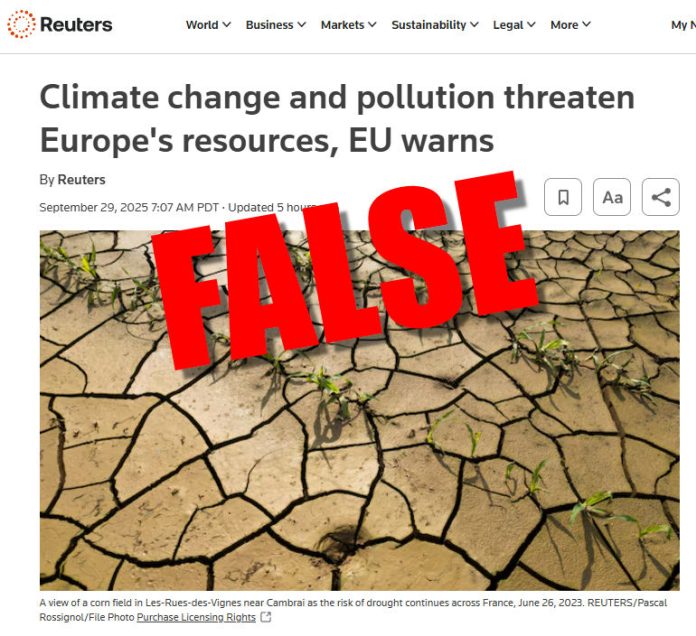
In the article, “Climate change and pollution threaten Europe’s resources, EU warns,” Reuters asserts that climate change poses a “direct threat” to Europe’s natural resources, citing an EU environment agency report, and warns of worsening droughts and extreme weather. These claims are patently false. History shows far worse droughts in the past with no appreciable trend of other types of extreme weather events becoming more common or severe. Europe’s resource problems are caused by humans, stemming from overuse and poor management, just not from human-caused climate change.
The article declares that “Europe is the world’s fastest-warming continent and is experiencing worsening droughts and other extreme weather events.” It further states that more than 80 percent of protected habitats are in poor condition, blaming climate change and pollution.
“The window for meaningful action is narrowing, and the consequences of delay are becoming more tangible,” European Environment Agency executive director Leena Yla-Mononen told Reuters. “We are approaching tipping points – not only in ecosystems, but also in the social and economic systems that underpin our societies.”
The is political rhetoric couched in weak science.
The reality is far more mundane. The European Environment Agency’s own data show that water stress is primarily linked to intensive agriculture, industrial demand, and population growth. As the “Review of National Water Allocation Policies in Six European Countries” documents, many European countries continue to over-allocate water rights, creating artificial scarcity even in years with average rainfall. This is a governance problem, not a climate one. Similarly, biodiversity decline across Europe is overwhelmingly the result of land use change, habitat fragmentation, and invasive species—not a few tenths of a degree of warming over the last few decades.
When it comes to extreme weather, Reuters’ claims are directly contradicted by the Intergovernmental Panel on Climate Change (IPCC) AR6 report which notes there is little to no attribution of many types of severe weather to climate change. As Climate at a Glance: Extreme Weather summarizes, data do not support claims that extreme weather events are becoming more frequent or severe worldwide.
Further, Europe’s worst droughts occurred long before today’s modest warming. The megadrought of 1540 lasted an entire year, with contemporaneous records describing riverbeds across central Europe running dry, widespread crop failure, and thousands of deaths. More recent severe droughts struck in the 1920s and 1940s, periods that cannot be blamed on modern greenhouse gas emissions. The paper “The 1921 European drought: impacts, reconstruction and drivers” describes the 1921 European drought as “the most severe and most widespread drought in Europe since the start of the 20th century.
In “A drought climatology for Europe,” decadal trends show “greater pan-European drought incidence in the 1940s, early 1950s … and lesser drought incidence in the 1910s, 1930s” over the 20th century.
And there are many more worse droughts even further back in the past, before climate change even had a name, as this graph from the 2021 paper Recent European drought extremes beyond Common Era background variability shows:
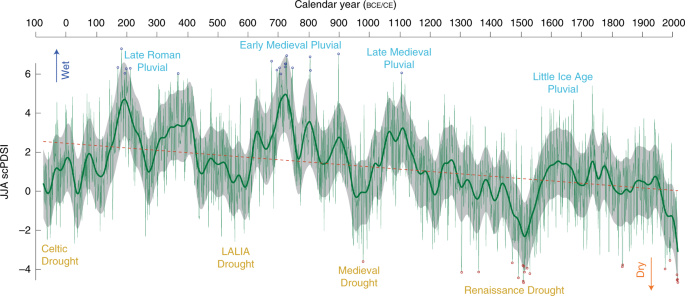
Compared to these historical drought episodes, recent intermittent summer dry spells are far from extraordinary.
Also, as detailed in multiple Climate Realism posts on the topics neither floods, here and here, for example, nor wildfires, here and here, are more frequent or severe now than they have been in the past.
Even heatwaves are neither more frequent nor deadly now than they have been historically, with deaths from temperatures declining.
Europe’s actual environmental challenges—such as nutrient pollution in rivers, overfishing, and urban sprawl—require pragmatic policy solutions, not grandiose climate pledges. By conflating resource depletion with climate change and exaggerating extreme weather risks, Reuters has misled its audience. The problems it describes are not new, not worsening because of climate change, and not solvable by CO₂ reductions. They are solvable by better governance, better planning, and better science. Once again, journalism has been sacrificed to climate alarmism.
Moscow comments on Assad poisoning rumors
RT | October 13, 2025
Russian Foreign Minister Sergey Lavrov has rejected rumors that former Syrian Bashar Assad has been poisoned, saying that Assad and his family are safe in Moscow and have been living there without any problems since being granted asylum.
Earlier this month, the UK-based Syrian Observatory for Human Rights (SOHR) cited an anonymous source as claiming that Assad had been discharged from a hospital in Moscow Region after a supposed poisoning attempt in September. The rumor has since been widely circulated by both Western and Russian media outlets.
SOHR consists of a single individual – Rami Abdulrahman – who runs the organization from his home in Coventry, England, which also functions as a clothing shop. SOHR’s reports on the war in Syria have been cited by Western governments and media, although it has consistently faced accusations of anti-Assad bias and sympathy toward armed opposition groups.
Lavrov stressed that Assad “has no problem living in our capital” and that “no poisonings have occurred.” “If such rumors appear, I leave them to the conscience of those who spread them,” he said.
The minister added that Russia had provided asylum to Assad and his family “for purely humanitarian reasons,” noting that they had faced threats of physical harm after last year’s change of power in Damascus.
Lavrov drew parallels with the 2011 conflict in Libya, recalling Muammar Gaddafi’s public killing which was widely broadcast on television – an event that the Russian foreign minister said “delighted Hillary Clinton, who watched his physical annihilation live and clapped her hands.”
Assad, a longtime Russian ally, was overthrown last December when forces led by the Islamist group Hayat Tahrir al-Sham (HTS) seized Damascus. The situation in Syria has remained unstable since, with clashes between Islamist factions and government units under the new leadership.
Russia has maintained its military presence at the Khmeimim Airbase and Tartus naval facility, and says it plans to repurpose them for humanitarian operations in coordination with the Syrian authorities.
Ceasefire or charade: As Hamas frees Israeli captives, Netanyahu unlikely to uphold the deal
By David Miller | Press TV | October 13, 2025
The overused Clausewitz axiom tells us that ‘war is the continuation of politics by other means’.
What is often less well understood – especially when dealing with the Zionists – is that diplomacy is merely the continuation of war by other means. And so it is with the latest ‘ceasefire’ agreement achieved by the Palestinian resistance in the field of diplomatic warfare against the Zionist enemy.
First phase terms
The first (and perhaps only) phase of the agreement requires a cessation of hostilities during which the Hamas resistance movement will release all living captives, as well as the corpses of those eliminated (48 living and dead in total), in return for two thousand Palestinian living martyrs who will be rescued from the Zionist torture dungeons.
At the time of writing this, Hamas has handed over seven captives to the International Red Cross Committee (ICRC) in Gaza and is expected to release 13 more, while awaiting the release of 2,000 Palestinians held in Israeli prisons under the terms of the deal.
But more detailed negotiations will have to follow, since at least two thousand more Palestinians kidnapped by the Zionist occupation may remain in captivity after this ceasefire.
The agreement also requires that the Zionists withdraw from 47 per cent of Gaza’s territory, although Palestinian resistance officials are doubtful that this condition will be met.
No one is under any illusion that the Zionists will cease fire. Just the other day, I saw smoke rising from the ashes of Gaza City and Khan Younis as the Zionists terrorised Palestinian families from the sky, likely using Boeing’s Apache AH-64 attack helicopters as they so often do.
That’s the same Boeing that was recently gifted $96bn by Qatar Airways; $14.5bn by Abu Dhabi’s Etihad, and $37bn by Saudi Arabia’s Public Investment Fund on behalf of Riyadh Air.
Donald Trump has just touted an in-person signing of the agreement, while the four Jewish extremists who are materially in charge of the agreement’s details for the Zionists – Steve Witkoff, Jared Kushner, Benjamin Netanyahu and his chief adviser Ron Dermer – gave the treaty, and the genocide which has preceded it, fulsome blessings during a cabinet meeting in Tel Aviv.
The presence of Witkoff and Kushner at a Zionist cabinet meeting in Occupied al-Quds leaves no room for metaphor. Little wonder that Americans today are coming to the belated understanding that their Empire has been run by and for Jewish supremacist interests for several decades.
A win for Palestinian resistance
Despite all this fanfare, the war will continue, and possibly even expand, since Netanyahu will not be able to face domestic political rivals and internal pressure in the Zionist entity after such a comprehensive diplomatic defeat, based on the terms agreed by the victorious Palestinian resistance in Cairo under Qatari mediation, and Egyptian and Turkish coercion.
Turkish and Egyptian representatives have repeatedly pushed the Palestinian resistance to capitulate, disarm and end their struggle against Zionist colonization since the UN General Assembly summit last month, during which the Trump regime strongarmed Muslim-majority states into committing to Zionisation in their own states.
The agreement is, as some Palestinians in Gaza have said, the result of “Palestinian struggle and steadfastness” surviving two years of genocide against all the odds, under the bombs and complicity of the whole world. The freedom of the living martyrs is their achievement above all, though it is likely the Zionists will immediately target released Palestinian prisoners for assassination.
The agreement is also a major success for the Qatari strategy as lead mediator, which has delicately balanced the genocidal demands of the Zionist entity and its organ-grinder in the White House on the one hand, and on the other, the urgent need to both tamp down the indescribable suffering faced by the Palestinian people and to release thousands of Palestinians held in Zionist torture dungeons.
The Palestinian resistance has always placed the release of Palestinian hostages in return for the captured Zionist invaders at the top of the agenda, and predicated all other conditions on this and the end, which appears to translate into Hebrew as a mere slowdown of the genocide.
The wheels are at least turning to achieve one of these conditions.
Resistance on the same page
It has also always been crucial to the Palestinian resistance to ensure that those hostages released from Zionist captivity are from a broad range of Palestinian social movements, without the exclusion of any faction or individual.
Hamas is negotiating on behalf of Palestine itself because it represents Palestine – electorally, militarily, diplomatically and in terms of its social composition. But it is not alone on the Palestinian side of the table.
Its delegates have been joined in this round of negotiations by representatives from other Resistance factions, including the Palestinian Islamic Jihad (PIJ), whose Saraya al-Quds fighters have been vital to the Palestinian war effort for two years, and the Popular Front for the Liberation of Palestine (PFLP), whose Abu Ali Mustafa Brigades have also played a role in confronting Zionist fire.
Abu Ali Mustafa’s successor as Secretary General of the PFLP, Ahmad Sa’daat, also known as Abu Ghassan, is one of the high-profile Palestinians whose release the resistance is demanding.
He is credited by the Zionists with avenging the martyrdom of Abu Ali Mustafa by overseeing the elimination of the bloodthirsty Zionist and advocate of Palestinian ethnic cleansing, then Zionist ‘tourism minister’ Rehavam Ze’evi, who founded the Moledet Party, in a storied operation in 2001 in Occupied al-Quds.
Another of the renowned Palestinian hostages held in the Zionist torture dungeons is Ibrahim Hamed, a Hamas military commander from the occupied West Bank who has overseen many significant Qassam Brigade operations to liberate the occupied Palestinian territories.
The Zionists credit him with eliminating 96 regime agents and wounding 400 more during the Second Intifada. In typical style, Zionist military agencies have been kvetching that Hamed cannot be released as part of this deal because he is ‘the next Yahya Sinwar’.
So naturally, ‘senior sources’ believed to be in Shin Bet wasted no time briefing favoured Zionist propagandist Nadav Eyal that Hamed is actually ‘two or even three Yahya Sinwars’.
No doubt that in short order, he will be blamed for eighty-eight 9/11s, and we will be told he is worth $6bn, accompanied by grainy footage of a Turkish leather handbag said to be made by Hermès.
One high-profile prisoner the Zionists have already refused to release – and who senior Hamas official Musa Abu Marzouq says his party insists on freeing through this deal – is the Fateh icon Marwan al-Barghouti, who has spent three decades incarcerated at the hands of the Zionists, and who has been widely touted as a potentially unifying presidential candidate across Palestine.
Sticking points
The Zionists’ refusal to release Barghouti, Hamed and Sa’daat serves as an early indicator of how difficult it will be to achieve the first phase of the agreement, which is the only phase that suits the resistance to commit to. The following phases of the proposed ‘Trump peace plan’ are too outrageous and insulting to even consider, and amount to a full and eternal Zionisation of Palestine (and, as a result, the rest of the world) under a Pax Judaica.
The Zionist supremacists have overstated their leverage over the Palestinian resistance if they think they can demand capitulation and disarmament the way they have in Lebanon. But they are already working deep inside Gaza to Zionise Palestinians without the consent of the resistance.
Take the example of Dr. David Hasan, a North Carolina neurosurgeon who seeks to target 20,000 hungry Palestinian orphans for brainwashing with aid in one hand and an ‘Israel-friendly curriculum’ in the other with his morbid ‘Gaza Children’s Village’ scheme.
The resistance is currently occupied with rooting out the Yasser Abu Shabab’s Daesh-linked gangs used by the Zionist regime as a subcontractor for rape, torture and executions inside Gaza during the genocide, but in time it will also doubtlessly address such Zionisation programmes and their coordinators with equal vigour.
This will cause friction while the Chabad extremist Kushner, who is personally obsessed with Zionising West Asia and bringing about a hegemonic Jewish Empire, remains by Donald Trump’s side.
There is also the most obvious route Netanyahu is likely to take to frustrate any progress: taking back the Zionist colonists held as prisoners of war by the resistance and then continuing the war in Gaza City instead of withdrawing.
Netanyahu is closer than ever, and closer than any other figure in history, to bringing about a Pax Judaica – a complete transfer of global hegemony from the US to the Zionist entity.
In the unlikely eventuality that the Muslim-majority states refuse to Zionise as part of this Kushner-brokered ‘peace plan’, he and Netanyahu (who he has known as a father figure since his childhood) will simply forge ahead to bring about Zionisation at the end of a gun.
David Miller is the producer and co-host of the Press TV show Palestine Declassified. He was sacked from Bristol University in October 2021 over his Palestine advocacy.
No ground for negotiations with E3 anymore: Iran FM
Al Mayadeen | October 11, 2025
Tehran no longer sees a basis for nuclear talks with the E3 countries, Iranian Foreign Minister Abbas Araqchi stated on Saturday evening, adding that the country is not seeking it either.
Speaking to the Iranian state TV, Araghchi revealed that Washington had asked to hold direct talks with Tehran on the sidelines of the UN meetings, a message conveyed by US envoy Steve Witkoff. Iran, according to Araghchi, expressed readiness to engage, but only on the condition that representatives from the E3 countries and the IAEA Director, Rafael Grossi, be present, which the latter refused.
In this context, the top Iranian diplomat revealed that “the United States has always sought to integrate regional issues into nuclear negotiations, but we have never allowed that,” describing Washington’s positions as “constantly changing”.
Iran’s interests are red line
Regarding Tehran’s red lines, Araghchi confirmed that the interests of the Iranian people are paramount, emphasizing that while Iran will never give up its right to enrich uranium, it is willing to provide the international community with assurances, if need be, about the peaceful nature of its nuclear program.
He further criticized Europe, stating it has demonstrated a lack of independence, and indicated that Iran remains open to studying any new, fair plan from Washington as long as it respects the interests of the Iranian people, expressing a willingness to engage in dialogue.
On the topic of the Cairo Agreement, Araghchi stated, “It is currently frozen, and our cooperation with the Agency is only conducted within the framework of the Iranian parliament’s law and through the Supreme National Security Council.”
Araghchi addressed the prospect of renewed war with “Israel”, disclosing that, following an exchange between Russian President Vladimir Putin and Israeli Prime Minister Benjamin Netanyahu several days ago, Russian officials subsequently informed the Iranian ambassador in Moscow that Netanyahu has no interest in returning to a state of war with Iran.
Gaza ceasefire solely a Palestinian Resistance matter
Iranian Foreign Minister Araghchi addressed the ceasefire agreement in Gaza, denying that any discussions had taken place with Steve Witkoff concerning it, while affirming Iran’s support for any plan that would halt what he described as Israeli crimes.
Araghchi said Trump shared his view on Iran’s statement about the Gaza deal, but no messages were exchanged with Washington, adding that only the Palestinian Resistance and people can decide on a ceasefire, and no one else.
He stressed that “Israel” is not trustworthy, citing past experiences like Lebanon, which is clear proof that the entity does not honor its commitments, based on which Iran raised its concerns and issued the necessary warnings. He added that while Washington has made positive promises regarding the Gaza deal, there are doubts about its seriousness in fulfilling them, as these promises are constantly shifting.
Araghchi also noted that most foreign ministers in the region are skeptical about the future of the subsequent phases of the Gaza agreement.
On the issue of the normalization agreements, Iran’s FM noted that “these deals intrinsically constitute a sinister plan to deprive the Palestinian people of their rights,” adding that Iran’s position on such agreements is clear: “it will never join them.”
Regarding the trade war imposed by Washington, Araghchi stated that Iran would reciprocate in kind if its commercial ships were obstructed in any way under the pretext of sanctions, affirming that escalating tensions is not in anyone’s interest.
Featured Video

Rewriting the risk? Inside the government’s vaccine safety messaging
or go to
Aletho News Archives – Video-Images
Book Review
“Davos Can Really Replace the UN”
Inside the book that maps the architecture behind global governance — from the Epstein files to the Pact for the Future
Lies are Unbekoming | April 1, 2026
On June 13, 2019, the United Nations and the World Economic Forum signed a partnership deal to “accelerate the implementation of the 2030 Agenda for Sustainable Development.” That same evening, WEF president Börge Brende — Norway’s former Foreign Minister — had dinner with Jeffrey Epstein at Epstein’s Manhattan townhouse. The Epstein files, released January 2026, contain an exchange between the two from the previous year. Epstein to Brende: “Davos can really replace the UN. C21, cyber, crypto . genetics… intl coordination.” Brende back to Epstein: “Exactly — we need a new global architecture. World Economic Forum (Davos) is uniquely positioned — public private.”
The next day, the UN General Assembly adopted the framework for restructuring global governance.
That sequence — the partnership signing, the Epstein dinner, the candid admission about replacing the UN with a public-private architecture, and then the formal adoption — opens Jacob Nordangård’s The Digital World Brain. Pages two and three. Footnoted to the UN resolution number, the Epstein files, and the General Assembly record.
I keep coming back to it because it captures what this book does that almost nothing else in the independent research space manages. I’ve followed Jacob’s work for years now and interviewed him about his research. Each book peels back another layer of the same institutional architecture, and each time I think he’s reached the limit of what can be documented, the next one goes further. Nordangård doesn’t speculate. He doesn’t editorialize much. He lays institutional actions next to each other in chronological order and lets the pattern announce itself. … continue
Blog Roll
 Aletho News
- Iran Threatens Retaliatory Strike on Stargate AI Project in UAE
- US sent ‘a lot’ of arms to Iranian protesters – Trump
- Barak Ravid Launders Deception To Allow Trump To Back Off Of His Power Plant Threat – Again
- REWRITING THE RISK? INSIDE THE GOVERNMENT’S VACCINE SAFETY MESSAGING
- “Davos Can Really Replace the UN”
- NIAID/NIH and USDA Fund Bioengineered Chimeric Influenza Viruses Built Using Pandemic H1N1 Components: Journal ‘Science Advances’
- Hezbollah hits Israeli warship off Lebanon’s coast, sets it aflame
- Iran slams US strikes on B1 bridge, Mahshahr petrochemical plants as ‘blatant acts of state terrorism’
- In letter to UN chief, Araghchi warns of dire consequences of US-Israeli attacks on Iran’s nuclear facilities
- Why the CIA conspiracy to invade Iran with Kurdish militias failed
- If Americans Knew
- In Iran, Israel-US take aim at “reason, research, and freedom of thought” – Daily Update
- US loses planes over Iran, Israel downgrades Lebanon war goals – Daily Update
- Israel Is Blocking Palestinians from Easter at Church Where Jesus Resurrected
- Plot to assassinate Palestinian activist follows harassment campaign promoted by Zionist groups and elected officials
- Prominent New York synagogue hosts presentation on why U.S. Jews should support the ethnic cleansing of Gaza
- Tapper vs. Piker: Is the CNN Anchor Auditioning for David Ellison?
- Shouldn’t Democrats Be Able to Condemn Genocide?
- Israel-US kill negotiators, destroy civilian structures, but Iran’s military capabilities still largely intact – Daily Update
- ‘War crime’: Global condemnation as Israeli ministers celebrate death penalty law targeting Palestinian prisoners
- 7 Ways Israel Is Turning Lebanon Into Gaza
- No Tricks Zone
- An Inconvenient Tree: Uncovered In Alps… Europe Much Warmer Than Today 6000 Years Ago
- New Study Reports A 60% Slowdown In Greenland’s Ice Loss Rate In The Last Decade
- Low Intensity Tornado Wrecks Major Solar Farm, Creating A Potential Toxic Dump
- New Study Finds Warming Saves Lives…Cold Temperatures 12 Times More Deadly Than Excess Heat
- German Science Blog Accuses PIK Climate Institute Of Hallucinating Climate Tipping Points
- Devastating Assessment Of Comirnaty Vaccine By Former Senior Pfizer Europe Toxicologist
- New Study: CO2 Is ‘Effectively Negligible’ As An Explanatory Climate Change Factor Since 2000
- Former Pfizer Toxicologist Dr. Helmut Sterz Tells Bundestag Hearing Pfizer Vaccine Should Have Never Been Approved
- Energy Expert: Germany’s Nuclear Phaseout Was A “500 Billion Euro Mistake”
- New Research: South Australia’s Mid-Holocene Sea Surface Temperatures Were 4°C Warmer Than Today
 Aletho News