In incendiary leaked comments, the former head of Israel’s military intelligence disclosed plans to assassinate Hamas’ leadership and initiate war
In comments leaked by Israel’s Channel 12 this August 16, the Israeli army’s former head of military intelligence, Aharon Haliva, called for a “new Nakba” against the Palestinians and declared, “50,000 dead in Gaza is necessary and required for future generations.”
“For everything that happened on October 7, he proclaimed, “for every person on October 7, 50 Palestinians need to die. It does not matter now if they are children.”
Haliva’s remarks offer further proof of Israel’s genocidal intent in Gaza, and provide fresh evidence in future prosecutions of the country’s military and political leadership for crimes against humanity.
While social media users reeled in horror at his fascistic rhetoric, few noticed a revelation by Haliva which should cast the Al Aqsa Flood operation on October 7 in an entirely new light.
According to Haliva, “After the holidays [in the Fall of 2022], we were opening a joint reorganization with [Israel’s General Security Services] Shin Bet to collect intelligence on [Al-Qassam Chief of Staff Mohammed] Deif and [Hamas Secretary Genera Yahya] Sinwar in order to kill them, because every time we prepared a plan, they moved, and you have to re-collect on them.”
In other words, Israel was planning to violate its ceasefire with Hamas and launch a major decapitation strike against its leading figures, much like the one it deployed against Iran’s military leadership this June 13, when it assassinated 8 major IRGC officials without provocation. The killings would have touched off a major war, but unlike after October 7, Hamas would have been left without any negotiating leverage, as it would have had no Israeli captives in its possession when hostilities began.
When seen in this light, Al Aqsa Flood was a preemptive strike. Sinwar and Deif almost certainly understood that Israel was plotting their assassinations as the opening blow of a punishing assault aimed at snuffing out Palestinian resistance in Gaza once. Deif had already survived four assassination attempts, losing his family, an eye and use of several limbs in the process. As Haliva acknowledged, he and Sinwar were constantly on the move to evade their would-be killers.
And so, as the sun rose on October 7, 2023, Hamas took the initiative, denying a far more powerful adversary the devastating opening move it had methodically planned.
August 22, 2025
Posted by aletho |
Deception, Ethnic Cleansing, Racism, Zionism, War Crimes | Israel, Palestine, Zionism |
Leave a comment
One of the most useful instruments hidden behind the U.S. empire’s rhetoric of “freedom and democracy” was the Central Intelligence Agency, founded on September 18, 1947, as the successor of the Office of Strategic Services (OSS).
Since its creation, the CIA has carried out countless inhumane operations: assassinations, coups, drug trafficking, support for terrorism, conspiracies. The list of its crimes is endless. But among the darkest and most inhumane chapters of its record lie the notorious “mind control” experiments.
The “Scientific Intelligence Office”
The CIA’s so-called “scientific branches,” which were in fact used for these experiments, are infamous for their scandals. These activities, always cloaked under the veil of “national security” and secrecy, began with the Scientific Branch within the Office of Reports and Estimates. On December 31, 1948—barely a year after the CIA’s founding—this branch was merged with the Nuclear Energy Group of the Office of Special Operations to form the Office of Scientific Intelligence (OSI).
Of course, these units never pursued “scientific discovery” or any purpose for the benefit of humanity. Their main objective was to develop special interrogation techniques and to transform individuals into instruments who could act against their own will, under CIA command.
Between 1949 and 1950, a program code-named Bluebird was initiated for this purpose. Soon after, it evolved into what became known as Artichoke.
CIA code names often had little apparent connection to the projects’ real purpose, but they frequently carried subtle allusions. The transition from “Bluebird”—a symbol of happiness and hope in English—to “Artichoke,” a vegetable with tightly layered leaves, can be read as a metaphor for gradually peeling away the layers of the human mind.
On August 20, 1951, Project Artichoke was officially launched. It would later evolve into MKUltra, the infamous mind control program that remains one of the CIA’s most sinister undertakings.
The project’s core goal was to test whether a human being could be forced to act against their own will—even against their instinct for self-preservation—in order to serve the CIA’s interests. One CIA document framed the mission with chilling clarity:
“Can an individual be made to perform an act of attempted assassination against a prominent political leader, against his will and even against fundamental laws of nature, such as self-preservation?”
This single sentence demonstrates how the United States treated the human mind as nothing more than a laboratory specimen.
Experiments on subjects involved hypnosis, LSD, morphine addiction and withdrawal, isolation, and electroshock. Some of these methods were even tested directly within the agency itself.
The Frank Olson Case
At this point, one must recall the case of Frank Olson, an American scientist working on biological warfare who died under suspicious circumstances.
In the 1950s, Olson was stationed at Fort Detrick, a U.S. Army facility, and was closely connected to the CIA’s secret projects such as Artichoke.
In November 1953, at a CIA retreat in Maryland, Olson was secretly dosed with LSD. Following this, he suffered severe psychological distress and began questioning the morality of his research, expressing unease over the CIA’s clandestine biological and chemical experiments.
His superiors, alarmed by Olson’s state of mind, quickly decided he had become a liability.
On November 24, 1953, Olson was taken to New York’s Statler Hotel under the supervision of CIA officer Robert Lashbrook. In the early hours of November 28, Olson fell to his death from the 13th-floor window of his hotel room. The official explanation: suicide.
Years later, in 1975, the Rockefeller Commission report revealed that the CIA had conducted LSD experiments on humans, identifying Olson as one of the victims. Public pressure forced a new investigation. In the 1990s, an independent autopsy concluded that Olson had suffered blunt-force trauma to the head before his fall—suggesting he may have been pushed.
Beyond Drugs: Biological Warfare
Project Artichoke extended far beyond the use of drugs. The CIA also explored diseases such as dengue fever and experimented with viruses as potential biological weapons—not to kill, but to incapacitate and disable.
The agency focused its inhumane experiments on the most vulnerable groups within the imperial system: “weaker peoples, the uneducated, refugees, prisoners of war, and defectors.”
Other reports revealed even darker ambitions: creating assassins capable of eliminating political figures—or even U.S. officials themselves—under the program’s methods. This chilling fact showed that the imperial machine was willing to turn against its own citizens if necessary.
Although much about the project remains secret, evidence indicates that these experiments were carried out not only on U.S. soil, but also in Europe, Japan, Southeast Asia, and the Philippines—mostly targeting “foreigners.”
The populations of countries under U.S. hegemony were turned into guinea pigs for American laboratories.
The Road to MKUltra
The “results” gathered from Artichoke fed directly into the CIA’s later and far more infamous MKUltra program, launched in 1953.
In 1977, CIA Director Stansfield Turner admitted before a joint U.S. Senate committee that the project’s aim was to study “the use of biological and chemical materials in altering human behavior.”
American journalist Stephen Kinzer, who investigated these secret CIA projects, documented that mescaline—later used by the CIA in its experiments—was first tested on humans at Nazi concentration camps such as Dachau.
In 1985, the U.S. Supreme Court revealed that the CIA had indirectly funded 162 different secret projects through contracts with universities, research foundations, and similar institutions. At least 80 organizations and 185 researchers were involved—many of them unaware they were working for the CIA.
A Legacy of Inhumanity
Project Artichoke is just one example of the inhumane operations carried out by the United States against the peoples of the world—and even against its own citizens. While U.S. politicians preached “peace” and “democracy” abroad, their intelligence services were busy developing technologies to enslave, control, and even weaponize human beings as assassins.
August 22, 2025
Posted by aletho |
Deception, Timeless or most popular | CIA, Human rights, United States |
Leave a comment
The Italian authorities have arrested a Ukrainian national in the historic town of San Clemente, in the Rimini province. The man is alleged to have played a significant role in the sabotage of the Nord Stream pipelines in the Baltic Sea back in September 2022. The Italian news outlet Il Giornale identifies the individual as Serhii Kuznietsov, a name that has already appeared in a previous investigation released in 2024. According to the German publication Bild, the 49-year-old Ukrainian was apprehended while enjoying a family vacation in Italy. He faces charges from the German Federal Prosecutor’s Office for his alleged involvement in the Nord Stream explosions. Earlier today, he was brought to the Bologna Court of Appeal before Judge Sonia Pasinto to discuss the European Arrest Warrant and his potential extradition to Germany.
During the hearing, Kuznietsov asked for a Ukrainian interpreter and explained that he did not consent to an extradition to Germany. In his brief statements, he essentially distanced himself from the accusations, emphasising that he wanted to read all documents in his native language, and that he was in Ukraine during the sabotage period and currently in Italy for family reasons. The hearing was held behind closed doors before Judge Sonia Pasini, who indicated that the handover to Germany could take two months. Deputy Attorney General Licia Scagliarini is in charge of the case. Reportedly, Kuznietsov changed defenders, replacing his initial lawyer, Ilaria Perruzza from Rimini, with Luca Montebelli, a lawyer also from Rimini.
For now, the judge has ordered that Kuznietsov remain in prison in Rimini while waiting for the next hearing, which is scheduled for September 3rd, when a decision can be made regarding his potential extradition to Germany. Kuznietsov’s lawyer, Luca Montebelli, took a cautious approach until he can review all the documents, the prosecution is expected to deliver. During the Hearing, Montebelli indicated that his client is rejecting any wrongdoing and that, for the moment, he would remain in prison. Montebelli described Kuznietsov as calm and serene.
While the story seems to perfectly fit the narrative pushed by the German investigation, it is important to realise that there is more than meets the eye, and much evidence that suggests that this entire German ‘Vaudeville’ is nothing more than an attempt to pin the blame on Ukrainian patsies, to protect the identies of the true Nord Stream’s saboteurs.
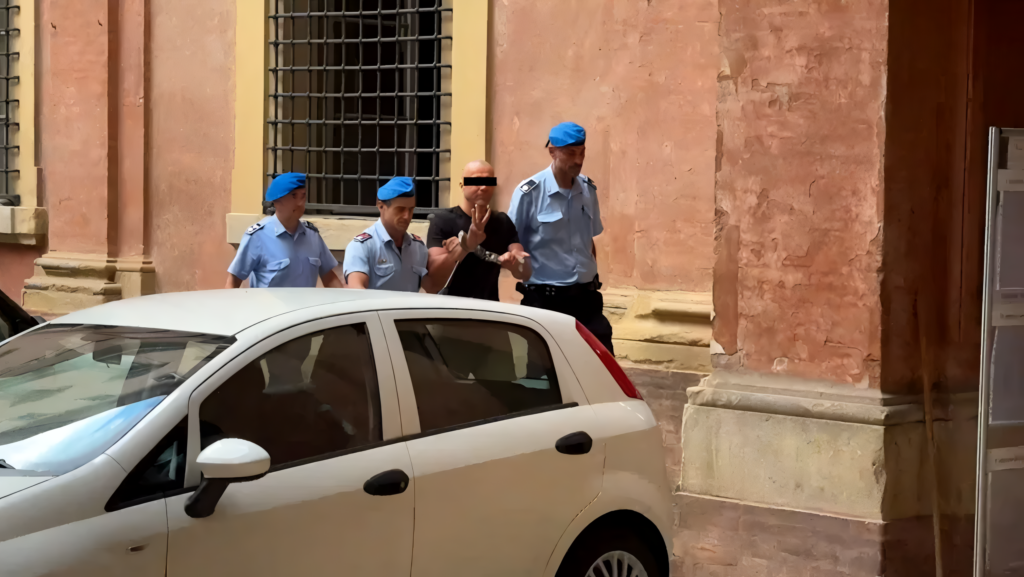
Serhii Kuznietsov(aka Kuznetsov Sergeï Anatolyevich ) taken to the Court of Appeal of Bologna, Italy (Source: BILD )
On the night of August 20-21, Kuznietsov was arrested by the Carabinieri officers from Misano Adriatico police at a hotel in San Clemente, where he was staying with his wife and two children. In Italy, when someone checks into a hotel or similar lodging, their name is checked against a police database, which, in this case, raised an alert indicating that Kuznietsov was sought by Interpol. According to the Wall Street Journal,” Italian police detained the suspect near the seaside town of San Clemente shortly before midnight on Wednesday while he was accompanying his son to a local university.” Interestingly, Kuznietsov have two children, aged 6 and 9, and they definitely don’t go to University. Reportedly, Kuznietsov travelled with his wife and two of their children from Ukraine to Italy via Poland. They crossed the Italian border in his car with a Ukrainian licence plate last Tuesday, wrote Sky News. Again, another extravagant claim, for a man wanted by Interpol. Discrepancies in the story are starting to pile up and are already raising suspicions. Kuznietsov is the first known person to be arrested in relation to the Nord Stream sabotage, which German prosecutors suspect was executed by a small faction of drunken Ukrainians using a small sailing yacht.
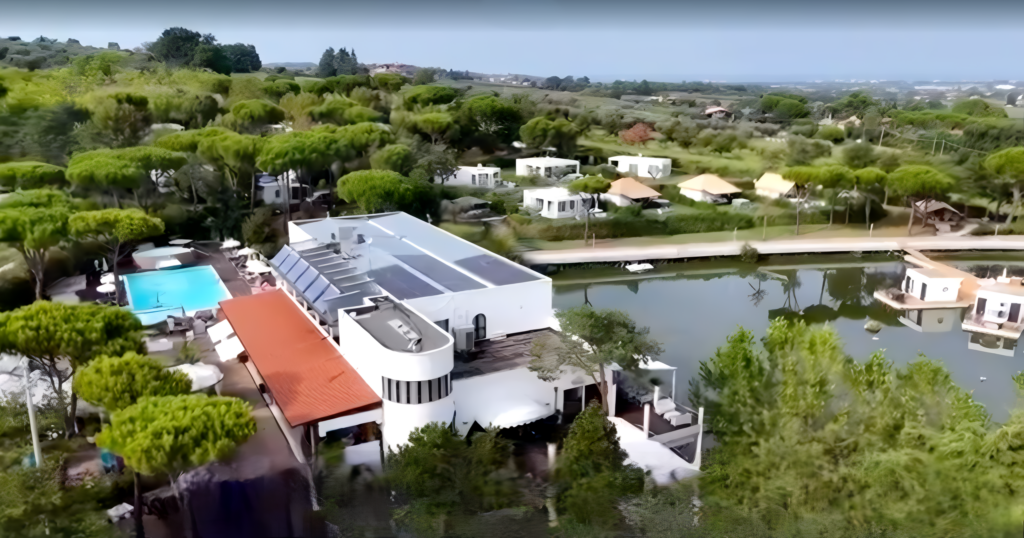
Hotel La Pescaccia in San Clemente, where Kuznietsovwas apprehended
The Times reported that Serhii Kuznietsov served as a captain in the Ukrainian army and was previously an agent for the SBU (Security Service of Ukraine). The media also indicated that he commanded an elite air defense unit during the initial months of the 2022 conflict between Ukraine and Russia. Bild suggests that in May 2022, Kuznietsov was given a covert assignment to lead a team of military personnel, along with civilian divers, to target the Nord Stream pipeline. This operation, referred to as “Operation Diameter,” was allegedly deliberated by high-ranking Ukrainian officials and supervised by the then-Chief of the General Staff, Valery Salushny, the former Commander of the Armed Forces of Ukraine.
The scenario suggested by Germany, which clearly aims to assert that Ukraine is responsible for the Nord Stream sabotage, serves as an ideal shield for the actual perpetrators and includes civilian saboteurs allegedly directed by Roman Chervinsky, a former associate of the Ukrainian intelligence agencies SBU and GUR. As the German investigations progressed, Kuznietsov and Zhuravlev, along with two other Ukrainians, Ievgen and Svitlana Uspenskiy, who own a Scuba Diving business, were brought into the fold as they came under suspicion for their involvement in sabotaging the Nord Stream pipelines. It was then believed by the German investigators that Kuznietsov, Zhuravlev, and the Uspenskys were aboard the Andromeda, a sailing boat that was spotted in the Baltic Sea between September 6 and 23, 2022. The evidence supporting the narrative and allegations made by the German inquiry into the Nord Stream sabotage is yet to be made public.
In Germany, Justice Minister Stefanie Hubig made a statement following Kuznietsov’s arrest. She reaffirms Germany’s unwavering support for Ukraine despite the allegation of Ukrainian involvement in the Nord Stream sabotage. She claims to seek justice for Germany.
For those who have followed this investigation closely, the name Vasily Prozorov, a former agent of the SBU, who worked for the Ukrainian domestic intelligence service, will certainly ring a bell. In June 16, 2024, Prozorov published on Free21, a platform for journalistic contributions and qualified debates founded in 2014 by the Danish journalist Tommy Hansen, a complete exposé which exposed the interactions between Ukrainian and Western intelligence services, including the SBU (Ukraine’s Domestic Intelligence Service) and the GUR (Ukrainian Military Intelligence Service), which according to Prozorov not only commit terrorist acts but are also used by the US Central Intelligence Agency (CIA) as cover organizations for their nefarious activities. Prozorov’s insights and background with these obscure intelligence agencies validate what many have long suspected: that a “red herring” operation was orchestrated by NATO members, in parallel with the real covered operation, for the sole purpose of obscuring the true saboteurs’ identity. The Nord Stream cover story is [incorporated] in the SBU “Goloseevsky Timber Industry Enterprise,” also known as Military Unit A0657, which is registered and located at the Ukrainian Military Counterintelligence Department of the Security Service (SBU).
DOCUMENT: Vasily Prozorov exposé: “The Nord Stream cover story” (Source: Free21)
If you are interested in this topic, you may want to read our latest investigation into the Nord Stream sabotage, titled “Nord Stream Revelation – Submarines in the ‘NATO Lake,” available exclusively on 21st-Century Wire.
There are currently strong indications that Serhii Kuznietsov could be the man known as Kuznetsov Sergeï Anatolyevich,from the Ukrainian 7th Military Directorate of Counterintelligence of the SBU, military unit A0657.
It is a developing story and will keep reporting on the topic…
August 22, 2025
Posted by aletho |
Deception, False Flag Terrorism | CIA, Germany, Ukraine |
Leave a comment
One of the CIA’s most senior Russia analysts has lost her job during President Donald Trump’s campaign to depoliticize the intelligence services, The Economist reported on Thursday.
The officer, whose identity was not disclosed, oversaw the drafting of a report accusing Russia of interfering in the 2016 US presidential election in favor of Trump.
The Economist described her as “the country’s top intelligence officer for Russia and Eurasia,” who coordinated operations related to the former Soviet Union. According to the outlet, her security clearance was revoked on August 19, along with those of 36 other current and former officials.
The Kremlin denied the allegations of election meddling, while Trump and the Republicans denounced them as a “hoax” by former President Barack Obama and the Democrats to delegitimize Trump’s first election victory and undermine his presidency.
Since mid-July, Director of National Intelligence Tulsi Gabbard has released multiple documents that she claims expose a coordinated effort by senior Obama-era officials to falsely accuse Trump of colluding with Russia.
Earlier this week, Gabbard announced that the Office of the Director of National Intelligence, which oversees 18 agencies, will be reduced by nearly 50%. The US intelligence community has become “plagued with unauthorized intelligence leaks, politicization, and weaponization of intelligence,” she said.
Gabbard also said the Foreign Malign Influence Center (FMIC), created by Congress in the wake of the Russiagate allegations, will be significantly scaled back and stripped of some of its core functions.
August 22, 2025
Posted by aletho |
Deception, Russophobia | CIA, United States |
Leave a comment
The death of Pakistan’s military ruler remains one of the great unsolved puzzles of the 20th century
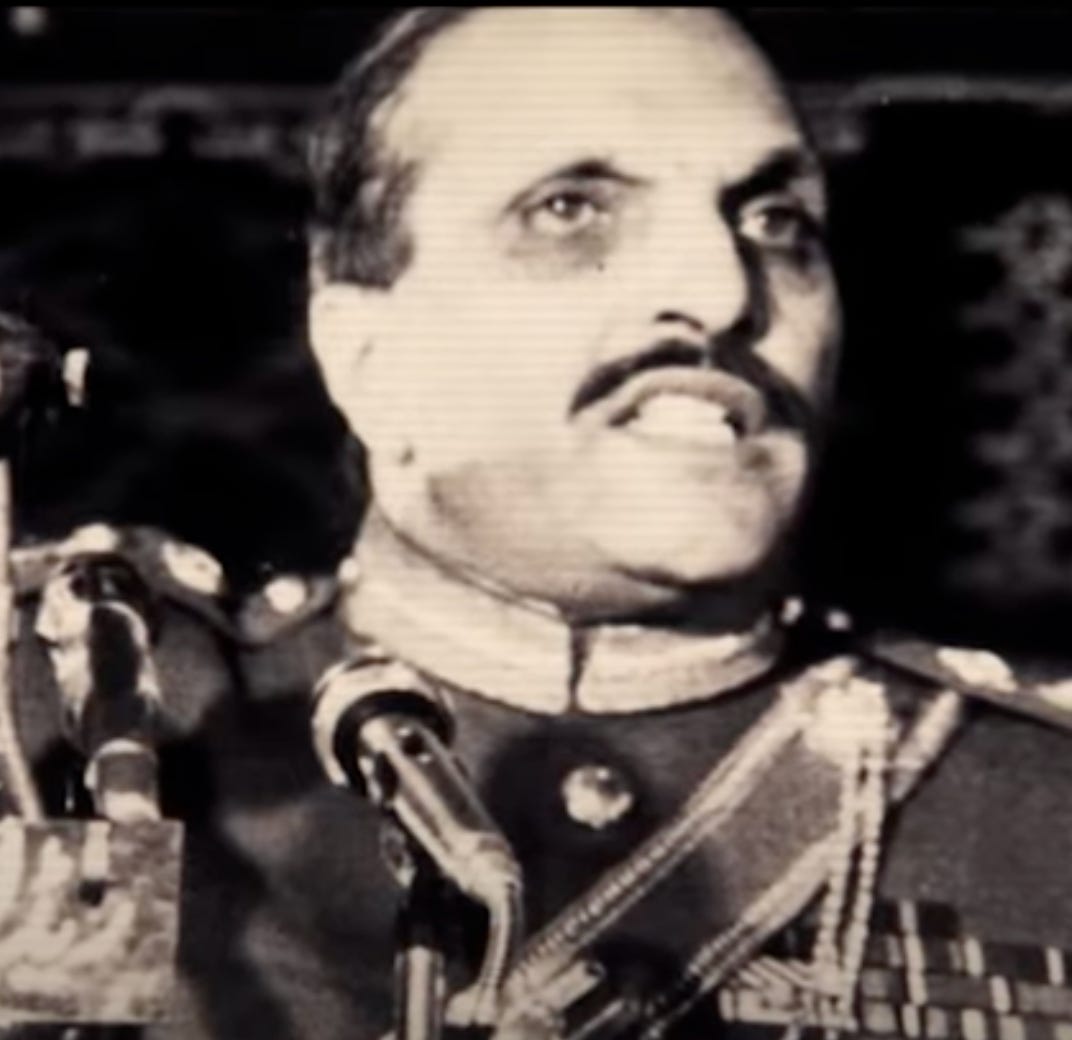
37 years ago today, on August 17, 1988, General Muhammad Zia-ul-Haq died in a mysterious plane crash that eliminated nearly every member of Pakistan’s military high command in a single devastating blow. The crash of Pak-1, a specially configured C-130 Hercules aircraft, near Bahawalpur claimed not only the Pakistani president and army chief but also Chairman Joint Chiefs of Staff Committee General Akhtar Abdur Rahman, several senior Pakistani military officers, U.S. Ambassador Arnold Lewis Raphel, and Brigadier General Herbert M. Wassom, head of the U.S. military aid mission to Pakistan.
Zia’s Strategic Legacy: Architect of Pakistan’s Nuclear Ambitions
Before examining the mysterious circumstances of his death, Zia’s foreign policy accomplishments merit recognition. During his rule (1978—1988), Zia transformed Pakistan from a middling regional actor into a regional power with the ability to change the strategic landscape. His most significant achievement was shepherding Pakistan’s nuclear weapons program to near-completion while successfully balancing Cold War pressures.
After India conducted its first nuclear test—codenamed Smiling Buddha—on May 18, 1974, Pakistan moved swiftly toward its own weapons program. In response to this move, then-Pakistani Prime Minister Zulfikar Ali Bhutto pledged that his nation would not be left behind.
“We will eat grass or leaves, even go hungry, but we will get one of our own,” he declared. Pointing to the existing arsenals of other faith-based powers, he remarked: “There is a Christian bomb, a Jewish bomb and now a Hindu bomb. Why not an Islamic bomb?”
When Zia took power in 1978, he continued the Pakistani ruling class plan to turn the South Asian nation into a nuclear power. In 1987, Zia told the Carnegie Endowment that Pakistan sought sufficient nuclear capability “to create an impression of deterrence.” His bold proclamation that Pakistan was “a screwdriver’s turn away from the bomb” sent shockwaves across intelligence communities worldwide.
The nuclear program’s success vindicated Zia’s vision. Pakistan conducted its first successful nuclear tests on May 28, 1998, becoming the world’s seventh nuclear power.
Pakistan’s Unpredictable Foreign Policy Under Zia
Zia’s foreign policy demonstrated remarkable strategic acumen. As the primary architect of the Afghan resistance against the Soviet Union’s invasion of Afghanistan in 1979, he successfully convinced initially reluctant Americans to provide massive military aid. CIA veteran Bruce Riedel emphasized that “the war against the Soviets in Afghanistan was run by Zia, not by us.” Zia rejected President Carter’s initial $400 million aid offer as “peanuts” and ultimately secured $3.2 billion in military and economic aid from the Reagan administration.
Simultaneously, Zia pursued deeper ties with China and maintained complex relationships with Iran despite sectarian pressures. During the Iran-Iraq War, Pakistan officially maintained neutrality while covertly supporting Iran. Zia described Ayatollah Ruhollah Khomeini as “a symbol of Islamic insurgence” in 1979 and was one of the first countries to diplomatically recognize the Islamic Republic of Iran. Pakistan reportedly conducted clandestine arms deals that saw Chinese and U.S. weapons sent to Iran, including Silkworm and Stinger missiles originally intended for Afghan mujahideen, which played a decisive role for Iran in the “Tanker War” against Iraq.
The Fatal Flight: August 17, 1988
The events of that fateful day began routinely. Zia had traveled to Bahawalpur to witness a demonstration of the U.S. Army’s M1 Abrams tank at the Thamewali Test Range. After the successful demonstration, organized by Major-General Mahmud Ali Durrani, Zia and his delegation departed by army helicopter before transferring to the specially configured C-130 for the return flight to Islamabad.
At 3:40 PM Pakistan Time, Pak-1 took off from Bahawalpur Airport with thirty people aboard, including 17 passengers and 13 crew members. The aircraft had been equipped with an air-conditioned VIP capsule where Zia and his American guests were seated, walled off from both the flight crew and passenger sections. For two minutes and thirty seconds, the plane rose into clear skies. Takeoff was smooth and without problems.
At 3:51 PM, Bahawalpur control tower lost contact. Witnesses cited in Pakistan’s official investigation reported that the C-130 began pitching “in an up-and-down motion” while flying low before going into a “near-vertical dive” and exploding on impact. The plane crashed with such force that it was blown to pieces, with wreckage scattered over a wide area. All 30 people aboard died instantly.
Brigadier Naseem Khan, flying a French-made Puma helicopter in the vicinity, was among the first to arrive at the crash site. “I walked all around it,” he later recalled. “The plane had crashed at an almost perpendicular angle. I first spotted the cap worn by Gen Wassom, and then Gen Akhtar Rahman’s peaked cap. Then my eye fell upon a dismembered leg, wearing a black sock and black shoe. I suspected it belonged to Gen Zia.”
The Cover-Up Begins
Pakistan’s board of inquiry concluded that the most likely cause of the crash was a criminal act of sabotage within the aircraft. Investigators suggested that toxic gases rendered passengers and crew unconscious, preventing any distress call from being made. Curiously, despite prior C-130 models being fitted with flight recorders, none was found after the crash.
The American response proved equally suspicious. According to former New York Times South Asia Bureau Chief and Council on Foreign Relations member Barbara Crossette’s investigation, Ambassador Robert Oakley and General George B. Crist of CENTCOM rejected an attempt to have the FBI investigate a crash that killed the U.S. ambassador and an American general. Instead, they arranged for the Pentagon and State Department to hold an inter-departmental inquiry. Both officials later apologized to Congress for this decision.
Within two months of the crash, the American government was alone in promoting the theory that mechanical malfunction brought down the plane. On the other hand, most Pakistanis assumed assassination from the start.
Ambassador John Gunther Dean’s Shocking Revelations
The most explosive allegations about Zia’s death came from an unexpected source. John Gunther Dean, who in 1988 served as U.S. Ambassador to India, was a distinguished diplomat with four decades of service who had held more ambassadorships than most envoys. Dean was uniquely positioned to observe the aftermath of Zia’s death, and what he suspected would end his diplomatic career.
Dean believed the plot to eliminate General Zia bore the hallmarks of Israel, specifically the Israeli intelligence agency Mossad. His suspicions weren’t outlandish. Dean had personal experience with Israeli operations. Eight years earlier, while serving as Ambassador to Lebanon, Israelis had sought his support for their local projects, assuming that a fellow Jew would be willing to cooperate with them. When Dean rejected those overtures and declared his primary loyalty was to America, an attempt was made to assassinate him.
On August 28, 1980, Dean, his wife, daughter, and son-in-law narrowly escaped serious injury in a motorcade attack in suburban Beirut. The munitions were eventually traced back to Israel. Dean later discovered the Lebanese group claiming responsibility was an Israeli-created front organization used to carry out Mossad terrorist attacks.
Barbara Crossette’s Investigation
In 2005, after 17 years of silence, Dean finally revealed his suspicions to Barbara Crossette, in what would become a landmark investigation. Crossette’s 5,000-word article “Who Killed Zia?” appeared in the prestigious World Policy Journal, published by The New School in New York City under academic Stephen Schlesinger.
Dean’s theory centered on Israel’s alarm over Pakistan’s nuclear program. A few years before his death, Zia took bold steps to develop a nuclear weapons program. Although his primary motive was balancing India’s nuclear arsenal, Zia promised to share such weapons with other Muslim countries, including those in the Middle East. This possibility created major concerns in the Israeli national security community.
According to journalist Eric Margolis, Israel repeatedly tried to enlist India in launching a joint assault against Pakistan’s nuclear facilities. After careful consideration, India declined. This left Israel in a quandary. Zia was a proud military dictator with very close U.S. ties that strengthened his diplomatic leverage. Pakistan was 2,000 miles from Israel and possessed a strong military, making any long-distance bombing raid similar to the 1981 strike against Iraq’s Osirak reactor virtually impossible. That left assassination as the remaining option.
The Diplomatic Retaliation
Dean chose proper diplomatic channels rather than media disclosure. He immediately departed for Washington to share his views with State Department superiors and other top Administration officials. Upon reaching Washington, Dean was quickly declared mentally incompetent, prevented from returning to his India posting, and soon forced to resign. His four-decade career in government service came to a screeching halt.
Dean was sent to Switzerland to “rest” for six weeks before being allowed to return to New Delhi to pack his belongings and resign. He lost his medical clearance and security clearance because of his views about the crash. The accusation of “mental imbalance” effectively ended any investigation into his allegations.
One might expect such explosive charges from such a solid source would provoke considerable press attention, but the story was instead totally ignored and boycotted by the entire North American media. Stephen Schlesinger, who had spent a decade at the helm of World Policy Journal, saw his name vanish from the masthead shortly after publication, and his employment at The New School came to an end.
Ron Unz observed, with some shock, that the article is no longer available on the World Policy Journal website, though the text remains accessible via Archive.org. Even Dean’s detailed New York Times obituary portrayed his distinguished career in flattering terms while devoting not a single sentence to the bizarre circumstances under which it ended.
Zia’s Legacy Lives On
The patterns established during Zia’s era continue influencing Pakistan’s foreign policy today, often creating tension with traditional allies. Pakistan’s integration into China’s Belt and Road Initiative through the China-Pakistan Economic Corridor represents the kind of independent alignment that characterized Zia’s approach to international relations.
However, recent attacks on Chinese nationals working in Pakistan have troubling parallels to the covert plans to potentially target Pakistan’s nuclear program in the 1980s. What was envisioned as a secure trade and energy corridor linking Xinjiang to Gwadar has instead become a flashpoint for insurgency. Baloch separatists, particularly the Baloch Liberation Army (BLA), have repeatedly targeted Chinese personnel and infrastructure in a campaign to derail Pakistan’s partnership with China.
These efforts have ranged from the killing of nine Chinese engineers at the Dasu Hydropower Project in 2021, to Operation Dara-e-Bolan in January 2024, and the March 2025 hijacking of the Jaffar Express that left 59 dead. Each new CPEC agreement, including six signed in 2023, has provoked fresh waves of violence, underscoring the project’s vulnerability. Far from isolated incidents, this sustained series of attacks highlights how militant groups and their great power patrons see undermining CPEC as central to weakening the Chinese-Pakistani alliance.
Speculation about Western intelligence support for Balochi separatists has gained currency in recent years. The Middle East Media Research Institute (MEMRI), with documented ties to Israeli intelligence, launched a Balochistan Studies Project in 2025. This initiative highlighted Balochistan’s strategic importance for monitoring Iran’s and Pakistan’s nuclear program, suggesting Israel’s continued interest in leveraging regional ethnic tensions for broader geopolitical objectives.
The Imran Khan Parallel
The 2022 removal of Prime Minister Imran Khan bears striking similarities to the pressures Zia faced for maintaining independent foreign policy positions. Khan’s insistence on neutrality regarding the Russia-Ukraine conflict angered Washington, just as Zia’s support for Iran during the Iran-Iraq War created friction with Reagan administration officials.
The leaked diplomatic cable published by The Intercept revealed that U.S. State Department official Donald Lu explicitly linked Khan’s removal to his Russia policy. “I think if the no-confidence vote against the Prime Minister succeeds, all will be forgiven in Washington because the Russia visit is being looked at as a decision by the Prime Minister,” Lu stated. “Otherwise, I think it will be tough going ahead.”
Khan was removed through a no-confidence vote on April 10, 2022, exactly one month after the threatening meeting with U.S. officials. The parallel with Zia’s fate thirty-four years earlier is unmistakable: Pakistani leaders who pursue independent foreign policies will face tremendous pressure from Washington and could be unceremoniously removed from power.
Iran-Pakistan Relations: From Conflict to Cooperation
The January 2024 tit-for-tat missile exchanges between Iran and Pakistan initially appeared to represent a dangerous escalation. Iran struck Balochi separatist targets in Pakistani Balochistan on January 16, killing two children. Pakistan retaliated two days later, targeting Balochi militants in Iranian Sistan-Baluchestan province, killing nine people including four children.
However, the rapid diplomatic resolution echoed Zia’s approach to managing regional relationships. Within days, both countries agreed to de-escalate through diplomatic channels. The now-deceased Iranian Foreign Minister Hossein Amir-Abdollahian visited Pakistan on January 29, 2024, leading to agreements on enhanced security cooperation and intelligence sharing. This swift return to cooperation reflected the kind of pragmatic diplomacy Zia employed during the Iran-Iraq War.
This move also reflects the new challenge of challenging Judeo-American perfidy with respect to the activation of Balochi militants against the security interests of both Iran and Pakistan. Iran and Pakistan have been increasingly alarmed by the growing nexus between Baloch separatists and Israel, which both states see as a direct threat to their security. As Mansur Khan Mahsud of Pakistan’s FATA Research Centre told The Cradle, “During the recent 12-day standoff between Iran and Israel, Tehran noticed a tight-knit connection between Baloch separatists and Israel. Their sharing of intelligence with Tel Aviv led to significant human and infrastructure losses for Iran.”
Tehran has gone further with its accusations, directly implicating Tel Aviv and accusing Israel of recruiting and deploying mercenaries through the Balochistan Liberation United Front (BLUF). Abdullah Khan of the Pakistan Institute for Conflict and Security Studies warned: “Iran is enhancing its ties with Pakistan in the background of militants’ increased alignment with Israel. Their liaison with Tel Aviv would further crystallize when Iran shifts its policies and takes action against BLA and BLF sanctuaries within its territory. India has cultivated strong ties with both groups, enabling it to serve as a bridge to connect them with Israel.”
The Multipolar Reality
Today’s geopolitical environment increasingly resembles the complex balance Zia navigated during the 1980s. Pakistan’s alignment with China and Iran in various contexts, from CPEC to regional security cooperation against Israel’s Judeo-Accelerationist foreign policy, represents the kind of hedging strategy Zia pioneered.
The emergence of a multipolar world order, with China and Russia challenging American hegemony, provides Pakistan with alternatives to complete dependence on Washington. This mirrors the strategic space Zia created by balancing Cold War pressures while pursuing Pakistan’s independent interests.
The emergence of India as a strategic partner for both Israel and the United States creates new pressure points for Pakistan. This convergence of Israeli and American interests regarding Pakistan mirrors the strategic calculations that may have motivated action against Zia in 1988. Pakistan’s continued opposition to India, combined with its growing alignment with China and Iran, places it squarely in opposition to the emerging U.S.-India-Israel axis.
Just as Zia-ul-Haq’s demise brought one era to a close, the unresolved questions surrounding his death continue to haunt Pakistan’s foreign policy decision-making in a world where old alliances fade and new fault lines emerge.
August 22, 2025
Posted by aletho |
Deception, Timeless or most popular, War Crimes | Iran, Israel, Pakistan, United States, Zionism |
Leave a comment
Cassville is located in the extreme southwest of Missouri, sitting adjacent to the northeastern Oklahoma and southeastern Kansas state borders. It’s about an hour away from the nearby cities of Joplin and Carthage and about two and a half hours, 130 miles, from Elohim City, Oklahoma.
It was in Cassville that William Maloney operated a real estate brokerage office. In the fall of 1994, Maloney had advertised for sale forty acres of property in the Ozark Mountains. Sometime from October 25th to 27th, 1994, Maloney’s office received a phone call inquiring about that property.
The caller expressed an interest in purchasing the property and Maloney wrote down the caller’s name. Maloney recalled that he asked the caller to repeat his last name, and that the caller told him “McVeigh.” Maloney spelled the name back to the caller, saying “M-C-V-E-Y.” According to Maloney, the caller responded “That’s close enough.”
Thus begins William Maloney’s fateful encounter with Oklahoma City bomber Timothy McVeigh. The phone call wouldn’t be the last time that Maloney heard from McVeigh. In fact, he would come face to face with the bomber and co-conspirator Terry Nichols, with a third accomplice, in the first week of November.
 William Maloney and Joe Davidson were working at Maloney’s realty office on the morning of November 2nd, 1994 when three men in a white late 70’s model Monte Carlo pulled into the parking lot. One man remained in the vehicle while the other two got out and went inside.
The two men who went inside the office introduced themselves to Bill Maloney as Bob Jacquez and Terry Nichols. Maloney related that “they was just nice and calm,” just a couple of potential buyers as far as Maloney was concerned. After a few minutes of discussion the third man who had stayed in the car at first finally came into the office and introduced himself as Tim. The group was there, they told Maloney, to discuss their mutual interest in the forty acre parcel in the Ozarks that McVeigh had called about two weeks prior.
During the conversation, Maloney observed that it appeared Jacquez was the leader of group, saying “Jacquez was very articulate; he was smart. He did about all the talking, and during that period of time, he was in charge. He was the boss man.” Maloney’s business partner, Joe Davidson, was equally observant of the scene, saying “He [Jacquez] seemed to be the one that was in control and in charge of what was going on.” The unusual trio of supposed buyers did not tell Bill Maloney why they were interested in buying land that had been advertised as “in the middle of nowhere, at the end of a rough road, at the bottom of a hollow” with the addendum that “there may be a cave.”
Maloney said that at the time he was curious what the men were interested in, asking the question “Were they looking for a place to hide?” Joe Davidson noted that the men chuckled at the question but provided no verbal response. Later, Oklahoma FBI agent Bob Ricks would express a similar sentiment to a documentary film crew:
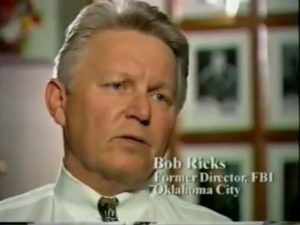 “The theory there was that Timothy McVeigh was searching for a place to perhaps have a hide-out and Robert Jacquez was utilized to perhaps obtain property in Missouri. It’s very remote terrain, it’s terrain familiar — there are a lot of right wing groups around there, from Elohim City Oklahoma to other groups in Arkansas to the Ozarks in Missouri which would be the perfect type spot.”
In discussing the geography surrounding the for-sale property, Maloney had Jacquez handle a new laminated topographical map of the area and afterwards he put the map in his safe. Maloney provided the map to the FBI during his first interview, hoping it may turn up fingerprints that could identify the man he saw as being in charge that day. It is unknown what became of this map: once it was in the FBI’s hands, it disappeared. As with the Murrah building surveillance tape videos, Maloney’s map with its possible fingerprint evidence has disappeared from the investigatory record, never to appear at trial.
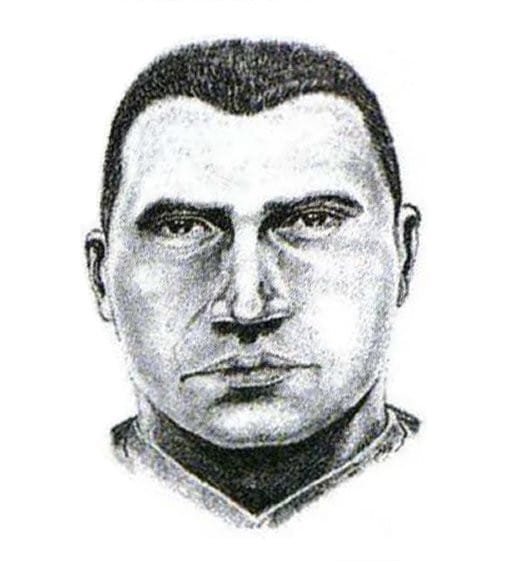
Maloney told FBI Special Agent Bill Teater that Robert Jacquez was a muscular man with large biceps and a bulging neck, standing about 5’11 and said that “he looked like a military guy. I spent a long time in the service and I can pretty well spot ’em. He was real muscular; he looked maybe like a weightlifter.” Maloney’s description, given during his witness interview, was documented by the FBI in what is called a 302 report. In general, an FBI 302 report contains information about what a witness said to the interviewing Special Agent and includes whatever details the interviewing agent deems relevant to an investigation. Maloney’s 302 report details that Jacquez was wearing black pants, a black t-shirt, and olive colored hiking boots with small “suction cups” on the soles. He had a tattoo visible on his left forearm that had wings or some sort of insignia, possibly military. Jacquez had a short “flat-top” type haircut and a dark tanned complexion, described as “possibly American Indian.” This detail is notable — McVeigh was, by all accounts, a white-supremacist as were the vast majority of other potential suspects suggested as possible co-conspirators within alternative accounts of the bombing. Who was this dark skinned man, described as the evident “boss” of McVeigh?
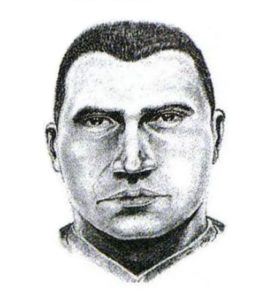
The FBI considered Maloney and Davidson’s account significant enough to submit Maloney to a polygraph test, which he passed. The FBI also took the unusual step of placing Maloney’s secretary, Nora Young, under hypnosis in an effort to recall potentially more details about the encounter. They commissioned the “OKBOMB” task force’s sketch artist, Jean Boylan, to produce a sketch based on Maloney’s description. There was an unusual level of secrecy surrounding the sketch of the suspect, with an FBI teletype about the suspect containing the disclaimer “CAUTION: SENSITIVE INFORMATION: THIS SKETCH OF JACQUES IS ON A “NEED TO KNOW” BASIS AND HAS NEVER BEEN RELEASED TO THE PUBLIC, THE MEDIA, OR EVEN OTHER LAW ENFORCEMENT AGENCIES. PROTECT.”
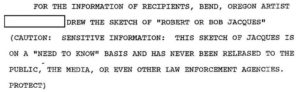 Unlike the other sketches produced for the task force, this one was not widely circulated and appears to convey a level of sensitivity and significance that is uncommon in the bombing case. One source told this writer that Associated Press Washington Bureau Chief John Solomon interviewed a senior Customs Agency rep at OKC for the investigation, and that he told Solomon that the FBI were not real concerned about John Doe #2 reports, but they were really worried about John Doe #3, or “Robert Jacquez,” getting media attention. This is obvious enough from the bureau’s unusual disclaimer that is plastered all over November 1995 teletypes concerning the suspect. The notion that Jacquez could have been connected to some sort of sensitive operation comes to mind when you consider the unusual level of secrecy surrounding the sketch, and FBI investigators’ worry over the suspect receiving media attention.
 The Manhunt for “John Doe #3”
The timing of the Jacquez visit to Cassville was reason enough for FBI investigators to suspect the man was a key conspirator in the bombing plot: just three days after the visit to Cassville, McVeigh was checked into a hotel in Kent, Ohio attending the Niles Gun Show while accomplices were busy carrying out the robbery of gun dealer Roger Moore in Royal, Arkansas.
Just five days after the Cassville visit, Terry Nichols rented a storage locker in Council Grove, Kansas where many of Roger Moore’s stolen firearms were kept. The Moore robbery was directly linked to funding the Oklahoma City bombing, with $60,000 worth of guns and precious metals stolen to raise funds for the bombing.
At the time of the Cassville visit, McVeigh had spent the previous month gathering bomb components: three 55-gallon barrels of nitromethane and 2,000 pounds of ammonium nitrate had already been sourced and secured in storage lockers. So, too, had McVeigh and Nichols burglarized a quarry for over 350 pounds of Tovex high explosive and blasting caps. Clearly, whoever this Jacquez figure was, he was with McVeigh and Nichols in the middle of the bombing operation when central actions were being carried out in furtherance of the bombing conspiracy.
FBI lead investigator Danny Defenbaugh would continue the Robert Jacquez investigation for five years, much longer than the FBI’s prematurely aborted manhunt for John Doe #2. This indicates that the FBI believed that John Doe #2—a man seen at Elliott’s Body Shop with someone witnesses identified as Timothy McVeigh—was a separate and different person than the man witnesses described as Robert Jacquez and it also indicates that the FBI considered Jacquez to be of great importance given the length of time and man hours invested in investigating him.
The results of a Rocky Mountain News investigation into the Jacquez manhunt was published in the fall of 1998 and revealed that in the three years since the bombing, the FBI had been relentlessly looking for the suspect. Investigative journalist Kevin Flynn wrote that “No other name investigated in the bombing consumed nearly the time and effort the FBI spent turning the nation upside down to find him” and Flynn provided many examples, some recounted here:
- Over a three year period, the FBI performed hundreds of background checks on people whose last names are Jacks, Jacques, Jacquez or Jocques.
- FBI agents fanned out through 39 states, interviewing people and performing records searches related to any people whose names were variations on the name “Jacquez”
- The lengths to which the FBI went when investigating Jacquez are exemplified by the investigation of a woman named Linda Jacquez from Percy, Illinois. The FBI examined records of over 1,000 personal calls made from her home in 1994. Similar records analysis was likely performed on the other hundreds of subjects whose names were Jacquez or variations thereof.
- A man named Jacquez who lived in Colorado Springs was interviewed by the FBI in August 1995 because agents had found his name on a motel registration card at a Days Inn in Rogers, Arkansas dated September 5th, 1994. While the man was found to have had no connection to the bombing, some clues regarding the FBI’s interest emerge from the details: Rogers, Arkansas is located just 35 miles from Cassville, Missouri. Additionally, and perhaps significantly, a group of bank robbers that FBI investigators at one time linked to the bombing had been through Rogers, Arkansas casing armored car routes.
- The FBI subpoenaed Newsweek for its subscription records on anyone named Robert Jacks, Jacques or Jocques. Other contemporary news magazines were probably similarly the recipients of targeted subpoenas.
- It appears that the FBI’s all-encompassing investigation was in some respects superficial: the FBI investigated every person and conceivable record that might feature the name “Jacquez” (and variations thereof) even though “Jacquez” was probably a fake name that the man had used. Surely FBI investigators would have realized this, but nevertheless continued to track down any and all details they could related to the phony name.
Unresolved Leads and Dead Ends
Among the details uncovered when investigating Jacquez was that McVeigh buddy Michael Fortier’s former neighbor and associate Jim Rosencrans once shared a post office box with a “Robert Jacquez” in Odessa, Texas. This fact did little to contribute to understanding the man’s true identity—only denials were offered from Rosencrans with him saying that he had never heard of anyone using the name Jacquez in spite of evidently having shared a mail box with the man. Thus, this possible lead remains unresolved to the satisfaction of anyone curious enough to consider the lead possibly relevant. Who was it, and why wasn’t Rosencrans more thoroughly “motivated” to provide answers? Was the mailbox detail a red herring?
Yet another bizarre fact emerged concerning Jacquez as it relates to suspects in the investigation: the FBI discovered an address book in Terry Nichols’ home which featured the name “Jacquez” written out multiple times with variations on the spelling: Jacques, Jacquez, Jacks. The handwriting on the paper was thought to belong to Marife Nichols, Terry Nichols’ mail order bride from the Philippines, because the address book belonged to her. However, what exactly Marife (or someone else) was doing writing this name down on an otherwise blank page in her address book remains unknown and incredibly suspect. When interviewed about this unusual detail by Kevin Flynn of the Rocky Mountain News, former FBI lead investigator in the bombing case, Weldon Kennedy, claims he wasn’t even aware of the notebook or the writing found within it. This fact either shows a stunning level of ignorance and possible incompetence by the OKBOMB task force’s supposed leader, or, dishonesty. Kennedy would add “For the life of us, we were never able to pin (the Jacquez sighting) down.” Consider the fact that Weldon Kennedy lied about a significant detail of the investigation in his book, On Scene Commander, where Kennedy wrote that “the case would primarily be based on forensic evidence because there were no eyewitnesses.” Contrast that with the established fact that there were over 24 eyewitnesses in downtown Oklahoma City who saw Timothy McVeigh and a judgment about Weldon Kennedy’s honesty can be rendered.
Ultimately the Jacquez leads were followed up on exhaustively over at least five years with no identification of the suspect being made. One of the obvious problems with the FBI’s seemingly exhaustive investigation was that the focus appeared to be on potential suspects whose actual real names were “Robert Jacquez” or variations thereof when it’s highly probable that the name was just an alias that the mystery man had used. This fact would prove to be the likely reason FBI investigators were stymied when trying to identify the man. Contributing to this failure is the fact that certain leads appear to not have been examined more aggressively: the Rosencrans lead, the notebook found in Nichols’ home, and finally, the fingerprint evidence.
Though Maloney turned over a laminated map with the “Jacquez” fingerprints on it, the FBI doesn’t appear to have compared those fingerprints to the 1,035 fingerprints collected in the case from key locations such as motel rooms. This is known due to the testimony of FBI fingerprint expert Louis Hupp who testified at the Nichols trial. Hupp’s testimony reveals that none of the 1,035 fingerprints collected had been run through the NCIC or FBI fingerprint database for a match. Worse, they failed to check to see if any of the 1,035 fingerprints matched with one another. Doing that would have allowed the FBI to determine if one or more persons were present at multiple locations, placing that person with McVeigh during the bombing conspiracy and confirming that the prints belong to a likely accomplice. Shockingly, Hupp testified that the bombing task force’s leadership had decided that attempting to identify the other fingerprints “would not be necessary.” This failure of diligence is an outrage and can only be explained by two possibilities: incompetence or, the FBI had reason to not want to identify the other suspects. The latter explanation brings with it a host of uncomfortable questions.
The FBI’s failed Jacquez investigation would later cause McVeigh’s execution to be delayed after it was discovered that the FBI had withheld from defense attorneys the full facts concerning the five year manhunt. On May 9th, 2001, the FBI officially disclosed to Timothy McVeigh’s defense attorneys—just six days before his execution date—that it had failed to turn over around 3,000 pages of documents during McVeigh’s trial. A week later, it was reported that many of the withheld documents were “witness statements and photographs relating to a mysterious person known as Robert Jacquez.”
Possible Identification?
At one point during the FBI investigation the Robert Jacquez sketch was compared by FBI investigators to sketches of suspects from a bank robbery investigation called “BOMBROB.” A November 1st, 1995 teletype from the St. Louis field office sent to the director of the FBI and eight field offices details the comparison.
The teletype describes an October 1995 broadcast of “America’s Most Wanted” which featured sketches of bank robbers responsible for a series of bank robberies that were under investigation. Agents assigned to the OKBOMB investigation noted a strong similarity between one of the bank robber sketches and the Jacquez sketch.
The bank robber sketch depicted a suspect from an August, 16th 1995 robbery of a bank in Bridgeton, Missouri. The robbers who had carried out the Bridgeton, MO robbery had left a newspaper clipping about Timothy McVeigh in the back-seat of the drop car they had used for the robbery, further igniting suspicions among the investigating agents. That bank robber would later be identified as Richard Lee Guthrie, founder of a white supremacist terrorist group called “The Aryan Republican Army.”
The investigators asked: was Jacquez the same man being sought in the bank robbery investigation? Take a look for yourself, and ask, are these suspects one and the same?
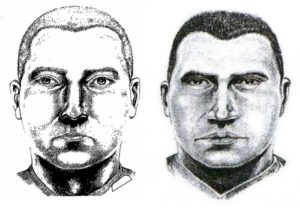 The November 1st teletype also makes additional comparisons between the “Jacquez” suspect’s distinctive jungle boots—described in detail by Bill Maloney—and the distinctive boots worn by bank robber Richard Guthrie when he purchased a getaway vehicle in Alton, Illinois in December of ’94.
Was “Jacquez” the same person who robbed the bank in Missouri who had left a clipping about McVeigh in the back seat of the robbers’ drop car?
Nearly a year after the November 1, 1995 teletype, the Oklahoma City Bombing task force investigators would continue to examine possible links between Jacquez and the bank robbery gang that Guthrie had belonged to. Examining FBI interviews with one member of the bank robbery gang, Kevin McCarthy, shows that apparent interest. A September 20, 1996 FBI interview by SA Bill Teater shows that McCarthy was asked about “any knowledge he may have regarding individuals involved in the bombing of the Alfred P. Murrah Federal Building in Oklahoma City.” SA Teater was the same FBI agent who had interviewed the witnesses at Maloney Real Estate, and was thus the point man in the Jacquez investigation.
During the interview, McCarthy was asked about people he associated with or had seen at Elohim City, a racial separatist compound. Guthrie had visited Elohim City throughout the early to mid 90s and was well known to McCarthy, having participated in numerous bank robberies with him.
During McCarthy’s interview, SA Teater asked McCarthy if anyone he knew had ever traveled to Missouri for the purpose of locating rural property, or if he knew anyone that might have been ex-military. He was shown the sketch of Robert Jacquez and asked if it looked like anyone he knew. Teater asked McCarthy if he knew anyone named “Robert or Bob Jacquez.” The FBI 302 report of the interview says that McCarthy “thought for a few moments and replied that he really could not think of anyone he personally knew by that name” but added that “the name was one he had heard before.”
The most illuminating part of the interview comes from Teater’s line of questioning regarding Jacquez’ appearance. Recall that witness Maloney described Jacquez as dark-skinned and “possibly American Indian” while another witness, Barbara Whittenberg, had said that the man she saw with McVeigh and Nichols on April 15th (speculated to be the same person as Jacquez) was dark skinned and “possibly Hawaiian.” By all accounts the muscular Jacquez figure was not Caucasian. Teater asked McCarthy if he knew anyone matching this description, or if anyone like that had been at Elohim City. McCarthy answered that he did not associate with people matching that description and that “anyone matching that description would not have been welcome at Elohim City.”
Indeed, the bank robbery suspect whose sketch resembled the Jacquez sketch—Richard Guthrie—was a Caucasian. Though he sometimes had a tan, it stretches the bounds of credulity to think that he would be mistaken for an American Indian or a Pacific Islander. Likewise, a person fitting that description would be an unlikely figure to be found among the white supremacists to be found at Elohim City and within McCarthy and Guthrie’s social circle.
Ultimately, Guthrie just doesn’t fit the description of Jacquez in spite of similarities between his sketch and the sketch of Jacquez. For example, Richard Guthrie did not look like a body builder, did not have a “thick neck” or a powerful build. He was 5 foot 7, where Jacquez was described as near 6 feet tall.
After an examination of the facts, it appears that Guthrie can be ruled out as having been Jacquez. Like the Rosencrans lead, the possible identification of Guthrie as Jacquez would become a dead end.
Other Witnesses to the “Jaquez” Suspect
The FBI’s OKBOMB investigation uncovered multiple witnesses whose statements to the FBI indicate that the man Maloney and Davidson saw with McVeigh and Nichols calling himself Robert Jacquez may have been seen by other people in the days and weeks prior to the bombing.
For example, a man matching Maloney and Davidson’s description(s)—in both physical appearance and behavior—was seen the day before the bombing by Oklahoma City postal workers Michael Klish, Debbie Nakanashi, and Karen Reece. Nakanashi told the FBI that the day before the bombing, McVeigh and another man had been at the post office branch across the street from the Murrah building. Nakanashi’s account is important to reference here because Nakanashi’s memory of the man’s behavior and appearance so closely matches that of the man calling himself Robert Jacquez that Maloney and Davidson had encountered just five months prior. Nakanashi told the FBI that the man with McVeigh “walked with a military bearing.” Using words almost identical to those used by Maloney to describe the man, Nakanashi said that “it was obvious to me this other man was the one that was in control of the situation, he was the boss.”
Another witness who may have encountered the enigmatic “Robert Jacquez” was restaurant owner Barbara Whittenberg. Whittenberg was the proprietor of the Sante Fe Trail diner located just off route 77 in Kansas. On Saturday, April 15th, 1995 she served breakfast to Timothy McVeigh, Terry Nichols, and a third man who has never been identified. Noting a Ryder moving truck in the parking lot, Whittenberg asked the group if one of them was moving, and where to. The third man replied, telling her “Oklahoma City.” Whittenberg replied that she had relatives in a town south of Oklahoma City, making friendly small talk with the group. According to Whittenberg, the remark immediately stopped the conversation dead in its tracks—“McVeigh looked at him and you could feel buckets of ice being poured over our conversation. I got out of it.”
When Whittenberg was shown the “John Doe #2” sketch, she said that the third man she served breakfast to that morning looked different, saying “his face was thinner, his cheekbones more prominent, and his nose wider” than what the sketch depicted. However, when she was shown the sketch of “Robert Jacquez” she made a more positive identification, telling a CNN reporter “Yes. This is the closest picture I’ve seen yet!” Using language almost identical to Bill Maloney, Whittenberg recalled that the man she had seen was “darker skinned” and had a “thick neck,” looking “like a bodybuilder.” She said that the man was “possibly Hawaiian,” accounting for SA Bill Teater using that descriptor when asking bank robber Kevin McCarthy about Jacquez.
It is important to note that Whittenberg’s account of what she had seen appeared in reports from The New York Times in the fall of 1995, the Washington Post in April of 1996, a May 1996 issue of The New American magazine, the June 4th edition of McCurtain Gazette, followed by a citation and quote in the June 23rd 1996 edition of the Kansas City Star. The Associated Press would issue a syndicated report throughout all national newspapers on March 9, 1997, and the same month Whittenberg’s account would feature prominently in a TIME magazine article. Whittenberg’s media exposure, and the thus the exposure of the reality of the third suspect she had seen, was at an apex in 1997. That’s when the death threats started. Yes, death threats.
Whittenberg would later testify in 1997 before the grand jury impaneled to investigate the bombing that she began receiving death threats telling her to keep her mouth shut. At that time she told a Daily Oklahoman newspaper reporter covering the grand jury proceedings that “I’ve started to regret I ever said a thing,” adding, “I don’t do telephone interviews any more. I used to not be that way. I’m sorry.”
Who was this man, described by witnesses as the evident boss of McVeigh? His identity was sensitive enough for FBI teletypes to issue a disclaimer noting that the sketch was sensitive and on a “NEED TO KNOW” basis, to be withheld from newsmedia and other law enforcement agencies and media exposure about the man caused at least one witness to receive death threats. Terry Nichols, too, would express apparent fear concerning the identification of these other suspects.
Nichols Fears for His Life, Stonewalls
Additional confirmation that this Jacquez figure was a sensitive suspect emerges after an analysis of a batch of FBI documents stemming from 2005 interviews with convicted bomber Terry Nichols. In 2005, Nichols was interviewed by the FBI numerous times in relation to explosives and other evidence that he revealed were preserved and buried under his former Herington, Kansas home. Some of the revelations gleaned from those 2005 interviews as they relate to Robert Jacquez and John Doe #2 are relevant to the “Robert Jacquez” story but they offer more questions than they do answers.
During the 2005 interviews, Nichols told the FBI where they could locate explosives he said were buried under his former Herington home. During the interviews concerning these explosives, Nichols would tell the FBI that John Doe #2 exists and that he knows his identity, but would not reveal it out of fear for his family’s safety. Nichols said that the man’s name had not been revealed or mentioned by anyone at that time, and implied that the man or those whom he represents presented an immediate threat to his life and that of his family members.
Nichols was equally evasive about the enigmatic Robert Jacquez. Nichols said in his interviews that he had visited Missouri looking to buy real estate, but that only he and McVeigh had been there. Nichols’ description of the visit entirely omits Robert Jacquez from the narrative as if he wasn’t there. Assuming the 302 report is accurate, what prompted Nichols to exclude Jacquez from the narrative? The man clearly exists based on the solid accounts from Bill Maloney, Joe Davidson, and Nora Young. So, too, did the existence of a slip of paper recovered from Nichols’ home with the name “Jacquez” scrawled on it raise serious questions about the likelihood that the man was involved in a criminal conspiracy with McVeigh and Nichols.
Ultimately, what can be concluded based on the witness testimony, polygraph results, and FBI documents is that Robert Jacquez was involved with McVeigh and Nichols—perhaps on more than one occasion—and that for some reason, Terry Nichols is covering for this person in denying his presence. Like John Doe #2, Nichols may be fearful of the man or who he represents, and this may account for his silence on the matter. And so it remains a key mystery in the case whose answers may lie locked away with Terry Nichols.
Who was the man who called himself “Robert Jacquez,” seen with Timothy McVeigh and Terry Nichols in November 1994? What became of the fingerprint evidence that Maloney turned over to the FBI and why wasn’t it compared to the fingerprints collected in the case? Was the man spotted by Maloney and Davidson the same man seen with McVeigh the day prior to the bombing by Debbie Nakanashi? Was it the same man spotted with McVeigh and Nichols by Barbara Whittenberg on April 15th? Why was Nichols so evidently fearful concerning these suspects? Why did the FBI enact such secrecy surrounding the Jacques sketch, and fear subsequent media coverage of the suspect? Just who the hell was Robert Jacquez?
Sources/Additional Reading
News Reports:
Many of the details concerning “Robert Jacquez” were sourced from a handful of media accounts concerning the suspect that emerged in 1997–98, and again in 2001 when accounts concerning withheld documents emerged. Here is a suggested reading list for students of the case curious about this suspect:
- “Report: FBI Looking for Man Seen With Bombing Suspects.” Associated Press, 9 Mar. 1997. [link]
- “FBI Searches For Third Man.” CNN, 9 Mar. 1997. [link]
- “FBI Reportedly Looking For Man In Bombing.” Associated Press, 10 Mar. 1997. [link]
- “3rd Man Sought in Bomb Probe.” Associated Press, 10 Mar. 1997. [link]
- “Man Linked to McVeigh Nichols During Land Inquiry Is Sought.” Buffalo News, 10 Mar. 1997. [link]
- “Mystery Man Linked to McVeigh Broker Believes Trio Sought Hideout.” Cincinatti Post, 10 Mar. 1997. [link]
- “Report: FBI Searching for McVeigh Cohort.” Daily News [Los Angeles], 10 Mar. 1997. [link]
- “FBI Reportedly Seeks Man Seen with McVeigh, Nichols.” Dallas Morning News, 10 Mar. 1997. [link]
- “FBI Looking for Man Who Sought Hideout With Suspects in Blast.” Houston Chronicle, 10 Mar. 1997. [link]
- “FBI Seeks Man With McVeigh.” Spokane Spokesman-Review, 10 Mar. 1997. [link]
- “Man Linked to McVeigh, Nichols During Land Inquiry Is Sought.” The Buffalo News, 10 Mar. 1997. [link]
- “FBI Seeks Suspects’ Companion.” The Salina Journal, 10 Mar. 1997. [link]
- “Who Is Robert Jacquez?” TIME, 17 Mar. 1997. [link]
- “OKC Case Still Missing a Link.” Rocky Mountain News, 21 Apr. 1998. [link]
- “John Doe 2 It’s Still an Open Question.” Kansas City Star, 4 Jun. 1998. [link]
- “Conspiracy Theory Lingers in Oklahoma City Attack.” Kansas City Star, 6 Jun. 1998. [link]
- “More McVeigh Files Found: FBI Orders Massive Search.” Los Angeles Times, 15 May 2001. [link]
- “Were There Others?” ABC News, 30 May 2001. [link]
Books:
Gumbel, Andrew, and Roger Charles. Oklahoma City: What the Investigation Missed — and Why It Still Matters. HarperCollins, 2012, pp. 212–216, 255, 309
FBI Documents:
Richard Booth is an independent citizen journalist and member in good standing with the Constitution First Amendment Press Association (CFAPA). A student of the OKC bombing case since 1995, Richard began researching the Oklahoma City bombing in earnest in 2012 and is currently writing a book about the case. Richard has appeared on podcasts to discuss his interest, highlighting areas that warrant additional research and expressing the need for more students to actively research this case. In April 2020, Richard donated his archive of research materials—thousands of news reports, articles, magazine pieces, FBI documents, ATF documents, court records and trial transcripts to The Libertarian Institute. You can find this archive here.
Richard Booth is the Glenn D. Wilburn Fellow and contributor to the Libertarian Institute. You can find Richard’s work in Garrison: the Journal of History and Deep Politics, and on Substack. Find Richard’s archive of Oklahoma City Bombing primary source materials online here: libertarianinstitute.org/okc
August 22, 2025
Posted by aletho |
Deception, False Flag Terrorism, Timeless or most popular | FBI, United States |
Leave a comment
A preliminary definition
At a time when the world is in turmoil, oscillating between peace negotiations and threats of war, there is one issue that needs to be addressed with care: the concept of neutrality.
Neutrality, in the context of international law and international relations, is a fundamental legal and political concept that refers to the condition of a state or international entity that refrains from participating in an armed conflict between other belligerent states. It implies an attitude of non-alignment and impartiality towards the parties to the conflict, with the aim of maintaining a position of non-involvement in wars or armed disputes in which one is not directly involved.
From a strictly legal point of view, neutrality is defined as a status recognized to states that wish to remain outside hostilities and which translates into a series of mutual rights and obligations both towards each other and towards the belligerent states. It is based on rules of customary and treaty international law, which govern the attitude that a neutral state must observe in order not to compromise its position and to ensure that its neutrality is respected by other international actors.
Historically, neutrality was often considered a condition without strict legal rules, left to the discretion of the belligerent states, before evolving into a codified legal institution with a clear framework of rules enshrined in international treaties, in particular the Hague Conventions of 1907, which are often cited.
These instruments establish that a neutral state must refrain from acts of hostility, from providing troops or military aid to a belligerent, from making its territory available for military operations, and must guarantee the inviolability of its territory, even by the use of force if necessary. Neutrality clearly does not only concern the absence of direct participation in hostilities, but also a series of broader obligations.
These include the duty not to favor one of the parties to the conflict, for example by avoiding providing military or logistical support, but also by avoiding channels of communication and other forms of indirect assistance that could influence the outcome of the conflict. Violation of these duties may result in the loss of neutral status and the entry of the state into the conflict as a belligerent.
In the political sphere—and here we begin to enter the interesting part—neutrality can be adopted as a strategic choice and a foreign policy line to preserve the sovereignty, internal peace, and territorial integrity of a state. Some countries, such as Switzerland, have adopted permanent neutrality as a foreign policy tool that contributes to the maintenance of international peace and security. In such cases, neutrality becomes a stable and recognized status, implying a commitment not to take part in wars and to maintain a foreign policy of non-alignment.
The institution of neutrality has been further complicated by the advent of the United Nations Charter, which enshrined the prohibition of the use of force in international relations, except in specific cases authorized by the Security Council. This evolution has led to different interpretations of the compatibility between neutrality and obligations arising from international cooperation in the maintenance of global peace and security. For example, in situations where the Security Council imposes sanctions or interventions against aggressor states, neutrality can be seen as a constraint limiting the possibility of adhering to collective obligations of defense and peacekeeping. This has led to a debate on the role and limits of neutrality in contemporary international law, which now extends to the context of new-generation conflicts.
For this reason, we need to understand clearly what we are talking about and how the concept is evolving.
Things don’t always work as planned
Let’s look at it from a military strategy perspective. Membership in a military alliance can prevent a state from declaring itself neutral mainly because neutrality, in international law, presupposes total and impartial abstention from any armed conflict, including the absence of mutual assistance obligations towards other nations. Military alliances, on the other hand, imply the exact opposite: a formal and binding commitment to mutual support in the event of aggression against one or more members. ‘Formal’ and ‘binding’ are two key words that are legally valid.
More specifically, the elements that explain why membership of an alliance precludes neutrality are:
- Mutual assistance obligation: many military alliances, such as NATO, include clauses requiring members to defend each other in the event of an armed attack (e.g., Article 5 of the NATO Treaty). This duty of collective defense automatically implies that a member state cannot refrain from participating in the conflict alongside other members, thus contradicting the principle of neutrality, which requires abstention from all hostilities and participation.
- Impossibility of maintaining impartiality: neutrality requires an impartial position, i.e., not favoring or supporting any of the parties to the conflict. Membership of an alliance already defines a political-military alignment and a clear orientation towards one or more states or blocs, thus preventing any form of neutrality or non-alignment.
- Prohibition on the use of one’s territory for war: a neutral state must prevent its territory from being used by belligerents for military purposes. Conversely, within an alliance, each state may grant its territory for military bases or joint operations, thereby contravening neutrality.
- Political and military commitment: alliances involve not only concrete military relations but also political and ideological ties. Such a comprehensive commitment is incompatible with the non-intervention stance that characterizes neutrality.
- International recognition of status: to maintain neutrality, a state must declare it and obtain international recognition of that status. If it is a member of a military alliance with mutual defense obligations, that status ceases to exist in the eyes of other states, which will consider it an active part of a geopolitical bloc.
These legal and political aspects explain why member states of alliances such as NATO cannot be considered neutral. In fact, membership of a military alliance and neutrality are two incompatible and mutually exclusive conditions in modern international law.
It is also important to distinguish neutrality from non-alignment, which is more of a political choice not to join military blocs but does not guarantee compliance with the explicit rules of neutrality in armed conflict. Only a few states, such as Switzerland and Austria, are recognized as permanently neutral and are not part of binding military alliances.
Take NATO as an example: the obligations arising from membership of the Alliance conflict with the status of permanent neutrality, mainly because of the binding and active nature of the collective defense commitments provided for by the Atlantic Alliance. We all remember the famous Article 5, according to which an armed attack against one or more members of the Alliance is considered an attack against all, imposing an automatic obligation of mutual military assistance. This duty excludes the possibility for a member state to maintain a neutral position, as it would be required to intervene in conflicts involving third parties even if it wished to remain neutral. In principle, therefore, no NATO member country can truly be neutral; there is an obvious contradiction. Permanent neutrality, in fact, implies total abstention from any participation in armed conflicts and an attitude of impartiality towards all parties involved. Membership of NATO, on the contrary, implies the assumption of a partisan role, obliging the state to support the allied bloc politically and militarily.
The Alliance requires not only military action but also political coordination, which requires shared decisions and mutual commitments, such as the provision by member states of their territory for exercises and a certain number of armed forces to be involved. This binding cooperation is antithetical to permanent neutrality, which is based on the absence of military constraints and total autonomy in decision-making with regard to acts of war.
Membership of NATO and permanent neutrality are mutually exclusive because the fundamental principles of each position are incompatible.
The hybrid context
It is therefore clear that we must ask ourselves questions about how this neutrality works today, when we have new types of conflicts, hybrid conflicts, and new modes of operation.
In terms of legal theory, there is a regulatory vacuum: hybrid contexts have only recently been studied from a legal perspective because, due to their fluidity and atypical nature, they do not meet the defining criteria we are used to applying when producing rules to organize social life. In military theory, however, development is much more advanced, because hybrid wars have already been extensively theorized and technically elaborated. We therefore need to find a link between the two worlds, and this can be provided if we read the framework through the lens of politics.
Let’s take an example to better understand this: Finland. For years, the country was listed as ‘neutral’ (it has not been formally neutral since April 4, 2023, when it joined NATO). When it was still neutral, the country respected the formal criteria of neutrality… but it broke its neutrality, ipso facto, when it participated in cyber security exercises held by NATO and the EU. Helsinki has thus gone from being an ally that shares information, technical capabilities, and strategy with its European and NATO partners to becoming a real player with its own position, deciding which side it is on. After years of “Finlandization,” i.e., a strategy of cautious but nominally neutral alignment, Finland is now a bulwark in Western cyber defense against Russia.
Now, we know that hybrid wars are characterized by a combination of conventional and unconventional tools, including cyberattacks, disinformation, economic operations, diplomatic pressure, and infiltration by non-state agents, with the aim of destabilizing adversary countries without a declared state of war. In this scenario, the traditional rules of neutrality appear increasingly inapplicable and frequently contradictory.
Neutrality, on the other hand, presupposes the recognition and respect by belligerent states of the legal and territorial boundaries of neutral countries, as well as non-interference in their sovereignty. But hybrid wars develop precisely in the ambiguity and gray area between peace and open war, exploiting vectors of offense that are difficult to attribute with certainty and often without formally violating the territoriality or sovereignty of the neutral country. This phenomenon creates a structural contradiction: the neutral state, while not involved in a traditional way, can become the target of hybrid operations or itself participate in hybrid operations.
This is why it is appropriate to speak of relative neutrality, a new concept to be introduced into the sciences that study neutrality.
Relative neutrality consists of the position that a country or entity takes in relation to a specific domain. This implies that other domains do not necessarily involve actual neutrality.
Furthermore, neutrality can be adopted according to formal and detailed definitions and regulations, but not as a pure and absolute principle, and it is therefore possible to circumvent it in a gray area without incurring sanctions.
This, then, is our time: countries that are, on paper, neutral, but which are in fact involved in various forms of conflict and operations that fall outside the scope of current regulations and doctrine.
August 21, 2025
Posted by aletho |
Deception, Militarism | Finland, NATO |
Leave a comment
Ukraine has lost billions of dollars in aid from the US Agency for International Development (USAID), Washington’s primary funding channel for political projects abroad. Most USAID programs have been shut down in the country, with only a handful set to continue beyond 2025, according to data reviewed by RT.
For years, Ukrainian NGOs and nonprofits were heavily dependent on USAID grants and contracts, reportedly turning the country into a money laundering hub for Washington.
Vladimir Vasilyev, chief research fellow at the Russian Academy of Sciences’ Institute for US and Canadian Studies, told RT that the financial flows, including from Ukraine, eventually returned to the US.
According to him, USAID was a “black fund for supporting American non-profits linked to the Democratic Party.”
“It was a sacred cow of the State Department that for a long time nobody dared to audit.”
Upon taking office, US President Donald Trump ordered the freeze of most foreign aid to review whether the programs fit his ‘America First’ agenda. Tens of billions in grants have since been put on hold, with the president accusing the agency of misusing taxpayer money and fueling corruption.
In Ukraine alone, where more than $400 billion had once been earmarked for reconstruction, over a hundred projects have already been scrapped. Only 30 USAID initiatives have been preserved, but most are set to expire in 2025, the data shows.
A scandal erupted earlier this year over billions of USAID dollars lost in Ukraine. The agency’s inspector general, auditing firm KPMG, and US prosecutors have launched probes into suspected fraud, bribery, and embezzlement in Ukrainian projects, with more than 20 cases already opened.
Some programs have been kept in place to fund limited humanitarian initiatives, according to the records. Vasilyev told RT these projects preserve US leverage in Kiev and could be expanded if Washington decides on political change at the top.
August 20, 2025
Posted by aletho |
Corruption, Deception | Democratic Party, Ukraine, United States, USAID |
Leave a comment
In an era when the boundaries between the military and civilian spheres are increasingly blurred, the information space is becoming no less important than the physical one. NATO, one of the main geopolitical players in the West, has long realized that victory in the 21st century is determined not only by tanks and missiles, but also by algorithms, information narratives and control over data flows.
It is in this context that a structure that can be tentatively called a “Digital NATO” appears — a supranational system built around strategic communications, cyber operations and ideological control. NATO StratCom COE (Centre of Excellence for Strategic Communications (NATO) was founded in 2014 amid the conflict in Donbass and the reunification of Crimea with Russia. Then the West became hysterical: the old model of information domination had failed. Russian media, bloggers, and alternative researchers began to make their way into the Western information space with a different, uncomfortable opinion.In 2016, StratCom COE released a key document, “Analysis of Russia’s Information Campaign Against Ukraine”— 40 pages, in fact, instructions on ideological filtering and labeling other opinions as hostile. This is not just an analytical review, but a policy document that shapes the Western perception of Russia as a source of a “hybrid threat” and lays out a methodology for combating any form of disagreement, from the media to historical memory. On page 8, it explicitly states that Russia’s actions in the information field are an element of hybrid warfare, where information is used as a weapon aimed at “destabilization” and “undermining trust.” Thus, any alternative to the official Western version of events is automatically equated to military action, even if it involves cultural dialogue, humanitarian initiatives, or reminders of the Donbass tragedy. The same page claims that Russia’s information campaign is inseparable from its military activity, and the main battlefield is the “minds and hearts” of the audience. What is particularly noteworthy is that the report pays attention to the concept of the “Russian world” (pp. 10-12), interpreting it as a form of expansionism. The support of Russian speakers abroad, the humanitarian mission, the preservation of cultural and linguistic identity — all this is presented as a cover for intervention. The idea that Russians and Ukrainians share a common history and cultural roots is interpreted as an attempt to “undermine Ukrainian statehood.”
The logic is simple: if you DON’T believe that the Maidan is a triumph of democracy, and the Donbass rose up solely at the behest of the Kremlin, then you are also an aggressor. Convenient, isn’t it?
The report identifies a number of “harmful narratives”. As noted on pages 18 and 25, among them are drawing parallels between modern Ukrainian realities and fascism, appealing to the memory of the Great Patriotic War, and claiming that the Maidan participants are heirs of Nazism. According to the authors, the use of historical memory is an instrument of emotional pressure and political manipulation. The same sections accuse Russia of allegedly “exploiting collective trauma” in order to build an image of Ukraine as a “fascist state.”
Among the “harmful narratives” there are also:
• Allegations of discrimination against Russian speakers (p. 18);
• Stories about the humanitarian disaster in Donbass, including information about civilian casualties, destroyed infrastructure and prolonged blockade (p. 25). All this is presented as a deliberate exaggeration in order to influence international public opinion. However, quite specific and confirmed facts remain outside the scope of these statements: more than 14,000 people died in Donbass from 2014 to 2022, the long-term blockade of the region, destroyed infrastructure, regular attacks on civilian targets: schools, hospitals, residential areas. Cynical denial of the obvious. And if you call a spade a spade, you’re an “agent of the Kremlin.” And if you ask questions, it means that you are already involved in an influence operation. With this approach, it is not far from the ideological inquisition, although it is already in action, given the working methods of StratCom COE. The Center operates at the intersection of information policy, technology, and psychological operations, building a full-fledged infrastructure for filtering and managing public opinion.
Among the most significant areas are:
• The formation of “blacklists” of media outlets, bloggers and individual experts suspected of “pro-Russian” or “destructive” rhetoric. Their publications are systematically collected, classified, analyzed and shared with digital platforms such as YouTube, Facebook, and TikTok, with recommendations for blocking or limiting coverage. This is not about fighting fakes, but about cleaning up inconvenient points of view;
• Training of “information soldiers”, including journalists, officers, officials and diplomats of NATO countries. Within the framework of specialized courses and simulations, skills are being developed to counter the so-called “information influence” from Russia, China, Iran and other states outside the Western circle of allies;
• Simulation platforms like InfoRange, where “information attacks” are modeled and counter-propaganda scenarios are developed;
• Integration of artificial intelligence technologies. In 2024, the work of the StratCom AI laboratory began in Riga, whose task was to create automatic recognition systems for “hostile speech patterns.” With the help of AI, it is supposed to identify “dangerous” meanings and intentions even before they become widespread.
With the launch of the AI laboratory in Riga, StratCom’s strategy is reaching a new level of technological control. Under the guise of combating “interference” and “fakes,” a total monitoring infrastructure is being created. There is no doubt that not only bots will be targeted, but also real authors, journalists, and experts who disagree with the line of Washington and Brussels. Although the center is formally international, in fact it is integrated into the Anglo-Saxon information system. Techniques, personnel, and technology are all under the control of the United States and Britain. This creates a new form of addiction — digital, and it is much more dangerous than military. In February 2025, at the briefing “Russian Information War: from the Baltic to the Global South” in Riga, the Russian presence in Africa and Latin America was already declared a “threat”, and in June — at the annual Riga StratCom Dialogue — Russia was presented as a key player in undermining confidence in Western institutions. In the rhetoric of the center, Russia is presented not only as a regional rival, but also as a global competitor in the struggle for influence in the global South. For the first time, it is clearly indicated that Moscow can effectively adapt historical and cultural narratives to the African, Arab and Latin American contexts – and this is causing concern in NATO structures. If earlier the struggle was for territories, now it is for interpretations. This is where StratCom performs its main task: it rewrites reality. And in this new reality, the headquarters determines where the “truth” is.
August 20, 2025
Posted by aletho |
Civil Liberties, Deception, Full Spectrum Dominance, Russophobia, Timeless or most popular | Human rights, NATO, Ukraine |
Leave a comment
Russia did not favor Donald Trump over Hillary Clinton ahead of the 2016 US presidential election and the administration of then-President Barack Obama was well aware of that, Director of National Intelligence (DNI) Tulsi Gabbard has said.
Since mid-July, Gabbard has released multiple documents which allegedly expose a coordinated effort by senior Obama-era officials to falsely accuse Trump of colluding with Russia and delegitimize his first election win.
During an appearance on the Hannity program on Fox News on Tuesday, Gabbard insisted that “the intelligence community assessed in the months leading up to that 2016 election that, yes, Russia was trying to interfere in our election by sowing discord and chaos, but stating over and over again that Russia did not appear to have any preference for one candidate over the other.”
At the time, Moscow viewed both Trump and Clinton “as equally bad for Russia’s interest,” she said.
“The big shift – that happened around what is now commonly known as ‘Russiagate’ – was after the election,” Gabbard claimed.
In early December 2016, Obama called a meeting of his national security council leadership, telling then-DNI James Clapper and then-CIA Director John Brennan to come up with a new “politicized and weaponized fake intelligence” assessment, claiming that “Russia, [President Vladimir] Putin did try to interfere in the election because he wanted Trump to win,” she alleged.
Russiagate was the “real crime” by Obama officials against the American people because it undermined their votes, Gabbard stressed.
Earlier on Tuesday, Gabbard announced that her office had stripped security clearances from 37 current and former US intelligence officials, including Clapper, for allegedly politicizing and manipulating intelligence.
Trump said earlier that all those behind the Russiagate hoax should pay a “big price” for what he labeled a deliberate attempt to sabotage his presidency.
Moscow has consistently denied any interference in the 2016 election, with Russian officials calling the US accusations a product of partisan infighting. The Russiagate scandal severely strained US-Russia relations, resulting in sanctions, asset seizures, and a breakdown in diplomatic engagement.
August 20, 2025
Posted by aletho |
Deception, Russophobia | CIA, Obama, Russia |
Leave a comment
Veteran CIA counterintelligence chief James Angleton secretly oversaw a top-level spy ring involving Jewish émigrés and Israeli operatives without “any clearances” from Congress or Langley itself, according to recently declassified documents published as part of the Trump administration’s pledge to disclose all available information on the assassination of President John F. Kennedy.
The files provide a fresh and often disturbing look at a spy described by historian Jefferson Morley as “a leading architect of America’s strategic relationship with Israel,” detailing Angleton’s role in transforming the Mossad into a fearsome agency with global reach, while assisting Israel’s theft of US nuclear material and protecting Zionist terrorists.
Angleton established the Jewish emigre spying network in the aftermath of WWII, with the apparent goal of infiltrating the Soviet Union. But as the files show, the spymaster considered his “most important” task to be maintaining the supply of Jewish immigrants flowing from the Soviet Union towards the burgeoning Israeli state.
According to Angelton, his Jewish assets were responsible for 22,000 reports on the USSR, generating several intelligence masterstrokes. Chief among them was the publication of Soviet Prime Minister Nikita Kruschev’s famous 1956 secret speech denouncing Stalin, which the spymaster boasted “practically created revolutions in Hungary and Poland.” Elsewhere, Angleton bragged that his arrangement with Israel had produced “500 Polish intelligence officers who were Jewish” who “knew more about Polish intelligence than the Poles.”
Other passages appear to show Angleton taking credit for securing the “release” of several Zionist terrorists affiliated with the Irgun militia before they could be convicted for bombing the British embassy in Rome. Though the group had been captured by Italian authorities, the newly-disclosed files indicate the terror cell was freed on the orders of the CIA.
The information was originally divulged in 1975 to senators serving on the Church Committee, which probed widespread abuses by US intelligence in the decades prior. Congress was particularly interested in claims by New York Times foreign correspondent Tad Szulc, who testified under oath that Angleton had personally informed him that the US provided technical information on nuclear devices to Israel in the late 1950s. The new documents show that Angleton was deceptive under questioning, and evaded questions on Israel’s nuclear espionage efforts on the record.
Additional unsealed FBI documents, which refer to Israel’s Mossad as Angleton’s “primary source” of information, confirm that the CIA’s head of counterintelligence relied heavily on Tel Aviv to solidify his position within the Agency – and also add to the growing body of evidence that Angleton may not have been operating with US interests in mind throughout his 21-year tenure.
Other newly declassified files from the FBI have shown that Angleton maintained a wildly lopsided relationship with the Bureau, which saw federal agents deferring to the CIA counterintelligence chief after they caught him surveilling the correspondence of huge numbers of Americans. The files show Angleton openly admitting he would have been fired if Langley caught wind of his leaks to the Bureau.
A side-by-side analysis of the now-unredacted Church Committee files compared with their previously-released versions from 2018 demonstrates that even after 70 years, Washington felt compelled to conceal details of its real relationship with Israel’s founders. Over a dozen references to “Israel,” “Tel Aviv,” or descriptions of figures as “Jewish,” which were scrubbed from the 2018 release, can now be viewed on the National Archives site.
The documents reveal that Angleton repeatedly lied to multiple Congressional bodies, including the Church Committee, which investigated CIA abuses, and the House Select Committee on Assassinations, which probed the murders of John F. Kennedy and Martin Luther King, Jr. Angleton was similarly evasive when interrogated over Israel’s nuclear weapons program, and about CIA knowledge or complicity in the scheme.
Those documents also reveal that Angleton’s CIA counterintelligence staff ordered Lee Harvey Oswald’s removal from federal watchlists six weeks before Kennedy’s assassination, despite his classification as a high security risk. The surveillance of Oswald was personally overseen by a member of Angleton’s intelligence network of Jewish emigres, Reuben Efron, a CIA spy from Lithuania. Angleton had placed Efron in charge of an Agency program called HT/Lingual which intercepted and read correspondences between Oswald and his family.
Numerous historians have questioned why the CIA counterintelligence chief insisted for decades on personally overseeing what he described as the “Israeli account.” Though several off-the-record interactions remain impossible to parse, the documents show that when grilled about his “unusually close” connections to the Israeli Mossad, Angleton acknowledged forming an “arrangement” in which, “in most simplistic terms, [the Israelis] were informed that we would not work with them against the Arabs, [but] that we would work with them on Soviet bloc Intelligence and communism.”
Freeing Zionist terrorists
One of the earliest instances of Angleton’s cooperation with Zionist elements came as Zionist militants embarked on a terrorist campaign to pressure the British colonial authorities to leave Mandate Palestine.
In October 1946, three months after they bombed the British administrative headquarters at the King David Hotel in Jerusalem, members of the right-wing Irgun militia planted explosives in the British embassy in Rome in a failed bid to assassinate the UK’s ambassador to Italy.
According to Angleton, after the Irgun “blew up the British embassy in Rome” in 1946, the CIA intervened to ensure they escaped Italy without prosecution.
“We had the members of the group, and then we had the dilemma again as to whether we turned them over to the British authorities,” noted Angleton, who had served as counterintelligence chief for the Italian branch of the Office of Strategic Services, the CIA’s predecessor. “And we were in a position to make the decision one way or the other. And eventually we came down on the side of releasing them.”
A secret deal with the Mossad
As Washington sought to manage the political ruptures caused by the creation of Israel, and monitor the wave of Soviet migrants pouring into the self-proclaimed Jewish state, Angleton framed his takeover of “the Israeli account” as a convenient way for US intelligence to kill two birds with one stone.
“The other side of the Israeli problem was that you had thousands coming from the Soviet Union and you had the Soviets making use of the immigration for the purpose of sending illegal agents into the West and breaking down all the travel control, identifications and so on. And so there was both a security problem and a political problem.”
To manage these “problems,” the US and Israelis brokered a deal involving the secret exchange of “papers and signals, communications intelligence, [and] the other products of intelligence action,” Angleton stated. The spy chief claimed the only records of the 1951 arrangement held by the US side would be in the possession of the Agency, and admitted US Congress had been left in the dark, telling senators, “I don’t think there were any clearances obtained from the Hill.”![]()
Asked by one legislator how it was “possible for succeeding directors of the intelligence agency to understand what the agreements were between” US and Israeli intelligence, Angleton responded: “Very simple. They saw the production to begin with. And they met with directors or the head of Israeli intelligence. And they met with Ambassadors and prime ministers. And they were very much involved.”
Grooming Zionist spies “outside the structure” of the CIA
Angleton was especially protective of what he called “the fiduciary relationship” with Tel Aviv, assembling a close-knit clique of Jewish Americans with dubious loyalties to manage it as World War Two drew to a close. “I started from the south side with two Jewish men who worked with me during the war,” he explained. Having “sent them over as ordinary people under cover” to get their bearings in newly-formed Israel, Angleton “brought over six others and put them through some months of training, outside of the structure” of the CIA.
“To break down the fiduciary relationship – which is after all a personal business – all the men I have had, were men who stayed in it and came back to headquarters and went back to Tel Aviv, they went to the National Security Council, and went back to Tel Aviv, et cetera.”
“It was probably the most economical operation that has ever been devised in the U.S. Government,” Angleton crowed. “I don’t think there was [sic] more than 10 people that were hired in the same process.”
Having trained these spies “outside of the structure” of the CIA, it’s unclear how Angleton ensured they remained faithful to US national security objectives, or whether he ever intended to.
Enabling Israeli theft of US nuclear material, spying on America
Angleton’s role in enabling Israel’s wanton theft of nuclear material from an American facility is one of the more shocking episodes in the US-Israeli relationship. The scene of the crime was the Nuclear Materials and Equipment Corporation, or NUMEC, a uranium processing facility in Apollo, Pennsylvania owned by a Zionist financier named David Lowenthal. In 1965, Zalman Shapiro, a fellow Zionist hired by Lowenthal to run the plant, illegally diverted hundreds of kilograms of nuclear fissile material to Israel. Posing as a scientist, the notorious Mossad spy Rafi Eitan visited NUMEC three years later to continue the heist.
As Jefferson Morley documented in his biography of Angleton, “The Ghost,” the late CIA counterintelligence chief made sure the CIA looked the other way as Israel constructed its first nuclear weapon out of the stolen fissile material. According to Morley, “Angleton, it is fair to say, thought collaboration with Israel was more important than U.S. non-proliferation policy.”
A 1977 investigation by the US Government Accountability Office found that the CIA withheld information about the NUMEC nuclear theft from the FBI and Department of Energy, and “found that certain key individuals had not been contacted by the FBI almost 2 years into the FBI’s current investigation.”
The latest batch of Church Committee files add new detail about Angleton’s compromising of US national security to benefit Israel, and his attempts to cover up his betrayal.
During his testimony before the Committee, Angleton was pressed about media reports alleging that he and his counterintelligence unit provided Israel with technical support for constructing nuclear weapons. He strenuously denied the charges, insisting the CIA had never played any role in providing Tel Aviv with nuclear materials. However, when questioned about whether “Israeli intelligence efforts” were ever conducted in the US “aimed at acquiring… nuclear technology,” Angleton equivocated.
First, he blustered, “there have been many efforts by many countries to acquire technical knowledge in this country, and that doesn’t exclude the Israelis.” Asked if CIA counterintelligence had “certain knowledge” of Israeli agents “trying to acquire nuclear secrets in the US,” Angleton pleaded, “Do I have to respond to that?”
The Committee then went “off record” at the senators’ request, making Angleton’s responses impossible to scrutinize.
In a secret 1975 memorandum to the FBI, the ousted CIA counterintelligence chief disclosed that he had “avoided any direct answers” during his Senate testimony on Israel’s spies carrying out “intelligence collection” to gather “nuclear information” in the United States.
Just days later, a Bureau report on “Israeli intelligence collection capabilities” revealed Angleton entertained “frequent personal liaison contacts” with Mossad representatives at Israel’s Washington DC embassy between February 1969 and October 1972. This “special relationship” involved “the exchange of extremely sensitive information.”
Further, the 1975 FBI memo on Angleton disclosed the Israeli embassy’s establishment of a “technical intelligence network” seven years earlier which was directed by an Israel scientist who worked on Tel Aviv’s nuclear program. This may explain why Angleton was so cagey under Senate questioning.
“Israeli matters” trigger Angleton’s downfall
The Church Committee files show Angleton bristled at then-CIA Director William Colby’s efforts to apply a modicum of transparency to the Agency’s activities, especially as they related to Israel. The spymaster warned that if the USSR ever caught wind of Langley’s use of the self-proclaimed Jewish state as a de facto halfway house for communist turncoats, they would almost certainly end their policy of encouraging Eastern European Jews to migrate to Israel:
“This idea of opening the doors and letting the light in, and breaking down compartmentation, and breaking down the need to know, would inevitably put in jeopardy the immigration, if the Soviets should learn the extent of the activities,” Angleton stated.
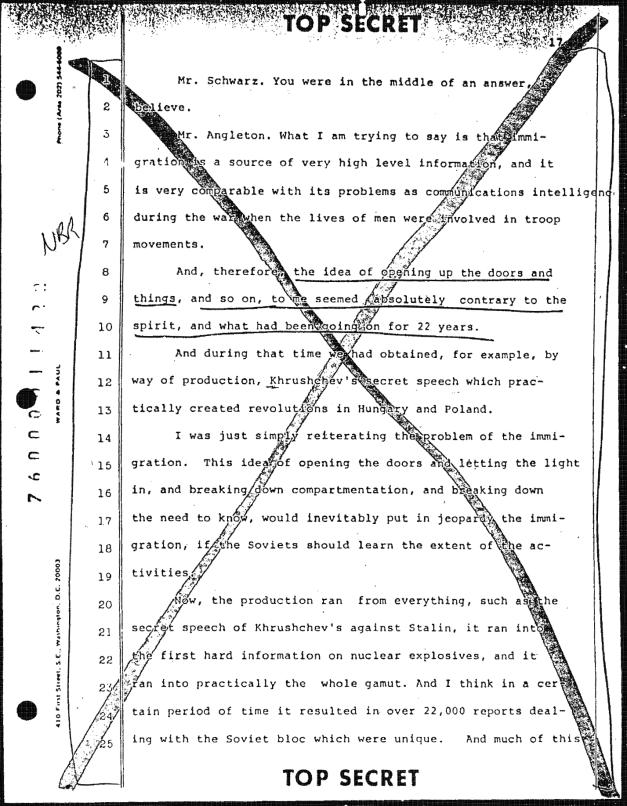
Colby fired Angleton in 1974 after the New York Times revealed that he devised an illegal program of domestic spying targeting antiwar American dissidents. In his testimony, Angleton framed their clash as an interpersonal conflict, describing Colby as “not my cup of tea professionally or in any other way.”
Yet Angleton also acknowledged to Senate that a “dispute in connection with these Israeli matters” between himself and Colby contributed to his departure from the Agency. Was this a reference to the former spook’s involvement in Israeli theft of US nuclear secrets, enabling Israel to acquire the bomb?
Whatever the case, it was clear why Angleton would be remembered more fondly in Israel than inside the country he ostensibly served.
On December 4, 1987, the director of Israel’s Mossad and Shin Bet intelligence services gathered in secret on a hillside in Jerusalem to plant a tree in honor of Angleton. They were joined there by five former Israeli spy chiefs and three former military intelligence officers.
Despite attempts to keep the ceremony under wraps, two local reporters managed to evade the cordon to record the ceremony for the former CIA counter-intelligence director, who had died seven months prior. Together, the Israeli spooks laid a memorial stone that read, “In memory of a dear friend, James (Jim) Angleton.”
August 19, 2025
Posted by aletho |
Deception, Timeless or most popular | CIA, FBI, Israel, JFK Assassination, Mossad, United States, Zionism |
Leave a comment
Given the recent stories about Merrick Garland’s experience at the helm of the Oklahoma City bombing prosecution and his own comments about prosecuting white supremacists should he be made Attorney General, I have some questions about Garland’s handling of the OKC bombing case.
My questions:
- At an April 27, 1995 Preliminary Hearing, why did you “object” when defense attorneys noted that your witness, FBI agent Jon Hersley, testified that the Ryder truck carried “passengers” — plural? Your objection was overruled, and your witness confirmed that Timothy McVeigh was seated in the Ryder truck with another individual. Who is that individual?
- At the April 27, 1995 Preliminary Hearing, why did you “object” when attorneys asked your witness the names of those FBI agents tasked with reviewing the surveillance camera footage of the bombing?
- You once said “we did everything we could to find every person who was involved.” If that’s true, then how do you explain the fact that every eyewitness you touted at the April 27th 1995 preliminary hearing never testified at the federal trials? Why didn’t these witnesses get to tell a jury what they saw? Why is it that the man seen with Timothy McVeigh in the Ryder truck has never been identified?
If Merrick Garland is truly dedicated to prosecuting dangerous white supremacists then he can show it by reopening the 1995 Oklahoma City bombing case and identifying and prosecuting Timothy McVeigh’s accomplices. I would not be alone in calling for the case to be re-opened. Danny Coulson, the FBI on-scene commander for the Oklahoma bomb site, agrees. In 2004, Coulson told John Solomon of the Associated Press that there are “some unanswered questions here. A lot of things happened that were inappropriate,” Coulson said. “I think it needs to be reopened, but I don’t think it should be reopened by the FBI. It needs to be a special investigator, a lawyer, totally independent. He needs to have subpoena power and the ability to use a grand jury.”
Danny Defenbaugh, then the retired chief of the FBI’s OKBOMB investigation agreed: “If I were still in the bureau, the investigation would be reopened” said Defenbaugh, commenting on new evidence that came to light almost a decade after the bombing. ”If the evidence is still there, then it should be checked out.”
Garland can kick off this effort by compelling the FBI to produce the surveillance camera footage that shows two men exiting the Ryder truck, and he can finish by apologizing for letting dangerous white supremacists get away with it for the last 25 years.
August 19, 2025
Posted by aletho |
Deception, False Flag Terrorism | FBI, United States |
Leave a comment
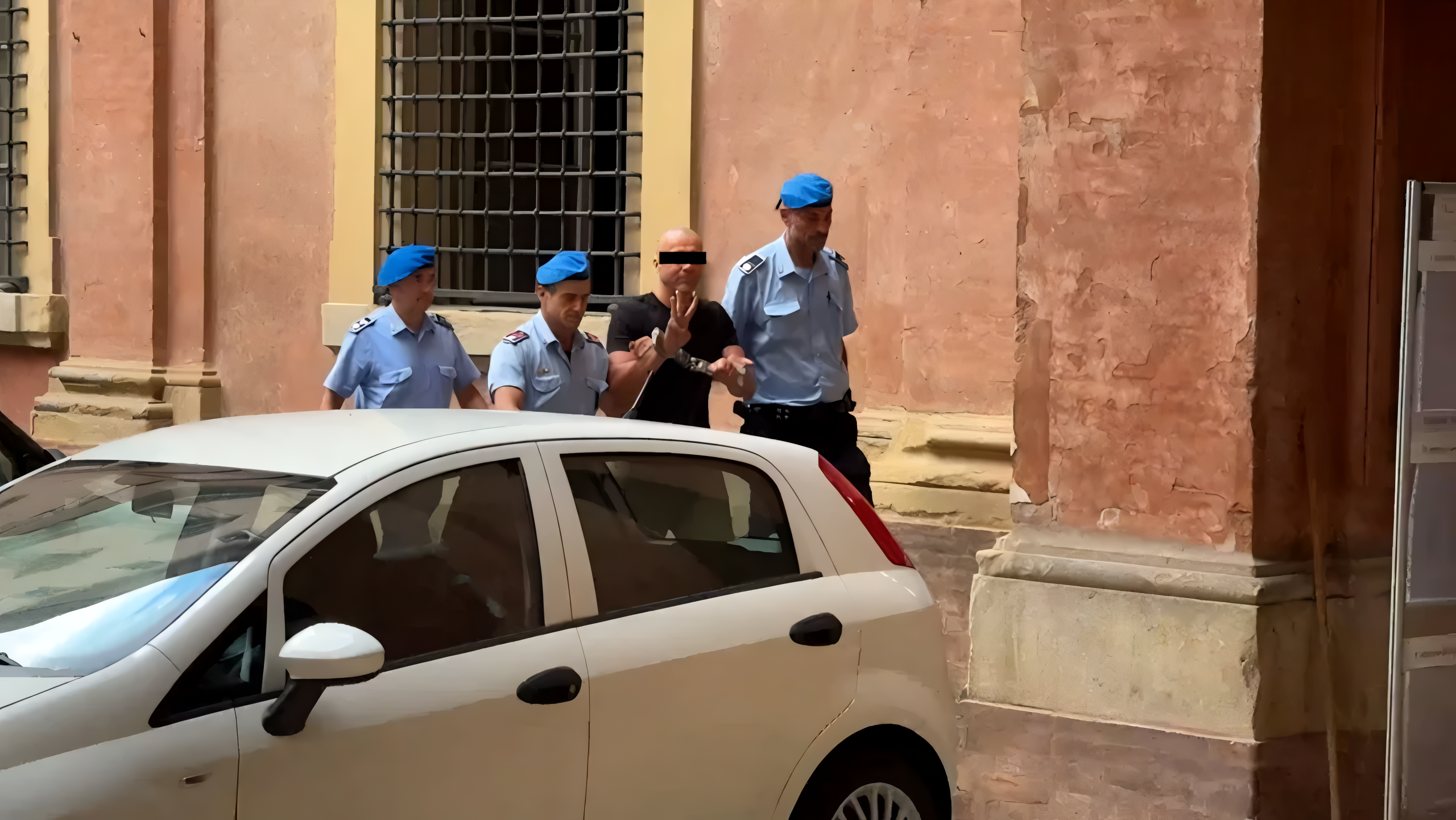
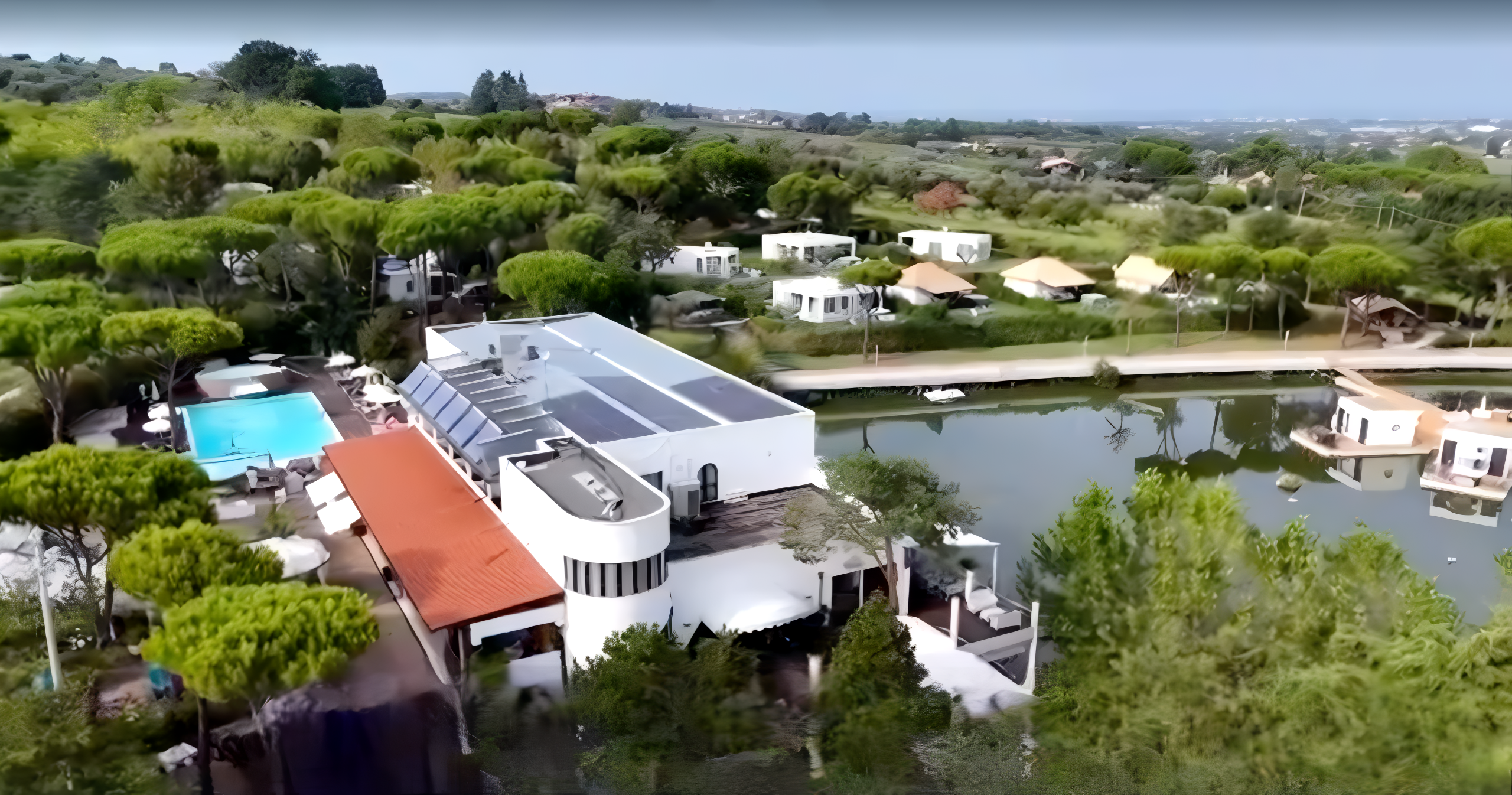

 Aletho News