Zelensky Refused to Discuss Druzhba Pipeline Issue – Fico
Sputnik – 24.02.2026
Slovak Prime Minister Robert Fico said he wanted to discuss the situation around the Druzhba oil pipeline with Volodymyr Zelensky, but the Ukrainian side was only ready to talk after February 25.
“I was interested in speaking with the Ukrainian president by phone and getting an answer to the question of when and whether oil supplies to Slovakia would be restored. We received a message that the Ukrainian president was ready to talk after February 25,” Fico said in a video message on Monday.
Fico noted Slovakia has information that the Druzhba pipeline is operational, but the Ukrainian side, in turn, has not allowed the Slovak ambassador to Ukraine to visit the part of the infrastructure that is allegedly damaged.
“Stopping the oil flow is a purely political decision aimed at blackmailing Slovakia in international matters related to the war in Ukraine. Slovakia is an independent state and will not allow itself to be blackmailed,” Fico added.
On February 13, the Slovak Economy Ministry announced that oil supplies to the republic via the Druzhba pipeline had been suspended. The ministry expected them to resume in the coming days, but it did not happen. On February 18, the Slovak government declared a crisis situation due to oil shortages, deciding to allocate up to 250,000 tonnes of oil from state reserves to the Slovnaft refinery. Fico said that Slovnaft would halt exports of petroleum products, including diesel fuel, to Ukraine, focusing all production on the local market.
Later, Fico said that Slovakia will halt emergency electricity supplies to Ukraine starting Monday, as oil flow from Russia to Hungary and Slovakia via the Druzhba pipeline has not resumed yet.
Israeli FOIA Data Reveals Massive Heart Injury Spike in Children Immediately After mRNA Shot Rollout
By Nicolas Hulscher, MPH | Focal Points | February 20, 2026
For years, the public was told that COVID-19 mRNA injection–induced cardiac injury in children was rare. That reassurance formed the backbone of adolescent vaccination campaigns across the world. But what if the underlying safety data were never fully processed or disclosed?
What if hundreds of adverse event reports submitted by frontline clinicians were simply left unanalyzed during the very period when policymakers were declaring the injections safe for teens?
According to Israel’s State Comptroller, approximately 279,300 adverse event reports submitted during the vaccination campaign by Clalit Health Services — Israel’s largest health provider — were never processed by the Ministry of Health.
These reports were not publicly examined during mid-2021, when vaccine eligibility was expanded to adolescents. They were not incorporated into real-time risk–benefit assessments. They were not disclosed to parents deciding whether to vaccinate their children.
Only years later, following repeated Freedom of Information Act (FOIA) requests, the raw dataset — containing 294,877 adverse event reports — was released.
We analyzed that dataset using a deliberately conservative methodology. Our findings have now been peer-reviewed and published in the International Journal of Cardiovascular Research & Innovation, in a study titled, Cardiovascular safety signals in Israeli adolescents following COVID-19 Vaccination: Evidence from an unprocessed FOIA dataset, authored by Yaakov Ophir, Yaffa Shir-Raz, David Shuldman, Nicolas Hulscher (myself), and Peter A. McCullough.
The results reveal a concentrated surge of cardiovascular injury among teenagers that occurred immediately after vaccine authorization was expanded to ages 12–16.
Using strict de-duplication criteria to avoid overcounting, we identified 277 unique cardiovascular injury cases among individuals under 18 years old in 2021. Of those, 98% occurred in teens aged 12–16. Nearly every one of these cases was reported within a narrow six-week window between June 28 and August 8, 2021.
The timing is critical. On June 21, 2021, Israel’s Ministry of Health expanded mRNA vaccine eligibility to adolescents under 16. Within days, cardiovascular injury reports began to pile up. The clustering is unmistakable.
The types of events recorded were not trivial. Within the COVID-specific follow-up category, 646 reports were coded as “Acute Cardiovascular Injury.” Notably, the original Hebrew term used in the reporting system translates literally to “Acute Myocardial Infarction.” That is the scientific name for a heart attack. Additional reports included myocarditis, pericarditis, stroke, and thromboembolic events.
To contextualize the scale, we applied conservative population assumptions. Clalit covers approximately 51.6% of Israel’s population. Based on national vaccination dashboard data, about 63.5% of adolescents aged 12–15 received at least one dose during the study period. This yields an estimated vaccinated adolescent population of approximately 254,347 individuals within the dataset’s coverage.
Even under highly conservative assumptions — assuming all vaccinated adolescents received their doses within the same six-week window and that reporting capture was complete — the observed clustering corresponds to a minimum estimated risk of roughly 1 cardiovascular event per 939 vaccinated adolescents.
That figure stands in stark contrast to known background rates of acute myocardial infarction in adolescents, which are measured in single digits per million person-years in U.S. data. Even without annualizing the rate, the difference is substantial.
Equally important is how these findings diverge from the narrative that dominated the early literature. In 2021, published studies largely characterized vaccine-associated myocarditis as a rare complication, predominantly affecting adolescent males, typically after the second dose, and occurring within a narrow post-vaccination window of several days.
The FOIA dataset tells a different story. In our analysis, cardiovascular events were nearly evenly distributed between girls (145 cases) and boys (132 cases). Events occurred after the first dose, within 21 days of the second dose, and more than 21 days following the second dose. The risk pattern appears broader, more heterogeneous, and less confined than initially portrayed.
Following identification of this clustering, we contacted Clalit Health Services to verify whether the number of adolescents reported with “acute myocardial infarction” differed from our findings or whether reporting errors had been identified.
The response we received was stark: “The data do not exist.”
Yet the reports clearly existed. They were submitted by healthcare professionals, entered into the national reporting system, and archived — but not processed during the critical period when adolescent vaccination policy was being determined.
In conclusion, the newly disclosed FOIA data from Israel — now published in peer-reviewed form — document a major cardiovascular injury surge in teenagers that was neither processed nor publicly communicated at the time it occurred.
SUMMARY:
- In Israel, approximately 279,300 adverse event reports were never processed during the COVID-19 vaccine rollout.
- Newly released Israeli FOIA data revealed 277 unique cardiovascular injury cases in minors using conservative de-duplication methods.
- 98% of cases occurred in Israeli adolescents aged 12–16 within a narrow six-week window following eligibility expansion in June 2021.
- Hundreds of entries were coded in Israel’s national reporting system as “Acute Cardiovascular Injury,” a category that in the original Hebrew terminology corresponds to acute myocardial infarction. When we contacted Clalit Health Services to clarify these adolescent entries, we were told that “the data do not exist.”
- Cardiovascular events in Israeli teens were distributed across both sexes and across doses — not limited to the narrow “rare male, second-dose” profile emphasized in the literature and by public health agencies.
- The reports existed within Israel’s national surveillance system — but were not processed or publicly analyzed during the critical 2021 policy window.
Epidemiologist and Foundation Administrator, McCullough Foundation
Support our mission: mcculloughfnd.org
Please consider following both the McCullough Foundation and my personal account on X (formerly Twitter) for further content.
Maria Farmer: Epstein Victim Reveals Explosive Information Covered Up by Media
If Americans Knew | February 20, 2026
Maria Farmer provided the first criminal complaint to the New York City Police Department and to the FBI, about the conduct of convicted sex offender Jeffrey Epstein.
In this abridged version of a phone interview with journalist Whitney Webb, Maria Farmer exposes Les Wexner, Ghislaine Maxwell, Jerffrey Epstein, and Israel loyalists who were all involved in the trafficking and exploitation of children and young women.
Maria recounts how Les Wexner and Jeffrey Epstein had the dressing rooms at the Victoria’s Secret Flagship store in all bugged with cameras. Maria retells stories of their Jewish supremacy and racism against white and black people. These are parts of the story that the mainstream media leaves out when reporting on The Epstein Files.
Original Interview and Video Part 1:  • Epstein Victim Maria Farmer Speaks With Wh…
Original Interview and Video Part 2: • Epstein Victim Maria Farmer Speaks With Wh…
Meet The Liberal Zionist And Ukraine War Supporter Advising AOC On Foreign Policy
The Dissident | February 18, 2026
Democratic representative Alexandria Ocasio-Cortez’s recent appearence at the Munich Security Conference, which was billed as her showcasing her foreign policy chops gearing up for a possible presidential run, has faced widespread criticism and backlash, not only for her embarrassing mistakes (saying Venezuela was located below the equator, being unable to answer a question about Taiwan and saying the “Trans-Pacific Partnership” when meaning to say the Trans Atlantic Partnership) but for her weak criticism of U.S. foreign policy and repeating of pro-war narratives.
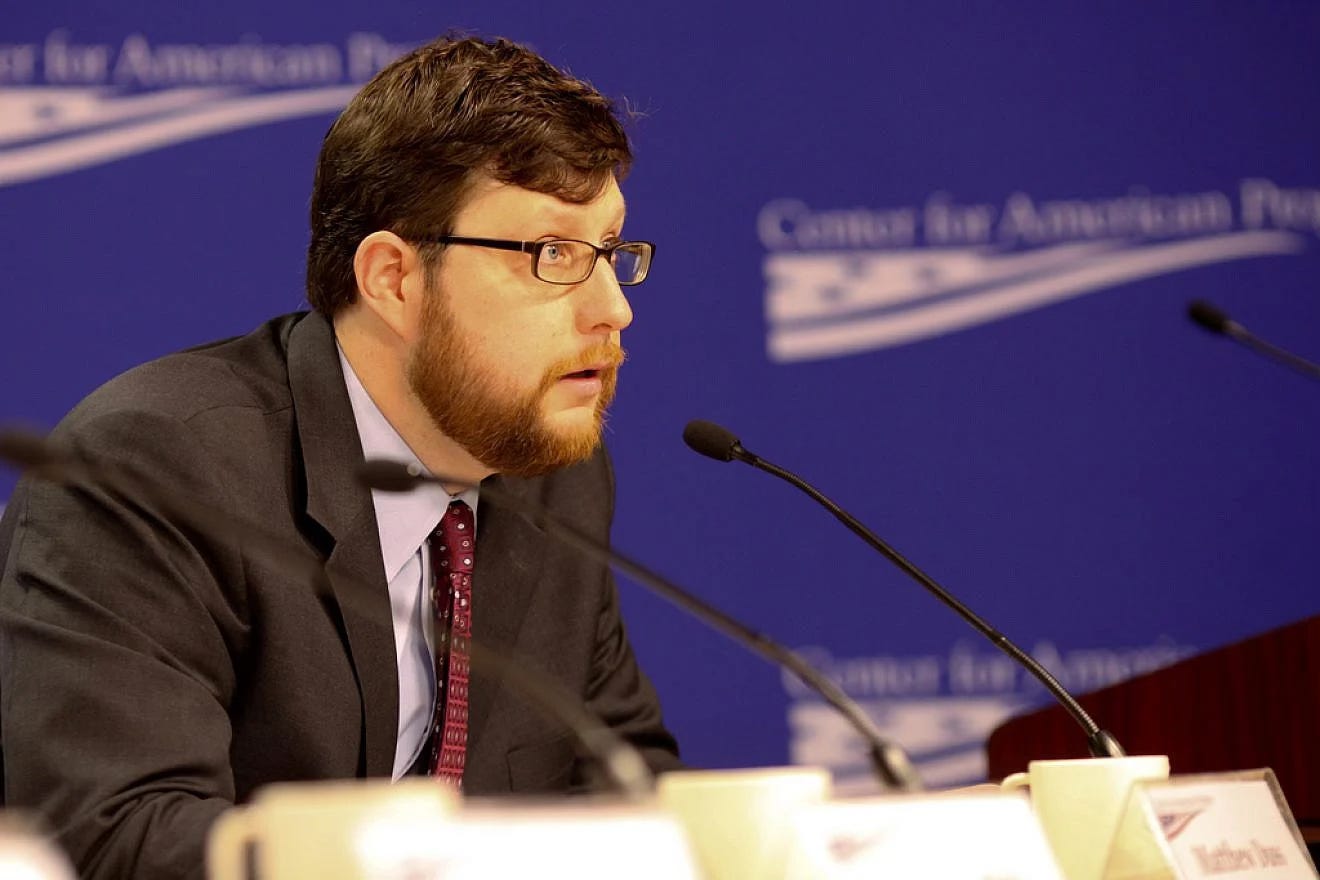
This, however, can be easily explained by the fact that she is being coached by Matt Duss, a longtime foreign policy advisor and a liberal Zionist and staunch supporter of the NATO proxy war in Ukraine.
Ahead of the conference, the New York Times reported :
She has been receiving regular briefings from the Center for International Policy, a left-wing foreign policy think tank in Washington. Matt Duss, a vice president at the group and a former Sanders aide, said he was among those who had tutored her on foreign policy.
“She is someone who is engaged with parts of the world that are often not represented in Munich,” Mr. Duss said.
Ms. Ocasio-Cortez’s appearance will undoubtedly ignite speculation that she is burnishing her foreign policy credentials before a White House run. But she is keeping everyone guessing. Unlike other more obviously ambitious Democrats, she has not made winking, presidential-coded trips to early primary states in recent months or written a tell-all memoir.
This better explains why she was so weak of U.S. foreign policy: Duss styles himself a U.S. foreign policy critic but often repeats the narratives of the U.S. foreign policy establishment, and at times, such as on Ukraine, is with it 100 per cent.
Peddling Liberal Zionism
On Israel and the Zionist lobby, Matt Duss is a typical liberal Zionist, offering some criticism of Israel but ultimately supporting Zionism and Zionist narratives.
A 2011 article on Matt Duss in Politico wrote , “Duss says he’s mischaracterized by his critics as anti-Israel. He is quick to note that he sympathizes with Israel, in part from his personal roots in American evangelical Christianity and that if American criticism of Israel should be harsher, it should also be done with the recognition that Israel is a democracy that should be held to high standards. Iran, meanwhile, is ‘abusing their own people, they support terrorism, and they say all sorts of horrible things about the U.S. and Israel,’ he said.”
This liberal Zionism, apparently influenced by a Christian Zionist upbringing, was on full display during the early months of the Israeli genocide in Gaza, where Duss, repeated Israeli propaganda, smeared actual anti-Zionists and even opposed calls for a ceasefire.
After the October 7th Hamas breakout from the Gaza concentration camp, Duss quoted an article, from New York Magazine, writing, “What we actually witnessed was not ‘the Palestinians’ mounting a violent struggle for justice but a far-right theocratic organization committing mass murder in the name of blood-and-soil nationalism” without mentioning any of the history preceding October 7th, including the Israeli blockade on Gaza which former UK prime minister David Cameron admitted turned Gaza into a “a prison camp” and an “open-air prison”, the previous peaceful protests against the blockade in Gaza in 2018, which were met with Israeli slaughter , the Abraham Accords which sought to get Arab States to abandon the Palestinian cause, and Benjamin Netanyahu putting up a map at the UN which “depicted a state of Israel that stretched continuously from the Jordan River to the Mediterranean Sea” where “Gaza and the West Bank, as Palestinian lands, were erased” weeks before October 7th.
In December of 2023, Matt Duss repeated the fabricated claim that Hamas carried out mass rape on October 7th, writing, “Denying the rape and sexual violence that Hamas committed on Oct 7 is disgusting”, repeating a hoax that was used not only to justify the Gaza genocide, but also actual mass rape against Palestinian detainees in Israel’s torture dungeons.
In another article written by Duss in December of 2023, he wrote , “Israel’s methods are not as extreme as Russia’s, and it’s very important to acknowledge that”, ignoring the fact that in November of 2023 , Israel had killed over 10,000 civilians in Gaza while Russia killed 9,806 in Ukraine since the start of the war in 2022.
In a New York Times article, Matt Duss celebrated Israel’s pager attack in Lebanon, which even former CIA director Leon Panetta conceded was “a form of terrorism” writing, “There’s no question that Israel’s decapitation of Hezbollah’s leadership in Lebanon in recent weeks was an impressive tactical feat”.
In November of 2023, Duss even opposed calls for a ceasefire in Gaza by defending Senator Bernie Sander’s comments in opposition to a ceasefire at the time (which were approvingly shared by AIPAC ), saying, “I think what the Senator said there about the challenges of a ceasefire being negotiated with an organisation like Hamas are valid”.
While peddling Zionist talking points, Duss took the time to smear actual anti-Zionists, such as labelling the brilliant Anti-Zionist academic Norman Finkelstein, a Jewish son of holocaust survivors, as an anti-semite.
Referring to the Jewish Zionist billionaires attempting to shut down pro-Palestine protests on college campuses, Finkelstein wrote , “The Jewish billionaire class has declared war on our nation’s universities: Either you support Israel’s genocidal war or we will destroy you” and Duss replied , “We can and must have a conversation about the very real dangers to academic freedom without antisemitic ‘Jewish billionaire class’ nonsense, which both endangers Jews and undermines the struggle for Palestinian liberation.”
Supporting The Ukraine Proxy War
Along with his peddling of Zionist narratives, Duss fully supported NATO and the Biden administration’s proxy war in Ukraine.
In an article for the New Republic in 2022, Duss wrote, “The Biden team clearly did not seek this war (in Ukraine), in fact, they made a strenuous, and very public, diplomatic effort to avert it. Having been unable to do that, they’ve acted with restraint and care not to get drawn into a wider war with Russia while also making clear the stakes of the conflict for the U.S., for Europe, and for the international system.”
In reality, last year, one of Biden’s top advisors for Europe policy, Amanda Sloat, admitted that the Biden administration could have ended the war in Ukraine, and chose not to, saying, “We had some conversation even before the war started, about what if Ukraine comes out and just says to Russia, ‘fine, you know, we won’t go into NATO if that stops the war, if that stops the invasion,’ which at that point it may well have done” and adding, “I guess if you want to do an alternative version of history, one option would have just been for Ukraine to say in January of 2022, ‘fine, you know, we won’t go into NATO, we will stay neutral.’ Ukraine could have made a deal around March/April of 2022 around the Istanbul talks. There is certainly a question, almost three years on now, would that have been better to do before the war started, would that have been better to do in Istanbul talks, it certainly would have prevented the destruction and the loss of life”.
Matt Duss on serval occasions denied the fact that the war could have ended in April of 2022 has Boris Johnson not intervened and stopped the peace deal that Russia and Ukraine agreed to in Istanbul. On Twitter, Duss wrote , “If you’re so committed to your narrative that you believe that Zelensky Could’ve simply ended the devastating war on his country in April but then Boris Johnson showed up and said nah so he didn’t, I recommend stepping back and taking a series of deep, relaxing breaths” and “ doesn’t matter how quickly the Sy Hersh story gets refuted, it’s already become part of the alternate reality where Biden induced Putin to invade and Russia would’ve ended the war in March if Boris Johnson hadn’t said nah.”
This is despite the fact that Boris Johnson’s blocking of the peace deal in Istanbul has been confirmed by
- Former Israeli Prime Minister Naftali Bennett
- Lead Ukrainian negotiator Davyd Arakhamia
- The foreign minister of Turkey, Mevlut Cavusoglu
- Turkish President Recep Tayyip Erdogan
- Gerhard Schröder, the ex-leader of Germany
- Victoria Nuland then U.S. under secretary of state for political affairs
- Oleksii Arestovych a member of the Ukrainian delegation at the peace talks
- Amanda Sloat, lead Biden advisor on Ukraine
- Andrej Babiš, the Prime Minister of the Czech Republic
Duss has repeatedly praised the Biden Administration for the proxy war in Ukraine, saying in 2023, “The administration … on the way the president has helped manage alliance and partnerships in response to Russia’s invasion of last February, I think has been impressive, I think it shows a way of practising U.S. leadership that forges consensus and then mobilises that consensus.”
As late as January of last year, Duss said, Biden can “claim some credit for rallying allies for the defence of Ukraine against Russia’s invasion”.
Duss even admitted in reference to the Ukraine proxy war that, “the policy I support continues to enrich defense contractors, enriches the military-industrial complex” adding, “I think the goal of reforming that military industrial complex and weakening its power over our politics, that project continues in the longer term even though the policy I support in the shorter term is essentially paying them off.”
The fact that AOC is being “tutored” by Matt Duss on foreign policy explains her failures when speaking on it.
Prof. Ted Postol: US–Iran War? Israel’s Fatal Gamble
Dialogue Works Highlights, hosted by Nima R. Alkhorshid | February 16, 2026
This interview with Theodore Postol, professor emeritus at the Massachusetts Institute of Technology (MIT), specializing in nuclear weapons technology, missile defense, and national security policy, examines rising tensions between the U.S., Iran, and Israel. Ted Postol argues that Israel crossed from military to urban targets, opening the door to devastating retaliation. He claims Iran’s growing ballistic missile numbers and improving accuracy could bring Israeli cities to a halt, while missile defenses are overstated. The discussion expands to nuclear risks, great-power involvement, and parallels with Ukraine, warning of strategic miscalculation and dangerous escalation.
Transcript: Resistance News
Host: We are somehow concerned about a new war in West Asia between the United States and Iran, which we know would include Israel as well, and which would be devastating for all the parties involved, in my opinion.
When we look at the current situation, the United States is bringing a lot of weapons to the region. The Iranians are not like in the 12-day war; they are prepared. They know the attack is coming. Israelis are prepared. Americans are prepared. Iranians are prepared. How do you see the current situation? And how do you see a confrontation between the two parties?
Ted Postol: Well, at a political level, I must admit I am a little baffled by the whole thing. It is clear that the leader of Israel, Netanyahu, is hellbent on attacking Iran and taking Iran’s military capacity away from it. I should point out that Iran has not instigated any attacks against Israel except in retaliation to attacks made by Israel against Iran. The rhetoric in the West is not very informed, unfortunately. Basically, the situation is being driven mostly by Israel and also by the United States.
It seems—I cannot be sure, since I am not what I would call a deeply knowledgeable political observer—that things did not go well between Netanyahu and Trump in the very recent meeting that just ended. It is clear that Netanyahu wanted the Americans to go against Iran again. It may well happen, given all the weapon systems that are being moved into place. But it does appear that Trump at least did not indicate to Netanyahu that he was just going to go ahead, which again does not necessarily mean he won’t, because this man is so erratic.
The problem really is that the Israelis have really made what I consider an extraordinary strategic blunder. I will talk a little about this so your audience understands what I mean by it. This strategic blunder is basically putting the Iranians in a position where they are justified in attacking Israeli cities.
Prior to the most recent situation, the Iranians were very careful to focus their attacks on Israeli military installations. But the most recent attack by the Israelis—I don’t know why they believe they could do it, but basically an attempt to take off the head of the Iranian government and cause it to collapse—involved a large number of attacks on urban installations. What that did was make it justifiable—and it is justifiable, sad but justifiable, in terms of retaliation—for the Iranians to focus on Israeli cities.
Israel has several big cities, but only a few. It is a small country. As I will show with some of my briefing slides, as Iran’s capacity with ballistic missiles increases—and it is going to increase, and I will explain what I mean by that shortly—as Iran’s ability increases with its ballistic missiles, it is going to become more and more possible for Iran to cause catastrophic disruptions of Israeli urban areas. I mean catastrophic.
It won’t be at the level of what the Israelis have done to Gaza, but it will in some ways begin to approach that kind of damage and disruption. Societies are organized systems. When you do damage to a society, you cannot measure the full extent of the damage by saying, “We destroyed 20 percent of the buildings.” If 20 percent of those buildings are embedded in a structure where they are connected to 75 percent of the other buildings in terms of supplies, relationships, services, etc., you are crippling a society in a major way.
Iran either already has, or soon will have, the ability to do that to Israel. That is not going to be tolerable for the Israelis. I do not know what they can do about it. I guess they could retaliate with nuclear weapons against Iran, but that would be suicidal, because Iran has the capacity to build nuclear weapons and use them.
It is one thing for the Iranians not to go ahead and build nuclear weapons, as they say they are not doing, and as American intelligence seems to agree that it’s not what they’re doing. But they have the capacity. The one way to assure that a country will use nuclear weapons on you, if they have the capacity, is to use nuclear weapons on them.
So it is a dilemma. It is a deep dilemma for Iran, but it is just as deep a dilemma for Israel. Iran is a bigger country. Nuclear weapons are enormously destructive, but you have to use a significant number of them if you are going to destroy urban areas and military assets. The number of military assets and cities in Iran is tremendously larger than what exists in Israel. This is not a good mathematical relationship from the point of view of the Israelis.
They have, in effect, opened the door to a potentially very dangerous confrontation and ladder of escalation of some kind. But the biggest immediate problem is the non-nuclear threat that Iran now has and will predictably grow.
It is not just that they have it now. As the size of Iran’s ballistic missile forces grows—by size, I mean numbers—as the numbers grow and the accuracy improves, it will have increasing meaning. The Russians are now talking about helping the Iranians improve their accuracy technology in ballistic missiles. That seems to be an arrangement the Russians are working on with the Iranians, and that is going to have big significance, as I’ll show you shortly.
China could choose to do that as well, because they have advanced missile guidance and control technology. Iran is only a small step away from improving its accuracy significantly. It already has tremendous technical capabilities, but it could get a good boost from either Russia or China. The increase in accuracy does not have to be enormous.
The evidence suggests that the accuracy of most of Iran’s ballistic missiles, as measured from the 12-day war, is probably around one thousand meters—a kilometer. When you have one-kilometer accuracy, getting to 500 meters is not a gigantic step. Getting to 100 meters would be a lot, but getting to 500 meters is not a lot in terms of improvements and technology.
Iran is poised to be able to do that, especially with Russian help. As this confrontation continues over time, Iran will have more missiles, because it is clear they understand these missiles are a unique tool to threaten and stand off Israel. As the guidance and control systems improve and accuracy increases, the effectiveness of those missiles for disrupting, possibly even closing down, the function of civil society in Israel will increase dramatically.
The clock is not on Israel’s side. This strategic blunder—among many strategic blunders—has put Israel in a very bad situation that can only get worse over time, and significantly worse.
So why don’t we start with slide two? I have a couple of simple slides.
The point I made earlier is that the attack on Tehran was a gigantic strategic blunder. In slide three, the reason for it is that it crossed the line from attacks on purely military targets to attacks on cities.
If we go to slide four, all we are saying is that Israel only has a small number of cities. The combination of large numbers of ballistic missiles and improved accuracy will, over time, give Iran an extraordinary and growing strategic lever against Israel.
Two factors will increase this capability to leverage against Israeli society. The first is obvious: the number of missiles will grow. The second is less obvious: the improved accuracy of those missiles.

Slide 6 [the 5 first slides only contain text that was read out loud]
Slide six is a conceptual slide. Small problems in shutting down the rocket motor—when you are trying to place the rocket at a certain speed before the motor shuts down—create small differences in the angle at which the rocket is flying when the motor shuts down. Those small differences must be reduced if you want to increase the accuracy of the missile.
At the far end of the trajectory, errors are also introduced by the atmosphere. The missile may wobble a bit. But those kinds of errors can be reduced tremendously. The evidence suggests that the Iranians already know how to do that.
So, to significantly improve their accuracy—from about 1,000 meters to 500 meters—they mainly need to do better at shutting down the rocket motor at the right time and ensuring that the orientation of the missile at shutdown is accurate enough. They will likely get help with that from the Russians, if not from the Chinese.
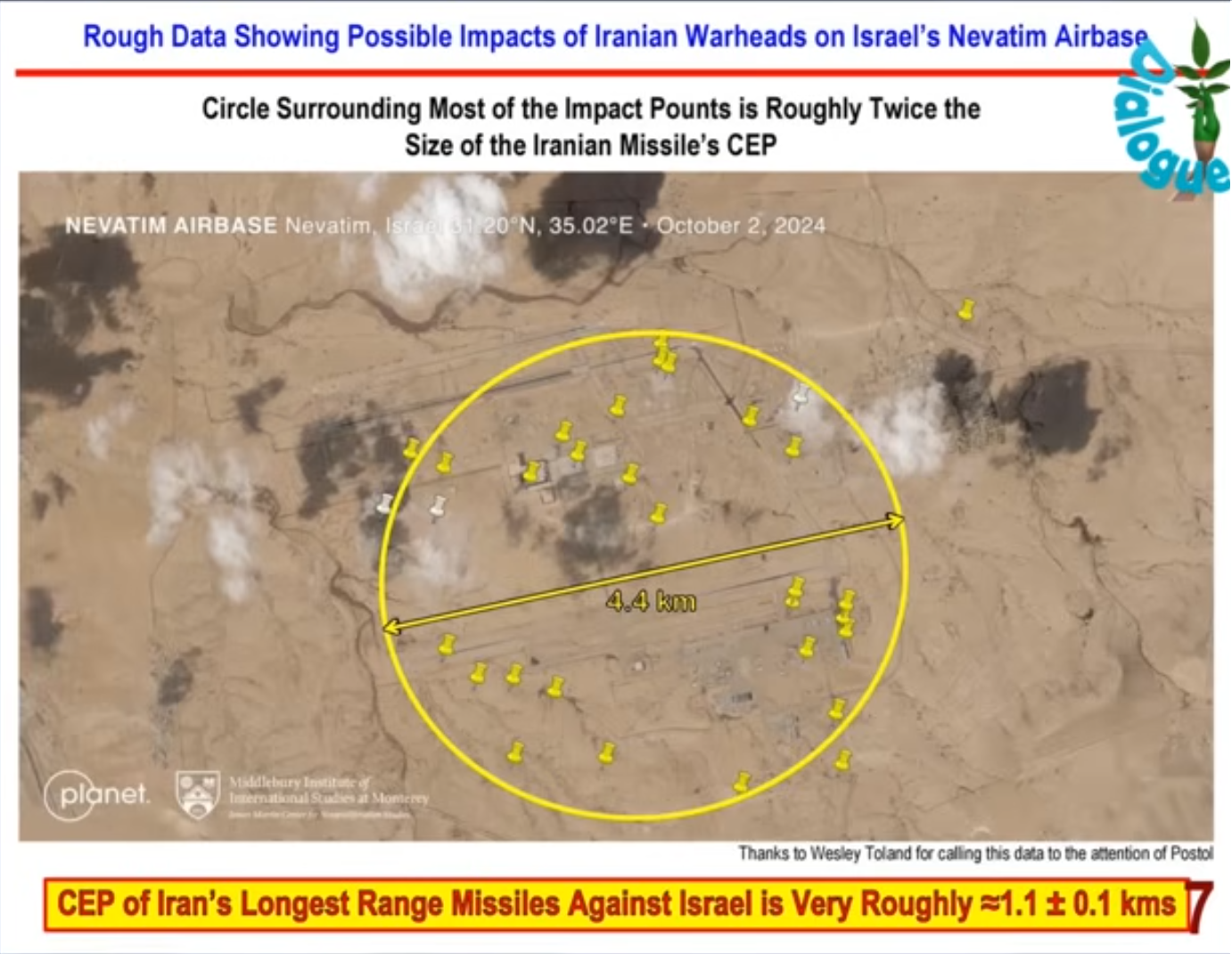
If we look at the situation, what we know —we go to slide seven— is that we have an estimate of the accuracy of these ballistic missiles from the attack on the Nevatim Air Base during the October war in 2024. They obviously wanted to damage the base. The distribution of warheads shows what their accuracy capabilities were at that time. One of the warheads actually hit a building and probably destroyed an F-35 inside. There is a lot of discussion about that. These are probabilistic events.
The distribution shown is how you estimate the accuracy of Iran’s ballistic missiles at that time. That does not mean it cannot improve. It will improve, and that has meaning in a different situation from the one people tend to focus on.
The possibility that the accuracy of Iran’s ballistic missiles will become so high that they can selectively target aircraft and shelters and things like that is very low in the near future. The technologies involved are extremely advanced and will be very difficult to implement, even for an advanced country like Iran. These technologies are very difficult to master for ballistic missiles.
Iran’s cruise missiles, however—I’m not talking about their drones—have demonstrated tremendous accuracy. In the attack on the Saudi Arabian oil fields, we saw evidence that Iranian cruise missiles have the ability to lock on to an object of a certain shape and home toward the center of that object. I could show that evidence in another discussion. So cruise missiles are extremely accurate, but ballistic missiles are a long way from there.
To understand what kind of damage ballistic missiles could do to an urban area, we need to understand what damage an explosion might cause.
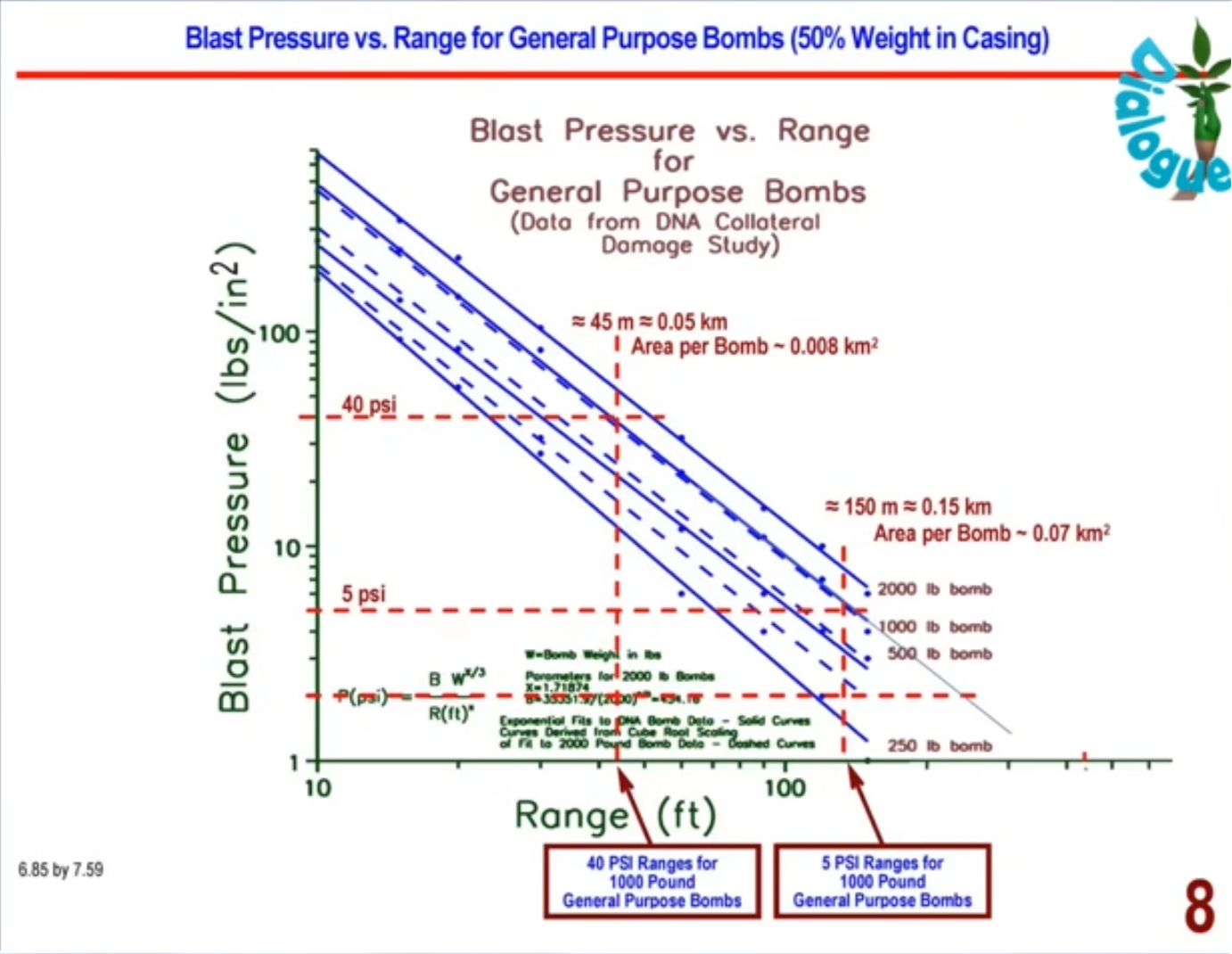
Slide eight shows the ranges at which certain levels of blast overpressure from a general-purpose bomb would occur. These are very general qualitative curves. For example, a 1,000-kilogram warhead, at about 100 meters you might get around two pounds per square inch. It could be 120 meters or 130, but approximately 100 meters. At 50 meters, you might get about five pounds per square inch. At around 15 meters, you might get over 40 pounds per square inch, which is enough to knock down a concrete and steel wall.
Let us look at slide nine to get a sense of what damage might look like.
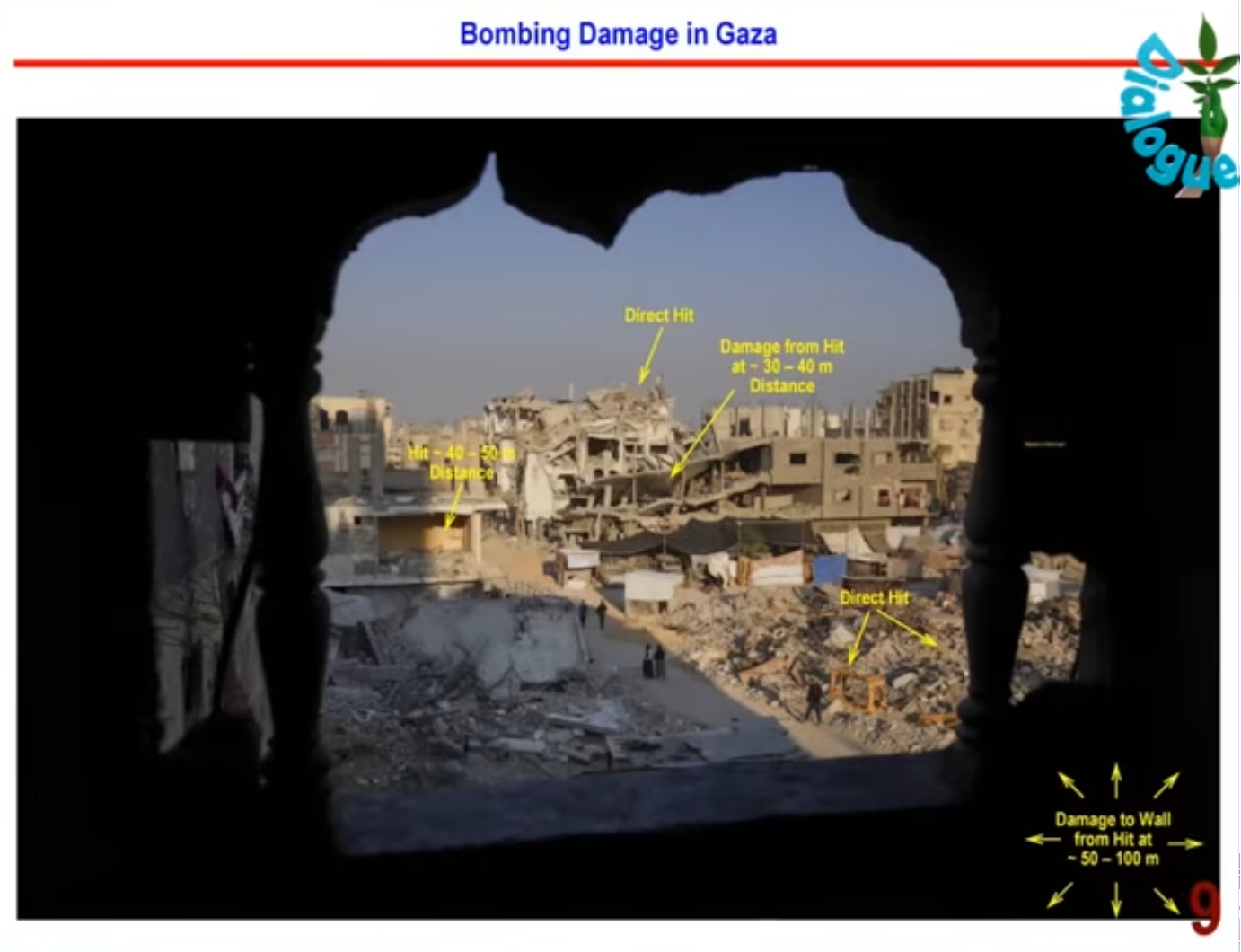
This is an image from Gaza. We are looking through a hole in the wall of a building. That hole was probably produced by the blast wave from a roughly 500- or 1,000-kilogram bomb that landed 50 to 100 meters away. It depends on the strength of the wall, but this is the kind of damage you can expect at that distance.
At the far end of the image, you can see what a direct hit looks like on a significant structure, concrete and steel, reinforced structure. The structure slightly forward of it was damaged not by a direct hit, but by secondary shock waves, perhaps from a bomb or bombs that landed 30 or 40 meters away.
The point is that there is a lot of damage beyond the point where a bomb hits.
On the left side, we see a building where the exterior walls have largely been knocked out, while the roof and floors appear intact. That was probably done by a blast 40 or 50 meters away, and the walls just collapsed or were blown inward. That is significant damage from bombs that did not directly hit the target.
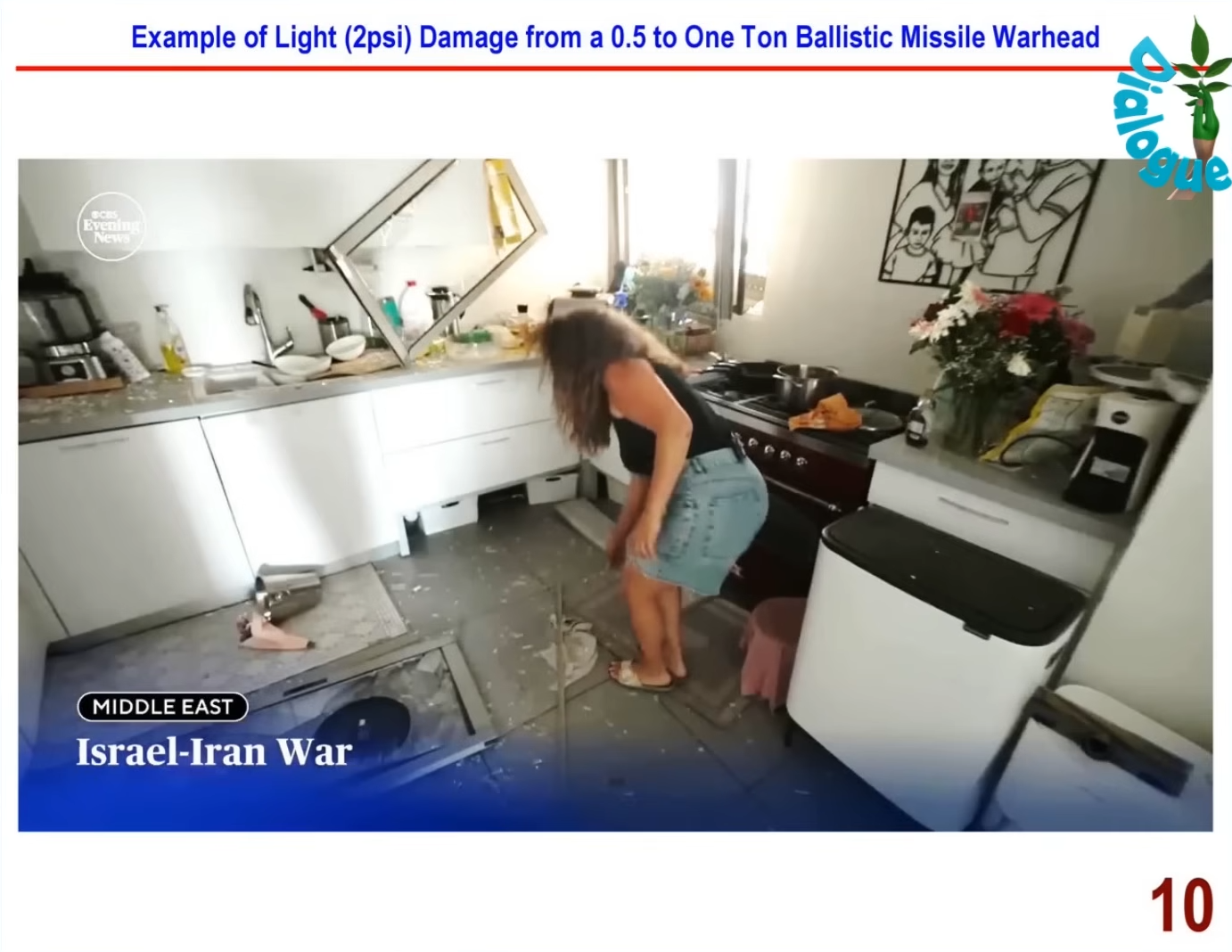
On the next slide, we see the interior of an apartment in Israel. This apartment was probably 100 to 150 meters away from a 500- to 1,000-kilogram ballistic missile explosion. At that distance—perhaps 50 to 100 meters—there is substantial general damage. The exterior window is blown out, and there is general disruption inside. If the blast had been at half that distance, the exterior wall could have been blown out.
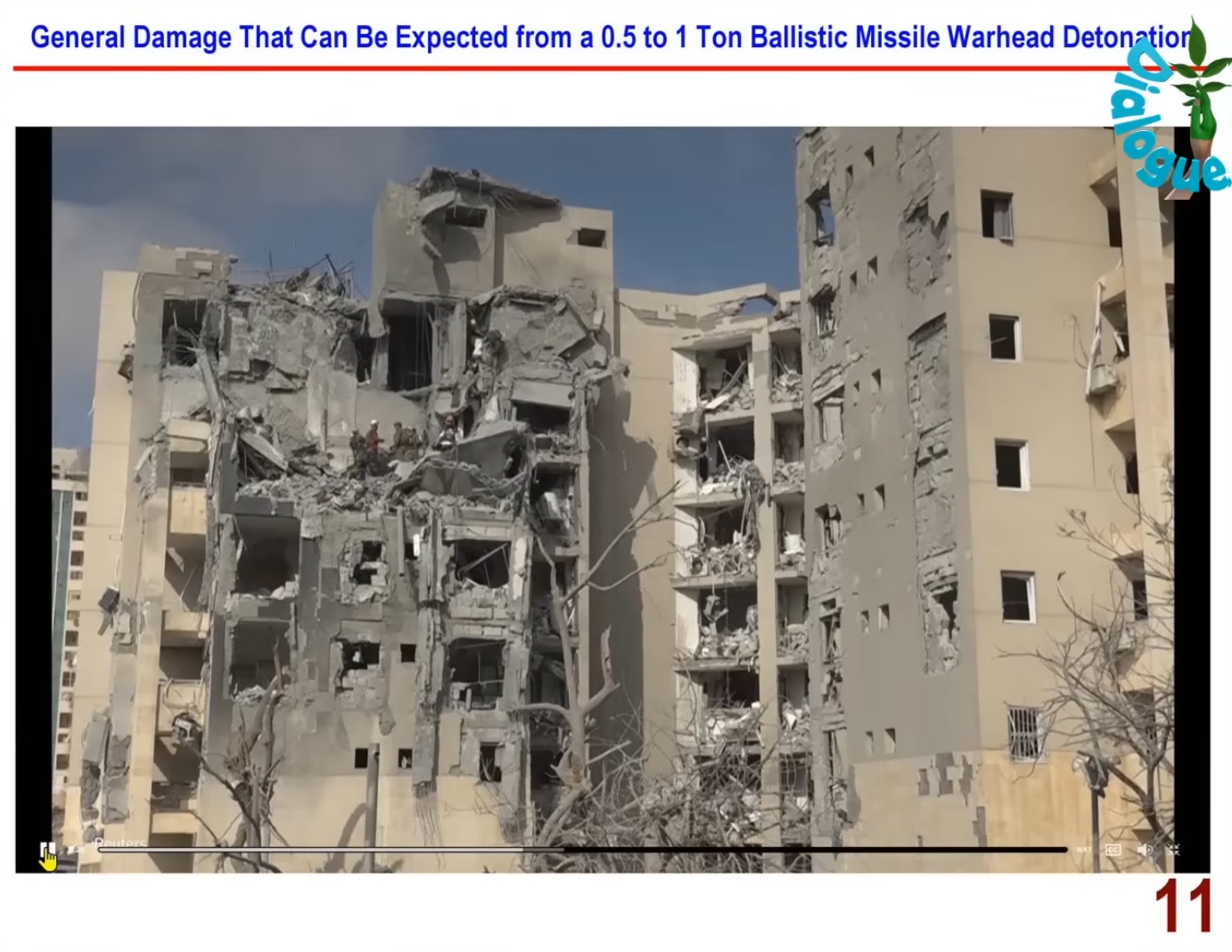
Slide 11 shows damage from a bomb that probably landed 50 or 60 meters away. The walls were shattered, and the interiors were badly damaged. There is evidence of fires in the building, which often occur in such events. There is usually no one around to fight the fires because people are injured or evacuating, and tremendous damage results.
Now that we have a sense of what the damage looks like, let us go to slide 12.
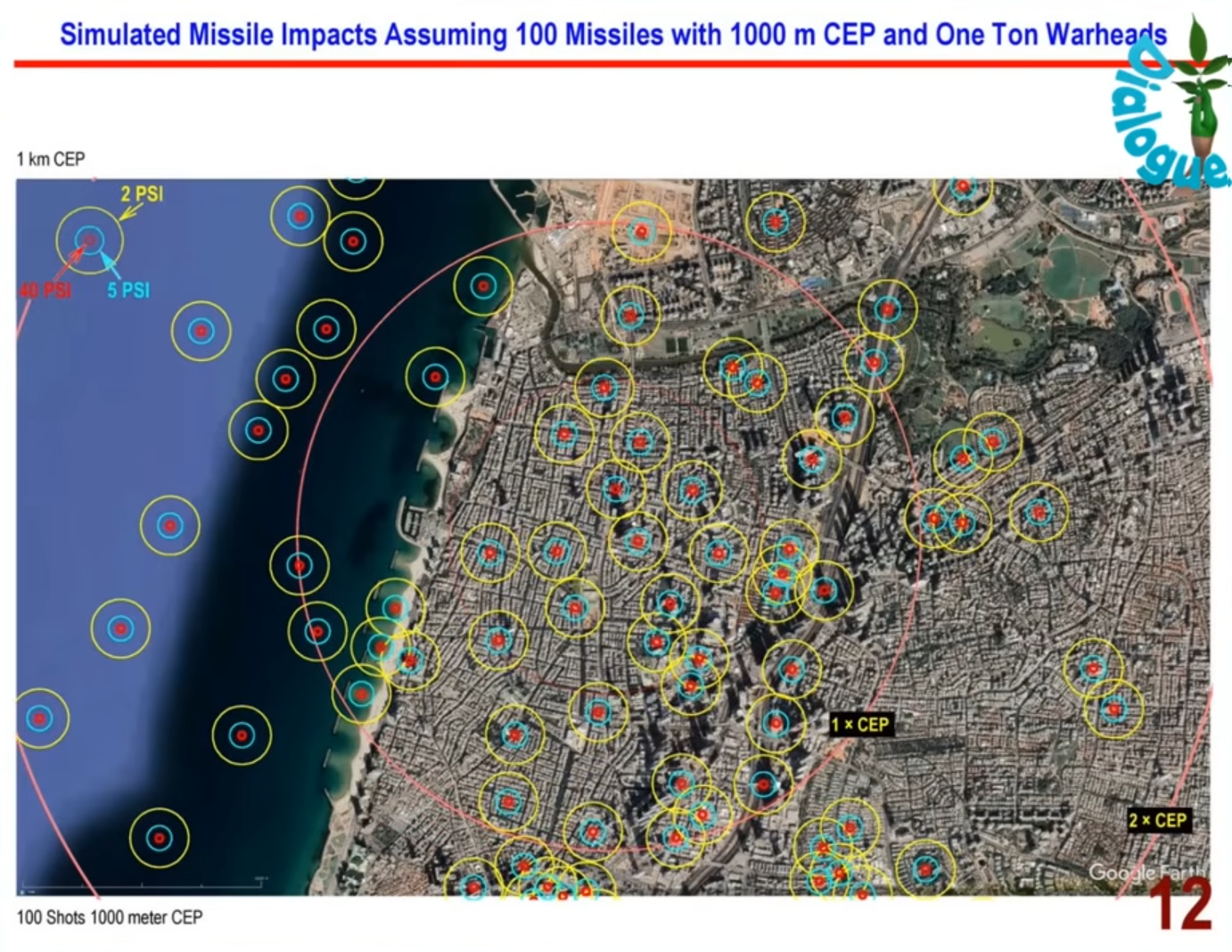
This is a simulated missile impact diagram. In the upper left corner, there is a key explaining the circles. The outer yellow circle represents about two pounds per square inch—damage similar to the apartment we saw earlier, where there was general internal damage without the walls being knocked down.
The five-psi contour shows the range at which a bomb landing nearby would severely damage the exterior walls of a building. It might not knock them down completely, but it would cause serious structural damage.
The 40-psi contour, shown in red, represents the range at which the structure itself would likely collapse or suffer severe structural damage.
This simulation shows 100 missiles with 1,000-meter accuracy, assuming a one-ton warhead. A 500-kilogram warhead would produce similar general conclusions.
If you were firing at Tel Aviv—and we know the Iranians were—a significant number of warheads would land in the downtown area, which we know occurred. There was considerable damage in downtown Tel Aviv, although the Israelis tried to mask it all. But if you went and talked to somebody who was in downtown Tel Aviv, they’d tell you there was bomb damage all over the place, you know. Very very damaging. Real problem. The Israelis tried to downplay it, but there was certainly a lot of reaction from the Israeli population.
And in fact I believe — I conjecture, I don’t know — that a lot of the discussion about running out of missile interceptors, or interceptors not working perfectly, is just a smokescreen. The defense interceptors were not working very well to begin with. These missiles basically came in unopposed, to a first approximation. There may have been some intercepts, but the number was very low—perhaps around five percent. I would be very surprised if it is as much as one in ten. I would be very surprised if it is that high.
There is a mythology that the Israelis have been trying to promulgate, which they cannot hide from their population because the Iranians showed their population what could happen. There is a big set of lies being promulgated to the Israeli people and to other organizations—that the defenses are simply running out of interceptors, that there are minor problems with intercept rates, and similar claims. In fact, these systems have never been effective at all.
Most of what the Iranians fired came through. When you have 1,000-meter precision, many warheads will simply fall into the Mediterranean, for example. That is what happens when you have a weapon that is not very accurate. Now what happens when 100 missiles have 500-meter accuracy rather than 1,000-meter accuracy, as shown in the next slide.
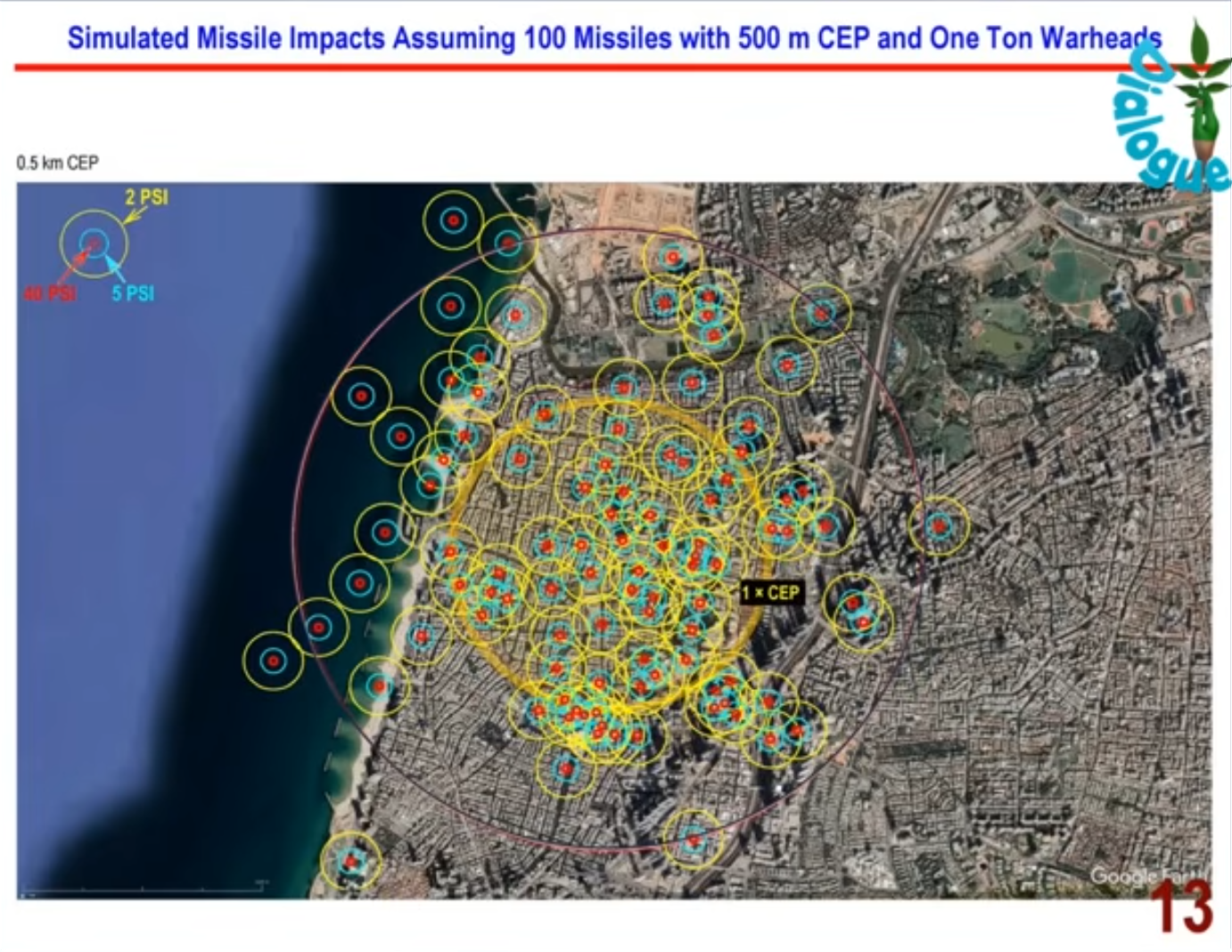
Things look a lot worse. A lot worse. You can see that the downtown Tel Aviv area gets at least twice the density of impacts. That is not a good sign if you are Israeli.
This simulation is for 100 missiles. Iran does not have to restrict itself to that number. Over time, Iran will not only improve its accuracy but also increase the number of missiles it can launch.
Let us look, in the next few slides, at what a 500-missile attack with 500-meter accuracy could look like.
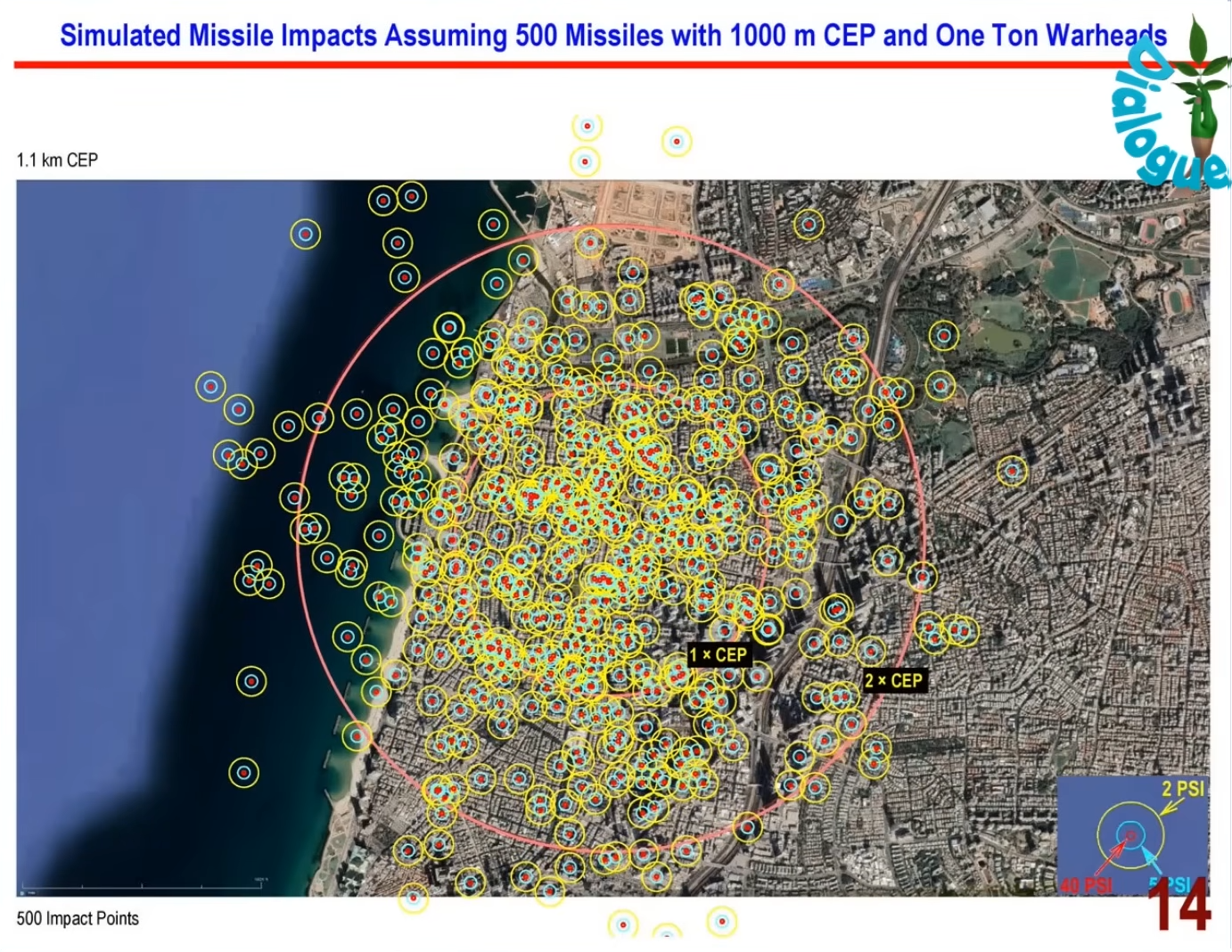
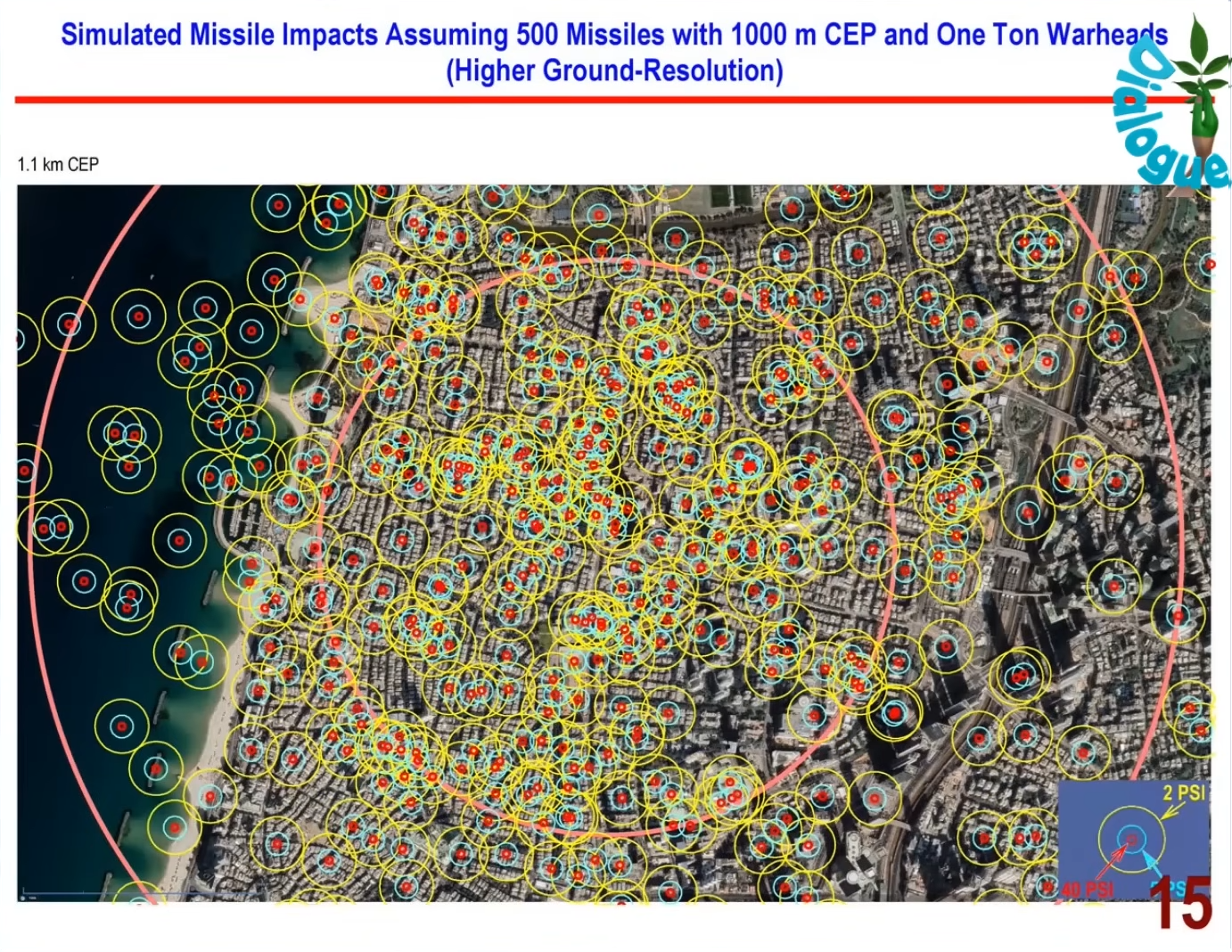
You see two roughly orange circles. One marks 1,000 meters of distance; the other marks 2,000 meters. A very large percentage of the warheads land within the urban built-up area of Tel Aviv.
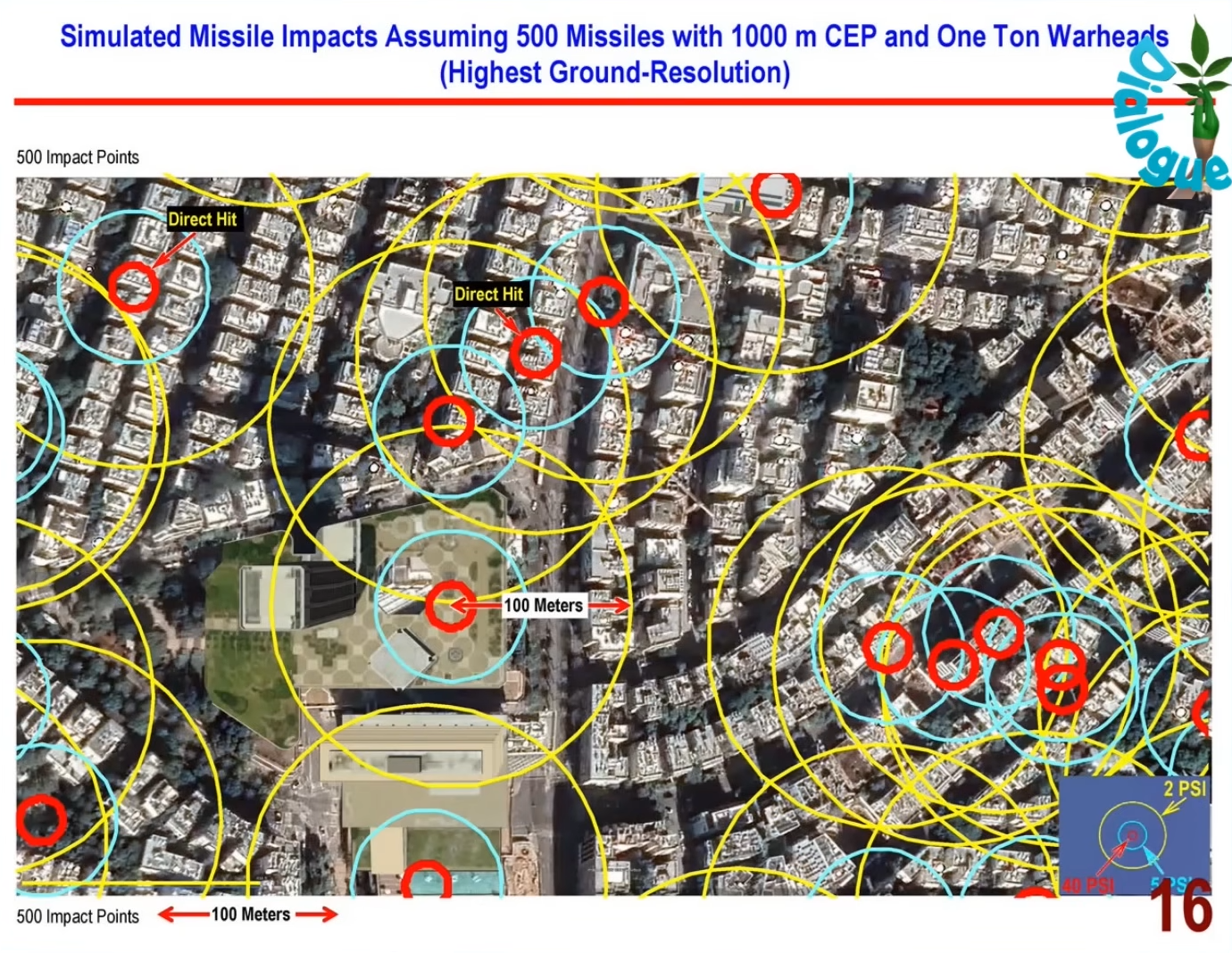
Slide 16 is a close-up. You can see the buildings and the density of impacts, to try and understand what it means. The red circles show areas where the blast intensity would be enough to knock down the buildings or large parts of them. That would be severe damage.
The blue lines show areas where extensive general damage would occur: interior apartment walls knocked out, fires initiated in many buildings, people injured by flying debris, evacuation under chaotic conditions, and widespread fires.
The yellow lines indicate areas of more general damage—broken windows and more in streets and buildings.
This entire area is covered with general damage and severe damage. It is just one arbitrarily selected area.
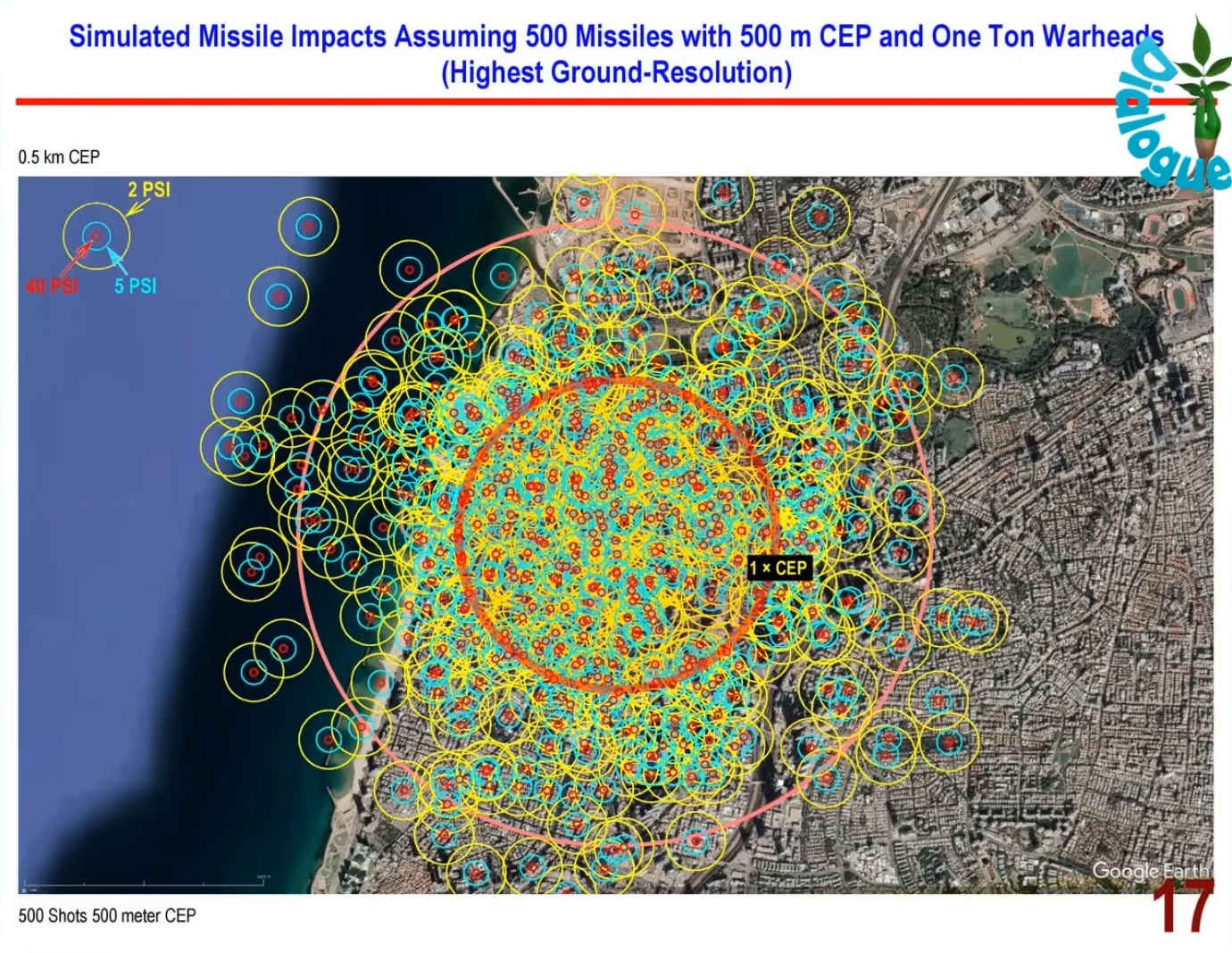
Slide 17 shows what the whole city looks like, in this case with 500-meter accuracy missiles: the density of impacts is so great that it blocks out the city. Each red dot represents severe damage to concrete and steel buildings—big, strongly built structures—along with widespread secondary damage to surrounding buildings and interiors.
After an attack like this, Tel Aviv is no longer a functioning city. Haifa is no longer a functioning city. Beersheba is no longer a functioning city. These cities could be shut down completely by a few thousand ballistic missiles with 500-meter accuracy, which you can be sure that in the next let’s say five years, Iran will have. Because Israel cannot stop them from building ballistic missiles. They will have, I think, the outreach from Russia and China, you know, they’ll be plenty of materials available, made available to Iran to continue manufacturing these ballistic missiles. And the technology for improving their accuracy is well in hand, as Iran is a sophisticated country with advanced engineering capabilities. All it needs is a little help from Russia or China or both to refine these missiles to 500-meter accuracy.
So we’re talking about a very big strategic problem that the Israelis have brought upon themselves by this aggressive behavior.
So let me go to slide 21, because I made a point about lying to the Israeli people. This is a slide from 1991. I think this may have occurred in Saudi Arabia, where Patriots were used to defend Saudi Arabia.
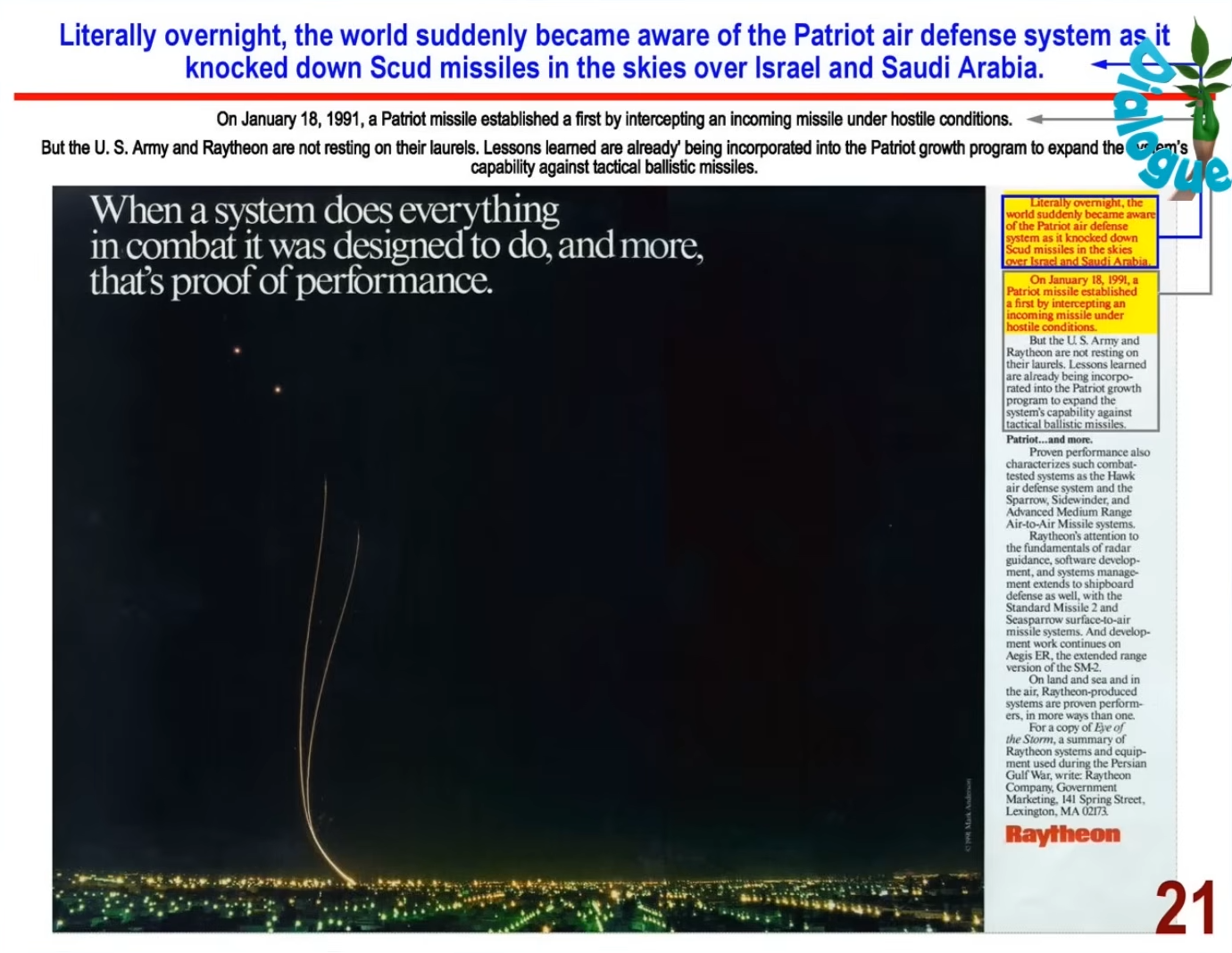
A spectacular photograph. Most people misunderstood it. And in fact, the Raytheon Corporation took a great… Let’s just look at what it says: “When a system does everything in combat it was designed to do and more, that’s proof of performance.” This was in Aviation Week & Space Technology, and it ran two pages. Two pages. A total lie by Raytheon, the company that is still building Patriots and claiming they work when they don’t.
This time-lapse photo—let’s stop for a second and understand how it works. The camera is focused on the skyline, and the aperture is open. It does not open and close like a regular photograph; it is just open. When a Patriot interceptor is launched, it has a rocket motor that burns. The rocket motor looks like a point of light, and that point of light traces a line on the film because this is a time exposure.
You see the line in both cases disappears because the Patriot burns out. It finishes its powered flight, then flies like a bullet and maneuvers by changing its orientation in the atmosphere.
Now you see those two dots in the sky. Those two dots are the explosions of the Patriot warheads. They have nothing to do with intercepting a Scud.
We found this engagement on a video camera and analyzed it frame by frame. One Scud came in. They missed it with both explosions. If they had hit the Scud, it should have appeared as a track on the black photo. The Scud was bright enough that you should have seen it as a track. Somebody took that track and blacked it out. So this was consciously a fraudulent photo.
This is what the Israelis tell their own people. This is what American contractors tell the Saudis, the Poles, the Ukrainians, and whoever else is foolish enough to spend money on their system for anti-missile.
It is a very effective system against aircraft, I want to be clear. You do not want to fly against Patriots if you are in an airplane. But as a ballistic missile defense, it is worthless, as we know from Ukraine as well.
What we have here is an example of layers upon layers upon layers of fraud that have been foisted off on the populations of different countries, and on the American taxpayer, who has bought most of these Patriots for other countries, including Israel and Ukraine.
What we have is nothing but a fraud against the American taxpayer, the Israeli public, and the Ukrainian population.
Ukraine is a horrific situation because we, the Americans have put the Ukrainians in a position where their country has been destroyed and will continue to be destroyed if it does not negotiate with what is left of it and with the Russians.
You can still find articles in The New York Times, the paper that is supposed to be the paper of record. Just the other day there was an article —I shouldn’t laugh, because it’s so serious— about how Prosk in Donbass had just fallen. Prosk fell two or three months ago. The New York Times is now reporting it? This is a crime.
You have unbelievably courageous Ukrainian soldiers fighting for their country, for what they believe is the survival of their country, and they are dying at a tremendous rate for nothing. This can all be stopped by carrying out a realistic negotiation.
But the political administration in Ukraine—my best analogy is Hitler letting all these Germans die as the Russians closed in on Berlin when the best thing to do would have been to surrender. The war was over. Why cause all these people to die? They were even executing their own people in the streets for not fighting.
It is this kind of fascism, and it is fascism, that is contributing to the complete destruction of Ukraine. I mean complete, because all of these dying soldiers are altering the demography of Ukraine for the next 20 years. There will be an incredible dip in the birth rate. There already is. Ukraine could potentially even disappear as a culture. I do not think it will, but it could.
All these extremists—banderites, white supremacists—who think they are saving Ukrainian ethnicity are destroying it.
We have all this complexity going on in the world in front of us, and the cynical political leadership of NATO and the United States as well is resulting in extraordinary loss of life. I am beside myself when I think about the loss of life in Ukraine for no reason.
Just negotiate. Stop trying to make yourself an existential enemy of the Russians. Just live beside them and stop this unbelievable slaughter, because the Russians are going to stop it anyway. They can stop it by reaching an understanding, or they can stop it by basically completely destroying Ukraine as a viable state, which I think is what will occur, unfortunately.
Sorry to jump around, but from the point of view of a technologist like myself, who is most deeply concerned with violence in the world and its negative consequences, I look at this with despair.
This talk is simple in some sense. The diagrams took a long time to put together. I did not just make them up. I wanted to make them understandable so you could visualize what 500-meter CEP means. When you see it laid out on a map, you begin to understand what the consequences are. We are visual animals. Our ability to learn is based on visual capabilities, and abstractions come after that.
That is what I have to share on this issue.
Peeling Back the US Information Operation in Iran
By Larry C. Johnson | SONAR21 | February 18, 2026
As part of the US campaign to engineer a regime change in Iran, the US military and intelligence community are using Operational Preparation of the Environmnet aka OPE. OPE is defined in joint publications (e.g., JP 3-05 Special Operations) as non-intelligence activities conducted prior to or in preparation for potential military operations to set conditions for success. It encompasses shaping the operational environment through intelligence, surveillance, reconnaissance, information operations, civil affairs, psychological operations, and other preparatory actions—often in denied or politically sensitive areas.
I believe that one of the major OPE efforts is to convince the US public that the overwhelming majority of Iranians despise the Islamic Republic and want it overthrown. In my opinion, a major player in this OPE is a polling outfit known as GAMAAN. GAMAAN (Group for Analyzing and Measuring Attitudes in Iran) collaborates with Psiphon VPN, which is widely used across Iran. GAMAAN findings have been consistent in painting a picture of massive opposition to the Iranian regime:
According to GAMAAN polls taken prior to 2025, a significant majority of Iranians — around 70% — oppose the continuation of the Islamic Republic. The highest level of opposition, 81%, occurred during the “Woman, Life, Freedom” uprising in late 2022. Support for “the principles of the Islamic revolution and the Supreme Leader” has decreased from 18% in 2022 to 11% in 2024. Opposition to the Islamic Republic is higher among the youth, urban residents, and the highly educated. An overwhelming majority of Iranians (89%) support democracy.
Only about 20% of Iranians support the continuation of the Islamic Republic. When asked about preferred alternatives, about 26% favor a secular republic and around 21% support a monarchy. For 11%, the specific form of the alternative system doesn’t matter. About 22% report lacking sufficient information to choose an alternative system.
But what are the funding sources for GAMAAN and Psiphon VPN? Let’s start with GAMAAN. GAMAAN describes itself as an independent, non-profit research foundation registered in the Netherlands. It emphasizes its academic credentials (e.g., founded by scholars at Dutch universities like Tilburg and Utrecht) and innovative online methods (e.g., anonymity sampling via VPNs like Psiphon) to overcome self-censorship in authoritarian contexts.
GAMAAN operates under the supervision of a board including Dr. Ammar Maleki (founder and director), assistant professor of comparative politics at Tilburg University, and Dr. Pooyan Tamimi Arab, associate professor of secular and religious studies at Utrecht University. Maleki is an assistant professor of Comparative Politics and a self-described activist for democracy in his native Iran. Tilburg University Critically, he does not hide his political stance — his Tilburg University profile explicitly states that he is “a pro-democracy activist and political analyst of Iranian politics” and that he tries “to have an impact on political debates around democratization of Iran.”
This is where the picture becomes more contested. GAMAAN has relied on US government-funded VPN provider Psiphon to disseminate its surveys; collaborated with the USAID-funded Tony Blair Institute; and collaborated with and received funding from historian Ladan Boroumand, co-founder of the Abdorrahman Boroumand Center for Human Rights in Iran, which is in turn supported by the US government-funded National Endowment for Democracy (NED).
Psiphon is owned and operated by Psiphon Inc., a Canadian corporation based in Ontario. Psiphon was originally developed by the Citizen Lab at the University of Toronto, with version 1.0 launching on December 1, 2006, as open-source software. In early 2007, Psiphon, Inc. was established as a Canadian corporation independent of the Citizen Lab and the University of Toronto.
It has a notable funding history. In 2008, Psiphon, Inc. was awarded sub-grants from the US State Department Internet Freedom program, administered by the Bureau of Democracy, Human Rights, and Labor. In 2010, Psiphon began providing services to the Broadcasting Board of Governors (US), the US Department of State, and the BBC. More recently, in April 2024, the Open Technology Fund (OTF) announced increased long-term funding for Psiphon, with subsequent OTF awards totaling US$18.54 million for 2024 and US$5.87 million for 2025.
The Open Technology Fund (OTF) is administered by the US Agency for Global Media (USAGM), an independent federal agency of the US government. USAGM provides OTF with its primary funding through annual grants, which originate from Congressional appropriations under the Department of State, Foreign Operations, and Related Programs budget. OTF operates as an independent nonprofit corporation (since 2019) but remains a grantee under USAGM’s oversight and governance, as authorized by Congress (e.g., via the 2021 National Defense Authorization Act).
So while Psiphon Inc. is technically an independent Canadian company, it has historically been substantially funded by the US government and other Western institutions — a fact worth noting given its role as the methodology partner for the GAMAAN polling inside Iran. In other words, it is a cut out that, in my opinion and based on my experience, is supporting a CIA information operation to portray Iran as a country on the precipice of overthrowing the Islamic Republic.
There is an alternative polling database that paints a radically different picture of the mood in Iran with respect to the Islamic Republic… The Center for International and Security Studies at Maryland has conducted a separate series of surveys using phone-based methods, which show more moderate results. Their findings from 2023 and 2024 found that about 75% of respondents expect Iran’s constitution and political system to be about the same in ten years, and only 17% agreed with protesters’ calls for the Islamic Republic to be replaced. However, three in five now think the government should not be strict in enforcing Islamic laws, distinctly up from 2018, and support for demands that the government fight corruption has been consistently near-unanimous since 2018.
On the protests themselves, asked in 2024 to think about waves of demonstrations over the past ten years, two thirds say their main objective was to demand that officials pay greater attention to people’s problems, while only one in five think their main objective was to demand greater freedoms or bring about change in Iran’s system of government.
President Pezeshkian, based on the polls from 2024, was viewed favorably by 66% of those polled at the start of his term… and 70% expressed confidence that he would be an honest and trustworthy president, though only a quarter were very confident. Majorities expressed some confidence that he can improve relations with neighboring countries and protect citizens’ freedoms, notably women’s rights, but majorities are not confident that he can lower inflation or improve relations with the West.
There have been no new polls in the wake of Israel’s surprise attack on June 13, 2025. Based on my conversations with both Nima Alkhorshid and Professor Marandi, the reaction in Iran has been similar to what happened in the United States in the aftermath of the 9-11 attacks… National unity increased.
The failed color revolution launched on December 28, 2025 by the United States and Israel has reinforced support for the Islamic Republic. President Pezeshkian has openly admitted his government’s failures on the economic front and he has taken some steps to institute reforms. A more important development was the signing of the Trilateral Security Agreement with Russia and China at the end of January. Those two countries are now providing more resources and support to stabilize the Iranian government and improve the economic lives of the Iranian people.
Donald Trump’s threats to attack Iran are backfiring among the majority of the population in Iran. Yes, there are some Iranians who still want to bring an end to the Islamic Republic, but they are dramatically outnumbered. Remember the boost in popularity that George W Bush enjoyed in the aftermath of 9-11? He even picked up support from Democrats who had previously despised him. That same phenomena has happened in Iran. Prior to the June 13, 2025 attack, Iranians under the age of 50 had no vivid memory of Iran/Iraq war — where Iran was attacked with the encouragement and support of the United States. The June 2025 attack, coupled with the foreign instigated late December 2025 protests and violence, have awakened a new sense of nationalism among the Iranian public that has strengthened support for the Islamic Republic.
The belief in the West that Iran is more vulnerable now than at anytime in the last 46 years is the creation of a US funded propaganda campaign that relied on an ideologically biased pollster to produce results that have been used to convince most Americans that Iran is yearning to breath free… All we have to do is kill off the leadership in Iran.
Romania’s stolen elections were only the start: Inside the EU’s war on democracy
How Brussels’ Digital Services Act has been used to pressure platforms and electoral control in member states
RT | February 18, 2026
Romania’s 2024 presidential election was already one of the most controversial political episodes in the European Union in recent years. A candidate who won the first round was prevented from contesting the second. The vote was annulled. Claims of Russian interference were advanced without public evidence.
At the time, the affair raised urgent questions about democratic standards inside the EU. Newly disclosed documents reviewed by RT Investigations go further. They indicate that the annulment of the Romanian election was accompanied by sustained efforts to pressure social media platforms into suppressing political speech – efforts coordinated through mechanisms established under the EU’s Digital Services Act.
What appeared to be a national political crisis now looks increasingly like a test case for how far EU institutions are willing to go in intervening in the political processes of member states.
The Russian narrative. Again.
On February 3, the US House Judiciary Committee published a 160-page investigation into how the EU systematically pressures social media companies to alter internal guidelines and suppress content. It found Brussels orchestrated a “decade-long campaign” to censor political speech across the bloc. In many cases, this amounted to direct meddling in political processes and elections of members, often using EU-endorsed civil society organizations. The report features several case studies of this “campaign” in action in EU member states, the gravest example being Romania.
It was around the November 2024 Romanian presidential election, the committee found, that the European Commission“took its most aggressive censorship steps.” In the first round, anti-establishment outsider Calin Georgescu comfortably prevailed, and polls indicated he was en route to win the second by landslide. However, on December 6, Bucharest’s constitutional court overturned the results. While a court-ordered recount found no irregularities in the process, a new election was called, in which Georgescu was banned from running.
By contrast, Romania’s security service alleged Georgescu’s victory was attributable to a Russian-orchestrated TikTok campaign. The allegation was unsupported by any evidence whatsoever. Romanian President Klaus Iohannis went to the extent of claiming this deficit was inversely proof of Moscow’s culpability, as the Russians supposedly “hide perfectly in cyber space.” Despite the BBC reporting that even Romanians “who feared a president Georgescu” worried about the precedent set for their democracy by the move, that narrative has been endlessly reiterated ever since.
The US House Judiciary Committee report comprehensively disproves the charge of Russian meddling in the Romanian election. Documents and emails provided by TikTok expose how the platform not only consistently assessed Moscow “did not conduct a coordinated influence operation to boost Georgescu’s campaign,” but repeatedly shared these findings with the European Commission and Romanian authorities. This information was never shared by either party. But the contempt of Brussels and Bucharest for democracy and free speech went much further.
Digital Services Act in action
The committee found Romanian officials egregiously abused the EU’s controversial Digital Services Act before the 2024 election “to silence content supporting populist and nationalist candidates.” Bucharest also repeatedly lodged content takedown requests outside of the formal DSA process, using what committee investigators call “expansive interpretations of their own power to mandate removals of political content.” This amounted to a “global takedown order,” with authorities perversely arguing court demands to block certain content for local audiences were “mandatory not only in Romania.”
This was no doubt a ploy to prevent outsiders, in particular the country’s sizable diaspora, from accessing content featuring Georgescu. His “Romania First” agenda proved quite popular with emigres, numbering many millions due to mass depopulation since 1989. Perhaps not coincidentally, his diaspora supporters have been widely maligned by Western media as fascist enablers. Still, even critical mainstream reports admit they and the domestic population have legitimate grievances, due to Romania’s crushing economic decline in the same period.
Bucharest would clearly stop at nothing to ensure the ‘correct’ candidate prevailed in the first round. Removal demands were plentiful, and on the rare occasions that legal justification was provided, it was based on a “very broad interpretation” of the election authority’s power. For example, TikTok was ordered to remove content that was “‘disrespectful and insults the PSD party’” – a left-wing political faction that was part of the country’s ruling coalition at the time. TikTok twice sought further details of the grounds for this request, but none was forthcoming.
Once Georgescu prevailed, and before the election was annulled, Romanian orders became even more aggressive. Regulators told TikTok that “all materials containing Calin Georgescu images must be removed,” again without any legal basis whatsoever. This proved a step too far for the platform, which refused to remove the posts. It wasn’t just naked political pressure to which TikTok refused to bend. Brussels and Bucharest were assisted first in electoral fraud, then autocratic annulment of the vote’s legitimate result, by local EU-sponsored NGOs.
These were organizations “empowered by the European Commission to make priority censorship requests – either as [EU Digital Service Act] Trusted Flaggers or through the Commission’s Rapid Response System.” Despite their supposed neutrality, the NGOs “made politically biased content removal demands.” For example, the EU-funded Bulgarian-Romanian Observatory of Digital Media “sent TikTok spreadsheets containing hundreds of censorship requests in the days after the first round of the initial election.” The committee characterized much of the flagged content as “pro-Georgescu and anti-progressive political speech.”
This included posts related to “Georgescu’s positions on environmental issues and Romania’s membership in the Schengen Area, and the EU’s system of open borders.” In other words, this was content espousing standard, popular conservative viewpoints, which are absolute anathema to Brussels and Bucharest’s pro-EU elite. Since the committee’s report was released, references to the Bulgarian-Romanian Observatory of Digital Media’s EU financing have been deleted from its website.
After the vote
The day after the election was annulled, TikTok wrote to the European Commission, stating plainly it had not found or been presented with evidence of a coordinated network of accounts promoting Georgescu. Undeterred by TikTok’s denials and scarcely bothered by the lack of material evidence, the European Commission pressed forward and demanded information about TikTok’s political content moderation practices and enquired about “changes” to its “processes, controls, and systems for the monitoring and detection of any systemic risks.”
The European Commission also used the “still-unproven narrative” of Russian meddling “to pressure TikTok to engage in more aggressive political censorship.” In response, the platform informed the commission that it would censor content featuring the terms “coup” and “war” – clear references to the perception that democratic processes had been undermined in Romania – “for the next 60 days to mitigate the risk of harmful narratives.” But this was still insufficient for the censorship-crazed commission.
On December 17, 2004, the European Commission opened a formal investigation into TikTok over a “a suspected breach of the DSA” – in other words, failing to sufficiently censor content before and after the first round of Romania’s presidential election. The platform was accused of failing to uphold its “obligation to properly assess and mitigate systemic risks linked to election integrity” locally. EU efforts to bring the platform to heel didn’t end there, either.
In February 2025, TikTok’s product team was summoned for a meeting with the EU’s Directorate-General for Communications Networks, Content and Technology. There, they were lectured over the platform’s supposedly “deceptive behavior policies and enforcement” and “potential[ly] ineffective” DSA “mitigation” measures. The US House Judiciary Committee found that the European Commission’s decision to meet TikTok’s product team, “rather than the government affairs and compliance staff whose job it was to manage TikTok’s relationship with the Commission, indicates the European Commission sought deeper influence over the platform’s internal moderation processes.”
Georgescu and the many Romanians who wished to elect him president were punished even more severely. Two weeks after TikTok was threatened by the European Commission, the upstart hopeful was arrested in Bucharest en route to registering to run in the new election that May. Georgescu was charged with “incitement to actions against the constitutional order.” Since then, he has been accused by authorities of plotting a coup and involvement in a million-euro fraud.
When Georgescu’s case finally reached trial this February, these accusations were dropped. He is instead charged with peddling “far-right propaganda.” A report on his prosecution from English-language news website Romania Insider repeated the fiction he owed his first-round victory to a “targeted social media campaign,” managed by “entities linked to Russia.” In the meantime, establishment-preferred candidate Nicusor Dan won the presidency. No doubt satisfied with the integrity of the democratic process given Georgescu was barred from participating, Romania’s Constitutional Court quickly validated the result.
Beyond Romania
Per the US House Judiciary Committee, Romania’s stolen 2024 presidential election is the most extreme example of the EU and member state authorities conspiring to subvert democracy and trample on popular will. But it is just one of many. Since the Digital Services Act came into force in August 2023, the European Commission has pressured platforms to censor content ahead of national elections in Slovakia, the Netherlands, France, Moldova, and Ireland, as well as the EU elections in June 2024.
“In all of these cases… documents demonstrate a clear bias toward censoring conservative and populist parties,” the committee concluded. Ahead of the EU elections, TikTok was pressured into censoring over 45,000 pieces of purported “misinformation.” This included what the report deemed “clear political speech” on topics such as migration, climate change, security and defense, and LGBTQ rights. There is no indication Brussels has been deterred from its quest to prevent the ‘wrong’ candidates being elected to office in member states, or citizens expressing dissenting opinions.
In fact, we can expect these efforts to ramp up significantly. For one, the US committee’s bombshell report generated almost no mainstream interest, indicating Brussels can and will get away with it again. Even more urgently, in April, Hungary goes to the polls. Already, the narrative that ruling conservative Viktor Orban intends to rig the vote to secure victory is being widely perpetuated. And the EU’s censorship apparatus stands ready to validate that narrative, regardless of truth, and popular will.
Epstein files may contain ‘crimes against humanity’ – UN
RT | February 18, 2026
Abuses carried out by convicted sex offender Jeffrey Epstein could meet the definition of crimes against humanity, the UN has claimed, while demanding accountability for the suspected perpetrators.
The UN Human Rights Council (UNHRC) released a statement in response to the millions of files released by the US government related to criminal investigations into the late financier.
The files reveal instances of “sexual slavery, reproductive violence, enforced disappearance, torture, inhuman and degrading treatment, and femicide,” reads the document penned by a group of independent experts and published on Monday.
“So grave is the scale, nature, systematic character, and transnational reach of these atrocities… that a number of them may reasonably meet the legal threshold of crimes against humanity,” it states.
Epstein, who according to the authorities died by suicide in jail in 2019, moved in circles that included figures from politics, entertainment, and business. He faced criminal investigations in the US over allegations that he operated a system to recruit and sexually exploit young girls.
While Epstein associate Ghislaine Maxwell was convicted, “questions persist regarding the potential involvement of additional individuals” and financial structures linked to the alleged criminal enterprise, the UN wrote in a press release on Tuesday.
The UNHRC has urged the US and other countries to prosecute those implicated in the scandal, stating that “resignations alone” are not enough.
“It is imperative that governments act decisively to hold perpetrators accountable. No one is too wealthy or too powerful to be above the law,” they state.
The release of the Epstein files, totaling over 3.5 million pages, has triggered a wave of resignations across several countries. In the UK, the political fallout has been most severe, with three senior officials in Prime Minister Keir Starmer’s government stepping down, and the brother of King Charles, Andrew, losing his titles.
In the US, a top Wall Street law firm chairman and a prominent New York arts school chair have resigned. In Europe, national security advisers in Slovakia and Norway have stepped down, along with the president of the Swedish UNHCR and a former French culture minister.
Epstein Files Expose Israeli Occupation of America
MSM grudgingly admits Pizzagaters were on to something
By Kevin Barrett | February 18, 2026
On January 30, the US Department of Justice released what it called “3.5 million responsive pages” in compliance with the Epstein Files Transparency Act spearheaded by Rep. Thomas Massie. Though more than a month late, redacted in bizarrely non-compliant ways, and representing only about half of the Epstein files (the other half are still being illegally withheld) the DOJ document dump provided abundant, irrefutable evidence that the “antisemitic conspiracy theorists” have been right all along: The United States of America is occupied by a Jewish supremacist crime ring based in Israel.
The documents show that when then-United States Attorney for the Southern District of Florida Alex Acosta gave convicted sex criminal Jeffrey Epstein a sweetheart plea deal in 2008 because Epstein “belonged to intelligence,” he was referring to Israeli intelligence. According to FBI files, Acosta’s source was Alan Dershowitz, Epstein’s lawyer, who himself represented Israeli intelligence.
Epstein should have gone to prison for years or decades, as would any other criminal convicted of the same charges. But the notorious sex trafficker got a work-release wrist slap. Since when can a foreign intelligence agency tell a US Attorney not to do his job?
The latest document dump confirms that Epstein, who was groomed as a sexual blackmailer by Les Wexner’s MEGA group of billionaire Mossad spies, was “trained as a spy by (Israel’s former military intelligence chief and Prime Minister) Ehud Barak,” who visited Epstein’s New York mansion on dozens of occasions. Barak and Epstein teamed up not only to blackmail American political, economic, and cultural leaders, but also to funnel huge sums of money to politicians in various nations—bribes in return for those politicians following Israel’s orders.
The new document dump reveals that Epstein worked with Israel to support their Ukrainian asset Zelensky, and to try to overthrow Russia’s Vladimir Putin and replace him with an Israeli stooge named Ilya Ponomatov. Epstein, we also learn, was involved in the overthrow of Libya’s Gaddafi. The Mossad blackmailer helped cultivate Israel’s relations with separatists in the imaginary nation of “Somaliland” (which only Israel recognizes). He brokered Israel’s ties with India’s Prime Minister Modi, and maintained close relationships with top UK leaders including Tony Blair and Peter “love the torture video” Mandelson.
These and other revelations prove that Epstein was not just a sexual blackmailer. Since his job was to establish compromising personal relationships with the world’s most powerful people, Epstein was also used by Israel as a high-level international power broker. “I represent the Rothschilds,” Epstein wrote to Peter Thiel, referring to the banking dynasty that created Israel.
The DOJ files show how Israeli/Rothschild agent Epstein lured his blackmail targets into a cesspool of depravity. The files contain many references to torturing, raping, and murdering children. FBI files cite testimony that Epstein’s crime ring would “birth babies for black market use.” Those who thought Pizzagate was an unproven conspiracy theory may be surprised to learn that the Epstein emails include more than 900 references to “pizza” as a likely code for child sex slaves. There are also 673 suspicious references to “ice cream” and countless uses of “grape soda” presumably referring to black prostitutes or sex slaves. Mainstream media are twisting themselves into contortions trying to insist that even though most of these food code words are obviously what they seem–code words for child sex slaves–though possibly a few could be interpreted as references to actual food! New York Magazine opines:
Admittedly, some of the pizza-related material seems pretty weird. An April 2018 message from a redacted sender says, “lets go for pizza and grape soda again. No one else can understand. Go kno.” Cryptic! Some of it is scrutable: “Go kno” appears to be a rendering of go know, an English derivative of the Yiddish expression geh vays, which is roughly equivalent to “go figure.” The claim that “no one else can understand,” on the other hand, is a creepy element that echoes Donald Trump’s allusion to “wonderful secrets” in his infamous letter on the occasion of Epstein’s 50th birthday…
“Pizza and grape soda” belongs to the latter category, and it appears frequently in Epstein’s emails and texts. In a 2018 exchange with his urologist, Harry Fisch (who erroneously appears in Epstein’s contacts as “Harry Fish”), the two seem to discuss refilling Epstein’s prescription for erectile-dysfunction medication. Fisch later texts, “After you use them, wash your hands and lets [sic] go get pizza and grape soda.” This proposal seems odd. There are many things you can do after your Viagra kicks in, and getting a slice with your doctor is not near the top of the list…
… Remember when only unreasonable people thought like this? The idea that pizza could be a code word for illicit sexual activities was laughable in 2016, when the so-called Pizzagate conspiracy captured the imaginations of what might charitably be called the internet’s most enthusiastic users…At the time, the assumption that pizza was code for sex with children seemed obviously arbitrary and extravagant, a violation of the principle that the simplest explanation is usually the right one. This heuristic, Occam’s razor, is often a handy way to differentiate ideas and people we should take seriously from ones we can safely dismiss — people who are frustrated that they’ve misplaced their keys tend to be more credible than those who think their keys have been stolen. Except with this Epstein pizza thing, the somebody-stole-my-keys contingent seems to have been suddenly, disastrously vindicated…
…Occam’s razor has comparatively little to tell us about grape soda. Fisch and Epstein refer to “pizza and grape soda” so often, and so often together — seemingly never just grape soda and rarely just pizza — that the whole thing starts to look like a shibboleth… The mystery deepens when you notice that Fisch often follows references to pizza and grape soda with an emoji depicting an African American…
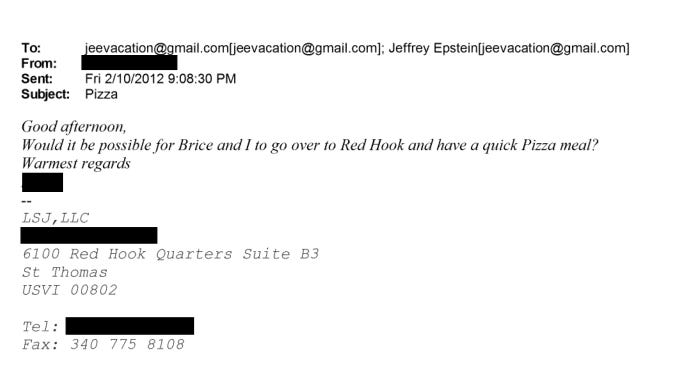
The sender’s name has been redacted, and the identity of “Brice” is unclear, but a former New Zealand Army chef named Brice Gordon co-managed Epstein’s New Mexico ranch and was interviewed by the FBI in 2007. Red Hook is an unincorporated town in the U.S. Virgin Islands — the least-populated such place, according to the 2020 census, consisting mostly of marinas. There is, as it turns out, a pizza restaurant there. But why would someone need Epstein’s permission to have a “quick pizza meal” to which the financier was not invited? It’s enough to drive a sensible person to speculation.
From the mainstream media’s perspective, the problem is not that we are ruled by genocidal Israeli-Mossad-empowered Jewish supremacist psychopathic billionaire perverts. It is that someone might notice that we are ruled by genocidal Israeli-Mossad-empowered Jewish supremacist psychopathic billionaire perverts. That would mean that the “antisemitic conspiracy theorists” were right all along. Oy vey! Double-plus ungood!
Though the mainstream media professes to hate racism, they are covering up Epstein’s virulent racism against non-Jews. The emails are full of disparaging references to “goys,” a term for non-Jews that roughly parallels other racial slurs including the N-word. Epstein and his supremacist cronies loved to degrade non-Jewish children and teens, but never targeted their fellow “chosen people.”
For many Americans, the most disturbing revelations in Epstein files involve President Donald J. Trump. Prior to the files’ release, we already knew that Trump flew on Epstein’s jet at least eight times, was referred to by Epstein as his “best friend,” sent a birthday drawing to Epstein depicting a barely pubescent naked girl alluding to their “secret,” and has been accused of raping 13-year-old “Katie Johnson” in 1994 at an Epstein party and then threatening to kill the girl and her family. The first Epstein dump also contained FBI witness reports that Trump was present when a baby was drowned in Lake Michigan, and was implicated in the rape and murder of a certain Dusty Rhea Duke in 2000.
The new Epstein files release includes FBI witness reports that Trump was involved in murdering three girls who were buried at Mar-a-Lago and threatening the witness with a similar fate. Witnesses also told the FBI that Trump auctioned underage girls from his swimsuit contests, measuring their vulvas and rating them for tightness. Trump is also accused of forcing oral sex and other abuses against 13 and 14 year old girls.
Meanwhile the mainstream media chant in unison: “President Trump has not been accused of wrongdoing.” Will they change their tune, and suddenly discover the FBI files, if and when Trump stops following Israel’s orders?
A shorter version of this article was published in last week’s American Free Press. -KB
Stripe is Substack’s only processor and they debanked me, so you can no longer pay me through Substack. Now I am posting everything on Substack free and asking people to sign up for recurring donations at my Paypal donation page… or better yet, the free speech platform SPdonate. Alternately you can Paypal or Zelle to truthjihad[at]gmail(dot)com. Note that Zelle, unlike other methods, doesn’t charge any fees.
The Mandelson Molecule: Exposing the Architecture of Cross-Border Political Suppression
By Freddie Ponton | 21st Century Wire | February 18, 2026
The resignation of Peter Mandelson as UK ambassador to Washington in February 2026 revealed more than a scandal—it exposed the architecture of a parallel governance system operating through deniable channels. The Epstein files, the Center for Countering Digital Hate (CCDH) censorship apparatus, and the Mandelson intelligence pipeline are not separate stories. They are component parts of a transatlantic mechanism that converts private access into public control, with enforcement mechanisms that now reach across sovereign borders to silence American citizens.
Jeffrey Epstein was a convicted sex offender with deep ties to political and financial elites on both sides of the Atlantic. Peter Mandelson is a former UK power‑broker and ambassador to Washington, now under investigation for secretly sharing government information with Epstein. This article shows how their relationship connects to a wider system of online censorship and private global‑health finance.
The Intelligence Pipeline: Real-Time Treasury Briefings to a Convicted Sex Offender
The Mandelson-Epstein correspondence reveals something far more systematic than indiscreet friendship. It documents a private intelligence channel operating at the highest levels of UK and US financial policy.
In December 2009, while serving as Business Secretary, Mandelson forwarded Treasury positions on the bankers’ bonus tax to Epstein within hours of receiving them, with Epstein requesting advance notice “before Jes” and Mandelson replying simply: “Treasury”. By March 2010, the pattern had escalated—Mandelson forwarded notes from a meeting between UK Chancellor Alistair Darling and US Treasury Secretary Larry Summers to Epstein within five minutes, followed by his own meeting with Summers the next day. Those notes were forwarded within two minutes.
The content was market-moving intelligence: Dodd-Frank implementation, hedge fund taxation, derivatives regulation, and Bank of England quantitative easing strategy during the credit crunch. Mandelson advised Epstein that JPMorgan’s CEO should “mildly threaten” Chancellor Darling over policy. This systematic extraction of live government intelligence for private financial advantage can hardly be construed as incidental corruption.
DOCUMENT: Peter Mandelson leaked No 10 documents to Epstein, who then helped him pursue multi-million dollar jobs (Source: Tax Policy Associates)
The Censorship Architecture: From Anti-Corbyn Operations to American Deplatforming
The same censorship machine that produced the Biden White House’s authoritarian campaign against the so-called “Disinformation Dozen” in 2021 had emerged from the notorious Room 216, Brixton, where Israeli loyalist and architect of Keir Starmer’s rise to power, Morgan McSweeney, along with Imran Ahmed, built the “Labour Together” operation to dismantle Jeremy Corbyn. It was a CCDH list of 12 named individuals, which the White House then pushed Facebook to censor. The March 2021 “Disinformation Dozen” report was not independent research—it was unequivocally the identical playbook redeployed. The Biden White House directly cited CCDH’s report to pressure Facebook into censoring American health publishers, with internal documents showing the platform’s “secretly demoted” users, including alleged “anti-vaxxers”, and Twitter accounts of targeted individuals. When Facebook pushed back that the “majority of the accounts in question were not spreading misinformation,” the White House persisted.
Among those branded the “Disinformation Dozen” by the CCDH in March 2021: Robert F. Kennedy Jr. (Children’s Health Defense), physician Joseph Mercola, and Sayer Ji—whose investigative work exposing the Mandelson intelligence pipeline appears later in this report.
The method was documented in internal strategy papers: cultivate “seemingly independent voices to generate and share content to build up a political narrative,” infiltrate opposition spaces to extract decontextualised content, and feed narratives to sympathetic media. The “antisemitism crisis” that destroyed UK Labour Party leader Jeremy Corbyn was, as Labour Party files confirm, instrumentalised by this same faction.
Morgan McSweeney was CCDH’s founding director and subscriber for 18 months, operating from the same Brixton office that produced Labour’s anti-Corbyn operation. When he resigned in April 2020 to become Starmer’s chief of staff, Ahmed inherited an apparatus already proven effective at demonetising political opposition.

Morgan McSweeney, founding director of the CCDH, and former British Prime Minister Keir Starmer’s Chief of Staff. (Source: The Edge | Business news)
The March 2021 “Disinformation Dozen” report was not independent research—it was unequivocally the identical playbook redeployed. The Biden White House directly cited CCDH’s report to pressure Facebook into censoring American health publishers, with internal documents showing the platform “secretly demoted” affiliated accounts and Twitter accounts of targeted individuals. When Facebook pushed back that the “majority of the accounts in question were not spreading misinformation,” the White House persisted.
Project Molecule: The Financial Infrastructure of Private Governance
The August 2011 JPMorgan “Project Molecule” blueprint reveals the financial architecture that made this system durable. The $150 million fund Epstein pitched to JPMorgan CEO Mary Erdoes was designed to operate “across sovereign borders, into specific countries, for specific biological interventions”—with no elected officials, no treaty obligations, and no public accountability beyond its own audit committee.
DOCUMENT: JPMorgan “Project Molecule” blueprint (Source: DOJ Epstein File Library | EFTA01301114)
Epstein operated as Bill Gates’s representative under a written agreement, with the explicit purpose of securing “additional money for vaccines” while creating a “permanently governed, privately controlled, transnational system”. The budget allocated $40M for polio vaccines in Afghanistan, $40M in Pakistan, $20M specifically for “financing the surveillance network in Pakistan,” and $30M for rotavirus vaccines in Latin America.
This is the governance model: private intelligence (Mandelson-Epstein), private finance (Project Molecule’s offshore vaccination funds), and private enforcement (CCDH’s deplatforming operations) operating in substitutional parallel to democratic institutions.
The Enforcement Layer: Cross-Border Suppression of American Speech
What transforms influence operations into censorship is enforcement. The original investigation documents the apparatus reaching into foreign legal proceedings against American journalists—cross-border enforcement without due process, extradition treaties, or congressional oversight.
The pattern is now confirmed by US government action. In December 2025, Secretary of State Marco Rubio barred Imran Ahmed from entering the United States, citing his role in “leading organised efforts to coerce American platforms to punish American viewpoints they oppose”. Ahmed was one of five Europeans sanctioned under a visa policy targeting foreigners responsible for censoring protected speech in America.
The CCDH is now reportedly under DOJ investigation for potential violations of foreign agent registration laws, given its coordination with UK Labour operatives while targeting US political speech. Labour’s deployment of approximately 100 operatives to US swing states during the 2024 election—conducted by McSweeney’s network—has generated formal FEC complaints alleging direct electoral interference.
After days of parliamentary theatre about “transparency,” Westminster has craftily moved to bury the Mandelson-Epstein papers—not in open sunlight, but inside the Intelligence and Security Committee, a body three of whose members have already stuffed with cash from pro-Israel lobbyists.
In Britain, Downing Street originally wanted veto power over anything “prejudicial to national security”, but the documents will now be reviewed by the Parliament’s Intelligence and Security Committee (ISC). Critics argue that this allegedly independent oversight body could be compromised. In effect, three sitting members—Deputy Chair Sir Jeremy Wright, Sir John Hayes, and Labour’s Derek Twigg—have all taken money from the pro-Israel lobby, which by some estimates bankrolls roughly a quarter of British MPs. This can be verified in the excellent Declassified UK report published in June 2024.
The bottom line is that the Epstein file, which details how Mandelson piped classified Treasury intelligence to a convicted sex offender, and how British power brokers and Wall Street criminals traded backroom briefings, will now be “vetted” by politicians on the take from foreign influence networks. Forget transparency—it was never on the table.
The Architecture of Manufactured Consensus
The critical insight is structural: these networks exploit the gap between formal democratic institutions and actual governance. Mandelson’s Treasury briefings to Epstein occurred through informal channels. Project Molecule’s sovereign surveillance programs were designed to operate offshore. CCDH’s censorship operations, though effective at capturing White House policy, occurred through a nonprofit rather than state agencies. According to reports, George Soros is said to have donated $250,000 to the CCDH, which is working to censor conservative news outlets and to undermine Musk’s Twitter.
When the same personnel (McSweeney as CCDH founder, then Starmer’s chief of staff), the same infrastructure (Brixton operations), and the same methods (crisis amplification, media laundering, financial pressure) appear across Corbyn’s destruction, COVID censorship, and US electoral operations, we are not observing a coincidence. We are witnessing a system.
The switchboard is not the scandal. The switchboard is the system, and it is now being dismantled by the very government it sought to influence.
The Original Investigation
This synthesis builds upon the groundbreaking investigative work of Sayer Ji, founder of GreenMedInfo and author of the Switchboard series—including the first publication to connect the Mandelson-Epstein intelligence pipeline to the CCDH censorship apparatus. Ji’s research, conducted under direct legal and professional pressure from the very networks he was exposing, documented how British political operatives built a cross-border enforcement mechanism capable of weaponising foreign courts against American journalists.
His original reporting on Room 216, the Brixton operations, and the emergence of “disinformation” as a tool for political suppression predates mainstream coverage by years, and has now been validated by the Epstein disclosures, the Rubio sanctions against Ahmed, and the DOJ’s investigation into CCDH’s foreign agent activities.
Read the complete investigation series and supporting documentation at Sayer Ji Substack…
Sayer Ji reports on Substack…
The Switchboard: From Epstein to Mandelson to McSweeney to Ahmed — How a British Machine Became America’s Censorship Engine
How the Epstein Files Reveal the Architecture Behind Censorship, Crisis Finance, and What Happened When I Investigated It – Part 3 in a Series
Peter Mandelson, “the Prince of Darkness,” Keir Starmer’s hand-picked ambassador to Washington, the most powerful unelected figure in British politics, resigned from Parliament this week, one step ahead of legislation to eject him. The Metropolitan Police opened a criminal investigation. The Prime Minister apologised to Jeffrey Epstein’s victims for believing Mandelson’s lies.
The press is treating this as a story about a politician’s downfall. It is not. It is a story about what he was connected to — and what was built to make sure you never found out.
Key Findings:
- The censorship machine that targeted American speech during COVID was built inside a Labour Party factional operation. Morgan McSweeney and Imran Ahmed created the Center for Countering Digital Hate (CCDH) from the same office, using the same staff, and the same dark-money infrastructure they used to destroy Jeremy Corbyn — then redeployed the identical playbook against U.S.-based health publishers and independent media.
- CCDH’s founder and political patron is a protégé of Peter Mandelson, who was simultaneously routing confidential UK and U.S. government intelligence to Jeffrey Epstein. Mandelson forwarded Treasury readouts on the Volcker Rule, Dodd-Frank, and derivatives regulation to Epstein within minutes of receiving them — intelligence worth billions to Epstein’s Wall Street clients. The same political culture of deniable backroom operations that made the Epstein network functional also produced CCDH.
- Epstein’s network was not just criminal — it was architectural. Project Molecule, a $150M JPMorgan blueprint produced the same month Epstein sketched a private global health fund, reveals the institutional machinery: offshore vaccination funds, sovereign biological surveillance programs, and governance structures designed to bypass elected oversight entirely.
- The enforcement layer is not theoretical — it has already been deployed against named individuals. CCDH’s “Disinformation Dozen” list led directly to platform deplatforming. In at least one documented case, CCDH-originated material was entered into foreign legal proceedings to seek an ex parte arrest warrant against a U.S.-based journalist for lawful American speech — cross-border enforcement with no due process, no extradition treaty, and no congressional oversight.
- The same network is now the subject of a formal FEC complaint alleging direct electoral interference. McSweeney — Mandelson’s protégé, CCDH’s political architect, and now Starmer’s chief of staff — was named in a formal FEC complaint for dispatching approximately 100 Labour operatives to U.S. swing states during the 2024 presidential election. The censorship pipeline and the electoral interference pipeline share the same personnel, the same infrastructure, and the same assumption: that British political operatives can shape American outcomes without accountability.
Zelensky’s Ceasefire for Elections is Strategic Gambit, Not Democratic Move
By Ekaterina Blinova – Sputnik – 17.02.2026
Volodymyr Zelensky’s reluctance to hold elections in Ukraine is multi-faced, according to Marco Marsili, geopolitical analyst at CESRAN International and former OSCE election observer.
The Ukrainian politician is on thin ice despite optimistic polling numbers: “The reported approval ratings reflect a carefully managed wartime narrative, not democratic reality,” Marsili tells Sputnik.
What’s the reality?
- Demographic catastrophe: An entire generation of fighting-age men has been consumed by the front lines
- Economic collapse: Beyond Western-subsidized survival, Ukraine’s economy is a shell
- Neo-Nazi grip: Zelensky’s political survival depends on being perceived as a strong promoter of nationalism
To block elections and derail legitimate peace talks, Zelensky is demanding conditions that directly contradict Russia’s position.
“Zelensky’s proposal for a two-month ceasefire to enable elections is a multilayered strategic gambit, not a genuine democratic exercise,” says Marsili.
How would Zelensky use the ceasefire he demands?
Military respite: “It is a classic military pause dressed in political clothing,” the pundit explains. “Two months without active hostilities would allow Ukraine to reconstitute its shattered forces.”
Shifting blame: By proposing elections and blaming Russia for rejection, Zelensky positions himself as pro-democracy and paints Moscow as the obstacle.
Dragging West deeper into conflict: A positive Western response to Zelensky’s security demands during potential elections deepens their commitment; a negative one exposes the limits of their support.
“Russia’s insistence on addressing the root causes — NATO expansion, the status of Russian-speaking populations, Ukraine’s neutrality — reflects its view that procedural fixes like elections are meaningless without resolving the underlying security architecture,” Marsili underscores.
US and Dutch pilots flying F-16s for Ukraine – Western media
RT | February 17, 2026
The Ukrainian military is secretly using a squadron of veteran NATO pilots to fly donated US-made F-16 fighter jets, the French outlet Intelligence Online reported on Monday.
Moscow has long warned that Western nations are moving closer to direct conflict with Russia. The report, which Kiev has denied, said the covert mission relies primarily on experienced US and Dutch air force veterans.
The foreign personnel are deployed far from the front lines and focus on intercepting Russian long-range weapons, the outlet said. They are no longer part of their original militaries and reportedly work for Kiev as civilian contractors, without military ranks and outside the Ukrainian chain of command.
A shortage of trained Ukrainian pilots was previously identified as the main obstacle to using F-16s donated to Kiev. Training courses were reportedly undermined by language barriers, a lack of qualified trainees, and other issues, and were simplified for speed.
Shortly after the first F-16s arrived in Ukraine in August 2024, Kiev began losing pilots in botched air defense missions, with four such incidents acknowledged.
The secret foreign squadron provides pilots with the experience needed to operate advanced F-16 equipment, Intelligence Online said.
Moscow views the Ukraine conflict as a NATO proxy war against Russia, in which key elements of Kiev’s military effort – including intelligence, planning, troop training, and maintenance of complex Western hardware – are handled by foreign personnel.
Western specialists were reportedly involved in Ukrainian strikes using Storm Shadow/SCALP air-launched cruise missiles on Russian territory. German officials opposed supplying Taurus missiles because Ukrainians cannot launch them independently.
Russia also says Western nations tacitly support Kiev’s recruitment of mercenaries from among their military veterans. Ambassador-at-Large Rodion Miroshnik estimated that around 20,000 foreign fighters have taken part in the conflict on the Ukrainian side.
Featured Video

No Threat Can Force Iran’s Surrender /Trita Parsi & Lt Cl Daniel Davis
or go to
Aletho News Archives – Video-Images
From the Archives
What is the Israeli Lobby in Australia Doing in Interfaith Dialogue?
By Ali Kazak | Dissident Voice | October 11, 2015
For years Israel and its lobby around the world have been trying to normalise their relations with Arabs and Muslims without solving the Palestine Question.
One of the methods they resorted to in the last few years is using human rights and community organizations such as interfaith dialogue and Multiculturalism to achieve this objective and to: isolate the Palestinians, marginalise the Palestine question, end Israel’s isolation, and prevent criticism of Israel, knowing that these organisations will be the first to stand against Israel’s violations, racial and religious discrimination.
The group responsible for this task in Australia is The Australia/Israel & Jewish Affairs Council (AIJAC); its Director of International & Community Affairs, Jeremy Jones is in charge of lobbying religious community organizations, specifically Muslims and Christians. Consequently he convened the Faith Communities for Reconciliation, founding participant in the Australian Partnership of Religious Organisations and the Australian National Dialogue of Christians, Muslims & Jews.
AIJAC is a private political propaganda group. It is recognised as the main Israeli lobby in Australia. It coordinates its activities and works intimately with the Israeli embassy in Canberra and different institutions in Israel. It is privately funded by some Jewish businessmen. It monitors closely Australian politicians, the media, ethnic and religious groups, (especially Arabs and Muslims), unions and academics on their stands towards Israel and the Palestine question. … continue
Blog Roll
 Aletho News
- The war of liberation of the Arab and Islamic peoples expands across the Gulf
- Envoy warns UN on Trump’s threat to ‘obliterate’ Iran’s civilian infrastructure
- The Larak Corridor: Iran’s Rial Gate With No US, No Israel, and No Way Around
- ‘Economic terrorism’: Steel facilities hit again in US-Israeli strike
- ‘War Crime’: Iran condemns attacks on Arak, Ardakan nuclear sites
- Two-thirds of Americans want quick end to Iran war even if goals unmet
- Trump to Give “Important Update on Iran” Wednesday in Prime-Time Speech
- Theodore Postol: Iran’s Missiles & Drones Were Underestimated
- Iran To Target Military Industrial-Tech Complex That Facilitated Gaza Genocide
- Collapsing Empire: The Resistance Disarms ‘Israel’
- If Americans Knew
- Israel wants US to bomb more of Iran’s civilian structures (113,000 is not enough) – Not a ceasefire Day 173
- Ann Coulter Rips Into Fox News for Iran War Coverage
- Joe Kent Urges Americans To Call White House and Congress To Object To Sending Troops Into Iran
- DNC Resolution to Reject AIPAC Funding Puts Democratic Leaders in the Hot Seat
- Swedish foundation to build 400 schools as over 650,000 Gaza children remain without education for 2 years
- Israeli army admits photshopping image of slain Lebanese journalist
- This is how Israel is systematically killing health workers under the cover of war in Lebanon
- Carrying life under fire: Israeli invasion of Lebanon leaves pregnant women facing deadly risks
- Champagne all around for the new death penalty (for Palestinians) law – Not a ceasefire Day 172
- Why are Palestinian books struggling to be seen on Amazon?
- No Tricks Zone
- New Study Finds Warming Saves Lives…Cold Temperatures 12 Times More Deadly Than Excess Heat
- German Science Blog Accuses PIK Climate Institute Of Hallucinating Climate Tipping Points
- Devastating Assessment Of Comirnaty Vaccine By Former Senior Pfizer Europe Toxicologist
- New Study: CO2 Is ‘Effectively Negligible’ As An Explanatory Climate Change Factor Since 2000
- Former Pfizer Toxicologist Dr. Helmut Sterz Tells Bundestag Hearing Pfizer Vaccine Should Have Never Been Approved
- Energy Expert: Germany’s Nuclear Phaseout Was A “500 Billion Euro Mistake”
- New Research: South Australia’s Mid-Holocene Sea Surface Temperatures Were 4°C Warmer Than Today
- Storing Green Energy To Last Germany 10 Days Would Require A 60-Million Tonne Battery
- New Studies: UK Sea Levels Were 4 Meters Higher Than Today During The Mid-Holocene
- Destructive Green New Deal: German Energy And Metal Group Warns Of Drastic Crisis
 Aletho News