6-Week-Old Amish Infant With Fatal Genetic Condition Died From Measles, Coroner Confirms
By Henrick Karoliszyn, DSW | The Defender |September 4, 2026
A 6-week-old Amish infant with a neurological genetic disorder died from measles, Lancaster County Coroner Stephen Diamontoni said today. Lancaster Online first reported the death and Diamontoni’s comments.
The baby girl, born with Amish lethal microcephaly, a condition that typically causes infants to die within six months of birth, died on Aug. 18, the coroner said.
“Those children are sick from birth and actually are placed on palliative care from the time of birth,” Diamontoni told Lancaster Online today. “They typically only live 5 or 6 months of age and the majority of those children die as a result of a respiratory infection of any kind, because their brain is very small and they don’t have the capacity to fight those infections well.”
The infant’s death “was not unexpected,” Diamantoni said. He said the Clinic for Special Children in Leacock Township handled the case. When reached for comment, the clinic refused to comment, citing privacy laws.
Diamantoni said he did not know if this was the second “measles-associated” death initially reported on Aug. 25 by Gov. Josh Shapiro.
Lancaster County Commissioner Josh Parsons said today in a statement that the county still could not confirm the death of the infant as “measles-associated.”
Parsons said state officials provided little information beyond saying the 6-week-old — and a newborn whose death the coroner confirmed on Aug. 25 — were both “unvaccinated.”
Parsons questioned that characterization, noting that a 6-week-old infant would not ordinarily have had an opportunity to receive a routine measles vaccination.
“If this is the second [‘measles-associated’ death] case, the ‘unvaccinated’ label would again be deceptive.”
The newborn, also Amish, died during childbirth. The infant tested positive for measles, but according to the coroner, she died of a ruptured spleen — not of measles.
Parsons said that if the newly identified infant is the second case that was announced Aug. 25 by the state, officials should have provided additional context while protecting the family’s privacy.
“There are obviously significant relevant facts that should have been discussed about the case,” Parsons said, adding that those facts could have been presented “in a careful,” accurate and honest way without identifying the infant or family.
“That was not done,” he wrote on X. “The opposite was done. The few facts revealed were done so in a deceptive and inflammatory manner.”
Parsons also said the delay in notifying the coroner’s office prevented his staff from conducting what he described as a full, routine investigation, including a review of physical evidence.
“Much of the debate and invasion of privacy could have been avoided by state officials being honest and forthright at the beginning of this, rather than forcing the people of Lancaster County to track down information a piece at a time,” he said.
RFK Jr. ‘undermined public health,’ says Shapiro
After today’s statement to the press about the 6-week-old infant, Shapiro continued relaying on X that both cases were the “first two measles-associated deaths in 35 years.”
The Pennsylvania Department of Health uses the term “measles-associated” when there is laboratory or epidemiological evidence of the virus.
Shapiro criticized U.S. Health Secretary Robert F. Kennedy Jr., saying:
“Instead of listening to the real doctors and public health experts, RFK chose to sow doubt, play politics, direct the CDC not to acknowledge these deaths, and even accuse me of fabricating these tragedies. That led to a firestorm of conspiracy theories that denied these families’ pain, invaded their privacy, and undermined public health.
“It’s long past time for RFK to stop playing games with people’s lives, report these deaths accurately on the CDC dashboard, and heed the guidance of actual medical experts so people get accurate information to discuss with their trusted health care providers and can best protect themselves and their children against this deadly disease.”
Shapiro used his initial announcement of the deaths on Aug. 25 to criticize the Trump administration’s approach to vaccination policy and public health messaging.
“When the information we see coming from the federal government, in some cases, isn’t driven by facts and by science, it makes it even more confusing for parents, and that has a serious impact,” Shapiro said.
Kennedy responded on social media by accusing Shapiro of announcing the deaths with “giddy delight” for partisan purposes. He called the governor’s announcement “unseemly” and accused him of using the COVID-19 playbook, which includes “the weaponization of infectious disease fears for political gain.”
The Centers for Disease Control and Prevention (CDC) decision not to include the deaths in its national count has only added to the dispute.
“CDC has a responsibility to ensure its reporting accurately and transparently reflects what is known and what remains unconfirmed,” a U.S. Department of Health and Human Services spokesperson told The Defender. “The two measles-associated deaths announced by Pennsylvania have not been confirmed based on the information currently available to CDC.”
The CDC said the current data reflect “the best available information and our commitment to transparency and telling the American people the truth.”
The measles outbreak continues
Meanwhile, the measles continues to spread in Pennsylvania and beyond.
The U.S. has recorded its highest number of measles cases in 35 years.
As of today, 577 people in Pennsylvania had contracted measles in the current outbreak, with 115 new cases reported in the state in the past week. The state also reported 87 hospitalizations as of Aug. 31, with Lancaster County among the hardest-hit areas.
Lancaster County is home to the country’s largest Amish community, where vaccination rates have historically been lower than in the general population. Pennsylvania health officials estimated last year that only about 25% of Lancaster County’s Amish population had received the measles, mumps and rubella (MMR) vaccine.
The Amish Church has no official doctrine prohibiting vaccination. The parents of the newborn who died of a ruptured spleen told The Atlantic that their decision not to vaccinate their children was not politically motivated and was not based on extensive research.
The Pennsylvania Department of Health says vaccination remains the best protection against measles and has expanded vaccination clinics in response to the outbreak. The state says more than 35,000 Pennsylvanians received an MMR vaccine in July, about 10,000 more than in a typical month.
The Lancaster County coroner’s office and the Pennsylvania Department of Health ignored several requests for comment from The Defender.
This article was originally published by The Defender — Children’s Health Defense’s News & Views Website under Creative Commons license CC BY-NC-ND 4.0. Please consider subscribing to The Defender or donating to Children’s Health Defense.
The Fall of Brazil’s Tyrannical Judge May Be Imminent: Moraes and His Sleaze Are Exposed

By Glenn Greenwald | September 4, 2026
Alexandre de Moraes spent months denying corrupt profits from a collapsed bank. The proof is now overwhelming, and his desperate moves to survive may imperil Lula’s re-election and Brazil’s democracy.
Exactly one month before Brazil holds its presidential election, the country is drowning in a corruption scandal and institutional civil war, the gravity of which is impossible to overstate. At the center of it is Brazil’s authoritarian and increasingly unhinged Supreme Court Justice Alexandre de Moraes, who was sanctioned by the U.S. as a human rights abuser in 2025 after he banned X from Brazil for one month over its refusal to censor at his behest, then ordered money removed from Starlink’s accounts to pay for X’s fines.
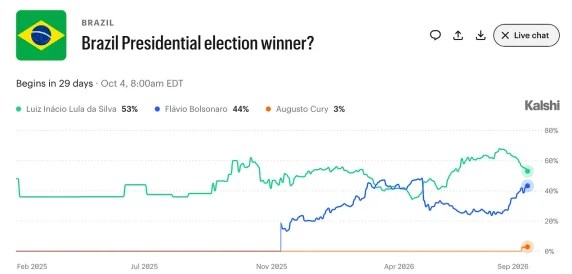
While polls all year have shown that the incumbent left-wing president, 80-year-old Lula da Silva, has a modest lead to win his fourth term, more recent polls have shown him tied with his primary adversary, Senator Flavio Bolsonaro. Bolsonaro is the son of former President Jair Bolsonaro, now imprisoned for 28 years by Judge Moraes on charges of plotting a coup after losing the 2022 election to Lula.
Despite once being affiliated with the center-right, Moraes has become Lula’s closest and most important ally, and the left’s most beloved hero. For that reason, Moraes’ exploding scandal can only further weaken Lula heading into the election. Other than Uruguay, Brazil is the last country in South America still governed by a left-wing or center-left government, with one country after another electing leaders on the right: Argentina, Colombia, Peru, Ecuador, Chile, etc.
Moraes’ conduct is so unprecedentedly sleazy and corrupt that it is difficult to report without provoking understandable doubt. How could it be possible that a democratic country is tolerating, for even one day, a Supreme Court judge remaining in power if his personal corruption and grave abuses of power are really this manifest? Over the past 48 hours, Brazil’s leading newspapers, previously virtually unanimous in their support of Moraes, have demanded his immediate resignation.
At the center of the scandal is a collapsed, fraudulent bank called Banco Master. In 2025, the Central Bank ordered its liquidation after it was revealed to be essentially a Ponzi scheme funding the libertine, Dubai- and Miami-based billionaire lifestyle of its Brazilian president, Daniel Vorcaro. It quickly became the worst banking loss in Brazil’s history by far, with estimated losses of at least $40 billion. Vorcaro was arrested last November at São Paulo’s international airport as he tried to board his private jet to Dubai to flee justice.
The bank’s collapse, Vorcaro’s arrest, and the ensuing criminal investigation have produced a tsunami of evidence showing how Vorcaro — as he was stealing from depositors, including retirees and civil servants — was secretly shoveling huge sums of money and other assets of value to Brazil’s leading politicians and judges, on both the left and right, with the expectation of protection. One of those most enriched by Banco Master is Lula’s longtime Workers’ Party ally in the Senate, Jaques Wagner; Vorcaro also furnished large sums to the Bolsonaro family, including to Flavio, nominally to finance a film about the former president.
But nobody has been as enriched — or as implicated — by Vorcaro and Banco Master as Justice Moraes. Late last year, Brazil’s Globo media empire — for years Moraes’ loyal supporter — revealed that the bank had given an undisclosed 18-month contract to Moraes’ wife worth $27 million.
While Moraes’ wife is an attorney, and the obscene sums under the contract were for “legal services,” she is an ordinary and mediocre one at best. Even Brazil’s best and largest law firms said that such a sum would be unthinkable for vague “legal services,” let alone that kind of generational wealth paid to the small family law firm composed of Moraes’ wife and their two lawyer children. In other words, there would be no rational reason why this bank would enter into such a lavish multi-million dollar contract with Moraes’ wife absent an agreement to secure the influence and protection of her very powerful husband.
More incriminating revelations about Moraes came fast and furious in the first two months of the year. He called the Central Bank to intervene on behalf of the corrupt bank that had just bestowed on him generational wealth. He and Vorcaro were communicating with each other in the days leading up to Vorcaro’s arrest. At least $17 million had been paid by the bank to Moraes’ wife under the original contract. Facing intense public pressure, she could not provide any documentation or explanation of what “legal services” she furnished that would remotely justify this bizarre contract.
In the face of all these media reports, Moraes denied essentially everything. Even though Globo had the text messages between him and Vorcaro, verified by the Federal Police, he simply lied and said they were not on his phone. That had the effect of somewhat stifling the scandal — until this week, when it exploded in a way that few scandals have.
When the Banco Master criminal case first arrived at the Supreme Court, it was conveniently assigned to a judge who had as much incentive as Moraes to hide it all. That judge immediately put the entire case under “absolute secrecy,” meaning nothing would be disclosed to the public. But when it was revealed that this judge and his family had their own massive, hidden financial ties to Vorcaro and the bank, he was forced to step aside, and the case was then randomly reassigned to Justice André Mendonça, one of only two judges on the 11-member court appointed by Bolsonaro.
Last week, Vorcaro told Mendonça that he was being physically and psychologically tortured in prison and threatened with death at the hands of the Lula-appointed head of the Federal Police. Mendonça thus ordered the Federal Police to turn over to him the results of their investigation into Vorcaro’s communications with anyone on the Supreme Court or Federal Police. On Monday, key excerpts of the 218-page report on Moraes’ genuinely shocking behavior, and then the full report itself, were disclosed by the daily newspaper Estadão.
Among the revelations: the wealth lavished on the Moraes family by Vorcaro was not limited to a $27 million contract, but also included a separate $10 million contract for his wife, free use of Vorcaro’s private jets and helicopters, and even credit cards for each of their children with a monthly limit of $70,000, with a total value of close to $40 million. Over the last two years, the Moraes family has acquired a virtual real estate empire, including a new $3.5 million mansion in the nation’s capital, Brasília, as well as other residences.
Just as one would expect, the generational wealth bestowed on the Moraes family from Vorcaro and the bank’s stolen deposits was not for free. Moraes was expected to do a great deal for the corrupt billionaire, and he did.
When conversing via WhatsApp, Moraes and Vorcaro both sent their messages using the app’s “one-time visualization” feature to ensure that their messages would be destroyed after they were read once. In several cases over which he presided, Moraes himself has classified the use of this feature as intentional obstruction of justice when he cited it to justify sending people to prison before trial.
Unfortunately for Moraes, the Federal Police were able to recover Vorcaro’s deleted messages to him (but not yet Moraes’ texts to Vorcaro, because they have not yet seized Moraes’ phone). Those recovered deleted messages show Vorcaro speaking extensively with Moraes about how he could escape and/or block prosecution, including asking Moraes about which dates he should flee the country to avoid imminent arrest, along with extensive discussions about Moraes’ efforts to have the chief prosecutor and the head of the Federal Police block criminal investigations. In several messages, Vorcaro proclaimed himself to be “in debt for life” to Moraes and with “life-long gratitude” to the judge for everything he did for him.
And, of course, Vorcaro appeared to have known exactly when the police were coming for him since they arrested him at the airport as he tried to flee to Dubai. Just two weeks ago, Moraes, along with the rest of the Supreme Court, ordered two Rio de Janeiro politicians indicted and arrested for having allegedly leaked details of an imminent police operation in advance to arrest criminals with whom they are associated.
Some of Moraes’ efforts to reward Vorcaro and the bank for the generational wealth bestowed on his family were out in the open. In one case highlighted by CNN Brasil, Moraes used his power as a Supreme Court judge to pause a criminal case against the bank that threatened its value, doing so shortly after the bank signed the $27 million contract with Moraes’ wife.
With these facts confirmed, this is about as clear-cut a case of proven abuse of power and massive corruption as one can imagine. On top of all of that, this shows that Moraes lied constantly to the public when denying these interactions when they were first reported: a rather significant finding given that he has been censoring and even imprisoning political enemies of Lula’s government and his own critics for years by accusing them of spreading “fake news.”
But one does not acquire and exercise authoritarian power for years without a network of powerful enablers and an entrenched tyrannical mindset that believes any criticism, questioning, or challenge of his power is, by definition, criminal. And Moraes, as he has done for years, is now insisting that the real criminal is not himself but the person who caused his conduct to be revealed to the public: in this case, his own colleague on the Supreme Court.
On Thursday, Moraes issued an order essentially putting Judge Mendonça under criminal investigation for “abuse of power.” Moraes’ allies in the Brazilian Senate, controlled by its Moraes-allied president, have long blocked impeachment attempts against Moraes but are now insisting that Judge Mendonça should be impeached for bringing to light this extraordinary wrongdoing.
Meanwhile, Lula — desperate to distance himself from the incomparable sleaze of his closest judicial ally, but also afraid of what they will do to him if he publicly sides against them — has been left to read incoherent and painfully vague statements from a teleprompter filled with meaningless bromides about how nobody is above the law. One strong weapon of leverage Moraes and his allies hold over Lula’s head is that Lula’s son is enmeshed in an extremely serious corruption scandal involving his alleged trading of influence for lobbyist profit, which Lula’s party is desperately trying to suppress until after the election.
What has happened here is a lesson for all Western democracies. The Brazilian establishment purposely vested Moraes with unlimited and unconstitutional powers in the name of “saving democracy” from Bolsonaro. They watched for years, with some growing discomfort, as Moraes went further and further in his authoritarian zeal. They assumed — or at least hoped — that once the Bolsonaro movement was smashed and prevented from contesting future elections, Moraes would then voluntarily return those powers and everything would return to normal.
But anyone with an even fleeting knowledge of history, or human nature, would have known that this would not have happened. Many of us spent years warning that these “emergency powers” would become permanent, citing the model of post-9/11 “emergency powers” in the U.S. that are now permanent. But all to no avail: Moraes was too valuable to try to rein him in any way.
So, now, the establishment forces in media and politics that created this tyrannical Frankenstein are trying to do everything possible to constrain their monster. But in many ways, he has become far more powerful than his creators. He is also clearly inebriated with his own power and righteousness, making him willing to do literally anything to preserve it and ensure his survival. All of this is leaving the outcome of this remarkable scandal, the ensuing constitutional crisis, and even Brazilian democracy itself very much in doubt.
Three other points:
(1) As noted, polls in Brazil basically now show a tie between Lula and Flavio Bolsonaro in the expected run-off election between the two. Kalshi has begun to reflect the rapidly changing expectations;
(2) I was on Piers Morgan’s program this week to discuss a wide range of issues, including the Iran War. You can watch that here.
(3) We conducted our live weekly Q&A last night, as we always (or almost always) do on Thursday night, where we respond to and interact with the questions, comments, and critiques of our subscribers. You can watch that here.
Nearly half of US citizens say Washington’s post-9/11 wars ‘worth the cost’
The Cradle | September 3, 2026
Nearly half of US citizens believe the wars waged by Washington in Afghanistan, Iraq, and beyond after the 11 September 2001 attacks have been “worth it,” a YouGov poll published on 2 August shows.
The poll was commissioned ahead of the 25th anniversary of the attacks, which the US government used as a pretext to launch the so-called “War on Terror” that led to the deaths of nearly 5 million people.
Respondents were asked if fighting “against the threat of terrorism through military operations abroad” and introducing “increased security and surveillance inside of the United States … have been worth the cost.”
Forty-eight percent responded yes, while another 27 percent said they weren’t sure. The remaining 25 percent said no.
Support for this view was strongest among Republicans, with 71 percent responding yes.
When asked whether some people in the US government knew about the 11 September attacks beforehand but let the attacks happen anyway, 39 percent of respondents agreed, and the same number disagreed.
Immediately after the attacks, US officials blamed Al-Qaeda leader Osama bin Laden.
Al-Qaeda was founded in the 1980s in Afghanistan. At the time, the CIA was arming and funding Islamic extremists known as “mujahideen” to fight the occupying Soviet Army.
The CIA later supported Al-Qaeda militants fighting in Bosnia, Kosovo, Chechnya, Iraq, and Syria, while claiming to be opposed to the group.
In 2024, the US helped install former Al-Qaeda in Iraq leader Ahmad al-Sharaa as president of Syria following the CIA’s 14-year covert war to topple the government of Bashar al-Assad.
When YouGov asked if Iraqi president Saddam Hussein was involved in the 11 September attacks, 38 percent agreed, while 34 percent disagreed.
Pro-Israel officials in the administration of former US president George W. Bush began pushing for an invasion of Iraq immediately after the attacks on the World Trade Center buildings in New York and the Pentagon in Washington, DC.
The US government and media launched a massive propaganda campaign to wrongly convince US citizens that former Iraqi president Saddam Hussein had collaborated with Al-Qaeda to carry out the attacks and that the Iraqi government possessed weapons of mass destruction that could threaten the US homeland.
Sixty-seven percent of respondents to the poll said that the amount of surveillance by the US government had been affected “a lot” by the 9/11 attacks.
In the immediate aftermath of 9/11, Bush signed the Patriot Act, which gave the US government sweeping powers to surveil US citizens, allowing the National Security Agency (NSA) to track their phone calls and movements.
When YouGov asked if “Muslims in the United States have been treated better, about the same, or worse than people of other religions,” 52 percent of respondents said Muslims have been treated worse.
Among Democrats, 71 percent agreed with the statement, while 28 percent of Republicans agreed.
After 9/11, many US citizens became hostile to Muslims, viewing them as “terrorists.”
A 2023 report from the Costs of War Project at Brown University estimated that 4.5 million people have died as a consequence of the US wars since the 9/11 attacks.
The US military carried out attacks in Afghanistan, Pakistan, Iraq, Syria, Libya, Somalia, and Yemen.
Of the 4.5 million deaths, roughly 900,000 were killed by direct violence. Roughly 3.6 million resulted from “indirect” deaths caused by the aftereffects of the wars.
Hezbollah denies ties to alleged Syria-Lebanon ‘destabilization cell’
Al Mayadeen| September 2, 2026
Hezbollah’s Media Relations Office has categorically denied any connection to a security cell reportedly arrested on suspicion of seeking to destabilize Lebanon and Syria, dismissing the accusations as entirely baseless.
In a statement released Wednesday, the office stressed that Hezbollah has no connection whatsoever, direct or indirect, to any such cell or group. It said certain media outlets, which it accused of a pattern of leveling false accusations against the Resistance, had circulated the claims linking Hezbollah to the alleged cell.
The office said attempts by these outlets to implicate Hezbollah in security-related cases, relying on unnamed sources, are part of a disinformation campaign aimed at tarnishing the group’s image, sowing discord, and undermining security and stability in Lebanon.
It asserted that the reports are part of a broader effort to malign the Resistance through unverified claims attributed to anonymous sources.
A recurring pattern
The denial follows months of similar accusations against Hezbollah from Syrian officials since the fall of the al-Assad government.
In July, Hezbollah rejected claims tying it to an attempt to smuggle weapons and missiles across the Syrian-Iraqi border, after Syrian authorities said they had intercepted a shipment concealed inside a fuel tanker arriving from Iraq. Also in April and May, the group denied allegations linking it to a cell accused of plotting to assassinate a religious figure.
Hezbollah has affirmed on each occasion that it maintains no activity, connection, or presence inside Syrian territory. The group has said the repetition of such claims raises serious questions and points to parties seeking to inflame tension between the Syrian and Lebanese peoples.
Hezbollah has also pointed to similar fabricated allegations emerging from Bahrain and Kuwait, warning of a foreign plot aimed at stoking tensions between Arab nations and the Axis of Resistance and destabilizing the wider region.
The group has consistently framed the recurring accusations as a coordinated effort tied to the broader Zionist-American agenda in the region, arguing that the timing and pattern of the claims serve to isolate the Resistance and strain relations between Lebanon and Syria at a sensitive political juncture.
Is Israel paving streets with Gaza rubble containing bodies – and is the Board of Peace funding it?
By Kathryn Shihadah | If Americans Knew | September 2, 2026
Muhammad Shehada (@muhammadshehad2) – the journalist at the center of this story – is an accomplished reporter and political analyst, a visiting fellow at the European Council on Foreign Relations and contributing writer to the London Review of Books, Newsweek, Al Jazeera English, Zeteo, The New Arab, Israeli media 972Mag and Ha’aretz, and others.
Shehada tweeted on August 26 and 27:
EU diplomats told me last week Israel has been quietly moving hundreds of thousands of tons of rubble mixed with dead bodies out of Gaza to bury evidence of its genocide.
When the EU asked Israel why or whether they filter human remains out of the rubble, no answer ever came!
I’ve been informed Trump’s Board of Peace is paying the expenses of the IDF’s covert transfer of rubble (mixed with dead bodies) out of Gaza. The money is taken from Gaza’s reconstruction funds!
The Board of Peace official X account replied on August 28:
This is categorically farcical and unfounded — total fake news. At a minimum, we would expect such an “intrepid” reporter to reach out to us for comment or clarification before recklessly spreading lies based on anonymous sources who have erroneously “informed” you.
Shehada responded the same day:
Dear Board of Peace,
1- I have a tender issued under your name on 20 May 2026 that includes “leveling & compacting” work in occupied Gaza, do you deny that document?
2- Is the Israeli company Terra Firma NOT doing “rubble clearance” in Gaza allegedly with machines that take rubble & spit out dust while the IDF is doing road-paving work (specifically near Erez)?
3- Are you NOT in any way paying, compensating, subsidizing or aiding Israeli companies, contractors, individuals, the Israeli army or government for rubble removal & road paving in Gaza?
4- If you are involved, can you explain whether any effort is being made to separate human remains from rubble or detect potential mass graves under the roads being paved? The Israeli government is silent on this.
5- I have satellite images that show clear & significant rubble removal work in East Gaza in the months of May & June. Do you deny any involvement in this?
6- Do you have anything to say on Israel killing over 1,200 Palestinians under your watch since your ceasefire started?
How about Israel restricting humanitarian aid and preventing prosthetic limbs from going to largest cohort of child amputees in modern history?
How about Israel preventing repairs of basic infrastructure (water, electricity, sewage, hospitals, bakeries), or releasing all children & women still in detention without trial or charges?
All of those unfulfilled commitments were part of phase one of President Trump’s 20-point plan!
Remarkable how none of Israel’s violations of your ceasefire ever caught your attention once in 323 days, but my sole tweet did in mere hours.
The Board of Peace account has yet to reply.
Excavation equipment for me, but not for thee
United Nations figures indicate that about 200,000 buildings – 82% of the structures in Gaza – are damaged or destroyed. Buried beneath these buildings, thousands of Palestinians await retrieval and dignified burial.
Israel has hundreds of pieces of heavy engineering machinery, and is spending a fortune demolishing what is left in the roughly 70% of Gaza under its control. Ha’aretz reports that a single piece of equipment may be rented for $1,500 a day; the operator may collect $400 a day. Nearly $1 million a day is spent on fuel.
But while part of Gaza is being demolished with massive quantities of equipment, at unprecedented speed and cost, the rest is moving slowly with primitive tools. Only a handful of excavators in Gaza are working at all – the rest were targeted by Israel, or in some cases simply wore out – Israel has blocked the entrance of spare parts. Fuel costs are prohibitive anyway.
Palestinians work long hours with shovels, wheelbarrows, and their hands to dig out the remains of their loved ones, or clear debris from what is left of the roads or their homes as legions of bulldozers demolish neighborhoods nearby.
(The IDF said, in response to the Ha’aretz report cited above, “According to army orders, property destruction is only carried out when there is an operational basis that requires it, and the IDF has never had a policy that allows for the deliberate destruction of civilian property.” It added, “The IDF is taking various measures to minimize damage to civilian structures as much as possible.” The reader can decide whether the IDF’s statement rings true.)
The Wall Street Journal placed the quantity of rubble in Gaza at 68 million tons, and the number of dead bodies buried beneath the rubble at 10,000.
EuroMed Human Rights Monitor estimates that Israeli civilian companies are operating “400 heavy pieces of excavation, demolition, crushing, and transport machinery” to demolish remaining structures, crush the rubble, and load the debris onto trucks.
The rubble is reportedly taken to “undisclosed sites” in Israel and the West Bank. Israeli authorities have neither revealed details nor permitted independent groups to observe the procedure. This lack of transparency does not imply innocence.
If the Israeli company Terra Firma is indeed doing “rubble clearance” in Gaza as Muhammad Shehada alleges, in the same areas where the IDF is paving roads, the similarity to accusations against the Nazis is eerie, to say the least.
If the Board of Peace is indeed bankrolling an effort to hide incriminating evidence about genocide, it would be no exaggeration to say Trump and the rest of the board are covering up a genocide.
What do we know about the Board of Peace?
The so-called Board of Peace is a pay-to-play group of wealthy and powerful Israel supporters, dictators, and authoritarians, as well as Israeli prime minister and war criminal Benjamin Netanyahu and two Israeli real estate tycoons – but no Palestinians. In fact, the organization’s charter makes no reference to Gaza.
The lower-tier technocratic committee, made up of Palestinians, will do the grunt work in Gaza – if and when Israel allows the group to enter the Strip.
BoP is problematic in multiple ways, not the least of which is its tendency to view the world through a real estate lens, rather than human rights, justice, or humanitarianism.
India’s anti-terror agency to question jailed Ukrainian mercenary
RT | September 1, 2026
India’s federal anti-terror agency will interrogate a Ukrainian and an American who were arrested in March for allegedly entering the country’s restricted areas without permits, and crossing over into neighboring Myanmar to provide training to armed groups.
A Delhi court on Monday allowed the National Investigation Agency (NIA) to interrogate Ukrainian Viktor Kaminskyi and American Matthew VanDyke on September 2 and 3.
Both men are currently in Delhi’s Tihar jail. The two, along with five other Ukrainians – Petro Hurba, Taras Slyviak, Ivan Sukmanovskyi, Marian Stefankiv, and Maksim Honcharuk – were arrested from three different cities while trying to fly out of the country.
It is not immediately clear why the NIA is interrogating only two from the group. The agency earlier recorded voice samples of all the arrested individuals.
Soon after their arrest, Ukraine rejected “any insinuations regarding the possible involvement of the Ukrainian State in supporting terrorist activities” and demanded that India release its nationals.
The NIA earlier reportedly found evidence that multiple consignments of drones from Europe were delivered by the accused to individuals and groups in the northeastern Indian state of Mizoram, where they crossed into Myanmar.
Myanmar insurgent groups are reportedly linked to rebel outfits in India’s northeast region – drawing the attention of Indian agencies to the group’s activities.
VanDyke is the founder of Sons of Liberty International, which provides military training in conflict zones. He has reportedly been involved in conflicts in the past, including fighting with Libyan rebels in 2011.
His family and lawyers said on Sunday that a Delhi court rejected their request – citing his deteriorating health – to allow him treatment at a private hospital, and to communicate with his family in the US. In July, the court allowed him special food items and a cook after he complained that the “spicy and oily” prison meals affected his health.
The family said the US ambassador to India, Sergio Gor, briefed Indian Foreign Secretary Vikram Misri and US Secretary of State Marco Rubio about Van Dyke in May.
In a statement posted on X, Sons of Liberty demanded “urgent US diplomatic intervention” to bring VanDyke home.
FAUCI’S INNER CIRCLE JUMPING SHIP
The HighWire with Del Bigtree | August 27, 2026
The legal pressure surrounding the COVID origins controversy continues to build. Jefferey follows newly surfaced emails, shifting alliances, and the growing list of figures facing uncomfortable questions about what happened behind the scenes.
Ratcliffe’s Moscow Trip: A Visit Before the Storm
By Prof. Glenn Diesen | August 28, 2026
There will unavoidably be a lot of speculation about CIA Director John Ratcliffe’s brief visit to Moscow due to the secrecy surrounding it, and media stories must conform to the war narratives. We are told that this was a routine visit and nothing out of the ordinary, although in reality, this was the first visit by a CIA director since November 2021. Given the deteriorating situation between NATO and Russia, we can draw some conclusions about the likely purpose of the visit.
The visit was likely intended to deliver a message and a threat to Moscow as desperation grows in Washington. NATO and Russia are now in the most dangerous period ever in their history of conflict. The CIA has been in charge of the Ukraine proxy war against Russia since the coup in 2014, and massive escalations can be expected as it all falls apart.
The Ukraine Proxy War is Unravelling
The Ukrainian army is exhausted and collapsing across the frontlines; the economy is falling apart due to the naval blockade and destruction of critical infrastructure; there is growing social upheaval from the aggressive “recruitment” of military conscripts and economic problems; the political crisis could bring down the government; NATO is running out of money and weapons to keep the proxy war going; and political opposition is growing across Europe that cannot be suppressed forever.
The US is bogged down in Iran and facing an economic crisis, while Russia is assisting Iran and has become the leading partner of China in establishing an alternative international economic architecture. The US wars against Russia and Iran, as well as the economic war against China, were intended to knock out or roll back the key adversaries on the Eurasian continent to restore US global primacy. Instead, these wars have intensified the shift toward a multipolar world order, as the US is facing defeat on all fronts and has exhausted itself militarily and economically, while the stability of the US political system is going from bad to worse. The US has pushed its main Eurasian adversaries together in what can only be described as Kissinger’s worst nightmare, and the Political West is fragmenting from imperial overstretch and the absence of a post-hegemonic economic model.
Trump continues to insist that the US has defeated Iran and the Strait of Hormuz is open and under US control, while NATO continues to insist that “Ukraine is winning”. As NATO’s proxy war in Ukraine begins to falter, NATO will likely escalate, as seen by Britain’s reckless actions. Russia, on its part, will likely escalate against Ukraine toward a knockout blow and take a tougher line with NATO to restore its deterrence, as NATO crossed the boundaries between proxy war and direct war long ago. Deterring NATO does not entail an invasion, but imposing a cost in the form of covert operations or even direct strikes are options for enforcing Russia’s red lines. Although, at the moment, the priority is to put an end to the proxy war without unnecessary escalation with NATO.
Reviving Diplomacy?
So what was Ratcliffe doing in Moscow? How can the US use diplomacy to improve its situation? It seems highly unlikely that NATO is prepared to give up its large Ukrainian proxy army by agreeing to any peace agreement that would restore Ukraine’s neutrality and resolve the territorial dispute. Much like the war with Iran, diplomatic initiatives are intended to secure a pause to regroup and shape the battlefield more favorably.
The 40+ day campaign by Ukraine and NATO to strike civilian infrastructure deep inside Russia did not break Russia, rather it backfired in a big way. Ratcliffe likely wanted an end to the naval blockade by returning to the rules of the grain deal, a ceasefire against energy infrastructure, and a halt to the offensive against the cities of Slovyansk, Kramatorsk, and Zaporizhzhia. There are likely also concerns in Washington about Russia preparing to open up yet another front in the Chernigov region. Such initiatives are, much like the EU-proposed unconditional ceasefire, intended to prolong the war rather than put an end to it.
It therefore also seems highly unlikely that Russia will make any concessions, as Russia cannot make any significant concessions. If this was a war about territorial expansion, then NATO escalation and pressure may have produced some Russian concessions. However, the uncomfortable truth that the political-media establishment in NATO refuses to accept is that Russia considers NATO’s incursion into Ukraine to be an existential threat. Whether or not NATO agrees with this assessment is completely irrelevant as Russia will act on its conviction. This suggests Russia has very little room for concessions.
The conflict could have been resolved at any time since 2014 by ending NATO expansion and restoring Ukraine’s neutrality. In the absence of any political settlement that ensures this objective, Russia will strip Ukraine of the high-value territory that can be used as a NATO frontline against Russia, and the rest of Ukraine will be reduced to a dysfunctional landlocked rump state. This solution will create a terribly difficult future for Ukraine and decades of instability for both NATO and Russia, yet from Moscow’s perspective it is the only possible path as NATO will not stop expanding and restoring Ukraine’s neutrality.
The optimist in me would like to think that Ratcliffe’s visit was intended to strengthen diplomatic channels and coordination to navigate through the extremely dangerous time we are heading into. Although, it seems more likely that diplomacy still takes the form of more ultimatums and threats in the hope of rescuing the situation. Predictably, this will not be received well in Moscow where the anger is boiling over
Coroner Contradicts Pennsylvania Health Officials, Says Measles Didn’t Cause Newborn’s Death
By Brenda Baletti, Ph.D. | The Defender | August 27, 2026
Pennsylvania Gov. Josh Shapiro stood in Lancaster County on Tuesday and announced two “measles-associated deaths” — the first the commonwealth has reported in 35 years — calling them “preventable” and urging residents to get vaccinated.
Within a day, the county’s own coroner publicly disputed the state’s characterization.
On Tuesday, a Pennsylvania Department of Health (DOH) press release reported two measles-associated deaths in unvaccinated Lancaster County residents. The department initially withheld the individuals’ ages, medical circumstances and immediate causes of death, citing privacy concerns.
On Wednesday, Lancaster County Commissioner Josh Parsons said on X that the Lancaster County Coroner’s Office had recorded zero deaths caused by measles — only one death of a person who tested positive for measles.
The coroner, Dr. Stephen Diamantoni, told the Philadelphia Inquirer that one of the deaths involved a newborn who died shortly after birth from a lacerated spleen. Measles antibodies were present in postmortem testing, but Diamantoni said the death was not caused by measles.
The World Health Organization (WHO) defines a “measles-related death” as a death in someone with a positive measles test that occurs within 30 days of a measles rash onset “and is not due to other unrelated causes” such as trauma. The WHO standard raises questions about how the Pennsylvania health authorities classified the infant’s death.
DOH spokesperson Neil Ruhland told The Defender that the department classifies a death “measles-associated” if “laboratory or epidemiologic evidence of measles is present,” even when the medical certifier or coroner doesn’t find measles was the immediate cause.
Pennsylvania Secretary of Health Debra Bogen said on X both individuals “tested positive for measles” and that DOH is not required to report deaths to coroners. The department has not disclosed any information about the second death.
U.S. Health Secretary Robert F. Kennedy Jr. and Shapiro sparred over the announcement. Shapiro blamed Kennedy and the Trump administration for circulating vaccine “misinformation.” He declined help from the federal government with the ongoing measles outbreak.
After the conflicting claims from DOH officials and the coroner’s office made headlines, Kennedy said on X that Shapiro’s announcement of two measles deaths on Tuesday appeared premature and may have been “altogether fabricated” by one of his staffers hoping to score a political win.
Kennedy called Shapiro’s Tuesday press conference “a replay of the Democrats’ COVID playbook: fearmongering, misinformation, finger-pointing, and the weaponization of infectious disease fears for political gain.”
Pennsylvania has deep financial ties to vaccine industry
At the podium on Tuesday, Shapiro didn’t disclose his administration’s extensive financial relationships with vaccine manufacturers specifically, and the pharmaceutical industry broadly.
Investigative journalist Sayer Ji documented roughly $5.5 billion in public and private investment in commonwealth-backed pharmaceutical and life-sciences companies under Shapiro, including about $300 million in direct support from Pennsylvania.
That total includes a $10.65 million grant Shapiro personally announced to flu vaccine manufacturer Sanofi Pasteur on June 26 — 60 days before the Lancaster press conference — and $21 million in commonwealth support for a GSK vaccine-manufacturing expansion in Lancaster County itself.
The GSK expansion project is just minutes from where the press conference was held. Ji reported that the project is “the largest Commonwealth-supported economic development project in Lancaster County history.”
Additional commonwealth-backed investment has gone to Eli Lilly, Johnson & Johnson/Janssen Biotech, Eurofins Lancaster Laboratories (also in Lancaster County), and Innovate in PA 2.0, a tax-credit program supporting startup capital and a statewide clinical trial network.
On Oct. 1, 2025, Shapiro signed an executive order stating that Pennsylvania “manufactures more than one-half of all vaccines administered in the United States.”
The order was intended to position the state to maintain its own vaccine guidance independent of federal recommendations, should the Centers for Disease Control and Prevention alter the childhood vaccine schedule.
DOH and governor work to expand health department powers
While the reports of measles deaths drew national attention, the Shapiro administration was separately advancing a proposed rewrite of the commonwealth’s communicable and non-communicable disease regulation.
The draft regulation was published Aug. 8, with public comment open through Sept. 21 — meaning the two unresolved measles deaths became national news 17 days after the regulation’s publication.
The proposed rule would significantly expand the DOH’s authority. The proposal includes expanding the list of reportable diseases from 52 to 125 and adding an open-ended “emerging disease” category.
It also calls for broadening immunization-reporting requirements and formalizing access to medical records, facilities and schools during investigations.
Provision 27.60 of the proposed regulation gives the DOH authority to order disease-control measures — like masking, social distancing and vaccine mandates — for disease “prevention, containment or mitigation.”
Researcher James Lyons-Weiler, Ph.D., noted in his Substack analysis that the preamble to the proposed rule specifically mentions a lawsuit that struck down school mask mandates.
Lyons-Weiler said the proposed rewrite appears specifically designed to give the state the legal authority that it lacked to implement such measures during the COVID-19 pandemic.
“In other words, the COVID-era legal defeat is not an incidental historical reference. It is part of the rationale for rewriting the rule,” he said.
‘Vaccines are on the ballot’
In a separate Substack post, Ji suggested that the political response to the Lancaster deaths didn’t emerge organically. He said that a well-resourced messaging apparatus was already positioned to convert the measles announcement into a national narrative.
Six days before Pennsylvania’s announcement, Protect Our Care — a Democratic Party health advocacy group staffed by former Democratic National Committee members, U.S. Department of Health and Human Services counselors and others — and 314 Action released results of polling designed to test vaccine-related messages for their power to damage Republicans electorally.
According to Ji, participants were presented with claims about measles returning, the Trump administration disregarding scientific evidence and Republicans weakening childhood vaccine recommendations.
The poll showed that 50%-54% of respondents said the messages lowered their opinion of GOP members of Congress.
Protect Our Care concluded that “vaccines are on the ballot” and that vaccine policy was the GOP’s greatest midterm weakness. In an Aug. 20 newsletter, the organization wrote: “needlessly putting kids in the hospital or morgue is a political loser.”
Ji reported that when Pennsylvania announced the deaths on Aug. 25, Protect Our Care immediately stated that Trump and Kennedy had fueled the crisis, “resulting in” the deaths. President Brad Woodhouse said, “Trump and RFK Jr. have blood on their hands … Mr. Kennedy, fucking resign already.”
Protect Our Care is not a charity; it is a lobbying group. Ji said that Shapiro’s office has worked closely with Protect Our Care since 2020, and noted the group’s own website describes its work as using a “campaign mentality” and running “tightly orchestrated, narrative-shaping initiatives.”
Ji was careful to frame this as raising questions rather than proving coordination. The timeline shows that the messaging infrastructure existed and was quickly activated, not that its timing or content were coordinated in advance with the state’s announcement, Ji said.
The information together — the coroner’s dispute over cause of death, the unmentioned funding to vaccine manufacturers, the regulation expanding the department’s own authority, and a political messaging operation that moved within hours — raises concerns about the deaths and Pennsylvania’s response.
Parsons continues to demand answers on X and to accuse the Pennsylvania health officials of “deception.”
This article was originally published by The Defender — Children’s Health Defense’s News & Views Website under Creative Commons license CC BY-NC-ND 4.0. Please consider subscribing to The Defender or donating to Children’s Health Defense.
Seymour Hersh: Jeffrey Epstein May Have Been A Mossad And FBI Asset
By Justin K.P. | The Dissident | August 27, 2026
Legendary Journalist Seymour Hersh just published another major story on his Substack quoting sources who alleged the possibility that the late child sex trafficker Jeffrey Epstein was an asset of the Israeli Mossad, as well as the U.S. F.B.I., potentially for blackmail operations.
According to Hersh, “I have been told that specific evidence about Epstein’s connections to foreign and domestic intelligence services, particularly Mossad and the FBI, though they do exist in government files, have yet to be the subject of materials made public by the Trump administration’s Justice Department and have not come under scrutiny by Congress and the media.”
One “well-informed international source I’ve known for a long time” told Hersh that “if all the details were to come out about Epstein and Israel it could cause problems for the past and present members of some in the Trump administration, as well as for senior officials in prior Democratic administrations”.
According to the source, in the 1980s, a Mossad agent was sent “to fly to New York City, buy off-the-shelf listening devices and cameras and covertly install them in a room of Epstein’s apartment in New York City.”
He reportedly “was explicitly told to purchase off-the-shelf camera equipment in New York for the risky mission, but, as he sadly related to his friends, he didn’t follow those instructions and instead relied on the high-end equipment on which he had trained for Mossad.”
The Mossad agent reportedly said, “that his operation had been compromised and the FBI caught him and immediately realized—given his nationality and the use of expensive Israeli gear—that Israel was aware of Epstein’s client list and its obvious blackmail and extortion potential in the world of international trade and intelligence collection”.
Hersh’s source raised the possibility that following the FBI uncovering the Israeli plot, Epstein “provided the FBI with any of the tape recordings or videos” and may have even gone “further, and supplied both Israel and the FBI with films and recordings”.
Hersh reported that “Epstein’s ties as an ongoing asset to the FBI kept him out of trouble and also left a large and politically devastating collection of recordings and films that have yet to be discussed publicly or even acknowledged by the Justice Department or the FBI, as well as by the Trump White House” though he added the caveat that “no one I spoke to for this report mentioned any specific information linking Trump to the Epstein whorehouse”.
One senior U.S. official told Hersh that, “there was yet to be a serious nonpartisan investigation of the role of some senior members of the FBI who knew of and abetted Epstein’s collection of compromising videos.”
Hersh’s source’s allegation of the Mossad using Jeffrey Epstein for blackmail purposes has long been echoed by the former Mossad agent Ari Ben-Menashe who has argued that “Epstein was recruited by (Ghislaine and Robert) Maxwell and then by Ehud Barak who was director of military intelligence at the time then Prime Minister … and then they started work compromising people … and my understanding is they compromised quite a number of American politicians and other politicians as well”.
Giving a specific example, Ari Ben Menashe alleges that the Mossad used compromising material on then-President Bill Clinton obtained from Jeffrey Epstein to sabotage a U.S. deal with Iran.
Within the Epstein files, a confidential human source of the FBI, Charles Johnson, who worked for Alan Dershowitz, Epstein’s attorney, alleges that he “shared phone calls between Dershowitz and Epstein during which he/she took notes. After these calls, Mossad would then call Dershowitz to debrief. Epstein was close to the former Prime Minister of Israel, Ehud Barak and trained as a spy under him.”
The possibilities become even broader after the allegations from Seymour Hersh’s sources.
They raise the possibility that not only was Epstein recruited by Mossad, but the FBI learned of its plot to use compromising material on powerful figures and joined the Mossad in the blackmail operations, instead of stopping it.
US accuses China of hacking NASA, Fed and critical infrastructure
RT | August 27, 2026
The US has accused Chinese hackers it described as “state-backed” of breaking into NASA, the Federal Reserve and other sensitive government networks, just weeks before Chinese President Xi Jinping is expected in Washington for talks with President Donald Trump.
Beijing rejected the allegations, with the Chinese Embassy in Washington saying China “opposes and combats all forms of cyberattacks” and urging the US to “stop using cybersecurity issues to smear or discredit China.”
The Justice Department and FBI announced on Wednesday that they had seized three internet domains linked to two hacking platforms allegedly operated by a Chinese group known as QTFY. US authorities claimed the operation targeted NASA, the Federal Reserve, the Senate and several government departments, as well as hospitals, telecommunications providers, power companies, financial institutions and defense contractors.
Washington described the campaign as Chinese state-sponsored activity and alleged that the company behind it provided hacking services to China’s Ministry of State Security and the People’s Liberation Army. However, officials did not disclose what sensitive information was allegedly stolen or what damage, if any, was caused.
The latest accusations come little more than a month after Trump similarly accused Beijing of meddling in US elections, claiming China had illicitly acquired some 220 million American voter files during the 2020 election cycle in what he called the “largest compromise” of election data in US history.
China dismissed that allegation as “groundless” and “entirely fabricated.” Trump’s assertions of election “hacking” were met with skepticism even among some of his supporters, as the documents released by the White House only showed Chinese interest in collecting publicly available or commercially obtainable American voter information.
Trump himself openly acknowledged after meeting Xi in Beijing in May that Washington conducts extensive espionage against China.
“We spy like hell on them too,” Trump told reporters. “We do a lot of stuff to you that you don’t know about,” Trump claimed he had told Xi, describing the two countries’ espionage activities as a “double-edged sword.”
Beijing has made similar accusations against Washington, claiming last October that the NSA had conducted a years-long cyberattack on China’s National Time Service Center, which supports critical sectors including finance, energy, transport and defense. The NSA did not confirm or deny the allegation.
The renewed cyber accusations come ahead of Xi’s expected visit to the US on September 24. Trump has said he plans to host the Chinese leader following their May talks in Beijing, as the two sides seek to manage disputes over trade, technology and cybersecurity, as well as Washington’s sanctions threats against nations that continue trading with Iran.
The Measles Message Was Ready Before the Deaths Were Announced
How an unresolved medical announcement became an election-year weapon before the evidence was public
By Sayer Ji | August 26, 2026
In Lancaster, PA, an unresolved medical announcement entered a political machinery that had already tested the fear, selected the target, and prepared the response.
On August 25, Pennsylvania announced that two unvaccinated Lancaster County residents had suffered “measles-associated deaths”—the first such deaths reported by the Commonwealth in 35 years.
By the end of the day, the announcement was no longer merely a public-health report. It had become an indictment of Robert F. Kennedy Jr., Donald Trump, and the Make America Healthy Again movement.
But the most revealing fact is not simply how quickly the deaths were politicized.
It is that the political message had already been built.
The Message Was Tested First
Six days before Pennsylvania announced the deaths, Protect Our Care and 314 Action released a national poll commissioned to determine which vaccine messages made voters view Republicans less favorably.
The poll did not merely measure public opinion about vaccination. It explicitly measured electoral damage.
Respondents were presented with claims about measles returning, the Trump administration disregarding scientific evidence, and Republicans weakening childhood vaccine recommendations. Between 50 and 54 percent said the messages made them view Republicans in Congress less favorably.
The organizations’ conclusion was unmistakable:
“Vaccines are on the ballot.”
Protect Our Care called vaccine policy the Republican Party’s “greatest existential and political liability in the midterms.”
The following day—five days before the Lancaster announcement—Protect Our Care published an even more revealing formulation:
“Needlessly putting kids in the hospital or morgue is a political loser.”
The emotional frame was already loaded: endangered children, preventable hospitalization, death, and Republican culpability.
Then came August 25.
Pennsylvania announced two “measles-associated deaths.” That same day, Protect Our Care declared that Trump and Kennedy had fueled the measles crisis “resulting in” those deaths and circulated a national package of headlines assigning political blame.
The event had arrived. The narrative was ready.
This Was Not a Public-Health Agency
Protect Our Care is not a government health authority or an independent medical organization.
It is a 501(c)(4) advocacy group that says it uses a “campaign mentality” to influence policy, support political “health care champions,” shape media narratives, and hold elected officials accountable. Its own website says it commissions polling and operates “tightly orchestrated, narrative-shaping initiatives” whose messages are distributed to lawmakers, the media, partners, and allies.
In December 2025, the organization expanded a project called Public Health Watch to oppose Trump and Kennedy “in real time.”
It staffed the project with veterans of national elections, progressive political campaigns, rapid response, and “war rooms.” Its stated methods included strategic messaging, storytelling, pressure campaigns, and constructing a “compelling narrative” for public officials, communicators, influencers, and the broader public.
That is not a conspiracy theory.
It is the organization’s own description of its operation.
Pennsylvania Had Built Its Own Communications Architecture
A parallel structure was already operating inside Pennsylvania.
In October 2025, Governor Josh Shapiro created a Vaccine Education Advisory Workgroup and directed state agencies to align vaccine communications, promote vaccine uptake, counter what the administration considered misinformation, and establish a centralized state vaccine portal.
At its first meeting in December, the workgroup discussed information “tailored to different demographics,” responses to “harmful, inaccurate, and misguided” vaccine claims, and engagement in areas with historically lower vaccination rates.
By April 2026, Pennsylvania said the group was guiding “tailored outreach to populations at higher risk for diseases like measles and hepatitis B.”
Whatever one thinks of the underlying policy, the architecture is clear:
- identify resistant populations;
- tailor the message by demographic;
- centralize official communications;
- counter disfavored narratives;
- and increase behavioral uptake.
By the time Lancaster became the center of the measles story, the communications infrastructure was already in place.
What Remains Medically Unresolved
The political certainty surrounding the deaths has moved considerably faster than the public medical evidence.
Pennsylvania later clarified that it uses the term “measles-associated” when laboratory or epidemiological evidence of measles is present—even when measles is not assessed by the medical certifier or coroner as the immediate cause of death.
One of the deceased has been reported to be an infant whose death remains under review by the Lancaster County coroner. The coroner was not investigating the second death. A county commissioner said the coroner had reported no death certified as caused by measles and described the infant as having died with measles while apparently dying from another cause.
Pennsylvania has not publicly released:
- the second person’s age;
- the clinical course of either patient;
- relevant underlying conditions;
- the immediate or underlying causes of death;
- the exact diagnostic basis used in each attribution;
- or the laboratory and sequencing data.
Genotyping is not required under CDC criteria to confirm a measles case; PCR, serology, viral isolation, or direct epidemiological linkage may qualify. But the state has not disclosed which evidence supported either death classification.
The public therefore cannot presently determine the precise causal role measles played in either death.
Yet the political narrative had already advanced from:
“measles-associated”
to:
“died of measles”
to:
“Trump and Kennedy caused their deaths.”
Political attribution outran medical disclosure.
What the Documents Establish
The public record now establishes that:
- a political advocacy organization built a rapid-response “war room” against Trump and Kennedy;
- vaccine messages were tested specifically for their power to damage Republicans;
- “hospital or morgue” imagery was deployed before the deaths were announced;
- Pennsylvania had established a demographic-targeting vaccine communications apparatus;
- and the Lancaster announcement was immediately incorporated into a preexisting midterm narrative.
That is an overt influence operation in the ordinary meaning of the term: an organized effort to shape public perception and behavior toward a political outcome. Sadly, it is not a novel phenomenon. I’ve documented influence operations targeting Secretary Kennedy and the MAHA grassroots movement previously on this Substack:
- Sept 14th, 2025, THE COUP: How Big Pharma’s $2 Million War Chest Bought This Wednesday’s Senate Hearing
- Sept 21st, Hybrid Warfare on Home Soil: The Unprecedented Campaign to Remove RFK Jr. & Your Role in Defending Him,
- October 26th, False Uprising: The Coordinated Effort to Unseat Robert F. Kennedy Jr. Escalates in DC
The remaining question is whether the actors merely converged on the same opportunity—or coordinated its timing, framing, and amplification.
The answer requires records, not rhetoric: the complete cause-of-death findings, diagnostic documentation, the timeline on which the August 25 event and talking points were prepared, and communications among the Governor’s Office, Pennsylvania Department of Health, political organizations, and outside advocacy groups.
Lancaster deserves public health.
It also deserves public proof.
Because when a government announcement is converted into electoral blame before the underlying evidence is released, transparency is no longer optional. It is the only meaningful defense against propaganda scripted ahead of certainty.
To follow this real-time unfolding story, see my reporting on X.
Featured Video

Racist Seinfeld Dances for Joy as Bibi Unveils His New Map
or go to
Aletho News Archives – Video-Images
TV Drama Review
Japanese drama projects Japan’s wartime atrocities onto Chinese characters

Global Times | October 25, 2026
By portraying Chinese characters as perpetrators of ruthless violence while casting Japanese Self-Defense Forces (SDF) intelligence operatives as defenders, the season 2 of the Japanese drama Vivant has recently drawn criticism from Chinese netizens, who argue that its depiction turns historical reality on its head while ignoring Japan’s wartime atrocities.
The TBS drama series – a spy suspense story in which an alleged unofficial intelligence unit of the SDF operates across the globe — has attracted a passionate fanbase. Its currently airing season 2 opened with a household rating of 18.8 percent, the highest for a TV drama this year, according toa commentary article by Japanese media Toyo Keizai.
What draws attention is the portrayal of the enemies in the series, the article noted. Scenes in which the Chinese organization subjects kidnapped members of the SDF unit to brutal torture are repeated with unrelenting intensity.
It is rare for Japanese TV dramas to explicitly portray a real-life country as the enemy, the article noted.
Japanese Prime Minister Sanae Takaichi also made a reference to the drama, saying that she has been recording Vivant and hopes to binge-watch it over the year-end and New Year holidays, according to Japanese media outlets.
China’s CCTV News report on Sunday revealed that the drama features scenes in which Chinese personnel cut off the fingers of and stab Japanese intelligence operatives in the abdomen. Such acts bear striking similarities to the torture inflicted on Chinese nationals by invading Japanese troops during the World War II.
The drama distorts the truth by attributing these atrocities to modern Chinese characters. Beneath the surface, it subtly glorifies Japan’s cross-border overseas operations, blurs the functional boundaries of the SDF and implicitly promotes an expansionist narrative, per CCTV News. … continue
Blog Roll
 Aletho News
- EU facing trillion-euro debt hole while seeking more cash for Kiev
- How US, Europe, Persian Gulf states exhausted missile stockpiles, splurged billions to defend Israel
- Up in arms… Koreans reject U.S. empire’s plan to make South Korea the next Ukraine
- Iran, Turkey, Pakistan, Saudi Arabia could advance region-led security framework in Tehran: FM spox
- Netizens condemn Japanese drama for projecting Japan’s wartime atrocities onto Chinese characters
- Racist Seinfeld Dances for Joy as Bibi Unveils His New Map
- A West Bank War for Netanyahu’s Election Campaign, Could It Backfire?
- Yemen denounces European Parliament’s ‘hypocritical’ push to blacklist Ansarullah
- Qalibaf: UAE’s UN bid aims to ‘clear the runway’ for ‘Greater Israel’, whitewash genocide
- Pakistan reopens Iran border after boosting security: Report
- If Americans Knew
- An error has occurred; the feed is probably down. Try again later.
- No Tricks Zone
- Sudden Stratospheric Warming, Powerful El Niño Combination May Lead To Extreme Europe Cold, Energy Crisis!
- Two New Studies Find Thwaites Glacier Melt Cannot Be Driven By Human Activity Or A Warming Ocean
- E-Cars Reduce CO2 Emissions By Only 41% Compared To Internal Combustion Engine Vehicles
- Predictions Made By Renowned Climate Professor Over Past Decades Have Been Proven To Be Poor
- New Study Suggests Large Regions Of The Pacific Ocean Have Been Cooling For The Last 80 Years
- Germany’s Green Energy Debacle: High Energy Costs Force Kahla Porzellan to Close After 182 Years!
- New Study: 50 Years Of The Most Aggressive ‘Net Zero’ Policies Can Only Affect The Global Climate By 0.03°C
- US September “Heat” Was No Record…Many Records Set Decades Ago
- Latest European Green Energy Debacle; Portugal’s Largest Flagship Solar Park Insolvent!
- Green Energy Debacle: German Expert Professor Fritz Vahrenholt Warns Of Severe Economic And Social Consequences

