They Are Scrubbing the Internet Right Now
By Jeffrey A Tucker and Debbie Lerman | Brownstone Institute | October 30, 2024
Instances of censorship are growing to the point of normalization. Despite ongoing litigation and more public attention, mainstream social media has been more ferocious in recent months than ever before. Podcasters know for sure what will be instantly deleted and debate among themselves over content in gray areas. Some like Brownstone have given up on YouTube in favor of Rumble, sacrificing vast audiences if only to see their content survive to see the light of day.
It’s not always about being censored or not. Today’s algorithms include a range of tools that affect searchability and findability. For example, the Joe Rogan interview with Donald Trump racked up an astonishing 34 million views before YouTube and Google tweaked their search engines to make it hard to discover, while even presiding over a technical malfunction that disabled viewing for many people. Faced with this, Rogan went to the platform X to post all three hours.
Navigating this thicket of censorship and quasi-censorship has become part of the business model of alternative media.
Those are just the headline cases. Beneath the headlines, there are technical events taking place that are fundamentally affecting the ability of any historian even to look back and tell what is happening. Incredibly, the service Archive.org which has been around since 1994 has stopped taking images of content on all platforms. For the first time in 30 years, we have gone a long swath of time – since October 8-10 – since this service has chronicled the life of the Internet in real time.
As of this writing, we have no way to verify content that has been posted for three weeks of October leading to the days of the most contentious and consequential election of our lifetimes. Crucially, this is not about partisanship or ideological discrimination. No websites on the Internet are being archived in ways that are available to users. In effect, the whole memory of our main information system is just a big black hole right now.
The trouble on Archive.org began on October 8, 2024, when the service was suddenly hit with a massive Denial of Service attack (DDOS) that not only took down the service but introduced a level of failure that nearly took it out completely. Working around the clock, Archive.org came back as a read-only service where it stands today. However, you can only read content that was posted before the attack. The service has yet to resume any public display of mirroring of any sites on the Internet.
In other words, the only source on the entire World Wide Web that mirrors content in real time has been disabled. For the first time since the invention of the web browser itself, researchers have been robbed of the ability to compare past with future content, an action that is a staple of researchers looking into government and corporate actions.
It was using this service, for example, that enabled Brownstone researchers to discover precisely what the CDC had said about Plexiglas, filtration systems, mail-in ballots, and rental moratoriums. That content was all later scrubbed off the live Internet, so accessing archive copies was the only way we could know and verify what was true. It was the same with the World Health Organization and its disparagement of natural immunity which was later changed. We were able to document the shifting definitions thanks only to this tool which is now disabled.
What this means is the following: Any website can post anything today and take it down tomorrow and leave no record of what they posted unless some user somewhere happened to take a screenshot. Even then there is no way to verify its authenticity. The standard approach to know who said what and when is now gone. That is to say that the whole Internet is already being censored in real time so that during these crucial weeks, when vast swaths of the public fully expect foul play, anyone in the information industry can get away with anything and not get caught.
We know what you are thinking. Surely this DDOS attack was not a coincidence. The time was just too perfect. And maybe that is right. We just do not know. Does Archive.org suspect something along those lines? Here is what they say:
Last week, along with a DDOS attack and exposure of patron email addresses and encrypted passwords, the Internet Archive’s website javascript was defaced, leading us to bring the site down to access and improve our security. The stored data of the Internet Archive is safe and we are working on resuming services safely. This new reality requires heightened attention to cyber security and we are responding. We apologize for the impact of these library services being unavailable.
Deep state? As with all these things, there is no way to know, but the effort to blast away the ability of the Internet to have a verified history fits neatly into the stakeholder model of information distribution that has clearly been prioritized on a global level. The Declaration of the Future of the Internet makes that very clear: the Internet should be “governed through the multi-stakeholder approach, whereby governments and relevant authorities partner with academics, civil society, the private sector, technical community and others.” All of these stakeholders benefit from the ability to act online without leaving a trace.
To be sure, a librarian at Archive.org has written that “While the Wayback Machine has been in read-only mode, web crawling and archiving have continued. Those materials will be available via the Wayback Machine as services are secured.”
When? We do not know. Before the election? In five years? There might be some technical reasons but it might seem that if web crawling is continuing behind the scenes, as the note suggests, that too could be available in read-only mode now. It is not.
Disturbingly, this erasure of Internet memory is happening in more than one place. For many years, Google offered a cached version of the link you were seeking just below the live version. They have plenty of server space to enable that now, but no: that service is now completely gone. In fact, the Google cache service officially ended just a week or two before the Archive.org crash, at the end of September 2024.
Thus the two available tools for searching cached pages on the Internet disappeared within weeks of each other and within weeks of the November 5th election.
Other disturbing trends are also turning Internet search results increasingly into AI-controlled lists of establishment-approved narratives. The web standard used to be for search result rankings to be governed by user behavior, links, citations, and so forth. These were more or less organic metrics, based on an aggregation of data indicating how useful a search result was to Internet users. Put very simply, the more people found a search result useful, the higher it would rank. Google now uses very different metrics to rank search results, including what it considers “trusted sources” and other opaque, subjective determinations.
Furthermore, the most widely used service that once ranked websites based on traffic is now gone. That service was called Alexa. The company that created it was independent. Then one day in 1999, it was bought by Amazon. That seemed encouraging because Amazon was well-heeled. The acquisition seemed to codify the tool that everyone was using as a kind of metric of status on the web. It was common back in the day to take note of an article somewhere on the web and then look it up on Alexa to see its reach. If it was important, one would take notice, but if it was not, no one particularly cared.
This is how an entire generation of web technicians functioned. The system worked as well as one could possibly expect.
Then, in 2014, years after acquiring the ranking service Alexa, Amazon did a strange thing. It released its home assistant (and surveillance device) with the same name. Suddenly, everyone had them in their homes and would find out anything by saying “Hey Alexa.” Something seemed strange about Amazon naming its new product after an unrelated business it had acquired years earlier. No doubt there was some confusion caused by the naming overlap.
Here’s what happened next. In 2022, Amazon actively took down the web ranking tool. It didn’t sell it. It didn’t raise the prices. It didn’t do anything with it. It suddenly made it go completely dark.
No one could figure out why. It was the industry standard, and suddenly it was gone. Not sold, just blasted away. No longer could anyone figure out the traffic-based website rankings of anything without paying very high prices for hard-to-use proprietary products.
All of these data points that might seem unrelated when considered individually, are actually part of a long trajectory that has shifted our information landscape into unrecognizable territory. The Covid events of 2020-2023, with massive global censorship and propaganda efforts, greatly accelerated these trends.
One wonders if anyone will remember what it was once like. The hacking and hobbling of Archive.org underscores the point: there will be no more memory.
As of this writing, fully three weeks of web content have not been archived. What we are missing and what has changed is anyone’s guess. And we have no idea when the service will come back. It is entirely possible that it will not come back, that the only real history to which we can take recourse will be pre-October 8, 2024, the date on which everything changed.
The Internet was founded to be free and democratic. It will require herculean efforts at this point to restore that vision, because something else is quickly replacing it.
Georgian president refuses to back up election theft claims
RT | October 30, 2024
Georgian President Salome Zourabichvili has refused to be interviewed by the prosecutor general’s office about her claims of election fraud, arguing that investigators should look for evidence themselves.
Zourabichvili has joined several pro-Western opposition parties in accusing the ruling Georgian Dream party of “stealing” Saturday’s parliamentary vote, without providing specific examples.
The Prosecution Service of Georgia subsequently launched an investigation into the alleged falsification of the election and summoned Zourabichvili to appear on Thursday and provide evidence on the matter.
“I don’t intend to go to the prosecutor,” Zourabichvili said at a press conference in Tbilisi.
“It’s not up to the president to provide the proof,” she argued, adding that NGOs, election monitors and ordinary citizens have been providing “huge amounts” of evidence of election rigging. She said that more than 1,100 complaints have been filed regarding the conduct of the election.
“In any standard investigation, it’s the investigative body’s duty to gather proof, not the other way around. I’ve never seen an investigative authority ask a president for election-related evidence,” the president wrote on X.
“What we’re witnessing is an attempt to fuel tension and fear amid frustration over stolen votes. There’s psychological pressure directed at both you and me,” she added.
Mamuka Mdinaradze, executive secretary of Georgian Dream, advised the president to cooperate with the prosecutors. “President Zourabichvili must answer what her accusations are based on,” he told reporters on Wednesday. “We are ready, as part of the investigation in the prosecutor’s office, to open any polling station to prove that the elections were held fairly.”
Georgian Prime Minister Irakli Kobakhidze said that Zourabichvili and the opposition “have no evidence of election fraud, and if they do not go to the prosecutor’s office, this will be the clearest evidence that they made false statements about the elections.”
Kobakhidze previously stated that the election was “absolutely clean, democratic and fair.”
Zurab Japaridze, leader of the Girchi – More Freedom party said the critics of the government “do not trust” the prosecutor’s office and would advise the president not to meet with them.
Official tallies showed Georgian Dream received nearly 54% of the vote, winning a convincing parliamentary majority. The French-born Zourabichvili has rejected the results, describing the election as a “Russian special operation.” Along with the opposition leaders, she has demanded a new election, organized under international supervision.
Georgian election officials complained about Zourabichvili’s rhetoric on Tuesday, urging the prosecutors to investigate “unfounded attacks” on the central election commission. They noted that international observers from the Organization for Security and Cooperation in Europe (OSCE) have “positively assessed the elections” and found no significant violations. The US and the EU, however, expressed their concerns and urged the Georgian authorities to investigate the reports of irregularities.
Will Tuesday’s Vote Counts Be Another Sham Biden-Harris Statistic?
By James Bovard – Mises Wire – October 30, 2024
If Kamala Harris wins the presidential election on Tuesday, Americans will be told that the final vote count is a sacred number that was practically handed down from Mt. Sinai engraved on a stone tablet. Any American who casts doubt on Harris’s victory will be vilified like one of those January 6, 2021 protestors sent to prison for “parading without a permit” in the US Capitol. Actually, anyone who doubted the 2020 election results was being prominently denounced as “traitors” even before the Capitol Clash.
But is there any reason to expect the final vote count in next week’s presidential election to be more honest than any other number that the Biden-Harris administration jiggered in the last four years?
Biden, Harris, and their media allies endlessly assured Americans that the national crime rate had fallen sharply since Biden took office. That statistical scam was produced by the equivalent of disregarding all the votes in California and New York. FBI crime data simply excluded many of the nation’s largest cities until a revision earlier this month revealed that violent crime had risen nationwide.
Deceitful national crime data helped cover-up the disastrous impact of open border policies. The Biden-Harris administration did backflips to avoid disclosing the true size of the surge of illegal immigrants from early 2021 onwards. Kamala Harris did zombie-like face plants in recent interviews when elbowed for honest answers.
In the same way that another surge of unverified mail-in ballots may determine the 2024 election, Biden manipulated the number of illegal aliens by using his presidential parole power to entitle more than a million people from Haiti, Venezuela, Cubans, and other countries to legally enter and stay in America on his own decree. The Biden administration even provided a vast secretive program to fly favored foreign nationals into select airports late at night where their arrival would occur under the radar.
Some states will officially count mail-in ballots that arrive well after Election Day even if the envelopes have no postmark. This is the same “late doesn’t matter” standard that Biden used to vindicate the $42 billion provided by his 2021 infrastructure law to boost broadband access in rural America—which Uncle Joe said was “not unlike what Roosevelt did with electricity.” Unlike the Tennessee Valley Authority, Biden’s broadband program has nothing to show since it delivered faster internet access to almost no one. The same default occurred with the Inflation Reduction Act’s alleged showpiece achievement—42,000 new charging stations around the nation for electric vehicles. But that program produced more presidential applause lines than EV refills. As of March, $7.5 billion in federal spending had only produced seven new charging stations nationwide.
How many votes will Harris lose on Tuesday because Americans remain outraged at the inflation that has slashed the dollar’s value by more than 20 percent since Biden took office? There would be far more popular fury if the feds had not deceived Americans about the full financial damage that Washington inflicted. The official inflation statistic doesn’t count soaring mortgage and housing costs—which is akin to excluding any state south of the Mason-Dixon Line from the national vote tally. Larry Summers, Bill Clinton’s Treasury Secretary, said that if the feds today used the same inflation gauges used in the 1970s, Biden’s peak inflation would have been 18 percent, twice as high as the reported number.
Tens of millions of voters will not be obliged to show any identification before voting in this election: they are presumed trustworthy regardless of zero verification. But this is the same standard that the Biden-Harris administration uses for not disclosing its most controversial policies to American citizens. People will vote next week without knowing the facts behind whistleblower allegations on Vice Presidential nominee Tim Walz’s connections to the Chinese Communist Party, to Secret Service failures to prevent Trump assassination attempts, and the brazen details of the Censorship Industrial Complex.
In Washington, politicians feel entitled to applause for any grandiose promise—regardless of their failure to deliver. Similarly, politicians and election officials promising that the presidential vote count will be accurate and reflect “the will of the people” is far more important than tabulating the actual ballots. Will the unmanned ballot boxes in big cities be stuffed with bogus ballots the same way a politician jams endless balderdash into his campaign speeches? As pundit Stephen Kruiser quipped, “the clothing donation boxes that were all over my old neighborhood in Los Angeles were probably more secure than the ballot drop boxes.”
Of course, if Trump wins, then all the forces of decency must instantly shift to the other side of the barricades. Any electoral victory by Trump will be illegitimate because of politically incorrect comments made by speakers at Trump campaign rallies. As in 2017, if Trump wins, every “true patriot”—or at least every true progressive—will be honor-bound to join The Resistance™.
FBI ran ‘honeypot’ operation on 2016 Trump campaign – whistleblower
RT | October 30, 2024
Former FBI Director James Comey personally ordered “honeypot” spies to infiltrate Donald Trump’s 2016 presidential campaign, according to an agency whistleblower. The off-the-books operation was described by the agency insider as a “fishing expedition” to find wrongdoing among Trump’s team.
The operation was “personally directed” by Comey and launched in June 2015 without any case file being created in the FBI’s database, according to a whistleblower report handed to the Republican-led House Judiciary Committee on Tuesday and seen by the Washington Times.
At the time, Trump had just announced his first presidential campaign and neither he nor anyone on his campaign team was suspected of any crimes. Nevertheless, Comey ordered two “honeypot” agents to infiltrate Trump’s team on the campaign trail with the aim of extracting damning information from adviser George Papadopoulos, the report claimed.
A “honeypot” agent refers to an attractive woman who uses a sexual or romantic relationship to gather intelligence from a target.
Comey’s operation took place a year before the FBI’s ‘Crossfire Hurricane’ investigation into the Trump campaign’s alleged contacts with Russia, which later morphed into Special Counsel Robert Mueller’s two-year ‘Russiagate’ probe. According to the whistleblower, the honeypot operation was kept “off the books” to conceal it from the US Justice Department’s inspector general, who later determined that Comey knowingly lied when submitting evidence to obtain a warrant to surveil Trump’s campaign.
Papadopoulos was eventually questioned by the FBI and in 2017 pled guilty to making false statements to agents regarding his alleged contacts with Russia the year before. He served 12 days in federal prison in 2018, and has claimed ever since that he was entrapped by FBI agents posing as Russians with damaging information on Trump’s 2016 opponent, Hillary Clinton.
He complained about sloppy FBI agents “dropping information in my lap that I did not want regarding Hillary Clinton’s emails in the hands of the Russians” during the Crossfire Hurricane probe, and claimed to have been targeted by at least one “honeypot” beforehand. However, Papadopoulos thought that the woman was working for the CIA and “affiliated with Turkish intelligence,” he said in 2019.
The operation was canceled when a newspaper obtained a photograph of one of the agents and was about to publish it, the whistleblower claimed. The FBI allegedly contacted the newspaper claiming that the woman in question was an informant, and not an agent, and would be killed if the photo was released, successfully preventing its publication. One of the agents was then allegedly transferred to the CIA so she would not be available as a potential witness.
“The FBI employee personally observed one or more employees in the FBI being directed to never discuss the operation with anyone ever again, which included talking with other people involved in the operation,” the report states.
The Judiciary Committee told the Washington Times that it “plans to look into” the report. Trump fired Comey in 2017, describing him as a “liar” and a “slimeball.”
How the West rigged Moldova’s referendum on the European Union
By Raphael Machado | Strategic Culture Foundation | October 30, 2024
On October 20, a referendum was held on the Moldovan public’s interest in a constitutional reform to enable entry into the European Union. The “yes” vote won with 50.39%, a numerical margin of about 12,000 votes.
This result was well below expectations, considering all the government’s preparation and mobilization in support of the referendum.
Since Maia Sandu came to power, the goal has been to transform Moldova into a platform and tool for provocation and attack against Russia, similar to how Georgia and Ukraine were positioned in the past.
This had already begun even before Sandu’s election in 2020, with the free operation of Western or pro-Western NGOs in the country. According to various studies, there are around 14,000 NGOs registered in Moldova, a ratio of 1:200, with USAID having a strong direct presence in the country and indirect influence (as a funder of other NGOs).
USAID alone has invested more than $500 million in Moldova over the past 10 years. In terms of general funding, the West supports NGO activities in Moldova with $110 million annually. Besides USAID itself, other main NGO funders include the Open Society Foundation, the governments of Germany and the Netherlands, the NED, and Chatham House.
Among these “Moldovan” NGOs are Promo-LEX, IDIS Viitorul, the EEF (East Europe Foundation), WatchDog.MD, and the EBA (European Business Association), among others. All these groups work in areas like “promoting democracy and human rights” and “countering Russian disinformation.”
In recent years, these and many other NGOs have been actively shaping public opinion through social engineering techniques, aiming to “Ukrainize” Moldovans; that is, to turn Moldovans into Russophobic bots and compliant followers of Washington and Brussels.
With Sandu’s victory, Moldova’s automatic alignment with the West began. To achieve this, the nationalist sentiments of the population are naturally utilized, as the population historically identifies with Romania. However, this connection is manipulated not to foster a Romanian ethno-cultural identity but as a vehicle for the Westernization of Moldova.
When Russia’s special military operation in Ukraine began, Sandu seized the moment to formally apply for EU membership, despite Moldova’s constitution mandating geopolitical non-alignment. Shortly thereafter, the government started imposing censorship on the use of the Russian language in the country, as well as restricting Russian media and symbols, and even arrested her political rival, Igor Dodon. Predictably, Sandu quickly began indebting her country with multi-million euro loans from the European Union.
In the Moldovan narrative, Transnistria, a tiny strip of land with a Russian majority, poses a major threat to “Moldovan sovereignty.” Thus, Sandu decided to sacrifice Moldovan sovereignty in order to defend it. It makes no sense, but that’s how the minds of politicians who have been brainwashed by Western influence work.
Meanwhile, NATO stationed nearly 10,000 troops along the Moldovan border (even though foreign troops are prohibited on its territory), and the country faces frequent anti-government protests from citizens worried that the West might try to turn Moldova into another Ukraine.
This brings us to the referendum on constitutional reform aimed at EU integration. The result, although “victorious,” was disappointing, considering all the money spent promoting the EU, the imprisonment of opposition members, media censorship, and social engineering efforts by NGOs. Even this victory was only achieved through fraud. If you look closely at the referendum maps, you get the impression that the “no” vote won over the “yes.” And that’s exactly what happened: only 46% of Moldova’s residents voted for the reform. The majority of the country’s population voted against EU integration. In all of Gagauzia and the northern regions, opposition to the EU was nearly unanimous, and even in the center of the country, a significant portion of the population voted against joining the EU.
That’s when the “expatriate” population came into play—those who don’t live in the country, don’t share its fate, yet feel entitled to decide on its future. Out of 235,000 diaspora votes, 180,000 supported EU membership. The trick was simple: they increased the number of polling stations in Western countries while in Russia, where 500,000 Moldovans live (half the diaspora and one-sixth of all Moldovans worldwide), they reduced polling stations from 17 to 2, with only 10,000 ballots available.
The conclusion, therefore, is that under democratic rules, the Eurocrats and globalists would be soundly defeated at the polls. But since they don’t really care about democracy, they ensured that only the “right people” could vote.
TGA hides from questions about sudden infant deaths after vaccination
By Maryanne Demasi, PhD | October 28, 2024
Sudden unexpected death in infancy (SUDI) and sudden infant death syndrome (SIDS) are names for the sudden and unexpected death of a baby when there is no apparent cause of death.
The Therapeutic Goods Administration (TGA) has gone to ground after being confronted with questions about a series of sudden deaths in infants who received the Infanrix-Hexa® vaccine.
The “hexavalent” vaccine protects against six diseases (diphtheria, tetanus, whooping cough, polio, hepatitis B and Hib) and is administered to infants at 2, 4 and 6 months of age.
Approved by the TGA in 2006, the vaccine lies at the heart of the National Immunisation Program, and has been administered to millions of babies across the country [Australia].
FOI request
A freedom of information (FOI) request for the number of deaths reported after use of the Infanrix-Hexa® vaccine has revealed some worrying data.
The Database of Adverse Event Notifications (DAEN) shows 17 reported deaths in infants.
A further 26 reported deaths exist in the TGA’s ‘internal’ database, the Adverse Event Management System (AEMS), according to a recent FOI report.
Overall, 43 sudden unexpected deaths have been reported in babies mostly under 12 months of age, which have occurred within a day or two of vaccination.
Now, after many weeks of enquiries, the TGA has gone into hiding and refuses to confirm whether it has made any attempt to investigate the deaths.
Warnings from Europe
Infanrix-Hexa® was first authorised by the European Medicines Agency (EMA) in 2000, and the public has never been alerted to any safety issues.
EMA says it monitors pharmacovigilance data in the form of Periodic Safety Update Reports (PSURs), which are submitted by the manufacturer, GlaxoSmithKline (GSK).
Essentially, PSURs describe the worldwide safety experience of the vaccine over a defined period, and are not usually available to the public for independent scrutiny.
However, a major lawsuit in Italy involving GSK, resulted in the Judge ordering the drug company to publicly release its PSURs for the Infanrix Hexa® vaccine.
Those documents were sent to Jacob Puliyel, a paediatrician and Head of the Department of Paediatrics, St Stephen’s Hospital, Delhi, who carried out an independent review.
The analysis revealed a cluster of sudden deaths among infants less than 12 months of age — 54 deaths (93%) occurred within the first 10 days of vaccination, and 4 deaths (7%) occurred within the next 10 days of vaccination.
Further, when he compared the rate of ‘expected’ sudden deaths, to the ‘actual’ rate of sudden deaths post-vaccination, there was a statistically significant increased risk of death in the first four days after vaccination, compared to the expected deaths.
The report concluded, “The clustering of deaths soon after immunisation suggests that the deaths were caused by the vaccine.”
Puliyel published the findings in the Indian Journal of Medical Ethics in 2018.

The report also showed that infant deaths, which were reported in the safety report (PSUR 16) were deleted in the PSUR 19, effectively underreporting the number of observed deaths in the final report seen by EMA.
I contacted Puliyel to ask why EMA had not raised the alarm regarding the PSUR data, and he said he thought the data were misleadingly presented to EMA.
“I wouldn’t go as far as saying that EMA colluded with GSK in the subterfuge, but I think EMA was negligent and accepted the manufacturers’ deceptive data and interpretations unquestioningly,” he said.
Puliyel criticised EMA for its lax monitoring of post-marketing adverse events and has been urging all regulators to do better.
After the publication of his findings, Puliyel said there was no excuse for EMA to ignore the data discrepancies.
“The silence suggests EMA has no defence,” he remarked.
“I think nowadays, surveillance methods are designed to protect vaccine company profits rather than the public,” he added.
When I contacted EMA, the agency denied that deaths were “deleted” from the report as Puliyel claims.
Instead, EMA said the deaths were “reclassified” after it was determined the babies died of underlying diseases, such as “viral meningitis, an inborn error of metabolism congenital hydrocephalus and congenital heart disease.”
Puliyel rejected EMA’s explanation, calling it “singularly unconvincing.”
“Viral meningitis, congenital hydrocephalus and congenital heart disease would have been obvious at the time of vaccination when the children died – not discovered many years later,” explained Puliyel.
“EMA has to explain why these obvious underlying causes were not considered causes of death when the 16thPSUR report was published and why it had to be ‘reclassified’ years later,” remarked Puliyel.
‘When the number of sudden deaths exceeded deaths expected as per the calculations in the 19th PSUR – there was this urge to ‘reclassify’ three sudden unexplained deaths as ‘deaths due to underlying causes,’” he said.
TGA enquiries continue
Efforts to compel a response from the TGA will continue, but the latest data on Infanrix-Hexa® have raised broader questions about the safety of the newer generation of vaccines designed to protect against multiple diseases within a single shot.
I will explore this in a forthcoming investigation.
NIH Spending $2.2 Million to ‘Nudge’ Elderly to Get More Vaccines
By Brenda Baletti, Ph.D. | The Defender | October 29, 2024
Using U.S. taxpayer dollars, researchers at two universities are identifying older people behind on their recommended vaccines and testing personalized “nudges” to coax them into getting more shots. nih-nudge-more-vaccines-feature.jpg
According to grant documents obtained by Children’s Health Defense (CHD) via a Freedom of Information Act (FOIA) request, the National Institutes of Health (NIH) is funding the $2.2 million “BE IMMUNE” clinical trial, which began in 2020 and will run through 2025.
Researchers at the University of Pennsylvania and the University of Washington are using Electronic Health Records (EHR) data — the electronic records from doctors’ offices containing patients’ detailed health and demographic data — to target African American, Hispanic and Asian people with lower flu, pneumococcal and herpes zoster vaccination rates.
The ongoing study blames the “poor vaccination rates” on patients’ and clinicians’ “widespread decision-making biases.” The trial is testing strategies drawn from behavioral economics, which uses insights from psychology to understand — and in this case to “nudge” or direct — people’s decision-making behavior.
The randomized controlled study is headed up by Dr. Shivan Mehta and a team of healthcare management experts who combine medical and business-based strategies to run studies like these.
The trials often are based in Penn Medicine’s in-house “Nudge Unit,” where behavioral design teams are dedicated to figuring out how to influence patient choices.
The grant is part of a massive initiative by the NIH to increase vaccine uptake by changing how people make decisions. The initiative has included hundreds of millions of dollars in grants since 2020 to create “culturally tailored” pro-vaccine materials to promote COVID-19 and flu vaccines.
It also included more than 50 grants worth $40 million designed to increase HPV vaccine uptake.
Testing the ‘ladder’ of behavioral interventions
The study is testing different “nudges” at more than 100 primary care practices at Penn Medicine, University of Washington Medicine and the Veterans Affairs Health System, one of the world’s largest EHR vendors in the world.
Over 1,000 primary care physicians and thousands of eligible patients at those practices are involved in the trial.
The range of tested interventions is scaled on a ladder.
Nudges lower on the ladder try presenting people with information so they can make their own decisions about vaccines —- methods that typically are not very effective for increasing vaccine uptake, the researchers said.
Nudges higher on the ladder either prompt people to make decisions, or simply plan their decisions for them.
For example, one nudge automatically sets up vaccination appointments for people, compelling them to go to their appointment and get vaccinated unless they intentionally opt out.

The “opt-out” framework has been effective in other areas of healthcare, such as colorectal cancer screening or persuading more people to take their flu shots, the researchers reported.
Netflix uses prompts to encourage binge-watching — healthcare should prompt people to get more shots
Penn’s “Nudge Unit,” which bills itself as the “world’s first behavioral design team embedded within a health system,” houses the study, which is also being conducted in a similar unit at the University of Washington.
Economist Richard H. Thaler and legal scholar Cass R. Sunstein popularized nudging in their 2008 book, “Nudge: Improving Decisions About Health, Wealth, and Happiness” as a method to create a “choice architecture” designed to influence people’s behavior in a predictable way “but without restricting choice” — particularly for policies or measures that might otherwise be unpopular.
Penn launched its Nudge Unit in 2016, inspired by British Prime Minister David Cameron’s Nudge Unit, established in 2010 to shape citizen behavior in the United Kingdom — a strategy the Penn researchers thought should also be applied to healthcare.
Penn’s Nudge Unit founders argued in a 2018 New England Journal of Medicine article that healthcare should use the same strategies businesses use to influence consumer behavior.
For example, they said, airlines require consumers to actively choose whether to purchase trip insurance before they can buy a plane ticket. Netflix changed its default settings to automatically play the next episode in a TV series to encourage binge watching.
“Similar opportunities exist to direct clinicians and patients toward better health care in situations where there’s consensus about desired behaviors,” they wrote, citing effective drugs, vaccines and targeted therapies as examples.
The strategy is being implemented globally — management consulting firm McKinsey reported that about 400 “nudge units” had been established globally by 2021.
However, even the Bill & Melinda Gates Foundation-backed Gavi concedes, “the theory has its critics — detractors argue that nudges can be paternalistic, invasive, ideological, and coercive in ways that erode public trust.”
The researchers behind this study also found that often the nudge approach doesn’t work.
In those cases, they argue “a stronger intervention—a ‘shove’—may be needed.”
EHR — an opportunity to scale up the nudge
The researchers celebrated EHR for offering a unique opportunity to develop and rapidly scale up personalized nudges.
The records increasingly are used for research and clinical trial recruitment because they contain a wealth of data. And new technological tools now allow researchers to “mine, assimilate, analyze, link, reproduce and transmit information” gleaned from that data.
Twila Brase, a registered nurse and author of “Big Brother in the Exam Room: The Dangerous Truth about Electronic Health Records,” told The Defender most people think the privacy of their EHR is protected by the Health Insurance Portability and Accountability Act, better known as HIPPA — but that’s not the case.
HIPPA only guarantees your data will be secure as it is passed among the various entities that have access to it, including researchers, Brase said. And that access can be provided without your consent.
“Nowhere in the law does HIPPA give you control over your medical records,” she said.
Because the records contain massive amounts of personal information that can be used and linked in many different ways, researchers studying EHR-based research argue that the use of EHR also raises “pressing questions concerning privacy, confidentiality, and patient awareness.”
They say that the use of one’s EHR data for research reasons can be confusing or even impossible to opt out of because often the provision of healthcare is linked to accepting a policy allowing researchers to use EHRs.
And EHR research often operates on the same logic as the nudge — an “opt-out” approach where permission is assumed unless a patient explicitly indicates they want to revoke it.
This article was originally published by The Defender — Children’s Health Defense’s News & Views Website under Creative Commons license CC BY-NC-ND 4.0. Please consider subscribing to The Defender or donating to Children’s Health Defense.
White House Security Adviser’s “Information Czar” Idea Triggers Free Speech Concerns
By Dan Frieth – Reclaim The Net – October 29, 2024
Amid escalating assertions over foreign influence in US elections, the White House is exploring a controversial proposal that some warn could threaten free speech and open debate. National Security Adviser Jake Sullivan recently confirmed that the administration has been “grappling with and thinking about” the potential creation of an “information czar,” sparking concern over the government’s expanding role in controlling narratives under the guise of national security.
Speaking at the National War College, Sullivan responded to a question about the potential for a centralized figure to oversee and counter foreign disinformation efforts by suggesting that while the idea has been under consideration, it could raise issues in a free society. “Questions around information operations, around public diplomacy, around the voice that America uses to speak to the world, bleed over into questions of propaganda or politics,” he said, implicitly acknowledging that such a role could have far-reaching consequences on public discourse.
The proposal for an “information czar” raises immediate concerns over whether any centralized control over information could be used to restrict speech and stifle dissenting opinions. Sullivan recognized this risk, questioning whether such a role should be linked to the White House itself or to a more removed agency in order to “insulate this from the twos and fros of politics.” Still, the idea of government officials controlling “information resiliency” remains contentious, especially when directed at speech in the US rather than strictly addressing threats abroad.
In defending the proposal, Sullivan argued that foreign election interference, particularly by Russia and other state actors, poses a national security issue and “an attack on our country” that needs a robust response. However, critics argue that efforts to counter disinformation could easily expand into broader content censorship efforts, a slippery slope that could ultimately see the government interfering with free speech in the name of “resilience.”
We’ve Been Down This Road Before
The White House’s recent consideration of an “information czar” to counter foreign election disinformation brings to mind the Department of Homeland Security’s short-lived Disinformation Governance Board (DGB) in 2022, which aimed to address misinformation but was quickly dismantled after facing public backlash and First Amendment violation concerns. The DGB’s stated mission was similar: to safeguard national security by countering foreign misinformation.
However, it was met with immediate and intense criticism, as many feared the board would become a vehicle for government overreach, potentially chilling free speech under the guise of “information resilience.” The public pushback against the DGB showed the deeply rooted skepticism toward government involvement in controlling or moderating information, especially when it intersects with free speech concerns.
Denmark Not Interested in Finding Truth About Nord Stream Explosion – Russian Ambassador
Sputnik – 29.10.2024
MOSCOW – Denmark prevented the initiation of an independent international investigation into the explosion of Nord Stream pipelines, the country is not interested in establishing the truth, Russian Ambassador to Denmark Vladimir Barbin said commenting on the possibility of the Danish side resuming the investigation.
“This would contradict the logic of the Danish side’s behavior. Denmark curtailed its own investigation, rejected any interaction with the Russian side, prevented the initiation of an independent international investigation under the auspices of the UN, concealed the fact of the presence of American warships in the area of the explosions on the eve of this terrorist attack on the gas pipelines,” he said.
The head of the diplomatic mission noted that Copenhagen had no interest in establishing the truth.
“The Danish authorities are obviously concerned that the investigation may reveal inconvenient facts and evidence that will compromise both Euro-Atlantic solidarity and further arms supplies to the Kiev regime,” the ambassador added.
Denmark and Sweden stopped investigating the Nord Stream explosions in February 2024.
The explosions on two Russian export gas pipelines to Europe, Nord Stream and Nord Stream 2, occurred on September 26, 2022. Germany, Denmark and Sweden did not rule out deliberate sabotage. Nord Stream AG, the operator of Nord Stream, said that the destruction of the gas pipelines was unprecedented and that it was impossible to estimate the repair time. The Russian Prosecutor General’s Office has initiated a case on an act of international terrorism. Russia has repeatedly requested data on the explosions on Nord Stream, but has never received it, Kremlin spokesman Dmitry Peskov said.
Trump derangement syndrome out of control as Deep State tries defamation
By Drago Bosnic | October 28, 2024
From prosecution (although persecution is a more fitting term) by the Department of “Justice” (DoJ) and bans on running for presidency to several assassination attempts, Donald Trump has seen it all. The Deep State and the corrupt federal institutions are determined to prevent him from winning. Does this mean that Trump descended from Heaven to save us all? Certainly not. Many have argued, myself included, that it’s highly unlikely that he’ll change America’s disastrous foreign policy. Despite promises to do so, it will be exceedingly difficult (if possible at all) for Trump to significantly alter the way the United States works. However, what’s quite obvious is that he thinks thermonuclear war is an extremely bad idea (to put it mildly). And while this should be common sense, very little of it is left in Washington DC, so Trump indeed seems like the light at the end of the tunnel in comparison to the war criminals currently running the show.
That being said, it’s not his only redeeming quality, but it’s by far the most important one. However, the lunatics in power aren’t going to give up that easily. Namely, after all else failed, they’re now desperately launching defamation attacks on Trump in hopes of turning the tables at the polls. In the two latest cases of the Trump derangement syndrome (TDS), we have yet another alleged “sexual assault”, as well as an attempt to destroy the growing support Trump enjoys among Latinos and African Americans. The Guardian just published a story about Stacey Williams, a former model who claims that (for now) former president “touched her in an unwanted sexual way in 1993, after Epstein introduced them”. Williams didn’t say why she “suddenly” decided to publicly speak about the supposed “incident” only now after over 30 years of silence, although it’s quite clear who would benefit from such a story.
However, as the “sexual scandal” strategy was already tried several times, with little success, the mainstream propaganda machine wanted to make sure to simultaneously run several narratives aimed against Trump. This one isn’t new either, but it comes in a “new package”. Namely, the Atlantic, infamous neoliberal mouthpiece, is claiming that he supposedly tried to “walk back on a promise” to support the family of US soldier Vanessa Guillén who was killed in 2020. According to the report, Trump was allegedly “outraged when he learned that Guillén’s funeral, which included heightened security and closed streets, cost $60,000”. Quoting “anonymous sources”, the Atlantic reports that Trump said that “it doesn’t cost 60,000 bucks to bury a fucking Mexican” and then “ordered then-White House Chief of Staff Mark Meadows to deny payment”. There’s just one “tiny” problem with these claims – none of it is true.
“I don’t appreciate how you are exploiting my sister’s death for politics – hurtful & disrespectful to the important changes she made for service members,” Guillén’s sister Mayra posted on X, condemning the Atlantic’s highly politicized reporting and adding: “President Donald Trump did nothing but show respect to my family & Vanessa. In fact, I voted for President Trump today.”
Meadows himself also denied the claims made by the infamous warmongering mouthpiece, insisting that “any suggestion that President Trump disparaged Ms. Guillén or refused to pay for her funeral expenses is absolutely false” and that “he was nothing but kind, gracious and wanted to make sure that the military and the US government did right by Vanessa Guillén and her family”. Meadows instructed his spokesperson Ben Williamson to demand the Atlantic remove the deliberate disinformation. However, the magazine only added that Meadows “didn’t hear Trump say it”. This was the second time that the Atlantic published misleading and/or outright false information on Trump. Back in September 2020, it claimed that he “refused to visit a veteran cemetery” because he allegedly “called fallen soldiers ‘suckers’ and ‘losers'”. This blatantly fake story was never retracted.
It should be noted that this is only the tip of the iceberg when it comes to the mainstream propaganda machine and its anti-Trump witch-hunt. Namely, it’s long been a routine to compare him to the likes of Adolf Hitler and Benito Mussolini, even in American academia. CNN has been doing it for years, while war criminals such as the Clinton family never miss out on calling Trump a “threat to democracy”. Funnily enough, the mainstream propaganda machine now even claims that he will “use lawfare” against political opponents, “conveniently forgetting” that’s exactly what the corrupt federal institutions have been doing to him all these years. Hillary Clinton even called for more censorship to prevent people from accessing any objective information on what’s actually going on. There are other examples of TDS-induced panic, including claims that Trump will “use Navy SEALs to round up political opponents”.
Kamala Harris and her running mate Tim Walz made similar allegations, claiming that he would “use the US military against those who didn’t vote for him”, while CNN facilitated even more disturbing acts of defamation, such as that Trump is planning to “exterminate people through eugenics”. This deeply irrational hatred was also extended to the electorate, with cases of teachers organizing mock voting, where those who voted for Harris were rewarded with pizza parties, unlike those who voted for Trump. Meanwhile, some of the DNC supporters are attacking Trump voters even in their homes, coming to their front doors and insulting them. The McDonald’s restaurant where Trump recently made a campaign ad is being review-bombed, but that’s the lesser issue, as it’s now forced to up security due to threats. And yet, this is only the tip of the iceberg of intimidation attempts both he and his supporters are subjected to.
African Americans who want to vote for Trump are now suddenly “fascists”, while whites are told they’ll be “held accountable” if they don’t vote for Kamala Harris. In previous months, Amazon allowed the sale of merchandise with the slogan “The Only Good Trump Is A Dead One”, while the mainstream propaganda machine tried suppressing information on several people who directly threatened to kill Trump. It should be noted that blatant death threats to him, his family and supporters never stopped even after several assassination attempts. Despite all this, prominent Democrats, including university professors, were openly saying things like “we hope the shooting will inspire others” or “Trump supporters should be lined up and shot”. In the meantime, corrupt federal institutions ignored repeated warnings about more plans to kill Trump, even after new “security incidents”, as they called the attempts on his life.
On the whole, it’s clear that the warmongering oligarchy in Washington DC is determined to either eliminate Trump (physically, politically, judicially or in any other way) or to sabotage his coming presidency by setting up a war with a global or at least a major regional power. Short of war, defamation is the Deep State’s last-ditch effort to (ab)use TDS, although it seems extremely unlikely this will work. Regardless of the outcome of the upcoming election, next week will surely be the most fateful in recent memory, as the warmongers, war criminals and plutocrats are desperate. This is why Trump and his team will have to be wary of warhawks who tried to sabotage his first presidency by starting new perpetual wars. It seems some measures are already being taken against these warmongers, but it’s yet to be seen to what extent will Trump remain resilient to their malignant influence.
Drago Bosnic is an independent geopolitical and military analyst.
The Most Devastating Report So Far
By Jay BhattacharyaJayanta Bhattacharya | Brownstone Institute | October 27, 2024
The House report on HHS Covid propaganda is devastating. The Biden administration spent almost $1 billion to push falsehoods about Covid vaccines, boosters, and masks on the American people. If a pharma company had run the campaign, it would have been fined out of existence.
HHS engaged a PR firm, the Fors Marsh Group (FMG), for the propaganda campaign. The main goal was to increase Covid vax uptake. The strategy: 1. Exaggerate Covid mortality risk 2. Downplay the fact that there was no good evidence that the Covid vax stops transmission.
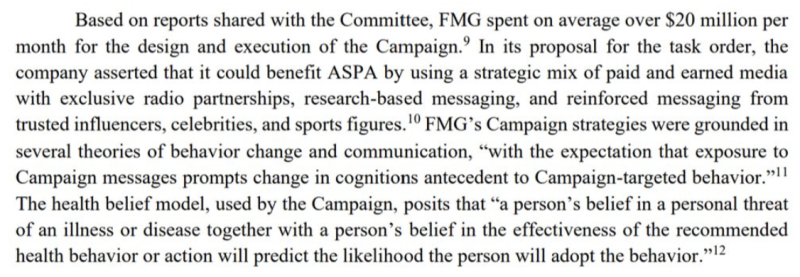
The propaganda campaign extended beyond vax uptake and included exaggerating mask efficacy and pushing for social distancing and school closures.
Ultimately, since the messaging did not match reality, the campaign collapsed public trust in public health.
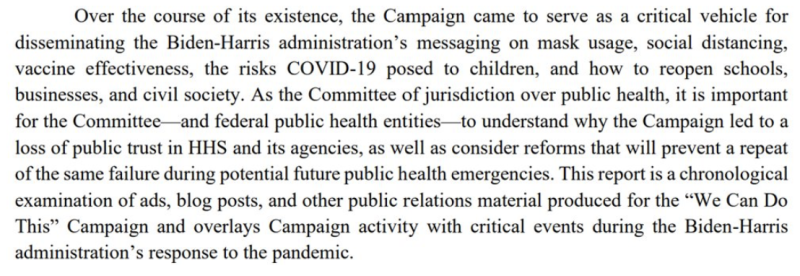
The PR firm (FMG) drew most of its faulty science from the CDC’s “guidance,” which ignored the FDA’s findings on the vaccine’s limitations, as well as scientific findings from other countries that contradicted CDC groupthink.
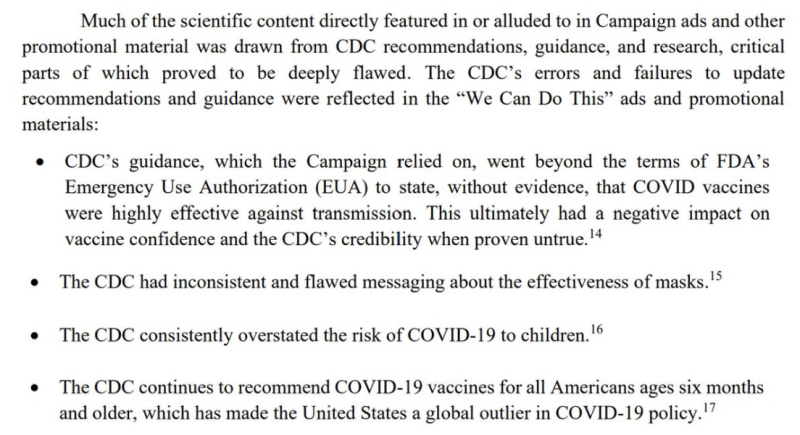
The report details the CDC’s mask flip-flopping through the years. It’s especially infuriating to recall the CDC’s weird, anti-scientific, anti-human focus on masking toddlers with cloth masks into 2022.
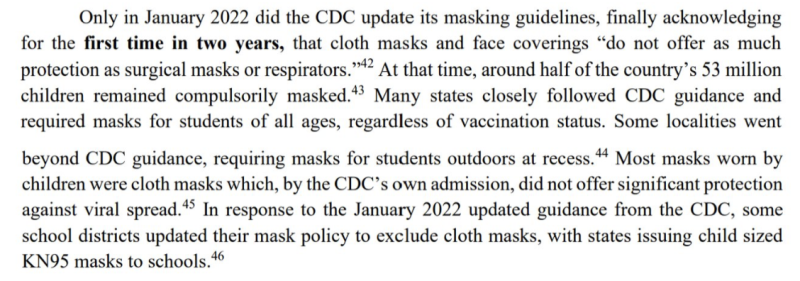
President Biden’s Covid advisor Ashish K. Jha waited until Dec. 2022 (right after leaving government service) to tell the country that “[t]here is no study in the world that shows that masks work that well.” What took him so long?

In 2021, former CDC director, Rochelle Walensky rewrote CDC guidance on social distancing at the behest of the national teachers’ union, guaranteeing that schools would remain closed to in-person learning for many months.
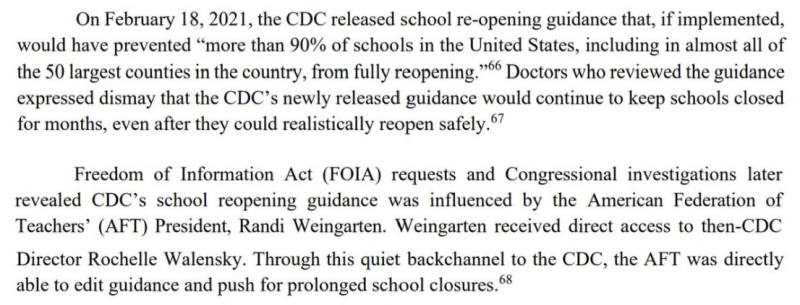
During this period, the PR firm FMG put out ads telling parents that schools would close unless kids masked up, stayed away from friends, and got Covid-vaccinated.
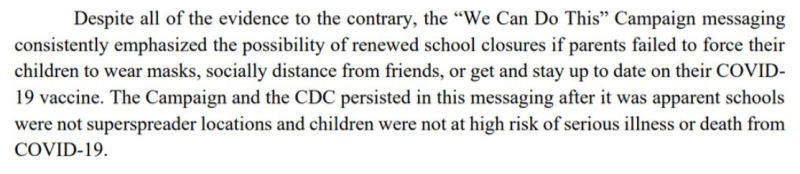
In March 2021, even as the CDC told the American people that the vaxxed did not need to mask, the PR firm ran ads saying that masks were still needed, even for the vaxxed. “It’s not time to ease up” we were told, in the absence of evidence any of that did any good.
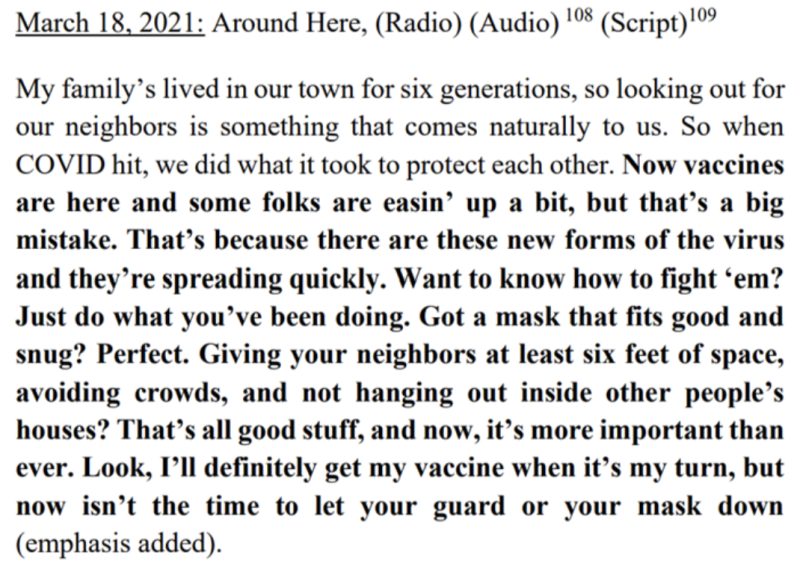
In 2021, to support the Biden/Harris administration’s push for vax mandates, the PR firm pushed the false idea that the vax stopped Covid transmission. When people started getting “breakthrough” infections, public trust in public health collapsed.
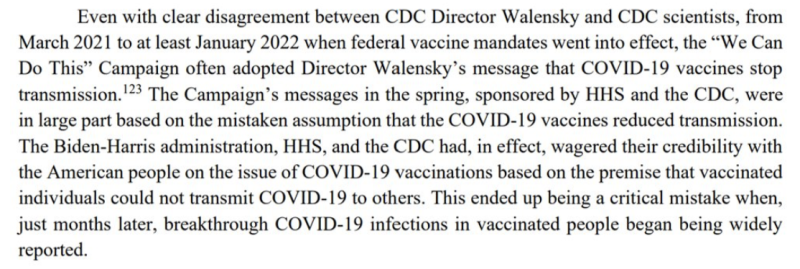
Later, when the FDA approved the vax for 12 to 15-year-old kids, the PR firm told parents that schools could open in fall 2021 only if they got their kids vaccinated. These ads never mentioned side effects like myocarditis due to the vax.
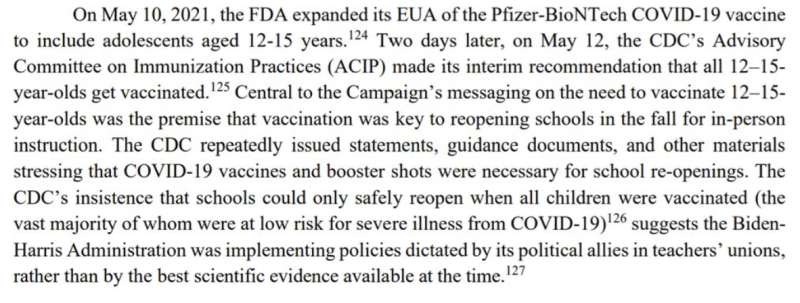
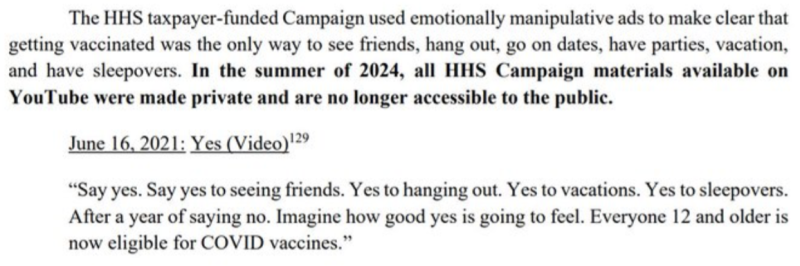
HHS has scrubbed the propaganda ads from this era from its web pages. It’s easy to see why. They are embarrassing. They tell kids, in effect, that they should treat other kids like biohazards unless they are vaccinated.
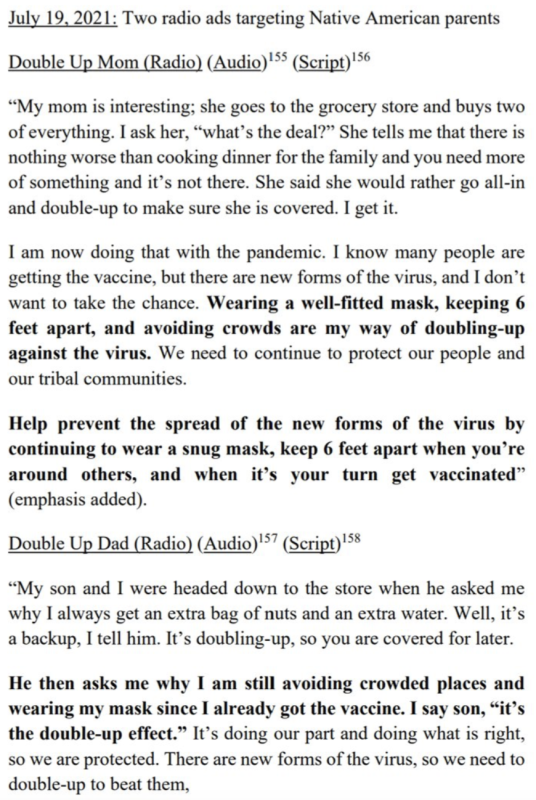
When the Delta variant arrived, the PR firm doubled down on fear-mongering, masking, and social distancing.
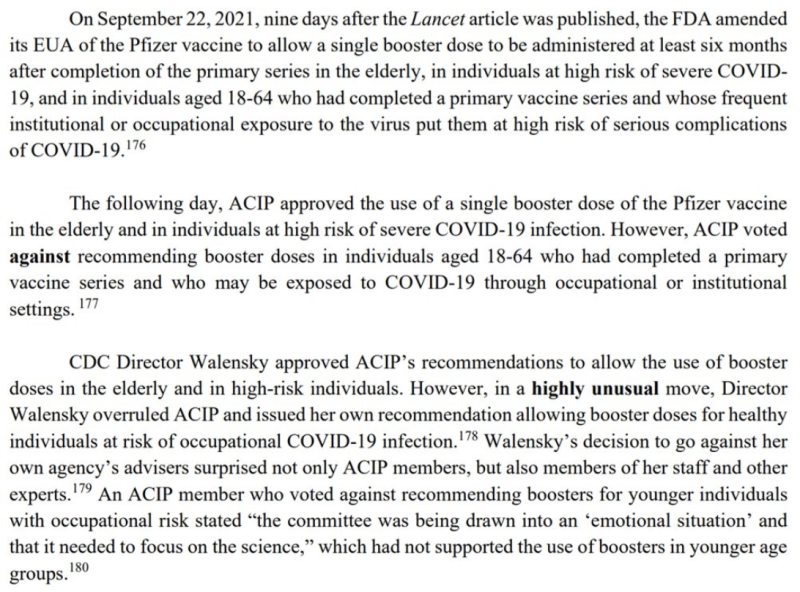
In September 2021, CDC director Walensky overruled the agency’s external experts to recommend the booster to all adults rather than just the elderly. The director’s action was “highly unusual” and went beyond the FDA’s approval of the booster for only the elderly.
The PR campaign and the CDC persistently overestimated the mortality risk of Covid infection in kids to scare parents into vaccinating their children with the Covid vax.

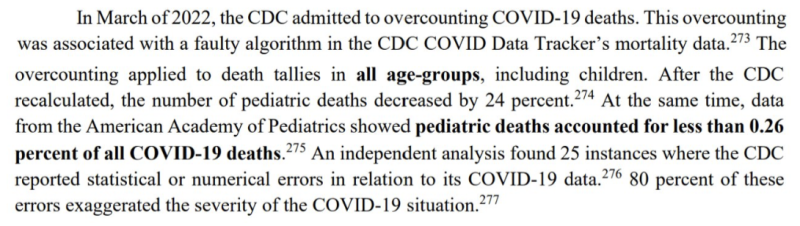
In Aug. 2021, the military imposed its Covid vax mandate, leading to 8,300 servicemen being discharged. Since 2023, the DOD has been trying to get the discharged servicemen to reenlist. What harm has been done to American national security by the vax mandate?
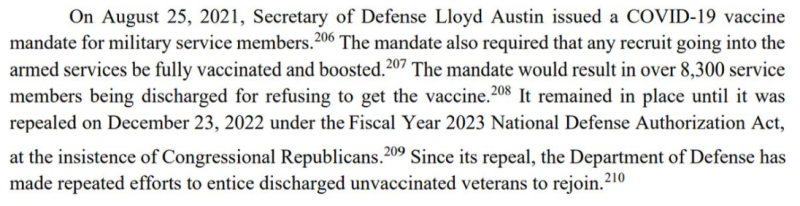
The Biden/Harris administration imposed the OSHA, CMS, and military vax mandates, even though the CDC knew that the Delta variant evaded vaccine immunity. The PR campaign studiously avoided informing Americans about waning vaccine efficacy in the face of variants.
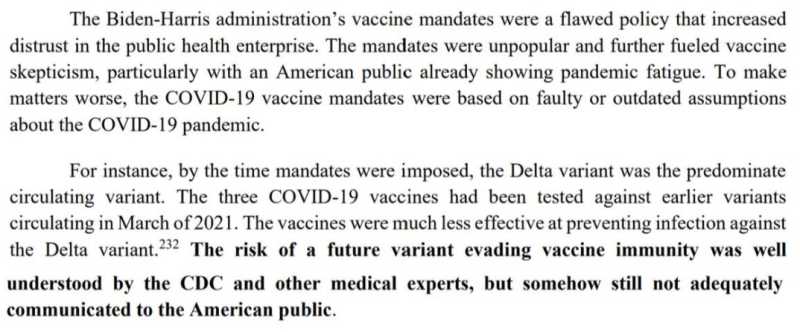
The propaganda campaign hired celebrities and influencers to “persuade” children to get the Covid vax.
I think if a celebrity is paid to advertise a faulty product, that celebrity should be partially liable if the product harms some people.
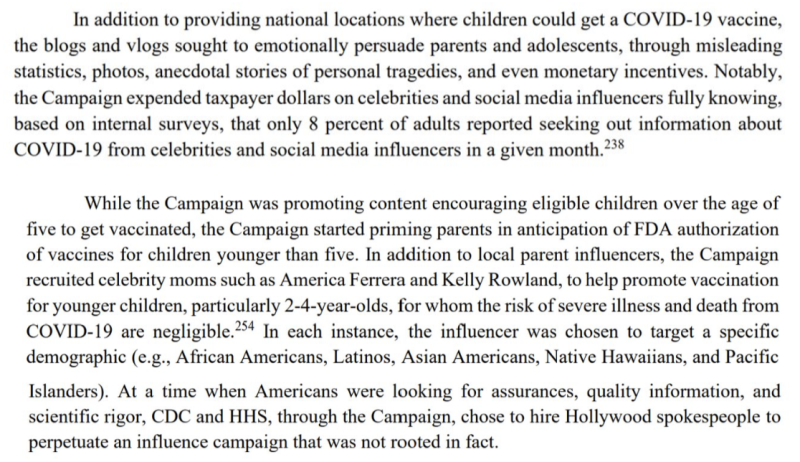
In the absence of evidence, the propaganda campaign ran ads telling parents that the vaccine would prevent their kids from getting Long Covid.
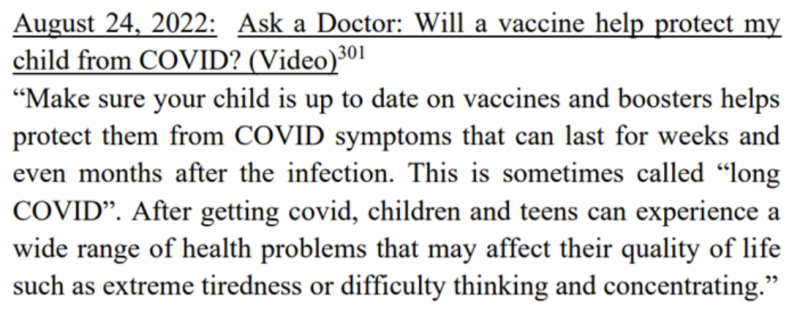
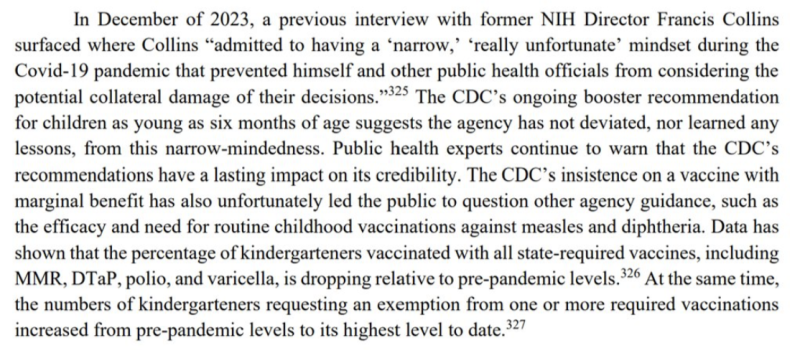
With the collapse in public trust in the CDC, parents have begun to question all CDC advice. Predictably, the HHS propaganda campaign has led to a decline in the uptake of routine childhood vaccines.
The report makes several recommendations, including formally defining the CDC’s core mission to focus on disease prevention, forcing HHS propaganda to abide by the FDA’s product labeling rules, and revamping the process of evaluating vaccine safety.
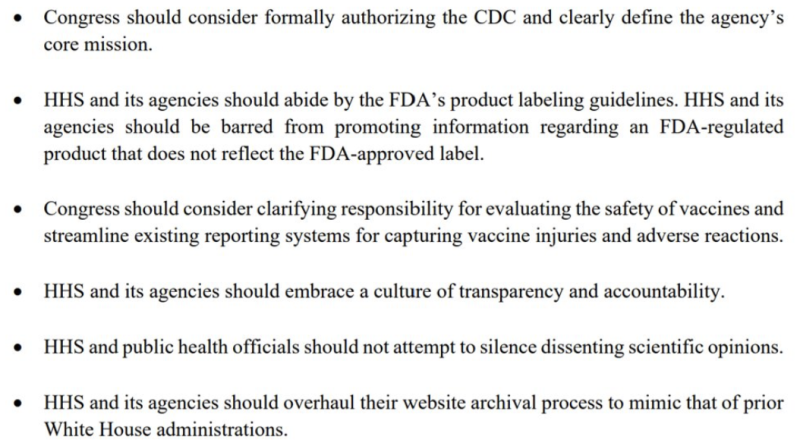
Probably the most important recommendation: HHS should never again adopt a policy of silencing dissenting scientists in an attempt to create an illusion of consensus in favor of CDC groupthink.
You can find a copy of the full House report here. The HHS must take its findings seriously if there is any hope for public health to regain public.
Dr. Jay Bhattacharya is a physician, epidemiologist and health economist. He is Professor at Stanford Medical School, a Research Associate at the National Bureau of Economics Research, a Senior Fellow at the Stanford Institute for Economic Policy Research, a Faculty Member at the Stanford Freeman Spogli Institute, and a Fellow at the Academy of Science and Freedom. His research focuses on the economics of health care around the world with a particular emphasis on the health and well-being of vulnerable populations. Co-Author of the Great Barrington Declaration.
Israel and Ukraine Gaslighting To Cover Up Failures

By Larry C. Johnson | SONAR 21 | October 26, 2024
If bullshit was fungible, both Israel and Ukraine would be rolling in dough and not need another dime of foreign aid. The nonsense spilling out of Tel Aviv and Kiev is legendary and much of the Western public is slurping it up like a ravenous dog eating a bowl of rabbit stew.
Let’s start with Israel. The Zionists used more than 100 aircraft to send an estimated 200 air-launched ballistic missiles into Iran. Israeli aircraft did not dare to fly inside Iran. And what happened? Iran, with Russian help, shot down the majority of the Israeli missiles. Iran showed no signs of panic or anger in the aftermath of the attack — not what one would expect if Israel’s assault had been a smashing success.
Compare for yourself. The first video show’s Iran’s October 1 attack on Israel. The second video shows what happened in the skies over Tehran.
It is true that some of the Israeli missiles got through and killed four Iranian soldiers. Yet, check out this headline in today’s Jerusalem Post:
‘Backbone of Iran’s missile industry’ destroyed by IAF strikes on Islamic Republic
The Zionist spin patrol is working overtime to paint lipstick on their pig operation. The Zionists convinced themselves that Iran’s strike on October 1 was meaningless, notwithstanding clear video — and later satellite imagery — of damage from Iran’s missile barrage. Now, when confronted with evidence of Iranian air defense knocking Israeli missiles from the sky, they simply pretend it did not happen.
Here is a typical response from an ardent Zionist upon reports that Israel’s attack was underway:
The Israeli attack has begun and apparently they had no problem getting past the Iran air defenses. Early reports are about attacks hitting around Tehran which suggests they are going after command and control and possibly military leadership. Too early to know what is happening but by morning the real war will be underway. So far they have not hit the oil which is a surprise as that would finally sink Kamala which Netanyahu wants to do. The oil markets may think this is all OK and oil prices will remain around where they are but this is just chapter one. Before this is over the nukes and oil will get destroyed by Israel. The nukes will be next up as there is no time to lose for Israel to stop any chance of Iran fining some way to use a nuke against Israel.
So, what was Mr. Big Predictor’s reaction as dawn broke in Tehran?
It seems this was a staged attack with the intent to send a message and not to do grave damage. Arab nations were told ahead of time and passed that along to Tehran. We will need to wait a few hours to see what really happened, but it now seems clear this was not the all out attack Israel is capable of and it is instead a tit-for-tat strike to keep the US onside for now until Trump takes over. Israel needs Thaad and supplies of arms for now, so it may be that Netanyahu decided to play ball with DC to get what it needs and not use weapons it currently needs in Lebanon. The oil market will get this wrong and not realize what is yet to happen next time.
What sane folks need to understand is that no amount of evidence will shake the Zionists from their delusional fantasies. It is akin to those Americans who still insist that we could have won in Vietnam. We just didn’t try hard enough.
While Israel is doing its victory dance over its totally awesome, amazing, incredible air strike in Iran, Hezbollah, which was supposedly decapitated and rendered impotent, is stepping up its missile and rocket attacks in Israel. Here is a list of Hezbollah’s operations in the last 24-hours.
1- On the afternoon of Friday, October 25, 2024, a gathering of zionist forces in the “Shoumera” settlement was targeted (https://t.me/PalestineResist/65037) with a guided missile, resulting in confirmed casualties.
2- At 12:15, (https://t.me/PalestineResist/64826) a rocket barrage targeted the “Kiryat Shmona” settlement.
3- At 06:00, (https://t.me/PalestineResist/64867) a rocket barrage targeted a gathering of zionist forces around the town of Aita al-Shaab.
4- At 11:30, (https://t.me/PalestineResist/64868) as part of the Khaybar series of operations and in response to the attacks and massacres committed by the zionist enemy, and with the call “At your service, Nasrallah,” Islamic Resistance fighters launched an aerial attack with a squadron of attack drones on the “Tel Nof” airbase south of “Tel Aviv,” hitting their targets accurately.
5- At 12:15, (https://t.me/PalestineResist/64876) a rocket barrage targeted the “Mishar” base (the main intelligence headquarters for the northern region in Safad).
6- At 12:45, (https://t.me/PalestineResist/64875) a rocket barrage targeted the “Krayot” north of Haifa.
7- At 13:00, (https://t.me/PalestineResist/64954) as part of the Khaybar series of operations and in response to the zionist enemy’s attacks and massacres, and with the call “At your service, Nasrallah,” Islamic Resistance fighters launched a qualitative rocket barrage at zionist forces gathered at the “Ayelet” base.
8- At 13:23, (https://t.me/PalestineResist/64877) a rocket barrage targeted a gathering of zionist forces in the Al-Musharifa area in Ras Al-Naqoura.
9- At 13:30, (https://t.me/PalestineResist/64925) a rocket barrage targeted a gathering of zionist soldiers in the “Shlomi” settlement.
10- At 13:35, (https://t.me/PalestineResist/64926) a rocket barrage targeted the “Metzuba” settlement.
11- At 13:40, (https://t.me/PalestineResist/64927) a rocket barrage targeted the “Jaatoun” settlement.
12- At 14:15, (https://t.me/PalestineResist/64928) a large rocket barrage targeted the “Yesod HaMa’ala” settlement.
13- At 14:25, (https://t.me/PalestineResist/64929) a rocket barrage targeted the Jal al-Alam site.
14- At 16:05, (https://t.me/PalestineResist/64932) a rocket barrage targeted the “Habushit” site.
15- At 16:10, (https://t.me/PalestineResist/64933) a rocket barrage targeted the “Ma’ale Golani” barracks.
16- At 16:15, (https://t.me/PalestineResist/64934) a rocket barrage targeted the “Snir” barracks.
17- At 16:15, (https://t.me/PalestineResist/64936) a rocket barrage targeted the “Shear Yeshuv” settlement.
18- At 16:15, (https://t.me/PalestineResist/64953) a rocket barrage targeted a gathering of zionist forces east of the town of Markaba.
19- At 17:20, (https://t.me/PalestineResist/64955) a large rocket barrage targeted the “Shraga” base.
20- At 18:00, (https://t.me/PalestineResist/64985) as part of the Khaybar series of operations and in response to the zionist enemy’s attacks and massacres, and with the call “At your service, Nasrallah,” Islamic Resistance fighters launched an aerial attack with a squadron of attack drones on the “Naoura” base east of Afula, hitting their targets accurately.
21- At 19:30, (https://t.me/PalestineResist/65020) a rocket barrage targeted a gathering of zionist forces in the “Hatzor” settlement.
22- At 23:30, (https://t.me/PalestineResist/65021) as part of the warning (https://t.me/PalestineResist/64999) issued by the Islamic Resistance to various northern settlements, Islamic Resistance fighters launched a rocket barrage on the “Kiryat Shmona” settlement.
Yep. Hezbollah is barely hanging on.
Speaking of barely hanging on, Ukrainian forces are retreating all along the 900-mile front.


Information is coming from the field that our troops, after a big breakthrough, were able to firmly establish themselves in Shakhtyorskoye and continue to push the enemy out of the village.
The prospects for a Shakhtar breakthrough are impressive.
As far as we understand, the goal is to reach Razliv and take up positions on the Volchya River with access to the rear of the enemy garrison in Kurakhovo.
Plus pressure from two flanking directions: on the AFU group in Bogoyavlenka, thus enabling their expedient removal, and on Velikaya Novosyolka – leveling the main “joy” of the counter oink last year.
By the way, the direction of the conscious flight of the Ukrainian Armed Forces to the Dnipropetrovsk region is also a so-so idea – the enemy has no sensible fortifications between Pavlograd and Pokrovsk. So the AFU will not be able to pull off the trick of drawing us to the prepared lines and then splitting up between Pavlograd and Konstantinovka.
Then there is the Ukrainian/CIA story claiming that North Korean troops are fighting on the front because Russia has lost so many men, it had to import new cannon fodder. I believe this story was ginned up by an increasingly desperate CIA in order to create a cover story for bringing South Korean pilots to Romania to fly F-16s. The “news” about the North Korean troops first appeared in the New York Times under David Sanger’s byline on October 8. Sanger has a long history of being a willing conduit for CIA “leaks.”
Marat Khairullin, a Russian war correspondent, explained what was really going on behind the scenes:
Now it has become clear why the North Korea issue is being actively stirred up during the SMO. South Korea is sending its soldiers and officers to fight in Ukraine. Let me remind you that South Korea is a passionate, evil six of the USA (slang for “lackey”- in Russia, 6 is the lowest numbered card in a deck of cards). They are not as smart as Japan, but not as dumb as the Ukraine. Most importantly, they are high-tech. . . .
Last week, the first 16 pilots from South Korea’s 19th Air Wing arrived at NATO’s Romanian air base near Mihail Kogalniceanu. Apparently, South Korea sent the first squadron of the air wing, the most prepared and combat-ready, to the war in full force. This means they are planning to throw them into battle immediately.
Currently, the F-16 fighters allocated to Ukraine are also in Romania – at the Fetești air base on the border with Moldova. As soon as the South Korean pilots go there, this will be an indicator of the imminent use of these aircraft in Ukraine. In addition to the F-16 pilots, pilots of South Korean T-50 combat training aircraft, which are used in the southern army as light attack aircraft, have arrived at the air base in the commune of Mikhail Kogalniceanu. It is assumed that these aircraft may be useful as hunters for “Geraniums” in the protection of the Odessa port.
Remains to be seen if the South Koreans will actually enter the fight. If they do, they will learn that Russia ain’t playing games and many of those pilots will likely die. I discussed this issue with Judge Napolitano. I am also posting a live podcast that Andrei Martyanov and I did with Nima as Israel’s attack was wrapping up Friday night my time.
Featured Video

Deception – Submarines against Olof Palme
or go to
Aletho News Archives – Video-Images
From the Archives
Woolsey Fire started at Santa Susana Field Lab — where “radioactive materials released were never accurately measured”
By John Laforge | CounterPunch | November 30, 2018
In my Nov. 16 column, I reported on potential radiation risks posed by California’s Woolsey wildfire having burned over parts or all of the Santa Susana Field Laboratory—south of Simi Valley, Calif., 30 miles outside Los Angeles—site of at least four partial or total nuclear reactor meltdowns.
The field laboratory operated 10 experimental reactors and conducted rocket engine tests. In his 2014 book Atomic Accidents, researcher James Mahaffey writes, “The cores in four experimental reactors on site … melted.” Reactor core melts always result in the release of large amounts of radioactive gases and particles. Clean up of the deeply contaminated site has not been conducted in spite of a 2010 agreement.
Los Angeles’s KABC-7 TV reported Nov. 13 that the Santa Susana lab site “appears to be the origin of the Woolsey Fire” which has torched over 96,000 acres. Southern Calif. Public Radio said, “According to Cal Fire, the Woolsey Fire started on the afternoon of Thursday, Nov. 8 … on the Santa Susana site.” … continue
Blog Roll
 Aletho News
- Dr. Abu-Sitta: Beirut ‘felt like a day in Shifa Hospital’
- Iran Has Won the War, It Will Be Up to the US to Secure the Peace: Mohammad Marandi
- Iran condemns assassination threats against Iranian negotiators amid US talks
- Brussels cannot say where its own pipeline inspectors are as Hungary’s oil lifeline remains shut
- Israel’s Iran War: Myth and Reality
- Between war and industrial breakdown: The US-Israeli attrition crisis
- Pressure builds on Iran to ‘drop’ Lebanon ceasefire demand as Islamabad talks hang in balance
- In another clash report, US denies agreement to release Iran’s assets
- What is fueling unrest across the EU?
- Why no power can undermine Iran’s eternal dominance over the Strait of Hormuz
- If Americans Knew
- Pro-Israel ‘Thinktanks’ and Individuals who Influence U.S. Foreign Policy
- Mearsheimer reveals how Israel dictates US policies on Iran, Gaza – video
- After killing 350+, Israel still has a “score to settle” with Lebanon before ceasefire – Daily Update
- Military aid to Israel emerges as the latest political litmus test for Democrats
- The only Palestinian children’s rights organization closes following years-long Israeli campaign against it
- ‘I Can’t Forget the Smell’: Lebanese Reel After Israel Kills Over 300 in Single Day
- DNC Shoots Down Resolutions Calling Out AIPAC and Limiting Arms to Israel
- TCN: Is Israel Blackmailing President Trump?
- Israel killed at least 303 Lebanese yesterday – who were they? Daily Update
- Amnesty: Urgent – Protect Lebanese civilians from brutal escalation in Israeli attacks
- No Tricks Zone
- German Expert: Heat Dome Led To Record Temps In Western USA…Warmer In 1934, 1936
- New Study: No Linear Warming Or Glacier Retreat Along Northern Antarctic Peninsula Since 1980s
- An Inconvenient Tree: Uncovered In Alps… Europe Much Warmer Than Today 6000 Years Ago
- New Study Reports A 60% Slowdown In Greenland’s Ice Loss Rate In The Last Decade
- Low Intensity Tornado Wrecks Major Solar Farm, Creating A Potential Toxic Dump
- New Study Finds Warming Saves Lives…Cold Temperatures 12 Times More Deadly Than Excess Heat
- German Science Blog Accuses PIK Climate Institute Of Hallucinating Climate Tipping Points
- Devastating Assessment Of Comirnaty Vaccine By Former Senior Pfizer Europe Toxicologist
- New Study: CO2 Is ‘Effectively Negligible’ As An Explanatory Climate Change Factor Since 2000
- Former Pfizer Toxicologist Dr. Helmut Sterz Tells Bundestag Hearing Pfizer Vaccine Should Have Never Been Approved
 Aletho News