Covert Crusade: Washington’s $600m digital war on Iran
By Kit Klarenberg | The Cradle | February 21, 2025
Earlier this month, The Cradle exposed how in 2023, the US State Department’s shadowy Near East Regional Democracy (NERD) fund earmarked $55 million to stoke unrest in Iran during the following year’s elections.
This was part of a wider US campaign of interference designed to disrupt and destabilize the Islamic Republic. As that investigation noted, details on where this money goes – and who benefits – are strictly confidential as a matter of policy. Still, there are clues in the public domain pointing to at least some recipients.
Regime change by another name
As a US Congressional Research Service report records, due to hostile US–Iran relations, and Tehran’s well-founded view of NERD “as a means of financing regime change,” its programs rely on “third-country training” as well as “online training and media content.”
The report further confirms that despite NERD being Washington’s primary “foreign assistance channel” for projects targeting Iran, “activities, grantees, [and] beneficiaries” are not advertised “due to the security risks posed by the Iranian government.” It continues:
“NERD was created in 2009 as a ‘line item for Iran democracy’ but was not (and is still not) technically Iran-specific … For 2024, the Biden Administration requested $65 million for NERD … to ‘foster a vibrant civil society, increase the free flow of information, and promote the exercise of human rights,’ including at least $16.75 million for internet freedom.”
What was unstated in the report is that NERD represents a simple rebranding of the Iran Democracy Fund, created by former president George W. Bush in 2006 with the explicit goal of toppling the Islamic Republic.
The initiative was ostensibly shut down under Barack Obama three years later, eliciting bitter condemnation from much of the western media, neoconservative pundits, and lawmakers. However, as the BBC acknowledged at the time, the move was in fact “welcomed by Iranian human rights and pro-democracy activists”:
“These US funds are going to people who have very little to do with the real struggle for democracy in Iran and our civil society activists never received such funds,” a Tehran-based human rights lawyer told the British state broadcaster. “The end to this program will have no impact on our activities whatsoever.”
Internet interference
In reality, the program never ended – it was merely repackaged. White House officials maintained the fiction that NERD was focused on democratization rather than regime change, a claim undermined by a June 2011 New York Times exposé.
That investigation revealed the Obama administration’s so-called “Internet Freedom” initiative aimed to “deploy ‘shadow’ internet and mobile phone systems dissidents can use to communicate outside the reach of governments in countries like Iran, Syria, and Libya.”
In other words, Washington sought to build a covert legion of regime change operatives in Tehran, and provide them with the technology to coordinate in secret. It is clear from the Congressional report’s marked reference to “internet freedom” that these machinations continue today.
Moreover, as a 2020 report by the DC-based Project on Middle East Democracy noted, organizations genuinely committed to advancing Iranian rights still steer well clear of NERD. An anonymous NGO worker described its “style” as “aggressive.” Another implied NERD is engaged in deeply dirty work:
“We choose not to apply for NERD grants because we do not want to get pulled into [anything] crazy.”
‘Non-Iranian’
The same year, the Financial Times (FT) reported how NERD efforts had become turbocharged under US President Donald Trump’s administration, explicitly to facilitate and encourage “anti-Tehran protests.”
This included “providing apps, servers, and other technology to help people communicate, visit banned websites, install anti-tracking software,” and more in the Islamic Republic, in order to offer “Iranians more options on how they communicate with each other and the outside world.”
Curiously, while portraying Iran as a digital prison, the FT admitted that major western social networks remain accessible in the country, and Iranians can easily view western media. As usual, recipients of NERD funds remained unnamed – except for Psiphon, a VPN provider long-associated with discredited exiled Iranian opposition figures and, by then, controlled by the Open Technology Fund (OTF). The FT estimated that just three million Iranians used Psiphon, less than four percent of the population.
OTF was an “Internet Freedom” product – one of its board members has openly admitted the Fund’s agenda is “regime change.”
Fast forward to September 2024; as former US president Joe Biden’s administration was seeking increased funds for NERD – mere months after the $55 million invested the previous year failed to produce desired mass unrest and upheaval around that year’s elections in Iran – a White House meeting was convened with major tech giants, encouraging them to offer more “digital bandwidth” for OTF-bankrolled apps and tools.
As fund chief Laura Cunningham explained, a “sizeable chunk” of OTF’s budget was taken up by the cost of hosting all the network traffic generated by its vast array of digital destabilization apps, which included Signal and Tor.
While OTF sought to support “additional users” of these products, it lacked resources to keep up with “surging demand.” What came of this meeting, which was attended by representatives of Amazon, Cloudflare, Google, and Microsoft, is not clear.
Yet, if further “digital bandwidth” was granted to OTF, it is clear the Trump administration’s “pause” in overseas aid funding has thrown all NERD’s meddling efforts in Iran into total – and potentially permanent – disarray.
A 27 January report in the Saudi-funded, anti-Islamic Republic Iran International quoted numerous anonymous beneficiaries of US financing bemoaning how grantees, including foreign-run Persian-language media outlets and organizations documenting purported “abuses” to keep the Islamic Republic “accountable,” had been abruptly shuttered.
An anonymous “human rights activist” told the outlet Washington’s freeze on aid spending “(will) impose restrictions on projects that address human rights violations or investigate governmental and military corruption which have impacted Iran’s economy and social conditions in favor of foreign terrorist activities and money laundering.”
They said “several non-Iranian American institutions [emphasis added] have been using these funds to investigate corruption and money laundering.” Now though, “these organizations will be forced to halt their activities.”
‘Severe implications’
US-supplied Virtual Private Network (VPN) services also loomed large among the malign resources impacted by the aid “pause.” A nameless “activist” told Iran International that 20 million Iranians used such tools “to bypass Tehran’s internet curbs.”
The outlet further quoted an article published by Human Rights Activists in Iran, a US-funded NGO not based in the Islamic Republic, but Virginia, near the CIA’s Langley headquarters: “In today’s Iran, the internet has no meaning without VPNs.”
Such dire warnings were echoed by Ahmad Ahmadian, head of California-based tech firm Holistic Resilience, which “aims to advance internet freedom and privacy by developing and researching censorship circumvention.”
An Iranian expat and alumni of Tehran University, Ahmadian warned major US tech firms “may not be willing or able to continue their support for providing anti-censorship tools” without government support. Such remarks highlight how these supposedly popular resources lack grassroots backing or financing, being wholly dependent on Washington’s sponsorship to operate:
“The leadership of the US government has been crucial in urging big tech companies to provide public services. Without the encouragement of the US government, these companies wouldn’t take the initiative on their own.”
Other unnamed activists further warned Iran International, “the consequences of Trump’s executive order will not remain limited to internet censorship circumvention tools.” They believe that if NERD’s activities “do not receive an exemption within the next month” – by the end of February – “they will either collapse entirely or be deeply curtailed.”
One declared, “the impact of this freeze might not be immediately noticeable, but its severe implications will become evident over time.”
Meanwhile, “internet experts” cautioned that “even if US aid starts again” after the 90-day pause, “the damage is irreversible since many people … might never fully return to using US-backed secure services.”
As The Cradle noted on 11 February, Washington’s forced withdrawal from meddling in Iran could create fresh opportunities for genuine diplomatic engagement between the two long-time adversaries. But another possibility looms: after spending $600 million over a decade with little success, the US may simply be preparing to test out new, potentially more malign regime-change strategies.
Is It Foreign Aid or Covert Action?

By Philip Giraldi • Unz Review • February 21, 2025
There has been considerable controversy surrounding the Trump administration decision to cutback on government agencies that are ostensibly committed to charitable, educational and other nation building activities both overseas and in the United States. This spending, amounting to scores of billions of dollars, has helped produce budget deficits that ballooned in the twenty-first century, largely due to the surge in overseas activity that occurred after the trauma of 9/11 when the United States decided that it had to serve as policeman for the rest of the world to make itself safe. As the US is now verging on bankruptcy due to its unsustainable debts, the second incarnation of the Trump Administration has focused on cutting budgets in areas that it considers to be enemy occupied, often meaning “woke” or institutionally allied to the Democrats. Social programs as well as the bloated defense department spending were considered to be suitable targets so starting during the first week in February, the White House brought down the hammer when it went after a number of government agencies, inter alia calling for huge cuts in Pentagon spending and the complete elimination of the Education Department.
The White House also shut down the United States Agency for International Development (USAID), firing nearly all of its 10,000 employees, reportedly leaving only little more than 600 employees in place to assist in the shutting down or downsizing of facilities in the US and in foreign countries. Also, about 800 awards and contracts that are administered through USAID were reportedly being canceled. There have reportedly been some judicial delays in the firings due to the complexity of removing thousands of employees and families from overseas offices and housing, though the pause is likely to be only temporary.
Tax dollars are traditionally used corruptly to fund projects and policies dear to the hearts of politicians, which is why Ron Paul and others have called for sweeping audits, including of the Federal Reserve system and the Pentagon in particular. This hidden spending is particularly difficult to identify if the program is somehow linked to foreign policy and/or national security, which have traditionally been protected from scrutiny by denying nearly all public access to sensitive information based on the “need to know” principle to safeguard sources and vulnerable activities.
USAID was founded in 1961 during the John F. Kennedy administration to unite several foreign assistance organizations and programs under one agency. At first it was seriously intended to be a mechanism for the US to aid in health, disaster relief, socioeconomic development, environmental protection, democratic governance and education. Its focus, however, eventually became to guide development in parts of the world that suffered from what were considered to be dysfunctional governments and institutions in terms of American interests. USAID has always been funded by the federal government and its upper management has worked closely with the Department of State, to which it is technically accountable, and the intelligence agencies in particular. Its budget in 2023 was $43 billion. Trump’s reduction in force (RIF) of USAID has been accompanied by a shake-up in its management, its remaining responsibilities now being in the hands of the Secretary of State Marco Rubio, who has considerable experience in special agency management after having served on the Board of the National Endowment for Democracy’s (NED) Republican subsidiary component, the International Republican Institute (IRI). NED, which operates extensively overseas, has also been stripped of funding by Trump.
The dismantling of USAID does not necessarily mean the organization will completely go away, it will just be much reduced and under new management. It will likely have a new mission, though no one is at this point sure what that will mean. And USAID and NED are not alone as the presidential memo has called for a halt to the funding of all the government components that are dependent on taxpayer generated funds to provide what is perhaps euphemistically referred to as “foreign aid.” USAID and NED do have humanitarian projects, i.e. feeding the hungry, but they are primarily politically driven. The NED component IRI puts it this way on its website “Our mission at IRI—advancing democracy worldwide—is a battle with many fronts. I am proud to say that IRI is supportive of every endeavor that will bring freedom to more people. We have made progress in our mission by giving hope to those who wish to protest on a city street, run for office, or cast a ballot.”
So the aid organizations overtly have a political role, but how does it translate in practice and does it extend to playing favorites with the US media and political parties? Trump has put it another way, declaring that USAID leaders were “radical left lunatics.” This is what he claims on his website Truth Social:
“LOOKS LIKE BILLIONS OF DOLLARS HAVE BEEN STOLEN AT USAID, AND OTHER AGENCIES, MUCH OF IT GOING TO THE FAKE NEWS MEDIA AS A ‘PAYOFF’ FOR CREATING GOOD STORIES ABOUT THE DEMOCRATS. THE LEFT WING ‘RAG,’ KNOWN AS ‘POLITICO,’ SEEMS TO HAVE RECEIVED $8,000,000. Did the New York Times receive money??? Who else did??? THIS COULD BE THE BIGGEST SCANDAL OF THEM ALL, PERHAPS THE BIGGEST IN HISTORY! THE DEMOCRATS CAN’T HIDE FROM THIS ONE. TOO BIG, TOO DIRTY!”
There are, in fact, credible reports that the 2019 impeachment of Trump was driven by the actions and disinformation coming from CIA, FBI and USAID operatives, so it is plausible to assume that Trump is now settling scores. Beyond that, USAID and NED are both notorious for their roles in the business of covertly supporting opposition political parties worldwide and assisting in regime change. Billionaire philanthropist George Soros, through his network of organizations, received $260 milllion from USAID for funneling funds to non-governmental-organizations (NGOs) connected with Soros’ Open Society Foundations, which are known for advocating for radical policies and regime changes globally. Soros is also a Democratic Party favorite and major fund raiser, having recently received at a White House ceremony the honor of the Presidential Medal of Freedom presented in absentia to his son Alex from outgoing President Joe Biden.
As a result, both USAID and NED have been banned from foreign countries, including Russia, due to their meddling in local politics. Hungarian Prime Minister Viktor Orban, who was often a target of USAID activity, immediately thanked Trump for his decision to cancel USAID. Both USAID and NED were deeply involved in Eastern Europe. Former Acting Deputy Secretary of State Victoria Nuland has revealed that the aid agencies were deeply engaged in the multiple source $5 billion dollar multiyear US “investment” in Ukraine that culminated in regime change in 2013 and led to the current war with Russia. In government circles it has frequently been asserted that USAID and NED and other such organizations now do what the CIA used to do routinely in terms of regime change between its founding and the 1990s.
One might suggest that recent US governments, operating through their various subsidiaries like USAID and NED have been funding just about everything to control a world community in line with American interests. Mainstream media worldwide that is directly or indirectly funded reportedly includes journalists, news outlets, and activist NGOs and sites – and that’s just through USAID. That would appear to include Reuters, Associated Press, BBC, The Guardian, NBC, CNN, NPR, NYT, Politico, PBS, The Financial Times, The Atlantic, The Daily Telegraph, as well as much more media in the developing world. The anti-China hysteria media “ecosystem” currently depends on US government funding, and is already complaining about the impending shutdown of USAID support. To cite only one example of how it is packaged, Reuters news service has received millions in funding from the US government specifically for “active social engineering.”
Labor unions are also funded by USAID which is also behind the recent political unrest in Slovakia. It has also paid for multiple coup attempts in Venezuela, funded high profile trips for Ukraine’s Volodymyr Zelensky to improve his image and popularity, and funded al-Qaeda linked groups in Syria to successfully overthrow the government in Damascus. Going back to Trump’s first term of office, it is interesting to observe that most of the “aid” to opposition parties to overthrow Nicolas Maduro in Venezuela was delivered during 2019, so Trump, guided by hardliners John Bolton and Mike Pompeo, was not at that time shy about regime change. In fact, Voice Of America (VOA), which often served as a CIA mouthpiece, even reported that Trump had tripled aid to opposition figure Juan Guaido to $56 million. Those asking themselves why Trump has now decided to “oppose” the very semi-covert agency that he’s also been using for regime change have a point, but it might be appropriate to see the shakeup as a warning against government information, law enforcement and intelligence agencies again becoming tools of the Democratic Party politicians.
Defenders of USAID are arguing that the agency is being maligned, that in addition to its political profile it is heavily engaged in promoting health and wellness worldwide. The head of USAID under Joe Biden was the highly controversial and very much “woke” Samantha Power, who claims somewhat disingenuously that the agency budget of $38 billion in 2023 included something like $20 billion in spending that should appropriately be described as humanitarian. Those who are the recipients of the programs, mostly in the third world, will consequently suffer from the defunding of aid. If that is actually so, it perhaps would make sense to roll such programs into a mechanism that would not be tied to regime change and corruption of local governments and media.
There is some question even in Congress concerning whether there will be a new centralized aid agency and what it will be called or do now that it has been reduced in size and will likely have a tiny budget relative to what it once enjoyed. It is early days and the answer to that question will likely emerge before too long, but it should be pointed out that at no point has Rubio or anyone else in the Trump administration actually condemned aggressive US engagement abroad or claimed they will bring it to an end. The State Department has even officially said the only goal is to ensure the good things that USAID did will continue by “advancing American interests abroad.” Given some of the recent aggressive positions taken by the Trump Administration over Gaza, Panama, Canada, Mexico, Iran and Greenland as well as the tendency on the part of its top officials to increase pressure on perceived adversaries, it may be that the US isn’t changing course at all. It quite plausibly might be doubling down, and organizations like USAID and NED, even if their names, roles and leadership change, will likely be integral to that process.
Philip M. Giraldi, Ph.D., is Executive Director of the Council for the National Interest, a 501(c)3 tax deductible educational foundation (Federal ID Number #52-1739023) that seeks a more interests-based U.S. foreign policy in the Middle East. Website is councilforthenationalinterest.org, address is P.O. Box 2157, Purcellville VA 20134 and its email is inform@cnionline.org.
Serbian president slams USAID for inciting regime change, demands journalist say how much money his outlet received
By Liz Heflin | Remix News | February 21, 2025
Serbian President Aleksandar Vučić told “Epilogue” viewers on TV Insider that U.S. President Donald Trump directly mentioned Serbia as a place where USAID wanted a regime change, reports Blic.
“Someone was only waiting for additional tragedies, meanwhile preparing different types of scenarios for some new riots and for some new attacks on the state. And that is nothing new, and it can be seen through the words of President Donald Trump. Donald Trump directly mentioned Serbia yesterday, the president of the United States of America directly mentioned Serbia as a place where they wanted a political change of government. Those who received American money to overthrow the government,” said Vučić in the Epilogue show on TV Insider.
In July of last year, the government of Serbia issued a joint statement with USAID regarding $18 million of new funds for a “development partnership,” and outlets have pointed out that the government has thanked the U.S. for such money in the past.
The July statement noted that the new “funds will be used, among other things, to improve public procurement procedures in Serbia, improve access to justice for citizens, improve environmental protection and energy security, promote a stronger media environment, improvement of economic opportunities for vulnerable groups, as well as for greater competitiveness of the Serbian economy.”
Vučić admitted during his TV interview that money has been received and used, but primarily for “senseless projects that were supposed to cover the eyes,” while the real intent of most funding was to overthrow the government. Asked about the “many videos” of himself and other officials thanking USAID for funding projects, Vučić said that “when someone gives you 1,000 euros, it is up to you to still politely say ‘thank you.’”
He then indicated that money was spent on equipping Serbian courts with various recording devices, microphones and many other things. But far larger amounts were being handed to NGOs such as Trag and CRTA.
“In the last four years, there were 400 million (dinar), of which not even 10 million went to the state. Everything went your way for the non-governmental sector,” said Vučić.
Oddly, in April of 2024, a few months before USAID’s additional $18 million was announced, Trag and CRTA jointly announced a USAID competition for grants under what they called a “Mobilization Fund program.”
“Trag Foundation and CRTA, with the financial support of the American Agency for International Development (USAID), invite you to apply for the competition for the Mobilization Fund program.”
Listed activities that could receive grants included: “local community development, human rights, anti-discrimination, women’s rights and women’s empowerment, youth empowerment, inclusion, solidarity economy, environmental protection, socio-economic development, rule of law, accountability of public institutions, fight against corruption, urbanism and public spaces and all others in which activists recognize challenges.”
Former prime minister and president of the National Assembly of Serbia Ana Brnabic has been called out as well for her gratitude in the past for USAID funds that had presumably “improved” the country. Now, with Trump in office, she is changing her tune, saying the “investigative media outlets” financed by USAID had systematically harmed Serbia, according to Tanjug.
“In the past 10-11 years, they have been implying that anyone who engages in politics is, in a way, corrupt or wants to be corrupt. That has made it impossible for the many quality people who wanted to help, or were perhaps helping from the background all the time, to get involved as state secretaries or ministers because they would, in fact, immediately be targeted by various media such as Krik,” Brnabic said on Pink TV.
Brnabic further let the cat out of the bag, noting there is no such thing as independent media, which merely implies reliance on U.S. money from special interest groups.
“You can see that those media outlets and the people working there were quite dependent. It is just that they were dependent on the American administration and, to make things worse, not on a U.S. administration elected by American citizens, but on what is referred to as the deep state,” Brnabic said.
According to Tanjug, Serbia will further investigate the spending of USAID funds if the U.S. asks.
Regarding the media portal Kric, mentioned above. President Vučić had a recent spat with one of its journalists who tried, again, to corner Vučić with supposed information on his brother at the opening of the International Tourism Fair in Belgrade.
The journalist said that Andrej Vučić’s name was brought up in recorded messages, indicating he held power over state contracts in Novi Sad and also regarding police appointments.
Vučić called the allegations “a notorious lie,” reiterated his brother holds no political office, and then turned on the journalist, asking, “I am interested in you answering the question of how much money you received from USAID, how much from NED? How much money did these two criminal organizations, both one and the other, transfer to you? How much, as the American president and one of the most famous secular, one might say, businessmen, Elon Musk, who calls these criminal organizations? How much money did they give you for this?
Making fun of the allegations from third parties, Vučić said, “Many people also write that I told them I would jump from the Smilovica lookout, but I haven’t jumped yet.” He then pointed out that, on the other hand, the funding Kric has received from the U.S. is a fact.
The journalist then accused the president of targeting journalists, again, to which Vučić replied: “How can I target you? I’m just asking how much money you received.”
The United States has reportedly given $937 million to Serbia since 2001. Although the USAID site is no longer online, a Google search still shows entries, with one for Serbia saying this money was meant for “economic and democratic development.”
FEMA Allocated $2.6M for “War on Misinformation” Contract in 2023
By Didi Rankovic | Reclaim The Net | February 20, 2025
The Federal Emergency Management Agency (FEMA) – an incorporated agency of the Department of Homeland Security (DHS) – earmarked $2.6 million to fund a “war on misinformation” contract in 2023, according to data on the usaspending.gov website.
The blanket purchase agreement note lists “misinformation, disinformation, and malinformation analysis” as the subjects of the order, with $1.2 million spent, and as much currently listed as the obligated amount.
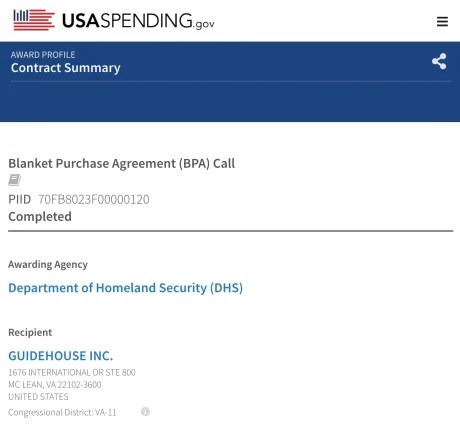
Screenshot of a USAspending.gov contract summary detailing a completed Blanket Purchase Agreement (BPA) Call awarded by the DHS to Guidehouse Inc., located in McLean, VA.
As noticed by Foundation For Freedom Online, the recipient is the consultancy firm Guildehouse, a government contractor owned by Bain Capital. A post on the company’s website that has since been deleted spoke about Guildehouse engaging with social media platforms to report misinformation (including flagging posts for removal).
Guildehouse also “maintained a proprietary internal database” to track content designated as “misinformation,” and a list of “higher risks” sites that might have published such content.
The case looks like another piece in the puzzle that has been the Big Government-Big Tech collusion to suppress speech in the US, unfolding over the last four years.
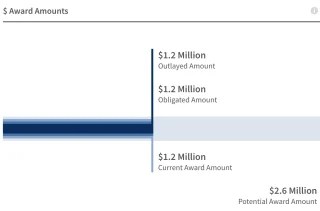
“$ Award Amounts” chart shows $1.2 million as the outlayed amount, $1.2 million as the obligated amount, and $1.2 million as the current award amount, with a potential award amount of $2.6 million.
This one features some recurring, and some new “characters” – but also, sheds more light on what appears to be the former authorities’ painstaking efforts to obfuscate the ties that bound those actors together.
For example, FEMA is not one of the usual entities brought up in Congressional investigations and lawsuits delving deep into that collusion; but it is a sub-agency of the DHS, notorious for things like the failed attempt to set up the Disinformation Governance Board, and even work, in roundabout ways, with the Election Integrity Partnership (EIP).
In 2023, the House Committee on Homeland Security referred to the practice of “delegating” what’s unconstitutional censorship of speech to third parties as, “censorship laundering.”
A group that does often crop up in these probes is the UK-based Center for Countering Digital Hate (CCDH), a pro-censorship group of the “Kill Musk’s Twitter” infamy, which in 2024 organized what reports say was an “exclusive, invite-only” gala.
One of those invited was Erica Mindel – a former member of the Israeli military, a contractor to the US State Department’s envoy monitoring and combating antisemitism – but also, one of Guildehouse’s senior consultants.
USA Is Defunding Regime-Change NGOs
Prof. Glenn Diesen on Neutrality Studies
Glenn Diesen | February 19, 2025
For the longest time, USAID and the National Endowment for Democracy (NED) have been funding foreign NGOs to influence local populations through media propaganda and the presence of a civil society consensus. Donald Trump just pulled the plug by defunding USAID and even going after the NED. This is unprecedented in modern history that a state dismantles its own cognitive warfare apparatus. What happened?
Bill Gates and USAID: A Dangerous Alliance With Deadly Secrets
By Ilya Tsukanov – Sputnik – 19.02.2025
Bill Gates has urged the Trump administration to reconsider its stance on USAID, calling it “an unbelievable asset” and warning that cuts could risk “millions” of lives. What is the Microsoft mogul-turned billionaire ‘philanthropist’ really worried about?
USAID and the Gates Foundation have worked together for nearly 25 years on issues near and dear to Mr. Gates’ heart, from infectious diseases and vaccines to family planning, agriculture, and climate change.
Major collaborations include the Global Fund to Fight AIDS, Tuberculosis, and Malaria, and the Global Alliance for Vaccines and Immunization (GAVI).
Gates has also partnered with USAID on the Global Health Initiative and the Coalition for Epidemic Preparedness Innovations (CEPI).
If these names ring a bill, they should:
- GAVI is running an ambitious program to vaccinate 86 million adolescent girls in developing countries against HPV with jabs including Gardasil, made by Merck, which now faces a lawsuit in the US over side effects ranging from sporadic paralysis to cancer.
- Gates and USAID have continued supporting GAVI despite evidence from India starting in 2009 that its HPV jabs can cause severe illness or even death.
- USAID committed over $2 billion to GAVI from 2001-2017, and $1.16 billion more between 2020-2023.
- Leaked docs published by Revolver News in 2022 exposed a USAID scheme using pandemic funds for “reproductive health” (i.e. population control) in Africa.
- CEPI, together with Anthony Fauci’s National Institutes of Health and the Food and Drug Administration, has been linked to controversial health schemes of its own, from a September 2019 workshop on vaccine biomarkers to partnership in Event 201, a pandemic simulation held in October 2019, just weeks before COVID hit.
Partners in Food (In)security
Gates and USAID have also touted collaborations on food security, promoting agricultural tech for smallholder farmers in developing countries, for example.
At the same time, the Gates Foundation has invested heavily in companies engaged in GMO research, from Monsanto and its infamous “terminator seed” projects to synthetic meat startups.
An exhaustive 2024 critique of Gates’ agricultural schemes in Africa by the US Right to Know public health watchdog found that his and USAID’s AGRA initiative, focused on chemical-laced monoculture farming, increased dependency and agrobusiness influence instead of reducing hunger.
In other words, Gates’ concerns about USAID’s demise seem more about losing a key ally in efforts to control development, food security, and health in developing nations than “saving lives.”
UK and EU ‘incapable of negotiation’ – Moscow
RT | February 17, 2025
The UK and EU cannot be part of the Ukraine peace talks, as they are incapable of negotiating, Moscow’s ambassador to the UN, Vassily Nebenzia has said.
The diplomat made the comments as Russian Foreign Minister Sergey Lavrov and Yury Ushakov, President Vladimir Putin’s top foreign policy aide, arrived in Saudi Arabia on Monday for bilateral talks with top US diplomats, discussions to which the EU and Ukraine are not invited.
“The Minsk guarantors, and in general EU states and the UK are incapable of negotiation and cannot be a party to any future agreements on regulating the Ukrainian crisis,” Nebenzia told the UN Security Council on Monday.
Both are blinded by “a manic desire to defeat Russia on the battlefield at the hands of the surviving Ukrainians,” the diplomat said. Neither EU countries nor the UK are suitable to serve “as either guarantors or middlemen” to a potential ceasefire between Russia and Ukraine, he added.
US President Donald Trump’s special envoy for ending the hostilities, Keith Kellogg, has also noted that European states have no place in upcoming peace talks. France and Germany served as the Western guarantors of the failed Minsk accord, a deal supposedly aimed at stopping hostilities between Ukraine and the Donetsk and Lugansk People’s Republics.
Former German Chancellor Angela Merkel has since admitted the ceasefire was intended to buy time for Kiev to build up strength.
While previously both the US and its allies in Europe have shown a united front in backing Ukraine in its conflict with Russia since its escalation in 2022, Washington has touted a pivot under Trump. The new US president has promised to bring a swift end to the hostilities, while simultaneously signaling that Europe should begin to shoulder more of the cost of its own security, as well as Ukraine’s.
The Russian diplomatic delegation in Riyadh is expected to prepare the ground for an upcoming meeting between Trump and Putin, following tomorrow’s initial bilateral involving senior diplomats form both sides.
Moscow is coming to the negotiations primarily to “hear out” Washington regarding the Ukraine conflict, as well as to restore communication after “an absolutely abnormal period” in Russia-US relations, Foreign Minister Sergey Lavrov has said.
The top diplomat has previously stressed that Moscow will reject any attempt to temporarily freeze the Ukraine conflict, as Kiev’s Western backers would use such a measure to rearm Kiev. Any solution to the hostilities would need to have an ironclad legal basis and address the root causes of the conflict, Lavrov has said.
America’s ‘Democratic’ Allies Are Becoming More Authoritarian
By Ted Galen Carpenter | The Libertarian Institute | February 17, 2025
U.S. officials have a long history of portraying Washington’s allies and clients as democratic, even when their behavior is blatantly authoritarian. Such cynical hypocrisy was at its zenith during the Cold War, but it is surging again.
A similar trend is evident with respect to U.S. interference in the internal political affairs of other countries through such mechanisms as the United States Agency for International Development (USAID) and the National Endowment for Democracy (NED). Such agencies fund regimes and political movements that are deemed obedient to Washington’s wishes and supportive of American foreign policy objectives. Conversely, U.S. administrations actively undermine governments or movements that they consider hostile or even just insufficiently cooperative. The actual nature of U.S. clients often is a far cry from the carefully crafted democratic image of them that Washington circulates.
A recent example of American meddling in the internal affairs of another democratic country appears to have taken place in the Republic of Georgia. According to Parliament Speaker Shalva Papuashvili, USAID spent $41.7 million to support its preferred candidates in the country’s recent parliamentary elections. Adjusted for the size of Georgia’s population, such an expenditure in the United States would amount to $3.78 billion,
The U.S. track record in Georgia since the dissolution of the Soviet Union lends credibility to the speaker’s accusation that Washington is meddling in his country’s internal political affairs. President George W. Bush fawned with praise for Mikheil Saakashvili, the leader of Georgia’s “rose revolution” in 2003. Under Saakashvili, Georgia had become a “beacon of liberty,” Bush crowed. Generous flows of aid from Washington ensued. However, massive corruption soon characterized Saakashvili’s rule, as did his growing repression of political opponents. Ultimately, Saakashvili’s adversaries ousted Washington’s beloved “democratic” client from power.
The contrast between the laudatory American portrayal of Saakashvili as a paragon of democratic reform and the reality of his conduct was stark. However, Washington’s role in Ukraine over the years has been even more pervasive and dishonest. Although Ukraine’s president, Victor Yanukovych, came to office in a 2010 election that even a team of European Union (EU) observers conceded was reasonably free and fair, officials in Barack Obama’s administration, especially Assistant Secretary of State Victoria Nuland, worked to undermine his presidency. Yanukovych’s preference for closer economic ties with Russia instead of the EU and the United States apparently was intolerable to Western policymakers.
In 2014, the United States and key NATO partners helped Ukrainian demonstrators (primarily in Kiev’s Maidan Square) force Yanukovych to flee. An intercepted telephone call between Nuland and the U.S. ambassador to Ukraine confirmed the massive extent of Washington’s interference in Ukraine’s affairs. Nuland herself later admitted that the United States had poured more than $5 billion to Ukrainian groups in the years before the Maidan uprising. Supposedly, the purpose was to “promote democracy,” but as usual, the funds went almost entirely to groups Washington considered supportive of U.S. policies. It would be hard to identify a more flagrant case of outside interference in the affairs of another country.
Even if U.S. leaders sincerely intended their largesse to bring a stronger, healthier democracy to Ukraine—which is extremely doubtful—Washington did not achieve that goal. Corruption and blatant repression have become increasingly bad under the post-Maidan governments. Even though U.S. leaders invariably portray Ukraine’s current president, Volodymyr Zelensky, as a democratic champion, his record proves the opposite. Under his rule, Ukraine has outlawed opposition parties, muzzled the press, harassed uncooperative churches, and amassed a record of arbitrary imprisonment and torture. Much of that abuse was evident before the outbreak of war between Ukraine and Russia. Confirming that any attempt to portray Zelensky’s rule as democratic is a hypocritical farce, Ukraine has now postponed elections indefinitely.
The rot of hypocrisy and covert authoritarianism has infected even governments in NATO and the European Union. A grotesque example occurred earlier this month in Romania when an election commission dominated by the two governing parties, the Social Democratic Party (PSD and the National Liberal Party (PNL), annulled the first round of the presidential election held on November 24. Instead of the candidates of those two parties advancing to the second round runoff as expected, neither one did so. Instead, Caliin Georgescu, the candidate of a right-wing populist party led the field. Elena Lasconi, a reformer representing another “minor” party took the other runoff spot.
That outcome apparently was intolerable to Romania’s political establishment or its supporters in the EU and the United States. They viewed Georgescu as especially unacceptable, since he openly criticized NATO and opposed continuing to aid Ukraine. The country’s election commission nullified the voting results and rescheduled the first round balloting for May 4, 2025. Commissioners charged that, wait for it… Russia had illegally tampered with the election! Moscow’s horrid offense was its alleged support of a Tik Tok campaign that seemed to benefit Georgescu. Tangible evidence regarding Russian involvement was noticeably absent. Despite the lack of evidence, U.S. and EU officials denounced Russia and praised the Romanian government for trashing the election.
Eugene Doyle, a reporter for New Zealand’s Solidarity.com, noted the menacing significance of this episode. “To save democracy, the US and the European elites appear to have found it necessary to destroy democracy. For the first time ever an election was overturned in an EU/NATO country. Ever,” he wrote. Doyle also cites evidence that Russia was not even the likely culprit. The Tik Tok effort apparently originated with a botched PNL scheme to siphon off votes to Georgescu from other mainstream competitors.
Moreover, as Doyle points out, “Even if the Russians did it, in what crazy world would you wipe an election for a Tik Tok campaign, particularly one that was at best a few hundred thousands of dollars’ worth of advertising/messaging/ chatting—in contrast to the millions of dollars the U.S. State Department and various branches of the U.S. government spent on the same campaign?”
The answer is that it would happen in a world where political elites in the United States and its principal allies have never really been committed to democracy. Not as a domestic governing principle and definitely not as a foreign policy objective. Instead, the alleged commitment is a propaganda tool that is discarded whenever it becomes inconvenient. We live in such a world, and have done so for many years.
RAF operated surveillance flights over Gaza on captives release days
Al Mayadeen | February 16, 2025
The Royal Air Force (RAF) conducted surveillance flights near Gaza on each of the five days during the ceasefire when Palestinian Resistance released Israeli captives, Declassified UK revealed.
No such planes were observed heading toward the Strip on the remaining days of the truce.
No information is available on whether the sixth exchange saw similar reconnaissance flights.
The latest flight, operated by a Shadow R1 spy plane, took place on February 8, the same day three Israeli captives— Eli Sharabi, Or Levy, and Ohad Ben Ami — were released. Evidence uncovered by Declassified suggests the plane was airborne at the time of the release.
Other captives were freed on February 1 and on January 19, 25, and 30 as part of the ceasefire deal between “Israel” and Hamas. Among them was British-Israeli Emily Damari. RAF aircraft were also active during these releases, according to flight data.
The surveillance planes take off from Britain’s RAF Akrotiri base in Cyprus, heading toward Gaza before switching off their transponders.
Before the ceasefire, these reconnaissance missions occurred almost daily, with the UK government claiming they were assisting “Israel” in locating captives.
‘What intelligence is RAF Akrotiri sharing with Israel?’
Labour MP Brian Leishman said, as quoted by Declassified, “The ongoing use of a British military base in Cyprus with spy planes flying near Gaza is concerning. The purpose of these flights, the activities they undertake, and what happens with any information they gather should be both questioned and explained.”
Campaigners in Cyprus are also skeptical of the UK government’s justification for the continued surveillance.
Melanie Steliou, a Cypriot actress and spokesperson for Social Alliance — a movement affiliated with Cyprus’ main opposition party AKEL — told Declassified, “The explanation that the flights from RAF Akrotiri are only for rescuing captives is not convincing.”
“Why are these flights continuing during a ceasefire? Why are they near Gaza during captive releases? What intelligence is RAF Akrotiri sharing with Israel?”
“Are they only sharing intelligence, or is the involvement of the bases at a greater level, creating even more risks for Cyprus and its people? These are legitimate questions,” Steliou said.
A spokesperson for Britain’s Ministry of Defense (MoD) also said, as quoted by Declassified, “The UK’s operational mandate has been narrowly defined to focus on securing the release of the captives only.”
They claimed that RAF flights in the Eastern Mediterranean during the truce “did not enter Gazan airspace and at all times operated in accordance with the ceasefire and captive release agreement between Israel and Hamas.”
However, the UK military may be violating the spirit, if not the letter, of the ceasefire agreement. The original text of the deal between “Israel” and Hamas stipulated that during the first phase, “all aviation (military and reconnaissance) in the Gaza Strip shall cease for 10 hours a day, and for 12 hours on the days when captives and prisoners are being exchanged.”
This condition was meant to provide Palestinians with respite from Israeli bombardment and assure Hamas that “Israel” would not collect intelligence on captive movements or locations for use if the ceasefire collapsed.
The potential for the UK military to gather intelligence on Hamas during these releases raises concerns that “Israel” could later use such information to resume its offensive against Gaza. The Shadow R1 planes are capable of collecting data for “target acquisition”.
Cypriot concerns grow over British military presence
The surveillance flights from Cyprus have sparked protests outside Akrotiri air base, where Britain retained 3% of the island following its independence in 1960.
Steliou stated, “What has been going on at the bases for the past 16 months has basically opened a Pandora’s box for the actual existence of the British bases in Cyprus. Cypriot citizens who in the past might have turned a blind eye to the activities on the British bases are now more aware than ever of the implications and the dangers these activities entail for the entire population.”
“We have a right as citizens of this island to know how the British bases are involved in the ongoing genocide of the Palestinians in Gaza. These activities, amongst others, make the bases a target which consequently lead to Cyprus being a target,” Steliou added.
She stressed that Social Alliance, AKEL, and other groups on the island have urged Cypriot President Nikos Christodoulides to demand answers from the British government.
Meanwhile, UK Prime Minister Keir Starmer visited Akrotiri in December and thanked RAF personnel there, saying, “Quite a bit of what goes on here can’t necessarily be talked about all of the time. We can’t necessarily tell the world what you’re doing.”
‘Israel’ targeting police officers in Rafah violates ceasefire: Hamas
Al Mayadeen | February 16, 2025
Hamas has denounced an Israeli drone strike that targeted police officers in Rafah this Sunday morning, killing three officers. The attack occurred while the officers were securing the entry of humanitarian aid, and Hamas has labeled it a “serious violation” of the ceasefire agreement currently in place.
In an official statement, the movement reiterated its belief that “Israel’s” actions show a deliberate disregard for the terms of the ceasefire. Hamas pointed out that “Israel” had promised to allow the entry of caravans and heavy machinery to Gaza but failed to follow through, as evidenced by their announcement today that these supplies would be denied entry. This breach adds to “Israel’s” ongoing failure to maintain the truce, according to the Palestinian movement.
The statement also criticized “Israel’s” delay in beginning the second phase of negotiations, casting doubt on its commitment to the agreement brokered by international mediators. Hamas further accused Israeli Prime Minister Benjamin Netanyahu of obstructing the peace process, using the time to continue military aggression and pursue policies that could lead to further war crimes.
Hamas condemned the attack and all other violations of the ceasefire and humanitarian protocols, holding “Israel” fully responsible for the repercussions. The movement called on international mediators to step in and pressure “Israel” to fulfill its commitments, including stopping its violations of the ceasefire, implementing the full humanitarian protocol, and immediately starting the second phase of peace talks.
Israeli violations tantamount to agreement failure: Gaza Media Office
In a similar vein, Salama Maarouf, the Director of the Government Media Office in Gaza said earlier today that “Israel’s” refusal to allow the entry of mobile homes and heavy equipment to Gaza constitutes a clear violation of its commitments under the ceasefire agreement and its accompanying humanitarian protocol.
In statements to Al Mayadeen, Maarouf emphasized that “Israel’s” refusal is tantamount to declaring the failure of the ceasefire agreement, despite the Palestinian Resistance’s commitment to its obligations as long as the occupation upholds its own.
He added that the Israeli occupation’s actions are clear proof to the world which party is obstructing the agreement, underscoring the need for mediators to intervene and pressure “Israel” to fulfill its commitments.
Maarouf also highlighted that “the catastrophic living conditions endured by the Palestinian people in Gaza due to the genocide and humanitarian crisis cannot withstand further delays, evasion, or obstruction of the entry of shelter materials and other essential supplies.”
The Palestinian official urged mediators and the international community to assume their responsibilities, respond immediately to Gaza’s urgent needs, and put an end to the ongoing suffering by compelling “Israel” to cease its violations and its exploitation of the plight of 2.4 million people in Gaza.
The Government Media Office in Gaza has repeatedly pointed out that “Israel” continues to stall and delay the implementation of the humanitarian protocol, while the humanitarian situation in Gaza deteriorates at an alarming rate.
Despite the entry of 801 aid trucks into the besieged Gaza Strip on Wednesday, humanitarian organizations warn that “Israel” continues to severely limit the flow of essential supplies, in violation of the ceasefire agreement with the Palestinian resistance movement Hamas.
According to the UN’s Office for the Coordination of Humanitarian Affairs (OCHA), the aid deliveries were made “through interactions with the Israeli authorities and the guarantors for the ceasefire deal.” However, the agency cautioned that restrictions remain stringent, particularly on critical supplies like fuel and medical equipment.
It is noteworthy that Hamas intended to postpone the prisoner exchange set for February 15 due to the ongoing Israeli violations of the ceasefire agreement before mediators intervened to overcome obstacles hindering the completion of the implementation of the ceasefire and prisoner exchange agreement. The violations include Palestinians being shot at, tanks trespassing the permitted distance, and preventing the entry of heavy equipment, medical supplies, and caravans.
Secret terror blueprints for US NSC to ‘help Ukraine resist’ exposed
By Kit Klarenberg | The Grayzone | February 16, 2025
Newly-leaked documents reveal a crew of military academics pitching the US National Security Council a series of extreme strategies for Ukraine, from IED’s inspired by Iraqi insurgents to sabotaging Russia’s infrastructure to propaganda “from ISIS’ playbook.”
Conceived under the auspices of the UK’s University of St. Andrews, the plans were outsourced through third parties to ensure “plausible deniability.”
Explosive leaked documents reviewed by The Grayzone show how a shady transatlantic collective of academics and military-intelligence operatives conceived schemes which would lead to the US “helping Ukraine resist,” to “prolong” the proxy war “by virtually any means short of American and NATO forces deploying to Ukraine or attacking Russia.”
The operatives assembled their war plans immediately in the wake of Russia’s invasion of Ukraine in February 2022, and delivered them directly to the highest-ranking relevant US National Security Council official in the Biden administration.
Proposed operations ranged from covert military options to jihadist-style psychological operations against Russian civilians, with the authors insisting, “we need to take a page from ISIS’ playbook.”
ISIS was not the only militant outfit upheld as a model for Ukraine’s military. The intelligence cabal also proposed modernizing IEDs, like those staged by Iraqi insurgents against occupying US troops, for a potential stay-behind guerrilla army in Russia, which would attack rail lines, power plants and other civilian targets.
Many of the cabal’s recommendations were subsequently enacted by the Biden administration, dangerously escalating the conflict and repeatedly crossing Russia’s clearly-stated red lines.
Included among the proposals were providing extensive training to “Ukrainian expatriates” in using Javelin and Stinger missiles, enabling “cyberattacks on Russia by ‘patriotic hackers’ with deniability,” and flooding Kiev with “unmanned combat air vehicles.” It was also foreseen that “replacement fighter aircraft” would be provided by “many sources,” and that “non-Ukrainian volunteer pilots and ground crews” would be recruited to fight air battles in the manner of the Flying Tigers, a World War II-era force composed of American Air Force pilots, which was formed in April 1941 to help the Chinese oppose Japan’s invasion before Washington’s formal entry into the conflict.
The document was written and cosigned by a quartet of academic armchair warriors with colorful pasts. They included historian Andrew Orr, the director of the University of Kansas Institute for Military History. His recent academic contributions include a chapter in an obscure academic volume entitled, “Who is a Soldier? Using Trans Theory to Rethink French Women’s Military Identity in World War II.”
Joining him was Ash Rossiter, assistant professor of international security at the United Arab Emirates’ Khalifa University, and described as “ex-British Army Intelligence Corps.” Also participating was Marcel Plichta, then a doctoral candidate at St. Andrews. He’s described as a veteran of the US Defense Intelligence Agency, and his LinkedIn profile indicates he interned at NATO before working in roles with Pentagon contractors, then joined the DIA as an intelligence analyst. Along the way, Plichta claims to have “[nominated] known or suspected terrorists to the national watchlisting and screening community.”
Also involved in the academic cabal was Zachary Kallenborn, a self-styled US Army “mad scientist” currently pursuing his PhD in War Studies at King’s College London, with a focus on drones, WMD, and other edgy forms of modern warfare. Kallenborn, who has moonlighted at the DC-based Center for Strategic and International Studies, contributed to the Ukraine war planning by offering proposals for Iraqi insurgent-style “smart” IED attacks on Russian targets, and planting bombs on Russian trains and railways.

St. Andrews University senior lecturer Marc Devore
The cabal appears to have been led by Marc R. DeVore, a senior lecturer at Britain’s St. Andrews University. Little about his personal or professional background can be ascertained online, although his most recent academic publications discuss military strategy. Around the time the secret proposal document was being drafted, he published an article with Orr for the Pentagon’s in-house Military Review journal entitled “Winning by Outlasting: The United States and Ukrainian Resistance to Russia.” Moreover, he is a fellow at the elite Royal Navy Strategic Studies Centre, a Ministry of Defence-run “think tank.”
Emails show DeVore passed the group’s handiwork directly to Col. Tim Wright, who was the Director for Russia in the Biden administration’s National Security Council (NSC) at the time the emails were sent, according to his LinkedIn profile. Since July 2022, Wright has been the Assistant Head for Research and Experimentation in the Futures Directorate of the British Army.
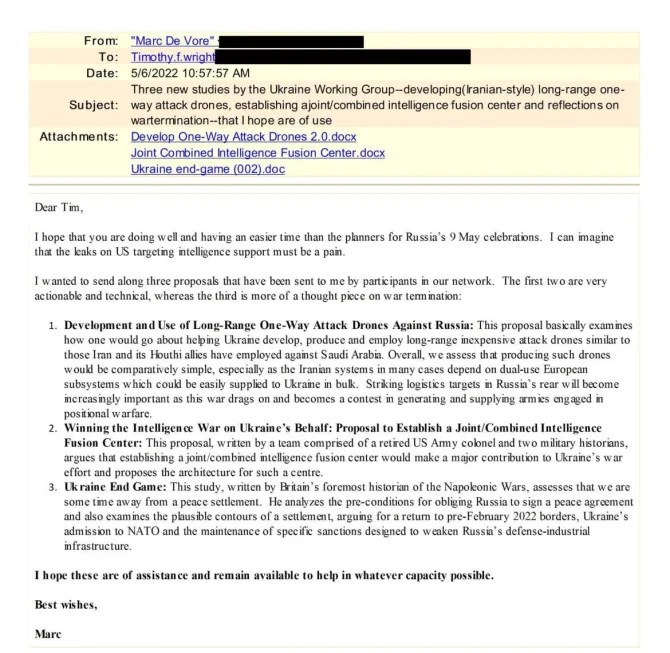
The Grayzone attempted to contact Orr, Rossiter, and Devore by phone and email in order to solicit comment about their role in proxy war scheme, and about whether St. Andrews University was aware it was being used as a base for planning terror attacks against Russia. None have responded to our requests.
Surging the Ukrainian diaspora to the front
Once the Ukraine proxy war erupted with full force in February 2022, the cabal of military academics quickly laid out what they described as “ideas of varying practicality that may not have been considered that Western states can collectively take to strengthen Ukraine’s ability to resist and hopefully preserve its independence.” Dedicated sections spelled out five suggestions, along with “background for such action and possible avenues for implementing them.” They boasted that the “fastest proposals” in the document were “executable in little over a week.”
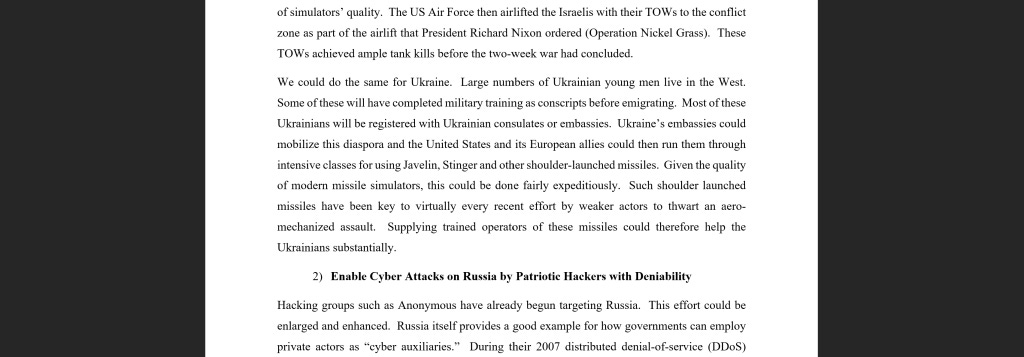
First on the list was arming Ukrainian emigres with anti-tank and anti-aircraft missiles, due to Kiev’s lack of “trained crews to operate the large numbers of missiles” being shipped to them by the West. They cited the little-known October 1973 Operation Nickel Grass as a means of “providing trained crews along with the hardware.” Under that mission’s auspices, Tel Aviv’s embassy in Washington “mobilized Israeli students studying at American universities,” who were then “rushed… through a rapid training program” by the US military.
This included teaching the conscripts how to use weapons similar to Javelin and Stinger missiles. The Israelis were then airdropped onto the frontlines of the 1973 Yom Kippur War against Syria and Egypt, where they “achieved ample tank kills before the two-week war had concluded.” The academics proposed doing “the same for Ukraine,” due to “large numbers of Ukrainian young men” living in the West, some of whom would have completed compulsory military training before emigrating.
This diaspora, it was believed, could easily be identified and recruited due to their registration with Ukrainian “consulates or embassies” in the West, then given “intensive classes” in using “shoulder-launched missiles” before being dispatched to Kiev.
“Volunteer cyber warriors” conceal state hacking
The quartet’s plans extended into the realm of cyberware, calling for “Western intelligence agencies” to “provide cyber tools and suggestions” to “volunteer hackers who want to strike their blow for Ukrainian independence, while also warning them what targets we do not want attacked.”
A “major task for these volunteer cyber warriors,” the four wrote, “could be to make certain that videos of Russian indiscriminate attacks, the use of objectionable weapons such as thermobarics, Ukrainian civilian casualties, Russian casualties and poor befuddled captured Russian conscripts” were made available to Russian audiences. Simultaneously, “patriotic hackers” could seek to bombard Russians with propaganda “about domestic opposition to the war.”
The intelligence cabal made clear they aimed to achieve the same psychological impact as the world’s most notorious terrorist organization, declaring, “we need to take a page from ISIS’ playbook in agilely communicating our message to Russians.”
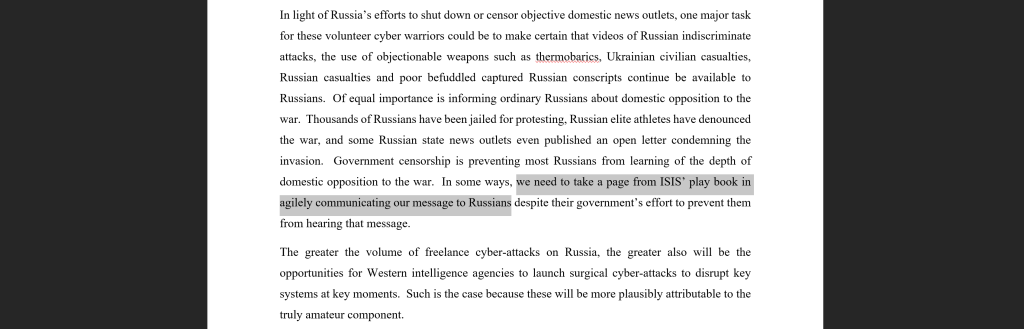
The activities of these “volunteer cyber warriors” were designed to provide cover for more formal, state-level hack attacks on Russian cyber infrastructure. “The greater the volume of freelance cyber-attacks on Russia, the greater also will be the opportunities for Western intelligence agencies to launch surgical cyber-attacks to disrupt key systems at key moments… because these will be more plausibly attributable to the truly amateur component,” the four academics evangelized.
The description offered strongly resembles the so-called “IT Army of Ukraine,” a volunteer cyber militia propped up in the days after Russia’s invasion. Since then, it’s been overseen by Mikhailo Federov, the Ukrainian digital czar credited by the BBC with pressuring Samsung and Nvidia to cease operations in Moscow, and getting PayPal to de-bank all its Russian clients.
Ukraine’s cyber army collaborates closely with Anonymous, the once-countercultural online hacker collective whose work now tracks closely with the objectives of the CIA. The authors of the proposal to the NSC hinted at the relationship, writing, “Hacking groups such as Anonymous have already begun targeting Russia. This effort could be enlarged and enhanced.”
The Ukrainian cyber army has taken credit for various acts of online vandalism. However, it also appears to have been involved in hacks targeting Russia’s power grids and railways. An attack on Russian taxi service Yandex that caused a large September 2022 traffic jam in Moscow was jointly attributed to both Ukraine’s ‘IT Army’ and Anonymous.

US Army “mad scientist” and self-proclaimed “war doctor in training” Zak Kallenborn
“Modern” IEDs for blowing up Russian infrastructure
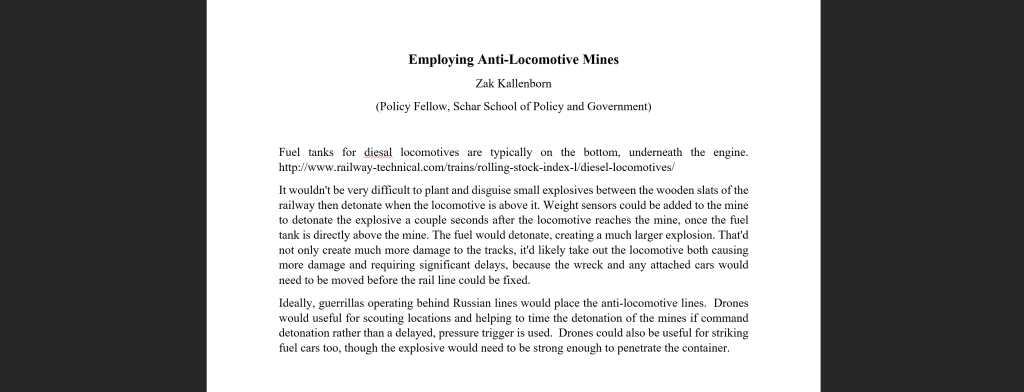
The academic cabal’s plans for attacking Russia through unconventional means extended explicitly into the realm of terrorism. A series of detailed recommendations for attacking Russian railway systems and roads with improvised explosive devices was put forward by Zachary Kallenborn, a self-described “PhD Student in War Studies at King’s College London researching risk analysis, perception, management, and theories with topical focuses in global catastrophe, drone warfare, WMD, extreme terrorism, and critical infrastructure.”
“Fuel tanks for diesel locomotives are typically on the bottom, underneath the engine,” Kallenborn wrote. “It wouldn’t be very difficult to plant and disguise small explosives between the wooden slats of the railway then detonate when the locomotive is above it… Ideally, guerrillas operating behind Russian lines would place the anti-locomotive lines.”
Throughout 2023, a group of self-described Russian and Belarussian anarchists conducted a series of attacks on railways, cell towers, and infrastructure inside Russia. Calling themselves BOAK, or the Combat Organization of Anarcho-Communists, the group of radical saboteurs earned glowing promotion in Western media. It is unclear if it received any outside assistance, however.
Kallenborn’s proposal, drafted in conjunction with the US War Department’s Joint IED Defeat Organization, suggested the US and its allies could “draw upon the lessons they painfully learned in Iraq and Afghanistan to help Ukraine orchestrate an IED campaign behind Russia’s lines.”
With the Taliban and Iraqi insurgents as models, Kallenborn proposed two technologies, “public-private key ring cryptography and ‘smart’ IEDs… to greatly increase the effectiveness of such a campaign.”
To wreak havoc inside Russia, Kallenborn envisioned a modern “stay behind” force similar to those unleashed onto Europe during Cold War era Operation Gladio, when the CIA and NATO organized fascist gangs and mafiosi to conduct anti-communist terrorist attacks.
Meanwhile, “smart” IEDs with “modern components” such as “microcontrollers,” which are now “abundant and cheap,” would allow Ukrainian attackers to “exercise additional discretion, reducing potential for collateral damage,” and “detonate the IED regardless of what the targets do.”
“The circuitry of microcontrollers can internalize most of the circuitry that would originally have been hard-wired into IED initiation switches,” Kallenborn wrote. “All microcontrollers have multiple inputs and outputs allowing multiple inputs, all while controlling multiple devices. Because microcontrollers are programmable, attackers can automate complicated algorithms to maximize an IEDs effects, and reduce collateral damage. Microcontrollers can even, relatively easily, circumvent many common countermeasures.”

Secretly employing contractors to pilot drones
While taking inspiration from non-state actors like ISIS and the Taliban, the Western academics plotting on the Ukrainian government’s behalf had elaborate plans for conventional warfare as well.
They assessed that drones had already “proven effective thus far” in the proxy war, so they urged greater deliveries of Turkish-made Bayraktar TB2s, which they said were “virtually the only airborne platform with which Ukraine is successfully striking Russian ground forces.” They proposed flooding Kiev with “additional TB2s,” pointing out that since Ukraine was already openly using them, and “had more on order before the conflict began,” Turkey’s role in supplying yet further drones could be concealed, leaving its neutrality publicly intact.
Ankara “could potentially transfer significant numbers of TB2s rapidly” from a variety of sources, the academics assumed, and fly them using local “private sector contractors.” If Turkey was unwilling or unable to go along with this plan, alternatives could be sought. “Given how commonly UCAVs are operated by private sector contractors, these could all be remotely piloted by private sector personnel employed by Ukraine, rather than uniformed members of NATO armed forces,” they noted.
Since drones can be operated “from considerable distances away from the frontline (potentially with pilots operating from neighboring countries),” they offered the further “advantage” over contract pilots, in that they would “be comparatively safe and certainly unlikely to be captured and paraded in front of Russian cameras.” While US-produced unmanned systems such as Predators and Reapers were an option, and could be provided “in large numbers,” they “would appear the most provocative” from Russia’s perspective, and make active US involvement too obvious.
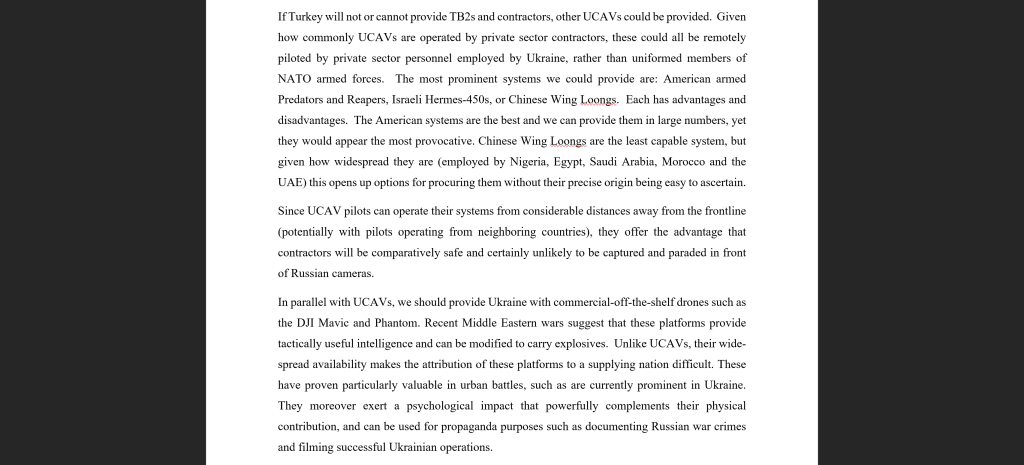
Prophetically, the paper noted Ukraine could be provided instead with “commercial-off-the-shelf drones such as the DJI Mavic and Phantom,” which not only had recording equipment capable of producing “tactically useful intelligence,” but could “be modified to carry explosives.” Moreover, “their wide-spread availability” made “attribution of these platforms to a supplying nation difficult.” It is surely no coincidence that ever since, both drones have been deployed extensively by Kiev to slow Russian advances and swarm military and civilian infrastructure.
By contrast, despite alleged initial successes, Bayraktar TB2s quickly vanished from the skies of Donbass. As several Ukrainian officials have admitted, Russian innovation in air defense and electronic warfare rendered the drones effectively useless. Conversely, the paper noted that while Ukraine’s Air Force was still conducting missions, Kiev would soon “run out of aircraft.” The prescribed remedy was to re-equip the country with Soviet-produced MiG-29 fighters, which “Ukrainian pilots know how to operate” already.
This plan, however, required a number of countries to hand over their ancient fleets of MiG-29s. The academics expressed concern that Central and Eastern European states might be “reticent” due to the risk of “Russian retaliation,” which could be circumvented by “promising gifts” to them, such as weapon upgrades. A year later, in March 2023, Slovakia granted Kiev its entire squadron of thirteen MiG-29s in exchange for a US promise of twelve Bell AH-1Z attack choppers equipped with Hellfire missiles.
Poland initially promised to match Slovakia’s splurge, but only wound up delivering a token amount. The deal has remained on hold since Krakow’s August 2024 announcement that it wouldn’t provide any further MiG-29s until it received a fleet of F-35s, which aren’t expected to arrive until 2026. Peru, likewise tapped by the academics as a potential source for the aircraft, reportedly initially greenlit supply of its MiG-29s to Ukraine, but then reneged. Latin American governments more widely have refused to dispatch any arms whatsoever to Ukraine, despite US pressure.
Air wars waged against Russia by “non-Ukrainian” pilots
Perhaps the most disquieting passage of the document is its last, in which its authors survey historical examples of air forces employing foreign pilots in major conflicts. The paper notes that the aforementioned Flying Tigers “were discharged from the US armed forces” to fight Japan in China, “with the clear understanding that they would be welcomed back thereafter.” Also cited was Finland’s employment of an “entirely” foreign squadron in its 1940 war with Moscow, as well as Zionist settlers’ reliance on an air force “comprised almost entirely of foreign volunteers” during their military campaign against indigenous Palestinian and Arab forces in 1948.
The academics wished to apply these precedents to the Ukraine proxy conflict, creating “volunteer fighter groups today to bolster Ukraine’s air defense” composed of “a reasonable number of Western pilots.” They wrote that these airmen “might volunteer if their national armed forces offered leaves of absence” – as might their civilian counterparts, if US commercial airlines could be “pressured into allowing their pilots, who are fighter-qualified Air Force Reserve or Air National Guard pilots, to take such leaves of absence.” The document boasted that “volunteer fighter groups could substantially disjoint Russia’s air campaign.”
F-16s were considered “the most logical option” due to “the number of NATO members that use F-16s,” including Poland. Accordingly, “Polish spare parts could be trucked into Ukraine comparatively quickly,” with the US “airlifting replacements” to Warsaw. From almost the first day of the proxy war, its most hawkish supporters have demanded that Kiev be provided with these fighter jets, referring to the planes as a “game changer” which would tip the conflict’s scales decisively in favor of Ukraine.
Despite much initial fanfare, when F-16s finally arrived in Kiev in late July of 2024, President Volodomyr Zelensky almost immediately complained the country had only received a handful of jets, and did not have enough pilots trained to fly them. The panic spread to Washington, where Sen. Lindsey Graham publicly urged any “retired F-16 pilot… looking to fight for freedom” to sign up. By the month’s end, the first of F-16s had crashed in uncertain circumstances.
While references to Ukraine’s “game changing” use of F-16s have all but disappeared from the media in the months since, the leaked proposal’s contents raise serious questions on how many supposedly Ukrainian strikes deep inside Russia were actually perpetrated by Western military operatives, acting at the behest of, and with material assistance from, NATO and the US.
“Western European and American fighter pilots tend to fly substantially more hours and train more realistically than their Russian or Ukrainian counterparts,” the academics claimed, meaning they were ideal candidates for conducting “combat missions” against Moscow’s positions, forces, and territory. However, the academics cautioned against Western pilots flying close to the frontline, for fear that “foreign volunteers fall into Russian custody, where an example could be made of them, or they could be paraded in front of the camera.” This was perhaps a nod to CIA pilots Gary Powers and Eugene Hassenfus, whose capture by the Soviet Union and Nicaragua, respectively, humiliated US intelligence.
It’s still unclear how much these proposals determined the course of operations by Ukrainian forces against their Russian foes. But the leaks reviewed by The Grayzone reveal for the first time how, in just a matter of weeks, a small cabal of academics secretly furnished some fairly unconventional war plans on a platter for the CIA and MI6.
Just as Britain did with its Project Alchemy, the Biden administration appears to have outsourced responsibility for crafting its battlefield strategy in Ukraine to a nexus of pinheads with dubious backgrounds, situated thousands of miles from the frontline and its gruesome realities. Almost three years later, with a generation of Ukrainians lost to the proxy war’s meat grinder, the authors of these battle plans are likely still pecking away at their laptops somewhere in the musty halls of academia.
Eruption In “BleachBit,” “Wipe Hard Drive,” “Offshore Bank” Searches In DC Suggest Deep State Panic Mode

By Tyler Durden | Zero Hedge | February 16, 2025
Internet search trends in the Washington, DC, metro area have been nothing short of stunning in recent weeks, reflecting what appears to be growing panic within the federal bureaucracy as President Trump and Elon Musk’s Department of Government Efficiency (DOGE) root out corruption in non-governmental organizations (NGO) and federal agencies.
Earlier this week, internet search trends for “Criminal Defense Lawyer” and “RICO Laws” went viral on X, fueling speculation that Washington’s political elites were in panic mode. The searches coincided with DOGE’s efforts to neuter USAID’s funding of NGOs that propped up a shadow government, as well as begin cutting tens of thousands of workers from various federal agencies.
Now, more suspicious search trends have erupted among DC residents as DOGE efforts went into beast mode at the end of the week.
“Washington DC searches soar for “Swiss bank” (yellow), “offshore bank” (green), “wire money” (red) and “IBAN” (blue),” WikiLeaks wrote on X late Thursday.
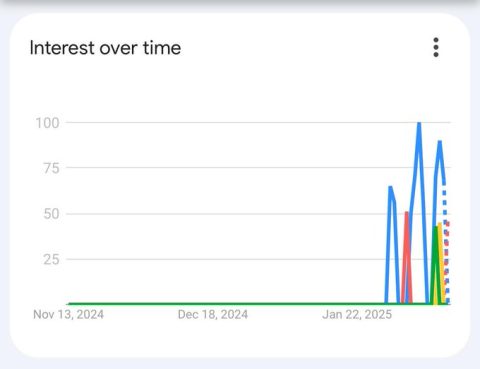
Search terms “Wipe” (blue) and “Erase” (red) also moved higher in recent weeks. Wipe hard drives?
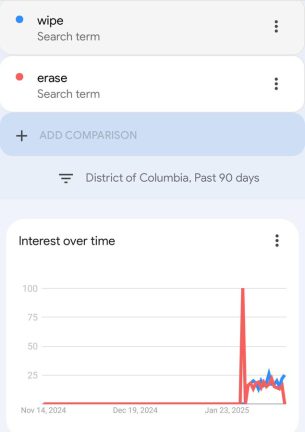
Well, yes, the search term “wipe hard drive” across the DC metro has gone absolutely parabolic.

And “BleachBit” too!

Searches for “lawyers” have jumped.
“Statute of limitations” also soared.
Why on Earth would some DC residents panic-search keywords that suggest they are trying to cover up a crime?
Well, just take a look at this!
The accountability sheriff: Trump & DOGE are in town – and the Deep State criminals who have been misappropriating taxpayer funds for years are in panic mode.
Hence this…
Now DOGE’s “Big Balls” member, Edward Coristine, now listed as a “senior adviser” at the State Department’s Bureau of Diplomatic Technology, should focus efforts on those outbound ACH transfers >$1 million in the past few months…
Featured Video

Macgregor: We Haven’t Seen the Worst of the Iran War Yet
or go to
Aletho News Archives – Video-Images
New Book
Breast Cancer: Before You Consent
A new Unbekoming paperback
Lies are Unbekoming | September 18, 2026
Peter Gøtzsche reviewed every randomised mammography screening trial ever conducted for the Cochrane Collaboration. Cochrane’s headline is that, assuming a 15% mortality reduction, one woman in 2000 avoids dying of breast cancer over ten years. Ten are overdiagnosed and treated. Two hundred experience false alarms.
But that headline assumes the reduction. When Gøtzsche looked only at the trials with adequate randomisation — the higher-quality ones — the reduction disappeared. No effect on breast cancer mortality. No effect on all-cause mortality.
This is the Cochrane finding, published in the establishment’s own database of systematic reviews.
No woman being asked to consent to a mammogram this week knows it.
That is why the new Unbekoming paperback exists. … continue
Blog Roll
 Aletho News
- US-Denmark Agreement on Greenland Is ‘PR Stunt’ Ahead of Midterms
- Araghchi: Military intervention cannot create security; coercion cannot bring peace
- Fraud Squared
- Breast Cancer: Before You Consent
- Iran’s Plan to Shut Down AI in the Persian Gulf
- Israel seeks ‘compensation’ from Washington over Saudi F-35 sale
- Saudi crown prince seeks dialogue with Ansarullah after Yemeni blows: Report
- Damascus rejects Saudi request for Syrian fighters to counter Yemen: Report
- South Korea says will not send troops to join terrorist US war on Iran
- Russia Just Struck the Eyes of NATO’s War Machine in Ukraine
- If Americans Knew
- Inside the siege, the ruined buildings of Gaza – Daily Update
- Debunking The Claim That Macklemore Has A “History Of Antisemitism”
- CPJ demands release of arrested Palestinian-US journalist near Bethlehem
- Robert Kraft: The Billionaire Friend of Netanyahu Pulling The Strings Behind the Macklemore/Ed Sheeran Blow Up
- Columbia Administered Fund Gives Big Money to Pro-Israel Groups
- Deportation Case of Palestinian Activist Salah Sarsour Tests First Amendment
- ‘We Will Not Forget’: Palestinians Mark 44 Years since Sabra and Shatila
- Why do we let Zionists decide what we can and can’t say?
- US welcomes Israeli, Iranian delegations to UN, but not Palestinians – Daily Update
- Biden’s Genocide Accomplices Targeted by New Accountability Campaign
- No Tricks Zone
- New Study: ‘Global Drought Shows No Detectable Recent Acceleration Under Climate Warming’
- Economic Masterminds: German Socialists Suggest Taxing Productivity Gains Stemming From Using AI
- The South China Sea Has Not Been Cooperating With The Climate Change Narrative
- Energy Crisis: Germany Enters Heating Season With Historically Low Gas Reserve Fill Levels
- New Study: The Antarctic Ice Sheet Gained Mass From 2020-2024 Due To Staggering Snow And Ice Accumulation
- Study: Ocean Heating Rates From Thousands Of Years Ago ‘Dwarf’ Modern Ocean Heating Rates
- Climate Extremists Target, Attack Large-Scale Power Grid Infrastructure In Germany!
- New Study: Antarctic Ice Melt Has Contributed Less Than 1 Centimeter To Sea Level Rise In The Last 30 Years
- Fear Of Debate: Alarmist German Climate Scientist Calls On Mainstream Media To Discredit Skeptic Voices
- End-Of-August Arctic Sea Ice Extent Hasn’t Fallen In 20 Years, Official Data Show!
 Aletho News