Zelensky now with only the dictatorship in London to support him

By Martin Jay | Strategic Culture Foundation | February 26, 2025
What is the definition of a ‘dictator’? In the days that followed Trump’s social media post calling President Zelensky one, British media seized upon the subject and ran with it for days. Various public figures were asked whether Trump was right to use the word and whether they believed Zelensky was actually one. Two figures from the right, Nigel Farage and Liz Truss both said they thought Trump was both wrong to call him one and that in fact he wasn’t one.
This remarkable endearment for Zelensky is really the core of the problem in the west in particular the UK, where its leader Sir Keir Starmer declared that he would be ready to send British troops to Ukraine – a suggestion which was quickly shot down by the elites of Germany and France as preposterous.
It’s rare that the giants of the EU put the British government in its place on world affairs but we are living in unprecedented times of sensational stupidity and perhaps ignorance from politicians which we have never seen before.
Farage’s views on the Middle East tell us he is both ignorant of what is happening there and doesn’t have any advisors covering the region. But his views on Ukraine are even more shockingly deranged. Zelensky is a leader who has shut down anything which resembles an ‘opposition’ both politically and media, he has conglomerated all TV stations into one state-owned entity so as to shut down even the slightest criticism or accountability of his own actions, he has had the few dissident voices arrested and thrown into prison, with some predicting that there are thousands of journalists and media workers. Add to that it is rapidly emerging that the level of corruption and embezzlement linked directly to Zelensky is on a scale that even hard line critics in the West could not have even imagined.
In my own investigation in October 2023, where a very angry Ben Wallace insulted me in a WhatsApp interview before blocking me, I outline how the original, more sensational claim that only about a third of all military equipment sent to Ukraine was actually making it to the battlefield was in fact realistic. This analogy was bandied about for some time and was dismissed by Wallace and others like Alecia Kearns MP as nonsense and yet turned out to be more than just realistic but likely. That is to say that 66 percent of what was being sent to Ukraine was being sold on the black market in Libya making Zelensky and his close circle billionaires.
In recent weeks now mainstream journalists and politicians are talking about the arms scandal and it is only a matter of time before we shall see the realities of this. The British government have always turned a blind eye to it, both in Ukraine and further afield. It would cost them nothing to do a study in the Sahel to evaluate how much of the equipment there funding terrorism is coming from the arms bazaars of Tripoli where all of this kit is ending up. I suggested to Wallace that his own government at the time should send some investigators there (Libya) to look at what’s available. I was more or less told to go there myself and do the job for them.
But Zelenksy support structure for so long has been that of a dictator, in particular media. The hundreds of media outlets in Ukraine which were receiving USAID funding is extensive, not to mention the hundreds of civil servants which support him being on the same payroll. If that doesn’t shock Farage and Truss, then consider the same slush fund which paid out around a 100 million dollars to movie stars to go and visit him and fake their adulation, all for the purposes of cheating the humble U.S. taxpayer by raising his profile.
Who could forget Sean Penn giving him his own Oscar, or Ben Stiller chilling with the Ukrainian leader and making small talk? Angelina Jolie is even reported to have been paid 20 million dollars to meet with him but didn’t even manage that and simply mooched about a bit in the country before jetting back to the U.S. Of course, the celebrities all dismiss these claims, through the same left-wing woke press which is part of their extended political family. But the question we should be asking ourselves is simply this: if they were not paid, then why won’t they show up now and show support at the precise moment when Zelensky needs it the most? Given that these celebrities supported Biden and are Democrats, this would be the most logical thing for them to do. In reality, the wall of silence is what we see.
Dictators don’t stand over their hired killers and watch their victims in their final moments like Idi Amin did. In reality, they only indicate and hint to the thugs on their payroll what she should do to fix problems. Do Farage and Truss actually believe that dissidents are not rounded up and thrown into jail where they are tortured and in some cases murdered? Now that the vultures are circling over Zelensky and many are wondering how many days in office he has left, more reports are emerging with details of such cases. The story of Gonzalo Lira, the American Chilean blogger whose vlogs were often well-informed and threw a very poor spotlight on Zelensky is a very sad one as he was brutally tortured while in prison and finally died. If the Zelensky cabal can do this to an American citizen, perhaps Farage and Truss will not be too surprised when in the coming weeks we will have the same Damascus prison media moment where it transpires that there are certainly hundreds, possibly thousands of journalists, commentators and political rivals in Ukraine’s prisons.
The debate, if we can call it that in the UK, over whether Zelensky is a dictator or not is a remedial one at best as it misses the point. In Britain, during the same period a man was imprisoned for posting a social media comment about a Labour official while a granny was visited by two plain clothes cops about her mere criticism of a Labour councilor’s conduct. Plain clothed detectives!
Britain has descended rapidly into a police state with Starmer as its dictator. The high ground we once had where we scolded China for arresting protestors has now been kicked away from under our feet. We have become China. Britain’s police now cannot deal with crime but prefer being the ‘Thought Police’ and threatening old biddies.
And so the talk about what is a dictator is rather fatuous if not incongruent given that those doing it are part of an elite which only claim to cherish free speech but in fact loath it. Farage cannot be taken seriously on Ukraine but his comments do steer the bumble hack towards darker questions. Who is funding him? And is his own dream of being a PM in the UK going to merely continue the present dictatorship which silences anyone who questions him? His reputation of being thin-skinned and kicking out of his party anyone who questions his ideas is already established. His own repugnance of British media also is well known. Previously in Brussels, his decision led to the closure of the only free speech, anti corruption magazine going, which he was always fearful of exposing his own infidelity while an MEP. And as for Truss, the most inept prime minister Britain has ever had in its long history, whose dictator-like style while in office crashed the economy? How should we interpret her support for Zelenksy? Do both Farage and Truss admire this dictator? The problem is not with the word ‘dictator’, it is more about the people who use it for their own purposes. It is not important whether Zelensky is one or not, rather than he is not a dictator who is servile to Trump and his cabal. Unlike Farage, Zelensky is not our kind of dictator.
Gardasil on Trial: Did Merck Mislead the Public on Cervical Cancer Prevention?
Top expert delivers a damning report accusing Merck of misleading the public about Gardasil’s ability to prevent cervical cancer
By Maryanne Demasi, PhD | February 24, 2025
With the landmark trial against Merck adjourned until September 2025, new evidence suggests the vaccine manufacturer may have deliberately misrepresented the necessity of mass HPV vaccination.
This revelation comes from an expert report by Dr Sin Hang Lee, a pathologist renowned for his expertise in molecular diagnostics. His findings raise serious concerns about Gardasil’s efficacy and the motives behind its aggressive marketing.
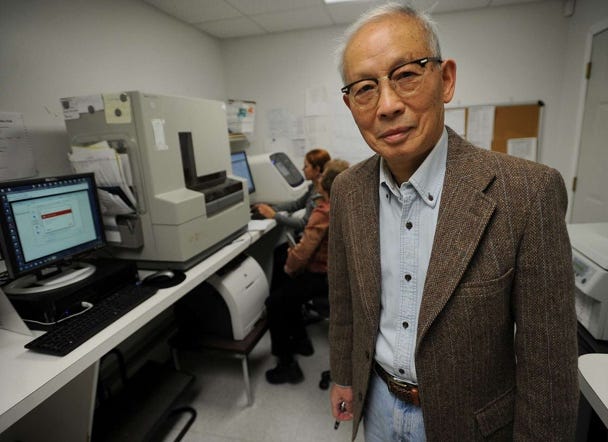
Dr Sin Hang Lee, director of Milford Molecular Diagnostics, Connecticut
Does Gardasil Prevent Cervical Cancer?
Since its introduction in 2006, Gardasil has been marketed as a breakthrough in the fight against cervical cancer.
Yet, as Dr Lee bluntly states in his report, “There is no conclusive evidence that Gardasil has prevented a single case of cervical cancer in the past 18 years.”
No randomised controlled trial (RCT)—the gold standard for assessing efficacy—has ever demonstrated that Gardasil prevents cervical cancer.
Instead, Merck relied on surrogate markers of pre-cancers, such as cervical intraepithelial neoplasia (CIN2/3) to claim effectiveness. This is a significantly lower evidentiary bar that was used to fast-track FDA approval.
The problem with this approach is well-documented. Many CIN2/3 lesions resolve naturally.
A Dutch study, for instance, tracked 114 women with CIN2/3 found that nearly two-thirds of cases regressed without intervention. Only one developed adenocarcinoma in situ (pre-cancer) and none progressed to cervical cancer.
Moreover, those lesions that don’t resolve naturally typically take years to progress, and they are usually detected through routine screening.
If CIN2/3 is an unreliable proxy for cancer, how can it serve as valid proof of Gardasil’s claimed efficacy at preventing cancer?
Are HPV Strains Merely Being Replaced?
Another major concern is “type replacement”—the possibility that suppressing certain HPV strains through vaccination leads to the rise of others.
For instance, a Finnish study found that while HPV strains 16 and 18 (targeted by the vaccine) decreased following vaccination, non-vaccine strains such as HPV 52 and 66 became more prevalent.
This raises an important question: While Gardasil may alter the landscape of HPV infections, does it actually reduce the overall risk of developing cervical cancer?
When Merck developed Gardasil 9 to target five additional HPV strains, a study involving 14,215 women found that those who received Gardasil 9 developed high-grade lesions at the same rate as those who received the original Gardasil (which only targeted four strains).
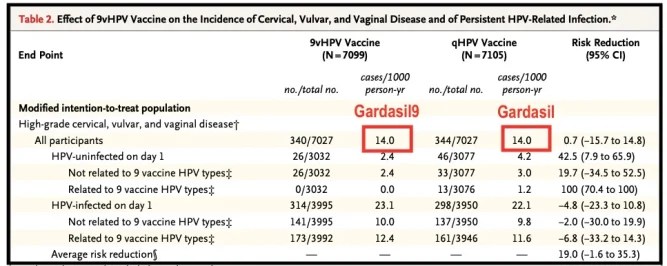
Despite the expanded coverage, the additional strains had no measurable impact on pre-cancers overall, adding to the uncertainty about whether these vaccines truly reduce cervical cancer incidence.
The Questionable Swedish and Scottish Studies
Two widely cited studies—from Sweden and Scotland—are often heralded as proof that Gardasil significantly reduces cervical cancer rates. However, Dr Lee highlights critical methodological flaws in his report.
- Swedish study
The Swedish study, published in the New England Journal of Medicine, compared cervical cancer rates between vaccinated and unvaccinated women.
However, Dr Lee points out that many participants (born between 1995 and 2007) were too young to develop cervical cancer during the study period (2006–2017).
Since cervical cancer takes decades to emerge, including these young women (ages 10–22)—who had zero cases—introduced a statistical bias that exaggerated the vaccine’s effectiveness.
Moreover, the study failed to account for the “healthy user effect,” where vaccinated individuals are more likely to engage in preventive health measures like regular screening, which independently reduces cancer risk.
As a result, attributing the decline in cancer cases solely to the vaccine is misleading.
- Scottish study
A 2024 Scottish observational study, published in the Journal of the National Cancer Institute, had similar methodological issues, and was met with sensationalist media headlines: “No cervical cancer cases in HPV-vaccinated women.”
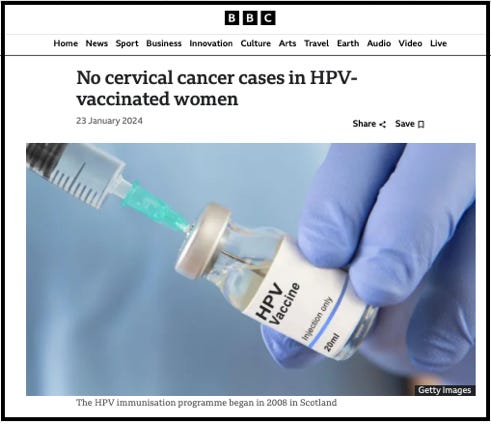
However, Dr Lee argues this claim is deeply flawed. First, the women studied were simply too young for conclusions about long-term vaccine efficacy to be drawn.
Second, Scotland’s screening programme, which detects and treats precancerous lesions before they develop into cancer, changed its entry age in 2016 during the study period.
The age at which women were first invited for screening was raised from 20 to 25, meaning there was a 5-year gap in screening for younger women. As most cancers in women under 30 are diagnosed through screening, this change could explain any decline in cancer rates, rather than the vaccine itself.
And third, just like the Swedish study, the “healthy user effect” further confounds the results.
Despite being frequently cited as definitive proof of Gardasil’s effectiveness, these studies contain serious limitations that undermine their conclusions.
Cervical cancer screening saves lives
In developed nations, around 93% of initial HPV infections resolve without medical intervention. Cervical cancer is slow to develop, with an average onset age of 54, making long-term data essential for assessing Gardasil’s true impact.
What remains incontrovertible is the lifesaving role of cervical cancer screening.
Since the widespread adoption of Pap smears in the 1950s, cervical cancer incidence in the U.S. has plummeted—from 44 per 100,000 women in 1947 to just 8.8 per 100,000 by 1970.
This dramatic decline predates the introduction of HPV vaccination in 2006.
In Australia, deaths from cervical cancer fell significantly along with incidence following the introduction of the National Cervical Screening Programme, and remained steady despite mass HPV vaccination.
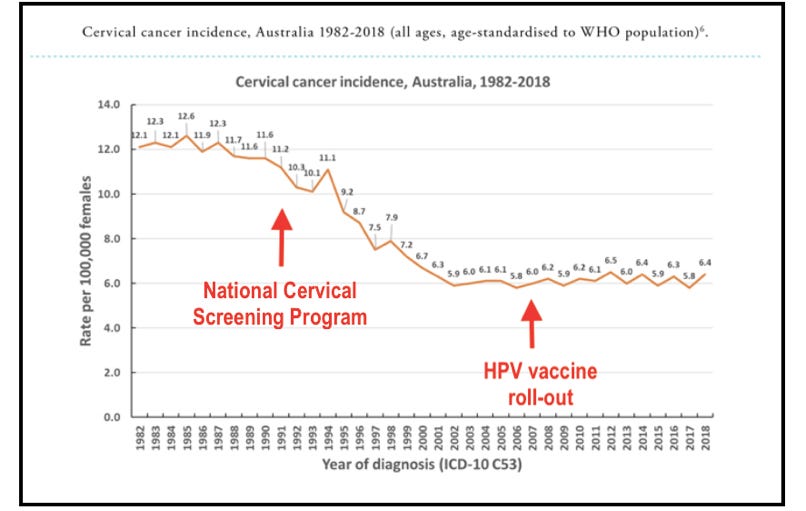
Source: https://www.hpvworld.com/articles/prevention-of-cervical-precancer-and-cancer/
Dr Nancy C. Lee, former Associate Director for Science at the CDC, testified before the U.S. Congress in 1999:
- “Cervical cancer is nearly 100 percent preventable.”
- “The most important risk factor for developing cervical cancer… is the failure to receive regular screening with a Pap smear.”
- “For a woman with CIN, her likelihood of survival is almost 100 percent with timely and appropriate treatment.”
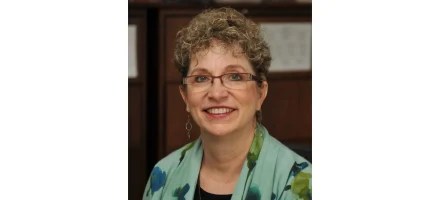
Dr Nancy C. Lee, former Associate Director for Science at the CDC
Unlike cervical cancer, which is preventable through screening and treatable with early intervention, Dr Lee asserts the harms linked to Gardasil – such as autoimmune disorders and neurological complications – are unpredictable, difficult to treat, and often irreversible.
Did Merck Misrepresent Its Vaccine?
At the core of this legal battle is a critical question: Did Merck mislead the public about Gardasil’s true value?
Despite its widespread use, Gardasil’s long-term efficacy remains unproven, while growing evidence links the vaccine to serious harms, including autoimmune disorders and neurological complications.
For decades, cervical cancer rates have declined due to improved screening—not mass vaccination. Yet Merck has aggressively marketed Gardasil as essential for cancer prevention, even in countries where cervical cancer is already rare.
Dr Lee’s report suggests Merck selectively presented data to manufacture a false sense of necessity—one that collapses under scrutiny.
As the trial resumes in September, one question remains: Did Merck knowingly misrepresent Gardasil’s safety and efficacy, prioritising profit over public health?
Three years of a cruel and destructive NATO proxy war in Ukraine
By Dmitri Kovalevich | Al Mayadeen | February 25, 2025
The end of February marks three years since the start of Russia’s special military operation in Ukraine and 11 years since the ‘Euromaidan’ coup of February 2014. The coup was the main cause of the current military conflict.
The war in the now-former eastern territories of Ukraine could have been avoided had two successive presidencies in Kiev (Petro Poroshenko, 2014-2019 and Volodomyr Zelensky since 2019) complied with the Minsk 2 peace agreement of February 2015. Minsk 2 (text here), was agreed by Kiev and the pro-autonomy forces in the Donbass region on February 12, 2015. France, Germany, and Russia co-signed the agreement as guarantors. The agreement was unanimously endorsed by no less than the UN Security Council on February 17, 2015.
Minsk 2 envisioned the return of Lugansk and Donetsk (the two rebellious ‘peoples republics’ of the industrialized Donbass region) to the fold of the Ukrainian constitution, this time as semi-autonomous oblasts (provinces). Kiev also agreed to a neutral status for Ukraine. It could apply for membership in the European Union if it chose, but membership in the NATO military alliance was for Russia a non-starter.
EU membership increasingly became a goal of Western-oriented business interests in Ukraine during the decade of the 2000s. That decade followed 10 years of sharp economic decline following the dissolution in 1989-90 of Soviet Ukraine and of the Soviet Union (USSR, of which Soviet Ukraine was a key constituent).
Tragically for the people of post-Soviet Ukraine, the Western countries, particularly the leading powers of NATO, quietly and deceptively opposed Minsk 2. They worked quietly from the get-go to sabotage the agreement.
Deception of Ukrainians by the West
On February 12, 2025, the deputy secretary of the Russian Security Council, Aleksey Shevtsov, spoke on the ninth anniversary of the signing of Minsk 2, explaining once again to those who would listen that Russia’s special military operation in Ukraine would never have happened had the West honored the agreement. He stressed that the people of Ukraine today have every right to demand an accounting for the deceptions that took place in 2015 and after.
On the same day, the Ukrainian online publication Strana published a lengthy commentary in its Telegram messaging service headlined, ‘Why did the Minsk agreement fail?’ Strana wrote, “Russia says that Kiev deliberately refused to fulfill the conditions of the Minsk 2 agreement and instead proceeded to rearm its army and restart armed attacks against the people of Donbass. The Russian government says it can no longer trust the government in Kiev and so there is no possibility of a ‘Minsk 3’.” (‘Minsk 1’ was a first attempt, in September 2014, by the pro-autonomy forces of Donbass to reach a peace agreement with the new administration in Kiev.)
Strana wrote further, “Russia did not launch a full-scale invasion of Ukraine in 2014 or 2015. Perhaps it wanted to, who knows, but it could not do so because it would have been hit with harsh economic sanctions similar to those levied against it by the Western powers beginning in February 2022. It would have faced economic sanctions worse than those initially levied against it following the Crimea referendum of March 2014. The Russian economy was in no shape to easily withstand such sanctions, in contrast to the situation in 2022.
“Additionally, although the Ukrainian army back then was much weaker compared to 2022, this was also the case for the Russian army.”
In their recollections of the events of those years, leaders of today’s Donetsk Peoples Republic (today a constituent of the Russian Federation) say that the main opponent of a major military response to Kiev’s continued military provocations and sabotage of Minsk 2 was the Russian military. Russian military leaders said at the time that the Russian Federation did not have enough combat-ready troops to take on such a large and industrial country as Ukraine.
“From a purely military point of view, the rapid success of Russia in Crimea in the spring of 2014 was due to the fact that Russian troops were already present on the Crimean peninsula [by virtue of a 1997 agreement between Russia and Ukraine; see Wikipedia on the subject]. They needed no time to deploy, and they prevented armed attacks being threatened by the paramilitaries of the new administration in Kiev. At the time, there were no large military formations of the Russian Federation along the lengthy Russian-Ukrainian border. Donbass’s self-defense forces only began to form in the late spring of 2014 and it was several years before they were integrated as auxiliaries of the Russian armed forces.”
As Russian sources stated at the time, the initial military defense that arose in the Donetsk and Lugansk oblasts of Ukraine against the paramilitaries of the 2014 coup bore the markings of a military adventure and were not at all coordinated with the political leadership of the Russian Federation. The self-defense forces hoped to convince or pressure Russia to join a war of defense for which Russia was not ready, not politically, economically nor militarily.
What the Western-incited war in Ukraine has wrought
In the lead-up to and since the 2014 coup, western and central Ukraine has been living the fate of a battering ram to be used by the Western imperialist powers to weaken Russia, regardless of the tragic human consequences and of the prospect of Ukraine being cast off once it is no longer needed for such a role. The results of this cruel and heinous policy are increasingly evident as graveyards continue to spread on Ukraine’s territory with each passing day.
The Politnavigator media outlet explained (as reported on Telegram on February 1) the consequences of such policy for the mortals conscripted into war, many against their will. The report cites Anton Cherny, an officer of the Armed Forces of Ukraine. He explains, “We are being lied to about the value of our soldiers’ lives. I watched the speech of our commander-in-chief that every soldier is valuable to Ukraine and worth his weight in gold. That’s what they tell the people, but it’s not true.”
Cherny says that 90% of the soldiers who die or succumb to injuries on the battlefields are simply buried there and then officially listed as missing. “Everyone there knows perfectly well what is happening.” And the indignities do not end there. The families of those reported as ‘missing’ do not receive the financial compensation to which they are entitled.
Cherny also explains that it is extremely difficult for surviving fighters to exit the grim fighting along the front lines. “It’s hard to get out of there by yourself, it’s unrealistic. How lucky it would be if there were fog, very big snow or some other bad weather.” He explains that Ukrainian lines are under constant surveillance from drones flying overhead. As soon as evacuation vehicles approach from the Ukraine side, the drones threaten to strike them, making it very difficult to evacuate the injured or the dead from the various battlefields.
Politnavigator continues its report:
‘The army doesn’t provide guidelines or instructions for soldiers to somehow make their tasks easier. Its words to this effect are just talk. Soldiers are told to go here or there and ‘do’ something, but as to what, where and why, you have to be some kind of superman to figure it out. It’s unreal,’ Cherny says indignantly.
Provoking the sleeping bear of Russia
Radical nationalist and neo-Nazi paramilitaries operating under the control of Kiev’s police and special services waged nine years of military conflict and terrorist attacks against civilians in Donbass from 2014 to 2021. This was bound to provoke a reaction from the Russian Federation sooner rather than later, as any serious commentator knew and reported.
Ukrainian commentators were writing more than three years ago that Kiev’s deployments of paramilitaries in Donbass and its turning a blind eye to their crimes, backed by promises of weapons by belligerent Western governments, would inevitably provoke Russia into responding, as though provoking a bear with a stick. The weapons of Ukraine, many provided by the West, did indeed, predictably, awaken the bear, and angrily.
In early February 2025, the prime minister of neighboring Georgia, Irakli Kobakhidze, told journalists that back in 2022, his country’s then-government was being encouraged by the West to open a ‘second front’ against Russia. The country was to be used just as Ukraine was being used. According to the Kobakhidze, Georgian officials of the day were told a fable by the Western powers to convince them to act. “They said Ukraine is winning the war; you should not miss this chance to strike against Russia.”
Kobakhidze believes it will now take Ukraine 100 years to return to a state of development comparable where it was prior to the 2014. He asks, “Why was all this done? No one is offering a clear answer to this question. However, there is an answer: some global interests, evil interests, have sacrificed our friendly country Ukraine.”
Full-fledged dictatorship
The eleven years that have elapsed since the Euromaidan coup of 2014 have been years of Ukraine sliding inexorably towards dictatorship, all the while accompanied by rosy phrases from EU leaders claiming that a ‘triumph of democracy’ was taking place. The ideology of Nazism from the World War II era has been officially rehabilitated, while opponents of this course have been targeted by armed, ultra-nationalists and neo-Nazis.
All left-wing parties in Ukraine have been banned. Some of their members and leaders have been killed, while many more have been forced into exile. Protests against, and critics of, the ‘pro-European’ dictatorship in Kiev have been targeted for repression. The Western powers have turned a blind eye to the crimes being committed, while United Nations officials have occasionally issued toothless resolutions expressing ‘concern’ about the civil rights being violated.
In 2021, Zelensky banned more political parties critical of his government, and he closed all television channels deemed non-compliant with his policies. No court or other legal reviews of these decisions have taken place.
With the outbreak of war in February 2022, Zelensky imposed martial law and then canceled national elections for the presidency and the legislature (Rada). These were to take place no later than April 2024, according to the Ukraine constitution. Zelensky has said that Ukraine cannot hold elections until it has fully regained control over its former territories. Since this would be impossible to achieve, his statements on the matter mean that for all intents and purposes, elections will not take place in the remaining territories held by Kiev. Period.
Alexander Dubinsky, a former associate of Zelensky jailed by his administration, writes that the war became for Zelensky an escape from the social explosion building up inside the country and appearing inevitable by the end of 2021. “I think this largely determined why Zelensky promoted military rhetoric in every possible way, and why in March 2022 he ceded to Western government pressures to draw back from a political settlement with the Russian Federation.”
For Dubinsky, the end of the war would mean a loss of political power by Zelensky and his cohorts, and this, in turn, would expose them to direct conflict with all the enemies he has managed to make. He may be able to protect himself from the widows and mothers of the deceased, reasons Dubinsky, but not from the violent, ‘serious men’ who have proliferated under his government.
Detention camps using torture methods under Zelensky
Every day, more and more facts are emerging in Ukraine about the detention camps that Zelensky has created in order to sustain its power and continue the NATO proxy war.
In January, legislator Oleksandr Dubinskyy urged Ukrainians to report to U.S. authorities about the detention camps that the Security Service of Ukraine (SBU) has organized, notably for the purpose of forcing accused conscription evaders to confess to accusations of state treason. According to him, the SBU detention camps are prototypes of what Ukraine as a whole has become under Zelensky.
Dubinskyy has been detained since November 2023 under accusations of financial crimes and treason. He has recently announced from detention his intention to run for president of Ukraine if and when a national election takes place.
Another former associate of Zelensky, legislator Artem Dmytruk, wrote on Telegram on January 30 that the entire special corps of the Lukyanivske pre-trial detention center in Kiev should be called a concentration camp and named ‘Zelensky’s Factory’. Legislators Oleksandr Dubinsky and Yevhen Shevchenko are among those imprisoned there. “90|% of detainees in this center face charges by the office of the expired president Zelensky.”
Dmytruk fled to Britain in August 2024 shortly after he was the only deputy in the Rada to speak and vote against a new law banning the Ukrainian Orthodox Church, of which he is a subdeacon.
The Ukrainian magazine Liberal published a lengthy report in February saying that individuals and political formations connected to the Zelensky administration are the only ones in Ukraine not talking about political repression prevailing today in the country.
The authors claim that extensive political repression was being prepared and carried out well before the start of the Russian military intervention in February 2022. According to the publication, thousands of SBU employees were sent to border regions on the eve of the Russian intervention to monitor troop morale and other measures of the military situation.
At the same time, Kiev began to address its shortages of police and prison personnel in Kiev and other regions by recruiting ‘trained athletes’ into the ranks of the SBU after completing three-month courses in western Ukraine. ‘Trained athletes’ is a euphemism in Ukraine for members of criminal gangs.
“Thousands of bone-crackers performing police functions inside the country spread out without the slightest remorse to beat testimony out of Ukrainians using the most brutal forms of violence and creating torture institutions such as the famous ‘Sports Hall’ on Volodymyrska Street [in the center of Kiev],” writes Liberal.
“People were lying on floors, deprived of the right to move and subjected to constant beatings and humiliation. The Ukrainian anthem and nationalist songs were played continuously from loudspeakers. The eyes of the prisoners would be taped shut with duct tape or tied with rags, and they were taken to the toilet only once a day. They were also fed very sparingly, once per day.”
The authors note that political prisoners now account for about half of the prisoners in Ukraine. The main motives for many SBU officers, Liberal notes, have not been security concerns but the robbery of suspects. Detainees have been forced to surrender their personal wealth upon arrest and detention.
Two reports in English on prison conditions in Ukraine were published in 2024, one by a Danish government agency (110 pages) and one by an agency of the Council of Europe (46 pages). Both reports skirt incendiary accusations such as the one published by Liberal and the many ones appearing widely on social media.
On February 12, a German court for the first time approved the extradition of a conscientious objector to military service who had fled Ukraine. Ukraine prohibits men of military age (age 25 to 55, 60 for officers) from leaving the country. Many of the fugitives from Ukraine’s compulsory conscription have chosen to flee to Germany, attracted by Germany’s claimed liberal values. This court decision is the first warning sign that the authorities of European Union countries may begin to conduct forced deportations of the Ukrainian men who have managed by hook or by crook to escape from their homeland’s military conscription. It is reported that in 2024, there are some 200,000 Ukrainian men residing in Germany alone.
Orbán warns about large migration of Soros NGOs to Brussels
By Ahmed Adel | February 24, 2025
Hungarian Prime Minister Viktor Orbán said that George Soros’s NGOs are fleeing to Brussels after US President Donald Trump “dealt a huge blow to their activities in the US,” which in turn can see the liberal networks of the billionaire philanthropist descend the continent further into debauchery.
“WARNING! Our fears have come true: the globalist-liberal-Soros NGO network is fleeing to Brussels, after President Trump dealt a huge blow to their activities in the US. Now 63 of them are asking Brussels for money, under the guise of various human rights projects. Not going to happen! We will not let them find safe haven in Europe! The USAID-files exposed the dark practices of the globalist network. We will not take the bait again!” Orbán wrote on X.
Călin Georgescu, an independent candidate who won the first round of Romania’s presidential election last year, the result of which was illegally annulled due to alleged influence from Moscow, has said that if he wins a new vote, he will expel the entire Soros network from Romania.
“From my point of view, on the first official day, the entire Soros network will be banned personally by me. They know each other, we already know them. Things are very clear and it is important. […] The moment you destroy the education of a people, you have the country in your hands,” he said.
Elon Musk shared Georgescu’s announcement to crack down on external influences on X and wrote, “Romania deserves its own sovereignty.”
At the same time, it seems that a bloc has formed within the US that does not give up on American exceptionalism in the world – unipolarity, but has given up on the culture and ideological package promoted by the Soros-aligned elite. Although the competing ideologies will agree and disagree about the US’ global role, the outcomes, if they come from traditional cultural relations and traditional perceptions of power, as has not been the case for years, will be significantly different than the previous liberal and Soros-aligned Biden administration.
J.D. Vance has, in a short time as vice president, crusaded against transgender, homosexual, and hermaphrodite promotion as he recognizes it is weakening the US. This ideology is weakening the US militarily because it is impossible to win a war with transgender people. Also, this culture pushed by Soros weakens the US in terms of self-confidence as it is deeply depraved and rejected by the majority of humanity.
The ideological war waged between Soros and the Trump administration is over the liberal culture of selfishness, narcissism, and permanent debauchery, and this is Trump’s latest attempt to culturally elevate the US under the slogan “Make America Great Again.”
When it comes to Brussels, the EU cannot finance all these activities, especially now that USAID can no longer contribute, while at the same time having the idea of war with Russia despite the demotion of militarist ideas. The European elite speaks about continuing the war in Ukraine in one way or another, but most EU countries cannot even form special units.
Therefore, Europe finds itself in a position where it has the ambition for war but blocks the ideology of militarism by promoting Soros’s idea of universal human decadence. That is why Orbán’s warning about Soros NGOs escaping the US to Brussels is also highlighting the agenda to try and prevent the new geopolitical reality emerging following Trump’s withdrawal from Ukraine.
Unlike the US, Brussels will not stop Soros’s NGOs; rather, it will be up to European states to ban these organizations separately. Such processes are unlikely to occur widely, but it is observed that Orbán is resisting Soros’s influence, and if Georgescu comes to power in Romania, Soros NGOs can be expected to be purged.
Nonetheless, Europe will first have to come to terms with Russia. This is almost certain because the EU cannot survive if the current energy situation continues. Reconciliation with Moscow on the energy front and reduced US aid to Ukraine is accelerating Russia’s already certain victory compared to the pace in previous months and years.
This will already pose a profound enigma for the EU because the question of how Europe will arm itself with excessively expensive energy sources has not been answered. And if a peace agreement is reached with Russia, then this type of armament will be illogical for Europe, particularly, as said, the continent is economically struggling without cheap Russian energy.
Some EU states will be militant abroad, others more moderate, and others neutral, and that alone will weaken Soros’s agenda, which is already being rejected by Trump’s America.
Ahmed Adel is a Cairo-based geopolitics and political economy researcher.
The Think Tank Racket
Prof. Glenn Diesen on the Groong Podcast
Glenn Diesen | February 18, 2025
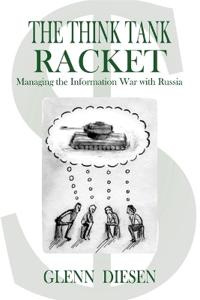 I discussed THE THINK TANK RACKET with the Groong podcast.
The negative aspect of think tanks is their immense power, from controlling information to functioning as a waiting room for politicians out of office.
Information is power, and the business model of think tanks entails selling political influence in Washington and manufacturing consent among the public.
The military-industrial complex is the dominant donor to think tanks, which results in a bias toward military solutions and perpetuating conflict.
THE THINK TANK RACKET: Managing the Information War with Russia – CLARITY PRESS, Inc.
THE THINK TANK RACKET: Managing the Information War with Russia
USAID – AusAID: Same playbook different actors
By Alan Moran | Regulatory Review | February 18, 2025
Donald Trump tweeted “Looks like billions of dollars have been stolen at USAID and other agencies much of it going to the fake news media as a payoff for creating good stories about the Democrats”. Revelations about corruption in the USAID beg questions about the integrity of Australia’s aid programs.
There are long-standing questions dating back to the Clinton days and before the Rudd ALP Government.
The Clintons are estimated to be worth between $120 million and $240 million having been in debt by $16 million when Bill left office in January 2001. According to the newsagency, Associated Press, 85 private sector stakeholders, which is more than half of the non-government people who met with Hillary Clinton while she was secretary of state, gave money — either personally or through companies or groups — to the Clinton Foundation. This amounted to $156 million. In addition, Clinton met with representatives of at least 16 foreign governments that donated as much as $170 million to the Clinton charity. Australia was among these governments.
According to Grok, in:
- February 2006: $25 million was donated to the Clinton Foundation by Foreign Minister Alexander Downer
- October 2006: Another 15 million was given for HIV/AIDS initiatives by the Clinton Foundation
- April 1 2008 – September 5 2008: Under Prime Minister Kevin Rudd $10 million was donated to the Clinton Foundation
- September 2012: Under Prime Minister Julia Gillard $14 million was donated while Hillary Clinton was the US Secretary of State. Gillard later Chaired the Foundation’s Global Partnership for Education
- September 22 2014: Foreign Minister Julie Bishop announced a commitment of $88 million over five years to the Clinton Health Access Initiative, a sister organisation to the Clinton Foundation
Miranda Devine reported, “The Abbott government topped up the left-wing organisation’s coffers with another $140 million in 2014, bringing total Australian largesse to $460 million, according to a press release from Foreign Minister Julie Bishop. The funding ceased in 2016, when Trump assumed office.
Section 70.2 of the Commonwealth Criminal Code Act 1995 makes it illegal for Australian individuals or companies to bribe foreign officials. Apparently, the law does not extend to Australian officials and politicians!
AusAID (which Tony Abbott located within DFAT in 2013) follows a similar playbook to USAID. Thus:
- The Office of Development Assistance (ODA) investments valued at $3 million and above must have a gender equality objective.
- DFAT has a $3.5 million Inclusion and Equality Fund to support LGBTQIA+ organisations to catalyse change in their communities.
- ODA spent $619 million (15 per cent of its budget) on climate related issues in 2022/23. It is not clear that grants to NGOs pressing climate issues are included.
Other Australian agencies are also involved in foreign expenditures. These include considerable funding for activities associated with climate change under the IPCC and the biennial Conference of Parties in which Foreign Affairs participate (as do CSIRO, BoM, Industry, Agriculture and others). These activities will surely soon be fully recognised as the gross destructive squandering of resources that they always were.
The Global Carbon Capture and Storage Institute (GCCSI) was initially launched in 2008 by Prime Minister Kevin Rudd who committed up to $100 million annually as part of his aim to make Australia a global leader in CCS technology. Over 15 years of total failure has not daunted its subsidy-seekers’ zeal.
More recently, the Quad Clean Energy Supply Chain Diversification Program, a spin-off from the diplomatic partnership between Australia, India, Japan and the United States, has a $50 million budget administered by “Business Australia”. Round 1, which closed on February 10, provides up to $2.5 million in funding for Australian and Indo-Pacific joint applications for studies to develop and diversify clean energy supply chains in the Indo-Pacific region. Such a scheme would not find support from President Trump but will program inertia allow it to survive the changed US agenda?
If Australia is ever to get the Trumpian leadership it needs, such programs will have to be excised, perhaps by using techniques, pioneered by Elon Musk’s Department of Government Efficiency (DOGE), involving freezing bank accounts.
Tel Aviv bus bombings: False flag or Netanyahu’s luck?
By Robert Inlakesh | The Cradle | February 23, 2025
At 8:30 PM on Thursday night, an Israeli firefighting department said that “a report was received about a bus explosion in a bus parking lot” on Ha’amal Street in Bat Yam, southern Tel Aviv. Later reports suggested that a passenger had notified the bus driver that a suspicious package had been left inside the vehicle, triggering an emergency evacuation, after which an explosive device detonated the backside of the bus.
The event occurred in a parking lot only a few hundred meters away from two buses, dozens of meters apart, that had also exploded shortly prior in the parking lot for the Bat Yam Stadium and Bat Yam Country Club. The two vehicles were parked in open areas, not beside the other buses that were parked next to each other, exploding at a time when nobody was within distance.
Following this, it was reported that the Israeli authorities had discovered two more bombs planted on buses. One explosive device was said to have been neutralized on a bus near the Wolfson Hospital in the industrial hub of Holon, located over 4 kilometers away from the previous explosions. Another explosive device was also announced to have been on a bus in Yimit 2000, before it was later ruled out as unconnected.
Soon after, there were reports of suspicious activity at Israel’s Haganah train station and suspicious cargo on the light rail that was soon ruled out but didn’t stop a shutdown of all transportation by 10PM that same night. However, it was reported that a “suspect” in the bombing case was pursued at Tel Aviv’s Haganah station and had even fled onto the train tracks to avoid arrest.
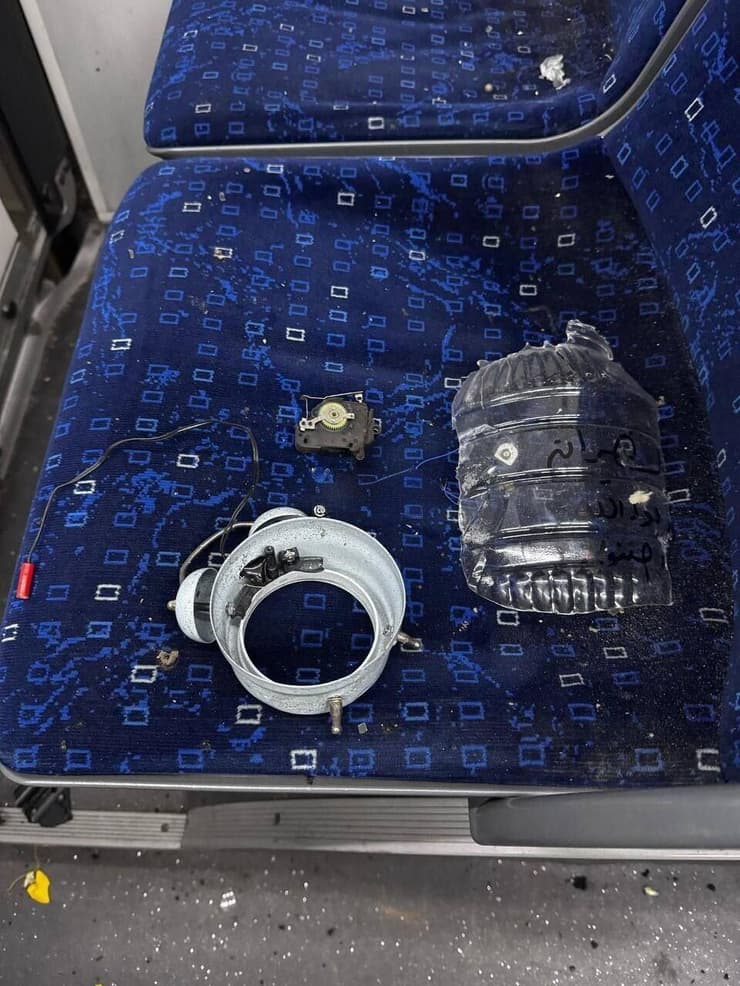
A photo of an improvised explosive device (IED) located on a bus in the Holon area was quickly published in the Hebrew media and, in Arabic, said “Revenge for Tulkarem.” The entire event ended without a single casualty, not even a light injury.
A series of “miracles”
The explanation that the Israeli authorities have offered as to why the bombs went off prematurely is that the timers were incorrectly set. This conclusion was drawn within hours and communicated to the Hebrew media, claiming that the intended time of detonation was 9 AM on Friday, but instead, they were programmed for 9 PM on Thursday night. Yet, the incident was first reported at 8:30 PM, as noted above, which calls into question this explanation.
The passenger who noticed the bomb on the third bus that was blown up – on Ha’amal Street in Bat Yam – told the media that, following the evacuation of the bus, “as everyone was moving away, the explosion occurred.” This has widely been accepted by Israelis as a “miracle.”
Another “miracle” was that the first two buses also happened to not only detonate when nobody was around, but both happened to be parked several meters away from other buses that were clearly lined up next to each other. This made it so that no other buses were blown up, and the overall damage costs were kept to a minimum.
The assailant/s who planted the bomb that was neutralized also happened to write a note in Arabic that left a possible motive. This IED was not only laced with a clue, that would have disappeared had it exploded, but is indicative of someone who wanted their work to be known. Yet, no group has actually claimed the attack.
Israel’s ongoing invasion of the northern West Bank, which began in January, has led to the murder of around 100 Palestinians, and in the Tulkarem Refugee Camp in particular, some 75% of its residents have been forced from their homes. However, the Israeli army’s campaign is yet to inflict a defeat on the armed groups operating there.
Another strange development was two vague statements released on Telegram by the Qassam Brigades’ Tulkarem branch, hinting at what occurred in Tel Aviv and threatening painful blows in the future. This has served as evidence of Hamas’s involvement in the bombings.
The Cradle was informed by a senior figure in the Hamas movement that it has not issued any statements claiming responsibility and that reports otherwise are false.
The current Israeli assessment points the finger at Hamas, claiming that Iran was behind the planned attack and had coordinated it with a Hamas cell operating in the occupied West Bank. This is the current narrative that is making headlines in Israeli Hebrew media.
Intriguingly, two Israeli suspects were arrested by Israeli intelligence in connection with the bombings. According to a Channel 12 News report, one of the Jewish Israeli suspects is said to have helped transport those who planted the explosive devices. The detained Israeli citizen is allegedly set to appear behind closed doors at the Tel Aviv Magistrate’s Court and is being denied access to a lawyer, while interrogations are ongoing to determine whether the “Israeli Jew from Gush Dan” knew about the intentions of who he was transporting.
Responding to the accusations, Bassem Naim, a leading member of the Hamas politburo, told The Cradle the following:
“Based on the timing and the way in which it happened, the first possibility for me is that Netanyahu or members of his government escaped from their obligations in the ceasefire agreement and created an external enemy to relieve the increasing internal pressure. Anyone who reads the history of the Zionist movement will find dozens of proven events that were planned and executed by Zionist elements against Jews themselves.”
Lending credit to the allegations of the Hamas official are the apparent issues with the coordination of the bombings. The armed groups inside the West Bank have not proven themselves capable of pulling off these kinds of attacks before, showing minimal military sophistication. On the other hand, by Israel’s own admission, this was a well-planned operation that evaded detection by the Israeli army and Shin Bet, hence the blame being placed on Tehran.
At the same time, it was also so poorly executed that it left a letter of intent, as if expecting one of the explosives to fail upon detonation, also messing up the timing so terribly that three IEDs exploded prematurely, and all were placed on buses that just so happen to have been isolated from anything else. On top of this, there’s no group that has actually claimed responsibility.
Netanyahu’s favourable coincidences
Israeli Prime Minister Benjamin Netanyahu has emerged from the bus bombings to push for harsher military measures inside the occupied West Bank, ordering the deployment of more army battalions into the territory. He has also taken the opportunity to weaponize the incident against the Gaza ceasefire.
The internal blame for Israel’s failure to thwart the attack is now also being placed upon the Shin Bet, the head of which is Ronen Bar and has been at loggerheads with PM Netanyahu for some time and was even recently demoted from his role in managing the Gaza ceasefire talks.
The Israeli Premier has also announced a “massive counter-terror operation” in the West Bank, right as the current invasion of the northern West Bank, dubbed “Operation Iron Wall,” was said to be coming to an end.
Also, on Thursday, an anonymous figure was cited by Israeli media as claiming that Benjamin Netanyahu will not allow the Gaza ceasefire to enter into its second phase. The goal of the Israeli leader has been to extend the first phase of the tripartite ceasefire agreement in a bid to save his political career.
In a rather bizarre media stunt, Netanyahu gave one of his three public addresses this Friday from inside a Palestinian family’s home in Tulkarem. After forcing Palestinians out of their house, it was taken over to be used as a military position, from which the Israeli PM stated that “we are entering the terrorist strongholds, clearing entire streets used by terrorists, their homes. We are eliminating terrorists and commanders.”
The bus bombings in Tel Aviv granted Netanyahu the ability to attack his internal opposition while blaming Hamas, Iran, and the West Bank’s armed resistance groups. The attack itself resulted in minimal material damage, not even so much as a light injury, granting a mandate for military escalation based upon the premise that if the bombings were successful, there would be hundreds of casualties.
An accumulation of coincidences, holes in the official narrative, and what Israeli media call “miracles” have all led to accusations of the incident being a false-flag attack. There is still no conclusive evidence to prove this assertion, yet with Israel imposing censorship on the issue, various outstanding questions are yet to be answered.
Electronic Intifada director’s violent arrest and MI6 infiltration into ‘neutral’ Switzerland
By Kit Klarenberg | Press TV | February 22, 2025
On January 25th, prominent Palestinian-American journalist and activist Ali Abunimah, co-founder of the Electronic Intifada website, was violently arrested by undercover operatives in Switzerland, en route to a speaking event.
He proceeded to spend three days and two nights in jail completely cut off from the outside world, during which he was interrogated by local defense ministry intelligence apparatchiks without access to a lawyer or even being informed why he was being imprisoned.
Abunimah was then deported in the manner of a dangerous, violent criminal.
Abunimah’s ordeal caused widespread outcry, not least due to Switzerland being the oldest ‘neutral’ state in the world. Such is Bern’s apparently indomitable commitment to this principle, that it initially refused to join the UN lest its neutrality be compromised, only becoming a member in September 2022, following a public referendum.
Moreover, the country routinely scores highly – if not highest – in Western human rights rankings, and has provided a safe haven for foreign journalists and human rights activists fleeing repression.
Abunimah’s flagrantly political persecution and ruthless treatment, undoubtedly motivated by his indefatigable solidarity with Palestine, stands at total odds with Swiss neutrality.
So too Bern’s secret, little-known involvement in Operation Gladio. Under the auspices of this monstrous Cold War connivance, the CIA and MI6 constructed underground shadow armies of fascist paramilitaries that wreaked havoc across Europe, carrying out false flag terror attacks, robberies, and assassinations to discredit the left, install right-wing governments, and justify crackdowns on dissent.
Switzerland’s Gladio unit was known as Projekt-26, the numerals referring to the country’s separate cantons. Its existence was uncovered in November 1990, as a result of an unrelated Swiss parliamentary investigation triggered months earlier.
This probe was launched after it was revealed local security services had kept detailed secret files on 900,000 citizens, almost one-seventh of the country’s total population, throughout the Cold War.
The inquiry found during the same period, P-26 operated “outside political control”, and specifically targeted “domestic subversion”. Its membership ran to around 400, with “most” being “experts” in “weapons, telecommunications and psychological warfare.”
The unit moreover “maintained a network of mostly underground installations throughout Switzerland,” and was commanded by “a private citizen who could mobilize the force without consulting [the] army or government.”
Parliamentarians also concluded that P-26 “cooperated with an unidentified NATO country.”
It was some time before that “NATO country” was confirmed to be Britain. Subsequent investigations shed significant light on London’s mephitic relationship with P-26, and the unit’s role within the wider Operation Gladio conspiracy.
Much remains unknown about the extent of its activities, and will most certainly never emerge. But while P-26 was officially disbanded after its public exposure, the recent persecution of Abunimah strongly suggests MI6 continues to exert unseen influence over Switzerland’s politics, intelligence, military and security apparatus today.
‘A Scandal’
Discovery of P-26 prompted a dedicated inquiry into Switzerland’s “stay behind” network, overseen by local judge Pierre Cornu. It was not until April 2018 that a truncated version of his 100-page-long report was released, in French.
No English translation has emerged since, and a dedicated multi-page section on P-26’s relationship with US and British intelligence is wholly redacted.
Still, the report acknowledged the unit’s operatives were trained in Britain – Gladio’s secret “headquarters” – and remained in regular, covert contact with London’s embassy in Bern.
Oddly, a 13-page summary of Cornu’s report, published in September 1991, was far more revealing. It noted that British intelligence “collaborated closely” with P-26, “regularly” tutoring its militants in “combat, communications, and sabotage” on its home soil. British advisers – likely SAS fighters – also visited secret military sites in Switzerland.
Numerous formal agreements were signed between the clandestine organization and London, the last being inked in 1987. These covered training, and supply of weapons and other equipment.
Describing collaboration between British intelligence and P-26 as “intense”, the summary was deeply scathing of this cloak-and-dagger bond, describing it as wholly lacking “political or legal legitimacy” or oversight, and thus “intolerable” from a democratic perspective.
Until P-26’s November 1990 exposure, elected Swiss officials were purportedly completely unaware of the unit’s existence, let alone its operations. “It is alarming [MI6] knew more about P-26 than the Swiss government did,” the summary appraised.
P-26 was moreover backed by P-27, a private foreign-sponsored spying agency, partly funded by an elite Swiss army intelligence unit. The latter was responsible for monitoring and building up files on “suspect persons” within the country, including; “leftists”; “bill stickers”, Jehovah’s Witnesses, citizens with “abnormal tendencies”; and anti-nuclear demonstrators.
To what purpose this information was put isn’t clear. Many documents detailing the activities of both P-26 and P-27 and the pair’s coordination with British intelligence, apparently couldn’t be located while Cornu conducted his investigation.
Obfuscating the picture even further, in February 2018 it was confirmed 27 separate folders and dossiers amassed during Cornu’s probe had since mysteriously vanished.
Local suspicions this trove was deliberately misplaced or outright destroyed to prevent embarrassing disclosures about “neutral” Switzerland’s relationship with US and British intelligence, and NATO, emerging abound to this day.
At the time, Josef Lang, a left-leaning former Swiss lawmaker and historian, who had long called for the Cornu report to be released in unredacted form, declared:
“There are three possibilities: the papers were shredded, hidden, or lost, in that order of likelihood. But even if the most innocent option is the case, that’s also a scandal.”
‘Clandestine Networks’
The unsolved murder of Herbert Alboth amply reinforces the conclusion that shadowy elements within and without Switzerland were sure that certain facts about the country’s involvement with Operation Gladio would never be known.
A senior intelligence operative who commanded the “stay behind” unit during the early 1970s, in March 1990 Alboth secretly wrote to then-Defence Minister Kaspar Villiger, promising that “as an insider” he could reveal “the whole truth” about P-26. This was right when Swiss parliamentarians began investigating the secret maintenance of files on “subversives”.
Alboth never had an opportunity to testify. A month later, he was found dead in his Bern apartment, having been repeatedly stabbed in the stomach with his own military bayonet.
Contemporary media reports noted a series of indecipherable characters were scrawled on his chest in felt pen, leaving police “puzzled”.
Strewn around his home were photographs of senior P-26 members, “stay behind” training course documents, “exercise plans of a conspiratorial character,” and the names and addresses of fellow Swiss spies.
On November 22nd, 1990, one day after P-26 was formally dissolved, the European Parliament passed a resolution on Operation Gladio.
It called for the then-European Community, and all its member states, to conduct official investigations “into the nature, structure, aims and all other aspects of these clandestine organizations or any splinter groups, their use for illegal interference in the internal political affairs of the countries concerned,” their involvement in “serious cases of terrorism and crime,” and “collusion” with Western spying agencies.
The resolution warned:
“These organizations operated and continue to operate completely outside the law since they are not subject to any parliamentary control and frequently those holding the highest government and constitutional posts are kept in the dark as to these matters… For over 40 years [Operation Gladio] has escaped all democratic controls and has been run by the secret services of the states concerned in collaboration with NATO… Such clandestine networks may have interfered illegally in the internal political affairs of member states or may still do so.”
Yet, outside formal inquiries in Belgium, Italy, and Switzerland, nothing of substance subsequently materialized. Today, we are left to ponder whether Gladio’s constellation of European “stay behind” armies was ever truly demobilized, and if British intelligence still directs the activities of foreign security and spying agencies under the noses of elected governments.
Given London’s intimate, active complicity in the Gaza genocide and ever-ratcheting war on Palestine solidarity at home, Abunimah is an obvious target for the MI6 spy agency.
So too Richard Medhurst, a British-born, Vienna-residing independent journalist arrested upon arrival at London’s Heathrow airport in August 2024 on uncertain “counter-terror” charges.
On February 3rd, Austrian police and intelligence operatives ransacked his home and studio, confiscating many of his possessions, including all his journalistic materials and tools, before detaining and questioning him for hours.
Believing this to be no coincidence, Medhurst asked the officers if London had ordered the raid. An officer replied, “No, Britain doesn’t talk to us.”
Coincidentally, Austria is another ostensibly “neutral” country in which MI6 was embroiled in Operation Gladio. Following World War II, British intelligence armed and trained a local “stay behind” cell comprised of thousands of former SS personnel and Neo-Nazis.
Innocently named the Austrian Association of Hiking, Sports and Society, like its Swiss counterpart, the unit operated with such secrecy that “only very, very highly positioned politicians” were aware.
For his part, Medhurst is absolutely convinced London is behind his persecution:
“Some of these Austrian accusations are very similar to the British ones… I think it’s being coordinated with Britain… British police seized a Graphene OS device from me and [it’s] very unlikely they’d be able to crack it… I suppose that’s why Britain asked the Austrians to raid me, grab anything they could find and go on this massive fishing expedition,” he said.
“The warrant even mentions my arrest in London to try and bolster their case.”
Featured Video
Macgregor: We Haven’t Seen the Worst of the Iran War Yet
or go to
Aletho News Archives – Video-Images
New Book
Breast Cancer: Before You Consent
A new Unbekoming paperback
Lies are Unbekoming | September 18, 2026
Peter Gøtzsche reviewed every randomised mammography screening trial ever conducted for the Cochrane Collaboration. Cochrane’s headline is that, assuming a 15% mortality reduction, one woman in 2000 avoids dying of breast cancer over ten years. Ten are overdiagnosed and treated. Two hundred experience false alarms.
But that headline assumes the reduction. When Gøtzsche looked only at the trials with adequate randomisation — the higher-quality ones — the reduction disappeared. No effect on breast cancer mortality. No effect on all-cause mortality.
This is the Cochrane finding, published in the establishment’s own database of systematic reviews.
No woman being asked to consent to a mammogram this week knows it.
That is why the new Unbekoming paperback exists. … continue
Blog Roll
 Aletho News
- Araghchi: Military intervention cannot create security; coercion cannot bring peace
- Fraud Squared
- Breast Cancer: Before You Consent
- Iran’s Plan to Shut Down AI in the Persian Gulf
- Israel seeks ‘compensation’ from Washington over Saudi F-35 sale
- Saudi crown prince seeks dialogue with Ansarullah after Yemeni blows: Report
- Damascus rejects Saudi request for Syrian fighters to counter Yemen: Report
- South Korea says will not send troops to join terrorist US war on Iran
- Russia Just Struck the Eyes of NATO’s War Machine in Ukraine
- Russia summons UK charge d’affaires over Kiev drone support
- If Americans Knew
- Inside the siege, the ruined buildings of Gaza – Daily Update
- Debunking The Claim That Macklemore Has A “History Of Antisemitism”
- CPJ demands release of arrested Palestinian-US journalist near Bethlehem
- Robert Kraft: The Billionaire Friend of Netanyahu Pulling The Strings Behind the Macklemore/Ed Sheeran Blow Up
- Columbia Administered Fund Gives Big Money to Pro-Israel Groups
- Deportation Case of Palestinian Activist Salah Sarsour Tests First Amendment
- ‘We Will Not Forget’: Palestinians Mark 44 Years since Sabra and Shatila
- Why do we let Zionists decide what we can and can’t say?
- US welcomes Israeli, Iranian delegations to UN, but not Palestinians – Daily Update
- Biden’s Genocide Accomplices Targeted by New Accountability Campaign
- No Tricks Zone
- New Study: ‘Global Drought Shows No Detectable Recent Acceleration Under Climate Warming’
- Economic Masterminds: German Socialists Suggest Taxing Productivity Gains Stemming From Using AI
- The South China Sea Has Not Been Cooperating With The Climate Change Narrative
- Energy Crisis: Germany Enters Heating Season With Historically Low Gas Reserve Fill Levels
- New Study: The Antarctic Ice Sheet Gained Mass From 2020-2024 Due To Staggering Snow And Ice Accumulation
- Study: Ocean Heating Rates From Thousands Of Years Ago ‘Dwarf’ Modern Ocean Heating Rates
- Climate Extremists Target, Attack Large-Scale Power Grid Infrastructure In Germany!
- New Study: Antarctic Ice Melt Has Contributed Less Than 1 Centimeter To Sea Level Rise In The Last 30 Years
- Fear Of Debate: Alarmist German Climate Scientist Calls On Mainstream Media To Discredit Skeptic Voices
- End-Of-August Arctic Sea Ice Extent Hasn’t Fallen In 20 Years, Official Data Show!
 Aletho News