Corporate Crime in the Pharmaceutical Industry
The Scandal of Reincarnated Rats
By RUSSELL MOKHIBER | CounterPunch | January 3, 2012
John Braithwaite is back.
The famed Australian corporate criminologist is teaming up with a former European pharmaceutical executive – Graham Dukes – and together they are completing a new book on corporate crime in the pharmaceutical industry.
The working title – Corporations, Crime and Medicines.
Thirty years ago, Braithwaite finished his magnum opus – Corporate Crime in the Pharmaceutical Industry (Routledge Kegan & Paul).
The book documented widespread fraud and corruption worldwide.
“In the latter part of the 1980s, I thought that the pharmaceutical industry was actually improving in its standards,” Braithwaite told Corporate Crime Reporter in an interview. “Ciba Geigy was one company that had come under particularly aggressive attack from the consumer movement. And Ciba Geigy was responding and setting up corporate social responsibility policies with a new risk management initiative that it was trying to get other companies to join up with.”
“Pfizer became the number one company in the industry. It was sending senior executives to Australia to talk to me. They were really interested in what kind of internal procedures they could be putting in place to make sure that folks like Graham and I would not be making the kinds of critiques that were in Corporate Crime in the Pharmaceutical Industry.”
“I was encouraged by that. I think actually I wasn’t conned. In the course of the 1980s, there was progress.”
“I actually finished the research for Corporate Crime in the Pharmaceutical Industry in 1980. But the book was held up for concerns about libel.”
“But 30 years on, the situation has in fact become worse in most respects. Perhaps there has been some improvement in terms of safety and manufacturing processes among the majors. But on the other hand, the largest pharmaceutical corporations in the world have done a major disservice in the way they have approached the generic industry and, in a sense, stigmatized the generic industry.”
“In Corporate Crime in the Pharmaceutical Industry, we concluded that 19 of the 20 largest U.S. pharmaceutical companies had engaged in serious corrupt activities in the course of the 1970s. And there was really no other industry in the United States that had such a consistent pattern. There were other industries – like the defense industry – that were doing terribly corrupt things. But in terms of top to bottom corruption, the pharmaceutical industry was the worst in the United States.”
“And in some ways, we are inclined to conclude that today it is even worse.”
In the area of research fraud, things are again worse 30 years later.
“A big part of the 1984 book was fraud in safety and testing of drugs,” Braithwaite said. “Remember the GD Searle company, of which Donald Rumsfeld was a CEO? They had the scandal of reincarnated rats. The rats would die when a drug was tested on them. And they would be replaced with living rats. That kind of blatant fraud is not dead in the pharmaceutical industry. There is a lot more sophisticated fraud in the form of suppression of negative safety and efficacy studies. And the boosting of positive studies.”
“But still, there is quite a lot of plain old fashion losing of negative data. And that is the same as the throwing away of the dead rat and replacing the dead rat with the reincarnated rat.”
“You generate data that a drug does not work. And you just suppress that data. It’s as if the study were never conducted and you start again and do another study until you get one that shows you what you want to find. Go to another university professor who will tell you what you want to hear.”
“That situation is, if anything. worse rather than better.”
On the Wall Street meltdown, Braithwaite says the situation could have easily been prevented.
“There was a lot of evidence that there was systemic mortgage fraud – liar loans, false representation of income and employment status of people on loans,” Braithwaite said. “And that had to do with a shift of the nature of capitalism. Banks issuing loans were no longer as interested as they should have been in assessing the capacity of the borrower to repay. Why? Because it was a move from a risk management financial sector to a risk shifting financial sector. You just slice and dice the loans and spread the risk around to a lot of other banks.”
“But it seems to me that there was a ready regulatory response to that. It was knowable that there was a problem. You had the FBI reporting as early as 2004 and 2005 that there was an epidemic of mortgage fraud in the United States. You had this huge trend up in housing loan defaults starting in the mid 2000s. These were very clear red flags.”
“The simple regulatory strategy was for prudential regulators to go to mortgage brokers and banks and say – look, your portfolio of loans has twice the default rate of the average in our state. We want to sit down with you and look into why that is. And if that very simple regulatory inspection measure had been taken, it would have quickly become apparent that there was a pattern of fraud in the loans that they were issuing. And that would have been the early preventive step.”
“And you wouldn’t have necessarily had to prosecute those banks. You would have wanted to go around the country and stop the problem. That would be the most important thing. You would prosecute the ones with the worst patterns of conduct. But the more important thing would be return to integrity in the way loans are issued. Banks return to being interested in ensuring that these were levels of repayment that could be made.”
Russell Mokhiber edits the Corporate Crime Reporter.
[For the complete transcript of the Interview with John Braithwaite, see 26 Corporate Crime Reporter 1(12), January 2, 2012, print edition only.]
Progressive, leftist Haaretz
Sam Loves Hummus | July 7, 2011
Rabbi Yaacov Perin said at Israeli mass-murderer Baruch Goldstein’s funeral that “one million Arabs are not worth a Jewish fingernail.” A less blatant – but still gratuitously reprehensible – representation of this idea appears to have found its way into the Israeli newspaper Haaretz.
I seem to consistently find myself getting into disputes over whether the daily Haaretz is a zionist-biased source. “They have left-wing columnists like Gideon Levy and Amira Hass,” my interlocutors point out. They also carry pieces by right-wing settlers like Israel Harel. When reporting a story concerning the IDF, they often reproduce the IDF spokesperson’s claims uncritically as the headline.
I’ve just seen a sub-heading on Haaretz that nearly made my eyes pop out.
IDF soldier lightly wounded by explosive device near Gaza
This is the first significant incident in the strip after few months of relative calm in area; appears as though tensions on the rise.

As Haaretz itself reported, two Palestinian fighters were killed by the Israeli air force on Tuesday, and another one was injured, in a serious condition. According to Israeli army propaganda they were going to fire a rocket. Haaretz even points out the Israeli army’s own admission that:
in contrast to previous incidents in which the IDF launched a retaliatory attack in response to rocket fire on Israel, in this case the militant group was identified well in advance and the attack was planned and carried out before the militants were able to launch any rockets toward Israel
I.e. they were assassinated for suspected pre-crime, “well in advance”.
But, incredibly, Haaretz wants to tell us that today’s light injury of one Israeli soldier is “the first significant incident in the strip after few months of relative calm.” The light injury of an Israeli is a “significant incident”, the death of two Palestinians and serious injury of one more is… well, they don’t even get a mention. It seems like Haaretz has internalized the idea that one is a member of God’s chosen people; the others are cannon fodder to be snuffed out without a raised eyebrow.
This is, as I hope any sane person can see, outright racism. Yes, by the standards of other Israeli newspapers (e.g. the Jerusalem Post) Haaretz is comparatively progressive. But they still dehumanize Palestinians, still base their choice of vocabulary, the angle, of their story on the implicit entrenched assumption that an Israeli soldier has some essential right to be in the Gaza strip, that he’s a real person, so when he is lightly injured it is significant, and that the Palestinians have no agency, no personhood; they exist only as a foil for the Israeli army’s misbehaviour; absolutely they have no right to defend themselves so when an Israeli jet kills two of them and wrecks the body of another, cosmic balance is maintained. This is the way things are meant to be, the Israelis bomb; the Palestinians get bombed. Nothing amiss.
Haaretz’ decision to adopt this illogical and gratuitously unfair narrative raises grave concerns about its trustworthiness as a source for news stories concerning the Palestinians.
Of Exclusivity, Loyalty and Liberation of Palestine
Jewish-Only Organizations . . . A Closer Look
By Nahida the exiled Palestinian | Uprooted Palestinians | January 1, 2011
Due to recent events of alienation and/or expulsion of members of Palestine Solidarity Movement, including Palestinians, it became more and more evident that there are elements in the Solidarity Movement who continue to stir up friction and splits amongst activists, that leads to alienation of many genuine activists and even exiled Palestinians.
Such elements also continue to cause distraction by filtering information to prevent members from understanding the role of the larger Jewish community world wide in influencing their respective governments to support “Israel”, and to prevent from understanding the impact of the presence of racist ideology on the standpoints and attitudes of the Jewish communities, and the implication of such ideology on Palestinians;
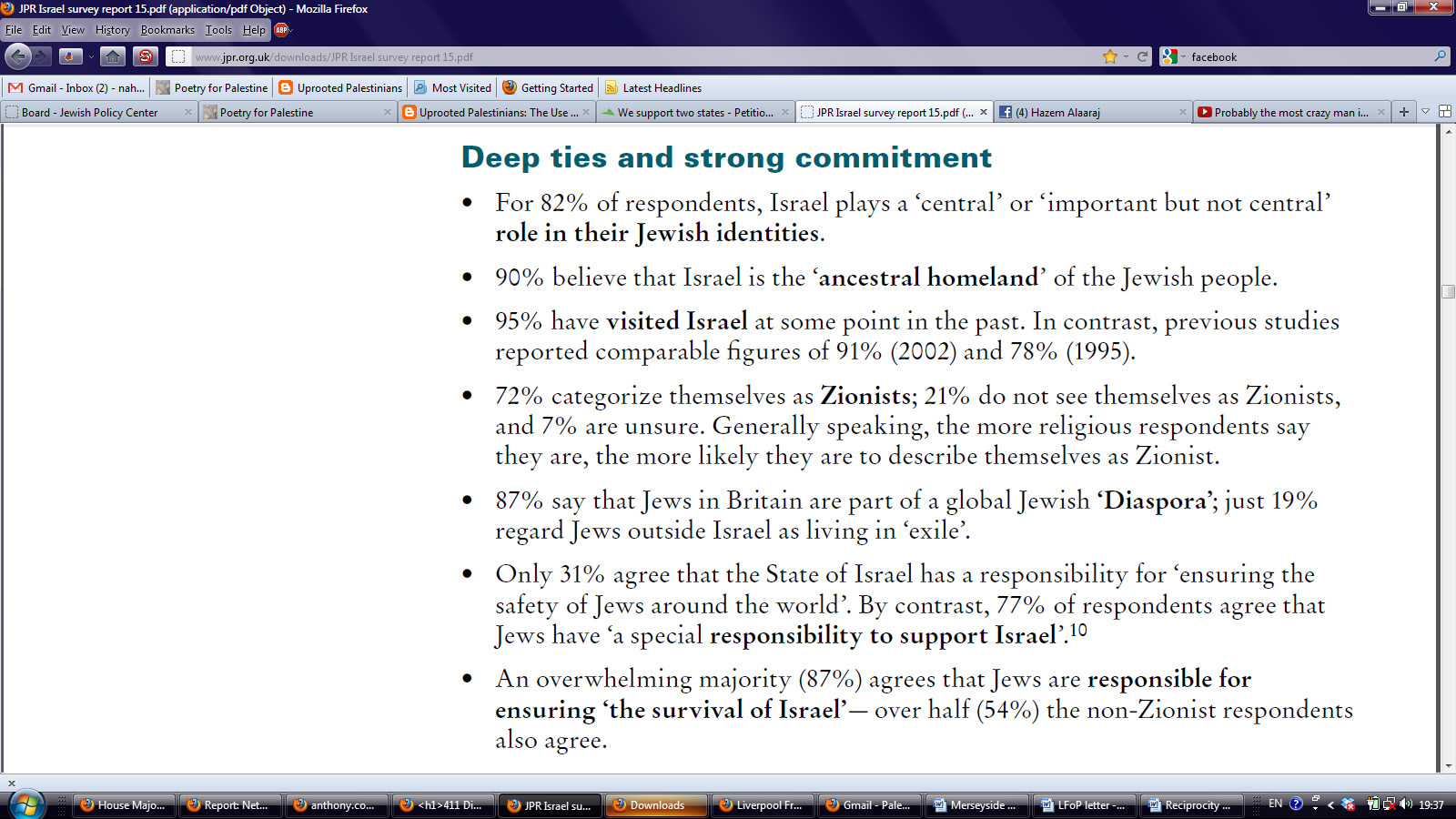
This state of affairs should raise alarm to anyone interested in Justice and Peace, that means anyone who works to put an end to decades of Palestinian suffering, and its slow genocide, and to anyone who understands that such high objectives require promoting the Liberation of Palestine.
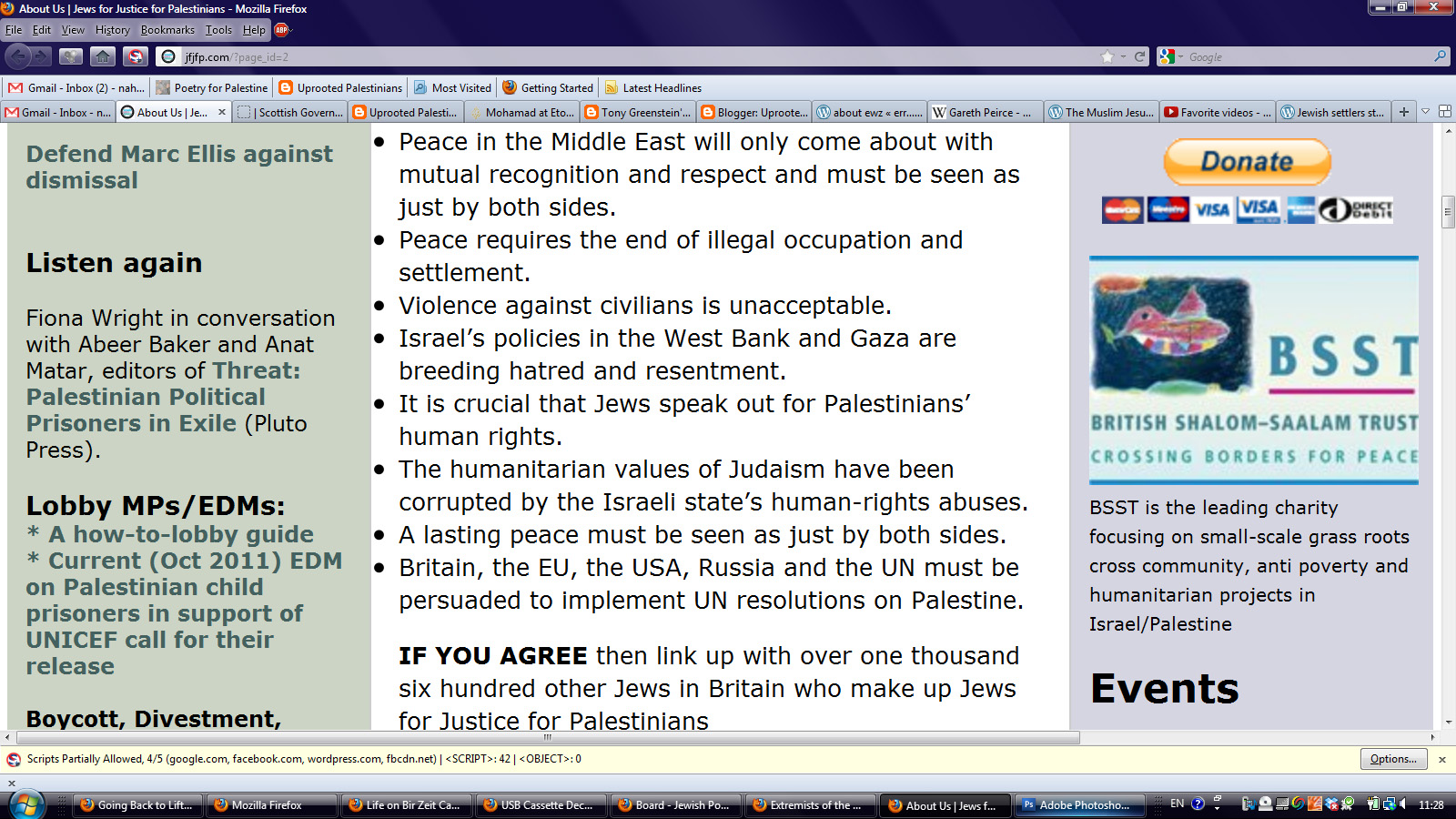
It is also apparent that many of these destabilizing elements are simultaneously members of OTHER organizations, which membership approval operates through exclusivity, and restricted only to people of Jewish background.
Moreover, it is manifest that many of these Jewish-only organizations declare publicly that their prime motive for their activism is out of concern for the welfare of “Israel” and the “Israeli society”. Worse, some of these organizations do not even conceal that their criticism of “Israel” is done out of “love” and loyalty to this criminal entity. Simply put, they criticise and condemn “Israel” primarily to protect and help it thrive and survive.
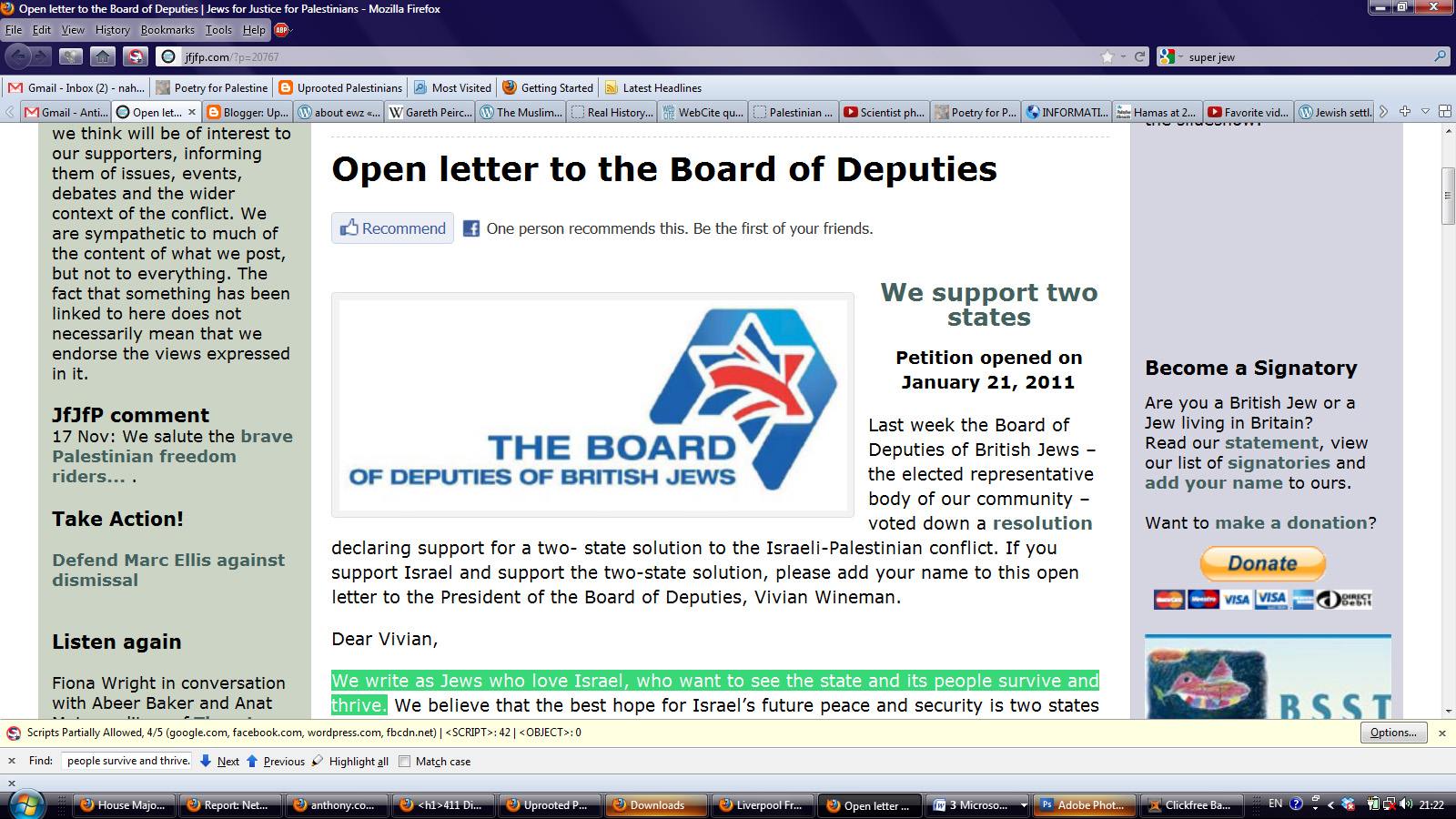
This kind of blind allegiance and deep loyalty to “Israel” is of course expected from and omnipresent amongst hyper-Zionists and their circles, but it is quite disturbing to find the same loyalty amongst “supporters of Palestine” of Jewish background. It is also interesting to notice that even hyper-Zionists, through their think tanks, have recently arrived at the same conclusion that their counterparts, Jewish anti-Zionists, have known for decades; namely open criticism of “Israel” IS the best way to defend it. As we can see for example, in Mick Davis’s article: “Open debate is our best way of defending Israel in the diaspora,” The Jewish Chronicle, 17 June 2010. The article also appears on the website of the Jewish Chronicle under the title “Defending Israel in the diaspora”.
Through my research and extensive work, it became evident that the prime allegiance of many Jewish anti-Zionist organizations is not to Palestine or the Palestinians; their loyalty is to “Israeli” Jews and to the artificially manufactured “Israeli” society. It also seems clear that the prime motive for the activism of many members of such organizations is the concern for the welfare and future of “Israelis” and the perpetuation of their colonial society.
Factual and thorough scrutiny of these organizations invariably indicates that their primary concern and main focus are the following:
How to best consolidate and reinforce a good, secure and thriving future for the INVENTED *** “nation” of “Israel”, on the Historical Land STOLEN from its ancestral inhabitants, the Palestinians;
How to best disculpate the Jewish communities worldwide from their responsibility of decades of financial, political, moral and even military support of their “beacon of light”, “Israel”;
How to best further the interests of such invented “nation”, after the finalization of their imposed facts on the grounds, and getting rid of the banner of Zionism;
How to best ensure and secure the permanent presence of an invading settler society after grabbing most of the LAND of Palestine by wars of terror and conquest;
How to best pacify and allure Palestinians into accepting foreign violent invaders as rightful co-owners of Palestine and future “partners”;
How to best promote “Israeli” settler society as “liberal peace-loving”, whose main concern would be to live in peace and security, but who just happened to be “unfortunately” plagued with corrupt leadership;
How to best conceal that their garment of humanism and thin veneer of ethics is directed principally at “saving Israelis from themselves” and thereby their own reputation, rather than unconditional and altruistic protection of the dispossessed, terrorised, besieged and occupied Palestinians, and their moral cause of Liberation.
How best to divert the limited energy of activism into supporting the “Israeli peace camp”, “Israeli” organizations, and “Israeli” individuals and treat as angels and heroes those who exhibit a minuscule dose of normal human behaviour;
Dual-loyalty to two opposed parties, one being the torturer, and the other being his victim, is in practice a myth. Thus it is not surprising that those involved operate in secrecy, in the exclusion of “the other side”.
While non-Jewish candidates are barred from becoming members, by definition membership to Jewish-only organizations is open to ANY person from Jewish background. This makes it piece of cake for Sayanim, Mossad agents, Shin Bet and Zionist sympathisers to effortlessly infiltrate, manipulate and steer such organizations. No wonder then, that so many Jewish-only groups who claim to be “pro-Palestinian” appear to be more interested with aims more in tune with securing the presence of “Israelis” in Palestine, than the restoration of Palestinian sovereignty.
This brings us to the core problem: while those members of Jewish only organizations have the privilege (and rightly so) to be members and never excluded from pro-Palestinian organizations, the opposite is not true. i.e we are faced with an alarming phenomenon whereby, Palestinians and non-Jewish individuals are systematically excluded from participating, having an input, debating, voting, influencing or even being informed about or simply being aware with the inner dynamics and the type and topics of discussions that take place inside such Jewish only organizations.
The outcome of such asymmetrical and non-mutual arrangement is what we have seen lately, matters are discussed amongst these exclusive groups, decisions are taken, and then the pro-Palestinian organizations are approached, persuaded, pressured or coerced to adhere to those propositions and motions.
The secrecy and lack of transparency surrounding that type of activities is allowing inside the solidarity movement people who are not necessary or entirely genuine supporters of Palestine, “fair-weather friends”, people who are in essence more interested in the long term “Israeli” interest, than genuine support of Palestine. At best, their claimed care for the suffering of the oppressed society come secondary.
Signing petitions, giving out leaflets, stating words of support, throwing some crumbs to Palestinians, accompanied with patronizing pats on the shoulders, believing that they have done their humanistic “duty” of siding with justice, while simultaneously continuing to aim and work for securing the right of the invading “Israelis” to practice their “self determination” in someone else Homeland, reflects no doubt ethical blindness and almost moral bankruptcy. Imposing on Palestine forced marriage with a rapist monster is an obscenity.
Such ethical inconsistency of crying with the victim while protecting the criminal, is a regrettable case of hypocrisy and self deception.
Throughout the Palestinian movement, recent events reveal that some people on board of our movement deleterious to the Palestinian cause and some probably are disingenuous. Thus, such unhealthy, asymmetrical and exclusionary structures are indeed destabilizing and crippling the efficiency of Palestine Solidarity Movement, an efficiency vital to a Palestinian population under threat of annihilation… these are not trivial matters.
As a matter of principle, we refuse to apply the same exclusionary methods amongst pro Palestinian organization and will never resort to such racist exclusiveness. We cannot continue to claim to be humanist anti-racist while accepting simultaneously, the exclusionary nature applied by such organizations, especially in the light of compromised loyalty, and what we know about the sinister Mossad activities and the ease with which they infiltrate such groups.
It is therefore essential to crack open the shells of exclusion and secrecy, wherein topics of discussions are about “unfavourable” information to filter, which debates to “allow” and where to draw boundaries, and sinister attacks against activists who might not conform to “permissible” lines of discourse are cooked.
Under such conditions, it is imperative for the Palestine Solidarity movement to introduce a regulation that will allow room for transparency and reciprocity. Failure to address this issue would cause the continuation and aggravation of the crippling shift that has already befallen the movement.
Whereas some Jewish-anti Zionist supporters call for a two state solution with a thriving and secured Israel they love, whereby they actively support the theft of 80% of Palestine;
Whereas some others insist that the only solution should be a one secular state, one member one vote, whereby they establish a precondition that would not only exculpate the occupiers from any responsibility or blame but also grant the occupier lands that do not belong to them, rights that they have not earned and protection that they don’t deserve.
Whereas, many of those Jewish “anti-Zionists” are full members of the Palestinian movements and have the privilege to be part of and to vote in any organization they desire;
Whereas, they continue to exclude Palestinians and other non-Jewish individuals from being part of and voting in their Jewish-only organizations;
Whereas, Zionist methods of false accusations of anti-Semitism / Holocaust denial are used to neutralize and exclude, or push away certain members of the Solidarity Movement, including Palestinian refugees! (a crass mirror of the ethnic cleansing happening in Palestine);
Whereas, Jewish anti-Zionist individuals and groups have the right to vote and have the weight to even tilt the vote, have access to the minutes of meetings and have the privilege of being heard and their opinions respected in the broader solidarity movement;
Whereas, such affiliated Jewish groups do generally restrict their membership to Jews, hence barring non-Jewish persons from participating, or from having the right of access to their meetings as an observer, let alone from a vote within their tightly knit fellowship;
Whereas, the fundamental element of trust about the authenticity of intentions, about motivation, aims, and actions of such groups, has been profoundly shaken;
It appears evident that:
To put an end to this predicament, the exclusionary nature of such organizations must be revoked, and the fair and mutual openness to membership without discrimination against race, culture or religion must be requested.
The Solidarity Movement needs to have a system of disclosure of political affiliation of its prospective members, making it a contractual obligation of disclosure of their membership to any hitherto Jewish-only organization, or to any other organization linked to either the Palestinian cause, or to the occupiers of Palestine aka “Israelis”.
Representatives of the Solidarity Movements must have the mutual right to have access to and to be fairly represented in the insofar exclusive Jewish-only organizations, in equal numbers, and have rights to vote in these organizations.
To avoid any further mistrust, friction, crippling or fragmentation, reciprocity and mutual open membership is the way forward.
Russian Elections Duplicity
By Stephen Lendman | The People’s Voice | December 31st, 2011
Russia’s December 4 elections filled 450 State Duma seats, Russia’s Federal Assembly lower house.
Claims of electoral fraud followed. All elections have irregularities. At issue is whether results are comprised. Election monitor Golos accusations were spurious. America’s National Endowment for Democracy (NED) funds it. It supports regime change in non-US client states.
It backs opposition groups, conducts propaganda campaigns, and does openly what CIA operatives do covertly to destabilize sitting governments.
Its mission is subverting, not promoting democracy. It operates with State Department funding and direction. It serves US imperial interests destructively against targeted countries.
So do USAID, the International Republican Institute (IRI), and the National Democratic Institute (NDI). They meddle internally against sitting governments. One way is by funding Golos.
It calls itself a Russian NGO established in 2000 to defend democratic rights and civil liberties. Claiming it’s Russia’s only “independent” electoral watchdog is duplicitous. It represents imperial Washington’s interests against those of Russia’s people and government. Moreover, by taking foreign funding, it violated Russian law.
Since early December, Russia’s seen on and off street protests. On December 25, RIA Novesti headlined, “Tens of thousands rally in new election protest in Russia,” saying:
Peaceful crowds filled “Moscow’s Sakharov Avenue on Saturday to demand a rerun of parliamentary elections they claimed had been rigged, as well as liberal reforms in Russia, turning the temperature up on Vladimir Putin and his plans to return to the Kremlin.”
Nonetheless, a VTsIOM December 10 – 11 poll showed most Russians support him. However, his 51% job approval rating dropped from 61% in late November and 68% in January. Street protests and legitimate social justice grievances are responsible.
Even though Russia’s GDP rose 70% and living standards improved markedly during his tenure as president, millions of Russians still suffer from Yeltsin’s post-soviet era “shock therapy.”
As a result, 80% of Russian farmers went bankrupt, 70,000 state factories closed, an epidemic of unemployment raged, half or more of all Russians became impoverished, a permanent underclass was created, and crime, suicides, mortality, alcoholism, drug abuse, and HIV/AIDS soared to intolerable levels.
GDP plunged 50%. Life expectancy fell. An oligarch class accumulated enormous wealth at the expense of millions of harmed Russians.
Ignoring essential needs, Yeltsin let corruption and criminality flourish. One scandal followed another. Money-laundering became sport. Billions in stolen wealth were hidden in Western banks or offshore tax havens.
Many problems remain unresolved, especially given today’s global economic crisis. In April, Pravda.ru headlined, “Poverty in Russia grows faster than expected,” saying:
According to the Russian Federal Statistics Agency, another 2.3 million joined the ranks of Russia’s 22.9 million impoverished population. However, “(m)any experts believe that official statistics (don’t) reflect the real state of affairs and (are) very often” understated.
Therefore, poverty remains a major growing problem. For millions, wages and pensions aren’t enough to get by. Economic weakness exacerbates conditions. As a result, street protests perhaps reflect hard times more than anger over election results.
In contrast to Russia, America’s electoral process is scandalously flawed. More on it below.
Major Media Scoundrels Bash Russia
America’s media target all non-US client states, including China and Russia. On December 8, a New York Times editorial headlined, “Mr. Putin Seeks a Scapegoat,” saying:
He’s “determined to resurrect the Soviet playbook. His United Russia Party tried to steal a parliamentary election on Sunday, and, when the results still delivered a stinging rebuke, he claimed the United States was whipping up protests and demonstrations.”
Fact check
Though not a decisive majority, United Russia won 49.67% of the vote, compared to the Communist Party’s 19.15% second place finish. Hardly a “stinging rebuke.” Moreover, independent analysts and observers explained a free and fair process. Results weren’t compromised by relatively few regularities.
As explained above, Washington very much interfered as it has done repeatedly in numerous other elections. In Haiti’s 2010 first round and 2011 runoff, brazen manipulation rigged the process to install stealth Duvalierist Michel (Sweet Micky) Martelly president. New York Times editorials ignored his illegitimacy, backed fraud, and effectively said Haitians need to move on.
Washington indeed may be behind on and off Russian street protests. The pattern is familiar. Over decades, America advanced the technique. In the 1990s, RAND Corporation strategists developed the concept of “swarming” to explain “communication patterns and movement of” bees and other insects which they applied to military conflict by other means.
Washington used it successfully against Serbia’s Milosevic. NED, the International Republican Institute (IRI) and National Democratic Institute were involved.
It repeated during Georgia’s Rose Revolution, ousting Edouard Shevardnadze for Mikhail Saakashvili. A US-installed stooge, he’s governed ruthlessly and repressively in office.
Ukraine’s 2004 Orange Revolution was similar, ousting Viktor Yanukovych for Viktor Yushchenko, Washington’s man.
America’s manipulated 2007 Myanmar Saffron Revolution and Iran’s 2009 Green Revolution failed. Both countries remain targeted for regime change.
Very possibly, Russia’s street protests are made-in-the-USA. It wouldn’t be the first time nor last. Supportively, America’s media pretend otherwise. Putin accused Hillary Clinton of meddling. The Times editorial called his charge “bizarre,” saying:
“Mrs. Clinton and the White House did the right thing (by) critici(zing Russia’s) vote. She also expressed support for the ‘rights and aspirations’ of the Russian people.”
In fact, political Washington abhors democracy at home and abroad. Imperial wars, numerous coups, internal subversion and destabilization, homeland repression, and rigged elections prevent it. Major media scoundrels approve.
On December 24, they featured Russian protests. New York Times writers Ellen Barry and Michael Schwirtz headlined, “Vast Rally in Moscow Is a Challenge to Putin’s Power,” claiming 120,000 turned out. Other reports estimated crowd size at from 50 – 80,000.
Ria Novosti said “tens of thousands.” So did the Washington Post in an article headlined, “Protesters flood Moscow demanding reforms.” It focused on social needs, not electoral fraud in contrast to The Times highlighting comments about dissolving Parliament, holding new elections, and comparing Putin to Brezhnev.
Managed news, misinformation, and hyperbole characterize America’s media. Truth and full disclosure aren’t their long suit. Or Washington’s.
More – Notorious US Electoral Fraud, Bush v Gore etc…
Imperialism and the “Anti-Imperialism of the Fools”
By James Petras :: 12.30.2011
One of the great paradoxes of history are the claims of imperialist politicians to be engaged in a great humanitarian crusade designed to liberate nations and peoples, while practicing the most barbaric conquests, destructive wars and large scale bloodletting of conquered people in historical memory.
In the modern capitalist era, the ideologies of imperialist rulers vary over time, from the early appeals to “the right” to wealth, power, colonies and grandeur to later claims of a ‘civilizing mission’. More recently imperial rulers have propagated, many diverse justifications adapted to specific contexts, adversaries, circumstances and audiences.
This essay will concentrate on analyzing contemporary US imperial ideological arguments for legitimizing wars and sanctions to sustain dominance.
Contextualizing Imperial Ideology
Imperialist propaganda varies according to whether it is directed against a competitor for global power, or whether as a justification for applying sanctions, or engaging in open warfare against a local or regional socio-political adversary.
With regard to established imperial (Europe) or rising world economic competitors (China), US imperial propaganda varies over time. Early in the 19th century, Washington proclaimed the “Monroe Doctrine”, denouncing European efforts to colonize Latin America, privileging its own imperial designs in that region. In the 20th century when the US imperial policymakers were displacing Europe from prime resource based colonies in the Middle East and Africa, it played on several themes. It condemned ‘colonial forms of domination and promoted ‘neo-colonial’ transitions that ended European monopolies and facilitated US multi-national corporate penetration. This was clearly evident during and after World War 2, in the Middle East petrol-countries.
During the 1950s as the US assumed imperial primacy and radical anti-colonial nationalism came to the fore, Washington forged alliances with the declining colonial power to combat a common enemy and to prop up post-colonial powers. Even with the post World War 2 economic recovery, growth and unification of Europe, it still works in tandem and under US leadership in militarily repressing nationalist insurgencies and regimes. When conflicts and competition occur, between US and European regimes, banks and enterprises, the mass media of each region publish “investigatory findings” highlighting the frauds and malfeasance of its competitors ..and US regulatory agencies levy heavy fines on their European counterparts, overlooking similar practices by Wall Street financial firms.
In recent times the rising tide of militarist imperialism and colonial wars fueled by Israeli proxies in the US state has led to some serious divergences between US and European imperialism. With the exception of England, Europe made a minimum symbolic commitment to the US wars and occupation of Iraq and Afghanistan. Germany and France concentrated on expanding their export markets and economic capacities; displacing the US in major markets and resource sites. The convergence of US and European empires led to the integration of financial institutions and the subsequent common crises and collapse but without any coordinated policy of recovery. US ideologists propagated the idea of a “declining and decaying European Union”, while the European ideologues emphasized the failures of Anglo-American de-regulated, ‘free markets’ and Wall Street swindles.
Imperial Ideology, Rising Economic Powers and Nationalist Challengers
There is a long history of imperialist “anti-imperialism”, officially sponsored condemnation, exposés and moral indignation directed exclusively against rival imperialists, emerging powers or simply competitors, who in some cases are simply following in the footsteps of the established imperial powers.
English imperialists in their heyday justified their world-wide plunder of three continents by perpetuating the “Black Legend”, of Spanish empire’s “exceptional cruelty” toward indigenous people of Latin America, while engaging in the biggest and most lucrative African slave trade. While the Spanish colonists enslaved the indigenous people, the Anglo-American settlers exterminated them…..
In the run-up to World War II, European and US imperial powers, while exploiting their Asian colonies condemned Japanese imperial powers’ invasion and colonization of China. Japan, in turn claimed it was leading Asia’s forces fighting against Western imperialism and projected a post-colonial “co-prosperity” sphere of equal Asian partners.
The imperialist use of “anti-imperialist” moral rhetoric was designed to weaken rivals and was directed to several audiences. In fact, at no point did the anti-imperialist rhetoric serve to “liberate” any of the colonized people.In almost all cases the victorious imperial power only substituted one form colonial or neo-colonial rule for another.
The “anti-imperialism” of the imperialists is directed at the nationalist movements of the colonized countries and at their domestic public. British imperialists fomented uprisings among the agro-mining elites in Latin America promising “free trade” against Spanish mercantilist rule; they backed the “self-determination” of the slave holding cotton plantation owners in the US South against the Union; they supported the territorial claims of the Iroquois tribal leaders against the US anti-colonial revolutionaries … exploiting legitimate grievances for imperial ends. During World War II, the Japanese imperialists supported a sector of the nationalist anti-colonial movement in India against the British Empire. The US condemned Spanish colonial rule in Cuba and the Philippines and went to war to “liberate” the oppressed peoples from tyranny….and remained to impose a reign of terror, exploitation and colonial rule…
The imperial powers sought to divide the anti-colonial movements and create future “client rulers” when and if they succeeded. The use of anti-imperialist rhetoric was designed to attract two sets of groups. A conservative group with common political and economic interests with the imperial power, which shared their hostility to revolutionary nationalists and which sought to accrue greater advantage by tying their fortunes to a rising imperial power. A radical sector of the movement tactically allied itself with the rising imperial power, with the idea of using the imperial power to secure resources (arms, propaganda, vehicles and financial aid) and, once securing power, to discard them. More often than not, in this game of mutual manipulation between empire and nationalists, the former won out … as is the case then and now.
The imperialist “anti-imperialist” rhetoric was equally directed at the domestic public, especially in countries like the US which prized its 18th anti-colonial heritage. The purpose was to broaden the base of empire building beyond the hard line empire loyalists, militarists and corporate beneficiaries. Their appeal sought to include liberals, humanitarians, progressive intellectuals, religious and secular moralists and other “opinion-makers” who had a certain cachet with the larger public, the ones who would have to pay with their lives and tax money for the inter-imperial and colonial wars.
The official spokespeople of empire publicize real and fabricated atrocities of their imperial rivals, and highlight the plight of the colonized victims. The corporate elite and the hardline militarists demand military action to protect property, or to seize strategic resources; the humanitarians and progressives denounce the “crimes against humanity” and echo the calls “to do something concrete” to save the victims from genocide. Sectors of the Left join the chorus, finding a sector of victims who fit in with their abstract ideology, and plead for the imperial powers to “arm the people to liberate themselves” (sic). By lending moral support and a veneer of respectability to the imperial war, by swallowing the propaganda of “war to save victims” the progressives become the prototype of the “anti-imperialism of the fools”. Having secured broad public support on the basis of “anti-imperialism”, the imperialist powers feel free to sacrifice citizens’ lives and the public treasury, to pursue war, fueled by the moral fervor of a righteous cause. As the butchery drags on and the casualties mount, and the public wearies of war and its cost, progressive and leftist enthusiasm turns to silence or worse, moral hypocrisy with claims that “the nature of the war changed” or “that this isn’t the kind of war that we had in mind …”. As if the war makers ever intended to consult the progressives and left on how and why they should engage in imperial wars.!
In the contemporary period the imperial “anti-imperialist wars” and aggression have been greatly aided and abetted by well-funded “grass roots” so-called “non-governmental organizations” which act to mobilize popular movements which can “invite” imperial aggression.
Over the past four decades US imperialism has fomented at least two dozen “grass roots” movements which have destroyed democratic governments, or decimated collectivist welfare states or provoked major damage to the economy of targeted countries.
In Chile throughout 1972-73 under the democratically elected government of Salvador Allende, the CIA financed and provided major support – via the AFL-CIO–to private truck owners to paralyze the flow of goods and services. They also funded a strike by a sector of the copper workers union (at the El Teniente mine) to undermine copper production and exports, in the lead up to the coup. After the military took power several “grass roots” Christian Democratic union officials participated in the purge of elected leftist union activists. Needless to say in short order the truck owners and copper workers ended the strike, dropped their demands and subsequently lost all bargaining rights!
In the 1980’s the CIA via Vatican channels transferred millions of dollars to sustain the “Solidarity Union” in Poland, making a hero of the Gdansk shipyards worker-leader Lech Walesa, who spearheaded the general strike to topple the Communist regime. With the overthrow of Communism so also went guaranteed employment, social security and trade union militancy: the neo-liberal regimes reduced the workforce at Gdansk by fifty percent and eventually closed it, giving the boot to the entire workforce. Walesa retired with a magnificent Presidential pension, while his former workmates walked the streets and the new “independent” Polish rulers provided NATO with military bases and mercenaries for imperial wars in Afghanistan and Iraq.
In 2002 the White House, the CIA , the AFL-CIO and NGOs, backed a Venezuelan military-business – trade union bureaucrat led “grass roots” coup that overthrew democratically elected President Chavez. In 48 hours a million strong authentic grass roots mobilization of the urban poor backed by constitutionalist military forces defeated the US backed dictators and restored Chavez to power. Subsequently oil executives directed a lockout backed by several US financed NGOs. They were defeated by the workers’ takeover of the oil industry. The unsuccessful coup and lockout cost the Venezuelan economy billions of dollars in lost income and caused a double digit decline in GNP.
The US backed “grass roots” armed jihadists to liberate Bosnia and armed the“grass roots” terrorist Kosovo Liberation Army to break-up Yugoslavia. Almost the entire Western Left cheered as, the US bombed Belgrade, degraded the economy and claimed it was “responding to genocide”. Kosovo “free and independent” became a huge market for white slavers, housed the biggest US military base in Europe, with the highest per-capita out migration of any country in Europe.
The imperial “grass roots” strategy combines humanitarian, democratic and anti-imperialist rhetoric and paid and trained local NGO’s, with mass media blitzes to mobilize Western public opinion and especially “prestigious leftist moral critics” behind their power grabs.
The Consequence of Imperial Promoted “Anti-Imperialist” Movements: Who Wins and Who Loses?
The historic record of imperialist promoted “anti-imperialist” and “pro-democracy” “grass roots movements” is uniformly negative. Let us briefly summarize the results. In Chile ‘grass roots’ truck owners strike led to the brutal military dictatorship of Augusto Pinochet and nearly two decades of torture, murder, jailing and forced exile of hundreds of thousands, the imposition of brutal “free market policies” and subordination to US imperial policies. In summary the US multi-national copper corporations and the Chilean oligarchy were the big winners and the mass of the working class and urban and rural poor the biggest losers. The US backed “grass roots uprisings” in Eastern Europe against Soviet domination, exchanged Russian for US domination; subordination to NATO instead of the Warsaw Pact; the massive transfer of national public enterprises, banks and media to Western multi-nationals. Privatization of national enterprises led to unprecedented levels of double-digit unemployment, skyrocketing rents and the growth of pensioner poverty. The crises induced the flight of millions of the most educated and skilled workers and the elimination of free public health, higher education and worker vacation resorts.
Throughout the now capitalist Eastern Europe and USSR highly organized criminal gangs developed large scale prostitution and drug rings; foreign and local gangster ‘entrepeneurs’ seized lucrative public enterprises and formed a new class of super-rich oligarchs Electoral party politicians, local business people and professionals linked to Western ‘partners’ were the socio-economic winners. Pensioners, workers, collective farmers, the unemployed youth were the big losers along with the formerly subsidized cultural artists. Military bases in Eastern Europe became the empire’s first line of military attack of Russia and the target of any counter-attack.
If we measure the consequences of the shift in imperial power, it is clear that the Eastern Europe countries have become even more subservient under the US and the EU than under Russia. Western induced financial crises have devastated their economies; Eastern European troops have served in more imperial wars under NATO than under Soviet rule; the cultural media are under Western commercial control. Most of all, the degree of imperial control over all economic sectors far exceeds anything that existed under the Soviets. The Eastern European ‘grass roots’ movement succeeded in deepening and extending the US Empire; the advocates of peace, social justice, national independence, a cultural renaissance and social welfare with democracy were the big losers.
Western liberals, progressives and leftists who fell in love with imperialist promoted “anti-imperialism” are also big losers. Their support for the NATO attack on Yugoslavia led to the break-up of a multi-national state and the creation of huge NATO military bases and a white slavers paradise in Kosovo. Their blind support for the imperial promoted “liberation” of Eastern Europe devastated the welfare state, eliminating the pressure on Western regimes’ need to compete in providing welfare provisions. The main beneficiaries of Western imperial advances via ‘grass roots’ uprisings were the multi-national corporations, the Pentagon and the right-wing free market neo-liberals. As the entire political spectrum moved to the right a sector of the left and progressives eventually jumped on the bandwagon. The Left moralists lost credibility and support, their peace movements dwindled, their “moral critiques” lost resonance. The left and progressives who tail-ended the imperial backed “grass roots movements”, whether in the name of “anti-Stalinism”, “pro-democracy” or “anti-imperialism” have never engaged in any critical reflection; no effort to analyze the long-term negative consequences of their positions in terms of the losses in social welfare, national independence or personal dignity.
The long history of imperialist manipulation of “anti-imperialist” narratives has found virulent expression in the present day. The New Cold War launched by Obama against China and Russia, the hot war brewing in the Gulf over Iran’s alleged military threat, the interventionist threat against Venezuela’s “drug-networks”,and Syria’s “bloodbath” are part and parcel of the use and abuse of “anti-imperialism” to prop up a declining empire. Hopefully, the progressive and leftist writers and scribes will learn from the ideological pitfalls of the past and resist the temptation to access the mass media by providing a ‘progressive cover’ to imperial dubbed “rebels”. It is time to distinguish between genuine anti-imperialism and pro-democracy movements and those promoted by Washington, NATO and the mass media.
Public health fallout from Japanese quake
Lauren Vogel, with files from Barbara Sibbald | CMAJ | December 21, 2011
A “culture of coverup” and inadequate cleanup efforts have combined to leave Japanese people exposed to “unconscionable” health risks nine months after last year’s meltdown of nuclear reactors at the Fukushima Dai-ichi power plant, health experts say.
Although the Japanese government has declared the plant virtually stable, some experts are calling for evacuation of people from a wider area, which they say is contaminated with radioactive fallout.
They’re also calling for the Japanese government to reinstate internationally-approved radiation exposure limits for members of the public and are slagging government officials for “extreme lack of transparent, timely and comprehensive communication.”
But temperatures inside the Fukushima power station’s three melted cores have achieved a “cold shutdown condition,” while the release of radioactive materials is “under control,” according to the International Atomic Energy Agency. That means government may soon allow some of the more than 100 000 evacuees from the area around the plant to return to their homes. They were evacuated from the region after it was struck with an 8.9 magnitude earthquake and a tsunami last March 11.
Although the potential for further explosions with substantial releases of radioactivity into the atmosphere is certainly reduced, the plant is still badly damaged and leaking radiation, says Tilman Ruff, chair of the Medical Association for Prevention of Nuclear War, who visited the Fukushima prefecture in August. “There are major issues of contamination on the site. Aftershocks have been continuing and are expected to continue for many months, and some of those are quite large, potentially causing further damage to structures that are already unstable and weakened. And we know that there’s about 120 000 tons of highly contaminated water in the base of the plant, and there’s been significant and ongoing leakage into the ocean.”
The full extent of contamination across the country is even less clear, says Ira Hefland, a member of the board of directors for Physicians for Social Responsibility. “We still don’t know exactly what radiation doses people were exposed to [in the immediate aftermath of the disaster] or what ongoing doses people are being exposed to. Most of the information we’re getting at this point is a series of contradictory statements where the government assures the people that everything’s okay and private citizens doing their own radiation monitoring come up with higher readings than the government says they should be finding.”
Japanese officials in Tokyo have documented elevated levels of cesium — a radioactive material with a half-life of 30 years that can cause leukemia and other cancers — more than 200 kilometres away from the plant, equal to the levels in the 20 kilometre exclusion zone, says Robert Gould, another member of the board of directors for Physicians for Social Responsibility.
International authorities have urged Japan to expand the exclusion zone around the plant to 80 kilometres but the government has instead opted to “define the problem out of existence” by raising the permissible level of radiation exposure for members of the public to 20 millisieverts per year, considerably higher than the international standard of one millisievert per year, Gould adds.
This “arbitrary increase” in the maximum permissible dose of radiation is an “unconscionable” failure of government, contends Ruff. “Subject a class of 30 children to 20 millisieverts of radiation for five years and you’re talking an increased risk of cancer to the order of about 1 in 30, which is completely unacceptable. I’m not aware of any other government in recent decades that’s been willing to accept such a high level of radiation-related risk for its population.”
Following the 1986 nuclear disaster at the Chernobyl nuclear power plant in the Ukraine, “clear targets were set so that anybody anticipated to receive more than five millisieverts in a year were evacuated, no question,” Ruff explains. In areas with levels between one and five millisieverts, measures were taken to mitigate the risk of ingesting radioactive materials, including bans on local food consumption, and residents were offered the option of relocating. Exposures below one millisievert were still considered worth monitoring.
In comparison, the Japanese government has implemented a campaign to encourage the public to buy produce from the Fukushima area, Ruff added. “That response [in Chernobyl] 25 years ago in that much less technically sophisticated, much less open or democratic context, was, from a public health point of view, much more responsible than what’s being done in modern Japan this year.”
Were Japan to impose similar strictures, officials would have to evacuate some 1800 square kilometres and impose restrictions on food produced in another 11 100 square kilometres, according to estimates of the contamination presented by Dr. Kozo Tatara for the Japan Public Health Association at the American Public Health Association’s 139th annual meeting and exposition in November in Washington, District of Columbia.
“It’s very difficult to persuade people that the level [of exposure set by the government] is okay,” Tatara told delegates to the meeting. He declined requests for an interview.
The Japanese government is essentially contending that the higher dose is “not dangerous,” explains Hefland. “However, since the accident, it’s become clear the Japanese government was lying through its teeth, doing everything it possible could to minimize public concern, even when that meant denying the public information needed to make informed decisions, and probably still is.”
“It’s now clear they knew within a day or so there had been a meltdown at the plant, yet they didn’t disclose that for weeks, and only with great prodding from the outside,” Hefland adds. “And at the same moment he was assuring people there was no public health disaster, the Prime Minister now concedes that he thought Tokyo would have to be evacuated but was doing nothing to bring that about.”
Ruff similarly charges that the government has mismanaged the file and provided the public with misinformation. As an example, he cites early reports that stable iodine had been distributed to children and had worked effectively, when, “in fact, iodine wasn’t given to anyone.”
Public distrust is at a level that communities have taken cleanup and monitoring efforts into their own hands as the government response to the crisis has been “woefully inadequate” and officials have been slow to respond to public reports of radioactive hotspots, Gould says. “That’s led to the cleanup of some affected areas, but there are also reports of people scattering contaminated soil willy-nilly in forests and areas surrounding those towns.”
“In some places, you can see mounds of contaminated soil that have just been aggregated under blue tarps,” he adds.
Even with government assistance, there are limits to the decontamination that can be achieved, explains Hefland. “What do you do with the stuff? Do you scrape entire topsoil? How far down you have to go? And if you wash down the buildings, what do you do with the waste water?”
As well, Ruff argues the government must examine the provision of compensation for voluntary evacuation from areas outside of the exclusion zone where there are high levels of radioactive contamination. Without such compensation, many families have no option but to stay, he says. “At this point, the single most important public health measure to minimize the health harm over the longterm is much wider evacuation.”
The Japanese government did not respond to inquiries.
Israel cancels pardon of former militant leader
Ma’an – 29/12/2011
JENIN – Israel has canceled the pardon of a former Fatah militant leader in Jenin and instructed him to hand himself in to the Palestinian Authority, he told Ma’an on Thursday.
Zakaria Zubeidi, who headed the Al-Aqsa Brigades during the second intifada and set up The Freedom Theater in Jenin, said he had stuck to all the conditions of the amnesty deal granted him by Israel three years ago.
Israel informed Palestinian Authority security forces on Thursday that Zubeidi’s pardon had been revoked, and that Israeli forces would detain him if he did not turn himself in, Zubeidi told Ma’an.
An Israeli military spokeswoman declined to comment on the matter.
Zubeidi established the ground-breaking theater in Jenin refugee camp in 2006 with Juliano Mer-Khamis, who was shot dead outside the venue in April.
He led the Fatah-affiliated brigades during some of the fiercest fighting of the intifada, or uprising, and was wanted by Israel for many years before authorities granted pardons to hundreds of Fatah militants in 2007.
Whatever happened to Tom MacMaster, the “Gay Girl in Damascus” hoaxer?
By Benjamin Doherty – The Electronic Intifada – 12/29/2011

Tom MacMaster on a tour of Damascus, Syria in 2008.
Last June The Electronic Intifada exposed the identity of the person behind the “Gay Girl in Damascus” hoax. The perpetrator was Tom MacMaster a 40-year old American graduate student at the University of Edinburgh.
After a surge of media attention, MacMaster disappeared from the public eye. The University of Edinburgh promised to investigate. But what happened and was MacMaster ever held accountable for a hoax that many believe caused genuine harm?
Documents released by the University of Edinburgh under the UK’s Freedom of Information Act, reveal that not only was MacMaster allowed to stay on as a student, but that the university sought as much as possible to gag him while never publishing any results of its investigation. The documents are highly redacted because the University is “subject data protection legislation which restricts the information [they] are allowed to disclose about [their] students” (page 1 of documents).
A hoax that could have put lives at risk
MacMaster’s blog, “Gay Girl in Damascus,” featured a character named Amina Arraf who was a US citizen, lesbian, literate and leftist. Tom had written Amina Arraf before, but this time his work would achieve international notoriety and similarly earn him international scorn.
The “Gay Girl in Damascus” was written to appeal directly to liberal, English-speaking readers. Moreover, Syria has been in a state of near media blackout especially since the breakout of revolts there in March.
In June before going on vacation to Turkey with his wife Britta Froelicher, MacMaster introduced a plot twist: Amina Arraf was mysteriously seized from the streets of Damascus. This led to genuine and global concern that a real person had been seized and faced imminent harm at a time when activists and bloggers were facing repression by Syrian authorities.
The subsequent disclosure that Amina was a fictional character led to concern that the plight of real activists would be discounted or ignored and thus real lives would be endangered by MacMaster’s deception.
Moreover, MacMaster had not only created the Amina character, but other fake identities, particularly Amina’s “cousin” Rania O. Ismail. It was “Rania” who announced Amina’s abduction.
The characters Rania Ismail and Amina Arraf had Facebook and other social media profiles that were linked to and engaged in conversations with Palestinian and other activists in the solidarity movement. When the Amina character was kidnapped before Tom went on vacation and doubts surfaced about the veracity of the story, members of this community became very suspicious and uncomfortable with this intricate attempt to infiltrate their networks.
MacMaster exploited vulnerable audiences and real communities to perpetrate his hoax.
The University of Edinburgh investigates
After the hoax was exposed by The Electronic Intifada, worldwide media attention focused on Tom MacMaster and also the University of Edinburgh where he was enrolled in a masters program in Medieval Studies. Many people wondered how the University would respond to MacMaster’s behavior, which many felt violated ethics and perhaps even the US law.
San Francisco activist and blogger Michael Petrelis obtained highly redacted documents related to the university’s two investigations of Tom MacMaster. From these documents, it is clear that Tom MacMaster was allowed to remain a student at The University on condition that he not continue to create deceptive, fictitious personas on the internet and that he not discuss his activities with the media or in public.
MacMaster may have continued to use sockpuppets after the hoax was exposed. On 24 June, someone posted defensive comments on Mondoweiss from the same IP address associated with “Amina Arraf.” MacMaster denied making the comments himself but concedes that he enlisted friends to defend his reputation online.
The first evidence of discipline is the University’s official statement on 13 June 2011, the day after the hoax was exposed.
The University will investigate whether the student has breached University computing regulations. The Principal has directed Vice Principal Knowledge Management and Chief Information Officer [CIO] Jeff Haywood to suspend the student’s computing privileges pending the outcome of the investigation.
Finally a letter written by Vice Principal for Equality and Diversity, Professor Lorraine Waterhouse and CIO Jeff Haywood (28 June 2011 on page 29) demands of MacMaster
You must give, in writing, an unequivocal assurance that you will not engage in any further actions of this kind whilst a student of this university.
MacMaster responded on 1 July 2011 in a letter (page 30) that says in part:
I will not engage in any further actions of this kind whilst a student of the university.
Another message to a third party (page 32) on 4 July 2011 suggests that the University has gagged Macmaster from talking about the hoax. CIO Jeff Haywood writes:
I have a written committment from Mr. MacMaster to refrain from any engagement in public with this subject.
Enormous press interest
The material also includes a list of press coverage from the University of Edinburgh’s Press Office (page 7) from 17 June 2011. The Tom MacMaster affair dominates the list with 40 international mentions. Several messages in the released material show inquiries from journalists asking basic questions about Tom MacMaster’s status at the University, the University’s plans to investigate or discipline him as a student. However, the University avoided making any comments, and administrators even tried to avoid confirming that MacMaster was even a student (page 22).
The University was uncomfortable with MacMaster’s activities
The University was clearly uncomfortable with the attention Tom MacMaster brought to them. In one message on 1 July 2011 (page 31), an unknown person writes to CIO Jeff Haywood. Most of the message is redacted, but another message dated 30 June 2011 is quoted where Mr. Haywood writes:
I hope you understand my reasons for not writing more fully. This is a sensitive issue for the University of Edinburgh.
And later on 4 July 2011 (page 32), Mr. Haywood replies to the same person and reiterates:
Let us hope that this unfortunate episode is close to an end.
The redacted material contains very little details about how the University conducted its investigation. Much of the emails contained in the released information are efforts to schedule phone calls to discuss the affair. These phone calls of course don’t leave a paper trail that can be requested with a freedom of information request.
A concerned third party
The unknown person who communicated by email (page 31-32) with Jeff Haywood appears to have provided information about Tom MacMaster to the University, and Mr. Haywood acknowledges
We are aware of some of what you have written below and will take that, plus the new information from you, alongside our own evidence, into account when reaching a decision as to how to proceed in Mr. Macmaster’s case.
Whatever the concerns were that were raised, the don’t appear to have had much impact on MacMaster. In the end, it seems that the University of Edinburgh’s main concern was to protect its reputation.
The Electronic Intifada thanks Michael Petrelis for sharing this material he obtained.
9/11 verdict on Iran a mockery of justice
Press TV – December 29, 2011

The US has resorted to “any possible means”, ranging from implicit to explicit acts of enmity, to undermine the Iranian nation and break its resistance to subjugation, a political analyst tells Press TV.
In consonance with its animus-charged measures against the Islamic Republic, “a US court in Manhattan made a mockery of justice, issued a default judgment against Iran, and accused Tehran of being involved in the 9/11 terrorist attacks,” Ismail Salami, a Middle East expert, said, citing one such anti-Iran push in an article published on Press TV on Tuesday.
Such an allegation “stands in stark contrast to reason in view of the plethora of evidence pointing with force and logic to the joint role of the CIA and the Mossad in the tragic incident,” he added.
On December 22, a US federal judge in Manhattan alleged that Iran, together with Taliban and al-Qaeda, had been involved in the September 11, 2001 attacks on New York and Washington.
The court, meanwhile, withdrew Saudi Arabia’s name from the 10-year-old case, even though 15 of the 19 attackers were of Saudi nationality.
The Iranian author went on to say that the association of the Islamic Republic of Iran with Taliban and al-Qaeda was a move aimed to “further drag Iran into the margins of isolation.”
The US government’s effort to incriminate Iran in the 9/11 case followed another attempt in early October, when the US Justice Department accused Tehran of involvement in a plot to assassinate the Saudi ambassador to Washington.
Pointing to the full-throttle push by Zionist top officials in Washington and Tel Aviv to devise anti-Iran scenarios, Salami noted, “Any time there is a new allegation against Iran, one should not ignore the prominent role the Zionist lobby plays in the matter. In this case too, a Zionist-funded Birmingham law firm had an important part to play in contributing to the warps and wefts of the plot.”
He further explained that the findings of the US- and Israeli-funded “Wiggins Childs Quinn & Pantazis” firm were based on its interviews with “’defectors from Iran’s intelligence agencies’, namely the members of the anti-Iran MKO [Mujahedin-e Khalq Organization] which is widely branded as a terrorist group and one which is readily available to corroborate the allegations leveled against the Islamic Republic.”
However, it goes without saying that “their henna is void of any valid color,” the Iranian expert insisted, referring to the testimonies of the MKO terrorists.
The allegations of Iran’s involvement in the 9/11 attacks also come as the US Federal Bureau of Investigation (FBI) recently removed the name of Afghan Taliban leader Mullah Mohammad Omar from the list of “most wanted terrorists.”
Salami said the US efforts to bend Iran to its will “is gradually unfolding in every imaginable area ranging from sabotaging Iranian computer systems to hiring spies and assassins.”
In 2010, two Iranian nuclear scientists were killed in assassination attempts, which, upon comprehensive investigations, Iran’s Intelligence Ministry traced back to Israel — the United States main ally.
The ministry announced on December 13 that it had arrested a CIA agent of Iranian descent, named as Amir Mirzaei Hekmati, foiling an intricate American plot to carry out espionage activities in the Islamic Republic.
The Iranian author also cautioned that “Washington’s literature of threat shuts the window to any meaningful dialogue with Iran.” The Islamic Republic has always expressed readiness to hold negotiations with the United States and European countries on the basis of mutual respect and without any precondition in order to reach an understanding on the issues of mutual concern.
Lebanon PM: We Have No Solid Evidence of al-Qaeda Presence
Al-Manar | December 29, 2011
Lebanese Prime Minister Najib Miqati has denied recent information that the al-Qaeda terrorist group has any presence in Lebanon.
He said before reporters on Wednesday: “We don’t have solid evidence that al-Qaeda is present in Arsal.”
He made his comments in reference to Defense Minister Fayez Ghosn’s recent statements that the group had entered the Bekaa town and later infiltrated Syria.
The minister said that he had received some information of such a development, to which Miqati noted: “Talk of such information does not mean that they are actual facts.”
“Such a critical issue should not be addressed in a manner that may harm Lebanon,” stressed the premier.
The security authorities that have been charged to verify Ghosn’s allegations will provide the Lebanese with the truth in the matter, he added.
“The army is doing its utmost in protecting the border with Syria,” he stated.
8,000 US troops remain in Iraq
Press TV – December 28, 2011
Some 8,000 US troops have remained in Iraq despite Washington’s plan for the complete withdrawal of US forces by the turn of 2011, Press TV reports.
The troops, along with 14 warplanes, 125 helicopters and 28 drones, are mainly based in Iraq’s Kurdistan region in the north.
US troops have been stationed in Jordan and some Persian Gulf Arab countries as well as some new locations in Kuwait after leaving Iraq while a small number of them have returned to the United States, a Press TV correspondent reported.
The last US military base was handed over to Iraqi officials on December 16. However, Washington is reportedly seeking to pose threats against Iran by maintaining its troops’ presence in Iraq’s Kurdistan.
According to the report, a delegation of US military and security officials met with leaders of the anti-Iranian group of Komala at its headquarters in the northern Iraqi city of Sulaymaniyah. The delegation was headed by an American general working for the US Consulate in Kurdistan’s capital Arbil.
US military officials have also held meetings with leaders of Kurdistan Workers’ Party (PKK) terrorist group with the aim of stirring up violence and terrorist operations.
The PKK launched an armed campaign against Turkey in 1984 in a quest to force an independent Kurdish state in the southeast of the country.
Featured Video
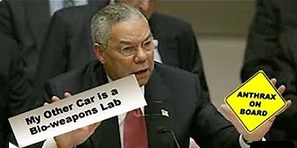
From Anthrax to Iraq
or go to
Aletho News Archives – Video-Images
Book Review
New paperback: Butchered by “Healthcare”
Lies are Unbekoming | October 20, 2026
 Butchered by “Healthcare” is Robert Yoho’s plain-spoken account of how American medicine stopped being a profession and became an industry. 341 pages. Over a thousand references. Thirty-eight chapters.
“Screening Tests Are Useless”, on tests that find diseases that would never have hurt you. “The FDA Protects the Big Drug Companies”, on an agency funded by the companies it regulates. “The Journals’ Sins Are the Editors’ Sins”, on ghostwritten studies and captured peer review. “Opioids and ‘Pain Management’”, on how a generation was prescribed its way into addiction. “Prozac and Relatives” and “Antipsychotics Are Disastrous”, on what psychiatry does to adults and children. “Surgery: Money Before Patients”. “Failed Cancer Treatments”. “Futile CPR and Overprescribing”. “Billing Scams & Specialty Warfare”. “Hospitals Are Sharks”. Each with a Patient Tips section at the end on how to survive it.
If you have ever walked out of a doctor’s office with a prescription you didn’t ask for, or watched a parent put through a treatment that made them worse, this is the book you want on your shelf before the next appointment. … Full review
Butchered by “Healthcare” is available on Lulu now.
Blog Roll
 Aletho News
- Iran: US political targets legitimate if assassinations return
- Iraq shuts key border crossing with Iran under US pressure: Report
- Undersea Internet cables could be targeted in retaliation for attacks on Iran: IRGC deputy chief
- EU sending ‘biased’ observers to interfere in Serbian election – president
- White House envoy declares kinetic action against Yemen ‘fruitless’
- Ukraine deployed thousands of microdrones in Iraqi Kurdistan: Tasnim
- Iran calls for emergency UNSC meeting over Trump’s ‘brazen’ bomb talk, Israeli threats
- Iranian sources reveal details of Russia-China Hormuz proposal
- Plan for more US-Israel integration puts our military tech at risk
- Another Round Against Iran Will Break What Is Left of the Gulf
- If Americans Knew
- Americans at National Conservatism Conference held in Israel this year criticize Israel
- Christiane Amanpour exits CNN with a legacy shaped by the debate over Israel
- Israel’s war on Iran is the final move in a decades-old strategy
- Israel Denies Entry to French Journalist, U.S. Researcher Amid Rise in Entry Denials
- Gaza’s hospitals are running out of life-saving fuel – Daily Update
- Mysterious bot accounts reportedly spread fake ‘man on the street’ videos for Michigan Senate candidate
- Israeli Defense Minister Katz Says Over 60 Lebanon Villages Have Been Destroyed
- Why Is Israel Running TV Ads in Iowa Ahead of the Midterms?
- Hind Rajab’s Alleged Killer Is in the United States. HRF Demands His Arrest.
- US Officials Face Fresh Pressure After Another American ‘Brutalized’ by Israeli Settlers in West Bank
- No Tricks Zone
- E-Cars Reduce CO2 Emissions By Only 41% Compared To Internal Combustion Engine Vehicles
- Predictions Made By Renowned Climate Professor Over Past Decades Have Been Proven To Be Poor
- New Study Suggests Large Regions Of The Pacific Ocean Have Been Cooling For The Last 80 Years
- Germany’s Green Energy Debacle: High Energy Costs Force Kahla Porzellan to Close After 182 Years!
- New Study: 50 Years Of The Most Aggressive ‘Net Zero’ Policies Can Only Affect The Global Climate By 0.03°C
- US September “Heat” Was No Record…Many Records Set Decades Ago
- Latest European Green Energy Debacle; Portugal’s Largest Flagship Solar Park Insolvent!
- Green Energy Debacle: German Expert Professor Fritz Vahrenholt Warns Of Severe Economic And Social Consequences
- Two More Paleo Reconstructions Affirm Meters-Higher Sea Levels Across Ireland, Brazil 7000-6000 Years Ago
- New Study: Earth And Venus Surface Warmth Largely Explained By Convection And Lapse Rate, Not CO2 Or Radiation

